

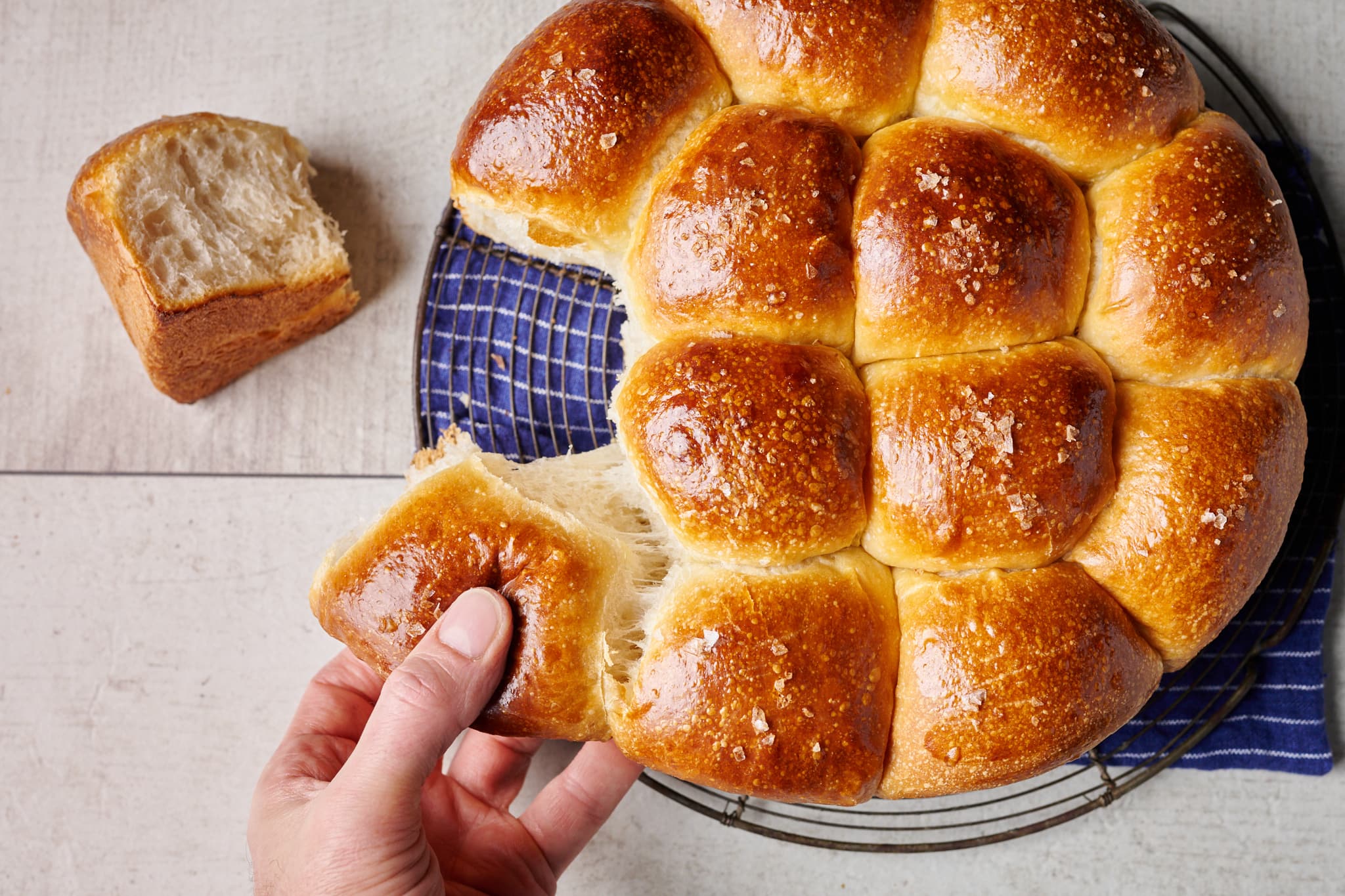
The holidays are the best excuse for binge baking. The end of the year is marked by that unique time when being chained to your oven is considered normal—nay, it’s even encouraged! As you might imagine, it’s my favorite time of the year. As Thanksgiving and Christmas approach, I can’t seem to help myself as all kinds of bread-baking ideas swirl in my imagination, taking me in this direction and that, and lengthening my “Things to Bake” list to unhealthy measures.
For the great meals of the holiday season, I always have a favorite loaf of bread or two earmarked for the dinner table, but often I also include a (sourdough) pie, sometimes a sweet bread, and always an experimental loaf. Last year, I served a variation of this roll recipe, and while they were great, they’ve come a long way through subsequent tests and trials. They’ve matured into these soft sourdough rolls, firmly on the menu for this year’s holiday meals (especially Thanksgiving).
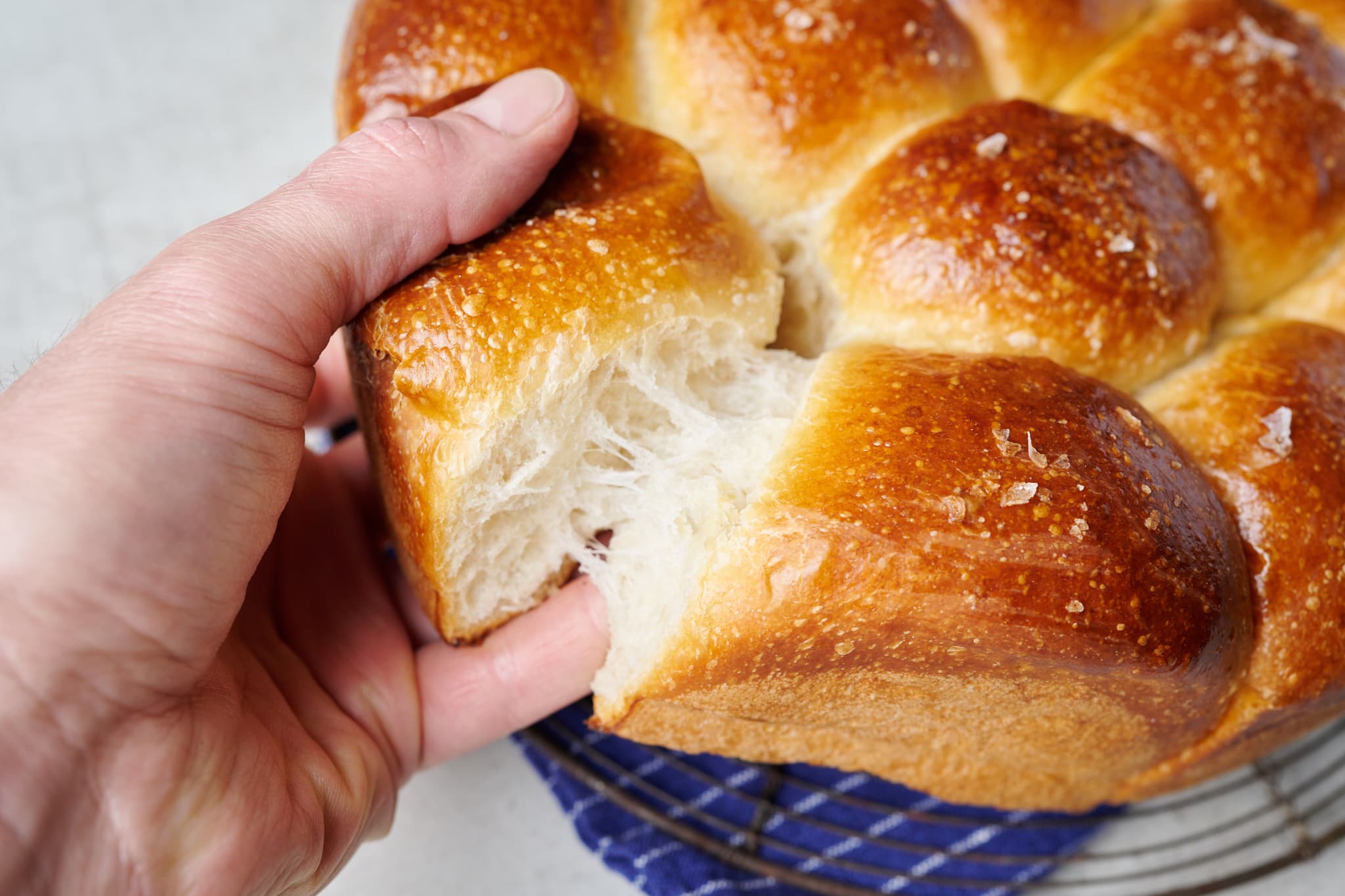
These soft sourdough dinner rolls (which are also in my cookbook!) are incredibly light and, for lack of a better adjective, squishy. Let me take you on a quick trip.
Remember your last visit to the state fair, where you ordered that massive cone of cotton candy—for me, this was many years ago, yet the memory is still quite vivid. Now pull off a large tatter of that soft, cloud-like sugar puff and watch it come apart into thick sheets, floating in front of your face. This image is similar to the delicate, yielding texture of buttery dinner rolls.
Video: Watch Me Make These Sourdough Rolls
Here’s my video of me making these rolls from start to finish!
Flavorwise, these rolls are what you want and expect from a dinner roll: slightly buttery, a smidgen sweet, and with only the slightest touch of sourness (if any). The flaky salt on top is like a lightning bolt to the taste buds, waking them up and sharpening the bread’s flavor. And let’s not forget a very important purpose of rolls at any meal: to soak up all sauces (gravy! salad dressing! au jus!) on the dinner plate. And yet, they also shine when you keep it simple and plain, enjoying them as-is or simply with a pat of warm butter.
Let’s look at which flour I used for this recipe and how tangzhong helps us achieve that cotton-candy-like tenderness.
Flour selection and tangzhong
This recipe calls for standard all-purpose flour and higher protein bread flour (King Arthur brand will work well for both). The bread flour brings extra protein and strength to the mix that helps these rolls rise a little higher and have more structure. But also, using only white flour helps keep the sourness to a minimum. In testing, the rolls were even softer and more tender without the bread flour, but I found that the added high-protein flour helps keep them sturdy when used for dipping.
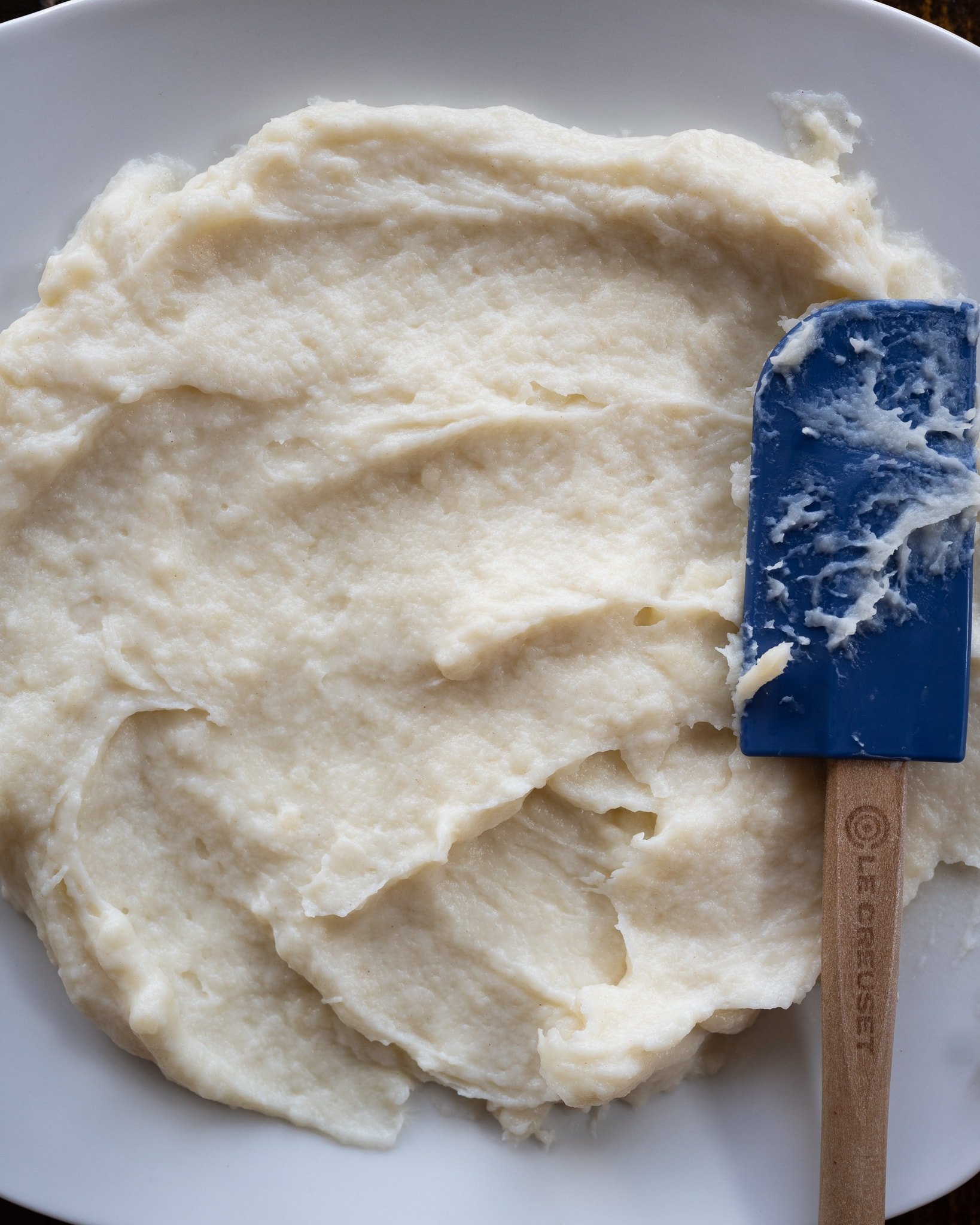
This sourdough dinner roll recipe uses a pre-cooked flour mix-in, also called tangzhong, to add extra tenderness. I use this same technique in my Hot Cross Buns and Sourdough Shokupan. The tangzhong technique is straightforward and takes only a few minutes in the first steps of the breadmaking process: you warm the flour and milk in a saucepan over medium heat until the mixture thickens, then let it cool. Then add this cooled gel paste (similar to a milk roux) to your mix as you would any other ingredient.
See my guide to the Tangzhong technique for a more in-depth discussion →
Baking Schedule

These super-soft sourdough rolls can be made in a single day (skipping the overnight levain) or they can be retarded (refrigerated) in proof to bake the next day, right before dinner. This recipe is extremely flexible, and you can adjust the timeline to fit the rolls into your cooking schedule.
For example, if you’re making these for Thanksgiving, you can make the rolls the day before and proof them in the fridge. Then on Thanksgiving day, take them out a few hours before the big meal, finish proofing on the counter if necessary, and bake them so that the rolls are warm for dinner.
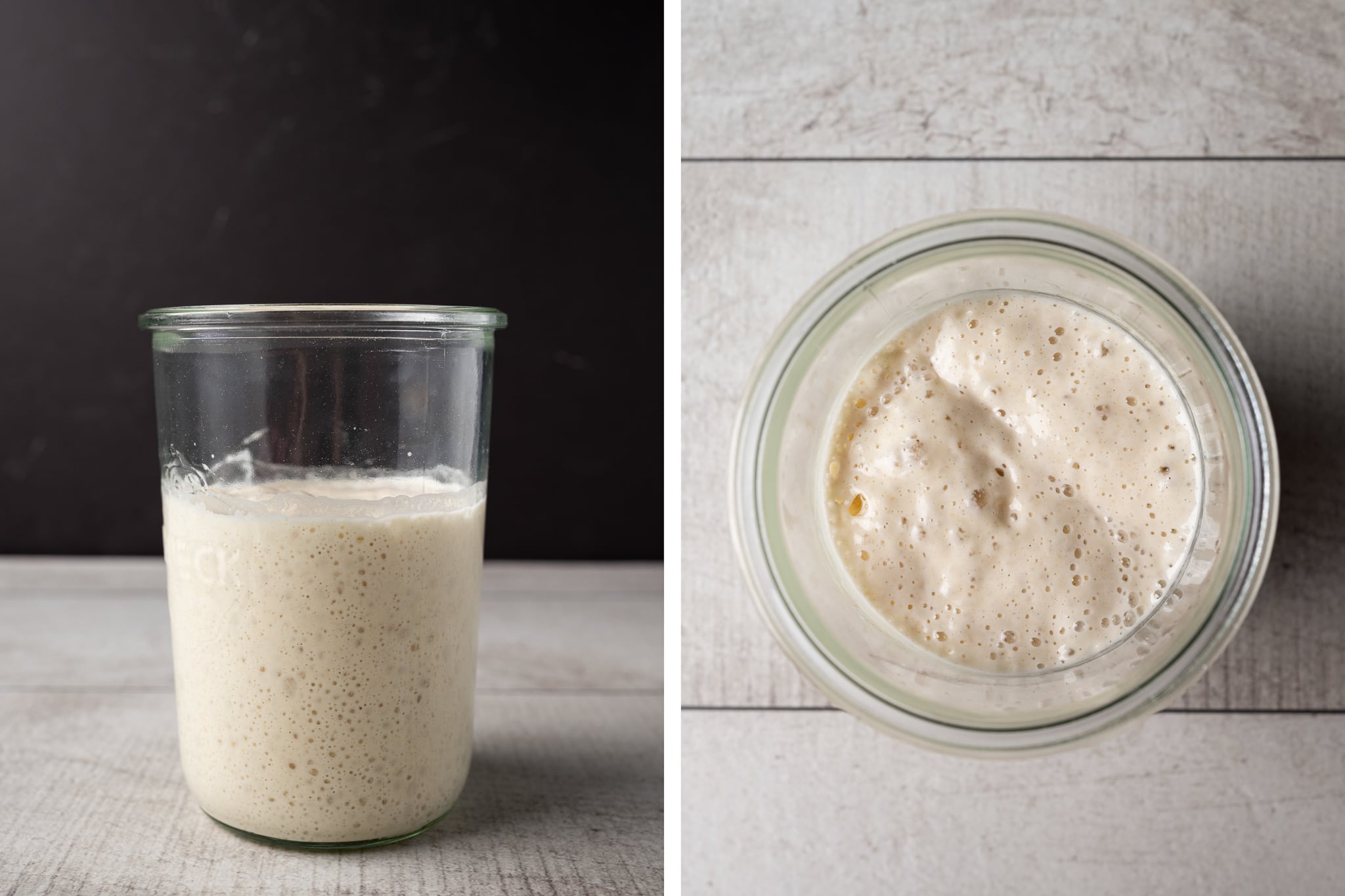
Be sure to use your levain when it’s ripe: it should be extremely bubbly, frothy, and well-risen. As mentioned in my guide to baking dough in the winter, the cold weather may slow the dough’s proofing; give it extra time if necessary.
Baking equipment
I’ve tested these super soft sourdough rolls with several baking pans, and below are my two favorites.
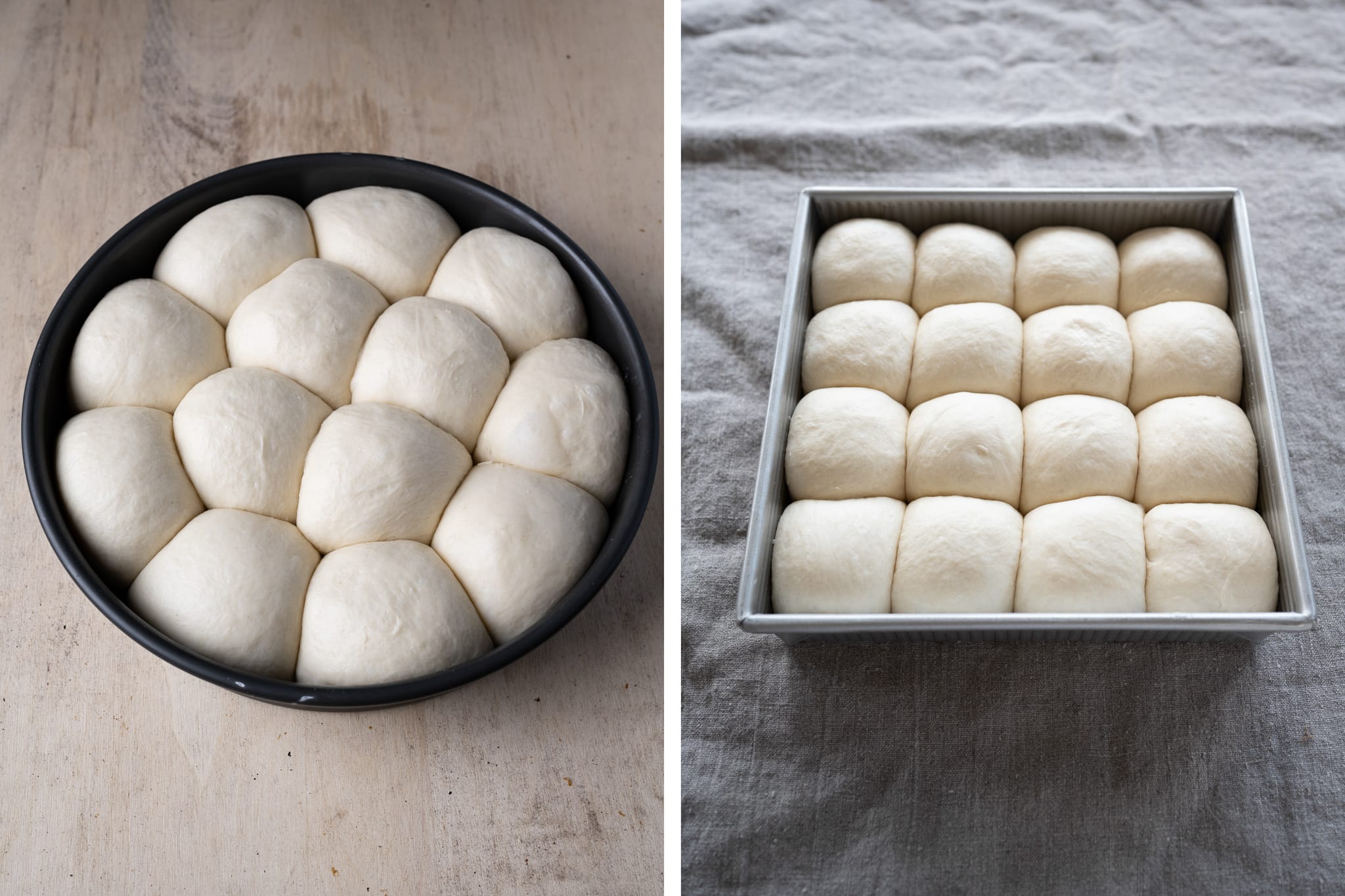
Round pan choice: LloydPans 10×2.25-inch round pan.
I use these round LloydPans for many things in my kitchen: from my sourdough focaccia to sourdough pizza to these dinner rolls. They are nonstick and conduct heat so well that they brown the bottom and sides of whatever is inside just as well as the top. They’re magical, actually.
Square pan choice: USA Pan 9-inch square pan.
I love this square pan because it has a nonstick liner and is extremely versatile. I use it for sweet cardamom rolls, cinnamon rolls, and even cakes or brownies. It bakes rolls that are evenly browned, and cleanup is a breeze.
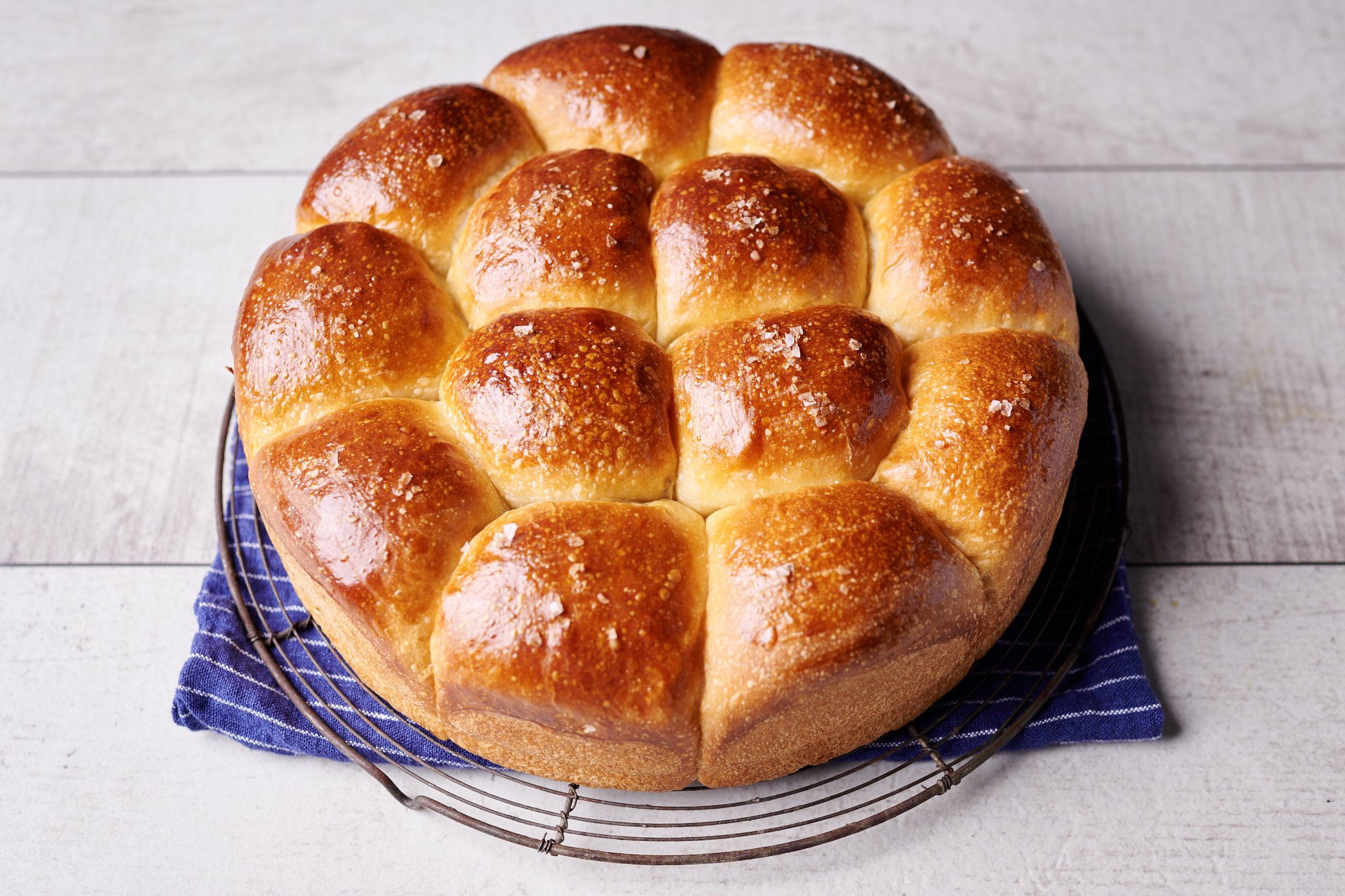
Super soft sourdough rolls formula
For tips on how to calculate baker’s percentages or how to modify this formula, see my post on baker’s percentages (baker’s math).
| Total Dough Weight | 1200 grams |
| Pre-fermented Flour | 12.5% |
| Levain in final dough | 37.1% |
| Hydration | 43.0% |
| Yield | 16 x 70g sourdough dinner rolls |
Total formula
Desired dough temperature: 78°F (26°C). See my post on the importance of dough temperature for more information.
Milk & butter alternative (vegan): If you want to make these rolls vegan, substitute water, nut milk, or full-fat oat milk for the dairy milk in the roux below. For the butter, go with Earth Balance Vegan Butter or a similar product.
| Weight | Ingredient | Baker’s Percentage |
|---|---|---|
| 41g | Tangzhong: Medium-protein bread flour or All-purpose flour (~11% protein, King Arthur Baking All-Purpose) | 7.00% |
| 166g | Tangzhong: Whole milk (see vegan options above) | 28.00% |
| 402g | Medium-protein bread flour or All-purpose flour (~11.7% protein, King Arthur All-Purpose) | 68.00% |
| 148g | High-protein bread flour (~12.7% protein, King Arthur Bread Flour) | 25.00% |
| 95g | Butter, unsalted | 16.00% |
| 53g | Caster sugar | 9.00% |
| 254g | Water | 43.00% |
| 11g | Salt | 1.80% |
| 30g | Ripe sourdough starter, 100% hydration | 5.00% |
Additional ingredients:
Egg wash: 1 large egg and 1 tablespoon whole milk, for brushing
Coarse sea salt, for topping (optional)
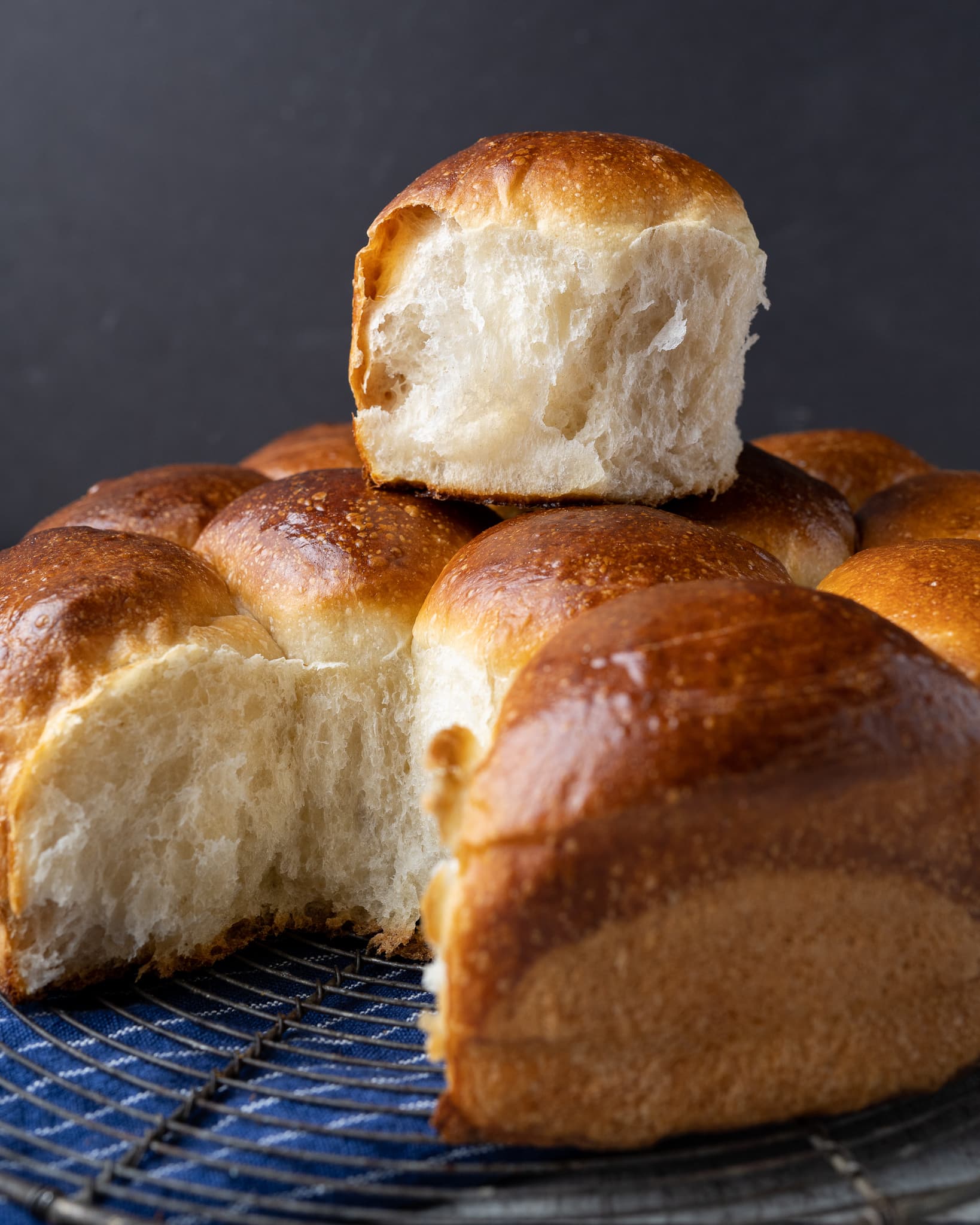
Super soft sourdough rolls method
1. Prepare Levain – 9:00 p.m.
| Weight | Ingredient | Baker’s Percentage |
|---|---|---|
| 74g | Medium-protein bread flour (all-purpose flour) | 100.0% |
| 15g | Caster sugar | 20.0% |
| 74g | Water | 100.0% |
| 30g | Ripe sourdough starter, 100% hydration | 40.0% |
Mix the ingredients in the chart above in a container and leave covered to ripen at about 76°F (24°C) for 12 hours overnight.
Like my pumpkin cinnamon sourdough bread, this recipe utilizes a sweet levain, or sweet starter, which calls for a little sugar added to the levain to promote yeast activity and help reduce sourness in the final dinner rolls. See my post on the differences between a starter and levain if the two terms are new to you.
2. Make the tangzhong – 8:00 a.m.
In a medium saucepan set over medium-low heat, add the 41g tangzhong flour and 166g tangzhong milk. Cook, whisking continuously, until the mixture thickens into a paste, 5 to 8 minutes. In the beginning, whisk vigorously to break up any flour clumps, and continue whisking to avoid burning. The mixture won’t seem to do anything for a while, but it will thicken.
Remove the pan from the heat and spread the tangzhong on a small plate to expedite cooling. Set aside.
3. Mix – 9:00 a.m.
| Weight | Ingredient |
|---|---|
| All | Tangzhong (from Step 2) |
| 328g | Medium-protein bread flour (all-purpose flour) |
| 148g | High-protein flour |
| 95g | Butter, unsalted |
| 39g | Caster sugar |
| 181g | Water |
| 11g | Salt |
| 192g | Levain |
I used my KitchenAid stand mixer to mix this dough, but it could also be mixed by hand using the slap and fold technique or a series of folds in the mixing bowl.
First, cut the butter into 1/2″ pats. Set them on a plate to warm to room temperature.
To the bowl of a stand mixer fitted with the dough hook attachment, add the water, flour, ripe levain, sugar, tangzhong, and salt. Mix on low speed (STIR on a KitchenAid) for 1 to 2 minutes until the ingredients come together and no dry bits remain. Increase the mixer speed to medium (2 on a KitchenAid) and mix for 4 to 5 minutes until the dough starts to strengthen and clump around the dough hook. It won’t completely remove from the bottom of the bowl, and it will still be shaggy.
Let the dough rest in the bowl for 10 minutes.
Turn the mixer to low speed and add the room-temperature butter, one pat at a time, waiting until each pat is fully absorbed before adding the next. Adding all the butter will take 5 to 8 minutes. After this, mix on medium speed for 1 to 2 minutes, until the dough is smooth and clings to the dough hook.
In the end, the dough will still be very soft, and it will not completely remove from the sides of the bowl. Transfer the dough to a bulk fermentation container and cover.
4. Bulk Fermentation – 9:30 a.m. to 1:00 p.m.
At a warm room temperature, 74-76°F (24°C), bulk fermentation should take about 3 1/2 hours. If your kitchen is cooler, place your bulk container in a small home dough proofer, or extend the bulk fermentation time to give the dough more time to ferment.
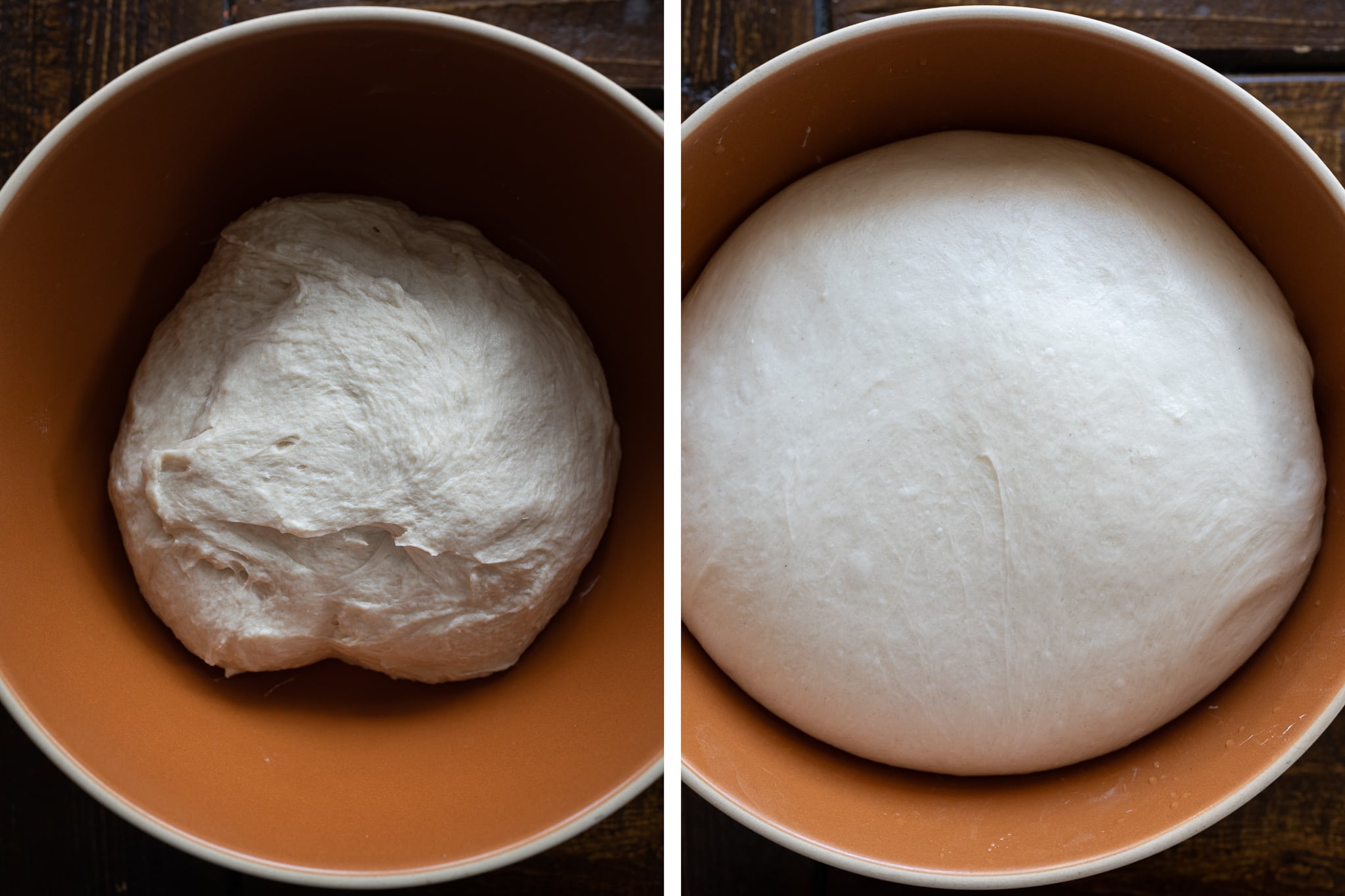
In the image below (tap/click to zoom in), you can see my dough at the start of bulk (left) and after 3 1/2 hours (right). The dough is ready when it has risen in the container, smooths, and is puffy to the touch.
Give this dough three sets of stretches and folds during bulk fermentation at 30-minute intervals. The first set begins 30 minutes after bulk fermentation starts. For each set, wet your hands, grab one side, and stretch it up and over the dough to the other side. Rotate the bowl 180°, then perform another stretch-and-fold (this forms a long rectangle in the bowl). Then rotate the bowl 90° and repeat the stretch and fold. Finally, turn the bowl 180° and do one last stretch and fold. The dough should be neatly folded up in the bowl.
After the third set, let the dough rest, covered, for the remainder of bulk fermentation.
5. Chill Dough – 1:00 p.m. to 1:15 p.m.
At this point, your dough should have risen in your bulk container, be puffy to the touch, and have smoothed out. If the dough still feels dense and tight, give it another 15 minutes and check again.
Uncover your bulk container and place it in the refrigerator for 15 to 25 minutes. Chilling the dough will help it firm up, making shaping and transferring to the pan much easier. Note that the longer you chill the dough in the fridge, the longer it will take to proof (because it will have to warm up that much more).
If your dough is extremely soft, keep the bulk container covered and chill the dough for up to 1 hour.
Overnight fermentation option: At this point, you can choose to place the covered bulk fermentation container into the fridge to retard the dough overnight and bake the next day. The next day, take the dough out of the fridge, let it warm up for 30 minutes, and then resume with the Shape step below.
6. Shape – 1:15 p.m.
Butter your baking pan (even if it’s nonstick) to ensure that the rolls come out cleanly after baking.
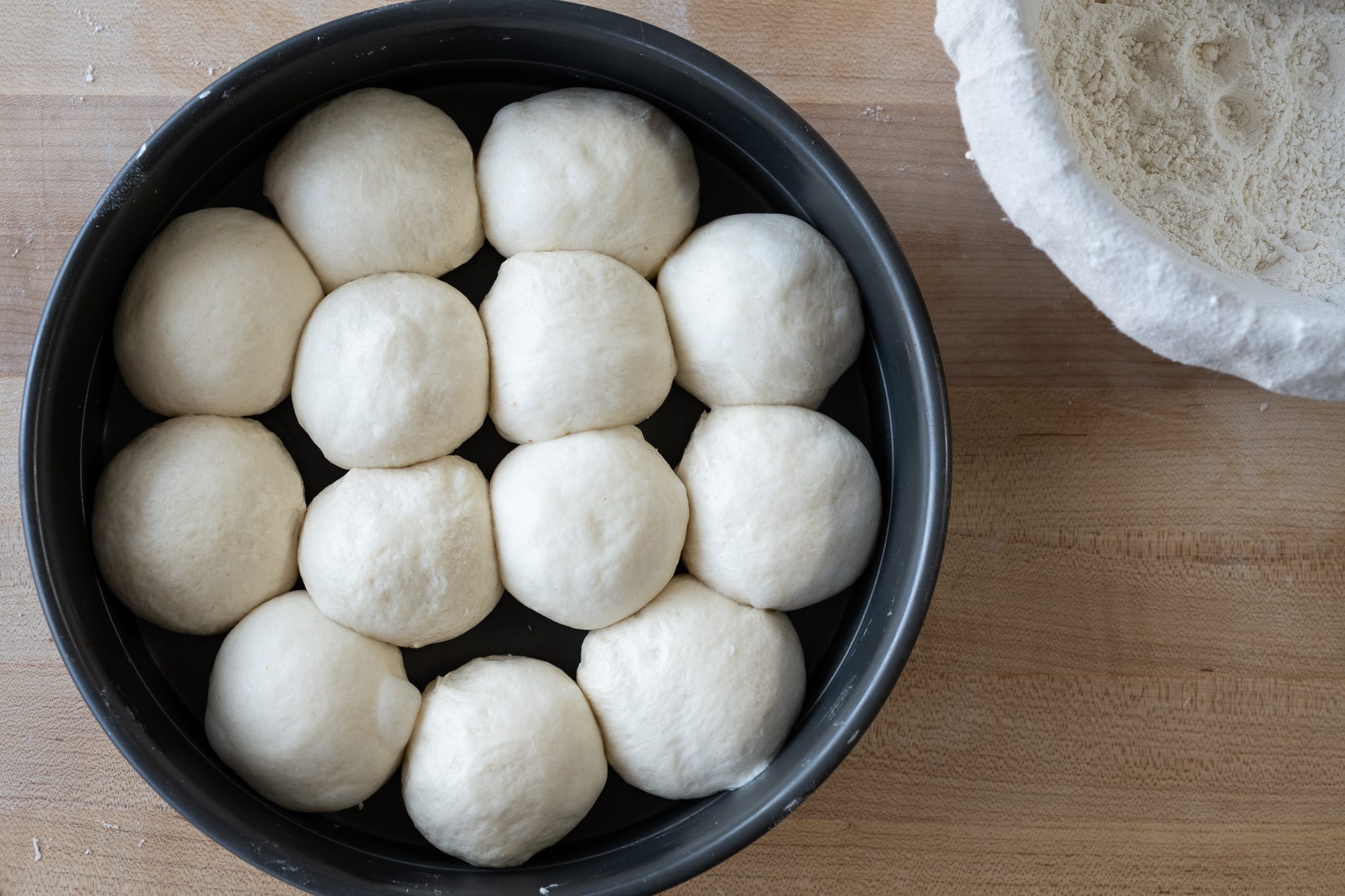
Remove the bulk fermentation container from the fridge, lightly flour the top of the dough in the bowl, and gently scrape the dough out onto a lightly floured work surface. The dough will be cool to the touch but still very soft. Lightly dust the top of the dough and divide it into sixteen 70g pieces (or fourteen 85g pieces for larger rolls).
Because the dough is so soft, I prefer to use my bench knife to shape each roll. Use the knife to drag the dough toward your body as your other hand rounds the dough, tucking the edge down under the ball. Repeat this dragging-and-tucking motion with the knife and your other hand until you have a uniformly round ball. Place the ball in the prepared baking pan. When using a round pan, I prefer to start by placing the rolls along the outside in a ring, then work inward as each ring fills.
For more shaping instruction, see my guide page to shaping buns and rolls.
Cover the pan with a large, reusable plastic bag and seal it shut.
7. Proof – 1:45 p.m. 4:15 p.m. (2 to 3 hours)
At a warm room temperature of 74-76F (23-24 °C), this dough should take 2 to 3 hours to fully proof. If your kitchen is cooler, expect it to take longer.
When fully proofed, the dough should be well-risen in the pan and very soft to the touch. Uncover your dough and gently press the tops of a few rolls. You shouldn’t feel any dense spots or tight areas—the dough should be very light and airy. If you do, cover the bowl and let your dough proof for another 15 to 30 minutes, then check again.
8. Bake – 4:15 p.m. (pre-heat oven around 3:45 p.m.)
Place an oven rack in the middle of the oven, and preheat the oven to 400°F (200°C).
Make an egg wash: In a small bowl, whisk together 1 egg and 1 tablespoon whole milk.
Remove the pan from the bag, evenly brush the egg wash over the tops of the rolls, sprinkle with coarse sea salt (optional), and slide the pan into the oven.
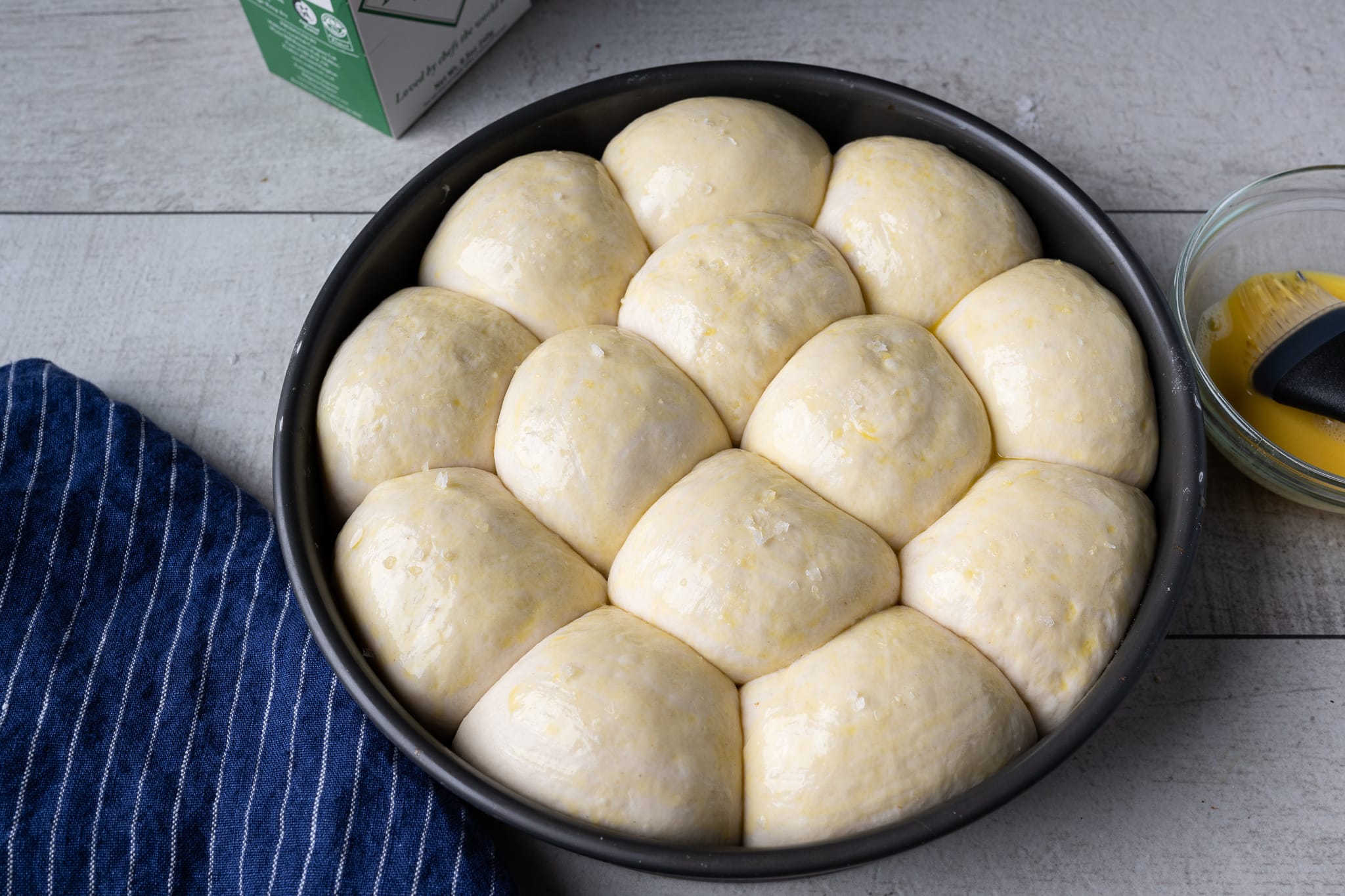
Bake for 20 minutes. Rotate the pan 180° in the oven and reduce the temperature to 350°F (175°C). Bake for an additional 20 minutes until the tops of the rolls are golden and the internal temperature is around 204°F (95°C).
Remove the pan from the oven and let it cool for 30 minutes before eating.
These are wonderful warm from the oven, but I like to let them cool for at least 30 minutes before eating. These rolls are best the day they’re made, but are still great the day after (if stored according to my post on storing bread).
Print
Super Soft Sourdough Rolls (with Tangzhong) Recipe
- Prep Time: 24 hours
- Cook Time: 40 minutes
- Total Time: 24 hours 40 minutes
- Yield: 16 rolls
- Category: Buns, Rolls
- Cuisine: American
Description
These super soft sourdough rolls are the perfect accompaniment to any dinner table (especially Thanksgiving!). They’re slightly buttery, a little sweet, ultra-tender, and the perfect counterpart for soups, stews, and any holiday meal.
Ingredients
Levain
- 74g medium-protein bread flour (all-purpose flour)
- 15g caster sugar
- 74g water
- 30g ripe sourdough starter, 100% hydration
Tangzhong
- 41 grams medium-protein bread flour (all-purpose flour)
- 166 grams whole milk
Main Dough
- All the tangzhong
- 328g medium-protein bread flour (all-purpose flour)
- 148g high-protein bread flour (bread flour)
- 95g butter, unsalted
- 38g sugar, caster
- 181g water
- 11g salt
- All the levain
Instructions
- Prepare levain (Day One, 9:00 p.m.)
Mix the following ingredients in a container and leave covered to ripen at about 77°F (25°C) for 12 hours overnight. - Pre-cook flour (Day Two, 8:00 a.m.)
To a medium saucepan, add the tangzhong flour and milk. Turn the heat to medium-low and cook, whisking continuously, until the mixture thickens and becomes like a paste, about 5-8 minutes. Set aside. - Mix (9:00 a.m.)
Cut the butter into 1/2″ pats. Set them on a plate to warm to room temperature. To the bowl of a stand mixer fitted with the dough hook attachment, add the water, flour, ripe levain, sugar, tangzhong, and salt. Mix on low speed (STIR on a KitchenAid) for 1 to 2 minutes until the ingredients come together and no dry bits remain. Increase the mixer speed to medium (2 on a KitchenAid) and mix for 4 to 5 minutes until the dough starts to strengthen and clump around the dough hook. It won’t completely remove from the bottom of the bowl, and it will still be shaggy. Let the dough rest in the bowl for 10 minutes. Turn the mixer on low speed and add the room temperature butter, one pat at a time, waiting to add each pat until the previous one is fully absorbed. Adding all the butter will take 5 to 8 minutes. After this time, mix on medium speed for 1 to 2 minutes until the dough smooths and clings to the dough hook. In the end, the dough will still be very soft, and it will not completely remove from the sides of the bowl. Transfer the dough to a bulk fermentation container and cover. - Bulk fermentation (9:30 a.m. to 1:00 p.m.)
Give the dough 3 sets of stretch and folds at 30-minute intervals, where the first set starts 30 minutes after the start of bulk fermentation. - Chill dough (1:00 p.m. to 1:15 p.m.)
Place the bulk fermentation container, uncovered, in the refrigerator for 15 minutes to make shaping easier. - Shape (1:15 p.m.)
Butter your pan. Divide the dough into sixteen 70g pieces (or fourteen 85g pieces for larger rolls) and shape each as a very tight ball. Place the balls in the buttered pan to proof. - Proof (1:45 p.m. to 4:15 p.m.)
Cover the pan with dough and let proof for 2 1/2 hours. - Bake (4:15 p.m.)
Preheat your oven to 400°F (220°C). Whisk together one egg and a splash of whole milk for the egg wash. When oven is preheated, brush on the egg wash and bake for 20 minutes. Then, rotate the pan 180° in the oven and reduce the temperature to 350°F (175°C). Bake for an additional 20 minutes until the tops are well-colored and the rolls have reached around 204°F (95°C). Remove from the oven and let cool in the baking pan for 10 minutes. Then knock the rolls out to cool on a wire rack. Let rest for 30 minutes, then enjoy.
Notes
Do ahead: you can prepare the tangzhong the night before. Cook the flour and milk as instructed and let cool to room temperature. Cover the tangzhong and keep in the fridge overnight. The next morning, take it out to let it warm some (to room temperature would be ideal) and proceed to add it during the mix as instructed.
Do ahead: you can prepare the dough and proof them overnight to bake the next day at any time. When chilling the dough, keep the covered bulk fermentation container in the fridge to retard the dough overnight. The next day, take the dough out, let it warm for 30 minutes, then continue with the Shape, Proof, and Bake steps. Alternatively, shape the dough into small balls and place them into the proofing pan. Cover the pan and put it into the fridge overnight. The next day, take them out 3 to 4 hours before you want to bake them and proof them on the counter until puffy and ready to bake.
To make these rolls vegan, substitute the milk for a full-fat nut or oat milk, and instead of an egg, use a flax egg.
What’s Next?
These super soft sourdough dinner rolls are now my go-to for all holiday meals, especially Thanksgiving. They’re just the right mix of buttery, sweet, savory (thanks, salt!), and squish-in-your-hand tender.
If you’d like to explore the ideas in this recipe even further, check out my sourdough shokupan loaf (which also uses tangzhong) or my sourdough pumpkin dinner rolls for a different take on rolls!
And if you are making these during the holidays, check out the Bread Baker’s Gift Guide for gifts for your favorite baker (or yourself!).


659 Comments
I’m doubling this recipe for Easter and wondered what the best strategy would be. I’ve made the single recipe before and it was great, but I’m worried that my regular old kitchenaid stand mixer won’t handle the doubled amount. Should I just do single recipes in separate bulk containers and have the timing of everything staggered? Or should I mix the two once I have the butter added to each? I’m concerned that one batch will be 30 minutes ahead on bulk and it will all just be a bit off. Also, am I ok baking Saturday to reheat on Sunday? I don’t think I’ll have time or oven space on Sunday morning to do a full proof and bake. Thanks as always!!
Should be totally fine to double it all and mix in one go, that's what I would do!
I just made these, and they came out great, but the outside is a little crunchier than I would like. Would reducing the oven temperature earlier help keep them softer on the outside?
Yes, exactly Amanda!
I’ll be making these for dinner this week and I just realized I only have salted butter on hand. We’re expecting snow and I’d rather not brave the crowds for butter if I don’t have to. Will salted butter be ok? Should I adjust the salt amount in the dough?
You can use that. Usually salted butter doesn't have that much salt, might be okay as is!
Hi Maurizio,
I just wanted to say how much I love your recipes, they’ve been such a joy to follow! I had a question about bulk fermentation. How much should the dough grow during this stage? I tried making some, and by the end, my dough had more than doubled, so I punched it down. After an overnight cold proof, it more than doubled again. The final bread turned out very sour, so I’m guessing it overfermented? It’s summer where I am, so I imagine the warm temperature played a big role too.
Thank you for sharing your knowledge and recipes. I really appreciate it!
Best,
Andrea
The dough shouldn't be doubling during bulk fermentation, Andrea – we typically look for about a 30-50% increase in volume before shaping. The warm summer temperatures definitely sped things up!
That excessive fermentation during bulk, followed by doubling again during the cold proof, explains the very sour flavor you got. Each time the dough over-ferments, more acids build up, leading to that strong sour taste. Additionally, over-fermented dough often loses strength and can result in a denser final loaf.
For your next bake, try shortening your bulk fermentation significantly – in warm weather, it might only take 2-3 hours to reach that 30-50% increase. You can also use cooler water in your mix to help control fermentation speed.
For more details on managing fermentation in warm weather, check out my guide .
Let me know how these adjustments help with your next bake!
Made these today but with some wheat flour. Turned out great but I only baked about 30 minutes total (temp was right).
also, I just hand mixed and did the slap and fold .
Norman, glad to hear the adjustments worked well for you! Those are great modifications – adjusting the bake time based on what you're seeing, and using the slap and fold method for mixing. Nice work!
Just made this today. Dough was so soft. I'm really happy with how this turned out. If anybody else made this and gave it to me, I wouldn't have believed sourdough starter was used. I'm going to make more of this and maybe larger batches.
Fantastic, Daniel!!
Made a double batch for the second time. with that much dough, it keeps climbing to the top of the dough hook. Family just devours them so quickly. Think I'll need a bigger mixer for larger batches.
Just wanted to note, at the top with total ingredients you have 402g flour and in the recipe list below you have 328g. I used 328g and came out great.
I’ve made these multiple times. Always amazing! If I wanted to add roasted or fresh garlic, what might you recommend?
I would add those at the end of mixing. Sometimes garlic can interfere with fermentation, so start low and work up.
Thank you for sharing the most amazing sourdough dinner roll recipe! Truly the SOFTEST, TASTIEST, MOST AROMATIC dinner roll probably ever made. No exaggeration, search for the perfect dinner roll ended after making this recipe. Again, thank you!
So happy to hear you like it, Ang!
Maurizio, I was wondering, do you keep a dedicated all/mostly white flour starter? And if so, is that what you use to make the levain for this recipe and/or other all/mostly white flour recipes? I wonder because no matter how strong my starter is (I keep a 1:1 white to whole wheat starter), when I make the levain for this recipe, it never gets to double volume and never looks as active as yours. Even when I increase the temperature a few degrees (up to ~80F) and let it go longer than 12 hours. Would transitioning and offshoot starter gradually to all-white flour over a few days, and making sure that can double and it's strong before making the levain, possibly help with this problem?
My starter is usually 70% white flour and 30% rye, but sometimes I do run out of rye and go 100% all white until I get more.
I talk about how I feed my starter here !
After following a starter strengthening regimen. I decided to give your chocolate knots recipe a try to test my newly strengthened starter. It was doubling at a 1:1:1 ratio at about 76°f in about 5 hours. Despite this, it still took the levain for the chocolate knots recipe close to 6 hours, to double and dome. When you say that the levain should have been ready in about 3 hours, I'm not sure what kind of volume increase you're seeing in those 3 hours, but I'm sure as heck afraid to use a starter that hasn't at least come close to doubling. I'm beginning to think your use of rye in your starter is the difference that I am missing and maybe other people too who seem to have similar problems. I'm going to add some rye to my starter food, making it 50% white 30% whole wheat and 20% rye and see if that makes some kind of a difference in the activity.
I'm wondering if I could add an egg and how much water that would replace in the recipe?
I'd say around 60g water (just a guess). A large egg is usually around 100g or so, but it's not 100% water.
My family LOVES these dinner rolls!!! I know you have a cinnamon roll recipe but I was wondering if I could use this dough for cinnamon rolls, also? Wonderful job!!!
That's a really interesting idea. I thnk it would work! Or you could use my cardamom roll dough , which is somewhat similar.
Hello Maurizio –
I have a question regarding dough additives to this recipe (which I have a lot of experience with…this has become my go-to recipe for celebratory holiday meals).
As per tradition, I will be making these (absolutely perfect) dinner rolls for Christmas dinner next week. We will be having this with a glazed ham, and I was thinking that converting these to an onion dinner roll would be a nice complement to the sweet ham. Whatever I end up doing, my plan is to incorporate the onions into the dough during the stretch and fold, as I would do with nuts, grains or seeds in a regular loaf (btw, oatmeal loaf in your cookbook is my base recipe for all nutty sandwich loaves now – it is phenomenal bread).
I'm currently debating between:
a) dried minced onion (pre-soaked or dry?), or
b) finely minced freshe scallions, or
c) finely minced fresh chives, or
d) caramelized onions, or
e) some combination of all the above
I have not done any incorporation of fresh vegetables into a dough and am uncertain as to how worried I should be about extra moisture from fresh scallions, or even any acidity implications? Curious if you have any thoughts on what would work best here.
Thanks in advance, if you're able to reply – and I hope you have a joyous and happy holiday season!
Hey Eric! Thanks so much for the kind words and super sorry about the late reply. Did you end up adding the onions?
I would probably go with b) or c) or d).
I hope they turned out great and happy holidays!
I went with diced scallions and topped half with sesame seeds and half with poppy seeds. Delightful!
Do I need to make the levain for the rolls to come out right ?
Yes, I highly recommend it.
Hi Maurizio,
I'm trying this recipe twice in a row, and my dough is never coming out to be dough-like as I see in your photos and video. it's still very sticky, where it's hard for me to even fold. Any suggestions on what I could do next time? I'm still going ahead to bake it, so I'll see how it turns out with current doughs!
Strange! I would say reduce the water in the recipe by 25g and see if this helps!
I love your recipes and your cookbook! Someone else asked if the rolls can be frozen prior to baking and then resume with step #6. I didn't see a reply. Is that possible?
I don't like to freeze sourdough rolls, they just don't get the same spring after thawing. Thanks, so glad you're enjoying the book and site Patricia!
I made these twice recently and both times I ended up with super hard rolls instead of super soft rolls. I also needed to bulk ferment overnight to get some rise in the dough. I was confused about your YouTube video. You call for 166g of milk which is about 3/4 quarter cup but your video looks like you are using 1 and 3/4 cup.
If they bake too long they'll get hard, I would try cutting back the bake time. You want them to still be a little pale at the edges. Check the full ingredient list above!
Is there a max time for cold proof for shaped rolls? I was hoping to bake closer to dinner time rather than in the morning and reheating. Afraid of overproofing.
It always takes me up to twice as long to bulk ferment and proof these as the recipe says. So judging by your bulk ferment time, and adding time (at least an hour?) for the dough to warm up from the fridge, count back how many hours your need to take them out for baking in time for dinner.
I’m going to make these to bring to Thanksgiving tomorrow. Can I par bake these tonight and finish the bake at the feast? If so, any tips on best way to do so? Is it as easy as just doing the first 20 minutes then doing the second on site?
I wouldn't do that, instead maybe just bake and cool just before you travel, or take them ready to bake with you, depending on travel time.
So I've already made a mistake with my dough and while I'm proceedin anyway, I have time to do it all over again at this point. I accidentally added all the butter at once, with the rest of the ingredients. Of course this altered the next few steps and it took longer to come together with no dry bits of flour remaining, I still went ahead and let it rest for 10 minutes, then mixed on medium for 2ish minutes just until it begin to come away from the sides and cling to dough hook. Will this mistake affect the final results greatly or do you think I can just keep trucking on. Big oops moment, lol!
Should be okay in the end, just so long as you mixed it far enough (which it sounds like you did). Adding the butter early would mean a long mix time. Keep with it, I bet you they'll turn out just fine!
I just made these as a trial run before Thanksgiving. Couple questions:
what size Pan is reccomended?
the rolls became golden at 25-30min bake time, do we go off of color vs time?
Definitely go by color, but you can also take the internal temp of the rolls and make sure they match what I say in the recipe. You can make these in any size pan, I often use a 10" circular pan to fit 7-8 rolls. Scroll up to the "Baking Equipment" section in the post, I talk about the exact pans I like to use.
Hi! I was wondering if there is a wheat version for this recipe? I love your book! My husband gifted it to me last Valentine’s Day—since then I’ve gifted it to 3 friends that make sourdough—they all rave about it!!!
Means a lot to hear that, Annette! Thanks so much for getting (and gifting) my book 🙂
What do you mean by a wheat version for this recipe? I only use wheat in this one!
With all the respect I have for your knowledge (I'm a really humble amateur) on the matter of baking bread, I read in King Arthur page that tang zhong is only needed in breads made with commercial yeast but not in sourdough breads. I wonder what are your thoughts on this.
That's interesting, and don't agree with that if that's actually what they said! It works incredibly well in any bread—yeasted or sourdough. I use it all the time.
Here's more info about it and why I like to use it:
https://www.theperfectloaf.com/how-to-make-and-use-tangzhong/
Love this recipe for my family, but my little baby has a cows milk protein allergy so we can’t have any dairy. I usually replace milk with coconut milk, and butter with tallow. Do you think this would work for these rolls? Or would you recommend a different fat? Possibly duck fat?
Yes, you can use any alternative milk here.
Soy milk is the closest to cows milk in terms of nutrients like protein (and my personal favorite milk to use for most anything). Just get unsweetened.
How long can i leave the levain? Is there a limit? And, can this be done with bread flour only?
Usually 12-16 hours is the sweet (hah!) spot for this levain. Yes, can go with only bread flour.
Iv made it all and have an hour left of rising the shaped rolls but I was wondering if I can put them in the fridge for tomorrow and bake them in the morning instead of straight after the final rise is done
Yes, absolutely!
Hi, I’d love to make these rolls tomorrow, but I don’t have time to make the special levain with sugar. I should have ripe starter when I wake up, though. Is there a way to still make these rolls with just the ripe starter, or would that change the character of the recipe too much? Thanks
Hey Emma. It’ll definitely change the recipe. You can still make them, though, but the flavor may be a little more sour than usual (still okay I’d say!).
Just remembered I ought to update you about how the modifications went–it was a big success! I used regular ripe 100% hydration starter instead of the levain, and I also used regular granulated sugar, and the rolls were excellent! Definitely a notable sour flavor, but it was welcome. The texture was soft but also strong–not like the super puffy delicate rolls you buy in a package at the store. Would make again!
Hello,
I have tried to make this a couple of times but all the times the rolls come out too hard. I tried replacing water with milk but that took turned out too hard. Do you think it could be the long duration and high(we) temperatures? Other sourdough recipes suggest baking at 350F for 20-25 mins.
Can you freeze these rolls after the shaping step #6 and then continue with the rest of the steps when you are ready to bake?
These rolls are amazing! I am wanting to use my new flour mill to make a whole wheat version? What measurements would you change to adjust? Increase water?
Hi. I believe there are two typos in this post. The sugar weight for the Main Dough is different in the text (step 3 – 39 g) vs the recipe ingredients list at the bottom (38 g). Also in step 7 the last sentence should read: cover the “pan” not “cover the bowl”. This is my first attempt at making these rolls so I read the recipe very carefully 🙂
Hi! I only have a 9 by 13 rectangular – how many rows would you recommend of 70 gram rolls? Is this recipe easy to double? Thanks!
Can I use half the portion of the sugar mentioned, will it affected the loaf softness hydration
It will, but they’ll still be great.
have you tried replace the tangzhong with yudang. If so, how much should the weight be. Thank you
Yes, same weight for yudane.
Caster sugar? I know this is used in Great Britain. Do you mean plain ole’ granulated sugar?? 🙂
Hah! It’s also called “superfine” sugar here in the USA.
bad typing…back on Dec. 25? Held in the frig for 2 days prior ot backing.