

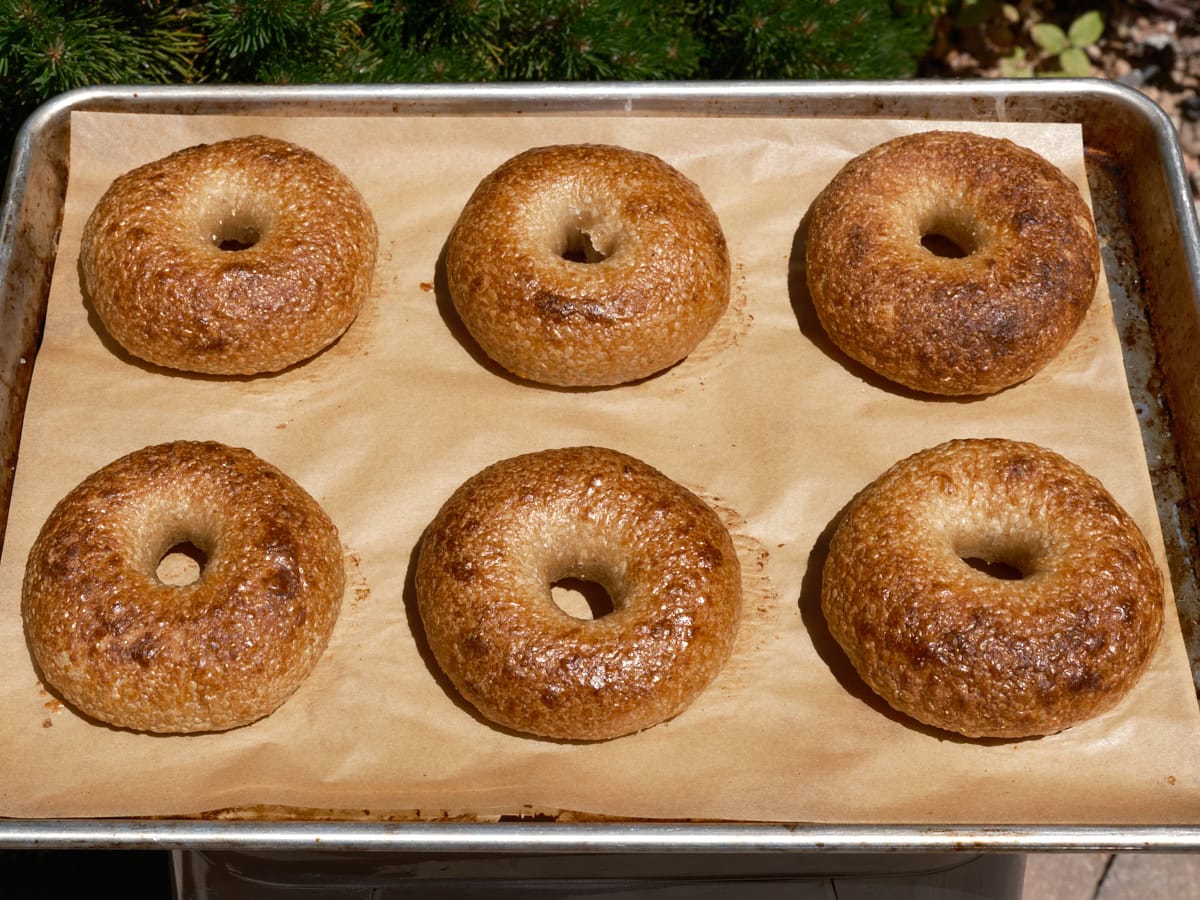
Some recipes refuse to sit still, and bagels kept pulling me back to the bench with questions. What if the levain carried some of the sweetness instead of dumping it all into the final dough? What if I swapped the single flour for a blend with more character—some whole grains, a little lower protein for more tenderness and openness? What if I shaped them differently and gave the dough an overnight rest in the cold, then boiled them with something other than water?
This version answers all of those questions. It’s a recipe, much like My Best Sourdough Bread, where all the little parts of the process, when seen from up close, don’t look like a big deal, but when seen as a whole, certainly add up.
And, I’ve been reworking this formula for a while now, one variable at a time, the way you do when a recipe is close but not quite there. The flour blend was the first thing to change: a mix of high- and medium-protein white flours, some whole wheat, and a little whole rye. Then the levain, which I created with a small amount of sugar to skew the balance toward a yeast-heavy culture for less sourness carrying through to the finished bagel. Then the shaping—I moved to the poke method, which is simpler for a higher-hydration dough. And finally, the overnight retard, which changed the crust and flavor in a way I didn’t fully expect. The crumb opened up slightly, the crust developed more blisters, and the whole thing tasted more complex in the oven, with a delightful crispness and color. More like what I want a bagel to be.
This isn’t a radical departure from the original. It’s the same bread, just sharpened a bit.
Video: Watch Me Make These New Wave Sourdough Bagels
How Are These Bagels Different From Your Cookbook?
The sourdough bagel recipe in my first sourdough cookbook is more of a traditional New York-style bagel: chewy, with a slightly thicker crust and a closed crumb.
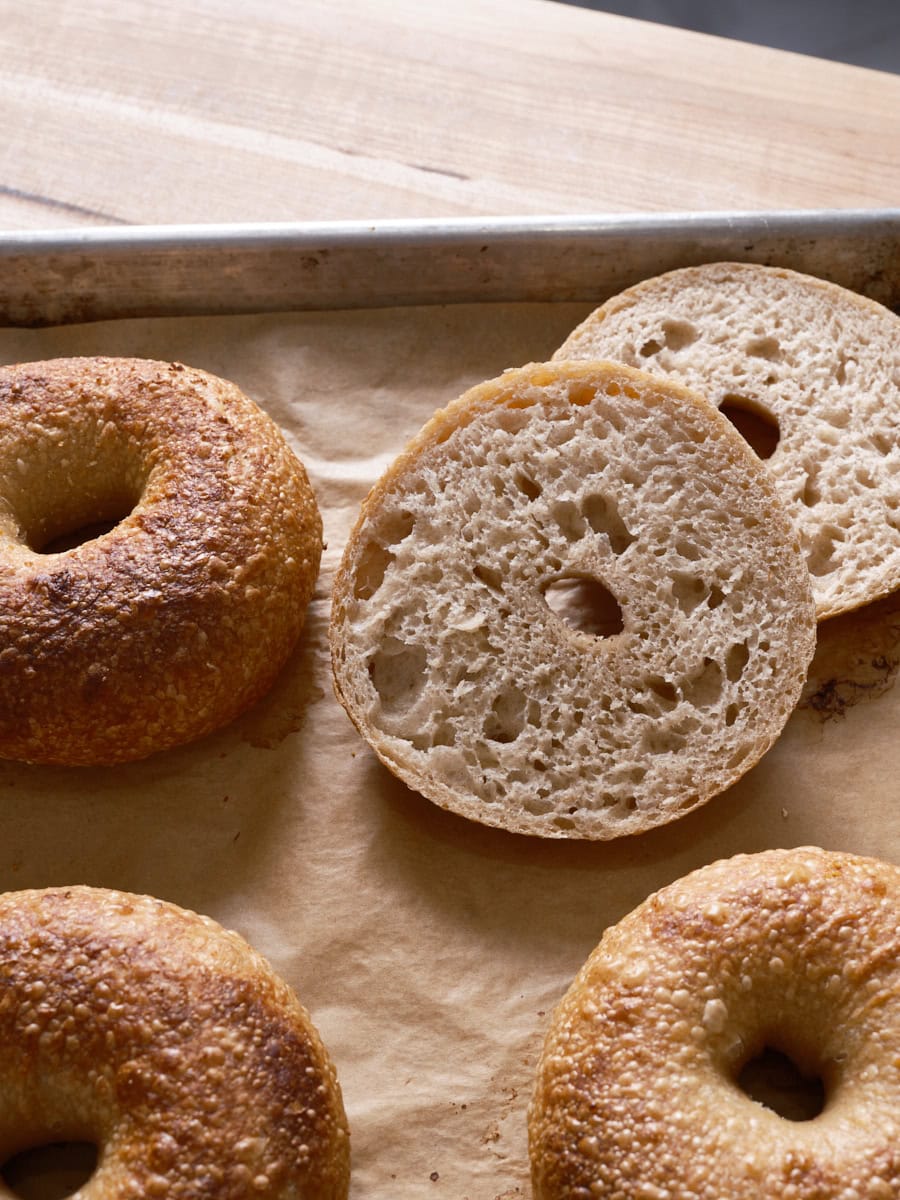
This “new wave” sourdough bagel, as I like to call it, leans more toward what you might find at newer bagel shops (like the uber-popular Courage Bagels in Los Angeles): a lighter bagel with a glossy, blistered crust that’s slightly crispy, a little less uniform in shape and structure, and a more open crumb.
Tips for Shaping, Boiling, and Baking Sourdough Bagels
A few things I’ve learned after making more batches of these than I care to count:
Use the poke method for shaping. Instead of rolling a rope and joining the ends (which can come apart during boiling and is harder to do with higher hydration doughs), I poke a hole through the center of each ball and gently stretch it open. It’s faster, more forgiving, and produces a more even ring. I’ll walk through it in detail in the method below.
Don’t skip the overnight retard. You can bake these same-day if you’re in a rush, but the cold overnight rest does contribute. The flavor deepens, and the scheduling is better: you shape one evening, boil and bake the next morning.
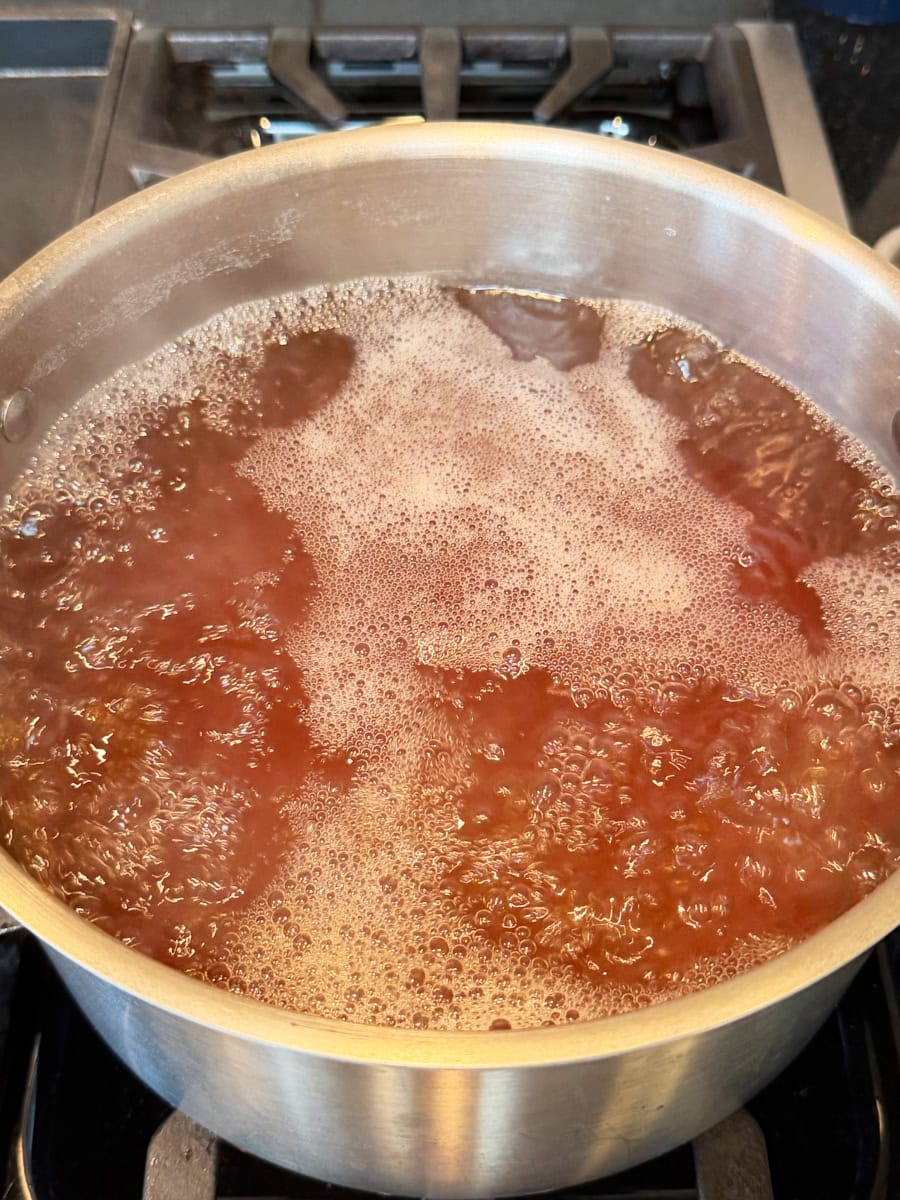
Get the boil water right. Adding lots of barley malt syrup to the water is the classic move, and it makes a real difference. The malt contributes to crust color and adds a layer of flavor you can’t replicate any other way. I also add a teaspoon of baking soda to increase alkalinity and further help with crust coloring. After everything is added, the water should look quite dark.
Boil time and intensity matter. I keep the boil short, for about 20 to 30 seconds per side. A shorter boil gives you a thinner, crispier crust. A longer boil builds more chew and a denser, more traditional skin. I prefer the shorter end for this particular dough—the crust still has plenty of bite without turning leathery. Since the boil is so short, be sure the syrup water is at a vigorous rolling boil, too.
Bake on a preheated stone or steel. Just like with sourdough pizza or hearth bread, intense direct heat from below is what gives bagels their explosive rise and bottom crust. A baking steel is ideal, though a thick stone works well too. Preheat it for at least 1 hour.
Steam the oven. I like adding some steam to the oven (just like I do when steaming bread dough) right after loading the bagels. I find that the steam further encourages microblisters to form on the bagel’s crust.
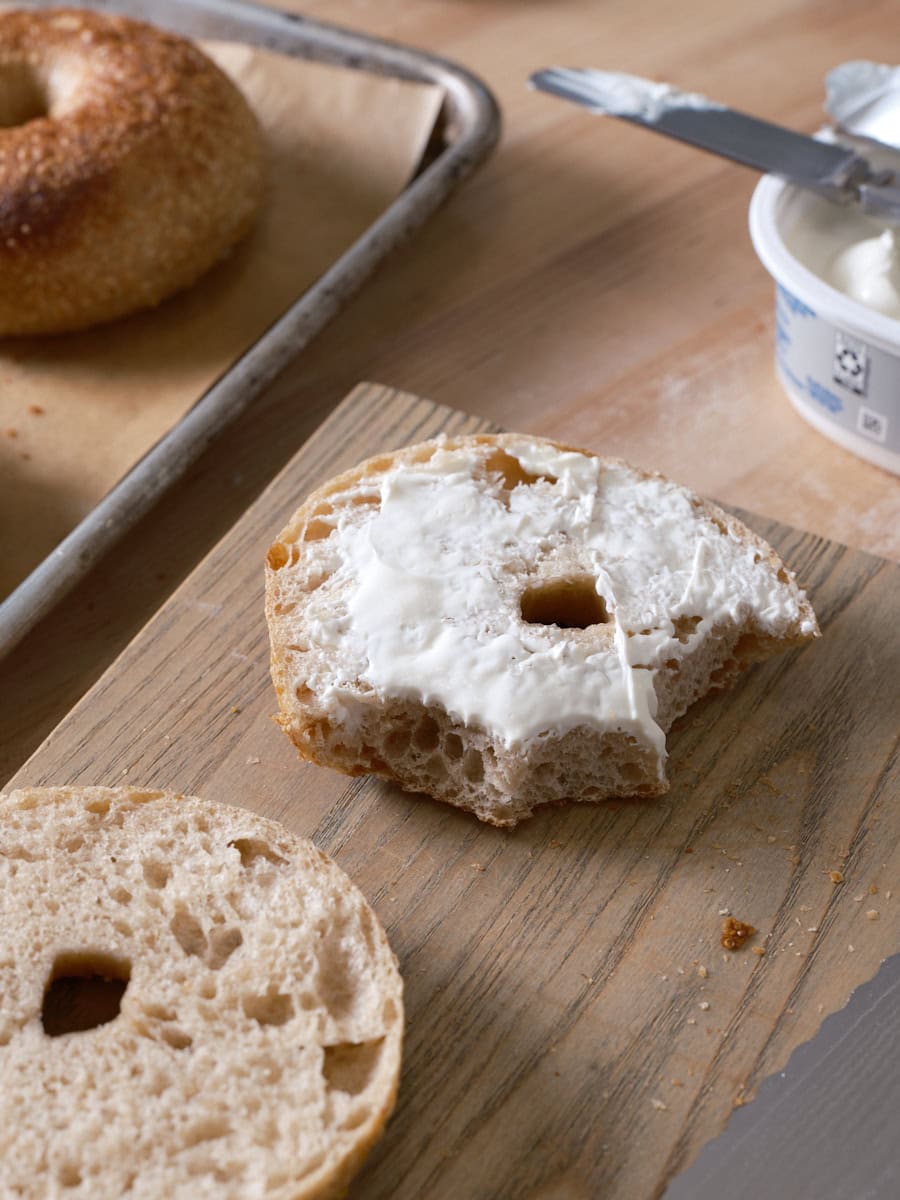
My goal with this version was to create a new wave sourdough bagel that felt deliberate. I wanted them to be light, subtly chewy, a touch crispy on the outside, malty, and with enough whole grain to give them extra personality. Something you’d actually want to eat with just a smear of cream cheese, no distractions.
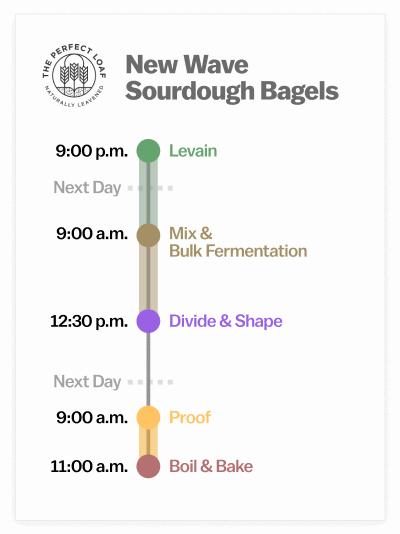
Baking Schedule
These sourdough bagels are made over the course of three days, but the schedule is flexible. The night before you want to mix, make the sweet levain (a preferment with a little sugar added) and let it ferment overnight. The next morning, mix the dough, bulk ferment it, and then cold proof (retard) it in the fridge until the next day. The bagels can be proofed and baked any time the next day, though I typically make them in the morning or early afternoon.
If you’d like, you can skip the overnight cold proof and let the bagel dough proof on the counter after shaping for 2 to 3 hours, until it passes the poke test.
Flour Selection
The flour blend here is doing a lot of the heavy lifting. High-protein white flour (I use one in the 12–14% protein range, like King Arthur Bread Flour or Central Milling Great Northern) makes up just under half the total and gives the bagels their signature chew and structure. Central Milling’s Artisan Bakers Craft—a medium-strong, finely milled bread flour—brings the next 40 percent. If you can’t find it, substitute any quality medium-protein white flour with at least 11% protein.
Whole wheat and whole rye make up the remaining 15 percent. They’re not there for health points. They’re there for flavor. The whole wheat adds a warm, nutty depth, and the rye brings a subtle earthiness and helps with fermentation activity and crust color. Together, they give the bagel a complexity you don’t get from white flour alone, without making the bagel feel heavy.
Bagel Barley Malt Syrup, Diastatic Malt, and Sugar
This formula has three sweeteners, each contributing differently.
Barley malt syrup goes into the final dough as an inclusion (in addition to using it in the boil). It’s the signature bagel flavor: malty, a little sweet, slightly bitter, deeply savory. It also promotes browning in the oven.
Diastatic malt powder is an entirely different tool. Unlike barley malt syrup (which is non-diastatic and adds flavor), diastatic malt powder contains active enzymes that break down starch into sugars during fermentation and baking. This helps with crust color, oven spring, and a slightly more open crumb. A little goes a long way, and compared to other bread doughs, 1% is pretty high. This is my favorite diastatic malt, and I use it in just about all my bakes.
Superfine (caster) sugar goes into the levain, not the final dough. The “sweet levain” or “sweet starter” here helps encourage yeast activity for maximum rise with very little sourness transferring to the final dough.
New Wave Sourdough Bagel Recipe
Vitals
This recipe makes 12 bagels, each weighing 130 grams. The formula is scaled to a total dough weight of 1,620 grams to account for some loss during dough prep. You can halve or double the formula as needed using baker’s percentages.
| Total dough weight | 1,620 grams |
| Prefermented flour | 10.0% |
| Hydration | 68.0% |
| Yield | Twelve 130-gram bagels |
Total Formula
With this dough, I shoot for a final dough temperature of 76–78°F (24–26°C).
| Weight | Ingredient | Baker’s Percentage |
|---|---|---|
| 406g | High-protein white flour (12–14% protein) | 45.0% |
| 361g | Medium-protein white flour (Central Milling Artisan Bakers Craft (or strong bread flour) | 40.0% |
| 90g | Whole wheat flour | 10.0% |
| 45g | Whole rye flour | 5.0% |
| 18g | Fine sea salt | 2.0% |
| 23g | Barley malt syrup (or honey) | 2.5% |
| 18g | Superfine (caster) sugar | 2.0% |
| 9g | Diastatic malt powder | 1.0% |
| 542g | Water 1 (levain and mix) | 60.0% |
| 72g | Water 2 (mix; bassinage) | 8.0% |
| 18g | Fine sea salt | 2.0% |
| 36g | Ripe sourdough starter (100% hydration) | 4.0% |
New Wave Sourdough Bagel Method
1. Prepare the Levain — Day One, 9:00 p.m.
| Weight | Ingredient | Baker’s Percentage |
|---|---|---|
| 90g | Medium-protein white flour | 100.0% |
| 81g | Water | 90.0% |
| 18g | Superfine (caster) sugar | 20.0% |
| 36g | Ripe sourdough starter (100% hydration) | 40.0% |
Mix the levain ingredients in a clean, tall jar (this levain will rise quite high, so use taller jars!). Stir until the sugar is dissolved and the starter is fully incorporated. Cover and leave at room temperature, around 74–76°F (23–24°C), to ripen overnight, about 12 to 14 hours. The levain is ready when it’s risen significantly, super bubbly on top, and smells sweet.
2. Mix — Day Two, 9:00 a.m.
Final Dough Ingredients:
| Weight | Ingredient |
|---|---|
| 406g | High-protein white flour (12–14% protein) |
| 271g | Central Milling Artisan Bakers Craft (or bread flour) |
| 90g | Whole wheat flour |
| 45g | Whole rye flour |
| 23g | Barley malt syrup (or honey) |
| 9g | Diastatic malt powder |
| 460g | Water 1 |
| 72g | Water 2 |
| 18g | Fine sea salt |
| 226g | Ripe levain (from above) |
With a mechanical mixer (like the Ooni Halo Pro): Add the flour, levain, barley malt syrup, diastatic malt powder, salt, and Water 1 to the bowl. Mix at low speed for 1 to 2 minutes until the ingredients come together into a shaggy mass. Increase to medium speed (120 to 130 RPMs) and mix for 5 minutes. The dough will be stiff, drier than most sourdough bread. Rest for 5 minutes. Resume mixing at medium speed, slowly adding Water 2 over 5 minutes. Continue mixing until the dough is smooth, strong, and pulls cleanly from the sides of the bowl. It should feel firm and slightly tacky but not sticky.
By hand: Combine all the dry ingredients and flour in a large bowl. Add the levain, barley malt syrup, diastatic malt powder, and Water 1. Mix thoroughly with wet hands or a dough whisk until no dry flour remains. This dough is stiff, so expect some resistance. Knead using the slap-and-fold technique on your work surface for 5 to 6 minutes. Rest 5 minutes. Add Water 2 gradually and continue kneading for another 4 to 5 minutes until the dough is smooth and cohesive. Toward the end, you may need to knead the dough like you would pasta: press the dough against the work surface to stretch, then fold it over and repeat. Transfer to a bulk fermentation container and cover.
Target a final dough temperature of 76–78°F (24–26°C).
3. Bulk Fermentation — 9:30 a.m. to 12:30 p.m. (3 hours)
At a warm room temperature of 74–76°F (23–24°C), bulk fermentation should take about 3 hours.
Since we mixed this dough quite heavily and it’s rather stiff, it will not need any stretches and folds during bulk fermentation. Let the dough rest for this time.
4. Divide and Shape — 12:30 p.m.
Sprinkle medium cornmeal on two 13 x 18-inch half sheet pans. I like using cornmeal because it doesn’t absorb water from the dough, making it much easier to remove the bagels later. Iff you don’t have any cornmeal, use white flour.
Gently scrape the dough out to your work surface and divide it into twelve 130-gram pieces. (You’ll have a small amount of scrap left over.)
Shaping bagels by poking takes place in two phases:
1) Ball the dough:
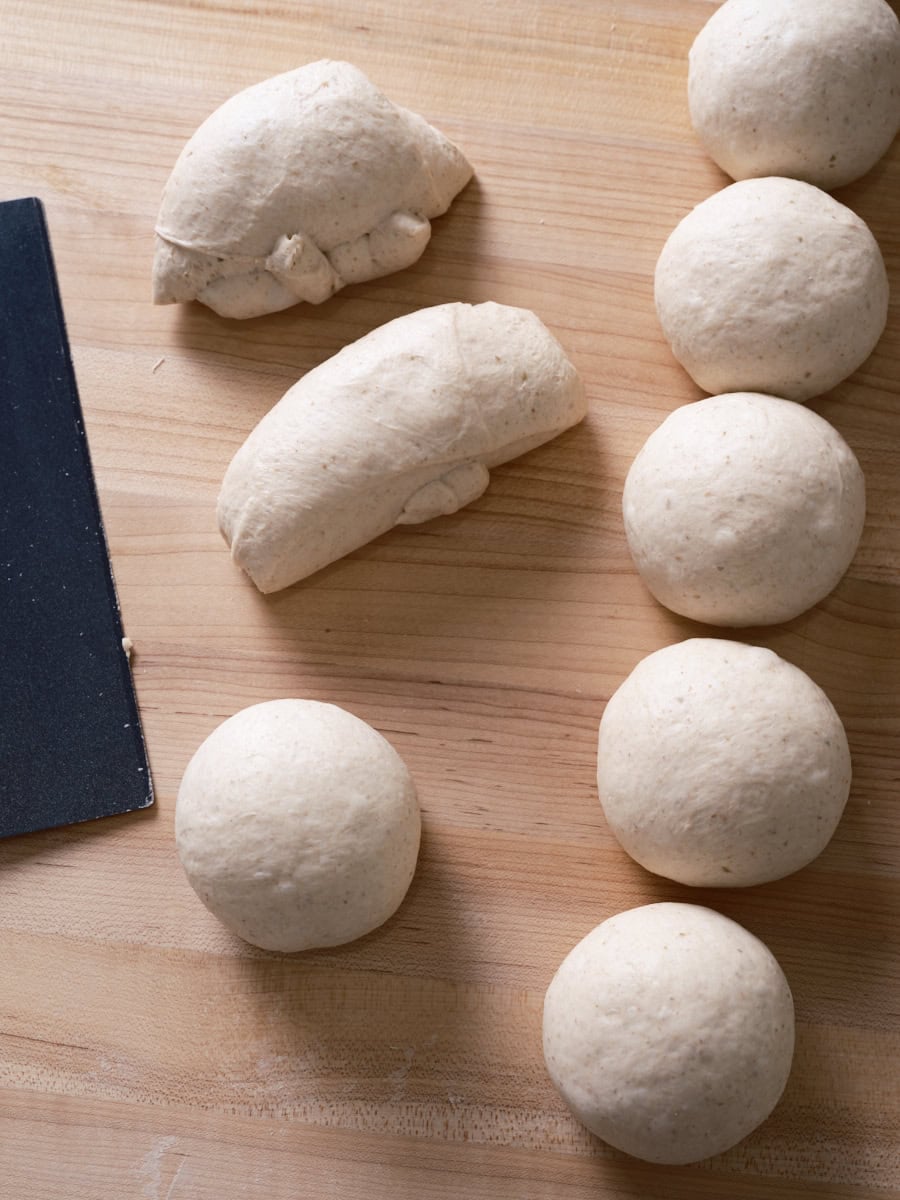
Form each piece of dough into a tight ball by folding the sides into the middle, then rolling it down. Then, push the dough against the work surface with the side of your hand to create a smooth surface on top. Flip the dough over and pinch the seam closed. You want a perfectly round, smooth, and closed-seam ball. Repeat for the remaining pieces.
2) Poke and make the ring:
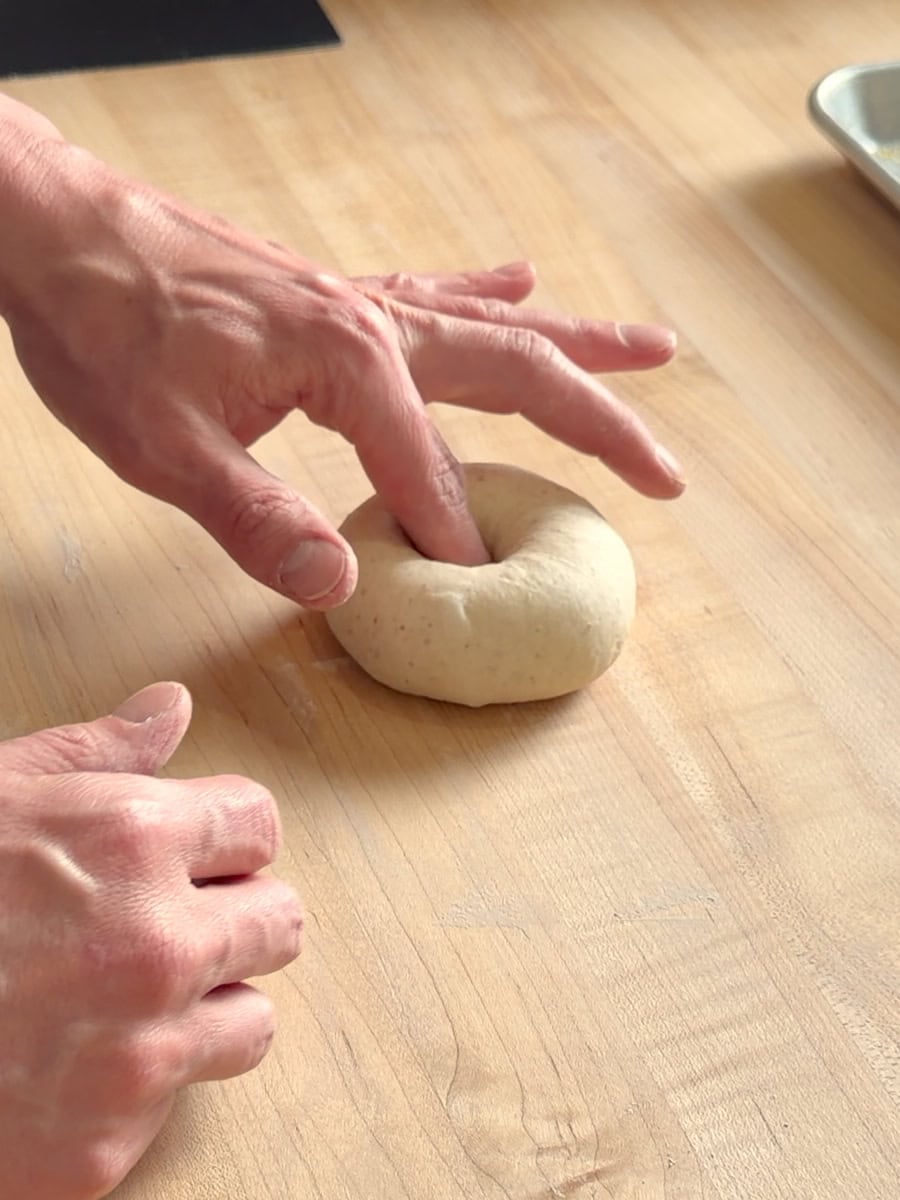
Starting with the first piece you balled, gently pat it to flatten just a bit. Then, use your index finger to press through the center of the ball to create a hole. Pick up the dough and using both hands, gently stretch the dough as you rotate it around to form an enlarged ring with a center hole about 2 to 2.5 inches in diameter. The hole will shrink during proofing and baking, so make it a bit larger than you think you need.
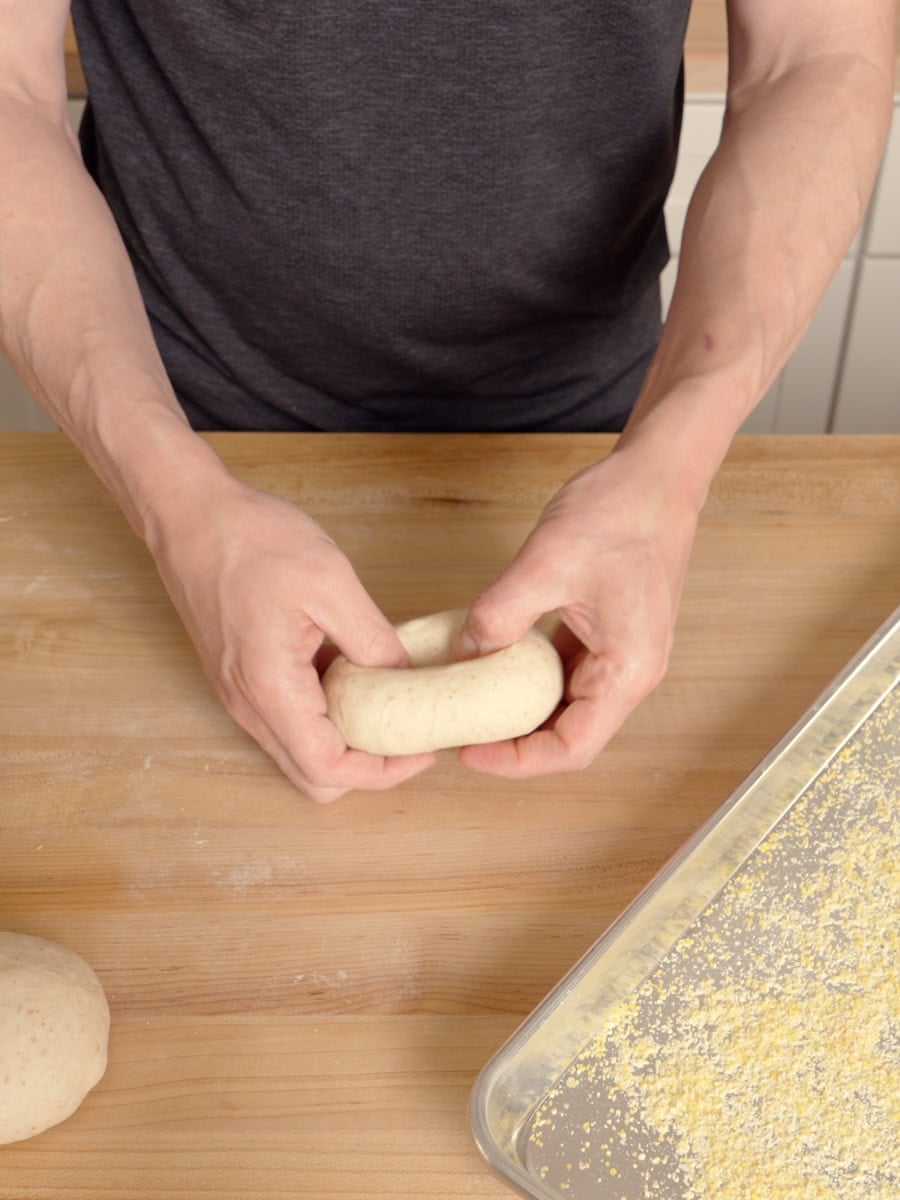
Place each shaped bagel on a sheet pan, leaving an inch or two between them and six to a pan.
Repeat with the remaining pieces.
5. Overnight Retard — 1:00 p.m. to 9:00 a.m (Day Three Morning)
Cover the sheet pans with lids (these pop-on lids are my favorite) and place them into the refrigerator.
This next step is flexible. If you need to bake them a few hours earlier or later the next morning—or even into the afternoon—the dough is forgiving.
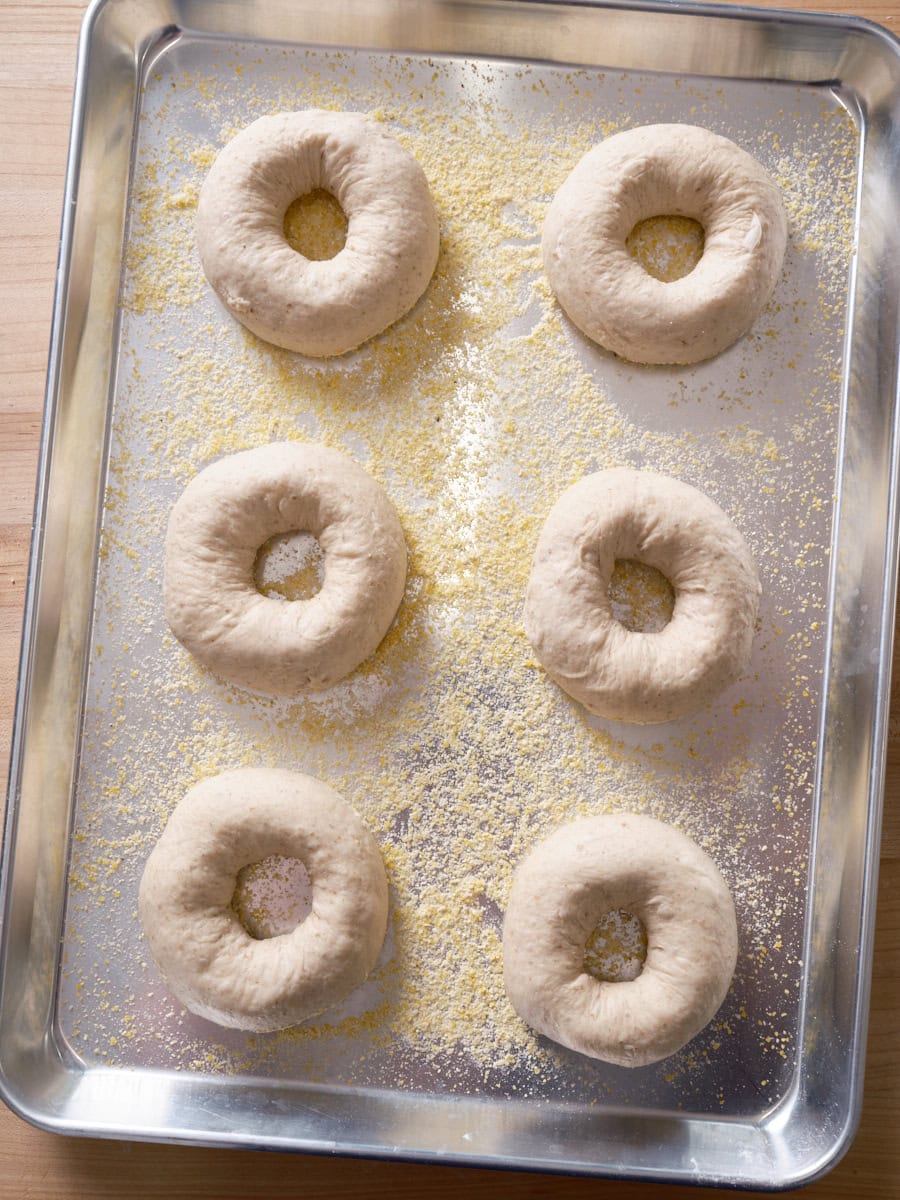
6. Proof — Day Three, 9:00 a.m.
The next day, when you want to make bagels, remove the two dough trays from the refrigerator and let them proof at warm room temperature for two hours.
About halfway through proofing, place a baking steel on the middle oven rack and preheat to 500°F (260°C) in convection (if you don’t have convection, 525°F/270°C). Give the oven at least one hour to preheat.
7. Boil — 11:00 a.m.
Set up your boil station:
To a large, wide pot, add 1 gallon of water and 1 teaspoon of baking soda, and bring to a rolling boil. Then add 5 tablespoons of barley malt syrup to the water and stir until dissolved. The malt water should be at a vigorous boil before you start.
Prepare a wire rack set over a sheet pan (or a clean kitchen towel) for the boiled dough. Have your toppings ready in shallow bowls or plates: sesame seeds, poppy seeds, everything seasoning, flaky salt—whatever you like.
To boil:
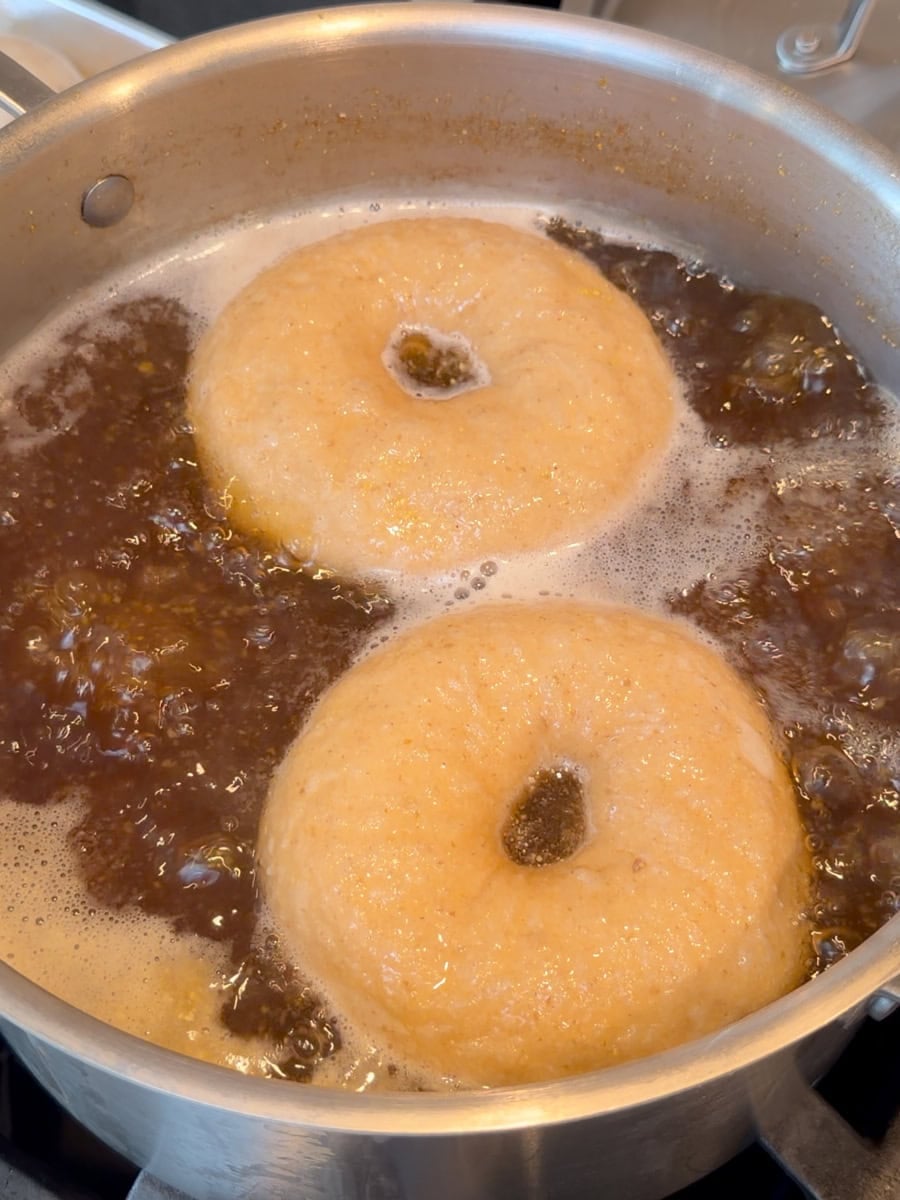
Working in batches of 2 to 3 (don’t crowd the pot; I usually do 2 at a time), gently lower the bagels into the boiling malt water, smooth side down first. They should float—if one sinks and doesn’t come back up within a few seconds, it may be underproofed. Boil for 20 to 25 seconds on the first side, then flip with a slotted spoon or spider and boil for another 20 to 25 seconds.
Using a slotted spatula, lift each bagel out of the water, let excess water drip off for a moment, and place it on the wire rack. If you’re adding toppings, dip the top of the wet bagel into the seeds or seasoning now, while the surface is still tacky. Place topping-side up on a parchment-lined sheet pan or directly on your peel.
8. Bake — 11:15 a.m.
Transfer one sheet pan with 6 pieces of dough to your preheated baking steel.
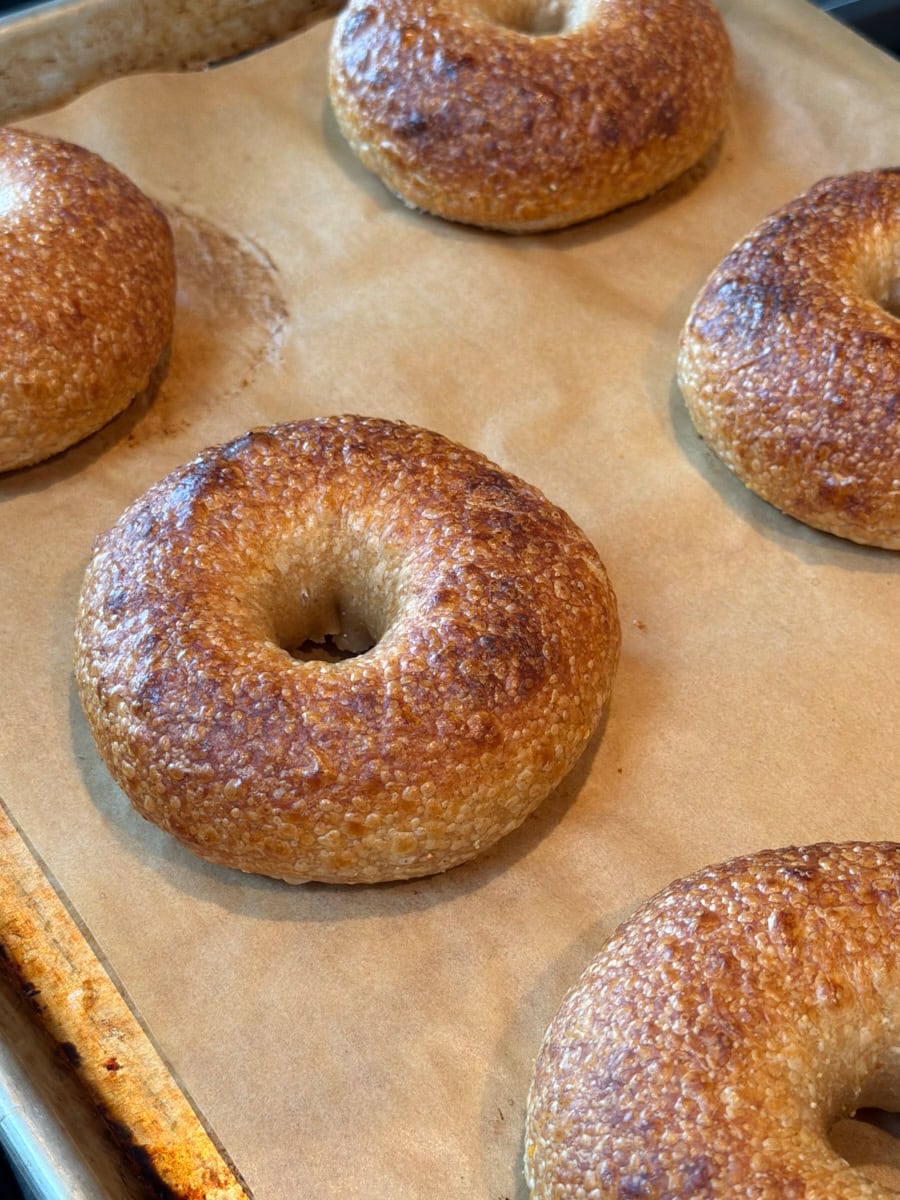
Bake for 10 minutes. Then, rotate the pan and reduce the oven temperature to 450°F (230°C) for 5 more minutes. The bagels are done when the crust is deep golden brown. The barley malt syrup in the dough and the boiled water will help them color beautifully—don’t pull them too early. A pale bagel is an underbaked bagel.
Transfer to a wire rack and let cool for at least 15 to 20 minutes before slicing. I know. But a bagel that hasn’t finished setting up will gum up when you cut it, and you’ve put too much time into this to rush the last step.
The bagels will keep well on the counter for up to a week. After baking and cooling, they can also be frozen and reheated later in a low oven after defrosting overnight in the refrigerator.
Print
New Wave Sourdough Bagels
- Prep Time: 16 hours
- Cook Time: 30 minutes
- Total Time: 16 hours 30 minutes
- Yield: 12 bagels
- Category: Bread
- Cuisine: American
Description
Crispy and chewy new wave sourdough bagels with a glossy, blistered crust and tender crumb. Built on a multi-grain flour blend, sweetened levain, and an overnight cold retard. Shaped with the poke method and boiled in barley malt water before baking on a steel.
Ingredients
Levain
- 90g medium-protein white flour
- 81g water
- 18g superfine (caster) sugar
- 36g ripe sourdough starter, 100% hydration
Main Dough
- 406g high-protein white flour (12–14% protein)
- 271g medium-protein white flour (or all purpose flour)
- 90g whole wheat flour
- 45g whole rye flour
- 23g barley malt syrup (or honey)
- 9g diastatic malt powder
- 460g water 1
- 72g water 2
- 18g fine sea salt
- 226g ripe levain (from above)
Boil Water
- 1 gallon water
- 1 teaspoon baking soda
- 5 tablespoons barley malt syrup
Toppings (optional)
- Sesame seeds, poppy seeds, everything seasoning, flaky salt, or plain
Instructions
- Prepare the levain (Day One, 9:00 p.m.)
Mix the levain ingredients in a clean, tall jar (this levain rises quite high). Stir until the sugar is dissolved and the starter is fully incorporated. Cover and leave at 74–76°F (23–24°C) to ripen overnight, about 12 to 14 hours. The levain is ready when it’s risen significantly, super bubbly on top, and smells sweet. - Mix (Day Two, 9:00 a.m.)
With a mechanical mixer: Add the flour, levain, barley malt syrup, diastatic malt powder, salt, and Water 1 to the bowl. Mix at low speed for 1 to 2 minutes until combined into a shaggy mass. Increase to medium speed (120–130 RPMs) and mix for 5 minutes. Rest 5 minutes. Resume at medium speed, slowly adding Water 2 over 5 minutes. Mix until smooth, strong, and pulling cleanly from the bowl. Target a final dough temperature of 76–78°F (24–26°C). - Bulk fermentation (Day Two, 9:30 a.m. to 12:30 p.m., 3 hours)
At 74–76°F (23–24°C), let the dough rest undisturbed for the full 3 hours. This dough was mixed heavily and is quite stiff, so no stretches and folds are needed. - Divide and shape (Day Two, 12:30 p.m.)
Sprinkle medium cornmeal on two half sheet pans (cornmeal won’t absorb water from the dough, making removal easier; use white flour if you don’t have cornmeal). Scrape the dough onto your work surface and divide into twelve 130g pieces. Shape in two phases: *Ball the dough:* Fold the sides of each piece into the middle, roll it down, then push against the surface with the side of your hand to smooth the top. Flip and pinch the seam closed. You want a perfectly round, smooth, closed-seam ball. *Poke and make the ring:* Starting with the first piece you balled, gently pat to flatten slightly. Press your index finger through the center to create a hole. Pick up the dough and gently stretch it with both hands, rotating to form a ring with a center hole about 2 to 2.5 inches in diameter (the hole shrinks during proofing and baking). Place on the prepared sheet pans, six per pan, with an inch or two between them. - Overnight retard (Day Two, 1:00 p.m.)
Cover the sheet pans with lids and refrigerate. This step is flexible—a few hours earlier or later the next morning, or even into the afternoon, the dough is forgiving. - Proof (Day Three, 9:00 a.m., 2 hours)
Remove the trays from the refrigerator and proof at warm room temperature for 2 hours. About halfway through, place a baking steel on the middle rack and preheat to 500°F (260°C) convection (525°F/270°C without convection). Give the oven at least 1 hour to preheat. - Boil (Day Three, 11:00 a.m.)
Add 1 gallon of water and 1 teaspoon of baking soda to a large, wide pot and bring to a rolling boil. Stir in 5 tablespoons of barley malt syrup until dissolved. Working in batches of 2 to 3, gently lower bagels into the boiling water smooth side down. They should float; if one sinks and doesn’t come back up, it may be underproofed. Boil 20 to 25 seconds per side, flipping with a slotted spoon or spider. Lift out, let excess water drip off, and place on a wire rack. Dip tops in toppings while still wet, if desired. Transfer topping-side up to a parchment-lined sheet pan or peel. - Bake (Day Three, 11:15 a.m.)
Transfer one pan of 6 bagels to the preheated steel. Bake for 10 minutes, then rotate the pan and reduce the temperature to 450°F (230°C) for 5 more minutes. The bagels are done when the crust is deep golden brown. Don’t pull them too early—a pale bagel is an underbaked bagel. Cool on a wire rack for at least 15 to 20 minutes before slicing. Repeat with the second batch.
Notes
Storage: Keep in a sealed bag on the counter for 3 to 4 days. Slice and freeze for longer storage; toast directly from frozen.
Same-day option: Skip the overnight retard. After shaping, proof at room temperature for 45 minutes to 1 hour until a bagel floats in water within a few seconds.
Sourdough Bagel FAQs
How can I make my sourdough bagels less sour?
These sourdough bagels shouldn’t be overly sour, and I use a sweet levain in this recipe partly for this reason. If yours are too sour, be sure you’re not using your sourdough starter when it’s too ripe when making the levain. You can also remove the whole rye flour from the recipe.
How can I get an open crumb with my sourdough bagels?
The crumb on these bagels should be quite open and light, but if you want an even more open crumb, try increasing the hydration 3-4% (or more, depending on your flour). Note that the higher the hydration, the harder the dough will be to handle when boiling.
Why are my bagels flat?
Usually, one of three things: the dough was over-fermented during bulk (or left too long in the fridge), the shaping wasn’t tight enough, or the boil water wasn’t at a rolling boil. A bagel that goes into lukewarm water will spread and flatten. Make sure the water is at a vigorous, aggressive boil before you drop them in.
Can I bake these the same day without the overnight retard (cold proof)?
Yes. After shaping, let the bagels proof at room temperature for about 2 to 3 hours. The dough should pass the poke test when it’s ready to boil. Same-day bagels will be slightly less complex in flavor but still very good.
How long should I boil bagels?
It depends on what you’re after. A 20 to 25-second boil per side yields a thinner crust. A 30 to 60-second boil on each side builds a thicker, chewier skin with a denser interior. I lean toward 20 seconds per side for this dough, but experiment and find what you like.
Do I need diastatic malt powder? Can I leave it out?
You can leave it out and still make good bagels. But the diastatic malt helps with oven spring, crust color, and crumb texture. It’s a small addition with an outsized effect. If you bake regularly, it’s worth keeping in the pantry.
What toppings work best?
The classics: sesame seeds, poppy seeds, everything seasoning (sesame, poppy, dried garlic, dried onion, flaky salt), or just coarse salt. Dip the bagels right after boiling, while the surface is still wet and tacky, so the seeds stick without any egg wash. For a plain bagel, skip the toppings entirely.
What’s Next?
Making bagels like this at home really shouldn’t be possible. With their thin and crispy, blistered crust and open, tender interior, they’ll surprise you each time you have one. Perfect with just a thick slick of cream cheese, or piled high with lox, capers, and dill—all fantastic with the right bagel base.
If you’re looking for a more New York-style bagel with a thicker crust, chewy interior, and still incredible flavor, see my original sourdough bagel recipe.
Big thanks go out to my baking friend Josh Fairbanks, who helped me hone this recipe. If you’re up in Portland, OR, and want some of the most gorgeous sourdough bread and bagels, definitely seek him out!


59 Comments
Hello, just made these bagels and lesson learned. Always, always, always use parchment paper.
I baked these bagels for the first time, and they turned out really good! I shared some bagels with my co-
workers and they really liked them. My daughter, sent me a picture of her eating a bagel and commented
” Girl this bagel is so good!”.
Thank you, Mr. Maurlzlo, Leo for sharing the recipes
I’m excited to try this formula. All I have is non-diastatic malt powder from a brewing supply shop. Can I use that in place of all the malt ingredients?
It seems commenters’ biggest challenges are higher hydration and the bagels coming out flat. I also ended up with a very tasty, but laughably flat result. I’m fairly confident the bulk and proof were well-timed, and boil was rolling, which leaves me with shaping (maybe not enough surface tension) and my flour selection.
I used King Arthur Bread (12.7%) for the high (12-14% protein), as suggested, but the way the recipe’s written is a bit contradictory on the med-protein element. Under “Flour Selection,” it says any medium protein with ≥ 11% could be substituted for Central Milling’s Artisan Bakers Craft (11.5%). Under “Total Formula” and “2. Mix” sections, it suggests a substitute of bread flour, then under the recipe card at the end, it suggests all purpose flour – which does line up better with Bakers Craft percentage.
I used King Arthur Bread (12.7%) for the high AND the medium, based on the first two “bread flour” substitutes mentioned in the recipe. Could this have contributed to my problem? They certainly didn’t need more hydration (I withheld 25g of water and they were still a bit challenging to work with).
Can’t wait to try again!
This is my third attempt to make this bagel. The dough is really wet to handle. The dough had a good gluten development, but it is still really wet to shape.
I look forward to seeing how this recipe works. I have been using your original recipe for years. I have a full sheet pan, like you recommended in the prior recipe. The bagels look to be about the same size, 125g vs 130g. Any reason not to bake them in one batch?
We live in Panama, where the ambient temperature hovers around 80 to 84.
Should I keep the levain in an air-conditioned room?
Same for the bulk fermentation?
Super excited to try these.
Gracias Mario.
Hey Ray. Yes, that’s a little warm. It’s fine to ferment the levain and dough at that temp, just be aware you’ll have to use it earlier because fermentation will be faster. I generally keep my levain and doughs around 76-78F. Let me know how they go for you!
Wow! I made so many mistakes (my 1st time making bagels), and they were still the best bagels I ever had!
So glad you liked them, Patricia! I’m making them tomorrow (again). Enjoy 🙂
Hey Maurizio
After a read through, I decided (as an old-school NYer) to stick with the old-school NY style bagels 🙂 from your older recipe, which I’ve had good results with in the past
I DID notice a slight discrepancy/error though. In the “Total Formula” section it calls for 36 g (4%) levain rather than the 226 g (25%) specified in the step-by-step directions. 226 g is clearly the right number, but some less-experienced bakers might be confused…
Hey, Jeff! The Total Formula table is correct as it is: it calls for 36g of sourdough starter, which is used to make the levain. So it’s correct!
these bagels were absolutely delicious!
Glad you liked ’em Alisa, enjoy 🙂 (I’m making another batch this week, too!)
Thank you very much Maurizio, your recipe is always great.
Yesterday I tried this recipe for the first time. I did cold proof for 3 hr and warm proof for 2.5 hr.
Here are my observations.
1. The flour I used can take all the hydration in the recipe.
2. For me, I have a problem when trying to move the dough into the pot. This is my first try baking bagel. It took me a few ruin bagels to practice before I realized that cornmeal was the key.
3. I think my bagels especially the second batch have a little soggy bottom. Any advice please?
4. Can I warm proof first and then cold proof and boil straight from the fridge?
Thank you very much. I appreciate all the advices:):)
Hey Sunan! A few comments:
2. Cornmeal really, really helps here. It basically makes the dough pull off nonstick as long as you have a thick enough base on the sheet pan.
3. Are you letting them drain after boiling? Make sure they’re sitting for a min or so on a wire rack so the excess boiling water can run off.
4. Yes, you can let proof longer before retarding in the fridge. Just keep in mind they will continue to ferment to a degree in the fridge, so don’t take it too far. You’ll have to play with the timing there.
Enjoy!
Have you had much luck adding vital wheat gluten to bread flour to increase the gluten of the flour? I don’t have local access to super high gluten flour and I don’t always wanna order it online.
I’ve never had to use vital wheat gluten here since I have access to high-protein flour. But if you need to, you can definitely do it! However, if you have a moderately strong flour, like an 11-12% protein, you could potentially just use that flour in this recipe. If doing that, I would drop the hydration to match, though. Definitely leave out Water 2, and maybe 100g of Water 1 as well. See how the dough feels in mixing. You want it on the slightly stiffer side, especially with lower protein.
Hi, I’ve always used your other bagel recipe from the book but thought I’d give this a try. I found bringing the bagels to room temperature made them very hard to work with. The dough was very sticky and some of my bagels stretched alot. Would it work to boil them straight from the fridge? The taste is great.
thanks
Pip
You can definitely boil straight from the fridge; just be sure your dough is fermented enough and doesn’t need that room-temp time afterward. It sounds like maybe your dough was! You can also always do a test: boil half straight from the fridge, then do the remaining an hour or so later. Compare the two.
I loved these, flavor, crust and crumb, all spot on! The amount of water was too much for the dough–I ended up adding about 8 oz more high protein flour (CMB). And didn’t add water 2.
Thanks for the wonderful recipe though. I love all your recipes from your book and appreciate the hard work you do testing and developing all these recipes.
So great to hear that, Nina! Thanks. It does sound like the higher hydration is harder for many here, but gosh, they work out just perfect here. I might go back and do a little adjustment. Happy baking and appreciate the feedback!
Delicious but Flat Bagels?
I just made these for the first time, and the flavor is amazing. I used honey instead of the malt barley syrup (couldn’t get it in time) in both the mix and the water boil. Bagels were super chewy (and not crispy) – so perhaps the water boil was a little too long? The main problem is that they are FLAT. Any advice?
How did the interior look, Robyn? If they were very tight and gummy, they might have been underproofed. If the interior was slightly moist with lots of small holes, it might have gone too long in proof and/or bulk fermentation. I don’t htink it was the boil, which doesn’t really penetrate deep enough into the dough to overcook them.
Can you use a lye solution to make these bagels? Is there any advantage or disadvantage to doing so?
Yes, that certainly works, Sharon. I’ve done it here in testing. The big thing you’ll notice is the bagels will definitely have more color, even more than using baking soda. However, the side effect is they’ll also potentially have a “pretzel” flavor from the lye—depending on how much you use. When I did it here, I used enough for that flavor to come through and while my kids loved them, I didnt 🙂
I am excited to try this recipe…. Have had a lot of success with your previous bagel recipe. How can I incorporate garlic and onion in the dough without inhibiting fermentation too much? I recently had some fantastic bagels from “The Bagler” in Chicago and wanted to try and mimic them
You’re going to love these, Sheila! As for those, I’ve never tried incorporating them. You might be okay just as is, especially if they’re dehydrated versions. Otherwise, you could try roughly folding them in midway through bulk fermentation if you find adding them directly doesnt work. I kind of like doing it that way, too, because you get uneven swirls of mix-ins.
I’d love to hear how this turns out for you. In the future, I plan on testing this combo as well as cinn-raisin, blueberry, etc.
Thanks! I was JUST going to ask how one could divide this dough and incorporate blueberries, cinnamon-raisin, etc. Can hardly wait!
Let us know how it goes for you, Sharon 🙂
My dough looked perfect before adding the 2nd water. Is it ok just to keep the 1st one smaller and keep some to mix in the salt?
Yes, absolutely!
I was so excited to try these, and I can report that the flavor is great. However, at 1.5 hours into the shaped proof, I checked on them, and they'd already overproofed. It was quite warm in my kitchen, which I thought was "warm room temp," per the recipe. Given that it's summer, I'd suggest a wider range of proofing times once they're shaped and out of the fridge.
Wow, that was quick, Jen! Surprised they proofed that quickly for you, I do wonder what temp it was in the kitchen. Here, it's usually around 74-76F.
Thanks this recipe looks fabulous, can't wait to try it. In NZ it's not easy to get diastatic malt powder, what could I use as a substitute please?
You could leave it out if you cant find any. Or, you could try adding the same weight in white sugar.
Thanks for All your recipes! This one came out too wet too handle easily. Looked great and had a clean bowl right before adding water 2. Water 2 took me all 5 minutes to incorporate. Dough never pulled away from side. Very sticky. I did try letting it rest for 30 minutes and then mixing again thinking it would give it more time to absorb water. But didn’t make much of a difference. I did follow recipe to a T. Any suggestions?
Hey Gary—I would say leave out Water 2 for the flour you're using!
I'm having the same problem this morning. The dough looked similar in consistency to your other bagel recipe before I added water 2. Now it is super wet and sticky (used KA bread flour and KA AP flour instead of the central milling flour you called for. Is there any way to salvage it?
I had the same issue but switched to hand mixing and reduced the initial water by 20g and the dough came together perfectly.
When I mixed, I probably did about 10 minutes of mixing and then I let it sit for 5 Minutes then did A slap and fold let it sit again for five minutes did a lamination one more five minutes sit and a few really gentle slap and folds and it was good to go and absolutely perfect.
If you’re in mixing, add a bit of flour to help dry and bring the dough together!
What are we looking for at the end of bulk fermentation? Should there be much rise? Any bubbling?
You shouldn't really see much bubbling, but you'll see about 20% rise, it will be puffy to the touch.
Regarding using this dough for bialys; I made 200 dozen bialys each weekend day when I was in high school at NY Bagels and Bialys in Chicago – generally batches with 100 pounds of high gluten flour, 7.5 gallons of water, cake yeast, and salt. No malt, no sugar – nothing else in the dough. And you don't press in a depression into the dough ball – you pull it outward, like you stretch a pizza dough. Authentic and healthier that way too.
There are probably many ways to go about it, which I think is very cool. Just like pizza, so many different ways to the end where we call it "pizza." This dough is definitely bagel first, but I used some to try and bialy and loved the result. If I were developing a bialy dough from scratch, I wouldn't have the ingredients I do here—it's just a way to make more products from the same dough. Happy baking, Bob!
What is the proof time on one day version? You have between 45min to 3 hrs
Usually, 2 to 3 hours!
I made the 1 day version, sticky but do-able. I think I needed a stronger flour. Also, they stuck to the pan like hot chewing gum! That's about what they looked like going into the boil, too, but they all puffed up & my guests just wanted bagels for breakfast, snacks, everything! These are really good & I can't wait to try them again with stronger flour & overnight proof.
I can tell this recipe is a winner! I’m still working on my slice and roll technique rather than the poke. it’s not easy and it’s taking many batches even to get close to being an advanced beginner bagel roller.
I hear you on that. Just like any bread technique, it takes putting in some time!
I love the bagel recipe from your book and have been wanting to play with adding whole grain to it so, thank you! I’m excited to try this recipe!
Let me know how you like the changes! I dont think this is a replacement, it's a very different kind of bagel 🙂
Great recipe! I’m curious about the combination of barley malt syrup and baking g soda for the boiling solution. The barley malt syrup is weakly acidic and I wonder if that doesn’t just neutralize the weak alkalinity of the baking soda?
When I’d tried using malt syrup in conjunction with lye, I kind of concluded that was what was happening. It certainly didn’t seem like an additive effect.
Yeah it's very hard to say. Without actually determining the pH, it's more of me just trying to keep things balanced. I did try a boil with several tablespoons of baking soda in addition to the BMS, but then I started getting off flavors (like pretzels) that I didn't really like. You could likely leave out the baking soda here and you'll get similar results.
Maurizio, this is why you are so my "go to" bread guy. All the detail and refinement. I've been using your bagel formula for years (scaling up to dozens at a time) with great success and different little modifications in flour. Typically, I've used CMs High Mountain as the primary and then some rye or khorasan or even durum to make things more interesting. I can not wait to try this formula. I've got a bunch of Cairnspring right now. How do you think their Expresso or Trailblazer would work here? I know it's thirsty but otherwise? I also love that you played with the hydration. Even in my Famag, a lot of low hydration bagel dough is very stiff and this encouragement to increase hydration a bit is very helpful, balancing that with the necessary stiffness for boiling.
Thanks so much, Tam! Lots of research and trials went into this, but it sure paid off. I think Trailblazer would be excellent for these bagels. I'd probably venture trying that at just 100% of the flour (or TB and rye). It's strong and can take quite a bit of water, but I think it'll make for a really nice bagel.
And you nailed it, the balance here is key with the hydration. Too high and it's hard to handle (and the crumb is too open). I found that with my flour blend, this was just right.
Let me know how it goes!
I wish I'd seen this comment prior to mixing this morning, haha. I have Cairspring Espresso and Edison currently (along with the wheat and rye) and it's pretty sticky after mixing … I've got it in the fermenting bowl for the past hour but am thinking I should have done more/something different in the mixing as it was/is sticky?
Am I able to save this batch still and have success?
My husband is picking up some Trailblazer on the way home, I'll make a new batch with it in two days as suggested and described above by you, but went ahead and shaped my very soft/sticky dough into balls/rings and they're in the refrigerator now for overnight. I'll give it a go tomorrow for boiling and baking just to see what comes out instead of tossing it out completely without giving it a chance, maybe I invented yet another version, haha 😉
I always do a 70% High Mountain 30% Cairnspring Organic Bread flour in my bagels with excellent results!!!