

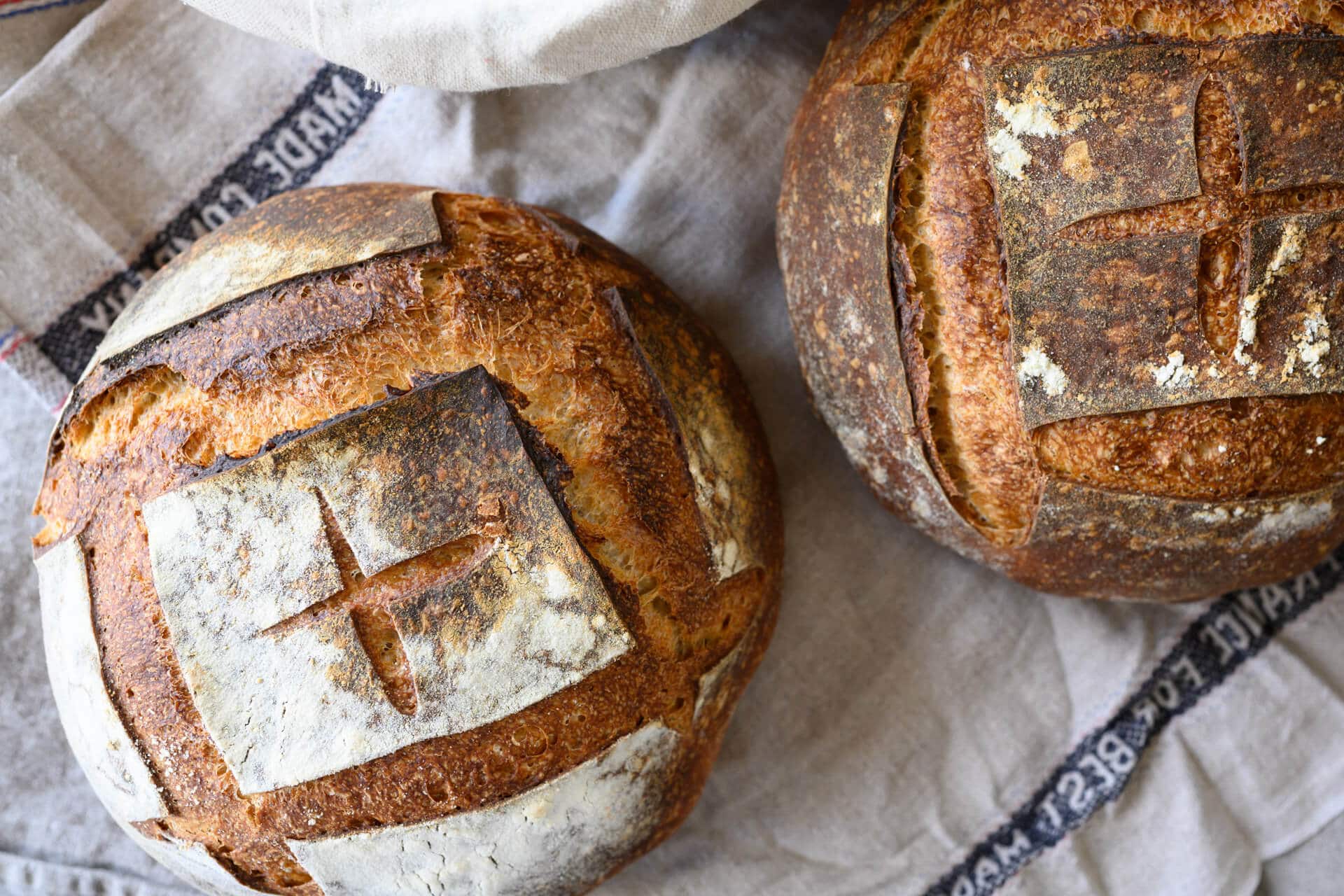
Baking a healthy and nourishing loaf of sourdough bread with your sourdough starter is gratifying, to be sure, but what if you’re not home all day to check in on the long-fermented dough? I mean, some of us do have to work, right? This simple weekday sourdough bread recipe and schedule are uncomplicated for mixing and baking a loaf of bread during the busy workweek.
This post includes pictures and videos that clearly and concisely convey the full sourdough bread-making process. But why is this recipe so easy compared to others?
Real Quick: Why is This Sourdough Bread Easy?
- It’s a no-knead sourdough bread recipe: mix everything in one bowl
- It uses only two types of flour: bread flour and whole-wheat flour
- It’s moderate hydration—no messy dough or counters
- It’s baked in a Dutch oven or combo cooker
- Timing is extremely flexible
Let’s go over the workweek schedule.
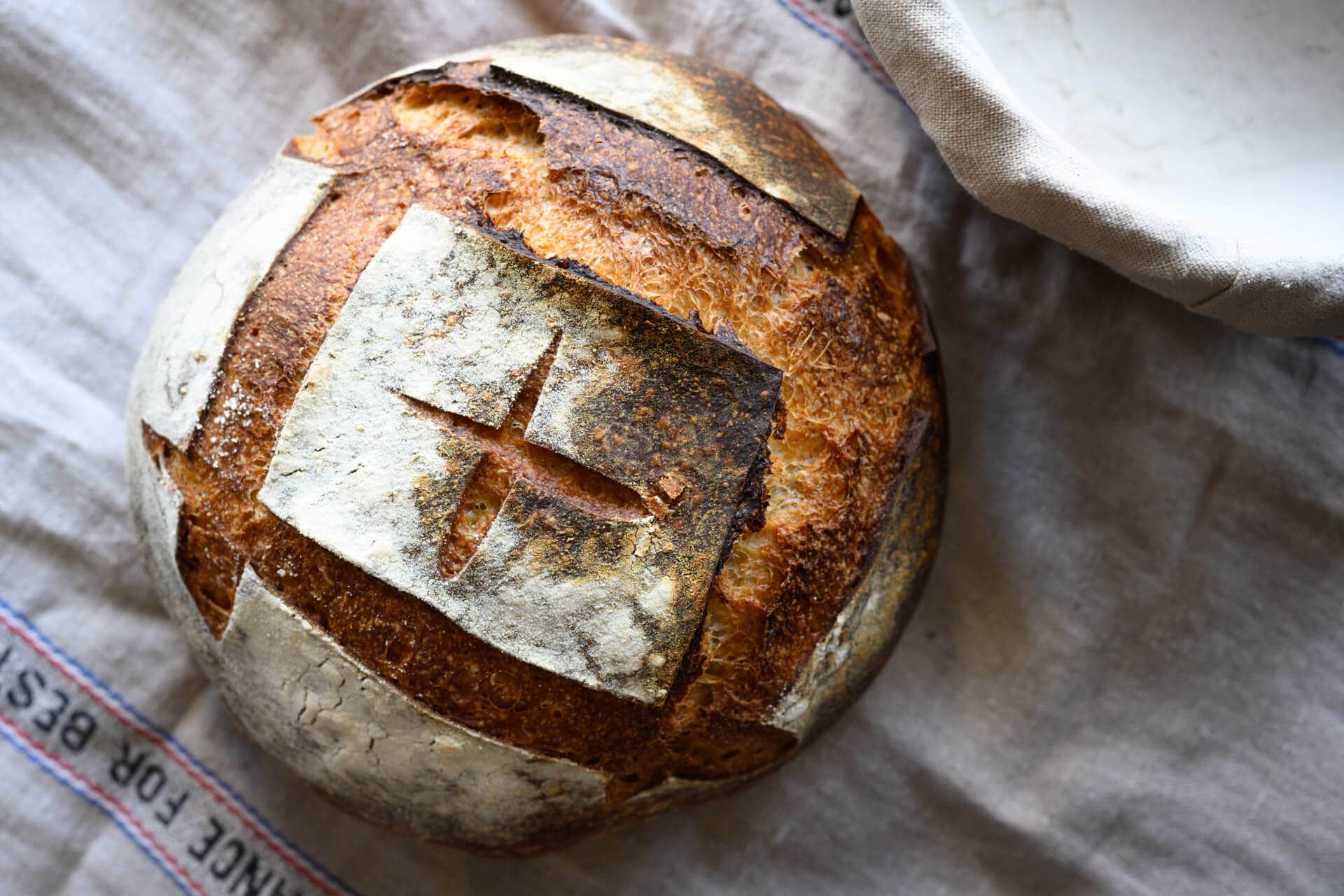
A simple weekday sourdough bread schedule
In the past, I’ve discussed a weekend baking schedule that outlines a schedule for low maintenance during the week with a bake on the weekend. The following schedule, however, allows baking during the week around a typical nine-to-five workday. It’s also quite flexible, and you always have the option to place the dough in the fridge longer to bake when you get a chance.
Read through my ultimate guide to dough proofing for more information on adjusting the proofing period for this sourdough bread.

| Time | Step |
|---|---|
| 7:00 a.m. (before work) | – Make the 10-hour levain (ready ~5:00 p.m.) – Save time later, scale-out flour & salt into bowls and cover |
| 5:00 p.m. (after work) | When levain ready, mix dough for autolyse |
| 5:30 p.m. | Finish mixing and begin bulk fermentation |
| 9:00 p.m. | Divide, pre-shape, and bench rest |
| 9:30 p.m. | Shape and place into the refrigerator to proof overnight |
| 7:00 a.m. (next day) | – Bake the next day before work – Alternatively, bake after work |
The schedule above has example times, so shift the timeline to earlier or later according to your schedule. Don’t worry if you don’t hit the times precisely as they’re written. There’s some flexibility there.
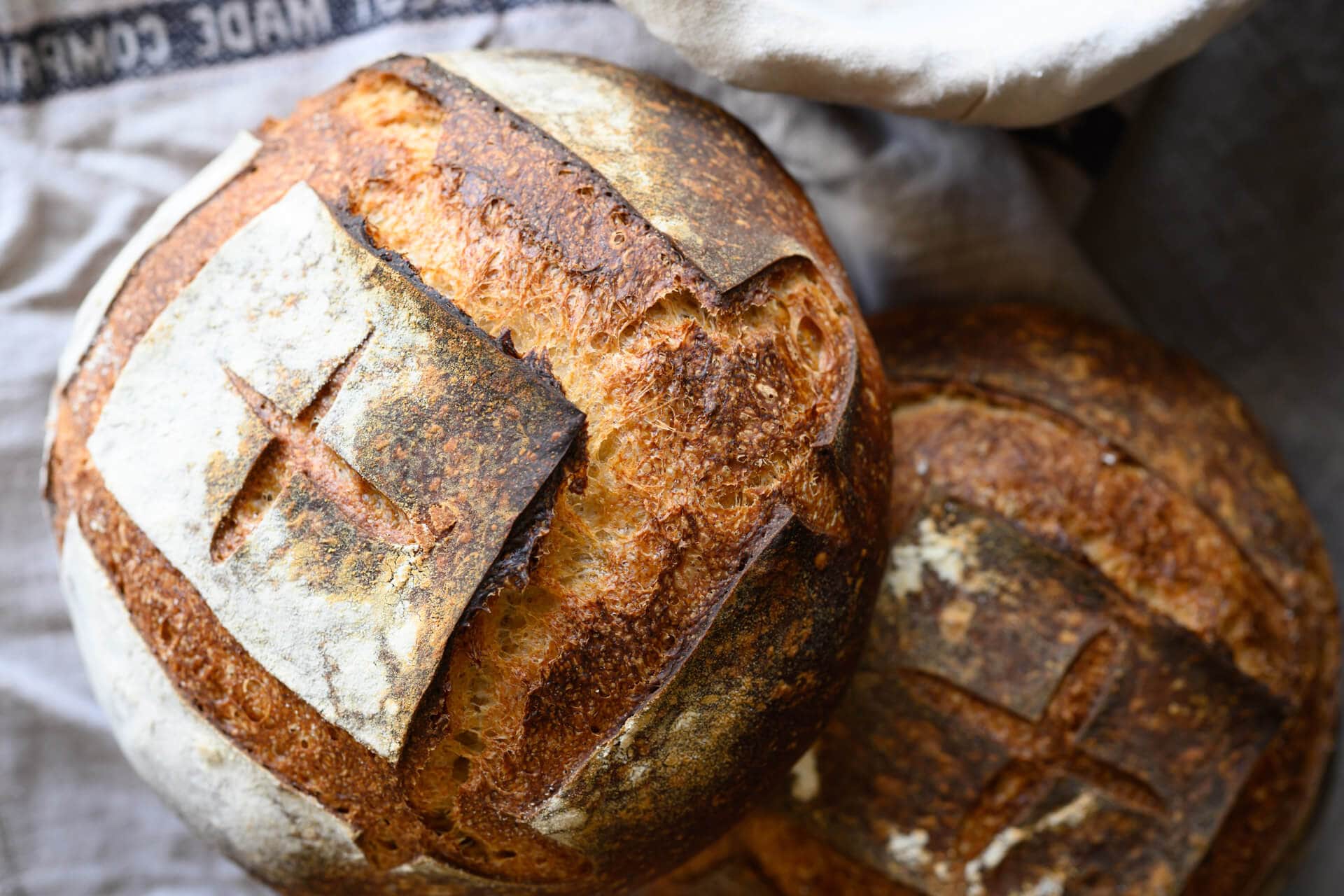
A Simple Weekday Sourdough Bread Recipe
Vitals
| Total Dough Weight | 1,800 grams |
| Pre-fermented Flour | 8.0% |
| Hydration | 76.0% |
| Yield | Two loaves |
Total Formula
The following table shows all the ingredients needed to make this bread. Each ingredient will be called out as needed in the method steps below.
My final dough temperature for this simple weekday sourdough bread was 75°F (24°C). For more information, see my post on the importance of dough temperature.
| Weight | Ingredient | Baker’s Percentage |
|---|---|---|
| 806g | High-protein white bread flour, malted (King Arthur Bread Flour) | 80.0% |
| 202g | Whole wheat flour (King Arthur Whole Wheat Flour) | 20.0% |
| 766g | Water | 76.0% |
| 19g | Fine sea salt | 1.9% |
| 8g | Ripe sourdough starter (100% hydration) | 0.8% |
Method
1. Prepare levain – 7:00 a.m., before work
A levain is simply an off-shoot of a sourdough starter. A sourdough starter is never used up completely; it’s continually fed day after day indefinitely. A levain is created with a small bit of a sourdough starter and left to mature (ferment) until ready to be mixed into a dough. Ultimately, it meets the same fate as the dough: baked in the oven.
In the morning before work, mix in a jar:
| Weight | Ingredient |
|---|---|
| 40g | Bread flour |
| 40g | Whole wheat flour |
| 81g | Water |
| 8g | Mature sourdough starter |
Loosely cover the jar; it should be ready after about 10 hours at room temperature, 72-75°F (22-24°C).
2. Autolyse with Levain – 5:00 p.m. after work
Performing an autolyse gives our dough a chance for the flour to fully hydrate and begin the gluten development process (all without kneading). I typically don’t do an autolyse with the levain included, but we’ll do that in this simple weekday sourdough bread recipe because it’s a short period.
Add all the ingredients below to a mixing bowl. Mix with wet hands until all the dry bits are incorporated. Cover and keep somewhere warm at room temperature for 20 minutes.
Note: the water in the table below is 50g less than the total water for this recipe; the water (and the salt) are held back for the next mixing step.
Dough Mix
| Weight | Ingredient |
|---|---|
| 766g | High protein bread flour, malted (King Arthur Bread Flour) |
| 161g | Whole wheat flour (King Arthur Whole Wheat Flour) |
| 635g | Water, Autolyse |
| 169g | Ripe levain (created in Step 1) |
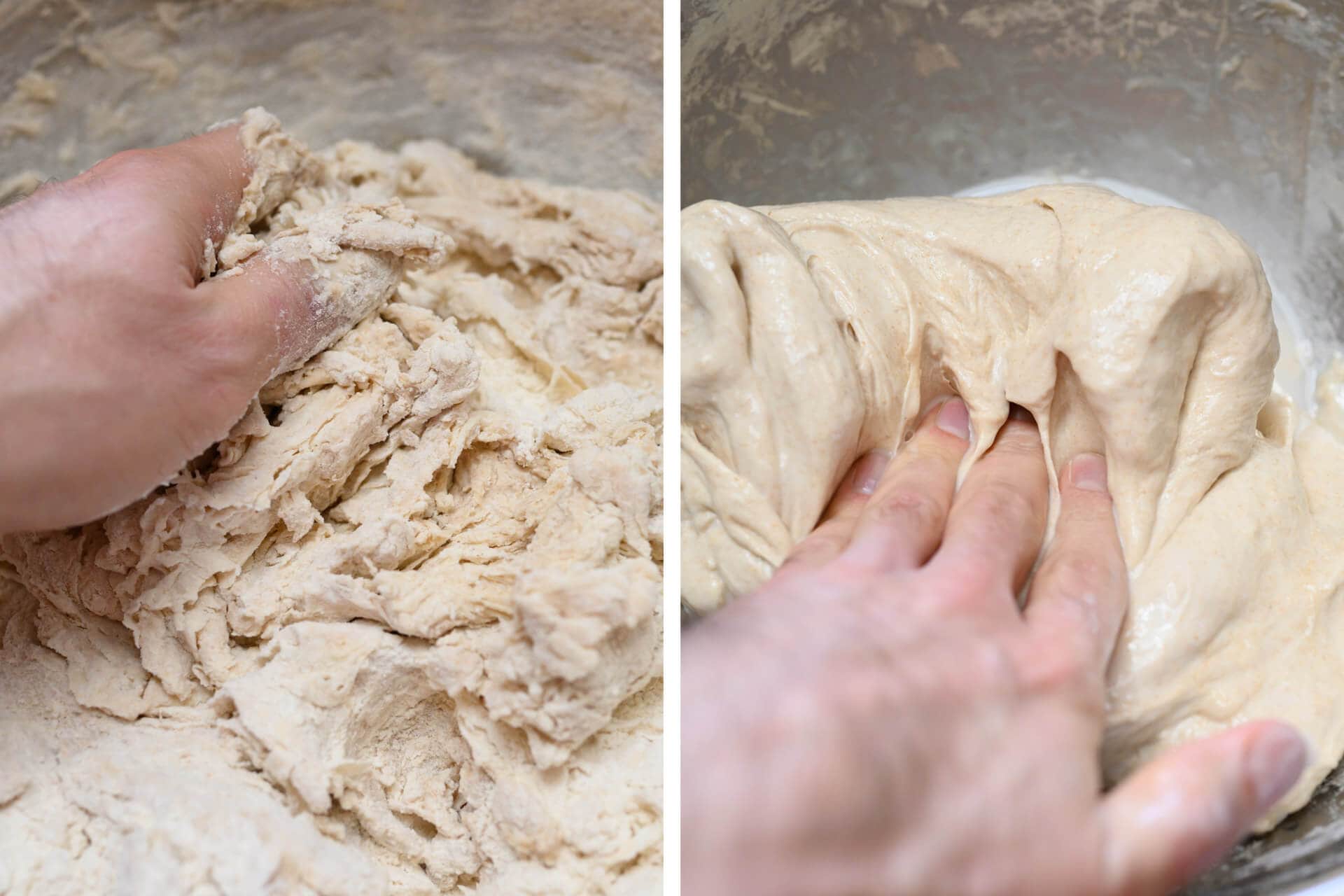
The image above shows the direct result of even a short autolyse. The left image shows the shaggy mass just before I finished incorporating everything. The right image shows how smooth and strong the dough becomes simply by resting. Let’s take this further with a little mixing.
3. Mix – 5:20 p.m.
Add the ingredients in the table below to the top of the dough: first, add the salt and then add the reserved water slowly to help dissolve the salt. Add the water a little at a time, depending on how the dough feels: it should be shaggy and loose, but not “soupy.” You can pause midway through pouring the water to incorporate it with a wet hand. If it feels like the dough can handle the rest of the water, add it all.
| Weight | Ingredient |
|---|---|
| 50g | Water, Mix (as needed) |
| 19g | Salt |
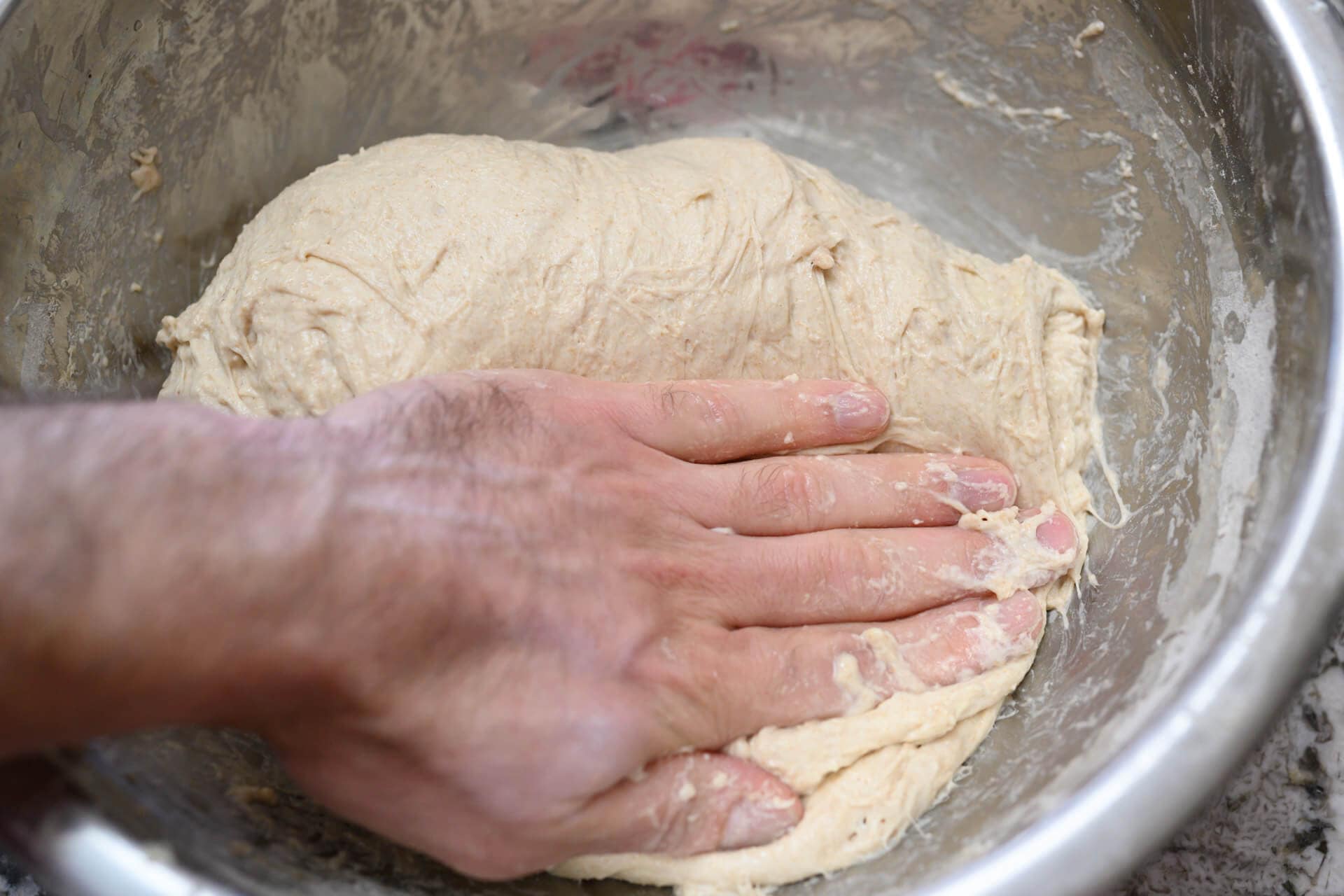
Since this dough uses a fair amount of high-protein white bread flour, it doesn’t require extensive mixing or kneading.
Using wet hands, mix everything until it comes together into a shaggy mass. This dough is rather strong and doesn’t require intensive mixing or kneading, but give it a few folds in the bowl, perhaps 5-10, until it smooths slightly (see the image, right).
Cover the bowl with reusable plastic and keep it somewhere warm in your kitchen for bulk fermentation.
3. Bulk Fermentation – 5:30 p.m. to 9:00 p.m.
Bulk fermentation, or first rise, occurs when the dough is leavened (through the production of carbon dioxide gas) and flavored (through the production of organic acids) as a result of natural fermentation. Below, you can see how much my dough rises during this 3-hour and 30-minute bulk fermentation at 75°F (24°C).
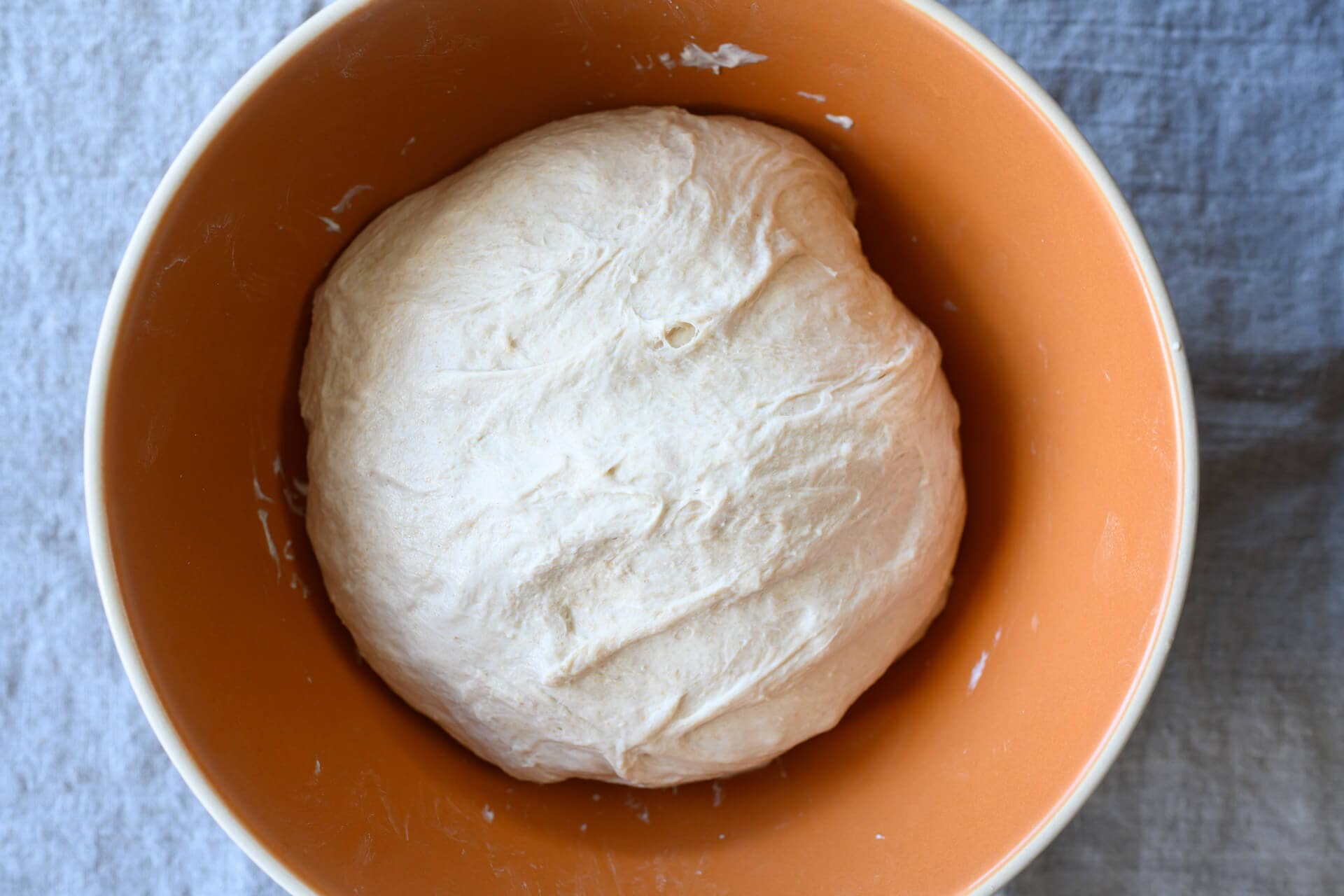
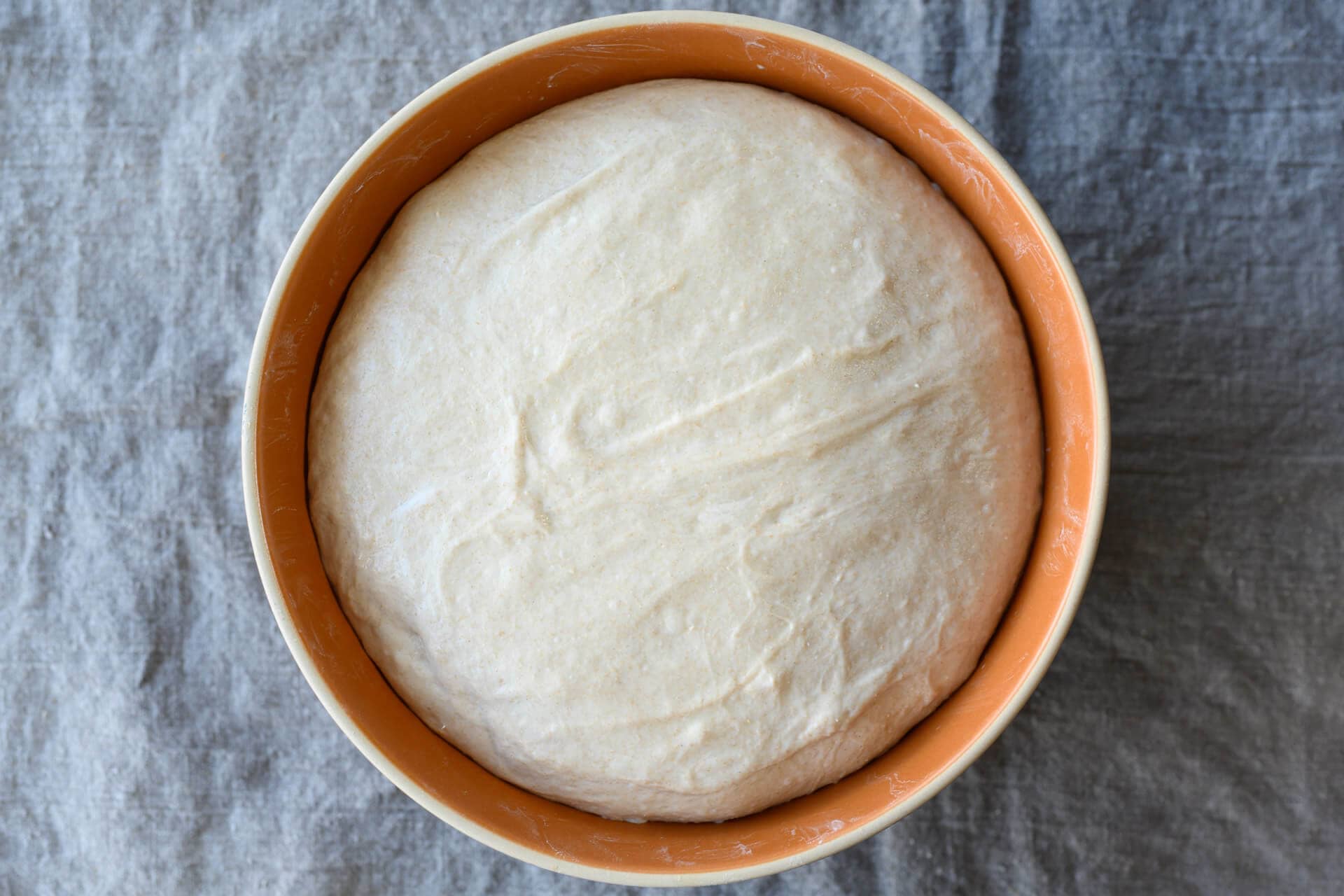
During this time, give the dough 2 sets of stretch and folds: the first set is 30 minutes after the beginning of bulk fermentation, and the second set is 30 minutes after the first. After the second set, let the dough rest, covered, until the next step.
As you can see in the video above, each set of stretches and folds is simple: With wet hands, grab one side and gently stretch it up and over to the other. Perform this fold in each direction: North, South, East, and West.
4. Divide & Preshape – 9:00 p.m.
Fill a bowl with some water and place it on your work surface. Scrape out your dough from the bulk container onto your dry counter. Divide the mass in half using a bench knife. Using a wet hand and the knife in the other, gently preshape each half into a loose round. Let the dough rest, uncovered, for 30 minutes until it’s relaxed outward.
See my guide to preshaping bread dough for a video and more instructions.
5. Shape – 9:30 p.m.
As seen in the video below, flour the top of the round with your hands and flip it over. Take the bottom edge and fold it up to about the middle. Take the left and right sides in your hands and fold the right over to about 2/3 of the left side. Repeat for the left side. Then, take the top and fold down to about the middle and gently seal. This should form a little envelope shape.
Now, flip over the entire thing and begin dragging and sealing the dough underneath itself (top-right, above). Using both hands, rotate and drag the mass toward you to create tension on the top. Repeat the dragging if necessary.
Read through my guide to shaping a boule for more instruction.
6. Proof – 9:45 p.m. to 7:00 a.m. or 6:00 p.m. (the next day)
Cover both proofing baskets entirely and put them in the fridge to proof overnight. The fridge allows us to slow fermentation to bake before or after work the next day.
7. Bake – 7:00 a.m. (pre-heat oven at 6:00 a.m.)
Preheat your oven with the rack at the bottom third to 450°F (230°C). Place your Dutch oven inside, with the lid and bottom side-by-side.
Take one basket out from the fridge and uncover it. Your dough might not have risen considerably in the fridge, but that’s fine. Cut a piece of parchment paper to fit over the basket and place a pizza peel (or large cutting board) on top. Using both hands, flip the entire stack over and remove the basket.
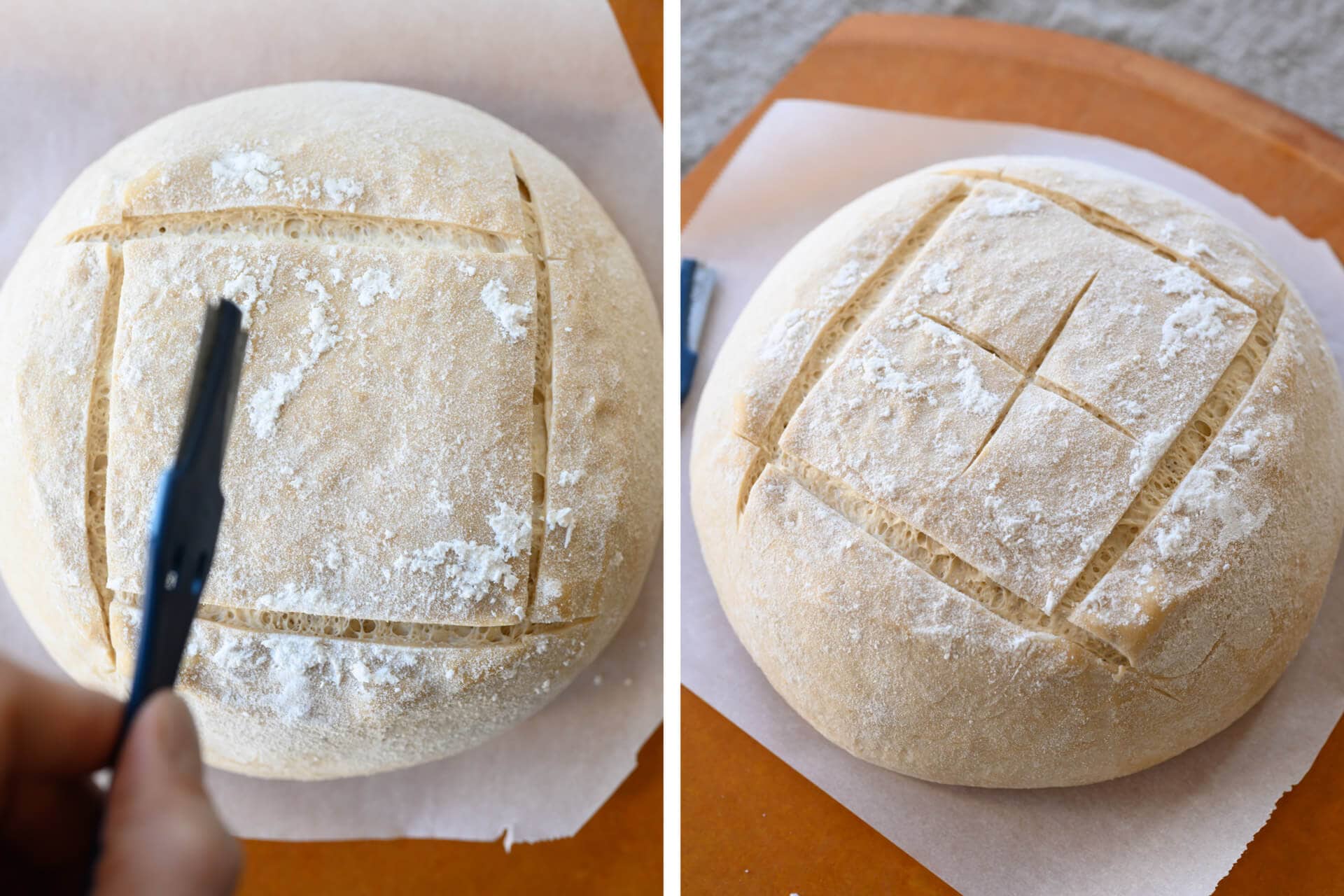
Score the dough using your favorite design. As you can see above, I love the “box top” score. Check out this video of me scoring this style (and a few others) below:
Now that your dough is scored, carefully slide it into the Dutch oven and bake for 20 minutes, covered.
After this time, remove the lid and bake for 30-35 minutes or until done. The internal temperature should be around 205-210°F (96-99°C).
(Note that If you’d like a thinner crust on this bread, increase the covered bake time to 30 minutes and reduce the second half of the bake (without steam) by 10 minutes. This increased baking time with steam can help reduce the thickness of the crust.)
Remove the loaf to a cooling rack for 2 hours before slicing. This lets the crust and crumb fully set and the flavor develop. Return the Dutch oven to the oven (without parchment) and bring it back to temp to bake the second loaf.
Follow my guide to storing sourdough bread to keep it fresh for the next week (or freeze it for longer!).
Print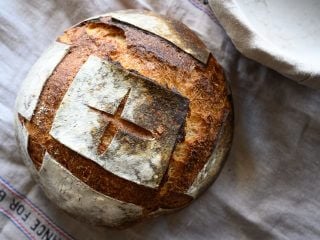
Simple Weekday Sourdough Bread
- Prep Time: 24 hours
- Cook Time: 1 hour
- Total Time: 25 hours
- Yield: 2 loaves
- Category: Bread, Sourdough
- Cuisine: American
Description
A loaf of delicious sourdough bread designed around a busy workday. The levain is prepared for this bread in the morning and left to ripen while you’re at work. When you get home, continue with the baking process. The dough can then be baked at night or the next day in the morning, or after work.
Ingredients
Levain
- 40g bread flour
- 40g whole wheat flour
- 81g water
- 8g ripe sourdough starter
Main Dough
- 766g bread flour
- 161g whole wheat flour
- 19g salt
- 685g water
- 169g ripe levain
Instructions
- Levain (7:00 a.m. before work)
In a small container, mix the Levain ingredients and keep it at a warm temperature for 10 hours. - Autolyse with levain (5:00 p.m after work)
In a medium mixing bowl, add all of the levain, 766g bread flour, 161g whole wheat flour, and 635g water (50g was reserved for mixing, later) and mix until no dry bits remain. Cover the bowl and let rest for 20 minutes. - Mix (5:20 p.m.)
To the mixing bowl holding your dough, add 19g salt and some of the reserved 50g water (or all if the dough feels like it can handle it). Mix thoroughly and strengthen the dough for about 5 minutes. Using wet hands, mix everything until it comes together into a shaggy mass. This dough is relatively strong and doesn’t require intensive kneading (like slap and fold), but give it a few folds in the bowl, perhaps 5-10, until it smooths slightly. Transfer the dough to a bulk fermentation container and cover. - Bulk Fermentation (5:30 p.m. to 9:00 p.m.)
This dough will need 2 sets of stretch and folds during bulk fermentation, the first set 30 minutes after bulk fermentation begins. Perform the second set 30 minutes after the first, and then let the dough rest the remainder of bulk fermentation. - Divide and Preshape (9:00 p.m.)
Lightly flour your work surface and scrape out your dough. Using your bench knife, divide the dough in half. Lightly shape each half into a round shape. Let the dough rest for 30 minutes, uncovered. - Shape (9:30 p.m.)
Shape the dough into a round (boule) or oval (batard), then place the dough in proofing baskets. - Proof (9:30 p.m. to 7:00 a.m. or 6:00 p.m. the next day)
Cover proofing baskets with reusable plastic and seal shut. Then, place both baskets into the refrigerator and proof overnight. - Bake (The next day, bake at 7:00 a.m. before work, or 6:00 p.m. after work)
Preheat your oven with a baking surface or combo cooker/Dutch oven inside to 450°F (230°C). Remove your dough from the fridge, score it, and transfer it to the preheated baking surface or combo cooker. Bake for 20 minutes with steam. After this time, vent the steam in the oven or remove the lid (you can keep it in the oven or remove it) and continue to bake for 30 minutes longer. When done, the internal temperature should be around 204°F (95°C). Let the loaves cool for 2 hours on a wire rack before slicing.
Notes
- This recipe is wonderful left plain, or you could top the dough with rolled oats, white sesame seeds, or flax seeds.
If you use this recipe, tag @maurizio on Instagram so I can take a look!
What’s Next?
There you have it; this simple weekday sourdough bread can be made daily and adjusted to fit your schedule. Now, there’s no reason not to bake. This recipe is also a great place to experiment: mix 125g of nuts like walnuts and pecans and dried fruit like cranberries, cherries, or raisins.
Many recipes on my site can be adapted to this simple weekday sourdough bread schedule, most notably my Beginner’s Sourdough. Both recipes use flexible doughs, and the fridge provides even more.
For a more hands-off approach, check out my easy no-knead sourdough bread recipe. It can also be adapted to bake in a single day or ferment longer for an easier schedule.
Happy baking!


917 Comments
Just wanted to THANK YOU for the ‘weekday’ sourdough bread recipe and technique – I finally baked sourdough bread that turned out great! After countless times trying the ‘perfect loaf’ recipe over a year ago and failing each attempt, I gave up. The information in that post seemed somewhat hard to follow and it was very time consuming. However, I decided I would try sourdough baking again and discovered an updated website and this recipe! I am so excited to finally be able to create good sourdough bread at home! The directions, pictures, and videos/links were game changers, especially the bread temperature calculator – it was easy to follow along compared to my previous attempts. Did you also streamline/revise the instructions for ‘the perfect loaf’ recipe? I checked it out today and it looked a lot clearer than last time – enough that I am going to attempt it again. Thanks for all the excellent content and links to the tools – I’m definitely better prepared to bake sourdough and hope to continue to improve.
You’re very welcome, Anni! Glad to hear your bake turned out great. Yes, I revamped that recipe as well as a few others (more to come). Here’s to more awesome bakes!
Hi Maurizio
Fellow ‘Burque baker here from downtown ABQ…. I am trying your everyday sourdough for the first time and am amazed at how little starter the levain requires…can I increase it for more sourdough flavor? And thanks for the site—it’s so helpful!
I am also curious about using more starter in the levain. I’m a beginner at making sourdough bread but the handful of loaves I’ve made haven’t tasted like sourdough. Any ideas?
I’m working on a post that will outline things there more clearly!
Hey there! It’s not as straightforward, adding more starter doesn’t 100% guarantee more sour flavor. I’m working on a post that will outline things there more clearly!
Hi there,
When it comes to shaping the dough (boules), do you prefer the stitching method, the one where you “drag” it to create tension or a mix of both? Or does it depend on the dough? If so, when is which method appropriate? Lastly, how much does the shaping method even matter in terms of oven spring compared to fermentation time, stretching during bulk ferment and strength of levain?
I see a lot of good bakers just give the dough a quick stitching and be done with it, but I’m always afraid to not get enough rise, so I tend to both stitch it, flip it over and drag it to really tighten it up, but I wonder if I am handling the dough more than necessary
Thanks!
Also for this specific recipe if I wanted to increase hydration, could I do that? And could I add in some rye or spelt without messing it up? If so, how would I go about it?
Yes, this is a moderately hydrated dough that can easily take more water. If you add in whole rye you might need to increase the water—but also watch the dough, fermentation activity will be higher. If you just add spelt, which is typically sensitive to water, you might not need any adjustments.
Hey, Oliver. It really depends on the dough. If it’s very slack and weak, I’ll typically do some form of “stitching” to tighten it up and provide additional strength. If the dough is on the stronger side, I’ll just do my usual tuck and roll. Shaping method is extremely important, it’s just as important as every other step! If you shape a dough too softly, it may spread and not spring up, which will lead to a squat loaf. Conversely, if you shape too tightly, it may not relax enough to rise properly. A balance.
Be weary about just taking an approach to shaping without assessing the dough itself. In other words, those stitching are likely dealing with a dough that’s more extensible/more slack/weaker and it needs that input. Your dough might be different. You can test this, though. Take the same batch of dough, shape one loaf one way, and the other another way. See which comes out better.
Can I use this recipe at high altitude. If so, what adjustments should I make. I notice my levain behaves differently at high altitude. It has a lower level of activity.
You absolutely can. Check out my guide to high altitude bread baking for some tips on the process. But, you should be able to bake this loaf as the recipe states, I live at 5280 ft.
Check out “The Bread Code”, a German Engineer who has scienced the heck out of the sourdough process. Highly recommend and take many notes. He has the whole process down and temperature/timing is key. Even the calculation of hydration of the protein content of your bread.
Will do!
Maurizio, I love your site. I’m really struggling with the parchment paper. I have to use it, otherwise the bread burns, but the paper creates ugly ripples in the bread on the sides. Any ideas on how to fix this? I’m using Kirkland. Thanks!!
Hey, Hollie! Thank you. I usually cut the parchment to fit the top of my round proofing basket, which is pretty much the same as the bottom of my combo cooker I use to bake. Cutting it smaller will prevent it from riding up the sides of the pot, which inevitably creases and causes issues.
Additionally, check out my post on baking in a Dutch oven if you haven’t yet, lots of tips in there to help prevent burning!
Hi, I’ve made this recipe and several of your others many times with generally great success. So now I’m trying to perfect my method and get a little higher rise. I’ve noticed that your bread (pre-baking) holds its shape much better than mine ever does at that stage. Mine is always still pretty wet when I shape it, or even after an overnight proof, it doesn’t hold its shape hardly at all when I take it out of the basket to score and bake. Should I be adding a little less water? Or should I let it rise longer during bulk fermentation?
It sounds like your dough is either over hydrated or it needs more strengthening. Try reducing the hydration by 5% and give it another go—the reduced water should bring strength to the dough and you’ll feel it immediately. Once you find a suitable hydration, you can try to push it back up (if desired), but as you do, take note of how the consistency of the dough changes: the dough will start to slacken out as you add more and more water, this means you’ll likely have to mix more upfront or add another set or two of stretch and folds during bulk fermentation.
Generally, with an increased hydration, you need to mix longer to develop the gluten in the dough to sufficiently support the water added, but this only goes so far. At some point, the flour you’re using just isn’t able to take on any more water and you’ll essentially have a weak and slack dough. It’s always best to start conservatively and work your way up with hydration as you feel out your flour. This is typically why I recommend holding back water during mixing, adding it in as the dough handles it.
Try to keep everything else as consistent as possible and let me know how the next attempt goes!
Is there a way I can do my second proof on the countertop to shorten the time needed? If so what would you suggest that time may be?
Yes, absolutely. Just leave the dough out on the counter 1-3 hours until ready to bake (warmer kitchen temps mean shorter time as dough will proof faster).
I studied your explanations on bakers percentages and have a question about the levain build… I cannot wrap my head around how we calculate/account for the items in the starter and levain build into the total formula? I’ve been running the numbers and not make them work … thank you so much!
Work out your own numbers so that at the end of the day you have a 75% dough or whatever. What I do is I go, right my levain is say 80g water, 80g flour. Now I add 620g flour. I now have 700g total flour. 75% of 700g is 525g water needed. But I already added 80g water. So I just need 525-80 = 445g water.
Good morning. How long would the final proof be without refrigeration? Thank-you
Hey, Mary! It depends on the temperature in your kitchen and the dough’s progress, usually 1-3 hours at typical room temp.
Thank-you. I love your recipes. Especially the banana bread.
Glad to hear that and thank you, Mary!
Hi, Maurizio. I came here after reading your baker’s math percentage, it’s really helpful! Thanks.
I was wondering whether the whole wheat flour could be replaced to bread flour only. Should I change the percentage of any other ingredients or it’ll still work well with what’s written?
Oh and can I make 2 or 3 hours only for the autolyse so that I could bake faster?
Thanks.
Glad to hear that, Nurina! Yes, you can certainly do that. I’d do a one-for-one swap there. Do you mean a 2/3 hr bulk fermentation? That can’t really be cut short if you keep the recipe and temperatures the same. Hope this hepls!
I’m sorry I don’t quite get it. Could you please explain more about one-for-one swap?
Also I happened to read 20% starter or 20% sourdough starter in some recipe. Does it mean the same with 20% levain?
Thank you and sorry for the trouble😉
Sorry! I just meant instead of whole wheat, use the same amount of bread flour. To answer your second question, check out my post on the difference between a starter and levain 🙂
Hi, tried the recipe yesterday and came out delicious.
Question? I put it in my Dutch oven for 20 minutes and than removed the cover and cooked it for another 20 uncovered and the internal temperature was 208.
Mine did not come with a nice hard cooked shell.
Should I have left it in for the 30 minutes until it browned up even though the internal temp was correct?
Or should I take it out of the DO and cook it directly on the rack
Thanks
Hi mark. If you take it out of your dutch oven after the second 29 minutes and place it directly on the oven rack for 10 mins more. Bread gets that hard dark shell. That worked for me and didn’t overlook.
Thanks Lynn
I’m a little confused
Cook
20 minutes covered
29 minutes uncovered
10 minutes out of the DO on the oven rack
Mark—sounds like you might have baked your loaf just a little too long. Shoot for a 205°F temp next go and see if that helps. You can take it out of the DO and move to the rack, that will be just fine, just bake it a little less next go.
Hello Maurizio! I just want to wish you a very Merry Christmas and a Happy New Year! I am very thankful for your recipes, they are just wonderful to follow and everything turns out great! Thank you so so much! ❤️
Liza—thank you so much! It means a lot to get your message. Merry Christmas and Happy New Year to you and family as well! And of course, happy baking 🙂
Hello Maurizio and Happy Holidays. I tried this weekday sourdough recipe and it’s f_g delicious. However my dough is always very sticky and it won’t behave like in the photos and videos I see. The aftereffect of this is that my loaf is flat, not a proper rise. what can I do?
So happy to hear that, Kathi! I’d say try dropping the hydration of the dough a bit, maybe just 2-5% will help. That should firm up the dough and make it much more manageable. Alternatively (or in concert), you could strengthen the dough more upfront by kneading or adding in more sets of stretch and folds. Either way should get you there. Happy holidays!
Hi Maurizio, thanks for the helpful website! I did notice that after a bulk fermentation in the fridge overnight the top of my loaf feels hard and dried out. Any thoughts and tips? Thanks!
I assume you mean the dough’s final proof. The dough should have been covered to prevent a thick skin from forming! It’ll be ok to bake, of course, just try to steam the oven a little more if possible. If you’re baking in a Dutch oven, add an ice cube or two to the pan after you load the dough, then quickly close the lid. Next time, be sure the dough is covered up tightly 🙂
Hi Maurizio, some of your recipes suggest baking straight after overnight refrigeration. In what cases do this apply? Is it applicable to recipes with additional dried fruits and nuts? Many thanks!
Natalia—in almost all cases I bake straight from the fridge. As long as your dough is fully proofed, it’s just fine to go from fridge right to the oven. If your dough needs a little more time on the counter to warm up (it feels dense), that might be necessary, but usually this isn’t the case as long as bulk fermentation was long enough and the dough felt alive and well-fermented during shaping. That all also applies for loaves with mix-ins like fruit and nuts. Happy baking!
Thank you Maurizio for your swift reply. Happy holidays!
Hi Maurizio, some of your recipes suggest baking straight after overnight refrigeration. In what cases do this work? Is this applicable with dough containing dried fruits and nuts? Many thanks,
Natalia
Hi Maurizio and thx so much for your beautiful site. I have 2 questions regarding the Dutch oven. First: does it really take THAT long to heat it (a full hour)? Second: I am totally disoriented since I have always been taught that the dough must start baking in a searing hot oven, but there are some competent-looking sites that recommend starting with a COLD dutch oven in a COLD oven. Have you ever tried that? Hugs and thank you again.
You’re very welcome, Dalia. No, you don’t have to preheat for a full hour; if you place your DO in the oven and start the preheat, it should be fully saturated with heat by the time the oven is (or close). I’ve actually never baked in a cold DO, but it’s something I’m going to be trying soon. I know King Arthur states it works pretty well, but like you, I’ve always believed that initial shock of high heat really helps your loaf spring (and that’s my experience thus far). I’m hoping to have a post comparing the two methods soon!
I’ve used the cold Dutch oven technique once or twice when I forgot about a loaf that was proofing (and I mean, forgot for *more than several* hours more than the dough needed). It did not look pretty, but had a good crumb with irregular holes, and decent crust. Worth trying!
You’re very welcome, Lauren! Adding mix-ins won’t compromise that extended proof time in the fridge—should be just fine. As far as how long it can stay in the fridge, once it’s in there the dough cools off significantly and really slows fermentation. As long as the dough isn’t pushed extremely far in bulk fermentation, a little extra time in the fridge should be just fine. The longer you push it, though, the less rise you’ll see with potentially more sourness. It usually works out just fine, though! Hope this helps 🙂
Happy to help, Lauren! Have fun 🙂
Ryan,
1) It might be that your flour is more coarsely milled than mine? That’s just fine!
2) If the dough is very strong during the stretch and folds, it might simply be strong enough and it doesn’t need any more strengthening. If so, skips the sets and let it rest until divide time.
3) It’s very hard, if not impossible, to overwork the dough by hand.
Overall, it almost sounds like your dough needs additional water. I’d try adding a bit more at autolyse time to see if that helps smooth it out, gain some extensibility (which means it’ll be able to stretch out more), and smoothness.
Thanks! Yes, lots more work to come on Food52 🙂
Thanks for the comments and I hope this helps!
KA whole wheat is great, not too coarse, in my experience!
Do you have any bread recipes that you can start and bake in one day?
I sure do, check out my sourdough bread with all-purpose flour recipe.
I have copied in my notes from this recipe that you had written, ” You could bake these after 2-3 hours proofing at room temp. if they pass the poke test.” Now I can’t find it in this recipe. Can I do this?
I wrote that to someone in a message—but yes, that’ll work! Just adjust the warm proof time based on how the dough is progressing.
Thanks so much., I did it yesterday and the 2 loaves came out good – first one rose higher than second, but taste was scrumptious!! Next time I’ll have to be sure the oven and DO are both 450 degrees before baking second loaf.
hi maurizio, how large should my dutch oven be to cook the sourdough? thank you!
🙂
Sophie-check out my guide to baking sourdough bread in a Dutch oven, any of those options listed in there will work!
I have cooked this recipe several times now, but I would like to split recipe in to four loaves instead of two, does that change the cooking time and temp?
I’d still go with the same temperatures, but you’ll need to reduce the bake time. Keep the same starting time, but shorten the second phase of baking as necessary!
I hope it turned out well, Daniel!
I have tried this recipe a couple of times to great success except that the bottom of the loaf gets burned. How do I prevent it? I use a Lodge combo cooker and I have a temp gauge inside my oven to make sure it’s 450. For my oven, I bake at 20 minutes covered and 20 minutes uncovered. I tried putting the combo cooker on top of a baking sheet but it still blackens the bottom. Any suggestions?
Glad to hear that, Ramon! Check out my guide to baking bread in a Dutch oven, lots of tips there to help with that!
Do you put the loaf into the cast iron pot with the parchment paper? I was not clear on that step. Thanks for all the recipes and pointers. Be safe & well.
Yes, that’s right. The parchment stays on the bottom of the loaf in the pot when baking—not a problem. Happy holidays!
I keep my starter at 100% Do I need to adjust my started to 76% before doing this recipe? Or is the levain adjusting to that percentage? I’m a little confused about hydration.
The levain will take care of that, not a problem!
Great! Thank you. I missed the stretch and folds during bulk fermentation, but hope it works out all the same. Thanks for this great article.
Hi Maurizio! I made this loaves for the first time and they were so yummy and the schedule is so easy to follow… just one thing, my loaves weighted 780grms more or less each… I added all the ingredients in the right amount, so do you know what happened?
Glad to hear that, Maria! That’s ok about coming in a little under, that’s totally normal. Some dough is inevitably lost during the process, either sticking to the bowl, hands, spatula, etc. Happy baking!
how long should i cook without a dutch oven just a normal overn
I replied to your other comment!
Hi Maurizio, I need your help. The texture and taste of my bread is very nice. But shape is not nice. I use an oval basket. After baked, pulls from the edges and swells to the middle. What is the reason ?
Is it not shaped tightly enough? The dough also need to be strong enough to form a tight skin on the outside so it removes cleanly from your proofing basket.
Not sure what I did wrong, but I have a hole in both loaves the size of the grand canyon! I only had King Arthur White Wheat flour, and King Arthur bread flour on hand. It proofed in the refrigerator from 10 PM to 2 PM. They went straight from fridge to hot cast iron skillet in the oven, not sure if that was correct. Still, it was a tasty loaf!
Hey, Ryan! It sounds like perhaps your dough was slightly underproofed. There are a few indicators your dough could be under: explosive rise in the oven, dense spots in the interior with potentially scattered large holes, and a gummy texture to the interior. Finally, it’s possible the bottom of the loaf might be slightly bowed upward (like the letter “U” — the top will kind of dome).
Make sure to build your levain from a starter that’s strong and mature (meaning it’s risen to it’s peak height before you take some to use). From there, bulk fermentation is very important! Make sure your bulk fermentation goes sufficiently far, you want the dough to look smooth, it should have risen considerably, and have bubbles here and there — it should look alive. If you tug on the dough a bit it should offer resistance to your tugging, it’ll feel stronger. Give the dough the time it needs in bulk fermentation! If you have to give it another 30m or hour to see these signs, do so. It’s important for this step to go sufficiently far for the dough to have enough fermentation activity before its proof.
Thanks Maurizio! I just made it again, and I wish I could show a picture of the crumb because it is perfect! I appreciate the descriptions of what it should look like. That helped tremendously. In the winter, I keep the house much cooler and didn’t account for that. This time I did the Bulk Fermentation in the oven with the light on and had all good activity.
Hi Maurizio – I’m wondering if there’s a typo in the Levain ratios – 8g of starter seems uncharacteristically low compared to many of the other recipes on the site – can you confirm?
No typo, that’s correct. The small amount of starter is because the levain is very long-running (10-12 hours). It’s also a small levain, so those two together mean a small seed. 🙂
I did not have bread flour but used organic unbleached flour. Will that make much of a difference?
Melissa—you might want to give your dough one or two more sets of stretch and folds during bulk fermentation to give the dough more strength.
Thank you. That’s exactly what I did! I think I might be getting the hang of this. My loaves turned out beautifully and are very tasty.
I have been so enjoying your bread recipe; I switch out the whole wheat for either spelt or rye, which makes it incredibly chewy. I also make up my loaves with three smaller balls to proof in the baskets overnight. Makes a beautiful “loaf” which is easy to divide without a knife. Thanks for the inspiration. Ps. I love your GSD! Seeing the photos convinced me that you are my breadman!
Love those changes, Kate! I especially like the use of rye. You’re very welcome and happy I could help. I just love my 8 yr old GSD, she’s such a great dog. Now she’s getting into her happy zone, temperatures are dropping and snow is here! Happy baking 🙂