

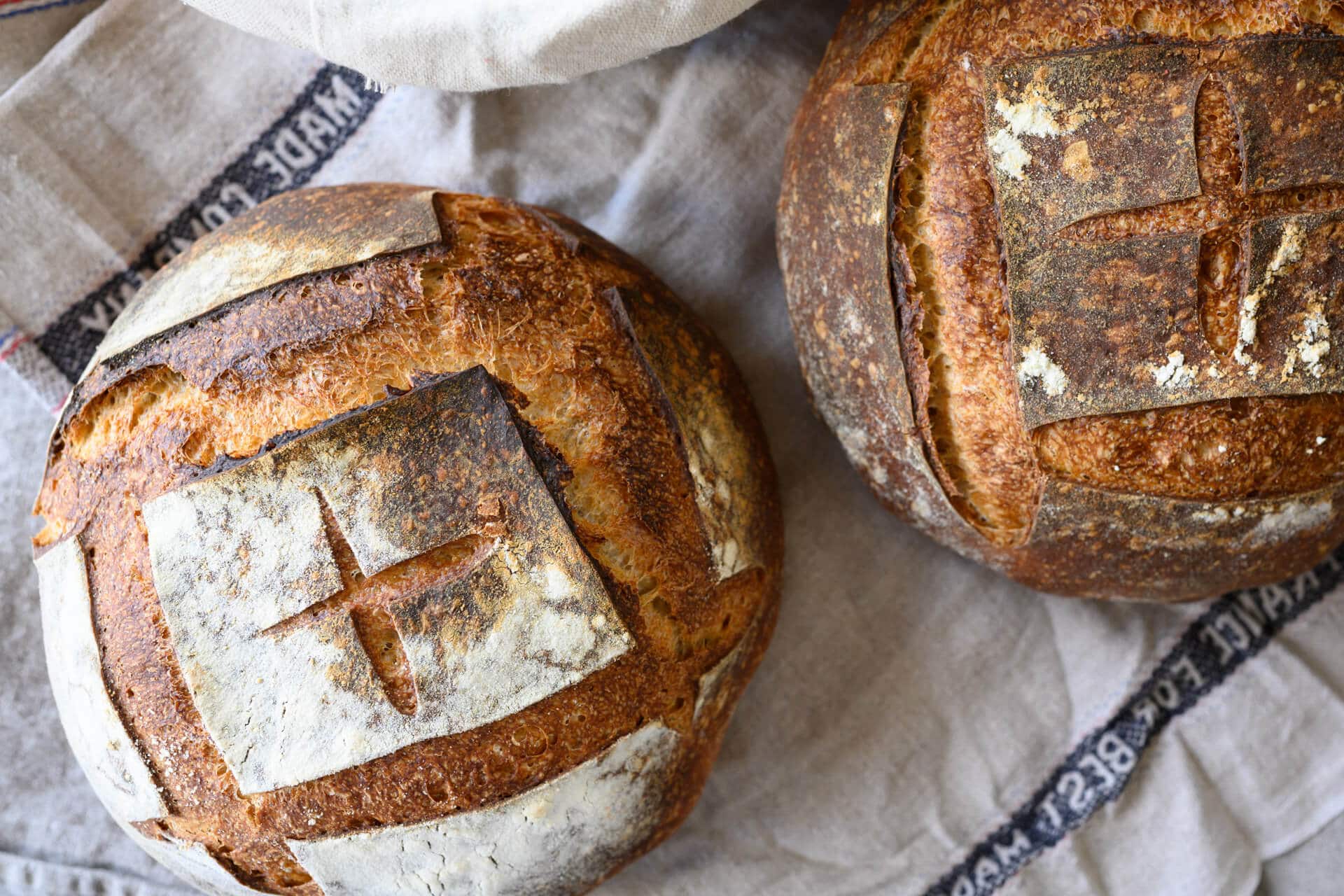
Baking a healthy and nourishing loaf of sourdough bread with your sourdough starter is gratifying, to be sure, but what if you’re not home all day to check in on the long-fermented dough? I mean, some of us do have to work, right? This simple weekday sourdough bread recipe and schedule are uncomplicated for mixing and baking a loaf of bread during the busy workweek.
This post includes pictures and videos that clearly and concisely convey the full sourdough bread-making process. But why is this recipe so easy compared to others?
Real Quick: Why is This Sourdough Bread Easy?
- It’s a no-knead sourdough bread recipe: mix everything in one bowl
- It uses only two types of flour: bread flour and whole-wheat flour
- It’s moderate hydration—no messy dough or counters
- It’s baked in a Dutch oven or combo cooker
- Timing is extremely flexible
Let’s go over the workweek schedule.
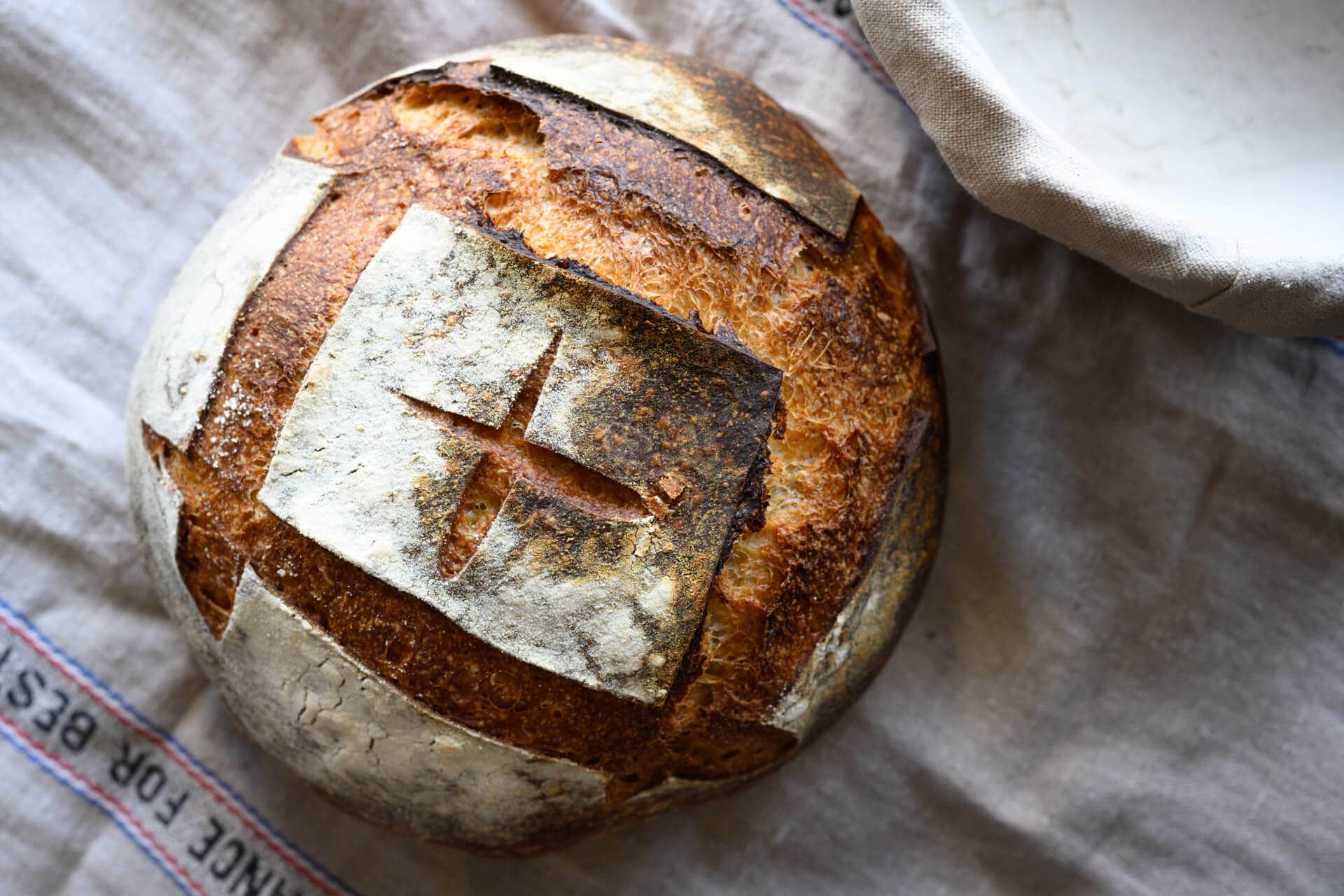
A simple weekday sourdough bread schedule
In the past, I’ve discussed a weekend baking schedule that outlines a schedule for low maintenance during the week with a bake on the weekend. The following schedule, however, allows baking during the week around a typical nine-to-five workday. It’s also quite flexible, and you always have the option to place the dough in the fridge longer to bake when you get a chance.
Read through my ultimate guide to dough proofing for more information on adjusting the proofing period for this sourdough bread.

| Time | Step |
|---|---|
| 7:00 a.m. (before work) | – Make the 10-hour levain (ready ~5:00 p.m.) – Save time later, scale-out flour & salt into bowls and cover |
| 5:00 p.m. (after work) | When levain ready, mix dough for autolyse |
| 5:30 p.m. | Finish mixing and begin bulk fermentation |
| 9:00 p.m. | Divide, pre-shape, and bench rest |
| 9:30 p.m. | Shape and place into the refrigerator to proof overnight |
| 7:00 a.m. (next day) | – Bake the next day before work – Alternatively, bake after work |
The schedule above has example times, so shift the timeline to earlier or later according to your schedule. Don’t worry if you don’t hit the times precisely as they’re written. There’s some flexibility there.
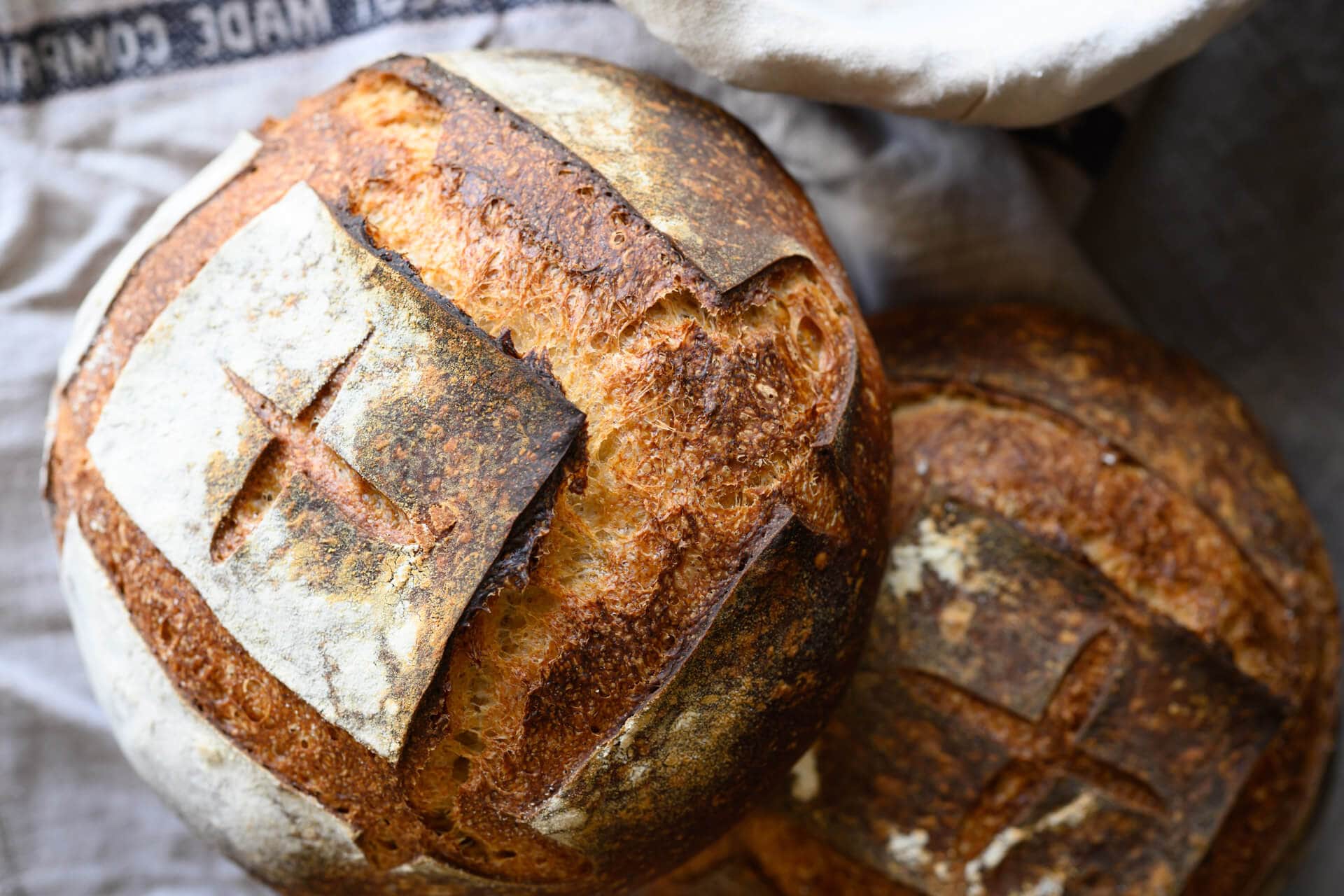
A Simple Weekday Sourdough Bread Recipe
Vitals
| Total Dough Weight | 1,800 grams |
| Pre-fermented Flour | 8.0% |
| Hydration | 76.0% |
| Yield | Two loaves |
Total Formula
The following table shows all the ingredients needed to make this bread. Each ingredient will be called out as needed in the method steps below.
My final dough temperature for this simple weekday sourdough bread was 75°F (24°C). For more information, see my post on the importance of dough temperature.
| Weight | Ingredient | Baker’s Percentage |
|---|---|---|
| 806g | High-protein white bread flour, malted (King Arthur Bread Flour) | 80.0% |
| 202g | Whole wheat flour (King Arthur Whole Wheat Flour) | 20.0% |
| 766g | Water | 76.0% |
| 19g | Fine sea salt | 1.9% |
| 8g | Ripe sourdough starter (100% hydration) | 0.8% |
Method
1. Prepare levain – 7:00 a.m., before work
A levain is simply an off-shoot of a sourdough starter. A sourdough starter is never used up completely; it’s continually fed day after day indefinitely. A levain is created with a small bit of a sourdough starter and left to mature (ferment) until ready to be mixed into a dough. Ultimately, it meets the same fate as the dough: baked in the oven.
In the morning before work, mix in a jar:
| Weight | Ingredient |
|---|---|
| 40g | Bread flour |
| 40g | Whole wheat flour |
| 81g | Water |
| 8g | Mature sourdough starter |
Loosely cover the jar; it should be ready after about 10 hours at room temperature, 72-75°F (22-24°C).
2. Autolyse with Levain – 5:00 p.m. after work
Performing an autolyse gives our dough a chance for the flour to fully hydrate and begin the gluten development process (all without kneading). I typically don’t do an autolyse with the levain included, but we’ll do that in this simple weekday sourdough bread recipe because it’s a short period.
Add all the ingredients below to a mixing bowl. Mix with wet hands until all the dry bits are incorporated. Cover and keep somewhere warm at room temperature for 20 minutes.
Note: the water in the table below is 50g less than the total water for this recipe; the water (and the salt) are held back for the next mixing step.
Dough Mix
| Weight | Ingredient |
|---|---|
| 766g | High protein bread flour, malted (King Arthur Bread Flour) |
| 161g | Whole wheat flour (King Arthur Whole Wheat Flour) |
| 635g | Water, Autolyse |
| 169g | Ripe levain (created in Step 1) |
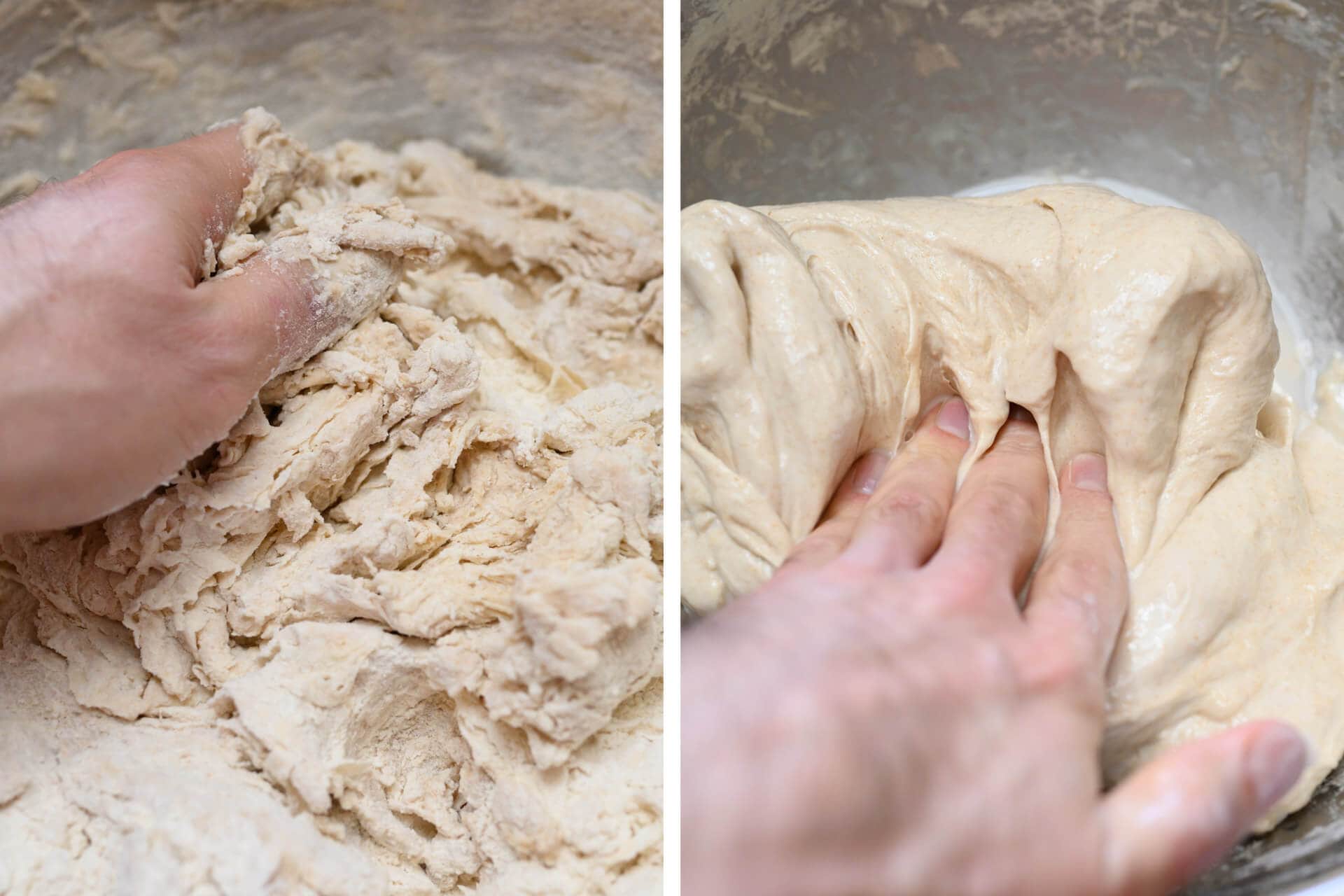
The image above shows the direct result of even a short autolyse. The left image shows the shaggy mass just before I finished incorporating everything. The right image shows how smooth and strong the dough becomes simply by resting. Let’s take this further with a little mixing.
3. Mix – 5:20 p.m.
Add the ingredients in the table below to the top of the dough: first, add the salt and then add the reserved water slowly to help dissolve the salt. Add the water a little at a time, depending on how the dough feels: it should be shaggy and loose, but not “soupy.” You can pause midway through pouring the water to incorporate it with a wet hand. If it feels like the dough can handle the rest of the water, add it all.
| Weight | Ingredient |
|---|---|
| 50g | Water, Mix (as needed) |
| 19g | Salt |
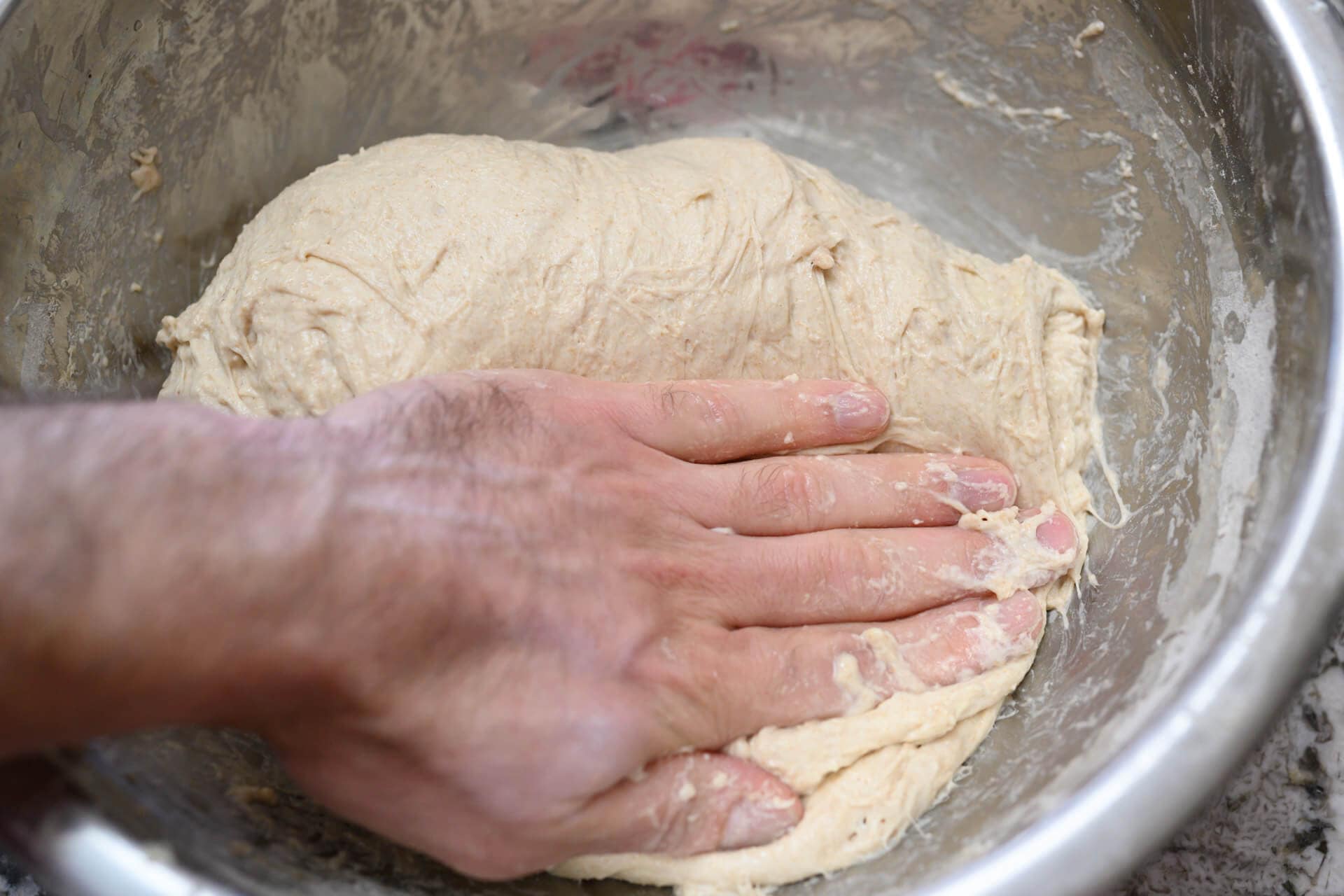
Since this dough uses a fair amount of high-protein white bread flour, it doesn’t require extensive mixing or kneading.
Using wet hands, mix everything until it comes together into a shaggy mass. This dough is rather strong and doesn’t require intensive mixing or kneading, but give it a few folds in the bowl, perhaps 5-10, until it smooths slightly (see the image, right).
Cover the bowl with reusable plastic and keep it somewhere warm in your kitchen for bulk fermentation.
3. Bulk Fermentation – 5:30 p.m. to 9:00 p.m.
Bulk fermentation, or first rise, occurs when the dough is leavened (through the production of carbon dioxide gas) and flavored (through the production of organic acids) as a result of natural fermentation. Below, you can see how much my dough rises during this 3-hour and 30-minute bulk fermentation at 75°F (24°C).
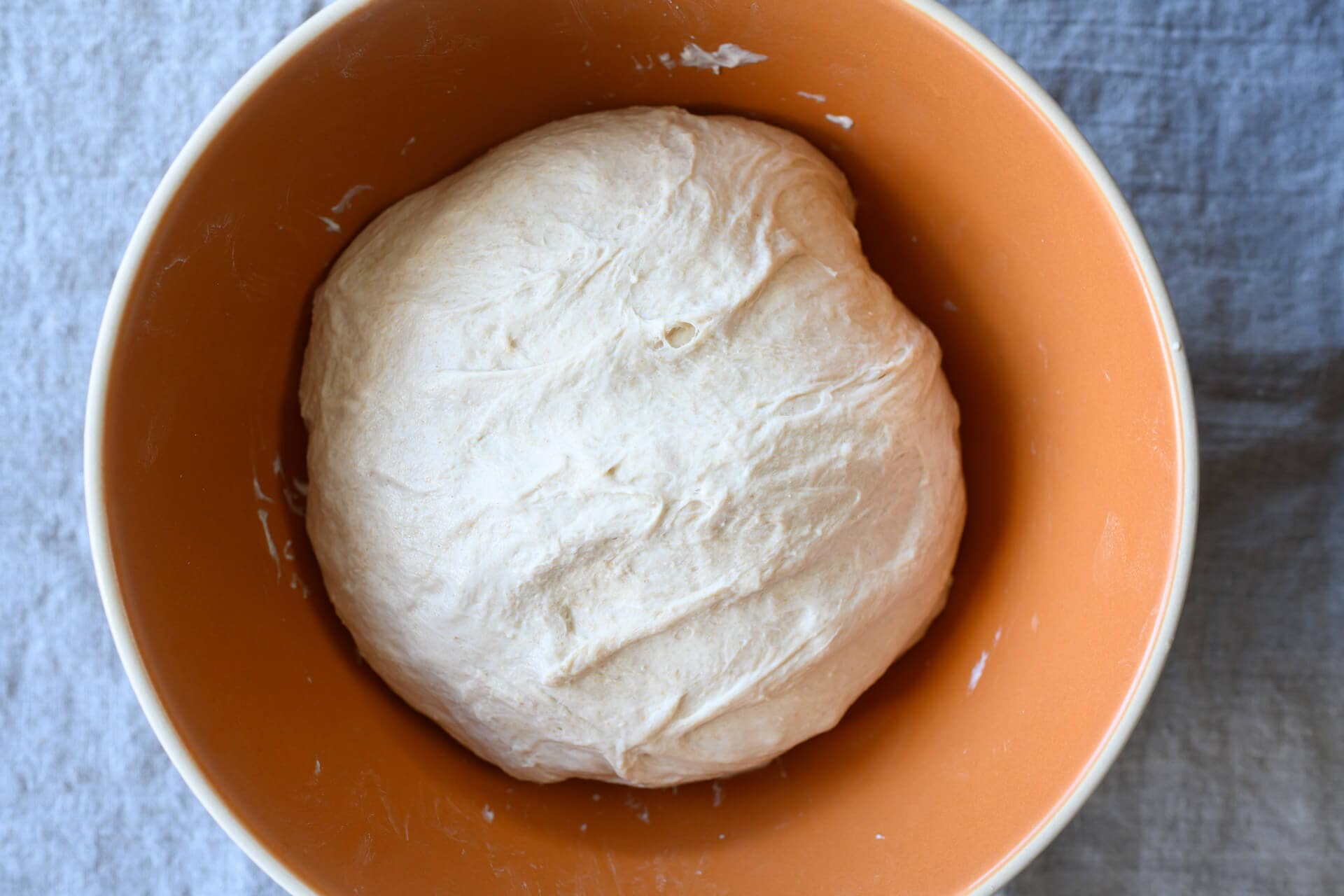
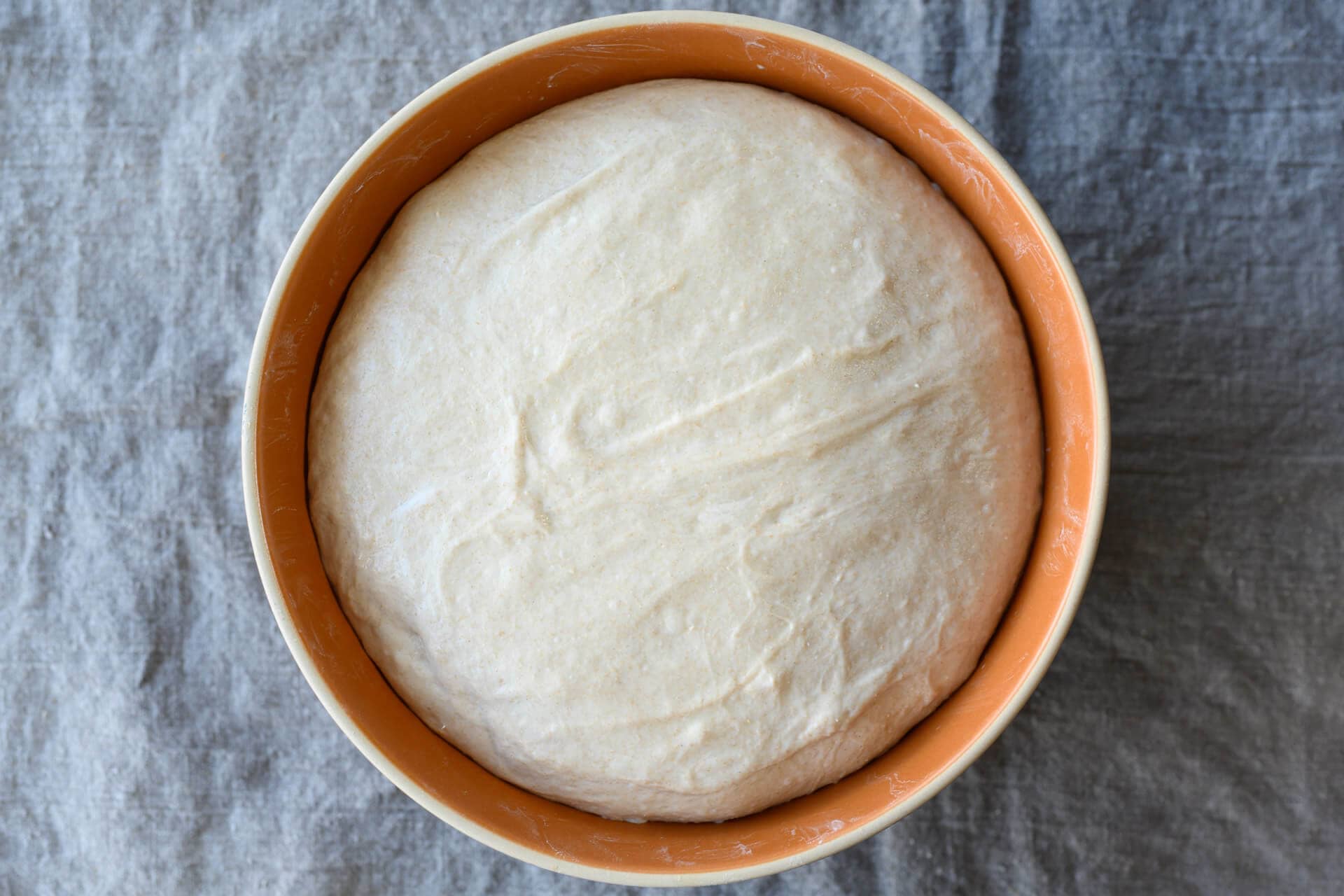
During this time, give the dough 2 sets of stretch and folds: the first set is 30 minutes after the beginning of bulk fermentation, and the second set is 30 minutes after the first. After the second set, let the dough rest, covered, until the next step.
As you can see in the video above, each set of stretches and folds is simple: With wet hands, grab one side and gently stretch it up and over to the other. Perform this fold in each direction: North, South, East, and West.
4. Divide & Preshape – 9:00 p.m.
Fill a bowl with some water and place it on your work surface. Scrape out your dough from the bulk container onto your dry counter. Divide the mass in half using a bench knife. Using a wet hand and the knife in the other, gently preshape each half into a loose round. Let the dough rest, uncovered, for 30 minutes until it’s relaxed outward.
See my guide to preshaping bread dough for a video and more instructions.
5. Shape – 9:30 p.m.
As seen in the video below, flour the top of the round with your hands and flip it over. Take the bottom edge and fold it up to about the middle. Take the left and right sides in your hands and fold the right over to about 2/3 of the left side. Repeat for the left side. Then, take the top and fold down to about the middle and gently seal. This should form a little envelope shape.
Now, flip over the entire thing and begin dragging and sealing the dough underneath itself (top-right, above). Using both hands, rotate and drag the mass toward you to create tension on the top. Repeat the dragging if necessary.
Read through my guide to shaping a boule for more instruction.
6. Proof – 9:45 p.m. to 7:00 a.m. or 6:00 p.m. (the next day)
Cover both proofing baskets entirely and put them in the fridge to proof overnight. The fridge allows us to slow fermentation to bake before or after work the next day.
7. Bake – 7:00 a.m. (pre-heat oven at 6:00 a.m.)
Preheat your oven with the rack at the bottom third to 450°F (230°C). Place your Dutch oven inside, with the lid and bottom side-by-side.
Take one basket out from the fridge and uncover it. Your dough might not have risen considerably in the fridge, but that’s fine. Cut a piece of parchment paper to fit over the basket and place a pizza peel (or large cutting board) on top. Using both hands, flip the entire stack over and remove the basket.
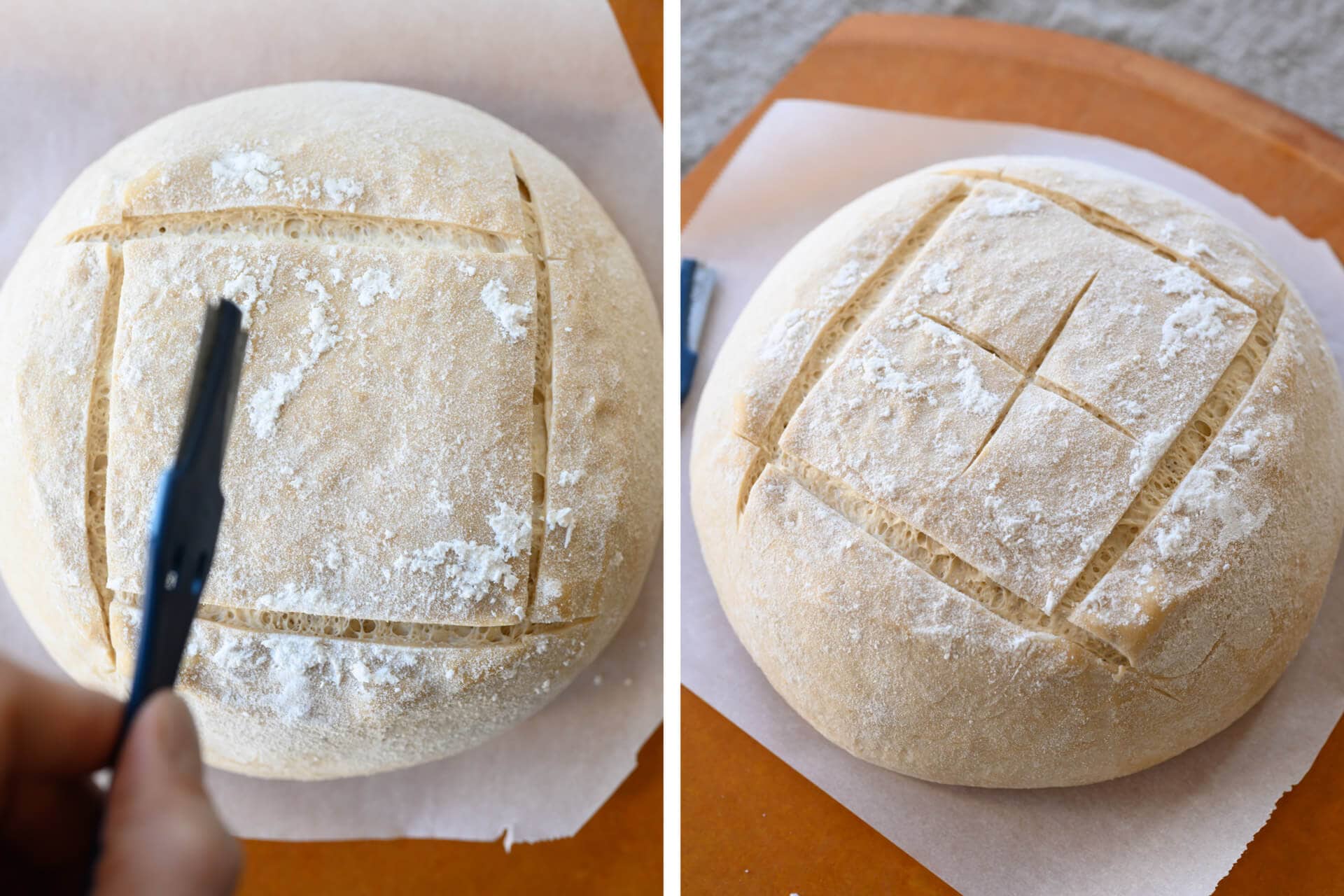
Score the dough using your favorite design. As you can see above, I love the “box top” score. Check out this video of me scoring this style (and a few others) below:
Now that your dough is scored, carefully slide it into the Dutch oven and bake for 20 minutes, covered.
After this time, remove the lid and bake for 30-35 minutes or until done. The internal temperature should be around 205-210°F (96-99°C).
(Note that If you’d like a thinner crust on this bread, increase the covered bake time to 30 minutes and reduce the second half of the bake (without steam) by 10 minutes. This increased baking time with steam can help reduce the thickness of the crust.)
Remove the loaf to a cooling rack for 2 hours before slicing. This lets the crust and crumb fully set and the flavor develop. Return the Dutch oven to the oven (without parchment) and bring it back to temp to bake the second loaf.
Follow my guide to storing sourdough bread to keep it fresh for the next week (or freeze it for longer!).
Print
Simple Weekday Sourdough Bread
- Prep Time: 24 hours
- Cook Time: 1 hour
- Total Time: 25 hours
- Yield: 2 loaves
- Category: Bread, Sourdough
- Cuisine: American
Description
A loaf of delicious sourdough bread designed around a busy workday. The levain is prepared for this bread in the morning and left to ripen while you’re at work. When you get home, continue with the baking process. The dough can then be baked at night or the next day in the morning, or after work.
Ingredients
Levain
- 40g bread flour
- 40g whole wheat flour
- 81g water
- 8g ripe sourdough starter
Main Dough
- 766g bread flour
- 161g whole wheat flour
- 19g salt
- 685g water
- 169g ripe levain
Instructions
- Levain (7:00 a.m. before work)
In a small container, mix the Levain ingredients and keep it at a warm temperature for 10 hours. - Autolyse with levain (5:00 p.m after work)
In a medium mixing bowl, add all of the levain, 766g bread flour, 161g whole wheat flour, and 635g water (50g was reserved for mixing, later) and mix until no dry bits remain. Cover the bowl and let rest for 20 minutes. - Mix (5:20 p.m.)
To the mixing bowl holding your dough, add 19g salt and some of the reserved 50g water (or all if the dough feels like it can handle it). Mix thoroughly and strengthen the dough for about 5 minutes. Using wet hands, mix everything until it comes together into a shaggy mass. This dough is relatively strong and doesn’t require intensive kneading (like slap and fold), but give it a few folds in the bowl, perhaps 5-10, until it smooths slightly. Transfer the dough to a bulk fermentation container and cover. - Bulk Fermentation (5:30 p.m. to 9:00 p.m.)
This dough will need 2 sets of stretch and folds during bulk fermentation, the first set 30 minutes after bulk fermentation begins. Perform the second set 30 minutes after the first, and then let the dough rest the remainder of bulk fermentation. - Divide and Preshape (9:00 p.m.)
Lightly flour your work surface and scrape out your dough. Using your bench knife, divide the dough in half. Lightly shape each half into a round shape. Let the dough rest for 30 minutes, uncovered. - Shape (9:30 p.m.)
Shape the dough into a round (boule) or oval (batard), then place the dough in proofing baskets. - Proof (9:30 p.m. to 7:00 a.m. or 6:00 p.m. the next day)
Cover proofing baskets with reusable plastic and seal shut. Then, place both baskets into the refrigerator and proof overnight. - Bake (The next day, bake at 7:00 a.m. before work, or 6:00 p.m. after work)
Preheat your oven with a baking surface or combo cooker/Dutch oven inside to 450°F (230°C). Remove your dough from the fridge, score it, and transfer it to the preheated baking surface or combo cooker. Bake for 20 minutes with steam. After this time, vent the steam in the oven or remove the lid (you can keep it in the oven or remove it) and continue to bake for 30 minutes longer. When done, the internal temperature should be around 204°F (95°C). Let the loaves cool for 2 hours on a wire rack before slicing.
Notes
- This recipe is wonderful left plain, or you could top the dough with rolled oats, white sesame seeds, or flax seeds.
If you use this recipe, tag @maurizio on Instagram so I can take a look!
What’s Next?
There you have it; this simple weekday sourdough bread can be made daily and adjusted to fit your schedule. Now, there’s no reason not to bake. This recipe is also a great place to experiment: mix 125g of nuts like walnuts and pecans and dried fruit like cranberries, cherries, or raisins.
Many recipes on my site can be adapted to this simple weekday sourdough bread schedule, most notably my Beginner’s Sourdough. Both recipes use flexible doughs, and the fridge provides even more.
For a more hands-off approach, check out my easy no-knead sourdough bread recipe. It can also be adapted to bake in a single day or ferment longer for an easier schedule.
Happy baking!


917 Comments
Love the flexibility of the schedule. One question though – do you take dough out of refrigerator when you start the oven (leaving dough to lose the chill) or do you wait until oven reaches 450 before taking out and scoring the loaf?
I almost always go straight from the fridge to the oven. The only instance I might deviate from this is if I felt the dough needed more fermentation time at warm temperature (but this is rarely the case since I push bulk fermentation quite far!). If you find your loaves are showing signs of under proofing (explosive rise in the oven, generally dense with large holes inside, etc.) try either bulking your dough 15-30 minutes longer or take them out in the morning and let them sit out while your oven preheats.
With experience you’ll get a feeling for the dough in the morning — you can always gently poke it on the surface to try and determine if it needs more time to proof or not. It should feel gassy, a little soft, and even a little “weak”. If it feels dense and lifeless, it might need more time. My best advice there is to try and keep things as consistent as possible from bake-to-bake and then try adjusting that proof to see how it affects the final bake.
I hope that helps, Phyllis!
I consistently am getting flatter loaves. The taste and crust are good, but cannot seem to get the dough to hold its shape after the overnight fridge proof. when it comes out of the bowl it flattens out again and ends up not very tall after baking. any suggestions?
It sounds like your dough might be over hydrated and/or under-strengthened. Try reducing the hydration by 5% (if doing this recipe) and give it another go — the reduced water should bring a lot of strength to the dough and you’ll feel it immediately. Once you find a suitable hydration, you can try to push it back up, but as you do, take note of how the consistency of the dough changes: the dough will start to slacken out as you add more and more water, this means you’ll likely have to mix more upfront or add another set or two of stretch and folds during bulk fermentation.
By the end of bulk fermentation your dough should be rather strong and shaping not too unruly — see my video above in this post, that’s a good example of a very strong dough!
Try to keep everything else as consistent as possible and let me know how the next attempt goes!
Dropped the hydration by 5% and possibly had some better shaping technique, but it rose so much more and the crumb is so much lighter. Great suggestions!
I’d like to express how much I love the scheduling graphic that you have on this post. It’s so helpful to be able to glance at the overall schedule in one spot.
Thanks for adding that!
You’re welcome, Rob! I’ll be including that on new write-ups as well — it’s nice to see at a glance. Happy baking!
Hello! I may just have to go down in the comments but… here I am. Is it possible to bake the entire loaf as one, instead of dividing it? Or to halve the recipe? Two loaves is great (don’t get me wrong) but to make this super convenient on a weekday just having to manage/bake one loaf might be easiest since I’m a super, super, super, super beginner….
Sure, you could do that. Just know the bake time will certainly need to be increased — bake it until it looks well colored on the outside and is around 205-210°F at the interior. Have fun!
Hi Maurizio,
Made today and added 100g cranberries and 200g toasted walnuts from your other recipe-didn’t have walnut oil, maybe next time. All other measurements from this recipe. It is fantastic. Very thin brittle crust, moist and flavorful. Best bread ever!
Thanks for reporting back, John! That’s one of my favorite combinations (with or without the walnut oil) — glad you got a great loaf! Enjoy 🙂
Hello,
thanks for this recipe. I will be testing it soon. If I dont get KAF flour in Germany. So just add 3-4g malt then?
If I want to play with Einkorn, Kamut or Emmer, would you just replace the whole wheat flour in the same proportion (20%)? Or do they lack too much gluten and require different percentages?
Btw, I noticed you took down the fermenter from your items list. Any particular reason? I got one just recently and after getting my mother in law to sew a cover to keep the heat in better I am quite happy so far.
Regards!
Phillip
You’re very welcome, Phillip! I’d likely do around 2-3g of malt, that should work. I”d say 20% with any will result is a really great loaf, but you’ll have to alter your expectations. Einkorn will lead to a slightly more squat loaf, but Kamut and emmer should likely be just fine. Regardless, they’ll be fun to experiment with and yield some really tasty bread!
I didn’t take my proofer off my baking tools! My B&T proofer is certainly one of my favorite tools for baking.
Hope that helps and happy baking, Phillip.
Ok, perfect. Thanks for the information. I will do some experimenting. With our son on the way I will soon get some additional time at home cooking for the family 🙂
Ahh, I overlooked the proofer. I am very happy and get much better rise due to the precise control. But I found I was wasting a lot of energy as the side parts have a lot of cracks. I also used it for 4 week black garlic making and therefore now have the cover for it.
Thanks again!
Congrats on the incoming baby! When I had each of my sons I had a little extra time at home so I was baking quite a bit… When I wasn’t super tired 🙂
Have fun!
Hi Maurizio,
I attempted this recipe today, my only downfall was that during the bulk fermentation I had to leave the house for a couple of hours and when I got back, my total bulk fermentation time ended up being 6 hours!
Nonetheless, I went ahead and shaped the loaf and it is now in the fridge doing its final proof. Wish me luck, this is my first sourdough loaf ever 🙈
Oh boy! That’s a long bulk, but it might be ok depending on the dough temperature. Hopefully it turned out ok!
Hello! I admire your efforts to educate others. I seek a clarification about your recipe: I get hydration of 77.9 % if all the water and flour in the starter are included, not 76%. I have experienced annoyingly damp crumbs with relatively high hydration even after baking 60 minutes and am apprehensive of this level!
That’s likely due to rounding errors, the hydration is 76%. Also, the levain is rounded up just a bit, to ensure there’s enough to cover the requirements. It sounds like your loaves have been over hydrated, though. I’d drop the hydration of this recipe by 5% and see how it goes, if it’s still too wet/slack/soupy, go down another 5% — that should help!
Hi Mauricio, is my first time working with sourdough, I think my hydration was too high, the dough was very sticky/wet despite the fact that I didn’t add the last 50gr of water when mixing, I have it in the oven let’s see how it comes out!
My oven is a convection oven and it has The option to add humidity in it, should I put, if yes what percentage of humidity?
Hey, Camila! I hope your loaf turned out great. Next time, try reducing the water a bit further to see if that helps (it will!). I’m not sure regarding the humidity option, I’ve never used anything like that. You really just want steam in the first 20 minutes or so of the bake, it should be pretty humid in there!
I’ve been trying a few of your recipes and giving the results to my friends or coworkers because I don’t have a big enough freezer 🙂
I have a question about the levain recipe here: based on the amounts to mix together, you would theoretically get only 164g, but the recipe calls for 165g of levain, and I can’t even get the whole 164g out of the container. How much of each ingredient should I actually mix?
Hah, I know how it is to have too much bread (I start making surprise visits to friends — they don’t mind!). it all gets eaten someway, though!
That’s due to a rounding error — I don’t put in sub-gram precision in the recipes here because most do not have a scale that’ll go that low, even if my calculations call for it. I’ll adjust the levain to cover it in the post. However, don’t worry too much about 1g, it won’t be a huge different at that scale. Just mix what’s called for and, when mature, get everything in that levain jar into the mixing bowl 🙂
Hi there! Quick question. You mentioned using KAF Bread Flour, malted. Are you adding diastatic malt (if so, how much) or are you saying that you use a particular type of bread flour that already contains it? Thanks!
Sorry for the confusion, I’ll fix that in the post. KAF BF already contains malt (if you check the ingredient list on the bag you’ll see it listed). So, don’t add anything, just use as-is!
Baked one loaf this morning. Sandwiches in time for lunch! Delicious!!!
Excellent, Susan! Glad to hear it — enjoy 🙂
I’ve always toyed with the idea of trying to make a weekday bake work, but all I ever did was make my loaves on the weekend, then bake 1-2 nights later. Now I’ll finally give it a shot- doing the entire process on weekdays. Thanks for taking the time to write this recipe for worker bees like me!
You bet, Dan! It is nice to have a go-to bread during the week. Happy baking 😀
Thank you for the weekday recipe! Made two loaves for friends! Wish I could send a picture!
Awesome, Donna! Happy to hear this worked out well for you. You can always email them over via the contact link on the About page. Either way, happy friends and happy baker — enjoy!
Hello Maurizio,
This schedule is perfect for me and I have a levain building this morning. I am wondering if you have any suggestions about how to use this schedule for your spelt, rye and wheat sourdough from your recent blog post?
Thanks for all the great advice and help you provide through your website.
Br,
Chris
Right on, Chris, glad to hear it. I think you could actually do something similar by adjusting the levain in that post to run a little longer so it matures while you’re at work. I have a 3-hour build for that bread which uses a 100% seed (by contrast the levain for this post is a 9% seed). I’d say try a levain with a 7-9% seed and see how it matures during the day while you’re at work. When you get home, proceed with the rest of that recipe as indicated. It should work quite well!
My lame never makes such clean cuts. It always seems to drag across the dough,even with a new blade. Is it my technique?
Hey, Lizzy! It might be that your dough isn’t shaped quite tight enough or, in a related way, lacks sufficient strength. Make sure when you shape the dough feels pretty taut on the counter, it should be nice and smooth when you place it into your proofing basket. If the dough is really weak and doesn’t have a smooth skin, it can drag if you don’t score fast.
Finally, when you cold retard (when your dough is proofed in the fridge) the dough, it also cuts much more cleanly because the dough is still cold and firm — this is one of the reasons I like to proof overnight in the fridge.
I recently posted a video of me scoring on Instagram, if you’re interested. You can see how the dough is smooth, taut, and the blade cuts through easily. It’s a fairly new razor in that lame, also.
I hope this helps!
Thank-you so much, Maurizio! I’ll try the overnight retard and see if that helps!
So I did the overnight retard, and not only did the dough come out of the basket much easier. it was also easier to score cleanly! Thanks so much for the suggestion!
Excellent, awesome to hear that. Thanks for reporting back, Lizzy. Enjoy!
What is the difference between doing 2 sets of stretch and folds vs 6 sets as in your best sourdough recipe? Do you get similar results or is this your second best sourdough recipe? LOL.
The more sets of stretch and folds the more strength you’re imparting on the dough. The differences with this recipe vs. my “best” is that this recipe uses much stronger flour (higher protein percentage) and has a significantly lower hydration. Because of these two things, the dough needs less strengthening, and thus less stretch and folds during bulk.
The results with this bread are quite different than my “best sourdough recipe” — that bread is more tender inside, more open, with a thinner, more gentle crust. BUT! Both are fantastic and nourishing recipes, just different 🙂
Thanks! I appreciate a recipe that won’t take up a whole Saturday…
Is the 7g in the leaving correct, or should it be 79g, equal to the water?
I think the amounts are correct as you’ll need 7g of starter to add to the 39g of bread flour, 39g of whole wheat flour, and the 79g of water. The total weight of the flours equal the weight of the water plus the 7g of mature starter. Hope that helps.
Yes, 7g is correct as @edimarcapella:disqus mentioned below!
Terrific post, thank you. Question, when you pull the loaves out of the fridge do you need to give them time to further proof or come to room temp? Or just go straight into the oven. Thank you!
Thanks, Linda! Almost always straight to the oven. The only time I would let them warm up is if I felt they were under fermented and needed more room-temperature proof time (rarely the case since I usually push bulk quite far!).
What about doing a “finger dent” test to see if they have fully proofed? My loaves didn’t rise much after my initial fold (I’m guessing due to a less than active starter) and the next morning they obviously haven’t risen more.
I’ll suggest that you put in a picture of your levain prior to your adding it to the main dough, just to show people how active it is.
The finger poke method can be a good indicator but it’s not a foolproof one, it can lead to false positives (especially if the dough has a high whole grain percentage and/or it’s still cold from the fridge). I do like to poke my proofed dough to get a feeling for where it’s at: does it feel gassy and light? Perhaps a little weak? Then it’s likely ready for the oven. If it feels very dense, no life to it, and the poke springs bake immediately, it’s likely not ready and needs more time.
I’ll work on that photo of the levain next time I bake this!
This is basically what I’ve been doing for the past few months, even when I bake on the weekend. I start the levain Friday morning before work, then I get home at 6pm and autolyse. It usually takes me longer for the bulk fermentation, and I end up putting them in the fridge to proof right around midnight, then I bake Saturday morning whenever i feel like waking up.
That’s great, Fred! This post — and similar to your comment as well — is what I almost always do when I can’t be home during the day. It’s a straightforward way to make sure you get baking done. Thanks for sharing that!
This is very, very similar to my weekday bread, with 20% levain, 2.2% salt and a 78% hydration. I use one round of lamination folds after the autolyse (this adds a little more water) and 1-2 rounds of gentle stretch and folds over the first 60-90 minutes of bulk and then sort of ignore it until shaping. After it gets in the basket I do like to let it hang at room temp for 30-60 minutes before retarding which results in a better crumb for me. It’s about fitting bread into my schedule rather than the other way around. Great post!
I do the same. Sometimes if I am in a real hurry, I leave it on the bench till it’s begun to rise again (skip the fridge altogether) and bake on the same day.
That’s a great approach also! If not too late, a same-day bake is wonderful as well. Thanks for sharing, Wendy 🙂
That’s exactly right, Jake! It’s all about fitting t he bread into your schedule! Your approach sounds great and shows one of the most important aspects about baking: responding to the dough and what it needs that day rather than following a recipe exactly. Baking almost always requires some measure of adjustment “in the field,” if you will. Thanks and happy baking!
What are you using for a bench knife in the ‘shaping boule’ video here? It appears to have a non-stick coating?
The knife is from Campbell at RackMaster and it’s just wonderful!
Do you recommend the 6″ or 8″?
I like the 8″ because I am usually dealing with large, 900g+ pieces of dough.
Heads up! I think “Your dough might not have risen considerably in the OVEN, that’s just fine.” should be “Your dough might not have risen considerably in the FRIDGE, that’s just fine.”
Fixed, thank you 🙂
This is great. Will help with my schedule. The bit about leaving in the refrigerator for longer apply to all of the recipes? If would really help if I could extend fridge time on some of the others.
It really depends on the recipe and, most importantly, the dough itself. If it looks and feels like it has some runway with fermentation and you won’t risk over proofing it, you can leave it in the fridge longer. I’ve found with a mostly-white recipe like this one it’s very flexible, but with doughs that have a higher percentage of whole grain that runway is shorter and much more delicate. The best thing to do, though, is test and see how it goes. Sometimes what I’ll do is keep one loaf to bake later and compare the results.
Hi Maurizo, Love your blog, thank you for the well written instructions.
In your experience how long can you wait to use the levain before you need to mix the dough? (before it starts to effect the quality of the final product)? e.g if I needed to mix 12 to 16 hours later, is it best to use less than 7g (as per this recipe) starter so it matures slower, or perhaps use cooler water.
What is the best variable to control the levain?
Thank you 🙂
You’re welcome, Ben, and thank you for the kind words.
There are two variables I use to control levain maturity most days: temperature and seed percentage (in this case the 7g). If you have a proofer you can use to control the temperature then you can warm or cool things to speed or slow the levain, respectively. Usually, however, I just modify the seed percentage and keep my levain warm in the proofer (so I don’t have to mess with the temperature much) or on the counter. Specifically with this recipe I kept it out of the proofer and on the counter, which was somewhere around 72-75F all day.
I find that I have an hour or so leeway with the levain, perhaps a little more with managed expectations: if I use the levain a little early expect bulk fermentation might take a little longer, which is fine, just be aware. Conversely, if I use it a little later and it has really fallen in the jar, expect that things will move faster. In my experience, using it later can result in a dough that’s a little unwieldily and can have a more dense interior if not adjusted for properly. In that case I might cut bulk short by 15-30 minutes depending on how it looks/feels, and things will be just fine.
Either way, it works and you’ll certainly end up with a fantastic loaf of bread! In your case, I might drop it down to 5-6g and see how the levain looks. If it’s fallen quite a bit drop it further next time. It’s a process of adjust and measure, adjust and measure. But that’s the fun, right? 🙂
Happy baking!
Another awesome post filled with great pictures, what an inspiration. That recipe is very close to what I usually bake during weekdays. It is very hard for me to complete the bulk fermentation before going to bed. So I put the dough in the fridge, wake up next day and leave at room temp for a couple of hours to complete the bulk fermentation, then shape and bake after work.
Thanks for the feedback, Guilherme! Yes, that’s a perfect modification as well. I find that if you do at least 2 hours of bulk fermentation at room temperature, the dough can go into the fridge at that point to finish later. I’ll collect all the feedback here and add this to the post. Thanks!
This comment and your reply were super helpful/relieving for me to read. After several years of baking (mostly guided by your recipes) I use plenty of discretion but sometimes I need some validation for my modifications! Thank you both
You’re welcome, Leah! Happy baking 🙂
I am relatively new to making sourdough bread. I love to try this recipe but need to use a KitchenAid mixer because I have arthritis. So, how long and at what setting should I used to mix all the ingredients?
A KA mixer will work well with this. Use the dough hook to incorporate everything on STIR at first. Once it’s together, I’d say mix until the dough starts to really grab around the hook and is lifting from the sides of the bowl. It might be anywhere between 3 and 6 minutes or so. That should do it!
Thank you. Much appreciated.
This recipe is a LIFESAVER. I’ve been using your Beginners Sourdough recipe for a few months now and have only ever done it on the weekend. Once, I tried on a Monday and literally took the dough to my office to do stretch-and-folds. My space heater kept my cubicle at a nice ambient temperature. This will be way more practical 🙂 I so appreciate your work!!
Ha ha, love that, Kel. I hear you, there have been times when I had to cancel lunch with a friend or skip other commitments because “I have to get home to turn my dough”! You’re very welcome, happy baking!
Hi! I’m so excited to try this out as I have a busy schedule and can never seem to manage sour dough during the week. A few questions!
-Can I substitute regular king Arthur flour for the bread flour?
-Will this recipe work well if I want to use more whole wheat or higher hydration?
-I have a ton of starter in My fridge – is there a way to use more of that already fermented starter in this recipe?
THANK YOU SO MUCH!
Awesome, Rachel. Answers:
– Yes you can use KAF All Purpose for this recipe if you’d like. In this case, you might want to add in another set of stretch and folds during bulk fermentation for a total of 3 sets (and even a 4th if the dough still feels very slack after the 3rd).
– You can definitely increase the whole wheat percentage (I’m working on a weekday whole wheat recipe, also!), just be sure to adjust the hydration up as needed and watch the dough during bulk, it’ll likely have increased fermentation activity with higher whole grain percentages.
– I wouldn’t use saved up starter discard in this dough, it’ll likely lead to a dense loaf. Instead, use that discard in any of my banana bread, waffle, or pancake recipes!
Hope that helps!
Hey Maurizio – Do you have any Crumb pics for this recipe? Just wondering how it looks like inside the loaf! Thank you!
Hey, Stéphane! I don’t, but I’ll bake this again soon and try to take some of the next loaf!
Thank you! And thanks for all of these recipes – they really are amazing!
You bet, happy to help — and of course, happy baking 🙂
I love your recipes – especially like the sound of this weekday sourdough bread. But, I can only tolerate Einkorn (which I grind myself) so, I’m constantly trying to adapt recipes! Looking forward to trying this method – and hoping you’ll tackle a “Weekday fresh ground Einkorn Sourdough” soon! Thanks!
Thanks so much, I really appreciate that. I have a few einkorn recipes up (check out my recipes page if you haven’t!) and a weekday einkorn loaf sounds great!
I have tried the Einkorn Sourdough Bread (you use Jovial all-purpose ) using my fresh ground; which (of course) yields a denser loaf; but still delicious!
Yes very true. I’ll work on a freshly milled einkorn loaf as well, I mill einkorn often here but haven’t yet used it at 100% of the flour. Enjoy!
You say the first stretch and fold is 30 minutes after the “beginning of bulk fermentation”.. when is the second? Thx in advance. can’t wait to try this.
Thirty minutes after the first set. I’ll update the post to make this more clear — thank you, Neal. Let me know how it goes!
thanks again. will do!
Question: I like a little rye flavor in my dough. How do you recommend inserting a little rye in the recipe?
I do like your format for this post. It’s so clear! I have been baking the Simple Sourdough recipe while also referencing the post of managing a weekend schedule. Now I can see it all one place! Plus that timing graphic is easy to understand.
I’d likely start with something similar to my beginner’s sourdough recipe and work in 5-10% whole grain rye into the recipe and reduce the whole wheat flour by 5-10% to compensate. In this recipe, to add 5% rye, you’d have: 735g bread flour, 138g whole wheat flour, 46g rye flour.
And thanks for the feedback on the post. I was waiting to hear what everyone thought of the changes, perhaps I’ll go this route in the future — and include the timing graphic as well.
Happy baking, Jason!
Thanks, Jason! I’d substitute in 5% rye for the white flour and see how that goes. My feeling is you’ll notice a flavor difference but the hydration shouldn’t change too drastically — you Might need a little extra splash of water but see how it feels and go from there.
There’s a copy/paste error in the description of bulk fermentation. You say “ the first set is 30 minutes after the beginning of bulk fermentation (at 1:35 p.m.)”, but I think you really meant 6:00 p.m., since the bulk fermentation of this schedule started at 5.
Fixed, thank you Tim!
Hey Mauricio, There is a typo under #7. It says preheat oven at 6 AM to bake at 7 PM. I think you meant preheat at 6 AM to bake at 7 AM, or preheat at 6 PM to bake at 7 PM. Thanks for all you do, and this recipe, which is making me rethink my weekend baking schedule to work during the week when we run out of bread. All the best!!
Ah yes, it’s now fixed, thanks for pointing that out! You’re very welcome, I’m glad to help. Let me know how it goes, this is my go-to method for baking when I can’t be around during the day 🙂
I don’t have 2 Dutch ovens, could I put both loaves in a big roaster with a lid? I have never make sour do bread before, so I am clueless. TIA
Yes, that’ll work quite well. As long as the loaves are trapped by the lid, steam will stay inside till you take it off. You could also bake one in the morning and one in the evening if you’d like.