

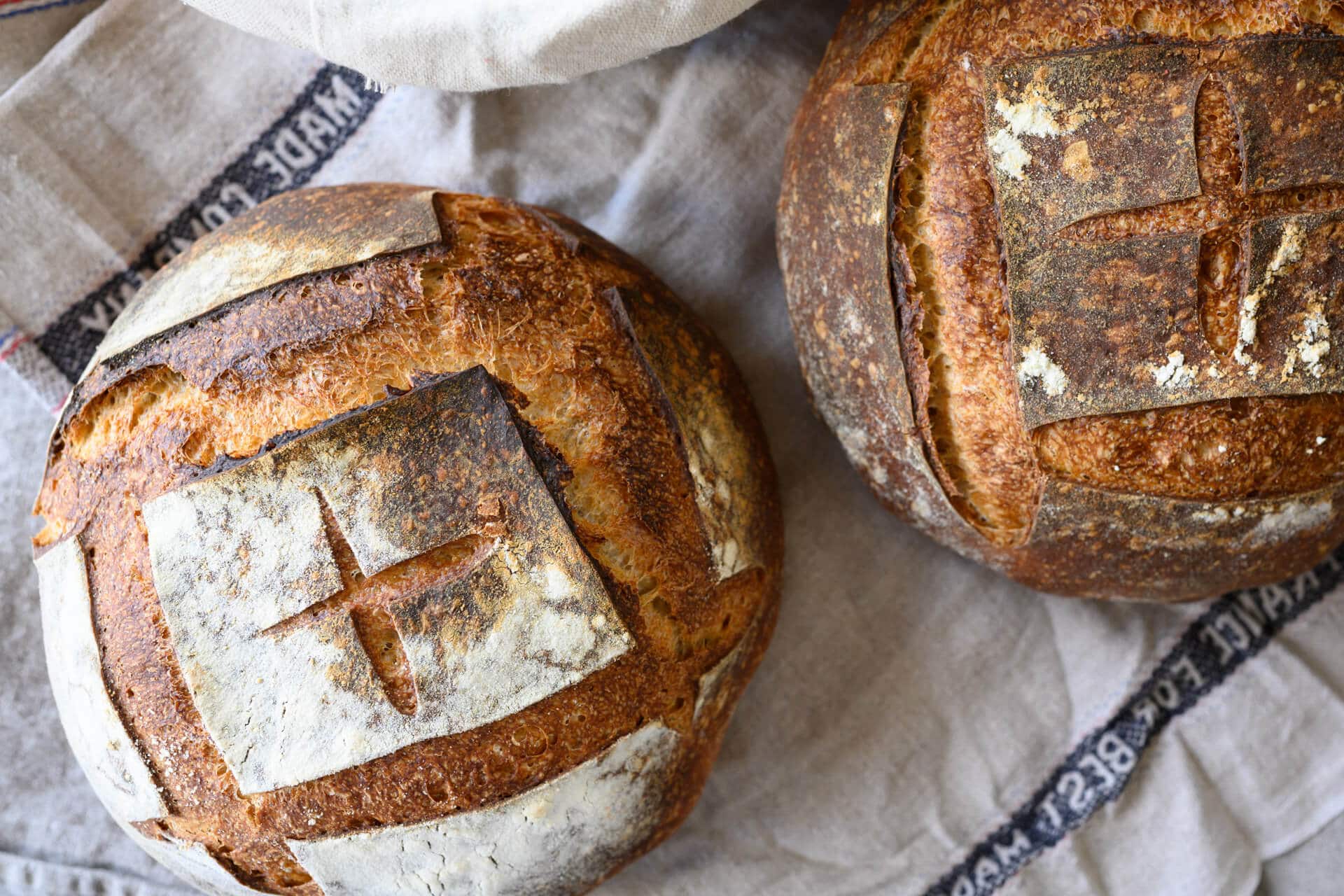
Baking a healthy and nourishing loaf of sourdough bread with your sourdough starter is gratifying, to be sure, but what if you’re not home all day to check in on the long-fermented dough? I mean, some of us do have to work, right? This simple weekday sourdough bread recipe and schedule are uncomplicated for mixing and baking a loaf of bread during the busy workweek.
This post includes pictures and videos that clearly and concisely convey the full sourdough bread-making process. But why is this recipe so easy compared to others?
Real Quick: Why is This Sourdough Bread Easy?
- It’s a no-knead sourdough bread recipe: mix everything in one bowl
- It uses only two types of flour: bread flour and whole-wheat flour
- It’s moderate hydration—no messy dough or counters
- It’s baked in a Dutch oven or combo cooker
- Timing is extremely flexible
Let’s go over the workweek schedule.
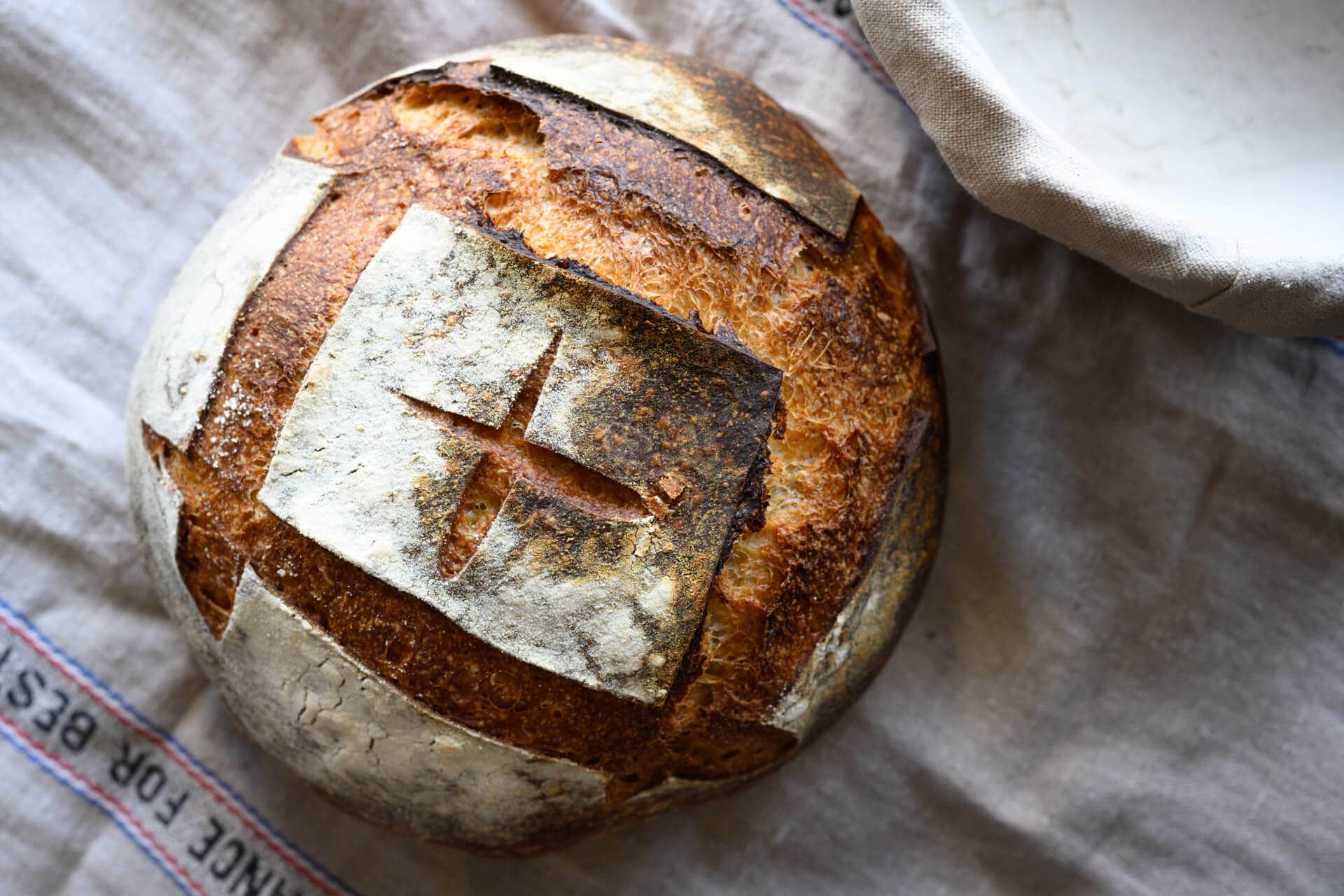
A simple weekday sourdough bread schedule
In the past, I’ve discussed a weekend baking schedule that outlines a schedule for low maintenance during the week with a bake on the weekend. The following schedule, however, allows baking during the week around a typical nine-to-five workday. It’s also quite flexible, and you always have the option to place the dough in the fridge longer to bake when you get a chance.
Read through my ultimate guide to dough proofing for more information on adjusting the proofing period for this sourdough bread.

| Time | Step |
|---|---|
| 7:00 a.m. (before work) | – Make the 10-hour levain (ready ~5:00 p.m.) – Save time later, scale-out flour & salt into bowls and cover |
| 5:00 p.m. (after work) | When levain ready, mix dough for autolyse |
| 5:30 p.m. | Finish mixing and begin bulk fermentation |
| 9:00 p.m. | Divide, pre-shape, and bench rest |
| 9:30 p.m. | Shape and place into the refrigerator to proof overnight |
| 7:00 a.m. (next day) | – Bake the next day before work – Alternatively, bake after work |
The schedule above has example times, so shift the timeline to earlier or later according to your schedule. Don’t worry if you don’t hit the times precisely as they’re written. There’s some flexibility there.
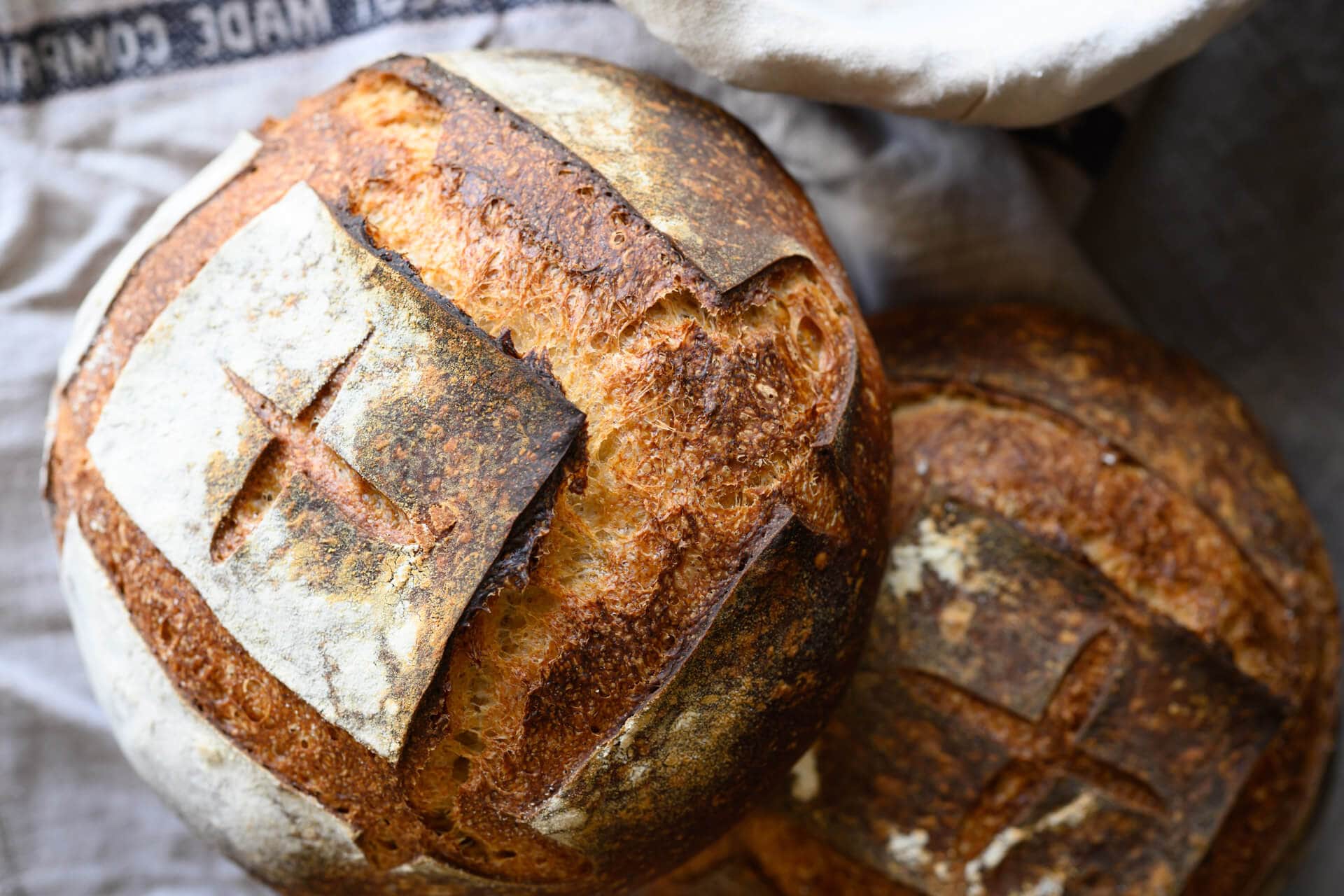
A Simple Weekday Sourdough Bread Recipe
Vitals
| Total Dough Weight | 1,800 grams |
| Pre-fermented Flour | 8.0% |
| Hydration | 76.0% |
| Yield | Two loaves |
Total Formula
The following table shows all the ingredients needed to make this bread. Each ingredient will be called out as needed in the method steps below.
My final dough temperature for this simple weekday sourdough bread was 75°F (24°C). For more information, see my post on the importance of dough temperature.
| Weight | Ingredient | Baker’s Percentage |
|---|---|---|
| 806g | High-protein white bread flour, malted (King Arthur Bread Flour) | 80.0% |
| 202g | Whole wheat flour (King Arthur Whole Wheat Flour) | 20.0% |
| 766g | Water | 76.0% |
| 19g | Fine sea salt | 1.9% |
| 8g | Ripe sourdough starter (100% hydration) | 0.8% |
Method
1. Prepare levain – 7:00 a.m., before work
A levain is simply an off-shoot of a sourdough starter. A sourdough starter is never used up completely; it’s continually fed day after day indefinitely. A levain is created with a small bit of a sourdough starter and left to mature (ferment) until ready to be mixed into a dough. Ultimately, it meets the same fate as the dough: baked in the oven.
In the morning before work, mix in a jar:
| Weight | Ingredient |
|---|---|
| 40g | Bread flour |
| 40g | Whole wheat flour |
| 81g | Water |
| 8g | Mature sourdough starter |
Loosely cover the jar; it should be ready after about 10 hours at room temperature, 72-75°F (22-24°C).
2. Autolyse with Levain – 5:00 p.m. after work
Performing an autolyse gives our dough a chance for the flour to fully hydrate and begin the gluten development process (all without kneading). I typically don’t do an autolyse with the levain included, but we’ll do that in this simple weekday sourdough bread recipe because it’s a short period.
Add all the ingredients below to a mixing bowl. Mix with wet hands until all the dry bits are incorporated. Cover and keep somewhere warm at room temperature for 20 minutes.
Note: the water in the table below is 50g less than the total water for this recipe; the water (and the salt) are held back for the next mixing step.
Dough Mix
| Weight | Ingredient |
|---|---|
| 766g | High protein bread flour, malted (King Arthur Bread Flour) |
| 161g | Whole wheat flour (King Arthur Whole Wheat Flour) |
| 635g | Water, Autolyse |
| 169g | Ripe levain (created in Step 1) |
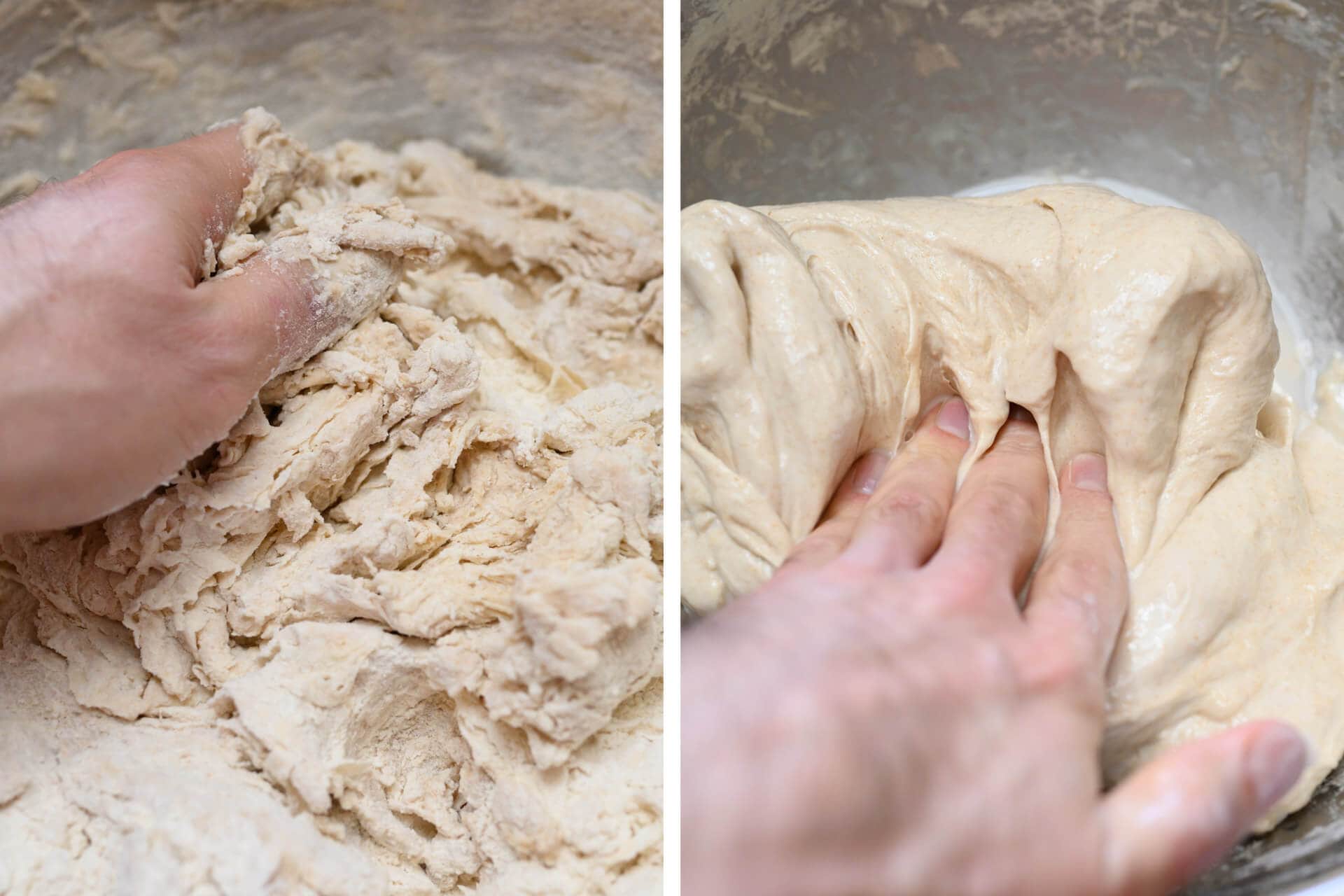
The image above shows the direct result of even a short autolyse. The left image shows the shaggy mass just before I finished incorporating everything. The right image shows how smooth and strong the dough becomes simply by resting. Let’s take this further with a little mixing.
3. Mix – 5:20 p.m.
Add the ingredients in the table below to the top of the dough: first, add the salt and then add the reserved water slowly to help dissolve the salt. Add the water a little at a time, depending on how the dough feels: it should be shaggy and loose, but not “soupy.” You can pause midway through pouring the water to incorporate it with a wet hand. If it feels like the dough can handle the rest of the water, add it all.
| Weight | Ingredient |
|---|---|
| 50g | Water, Mix (as needed) |
| 19g | Salt |
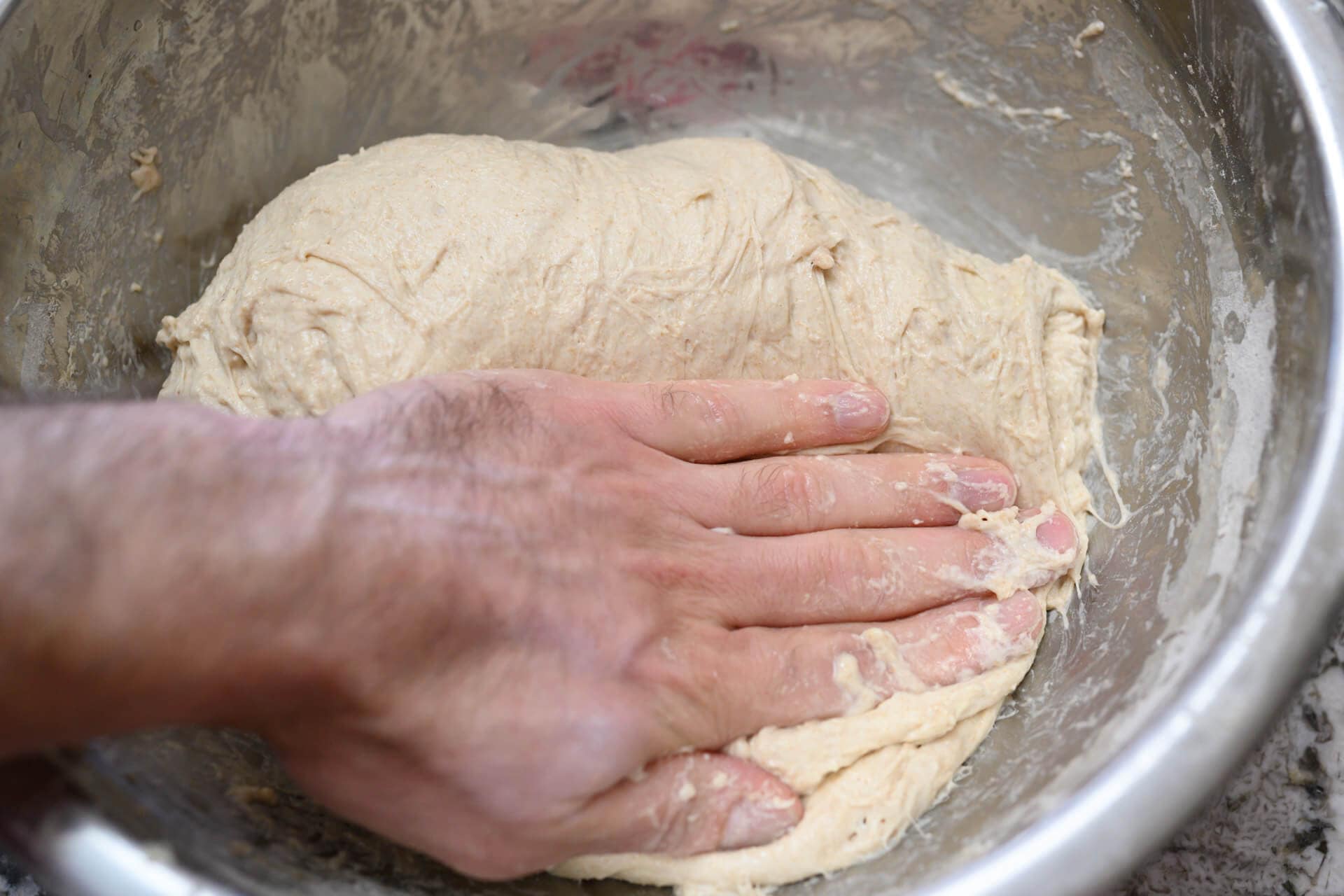
Since this dough uses a fair amount of high-protein white bread flour, it doesn’t require extensive mixing or kneading.
Using wet hands, mix everything until it comes together into a shaggy mass. This dough is rather strong and doesn’t require intensive mixing or kneading, but give it a few folds in the bowl, perhaps 5-10, until it smooths slightly (see the image, right).
Cover the bowl with reusable plastic and keep it somewhere warm in your kitchen for bulk fermentation.
3. Bulk Fermentation – 5:30 p.m. to 9:00 p.m.
Bulk fermentation, or first rise, occurs when the dough is leavened (through the production of carbon dioxide gas) and flavored (through the production of organic acids) as a result of natural fermentation. Below, you can see how much my dough rises during this 3-hour and 30-minute bulk fermentation at 75°F (24°C).
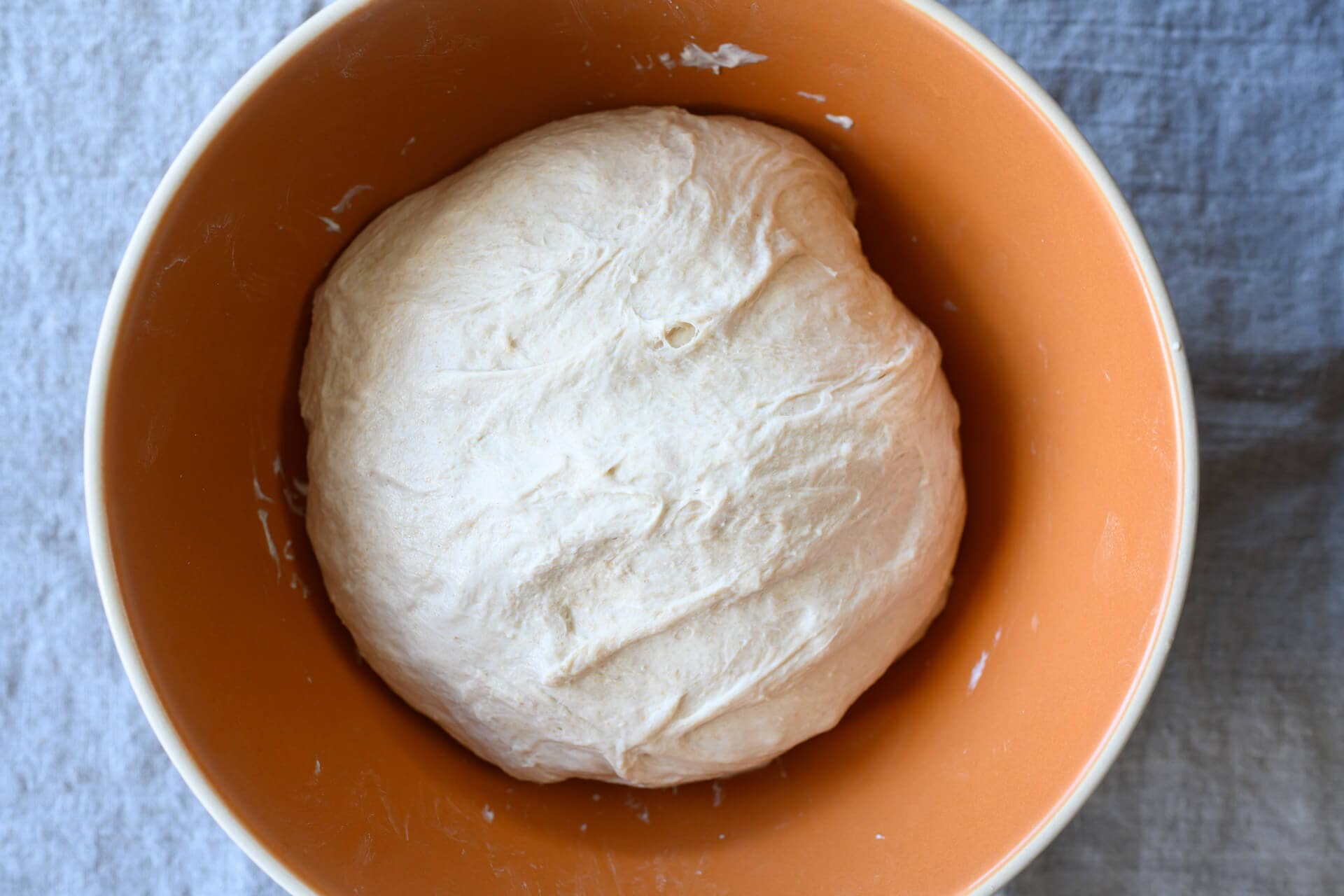
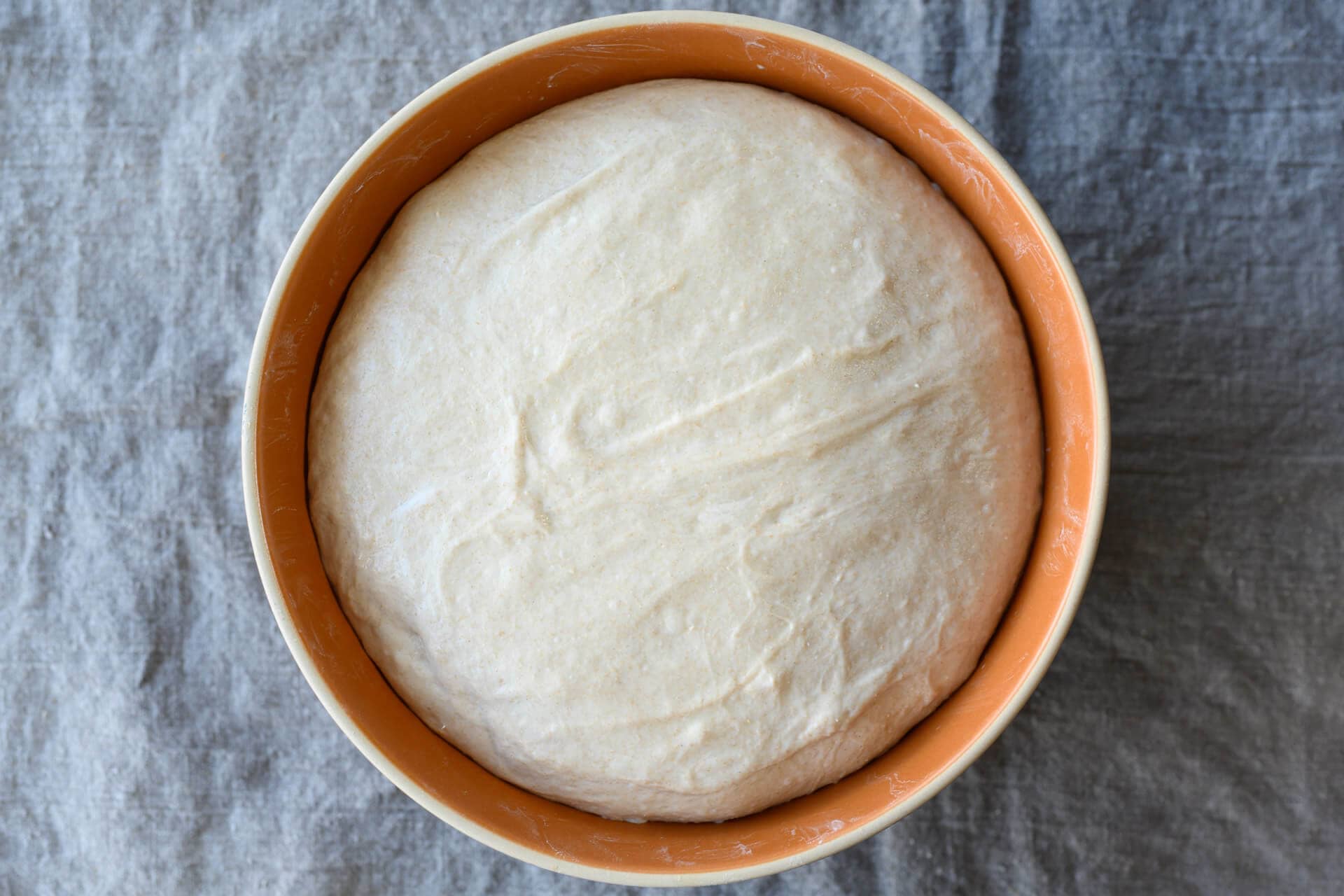
During this time, give the dough 2 sets of stretch and folds: the first set is 30 minutes after the beginning of bulk fermentation, and the second set is 30 minutes after the first. After the second set, let the dough rest, covered, until the next step.
As you can see in the video above, each set of stretches and folds is simple: With wet hands, grab one side and gently stretch it up and over to the other. Perform this fold in each direction: North, South, East, and West.
4. Divide & Preshape – 9:00 p.m.
Fill a bowl with some water and place it on your work surface. Scrape out your dough from the bulk container onto your dry counter. Divide the mass in half using a bench knife. Using a wet hand and the knife in the other, gently preshape each half into a loose round. Let the dough rest, uncovered, for 30 minutes until it’s relaxed outward.
See my guide to preshaping bread dough for a video and more instructions.
5. Shape – 9:30 p.m.
As seen in the video below, flour the top of the round with your hands and flip it over. Take the bottom edge and fold it up to about the middle. Take the left and right sides in your hands and fold the right over to about 2/3 of the left side. Repeat for the left side. Then, take the top and fold down to about the middle and gently seal. This should form a little envelope shape.
Now, flip over the entire thing and begin dragging and sealing the dough underneath itself (top-right, above). Using both hands, rotate and drag the mass toward you to create tension on the top. Repeat the dragging if necessary.
Read through my guide to shaping a boule for more instruction.
6. Proof – 9:45 p.m. to 7:00 a.m. or 6:00 p.m. (the next day)
Cover both proofing baskets entirely and put them in the fridge to proof overnight. The fridge allows us to slow fermentation to bake before or after work the next day.
7. Bake – 7:00 a.m. (pre-heat oven at 6:00 a.m.)
Preheat your oven with the rack at the bottom third to 450°F (230°C). Place your Dutch oven inside, with the lid and bottom side-by-side.
Take one basket out from the fridge and uncover it. Your dough might not have risen considerably in the fridge, but that’s fine. Cut a piece of parchment paper to fit over the basket and place a pizza peel (or large cutting board) on top. Using both hands, flip the entire stack over and remove the basket.
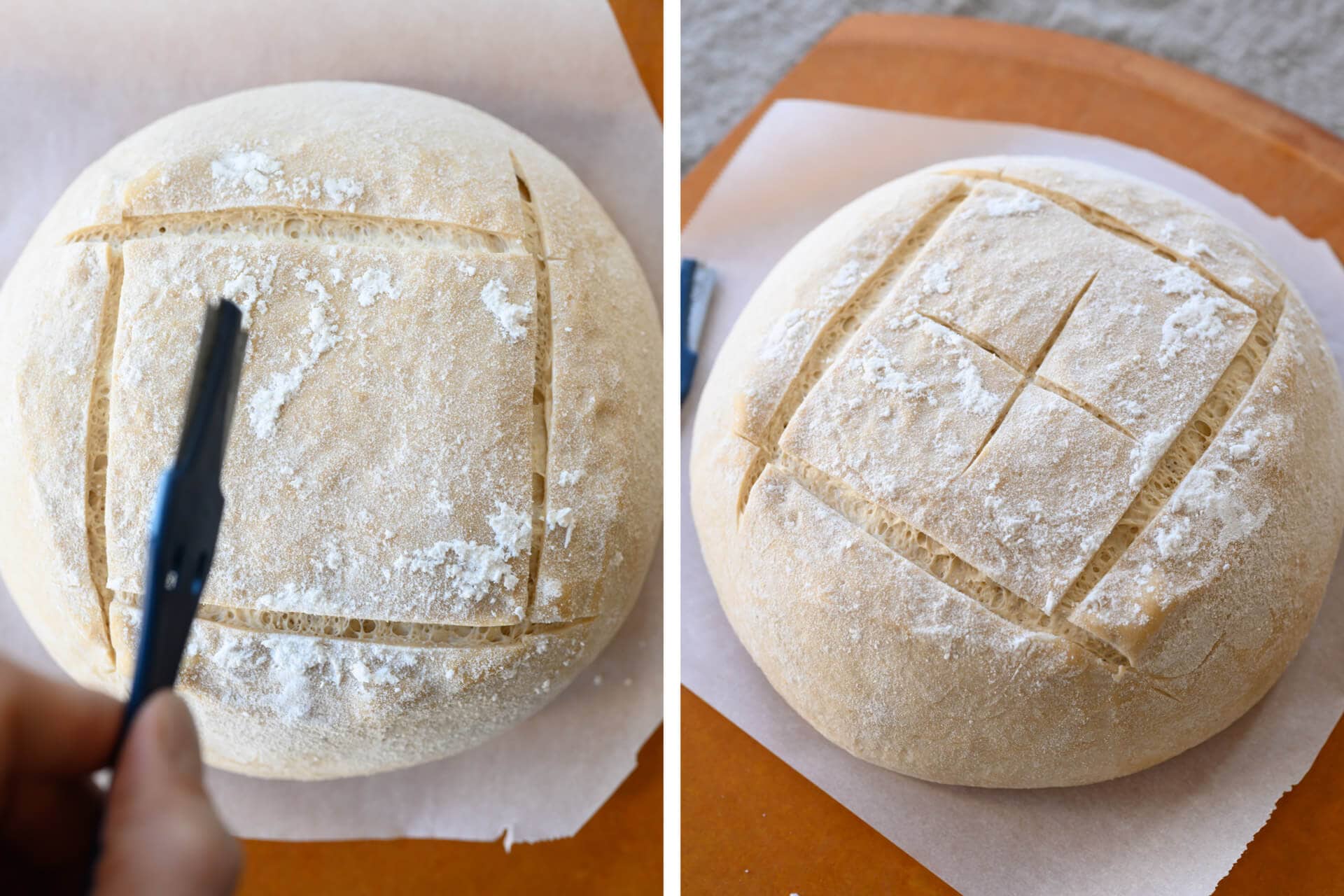
Score the dough using your favorite design. As you can see above, I love the “box top” score. Check out this video of me scoring this style (and a few others) below:
Now that your dough is scored, carefully slide it into the Dutch oven and bake for 20 minutes, covered.
After this time, remove the lid and bake for 30-35 minutes or until done. The internal temperature should be around 205-210°F (96-99°C).
(Note that If you’d like a thinner crust on this bread, increase the covered bake time to 30 minutes and reduce the second half of the bake (without steam) by 10 minutes. This increased baking time with steam can help reduce the thickness of the crust.)
Remove the loaf to a cooling rack for 2 hours before slicing. This lets the crust and crumb fully set and the flavor develop. Return the Dutch oven to the oven (without parchment) and bring it back to temp to bake the second loaf.
Follow my guide to storing sourdough bread to keep it fresh for the next week (or freeze it for longer!).
Print
Simple Weekday Sourdough Bread
- Prep Time: 24 hours
- Cook Time: 1 hour
- Total Time: 25 hours
- Yield: 2 loaves
- Category: Bread, Sourdough
- Cuisine: American
Description
A loaf of delicious sourdough bread designed around a busy workday. The levain is prepared for this bread in the morning and left to ripen while you’re at work. When you get home, continue with the baking process. The dough can then be baked at night or the next day in the morning, or after work.
Ingredients
Levain
- 40g bread flour
- 40g whole wheat flour
- 81g water
- 8g ripe sourdough starter
Main Dough
- 766g bread flour
- 161g whole wheat flour
- 19g salt
- 685g water
- 169g ripe levain
Instructions
- Levain (7:00 a.m. before work)
In a small container, mix the Levain ingredients and keep it at a warm temperature for 10 hours. - Autolyse with levain (5:00 p.m after work)
In a medium mixing bowl, add all of the levain, 766g bread flour, 161g whole wheat flour, and 635g water (50g was reserved for mixing, later) and mix until no dry bits remain. Cover the bowl and let rest for 20 minutes. - Mix (5:20 p.m.)
To the mixing bowl holding your dough, add 19g salt and some of the reserved 50g water (or all if the dough feels like it can handle it). Mix thoroughly and strengthen the dough for about 5 minutes. Using wet hands, mix everything until it comes together into a shaggy mass. This dough is relatively strong and doesn’t require intensive kneading (like slap and fold), but give it a few folds in the bowl, perhaps 5-10, until it smooths slightly. Transfer the dough to a bulk fermentation container and cover. - Bulk Fermentation (5:30 p.m. to 9:00 p.m.)
This dough will need 2 sets of stretch and folds during bulk fermentation, the first set 30 minutes after bulk fermentation begins. Perform the second set 30 minutes after the first, and then let the dough rest the remainder of bulk fermentation. - Divide and Preshape (9:00 p.m.)
Lightly flour your work surface and scrape out your dough. Using your bench knife, divide the dough in half. Lightly shape each half into a round shape. Let the dough rest for 30 minutes, uncovered. - Shape (9:30 p.m.)
Shape the dough into a round (boule) or oval (batard), then place the dough in proofing baskets. - Proof (9:30 p.m. to 7:00 a.m. or 6:00 p.m. the next day)
Cover proofing baskets with reusable plastic and seal shut. Then, place both baskets into the refrigerator and proof overnight. - Bake (The next day, bake at 7:00 a.m. before work, or 6:00 p.m. after work)
Preheat your oven with a baking surface or combo cooker/Dutch oven inside to 450°F (230°C). Remove your dough from the fridge, score it, and transfer it to the preheated baking surface or combo cooker. Bake for 20 minutes with steam. After this time, vent the steam in the oven or remove the lid (you can keep it in the oven or remove it) and continue to bake for 30 minutes longer. When done, the internal temperature should be around 204°F (95°C). Let the loaves cool for 2 hours on a wire rack before slicing.
Notes
- This recipe is wonderful left plain, or you could top the dough with rolled oats, white sesame seeds, or flax seeds.
If you use this recipe, tag @maurizio on Instagram so I can take a look!
What’s Next?
There you have it; this simple weekday sourdough bread can be made daily and adjusted to fit your schedule. Now, there’s no reason not to bake. This recipe is also a great place to experiment: mix 125g of nuts like walnuts and pecans and dried fruit like cranberries, cherries, or raisins.
Many recipes on my site can be adapted to this simple weekday sourdough bread schedule, most notably my Beginner’s Sourdough. Both recipes use flexible doughs, and the fridge provides even more.
For a more hands-off approach, check out my easy no-knead sourdough bread recipe. It can also be adapted to bake in a single day or ferment longer for an easier schedule.
Happy baking!


914 Comments
Hello,
In step four of the recipe, it states “mix thoroughly and strengthen for five minutes.” But in the introductory notes, strengthening for five minutes isn’t discussed. Do you mean something other than kneading? Mix by hand for five minutes? Let sit for five minutes? I’m not sure I follow. 🙂
Sorry about the confusion, I’ve updated the recipe card at bottom!
I’m still confused about this point.
Really loving this recipe! As a relatively novice bread baker, I’m curious about the consistency of my dough after proofing in the fridge. It seems to slacken slightly in that time, and when I turn it out of the banneton, it doesn’t have the same tension as when I put it in, leading to some subtle “ruffles” around the edge of the bread after baking (and not quite the oven spring I’m after). Is it possible that I haven’t shaped the dough well enough before the proof? Or could it be that the hydration is too high in my dough? Would love your thoughts, thanks!
Hey, Marja! It could be either, or both, of those things you mentioned. Slackening/relaxing of the dough during proofing is actually a good thing—to an extent (I talk about this in my guide to proofing). If you want less of that, shape it more tightly!
No, won’t hurt at all adding everything at the start!
I’m wondering if it is really only 8 grams of starter for the levain. Ratio seems off. And mine didn’t rise much in ten hours. But my banana bread from your recipe with discard sourdough was best banana bread I’ve ever made. Thank you
It’s 8g of starter that goes on to make the levain, which is essentially a scaled up starter that seeds fermentation in the bread. So yes, it is correct! Happy to hear the banana bread was a success! Enjoy, Colleen 🙂
The steps in this recipe are indeed flexible. I find it too difficult to follow the times of day as written (I don’t want my schedule to be ruled by a recipe but I do appreciate the timeline.) So I followed them loosely to see what would happen. The first day I completed step 4 and let it sit on the counter, covered, overnight. The 2nd day I completed step 7 (one loaf in a 9 inch banneton and the other in a 10.5 inch mixing bowl. (The one from the mixing bowl turned out better after baking than the other.) The 3rd day I baked the loaves as directed but not until early afternoon. The bread looked beautiful inside and out and tasted fantastic. The first truly professional sourdough loaf I’ve made!! By the way, I also live at altitude (6000 ft) and the bottom of the loaves are not burnt. I use a cast iron dutch oven (not coated with enamel) that I put in the oven when I turn it on. When the oven reaches temperature, I remove the first loaf from the fridge, place it on a piece of parchment paper, score it, put it in the hot dutch oven, and bake it exactly the amount of time stated in the recipe. When it’s done, I remove it and put the dough for the second loaf onto the same piece of parchment paper, score it, and place it into the same dutch oven and bake it. Thank you for this recipe!
I love your approach, Marianne! Flexibility is what I stress here, and yes, the timeline is there just as an aid. Happy your loaves turned out great and nice tips there with the baking to avoid over-burned areas!
May I know what is the size of the banneton for this bread ?
This is a 10-inch diameter basket!
Before I join a paying membership, I’ve followed the recipe to a tee. Just to let you know I live in America high altitude Utah near the mountains. I heat the cast iron pot up I have two layers of parchment dough, cover with lid cook according to directions remove lid finish. So why is the bottom of the bread burnt to a crisp, the rest of the loaf as shown in you picture s are to crisp burnt for me I like a nice brown loaf not a burnt loaf. Please help can I use artisan flour at all. Thank You please let me know what went wrong how I can prevent a black bottom cooked to the parchment paper.
Hey, Carla! It could be a few things, but typically when baking in a pot, you’ll get a darker bottom on your loaves. One solution is to preheat the pot for less time. Another solution is to carefully tip the dough out of the pot after about 30-35 minutes in the bake and finish baking it directly on the oven rack. This way, it has less contact with the super hot pot and won’t burn.
Check out guide to baking bread in a pot, it’ll have some other tips you can try as well!
Also, I live up at 5280ft here in Albuquerque!
Carla, I also live near the mountains in UT, but I’m at 4800 ft. I was having the same problem until I started using a cast iron trivet in the bottom of the cast iron DO. Never looked back, my bottom crust is as beautiful as the rest of my loaf. It was cheap, about $11 on Amazon.
What size Weck jars do you use for the starter?
Also, I have several sizes of Dutch ovens and I have no idea which to use.
Thank you so much for this blog
This Weekday Sourdough Recipe is my workhorse each week and I’ve used it for the last two years to make loaves that I gift and consume. I love the reliability of the product, the flexibility of the baking schedule, the crumb and taste of the finished loaves.
Thank you, Maurizio — for your recipes and your passion for bread and breadmaking!
Thanks so much for that message, William! I really appreciate that. So happy to hear my recipe has turned out so well for ya!
Is it me, or didn’t you use to have in the baking instructions to lower temperature down to like 350 for 30 minutes after the lid comes off? Now it says leave at 450?<
Oh, I remember. Use to be start at 500 then lower to 450
That’s right, Kevin! I start all my bakes now at 450F.
How do we get away with such a short bulk ferment? Is it because of the ratio of whole grain flour? I’m concerned about an underproofed loaf. Would this recipe work if it was entirely high protein bread flour alone?
Yes, it’s because of how much levain and whole grains there are in the dough. But as always, leave the dough as long as necessary to properly ferment for you! High protein BF will work, too.
How do you determine the % of levain to use in your various recipes?
You use different amounts for every recipe it seems.
You’re my bread guru. Such a great site and resource.
Thanks, Dake! I’m working on a post where I go into this into detail! Lots of factors 🙂
I am not new to baking, but I am very new to sourdough! So the one thing I want to be sure I understand about my starter: when I’m ready to bake I remove part of the starter to make the levain apart from the process of feeding the starter? Is that correct? So I will have the starter in one jar and the levain in another and I will feed them both?
Yes, that’s correct. Your levain will be made and used all in one bake, so you won’t need to feed it.
Hi Maurizio! My family has enjoyed many of your recipes. And I have loved all of your helpful instructions and tips as a new sourdough baker. We really like the flavor of the fifty-fifty whole wheat sourdough recipe. You mentioned that it could be easily adapted to the weekday schedule. Do I need to make any changes to the 50/50 recipe or do I just use the recipe and follow the timeline of weekday schedule? Thanks for all of your help!!
So glad to hear that, Raquel! I would use the same schedule, it will work with both doughs. Sorry for the delay!
Maurizio, I have quite a bit of starter in my fridge that I add to everyday from my smaller discard. Besides the waffles, pancakes, banana bread (which are all great) can I use this starter directly instead of making a levain? My starter I. The fridge always has a nice bubbles going on, it’s actually beautiful! Does it need to come to room temperature first? Thank you!
I do this as well, Barbara! I call it my starter “cache.” I would be hesitant to use it to leaven proper bread dough… Though I know it would work, it may not be in the best balance and at the strongest point for bread. I would say give it a try, I’m confident it’ll work, though may not be optimal! I would bring it to room temp first.
Thanks. I’ll give it a try.
Hi,
I’ve tried several of your beginner recipes. My doughs are more runny when compared to your photos and videos. Should i change the hydration or do more stretch and folds? I’ve tried to do several more stretch and folds plus one lamination, but the end result is the same. During proof it is sticky and runny and when i eventually score the bread it starts to spread from the sides so that a batard ends up looking like a boulle. Also, the struckture is sometimes chewy and very sour, almost 100% rye bread like. The flours here in the northernmost parts of Europe are different (10,8-12% protein, i’ve seen some imported to have 13%).
It sounds like your dough is most likely over hydrated—your flour likely isn’t able to take on quite a much water, and that’s ok! Try reducing the hydration by 5% and give it another go—the reduced water should bring strength to the dough and you’ll feel it immediately. Once you find a suitable hydration, you can try to push it back up (if desired), but as you do, take note of how the consistency of the dough changes: the dough will start to slacken out as you add more and more water, this means you’ll likely have to mix more upfront or add another set or two of stretch and folds during bulk fermentation.
Generally, with an increased hydration, you need to mix longer to develop the gluten in the dough to sufficiently support the water added, but this only goes so far. At some point, the flour you’re using just isn’t able to take on any more water and you’ll essentially have a weak and slack dough. It’s always best to start conservatively and work your way up with hydration as you feel out your flour. This is typically why I recommend holding back water during mixing, adding it in as the dough handles it.
Try to keep everything else as consistent as possible and let me know how the next attempt goes!
I love your site and recipes! Question about humidity. My kitchen is 10% humidity during winter. What should I do different? More water potentially? Crumbs are not great and I suspect it’s related.
Thank you!
Yes, increase hydration as necessary!
Today’s the day. I promised a loaf of SD to a friend, and I will see her tomorrow at 10 am. Meaning, I made the levain this morning, will mix, ferment, shape and proof tonight. The oven will preheat tomorrow at 6 am, bake at 7, cool until I leave. Thank you, the timeline helps me so much since I am still a newbie. I find I can do everything pretty well except plan how much time I need, apparently working backwards is a skill I need to learn). I know that will come with experience, but your ability to easily convey the “when” is a lifesaver.
It takes a bit of practice, this whole process, but you’ll build up an intuitive sense for how long each step will take and when the dough is “ready” over time!
The loaves were beautiful! I loved how the dough handled, and while I was a bit concerned about the tiny amount of starter in the levain, there were no issues when it came time to mix everything up. Thanks again, I am learning so much from you. To the point that when I’m on your site my family accuses me of watching sourdough porn! 😉
Wonderful, Patty! Ha ha, well, I’ll definitely take that as a compliment 🙂
Hi Maurizio,
Thank you for this resource! I have had a sourdough starter for a couple of years but have not yet had much success making bread with it – in fact, I think most of the output is pancakes, English muffins, a failed batch of crumpets and, recently, pikelets from your recipe on Food 52, which is what brought me here!
Somewhat ambitiously, I started with this recipe. I produced a very flat, very dense, sticky loaf of really delicious bread… I have some theories about what went wrong and would be so grateful for your thoughts!
1- my starter has always been fed exclusively with white flour, and my levain with the wholewheat didn’t rise very much before I added it to the dough
2- I accidentally added slightly more water than the recipe called for
3- I am terrible at judging volume and suspect that the dough didn’t increase sufficiently in volume in the bulk fermentation
4- At the end of bulk fermentation, after stretch-and-folds, although the dough was smooth it wasn’t particularly strong and didn’t hold the shape well on its own, and this was still true the following morning when I baked it
I’m wondering if the problem was more with the starter/levain activity, or a lack of gluten development, or both?
How would you go about switching from all-white to a mixture of flours for a starter? Elsewhere, it’s clear that a switch is possible, but going from 100% white to 50/50 in one go didn’t work very well!
Thank you again!
Louise
Hey, Louise! Welcome. A few answers:
1. Feeding with ww should be just fine!
2. Adding more water will definitely slacken out the dough.
3. It does sound like the dough was under proofed to me… That would lead to a gummy result.
4. This also makes me think over hydrated (too much water, mentioned in #2).
I would try reducing the water in the recipe by 5% to see if that helps. Also, be sure your starter and levain are nice and ripe before you use them, then, give the dough as much time as needed in bulk to become billowy and smooth.
No worries about switching flour in your starter/levain, it can be done at any point.
Let me know how the next attempt goes!
I just made my first loaves using this recipe and they turned out wonderful! Thank you!
Glad to hear that, Erica! Thanks for the comments and enjoy 🙂
Hi Maurizio,
Thanks for sharing this wonderful recipe. I have been baking it every week for the past 3-4 weeks now. I had question about the 10 hour levain build. I notice that it first rises for the first 6-8 hours and then falls slightly for the next 2-4 hours. I keep it in a room where the temperature is maintained at 24C. Is this rise-fall behavior expected? Should I proceed to autolyse when the levain is at its peak?
Yes, that behavior is expected. If you find it’s too ripe when you go to use it (very sour smelling, very loose consistency) you could use it earlier!
I usually do 2-3 hours for a warm proof like that. Expect a more mild flavor profile, and usually I see a thinner crust as well.
What’s the best way to have your sourdough starter ripe by 7am to start the levain process?
I would feed/refresh it the night before at 7-9 pm!
Thanks for this! Can’t wait to try it! Do you recommend resting dough at room temperature before baking (after fridge proof)? Also, any changes if using King Arthur AP flour?
No, you can bake straight from the fridge. Should work well with KA AP!
Hi, what fridge temp do you recommend? I’ve had some people tell me 60° F. But my fridge is 38° F. I could put them in the wine storage unit 🤷🏼♀️
Maurizio- A professional baker friend (@backdoorbread) referred me to your site. I learned from the NYT Cooking SD page, and now from you. Thank you for sharing your knowledge with us! IT is a true wealth of information, and generous of you to make it available. Your weekday recipe works so well for me. YES!
Thank them for me! So glad my site has helped, let me know how your baking is going—have fun 🙂
I was gifted starter and recommended to follow your blog. What can I substitute for proofing baskets etc since I don’t have those items?
I use my loaf pans and line it with a cotton towel to make boules (oval shapes), which is my preferred shape over a round loaf. I also role the shaped dough in rice flour before putting it in the loaf pan for proofing (or sprinkle the cotton towel with rice flower before putting the shape dough in loaf pan) to prevent sticking, but also to accentuate the scoring after baking.
Boules are the round loaves. Batard is oval.
Regular kitchen bowls lined with a clean kitchen towel will work just fine!
This guide is so helpful, so thank you. I was wondering if only the after shaping and during the proof if you could put the dough in the fridge. Could I stick the dough in there during any other part? Specifically, about the levain?
So glad it’s helped, Abby! Yes, after shaping, cover the dough in the baskets/bowls and place into the fridge overnight. No, I would not refrigerate the levain, you want that as strong as possible, and room temp (or warmer) is best there.
Is there a way to reduce the time taken in the levain build?
If you check out other recipes here at my site you’ll see I sometimes use a 3 or 5-hour levain build instead!
Is there a way to reduce the time taken in the levain build?
It sounds as though the final step before baking of putting the loaves in the refrigerator is to slow down things. But if you want to not slow things down, could you leave it out at room temperature and if so how much time should you take before you bake it?
Yes, you can absolutely proof them at room temp (around 1-3 hours, depending on temperature in kitchen) instead of proofing overnight in the fridge.
thanks for the information
I love this recipe, the timeline works for me and the bread has turned out delicious every time. Could I add a little olive oil to this dough? Thinking of a rosemary oil with some chopped fresh rosemary along with it would be really good!
Yes, you absolutely could!
Hey Maurizio!
I started out with your beginner recipe with much success! I recently switched to this weekday one and have been baking every week! I’ve been experimenting with it a bit but I feel that overall the dough is remaining quite flat throughout the process and not rising much in the fridge. (Especially comparing it to your bubbly photos above!) I realize its completely lacking that pillowy quality. My goal is more spring but I’ve noticed in my experiments that higher hydration with this time schedule = less spring. Could this be an issue of timing, temperature, hydration, or all of the above?! I really appreciate your tips and expertise! I will keep experimenting!
Thank you!
Natalie
That’s awesome, Natalie! Glad to hear you’re baking so often. Could be an issue with any of those, hard for me to nail it down without more details or photos. It’s ok if you don’t see the dough rise a lot in the fridge, but it should be pillowy and jiggly by the end of bulk fermentation. You want that dough to have significant fermentation at that point! This is a rather low hydration dough, but if it does feel very wet and sticky to you, try dropping the water a little bit (maybe just 2% or so) and see how it feels. That will definitely bring more strength to the dough.
Keep me posted!
Good morning Maurzio,
I have made this recipe about 6 times and I find the dough has a hard time keeping its shape even after the proofing. I don’t add any extra water during the autolyse step so my total water is 635g. Should I cut back even more on the water?
Thanks
Bob
Escondido CA
Hey, Bob! Yes, you can cut more water if necessary OR strengthen the dough some upfront using folds in the bowl (maybe 2-5 minutes or so). You can also try giving the dough another set or two of stretches and folds during bulk fermentation. Finally, be sure to shape it tightly!
Thanks so much Maurizio!
Hi Maurizio,
I’ve been making a version of this bread for the past year and it’s been amazing, thanks for your tutorials!
I have a general question about levains. This recipe uses a tiny amount of starter to build the levain over the course of a work day. If I increase the amount of starter, I assume it will decrease the build time of the levain, but will it have an effect on anything other than time? Just trying to see if I can schedule this bake a little differently and cut down on my overall timing. Appreciate it!
Hey, Andrew! It can change the dynamics of the levain depending on how much starter you’re keeping around, but generally, it should be fine to do this.
If you changed from something like a 10% inoculation (amount of starter added to the new levain build) to 50%, it can have flavor/performance implications in the final dough, not to mention it’ll speed up the levain ripening from about 12 hours to 5 hours, depending on the flour and temperature.
Hi Maurizio if I do not have inflatable baskets what can I use instead? And if I do not have bread flour what a substitute
If you don’t have any baskets you can use any mixing bowl in your kitchen lined with a clean kitchen towel. Instead of bread flour, use any “all-purpose” flour (essentially white flour that has around 11-12% protein or is suitable for bread-making).