

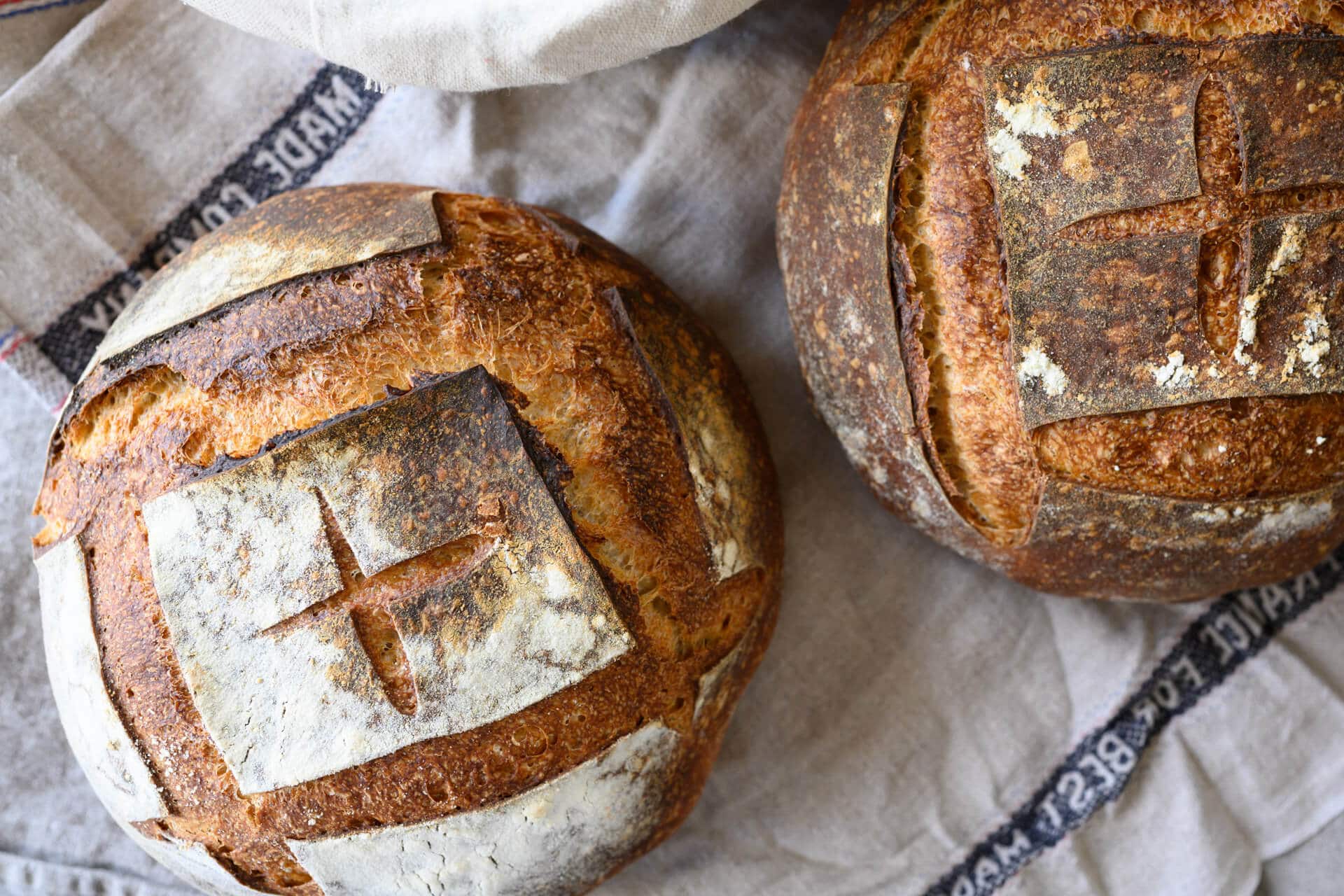
Baking a healthy and nourishing loaf of sourdough bread with your sourdough starter is gratifying, to be sure, but what if you’re not home all day to check in on the long-fermented dough? I mean, some of us do have to work, right? This simple weekday sourdough bread recipe and schedule are uncomplicated for mixing and baking a loaf of bread during the busy workweek.
This post includes pictures and videos that clearly and concisely convey the full sourdough bread-making process. But why is this recipe so easy compared to others?
Real Quick: Why is This Sourdough Bread Easy?
- It’s a no-knead sourdough bread recipe: mix everything in one bowl
- It uses only two types of flour: bread flour and whole-wheat flour
- It’s moderate hydration—no messy dough or counters
- It’s baked in a Dutch oven or combo cooker
- Timing is extremely flexible
Let’s go over the workweek schedule.
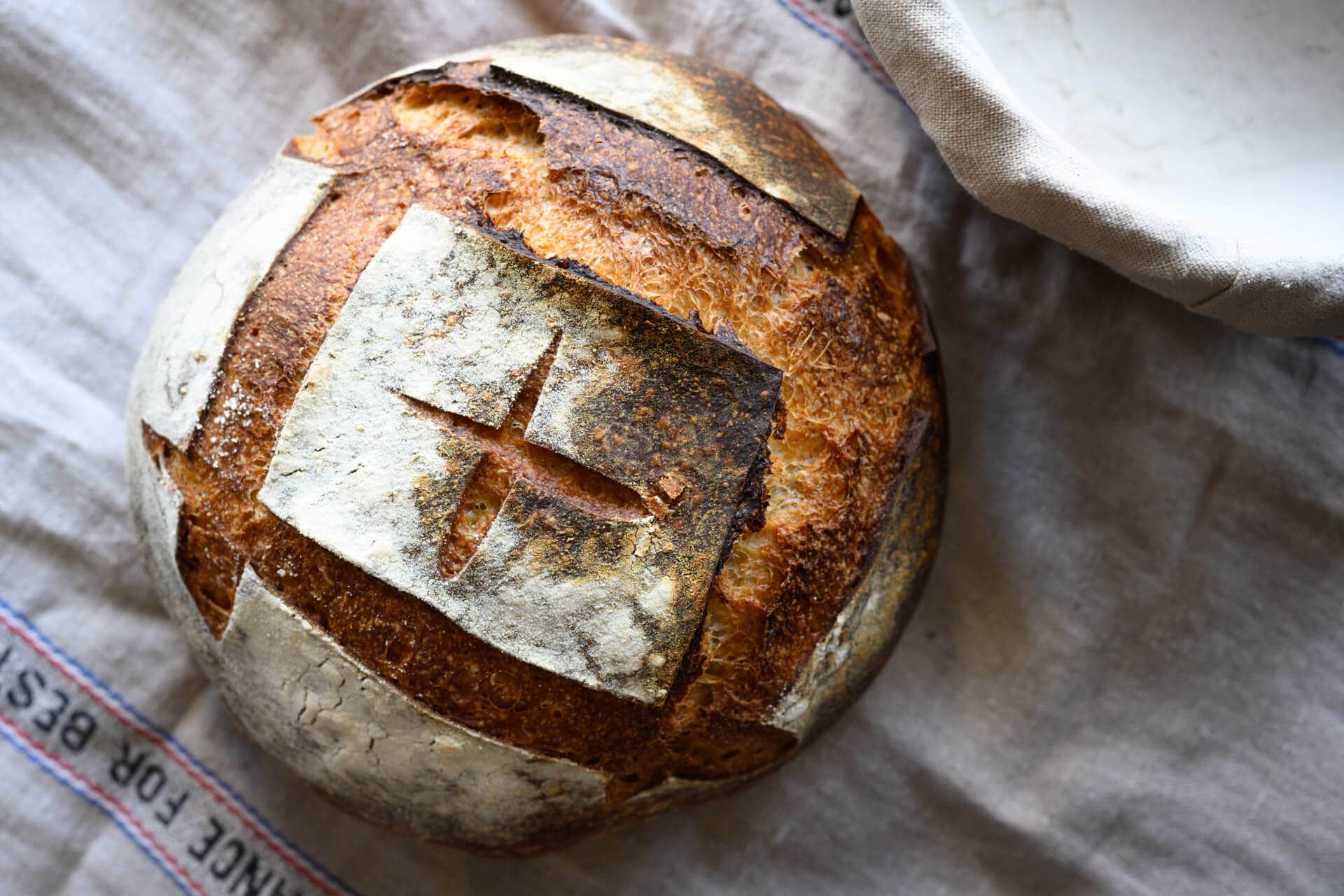
A simple weekday sourdough bread schedule
In the past, I’ve discussed a weekend baking schedule that outlines a schedule for low maintenance during the week with a bake on the weekend. The following schedule, however, allows baking during the week around a typical nine-to-five workday. It’s also quite flexible, and you always have the option to place the dough in the fridge longer to bake when you get a chance.
Read through my ultimate guide to dough proofing for more information on adjusting the proofing period for this sourdough bread.

| Time | Step |
|---|---|
| 7:00 a.m. (before work) | – Make the 10-hour levain (ready ~5:00 p.m.) – Save time later, scale-out flour & salt into bowls and cover |
| 5:00 p.m. (after work) | When levain ready, mix dough for autolyse |
| 5:30 p.m. | Finish mixing and begin bulk fermentation |
| 9:00 p.m. | Divide, pre-shape, and bench rest |
| 9:30 p.m. | Shape and place into the refrigerator to proof overnight |
| 7:00 a.m. (next day) | – Bake the next day before work – Alternatively, bake after work |
The schedule above has example times, so shift the timeline to earlier or later according to your schedule. Don’t worry if you don’t hit the times precisely as they’re written. There’s some flexibility there.
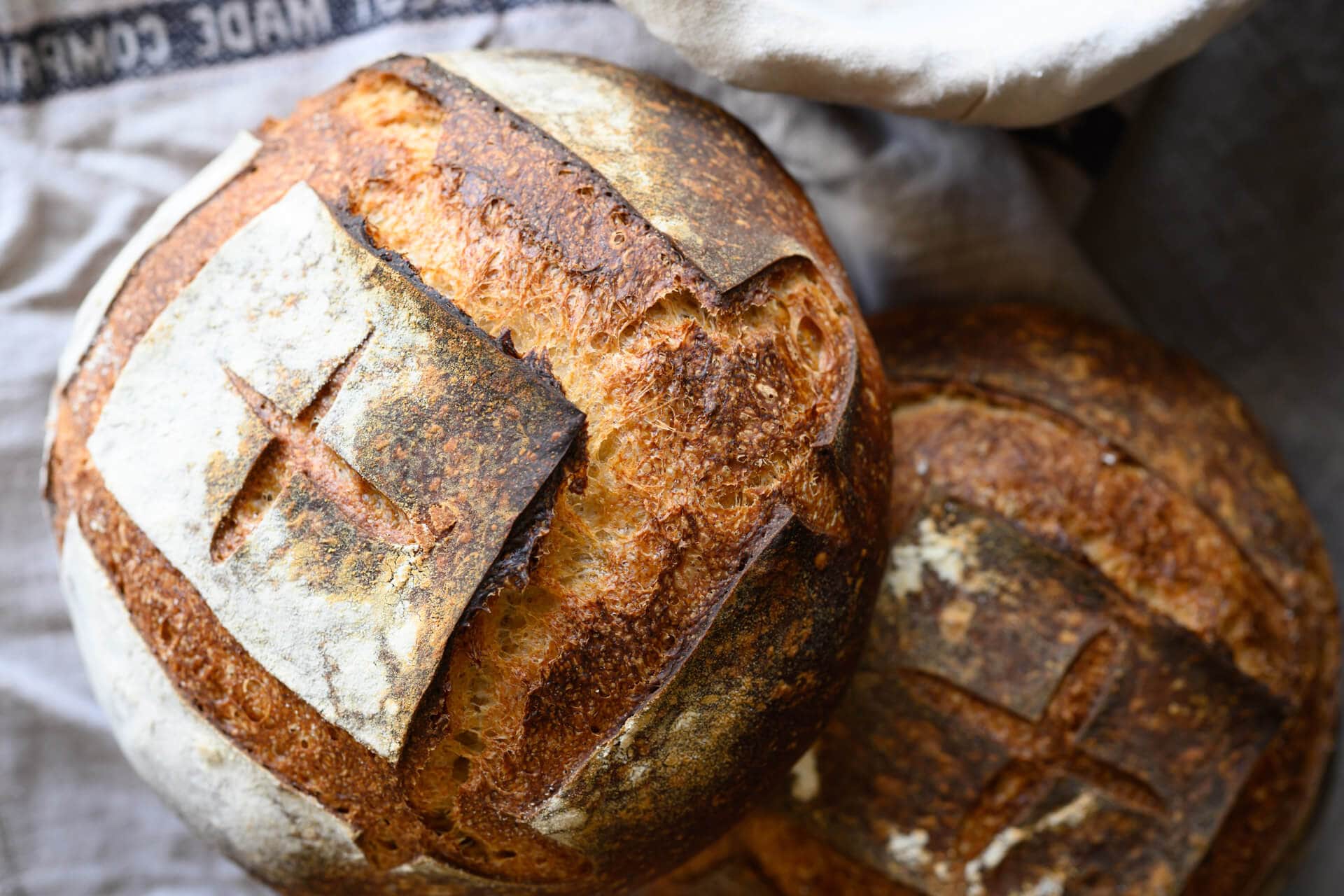
A Simple Weekday Sourdough Bread Recipe
Vitals
| Total Dough Weight | 1,800 grams |
| Pre-fermented Flour | 8.0% |
| Hydration | 76.0% |
| Yield | Two loaves |
Total Formula
The following table shows all the ingredients needed to make this bread. Each ingredient will be called out as needed in the method steps below.
My final dough temperature for this simple weekday sourdough bread was 75°F (24°C). For more information, see my post on the importance of dough temperature.
| Weight | Ingredient | Baker’s Percentage |
|---|---|---|
| 806g | High-protein white bread flour, malted (King Arthur Bread Flour) | 80.0% |
| 202g | Whole wheat flour (King Arthur Whole Wheat Flour) | 20.0% |
| 766g | Water | 76.0% |
| 19g | Fine sea salt | 1.9% |
| 8g | Ripe sourdough starter (100% hydration) | 0.8% |
Method
1. Prepare levain – 7:00 a.m., before work
A levain is simply an off-shoot of a sourdough starter. A sourdough starter is never used up completely; it’s continually fed day after day indefinitely. A levain is created with a small bit of a sourdough starter and left to mature (ferment) until ready to be mixed into a dough. Ultimately, it meets the same fate as the dough: baked in the oven.
In the morning before work, mix in a jar:
| Weight | Ingredient |
|---|---|
| 40g | Bread flour |
| 40g | Whole wheat flour |
| 81g | Water |
| 8g | Mature sourdough starter |
Loosely cover the jar; it should be ready after about 10 hours at room temperature, 72-75°F (22-24°C).
2. Autolyse with Levain – 5:00 p.m. after work
Performing an autolyse gives our dough a chance for the flour to fully hydrate and begin the gluten development process (all without kneading). I typically don’t do an autolyse with the levain included, but we’ll do that in this simple weekday sourdough bread recipe because it’s a short period.
Add all the ingredients below to a mixing bowl. Mix with wet hands until all the dry bits are incorporated. Cover and keep somewhere warm at room temperature for 20 minutes.
Note: the water in the table below is 50g less than the total water for this recipe; the water (and the salt) are held back for the next mixing step.
Dough Mix
| Weight | Ingredient |
|---|---|
| 766g | High protein bread flour, malted (King Arthur Bread Flour) |
| 161g | Whole wheat flour (King Arthur Whole Wheat Flour) |
| 635g | Water, Autolyse |
| 169g | Ripe levain (created in Step 1) |
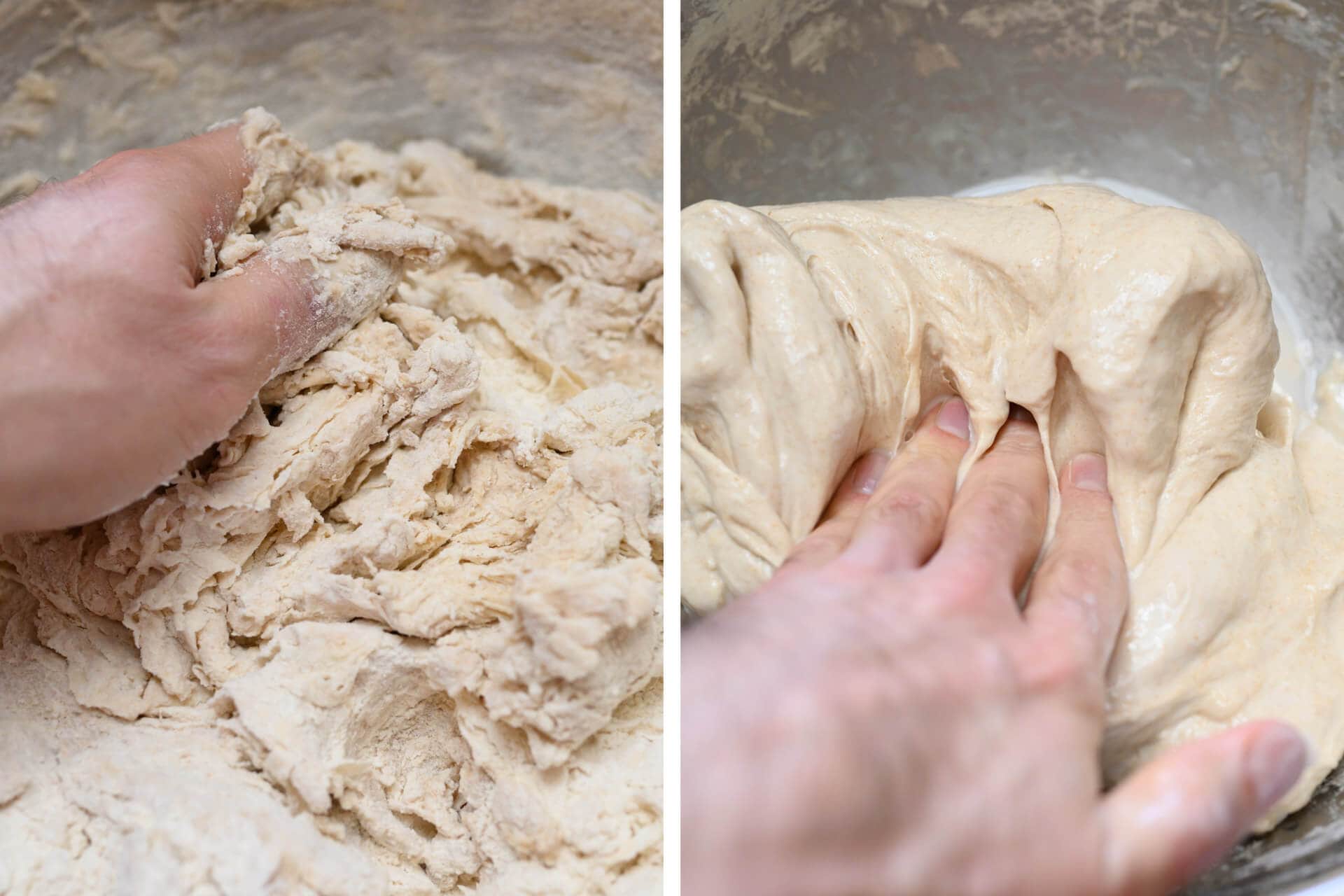
The image above shows the direct result of even a short autolyse. The left image shows the shaggy mass just before I finished incorporating everything. The right image shows how smooth and strong the dough becomes simply by resting. Let’s take this further with a little mixing.
3. Mix – 5:20 p.m.
Add the ingredients in the table below to the top of the dough: first, add the salt and then add the reserved water slowly to help dissolve the salt. Add the water a little at a time, depending on how the dough feels: it should be shaggy and loose, but not “soupy.” You can pause midway through pouring the water to incorporate it with a wet hand. If it feels like the dough can handle the rest of the water, add it all.
| Weight | Ingredient |
|---|---|
| 50g | Water, Mix (as needed) |
| 19g | Salt |
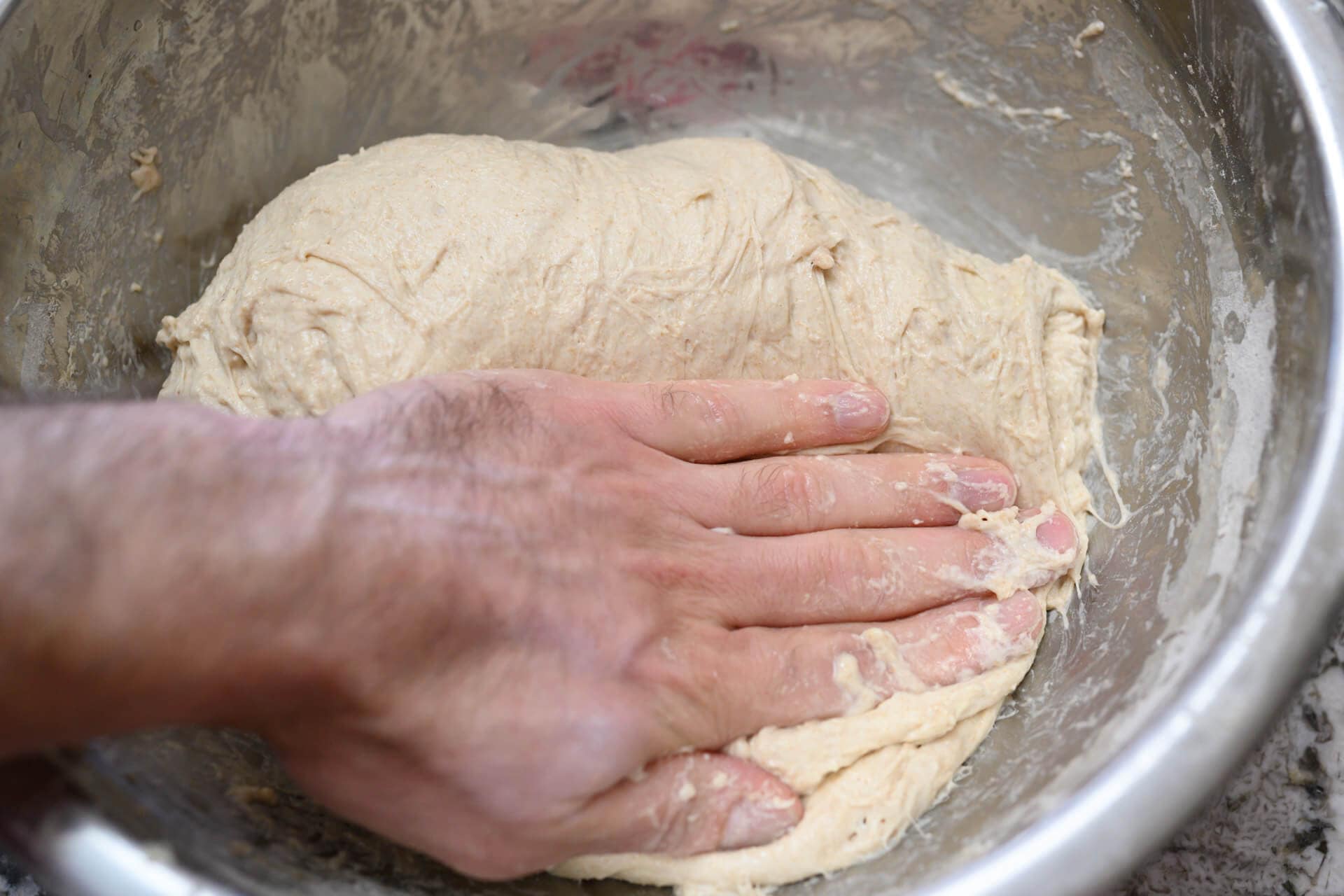
Since this dough uses a fair amount of high-protein white bread flour, it doesn’t require extensive mixing or kneading.
Using wet hands, mix everything until it comes together into a shaggy mass. This dough is rather strong and doesn’t require intensive mixing or kneading, but give it a few folds in the bowl, perhaps 5-10, until it smooths slightly (see the image, right).
Cover the bowl with reusable plastic and keep it somewhere warm in your kitchen for bulk fermentation.
3. Bulk Fermentation – 5:30 p.m. to 9:00 p.m.
Bulk fermentation, or first rise, occurs when the dough is leavened (through the production of carbon dioxide gas) and flavored (through the production of organic acids) as a result of natural fermentation. Below, you can see how much my dough rises during this 3-hour and 30-minute bulk fermentation at 75°F (24°C).
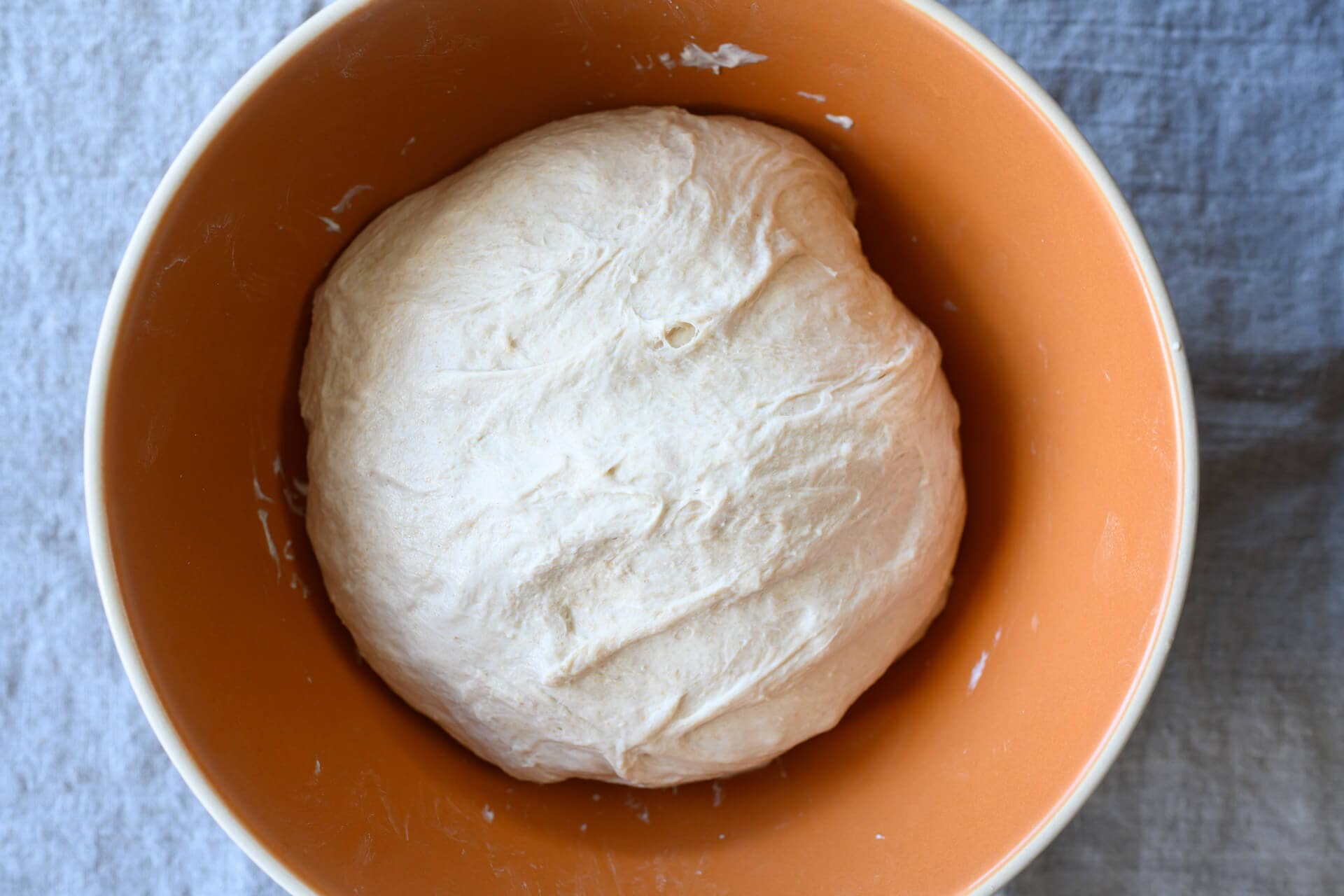
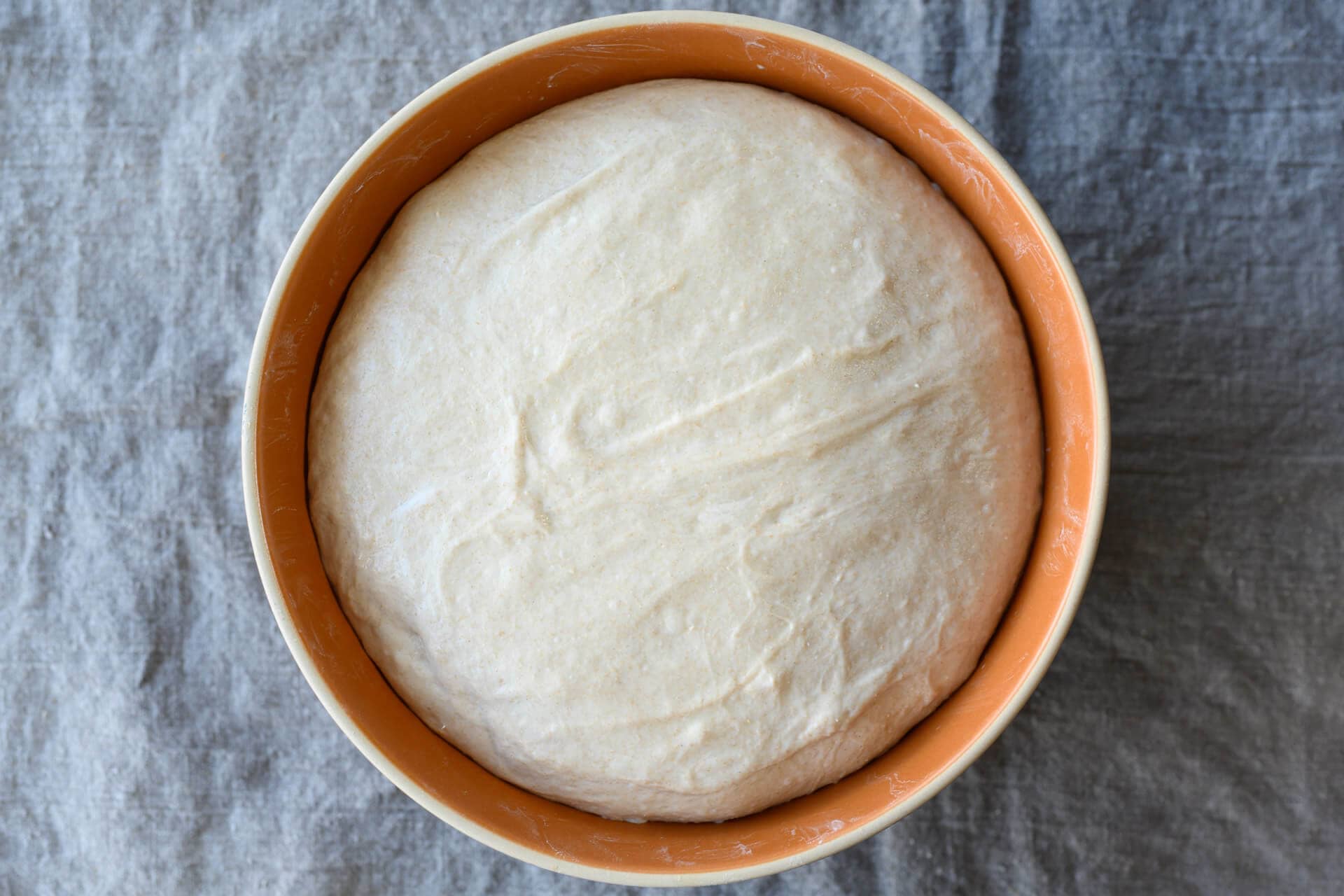
During this time, give the dough 2 sets of stretch and folds: the first set is 30 minutes after the beginning of bulk fermentation, and the second set is 30 minutes after the first. After the second set, let the dough rest, covered, until the next step.
As you can see in the video above, each set of stretches and folds is simple: With wet hands, grab one side and gently stretch it up and over to the other. Perform this fold in each direction: North, South, East, and West.
4. Divide & Preshape – 9:00 p.m.
Fill a bowl with some water and place it on your work surface. Scrape out your dough from the bulk container onto your dry counter. Divide the mass in half using a bench knife. Using a wet hand and the knife in the other, gently preshape each half into a loose round. Let the dough rest, uncovered, for 30 minutes until it’s relaxed outward.
See my guide to preshaping bread dough for a video and more instructions.
5. Shape – 9:30 p.m.
As seen in the video below, flour the top of the round with your hands and flip it over. Take the bottom edge and fold it up to about the middle. Take the left and right sides in your hands and fold the right over to about 2/3 of the left side. Repeat for the left side. Then, take the top and fold down to about the middle and gently seal. This should form a little envelope shape.
Now, flip over the entire thing and begin dragging and sealing the dough underneath itself (top-right, above). Using both hands, rotate and drag the mass toward you to create tension on the top. Repeat the dragging if necessary.
Read through my guide to shaping a boule for more instruction.
6. Proof – 9:45 p.m. to 7:00 a.m. or 6:00 p.m. (the next day)
Cover both proofing baskets entirely and put them in the fridge to proof overnight. The fridge allows us to slow fermentation to bake before or after work the next day.
7. Bake – 7:00 a.m. (pre-heat oven at 6:00 a.m.)
Preheat your oven with the rack at the bottom third to 450°F (230°C). Place your Dutch oven inside, with the lid and bottom side-by-side.
Take one basket out from the fridge and uncover it. Your dough might not have risen considerably in the fridge, but that’s fine. Cut a piece of parchment paper to fit over the basket and place a pizza peel (or large cutting board) on top. Using both hands, flip the entire stack over and remove the basket.
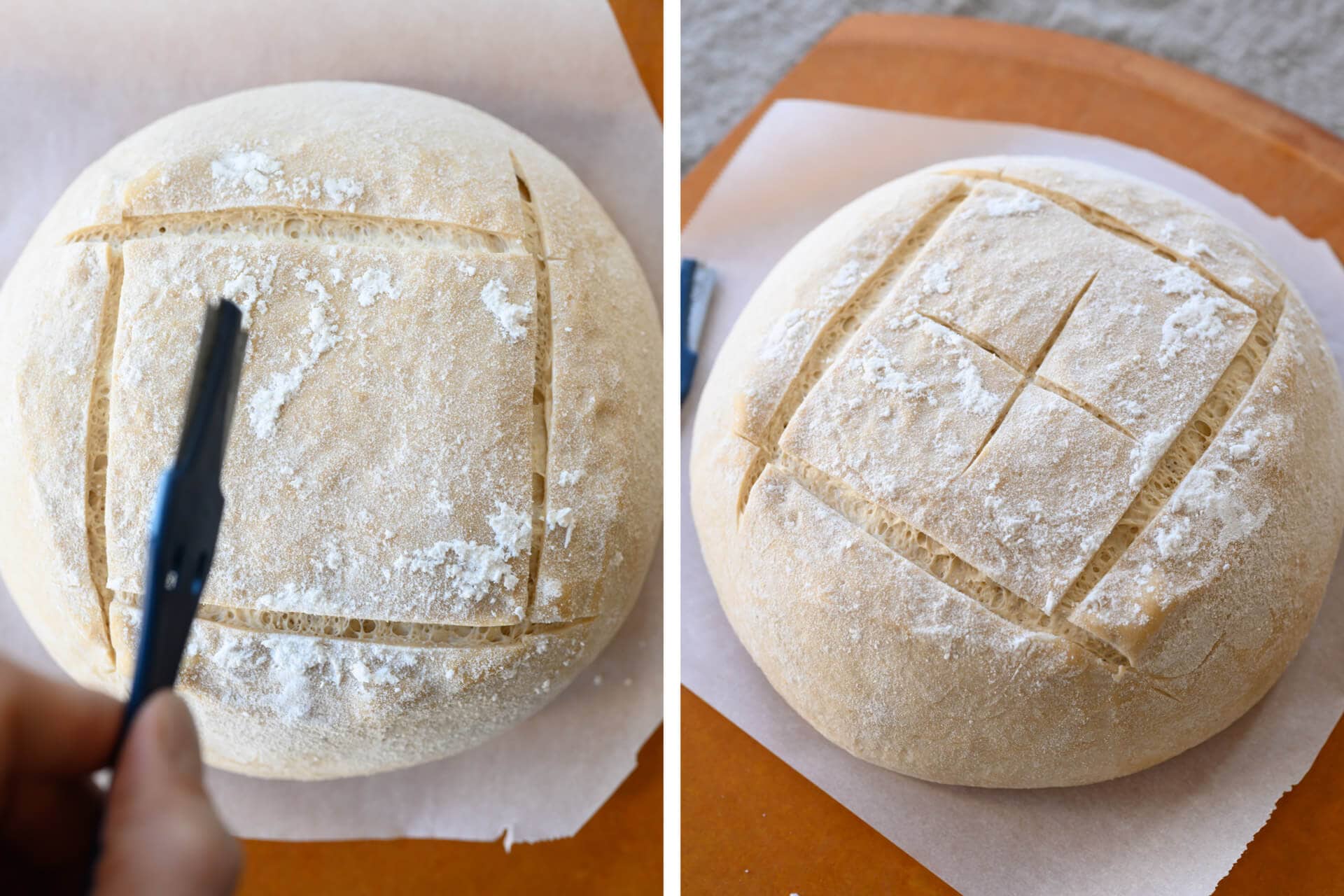
Score the dough using your favorite design. As you can see above, I love the “box top” score. Check out this video of me scoring this style (and a few others) below:
Now that your dough is scored, carefully slide it into the Dutch oven and bake for 20 minutes, covered.
After this time, remove the lid and bake for 30-35 minutes or until done. The internal temperature should be around 205-210°F (96-99°C).
(Note that If you’d like a thinner crust on this bread, increase the covered bake time to 30 minutes and reduce the second half of the bake (without steam) by 10 minutes. This increased baking time with steam can help reduce the thickness of the crust.)
Remove the loaf to a cooling rack for 2 hours before slicing. This lets the crust and crumb fully set and the flavor develop. Return the Dutch oven to the oven (without parchment) and bring it back to temp to bake the second loaf.
Follow my guide to storing sourdough bread to keep it fresh for the next week (or freeze it for longer!).
Print
Simple Weekday Sourdough Bread
- Prep Time: 24 hours
- Cook Time: 1 hour
- Total Time: 25 hours
- Yield: 2 loaves
- Category: Bread, Sourdough
- Cuisine: American
Description
A loaf of delicious sourdough bread designed around a busy workday. The levain is prepared for this bread in the morning and left to ripen while you’re at work. When you get home, continue with the baking process. The dough can then be baked at night or the next day in the morning, or after work.
Ingredients
Levain
- 40g bread flour
- 40g whole wheat flour
- 81g water
- 8g ripe sourdough starter
Main Dough
- 766g bread flour
- 161g whole wheat flour
- 19g salt
- 685g water
- 169g ripe levain
Instructions
- Levain (7:00 a.m. before work)
In a small container, mix the Levain ingredients and keep it at a warm temperature for 10 hours. - Autolyse with levain (5:00 p.m after work)
In a medium mixing bowl, add all of the levain, 766g bread flour, 161g whole wheat flour, and 635g water (50g was reserved for mixing, later) and mix until no dry bits remain. Cover the bowl and let rest for 20 minutes. - Mix (5:20 p.m.)
To the mixing bowl holding your dough, add 19g salt and some of the reserved 50g water (or all if the dough feels like it can handle it). Mix thoroughly and strengthen the dough for about 5 minutes. Using wet hands, mix everything until it comes together into a shaggy mass. This dough is relatively strong and doesn’t require intensive kneading (like slap and fold), but give it a few folds in the bowl, perhaps 5-10, until it smooths slightly. Transfer the dough to a bulk fermentation container and cover. - Bulk Fermentation (5:30 p.m. to 9:00 p.m.)
This dough will need 2 sets of stretch and folds during bulk fermentation, the first set 30 minutes after bulk fermentation begins. Perform the second set 30 minutes after the first, and then let the dough rest the remainder of bulk fermentation. - Divide and Preshape (9:00 p.m.)
Lightly flour your work surface and scrape out your dough. Using your bench knife, divide the dough in half. Lightly shape each half into a round shape. Let the dough rest for 30 minutes, uncovered. - Shape (9:30 p.m.)
Shape the dough into a round (boule) or oval (batard), then place the dough in proofing baskets. - Proof (9:30 p.m. to 7:00 a.m. or 6:00 p.m. the next day)
Cover proofing baskets with reusable plastic and seal shut. Then, place both baskets into the refrigerator and proof overnight. - Bake (The next day, bake at 7:00 a.m. before work, or 6:00 p.m. after work)
Preheat your oven with a baking surface or combo cooker/Dutch oven inside to 450°F (230°C). Remove your dough from the fridge, score it, and transfer it to the preheated baking surface or combo cooker. Bake for 20 minutes with steam. After this time, vent the steam in the oven or remove the lid (you can keep it in the oven or remove it) and continue to bake for 30 minutes longer. When done, the internal temperature should be around 204°F (95°C). Let the loaves cool for 2 hours on a wire rack before slicing.
Notes
- This recipe is wonderful left plain, or you could top the dough with rolled oats, white sesame seeds, or flax seeds.
If you use this recipe, tag @maurizio on Instagram so I can take a look!
What’s Next?
There you have it; this simple weekday sourdough bread can be made daily and adjusted to fit your schedule. Now, there’s no reason not to bake. This recipe is also a great place to experiment: mix 125g of nuts like walnuts and pecans and dried fruit like cranberries, cherries, or raisins.
Many recipes on my site can be adapted to this simple weekday sourdough bread schedule, most notably my Beginner’s Sourdough. Both recipes use flexible doughs, and the fridge provides even more.
For a more hands-off approach, check out my easy no-knead sourdough bread recipe. It can also be adapted to bake in a single day or ferment longer for an easier schedule.
Happy baking!


917 Comments
The baking schedule is great, but what is the best feeding schedule to keep in line with this bake schedule? Is it best to be fed once during the day and once during the night before to ensure that it is ready to be used at 7 AM?
Aloha 🙂 I’m trying to find a routine with my starter and love this schedule, thank you for sharing! I’m a little confused on why you use AP type flour for maintaining your starter, but then bread flour for this particular levain. Also, why are the levain ratios different for your different recipes? I keep my starter in the fridge so because I don’t bake every week. How long before I bake do you recommend I take it out of the fridge? Thank you so much for all your help and these amazing recipes 🙂
Has anyone tried using a kitchen aid/dough hook to mix instead of hands? Any success, or is that too rough on the dough? Thanks!
Hi, Maurizio. I added too much of the 50 g of water at the mixing stage, and now my dough is slick and a bit sticky. It is not soupy, but I think it is past the point where the “dough can take it.” Is there anything that can be done to save it?
What’s the secret to a perfect score like that?
Sufficiently tight shaping (smooth surface), a sharp blade, and quick movements 🙂
Hi! I’m planning my first bread after following the starter guide. I now have a happy, active starter, so I’m good to go! I was just wondering at the tiny amount of starter ure using here. It’s just 8gr (0.8%) where in the Beginners Sourdough Bread recipe you’re using as much as 35gr (3.75%) to create the levain. Is there a reason for the big difference? I’m trying to understand the way recipes are built up, so I can calculate my own recipes as well with the kinds of flour I have at home.
Was wondering exactly the same thing! I mixed the levain this morning, as directed, with 8g, and am hoping it will be sufficient to get the levain going. How did yours work out, assuming you ended up trying this recipe?
See my reply above!
Great — thanks for your response! That makes total sense (and goes some distance toward helping me understand rather than just dutifully follow recipes).
I haven’t baked yet, I’m scared to mess up, haha! I wanted to create my levain this morning, but we woke up a bit late. I’m going to spend this evening to plan my bake for tomorrow and Monday. Wish me luck!
How did your bread turn out?
Hey there! The reason is this levain takes a longer time to ripen, much longer than my Beginner’s Sourdough recipe (which is only 5 hours). Only a small amount of starter is required to fully ferment this levain mixture with such a long timeline. If you were to use the same starting amount as my BS recipe, your levain would be very overripe!
Thanks for your reply! So, say I had overslept and this had less time to prepare my levain, I would theoretically be alright to use a larger amount of starter for a shorter fermentation so I could still keep to the rest of the schedule?
Hi, I am sure you have been asked this before and sorry to repeat a common question.
Can I use the same recipe but withall purpose flour instead of bread flour? I have a lot of AP flour that I am trying to use up.
Also, is it ok to divide the recipe and make only one loaf?
Thanks,
Linda
Hey, Linda. You certainly can, with some modifications. But it sounds like you should check out my single loaf sourdough bread with all-purpose flour!
Thanks Maurizio. Could I use your all-purpose flour recipe but with 80% AP and 20% whole wheat flour? I like to add whole wheat if I can. Thanks!
For sure. Just watch the hydration (might need to be increased, but only do this if you feel it’s necessary) and the fermentation activity of the dough (you might need to divide the dough earlier as fermentation will speed up with the added whole grains).
Hi! love this recipe, im very new to sourdough baking. To make the levain, does the 8g of starter have to be ready in the sense, it floats? or will that happen during the course of the day?
Thanks in advance!
The 8g off starter is what you will start with. It will be hungry and can’t be used yet. You feed this with the flour and water and let it ripen and grow 2-3 times in volume. Once it’s grown you can do the float test to see if it’s ripe enough to use. I find that when my ripening starter begins to flatten and even sink just a bit, it’s ready for baking with regardless of float test. Make sure to be very gentle when doing float test because if not you may be knocking gases out of the ripe starter.
The one time I used this recipe, starter fed around 7am, when I got back from work it sunk way beneath the maximum point he reached during the day. Where did I go wrong? Or is this ok?
It likely just needed more time to ripen (maybe it was cold in your kitchen or it needed more starter). Just give it a bit more time to ripen. Next time, you can try using a little more starter to create the levain to speed things along.
It sounds like your saying that the starter had reached a height and had sunk while you were at work. If that is what you are saying, then the starter peaked while you were at work. Next time add less starter to the levain to slow it down so you can catch it when it is peaking.
Yes, as always: use your starter when ripe and you’d normally give it a refreshment when you make the levain!
I am pretty new to this, but in creating the levian how active does my starter need to be?
I usually keep my starter in the fridge so do I need to make sure it’s at its peak or has doubled before using in the levian?
Thanks
Aimee
Same question for Maurizio! In the past I’ve skipped making a levain, and just pulled the amount I needed from my starter for the dough. Realized recently that the levain formula appears to be different from a starter and could help me get better oven spring. Now I’m adding the levain step, but wondered if I need to pull from the starter to make the levain when it’s at it’s peak. Thanks Maurizio
Your starter should be quite active, I don’t like to use my starter if straight from fridge, I prefer feeding for a few days before using it!
Hi Maurizio, please are you able to post a pre-shaping video? Thanks!
I was thinking the exact same thing! 🙂
On it 🙂
Working on this!
Hi Maurizio
How would you recommend fermenting a loaf for two days?
Thanks for a great, informative site. Stellar work.
Best
Jacques
Should work if in the fridge!
Is the fridge time essential, or can you just bake it after the 3 1/2 hour rise?
I’m not an expert, but from what I know, the 3.5 hour bit is considered fermentation and not the actual rise. That happens very slowly in the fridge—or alternatively can be done more quickly at room temp. But you’ll likely get a different flavor profile with rising/proofing at room temp. You can probably do at room temp and then test it by inserting a floured finger into the proofed dough. If it slowly slowly rises back out it’s ready for baking. If it springs back, it’s not ready yet.
If you want you can skip the cold proof but instead let proof on the counter until it’s ready to bake. Usually this is between 2-4 hours as you said, depending on the temp of your kitchen.
I love this recipes! Thank you! I am a first timer with Sourdough and still learning. Who knew so much detail and time involved! Oven is getting ready at 450 with Dutch inside. My question is, it bakes all great except bottom get too overdone and hard to even slicing. We are at 6500 altitude, should I use cornmeal instead of parchment or adjust temp/time? Also, it seems that my Levain came out again 5-8 gr less for dough mixing. Should I adjust flour and water? Is it not raised long enough or too long? I used Bread flour (not malted) and Whole wheat per recipes. Thank you.
You can definitely use cornmeal instead if you’d like (or even a combination of both). If you see lots of burning, try both. That’s ok if your levain is just a bit short like that, don’t worry things will work just fine!
Hello! Is it ok to mix the flour and the water (autolyse) at the same time as the levain? In different bowls of course. Can this mix be on hold for 10h? So that at 5PM I mix everything together with the salt.
Thank you for all your help, you’re most kind!
I would not mix the dough and water that early. It’s possible it’ll be just fine, but it really depends on the flour you’re using. You could scale everything out and have it ready to go but don’t mix until you get back!
Wow, thanks for this super quick answer!
I don’t have a Dutch oven, only glass – https://www.ikea.com/hr/hr/p/buren-posuda-za-pecenj-posluz-poklop-prozirno-staklo-00214591/
A Dutch oven is planned in the future, I hope this works as well.
Yay, recipe was a success! This time I would like to add different mix-ins for each loaf. Given I can divide this recipe into 2 loaves, at whats step do I mix in? Most of what I read elsewhere suggests mix-ins during bulk fermentation (usually the second stretch and fold) prior to dividing to 2 loaves. So given I have different mix-ins, can I divide before bulk fermentation? If not, at what step? Thanks!
I would divide the dough after mixing, but be sure to keep the dough warm — if you have two smaller masses of dough, they can cool faster and fermentation will be slightly less efficient. After dividing the dough, add the mix-ins right after the division or after the first set of stretch and folds. Will work well!
Yes, that’s exactly what I would do, try doubling that to 16g and that should help!
You could try reducing the hydration of the dough by 25-50g and see if that helps bring strength to the dough. Generally, it sounds like your dough needs more strength. Reducing the hydration is one way to accomplish this, and you could also add in another set or two of stretch and folds during bulk fermentation.
Hi Maurizio! Can you tell me please if I can substitute whole wheat flour with spelt flour? Should I adapt something? Thanks. Great Job!
Aura, you certainly can (and I love spelt). Just be cautious with the water in the dough. I’d hold back more than the called for 50g reserve, I’d say 100-150g, and then add it in if it feels like the dough can handle it. Hydration adjustments are always necessary, but with spelt it needs a little more care because it’s sensitive to over hydration.
Hi Maurizio,
I just used this recipe for the first time and my loaves came out stunning. But! When I cut into the middle of one it was literally just one giant hole. What do you think happened here? Thank you!
Simone — usually this is from under or over proofing. I can also be due to uneven shaping, but that’s less likely the case. If the rest of the interior was very dense with no holes, it’s likely under proofing. Be sure your starter/levain are mature (bubbly, risen) when you use it, and be sure your bulk fermentation goes far enough: the dough should have risen perceptibly, be light and gassy, and generally look alive. If it needs more time in bulk, give it!
Conversely, if it’s over proofed you might see a large hole but the rest of the interior will have lots of small little bubbles and not look super dense. This is less likely the case because in my experience over proofed dough just wont rise much in the oven, you’ll get more like a pancake. If you think it’s over proofed, cut back bulk fermentation a bit and also the proof, the dough needs less fermentation time overall.
Hope this helps!
Hi Maurizio. I am using this recipe for a completely different reason than the work week schedule. The fact that it requires little mixing and almost no kneading makes it the perfect recipe for me to continue baking while I recover from a serious back injury. Turns out that not being able to lift or twist also means you can’t work with bread dough! This recipe has allowed me to keep baking. I still need my wife’s help to handle the cast-iron cookers and load the oven but the bread continues on!
Glad to hear this is working for you for other reasons, Michael! Yes, back, core, and arms… all important. I injured my neck not too long ago and I just didn’t realize how much the neck/upper back comes into play with just about everything in baking — it’s hard to mix when you can’t look down! Wishing you a speedy recovery and good health.
Hi Maurizio! I was wondering if this could be baked in the same day? Would you recommend extending fermentation in the 73-75 degree environment, or would this not work?
That’ll work! Just be sure to give it a sufficient final proof — the dough should be well risen and if you poke it with a finger in a few spots, it should slowly, and not completely, fill the indentation back in.
I hope it turned out well, Daniel!
Hi Maurizio, Thanks for all of your content!
I’d like to try using some local organic bread flour which has no added malt. How should I adjust the recipe to compensate?
You can add malt yourself or just omit it — my feeling is with the local flour it’s most likely quite fresh, you’d do fine without malt!
Appreciate it!
Hi! It has been almost impossible to get my hands on whole wheat flour but have got rolled oats in the pantry. Can I ever switch the called for whole wheat flour with oat flour? Any adjustments needed in terms of percentages?
Unfortunately, it won’t be a one-for-one substitution because oats do not have gluten. Take a look at my oat porridge sourdough recipe for an idea on how to work oats into a loaf!
Hi Mauricio, thank you for this superb site! Like some others below my final dough relaxes to the point of almost being flat, but it rises so much in the oven I’m not particularly bothered. But it does make it very difficult to shape. If I use less water I’m concerned I’ll increase density or there will be other unforeseen consequences 😁
Also, I wondered whether this recipe might work with spelt and, if so, at approximately what percentage? Having run out of wholemeal I replaced this with dark rye and it worked brilliantly!
I’m not Maurizio but I might have an answer for your first question. My first attempt at sourdough bench resting went flat as a pancake. I learned over time that more tension in the dough helps it stand up during the bench rest. Try shaping your dough rounds a little bit tighter using the same technique to scrape it across the counter that you use in your final shape. They will flatten some and get puffy but shouldn’t flatten out.
Glad to hear it’s going well, Thomas. You likely need to preshape it a little tighter, it should relax out during the bench rest but not into a thin layer. Further, if it’s really relaxing out quickly, you might want to give it more vigorous stretch and folds during bulk fermentation or add in another set to give the dough a bit more strength!
Hi There I love your site and insight! wondering if this recipe could be Halfed? I know, why would you only want one loaf. But I really only need one at a time and it lasts me several days. Let me know if I could HALF with the same results.
Thanks!!
Absolutely can be halved!
I’m not Maurizio, but yes, you absolutely could. I’ve done it! Just make sure you’re halving everything, including the 50g of water which is held out.
Hi Maurizio,
Thanks for this great site. I note your responses to queries for those without bread flour. My question is this: Is there anything preventing me from using the weekday method with the AP recipe or any sourdough recipe for that matter?
Not at all, will work great!
Hi – I love your website, I love how all the recipes come with schedules, that’s my favorite part. My question has to do with the type of flour i’m using. I’ve had excellent results using Bobs red mill artisian bread flour or KAF bread flour. I live in MA and bought this wonderful flour at a place in Hadley, they grow and mill all their own flour. https://www.groundupgrain.com/ Everytime i use this flour for this recipe i notice that over the course of the stretch and folds the dough almost seems wetter and by the time it comes to do the preshape and shape that dough is so sticky and so hard to keep shape and when i bake, the loaves are coming out flat, taste awesome but flat 🙁 i know what over proofed looks like and it’s not that, my starter is awesome and works well with all the other flours i use. I cannot figure out what the hell i’m doing wrong and why this flour behaves so differently?
Hi – I have been loving your site and all your recipes, the schedules have been my favorite part and extremely helpful. I’ve been using this recipe for a while now. I live in MA. I bought some flour that is grown in Hadley, MA and milled there by a place called https://www.groundupgrain.com I use their whole wheat 14% and their all purpose 12.9%. It tastes amazing, but every time I use their flour with this recipe I notice that in the beginning the dough seems normal, it’s lacking strength (rips apart) but as the day progresses the dough seems to get stronger (can see that windowpane) but also feels a lot wetter as I go through all the folds. Once it’s time to shape I have a really hard time getting this to keep any sort of shape, it’s extremely sticky, when it comes times to bake I get rather a flatter loaf 🙁 I cannot for the life of me figure out what the deal is with this flour. I know what over proofed looks like and I don’t believe that’s the issue, it’s not my starter either because I’ve had amazing results using Bob’s Artisian bread or KAF Bread flour. I checked all the different flours I’ve been using and noticed they all have about the same protein content. HELP 🙂
Dear Maurizio,
As a confinement project, I decided to get my starter going and give it a try to baking my very own sourdough bread – in Paris! 🙂
This is the third week I bake this wonderful bread!
I bake single loaves (half the recipe) using whole wheat (T150) and a combination of what we call here T80 and T65, which are kind of white but unrefined flour, since that’s what I had available. Great flavor, great crumb and crust!
https://photos.app.goo.gl/3Rh8UtXagHonDnWSA
THANK YOU for such a well-written guide, every step is very easy to follow.
And as a very nice consequence, we are now making your sourdough discard pancakes every weekend almost as a ritual.
Now I’m going to give a try to some of your other recipes using different flours.
Congrats on such a great blog,
Take care and stay safe!
Hi! Thank you for this recipe, I was always a little scared to follow along with your methods because I thought they were more complicated- but I’ve come to really appreciate the break down and proper language. I find it a lot more informative than some recipes out there. I was just wondering if you could offer some help – I keep finding when I go to preshape/shape my dough that it’s very relaxed and doesn’t look all strong/puffed up (or easy to pull into shape) like in your boule shaping video. So it seems a bit weak perhaps? When I put tension into it, it holds together well but then once in the fridge for proof and going to bake, it definitely flattens out and I end up with a pretty unspectacular slightly risen frisbee haha. Any tips would be great!
May I use sprouted rye instead of the whole wheat? As many people, there isn’t any available.
Also- the bread flour that I have from King Arthur says Gluten free. Is there a different bread flour from King Arthur?
https://shop.kingarthurflour.com/items/king-arthur-unbleached-bread-flour-5-lb
Of course almost impossible to find these days…
You’d get a more dense loaf with sprouted rye, but it would still be great bread. There is a standard Bread Flour from KAF that is not gluten free, that’s what you want. I don’t use any specialty gluten free flour here!
Hello there!
I started to build the levamisole 11h ago and it hasn’t risen nearly double.
Is that maybe, because my starter is not as strong as yours?
I don’t want to waste the good bread flour I brought for that so I‘ll stay up a couple more hours than usual and keep an I on it.
Hopefully it sprung up a few hours later. Keep it warm and give it time! If you’re seeing no activity at all, try creating your starter/levain with more carryover mature starter.
Unfortunately it didn’t worked out. So I started from new and the second try didn’t end up better. I had a pretty flat bread, but it was still very tasty and had a few air bubbles inside. I changed the feeding of my starter a bit in terms of temperature and flour.
– Mariella
Hello – Thanks so much for this site and for managing to respond to most questions, which is amazing. I have two questions when you have a chance – have tried to research both of these but have not found a clear answer.
1. What am I losing by taking a somewhat haphazard approach to starter activation? I keep a 50/50 starter in the refrigerator, feed it when I bake with it once or twice a week, and sometimes feed it randomly at other times. When I’m going to bake with it, I take it out, feed it, wait until it is actively bubbling (though it doesn’t usually rise), and use it in my bread recipe. I’ve mostly done recipes with levains and/or long, slow, bulk ferments so far, and they’ve been turning out well, which indicates to me that the starter has time to get going in the dough. As long as that’s true, do you think there’s something I’m missing from not doing a more rigorous feeding schedule and not giving the starter a full day/night to reactivate after the fridge? For example (just making this up), maybe this works fine to get a perfectly good loaf, but the rise/crumb would definitely better with a starter that is more up to speed?
2. What is the point of making a levain? A lot of recipes call for something like 50g starter, 100g flour, 100g water, mix and let that rise before you add to the larger autolysed flour/water salt. What do you get from doing that that you wouldn’t get from just adding 250g of ripe starter to the autolysed mixture? (Maybe one answer is that it lets you get better overall fermentation from a small quantity of haphazard starter by scaling up gradually?)
1. Yes, absolutely, a consistent refreshment regiment with your starter will improve your bread — hands down. Try it for a few weeks as an experiment: pay a little more attention to your starter, refresh it when it needs a refreshment on the dot (you’ll see it just start to fall in the jar, feed then), and keep it consistent. Use the same amount of flour, water, and carryover each time. Then after a week or so try baking with it, I’m sure you’ll see improvement. I say this from firsthand experience 🙂
2. You don’t have to make a levain, a starter and levain really are the same thing (I’m working on a post here about this very topic due out soon!). I like using a levain because it ensures my fermentation is at the right point when I go to mix, sometimes I have to scale up and I need more levain than the amount of starter I keep on hand, and I can change the flour mixture as desired. But you can certainly just use your starter, the key is to use it at the right stage of maturity each day.
Hi Susan, I am also a beginner but the standard Le Creuset in the US is 5.5 qt which is 5.2 liters so I imagine the 6 liter would be okay? It’s not much bigger.