

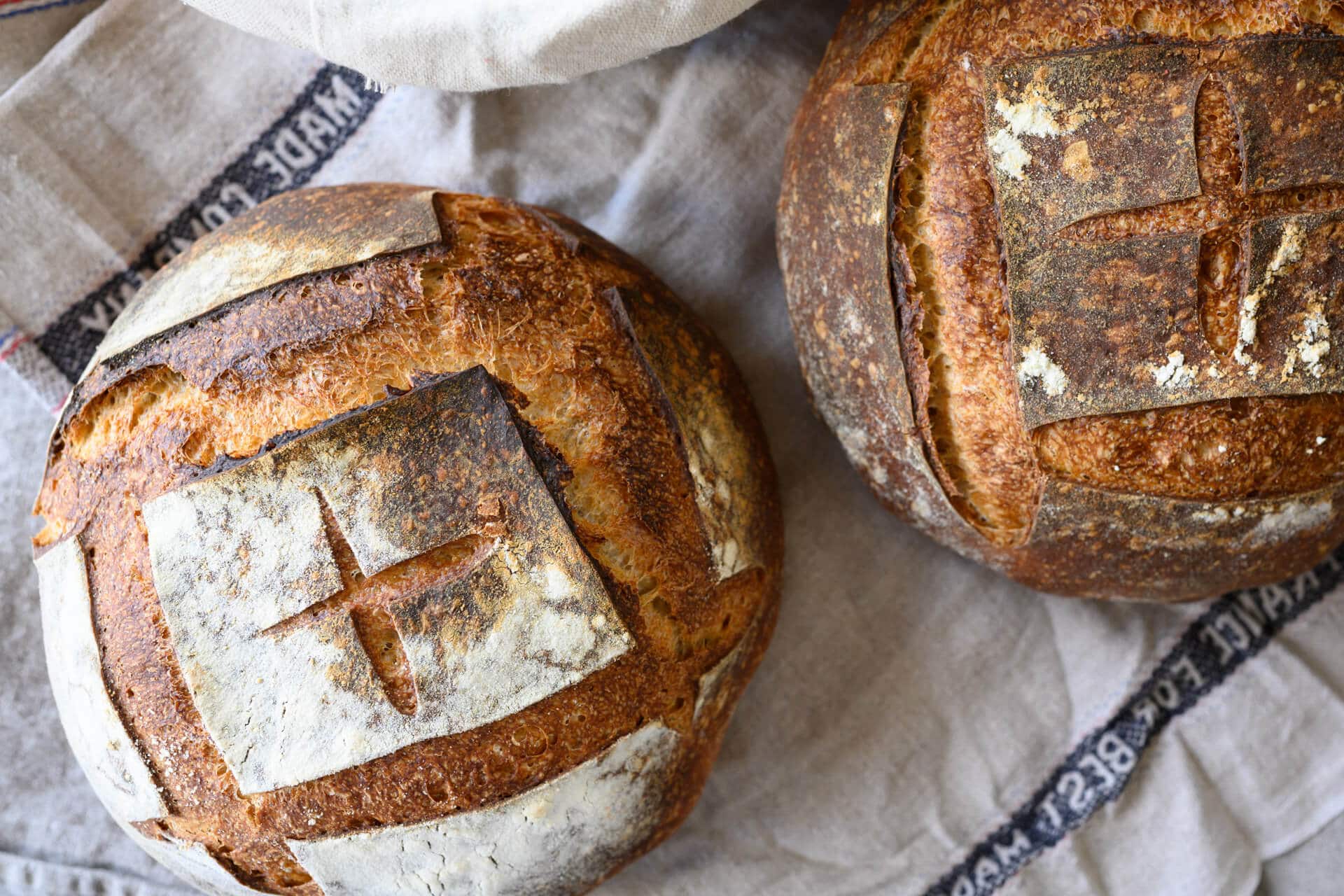
Baking a healthy and nourishing loaf of sourdough bread with your sourdough starter is gratifying, to be sure, but what if you’re not home all day to check in on the long-fermented dough? I mean, some of us do have to work, right? This simple weekday sourdough bread recipe and schedule are uncomplicated for mixing and baking a loaf of bread during the busy workweek.
This post includes pictures and videos that clearly and concisely convey the full sourdough bread-making process. But why is this recipe so easy compared to others?
Real Quick: Why is This Sourdough Bread Easy?
- It’s a no-knead sourdough bread recipe: mix everything in one bowl
- It uses only two types of flour: bread flour and whole-wheat flour
- It’s moderate hydration—no messy dough or counters
- It’s baked in a Dutch oven or combo cooker
- Timing is extremely flexible
Let’s go over the workweek schedule.
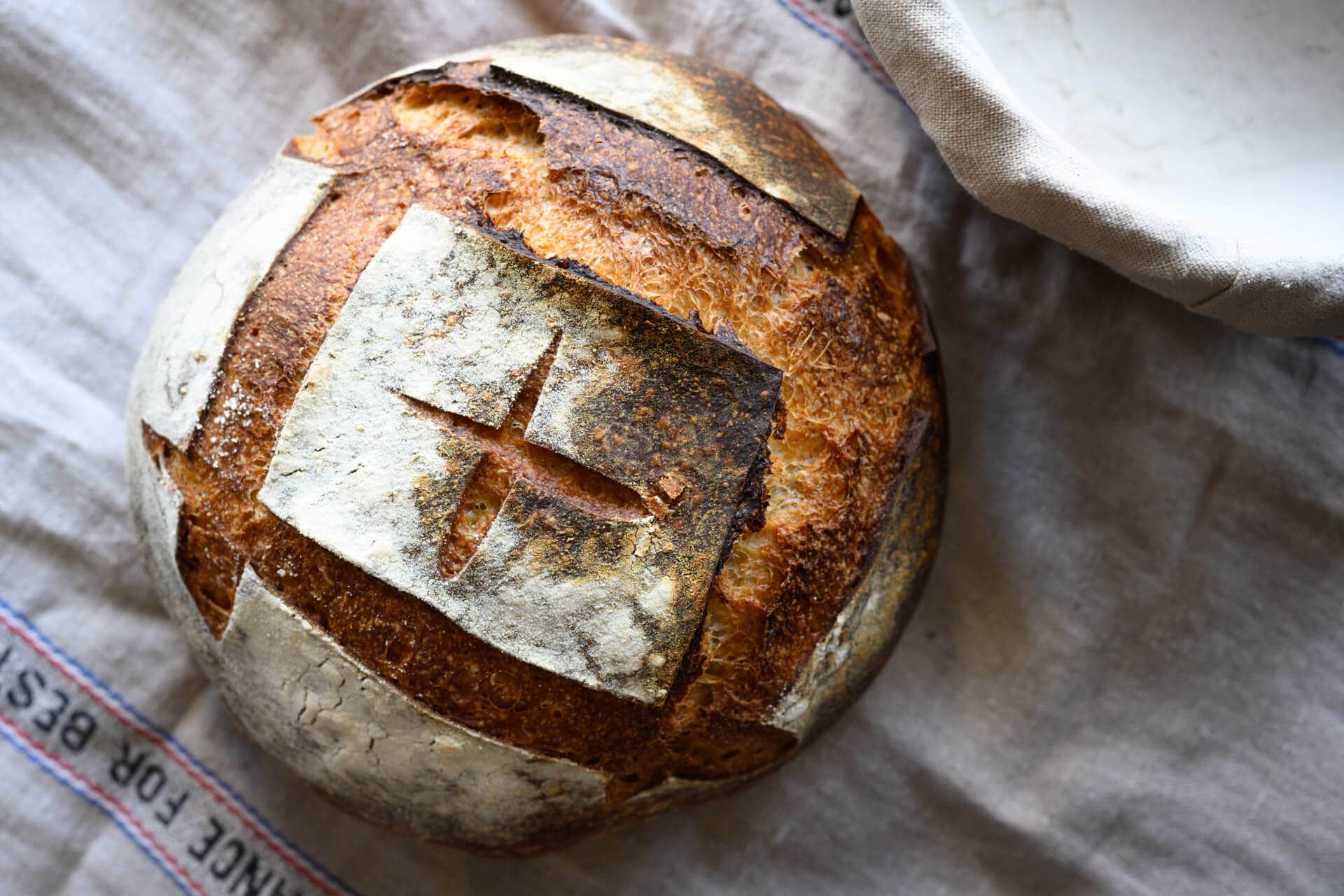
A simple weekday sourdough bread schedule
In the past, I’ve discussed a weekend baking schedule that outlines a schedule for low maintenance during the week with a bake on the weekend. The following schedule, however, allows baking during the week around a typical nine-to-five workday. It’s also quite flexible, and you always have the option to place the dough in the fridge longer to bake when you get a chance.
Read through my ultimate guide to dough proofing for more information on adjusting the proofing period for this sourdough bread.

| Time | Step |
|---|---|
| 7:00 a.m. (before work) | – Make the 10-hour levain (ready ~5:00 p.m.) – Save time later, scale-out flour & salt into bowls and cover |
| 5:00 p.m. (after work) | When levain ready, mix dough for autolyse |
| 5:30 p.m. | Finish mixing and begin bulk fermentation |
| 9:00 p.m. | Divide, pre-shape, and bench rest |
| 9:30 p.m. | Shape and place into the refrigerator to proof overnight |
| 7:00 a.m. (next day) | – Bake the next day before work – Alternatively, bake after work |
The schedule above has example times, so shift the timeline to earlier or later according to your schedule. Don’t worry if you don’t hit the times precisely as they’re written. There’s some flexibility there.
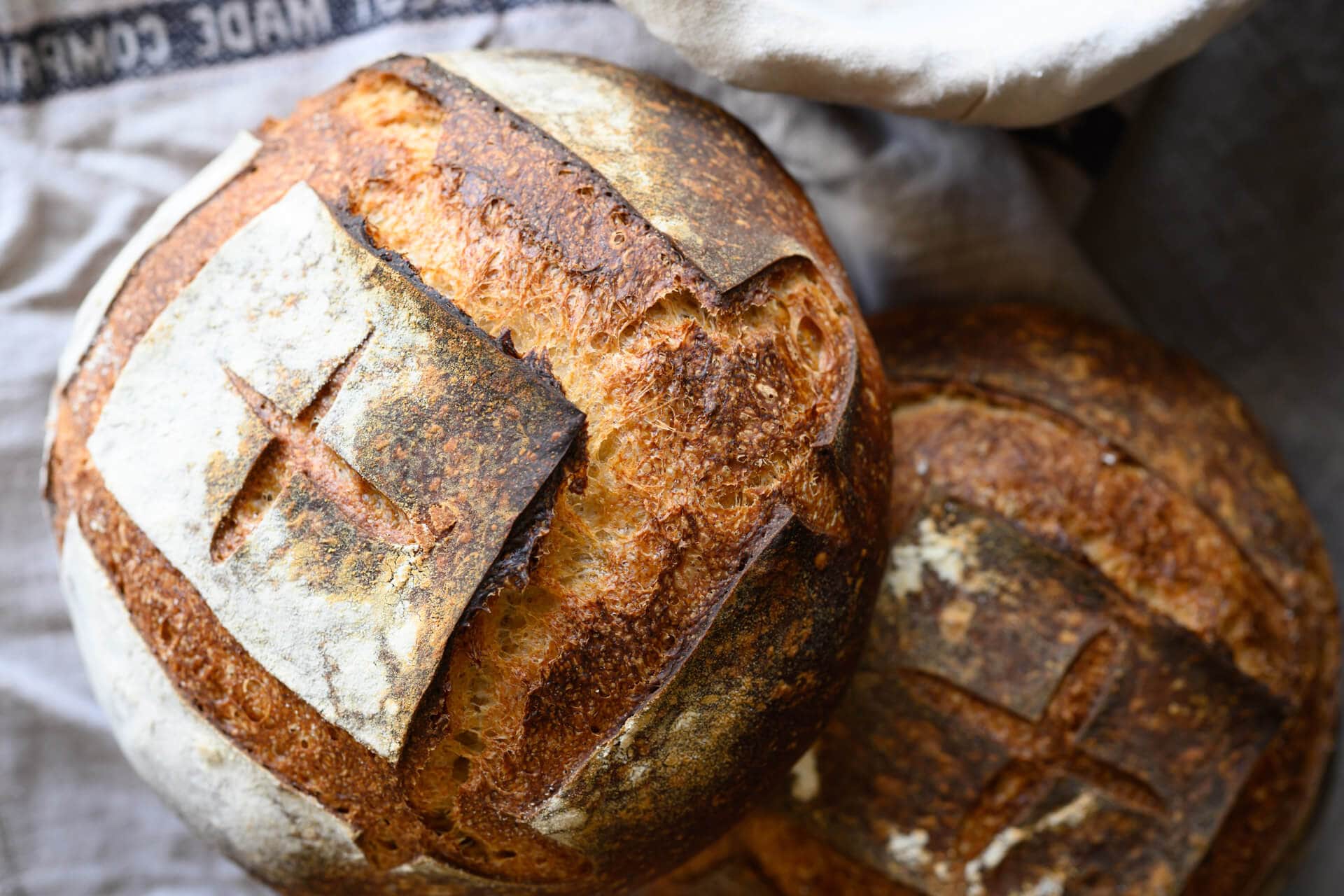
A Simple Weekday Sourdough Bread Recipe
Vitals
| Total Dough Weight | 1,800 grams |
| Pre-fermented Flour | 8.0% |
| Hydration | 76.0% |
| Yield | Two loaves |
Total Formula
The following table shows all the ingredients needed to make this bread. Each ingredient will be called out as needed in the method steps below.
My final dough temperature for this simple weekday sourdough bread was 75°F (24°C). For more information, see my post on the importance of dough temperature.
| Weight | Ingredient | Baker’s Percentage |
|---|---|---|
| 806g | High-protein white bread flour, malted (King Arthur Bread Flour) | 80.0% |
| 202g | Whole wheat flour (King Arthur Whole Wheat Flour) | 20.0% |
| 766g | Water | 76.0% |
| 19g | Fine sea salt | 1.9% |
| 8g | Ripe sourdough starter (100% hydration) | 0.8% |
Method
1. Prepare levain – 7:00 a.m., before work
A levain is simply an off-shoot of a sourdough starter. A sourdough starter is never used up completely; it’s continually fed day after day indefinitely. A levain is created with a small bit of a sourdough starter and left to mature (ferment) until ready to be mixed into a dough. Ultimately, it meets the same fate as the dough: baked in the oven.
In the morning before work, mix in a jar:
| Weight | Ingredient |
|---|---|
| 40g | Bread flour |
| 40g | Whole wheat flour |
| 81g | Water |
| 8g | Mature sourdough starter |
Loosely cover the jar; it should be ready after about 10 hours at room temperature, 72-75°F (22-24°C).
2. Autolyse with Levain – 5:00 p.m. after work
Performing an autolyse gives our dough a chance for the flour to fully hydrate and begin the gluten development process (all without kneading). I typically don’t do an autolyse with the levain included, but we’ll do that in this simple weekday sourdough bread recipe because it’s a short period.
Add all the ingredients below to a mixing bowl. Mix with wet hands until all the dry bits are incorporated. Cover and keep somewhere warm at room temperature for 20 minutes.
Note: the water in the table below is 50g less than the total water for this recipe; the water (and the salt) are held back for the next mixing step.
Dough Mix
| Weight | Ingredient |
|---|---|
| 766g | High protein bread flour, malted (King Arthur Bread Flour) |
| 161g | Whole wheat flour (King Arthur Whole Wheat Flour) |
| 635g | Water, Autolyse |
| 169g | Ripe levain (created in Step 1) |
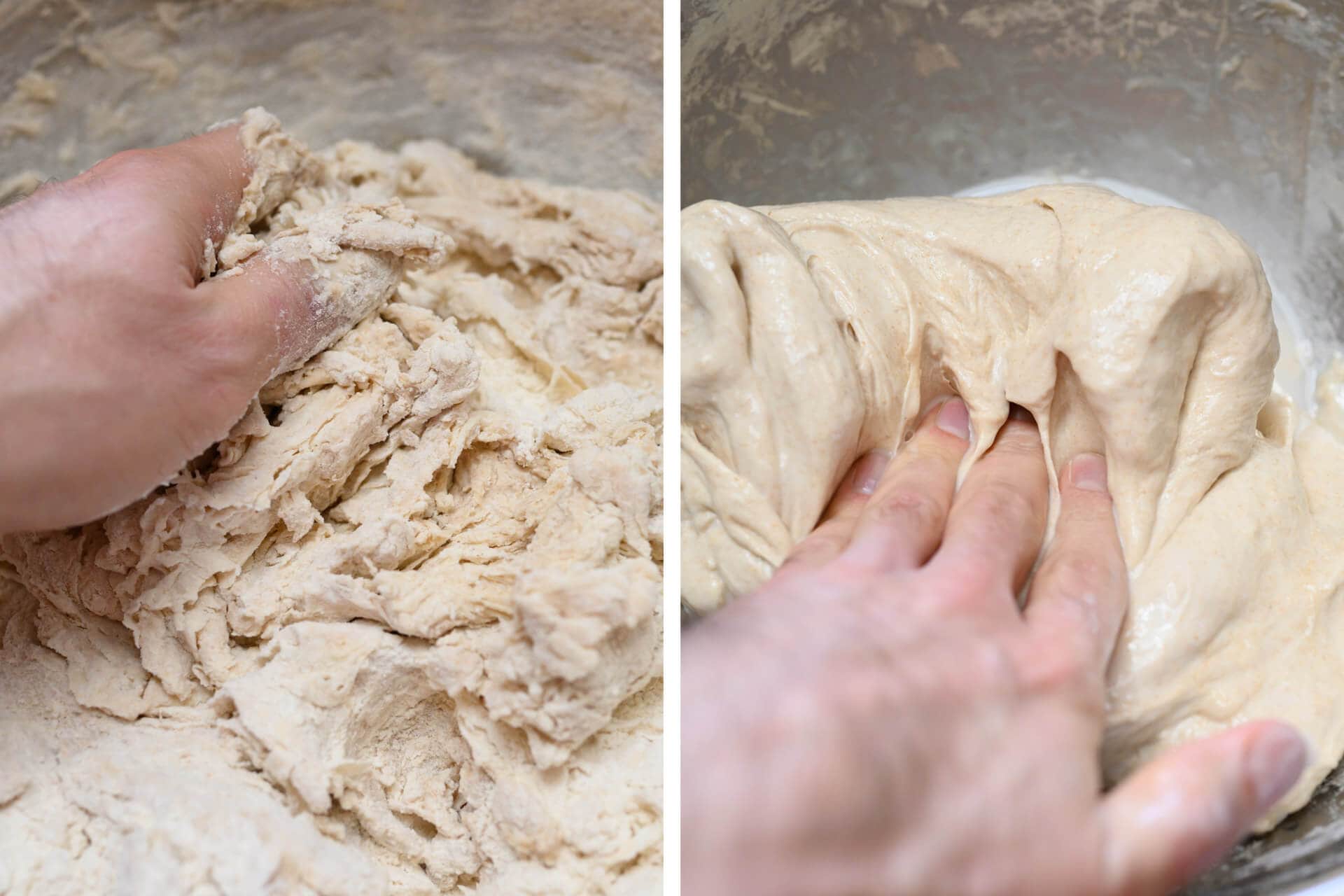
The image above shows the direct result of even a short autolyse. The left image shows the shaggy mass just before I finished incorporating everything. The right image shows how smooth and strong the dough becomes simply by resting. Let’s take this further with a little mixing.
3. Mix – 5:20 p.m.
Add the ingredients in the table below to the top of the dough: first, add the salt and then add the reserved water slowly to help dissolve the salt. Add the water a little at a time, depending on how the dough feels: it should be shaggy and loose, but not “soupy.” You can pause midway through pouring the water to incorporate it with a wet hand. If it feels like the dough can handle the rest of the water, add it all.
| Weight | Ingredient |
|---|---|
| 50g | Water, Mix (as needed) |
| 19g | Salt |
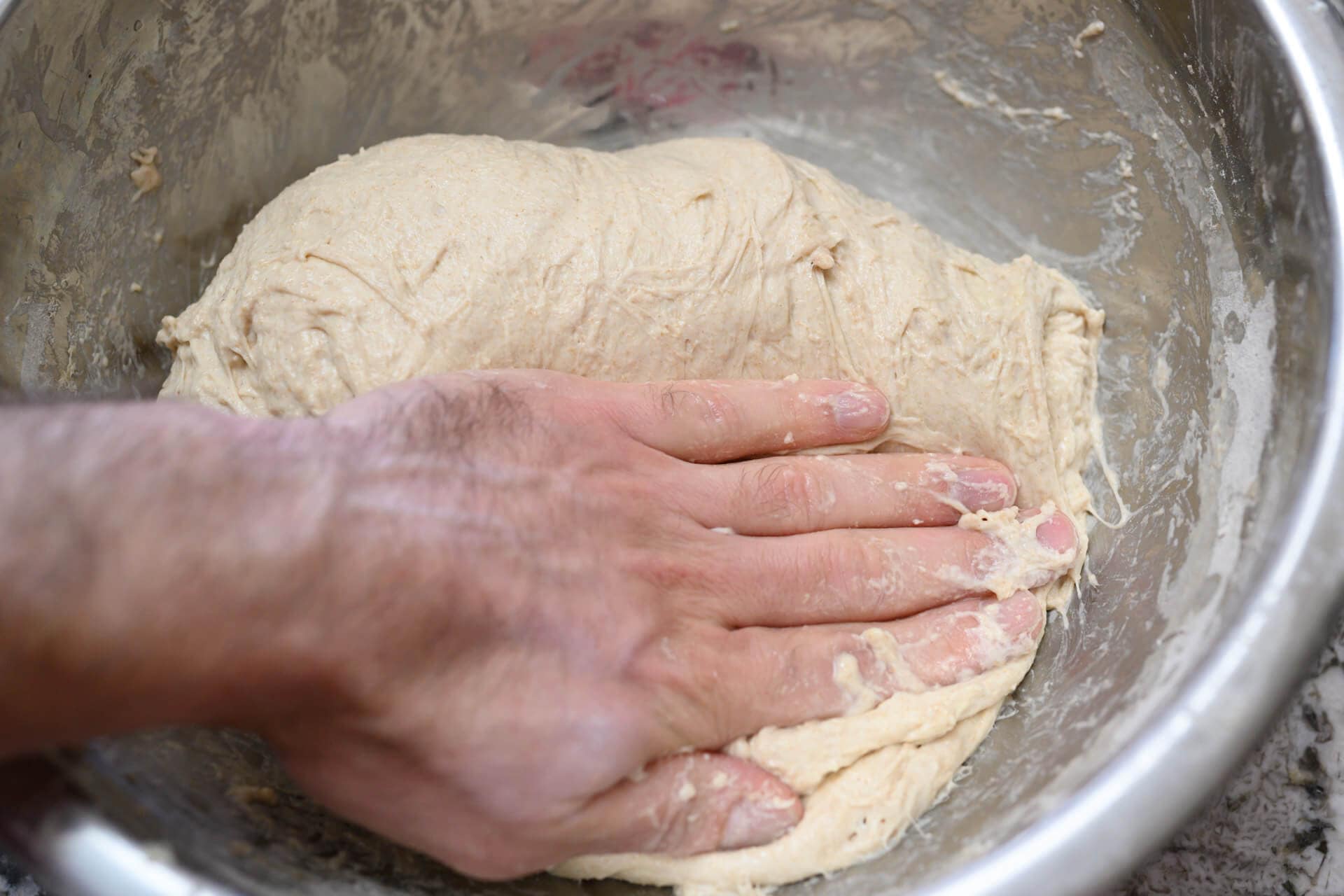
Since this dough uses a fair amount of high-protein white bread flour, it doesn’t require extensive mixing or kneading.
Using wet hands, mix everything until it comes together into a shaggy mass. This dough is rather strong and doesn’t require intensive mixing or kneading, but give it a few folds in the bowl, perhaps 5-10, until it smooths slightly (see the image, right).
Cover the bowl with reusable plastic and keep it somewhere warm in your kitchen for bulk fermentation.
3. Bulk Fermentation – 5:30 p.m. to 9:00 p.m.
Bulk fermentation, or first rise, occurs when the dough is leavened (through the production of carbon dioxide gas) and flavored (through the production of organic acids) as a result of natural fermentation. Below, you can see how much my dough rises during this 3-hour and 30-minute bulk fermentation at 75°F (24°C).
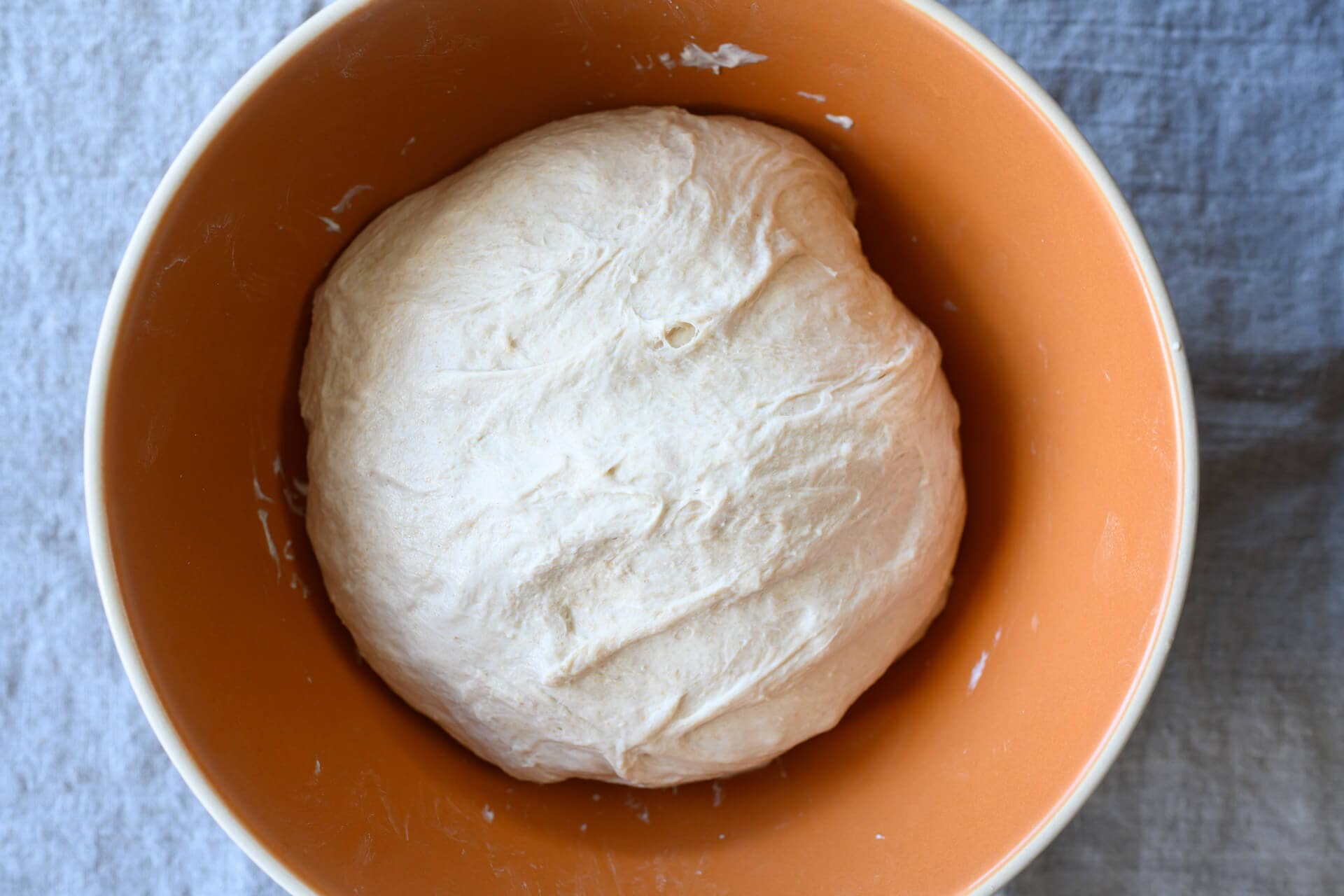
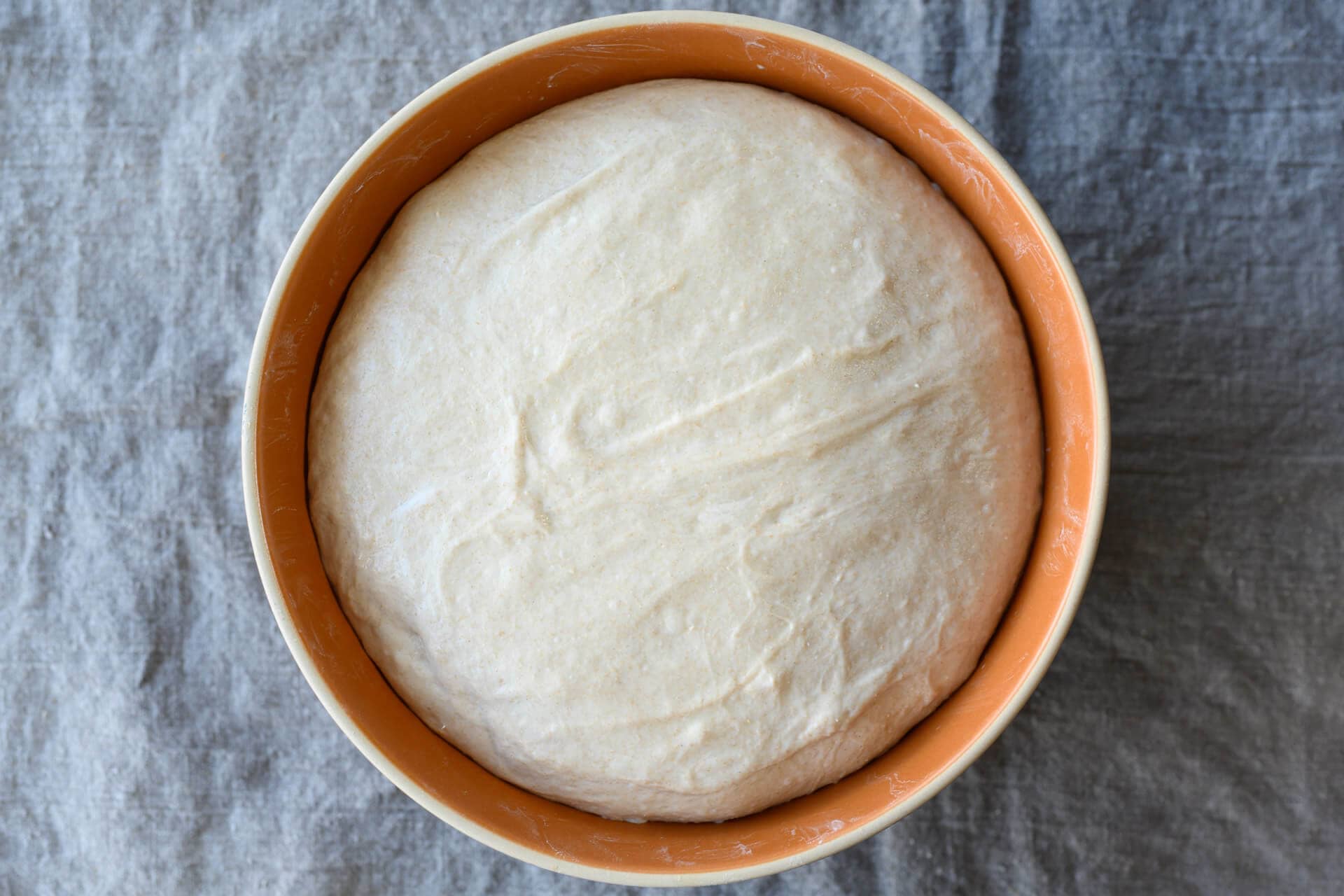
During this time, give the dough 2 sets of stretch and folds: the first set is 30 minutes after the beginning of bulk fermentation, and the second set is 30 minutes after the first. After the second set, let the dough rest, covered, until the next step.
As you can see in the video above, each set of stretches and folds is simple: With wet hands, grab one side and gently stretch it up and over to the other. Perform this fold in each direction: North, South, East, and West.
4. Divide & Preshape – 9:00 p.m.
Fill a bowl with some water and place it on your work surface. Scrape out your dough from the bulk container onto your dry counter. Divide the mass in half using a bench knife. Using a wet hand and the knife in the other, gently preshape each half into a loose round. Let the dough rest, uncovered, for 30 minutes until it’s relaxed outward.
See my guide to preshaping bread dough for a video and more instructions.
5. Shape – 9:30 p.m.
As seen in the video below, flour the top of the round with your hands and flip it over. Take the bottom edge and fold it up to about the middle. Take the left and right sides in your hands and fold the right over to about 2/3 of the left side. Repeat for the left side. Then, take the top and fold down to about the middle and gently seal. This should form a little envelope shape.
Now, flip over the entire thing and begin dragging and sealing the dough underneath itself (top-right, above). Using both hands, rotate and drag the mass toward you to create tension on the top. Repeat the dragging if necessary.
Read through my guide to shaping a boule for more instruction.
6. Proof – 9:45 p.m. to 7:00 a.m. or 6:00 p.m. (the next day)
Cover both proofing baskets entirely and put them in the fridge to proof overnight. The fridge allows us to slow fermentation to bake before or after work the next day.
7. Bake – 7:00 a.m. (pre-heat oven at 6:00 a.m.)
Preheat your oven with the rack at the bottom third to 450°F (230°C). Place your Dutch oven inside, with the lid and bottom side-by-side.
Take one basket out from the fridge and uncover it. Your dough might not have risen considerably in the fridge, but that’s fine. Cut a piece of parchment paper to fit over the basket and place a pizza peel (or large cutting board) on top. Using both hands, flip the entire stack over and remove the basket.
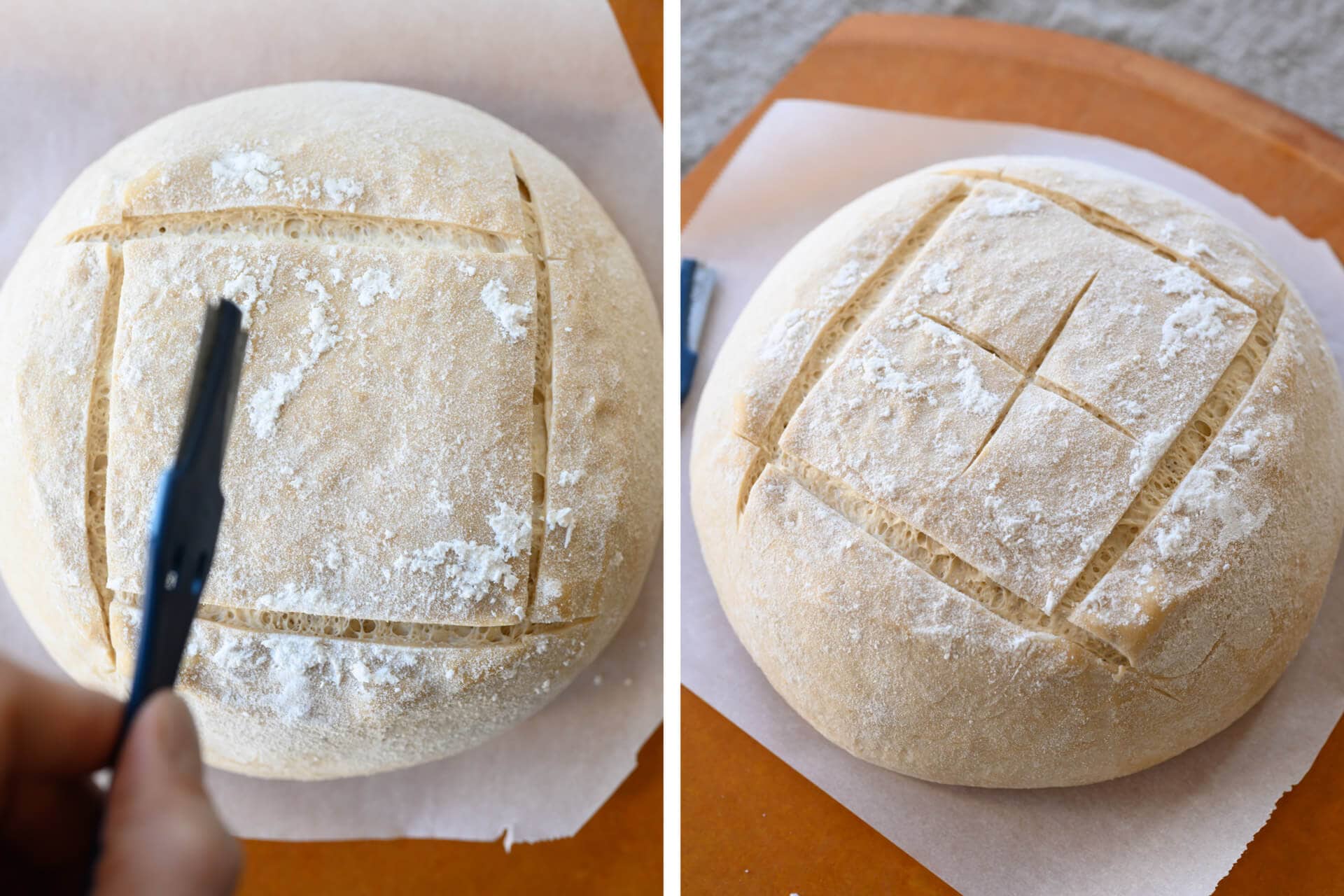
Score the dough using your favorite design. As you can see above, I love the “box top” score. Check out this video of me scoring this style (and a few others) below:
Now that your dough is scored, carefully slide it into the Dutch oven and bake for 20 minutes, covered.
After this time, remove the lid and bake for 30-35 minutes or until done. The internal temperature should be around 205-210°F (96-99°C).
(Note that If you’d like a thinner crust on this bread, increase the covered bake time to 30 minutes and reduce the second half of the bake (without steam) by 10 minutes. This increased baking time with steam can help reduce the thickness of the crust.)
Remove the loaf to a cooling rack for 2 hours before slicing. This lets the crust and crumb fully set and the flavor develop. Return the Dutch oven to the oven (without parchment) and bring it back to temp to bake the second loaf.
Follow my guide to storing sourdough bread to keep it fresh for the next week (or freeze it for longer!).
Print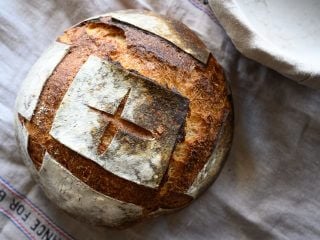
Simple Weekday Sourdough Bread
- Prep Time: 24 hours
- Cook Time: 1 hour
- Total Time: 25 hours
- Yield: 2 loaves
- Category: Bread, Sourdough
- Cuisine: American
Description
A loaf of delicious sourdough bread designed around a busy workday. The levain is prepared for this bread in the morning and left to ripen while you’re at work. When you get home, continue with the baking process. The dough can then be baked at night or the next day in the morning, or after work.
Ingredients
Levain
- 40g bread flour
- 40g whole wheat flour
- 81g water
- 8g ripe sourdough starter
Main Dough
- 766g bread flour
- 161g whole wheat flour
- 19g salt
- 685g water
- 169g ripe levain
Instructions
- Levain (7:00 a.m. before work)
In a small container, mix the Levain ingredients and keep it at a warm temperature for 10 hours. - Autolyse with levain (5:00 p.m after work)
In a medium mixing bowl, add all of the levain, 766g bread flour, 161g whole wheat flour, and 635g water (50g was reserved for mixing, later) and mix until no dry bits remain. Cover the bowl and let rest for 20 minutes. - Mix (5:20 p.m.)
To the mixing bowl holding your dough, add 19g salt and some of the reserved 50g water (or all if the dough feels like it can handle it). Mix thoroughly and strengthen the dough for about 5 minutes. Using wet hands, mix everything until it comes together into a shaggy mass. This dough is relatively strong and doesn’t require intensive kneading (like slap and fold), but give it a few folds in the bowl, perhaps 5-10, until it smooths slightly. Transfer the dough to a bulk fermentation container and cover. - Bulk Fermentation (5:30 p.m. to 9:00 p.m.)
This dough will need 2 sets of stretch and folds during bulk fermentation, the first set 30 minutes after bulk fermentation begins. Perform the second set 30 minutes after the first, and then let the dough rest the remainder of bulk fermentation. - Divide and Preshape (9:00 p.m.)
Lightly flour your work surface and scrape out your dough. Using your bench knife, divide the dough in half. Lightly shape each half into a round shape. Let the dough rest for 30 minutes, uncovered. - Shape (9:30 p.m.)
Shape the dough into a round (boule) or oval (batard), then place the dough in proofing baskets. - Proof (9:30 p.m. to 7:00 a.m. or 6:00 p.m. the next day)
Cover proofing baskets with reusable plastic and seal shut. Then, place both baskets into the refrigerator and proof overnight. - Bake (The next day, bake at 7:00 a.m. before work, or 6:00 p.m. after work)
Preheat your oven with a baking surface or combo cooker/Dutch oven inside to 450°F (230°C). Remove your dough from the fridge, score it, and transfer it to the preheated baking surface or combo cooker. Bake for 20 minutes with steam. After this time, vent the steam in the oven or remove the lid (you can keep it in the oven or remove it) and continue to bake for 30 minutes longer. When done, the internal temperature should be around 204°F (95°C). Let the loaves cool for 2 hours on a wire rack before slicing.
Notes
- This recipe is wonderful left plain, or you could top the dough with rolled oats, white sesame seeds, or flax seeds.
If you use this recipe, tag @maurizio on Instagram so I can take a look!
What’s Next?
There you have it; this simple weekday sourdough bread can be made daily and adjusted to fit your schedule. Now, there’s no reason not to bake. This recipe is also a great place to experiment: mix 125g of nuts like walnuts and pecans and dried fruit like cranberries, cherries, or raisins.
Many recipes on my site can be adapted to this simple weekday sourdough bread schedule, most notably my Beginner’s Sourdough. Both recipes use flexible doughs, and the fridge provides even more.
For a more hands-off approach, check out my easy no-knead sourdough bread recipe. It can also be adapted to bake in a single day or ferment longer for an easier schedule.
Happy baking!


917 Comments
Hi Maurizio! I made this loaf today and the taste, look, and crust are amazing. However my dough is dense and doesn’t have that many air bubbles. It seems like it didn’t ferment enough. I did only use all purpose flour because that’s all I had. Do you have any recommendations about how I can improve the consistency?
Thank you!!
Based on the description of your loaves it could be that they are slightly under proofed. There are a few indicators your dough could be under: explosive rise in the oven, dense interior with potentially scattered large holes, and gummy texture to the interior. Finally, it’s possible the bottom of the loaf might be slightly bowed upward (like the letter “U” — the top will kind of dome).
Make sure to build your levain from a starter that’s strong and mature (meaning it’s risen to it’s peak height before you take some to use). From there, bulk fermentation is very important! Make sure your bulk fermentation goes sufficiently far, you want the dough to look smooth, it should have risen considerably, and have bubbles here and there — it should look alive. If you tug on the dough a bit it should offer resistance to your tugging, it’ll feel stronger. Give the dough the time it needs in bulk fermentation! If you have to give it another 30m or hour to see these signs, do so. It’s important for this step to go sufficiently far for the dough to have enough fermentation activity before its proof.
Does the parchment go into the Dutch oven with bread? It was stuck?
I have always put it in the DO with my dough, have never had a problem!
We tried this recipe for our first time making sourdough. I found the dough was pretty firm. We were able to fold and stretch it during bulk fermentation but I feel like it probably needed more slack. When we used our levain, it started to fall a bit so it wasn’t at its peak. I wonder if its because of that or if we needed to incorporate more water. Also, both loaves look really different. One looks perfect with the texture different where we scored it. The other has the same texture all throughout, even where the score was (it has a golden crust all on top). Why would they look so different?
This is a pretty strong dough given the high amount of bread flour, it likely could take more water next time. You can also reduce the number of stretch and folds you give the dough, stop once it feels like it’s too hard to stretch out. Hard to say, perhaps it was the way they were shaped or their location in your oven (I know I have to shuffle things around to get even heat!).
Hi Michelle- I’m a beginner too and have made this recipe a couple of times and still troubleshooting- I’m not sure if you are also baking the loaves one at a time? I only have one dutch oven so I have to do them one at a time. I have found it made a HUGE difference when I put the dutch oven (including the lid) back in on it’s own for 5-10 min between loaves to heat back up (vs the dutch oven cooling down before the 2nd loaf got into it). Hope that maybe helps you too 🙂
Hi Maurizio! I’ve been having some trouble with the final, shaped boule. My boule loses a lot of its shape when I transfer from the fridge to cutting board/parchment paper. It’s a nice ball before then, but gently plopping it out onto the cutting board, and then letting it sit for a minute while I score, the dough starts to spread out, so by the time I get it into the dutch oven it’s not really a nicely shaped boule anymore and it’s flattened out. Any advice?
Sounds like it could use more strength, I’d give it one more set of stretch and folds and be sure to preshape and shape it tightly. If it still happens, it’s possible the dough is over proofing on you — in this case, cut back that proof time in the fridge 2-4 hours and see if this helps!
My question with this and other recipes is how do you have a mature starter first thing in the morning? Is a “mature” starter something that was grown and retracted overnight? Or is starter that is reaching its peak growth stage? Thanks for the info!
Unfed! Nevermind!
Hi Maurizio,
I just started my first sourdough starter tonight and want to make this bread for the weekend too. I live by myself so could I half the recipe, if so, would I half the levain too?
Hi Cronin
I would use the same amount of levain but remember, you are taking this out of the total amount of flour and water used. To be clear, measure up the total amount of flours and water for the recipe (in your case half of everything). take out what you need for the levain according to the full recipe and when mixing it all together, it should come right. It should in this case be like this:
Total ingredients:
403g bread flour
101g rye flour
383g water
9.5g salt
8g starter (yes I would not use less starter)
Leavain same as above
40g bread flour
40g rye flour
81g water
8g starter
When you mix the dough for autolyse, only reserve 25-30ml (grams) of water to add later when mixing in the salt oppose to the 50ml/g stated in the recipe above.
Good luck 🙂
Perry
I am also halving the recipe and instructions to bake 1 loaf. I believe this post is inaccurate. You halved everything except the amount of starter used to build the levain. Why? With 4g starter, 20g bread flour, 20g rye flour, 40.5g water it should still be able to provide the same quality of levain no?? All about ratios. Less discard in the end if making 1 loaf vs 2. Can someone please confirm this is ok?
Hi CHH
Well, I will suggest that you DO half everything as Maurizio states. However, I have done what I described above with the result of a slightly wetter dough (harder to work with) but ezcellent end result. 🙂
I kinda like to experiment but if you want to be sure then YES HALF of everything. Good luck. 😀
Perry
That’s correct, halve everything (as I describe on my introduction to baker’s percentages post!).
I just made this recipe for the first time. I followed the instructions precisely and…. it came out looking beautiful! I stated up a sourdough stater about 3 weeks ago and tried the “No Knead Sourdough” recipe from the NY Times Cooking section – I always got flat, dense, gummy results (the second rise never really came through). This time I used The Perfect Loaf recipe, managed to get KAF Bread Flour and White Whole Wheat, and as I said – came out picture-perfect!
The dough did “spread” slightly when I let it rest for 30 minutes before shaping into a boule – I may cut back on water even more next time. Also, I didn’t divide the dough – I dumped the whole thing into my 5.5 qt Le Creuset Dutch Oven – I was afraid to make a smaller loaf and have it “spread” during baking. I used a big mixing bowl lined with an ancient kitchen towel dusted with AP flour (no rice flour) for proofing and it worked out fine (no sticking)!
The main difference I felt with this recipe over my earlier attempts? When I was patting and shaping the dough, it felt almost “alive” – like it had its own personality. Not an evil consciousness, like “The Blob”, but a force for good 🙂 It was a totally different sensation.
When I first read this recipe I thought “ugh, too much detail!” After reading it over and over, the detail really helped me understand what to look for and the chemistry behind the process. Thanks for this excellent work! I can’t wait to try again…
That’s just fantastic to hear, Alan! Happy it turned out well for you. Yes, I’d say a bit less water and you’ll probably hit the sweet spot there. That’s exactly what you want to see, the dough should be alive, bubbly, jiggly. These are all good signs.
Thanks for the feedback and here’s to many more wonderful loaves!
Hi,
Thanks for the excellent information. I made sourdough last year and took a break for the winter. Now I’m starting up again using your website as a guide.
A couple questions:
1. My starter looks pretty good, and is rising reliably (I’ve been using a proofing box at 28c). I’m after day 5, do you think I can already use it to make a levain today?
2. Due to the current situation, I can’t seem to get bread flour at my local store, will the weekday sourdough recipe work using regular flour instead? Are there any modifications I should make?
Thank you and keep up the excellent work.
Answers:
1. Once you see your starter rising and falling consistently each day, it should be ready to bake with. You want to see it transform from a mixture of lifeless paste (just flour, water, and some mature starter) to a bubbly, risen, and sour-smelling mixture later in the day. This transformation should take about the same amount of time each day assuming the flour and temperature are kept consistent. It’s important to see this consistency because it indicates you now have a stable mixture of beneficial bacteria and wild yeast.
2. Yes, it’ll work just fine. I’d reduce the water in the recipe, perhaps 25-50g when mixing as needed.
Happy baking!
Hey there! Thanks so much for this resource. I am trying this recipe for the first time. I got to the bulk fermentation, waited 3.5hrs and saw very little rise. I left it overnight and saw more rise but the dough seems sticky – do you think I overwatered it? When trying to pre-shape and then shape it, it was very sticky to work with, not like what yours looks like. Is there anyway to recover the dough at this point? I wonder where I went wrong? Thanks so much!
It sounds like your dough is most likely over hydrated. Try reducing the hydration by 10% and give it another go — the reduced water should bring a lot of strength to the dough and you’ll feel it immediately. Once you find a suitable hydration, you can try to push it back up, but as you do, take note of how the consistency of the dough changes: the dough will start to slacken out as you add more and more water, this means you’ll likely have to mix more upfront or add another set or two of stretch and folds during bulk fermentation.
Try to keep everything else as consistent as possible and let me know how the next attempt goes!
Hi Maurizio, thanks for this recipe. I understand that keeping the dough in the fridge slows down the fermentation process, but what if I want to bake it the same night, how long should I proof it at room temperature and what indicators should I look out for to know its ready to bake? Thank you.
It depends on the dough that day, but generally I see it ready after 2-4 hours at room temp. If you poke the dough on the surface the indentation should slowly come back to the surface, perhaps not quite filling back in totally.
Hi there, really interested in trying this, i have been trying a recipe that uses 500g flour, 250g starter, 340g water and 10g salt. I follow a very similar process, mix the starter into water, add flour, rest 15 mins, autolyse, then stretch and fold every 30mins for around 3 hrs, then let it ferment for a few hours, shape then cold prove for 12hrs. Every loaf I bake has large holes/tunnelling at the top. It is so disheartening after putting in so much time. What do you think I am doing wrong? This was a recipe I used at a sourdough class and it turned out lovely. Thank you for any advice
Based on the description of your loaves it could be that they are slightly under proofed. There are a few indicators your dough could be under: explosive rise in the oven, dense interior with potentially scattered large holes, and gummy texture to the interior. Finally, it’s possible the bottom of the loaf might be slightly bowed upward (like the letter “U” — the top will kind of dome).
Make sure to build your levain from a starter that’s strong and mature (meaning it’s risen to it’s peak height before you take some to use). From there, bulk fermentation is very important! Make sure your bulk fermentation goes sufficiently far, you want the dough to look smooth, it should have risen considerably, and have bubbles here and there — it should look alive. If you tug on the dough a bit it should offer resistance to your tugging, it’ll feel stronger. Give the dough the time it needs in bulk fermentation! If you have to give it another 30m or hour to see these signs, do so. It’s important for this step to go sufficiently far for the dough to have enough fermentation activity before its proof.
Hi– I noticed the starter amount (8g) for the levain is significantly lower than in other recipes— how does this affect the breads ‘tanginess’ and fluffiness. Thanks!
Hey, Adrienne. It’s a low amount because the levain matures over 12-14 hours or so at warmish room temperature. Many considerations go into the end flavor of a bread, it’s hard to isolate just this component to draw conclusions!
do you think a 2 quart dutch oven would be big enough for this?
No, I don’t think it would fit. If you wanted to make a loaf that small I would reduce the dough weight to perhaps 500g and make several loaves.
Hi Maurizio, I have a starter that I keep in the refrigerator and feed it once a week (on Saturday). If I want to make bread mid week, can I use the starter in the refrigerator for the levain or do I need to allow the starter to sit at room temperature before using it? Thank you!
I like to keep my starter out for a few feedings (1 day or so) before using it to make a levain so it gets back up to full strength before making a levain. I essentially follow my weekend baking schedule, the section in that post on how to ramp my starter up after it’s in the fridge.
Got it! Thanks so much!
My kitchen is on the cool side – usually in the 67-70 range depending on time of day. I tried leaving my oven light on, but I must have turbo-powered oven lights because it was 100F after an hour, and 120F after two! Should I try to use the oven and keep it in the target temp range by turning the lights on and off periodically, or just use my countertop and plan on the leaven and bulk fermentation both taking a bit longer?
Either will work! I take your first approach: I toggle the light on and off to keep it at a nice warm temp but not too hot.
Hi! I was wondering if I could halve this recipe to make one loaf as opposed to two? Thank you!
Yes, absolutely!
Maurizio –
What kind of salt is recommended? Kosher, iodized, etc.
Sea salt is preferred, but kosher will work just as well. Don’t use regular table salt (iodized).
I’m a first-time sourdough baker and am a bit concerned about the proofing step – my kitchen towels are all fairly “barbed” and loose-knit and I’m worried the dough will stick. Can I proof the shaped boule on parchment in a mixing bowl, seam side down, so I can just lift directly into my dutch oven?
Sure, that could work, Jesse. If your towels are a little rough be sure to flour them liberally and if the dough is strong and tight enough, it should remove from the towel. You could test, one in parchment and one on the towel.
Hi, I too would like to know if I can skip the fridge. I just don’t have the space for two loaves in the fridge. Also would quite like to get it done in slightly less time.
Yes, you absolutely can! Leave the loaves to proof on the counter until they’re ready to bake (they should pass the “poke test”), typically 2-4 hours depending on the dough that day and the temperature of your kitchen.
This seems like such a small amount of starter in the levain, compared to many of your other recipes! I assume its not a typo since many people seem to be making it with success, but can you tell us how that works? I searched the site to see if I could find the answer but couldn’t. Do you need less starter if its a longer ferment (10 hours vs the 5-6 in the beginners sourdough recipe)? Thanks for the great website, just curious about the technique and its effect!
That’s right, there’s such a small amount of starter because the levain is maturing over 10-14 hours or so. If you added more starter, it would mature faster. You’re very welcome! Let me know how this bake goes for you and happy baking 🙂
Hi! I was wondering if I could use AP flour instead here? or do you have a recipe that uses AP flour? thanks!!
Yes, you can absolutely make this with 100% AP flour. Just keep an eye on hydration and dough strength: hold back that 50g of water in the mix and only add it in if it feels like the dough can handle it. You might also want to add in another set of stretch and folds during bulk fermentation to give the dough a bit more strength.
Hi! If I leave the dough at room temperature for proofing rather than putting it in the fridge overnight, how long would it take to proof? Would it be as effective? Thanks!
Likely 2-4 hours depending on the dough and temperature in your kitchen. You’ll end up with wonderful bread, it might not be as complex (sour) tasting and with the same colors on the crust, but delicious nonetheless!
Hi Maurizio, I’ve built a lovely sourdough starter following your guide and am so excited to start baking my first loaves! A question- in your AUTOLYSE step above, you say to add the levain to the flour and (almost all of) the water. I thought that autolyse was flour and water only, with the levain to be added afterwards? Many thanks!
Glad to hear that, Emily! As I mentioned in the little note there on that step (the little grey bubble with three dots) I don’t typically add the levain to an autolyse but in this case it’s a short period (20m) and the dough is relatively stiff/firm, the water in the levain helps it come together easier.
Ciao Maurizio, if I do not want to proof in the fridge, how many hours does the dough must stay in the basket at 24 or 25 Celsius? I usually do the Diretto method, all proof out of the fridge and then put the baskets in the freezer for 45 min and 15 min then in the fridge while I preheat the oven. Grazie!
Ciao! I’d say follow your method and bake when you feel the dough is ready. I typically say 2-4 hours depending on the temperature in the kitchen, but bake when the dough feels ready!
Should the levain that we build with mature starter double in size?
I don’t usually judge readiness by how much it rises, but usually that’s it risen to a peak and has leveled off, perhaps it’s started to fall in the jar. Once I see that peak, that’s when it’s good to go.
Hi Maurizio!
Thank you for this. I have jus started my levain, I started a bit late in the morning (2.5 hours late), do you think it will be ready before 10 hours mark? Or should I shift the remaining schedule for today back 2.5 hours?
Thanks 🙂
It really depends on the temperature it’s kept at… If it’s warmer, it’ll speed the process up.
Hi Maurizio,
I feel like I do everything right but my oven spring is not more then a few centimeters. My loafs are good to eat and is not dense or anything, but I don’t get the oven spring that I want. I don’t have the big “holes” either… Have thought that it may be my starter that don’t have a strong enof culture but I really don’t know what to do about that?? Hope you can help, love your blog!
Hey, Anne. If you’re seeing lots of small holes with little rise in the oven it could be either over hydration or over proofing. If the dough feels super wet and slack, try reducing the water in the mix, perhaps 5% with this recipe, and see if that helps next time. The dough should feel stronger and gain more rise. If the dough isn’t overly wet and slack but you’re seeing lots of little holes in the interior, you might be over proofing. Try reducing bulk fermentation a bit, perhaps 30 minutes, or cut back that final proof time in the fridge a few hours and see if you get more rise. If you do but it’s still not where you want it, reduce the proof time further until you get more and more oven spring.
Those are the two most common issues/solutions matching your description!
When the dough is fermenting in the fridge over night, how is it covered? Is it loose with a towel, or cling wrap?
Wrapped tightly, no air flow. I like the reusable plastic covers I have listed on baking tools page.
Thanks man! Appreciate the fast response. Making dough as I type this!
Hi Maurizio,
I have a question regarding the time table – it I start making the levain at 7:00 AM – can I use my starter before feeding it? I’m having a little bit of a problem sync the time that I prepare the levain with that time that the starter is at his best.
Thank toy for your beautiful site.
I’d also like to know the answer to this.
Me too. Can’t figure out a way to have a starter at its peak and not feed it during night. Many thanks, awesome site Mauricio! Thanks
See my reply above, John!
Sorry Maurizio, just to clarify. “you want to use your starter when it’s at it’s “best,” or it’s peak (highest point in the jar, most mature), to make the levain” – so I should feed it, wait for it to grow and then make the levain? Because then you say: “when you wake up in the morning and usually do a feeding, make the levain then” – it is different than the first sentence, no? Like, you can use it before it rises to its peak. I am a bit confused, sorry for so many questions.
I’ll update the post to clarify that, sorry for the confusion. You want to make your levain from your starter before you feed it.
The process is this: wake up, check starter and when it’s mature and read, make the levain from it. Then feed your starter.
See my reply above, Kyle!
Hey, Hagar — you want to use your starter when it’s at it’s “best,” or it’s peak (highest point in the jar, most mature), to make the levain. This is the same time you’d normally feed your starter. Just synch it up naturally: when you wake up in the morning and usually do a feeding, make the levain then. If you need to wait an hour or so — meaning your starter has fallen but need to wait to make the levain for an hour — that’s ok too, just let your starter sit in a fallen state for a little bit until you get to it. There’s some leeway with all this, it doesn’t have to be super exact for this bread!
I was wondering what the crumb is like on this loaf. Love the simplicity of the schedule. Hope you are safe and well in these strange times! Thank you for all you do for the bread community.
Hey, Tori! It’s a tighter interior, but still nice and open. I’ll take some photos next time I bake this. And likewise, I hope all is well with you, wishing you good health and happy baking 🙂
The baker’s percentages for the flour mix don’t seem to correspond to the masses. E.g. the baker’s percentages say the bread flour to whole wheat flour ratio should be 4:1, but that’s not the ratio of masses in the table.
Fixed — I had the baker’s percentages for the overall formula not just the dough mix (which look strange because they’re not round numbers, but that’s how it goes!). Thanks for pointing that out.
Hi. Thanks for this walk through for beginners! One thing I haven’t found anywhere is whether you place the parchment paper in the Dutch oven with the loaf to bake. Do you slide the dough into the pan (and off the paper) or place it in using (and keeping) the paper. Thanks!
Yes, I slide the dough on the parchment right into the DO, it fits just fine and doesn’t burn 🙂
Hi, Thank you for the response on the white flour! I have one more question….
My starter (day 6) tends to peak between the 3 and 4 hour mark (I’m keeping it in an 80 degree environment) then by around 6 hours it’s back down to it’s original height. Is this rising and falling too quickly in a 12 hour period? My concern is that when it’s time to mix in the starter to the Levain at 7am, my starter will not be at it’s peak from the night before – it will be back to it’s original height. If I wanted it at it’s peak, I would have to wake up at 4am to refresh it which isn’t realistic.Any advice would be helpful!
Leave less starter in your jar when you refresh, that’ll lengthen the time between refreshments. Check out my stater maintenance routine post for some ideas there!
Hello, I do not have bread flour and I cannot locate some right now. Can I replace the bread flour with King Arthur Flour All-Purpose Flour? I am aware it may not produce the same result, but would it still come out well?
Yes, actually you’ll get a wonderful result with AP flour! Be cautious with that reserved 50g water: you might not need to add all of it to the dough, only as as much as needed. I might also suggest giving it one more set of stretch and folds during bulk. Let me know how it goes and happy baking, Rose!
I am above 8000 feet. How should I adjust the starter or the sourdough recipe?
Thanks
You might be able to get away with using less starter/levain in the recipe at that altitude. I would likely reduce the levain percentage by 2-5%. Also, you might find your dough needs additional water during mixing, but this really depends on your flour. Add more water to the mix if necessary. Finally, you might find you need to bake these loaves longer until they reach the desired internal temperature (and signs shown above in the post). Hope this helps, I’ve never baked at that high of an altitude, it’s 5280ft here.