

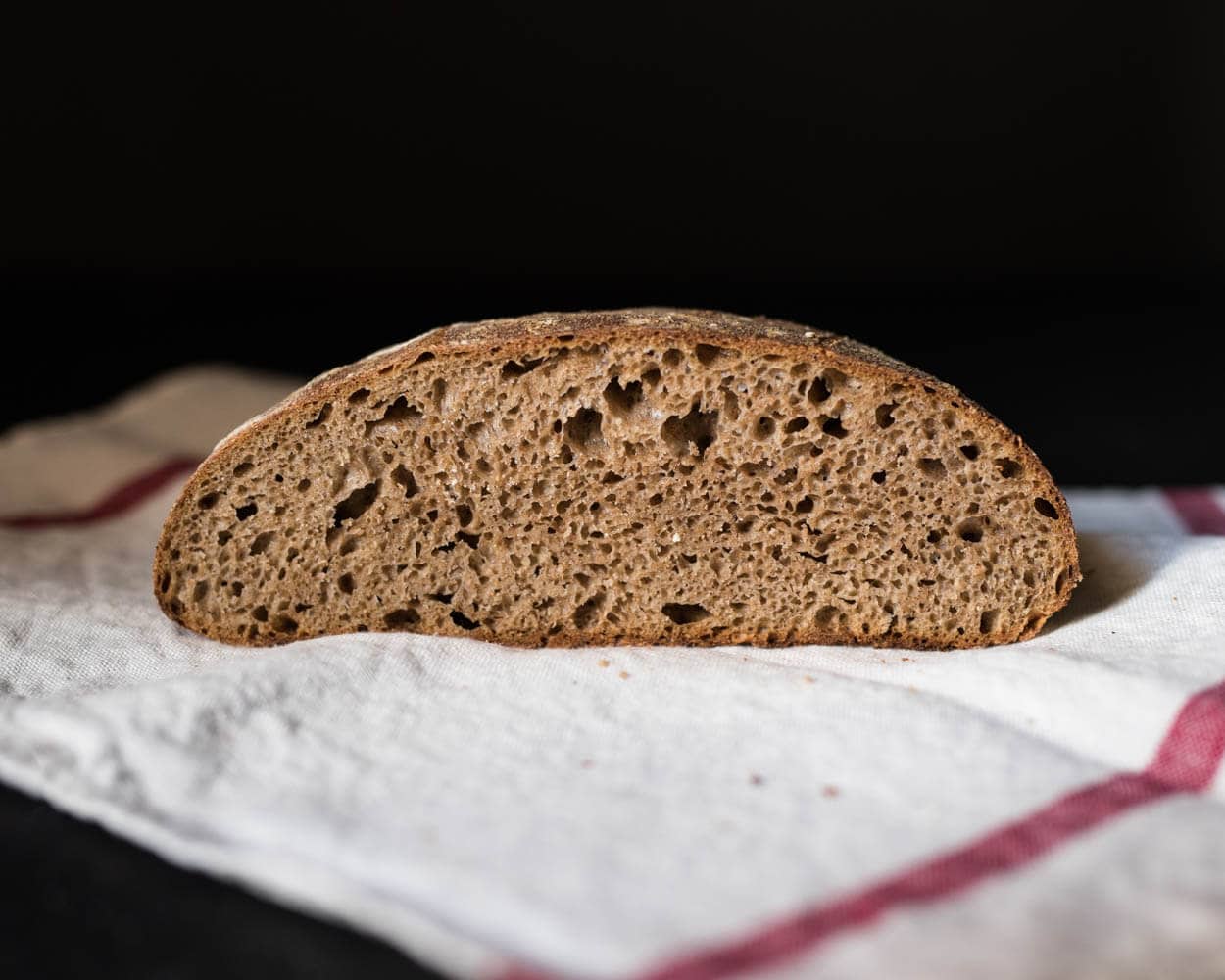
The wonderfully rich flavor profile of whole wheat sourdough bread ranges from sweet caramel notes to robust earthiness depending on the wheat variety used. But what I find even more important is the sense of satisfaction when eating this style of bread, both in terms of satiety and knowing you’re eating all of the nutrition a wheat berry has to offer.
Depending on the wheat variety you use, whole hard red wheat will give an upfront and personal flavor profile, whereas a white whole wheat loaf will be more subtle, thanks to the reduced tannins. Both kinds of wheat and other grain like spelt, Khorasan, and even durum are worthy additions to a loaf, as they serve different desires. My favorite, though, is to use hard red wheat, as I do in this recipe, to get all that robust and punchy wheat flavor.
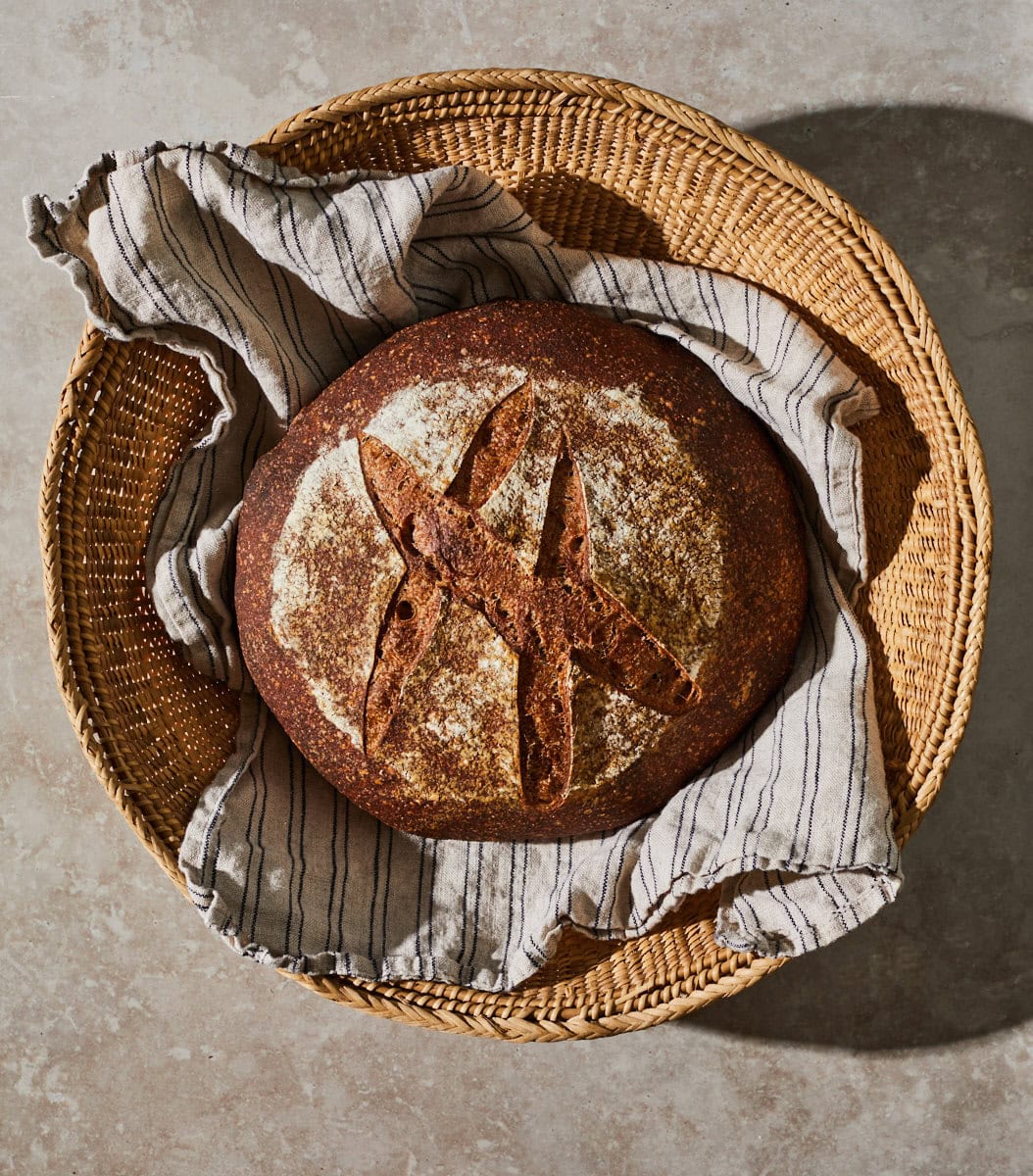
When it comes to whole-grain bread, it’s important to adjust our expectations of what exactly makes a successful loaf. Because whole wheat flour contains the entirety of the wheat berry, including much more of the nutritious bran and germ—and more fiber—the final loaf will be a little more squat than bread made with highly sifted white flour. But! While you’re trading ultra-tall loaves with an open crumb for a squatter loaf with a tighter interior, whole wheat sourdough bread is like a pirate’s ship hauling new bounty, laden with copious flavor and nutrition.
Still, if you want to eke out the highest rise and the most open whole wheat sourdough bread, I have an option with this bread to sift out the bran and germ, create a soaker from these bits, and then work them back into the dough during bulk fermentation. This sifting and scalding, as it’s sometimes called, helps you get more rise in a loaf by softening these nutritious bits by treating them like any seed soaker or other mix-in. This helps preserve a strong gluten network and open interior without forgoing nutrition or flavor.
Note: if you have my sourdough bread cookbook, you’ll find this recipe starting on page 219!
Flour Selection
I used Cairnspring Organic Whole Grain Expresso flour for this 100% whole wheat sourdough bread. This flour, made from hard red spring wheat, has a protein percentage of around 13.5 to 14.5%.
Note that compared to high-protein white flour, also known as whole wheat flour with a high protein content, is not “high-protein” in the same way we think about something like white bread flour. This is because whole wheat flour contains the entirety of the wheat berry, including the brand and germ, which are naturally high in protein. So while whole-grain flour is “high-protein,” it’s referred to as such because it is literally the entire grain, and not because it’s very strong white flour.
Due to the nature of whole wheat flour and the high level of nutrients available for your starter or levain, dough fermentation will be vigorous. Keep an eye on your dough during bulk fermentation, especially if it’s warm in your kitchen, and divide the dough when it looks ready (more on this later).
Can I Use Freshly-Milled Flour for This Whole Wheat Sourdough Bread?
Yes, freshly-milled whole-grain flour can be used for this sourdough bread recipe. Use your home grain mill to mill whole wheat berries into the finest flour possible. If available, I recommend using Yecora Rojo hard red wheat berries.
Be sure to follow my guide to freshly-milled flour at home for more tips on operating your mill for the highest quality flour and storing it after milling.
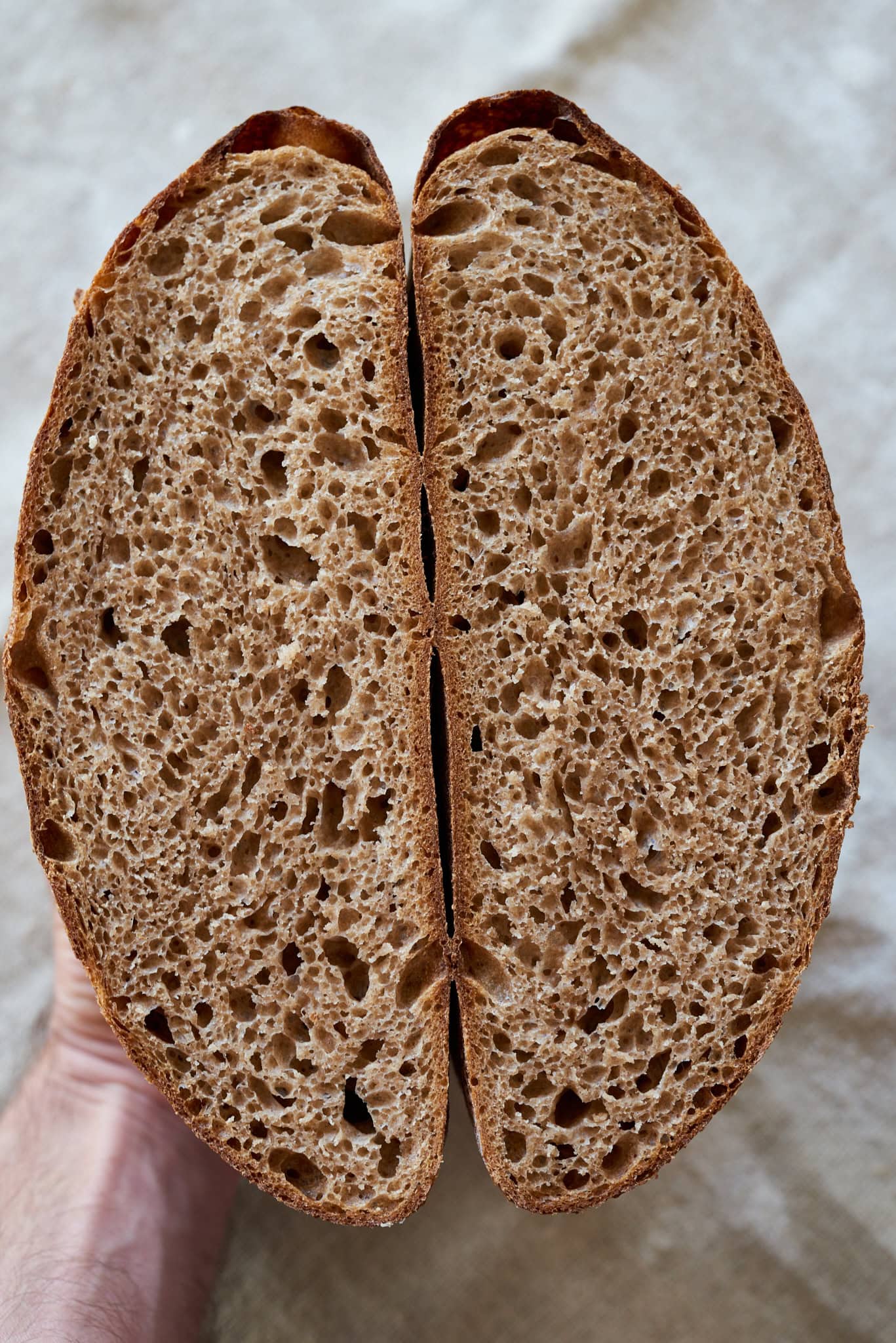
Why is Whole Wheat Bread Dense?
White flour primarily contains only the starchy and strong endosperm part of the wheat berry. When mixed into a dough, white flour produces an extensible and tight-knight viscoelastic dough that excels at trapping the gaseous byproducts of fermentation. With sourdough fermentation, and assuming all else equal, white dough is generally less acidic (higher in pH) when baked, leading to less gluten breakdown.
This means bread with potentially large interior holes, or an open crumb.
One challenge in baking bread with 100% whole-grain flour is that the resulting loaf will have less volume than a loaf made from all white flour (or a mix of white and whole wheat flour). Unlike white flour, whole-grain flour contains the entirety of the wheat berry, including the fibrous bran and germ. These nutritious bits can interfere with gluten development and, to a degree, reduce the volume and openness of a loaf.
But there’s a way around all that.
For Open Whole Wheat Bread, Sift and Scald Your Flour
To reduce the effect of the increased bran and germ in whole wheat flour, which can result in a tighter crumb, these larger bits can be sifted out of the flour, soaked in boiling water, and then reincorporated into the dough at the end of mixing or beginning of bulk fermentation. By performing this, we can soften these large particles and add them in after the dough has been strengthened when mixing (especially if you’re mixing in a mechanical mixer).
In essence, we’re transforming our whole wheat flour into whiter flour, then adding back in the bran and germ using a technique similar to that of porridge bread.
Another way to look at it is to think of the sift-and-scald technique as similar to how seeds, nuts, or other mix-ins might be incorporated gently into dough to reduce their impact on its structure.
Note that it’s a little easier to add the scalded mixture back into the dough at the very end of mixing instead of folding it back in during bulk fermentation—and it’s just fine to do this. (I personally add it back in bulk fermentation to reduce the impact on the dough structure as much as possible, but it does take some work to get it reincorporated.)
Sifting and Scalding Whole-Grain Flour: Step by Step
- Place a flour sifter or sifting screen over a large container or bowl
- Pour all of the whole wheat flour called for in the recipe on top of the screen
- Shake the container and screen to allow the fine bits (endosperm) fall through while the larger bits (bran and germ) are retained on top of the screen
- Remove the sifter and pour the retained bran and germ into a heatproof container or bowl and pour in boiling water to cover
- Let the mixture cool, then cover until ready to add it to dough at the end of mixing or in bulk fermentation
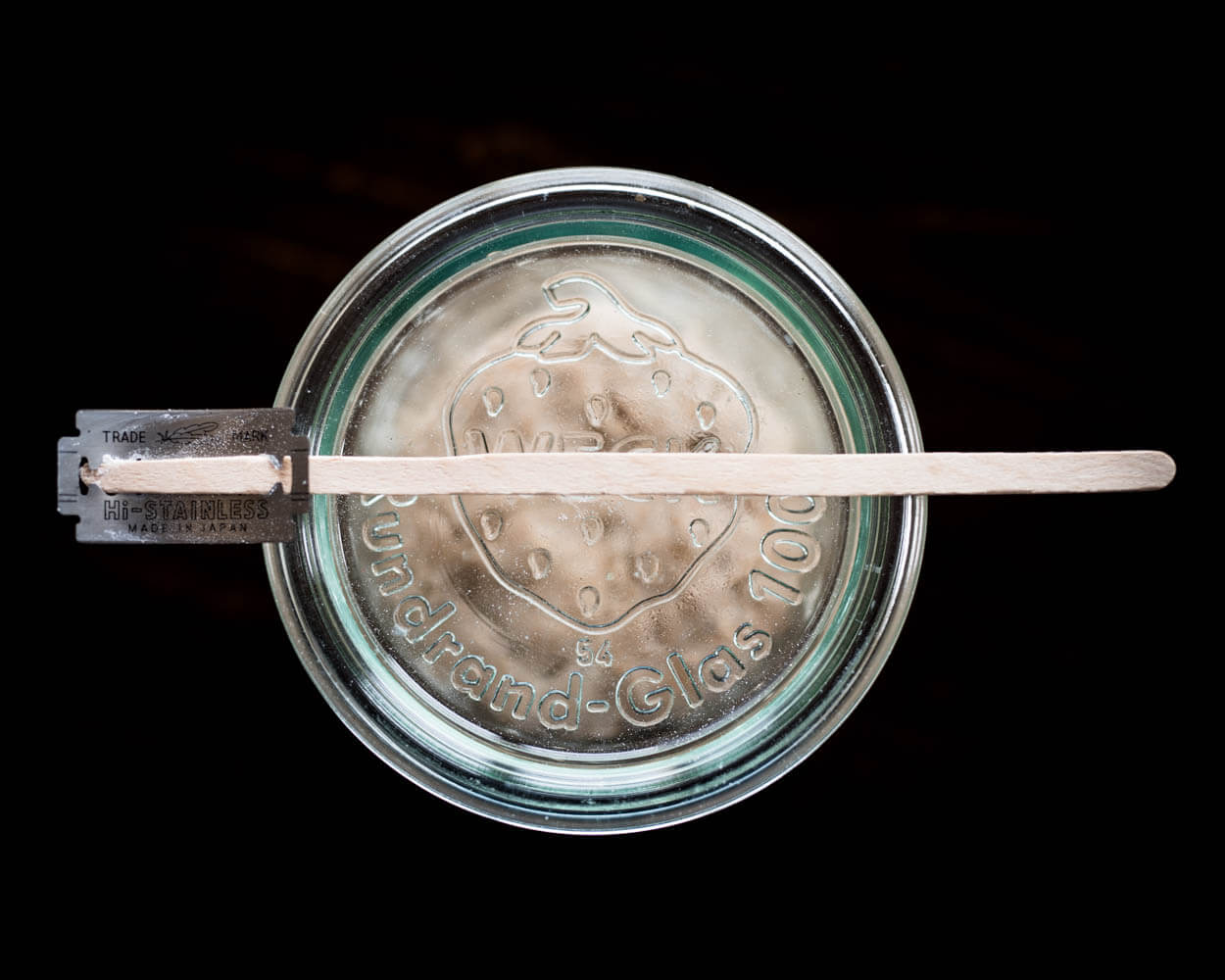
This is the sifting screen I use. After sifting my flour, about 13% remained on the screen. This means if I sifted 1000 grams total whole wheat flour, I’d have about 130 grams leftover to scalded. The final extraction heavily depends on the flour you’re using and how it was milled.
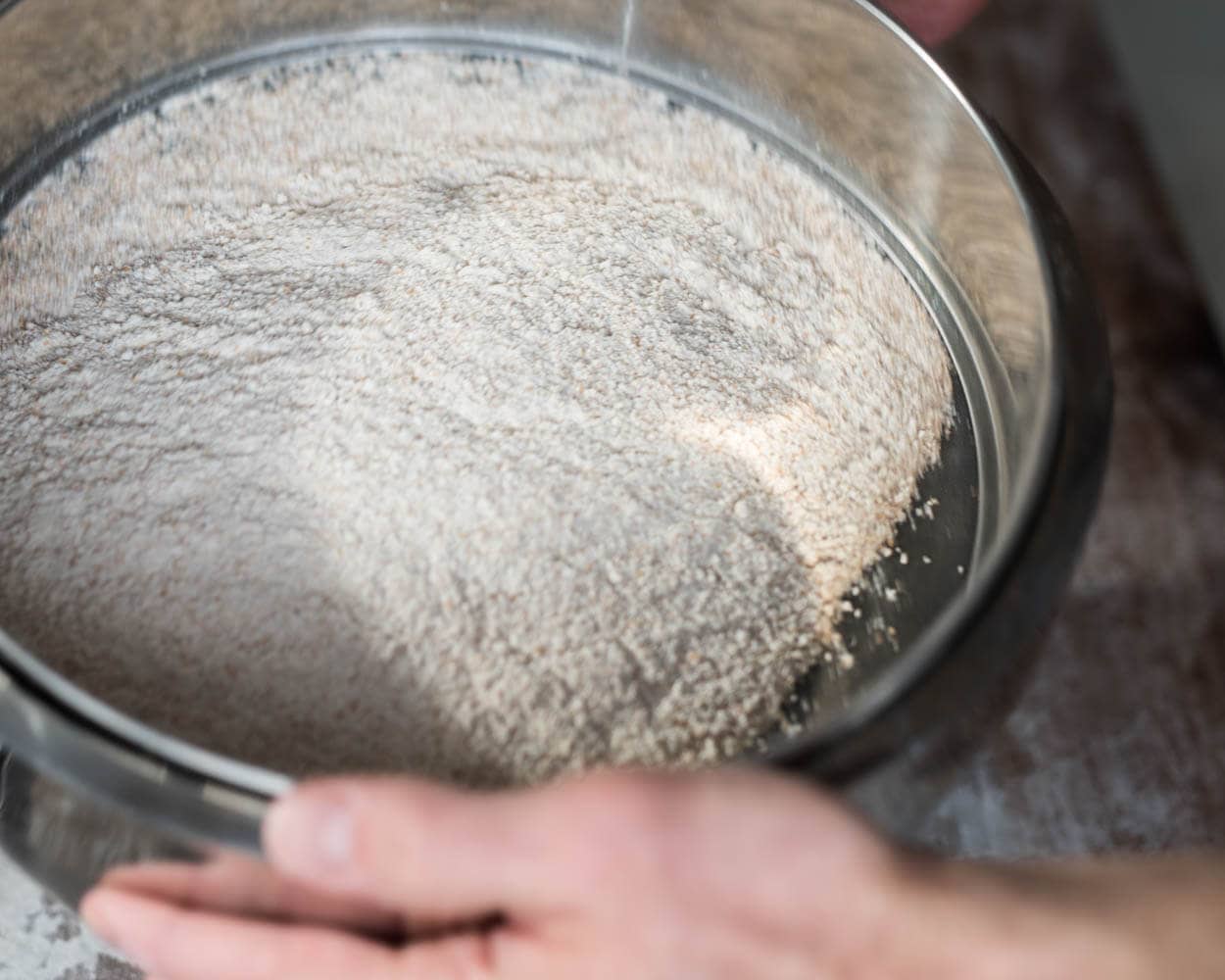
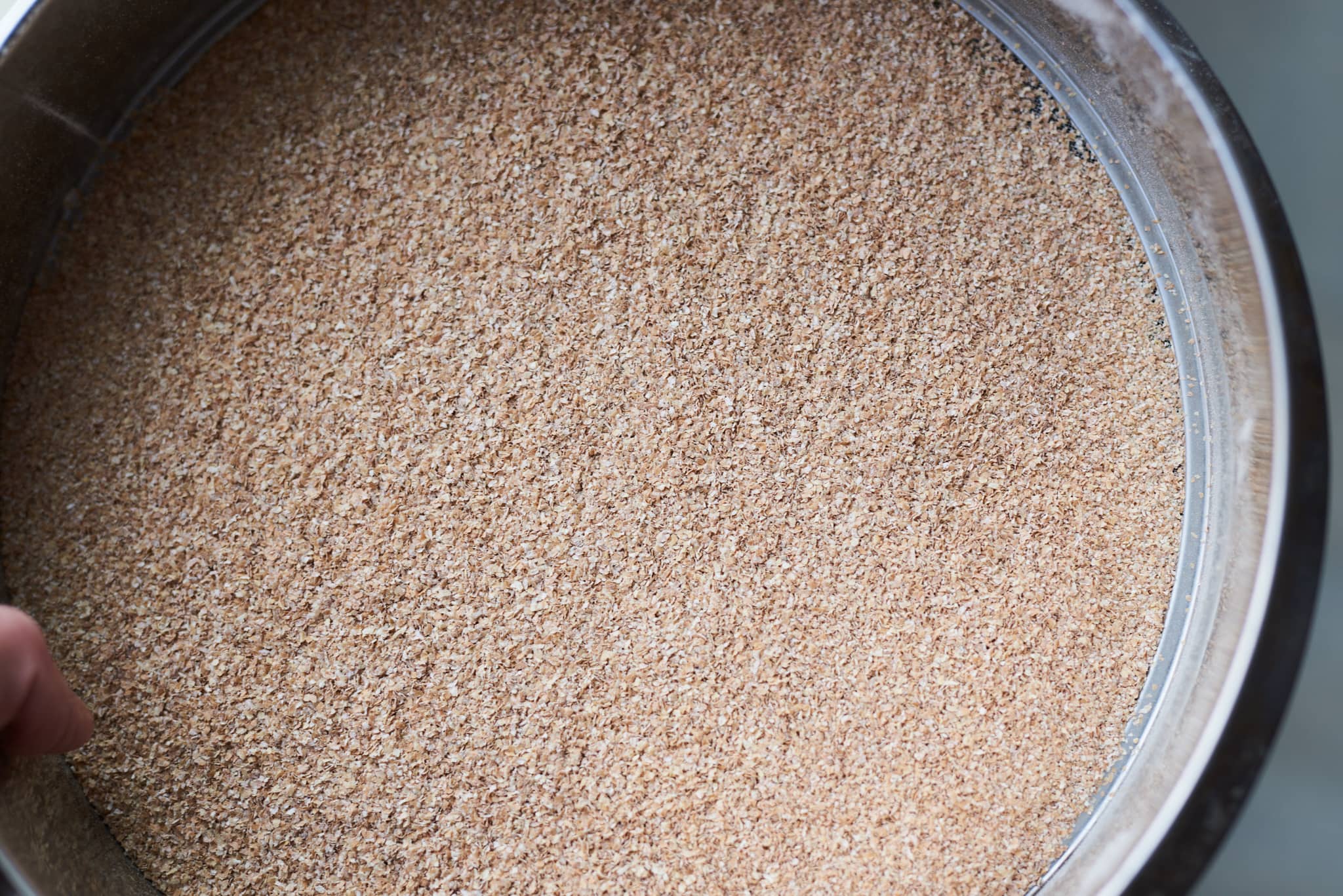
If your screen is more coarse or more fine, it’s okay, too. The extraction percentage here doesn’t have to be precise. Any amount sifted out will help lighten the loaf and it’s okay if more or less flour ends up in the dough.
Note that the amount of water used to scald the bran and germ should be accounted for in the recipe. In other words, I will take water from Water 1 or Water 2 (the water used in the recipe). This way, you’re not adding extra water to the dough, which may result in overhydration.
Baking Schedule
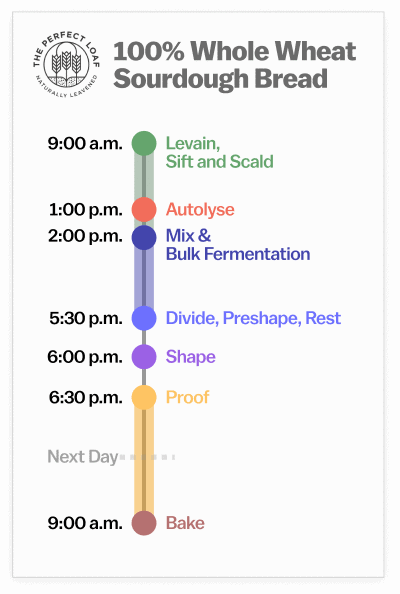
This whole wheat sourdough bread is made over two days for increased flavor and a convenient baking schedule. But it’s also possible to make it in a single day by allowing the dough to proof on the counter, shape it, and cover until it is puffy, relaxed, and passes the poke test (about 2 to 4 hours, temperature depending).
100% Whole Wheat Sourdough Bread Recipe
For tips on calculating baker’s percentages or modifying this formula (including baking only a single loaf), see my post on baker’s percentages (baker’s math).
Vitals
| Total dough weight | 1,800 grams |
| Prefermented flour | 7.0% |
| Levain in final dough | 15.1% |
| Hydration | 90.0% |
| Yield | Two 900g loaves |
Total Formula
Desired dough temperature: 75°F (23°C) (see my post on the importance of dough temperature).
| Weight | Ingredient | Baker’s Percentage |
|---|---|---|
| 921g | Whole wheat flour (Cairnspring Organic Whole Grain Expresso or Central Milling Hi-Pro Fine Whole Wheat) | 100.0% |
| 737g | Water 1 (levain, optional scald, and autolyse) | 80.0% |
| 92g | Water 2 (mix) | 10.0% |
| 18g | Fine sea salt | 1.9% |
| 32g | Ripe sourdough starter, 100% hydration | 3.5% |
Additional Ingredients
About 60g (½ cup) of raw wheat bran or, previously sifted bran and germ, for topping (optional)
100% Whole Wheat Sourdough Bread Method
1. Prepare the levain – 9:00 a.m.
| Weight | Ingredient | Baker’s Percentage |
|---|---|---|
| 64g | Whole wheat flour | 100.0% |
| 32g | Water 1 (levain) | 50.0% |
| 32g | Ripe sourdough starter, 100% hydration | 50.0% |
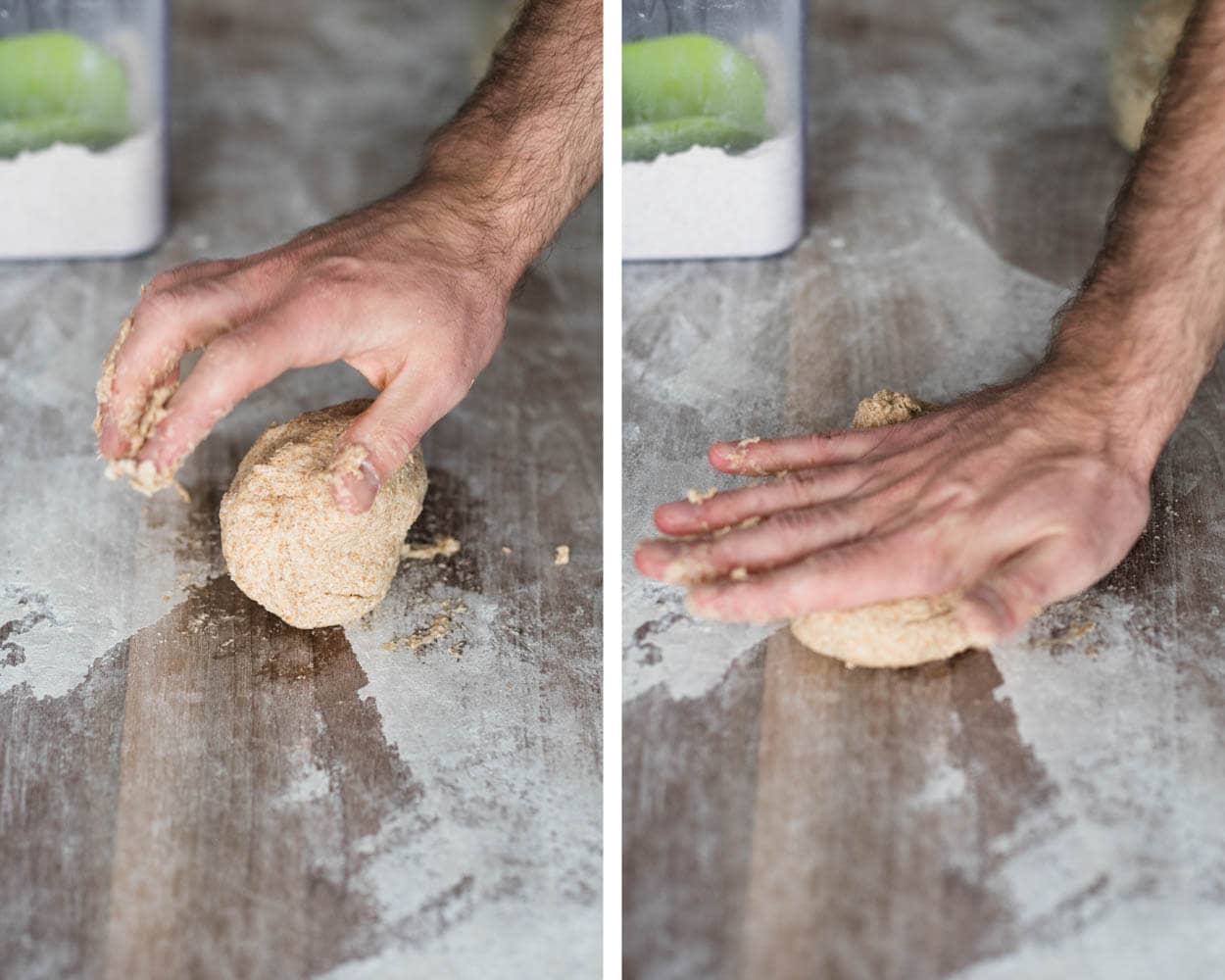
Mix the ingredients in the chart above in your favorite jar and leave them covered at a warm temperature, 74-76°F (23-24°C), to ripen for 5 hours. This is a stiff levain; if it is hard to knead the ingredients together, use more water as needed to make incorporation easier.
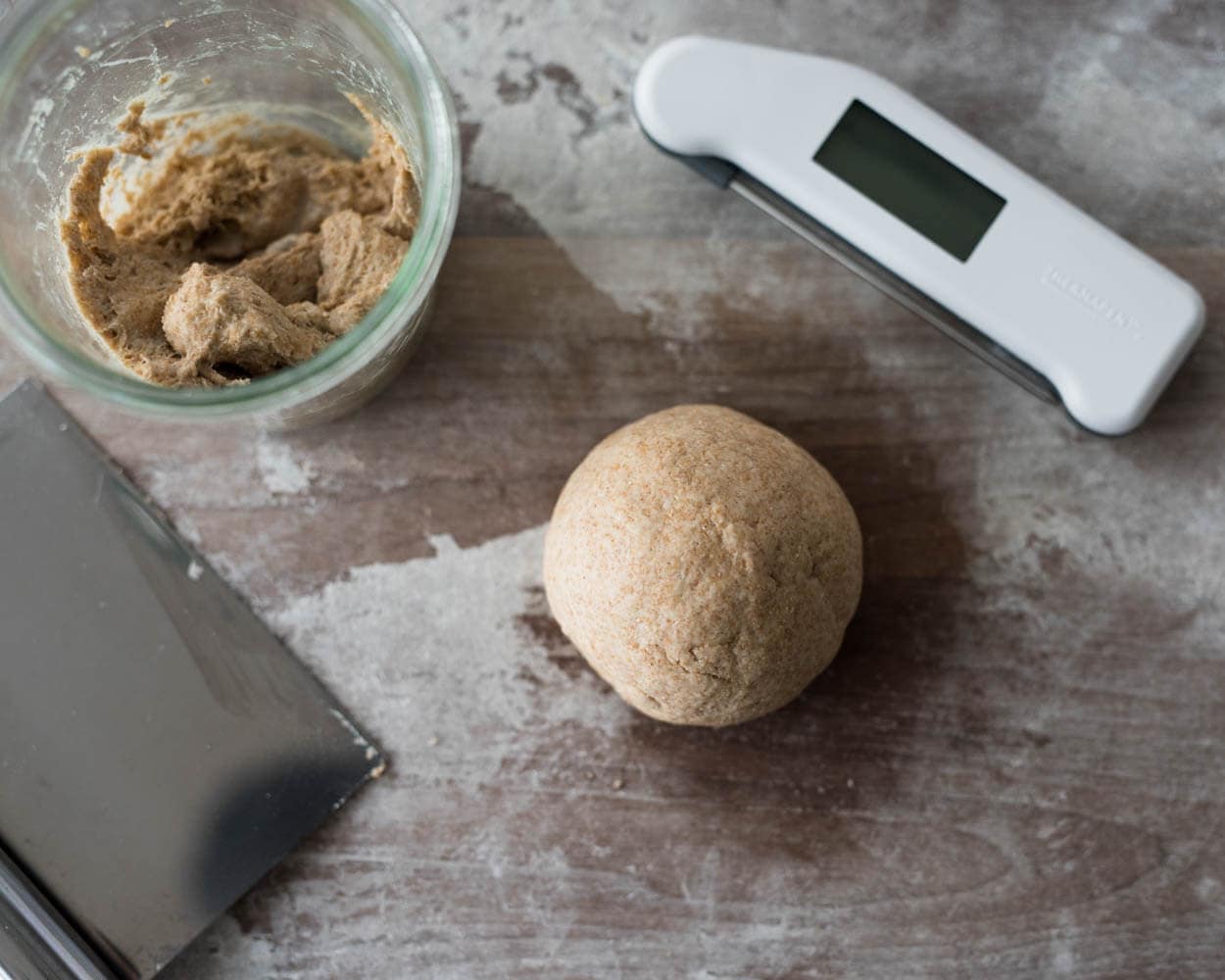
2. Optional: Sift and scald flour – 9:10 a.m.
Place your sifting screen over a large container. Pour some whole wheat flour and sift it by shaking the stack. When no more flour falls through, continue until you’ve processed all the flour.
Place the sifted-out bran and germ in a heatproof bowl and pour 200 grams of boiling water on top to cover. Let this soaking mixture rest near your levain until we are ready to mix the dough.
See earlier in this post, here, for more details on sifting and scalding.
3. Autolyse – 1:00 p.m.
| Weight | Ingredient |
|---|---|
| 857g | Whole wheat flour (minus any sifted) |
| 705g (or 505g if sifting and scalding, which will absorb all 200g of water) | Water 1 (autolyse) |
I use the autolyse technique for this recipe to help reduce the total mixing time required, but I also find it helps aid in the dough’s extensibility.
Warm or cool the autolyse water so that the temperature of the mixed dough meets the final dough temperature (FDT) of 75°F (23°C) for this recipe. Place the flour and water 1 (autolyse) in a large bowl. Use wet hands to mix until no dry bits remain; the dough will be shaggy and loose. Use a bowl scraper to scrape down the sides of the bowl to keep all the dough in one area at the bottom. Cover the bowl and place it near your levain for 30 minutes.
4. Mix – 2:00 p.m.
| Weight | Ingredient |
|---|---|
| 92g | Water 2 (mix) |
| 18g | Fine sea salt |
| 128g | Ripe levain (from Step 1) |
This highly hydrated whole wheat dough benefits from extra strengthening during mixing. Below, I’ll discuss mixing this dough by hand, but it’s also possible to use a mechanical dough mixer. In this case, mix the dough until it smooths and holds itself together, about 5 to 6 minutes on speed 2 in total.
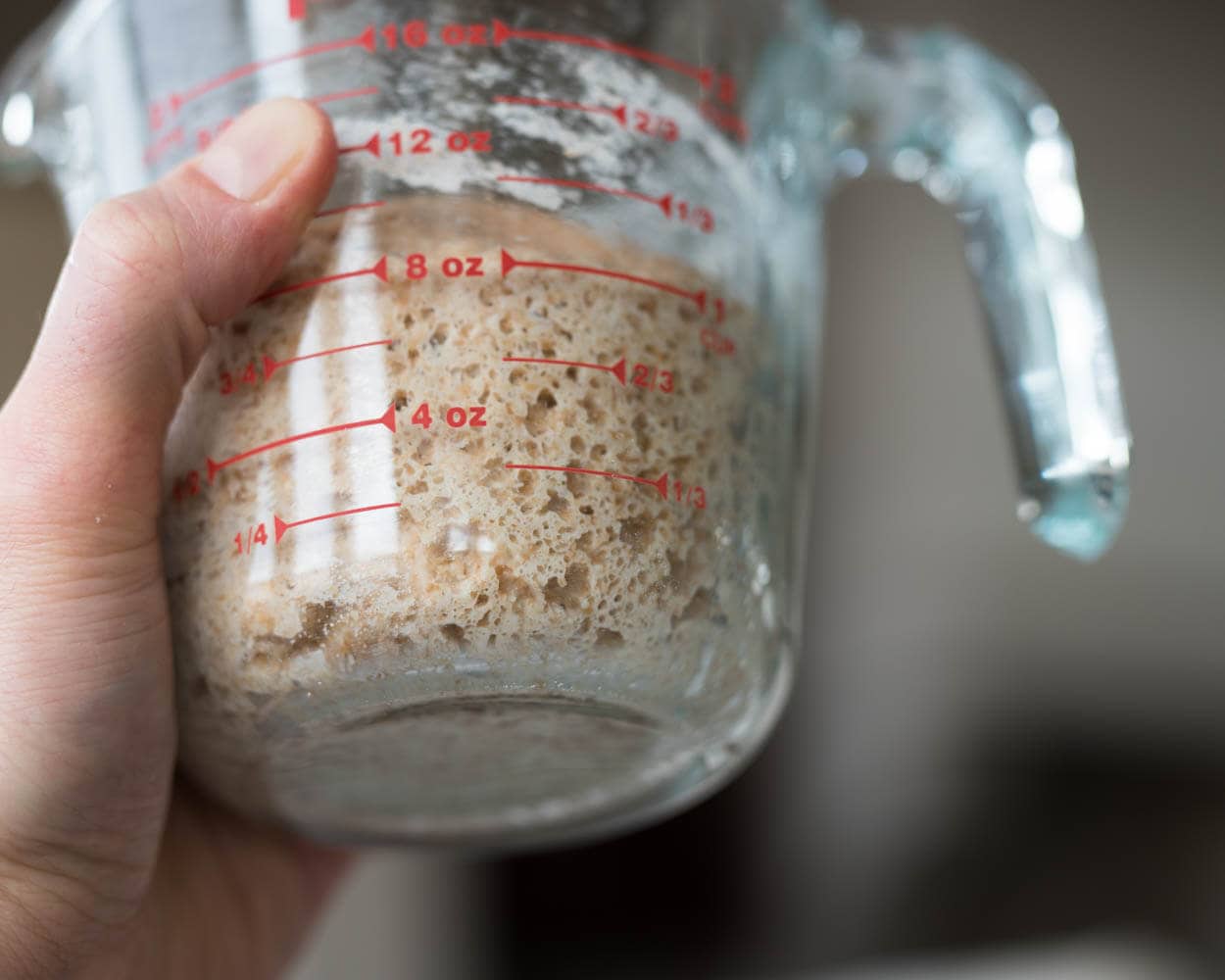
To mix by hand, add the salt and break the stiff levain apart, and spread on top of the dough in autolyse. Use a splash of water 2 to moisten. With wet hands, mix thoroughly. Use wet hands or a dough whisk to help make mixing easier.
Next, knead the dough for a few minutes using either the slap and fold technique or folds in the bowl. For this dough, I kneaded for about 5 minutes until the dough smoothed and became elastic. Transfer the dough back into the bowl, cover, and let rest for 10 minutes.
If the dough feels very wet and soupy, don’t add any remaining water. If it seems cohesive, add the remaining water 2, mixing it in until absorbed. Once again, scrape the dough out to the counter and use wet hands to slap and fold the dough for 3-5 minutes, making it smoother and more cohesive.
Transfer the dough to a bulk fermentation container and cover.
5. Bulk Fermentation – 2:30 p.m. to 5:30 p.m. (3 hours)
At a warm room temperature, 74-76°F (23-24°C), bulk fermentation should take about 3 hours and need 4 sets of stretches and folds at 30-minute intervals.
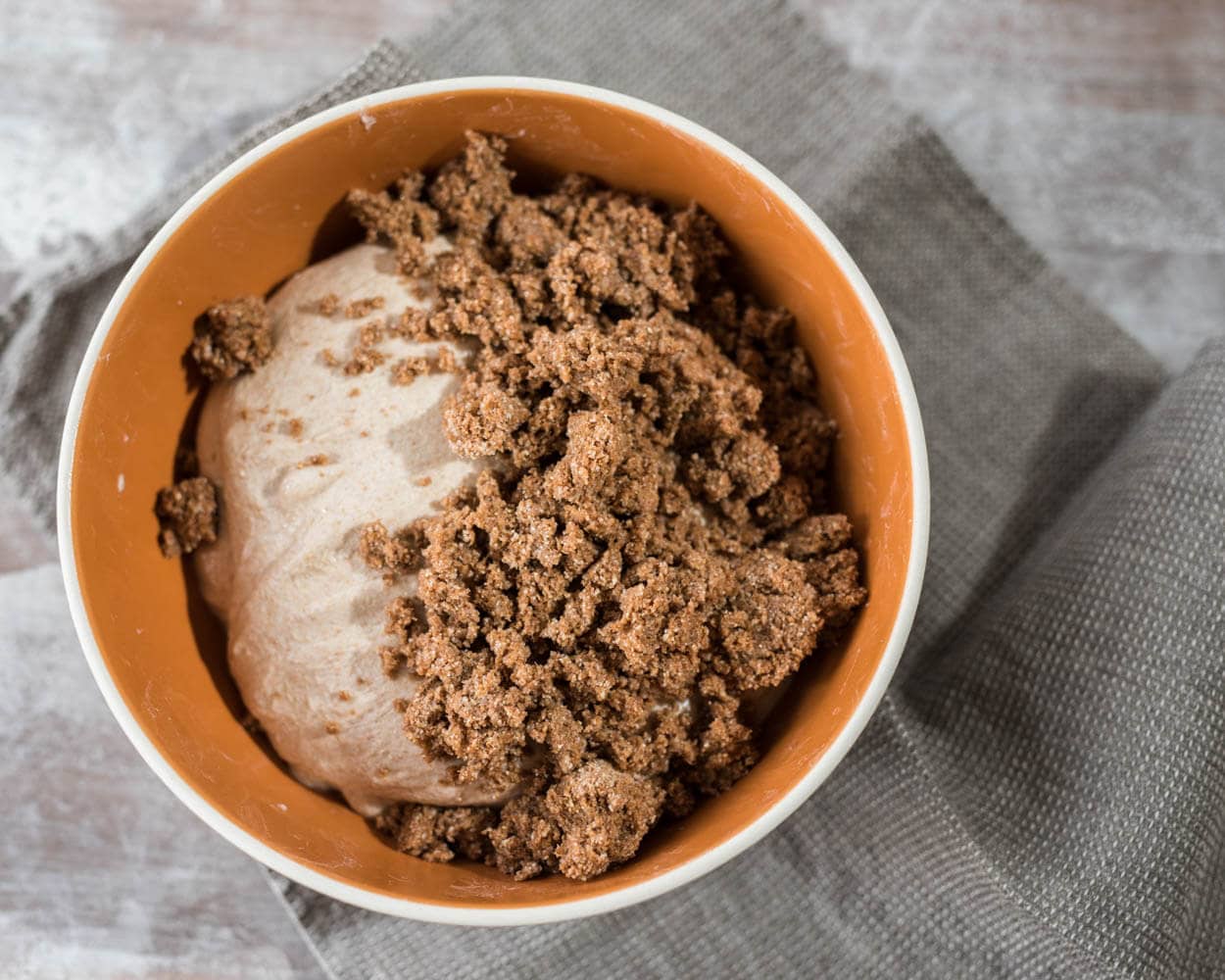
Before you give your dough its first set of stretches and folds, spread about 1/4 of the scald over the top of the dough (if you decided to do this optional step). Then, grab one side of the dough and stretch it up and over the dough to the other side. Spread on another 1/4 of the scald to the new top. Rotate the bowl 180° and perform another stretch and fold. Spread on another 1/4 of the scald, then rotate the bowl 90° and do another stretch and fold. Finally, spread on the last of the scald, turn the bowl 180° and do one last stretch and fold.
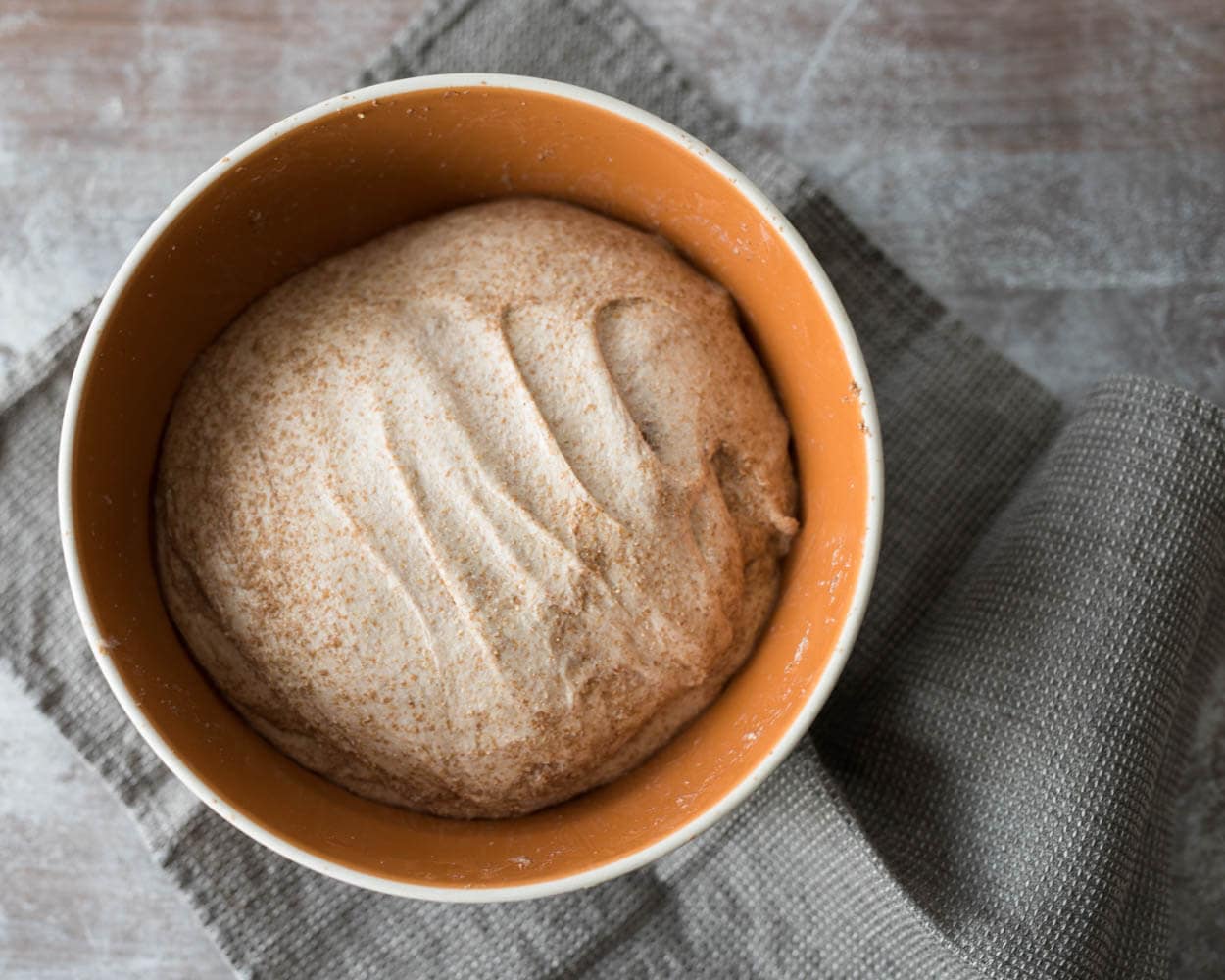
It’s okay if the scald streaks through the dough at this point, there will be more stretching and folding to help it incorporate more thoroughly.
Perform 3 more sets of stretches and folds at 30-minute intervals. After the fourth set, let the dough rest, covered, for the remainder of bulk fermentation.
6. Divide and Preshape – 5:30 p.m.
After 3 hours, the dough should be risen and puffy in the bulk fermentation container. Because of the high percentage of freshly milled flour and whole grains, the dough may not rise as high as a recipe with more white flour. It will be ready to divide when the top of the dough is smooth, bubbly, and the edge where the dough meets the container is slightly domed downward.
Fill a small bowl with water and place it next to your work surface. Scrape the dough onto a clean work surface and divide it into two equal pieces. With one wet hand and a bench knife in the other, preshape the pieces of dough into loose rounds.
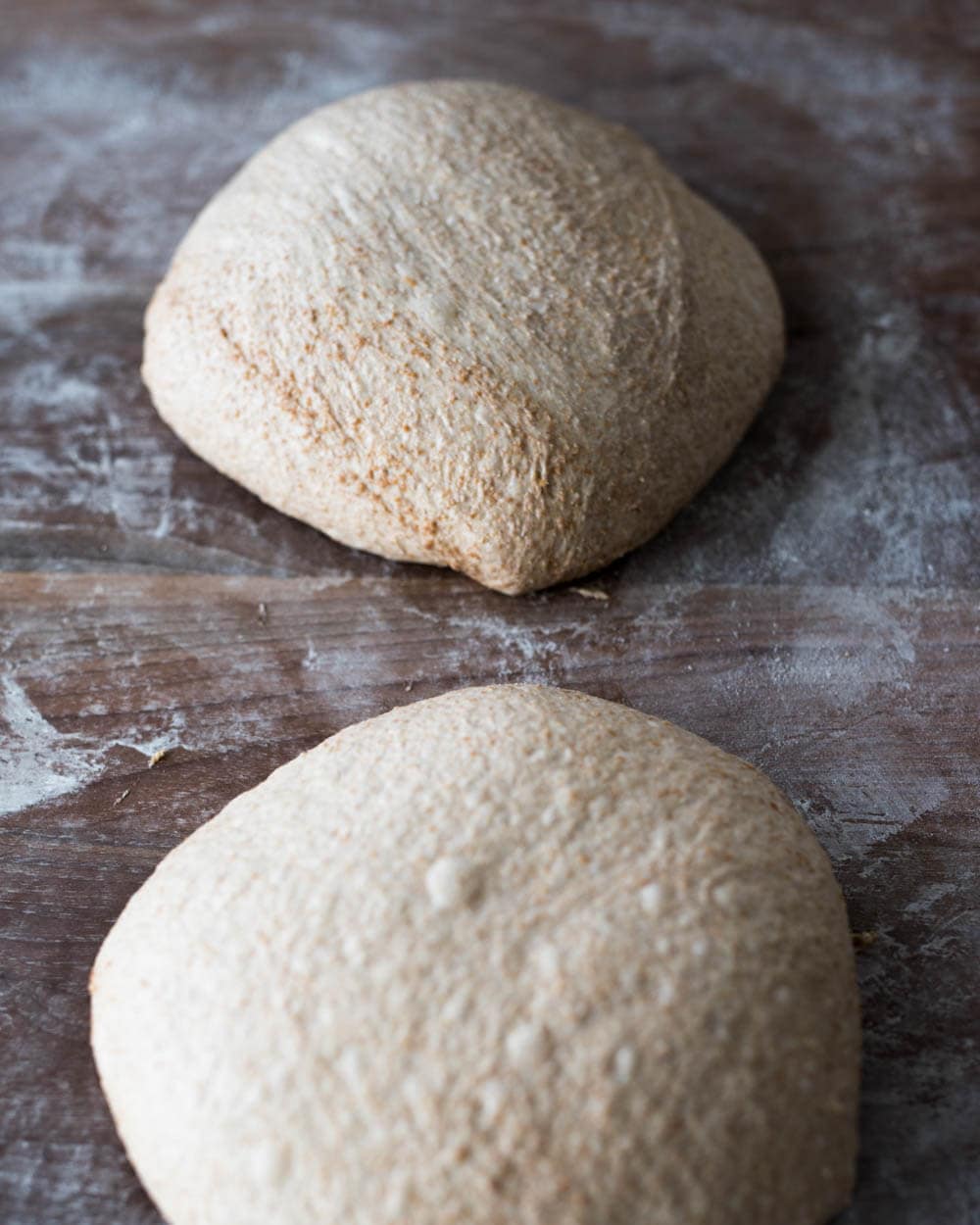
Let the dough rest, uncovered, for 30 minutes.
7. Shape – 6:00 p.m.
Place a baking sheet or clean kitchen towel next to your work surface and, if using, spread an even layer of raw wheat bran or germ on top, if using.
Flour the top of the preshaped round and your work surface. Using your bench knife, flip one of the rounds over onto the floured area. Using floured hands, shape the dough into a bâtard or a boule. Transfer the shaped dough, seam-side up, to the baking sheet with germ, if using, and rock it back and forth so the germ sticks. See my guide to topping bread dough for more help on topping bread dough.
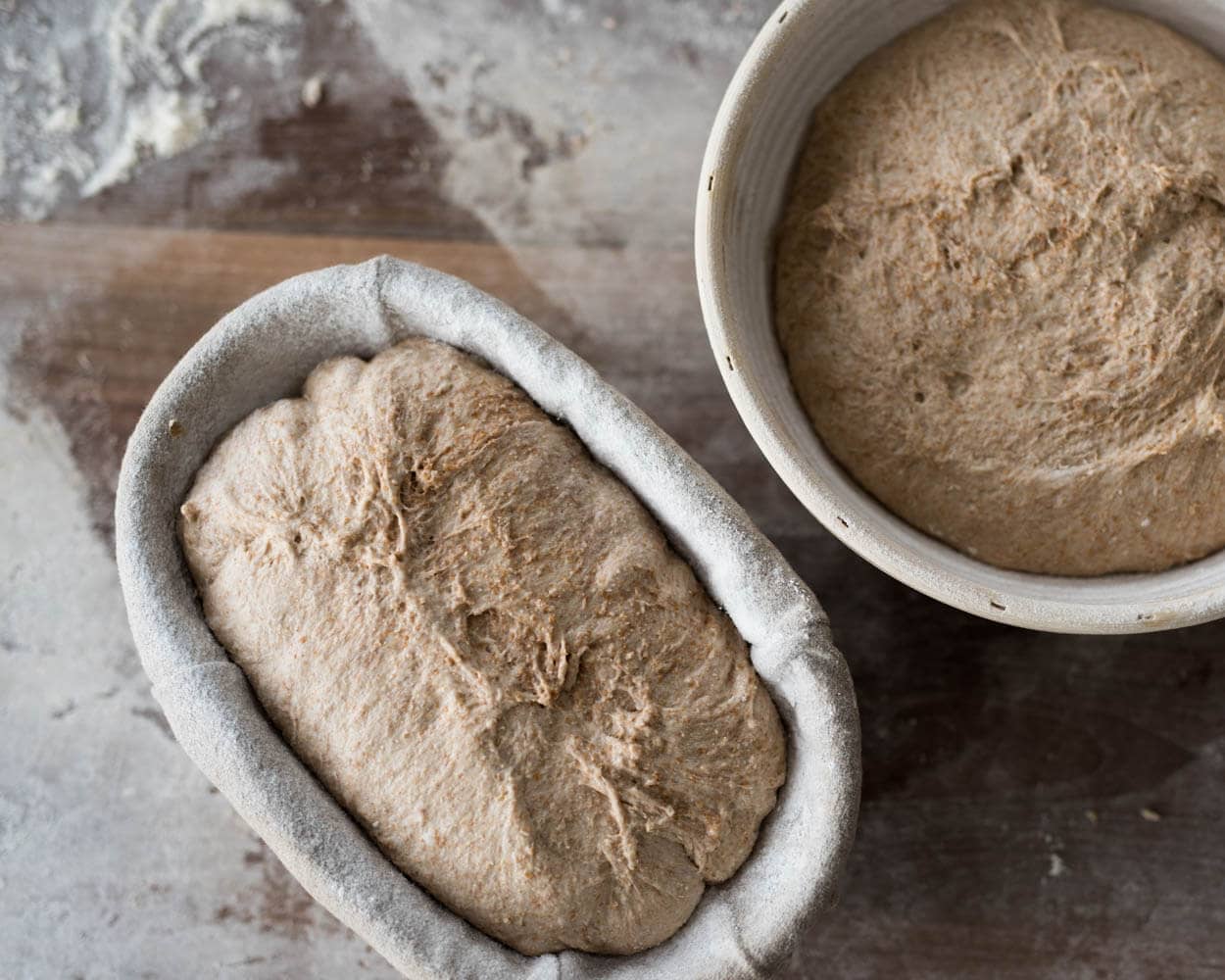
Gently transfer the dough to an 11-inch long proofing basket, seam-side up. Repeat with the remaining round.
8. Proof – 6:30 p.m. to 9:00 a.m.
Cover the baskets with a large, reusable plastic bag and seal shut. Place the baskets in the refrigerator to proof overnight.
9. Bake – 9:00 a.m.
Due to the oval shape of these loaves, you can bake them in a Challenger baking pan as I’ve done here or directly on a baking surface, steaming your oven.
Place an oven rack with an oval Dutch oven in the bottom-third of the oven. Preheat the oven to 450°F (230°C) for 30 minutes.
Take one of the proofing baskets out of the fridge, uncover it, and put a piece of parchment paper over the basket. Place a pizza peel or inverted baking sheet on top of the parchment, and using both hands, flip everything over. Gently remove the basket and score the dough.
Remove the bottom of the preheated Dutch oven and slide the dough into the pan. Return the pan to the oven and cover with the lid. Bake for 20 minutes. Vent the pan of steam by uncovering the pan (remove the lid from the oven or place it on the rack next to the bottom of the Dutch oven). Continue to bake for 35 minutes more. When done, the loaf should have an internal temperature of around 204°F (95°C), and the crust should be deeply colored.
Carefully remove the loaf from the Dutch oven to cool on a wire rack. Return the Dutch oven lid and bottom to the oven to preheat for 15 minutes. Repeat with the remaining dough in the refrigerator.
Let the loaves cool on a wire rack for at least 2 hours, preferably 3, before slicing.
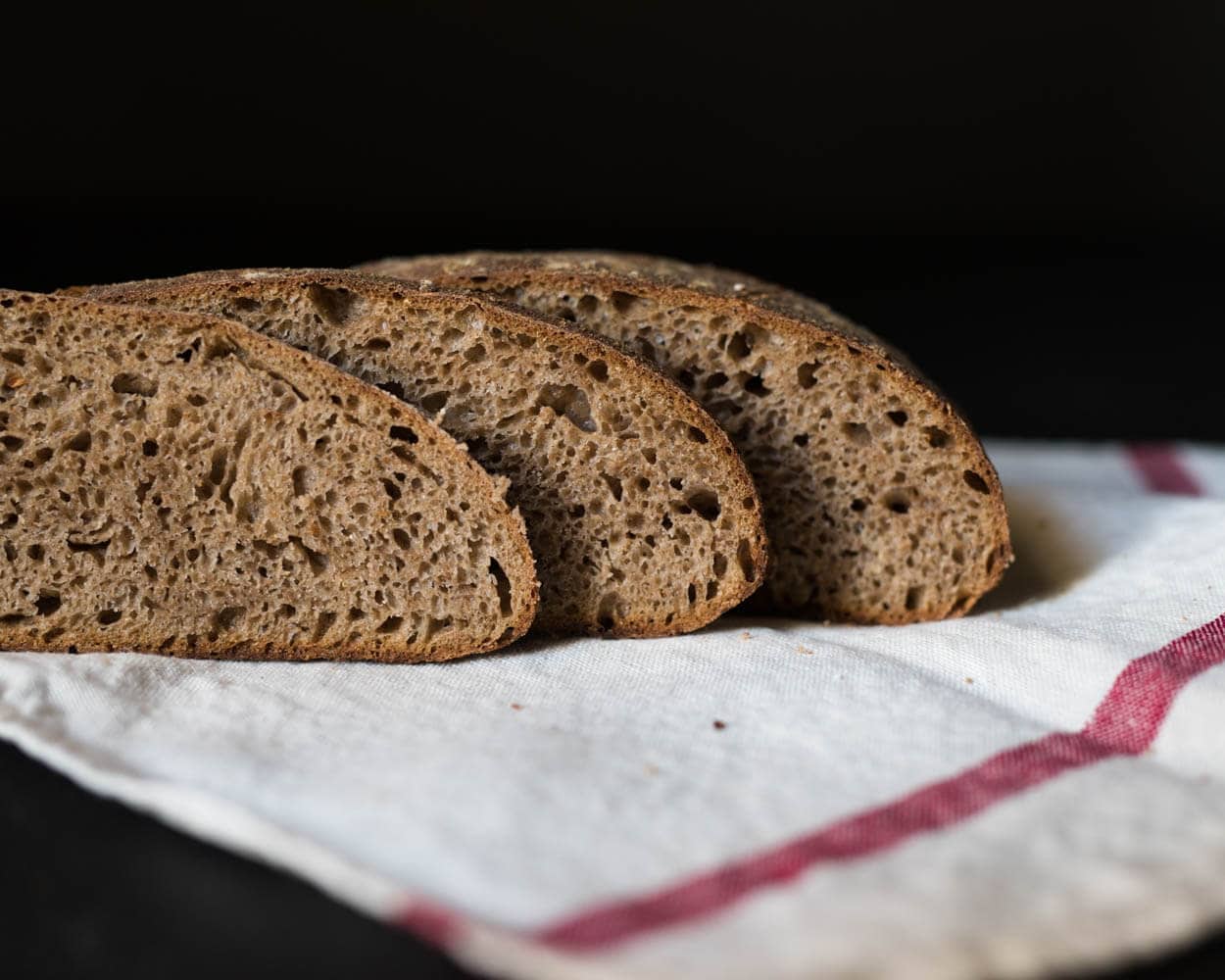

100% Whole Wheat Sourdough Bread
- Prep Time: 24 hours
- Cook Time: 1 hour 15 minutes
- Total Time: 25 hours 15 minutes
- Yield: 2 loaves
- Category: Bread
- Cuisine: American
Description
Sourdough bread made with 100% whole-grain wheat flour. With a robust and Earthy flavor, this is nourishing and wholesome bread.
Ingredients
Levain
- 64g whole wheat flour
- 32g water
- 32g ripe sourdough starter
Autolyse
- 857g whole wheat flour (minus any sifted)
- 705g water (or 505g if sifting and scalding)
Main Dough
- 92g water
- 18g fine sea salt
- 128g ripe levain
Instructions
- Levain (9:00 a.m.)
In a small container, mix and knead the levain ingredients and keep at 74-76°F (23-24°C) for 5 hours. - Optional Sift and Scald (9:10 a.m.)
Place your sifting screen over a large container. Pour some whole wheat flour and sift it by shaking the stack. When no more flour falls through, continue until you’ve processed all the flour. Place the sifted-out bran and germ in a heatproof bowl and pour 200 grams of boiling water on top to cover. Let this soaking mixture rest near your levain until we are ready to mix the dough. - Autolyse (1:00 p.m)
In a medium mixing bowl, mix the Autolyse ingredients, cover and let rest for 1 hour. - Mix (2:00 p.m.)
To the mixing bowl holding your dough, add the Main Dough ingredients: salt, ripe levain (from step 1), and water. Mix by hand or with a dough whisk and strengthen the dough for 5 minutes until it becomes smoother and slightly elastic. Transfer to a bulk fermentation container and cover. - Bulk Fermentation (2:30 p.m. to 5:30 p.m.)
Give the dough 4 sets of stretch and folds at 30-minute intervals, where the first set starts 30 minutes after the start of bulk fermentation. - Divide and Preshape (5:30 p.m.)
Lightly flour your work surface and scrape out your dough. Using your bench knife, divide the dough in half. Lightly shape each half into a round shape. Let the dough rest for 30 minutes, uncovered. - Shape (6:00 p.m.)
Shape the dough into a round (boule) or oval (batard)—place in proofing baskets. - Proof (6:30 p.m. to 9:00 a.m. the next day)
Cover proofing baskets with reusable plastic and seal shut. Then, place both baskets into the refrigerator and proof overnight. - Bake (Preheat oven at 8:00 a.m., bake at 9:00 a.m.)
Preheat your oven with a combo cooker or Dutch oven inside to 450°F (230°C). When the oven is preheated, remove your dough from the fridge, score it, and transfer to the preheated combo cooker. Place the cooker in the oven, cover with the lid, and bake for 20 minutes. After this time, remove the lid (you can keep it in the oven or remove it) and continue to bake for 30 minutes longer. When done, the internal temperature should be around 208°F (97°C). Let the loaves cool for 2 hours on a wire rack before slicing.
100% Whole Wheat Sourdough Bread FAQs
Why is my whole wheat bread gummy inside?
This can be from underproofing, overproofing, or underbaking. Be sure you use your sourdough starter when it’s ripe to make the levain, and ensure the levain is ripe when mixing it into your dough. To spot overproofing, look for a lack of rise in the oven and a dense interior with lots of little holes. Be sure to fully bake your dough until the interior temperature reaches around 204°F (95°C) and let it fully cool before slicing.
What gauge is your sifting screen?
My sifting screen is #20, but any gauge will work as long as it’s not too fine so that nothing falls through, or too large where everything falls through. You’re looking for around 10 to 20% extraction (meaning, for every 1000g you sift, 100 to 200g will be left over).
Can I make the sifted and scalded mixture ahead of time?
Yes. I would sift the flour, scald with boiling water, let it cool, then cover and keep it in the fridge for up to 3 days. The morning you want to add it to bread dough, let it come to room temperature so it doesn’t adversely cool the dough.
Can I add the scald back into the dough during mixing instead of bulk fermentation?
Yes. It’s easier to add the scalded bran and germ back in at the very end of mixing and if you prefer this, by all means, go for it.
What’s Next?
This 100% whole wheat sourdough bread is the purest example of healthy sourdough bread. If you’re looking for a loaf that’s just as flavorful but lighter in texture, my Fifty-Fifty Sourdough Bread is the ticket.
Buon appetito!


262 Comments
Hi! I made this bread as a double batch in four sandwich bread loaf pans. I proofed them in the fridge like you said but I proofed them in the pans and then brought them out of the fridge for about 20 minutes before baking. Then I let them preheat with the oven and baked at 375. For some reason they didn’t have any sour flavor and were dense/didn’t rise. I did the sift/scald step but didn’t get out as much as you did. My dough was wet but it sounds like that’s pretty normal. Do you have any ideas on what happened?
The density and rise issue could be from under/over proofing, but it's really hard to say without more details and seeing an image!
There are a few indicators your dough could be under the explosive rise in the oven, dense spots in the interior with potentially scattered large holes, and a gummy texture to the interior. Finally, the bottom of the loaf might be slightly bowed (like the letter “U” — the top will kind of dome) upward.
Make sure to build your levain from a strong and ripe starter (meaning it’s risen to its peak height before you take some to use). From there, bulk fermentation is essential! Make sure your bulk fermentation goes sufficiently far; you want the dough to look smooth; it should have risen considerably and have bubbles here and there — it should look alive. If you tug on the dough a bit, it should resist your tugging; it’ll feel stronger. Give the dough the time it needs in bulk fermentation! If you must give it another 30 minutes or an hour to see these signs, do so. This step must go sufficiently far for the dough to have enough fermentation activity before proof.
Check out my guide to proofing for a bit more help, too:
https://www.theperfectloaf.com/guides/proofing-bread-dough/
Hi Maurizio,
This did not turn well for me at all. I used the whole wheat from Azure and my final hydration was about 76%. The whole dough was shaggy and never developed any extensibility at all. It would just fall apart. I had to throw it all out. I also ran a little test with a small portion of the dough (100gr) and added some white flour but it didn't work; it just wouldn't stick together much. The temperature for me was higher than the FDT you mentioned (80F) since it was a warm day. I don't know what went wrong, really.
I'd try with a different flour, and use less water. It sounds like your dough is most likely over hydrated—your flour likely isn’t able to take on quite a much water, and that’s ok! Try reducing the hydration by 5% and give it another go—the reduced water should bring strength to the dough and you’ll feel it immediately. Once you find a suitable hydration, you can try to push it back up (if desired), but as you do, take note of how the consistency of the dough changes: the dough will start to slacken out as you add more and more water, this means you’ll likely have to mix more upfront or add another set or two of stretch and folds during bulk fermentation.
Generally, with an increased hydration, you need to mix longer to develop the gluten in the dough to sufficiently support the water added, but this only goes so far. At some point, the flour you’re using just isn’t able to take on any more water and you’ll essentially have a weak and slack dough. It’s always best to start conservatively and work your way up with hydration as you feel out your flour. This is typically why I recommend holding back water during mixing, adding it in as the dough handles it.
Try to keep everything else as consistent as possible and let me know how the next attempt goes!
Second question: do I understand that you're not supposed to bake both loaves at the same time? –I'm about to put mine in the oven. When I read the instructions step by step–the "narrative," as people say–it seems that way.
Hi Maurizio! I'm a whole-grains kind of person (though I have read that sourdough whitebread is better for you than whole-grain breads made with baker's yeast). I am in the middle of making my first sourdough bread ever, following your recipe (except that I'm also following a neighbor's recipe and using 20% rye flour and 80% whole wheat . . . we'll see!). And by the way, thank you for it, and for your painstaking instructions and videos.
Now here's my question.
The bulk fermentation calls for a three-hour fermentation, punctuated by four sets of slap-and-fold, with a rest of 30 minutes between each, beginning 30 minutes after all the dough ingredients are mixed. Starting the first slap and fold at 3:00 (following your time table), I get this:
1. 3:00
2. 3:30
3. 4:00
4. 4:30
–but there is still an hour to go! Please explain what I've misunderstood.
Thanks!
Hey! During that last hour, let the dough rest, untouched. Let me know how it goes!
Hi, Maurizio! I've looked up several whole wheat loaf recipes, and they all call for a stiff levain with an autolyse, and then tearing the levain up and adding it to the autolyse. What's the benefit of using a stiff levain over a regular 100% hydration levain when baking a 100% whole wheat loaf?
I talk about this a bit in my cookbook , but a stiff levain helps control fermentation rate and gives you more flexibility with timing. It also brings additional strength to the dough, which is especially helpful with 100% whole wheat loaves. This extra strength helps compensate for the gluten-weakening effect of the bran in whole wheat flour. Try it out!
Warm the mixing water to a temp even higher to increase the final dough temp past 78°F (26°C). This way, it will stay warmer through bulk fermentation. Go up to 82-84F.
Hi,
Would this recipe benefit from a couple tablespoons of vital wheat gluten, for more of a rise?
If you feel it's necessary, though I never have. I've never used VWG in my loaves! With whole wheat, we just need to re-train our expectations just a bit, it should be a squatter loaf, but when properly hydrated, mixed, and fermented, with lots more flavor. A good tradeoff IMO!
Would it be a problem to scald all the flower (like a tangzhong?) if I don't have a screen to sift the bran and germ out? I'm sort of a newb.
You know, I've never tried that. This is a really good question. If you don't have a screen, I would just skip that step!
Really appreciate the reply!
I did Skip the step and while the bread came out quite squat and dense, Im a big fan of the flavor and heartiness, so plan to make it again. I may try scalding half the flour and seeing how things change and report back for others.
If I took this dough with me into the shower, it might have been wetter but maybe not. And It turned out just like Maurizio's photo. I didn't have his special wheats, I combined Bob's Red Mill Stone Ground whole wheat and Cascade Organic whole wheat. I love it!
Ha ha, well said, Connie. Yes, with high percentages of whole grain flour, you really need to bump that hydration. It's a bit unnerving, but the result is worth it 🙂 Thank you for the comments!
Hi Maurizio, I only want to make one loaf, so do I half all the ingredients including the starter? thank you
Yup, just divide everything in half!
The dough is very sticky during the bulk fermentation process. Is there a way to fix that?
That's by design, Veronica! But if it's too hard to handle, leave out some of the water next time during mixing.
I want to make sourdough but I want to use whole wheat and not sift out the nutritious part of the wheat flour. I do mill my own wheat. How do you adapt this to use all the flour?
This recipe uses all of the flour, it's 100% whole grain! I sift, but then I reincorporate the sifted bits later in the process.
Hi! I would like to make this bread, adding seeds both in the dough and on top. Would this change water % etc?
Thinking I may not sift flour, unless you recommend a particular WW flour that would be best to sift.
Thanks in advance,
Carol
What you can do is take some of the water that would go into the dough and use that to soak the seeds overnight. Then add the entire thing keeping the hydration the same.
Hi Maurizio, I’ve tried this recipe one month ago using organic whole wheat from Germany, since in my country I do not have access to the same flour you used, and I baked it in my convexion oven. I’d got a quite satisfactory result.
Now, I just get a new oven with heater on top and bottom whit optional convexion fan. Could you recommend the best baking temp and option to get a best result? Thanks a lot.
Hey, Seung! You should be able to use the same temperatures, but if your convection fan is on all the time and you cant turn it off, reduce the temp by 25° and bake for the same amount of time.
What cookbook are you referring to below that is based on freshly milled flour from your kitchen?
I have a bunch of fresh milled flour info in my very own cookbook 🙂 https://www.theperfectloaf.com/cookbooks/
Hi Maurizio
I have a weird issue. When I sift my whole wheat flour, I get only like 17 g of bran. I’m not even really sure it’s actually bran. It is just some very small pieces that did not go through the sifter on the first shake. If I shake it again, it all falls through. So now I am very confused. When I soaked the ‘bran’ in boiled water, it did not absorb the water at all. The water just stayed on top looking like really watery cream of wheat.
Not really sure what to do at this point. I used all together, 775g of water between the autolyze and the mixing.
My FDT is 75 degrees. I feel like I have a potential disaster.
Right now, my dough is sitting for the first 30 minutes after mixing before the first set of folds.
Any hints you can give would be great. My plan if I don’t hear from you is just to act as if it’s all fine, and proceed. There is still about 25 ml of water in the container that held the bran
Sorry. One mistake. It is actually 142 ml of water left over.
Hey Lori! How did the loaf turn out? It’s okay if all of the water was not absorbed. Sometimes sifting can be difficult, and yes, if you continue to shake and sift more particles will end up falling through. Any coarse bits, though, will benefit from soaking.
I have tried your book 100% wholewheat recipe twice. It pancakes after shaping. I use (Bread Beckers =grain distributer) 10% rye and 45% hard red wheat and 45% hard white all home milled except for 50% King Arthur wheat and 50% King Arthur bread flours for starter. Now that I have seen this recipe Im wondering if I should try it or continue with the one in the book? Any advice is greatly appreciated.
Hey, Tree! I’m wondering if you’re having issues with the book recipe because of overproofing. It could also be over hydration, causing it to spread out instead of spring up.
I’m going to revamp the recipe here to be close to the recipe in the book, which I find to be better overall. I’ll still do the sift and scald here, but the bones of the recipe in the book should get you a really good result!
HI
At one point you say that it is 1000 g of flower . . . but then you have sifted out 129g of bran — so during the Autolyse, shouldn’t there be 871g of flour (1000 – 129 = 871) , because you are adding the 129g of Bran (and its scalded water) back in later?
thanks–ted
Don’t quite understand – once you retard the dough in the fridge, do you put it directly to the oven (i.e., cold!?) in the hot pans and skip any further proofing?
Directly in the oven!
Correct, bake straight from the fridge.
Hey Maurizio! Longtime fan of your blog and just received your cookbook. I make the whole wheat loaf regularly, and almost every time find that the very bottom of the bread has a line of undercooked bread (just before it hits the crust). Any idea of the cause, or is it just that I need to bake it for longer?
Hmm, very strange, Katina. Is it possible you’re dropping the dough in from a high height and smooshing it a bit? If the bottom is well-baked and yet you have that gummy area, I might guess the dough is getting smashed or pressed down somehow.
Love this recipe, conceptually at this point, and your comments about sifting out the bran, soaking and adding back. I’ve been struggling with getting a more open crumb in my whole wheat sour rye, using a recipe from Secrets of a Jewish Baker.
It really does help lighten things up, though it’s a bit of work!
Hi Maurizio,
I really want to try this recipe, but I would like to try with liquid starter. Will it work? if so, which are the adjustments I need to make to ingredients and process?
Thank you in advance!
Daniela
Yes, it’ll work just fine, Daniela!
Hi Maurizio and fellow bakers,
I joined the ranks of amateur sourdough bakers a couple years during pandemic lockdown, like so many others. Maurizio, I have found your site so helpful! I have an active starter and have had decent success with weekly bakes. This weekend, I tried the 100% whole wheat for the first time (using Whole Foods _white_ whole wheat). The grain was quite fine, and I did not use a sifter. I had 84% hydration dough, and used a stiff levain. I was very optimistic, as I had transformed an incredibly sticky dough into a tight, smooth and somewhat ball with 3 sets of 10 minute slap-and-folds. I then let it bulk ferment, doing three sets of gentle stretch and folds at 60, 90 and 120 minutes. Unfortunately, I then needed to leave the house for a few hours. I was afraid the bread would over-ferment (dough temp about 77). So, I put the dough in a fridge from 6:30pm to 7:30am the next morning. I then shaped it and let it bulk ferment again for two hours (heating the oven and the cast iron pot in the meanwhile). I baked for 40 minutes at 460 degrees, half with lid on and half with lid off.
In any case, the bread was a total pancake. I am trying to understand what went wrong, as the dough felt really good before I put in the fridge (though not yet fully proofed or bubbly). It did not rise at all in the fridge, nor in the two hours this morning. Might I have overproofed it, by letting it rise in the ambient temperature again this morning (house about 70 degrees)? Or perhaps underproofed?
Thanks for any thoughts you have!
It might be helpful to add that I had a two-hour autolyse (just flour and water).
Not Maurizio, but I look for bubbly, light dough at the end of bulk. Was yours like that? It sounds like it may have just needed more proofing time
Hi Deborah,
I make this recipe almost weekly with great success, and have found the flour you use matters a lot.
Once, I had run out of my normal flour (Great River Milling organic whole wheat) and tried using a finely ground Whole Wheat baking flour I had on hand. It was labeled as meant for “breads” – but specifically Rotis and south Asian breads, not fermented breads.
The result was a pancake, just like you describe. The flour was just too refined.
I’ve used White Whole Wheat (from Whole Foods or Trader Joe’s) a lot for baked goods like cookies/cakes happily, but given my above experience wouldn’t ever use it for sourdough bread such as this.
Hey there! My feeling is it likely overproofed. There are a few signs your dough could have gone over: sluggish rise in the oven, the score on top of the dough might not open with a nice “ear” and instead just kind of fuse together, the interior will have lots of small holes and perhaps one or two large ones near the top (but no dense areas of unfermented flour), and finally the loaf could be a little on the sour side. Try reducing the proofing period.
Check out my guide to proofing for a bit more help, too:
https://www.theperfectloaf.com/guides/proofing-bread-dough/
Hello,
I am wondering if you think this will work well with freshly milled whole wheat flour?
My friend and I are experimenting making a starter with only fresh ground hard red wheat and we are looking for more insight into making whole wheat recipes with only the fresh ground flour for its nutritional benefits.
Thanks in advance.
I am not the esteemed Maurizio, but I have been using freshly milled flour for a while now and it absolutely loves sourdough. I will never use fresh flour again in a granular yeast recipe, not that I really use granular yeast anymore.
Slow and steady with no autolyse is what works for me. I only use 30% fresh rye in my start though, the remaining 70% is Central Milling Baker’s Artisan flour.
I find a key to fresh flour is do not overhydrate it to the point of no return. Depending on granularity it takes a very long time to become fully saturated, so once it’s workable, I stop or add just a bit of extra reserved water. Once too much water is within the dough, it weakens instantly, the chances that it firms up properly are slim, so you have to add more flour back.
The second key, and I believe most important would be kneading. When I was devising my own recipes using granular yeast, if I kneaded one hour after the first knead, the bread, even if it was 50% freshly milled, would come out like white bread every time. I think fresh flour benefits from all the strengthening it can get, specifically, an extra session of kneading after a 10 minute rest, or extra sets of stretch and folds…. etc. However, the most important part is a bit of a rest and then the second knead.
Otherwise, I have racked my brain for over a year trying to understand freshly milled flour and this is really it. It behaves just similarly enough to most flour that you can do what you know, but you have to pay attention. It’s a bit of an art, because when you mill it yourself, there is no science or machinery to analyze ash content, particle size and distribution, and then perform adjustments for consistency that bakery’s and customers need/expect. You just have to feel the dough yourself and help it find its way along. Fresh flour is like a Michelangelo sculpture, the marble already knows what it is meant to be!
Thank you for all these comments and I agree!!
Yes, I think this recipe would work really well with freshly milled flour (more recipes in this area coming soon, by the way!). Like Kooky said below, I find fresh flour benefits from a little more mixing to help oxidize and strengthen it a bit, which helps with elasticity and loaf volume.
I dont keep my starter fed with freshly milled flour, usually, though I have in the past. Nothing wrong there, either, just keep an eye out because it’ll ferment very quickly—that’s lots of whole grains! Again, no problem with it, just something to be aware of.
Hi Maurizio. I tried this recipe from the cookbook rather than this site and I see it’s just slightly different. I did have some problems with an overly wet dough and I’m wondering if it might have been due to the fact I 1) divided the recipe in half for one loaf and 2) used all spelt milled myself fairly fine with a Mock Mill. I didn’t add the additional water, but everything else was as specified in the cookbook. When I got to the point of creating a tight ball, I had to add extra flour and it turned into a pancake as I let it rest! I ended up putting the dough back into a bowl and into the fridge overnight. It doubled in size by morning; I brought it to room temp and put into a basket for a final rise. I cooked it in a covered baker with low sides (so no support) and it came out a lot flatter than I had hoped. All that said, the taste was delicious!
As an aside, I regularly make a 100% spelt loaf with 530 grams flour, 350 grams water, 1/4 cup ripe starter (100% hydration), and 3 T honey. This is also a wet dough so I bake it in an oblong covered baker and I get tons of oven spring — maybe because the loaf is supported.
Do you think the spelt is the problem here, or do I just need to try with a drier dough for a free-form loaf (although yours looks good 🙂 ).
Thanks for any ideas!
Debra
Hey, Debra! Sorry for the delay. Yeah, with 100% spelt, you’ld probably need to drop the hydration, spelt is just so sensitive to over hydrating. I do find that fresh spelt usually can handle more water, since it’s freshly milled and whole grain, but still, I would drop the hydration!
And yes, baking in a Dutch oven or pot will definitely help keep it in shape and eek out more volume!
So to sum up, no problem with spelt, but I would drop the hydration 🙂
Hello, for retard, do we need to cover the dough? Thanks
I always do unless proofing in a bread fridge! (At home, yes.)
Thank you so much. My loaf came out dense. After the preshape, rest for 20 minutes or longer. How do I know if it needs more time before going into the fridge?
I have Einkorn freshly ground whole wheat that I sifted. I hope it will work.
It will but you might get a more dense and smaller loaf—but no less flavorful!
It turned out really well and thanks for the response!
I only had some small mill whole wheat bread flour in the pantry. The bran slipped right through my sifter, so we’ll see how it turns out.
Fingers crossed!
It seems a part of the water is missing? It says 750g plus 200g for the bran. Then it says use 700. Then later says use half remaining water, which would be 25g. I didn’t find any instructions for the remaining 25g.
I don’t think the sourness is from stale/old flour. Perhaps your starter/levain was used when too ripe/acidic? Or the dough was fermented for too long?
for sourdrough starter, how do u make whole grain sour dough starter?
Same as with AP just use the whole wheat. Or start with an AP starter and just feed with whole wheat.
Like @disqus_wvqMEoWZKS:disqus said below, either way will work!
Hi there!
I have a question, do you only get this amazing crumb with sourdough?
Or can you make something similar with instant yeast and a long ferment?
You can get similar results with a yeasted bread for sure. Unfortunately, I tend to bake only with sourdough so I don’t have any recipes I’ve developed with IY—sorry about that!
No problem Maurizio, don’t worry.
But if we talk about flour and it’s enzimes (I had the same problem as Jeremy about the viscous dough), and the bran acting as a razor and all that technical stuff what would be your recommendations?
I’m asking because I tried to adapt your recipe to a yeasted version with no succes.
I actually started a “masa madre” already, to see if it has to do anything with that beautiful, beautiful
crumb.
Thanks for your time, saludos desde México!
Suggestion: on sifting flour: I learned it in SE Asia from my mom. You sift flour over a double spread of newspaper and then pick up paper to transfer sifted flour to any bowl. It is way easier.
That’s a great idea, Soon! I’m going to have to try that, sifting can be a messy task.
I put the sifter with flour in a large plastic bag and hold the bag closed around the wrist of the hand that shakes the sifter.all the flour falls into th bag and no dust flies around.
sorry – how much sourdough starter do you add to this ww bread, 500g flour…
just begun the recipe and can’t see the weight… I have my starter bubbling away, so haven’t followed the weights you suggested… eek!
41g starter to build the levain!
So what exactly makes ‘bread flour’, bread flour? Is it just the additional of malted barley to whole grain wheat flour?
Flour classification here in the USA is very confusing. Typically, “bread flour” indicates flour that’s higher in protein percentage, usually around 12-13% vs. “All-purpose” which is usually around 11%. Bread flour, which is presumably intended for bread, also usually has diastatic malt added.