

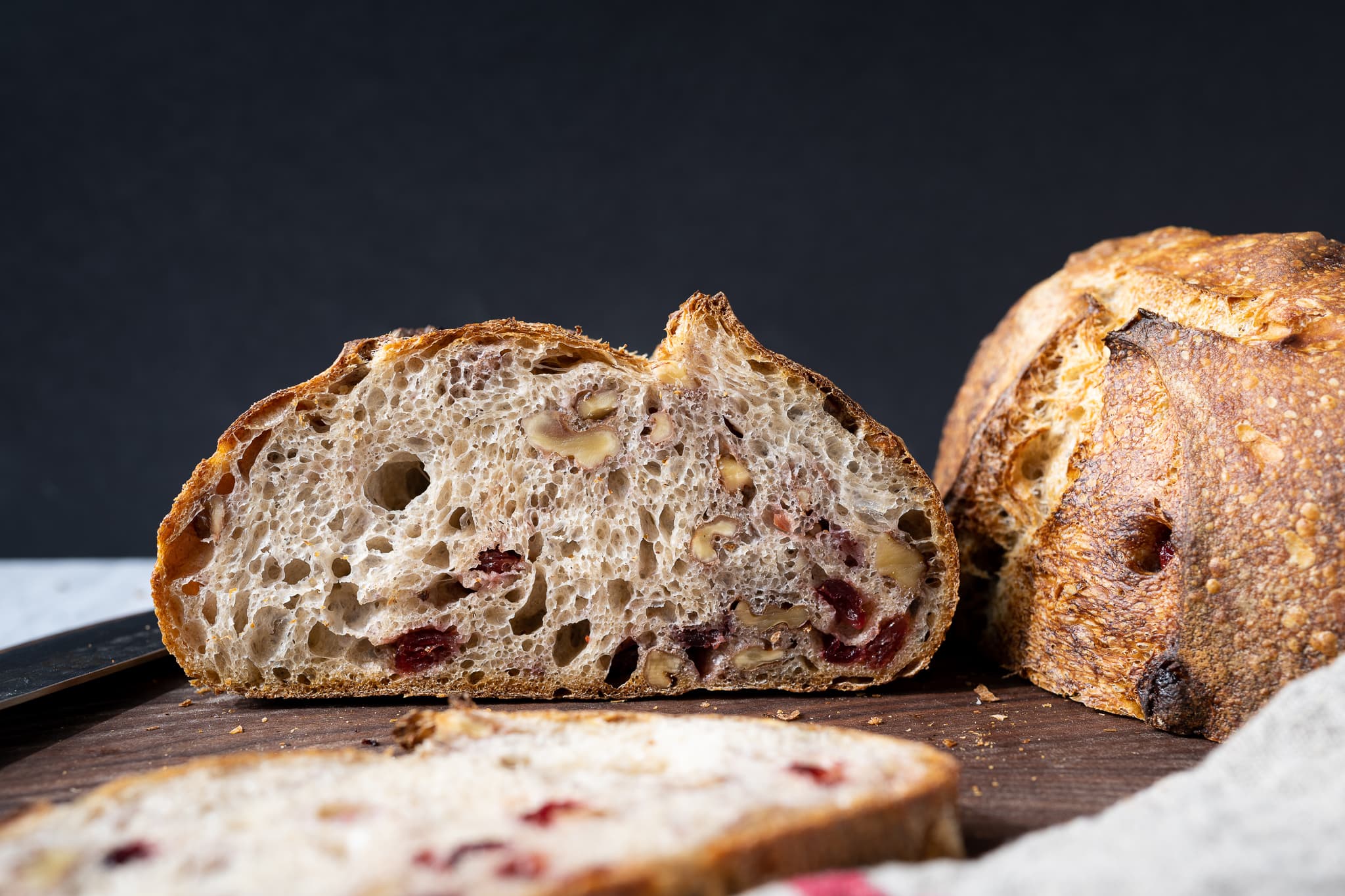
I’ve been baking sourdough bread padded to the brim with walnuts and cranberries since even before this recipe was originally posted back in 2014. Earthy walnuts are undoubtedly a favorite, as evidenced by the many recipes I have here with their inclusion, and there’s a real joy in the pairing of this enigmatic nut with the tart—yet sweet—cranberry. Walnuts and cranberries seem diametrically opposed, but as is usually true in nature, when two things ripen at around the same time, they almost always taste great together. And when looking over this walnut cranberry sourdough, you might read cranberry and think, “too tart!” I urge you to try baking this bread because it’s anything but.
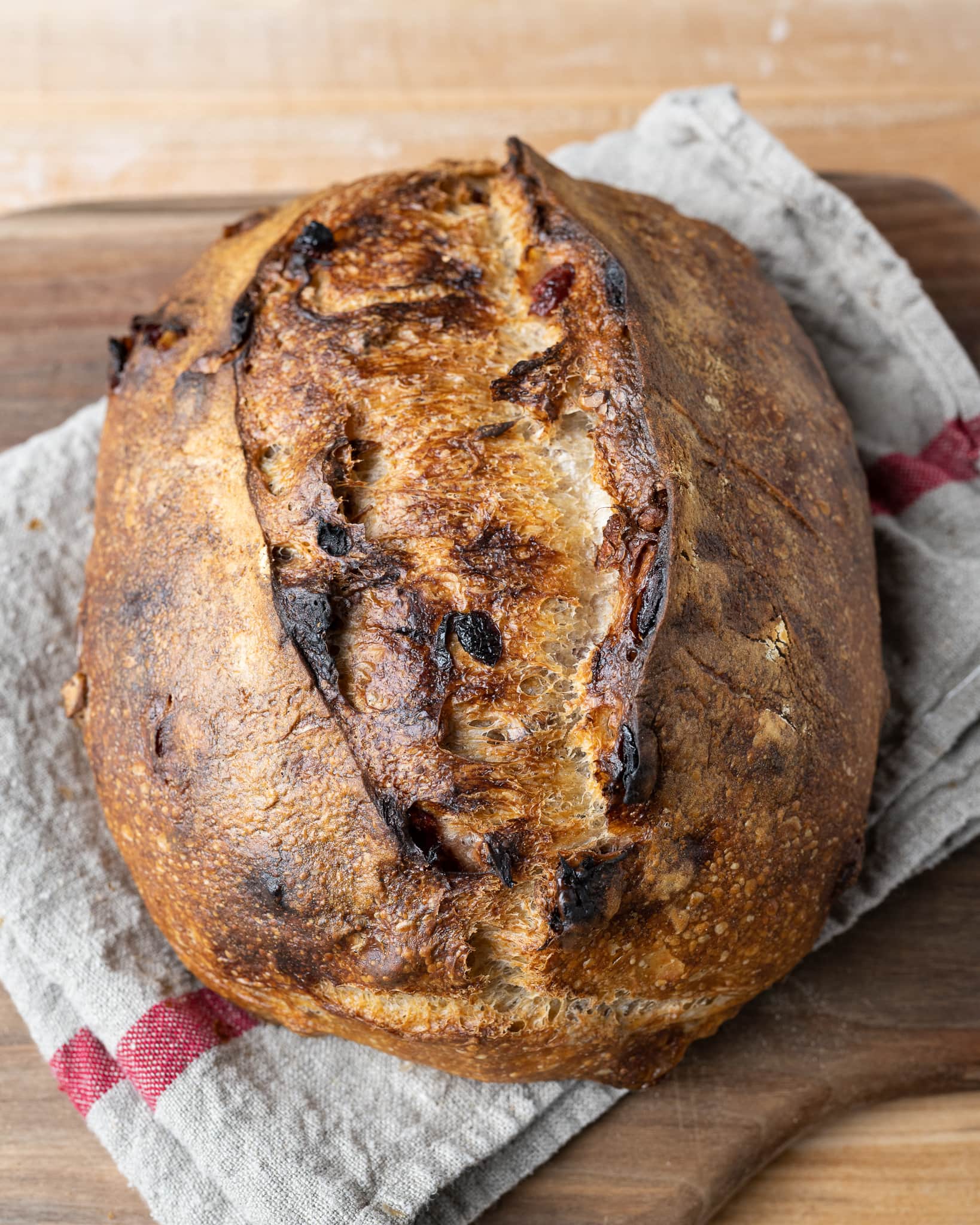
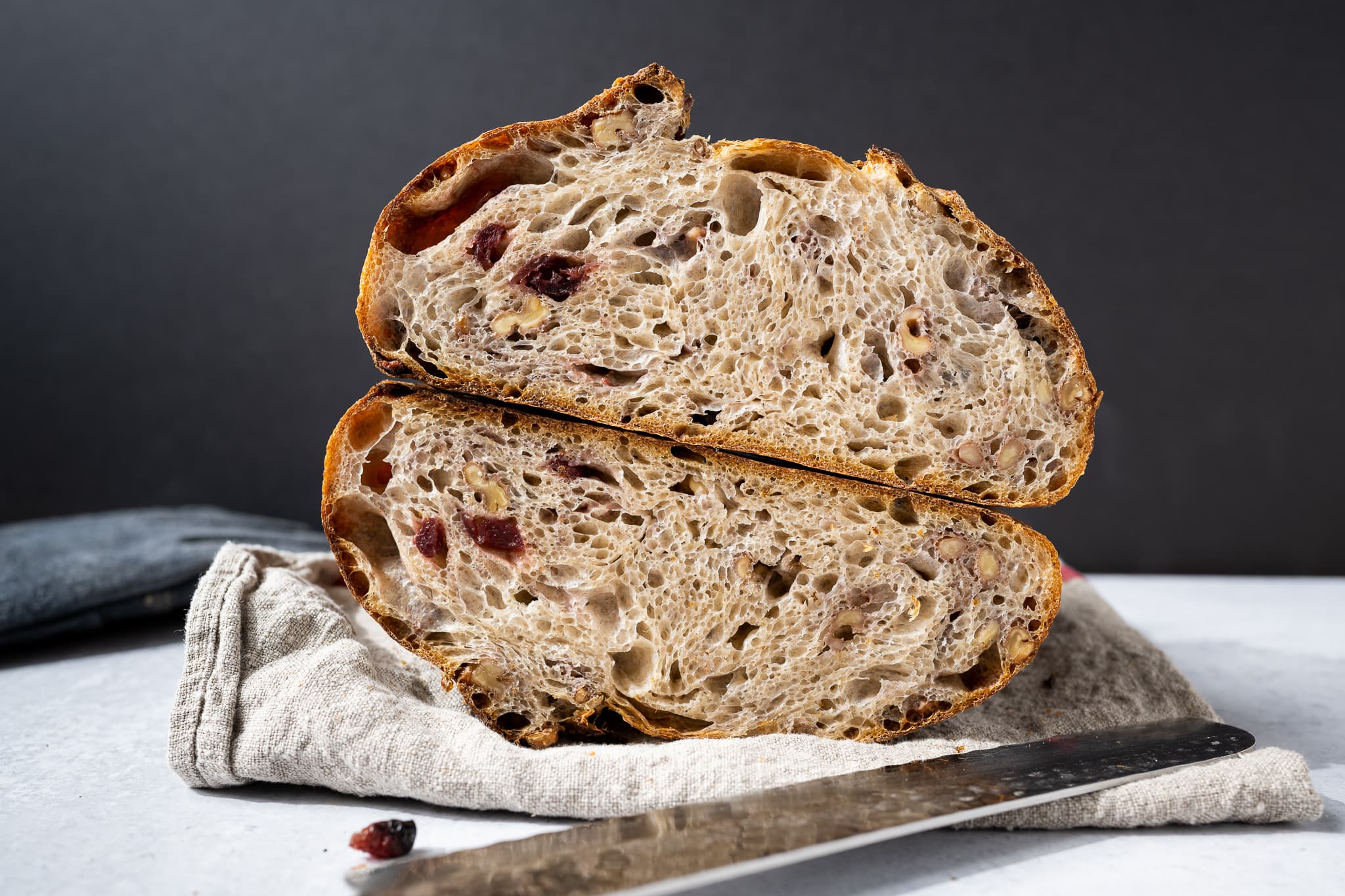
Out of the oven, this loaf carries some of the most dramatic coloring of any bread I bake. The crust ranges from burnished to just a kiss of brown, stopping everywhere between. The stray cranberries and walnuts that might have made their way to the surface, coloring deeply in the oven, add even more dramatic landscape to this darkly expressed loaf. What an eater experiences in drama on the outside is equally apparent inside, as each slice contains a scattering of sliced tart and sweet fruit and earthy nuts. But the show’s real star is the overall melding of flavors: the fruit, the nuts, and how the rich walnut oil enrobes the entire eating experience.
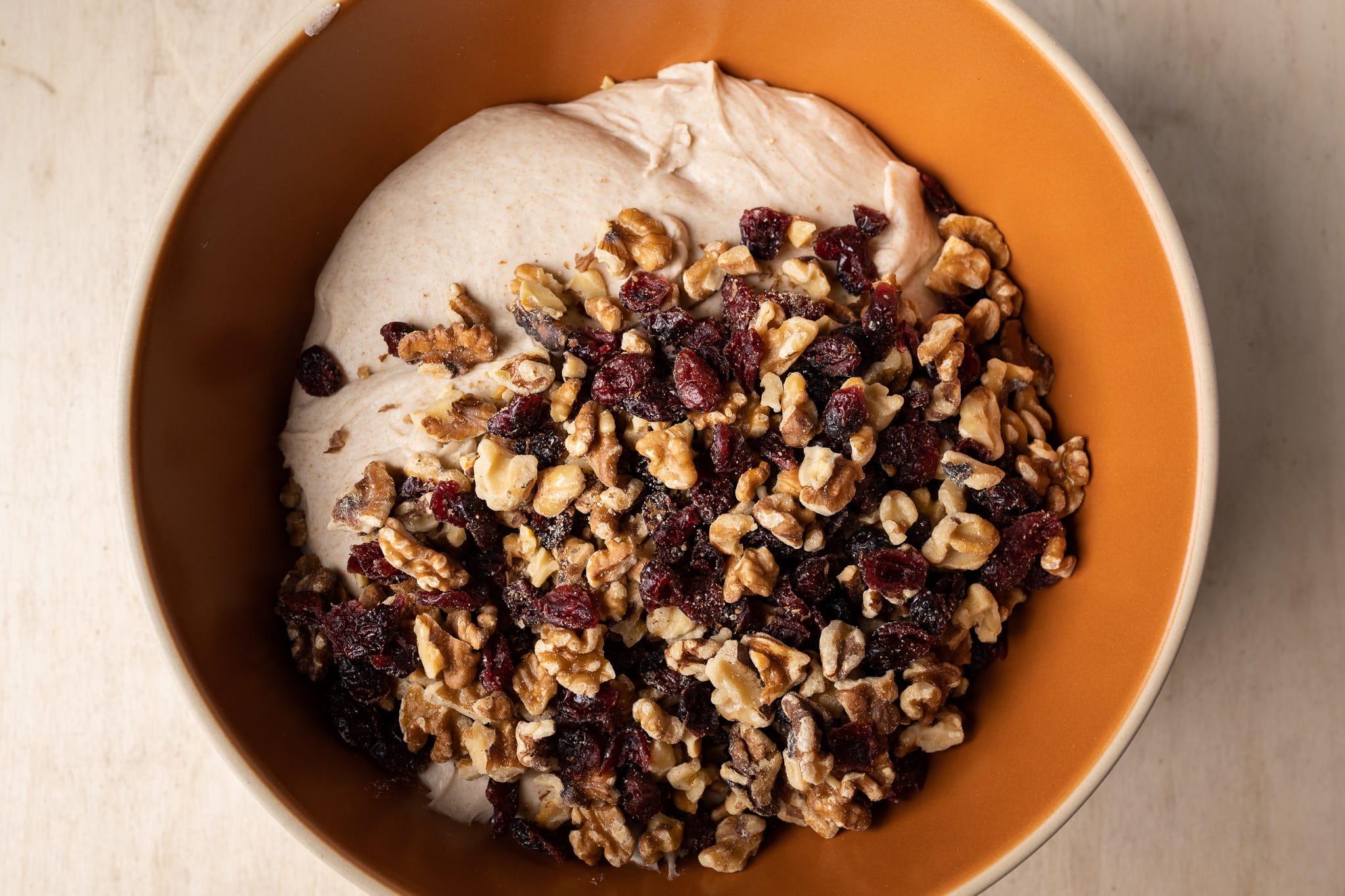
Let’s first look at the flour used in this walnut cranberry sourdough bread recipe, the dried cranberries, and the called for walnut oil.
Flour Selection, Cranberries, and Walnut Oil
This recipe calls for whole-grain rye flour in the levain. I mostly maintain my sourdough starter by refreshing it with a percentage of whole rye flour each day, so I always have some on hand. Additionally, I find adding it to the levain results in a flavor-forward end loaf by increasing the vigor of the levain.
The cranberries I used in this recipe are sweetened, ever so slightly. I find them at my local market in the bulk area, and I think in the end, they’re pretty similar to Craisins. I like to buy a big bag and keep it in my pantry, always ready to go into my next batch of this dough.
The small amount of walnut oil in this recipe brings a disproportionate amount of aroma and flavor to this bread. in this recipe, it sure brings with it a disproportionate amount of aroma and flavor to this bread. The oil carries an irresistible, luxurious aroma that’s only outstripped by the exuberant flavor. If I could sneak this oil into every bread I bake, I wouldn’t be sad about it. But in addition to the aroma and flavor, the oil also softens the end loaf much as any oil would; I highly recommend using it in this recipe (and it’s also great for salads). Alas, my love of walnuts continues.
Baking Schedule
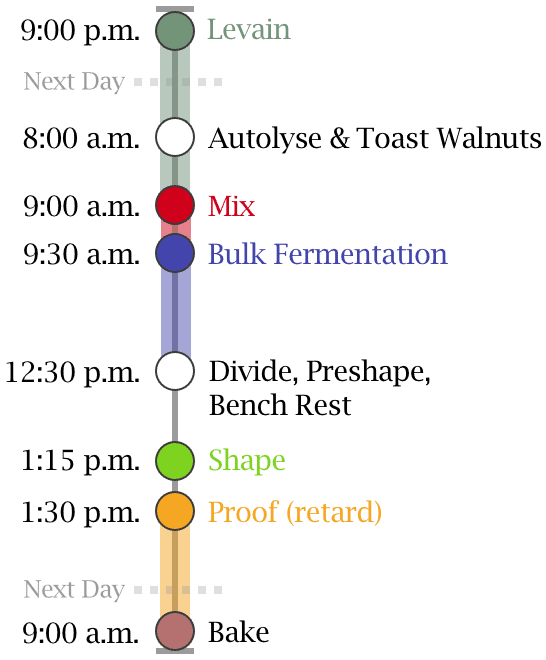
This walnut cranberry sourdough is made over the course of two days (not including the overnight levain). The cold proof of the dough brings significant flavor to this dough, but you could also opt for a same-day bake. Instead of placing the shaped dough into the refrigerator to proof overnight, leave it out, covered, to proof for 1-3 hours (depending on kitchen temperatures) until ready to bake.
See the baking schedule at right.
Walnut Cranberry Sourdough Bread Formula
Formula updates: There are a few subtle changes to this recipe over the one standing here for so many years: a slightly reduced salt percentage (from 2% to 1.9%), 3% reduction in hydration, 4% more dried cranberries, levain reduced from 25% to 23.33%, and finally, a conversion from “2 tablespoons walnut oil” to a more baker’s math friendly 3.00% walnut oil. After many iterations and permutations with this bread, these subtle changes have made this bread even better.
Vitals
| Total Dough Weight | 1,800 grams |
| Hydration | 85% (88% including walnut oil) |
| Pre-fermented Flour | 10.00% |
| Levain in final dough | 23.33% |
| Yield | 2 x 900g loaves |
This recipe makes two loaves. If you’d like to make a single loaf of walnut cranberry sourdough, divide all the ingredients in half. See my guide to using baker’s percentages for help with scaling.
Total Formula
Desired dough temperature: 76°F (24°C). See my post on the importance of dough temperature for more information on dough temperatures.
| Weight | Ingredient | Baker’s Percentage |
|---|---|---|
| 640g | Medium-protein bread flour or All-purpose flour (~11% protein, Central Milling Artisan Baker’s Craft or King Arthur Baking All-Purpose) | 80.00% |
| 120g | Whole wheat flour (Giusto’s Whole Wheat or King Arthur Baking Whole Wheat) | 15.00% |
| 40g | Whole rye flour (Flourist Whole Grain Rye) | 5.00% |
| 160g | Walnuts, shelled and toasted | 20.00% |
| 112g | Cranberries, sweetened and dried (Craisins would work well) | 14.00% |
| 24g | Walnut oil | 3.00% |
| 600g | Water 1 (levain and autolyse) | 75.00% |
| 80g | Water 2 (reserve for mixing) | 10.00% |
| 15g | Fine sea salt | 1.90% |
| 8.0g | Sourdough starter | 1.00% |
Walnut Cranberry Sourdough Bread Method
1. Prepare levain – Night before mixing, 9:00 p.m. (day one)
This is an overnight levain: mix the following ingredients in a container and leave covered to ripen at about 77°F (25°C) for 12 hours.
| Weight | Ingredient | Baker’s Percentage |
|---|---|---|
| 40g | Medium-protein bread flour or all-purpose flour | 50.00% |
| 40g | Whole rye flour | 50.00% |
| 80g | Water | 100.00% |
| 8g | Ripe sourdough starter | 10.00% |
2. Prepare mix-ins – 7:30 a.m. (day two)
Preheat your oven to 350°F (175°C). Spread the 160g walnuts out evenly on a sheet pan and bake for 10 to 15 minutes until they start to take on a little color and become very fragrant. Keep an eye on them; they can burn quickly. Set aside until called for during bulk fermentation.
3. Autolyse – 8:00 a.m.
This recipe uses the autolyse technique to increase the extensibility of the dough and make mixing by hand easier. The increased extensibility helps with incorporating the walnuts and cranberries.
Add the following to a mixing bowl and mix until incorporated.
| Weight | Ingredient | Baker’s Percentage |
|---|---|---|
| 600g | Medium-protein bread flour or all-purpose flour (~11% protein, Central Milling Artisan Baker’s Craft or King Arthur Baking All-Purpose) | 80.00% |
| 120g | Whole wheat flour (Giusto’s Whole Wheat or King Arthur Baking Whole Wheat) | 15.00% |
| 520g | Water 1 | 76.00% |
4. Mix – 9:00 a.m. (Day two)
| Weight | Ingredient | Baker’s Percentage |
|---|---|---|
| 24g | Walnut oil | 3.00% |
| 80g | Water 2 | 10.00% |
| 15g | Fine sea salt | 1.90% |
| 168g | Ripe levain (from step 1) | 1.00% |
Gather the following ingredients for mixing. The remaining water (water 2) should only be added through mixing if your dough feels like it can handle the addition. Use a splash to work in the levain and salt, adding the rest based on how the dough feels. If the dough is extremely slack, omit the rest of the water.
Finally, hold back the walnut oil until the later steps of mixing.
I strengthened this dough by hand using the slap and fold kneading technique, which quickly develops the dough. Alternatively, you could use a home spiral dough mixer, or even a KitchenAid would work with this dough.
Add the levain to the top of your dough in the mixing bowl (that’s been in autolyse) and use a splash of water to moisten. Mix the levain in thoroughly and slap and fold (or do folds in the bowl) for 5 minutes until the dough begins to smooth out and become elastic.
Let the dough rest in the mixing bowl for 10 minutes.
Sprinkle the salt over the dough, then dissolve with a splash of the reserved mixing water. Mix thoroughly. If the dough still feels very slack, continue to strengthen the dough in the bowl by stretching and folding (or do slap/fold on the counter) for a few minutes until it begins to tighten. Then, slowly begin adding the walnut oil while folding the dough in the bowl. I like to add a small pour every minute or so as I’m folding.
At the end of mixing this dough will still be very extensible and slack, but it will look smooth and shiny. The walnuts and cranberries will be added during bulk fermentation.
Transfer the dough to a container for bulk fermentation and cover.
4. Bulk fermentation – 9:30 a.m. to 12:30 p.m.
At a warm room temperature, around 74-76°F (23-24°C), bulk should take about 3 hours. If your kitchen is cooler, place your bulk container in a small home dough proofer, or extend the bulk fermentation time to give the dough more time to ferment. This dough needs about three sets of stretch and folds during the 3-hour bulk.
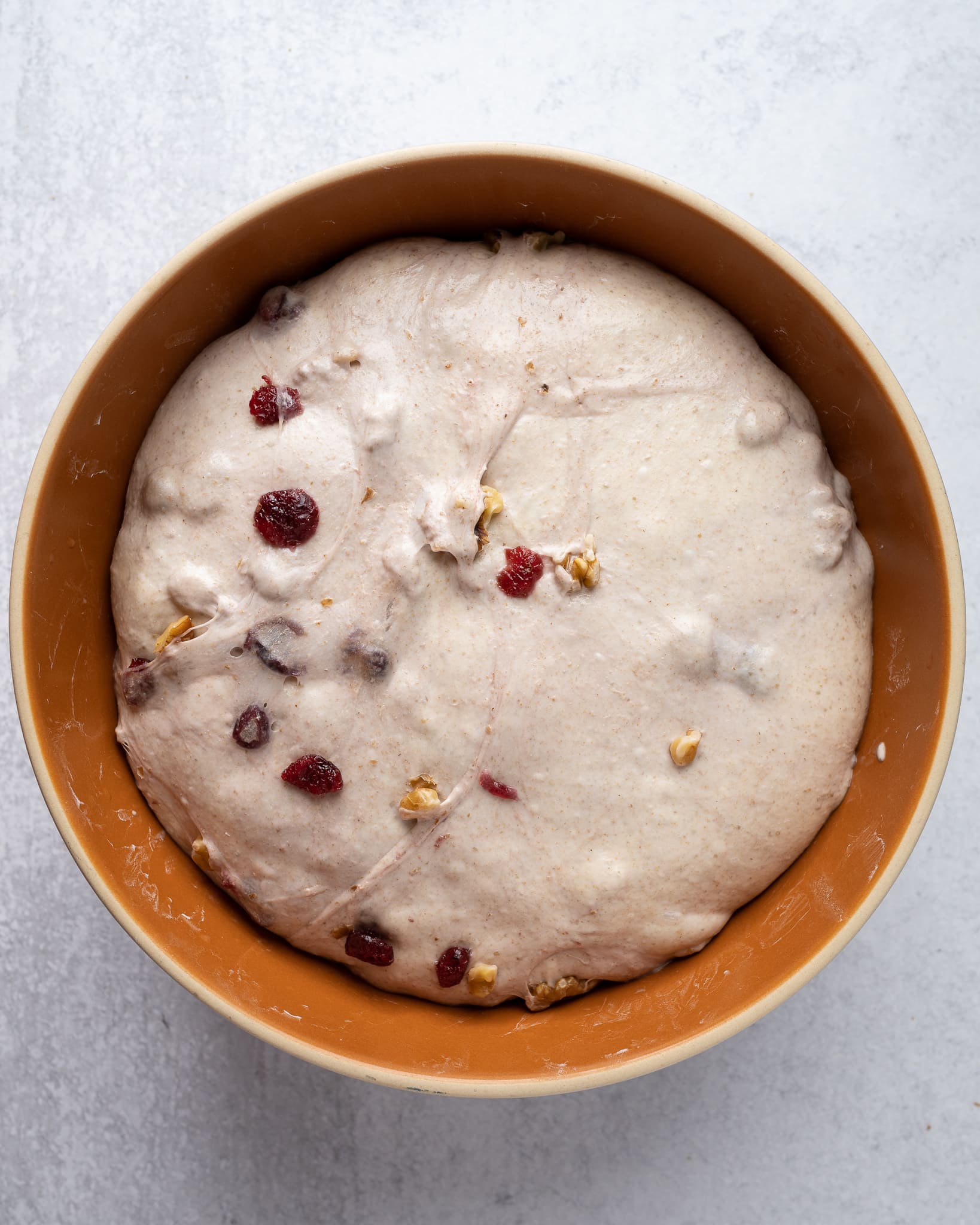
Combine the 160g toasted walnuts and 112g cranberries in a large bowl.
Before you give your dough its first set of stretch and folds, spread about 1/4 of the mix-ins over the top of the dough. Then, grab one side of the dough and stretch it up and over the dough to the other side. Spread on another 1/4 of the mix-ins to the new top. Rotate the bowl 180° and perform another stretch and fold. Spread on another 1/4 of the mix-ins, then rotate the bowl 90° and do another stretch and fold. Finally, spread on the last of the mix-ins, turn the bowl 180° and do one last stretch and fold. You should have the dough neatly folded up in the bowl with all the mix-ins tucked into the dough.
Here’s a video of me stretching and folding this dough over on Instagram.
The remaining two sets of stretch and folds should be a little more gentle. After the third set, let the dough rest, covered, for the remainder of bulk fermentation.
5. Divide and preshape – 12:30 p.m.
Fill a bowl with some water and place it on your work surface. Scrape out your dough from the bulk container onto your dry counter. Divide the mass in half using a bench knife. Using a wet hand and the knife in the other, gently preshape each half into a loose round.
Let the dough rest, uncovered, for 30 minutes until its relaxed outward.
6. Shape – 1:15 p.m.
I like to shape this loaf as an oblong batard, but a round boule would also work well. Shape each by first flouring the top of the rested rounds and your work surface, then shape them into your desired shape.
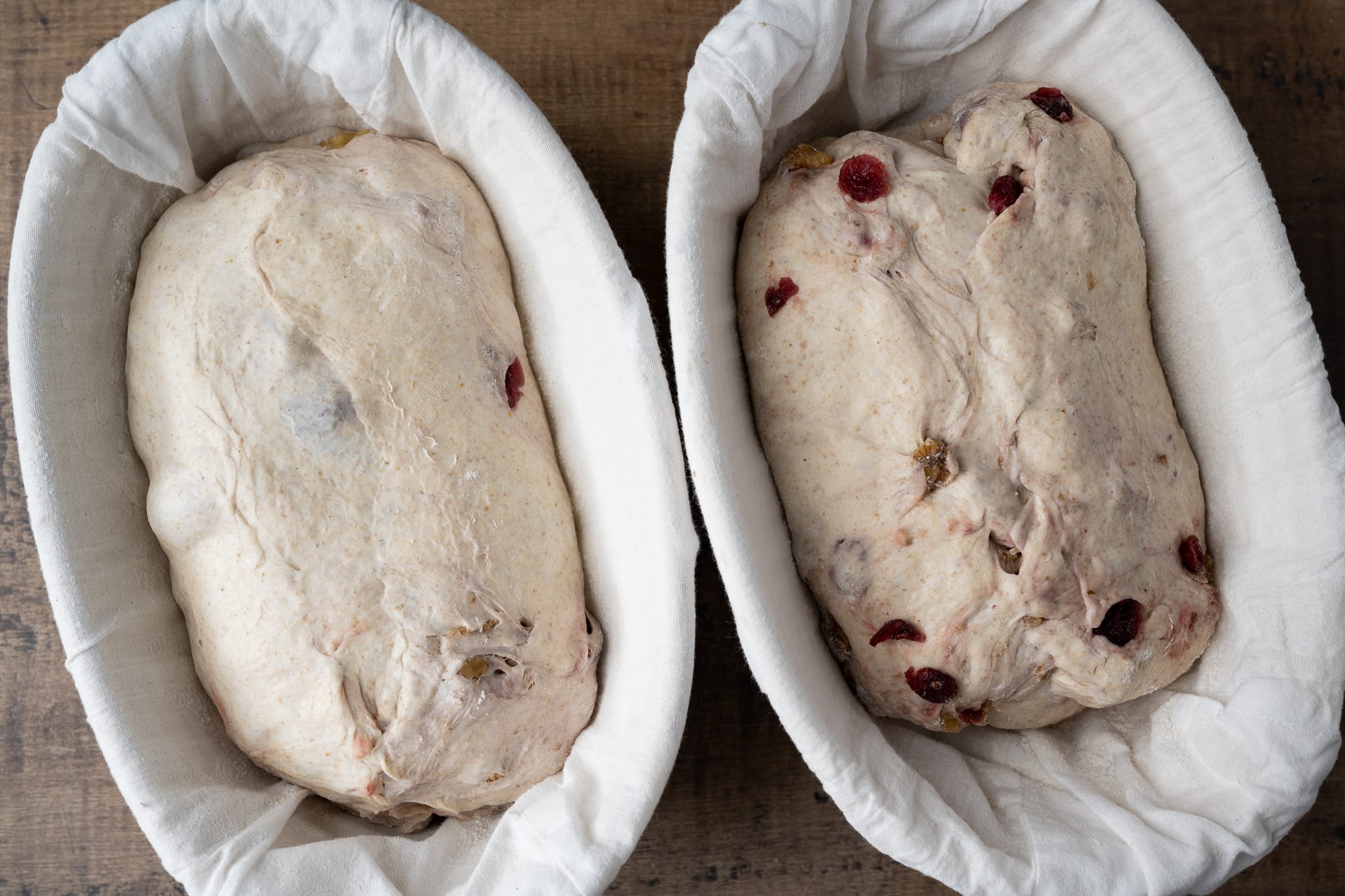
After the dough is shaped, place it seam side up in a proofing basket lined with canvas or a clean kitchen towel. I recommend lining your proofing basket because the red cranberries can ooze out a bit of color during the long, cold-proof. I like to use smaller, 10″ proofing baskets for this dough to keep it in a tighter shape during proof.
7. Proof – 1:30 p.m. to 9:00 a.m. (overnight)
Cover the baskets with a large, reusable plastic bag and seal it shut. Place the baskets into your refrigerator to proof overnight.
8. Bake – 9:00 a.m. (next day)
Preheat your oven with a baking stone or Baking Steel inside to 450°F (230°C).
I baked these loaves on my Baking Steel in my oven, following my guide on how to steam an oven for baking bread. However, you could also use a Dutch oven if you’ve shaped your dough as a round shape (see my guide to baking bread in a Dutch oven here).
Score each piece of dough and slide it into the oven—bake for 20 minutes with steam. Then, remove the steaming pans from inside the oven (or remove the lid to your combo cooker or Dutch oven) and bake for an additional 30 minutes, or until the crust is deeply colored and the interior temperature registers around 204°F (95°C).
Once fully baked, cool your loaves on a cooling rack for 1-2 hours. See my post on the best way to store bread to keep it fresh for a week or longer.
Walnut Cranberry Sourdough Recipe
- Prep Time: 24 hours
- Cook Time: 1 hour
- Total Time: 25 hours
- Yield: 2 loaves
Description
A delicious loaf of sourdough bread padded with tart and sweet cranberries and earthy walnuts, all tied together with a small addition of roasted walnut oil. This is one of the most flavorful bread recipes I bake, and there’s a good reason it’s also one of the most requested—it’s delicious!
Ingredients
Levain
- 40g medium-protein bread flour or all-purpose flour
- 40g whole rye flour
- 80g water
- 8g ripe sourdough starter
Main Dough
- 600g medium-protein bread flour or all-purpose flour
- 120g whole wheat flour
- 160g walnuts, shelled and toasted
- 112g cranberries, sweetened
- 24g walnut oil
- 15g sea salt
- 520g water 1 (autolyse)
- 80g water 2 (mix)
- 168g levain
Instructions
- Levain (night before mixing, 9:00 p.m.)
In a small container, mix the Levain ingredients and keep it at a warm temperature overnight. - Prepare mix-ins (the next day, 7:30 a.m.)
Preheat your oven to 350°F (175°C). Spread the 160g walnuts out evenly on a sheet pan and bake for 10 to 15 minutes until they start to take on a little color and become very fragrant. Set aside until bulk fermentation. - Autolyse (8:00 a.m)
In a medium mixing bowl, add the 600g medium-protein bread flour, 120g whole wheat flour, and 520g water and mix until no dry bits remain. Cover the bowl and let rest for 1 hour. - Mix (9:00 a.m.)
To the mixing bowl holding your dough, add the levain and a splash of water. Mix thoroughly and strengthen the dough for about 5 minutes. Let the dough rest for 10 minutes in the mixing bowl. Add the salt, another splash of water, and mix until incorporated. Strengthen the dough further if necessary until it’s elastic and smooth. Then, slowly add the walnut oil over the course of the next few minutes while stretching and folding until the oil is absorbed and the dough is smooth and shiny. Transfer the dough to a bulk fermentation container and cover. - Bulk Fermentation (9:30 a.m. to 12:30 p.m.)
Before you give your dough its first set of stretch and folds, spread about 1/4 of the mix-ins over the top of the dough. Add the rest of the mix-ins in the same way through the remaining folds for the first set. Perform two more sets of gentle stretch and folds during this 3-hour period, then let the dough rest the remainder of bulk fermentation. - Divide and Preshape (12:30 p.m.)
Lightly flour your work surface and scrape out your dough. Using your bench knife, divide the dough in half. Lightly shape each half into a round shape. Let the dough rest for 30 minutes, uncovered. - Shape (1:15 p.m.)
Shape the dough into a round (boule) or oval (batard) and place in proofing baskets. Cover the baskets with a reusable plastic bag. - Proof (1:30 p.m. to 9:00 a.m. the next day)
Cover proofing baskets with reusable plastic and seal shut. Then, place both baskets into the refrigerator and proof overnight. - Bake (The next day, bake at 9:00 a.m.)
Preheat your oven with a baking surface or combo cooker/Dutch oven inside to 450°F (230°C).When the oven is preheated, remove your dough from the fridge, score it, and transfer to the preheated baking surface or combo cooker. Bake for 20 minutes with steam. After this time, vent the steam in the oven or remove the lid (you can keep it in the oven or remove it) and continue to bake for 30 minutes longer. When done, the internal temperature should be around 204°F (95°C).
Let the loaves cool for 2 hours on a wire rack before slicing.
What’s Next?
While I’ve been baking this bread for ages, revisiting the formula and formalizing it here made me appreciate how much I love it. It’s surprising how much I look forward to the moments when I can eat a slice of this walnut cranberry sourdough, whether it’s in the morning toasted with butter, the afternoon with a turkey sandwich, or the evening simply on its own. When baking this bread, I often regret not doubling the recipe and making more—easily fixed next time!
Next, try your hand at my sunflower and sesame sourdough for another wonderful loaf with inclusions!
Buon appetito!


367 Comments
I’ve made this bread twice, and the final product is good, but the dough is very wet. I’ve used the quantities given, but it seems like it need some extra flour. What am I doing wrong.
Hey Rick. Sounds like you just need to reduce the water in the recipe to suit your flour—a normal adjustment depending on your flour. Know that this recipe is a high hydration, but the walnuts will pull in some water during bulk fermentation and result in a drier feeling dough by the time you have to divide it. However, if your dough feels super wet, hold back 25 to 50g of water when mixing!
Hi Maurizio,
I live and bake at 7200ft. Water boils at 199 F. I can never get the bread to go above 199 no matter how long I bake it without burning the crust. Is this something I have to live with?
Yup, that's totally normal, Mary. Your temperature for baked goods when they're done will be lower. I'm up at 5280ft and see this a little, too.
Here's some more tips about baking at high altitude:
https://www.theperfectloaf.com/how-to-bake-sourdough-bread-at-high-altitude/
Thanks Maurizio for the pointers. I have done what you suggested. After the required bake, I lower the oven temp to 350 (so as not to burn the crust) and bake it about 10 minutes longer. I think thought that 199 is what I have to be happy with.
Can I use fresh cranberries instead of dried? How would you recommend adjusting water, if at all?
I've never tried this… I know other bakers have in the past and it's worked for them. I prefer dried which are a little sweet, too.
Mine came out kinda flat. I am thinking if I had used my regular sourdough starter instead of the levain in the recipe, they may have had a better rise?
No the levain should actually help things. Be sure you're using your starter when it's ripe to make the levain, and the levain when it's ripe to mix the dough. You want strong fermentation in there!
I’d like to make several loaves of your Walnut Cranberry bread for Christmas gifts but would like to bake it ahead. How do you recommend storing it so it can be given later yet taste fresh?
You could try parbaking them. Bake until they're about 75% finished (still pale color, just starting to turn brown). Then take out and let cool. The day you want to eat, finish baking early. Test this beforehand!
is it possible to halve your walnut & cranberry recipe? If so, do I also halve the levain?
Can I halve your walnut & cranberry recipe? If so, do I also have to halve the levain?
is it possible to halve the your cranberry & walnut recipe? If so, do I also have to halve the levain? Titch (Australia)
Yes to both. I do it frequently.
Yes, absolutely. Just halve all the ingredients, even the levain!
Thank you for this recipe and for saying in another post that the oil can be omitted. I've been buying a Cranberry Walnut Sourdough at my local farmer's market almost weekly, which my husband adores. I would be embarrassed to tell you what I've been paying for it, especially since I have three jars of starter in my fridge! Going to go feed the starters right now!
It's totally okay if you're supporting a local baker, though! You'll love my version, it's an older recipe here that is probably my #1 baked loaf. Happy baking, Claudia!
Hi, I’ve been enjoying following your recipes and this bread is delicious. I’ve been using dried cherries instead of cranberries and I use a little more whole wheat flour, but otherwise I follow your guidelines closely. That said, I’m having trouble getting me breads to rise. Do you have any suggestions for things I might do differently?
It might be that you're using your starter/levain too early. Make sure it's very ripe, I have some visual cues, here:
https://www.theperfectloaf.com/how-do-i-feed-my-sourdough-starter/
Do you need to soak the dried cranberries in water before adding them? Thanks!
No, there is water enough in this bread not to let the cranberries get water from the dough.
No need to soak them unless they are super, super hard (like rocks).
Is the oil absolutely necessary? I’m trying to keep the food as close to it’s roots as possible. TIA
You can omit, Ann!
Hi, what does the oil do? Is it possible to make without it?
You can leave it out, David. It adds a bit of richness and softness to the dough 🙂
What does it mean to ‘strengthen the dough’? Is this kneading? Thanks.
Yes. It can be through kneading (like with the slap and fold technique) or through stretches and folds in bulk fermentation.
Like Karen M (a month ago), I’ve been making this from your 2014 recipe. I always like to print your recipes, and make appropriate notes after baking, but I usually check to see if you’ve updated the recipe. Would it be possible for you to highlight whatever changes you’ve made to a recipe? If I could see what changes you’ve made, I can just correct my copy, instead of reprinting it. Thanks in advance!
The changes are noted in the section called “Formula updates: “
As written, this recipe has a hydration level of 88.1%.
Not sure if that is to account for toasted (dry) walnuts absorbing some of the water. Even without the walnut oil, it’s over 85%. Here’s a link to my calculations, https://fgbc.dk/3edd
Should the final dough temp at the end of bulk fermentation by 78 degrees F? In the recipe it says to note final dough temp at an early step but after mixing the dough temp dropped.
It’s okay if it’s a little lower, 74-76F.
Could you add orange zest along with the walnuts and cranberries?
See you added a comment about this in your book! Cheers
It’s delicious!
I’ve been making your version of Walnut Cranberry dated 3/18/2014. Why have you changed the recipe so that it now has less of everything: flour, levin, walnuts, etc? I always get a nice rise from the 2014 version so I am curious about your reason for such a big change. Thank you!
The change is very, very small, and it’s the same ratio of ingredients. It will work super well for you, even better in fact 🙂
How much flavor or other characteristics are impacted by leaving out the cold proof and doing a same day bake. I want to make the bread the day before Thanksgiving and let it cool overnight and only have Wednesday to work on it. Thanks!!
You’ll get less sourness and complexity, it’ll still be absolutely delicious.
We love this bread. My wife loves it so much, it’s gotten so I need to have a loaf on hand for her at all times. It’s also delicious with pecans.
I’ve found that I always need to make extra levain, for this and other recipes we enjoy. (Love the Pane Siciliano!)
For instance, in this case 80 grams of flour, plus 80 grams of water plus 8 grams of starter adds up to exactly 168 grams of levain. But much of that sticks to the jar, and unless I make extra, I never have the 168 grams I need to add to the dough. I’ve been going with 45, 45, 90 and 9. How do you manage to get all the levain into your dough?
I also have had this problem. My solution has been to add the water to the levain and mix it up prior to adding the mixture to the flour. Much less waste. It seems to work well.
Thank you, Louis.
Maurizio, why do make this levain with just a small amount of starter and an overnight proof rather than a 3+ hour proof with a much larger amount of starter as many of your other recipes?? Thanks – Louis
Longer fermentation time to allow for more flavor!
Hello Maurizio. I made this bread this week. Everything looked great through every step of the process. The loaves held their form during the bench rest after preshaping. I refrigerated the shaped loaves in bannetons at 2:00 p.m. and baked them the next morning at 9:00 a.m. in a Fourneau baker. There was very little rise in the refrigerator. The loaves expanded nicely in the oven (2 1/4″), but mostly outward, not up. I thought I had shaped the batards adequately. What am I doing wrong? I am not a novice baker. I have been baking bread for nearly 35 years. Your expert opinion will be greatly appreciated.
I should add that the bulk fermentation lasted 3 1/2 hours at 76 degrees room temp. The dough was jiggly (but not too much) with some bubbles on top. The dough temp was 78 degrees at the end of bulk fermentation.
Last comment. I just read in one of your responses below that your refrigerator is set at 39 to 40 degrees. Mine is set at 36 degrees. I think that is what happened. Do you Gree?
Yes, I feel like you might have needed to let bulk fermentation go a little bit longer, I’m guessing the dough was underproofed!
Hello, I am planning to make this base dough recipe but add pistachios instead of walnuts. Is there anything I could substitute for the walnut oil?
That sounds delicious, Emmy! I haven’t tried that. You can leave out the walnut oil.
Pistachio oil
Looks and smells great but the loaves are super flat. Any ideas on what to change next time?
I did the bulk for more like 4-4.5 at 76 degrees as I was looking for doubling in the rise and the doming in the center. Too long maybe?
It could have been, yes! I would try to hit a final dough temp around 76-78F, then go for the bulk time listed above.
Thanks for an awesome recipe, as usual. A question – you don’t soak the cranberries?
Mine are moist enough so it wasn’t needed!
Can I add sugar to the dough and if so by how much please?
It would adjust the recipe quite a bit. I’d say as long as you’re around 0-4% to total dough weight, it should be fine, though.
I’m still looking at this, Darryl!
Hi Maurizio,
Would spelt flour/einkorn flour mix be okay to sub in? Or would this change the times/measurements?
Thank you!
You could definitely do that, just watch the hydration, you will need to reduce with those flours.
Hi Maurizio,
If my starter is a bit overripe or my house is colder, is there a good way to know when this is done bulking if I’m adding extra time? I get the sense it won’t get quite as airy because of the weight of the nuts and fruit. Is that accurate?
This dough does still rise up pretty well, even with the additions. To determine when bulk fermentation is finished, look for: dough that’s risen (a particular amount isn’t as important as *some* rise in general), perhaps bubbly on top, smoother and more elastic, and I always like to look at where the dough meets the edge of the container, it should be domed downward showing rise and strength.
Had to come back to say this bread was a hit and the texture was fantastic. I usually struggle with texture on my sourdough with it being a bit too chewy but this loaf checked all the boxes. Great flavor, great texture, great crust. Thank you again! I’ll definitely be trying more loafs with this ratio of AP flour.
Thanks for coming back with those comments, Mike! So glad you liked this one, it’s been a long time fav here, too. Enjoy!
Last night I made my levian and left on counter. The house was pretty cool overnight. I can’t recall exactly how the levian looked in the morning in the past, but this morning my levian does not appear to have risen much if at all. Not sure if I did something wrong or if the house may have been too cool to get the results. Can you please let me know what the levain should look like after sitting on counter overnight? Not sure if I should go ahead or toss and start over. Trying to bake by tomorrow AM for Thanksgiving. Any help would be appreciated. Thanks
Same exact thing happened to me. Thankfully I had some of my normal starter on standby. What I did was I tossed about 65g of the levain and mixed in 65g of my active starter in. I put the new levain mix in a warm spot (about 80°f) for about 4 hours and by that time it had more than doubled. Put me behind schedule a few hours but I just extended the room temp bulk ferment another few minutes since my cold ferment will know be shorter.
Great adjustments there, Mike! Keeping it warm is key.
Thank you! I should have kept it in the oven with the light on overnight. I know rye and AP flour will have less gluten structure than using wheat or bread flour, so it won’t rise as much rise to begin with. Thank you for the recipe, just took the first loaf out and it looks fantastic!
You want to see some bubbles, a sour aroma, and some rise in the levain. If it was too cool, it’ll take longer to ripen. You could try keeping it warm in the morning for an hour or two to speed things along!
Hi Maurizio, I am currently doing this bake to see if I can do it well enough to bring to Thanksgiving dinner in a couple of weeks, and have just shaped and proofed my two loaves. These two doughs fill the proofing baskets significantly less than any other bake I have done. This recipe calls for just 720 grams of flour, while most of your other recipes call for close to a kilo of flour(s). Is that intentional to accommodate for the additional mass of the mix-ins, or is this just intended to be a smaller bake? (Or perhaps I just made a mistake somewhere?)
Yes that’s right, there’s less flour because of all the mix ins!
Hi Maurizio! I’ve made this guy multiple times in the past – always good! With the cooling weather it seemed like a good time for another shot at it and, as in the past, this recipe doesn’t disappoint. Your mods worked like a champ, it was another big success.
I did make a couple of recipe changes … The rye was whole grain, milled at home. Rather than store-bought WW flour I milled my own with Red Fife wheat berries, which added a great extra touch of flavor, and I used KA Bread Flour (actually their Special Patent commercial flour) which is a little more protein-y than the specified All Purpose. Because of that I worried about gumminess but it was fine – super-sliceable :). I had initially thought to use Rouge de Bordeaux as the WW component but that’s soooo high-protein that I worried it would have toughened, or gummed, it up too much. Finally, used pecans instead of walnuts, because that’s what I had on hand. TBH the walnuts would probably be a little better since pecans are milder in taste than walnuts. But all delish, and we ended up roasting a turkey breast and having turkey sandwiches on this bread for dinner – heaven!
Right on, Jeff! Always love seeing your comments and so glad this one worked well for you again (with the mods). I’m gearing up to make this as well, I make it super often this time of year.
Great mods. I love the idea of using fresh rye, too. I’ve made this with pecans, and like you said, they’re a little more mild, more buttery. Good no doubt, but walnuts are my fav 🙂
I’m making this for the second time. It’s SO good. My question is about refrigerator proofing time. In this recipe you proof it for 19.5 hours (1:30pm-9am). I also often make your Fifty-fifty loaf and a few times the beginner sourdough -13.5 and 15.5 hours respectively. How do you select your time and any guidelines for longer/shorter? What if I leave it in the refrigerator till 3pm (so 6hrs longer) and then bake? What might happen? I did a site search with the word proof to see if you did a deep dive on this and didn’t see it. Thank you for sharing all your wisdom, I just eat it up.
It should be fine leaving it a bit longer. It all depends on how the dough is when it goes into the fridge, if it’s very well-fermented, it won’t last as long. With these doughs, though, there should be enough “runway” to push the proof longer in the fridge.