

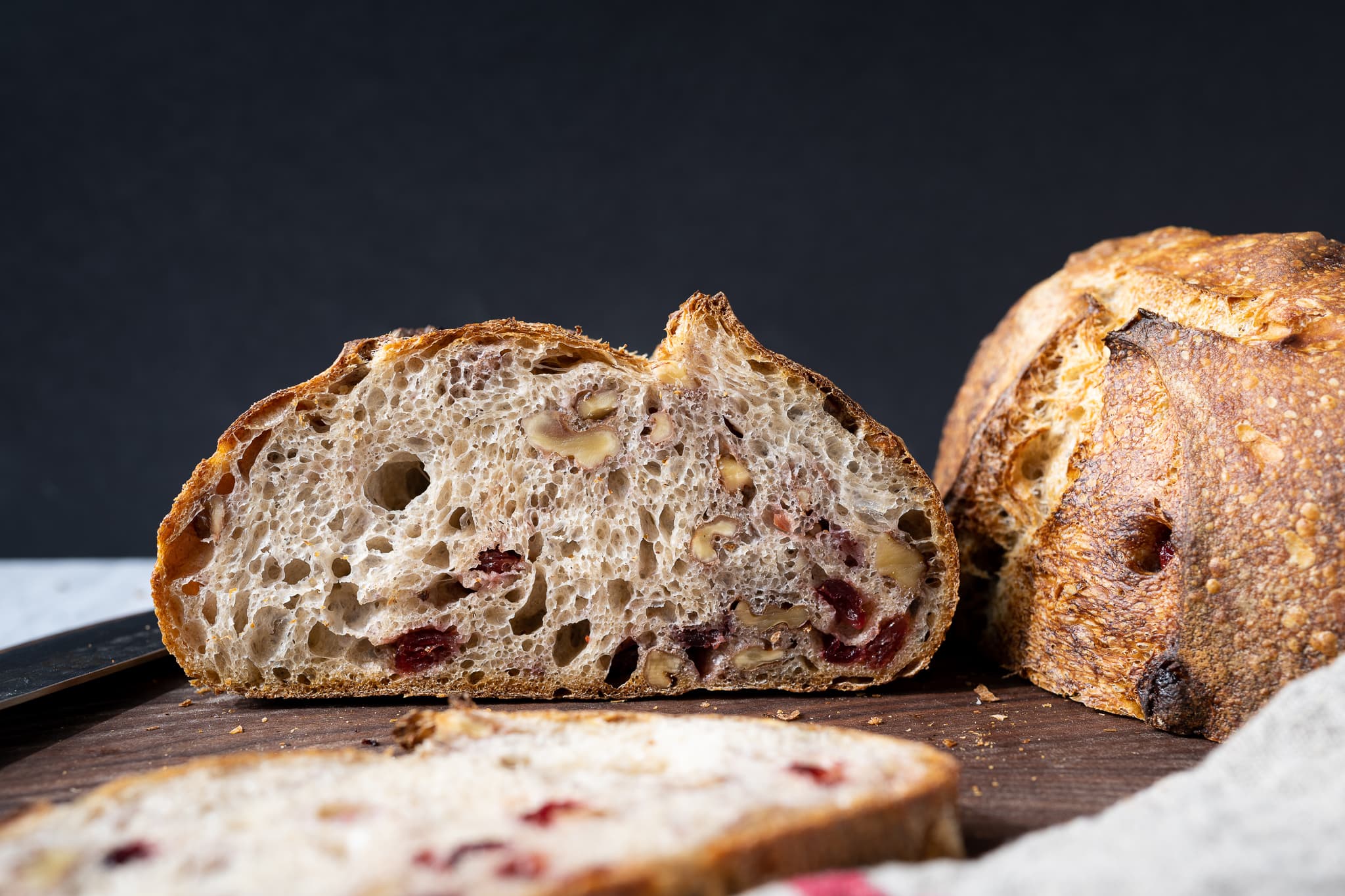
I’ve been baking sourdough bread padded to the brim with walnuts and cranberries since even before this recipe was originally posted back in 2014. Earthy walnuts are undoubtedly a favorite, as evidenced by the many recipes I have here with their inclusion, and there’s a real joy in the pairing of this enigmatic nut with the tart—yet sweet—cranberry. Walnuts and cranberries seem diametrically opposed, but as is usually true in nature, when two things ripen at around the same time, they almost always taste great together. And when looking over this walnut cranberry sourdough, you might read cranberry and think, “too tart!” I urge you to try baking this bread because it’s anything but.
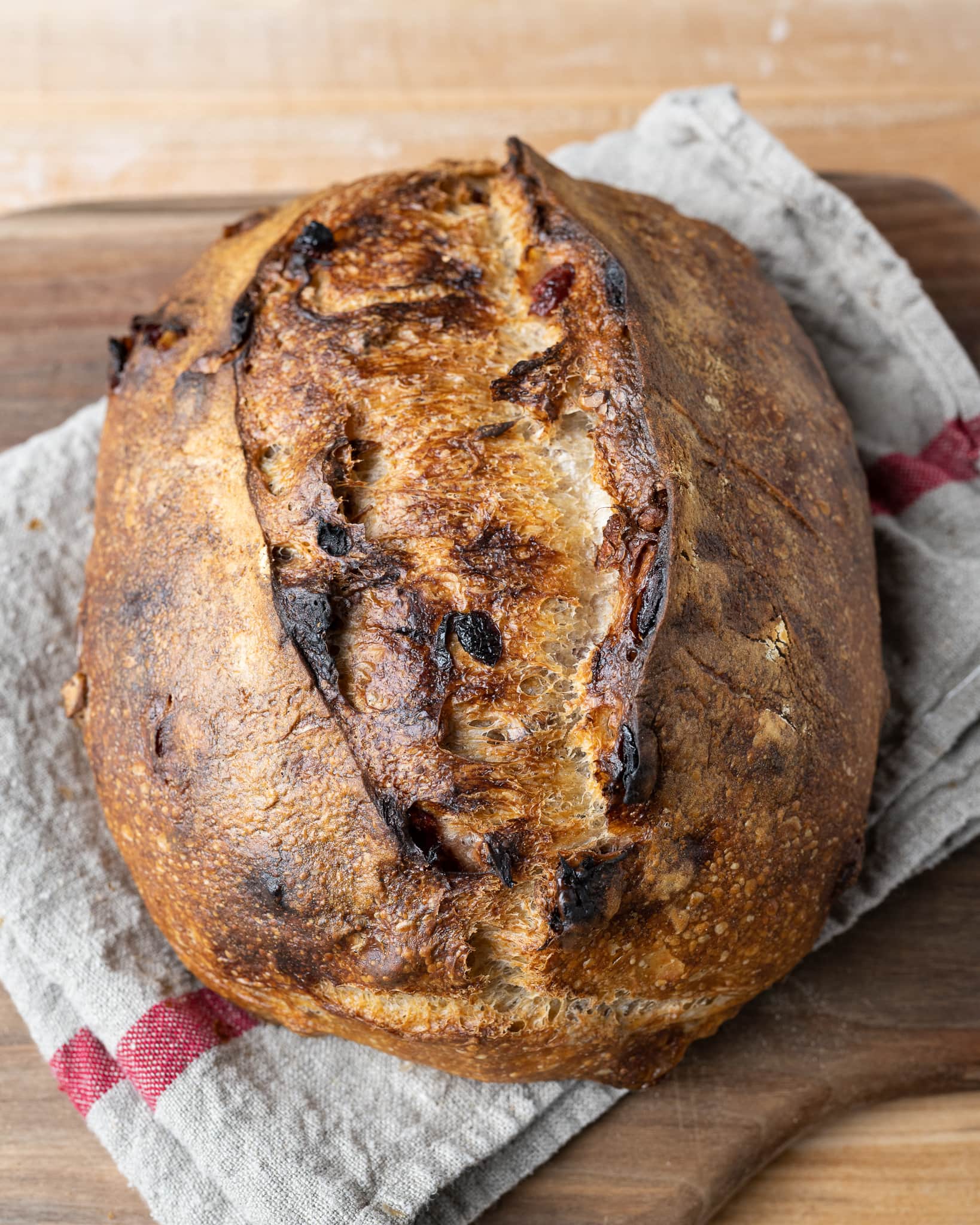
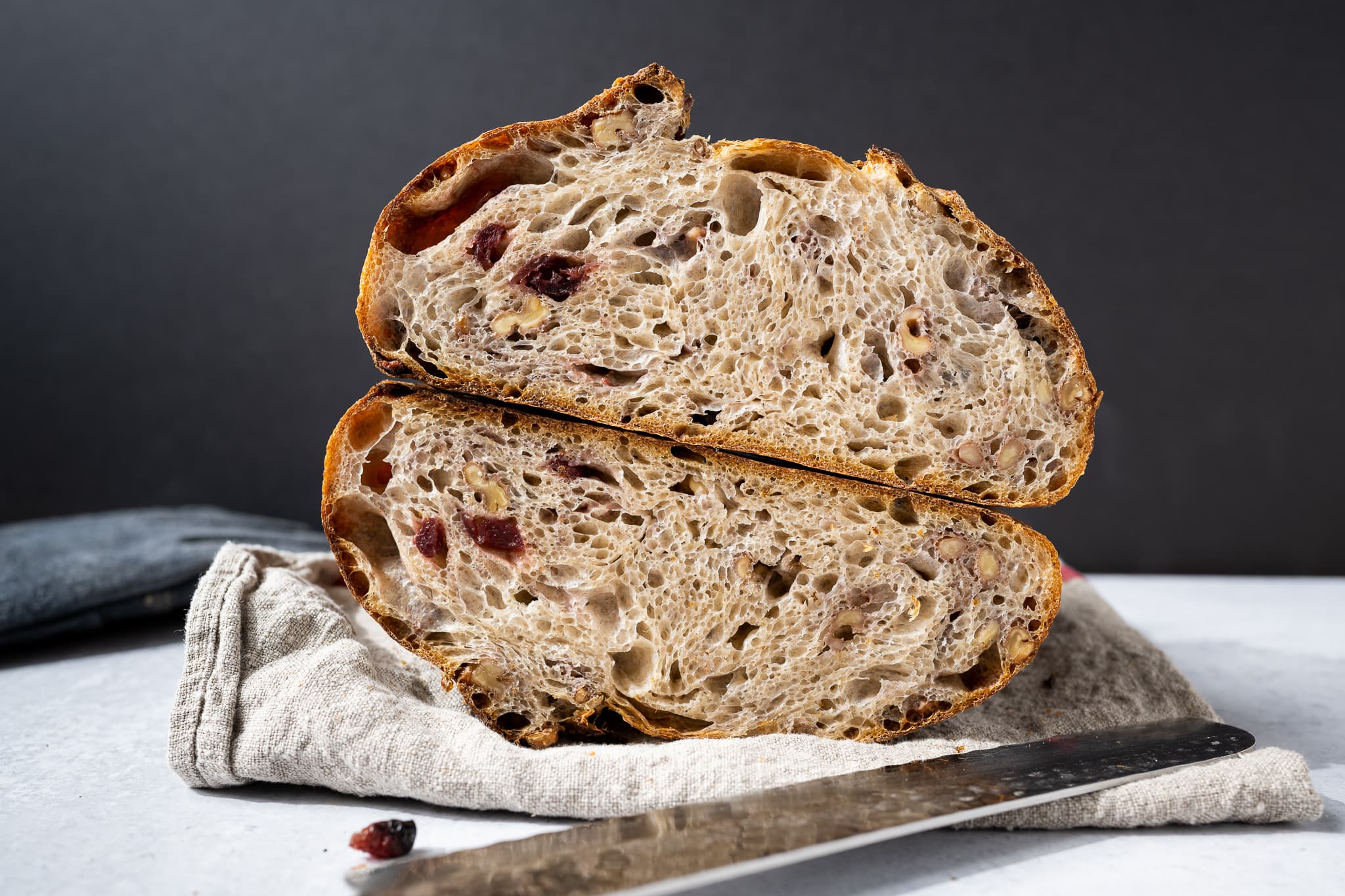
Out of the oven, this loaf carries some of the most dramatic coloring of any bread I bake. The crust ranges from burnished to just a kiss of brown, stopping everywhere between. The stray cranberries and walnuts that might have made their way to the surface, coloring deeply in the oven, add even more dramatic landscape to this darkly expressed loaf. What an eater experiences in drama on the outside is equally apparent inside, as each slice contains a scattering of sliced tart and sweet fruit and earthy nuts. But the show’s real star is the overall melding of flavors: the fruit, the nuts, and how the rich walnut oil enrobes the entire eating experience.
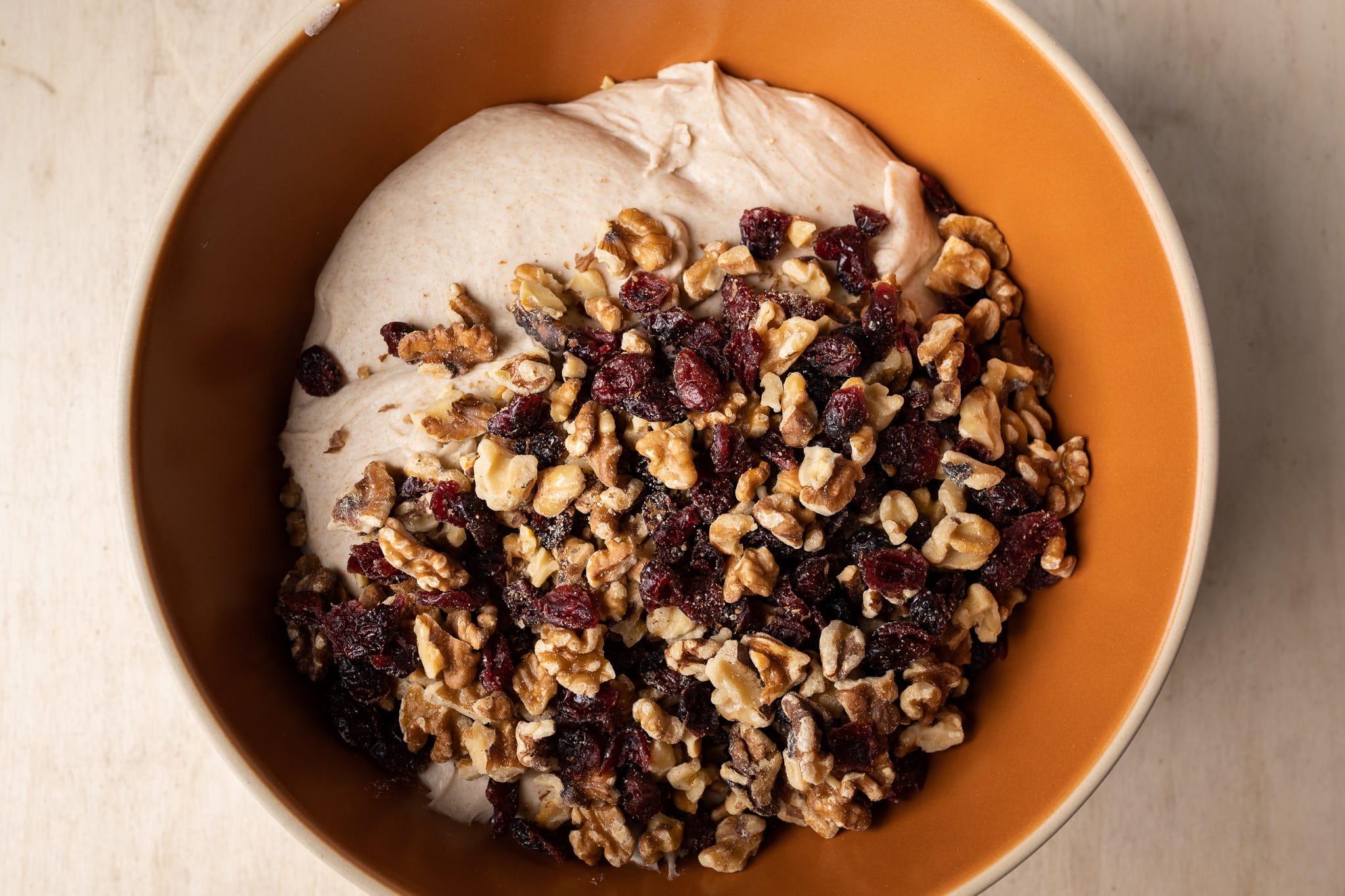
Let’s first look at the flour used in this walnut cranberry sourdough bread recipe, the dried cranberries, and the called for walnut oil.
Flour Selection, Cranberries, and Walnut Oil
This recipe calls for whole-grain rye flour in the levain. I mostly maintain my sourdough starter by refreshing it with a percentage of whole rye flour each day, so I always have some on hand. Additionally, I find adding it to the levain results in a flavor-forward end loaf by increasing the vigor of the levain.
The cranberries I used in this recipe are sweetened, ever so slightly. I find them at my local market in the bulk area, and I think in the end, they’re pretty similar to Craisins. I like to buy a big bag and keep it in my pantry, always ready to go into my next batch of this dough.
The small amount of walnut oil in this recipe brings a disproportionate amount of aroma and flavor to this bread. in this recipe, it sure brings with it a disproportionate amount of aroma and flavor to this bread. The oil carries an irresistible, luxurious aroma that’s only outstripped by the exuberant flavor. If I could sneak this oil into every bread I bake, I wouldn’t be sad about it. But in addition to the aroma and flavor, the oil also softens the end loaf much as any oil would; I highly recommend using it in this recipe (and it’s also great for salads). Alas, my love of walnuts continues.
Baking Schedule
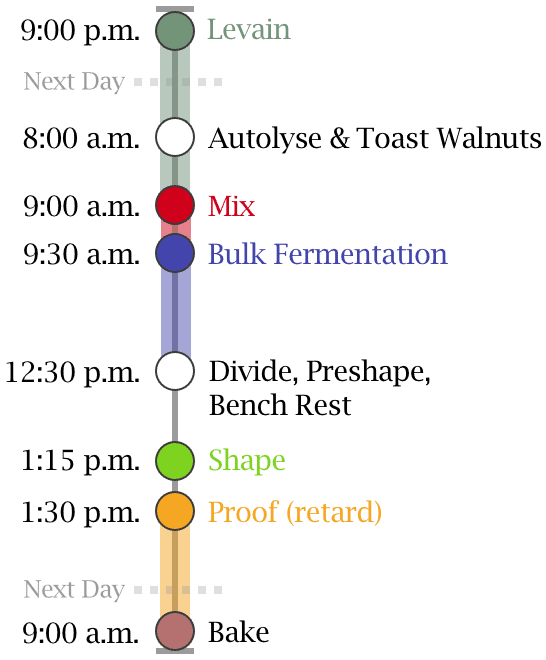
This walnut cranberry sourdough is made over the course of two days (not including the overnight levain). The cold proof of the dough brings significant flavor to this dough, but you could also opt for a same-day bake. Instead of placing the shaped dough into the refrigerator to proof overnight, leave it out, covered, to proof for 1-3 hours (depending on kitchen temperatures) until ready to bake.
See the baking schedule at right.
Walnut Cranberry Sourdough Bread Formula
Formula updates: There are a few subtle changes to this recipe over the one standing here for so many years: a slightly reduced salt percentage (from 2% to 1.9%), 3% reduction in hydration, 4% more dried cranberries, levain reduced from 25% to 23.33%, and finally, a conversion from “2 tablespoons walnut oil” to a more baker’s math friendly 3.00% walnut oil. After many iterations and permutations with this bread, these subtle changes have made this bread even better.
Vitals
| Total Dough Weight | 1,800 grams |
| Hydration | 85% (88% including walnut oil) |
| Pre-fermented Flour | 10.00% |
| Levain in final dough | 23.33% |
| Yield | 2 x 900g loaves |
This recipe makes two loaves. If you’d like to make a single loaf of walnut cranberry sourdough, divide all the ingredients in half. See my guide to using baker’s percentages for help with scaling.
Total Formula
Desired dough temperature: 76°F (24°C). See my post on the importance of dough temperature for more information on dough temperatures.
| Weight | Ingredient | Baker’s Percentage |
|---|---|---|
| 640g | Medium-protein bread flour or All-purpose flour (~11% protein, Central Milling Artisan Baker’s Craft or King Arthur Baking All-Purpose) | 80.00% |
| 120g | Whole wheat flour (Giusto’s Whole Wheat or King Arthur Baking Whole Wheat) | 15.00% |
| 40g | Whole rye flour (Flourist Whole Grain Rye) | 5.00% |
| 160g | Walnuts, shelled and toasted | 20.00% |
| 112g | Cranberries, sweetened and dried (Craisins would work well) | 14.00% |
| 24g | Walnut oil | 3.00% |
| 600g | Water 1 (levain and autolyse) | 75.00% |
| 80g | Water 2 (reserve for mixing) | 10.00% |
| 15g | Fine sea salt | 1.90% |
| 8.0g | Sourdough starter | 1.00% |
Walnut Cranberry Sourdough Bread Method
1. Prepare levain – Night before mixing, 9:00 p.m. (day one)
This is an overnight levain: mix the following ingredients in a container and leave covered to ripen at about 77°F (25°C) for 12 hours.
| Weight | Ingredient | Baker’s Percentage |
|---|---|---|
| 40g | Medium-protein bread flour or all-purpose flour | 50.00% |
| 40g | Whole rye flour | 50.00% |
| 80g | Water | 100.00% |
| 8g | Ripe sourdough starter | 10.00% |
2. Prepare mix-ins – 7:30 a.m. (day two)
Preheat your oven to 350°F (175°C). Spread the 160g walnuts out evenly on a sheet pan and bake for 10 to 15 minutes until they start to take on a little color and become very fragrant. Keep an eye on them; they can burn quickly. Set aside until called for during bulk fermentation.
3. Autolyse – 8:00 a.m.
This recipe uses the autolyse technique to increase the extensibility of the dough and make mixing by hand easier. The increased extensibility helps with incorporating the walnuts and cranberries.
Add the following to a mixing bowl and mix until incorporated.
| Weight | Ingredient | Baker’s Percentage |
|---|---|---|
| 600g | Medium-protein bread flour or all-purpose flour (~11% protein, Central Milling Artisan Baker’s Craft or King Arthur Baking All-Purpose) | 80.00% |
| 120g | Whole wheat flour (Giusto’s Whole Wheat or King Arthur Baking Whole Wheat) | 15.00% |
| 520g | Water 1 | 76.00% |
4. Mix – 9:00 a.m. (Day two)
| Weight | Ingredient | Baker’s Percentage |
|---|---|---|
| 24g | Walnut oil | 3.00% |
| 80g | Water 2 | 10.00% |
| 15g | Fine sea salt | 1.90% |
| 168g | Ripe levain (from step 1) | 1.00% |
Gather the following ingredients for mixing. The remaining water (water 2) should only be added through mixing if your dough feels like it can handle the addition. Use a splash to work in the levain and salt, adding the rest based on how the dough feels. If the dough is extremely slack, omit the rest of the water.
Finally, hold back the walnut oil until the later steps of mixing.
I strengthened this dough by hand using the slap and fold kneading technique, which quickly develops the dough. Alternatively, you could use a home spiral dough mixer, or even a KitchenAid would work with this dough.
Add the levain to the top of your dough in the mixing bowl (that’s been in autolyse) and use a splash of water to moisten. Mix the levain in thoroughly and slap and fold (or do folds in the bowl) for 5 minutes until the dough begins to smooth out and become elastic.
Let the dough rest in the mixing bowl for 10 minutes.
Sprinkle the salt over the dough, then dissolve with a splash of the reserved mixing water. Mix thoroughly. If the dough still feels very slack, continue to strengthen the dough in the bowl by stretching and folding (or do slap/fold on the counter) for a few minutes until it begins to tighten. Then, slowly begin adding the walnut oil while folding the dough in the bowl. I like to add a small pour every minute or so as I’m folding.
At the end of mixing this dough will still be very extensible and slack, but it will look smooth and shiny. The walnuts and cranberries will be added during bulk fermentation.
Transfer the dough to a container for bulk fermentation and cover.
4. Bulk fermentation – 9:30 a.m. to 12:30 p.m.
At a warm room temperature, around 74-76°F (23-24°C), bulk should take about 3 hours. If your kitchen is cooler, place your bulk container in a small home dough proofer, or extend the bulk fermentation time to give the dough more time to ferment. This dough needs about three sets of stretch and folds during the 3-hour bulk.
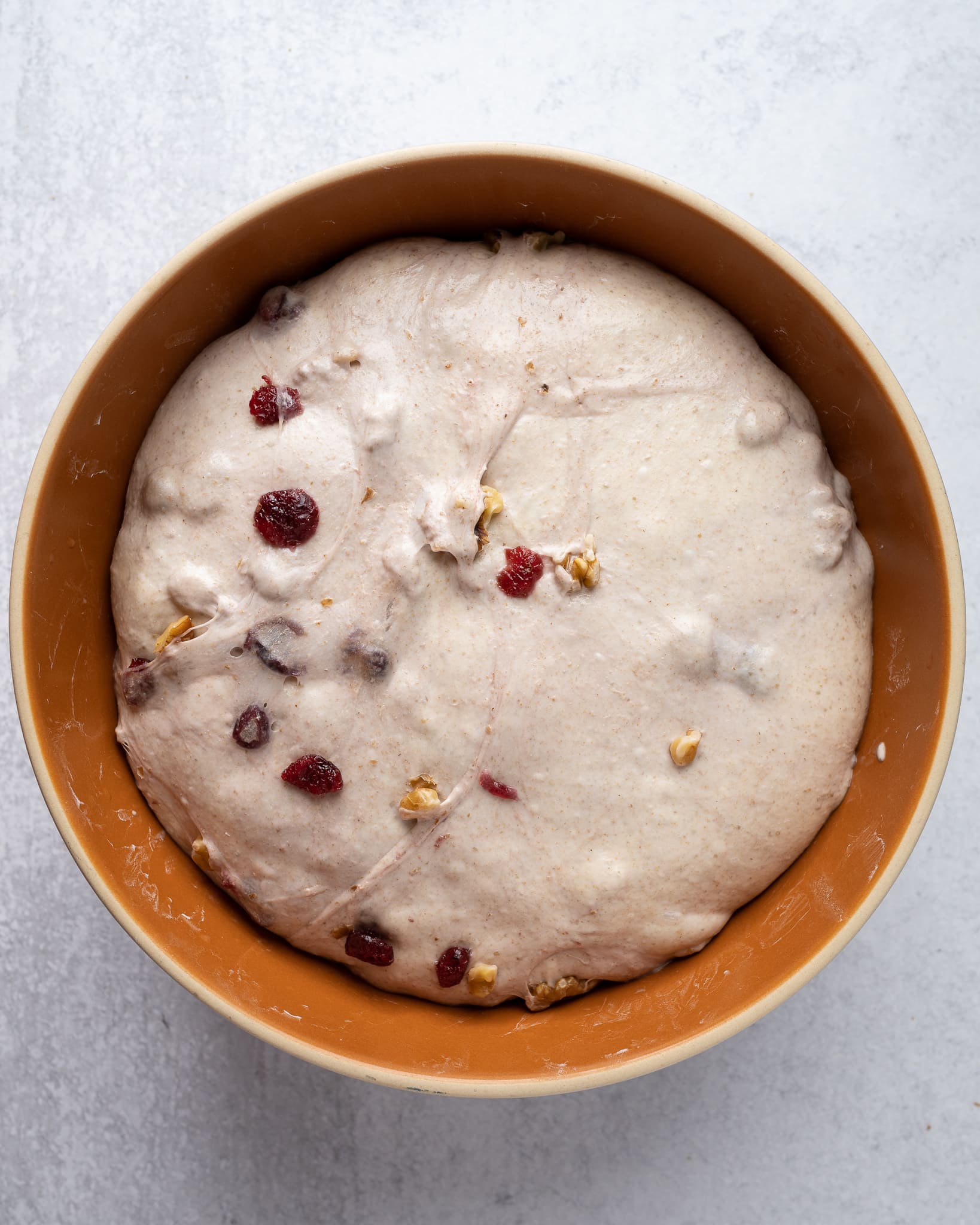
Combine the 160g toasted walnuts and 112g cranberries in a large bowl.
Before you give your dough its first set of stretch and folds, spread about 1/4 of the mix-ins over the top of the dough. Then, grab one side of the dough and stretch it up and over the dough to the other side. Spread on another 1/4 of the mix-ins to the new top. Rotate the bowl 180° and perform another stretch and fold. Spread on another 1/4 of the mix-ins, then rotate the bowl 90° and do another stretch and fold. Finally, spread on the last of the mix-ins, turn the bowl 180° and do one last stretch and fold. You should have the dough neatly folded up in the bowl with all the mix-ins tucked into the dough.
Here’s a video of me stretching and folding this dough over on Instagram.
The remaining two sets of stretch and folds should be a little more gentle. After the third set, let the dough rest, covered, for the remainder of bulk fermentation.
5. Divide and preshape – 12:30 p.m.
Fill a bowl with some water and place it on your work surface. Scrape out your dough from the bulk container onto your dry counter. Divide the mass in half using a bench knife. Using a wet hand and the knife in the other, gently preshape each half into a loose round.
Let the dough rest, uncovered, for 30 minutes until its relaxed outward.
6. Shape – 1:15 p.m.
I like to shape this loaf as an oblong batard, but a round boule would also work well. Shape each by first flouring the top of the rested rounds and your work surface, then shape them into your desired shape.
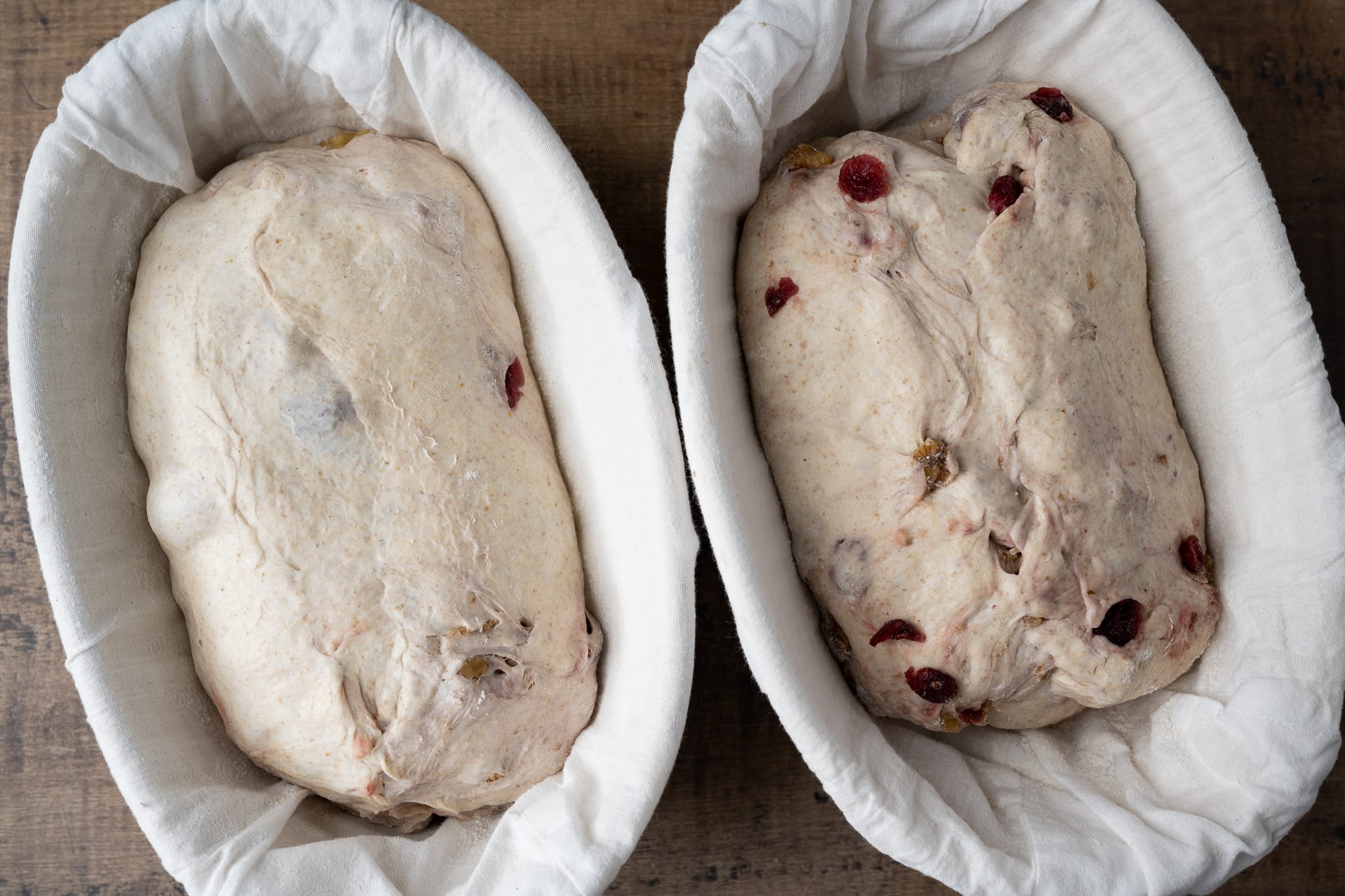
After the dough is shaped, place it seam side up in a proofing basket lined with canvas or a clean kitchen towel. I recommend lining your proofing basket because the red cranberries can ooze out a bit of color during the long, cold-proof. I like to use smaller, 10″ proofing baskets for this dough to keep it in a tighter shape during proof.
7. Proof – 1:30 p.m. to 9:00 a.m. (overnight)
Cover the baskets with a large, reusable plastic bag and seal it shut. Place the baskets into your refrigerator to proof overnight.
8. Bake – 9:00 a.m. (next day)
Preheat your oven with a baking stone or Baking Steel inside to 450°F (230°C).
I baked these loaves on my Baking Steel in my oven, following my guide on how to steam an oven for baking bread. However, you could also use a Dutch oven if you’ve shaped your dough as a round shape (see my guide to baking bread in a Dutch oven here).
Score each piece of dough and slide it into the oven—bake for 20 minutes with steam. Then, remove the steaming pans from inside the oven (or remove the lid to your combo cooker or Dutch oven) and bake for an additional 30 minutes, or until the crust is deeply colored and the interior temperature registers around 204°F (95°C).
Once fully baked, cool your loaves on a cooling rack for 1-2 hours. See my post on the best way to store bread to keep it fresh for a week or longer.
Walnut Cranberry Sourdough Recipe
- Prep Time: 24 hours
- Cook Time: 1 hour
- Total Time: 25 hours
- Yield: 2 loaves
Description
A delicious loaf of sourdough bread padded with tart and sweet cranberries and earthy walnuts, all tied together with a small addition of roasted walnut oil. This is one of the most flavorful bread recipes I bake, and there’s a good reason it’s also one of the most requested—it’s delicious!
Ingredients
Levain
- 40g medium-protein bread flour or all-purpose flour
- 40g whole rye flour
- 80g water
- 8g ripe sourdough starter
Main Dough
- 600g medium-protein bread flour or all-purpose flour
- 120g whole wheat flour
- 160g walnuts, shelled and toasted
- 112g cranberries, sweetened
- 24g walnut oil
- 15g sea salt
- 520g water 1 (autolyse)
- 80g water 2 (mix)
- 168g levain
Instructions
- Levain (night before mixing, 9:00 p.m.)
In a small container, mix the Levain ingredients and keep it at a warm temperature overnight. - Prepare mix-ins (the next day, 7:30 a.m.)
Preheat your oven to 350°F (175°C). Spread the 160g walnuts out evenly on a sheet pan and bake for 10 to 15 minutes until they start to take on a little color and become very fragrant. Set aside until bulk fermentation. - Autolyse (8:00 a.m)
In a medium mixing bowl, add the 600g medium-protein bread flour, 120g whole wheat flour, and 520g water and mix until no dry bits remain. Cover the bowl and let rest for 1 hour. - Mix (9:00 a.m.)
To the mixing bowl holding your dough, add the levain and a splash of water. Mix thoroughly and strengthen the dough for about 5 minutes. Let the dough rest for 10 minutes in the mixing bowl. Add the salt, another splash of water, and mix until incorporated. Strengthen the dough further if necessary until it’s elastic and smooth. Then, slowly add the walnut oil over the course of the next few minutes while stretching and folding until the oil is absorbed and the dough is smooth and shiny. Transfer the dough to a bulk fermentation container and cover. - Bulk Fermentation (9:30 a.m. to 12:30 p.m.)
Before you give your dough its first set of stretch and folds, spread about 1/4 of the mix-ins over the top of the dough. Add the rest of the mix-ins in the same way through the remaining folds for the first set. Perform two more sets of gentle stretch and folds during this 3-hour period, then let the dough rest the remainder of bulk fermentation. - Divide and Preshape (12:30 p.m.)
Lightly flour your work surface and scrape out your dough. Using your bench knife, divide the dough in half. Lightly shape each half into a round shape. Let the dough rest for 30 minutes, uncovered. - Shape (1:15 p.m.)
Shape the dough into a round (boule) or oval (batard) and place in proofing baskets. Cover the baskets with a reusable plastic bag. - Proof (1:30 p.m. to 9:00 a.m. the next day)
Cover proofing baskets with reusable plastic and seal shut. Then, place both baskets into the refrigerator and proof overnight. - Bake (The next day, bake at 9:00 a.m.)
Preheat your oven with a baking surface or combo cooker/Dutch oven inside to 450°F (230°C).When the oven is preheated, remove your dough from the fridge, score it, and transfer to the preheated baking surface or combo cooker. Bake for 20 minutes with steam. After this time, vent the steam in the oven or remove the lid (you can keep it in the oven or remove it) and continue to bake for 30 minutes longer. When done, the internal temperature should be around 204°F (95°C).
Let the loaves cool for 2 hours on a wire rack before slicing.
What’s Next?
While I’ve been baking this bread for ages, revisiting the formula and formalizing it here made me appreciate how much I love it. It’s surprising how much I look forward to the moments when I can eat a slice of this walnut cranberry sourdough, whether it’s in the morning toasted with butter, the afternoon with a turkey sandwich, or the evening simply on its own. When baking this bread, I often regret not doubling the recipe and making more—easily fixed next time!
Next, try your hand at my sunflower and sesame sourdough for another wonderful loaf with inclusions!
Buon appetito!


367 Comments
It appears this recipe makes less volume than most of your bread recipes. Therefore the loaves are much smaller. At lease mine are smaller. I like the idea that the recipe makes two loaves. Do you have any suggestions on the possibilities of increasing the recipe to get more volume to make two loaves of this delicious bread.?
Another great recipe…I added a few grams of diastatic malt powder.
What does that do? I'm making the recipe right now and have malt powder on hand it was just curious.
Make sure is diastatic malt powder. It helps with rise. Use 1 gram of malt powder to 100 grams of flour. https://www.theperfectloaf.com/what-is-diastatic-malt-powder/
This was by far the best tasting and best textured sourdough loaves I’ve ever made. Just wow. My expectations started low because I mixed a levain with all white AP flour to make my usual basic plain sourdough but when I woke up the next morning I decided to make this instead, even though I knew the levain might not be as strong or have the right flavor without the rye. But it somehow still worked and turned out perfectly. The inside was soft, the crust was perfectly crisp, it has just the right balance of walnuts and cranberries, and the flavor from the walnut oil took it all to the next level. I did have to ferment it quite a bit longer than the recipe called for but I expected that given my levain situation and the cooler temp of my house. I made some maple cinnamon butter to go with it and WOW. I can’t wait to make this again, and to try some more of your recipes, thank you!
Could I switch out the walnuts for pecans? If so, do I still use the walnut oil?
I've baked these loaves twice now and they are a huge hit with friends and family!
I have two questions though!
1. Why does this recipe use a lower protein content flour as opposed to, say, King Arthur Bread Flour which is 12.7% protein? I thought more gluten would help with bread that uses inclusions like nuts and fruits
2. Why is the bulk fermentation time for this recipe shorter than, say, the beginner sourdough recipe, which uses more levain?
Thanks!
Hi, can I use other kind of oil? Thank you
You don't say to chop the walnuts. Do you use halves?
What does it mean to "Mix thoroughly and strengthen the dough"? Are those two different actions?
Hello and thank you for the recipe. Tastes amazing. One question, though. What would be the right ingredients for one loaf? Thank you.
I just baked these loaves today and they were amazing! I followed your perfect recipe and instructions/timeline exactly as written and I could not be happier with the result. This was my fourth time baking with my starter and it came out so well thanks to you! I baked this for a brunch I hosted and it's all gone. It was amazing plain, with a bit of butter and also tried with Brie spread on it and WOW!
Elizabeth, that's wonderful! Love hearing about successful bakes, especially when sharing with others. And brie on fresh sourdough? That's a perfect pairing. Thanks for sharing your success – sounds like your starter is performing beautifully!
This is it, the perfect recipe I’ve been searching for! Thank you thank you thank you! Subbed pecans and avocado oil as I made one of the loaves for my dad who’s allergic to walnuts. It was exactly the loaf I’ve been trying to replicate from a bakery I visited and loved so much.
So happy to hear all that Heidi!
For the starter, does it matter if I use a starter that is 60% hydration? If so, what is the impact using a 60% starter vs 100% starter?
That's fine, too. You might need to add a little more water when making the levain, or it'll be stiff, too. (Essentially, you need to make up for the "missing" water in the stiff starter.)
Hi, I don’t have walnut oil, can I substitute with olive oil or do you recommend another oil?
OO will work really well!
Absolutely delicious. I subbed pecans and added some dried apricots to the cranberries. I’m addicted, will eat nothing much else for a week!
Oh that sounds delicious, Karyn! Huge fan of dried apricots ( as you can see here ).
Fantastic! I made it with cranberries and pistachios (omitted the walnut oil). I think these were my best loaves yet! I really enjoy your recipes. Thanks Maurizio!
Amazing, love pistachios! Enjoy 🙂
Made this for Thanksgiving a couple of years ago, didn’t have time the last couple of years, but made it again this year. It’s just phenomenally delicious, and absolutely beautiful. Everyone raves. Used Hayden Mills AP (oh, do I love their flours!!) this time around. Just posting this to say thanks for a wonderful recipe!!
Ahh, thanks so much Eben! Yes, this loaf would be stellar with Hayden flour—great stuff. Happy holidays and thank you for the feedback!
This year, as I have for the last 7-8 years , I am making this bread to bring to our family Thanksgiving. I really enjoy it so much!
I will say that I fiddle with it a bit – i.e. I frequently use (as I have this year) pecans rather than walnuts, because that's usually what I have on hand. I also change the process a little – rather than mixing in the additions in stretch&folds, which I find makes it harder to get them evenly distributed, I laminate the dough and spread out the additions over the entire batch during the lamination, which gets it all mixed in very evenly, and then do coil folds during the bulk. At least that's what works for me!
Happy Holidays!
Oh my, that means a lot Jeff! I make this every year as well, it's a tradition now 🙂 Great mods there, we all find our preferred method in the end. Happy holidays and enjoy!
Would it be a terrible idea to try and do this as baguettes instead? My plan was to use these ratios but then follow the instructions for your baguette recipe.
I have not tried but you certainly could. I would probably make them more like stubby batard (oval) shape instead. So maybe maybe 4 smaller ovals that are very tapered at the end, almost like a baguette.