

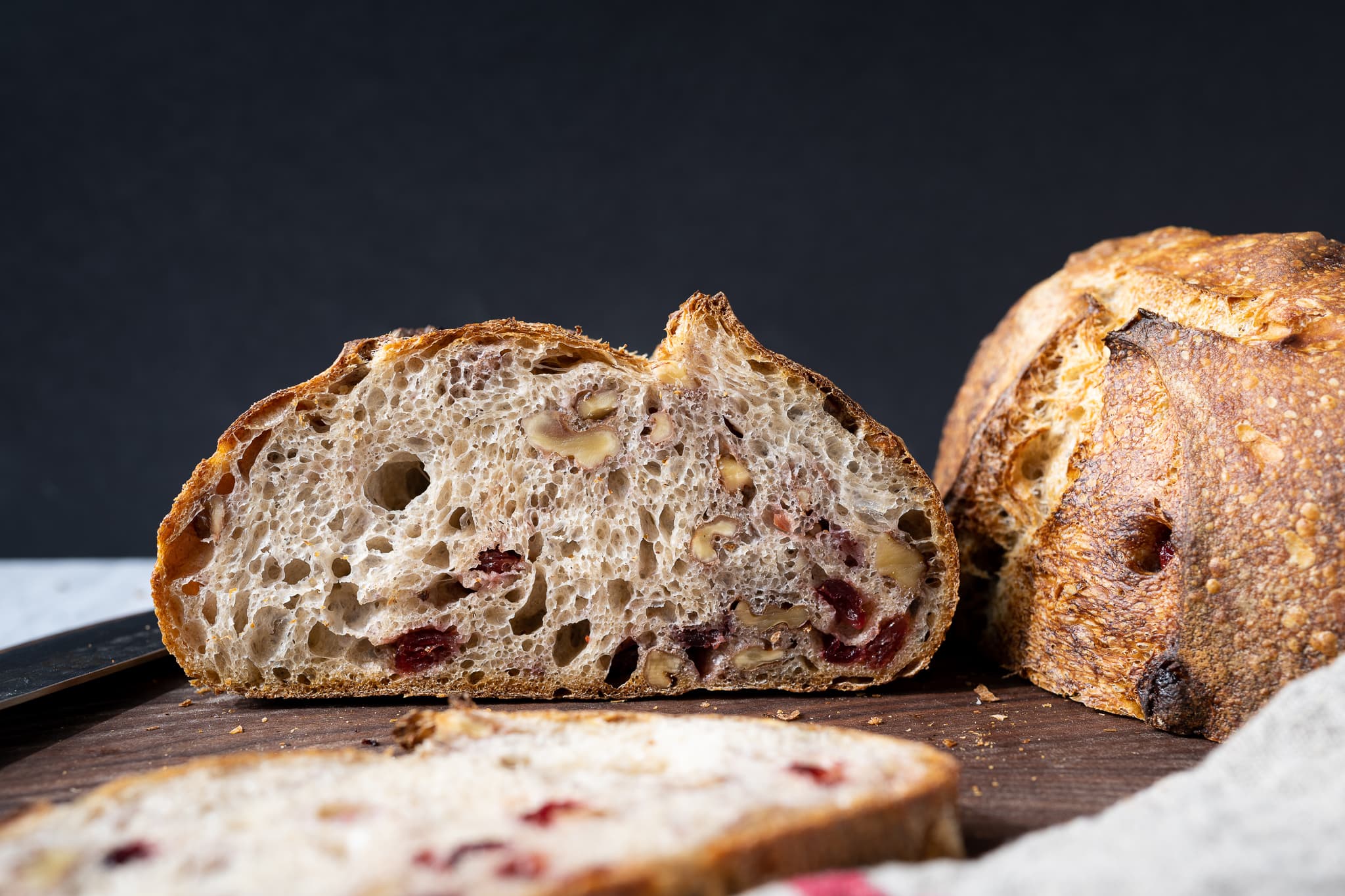
I’ve been baking sourdough bread padded to the brim with walnuts and cranberries since even before this recipe was originally posted back in 2014. Earthy walnuts are undoubtedly a favorite, as evidenced by the many recipes I have here with their inclusion, and there’s a real joy in the pairing of this enigmatic nut with the tart—yet sweet—cranberry. Walnuts and cranberries seem diametrically opposed, but as is usually true in nature, when two things ripen at around the same time, they almost always taste great together. And when looking over this walnut cranberry sourdough, you might read cranberry and think, “too tart!” I urge you to try baking this bread because it’s anything but.
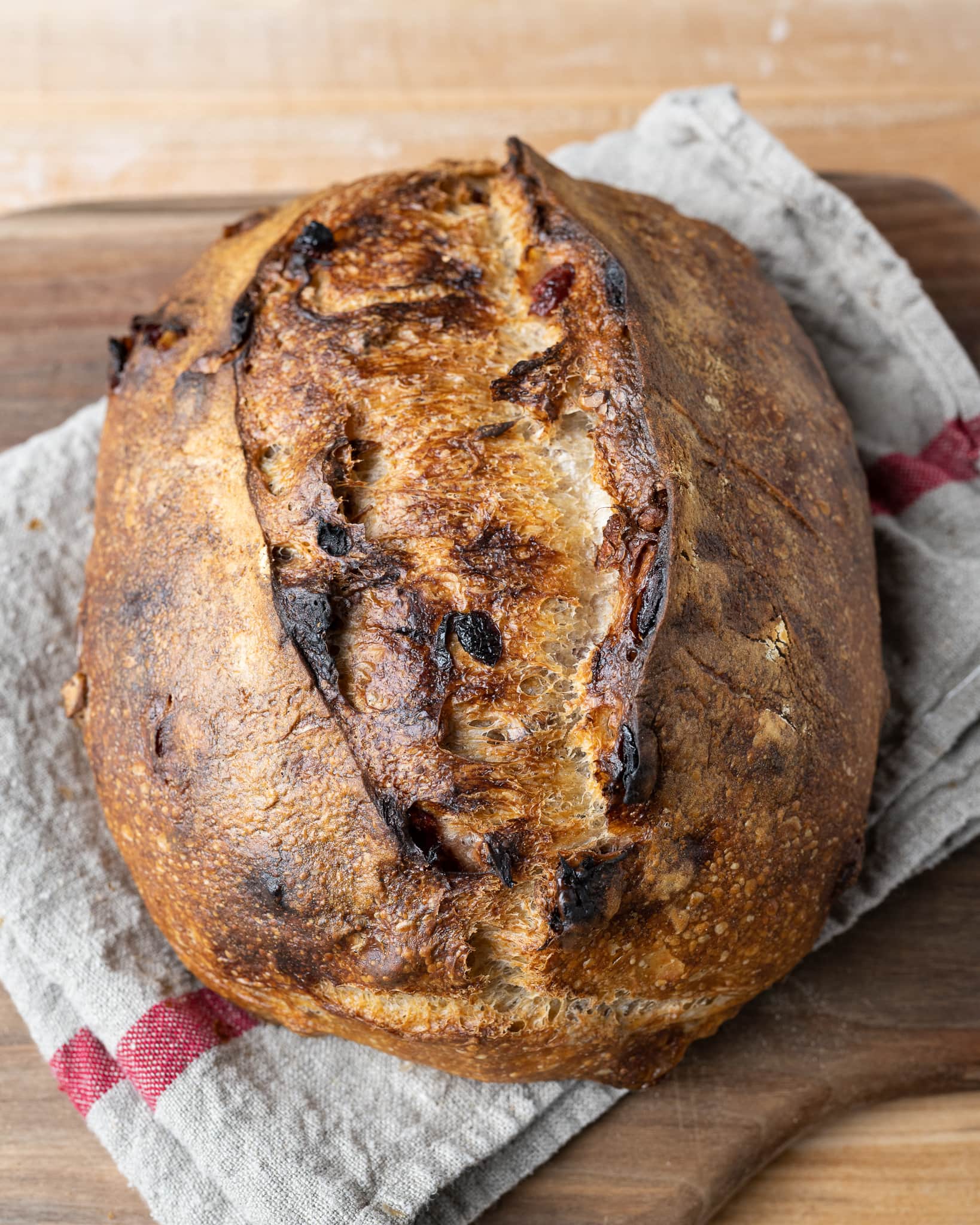
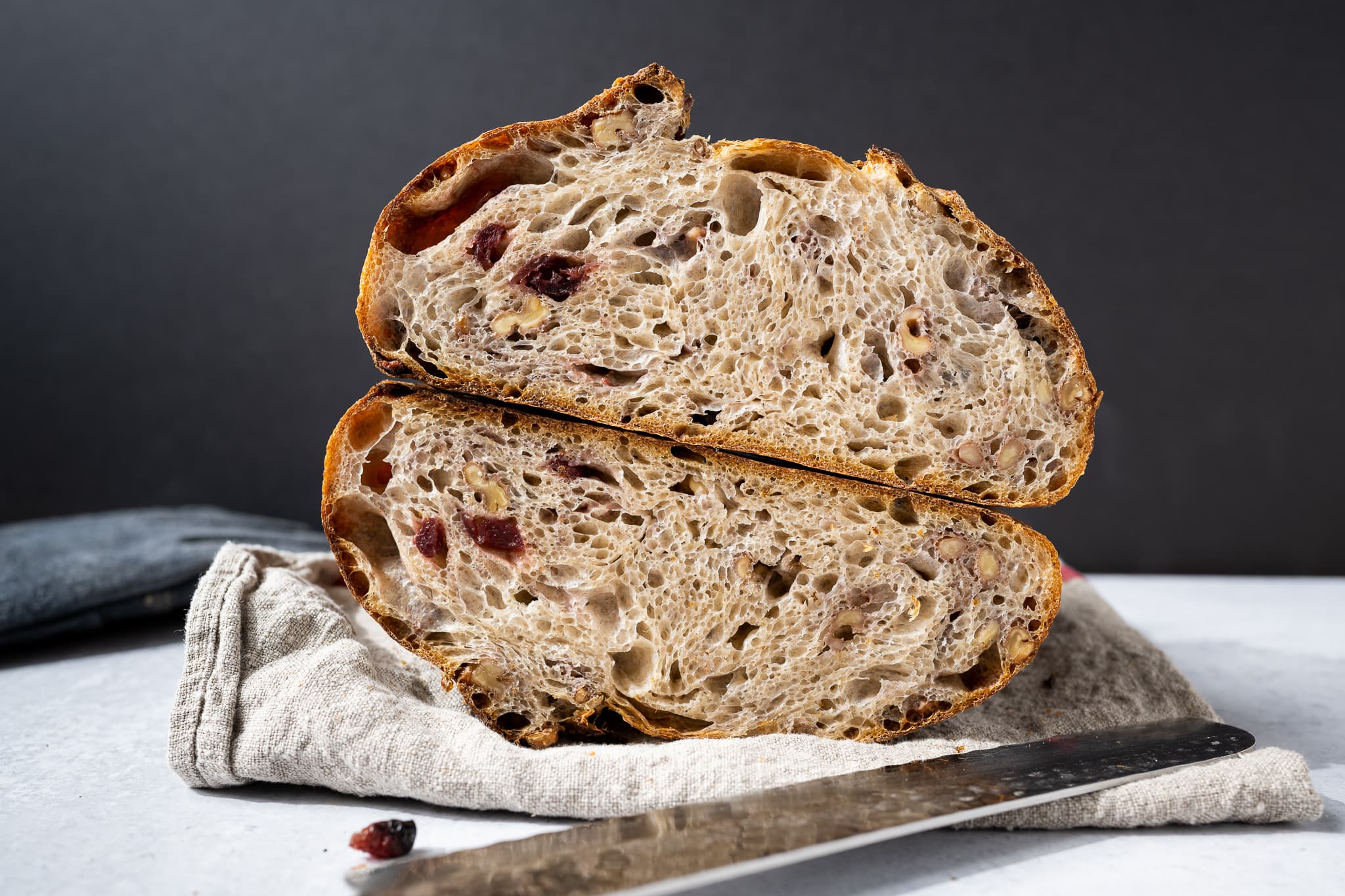
Out of the oven, this loaf carries some of the most dramatic coloring of any bread I bake. The crust ranges from burnished to just a kiss of brown, stopping everywhere between. The stray cranberries and walnuts that might have made their way to the surface, coloring deeply in the oven, add even more dramatic landscape to this darkly expressed loaf. What an eater experiences in drama on the outside is equally apparent inside, as each slice contains a scattering of sliced tart and sweet fruit and earthy nuts. But the show’s real star is the overall melding of flavors: the fruit, the nuts, and how the rich walnut oil enrobes the entire eating experience.
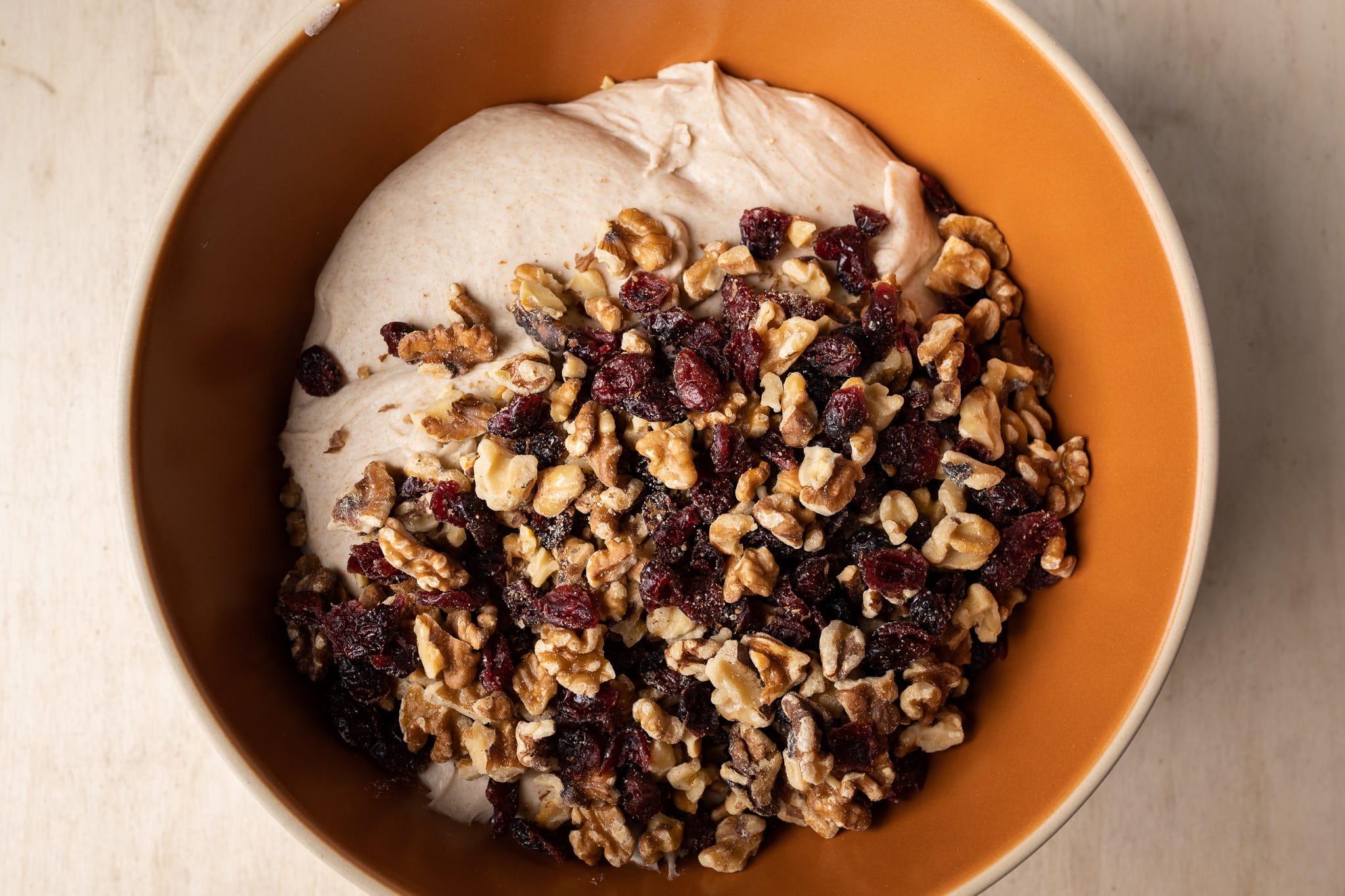
Let’s first look at the flour used in this walnut cranberry sourdough bread recipe, the dried cranberries, and the called for walnut oil.
Flour Selection, Cranberries, and Walnut Oil
This recipe calls for whole-grain rye flour in the levain. I mostly maintain my sourdough starter by refreshing it with a percentage of whole rye flour each day, so I always have some on hand. Additionally, I find adding it to the levain results in a flavor-forward end loaf by increasing the vigor of the levain.
The cranberries I used in this recipe are sweetened, ever so slightly. I find them at my local market in the bulk area, and I think in the end, they’re pretty similar to Craisins. I like to buy a big bag and keep it in my pantry, always ready to go into my next batch of this dough.
The small amount of walnut oil in this recipe brings a disproportionate amount of aroma and flavor to this bread. in this recipe, it sure brings with it a disproportionate amount of aroma and flavor to this bread. The oil carries an irresistible, luxurious aroma that’s only outstripped by the exuberant flavor. If I could sneak this oil into every bread I bake, I wouldn’t be sad about it. But in addition to the aroma and flavor, the oil also softens the end loaf much as any oil would; I highly recommend using it in this recipe (and it’s also great for salads). Alas, my love of walnuts continues.
Baking Schedule
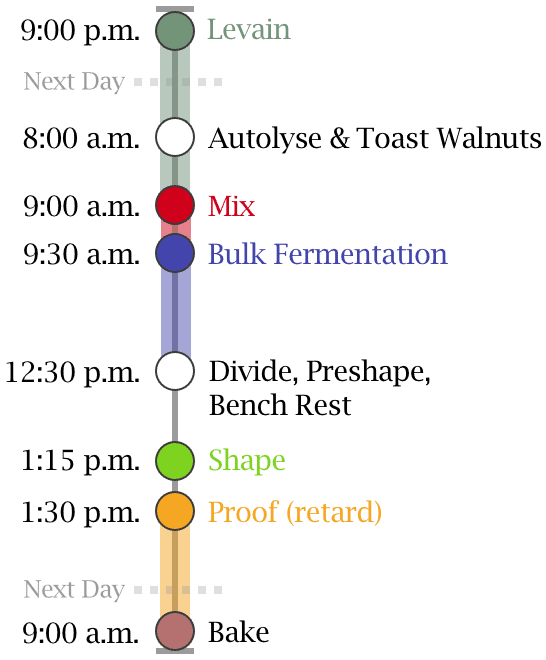
This walnut cranberry sourdough is made over the course of two days (not including the overnight levain). The cold proof of the dough brings significant flavor to this dough, but you could also opt for a same-day bake. Instead of placing the shaped dough into the refrigerator to proof overnight, leave it out, covered, to proof for 1-3 hours (depending on kitchen temperatures) until ready to bake.
See the baking schedule at right.
Walnut Cranberry Sourdough Bread Formula
Formula updates: There are a few subtle changes to this recipe over the one standing here for so many years: a slightly reduced salt percentage (from 2% to 1.9%), 3% reduction in hydration, 4% more dried cranberries, levain reduced from 25% to 23.33%, and finally, a conversion from “2 tablespoons walnut oil” to a more baker’s math friendly 3.00% walnut oil. After many iterations and permutations with this bread, these subtle changes have made this bread even better.
Vitals
| Total Dough Weight | 1,800 grams |
| Hydration | 85% (88% including walnut oil) |
| Pre-fermented Flour | 10.00% |
| Levain in final dough | 23.33% |
| Yield | 2 x 900g loaves |
This recipe makes two loaves. If you’d like to make a single loaf of walnut cranberry sourdough, divide all the ingredients in half. See my guide to using baker’s percentages for help with scaling.
Total Formula
Desired dough temperature: 76°F (24°C). See my post on the importance of dough temperature for more information on dough temperatures.
| Weight | Ingredient | Baker’s Percentage |
|---|---|---|
| 640g | Medium-protein bread flour or All-purpose flour (~11% protein, Central Milling Artisan Baker’s Craft or King Arthur Baking All-Purpose) | 80.00% |
| 120g | Whole wheat flour (Giusto’s Whole Wheat or King Arthur Baking Whole Wheat) | 15.00% |
| 40g | Whole rye flour (Flourist Whole Grain Rye) | 5.00% |
| 160g | Walnuts, shelled and toasted | 20.00% |
| 112g | Cranberries, sweetened and dried (Craisins would work well) | 14.00% |
| 24g | Walnut oil | 3.00% |
| 600g | Water 1 (levain and autolyse) | 75.00% |
| 80g | Water 2 (reserve for mixing) | 10.00% |
| 15g | Fine sea salt | 1.90% |
| 8.0g | Sourdough starter | 1.00% |
Walnut Cranberry Sourdough Bread Method
1. Prepare levain – Night before mixing, 9:00 p.m. (day one)
This is an overnight levain: mix the following ingredients in a container and leave covered to ripen at about 77°F (25°C) for 12 hours.
| Weight | Ingredient | Baker’s Percentage |
|---|---|---|
| 40g | Medium-protein bread flour or all-purpose flour | 50.00% |
| 40g | Whole rye flour | 50.00% |
| 80g | Water | 100.00% |
| 8g | Ripe sourdough starter | 10.00% |
2. Prepare mix-ins – 7:30 a.m. (day two)
Preheat your oven to 350°F (175°C). Spread the 160g walnuts out evenly on a sheet pan and bake for 10 to 15 minutes until they start to take on a little color and become very fragrant. Keep an eye on them; they can burn quickly. Set aside until called for during bulk fermentation.
3. Autolyse – 8:00 a.m.
This recipe uses the autolyse technique to increase the extensibility of the dough and make mixing by hand easier. The increased extensibility helps with incorporating the walnuts and cranberries.
Add the following to a mixing bowl and mix until incorporated.
| Weight | Ingredient | Baker’s Percentage |
|---|---|---|
| 600g | Medium-protein bread flour or all-purpose flour (~11% protein, Central Milling Artisan Baker’s Craft or King Arthur Baking All-Purpose) | 80.00% |
| 120g | Whole wheat flour (Giusto’s Whole Wheat or King Arthur Baking Whole Wheat) | 15.00% |
| 520g | Water 1 | 76.00% |
4. Mix – 9:00 a.m. (Day two)
| Weight | Ingredient | Baker’s Percentage |
|---|---|---|
| 24g | Walnut oil | 3.00% |
| 80g | Water 2 | 10.00% |
| 15g | Fine sea salt | 1.90% |
| 168g | Ripe levain (from step 1) | 1.00% |
Gather the following ingredients for mixing. The remaining water (water 2) should only be added through mixing if your dough feels like it can handle the addition. Use a splash to work in the levain and salt, adding the rest based on how the dough feels. If the dough is extremely slack, omit the rest of the water.
Finally, hold back the walnut oil until the later steps of mixing.
I strengthened this dough by hand using the slap and fold kneading technique, which quickly develops the dough. Alternatively, you could use a home spiral dough mixer, or even a KitchenAid would work with this dough.
Add the levain to the top of your dough in the mixing bowl (that’s been in autolyse) and use a splash of water to moisten. Mix the levain in thoroughly and slap and fold (or do folds in the bowl) for 5 minutes until the dough begins to smooth out and become elastic.
Let the dough rest in the mixing bowl for 10 minutes.
Sprinkle the salt over the dough, then dissolve with a splash of the reserved mixing water. Mix thoroughly. If the dough still feels very slack, continue to strengthen the dough in the bowl by stretching and folding (or do slap/fold on the counter) for a few minutes until it begins to tighten. Then, slowly begin adding the walnut oil while folding the dough in the bowl. I like to add a small pour every minute or so as I’m folding.
At the end of mixing this dough will still be very extensible and slack, but it will look smooth and shiny. The walnuts and cranberries will be added during bulk fermentation.
Transfer the dough to a container for bulk fermentation and cover.
4. Bulk fermentation – 9:30 a.m. to 12:30 p.m.
At a warm room temperature, around 74-76°F (23-24°C), bulk should take about 3 hours. If your kitchen is cooler, place your bulk container in a small home dough proofer, or extend the bulk fermentation time to give the dough more time to ferment. This dough needs about three sets of stretch and folds during the 3-hour bulk.
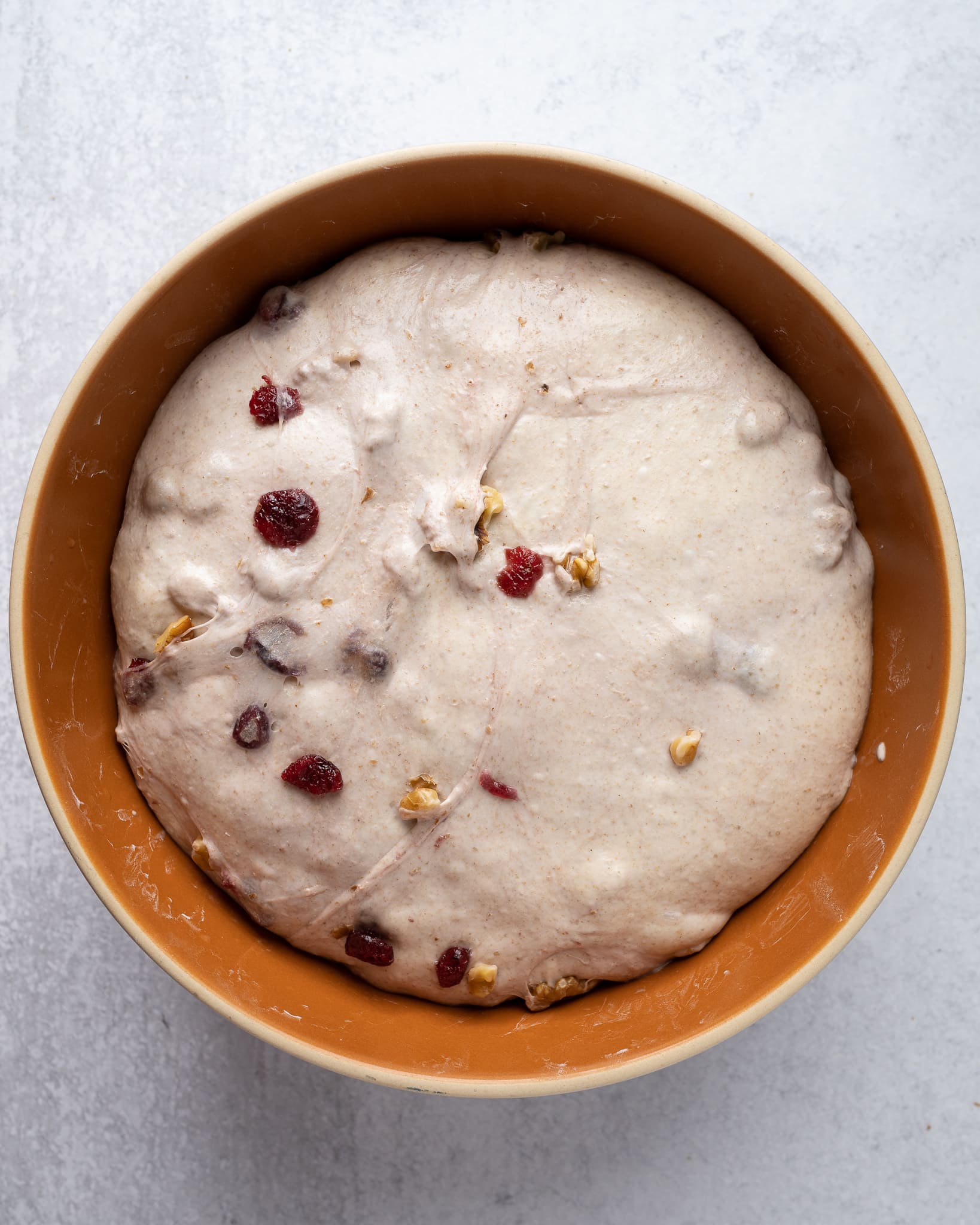
Combine the 160g toasted walnuts and 112g cranberries in a large bowl.
Before you give your dough its first set of stretch and folds, spread about 1/4 of the mix-ins over the top of the dough. Then, grab one side of the dough and stretch it up and over the dough to the other side. Spread on another 1/4 of the mix-ins to the new top. Rotate the bowl 180° and perform another stretch and fold. Spread on another 1/4 of the mix-ins, then rotate the bowl 90° and do another stretch and fold. Finally, spread on the last of the mix-ins, turn the bowl 180° and do one last stretch and fold. You should have the dough neatly folded up in the bowl with all the mix-ins tucked into the dough.
Here’s a video of me stretching and folding this dough over on Instagram.
The remaining two sets of stretch and folds should be a little more gentle. After the third set, let the dough rest, covered, for the remainder of bulk fermentation.
5. Divide and preshape – 12:30 p.m.
Fill a bowl with some water and place it on your work surface. Scrape out your dough from the bulk container onto your dry counter. Divide the mass in half using a bench knife. Using a wet hand and the knife in the other, gently preshape each half into a loose round.
Let the dough rest, uncovered, for 30 minutes until its relaxed outward.
6. Shape – 1:15 p.m.
I like to shape this loaf as an oblong batard, but a round boule would also work well. Shape each by first flouring the top of the rested rounds and your work surface, then shape them into your desired shape.
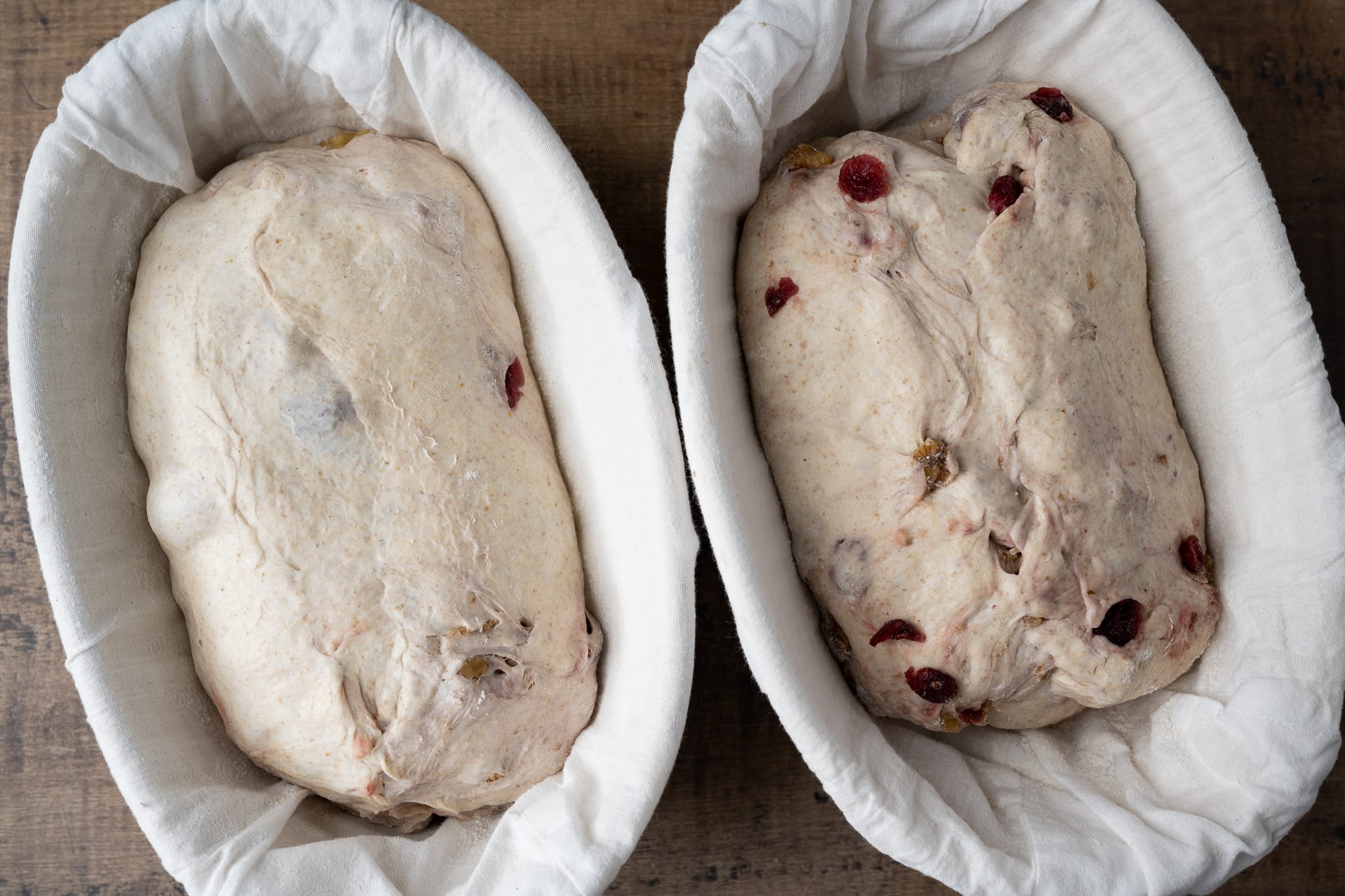
After the dough is shaped, place it seam side up in a proofing basket lined with canvas or a clean kitchen towel. I recommend lining your proofing basket because the red cranberries can ooze out a bit of color during the long, cold-proof. I like to use smaller, 10″ proofing baskets for this dough to keep it in a tighter shape during proof.
7. Proof – 1:30 p.m. to 9:00 a.m. (overnight)
Cover the baskets with a large, reusable plastic bag and seal it shut. Place the baskets into your refrigerator to proof overnight.
8. Bake – 9:00 a.m. (next day)
Preheat your oven with a baking stone or Baking Steel inside to 450°F (230°C).
I baked these loaves on my Baking Steel in my oven, following my guide on how to steam an oven for baking bread. However, you could also use a Dutch oven if you’ve shaped your dough as a round shape (see my guide to baking bread in a Dutch oven here).
Score each piece of dough and slide it into the oven—bake for 20 minutes with steam. Then, remove the steaming pans from inside the oven (or remove the lid to your combo cooker or Dutch oven) and bake for an additional 30 minutes, or until the crust is deeply colored and the interior temperature registers around 204°F (95°C).
Once fully baked, cool your loaves on a cooling rack for 1-2 hours. See my post on the best way to store bread to keep it fresh for a week or longer.
Walnut Cranberry Sourdough Recipe
- Prep Time: 24 hours
- Cook Time: 1 hour
- Total Time: 25 hours
- Yield: 2 loaves
Description
A delicious loaf of sourdough bread padded with tart and sweet cranberries and earthy walnuts, all tied together with a small addition of roasted walnut oil. This is one of the most flavorful bread recipes I bake, and there’s a good reason it’s also one of the most requested—it’s delicious!
Ingredients
Levain
- 40g medium-protein bread flour or all-purpose flour
- 40g whole rye flour
- 80g water
- 8g ripe sourdough starter
Main Dough
- 600g medium-protein bread flour or all-purpose flour
- 120g whole wheat flour
- 160g walnuts, shelled and toasted
- 112g cranberries, sweetened
- 24g walnut oil
- 15g sea salt
- 520g water 1 (autolyse)
- 80g water 2 (mix)
- 168g levain
Instructions
- Levain (night before mixing, 9:00 p.m.)
In a small container, mix the Levain ingredients and keep it at a warm temperature overnight. - Prepare mix-ins (the next day, 7:30 a.m.)
Preheat your oven to 350°F (175°C). Spread the 160g walnuts out evenly on a sheet pan and bake for 10 to 15 minutes until they start to take on a little color and become very fragrant. Set aside until bulk fermentation. - Autolyse (8:00 a.m)
In a medium mixing bowl, add the 600g medium-protein bread flour, 120g whole wheat flour, and 520g water and mix until no dry bits remain. Cover the bowl and let rest for 1 hour. - Mix (9:00 a.m.)
To the mixing bowl holding your dough, add the levain and a splash of water. Mix thoroughly and strengthen the dough for about 5 minutes. Let the dough rest for 10 minutes in the mixing bowl. Add the salt, another splash of water, and mix until incorporated. Strengthen the dough further if necessary until it’s elastic and smooth. Then, slowly add the walnut oil over the course of the next few minutes while stretching and folding until the oil is absorbed and the dough is smooth and shiny. Transfer the dough to a bulk fermentation container and cover. - Bulk Fermentation (9:30 a.m. to 12:30 p.m.)
Before you give your dough its first set of stretch and folds, spread about 1/4 of the mix-ins over the top of the dough. Add the rest of the mix-ins in the same way through the remaining folds for the first set. Perform two more sets of gentle stretch and folds during this 3-hour period, then let the dough rest the remainder of bulk fermentation. - Divide and Preshape (12:30 p.m.)
Lightly flour your work surface and scrape out your dough. Using your bench knife, divide the dough in half. Lightly shape each half into a round shape. Let the dough rest for 30 minutes, uncovered. - Shape (1:15 p.m.)
Shape the dough into a round (boule) or oval (batard) and place in proofing baskets. Cover the baskets with a reusable plastic bag. - Proof (1:30 p.m. to 9:00 a.m. the next day)
Cover proofing baskets with reusable plastic and seal shut. Then, place both baskets into the refrigerator and proof overnight. - Bake (The next day, bake at 9:00 a.m.)
Preheat your oven with a baking surface or combo cooker/Dutch oven inside to 450°F (230°C).When the oven is preheated, remove your dough from the fridge, score it, and transfer to the preheated baking surface or combo cooker. Bake for 20 minutes with steam. After this time, vent the steam in the oven or remove the lid (you can keep it in the oven or remove it) and continue to bake for 30 minutes longer. When done, the internal temperature should be around 204°F (95°C).
Let the loaves cool for 2 hours on a wire rack before slicing.
What’s Next?
While I’ve been baking this bread for ages, revisiting the formula and formalizing it here made me appreciate how much I love it. It’s surprising how much I look forward to the moments when I can eat a slice of this walnut cranberry sourdough, whether it’s in the morning toasted with butter, the afternoon with a turkey sandwich, or the evening simply on its own. When baking this bread, I often regret not doubling the recipe and making more—easily fixed next time!
Next, try your hand at my sunflower and sesame sourdough for another wonderful loaf with inclusions!
Buon appetito!


367 Comments
Hi Maurizio! Thank you for this masterpiece, I tried the recipe once and I fell in love with the flavor of this bread. Now I was wondering, how do you think these add-ins would work mixed in a baguette dough? Would using your baguette recipe (my go-to) and simply adding the cranberries and walnuts in the 2nd set of stretch&folds work? I thought perhaps I might reduce the amount of them, as the difficulty of mixing them and avoid them popping out of the dough would increase, I think. Looking forward to your response, and wish you a lovely new year’s eve! 🙂
You’re very welcome, Irene! I think these mix-ins will work in many doughs, but I’ve found they tend to really pull quite a bit of water from the dough during bulk and even through proof. The dry cranberries can be soaked in some of the mixing water from the recipe to offset this, but even the walnuts seem to be hydroscopic in a fashion. So, if wanting to add to a baguette style dough, you’d likely have to increase the hydration perhaps 5% or so (would have to go by feel!). That’s my gut instinct! Hope that helps and Happy New Year!
Apologies for the late reply, I actually went ahead and made the baguettes according to your advice on that very day! I must say I eyeballed the increased the amount of water based on my gut instinct and how the dough felt between my fingers, and I had previously soaked the cranberries. It worked out perfectly, might have been the fantastic combination of cranberry and walnut, but even if I’m still a beginner those might have been the most successful baguettes I made. Huge thanks to you for the quick reply!
This led me to thinking: would only a specific baguette dough work if I’d prefer to divide the same dough in portions and add different mix-in to each one? So, for example, would this exact dough recipe work shaped into a baguette (following your baguette method and timings), or should I just stick to adding different mix-ins to the same baguette recipe? I really hope this makes sense 😅 I’m really in the mood for experimenting with lots of different addition to bread recipes (took inspiration from.your blog of course!).
Thanks a lot again!
You’re welcome, Irene! Sure, this dough could certainly work with additions mixed in. Be sure to adjust the hydration as necessary (if dry additions, your dough might require more water, etc.).
adding to my comment below this bread makes the best turkey sandwich. Toasted with brie, homemade cranberry sauce and some butter lettuce its better than any sandwich you’ve ever had. Also I did use the roasted walnut oil in the recipe.
I can just imagine how good that sandwich is!
Baked this wonderful loaf this morning and it was delicious! The best walnut cranberry loaf I’ve baked! This ones a keeper and I can’t wait to bake it again. Used Lindley Mills Bread flour along with their whole wheat bread flour and some Bobs Red Mill Rye and it turned out great with really nice oven spring despite the fact I packed in almost three times the amount of cranberries the recipe calls for 😁
Ha ha, love that, Allison! I’m currently updating this recipe—just a few *tiny* little modifications, and one of them is more cranberries! Might as well 🙂 Thanks for reporting back about the walnut oil, I wondered how many actually added it (I always do), it brings such a nice flavor and texture. Enjoy!
First time to work with such a high hydration – I do hope this is going to work as if it doesn’t it will be an expensive experiment. Cant believe I will be able to make the loaves. I am about ready to start the bulk fermenation. Could I get 4 small loaves with this recipe?
You’ll be surprised, this dough firms up quite a bit given the walnuts and dried fruit. Give it a few extra sets of stretch and folds if necessary! Yes, you can, divide into 4, just adjust the bake time (shorter).
I love this so much. I didn’t have cranberries so I subbed in raisins and wow. This bread is so soft. It was really hard for me to shape the loaves tight so the oven spring wasn’t great for me but I’m so satisfied with the flavors.
So glad to hear you’re liking it, Paul! Raisins would be wonderful in this bread. Did you add the walnut oil called for? Enjoy!
No, I didn’t have any 🙁 Now, i’m wondering how this would taste with walnut oil. Gonna get me some for next time!
Awe, fantastic bread! So moist, love the crust! I cut the recipe in half and baked one loaf this morning and it’s almost gone. Thank you for sharing this excellent recipe ❤️
So glad to hear you liked it, Rada! Enjoy 🙂
Just made this again…so freaking good even if the top gets burned due to walking the dog and baking at same time. Got some Brie just to put on this….yummy! Word up
So awesome to hear that, Brian! This is absolutely one of my favorites 🙂 Enjoy.
Made this for Thanksgiving and it was a huge hit! I did have walnut oil and the aroma was heavenly. The walnuts remained moist and didn’t interfere with the slicing. I’m planning on making this again soon with dried cherries instead of the cranberries.
Awesome, Susan! The walnut oil, while optional, really is a nice touch. Dried cherries would be fantastic in this loaf. Enjoy!
We ate it for lunch ! Mamma mia va bene ! (En français, ça donne “Maman, que c’est bon” or in english, “Mum, it’s so good” or something like that).
I really don’t know how you arrive to create all these recipes, but thank you very much.
In few minutes, I will bake the kamut baguettes (oven is heating). I hope they will be ok. I’ll give you news in the associated page.
Thank you, Maurizio !
So happy to hear you enjoyed this recipe, Joanne! I love those baguettes as well, Kamut brings such a wonderful hue and flavor. Enjoy!
Where/ How do you get dry cranberries? Are yours ocean spray Sweetened kind of cranberries.?
Your recipe looks very tempting. Can I use olive oil?
My market here sells dried cranberries. Yes, I do believe they’re slightly sweetened (I think that’s all you can really find dried like this). The Ocean Spray ones will work! As for the oil, it’s optional. You can certainly use olive oil, or leave out the oil entirely.
How much would an olive oil sub affect the flavor? Would a different oil/fat like ghee work ok??
It’s in such small a percentage it should be just fine. Any oil would work, really, but if not using walnut oil I’d go with OO or a neutral oil (at that point it would be for textural improvements vs. flavor). The roasted walnut oil does bring a wonderful flavor to this bread, though!
I want to bake this for Thanksgiving (instead of the awful cranberry bread on the package of fresh cranberries!) so can you please confirm the baking steps. Instructions read: “…and bake, covered, for 20 minutes. After 20 minutes, and continue to bake for an additional 35 minutes…” Should it say “After 20 minutes, remove cover and continue to bake….”?? I’m still fairly new to baking sourdough and don’t want to take anything for granted!! Thanks!
That’s right, Susan! After 20 minutes, remove the lid and continue to bake for 35 minutes longer until done to your liking. I’ll fix the post, thanks for finding the typo!
Decided I wanted to do a cranberry walnut as my next loaf, so this is the firs place I looked. This looks delicious. I love the idea of adding walnut oil but I don’t have any and I’m very reluctant to buy walnut oil a month before the new crop harvest. As you know, walnut oil is not very shelf stable and tends to rancidity in a few months. The best olls are sealed in metal over nitrogen but I’ve only seen that from France and the stuff is pricey.
So, I think I’ll use either my favorite Tuscan olive oil or a toasted sesame oil. Will be a different flavor in either case, but I’m sure it will be fine. Would welcome any thoughts or suggestions on oils here.
Also, I have a general comment. I like to use a small percent of rye in most of my breads because, as you say, it jump starts fermentation. What I’ve taken to doing is putting all the rye I’m going to use in my levain. This way I get an exceptionally vigorous fermentation in the levain. I’ve been doing this for my last several breads, mainly pain de campagna types. I’ve not seen anyone else doing this but it sure has been working for me.
This is definitely one of my favorite loaves to bake! The walnut oil really brings a richness (and softness) to the loaf, but it’s not mandatory. Yes, it’s also very pricey! Those oils will also work well, my preference would be olive oil.
Adding rye to your levain is a great idea and I do it often! I find rye not only increases fermentation activity, but it brings a wonderful level of flavor to the final loaf.
Thanks for all the comments, Tom and sorry for the late reply!
Oh shoots! I didn’t take into account that it’s in the high 80’s and we’re getting smoked out by fires… So I’m wondering if I can wait to bake these until the evening when I can hopefully open the windows again… Will that be too much time for the loaves in a cold proof? It’ll be over 24 hours by this evening…!
Thanks for your ultimate input neighbor! We’re in Santa Fe! Got curious when I saw the Sangre de Cristo flour! Many thanks!
That should be just fine!
Holy moly. This bread is TOO delicious. Someone stop me. Butter and honey = SWOON.
So glad to hear that, Jaimie!
I just finished baking my first try at this and am pretty pleased, though I haven’t cut them yet. I love your site. It’s the only SD site I use because it gives me all the details (science!) I need to learn and get better. Although I found this dough much stickier and slacker than the beginner SD, which worried me, I actually got more lift this time. Still working on my shaping, but managing to get two boules. As always, not much noticeable rise in the fridge (I’m a beginner), but it held its shape well and showed off in the oven. I graduated the temp down three times toward the end, which seemed to work well for me. Used a combo cooker. I think I had more success because of something you wrote about levain and when it is ready. I waited hours longer for my levain to do its thing, but I was also using stronger flour on a rainy FL day. That little detail from your SD guide section helped push me further down the right path, I think, so thanks! And thanks for this recipe! Can’t wait to try a million variations! xox https://www.facebook.com/jaimiekeiko/posts/3557314740954330
Is there any alternative cooking temps/time? I only have a Dutch oven which can tolerate a max heat of 450.
Sometimes, in this hot weather, I use my counter top toaster oven outside to bake. I cut the loaf sizes down and pretty much forego the steam. That oven only goes to 450 (although I’ve found it’s pretty accurate). I’ve backed several loaves that I would normally bake at 475 or 500 in that oven and it’s been fine. i haven’t even seen it taking longer (although they are smaller loaves so that should cancel out). My point: I wouldn’t worry about the 50 degrees. Or, you could split the difference and bake at 475. I’m sure your dutch oven will handle that admirably.
Looks great! I really want to do this but i’m a bit cautious of the hydration. Still a newbie, but i’ve done the Tartine recipe – which is i think about 76% hydration? I’m quite comfortable with that for now. Can I do the same hydration % with this loaf or will it be too dry? Also, can add chocolate chips together with the nuts and cranberries? If so, do i reduce the amount of the other add-inns? Thanks!
You can certainly reduce the hydration a bit to help make the dough more manageable. Just keep in mind walnuts tend to suck a little water from the dough, so add a splash here and there during mixing if you find it necessary.
Thank you for this recipe! It looks and smells really yummy but I need some help – I can’t get it to shape properly. My dough looks nice and puffy and together after the bulk fermentation, and I can pre-shape it into a decent looking round. But after 20 minutes of rest, it just falls apart, flattens out like a puddle. I tried to pre-shape it again and it wont come back together really. The first time, it became so wet and gooey that I ended up pouring (yes, literally) the dough into a loaf tin to retard and bake (still taste all right but no rise and feels pretty wet inside). This time, I persisted with ‘shaping’ it multiple times (and it’s really really sticky) – I use the term loosely as it’s more like folding with a little bit of rolling motion. It’s in the fridge now but I’m not feeling very hopeful. What can I do to ‘fix’ it? I have already reduced the hydration to 83%, shall I reduce it further? Where I am, it’s pretty cold still (about 68F inside) and I can only get all purpose flour and supermarket grade wholewheat flour.
Also to add – I’ve been following your Beginners Sourdough recipes with great success under the same conditions (also with hydration percentage reduced).
Btw – mine was rather flat after rest. Shaped ok. Did not get lift during baking. Just too heavy. I used bread flour, rye and whole wheat versions available here in Ohio.
This loaf is also awesome subbing the walnuts for pistachios. Raw shelled pistachios toasted for 6 minutes at 350, stirring halfway (they toast much more quickly than walnuts!).
Hey Maurizio! Your blog has been my ultimate sourdough guide, so thank you!
I’m currently baking this loaf in the oven, and I’ve just been having this one issue recently with the loft.
I’ve noticed that in this recipe and the Tartine Sesame recipe, there is an omission of slap and folds between folding the salt in and stretch&folds/bulk fermentation.
I’m finding a slight lack of strength when I shape the loaf (a bit wet and a bit slack), and I can’t tell if it’s because the dough itself doesn’t have enough strength or if the dough is overhydrated. I’ve been making 500g loaves and I cut back the water 15g (88%->85%) on this one, but the Tartine Sesame loaf is only at 76%.
In any case, the crumb always looks beautiful afterwards and tastes delicious, so no worries there. I just wanted to ask if you have any tips on getting a better loft.
Edit: reading other comments, I’ll probably try two rounds of pre-shaping next time and score more shallowly as well.
Maurizio, thanks for this amazing recipe. So delicious, and I admit to having eaten WAY too much once I finally waited for it to cool! My question is: the center of my loaf was still quite tacky when I cut into it. Yours looks much drier. Did I not wait long enough (2 hours) or is there something I’m doing in the preparation that’s not right. I thought I followed your instructions to a T. Thanks!
You’re very welcome — one of my favorites! Cutting too soon can definitely cause the interior to turn gummy, but it could also be due to over hydration or under proofing. If the dough wasn’t super slack and wet to you, it likely wasn’t a hydration issue. Be sure to let the loaf cool fully and you could also try baking a little longer to ensure the interior is fully baked out, the internal temp should be around 208F.
Thanks! I’ll definitely check the internal temp next time and wait longer to crack it open. I’m also wondering about how I can get more loft. Both my beginner’s sourdough and these loaves were a little lacking in the height department. I might try to preshape a couple of times if they are flattening out while they rest. Next I’m trying your Pain de Mie! Can’t wait.
I have baked this bread and my family and I loved it. I think I burned it a bit and I agree, it was a bit moist in the center, though the bread was still delicious, even after freezing and thawing. My question is, so that I wouldn’t burn the bread, should I lower the temperature or decrease the baking time? I was only 15 mins on the 435F when you suggested 30 mins.
Yes, try dropping the temp but baking longer, that should help!
Finished my bake on this today around noon. It’s tasty but a little overly moist on the inside, I think. I’m not 100% sure where I want wrong. One loaf got degassed a bit during the transfer, but they both look similar in terms of crumb.
I reduced the water a bit because of higher humidity in NJ right now. But…
https://scontent.fewr1-5.fna.fbcdn.net/v/t1.0-9/100834074_10219714509965396_7017014222701723648_o.jpg?_nc_cat=107&_nc_sid=8024bb&_nc_ohc=yX4ArYRn4GwAX-1Rfhd&_nc_ht=scontent.fewr1-5.fna&oh=febe0140631eae7ea3860f567c77abf9&oe=5EF30444
Looks fantastic. Be sure to let this loaf fully cool before cutting into it to avoid a gummy interior. You could also try baking a little longer to ensure the interior is fully baked out, the internal temp should be around 208F.
I am going to start this tonight. I am in NJ so temp tomorrow will be upper 60s with humidity about 70% (today it was 90%). I am pondering reducing the water to about 80%. I will be using ADM Commander and King Arthur Whole Wheat flour. I am happy to take feedback on that idea or other recommendations!
Finished it up today. One loaf had an accident during transfer and degassed 🙁 So, it didn’t get quite as much loft in baking. That one is a little too dense in the center. The other is better, but still more moist than I expected.
https://scontent.fewr1-5.fna.fbcdn.net/v/t1.0-9/100785863_10219714583327230_7812307952487890944_o.jpg?_nc_cat=104&_nc_sid=8024bb&_nc_ohc=pa-kLIxZNd0AX-RKrlf&_nc_ht=scontent.fewr1-5.fna&oh=593681383fc7174dc403e73632cbcd57&oe=5EF251CE
I also had pretty high hydration on this one so will dial back a bit next time (this particular flour has a tendency to be wet in yeast doughs as well). Did you preheat your multi cooker on this one? Or is this supposed to be a colder bake given that the dough didn’t come back to room temp before baking and the longer bake?
Preheated the combo cooker!
My dough is very wet, what should I do? I think I overproof during the bulk fermentation.
Try reducing the hydration by 5% and give it another go — the reduced water should bring a lot of strength to the dough and you’ll feel it immediately. Once you find a suitable hydration, you can try to push it back up, but as you do, take note of how the consistency of the dough changes: the dough will start to slacken out as you add more and more water, this means you’ll likely have to mix more upfront or add another set or two of stretch and folds during bulk fermentation.
Try to keep everything else as consistent as possible and let me know how the next attempt goes!
Ok, I made this recipe yesterday and it was fabulous! Didn’t have the walnut oil but I can imagine how that would have kicked up the flavor even more. This is the 5th sourdough recipe I’ve made from your site and they have all been wonderful. My favorites are your Best Sourdough recipe, High(er) hydration sourdough and now this one. I can’t wait to keep exploring your site and trying more recipes.
Your instructions and formulas for each recipe are so clear that I went from a newbie to someone who looks like they’ve been baking sourdoughs for years. Even my friend who is a chef is impressed with my results!
Thanks so much Maurizio!
So glad to hear that, Kara! Happy baking 🙂
I made this recipe, your olive recipe and your weekday sourdough! They all turned out delicious. Why does this recipe and your olive recipe have such a higher percentage of starter compared to your weekday sourdough?
Love this recipe. A bit challenging die to the high hydration, but definitely worth it.
https://www.instagram.com/p/B_xvIgFnSHQ_KyXRpWnz7FD88USb1KI_px_CFE0/?igshid=ab8avb0gv0b3
I’ve been making your cranberry walnut, but since the dough mass is large enough to make two loaves, I’ve been doing one cranberry walnut and one plain sourdough each time. I’ve been dividing the dough after two stretch and folds at 30 min apart during the bulk fermentation, but now I’m wondering: does this damage the dough to divide it so early? What is the effect? And is it better to do that, or incorporate the walnuts and cranberries at a later stage? Thanks.
Hey, Becky. It’s definitely more efficient to keep the dough in one larger mass, it retains heat better and is just more efficient in terms of fermentation. But it’s ok to divide it if you’d like, just keep an eye on the dough and make sure its temperature doesn’t swing drastically one way or the other — a smaller mass is much more susceptible to this. And I like to incorporate mix ins a little early, but when hand mixing I do it at the beginning of bulk or after the first or second set.
I’ve just passed the initial mixing of the Levain and the mixed flour so it’s in the midst of the 40-minute rest period. When I attempt to weight the kosher salt, my scale doesn’t weigh the salt well so I was unsure how much salt to add. Went to the computer and calculated 20g of salt is approximately 3-1/8 tsp. Unless I hear from you that is the wrong amount, that’s what I’m going to add. Help.
Yes, that sounds about right!
I did receive a response reply that 3-1/8 tsp was an ok amount. For those of you that don’t have a scale to weigh everything, I can’t imagine trying to make this recipe. My scale works pretty well. Any ideas why it doesn’t weigh out salt? Every time a bread recipe adds the salt ingredients in grams I need to do a calculation. Your thoughts.
Hi! Do you think too much moisture can inhibit ears from forming? I cook my bread in a really old Le Creuset Doufeu. The lid has a well for ice cubes to facilitate braising. I experimented with it, adding some ice cubes, and I think it created too much steam. When I took off the lid to continue the baking process, the loaf was wet on the top. Otherwise, the bread came out beautiful.
https://imgur.com/gallery/X8I0gmh
Thanks for your wonderful recipes!
It’s possible, yes. I’d say try without the ice cubes to see if that helps. Usually, though, I notice a lack of “ear” when the dough is over hydrated, over proofed, or not scored deeply enough. Based on your crumb shot, I’d also say try pulling back your final proof a couple hours (if you’re proofing in the fridge) and see if that helps eek out a bit more explosive rise in the oven. Be sure to score in deep enough at an angle (not too deep, though!) to encourage the taught outer skin to peel back and open. Let me know how it goes next time!
Allergic to Walnuts, but tried cranberries and chocolate chunks! Excellent.
Sounds like a winner to me!
Hi,
I’m making this bread now. The dough is sooooo sticky and wet even after the 4th stretch and fold. If by any miracle you see this in the next few hours: What do I do? Keep doing more “stretch and folds” until it’s stronger? Add more four? Help please 🙂
Hey, Katia! I’d say give it another set or two of stretch and folds. If the dough is still very sticky when you preshape, do 2 prehsape steps (divide, preshape, let rest, then preshape it tight, again). Finally, shape it very tight in the basket.
If you’re going to bake it soon and the loaves are still very slack, score them very lightly and shallow, too much and they’ll spread in the oven. If the dough just looks like a soup at the time when you’re going to bake, you can try to shape them up a little tighter before baking or in the worse case, pour them into a tin and bake them like a loaf (this is always a good last resort!).
Hope that helps, let me know how it goes!
Thank you so much for your reply. We had a very unexpected rain storm here yesterday. That’s probably what affected the moisture so much. I took your advice and did a couple more stretch and folds. Should I be able to do the “window test” with this kind of dough? If so, I’m definitely not there, haha. I’m going to bake half in a loaf pan and the other half as a boule in my dutch oven. I’ll report back!
Yes, that could definitely cause an issue — I find myself constantly adjusting hydration based on flour (even a new bag!) and weather. By the end of bulk you should see something close to a windowpane test passing, but I honestly never test for that. You want the dough to hold its shape after you preshape it on the bench, it shouldn’t spread quickly/easily. If it does, do a second preshape.
Let me know how it goes!
As I expected the boule spread out a little too much, but it’s DELICIOUS. I haven’t cut into the one I made in my loaf pan, but I think it will be even better. Next time I will add a little less water. I think California is just a bit more humid. Here is a picture of my boule so you can see how it came out.
https://www.instagram.com/p/Bx0Z_5yhwVI/?utm_source=ig_web_copy_link
Ahh bummer! Well it still looks delicious. Yes, I’d say definitely over hydrated — but that’s a straightforward fix next time! Happy baking, Katia 🙂
Hi! I tried this again today (it’s one of my faves). I had very little oven spring. Can you tell from my crumb shot if the issue is over proofing OR over hydration?<https://imgur.com/a/YJUbfAl
https://imgur.com/a/YJUbfAl
I don’t think I linked my crumb shot properly in my last attempt
Hey, Katia! Looks like a little too much water in the dough to me. I’d say reduce hydration 5% next try and see if that helps!
Thank you! It’s so helpful to have your advice. I’m trying this again tomorrow. It’s been pretty humid here lately. I just got the ambient thermometer you recommend and humidity was at 65% this morning.
I was reading your porridge bread recipe and wanted to thank you for posting your “failed” attempts. It’s encouraging to see that even a seasoned baker has problems some times and that it just takes practice and observation. I’m still a novice with only about 10 sourdough bakes under my belt. So I know less than perfect loaves are going to happen. Nice thing is they are still pretty tasty 🙂
I’ve been itching to make this again. We had visitors over the weekend that finally emptied my freezer of bread. I took the water down to only 720 grams and it came out MUCH better. Very happy with the results.
https://www.instagram.com/p/By6sr65BQog/?igshid=1sfm3wssmu7j2
That’s awesome, Katia! Your loaf looks wonderful to me. Enjoy and happy baking!
Hi Maurizio, i made this bread yesterday, used dried cherries instead of cranberries though, decided to go for the full recipe and OMG there was so much dough! This time i really paid attention to the water temperature and checked FDT, as weather here (UK) is still a bit cold and my house is on the cool side (22 c) I increased the water temperature by 2 degrees, the dough had PLENTY of activity right from the beginning and I kept it in the airing covert during bulk to keep it warm. The dough was on the wet and sticky side but pretty manageable, having said this the bread didn’t turned out as i expected, it hardly rose it was a bit flat, when I took it out of the fridge to bake it was a bit loose and kind of slowly spreading so i had to be quick to transfer it to the combo cooker and score it asap. I wonder if it wasn’t so great to keep the temp in the water higher and the environment during bulk was too warm too? could this have worn out the energy of the dough? Here is the link to the photos https://www.instagram.com/p/BvekjYWg_Ke/?utm_source=ig_web_button_share_sheet
I like your changes! Based on the photo I’m wondering if the dough was either over hydrated or over proofed, or perhaps a bit of both. I’d say try reducing the hydration 5% and see if that helps next time. If the dough still feels very sticky after your last set of stretch and folds during bulk, give it another set after it’s rested 15-30 minutes. After you do the last set, the dough should feel strong enough to hold its shape for a few minutes after you fold it up in the bowl, if it spreads quickly give it another one.
If your dough temp is excessively high (84°F or higher) then you run the risk of over proofing based on my schedule above. If it gets that warm, try to keep it in a cooler spot or cut bulk shorter to compensate.
Let me know how the next attempt goes!