

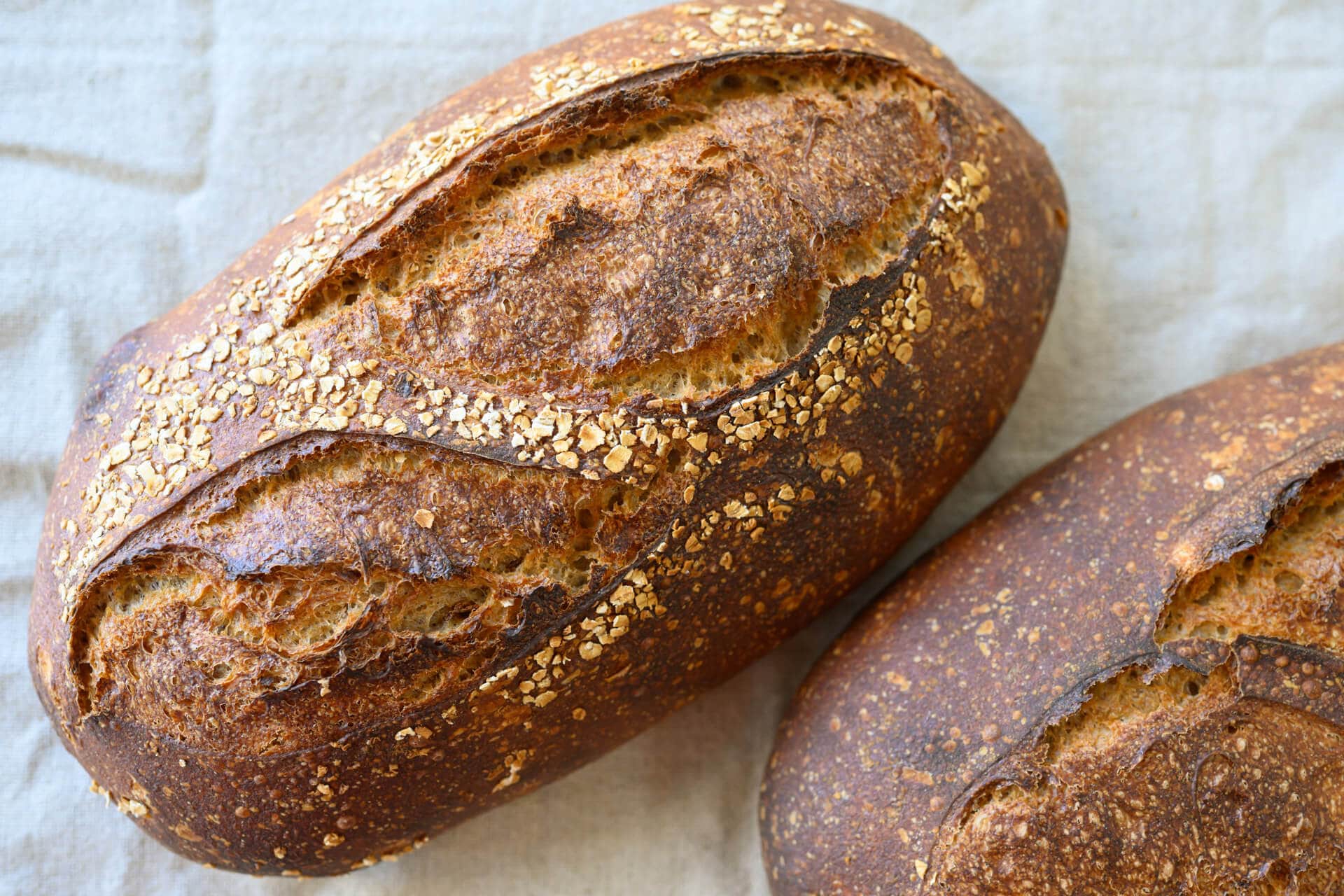
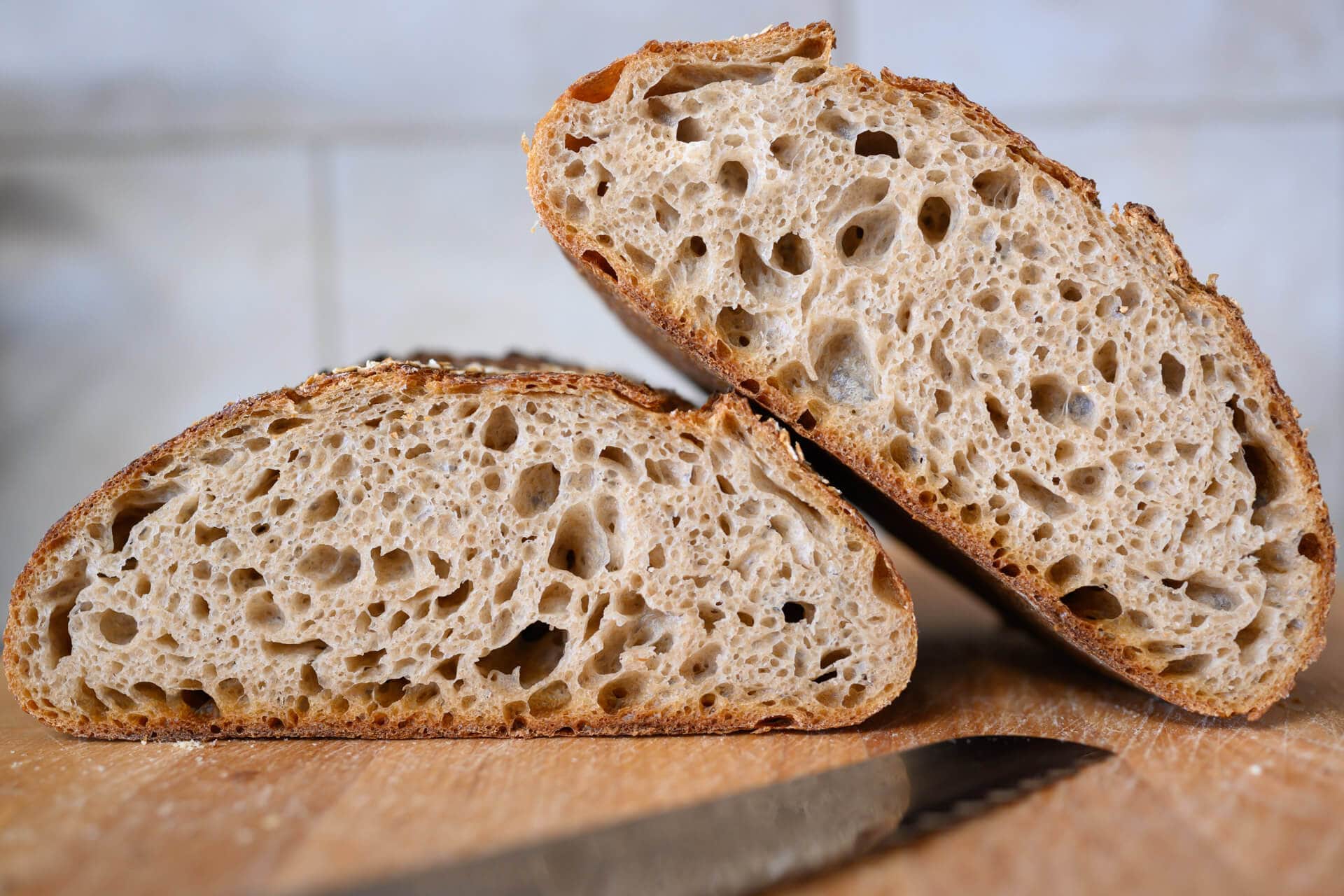
As the chill of winter sets in, I find myself drawn to this recipe. Vibrant and flavorful, healthful yet comforting, it is excellent at combating the cold weather, warming both your body and your kitchen at the same time. Winter urges me to bake anything and everything bread more than any other season. There’s nothing more wonderful to me than the aromas of freshly baked bread from a hot oven in contrast to the snow and howling wind outside. For this bread, I baked, tweaked, and baked again, ultimately landing on a mixture of white, spelt, rye, and whole wheat flours that produced a very craveable, satisfying sourdough bread that I cannot stop baking.
Part of this loaf’s abundant flavor is due to a little more sourness than you find in my typical recipe: a welcome addition that elevates the wholesome character of the crumb and crust. Sure, it has all the usual zest that comes with increasing the whole grain percentage, but it also has something more.
But what? What is that “something”? Is it the crust’s texture or the crumb’s tenderness altering my taste, or is it the perception of the loaf itself? Sometimes I wonder if the full range of textures, colors, and flavors I experience are genuinely there–visible to my eyes, present on my palate–or if I manufacture them when I see something mouthwatering. Perhaps this is the same way a barista might salivate at the sight of a properly pulled espresso, the aroma conjuring that recent summer strawberry, the allusion of toffee or black licorice. That “something more” seems to evolve as the loaf cools, hardens, and matures—an ever-changing kaleidoscope of flavors and textures.
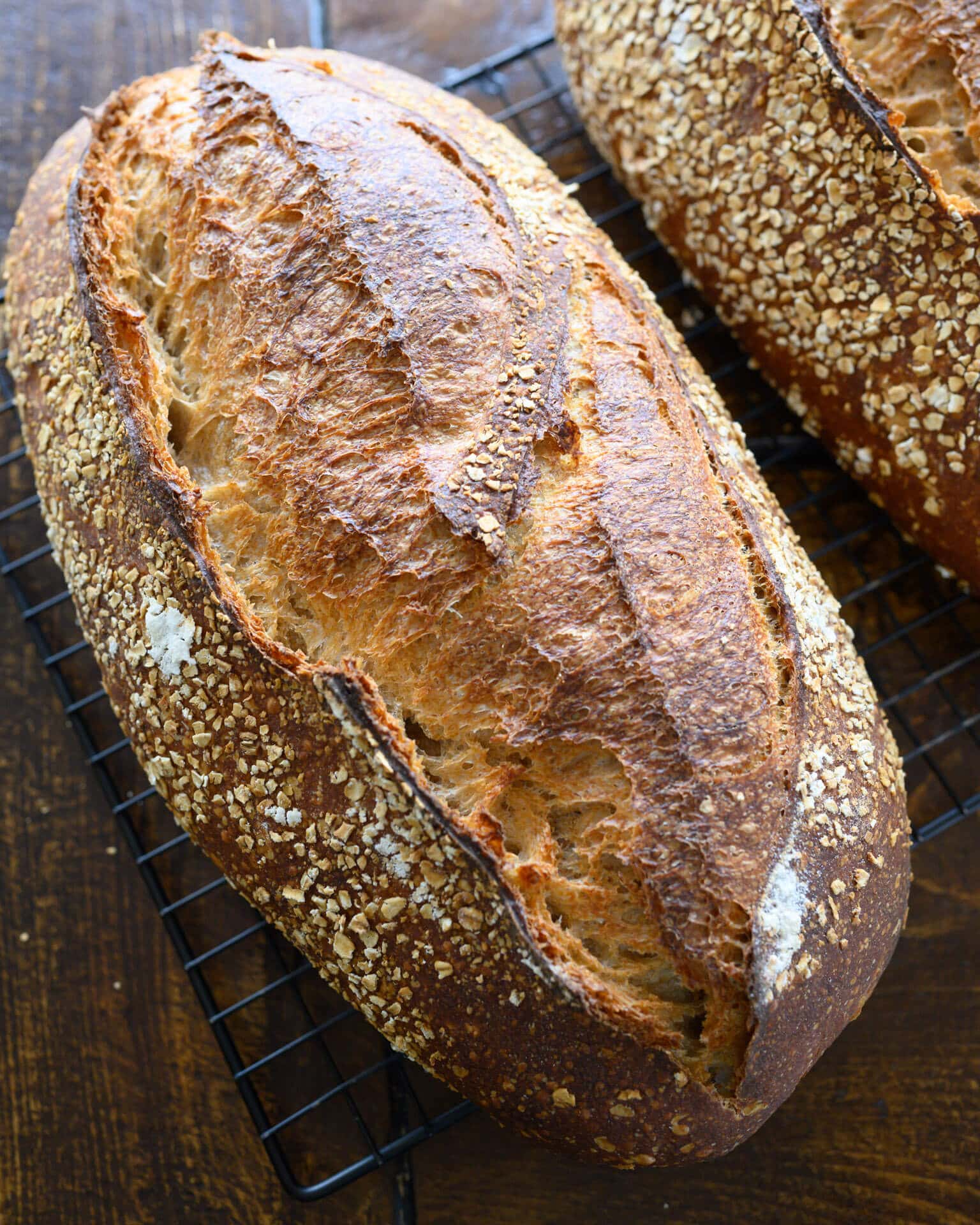
Baking a loaf of sourdough seems to be the only thing that has this effect on me. I think it has something to do with the art of the craft, the work that goes into it, and the satisfaction that results. It’s like a woodworker sitting in their precisely constructed no-nail design chair, corners fitting just so and pieces curved where they’re to be curved, straight where they’re to be straight. The pleasure of a well-executed bread is undoubtedly more than the aesthetic of it; it is also in the culmination of a detailed, devoted process that amplifies everything. Tasting how every piece is in the right groove, how the flavors and textures shift like fragments of colored glass from one bite to the next, is exhilarating.
Of course, it’s likely all of this is simply a result of my obsession with baking naturally leavened bread. But! I do proclaim that this is a great recipe that will make those who eat it smile, and you may even spy a split-second closing of their eyes as they savor the moment. This little, often overlooked token is what I look for when my kids are eating, indicating they deeply enjoy something. And I imagine that this bread will push its way to the top of your baking priorities more often than not.
Flour Selection
I love the small addition of rye flour in this recipe–it’s something you also see in my Beginner’s Sourdough Bread recipe. Even in a small percentage, rye seems to bring loads of flavor and color to the crust. And this loaf is all about flavor.
I use whole grain Red Fife for the whole wheat part of this recipe, which adds significant character to this already flavorful bread. If you have Red Fife, I’d recommend it, but if not, any whole wheat variety will also work very well.
Whole grain spelt brings a nutty, almost sweet character to the flavor profile. I use spelt often because of this addition, and in this bread, even though it’s in small quantity, it’s still a significant contributor to the overall complex flavor profile.
The white flour I use in this recipe is medium protein at around 11-12%. This would be a typical all-purpose flour or a base white flour used for bread-making. If you wanted to increase the strength of this dough and bring additional flavor and nutrition, you could substitute this white flour for a high-quality type 85 flour.
Baking Schedule
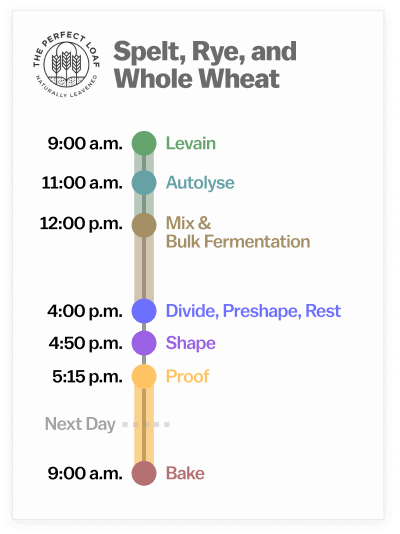
This sourdough bread recipe is made over two days, which gives the dough plenty of fermentation time, which results in a deeply complex and flavorful bread.
It’s also possible to bake this loaf all in a single day by allowing the dough to proof on the counter, shaped and covered, until the dough is puffy, relaxed, and passes the dough poke test.
Spelt, Rye, and Whole Wheat Sourdough Bread Recipe
If you want to make only a single loaf or scale this recipe up to make many more, see my guide to baker’s percentages to modify this formula.
Vitals
| Total Dough Weight | 2,000 grams |
| Pre-fermented Flour | 5.3% |
| Levain in final dough | 16.6% |
| Hydration | 85.0% |
| Yield | 2 x 1000g loaves |
Total Formula
The desired dough temperature for this recipe is 78°F (25°C).
| Weight | Ingredient | Baker’s Percentage |
| 520g | White flour (about 11.5% protein; Central Milling Artisan Baker’s Craft Plus) | 50.0% |
| 260g | Whole spelt flour (Central Milling Whole Grain Spelt) | 25.0% |
| 208g | Whole-grain wheat flour (Flourist Whole Grain Red Fife) | 20.0% |
| 52g | Whole-grain rye flour (Central Milling Whole Rye Flour) | 5.0% |
| 781g | Water 1 (levain and autolyse) | 75.0% |
| 104 | Water 2 (mix) | 10.0% |
| 20g | Fine sea salt | 1.9% |
| 55g | Ripe sourdough starter, 100% hydration | 5.3% |
Additional ingredients
Instant or rolled oats, for topping (optional)
Spelt, Rye, and Whole Wheat Sourdough Bread Method
1. Prepare the levain – 9:00 a.m.
| Weight | Ingredient | Baker’s percentage |
| 27g | White flour | 50.0% |
| 27g | Whole spelt flour | 50.0% |
| 55g | Water 1 (levain) | 100.0% |
| 55g | Ripe sourdough starter, 100% hydration | 100.0% |
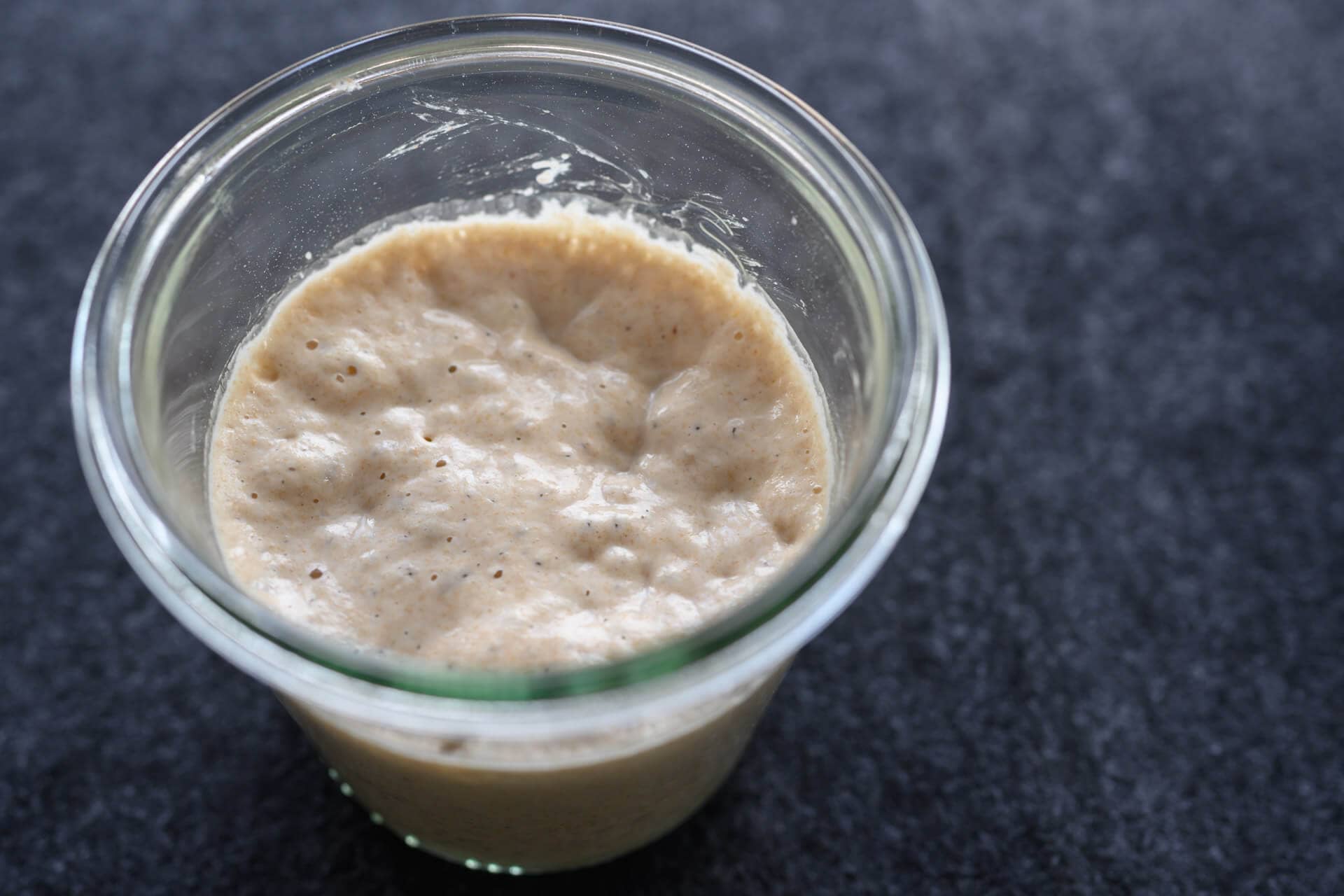
Mix the above ingredients in a jar and leave them covered at a warm temperature, 74-76°F (23-24°C), to ripen for 3 hours.
2. Autolyse – 11:00 a.m.
| Weight | Ingredient |
| 493g | White flour |
| 233g | Whole spelt flour |
| 208g | Whole wheat flour |
| 52g | Whole rye flour |
| 726g | Water 1 (autolyse) |
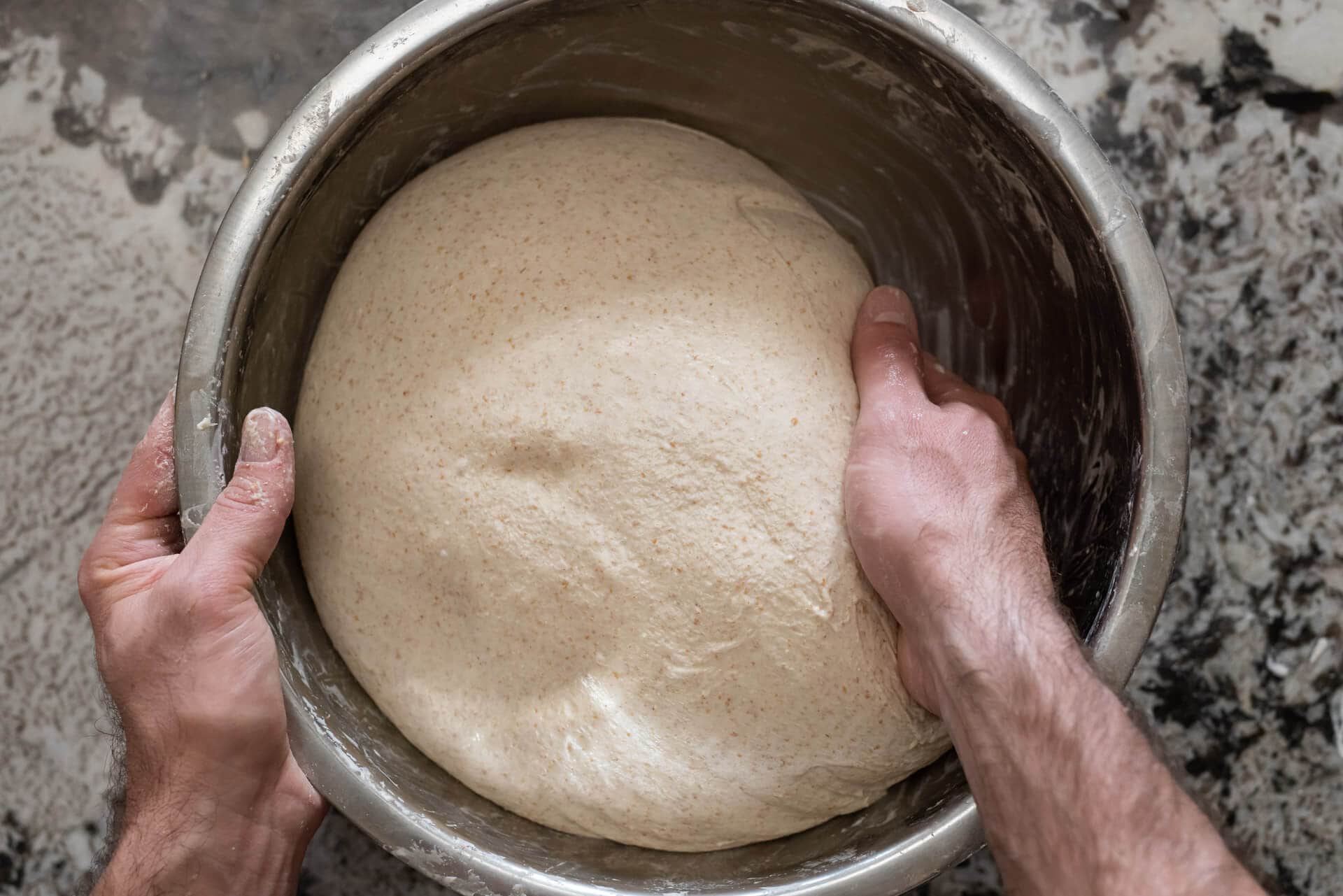
Warm or cool the autolyse water so that the temperature of the mixed dough meets the FDT (final dough temperature) of 78°F (25°C) for this recipe. Place all of the flours and water 1 in a large bowl. Use wet hands to mix until no dry bits remain; the dough will be shaggy and loose. Use a bowl scraper to scrape down the sides of the bowl to keep all the dough in one area at the bottom. Cover the bowl and place it near your levain for 1 hour.
3. Mix – 12:00 p.m.
| Weight | Ingredient |
| 104g | Water 2 (mix) |
| 20g | Fine sea salt |
| 164g | Ripe levain (from Step 1) |
Add the salt and levain to the top of the dough in autolyse, and use a splash of water 2 to moisten. With wet hands, mix thoroughly. Add the remaining water if the dough feels cohesive and it can handle the rest. Next, knead the dough for a few minutes using either the slap and fold technique or folds in the bowl. For this dough, I kneaded for about 5 minutes until the dough smoothed and became elastic.
Transfer the dough to a bulk fermentation container and cover.
4. Bulk fermentation – 12:30 p.m. to 4:00 p.m. (3 1/2 hours)
At a warm room temperature, 74-76°F (23-24°C), bulk fermentation should take about 3 1/2 hours.
This dough will require 3 sets of stretches and folds during bulk fermentation. After the first 30 minutes, wet your hands, grab one side of the dough, and lift it up and over to the other side. Rotate the bowl 180 degrees and repeat. The rotate the bowl a quarter turn and stretch and fold that side. Rotate the bowl 180 degrees again and finish with a stretch and fold on the last side. The dough should be neatly folded up in the bowl. Cover and repeat these folds every 30 minutes for a total of 3 sets of stretches and folds. Then let the dough rest, covered, for the remainder of bulk fermentation.
5. Divide and preshape – 4:00 p.m.
After 3 1/2 hours, the dough should be well-risen in the bulk fermentation container and puffy to the touch. The edge where the dough meets the container should be domed downward, showing strength and rise.
Fill a small bowl with water and place it next to your work surface. Scrape the dough onto a clean counter. Divide the dough into two equal pieces and prehsape each into a tight round.
Let the dough rest, uncovered, for 20 minutes. This is a shorter bench rest because the dough will be looser and slacker than most breads, spreading faster than usual.
6. Shape – 4:50 p.m.
I like to top this spelt, rye, and whole wheat sourdough bread with instant or rolled oats, but this step is optional. Spread an even layer of rolled oats on a clean kitchen towel or sheet pan.
I love to shape this recipe as a long, tapered batard (oval). See my process for shaping a batard or watch me shaping below for a quick tutorial.
Flour the top of each preshaped round and your work surface. Using your bench knife, flip one round over onto the floured area and shape it into a batard. Using two hands, transfer the dough top-side down to the oats, gently rocking the dough back and forth so that the oats stick. Then, flip the dough and place it seam-side-up into a prepared proofing basket.
Repeat for the other preshaped round.
7. Proof – 5:15 p.m. to 9:00 a.m.
Cover the baskets with a large, reusable plastic bag and seal shut. Let proof overnight in the refrigerator.
8. Bake – 9:00 a.m. (the next day)
Due to the large size of these loaves, they may not fit inside of a typical Dutch oven or Combo cooker. I prefer to bake them directly on a baking surface and steam my oven. See my guide to steaming a home oven for bread baking for instructions.
Place an oven rack in the bottom-third of the oven. Preheat your oven with a baking surface inside to 450°F (230°C).
Take the proofing baskets out of the fridge, uncover them, and put a piece of parchment paper over the basket. Place a pizza peel or inverted baking sheet on top of the parchment and, using both hands, flip everything over. Gently remove the basket and score the dough. I like to score these long ovals with a single long slash or a double slash.
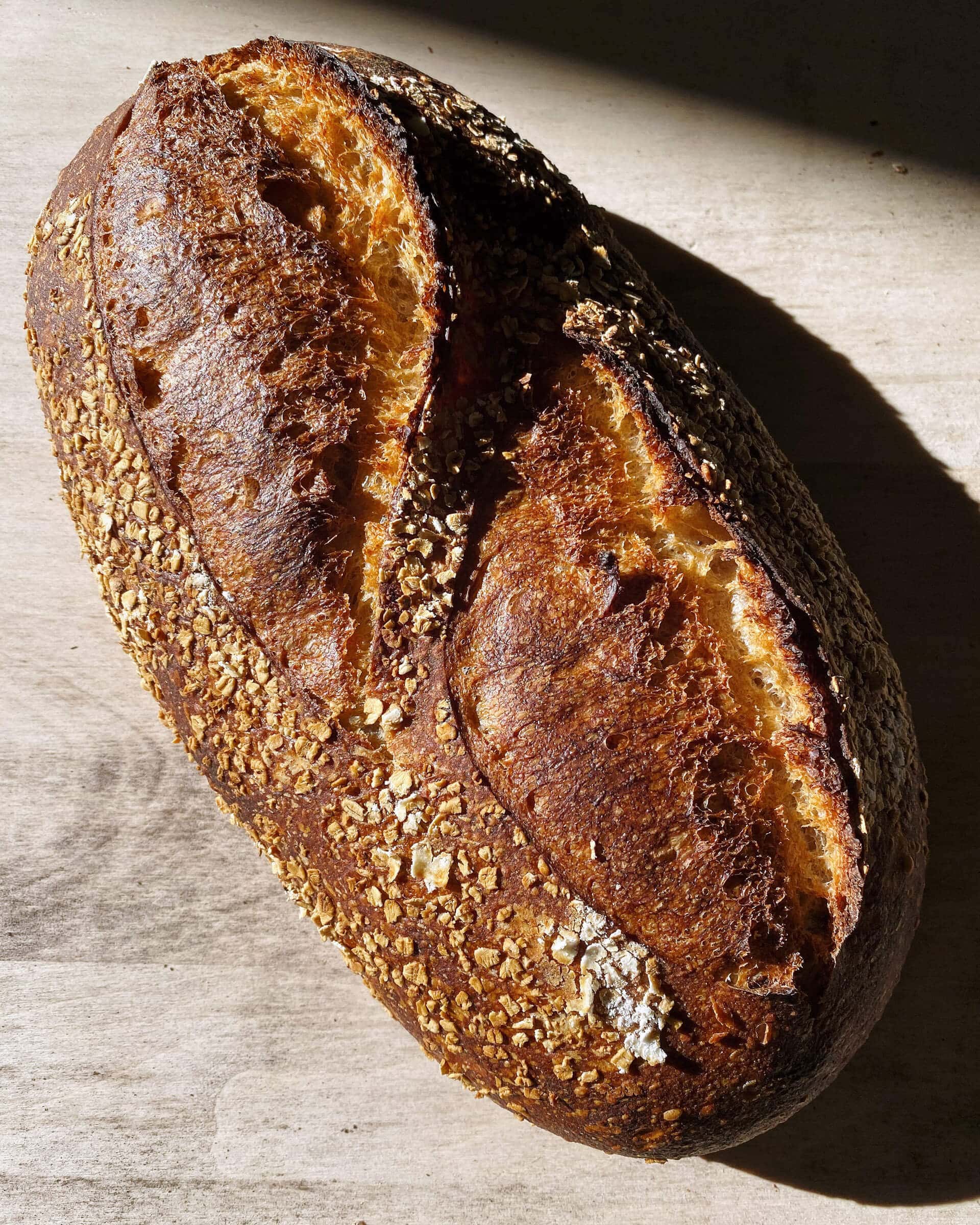
Slide the dough into the oven. Steam the oven by pouring ice into the preheated pan at the bottom of the oven. Bake for 20 minutes. Vent the oven of steam by removing the steaming pans. Continue to bake for 35 minutes more. When done, the loaf should have an internal temperature of around 204°F (95°C), and the crust should be deeply colored.
Let the loaf cool on a wire rack for 3 to 4 hours before slicing. This bread will keep well for a week or more if stored properly.
Print
Spelt, Rye, and Whole Wheat Sourdough Bread
- Prep Time: 24 hours
- Cook Time: 1 hour
- Total Time: 25 hours
- Yield: 2 loaves
- Category: Sourdough, Bread
- Cuisine: American
Description
A flavorful—and wholesome—loaf of sourdough bread with whole spelt, whole rye, and whole wheat.
Ingredients
Levain
- 27g white flour (about 11.5% protein)
- 27g whole spelt flour
- 55g water
- 55g ripe sourdough starter, 100% hydration
Autolyse
- 493g white flour
- 233g whole spelt flour
- 208g whole wheat flour
- 52g whole rye flour
- 726g water
Mix (final dough)
- 104g water
- 20g fine sea salt
- 164g ripe levain
Instructions
- Levain (9:00 a.m.)
In a small bowl or jar, mix the Levain ingredients. Cover the jar and keep it at a warm temperature for 3 hours. - Autolyse (11:00 a.m)
In a mixing bowl, add the autolyse ingredients until no dry bits remain. Cover the bowl and let rest for 1-hour. - Mix (12:00 p.m.)
Add the salt and levain to the top of the dough in autolyse, and use a splash of water to moisten. With wet hands, mix thoroughly. Add the remaining water if the dough feels cohesive and it can handle the rest. Next, knead the dough for a few minutes using either the slap and fold technique or folds in the bowl. For this dough, I kneaded for about 5 minutes until the dough smoothed and became elastic.Transfer the dough back to the bowl or to a container for bulk fermentation and cover. - Bulk Fermentation (12:30 p.m. to 4:00 p.m.)
This dough will require 3 sets of stretches and folds during bulk fermentation. After the first 30 minutes, wet your hands, grab one side of the dough, and lift it up and over to the other side. Rotate the bowl 180 degrees and repeat. Then rotate the bowl a quarter turn and stretch and fold that side. Rotate the bowl 180 degrees again and finish with a stretch and fold on the last side. The dough should be neatly folded up in the bowl. Cover and repeat these folds every 30 minutes for a total of 3 sets of stretches and folds. Then let the dough rest, covered, for the remainder of bulk fermentation. - Divide and Preshape (4:00 p.m.)
Use water and a wet hand or lightly flour your work surface (whichever you prefer) and scrape out your dough. Using your bench knife, divide the dough in half. Lightly shape each half into a round shape. Let the dough rest for 20 minutes, uncovered. - Shape (4:50 p.m.)
Lightly flour the top of your preshaped rounds and using floured hands, shape the dough into an oval (batard) shape, then place the dough in proofing baskets, seam side up. - Proof (5:15 p.m. to 9:00 a.m. the next day)
Cover proofing baskets with reusable plastic and seal. Then, place both baskets into the refrigerator and proof overnight. - Bake (The next day, 9:00 a.m.)
Preheat your oven with a baking surface inside to 450°F (230°C). When the oven is preheated, remove your dough from the fridge, score it, and transfer it to the preheated baking surface. Bake for 20 minutes with steam. After this time, vent the steam in the oven and continue to bake for 35 minutes longer. When done, the internal temperature should be around 204°F (95°C). Let the loaves cool for 3 to 4 hours on a wire rack before slicing.
Notes
If you want to bake only a single loaf, divide all the ingredients in half.
What’s Next?
If you love the nutty, almost sweet flavor of spelt flour as I do, check out my whole grain spelt pan loaf which is 100% whole spelt.
If you want to use some more rye in your baking, check out our Light Deli Rye which uses a scalded rye porridge to bring even more flavor.
Buon appetito!


347 Comments
Oh man this is a good recipe. Spelt lovers rejoice! It makes a wonderful bread to have with butter and flaky sea salt or a truly wonderful sandwich. I just made a lotta people happy with this one. Serious bread is love moment.
I’ll also add that I didn’t do the slap and folds before bulk – didn’t have the time – and it was still just wonderful going from shaggy ball to stretch and folds. I always do a 4th coil fold – and at that moment I could just see it was going to be a beautiful bread. The crumb was smaller but the flavor and texture were truly just so wonderful. I also did a 1.5x on this recipe and made two monster loaves that were just the right size to fit into the Dutch oven. Going to steam next time i make this one. So excited to see how it evolves!
I’m with you Jenn, as a fellow spelt enthusiast 🙂 So glad you enjoyed it!!
We love this bread, our favorite recipe I’ve made it countless times, and am now trying to bake it in a loaf pan. I’ve used a Pullman, that has worked fine, but I’m also trying to bake it in the Emile Henry oblong covered ceramic bread baker. I proof the doughs overnight in the pans, and have a terrible time scoring them. Ragged edges, no ear. Does bread dough cooked in loaf pans not need scoring? Any hints would be greatly appreciated
Glad you’re enjoying Ann! I don’t usually score pan loaves, but you totally can. If you’re finding it’s having a hard time slicing through, the first thing I’d suggest is trying a new razor (you’d be surprised how much of a difference it makes). Then, if it’s still having trouble, you might not be shaping with enough tension to create a smooth surface. That skin needs to be taut and clean for the blade to really cut through effortlessly.
It turned out great but I used Kirkland’s All Purpose Flour for the white flour. I would prefer to grind my own berries. Is there something I can use for the white flour such as Hard white or soft white?
For the white flour in this recipe you’d have to sift your own flour with a sieve to pull out the bran and germ which will get you closer to a true “white” flour!
This bread was excellent. I have been making sourdough for a about 5 months, experimenting with at several different recipes. I’ve gotten good rise and good texture, but the flavor has been lacking. This bread had everything I was looking for in a whole wheat sourdough– good flavor, good texture, and good looks.
I am still looking for a recipe for white sourdough that has that San Francisco sourdough flavor.
So happy you liked it, Micci! this really is one of my favs, even after all these years. As for the sour, sourdough, I have a lengthy recipe for something like that in my bread cookbook (if you have it, look for the extra sour sourdough bread in the recipes section).
Can I substitute whole wheat for spelt?
Yes you can just be mindful of the dough’s hydration, spelt can quickly overhydrate!
Another question about the same loaf. I allowed this to rise about 50% , it was jiggly, had 3 large bubbles on the top, and still sticky. Passed the poke test with a slight indentation remaining after 1 minute. I shaped it (was very loose). I pan baked it (we like this shape). After slicing, the center of the loaf is a bit dense and a slight bit gummy. the loaf opened up about 2 inches where I scored it down the center. And it has an ear of 1/4". Would you think this was over proofed? Or under proofed?
It sounds like you likely over proofed the dough. There are a few signs your dough could have gone over: sluggish rise in the oven, the score on top of the dough might not open with a nice “ear” and instead just kind of fuse together, the interior will have lots of small holes and perhaps one or two large ones near the top (but no dense areas of unfermented flour), and finally the loaf could be a little on the sour side. Try reducing the proofing period.
Check out my guide to proofing for a bit more help, too:
https://www.theperfectloaf.com/guides/proofing-bread-dough/
I made this recipe this weekend. I did the 5 minutes of slap and fold. After about 3 minutes, the dough was shaping into a smooth ball. When I got to 5 minutes, it was very loose and sticky. Did I do the right thing? Or did I miss something? Thanks!
That’s pretty typical when mixing that way. Just keep with it even if it falls apart like that, it will quickly come back together!
Well, not quite what I expected. I got to the final dough stage, I added the levain and salt and…..this was the slackest dough I've ever had.
I added NO water at this final step BUT instead added another 1.25 EXTRA cups of AP to try to stiffen it up. I got it to the slightly sticky stage where it mostly held it's shape. I followed the recipe to a T (using a scale) so I dunno.
It's now been in the fridge for 2 days and I'm getting ready to bake.
if this process starts at 9am, then 'the ripe starter' has to be refreshed at 6 am for it to be at it's most active??
Is that right?
This recipe drove home how flexible and resilient sourdough is. I used my starter 2 hours short of ideal. I was out of rye so I increased the WW. When I was about to put the loaves in the oven I had to leave the house. 6 hours later I preheated the oven (again) and baked. Is the crumb perfect? Not really but the flavor and texture are beyond fantastic.
For anyone new out there, we don’t need to be perfect to turn these recipes into bread we’ll love. Even when my dough is a wet mess, I still get a great loaf of bread.
Hi! I will be attemping this recipe as soon as my starter is ready. A few questions, can I use only whole wheat and rye flour for this recipe without changing everything else in the recipe but the kinds of flours I use? Thank you!
Hi Maurizio,
Do you add all of the water in the "mix" part of the recipe when making the dough? I mixed the dough with part of the water (104gms) and the dough was too thin and I was not able to control the dough in the shaping part for of it. please clarify
I'm looking forward to making and baking this bread. Thank you for the video on slap & fold as it's the best I've seen and now I get it! My question is, can I cold ferment the shaped dough longer than overnight? My plan is to prep later on a Sunday and get it into the fridge by 8pm but not bake until I get home from work on Monday. This would give me a 20 hours, is that too long or like my plain SD, it will just give it better flavour (I proof that for 36+hours). Thanks for your feedback!