

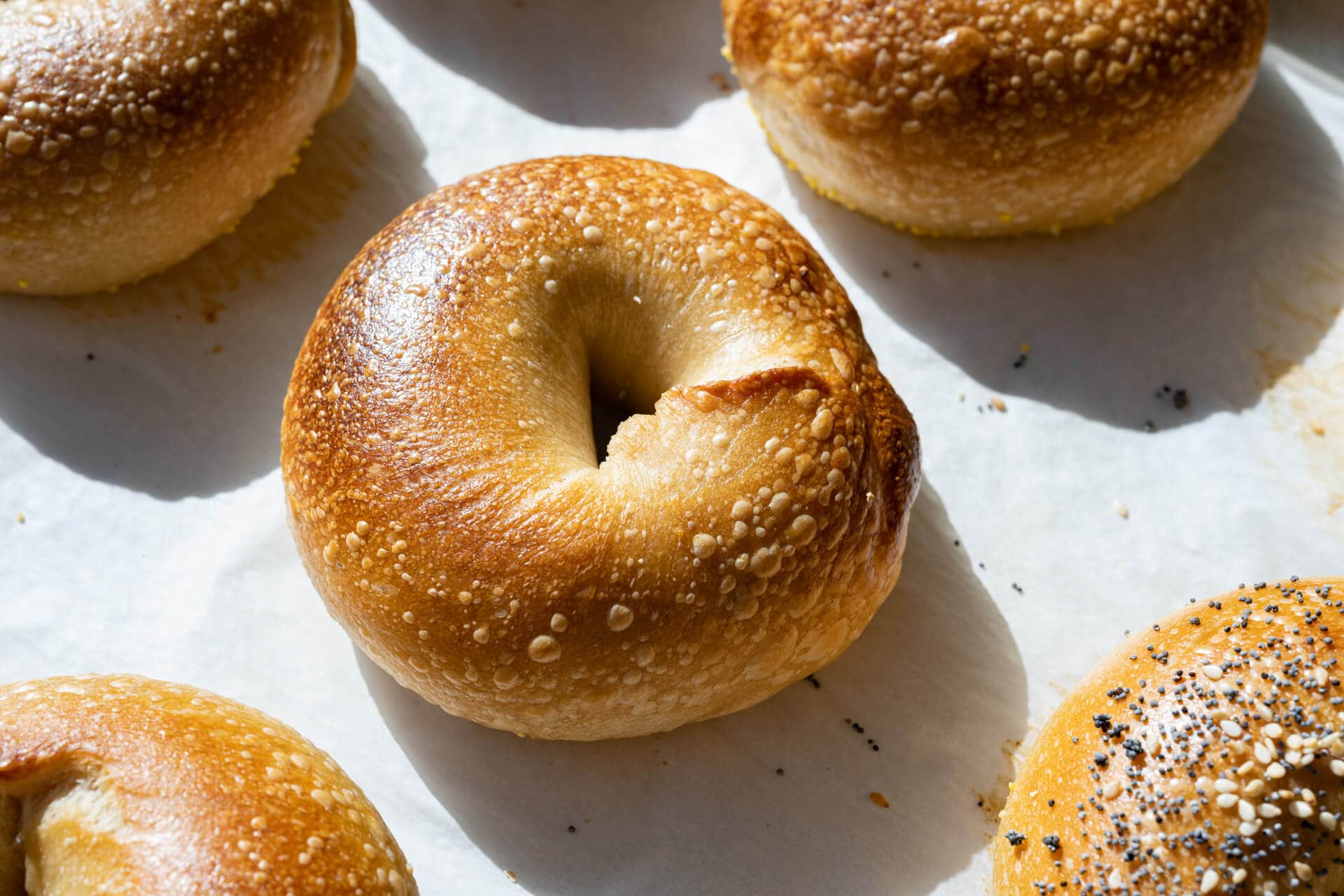
I try not to talk about bagels with friends. Talking about them always starts innocently, a little witty banter about the crust, crumb, and color traits and past eating experiences: “that bagel I had in New York that one time,” or “there was this one bagel shop down the street…” This jovial chat slowly evolves into a friendly argument about more-sweet versus more-savory and crunchy versus soft; maybe one even mentions steaming the bagel instead of baking it (😱).
Finally, the once innocuous chatter results in the participants either forming a stronger friendship over common bagel zealotry or the unfortunate end to the friendship altogether. It’s like the old axiom: never play Risk with a friend you want to keep. Exaggeration? Perhaps. But bagels do seem to rouse an enthusiasm rarely seen with other food (I’d argue pizza might be a solid contender, though). They carry a different meaning depending on where you’ve grown up, what local shops were in the area, and ultimately, where your preferences lie. But these sourdough bagels seem to transcend almost every bagel I’ve had, especially the mass-produced ones—oh yes, definitely those.
While these bagels are more along the New York Bagel style, I’m also a fan of the newer wave bagels with a super thin, glossy, and crispy crust. In fact, I have a recipe for those glossy bagels, too, if that’s more your thing.
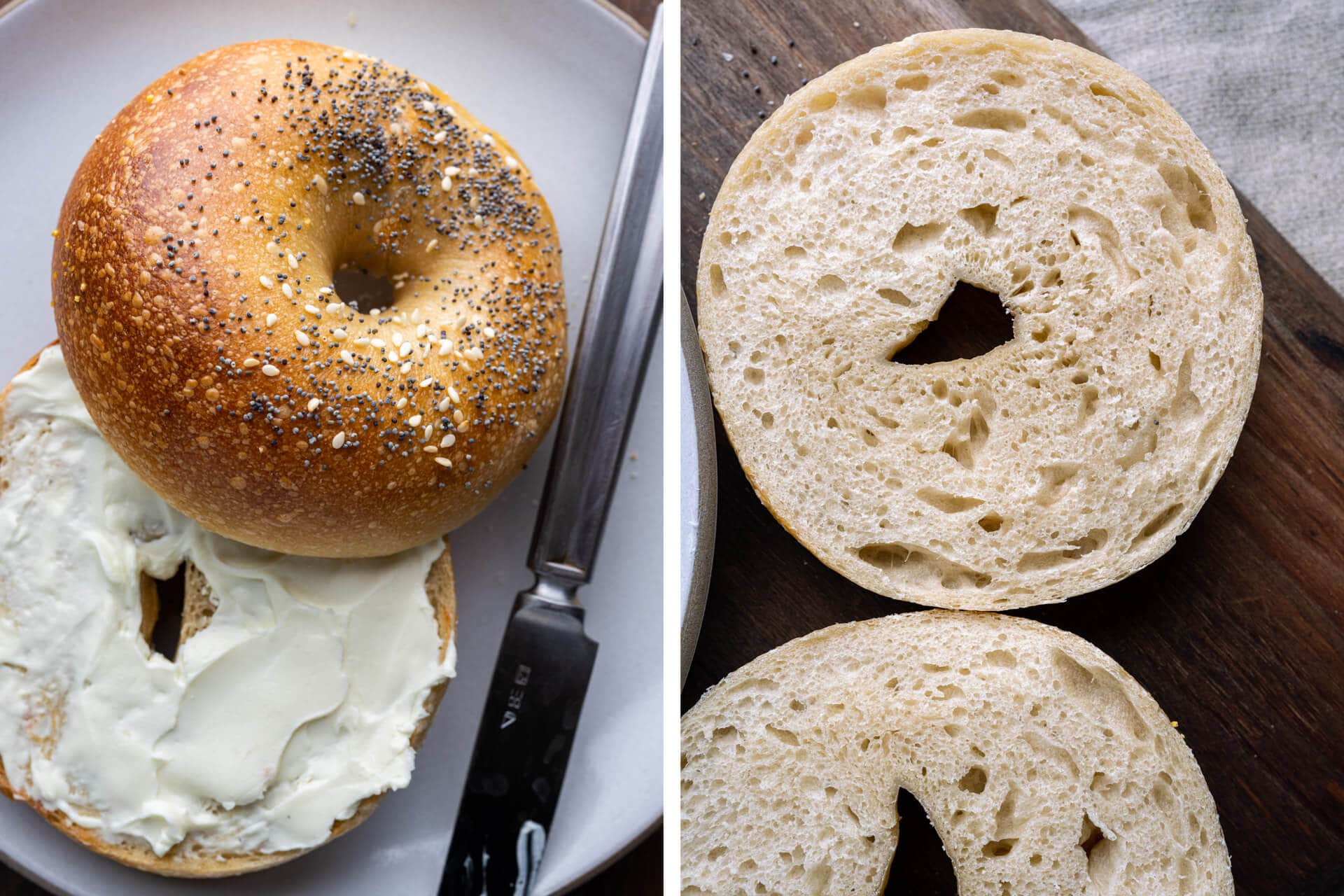
I recall occasionally eating those bagels from the bag at the market: that ultra-chewy (from end to end) vehicle was mostly there to convey cream cheese, or schmear, from package to mouth. Rest assured, these sourdough bagels are not that in the slightest. They have a very thin and crisp exterior, not tough or hard, but rather, a little crunch that gives the chewy bagel a textural counterpoint. You see, the interior is as chewy as you’d expect a bagel, but if the entire thing is chewy, you end up with just a big chewy thing. But if you have a contrasting texture, it seems to amplify the chewy thing, much like adding an acid elaborates other flavors.
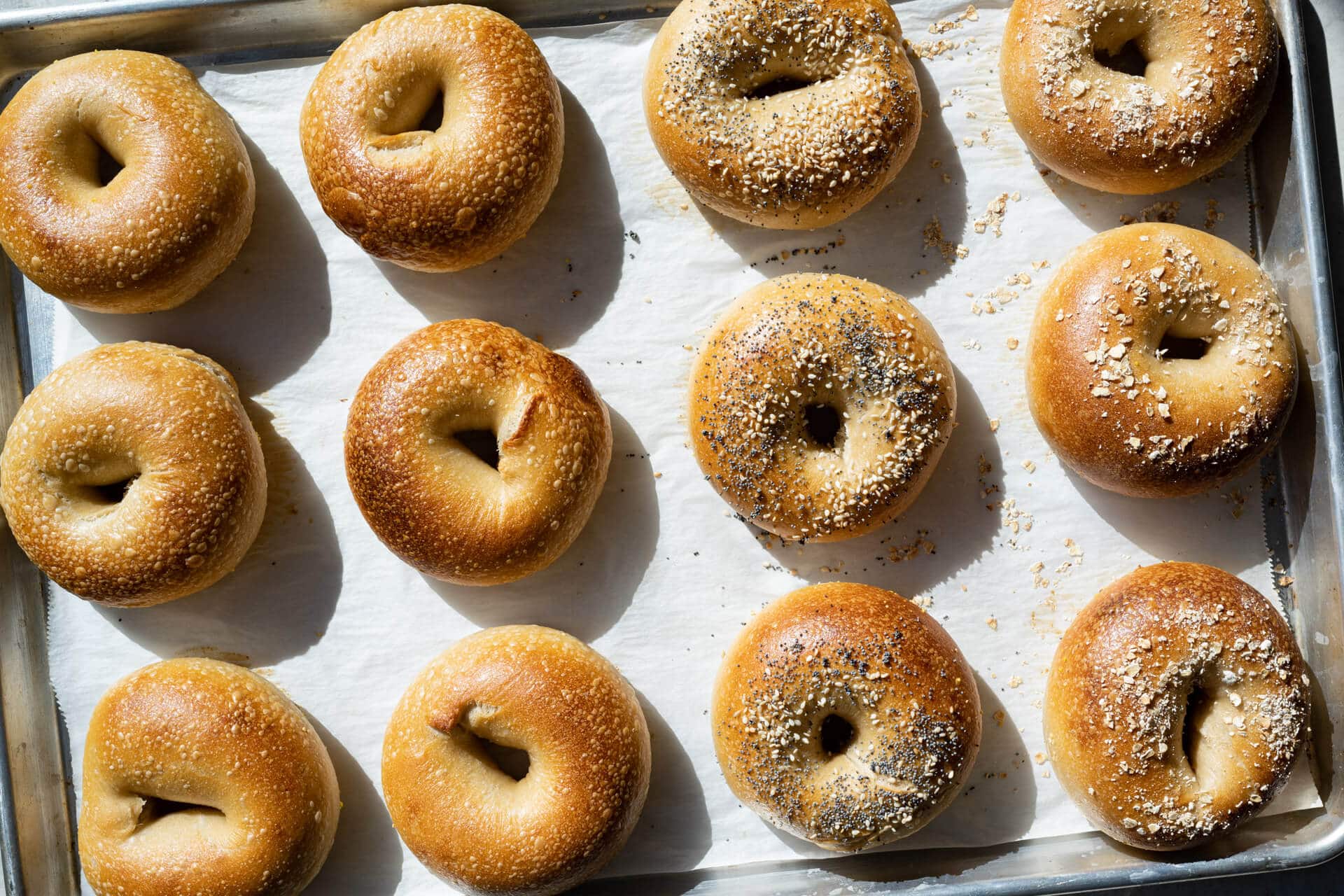
And overall, these bagels are pretty darn easygoing. Unlike bread dough, there’s no need to be overly critical of each motion when shaping, and in the end, the bagel rings puff up uniformly, boil beautifully, and bake easily. Speaking of the boil, perhaps one of the things that keep many from making them, but it’s such a simple thing. And while I often draw parallels between this dough and my sourdough pretzel—mostly in that they each have a stiff dough and a pre-bake step—there’s far less prep before baking bagels than pretzel—not that those sourdough pretzels aren’t worth the effort, because they certainly are.
First, let’s look at some tools I use when making these sourdough bagels.
Tools and Ingredients
First, a few of the tools and ingredients I use for this recipe
- Barley malt syrup – this is the classic sweetener added to a bagel dough and it has a very unique flavor and aroma. I like the Eden brand, but any should work well.
- Diastatic malt powder – see the post on diastatic vs. nondiastatic malt and why it’s used in baking.
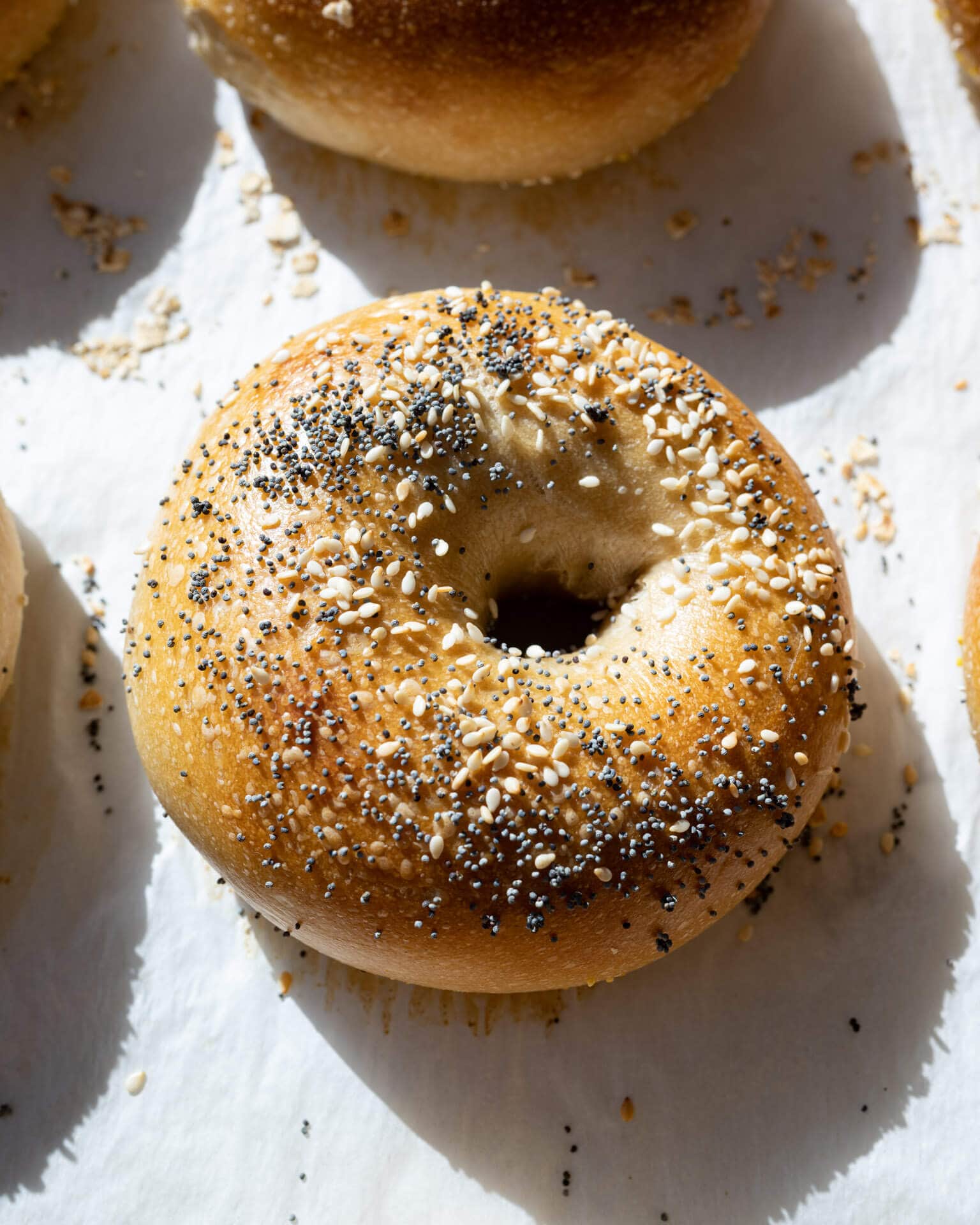
- Everything bagel topping – I love this mix of seeds and dried spices for topping bagels.
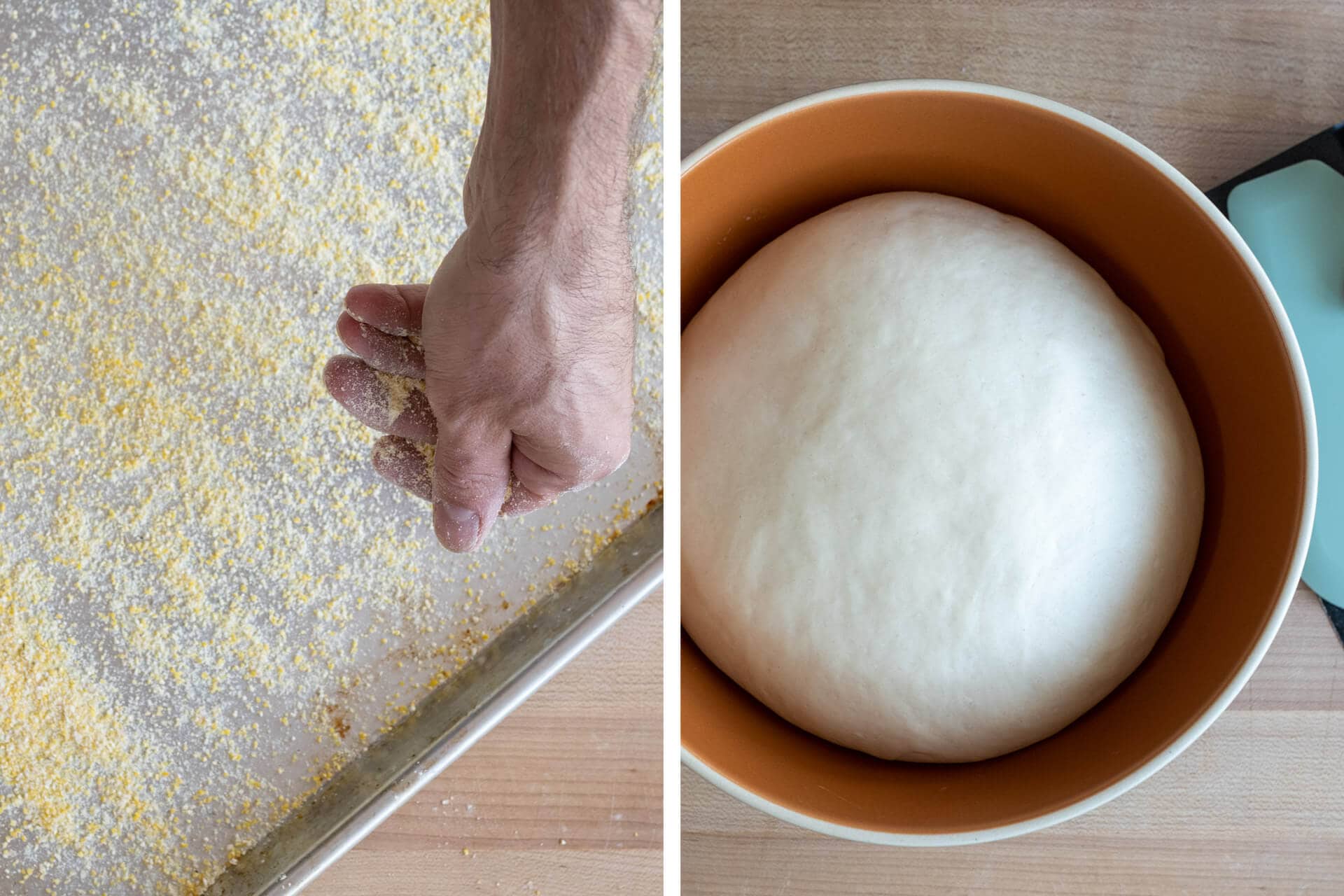
- Cornmeal – traditionally used to keep the bagels from sticking to the baking sheet during proofing (and they add extra starch to the boiling water).
- Half baking sheet – I use this to proof all 12 dough pieces to save space in a home refrigerator.
- Full baking sheet – perfect for baking all 12 bagels, with room in between, on a single baking sheet for even baking.
Flour Selection
Many bagel recipes, mine included, call for high-protein white flour to get that characteristic chew and structure.
I’ve tried this with Tony Gemignani’s Pizza Flour (15% protein), and while there was a bit more chew, I wouldn’t say it was necessary to order some for making sourdough bagels. I like to use Central Milling High Mountain, King Arthur Bread Flour, or Bob’s Red Mill Bread Flour.
Baking Schedule

These sourdough bagels take three days to make: from creating the levain at night on day one to boiling and baking them in the morning on day three. I know—three days!?—but the good news is, most of the time you’re not actively handling the dough, it’s fermenting in one stage or another.
All-in-all, this is a straightforward schedule. It’s also quite flexible by a few hours here and there once the dough is chilled and in the fridge: if you can’t boil and bake first thing on day three, it’ll hold a few more hours (or perhaps longer).
Sourdough Bagel Formula
For tips on how to calculate baker’s percentages or how to modify this formula, see my post on baker’s percentages (baker’s math).
| Total Dough Weight | 1,600 grams |
| Pre-fermented Flour | 12.00% |
| Yield | 12 x 125g bagels |
Total Formula
Desired dough temperature: 78°F (25°C). See my post on the importance of dough temperature for more information on dough temperatures.
| Weight | Ingredient | Baker’s Percentage |
|---|---|---|
| 964g | High-protein white flour (~13% protein, Central Milling High Mountain, King Arthur Flour Bread flour, or Bob’s Red Mill Bread Flour) | 100.00% |
| 530g | Water | 55.00% |
| 29g | Sugar, caster | 3.00% |
| 29g | Barley malt syrup | 3.00% |
| 18g | Salt | 1.90% |
| 7g | Diastatic malt | 0.75% |
| 23g | Sourdough starter (100% hydration; 40% rye, 60% white flour) | 2.40% |
Sourdough Bagel Method
1. Prepare Levain – Night before mixing, 9:30 p.m. (Day one)
Mix the following ingredients together in a container and leave covered to ripen for 12 hours overnight. It mixes up to a stiff consistency so I like to mix and knead the dough in a mixing bowl, then I transfer to a narrow and tall jar.
Try to hit a final dough temperature of 78°F (25°C) for this levain.
| Weight | Ingredient | Baker’s Percentage |
|---|---|---|
| 116g | High protein flour | 100.00% |
| 58g | Water | 50.00% |
| 23g | Ripe sourdough starter | 20.00% |
23.18% Levain In Final Dough Mix.
2. Mix – 9:30 a.m. (Day two)
A note on mechanical mixing: This dough is low hydration and comprised of high protein flour—it’s a firm dough! I used my Haussler Alpha mixer to mix this for 5 minutes on speed one. You could use a KitchenAid stand mixer to mix this dough for a few minutes in the beginning, but I wouldn’t push it too far and risk damaging the mixer—ultimately you make the call. After mixing in the KitchenAid, you could then turn the dough out to the counter to finish kneading like pasta dough, as described below.
| Weight | Ingredient |
|---|---|
| 848g | High protein flour |
| 472g | Water |
| 29g | Sugar, caster |
| 29g | Barley malt syrup |
| 18g | Salt |
| 7g | Diastatic malt |
| 197g | Levain (see Prepare Levain, above) |
Make the malt syrup slurry: This will help the sticky, viscous barley malt syrup incorporate more easily into the dough. To a small mixing bowl, add a bit of the mixing water, barley malt syrup, sugar, diastatic malt powder, and salt. Stir until everything dissolves.
To your mixing bowl, add the malt syrup slurry, flour, water, and ripe levain. If using a mechanical mixer (see the note, above), mix on low speed for approximately 5 minutes until the dough strengthens and begins to smooth. This dough is so firm it doesn’t need much.
If you do choose to use a mechanical mixer, you might need to cool the mixing water to ensure you hit the FDT of 78°F (25°C). I used cold water straight from my fridge.
If mixing by hand, mix everything in the bowl until well incorporated. Turn the dough out to a clean work surface and knead the dough like pasta: fold half over onto itself and push the mass away from you with the palm of your hand. Continue folding over and pushing away for 8-10 minutes until the dough firms up, and it becomes hard to knead any further.
Transfer your dough to a bulk fermentation container and cover.
3. Bulk Fermentation – 9:45 a.m. to 12:45 p.m.
Give this dough a single fold after 1 hour and 30 minutes into bulk fermentation. For the fold, turn the dough out to a clean work surface and do your best to fold it into thirds. Place the dough back into the bulk fermentation container with its seam side down, and cover. Let the dough rest, covered, for the remainder of bulk fermentation.
4. Divide and Shape – 12:45 p.m.
Use a half baking sheet (so it fits into your refrigerator) to hold the 12 pieces of shaped dough. Later, after boiling the dough, I upsize to a full baking sheet to help the dough evenly bake. Spread a thin layer of cornmeal on the half sheet to prevent the bagel dough from sticking during proofing.
Divide the dough into twelve 125g pieces.
First, degas the piece by tamping down a bit with your hand. Then, do your best to form the piece into a rough rectangle and cinch down from the top, so the dough ends up in a little tube. This cinching doesn’t have to be forceful, and it helps to get the dough into a tube shape.
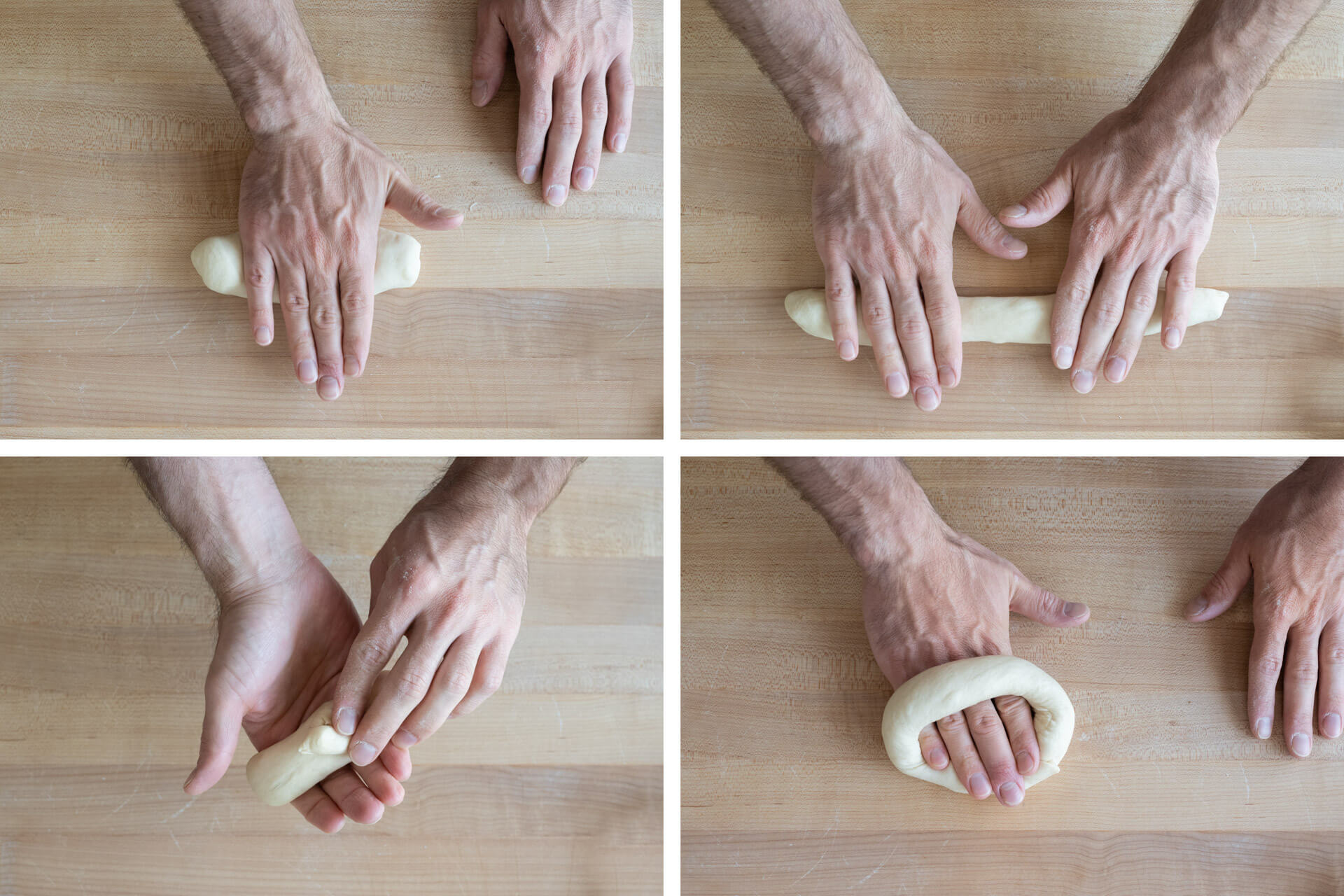
Next, roll your hand in the center a few times to create a bulb at each end. Then, switch to two hands and roll outward to about 12 inches and a tube that’s mostly the same thickness all the way through. If you prefer a bagel with a large hole, roll out the tube, so it’s longer.
Once rolled out to a long tube, wrap it around the backside of your hand between your knuckles and wrist. Overlap the two ends of the dough in the palm of your hand, and gently press the two ends together. Next, press your palm down on the work surface, and in a repetitive motion, roll the dough on the work surface repeatedly to seal.
Here’s a video on my YouTube channel of me shaping one of the pieces
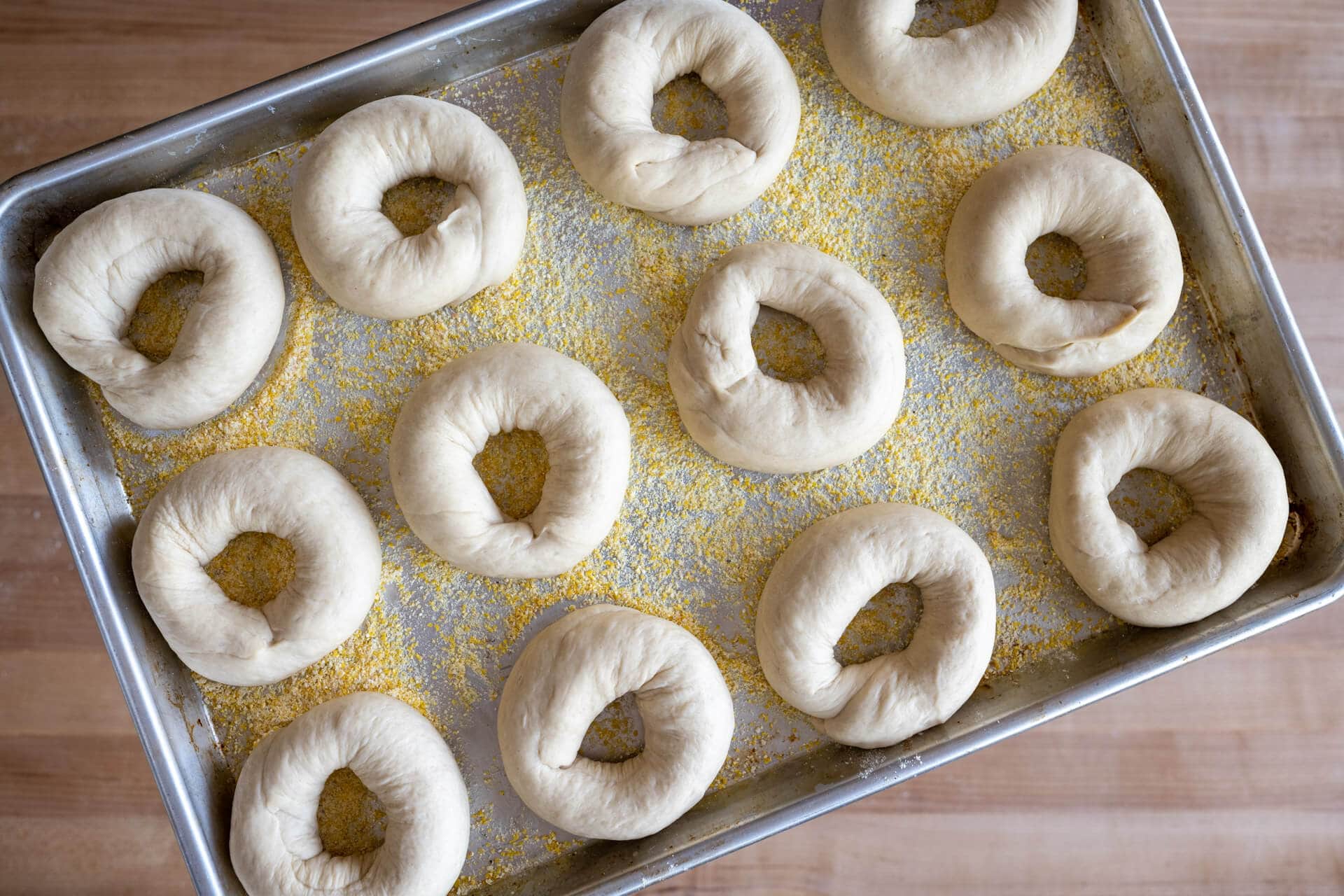
After shaping a piece, transfer it to the cornmeal-dusted baking sheet. Repeat for the remaining pieces, and you will end up with four rows of three.
5. Proof – 1:00 p.m. 3:00 p.m. (2 hours room temperature, then retard overnight)
Cover the baking sheet with a large, reusable plastic bag and seal shut. Let the dough proof at room temperature, around 72-74°F (22-23°C), for 2 hours. The dough should puff up slightly after this time but not excessively. If the dough still feels very dense to the touch, give it another 15-30 minutes and check again.
After 2 hours, place the covered baking sheet into the fridge overnight at around 39°F (4°C).
6. Boil and Top – 9:30 a.m. (Day three)
Oven prep: Before you begin boiling your bagel dough, preheat your oven to 475°F (245°C) with convection or 500°F (260°C) without convection. Place one rack at the bottom third of the oven. Place a baking stone or baking steel on the rack to preheat. I steam my oven as described on my oven steaming method post, so place a roasting pan on the bottom filled with lava rocks to prepare to steam. I also fill a cup of ice and place it next to my oven (I will pour this over the lava rocks to steam the oven).
Bagels are unique because you boil the dough before baking. This boiling gelatinizes the starches in the flour and gives them a little more chew and helps them achieve a shiny crust. This gelatinization is very similar to how you make a tangzhong or roux. But for a bagel, the longer you boil them, the thicker the crust and chewier they will become. There is a limit to the boil duration, though, as they will degrade in the water after a while. I have found boiling the dough 40 seconds on each side, for a total of 1 minute and 20 seconds, to be just right.
Many places like to add barley malt syrup or honey to the boiling water, but in side-by-side testing I didn’t find the added syrup to give them any more shine. The cornmeal brought into the boiling water might also add starches, much like when making pasta.
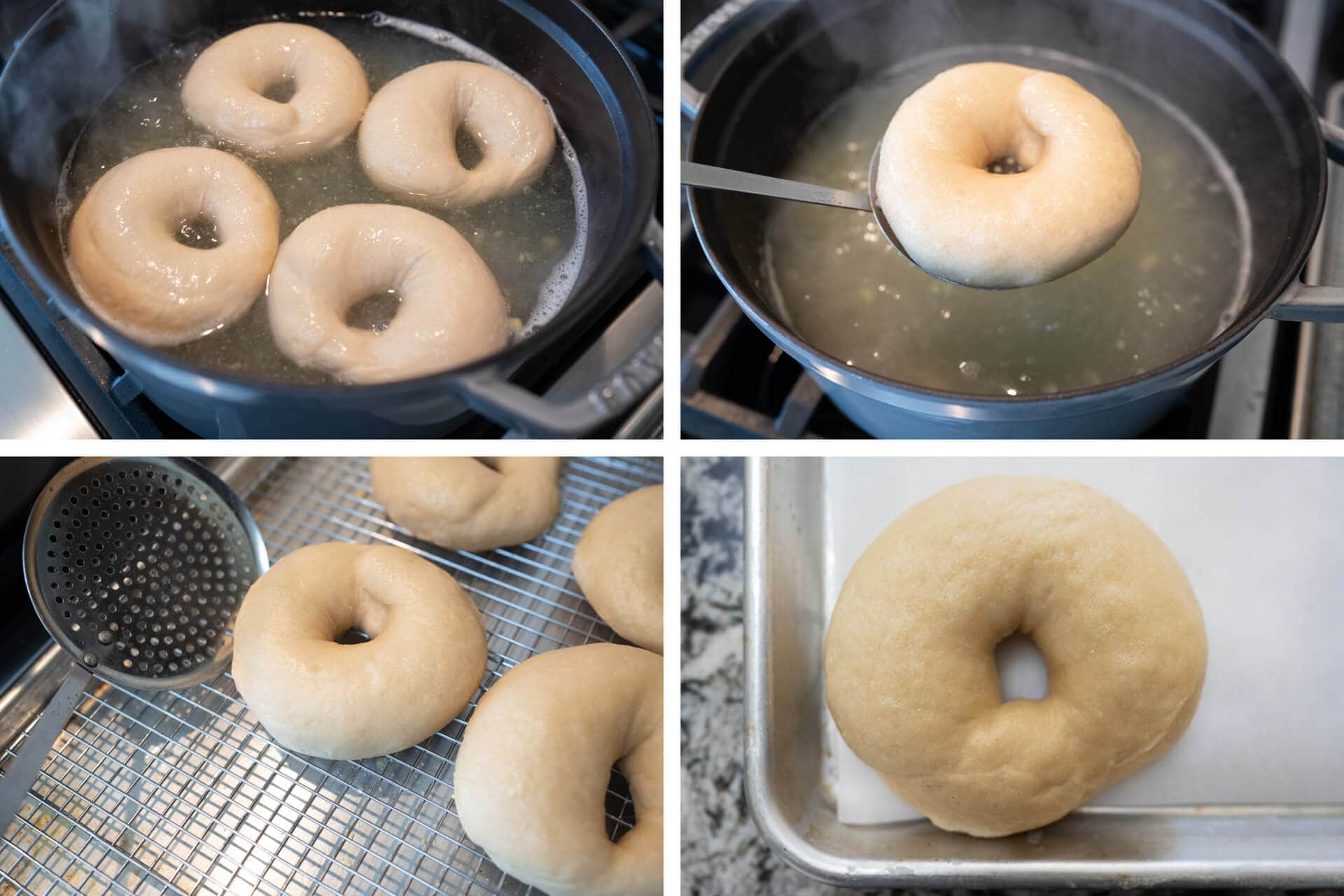
Boiling equipment prep: Fill a wide pot with enough water so the bagel dough can float without touching the bottom (in my 7qt Staub Dutch oven, this was about 1.5 gallons). Bring to a low boil. Next to your stovetop, place a half baking sheet with a cooling rack inside, this will hold the wet bagels for a minute and allow them to drain. Next, line a full baking sheet with parchment paper — this will hold the dough as it bakes. Finally, grab any toppings you’d like (poppy, oat, everything bagel mix, sesame, etc.) and place them in bowls on your work surface.
Boil: Once the water is at a low boil, boil the proofed sourdough bagel dough straight from the fridge, about 40 seconds per side. Using a spider strainer, transfer each piece to the cooling rack inside the baking sheet to drain while you boil the rest of the dough.
Once the pieces are all boiled, move quickly to top them, if desired, and get them onto the final baking sheet.
This dough should float immediately when dropped into the boiling water. If the dough sinks and doesn’t pop up within a few seconds, it’s likely under proofed. Give it more time to proof at warm temperature and try again.
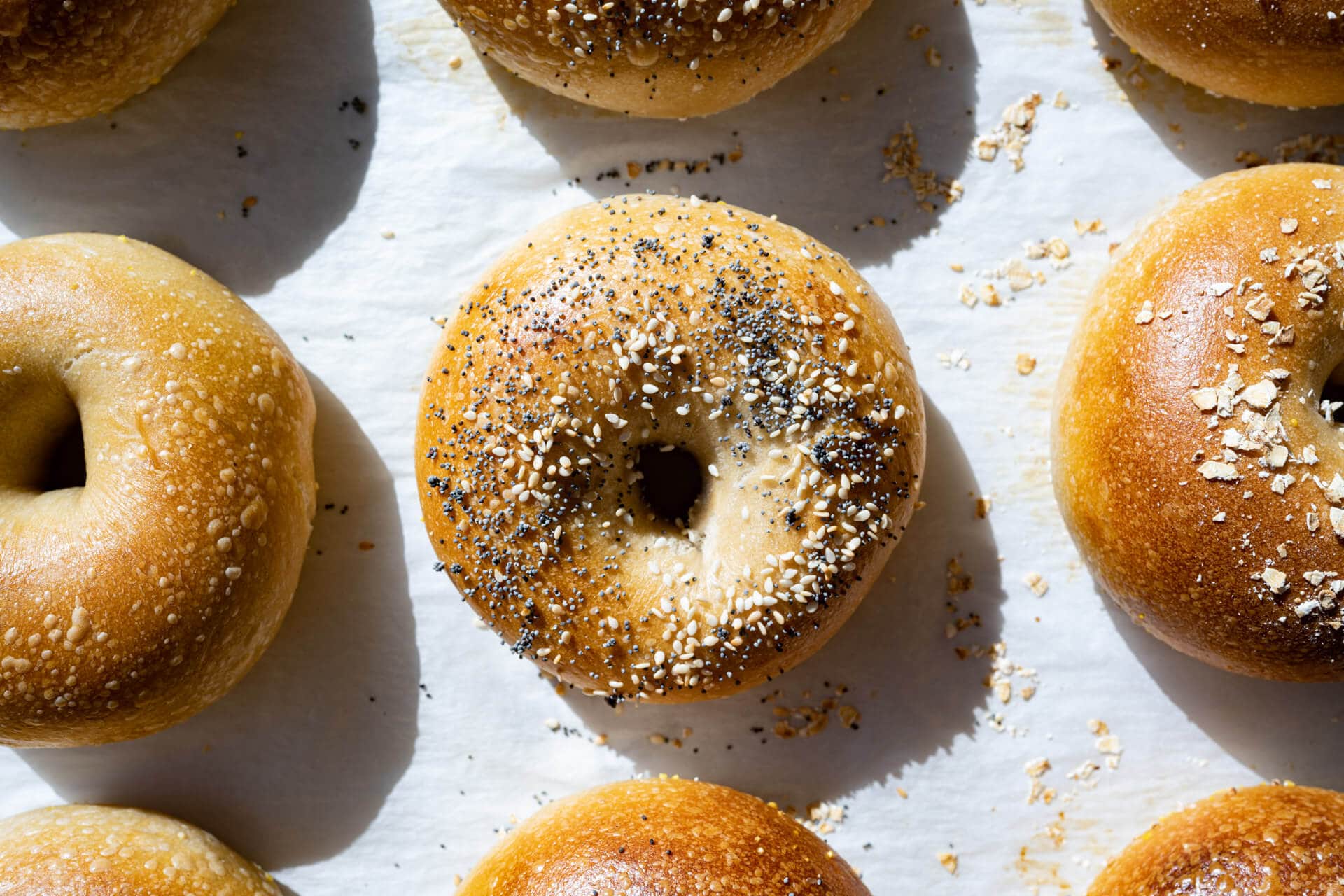
Once the bagels have drained for a minute on the baking rack, transfer them to the full baking sheet lined with parchment paper for baking. Top them with whatever toppings you’d like at this time.
7. Bake – 9:45 a.m.
Slide the full baking sheet with boiled dough into the preheated oven directly onto the baking stone or baking steel. Pour the cup of ice onto the pan with lava rocks and quickly close the oven.
Bake at 475°F (245°C) convection (500°F (260°C) without convection) for 10 minutes with steam. After 10 minutes, vent the oven and remove the steaming pan, rotate the baking sheet 180°, and bake for 5 minutes longer. After this 5 minutes, turn the oven down to 450°F (235°C) and bake for 5 minutes longer for a total of 20 minutes. Remove the sheet when the bagels are nicely colored.
Let cool 15-20 minutes on a wire rack. These are fantastic the first day they’re baked and hold well for a few days after that in a bread box. I also like to wait till they are room temperature, slice in half, and then freeze in a freezer bag. They can be reheated in the toaster, as described in my post on how to store bread.
Conclusion
When you take a bite of these bagels, you’ll first discover a fleeting crispness that gives in to chewiness, a textural dance that eventually leads to a subtle, onset of sourness. This mellow tang creeps in and propels you to keep going with it, to keep taking bite after bite until you’ve finished the entire bagel without the thought of stopping.
The entire eating experience is scary in how it takes over, and it’s exactly what I want in a bagel.
The whole eating experience is scary in how it takes over, and it’s exactly what I want in a bagel. That pop of flavor at the end of the bite is not something you find in mass-produced bagels, and I just love it. And while there are sugar and barley malt syrup added to the dough, it does not carry through to make these bagels sweet. There’s a beautiful balance in the eating experience of these sourdough bagels.
After making these bagels the first time, you’ll get the hang of the process. Subsequent batches become easier and more natural, and it’s no stretch to think these could become a weekly staple—and they freeze incredibly well (I slice them in half and place them in a freezer bag) if, by chance, there’s any left.
Print
Sourdough Bagel
- Prep Time: 24 hours
- Total Time: 24 hours
- Yield: 12 bagels
Description
My recipe for flavorful and chewy sourdough bagels with a thin and slightly crispy crust. Delicious topped with an everything bagel mix, coarse sea salt, oats, seeds, or anything else you can dream up!
Ingredients
Levain
- 116g high protein flour
- 58g water
- 23g sourdough starter, ripe
Main Dough
- 848g high protein flour
- 472g water
- 29g sugar, caster
- 29g barley malt syrup
- 18g salt
- 7g diastatic malt
- 197g levain
Instructions
- Levain (the night before mixing, 9:30 p.m.)
Mix all the Levain ingredients in a container and leave it at a warm temperature for 12 hours. - Mix (9:30 a.m.)
Add a splash of the mixing water, sugar, barley malt syrup, diastatic malt powder, and salt to a small bowl and mix together. To your stand mixer’s mixing bowl, add the malt syrup slurry, flour, water, and ripe levain. Mix on low speed for approximately 5 minutes until the dough strengthens and begins to smooth. Transfer your dough to a bulk fermentation container and cover. - Bulk Fermentation (9:45 a.m. to 12:45 p.m.)
Give this dough a single fold after 1 hour and 30 minutes into bulk fermentation. - Divide and Shape (12:45 p.m.)
Use a half baking sheet (so it fits into your refrigerator) to hold the 12 pieces of shaped dough. Spread a thin layer of cornmeal on the half sheet to prevent sticking. Divide the dough into twelve 125g pieces. First, degas the piece by tamping down a bit with your hand. Then, form the piece into a rough rectangle and cinch down from the top, so the dough ends up in a little tube. Roll the tube out to a 12″ long tube. Wrap the dough around the backside of your hand and pinch it together in the front. Roll a few times on the counter to seal. Transfer to the cornmeal-dusted baking sheet. Repeat for remaining dough pieces. - Proof (1:00 p.m. to 3:00 p.m.)
Cover the baking sheet with a large, reusable plastic bag and seal shut. Let the dough proof at room temperature, around 72-74°F (22-23°C), for 2 hours. The dough should puff up slightly after this time but not excessively. If the dough still feels very dense to the touch, give it another 15-30 minutes and check again. After 2 hours, place the covered baking sheet into the fridge overnight at around 39°F (4°C). - Boil and Top (9:30 a.m., Day Three)
Oven prep: Before you begin boiling your bagel dough, preheat your oven to 475°F (245°C) with convection or 500°F (260°C) without convection. Place one rack at the bottom third of the oven. Place a baking stone or baking steel on the rack to preheat. Place a roasting pan on the bottom filled with lava rocks to prepare to steam. I also fill a cup of ice and place it next to my oven (I will pour this over the lava rocks to steam the oven).
Boiling equipment prep: Fill a wide pot with water and bring to a low boil. Next to your stovetop, place a half baking sheet with a cooling rack inside, this will hold the wet bagels for a minute and allow them to drain. Next, line a full baking sheet with parchment paper — this will hold the dough as it bakes. Finally, grab any toppings you’d like (poppy, oat, everything bagel mix, sesame, etc.) and place them in bowls on your work surface.
Boil: Once the water is at a low boil, boil the proofed sourdough bagel dough straight from the fridge, about 40 seconds per side. Using a spider strainer, transfer each piece to the cooling rack inside the baking sheet to drain while you boil the rest of the dough. Then, transfer the boiled bagels to the full baking sheet and top, if desired. - Bake (9:45 a.m.)
Slide the pan with all the bagel dough into the oven and pour the cup of ice over the roasting pan with lava rocks. Quickly close the oven.
Bake at 475°F (245°C) convection (500°F (260°C) without convection) for 10 minutes with steam. After 10 minutes, vent the oven and remove the steaming pan, rotate the baking sheet 180°, and bake for 5 minutes longer. After this 5 minutes, turn the oven down to 450°F (235°C) and bake for 5 minutes longer for a total of 20 minutes. Remove the sheet when the bagels are nicely colored. Let cool 15-20 minutes on a wire rack.
Notes
- These are wonderful topped with an Everything Bagel mix, rolled oats, sesame seed mixture, or any other topping you’d like.
If you use this sourdough bagel recipe, tag @maurizio on Instagram and use the hashtag #theperfectloaf so I can take a look!
What’s Next?
Regardless of your bagel preferences, I’m confident these sourdough bagels will rank up there with the best you’ve had—and what could be better than making your own with your sourdough starter? And who knows, perhaps they’ll mend that friendship severed by staunch bagel ideals—these could be the olive branch; a crisp and seductively chewy one.
Next up, how about a simple bake like sourdough starter discard sugar cookies?
Buon appetito! 🥯


727 Comments
One is for the enzyme activity, one is for flavoring. If your flour is already malted, no need for the additional. I also add DM because it helps the bagels color up a little more in the oven!
Hi Maurizio,
Looks like a great recipe!
For times sake, I'd like to use regular starter vs. a levain.
Do you have any advice on how many grams of starter i should use to swap out levain?
Should I up the flour amount to make up for starter potentially being wetter than the levain would be?
@maurizioleo:disqus
Hey Josie. Use the same amount of starter as you would the levain! Any water differences can be adjusted during mixing (hold back some water).
Have made these a number of times and they are amazing. Made them this week and they really didn't rise much. Suggestions????
I wonder if your starter wasnt ripe enough? This is usually the case. It could also be that the dough was slightly overproofed, which would cause them to sag in the oven!
Hi Maurizio, I am new to sourdough baking and first want to say I love the amount of detail you provide in your guides and recipes. So far, I've made your beginner's sourdough bread, your banana bread, your pain de mie sandwich bread and your sourdough bagels. Everything so far has turned out fantastic! Thanks to you I'll never buy store-bought bread again! I have a question about the bagels: they were delicious and very chewy on the inside, but the crust was chewier and a little tougher than I would like. I used Bob's Red Mill Bread flour. I'm wondering if I might have over mixed the dough with my kitchenaid mixer. I didn't set a timer and so inadvertently mixed it for 6 minutes. Or maybe its my oven. I have a Miele combo-steam oven and when I use the steam feature, the highest the temperature goes is 435 degrees. Any guidance you might have would be greatly appreciated. Thank you!
Amazing, so glad so many things have worked well for you, Susan! No, i dont think you overmixed. With these bagels it's usually a baking issue. I'd try baking at a higher temp for a shorter time if you can!
Hi! I would love to freeze the dough boiled (or raw) to bake off when needed since I usually don’t need a full batch ready. Do you think there’s a good way to do this with this recipe? What do you recommend?
I haven't tried this, Sarah! I'd worry they wouldn't spring up in the oven after freezing…
Most parchment paper is only rated for up to 450 tops in an oven. I’m confused about you suggesting parchment paper at 500 degrees? Would I be alright just using a greased baking sheet instead? Thanks!
I have not used this recipe specifically but I’ve done lots of other bagels. You can just put it directly on the baking tray. It may stick very slightly but it will release easily with a spatula. You can also use cornmeal on the bottom of the bagels and that will make sure it will not stick.
How about a silicone baking sheet?
Go right on the baking tray as Eitan suggested if you're worried (I've not had a problem with any parchment at 500F, though!).
I want to add fresh blueberries, how much would I add and when? I don’t have the diastatic malt powder, can I replace it with something else or leave it out? Thank You
You can leave out the diastatic malt. I would add the BBs at the very end of mixing and just barely mix the dough to get them mostly distributed.
Hi! Any tips for keeping the bottom from getting too dark? Amazing recipe!
Thank you, Tara! If the bottoms darken too fast make sure you're not baking them on any baking surface, just the rack. You can move the rack up if it's close to a heating element, too.
Hi, if I wanted to bump the hydration of these up to around 70% could you tell me the measurements
I made the Perfect Loaf sourdough bagels for the first time yesterday. I am an experienced NY style bagel maker (weekly for years) but using a commercial yeast sponge method as my primary recipe. I have done a similar levain bagel using my regular recipe but fermenting a large proportion of levain for about 7 hours before bulk mixing with great success. The bagels are darn near perfect. But I wanted to give The Perfect Loaf bagels a try for the sake of experimentation and willingness to explore. The final results were decent, but I am having a crust issue. I find that the crust is too tough and not as crisp as I’d like. I have experienced a similar issue with the baguettes from The Perfect Loaf as well. What am I doing wrong @maurizioleo:disqus. I am certain it’s user error! Thank you for your excellent book, by the way. I am really enjoying baking my way through it and expanding my sourdough range!
Hey, Jules! Sorry for the delay. My guess is you need to bake hotter, but for a shorter time. Same for the baguettes (though, these really do benefit from A LOT of steam in the oven, too).
Hey all, just made a cinnamon raisin version that came out perfect. I was worried about the cinnamon’s effect on fermentation but it wasn’t an issue. Increased proof time by one hour. Been using a heating pad in the oven for proofing which gives me a solid 75-77 degree temp. Learned about that on the gram. I used the instructions from Peter Rheinhart’s The Bread Bakers Apprentice for the cinnamon raisin additions. So good. Also boiled with baking soda and some barley malt syrup. Thanks for all the great recipes Maurizio!
for the additions i added: 1 tablespoon of cinnamon, 2 cups of raisins (rinsed with warm water) and 4 TBSP of white sugar
These sound fantastic, Brian. Great tips there to keeping the dough warm, too. I NEED to try this asap 🙂
ARRGH, I’ve made these fabulous bagels many times… with much on my mind I failed to proof shaped bagels on counter for 2 or so hours. When removed from fridge they were stiff unrisen lumps. Can they be proofed at room temp and then boiled? Thanks for your fabulous book and website. I learn something new ever single bake.
Good news! After taking out of fridge and putting in oven with oven light on for a few hours they floated. Just came out of oven and PERFECT!!! Would still like your input. Thanks so much!
Awesome to hear that, Pam! You can proof these at room temp but they are much harder to transfer to the boil this way. I much prefer the fridge! You could try letting them proof on the counter a bit longer, maybe 30m, before putting them into the fridge.
When you said stuff did you mean ball of dough because my leavin is now a ball of dough. I have a scale and that’s what I got ….
Yes, it should be stiff like that!
Hello! I made this bagel recipe before and they turned out so good! I want to make a jalapeno cheddar version. When do you think the proper time would be to fold in inclusions? Thank you!
I would add them at the very end of mixing.
Just made my best batch yet! Pumpernickel but forgot the cocoa powder, oops, so not the right color but should taste good. The more I make these, the more I think they would be a good introduction to sourdough bread baking. I have learned a lot about the process, seeing what happened if they are a little wetter, if I let them proof longer/shorter, bake right out of the fridge or let them come to room temperature, so they have given me more confidence. And because they are more forgiving, you don’t end up with a total train wreck if you don’t do it exactly right. I just couldn’t get the rope type of shaping and have had better luck with forming a tight boule and then poking a hole in the center and stretching out from there.
Sounding good there, Kim!
Thanks for such a killer recipe Maurizio! These turned out incredibly well even on my first attempt.
I noticed there’s been some discussion of cinnamon raisin bagels (my favourite) in the comments:
– cinnamon messes up the fermentation, they may take longer to proof
-keep cinnamon around 1%
-fold in the cinnamon and raisins at the end of mixing
But you also mentioned that a cinnamon raisin bagel recipe may be forthcoming? I haven’t been able to find anything on that yet, but please point me in that direction if I’ve missed it!
Happy Baking 🙂
Update: I used 10g cinnamon, 1-1/4C raisins, and an extra table spoon of sugar.
I misted the raisins with water and briefly microwaved to rehydrate them a bit. And tossed them with some cinnamon and sugar.
Kneaded the raisins in at the end of the kneading process, and then added cinnamon and kneaded that in enough so that it was kind of swirled in.
Added 1.5hr shaped rise prior to fridge, and pulled them out of the fridge after 15 hrs, let them warm up a bit for 3hours, then followed the same boil (they floated!) and bake instructions as usual
I made a batch of plain bagels alongside these – and the cinnamon raisin clearly took longer to proof. Hence the extra time outside the fridge.
Turned out delicious!
So glad you liked these, Caleb! I’m still working on cinn + raisin bagels… That is the approach I was planning on using, though!
Hello! One problem I consistently have with bagels is that they don’t puff up to that super round ellipse shape that you get. And today for the first time, they actually sank when I put them in the boiling water. Like you mentioned, that’s probably underproofing. Since my house is so cold, right now, I did the first proof after shaping in the oven on Bread Proof (95 but I let most of the heat before I put them in for the 2 hours). This was the first time I have done that. And it’s the first time they sank. I wonder if there’s a correlation, like maybe it was too warm and it used up all the fun air. They looked great and puffy when they came out of that first rise, before I put them in the fridge, but then they sank and only partially recovered when I boiled them. When I put them in the water, the air bubbles really showed up and they floated after 20 seconds. I’m sure they’ll taste great, I just wish I could get that nice round rise you get. I’ve been trying for about a year! Love your book by the way. Both my mom and I have copies and we talk about it constantly. So well written and such a great approach to sourdough that demystifies the process. Thanks for writing it!
what is the trick to getting seeds to stick to the bagel? i’ve tried immediately putting the bagel on the seeds after they come out of water, but still when i go to slice most fall off 🙁 thanks for all your great info
Do an egg wash. One egg with a tablespoon of water, whisked. Brush on the bagels 20 seconds or so after they come out of boiling water and then season.
I’ve never had an issue with this! I think because the water is so sticky thanks to the cornmeal, the seeds stick no problem. You’re going to get some drop-off, sure, but the majority stick for me (with careful handling)!
The magic to seeding is the timing sweet spot. When you take the bagels out of the boil wait about 30-40 seconds. Then dredge them in seeds or sprinkle. The exterior of the bagel gets starchy for a 30 second-ish window after removing from the boil. If you boil them all and try to seed you will be disappointed. If you seed right out of the boil they slide off when handling. Do a few at a time and start seeding them 30 seconds out of the boil.
After a bit of a sourdugh break, I am back at making bagels, pumpernickel to be specific. Here is my latest iteratuion that I think has the taste I am looking for. This batch didn’t rise as much as I think it should have but that is my bad, not proofed long enough. I make a half batch which means: 283 bread flour, 141 rye flour, 236 + 2 Tblsp H2O, 15 g sugar, 15 g barley malt syrup, 9 g salt, 4 g diastatic malt, 99levain, 2 Tbls molasses, 2 tsp onion powder, 1 Tbls carraway seeds, 1 Tbls cocoa powder
Welcome back, Kim! That sounds fantastic to me.
Hello! I just made these sourdough bagels for the first time but after boiling them and topping them they were sooo fragile and started deflating. I delicately handled them but they still fell pretty flat. Do you think I could skip the second proof after shaping them and just pop them in the fridge for the overnight proof?
Hello, I am making this recipe now and have just done the first stretch halfway through BF. This dough is quite stiff and dry compared to sourdough bread of 70+ hydration, is that normal? I have also not seen much rise, should it be doubled in size before shaping?
Hey there! Thanks for spreading the word about my cookbook. Hmm. I would say maybe there’s too much water in the dough for your flour, I would hold back just a little bit.
I grew up just outside of NYC and these bagels are more delicious than anything I’ve had in one of the best places in the world to get a bagel. First time I made them, somehow they were a bit over-hydrated so they were hard to deal with, however they still turned out well. Great recipe! Thank you!
Huge praise, thank you!
Hi Maurizio thank you for this recipe! I’ve been making what I now describe as sub-par bagels for years. Wow these bagels are incredible and exactly as you describe. I did not have Diastatic malt, or barley malt syrup. I substituted honey. I also don’t have your steam setup so I baked them on a Pampered Chef stone. I took your advice and doubled the batch, took 20 minutes to knead the dough. This recipe differs from your bread recipes on bulk ferment, but I followed the instructions, bf for 90 minutes, single fold, bf for another 90 minutes AT TEMP and shaped, then in the fridge overnight. I love the shaping, they came out absolutely lovely. One hint I’ll share is to cut up parchment paper into small squares (big enough for a bagel). Place each shaped bagel on one square, place on pan, into the fridge. Then when you boil, put the bagel with the square of parchment into the water. The parchment will boil off, pick it out of the pot, and they come out nice and puffy. I didn’t put cornmeal on the square but you sure could! Now that my husband has sampled these, I predict I will be making them often. I ordered your cookbook a few days ago, very much looking forward to that! Thank you again for all of your wonderful guidance it is so appreciated!
So glad these worked for you, Barbara! Good sub with the honey, works really well. And some nice tips there with the parchment 🙂
How much honey did you substitute? I don’t have either of those ingredients in my house right now so thinking of subbing for honey as well.
The same amount as the barley malt syrup (29 g)
Thanks for step-by-step instructions which i have followed but my bagel did not come out any close what you have described. Can you please provide more tips on baking Schedule as it should not follow exactly as you describe. It totally depends on Temperature or some kind of sign we should look for. I have been baking Sourdough bread from last 3 years with very ripe starter and result is very good but now i want to make good bagels. Hopefully you will respond.
Hey Baki! Temperature is super important, yes. Make sure your dough is the same temperature at the end mixing that I mention up in the post—this is very important as it sets the stage for the schedule and fermentation!
I moved to Hawaii after having lived in NYC most of my life. My brother would send me expensive deliveries of bagels for the holidays because I missed them so much. I’ve tried a few of Mauricio’s recipes and they have ALL turned out deliciously, so why not try his bagel recipe?
Well, Wow! I admit I had a few moments of doubt throughout making these. (egs. I felt the smell of the barley malt was too overwhelming as I was mixing, and my dough was too wet and I should have followed the advice to hold back about 5% of the water before dumping it all in.) I have learned that I need to trust Mauricio’s recipes so I forged ahead! SO glad I did! These bagels put NYC bagels to the test! They have a really nice crust and a chewy but tender interior! I did use my Ankarsrum to mix the dough for about 8 minutes. I also think I under proofed my shaped dough before I put it in the fridge, but I let it proof on the counter a little more before boiling (waited for my bagels to pass the float test) and it all worked out!! Other than the little tweaks I have to make of holding back some water next time (as it has been quite humid here) and making sure my dough is a bit more proofed before it goes into the fridge, this recipe is PERFECTION! Thank you, Maurizio!!
Amazing, happy these came out great for ya! The barley malt is very strong tasting and aroma, but it’s just right for this dough (I found this through countless tests!). Enjoy and thanks for the feedback 🙂
Hi Maurizio! I would like to have some be egg bagels, I love that extra richness and yellow color. How would you recommend I adjust for adding an egg? Think it should just be yolks, or whole? Thanks!
If you just want color, I’d add only yolks. You’d have to hold back some portion of the water, hard to say how much, because yolks do contain some water!
Hi Maurizio, I’ve made these bagels a couple of times now and they have turned out great! I’m thinking about adding freeze dried blueberry powder to the dough and fresh berries during shaping, do you have any experience with adding freeze dried fruit powder to dough and the effects it may have? I read elsewhere to use 8-9% the total weight of flour in fruit powder. Tips would be appreciated, thanks!
I have not done this but it should work really well. I would just add the powder as is, since it’s a dry ingredient it should mix in just fine during mixing.
Hi Maurizio, I’ve been baking your sourdough bagels for the last 1.5 years and they are always fantastic! I’ve been using bread flour since I ran out of diastatic malt and they are just as good. This might be of help to other bakers.
I’d like to try my hand at making 6 of the bagels cinnamon raisin, but I’m not sure at what point to add the cinnamon and raisins. Also, will I need to adjust the rest of the recipe?
Amazing, so glad to hear this Susan! I would probably add the cinnamon and raisins at the end of mixing OR fold them in by hand if you want more marbling.
In my experience, I have successfully added the cinnamon when I add the flour and then added the raisins during the stretch and fold, like your Cranberry Walnut bread.
Do you ever see a use for Sir Lancelot (King Arthur) flour at 14% protein? I have a bag and am wondering what to do with it….thanks!
Will work well with this recipe, Mary!
Oh man! These turned out so perfect! The perfect taste and texture inside and out! I moved out of the city and lost access to my favorite bagel shop and these definitely brought me back to when I’d stop for a bagel and coffee on my way to work. Great job, Maurizio! This is my second recipe I’ve tried of yours and had great success!
Mama mia Maurizio! These are by far the best bagels I have ever baked and eaten in the history of bageldom. I 🥰 this recipe. Once again the method is perfectO! Thank you so much for your dedication to the craft. Looking forward to my next baking challenge! Tty then!
i made these bagels yesterday and it was not successful. I do not know what happened but it was too sticky and hard to shape. The bagels turned out flat and it was a bit tough. Please let me know what had happened? I’ve never put sugar in my bagels dough before in other recipies so I thought this might the problem.
I would say reduce the water in the mix. The dough should be very stiff and easy to handle! I don’t think the sugar was an issue here, unless you added more than called for in the recipe…
Hi Maurizio,
Thank you for this awesome website and your books.
What changes would I need to make to this recipe to make Sourdough Rye Bagels?
Thank you,
Dee Dee
You’re very welcome, Dee Dee! I have made this with up to 10% rye flour to total flour weight and they came out great. The higher rye percentage you go, the denser the bagel. (Super flavorful, though!)
Thank you for the reply.
I will give it a shot.
These bagels turned out exactly as you described them, Maurizio…a bit of a crunchy crust melting into a chewy interior. I wasn’t sure it would be worth it…that first full day of mixing, fermenting, etc. felt like a tough slog at times (especially dividing and shaping). But Day 2 (boiling, baking) was easy once I got myself set up and it was so exciting to see the bagels emerge at last, so beautiful and tasty. Thanks again for a spot-on recipe!
So glad these turned out well for ya, Marcie! They are a bit of work, but they also freeze beautifully. Make a double batch and have bagels for a month 🙂