

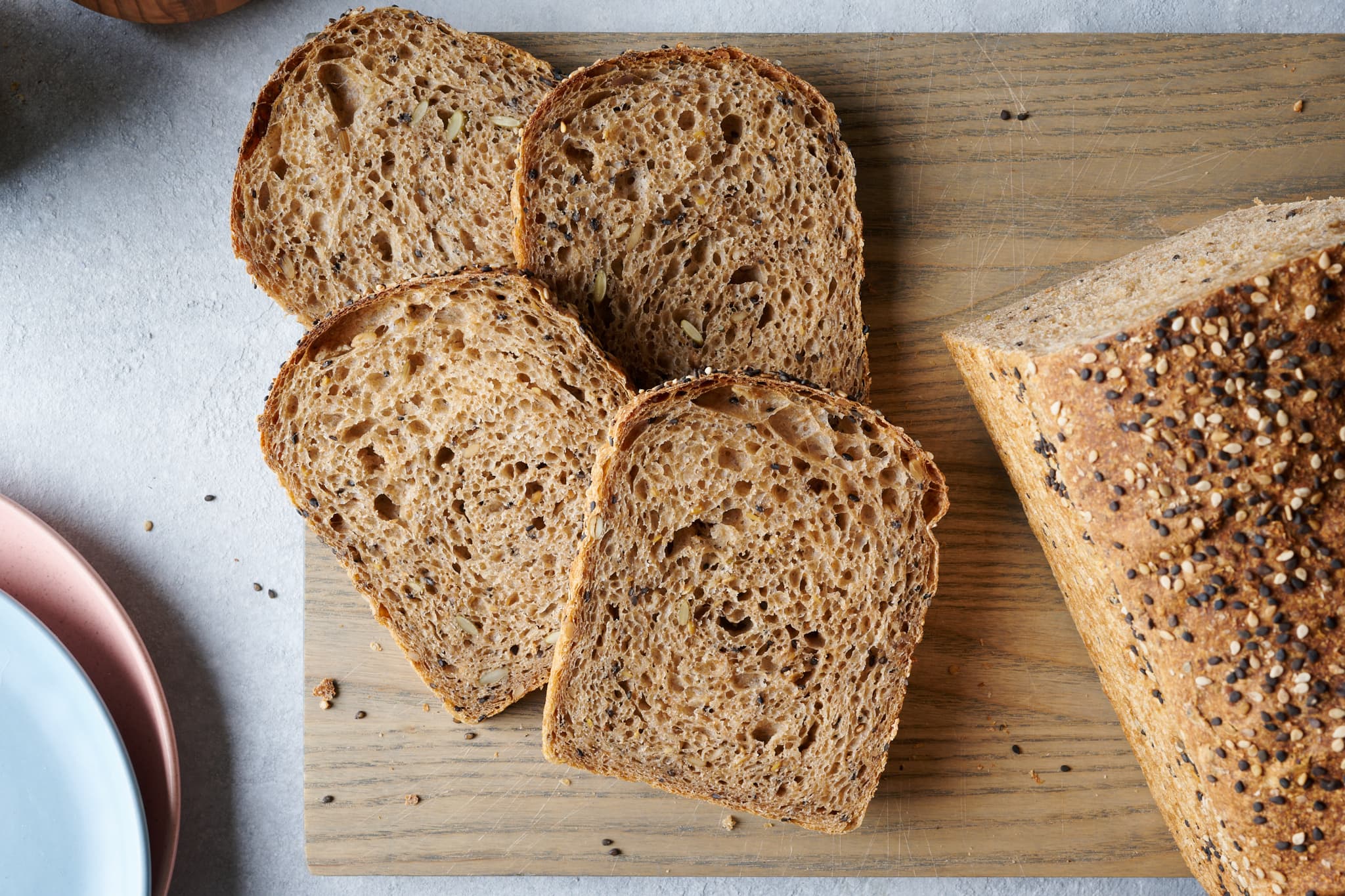
My goal when developing this high-fiber sourdough bread recipe was to create a healthy and nutritious bread recipe that my kids will enjoy. The recipe title might immediately make you think of food that tries to be too healthy, sacrificing flavor and texture for nutrition. But the surprising result here is that all the fiber and good-for-you ingredients to improve gut health result in a delicious, extremely easy-to-eat sourdough bread.
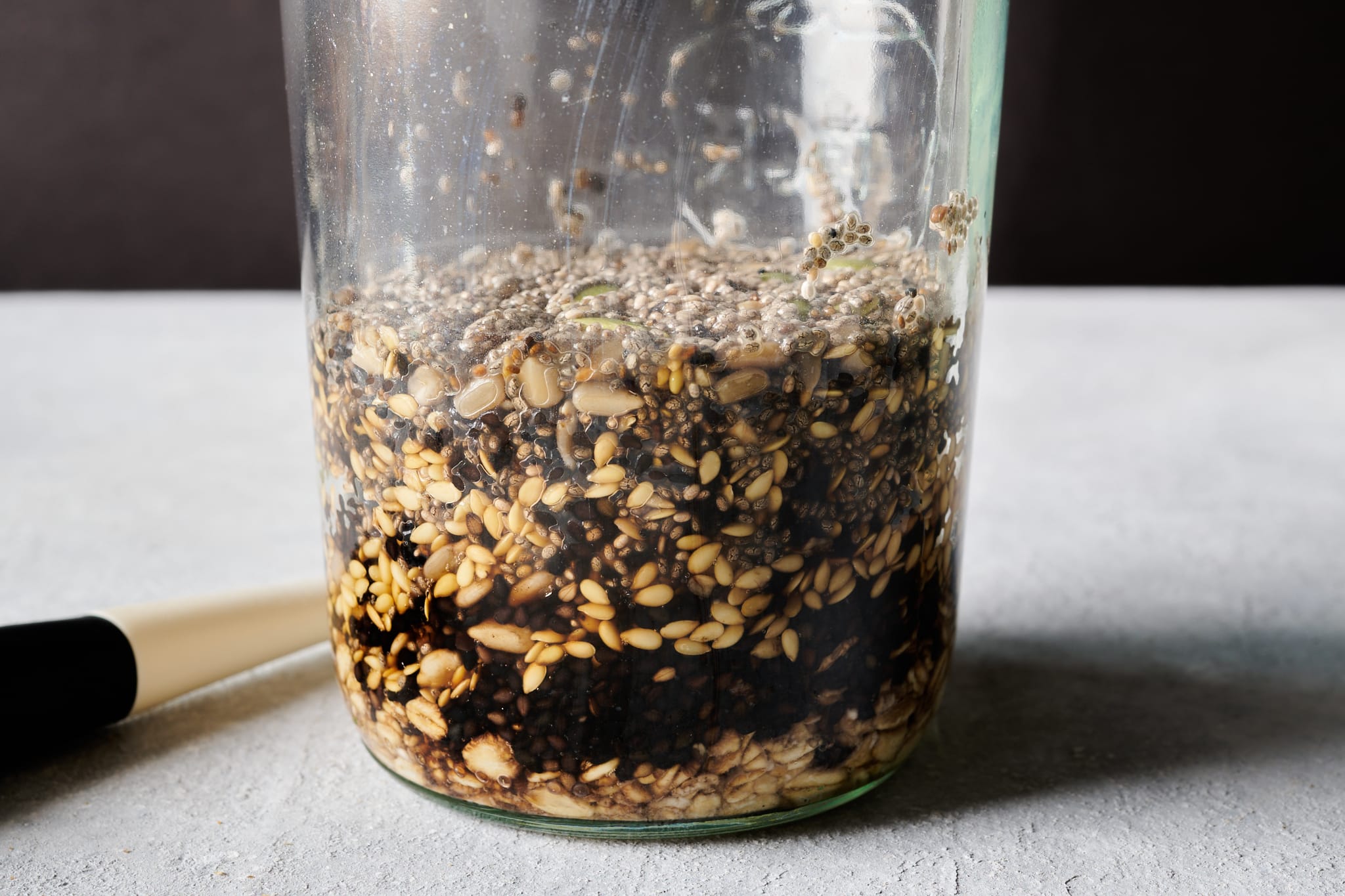
I knew I wanted the foundation of this super healthy bread to be a high percentage of whole wheat flour, and then to that I added a seed and oat soaker. While I picked seeds with high fiber content, I also love the different flavors and textures they bring to the bread. And there’s zero refined sugar in this dough; a little bit of natural honey brings just enough sweetness and more depth of flavor.
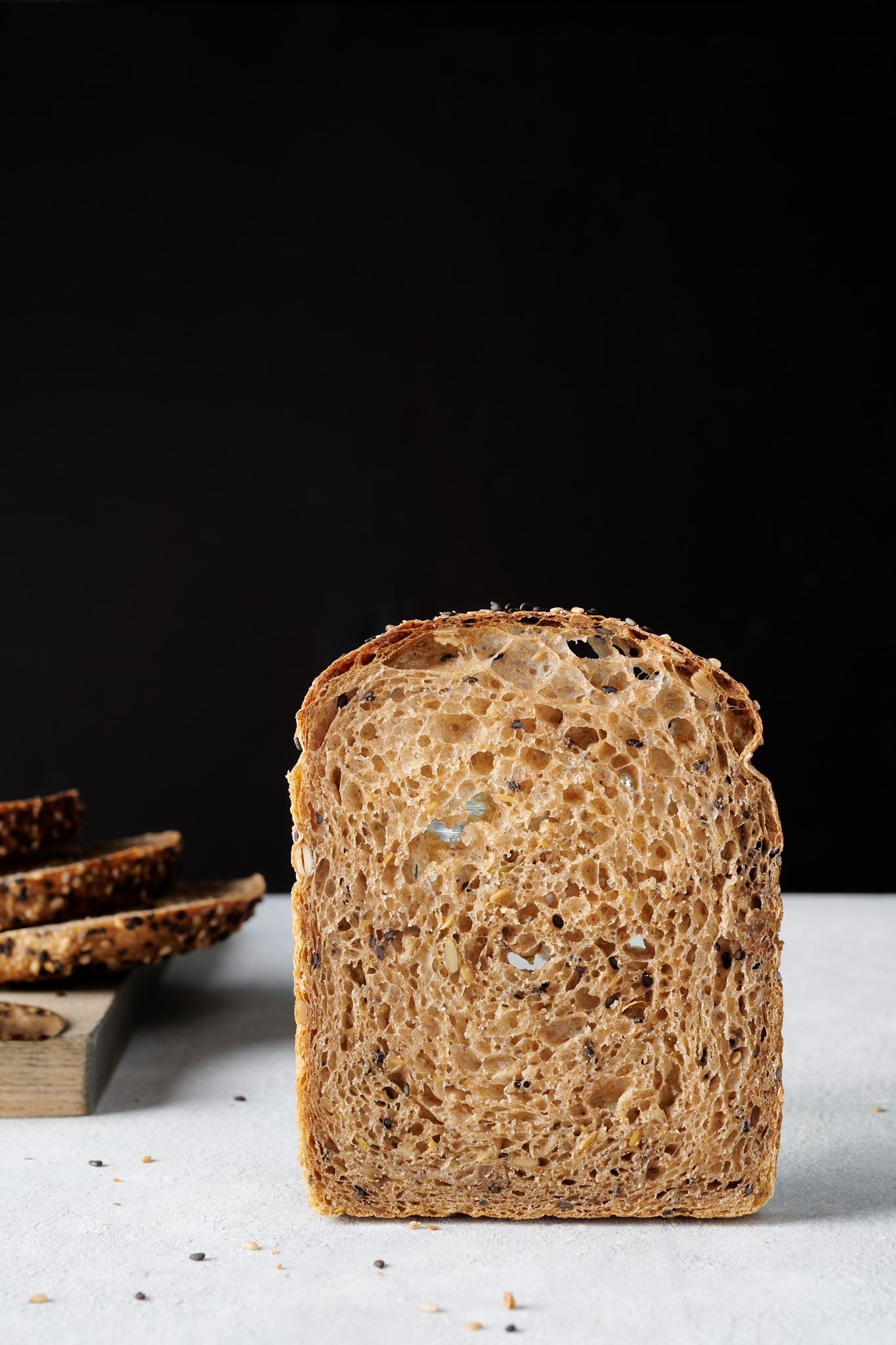
After many trials tweaking the baker’s percentages of each ingredient, I finally arrived at the right balance of whole grains, seeds, oats, and honey to make a subtly sweet, light, and delicious pan loaf that checks all the sandwich loaf requirements. It makes a pretty rad BLT.
Watch me make this high-fiber sourdough bread recipe from start to finish
Flour and ingredient selection
Flour
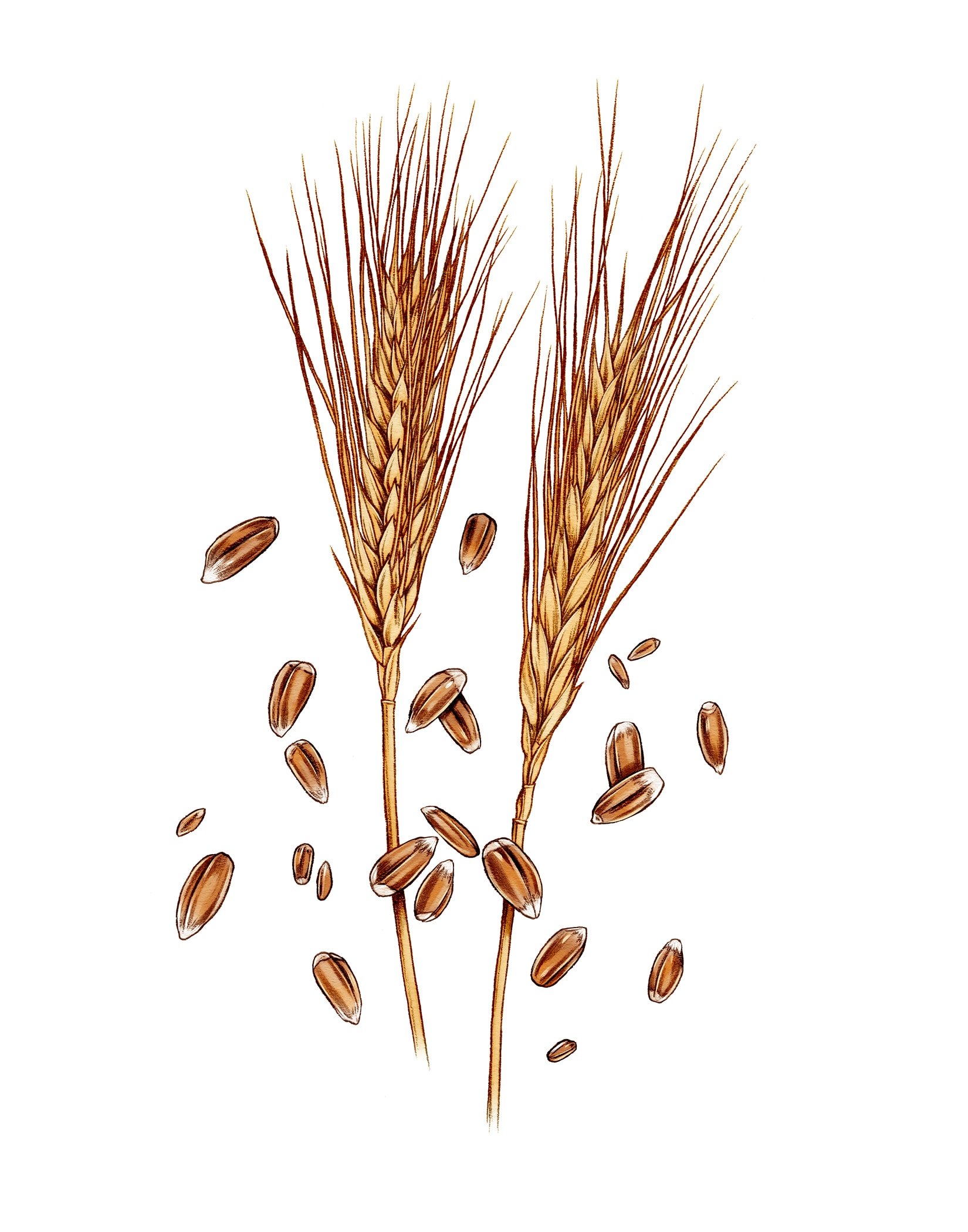
This recipe is primarily made with whole wheat flour and a smaller percentage of medium-protein white flour (all-purpose flour). I use whole wheat flour in the tangzhong, too, which is a neat technique for working in more whole grains without them causing a negative impact on the crumb structure of this bread. The result is a high-fiber, high-whole-grain bread with an open and light texture.
Wheat bran
I always have a bag of wheat bran in my pantry. I use it often to coat the outside of my large loaves, but I also use it in baked goods like sourdough muffins to bring added texture and nutrition. In this bread, I follow suit and add it to the dough during mixing. If you don’t have wheat bran, swap it out for more whole wheat flour or wheat germ.
Seeds and oats
This high-fiber bread recipe calls for a seed soaker made up of rolled oats, sesame seeds (I like black), pumpkin seeds (also known as pepitas, and are an excellent source of phosphorus, magnesium, and iron), sunflower seeds (rich in healthy fats, vitamins, and minerals), flaxseeds (helpful for improving digestive health due to high fiber content), and chia seeds (high in omega-3 fatty acids and fiber). If you don’t have any of these seeds in your pantry or don’t like one of them, feel free to swap them out for what you do have or what you prefer. For instance, if you don’t have flaxseed (which would be a shame because they are very high in omega fatty acids and fiber!), swap them out for an equal amount of chia seeds, sunflower seeds, or even benne seeds.
I like using rolled oats for the oat portion of this recipe, but steel cut oats will also work quite well. If you don’t have oats, you could coarsely crack wheat or spelt in your home grain mill.
Baking schedule
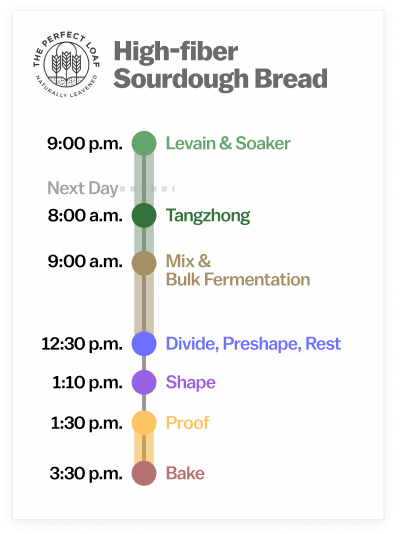
This high-fiber sourdough bread is made all in a single day, except for the overnight levain and seed soaker. The night before you want to bake these loaves, prepare the levain when your sourdough starter is ripe, and make the seed and oat soaker simultaneously. The next day, mix the dough when the levain is ripe, ferment it throughout the day, then bake it in the later afternoon or evening.
It’s also possible to extend the fermentation time of this dough by refrigerating it overnight. After you’ve shaped the dough and placed it into pans, cover them tightly and place them in the refrigerator. The next morning, take the pans out and let them finish proofing on the counter if necessary, or bake straight from the refrigerator if the dough looks well-risen and is puffy to the touch.
High-fiber sourdough bread recipe
The following tables represent the total formula for this recipe in baker’s percentages. In other words, they include every ingredient you will need to make this bread. In the method section that follows, the total formula table will be broken down into smaller tables showing you exactly what you need for that step of the recipe.
Vitals
| Total dough weight | 2,000 grams |
| Pre-fermented flour | 8.0% |
| Hydration | 73.0% |
| Levain in the final dough | 17.4% |
| Yield | Two 1,000g pan loaves |
Total formula
Desired dough temperature: 78°F (25°C) (see my post on the importance of dough temperature).
| Weight | Ingredient | Baker’s Percentage |
|---|---|---|
| 492g | Whole wheat flour (Central Milling Hi-Pro Whole Wheat) | 60.0% |
| 246g | White flour (about 11.5% protein; Central Milling Artisan Baker’s Craft) | 30.0% |
| 82g | Tangzhong: Whole wheat flour | 10.0% |
| 328g | Tangzhong: Whole milk | 40.0% |
| 57g | Honey | 7.0% |
| 16g | Wheat bran | 2.0% |
| 57g | Rolled oats | 7.0% |
| 25g | Sesame seeds (black or white) | 3.0% |
| 25g | Pumpkin seeds (pepitas) | 3.0% |
| 16g | Sunflower seeds, shelled, roasted, and unsalted | 2.0% |
| 16g | Flaxseeds | 2.0% |
| 16g | Chia seeds | 2.0% |
| 599g | Water | 73.0% |
| 16g | Fine sea salt | 2.0% |
| 7g | Ripe sourdough starter, 100% hydration | 0.8% |
Additional ingredients:
Neutral-flavored oil, for greasing
Black and white sesame seeds, for topping (optional)
High-fiber sourdough bread method
1. Prepare the levain – 9:00 p.m., the night before mixing
| Weight | Ingredient | Baker’s Percentage |
|---|---|---|
| 33g | Whole wheat flour | 50.0% |
| 33g | White flour | 50.0% |
| 66g | Water | 100.0% |
| 7g | Ripe sourdough starter, 100% hydration | 10.0% |
Use your sourdough starter when ripe, mix the above ingredients in a jar, and leave them covered at a warm temperature, 74-76°F (23-24°C), to ripen overnight.
2. Prepare the seed and oat soaker – 9:10 p.m.
In a tall jar, combine the 57g rolled oats, 25g sesame seeds, 25g pumpkin seeds, 16g sunflower seeds, 16g flaxseeds, 16g chia seeds, and 179g water. Stir, cover the jar, and let sit until called for during mixing.
3. Prepare the tangzhong – 8:00 a.m., the day of mixing
In a medium saucepan over medium-low heat, combine the 82 grams tangzhong flour and 328 grams tangzhong milk. Cook, whisking continuously, until the mixture thickens and becomes a paste (like mashed potatoes), 4 to 6 minutes. Remove the pan from the heat and spread the tangzhong out on a small plate to expedite cooling. Set aside.
4. Mix – 9:00 a.m.
| Weight | Ingredient |
|---|---|
| 459g | Whole wheat flour |
| 213g | White flour |
| 57g | Honey |
| 16g | Wheat bran |
| 354g | Water |
| 16g | Fine sea salt |
| 138g | Ripe levain (from Step 1) |
| All | Seed and oat soaker (from Step 2) |
| All | Tangzhong (from Step 3) |
I mixed and strengthened this dough in my KitchenAid stand mixer, but you could also mix it by hand using the slap and fold technique. If mixing in a mixer, be sure to hold back the soaker until the end of mixing. If mixing by hand, you can add the soaker at the end of mixing or during stretching and folding in bulk fermentation.
To the bowl of a stand mixer fitted with the dough hook attachment, add both flours, the honey, the wheat bran, the water, salt, ripe levain, and tangzhong. Mix on low speed (STIR on a KitchenAid) for 1 to 2 minutes until the ingredients come together and no dry bits remain. If the dough is very dry, conservatively add a splash of water as needed to moisten. Next, mix on medium speed (2 on a KitchenAid) for 5 minutes until the dough smooths and begins to cling slightly to the hook. This is a very soft dough and won’t completely clear the sides of the bowl at this point.
Let the dough rest in the bowl for 5 minutes.
Turn the mixer on medium speed and mix for 2 minutes until the dough gains more strength and clings once again to the dough hook. Add the entire contents of the seed and oat soaker jar and mix on low speed just until the soaker is incorporated. The dough will still be very soft and even shaggy looking, and it won’t altogether remove from the sides of the bowl.
After mixing this bread dough, transfer the dough to a bulk fermentation container and cover.
5. Bulk fermentation – 9:30 a.m. to 12:30 p.m. (3 hours)
At a warm room temperature, 74-76°F (23-24°C), bulk fermentation should take about 3 hours.
This dough will require 2 sets of stretches and folds during bulk fermentation. After the first 30 minutes, wet your hands, grab the side of the dough farthest from you, and stretch it over to the other side. Rotate the bowl 180 degrees and repeat. Then rotate the bowl 90 degrees, and stretch and fold that side. Rotate the bowl 180 degrees again and finish with a stretch and fold on the last side. The dough should be neatly folded up in the bowl. Cover and repeat these folds once more after 30 minutes. Then let the dough rest, covered, for the remainder of bulk fermentation.
6. Divide and preshape – 12:30 p.m.
After 3 hours, the dough should be well-risen in the bulk fermentation container and puffy to the touch. The edge where the dough meets the container should be domed downward, showing strength and rise.
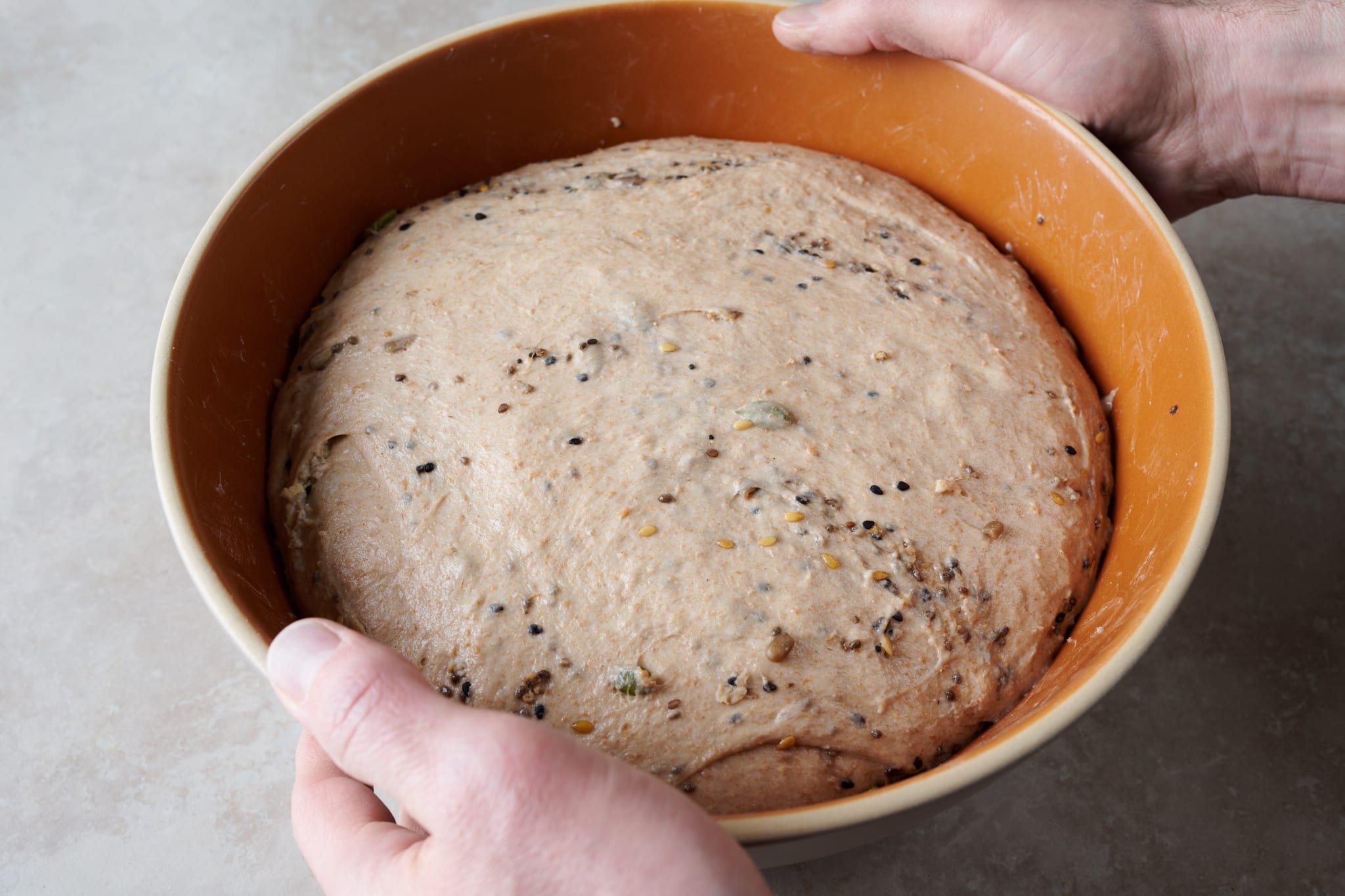
Fill a small bowl with water and place it next to your work surface. Scrape the dough onto a clean counter. Wet your free hand to keep it nonstick, divide the dough into 2 equal pieces, and preshape the pieces into loose rounds.
Let the dough rest, uncovered, for 30 minutes.
7. Shape – 1:10 p.m.
Grease two 9 x 4 x 4-inch Pullman pans with a neutral-flavored oil.
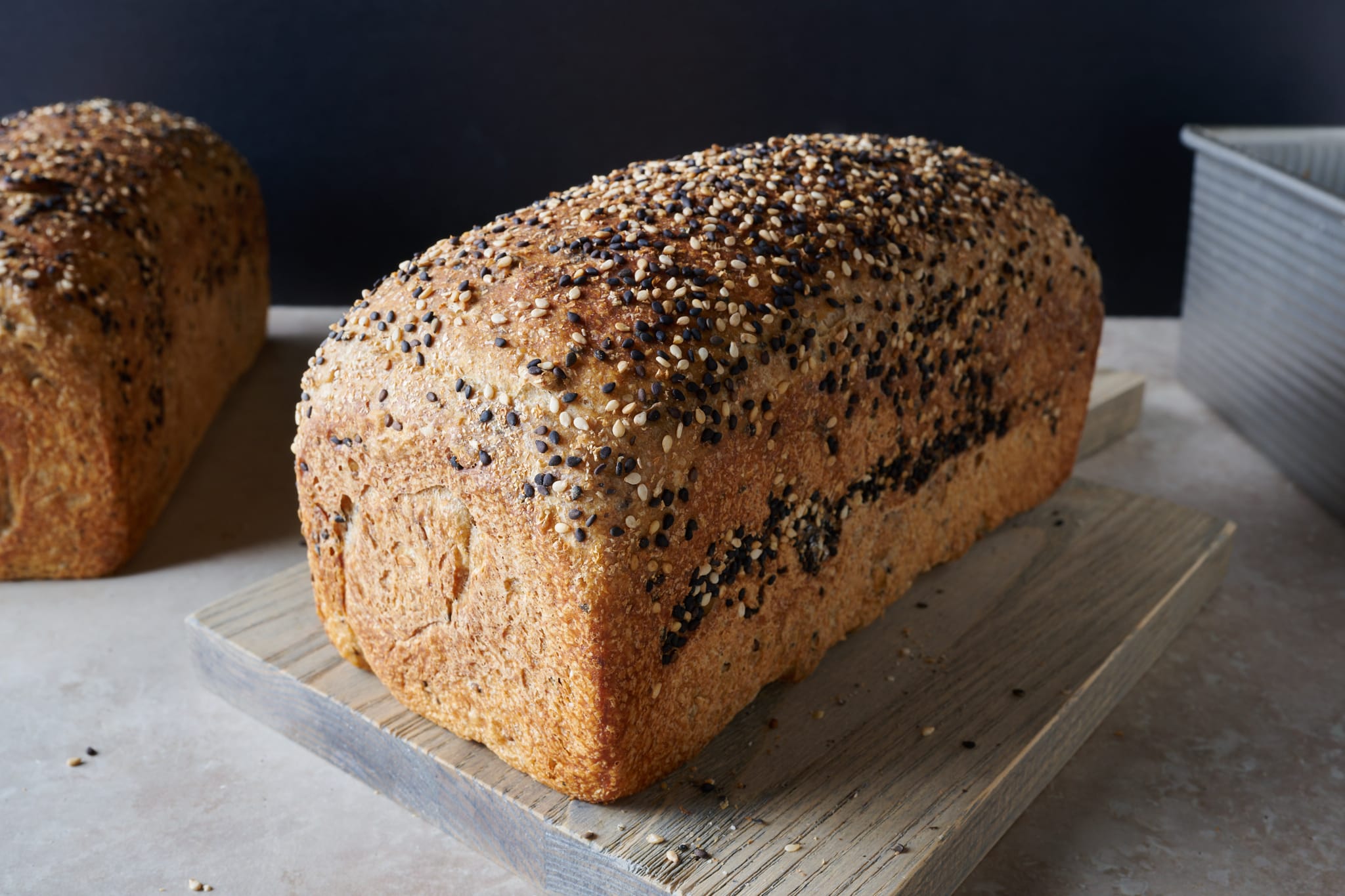
I like to top this high-fiber bread dough with a mixture of black and white sesame seeds (or use a single color, if you’d like). Other options include rolled oats or even more wheat bran, or you can omit all toppings. See my guide to topping bread dough for other topping ideas.
Spread an even layer of sesame seeds on a clean kitchen towel or sheet pan.
Flour the top of each preshaped round and your work surface. Using your bench knife, flip one round over onto the floured area. Using floured hands, fold in the sides of the dough, and then roll it down from top to bottom. Using two hands, transfer the dough top-side down to the sesame seeds, gently rocking the dough back and forth so that the seeds stick. Then, flip the dough over and place it seam-side-down in the prepared pan.
Repeat for the other preshaped round.
For information on baking in different pans, shaping pan loaves, and more, see my guide to pan loaves.
8. Proof – 1:30 p.m. to 3:30 p.m. (about 2 hours)
Cover the pans with a large, reusable plastic bag and seal shut. Let the dough proof on the counter for about 2 hours.
9. Bake – 3:30 p.m.
Place an oven rack in the bottom-third of the oven. Preheat the oven to 425°F (220°C) for 30 minutes. I baked these loaves on a bare oven rack in my oven; follow my guide on how to steam an oven for baking bread (you don’t need to bake on a baking surface—stone or steel—with pan loaves, just right on the oven rack).
The dough is ready to bake when it is puffy to the touch (it will pass the poke test) and has risen about 1/2 to 1 inch below the rim of the pan (see image below). If you see any large bubbles on the surface, gently pat them down.

Slide the pans into the oven and bake for 20 minutes with steam. Then, reduce the oven temperature to 350°F (175°C) and remove the steaming pans from inside the oven. Continue to bake for 25 to 30 minutes more. When done, the loaf should have an interior temperature of around 204°F (95°C), and the crust should be deeply colored. Remove the pans from the oven and the dough from their baking pans.
This high-fiber bread recipe benefits from additional rest after baking before slicing. Let the loaves cool on a wire rack for at least 2 hours before slicing with your bread knife. Be sure to store this bread properly to keep this bread fresh for a week or more.
Print
High-fiber sourdough bread recipe
- Prep Time: 15 hours
- Cook Time: 50 minutes
- Total Time: 15 hours 50 minutes
- Yield: 2 loaves
- Category: main course
- Cuisine: American
Description
A nutritious pan loaf with lots of whole grains, seeds, and fiber.
Ingredients
Levain
- 33g whole wheat flour
- 33g white flour (about 11.5% protein; all-purpose flour)
- 66g water
- 7g ripe sourdough starter, 100% hydration
Seed soaker
- 57g rolled oats
- 25g sesame seeds (black or white)
- 25g pumpkin seeds (pepitas)
- 16g sunflower seeds (roasted and unsalted)
- 16g flaxseeds
- 16g chia seeds
- 179g water
Tangzhong
- 82g whole wheat flour
- 328g whole milk
Main Dough
- 459g whole wheat flour
- 213g white flour
- 57g honey
- 16g wheat bran
- 354g water
- 16g fine sea salt
- All the levain
- All the soaker
- All the tangzhong
Topping
Black and white sesame seeds (optional).
Instructions
- Levain – 9:00 p.m. (the night before mixing)
Mix the levain ingredients in a jar and leave them covered at a warm temperature, 74-76°F (23-24°C), to ripen overnight. - Prepare the seed and oat soaker – 9:10 p.m. (the night before mixing)
In a tall jar, combine the seed soaker ingredients, cover, and let sit until called for during mixing. - Tangzhong – 8:00 a.m. (the day of mixing)
In a small saucepan over medium-low heat, combine the tangzhong ingredients and whisk continuously until a thick paste forms. Scrape out to a plate to cool until called for during mixing. - Mix – 9:00 a.m.
To the bowl of a stand mixer fitted with the dough hook attachment, add all of the main dough ingredients except the seed soaker. Mix on low speed for 1 to 2 minutes until the ingredients come together and no dry bits remain. If the dough is very dry, conservatively add a splash of water as needed to moisten it. Next, mix on medium speed for 5 minutes until the dough smooths and begins to cling slightly to the hook. Let the dough rest in the bowl for 5 minutes. Turn the mixer on medium speed and mix for 2 minutes until the dough gains more strength and clings once again to the dough hook. Add the seed soaker and mix on low speed just until the soaker is incorporated. Transfer the dough to a bulk fermentation container and cover. - Bulk fermentation – 9:30 a.m. to 12:30 p.m. (3 hours)
Give the dough 2 sets of stretches and folds during this time, at 30-minute intervals. After the second set, let the dough rest, covered, for the remainder of bulk fermentation. The dough is ready when it is smooth, puffy, and well-risen. - Divide and preshape – 12:30 p.m.
Fill a small bowl with water and place it next to your work surface. Scrape the dough onto a clean counter and divide the dough into 2 equal pieces. Then, preshape each piece into a loose round. Let the dough rest, uncovered, for 30 minutes. - Shape – 1:10 p.m.
Grease two 9 x 4 x 4-inch Pullman pans with a neutral-flavored oil. Shape each piece of dough into a long tube, top with sesame seeds if desired, and place them in their prepared pans. - Proof – 1:30 p.m. to 3:30 p.m. (about 2 hours)
Put the pans in a large, reusable plastic bag and seal shut. Let the dough proof at warm temperature for about 2 hours. The dough is ready to bake when it is puffy to the touch and about 1/2 to 1-inch below the rim of the pan. If you see any large bubbles form on the surface, gently pat them down to disperse. - Bake – 3:30 p.m.
Place an empty pan or pan with lava rocks on the bottom of the oven and preheat it to 425°F (220°C). Uncover the dough and slide the pans into the oven. Pour a cup of ice into the pan at the bottom of the oven and bake for 20 minutes. Then, reduce the oven temperature to 350°F (175°C), remove the steaming pan, and continue to bake for 25 to 30 minutes more. When done, the loaves should have an internal temperature of around 204°F (95°C), and the crust should be deeply colored. Remove from the oven, remove the loaves from their pans, and cool on a wire rack for at least 2 hours before slicing.
Notes
To make this recipe vegan, substitute out the whole dairy milk for full-fat nut or oat milk.
Be sure to liberally grease your baking pans with neutral-flavored oil or extra-virgin olive oil.
High-Fiber seeded sourdough bread frequently asked questions
Why does this high-fiber bread recipe have so little sourdough starter?
The 7 grams of sourdough starter are used to make a levain, which essentially scales up the starter to a much larger amount to seed fermentation in this bread (a sourdough starter and a levain are essentially the same things).
Do I need to toast sesame seeds before using them on the outside of the dough?
No. Since the sesame seeds are on the outside of the dough, they will toast in the oven as the loaf is baking.
Why don’t you add the wheat bran to the seed soaker?
You could do this, but the amount of water in the seed soaker is just enough to hydrate the seeds and oats properly. Adding the bran will cause the mixture to be overly dry, and the seeds may not sufficiently soften overnight. Soaking the bran (like I do in my 100% whole wheat sourdough bread) can make incorporating it into the dough easier and with less negative impact (it can cause a tighter crumb). However, I’ve found the bran hydrates sufficiently in this highly hydrated dough, and because of the strong tangzhong, the crumb is still quite open, resulting in a light and airy loaf of bread.
Can I mix this sourdough pan loaf by hand instead of using a mixer?
Yes! Use the slap and fold or folds in the bowl kneading techniques to quickly and efficiently develop the gluten in the dough before adding the seed soaker.
Can I proof this high-fiber seeded sourdough bread overnight?
Yes, absolutely. After shaping the dough and placing it in the proofing pans, cover them and put them into the refrigerator overnight. In the morning, take them out, uncover, and bake them straight from the refrigerator.
I don’t have one of the called-for seeds (or I don’t like it). Can I swap it out for another in this bread?
Yes. Change any seed for another, or leave it out entirely (don’t reduce the water in the recipe, though). I usually like to use similar seeds when swapping; for instance, I use poppy or more flaxseed instead of chia.
Can I use plant-based milk instead of dairy milk in this sourdough bread recipe?
Yes, any full-fat nut milk or oat milk will work as a substitute for the cow’s milk in this high-fiber sourdough bread recipe.
What’s next?
If you’re looking for a pan loaf that’s a little lighter than this one but no less healthy, check out my honey whole wheat sandwich bread. Or, if you want an incredibly light and airy pan loaf, my sourdough shokupan is still the one to beat.
Buon appetito!


288 Comments
Nice recipes, but what is the point of the three significant digits on ingredients measurements? This is false precision and fails to account for far larger variations in ingredient composition, moisture content, and so on. Better just to round to values that are meaningful; it actually would make you seem more credible and “scientific.”
As a self-described engineer, you should know this.
Fair point on ingredient variation (flour moisture alone can swing a few percent bag to bag, which is exactly why I treat hydration as adjustable and say so in the recipes). You correct water by feel as you mix, but unfortunately salt doesnt give you significant feedback when mixing.
The decimal isn’t a claim that I’m controlling all those variables. It comes from baker’s percentages. Salt at 1.8% (what I typically use for most doughs) of 750g flour is 13.5g. Round that to 15 (if you used 2% salt to avoid excessive precision) and you’ve added 11% more salt which is definitely enough to taste, and enough to measurably slow fermentation.
Salt (and malt and yeast, if you’re using it) has very tight tolerance, so throughout I match precision to tolerance out of necessity. The scale weighs it either way, so adding a little precision lets the baker choose whether they want to round up or not.
I don’t have flax seed but have ground flaxseed. How can I incorporate this into this bread?
I wouldnt do it at the same percentage as I have here, you’ll end up with a very strong flavor and different texture in the final loaf! This really is worth sourcing some whole flax to have (and there are so many great uses for it!).
Hi Maurizio,
I have made this bread a few times and enjoy it. This time I have some sprouted Khorasan flour on hand. How do you recommend adjusting the recipe? Should I simply replace the whole wheat one-for-one, or can I keep the amount of whole wheat, add some Khorasan and reduce the white flour?
Yes, I’d swap the WW for the Khorasan and see how that goes!
Another excellent recipe! Thank you!
I was curious about nutritional macros so I did the math. This is for the entire recipe of two loaves.
Calories 3863
Protein 147g
Carbs 734g
Fat 64g
Fiber 92g
Thanks Gonzo!
This recipe is baffling me. I’ve now tried to make it three times, but it refuses to rise in the bulk fermentation. I figured it was my starter but I’ve fed it every 12 hours for the past three days and it was positively leaping from its container by the time I made the levain. So, what is going wrong? I’m now into the 6th hour of bulk and the dough has not moved an inch. I really want this recipe to work. Help!!
Hey, Diana! Did you take the temperature of your dough after mixing? Was it warm (74-76F)?
Hey Maurizio – yes, it was slightly on the warm side – 80F so when I put it in my proofing box I did not add any heat. It’s around 78 degrees in the kitchen today. I checked the temp a few times and it remained around 80. So after 4 hours of bulk I did turn the proofing box on to 78 degrees to see if that helped. But no. It’s not moved. Thanks for your help! I love the ingredients in this recipe and the first two times I made it, it has tasted good, but it’s like a little bread brick!
Okay, gotcha. Yes, it sounds like either underproofing or overproofing to me. If you’re not seeing the dough rise during bulk, there’s a preferment issue going into it. I see we’re talking in email, will continue there!
When you make any bread that has seeds nuts or raisins in it. It is important to cover the dough completely for the fermentation plus the final shaped rise. As the games from the dough escape around the solid objects. Those being. Seeds, nilut or raisins. Try that. I am confident you’ll see results. Let me know how that goes for you! 😊
Thanks Joanie! I did cover it with plastic wrap for both the bulk fermentation and the final rise. I think I’m going to try a little less water in my seed soaker next time and see if that helps. I appreciate your helpful suggestion!
Great recipe, excited to try. Considering your angle in "hiding" some nutrition in this bread without compromising flavor or texture, have you ever experimented with other additions to boost fiber and/or protein? For example:
Fiber: Psylium powder, oat bran, apple fiber powder
Protein: Vital wheat gluten, hemp seeds
Hemp seeds, yes! They are fantastic.
Hi Mauricio! Thanks for this recipe. I had an issue with doubling it and wondered if you had any insight. On the recipe, when I click 2x, the numbers seem to go all over the place. The starter for the levain for example jumps up to 45g, and when I switch it back to 1x the recipe is different than the original. What’s going on, is it a glitch or is it supposed to be like that? To double the recipe, would I just multiply each ingredient by two, or would the recipe and percentages change?
**Maurizio, I got autocorrected lol
After 2 years of making plain old sourdough, I just tried this for first time. Turned out really well. Could have risen a tad more. Should I increase the amount of levain? BTW, the video is very helpful. Thanks @maurizioleo:disqus
You can definitely increase the levain if you want to speed it along!
Hi there!
Are the nutritional values posted somewhere? That would be super helpful.
Thanks!
made this bread yesterday and we love it. I’d like to get a bit of a higher rise. Can I use bread flour instead of AP? How can I get a higher rise? Thx!
Made this today – turned out perfect. Bulk fermentation was slow. It didn't really look ready after 6 hours so I shaped the loaves and proofed in the fridge overnight. Baked it today and it turned out great. One question, the top is not smooth – it busted open a bit on each loaf. What's that about?
Some great ideas in here, thank you. I don't want to add honey or other sweeteners but am not sure if I need to adjust hydration accordingly. Any advice? Also, the oven temperatures relate to what oven function, is it fan bake or conventional (top and bottom elements)? Thanks very much
You can omit the sweetener, you might need to add a touch of water to balance that out, but chances are, not. I would just leave it out and see how the dough feels during mixing. During baking, it's static (no fan).
Thanks so much, very helpful
I cannot have wheatbran. Can I replace it with oatmeal?
Yes, but you’d have to soften the oats somehow. You could cover them in boiling water (the water should be taken from the total mixing water so there’s no “extra” water added!).
can I use the KA Harvest Grain Blend for the seed mix?
Yes, definitely!
I've made this bread many times. It tastes great and is perfect for toast. However, even though it may rise nicely and look great after baking, it never is soft and spongy for sandwich bread like yours. Still a bit dense for a sandwich. What am I doing wrong?
Do you think it's underproofed Roma? It should definitely be light and airy!
I used AI to calculate the nutritional information per slice (assuming each loaf cut into 12 slices) in case anyone would like this info!
Calories ~115 kcal
Protein: ~4.5g
Fat: ~2.5g
Carbohydrates: ~19g
Fiber: ~2.5g
Really fascinating Chrissy!
i made this twice and have not had luck.
First, it does not grow that much – especially once it goes in the oven. the rise is minimal, plus the top comes hard. I followed the instructions to perfection. what am I doing wrong?
Make sure you're using a very ripe starter to make the levain, then the levain is very ripe when you mix it into the dough. If you're still having trouble, try doubling the levain in the dough.
Typically I have to cut back a few % on hydration on your recipes, and then they work really well for me. Interestingly, this one was very stiff after mixing – too much so for my taste, so I ended up increasing the hydration to about 78%. That worked perfectly. Delicious bread!
My dough was too stiff. After I mixed it without the seed soaker it was a tight ball. It was hard to incorporate the seed soaker. It was hard to do the stretch folds as it was too stiff. Do I need to add more water? I followed the amounts precisely. Please help!
I experienced the same thing Bonnie. I ended up increasing the hydration by about 5-6%, or about 50 gm of additional water. This resulted in a very nice dough, not too wet, but easy to handle, S&f, and shape. The resulting bread is delicious!
Another post had you replying to an inquiry wondering if you could bake these with the Pullman lids on. Your reply was affirmative, and you went on to say by doing this there is no need for the ice steam setup. Which makes me wonder why you suggest the ice steam setup in the first place; why not simply include in your instructions to bake for 20 with the lid on? I just did that for my second take on this recipe, and it produced significantly better results than the ice steam method I used in the initial bake. In both cases, the flavor was incredible (for round two I used a combo of home milled spelt, enikhorn and red fife in addition to KAAP); thanks so much for this one!
IIf I add all the dough to my 11×5 in cast iron Pullman pan, what temp / time would you suggest?
I assume if we wanted to toast the seeds we could? Would we need to adjust the recipe?
You surely can. You might need to add a bit of water to the mix since you won't be soaking. Just add that soaker water at the end of mixing.
I made this bread yesterday and we had it for breakfast this morning. Wow! That is really good. I will definitely add this to my "repeat" list. I used beer in the main dough, added 8 g psyllium seeds to the seed & oat soaker, and substituted barley malt for the honey. Oh, and I added 20g of sprouted barley to the levain. The flavor explosion was awesome! Mine is probably not as soft and fluffy as yours, because I used freshly milled for the wholegrain. I made a mix of hard red & white wheat, spelt & a tad of rye and the tangzhong was made with hard red wheat. I did leave out the extra wheat bran since it's already in there when I use freshly milled. The white flours were Expresso bread flour from Cairnsprings Mills and King Arther bread flour and a bit of All purpose flour. I added teff seed to the outside with the sesame seeds; the sesame fell mostly off but the teff stayed! Definitely a yummy bread. The tummy is happy now. Thanks for sharing! https://uploads.disquscdn.com/images/c18b6faf39c25e33423e728c2c1f45047d770be3ffae68f24213e7c9d09794d1.jpg
@sabinewalter:disqus I like the idea of subbing the barley malt for honey. I've been using maple syrup or molasses. Was the barley malt in the form of powder or syrup? How much barley malt did you use in place of the honey?
it was the syrupy kind from the homebrew store. My husband always gets extra when he brews another beer. I used the same amount of barley malt as the honey in the recipe. Honey or Maple Syrup is too sweet for me, Molasses works though, too.
That looks incredible, and thanks for sharing your modifications!
Gosh it came out perfect Sabine! Realkly nice work 🙂
Is there any reason you couldn't do this with the lid on the Pullman Loaf pan? How high should I let it rise before putting the lid on? Should I make any changes? Also, with all the seeds, will this be a little more difficult to get the window pane?
Despite following the instructions carefully…my bread did not rise much. I am an experienced baker and cannot determine what went wrong.
Thoughts on subbing flaxseed meal for wheat bran (which I don't have)
Can you do some sort of subscription model? I can’t even watch the video without it kicking me out to an ad… I don’t even want to watch it anymore, and the rest of the pages aren’t much better 🙁
You can subscribe to TPL for $60/year and that will eliminate all ads on all site pages.
Omfg, thank you! Is that new? Surprised I’ve never noticed that on the page before.
It's been available for awhile. The best part of it is being able to join the chat group; some incredibly talented folks there, and they are so very generous with their wisdom! Well worth the annual $60 fee-and the the ads vanish as well!
I accidentally added the seed soaker before the last 2 minutes of kneading, it seems a bit loose and doesn’t have much strength, can it be saved?
yes, I make this quite often, I add everything at once.
Hai. How if I don't have wheat bran, since it's not familier use in my country, and a bit expensive and rarely use? Can I just skip it or do I have to substitute? Thanks.
I've already found the answer 😁
Hi Maurizio. Thanks for the recipe. Made it today for the first time and turned out perfect. I left it rising oveenight so there was a strong Sourdough taste but I like it.
Do you happen to have the nutritional info?
thanks a lot.
https://uploads.disquscdn.com/images/04d2873c48a3acad86822782375d75a39a2b6878e6db6c7409202a4a64ee279d.png This is a screen shot from my cronometer app for my version of his bread. I used beer, which increases the calories. 7.8g protein is pretty awesome, & 5.5g fiber is perfect as well.
I love this recipe! I've made it so many times and love the way it tastes but I feel like I cannot get it to rise as much as the photos show its supposed to. I feed my starter every day, mix until the dough comes together cohesively and keep the dough at a warm temp usually between 78-80. The two biggest things that I've noticed are:
1) Sometimes when shaping my dough is tearing at the surface and sometimes during the second proof in the pan it starts to develop little holes and tearing (which is so strange because i feel like I'm developing the dough enough during mixing) and
2) My dough takes so long to complete its initial rise. Is there a percentage rise that I should be looking for? The last time I made this recipe I think I proofed it for about 6 hours and it was about a 30% rise. After baking it was still not as lofty as it should be.
I appreciate any feedback you can give me!
same here
Thank you for this amazing recipe!!!! I have made it 3x and use stone ground buckwheat and spelt for the whole wheat. So good
So glad to hear it, Anna. Enjoy!!
What if I don’t have wheat bran…can I leave it out without changing the recipe?
Yup, absolutely, Meredith.
Great recipe… Can I bake the entire dough in one 2.3qt stoneware loaf pan? or will I need to bake in 2 pans?
It's hard to say Sunita, I've not used a pan that small!
Just made this bread a second time. I made a few mistakes the first time but learned and corrected them. However, I'm thinking I should have held back some of the water as my dough was way stickier than yours and difficult to handle. I proofed it in a proofing box as I have a cold kitchen and it did rise well. I have a Bosch stand mixer and I think it's lowest setting is faster than your KitchenAid. I don't want to over mix it but I don't know if I'm not mixing enough. I haven't mixed for two or five minutes. Should I go ahead and mix for the suggested times or do something different? The bread tasted great both times!
Glad to hear you're having good results with the flavor, Roma! For the stickiness issue, you're right that holding back some water would help – I'd suggest keeping back about 50g of water and adding it gradually during mixing only if the dough feels like it can handle it.
Regarding your Bosch mixer, you're spot on – its lowest setting is typically faster than a KitchenAid. Rather than going by strict timing, watch for visual cues: the dough should start to come together, pull away from the sides (though it may still stick to the bottom), and develop some elasticity. You'll probably need less mixing time than what I suggest in the recipe.
Let me know how the next bake goes!