


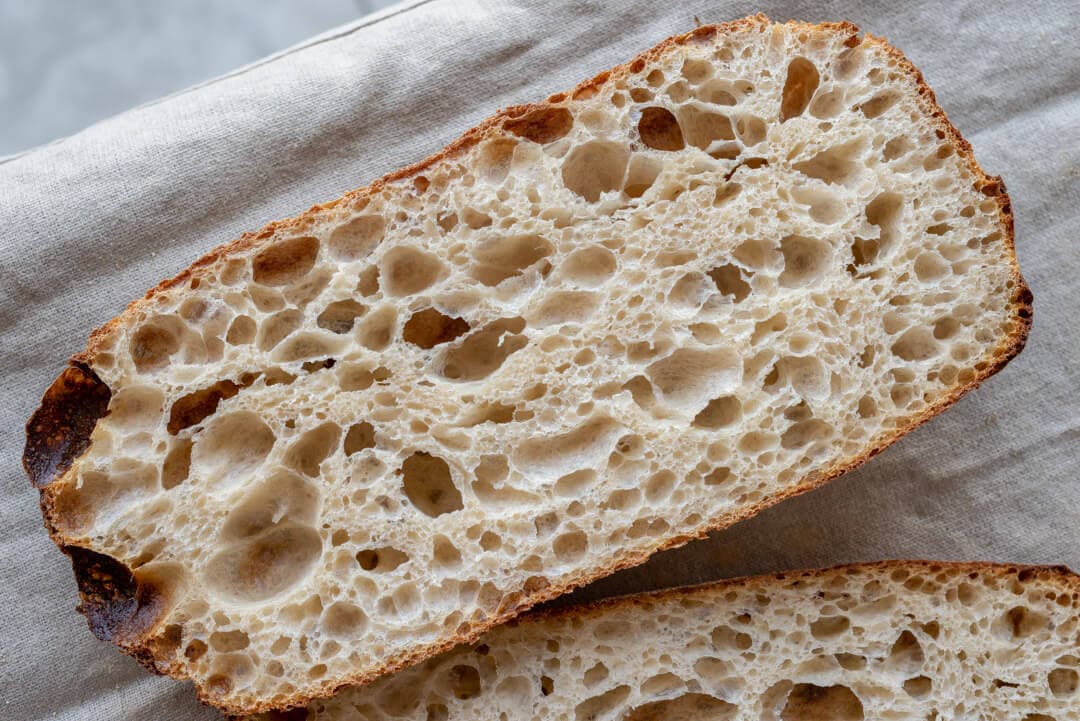
This bread is such a treat. It’s soft, incredibly open, and light in hand—almost like a bushel of puffy marshmallows bound together by a crust poised to shatter at the slightest pressure. It begs you to tear it with your hands and dunk it into the best olive oil in the pantry. That is, if you can stop cutting it in half and sandwiching delicious ingredients (I couldn’t, as you’ll see later). I hope this sourdough ciabatta bread recipe becomes a regular in your kitchen as it has been in mine.
Once you embrace its “hands-off” approach, you’ll find this is an incredibly easy bread to make.
While the appeal of this specialty bread is evident in its beautiful rustic crust and open crumb, working with a highly hydrated and wet dough can be challenging. But, once you embrace its “hands-off” approach, you’ll find this is an incredibly easy bread to make.
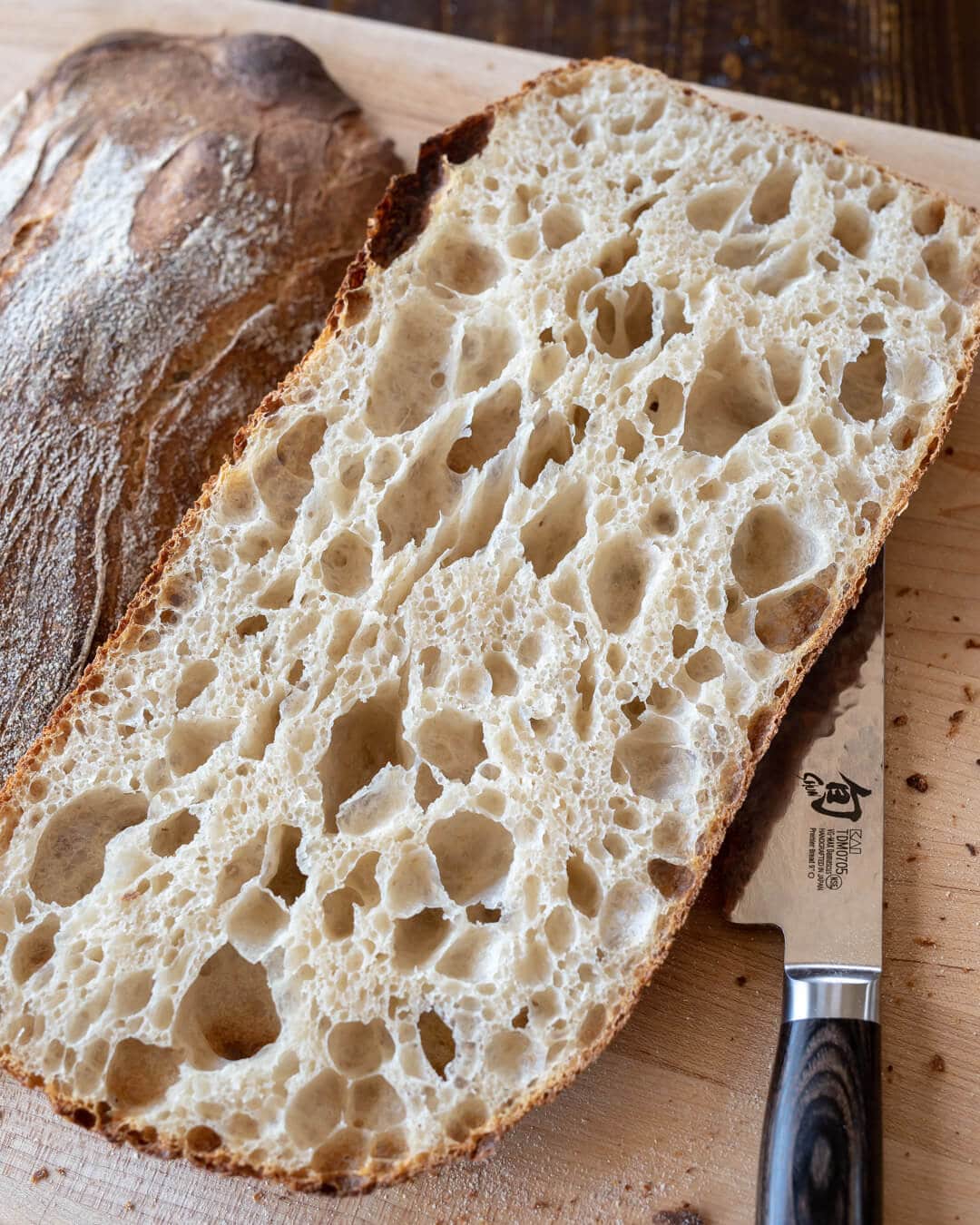
What is Ciabatta Bread?
Ciabatta is a rustic bread from Italy with a high hydration, chewy texture, thin crust, and wildly open crumb (interior). If you squint, you’ll see that the shape of the ciabatta loosely resembles a slipper (ciabatta means slipper in Italian) with a wide, sturdy crust and somewhat tubular shape. Smaller ciabatta panini are wildly popular in Italy, and even here in the United States, they’re the perfect little sandwich.
Flour Selection
Whole-Grain Flour for Ciabatta
I’ve iterated on this recipe utilizing a variety of grains, ranging from modern wheat to spelt to Khorasan (Kamut). When using 15% whole grain Khorasan, the grain imparts its characteristic golden hue and buttery, sweet flavor. The beauty of this formula is that the 15% can be used as a playground for whatever grain you fancy.
Whole-grain spelt sure was good—and you all know I have a soft spot for spelt—but I also enjoyed hard red whole wheat. So, if you don’t have Khorasan, swap that out for any whole wheat you have in your pantry.
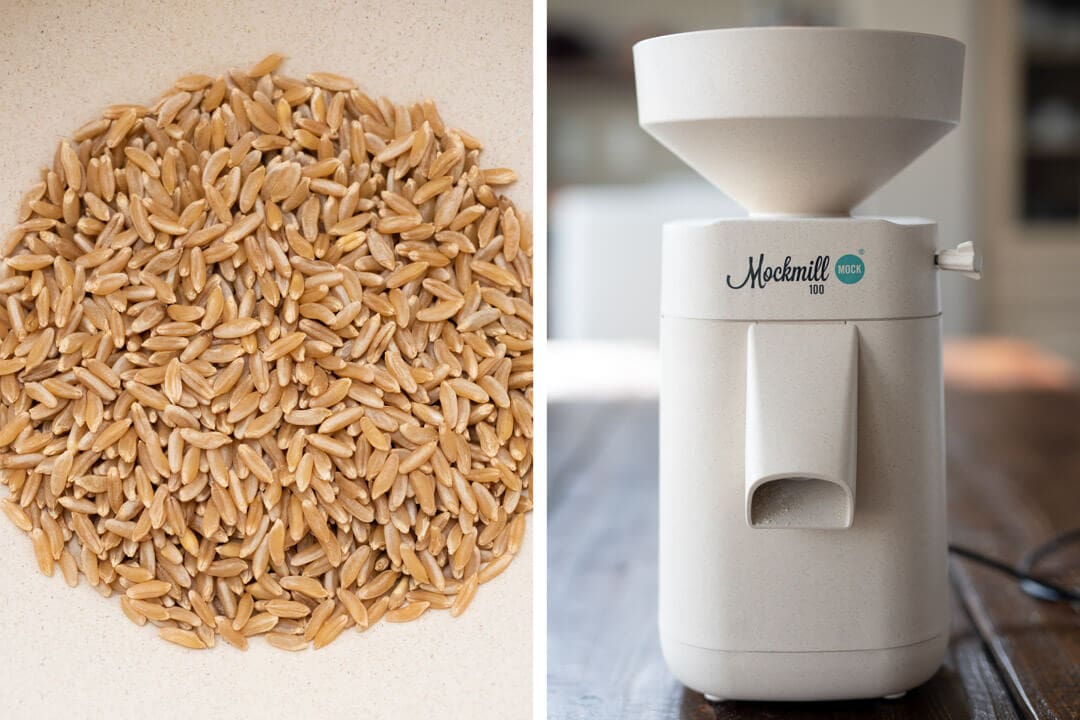
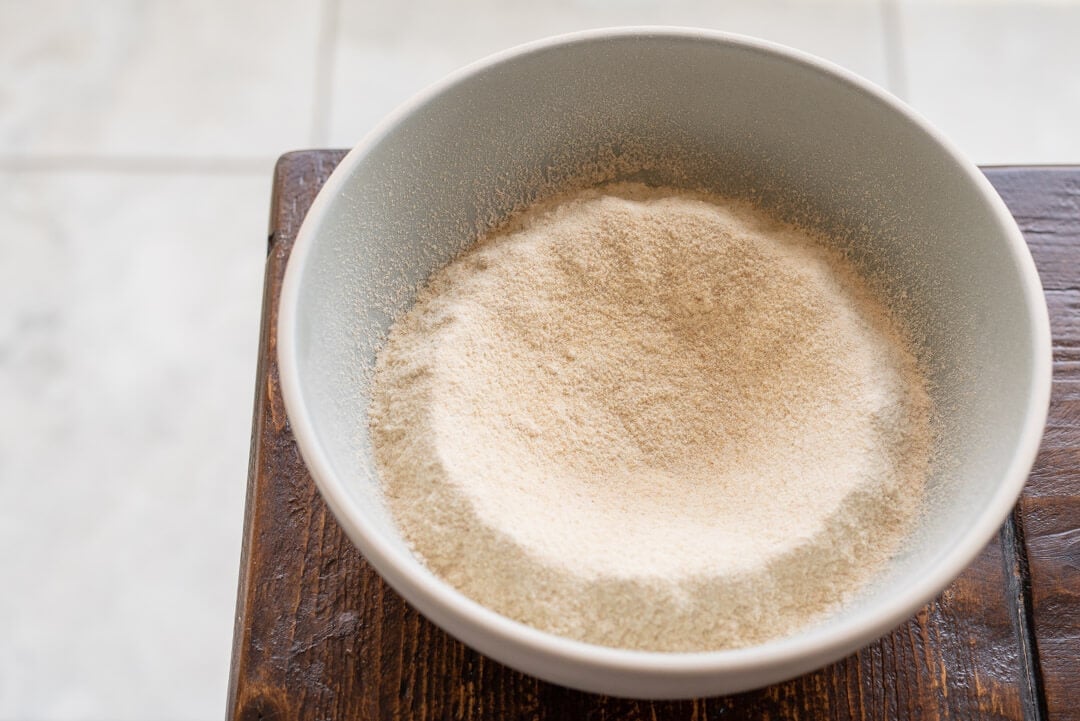
I milled the whole Khorasan berries into fine flour on my Mockmill 100 countertop mill. Because Khorasan is a relatively “hard” berry, it takes a bit longer to mill the grain, but it’s not a problem for the Mockmill.
High-protein White Flour for Ciabatta
I also use a large percentage of high-protein white flour in this formula. Why? In testing, I found that the high-protein flour helps support the high hydration of this dough and the added olive oil enrichment.
Generally, with bread formulas, I like to use as little high-protein flour as possible to avoid an overly gummy crust and interior. With high hydration doughs that have lots of inclusions (like seeds and nuts), though, the higher protein content gives the dough more structure to achieve a taller rise and more open interior.
Always a balancing act.
Mixing and the Bassinage Technique
What is the Bassinage Mixing Technique?
Bassinage is a French term that describes the process of adding water in several stages during mixing and kneading. This is helpful when working with highly hydrated dough, such as this, to increase mixing efficiency—it’s easier to develop a dough’s gluten when it’s at lower hydration levels. Adding water in two or more stages also helps you judge the consistency of the dough as you mix and avoid over-hydrating the dough.
If you’re a frequent reader here, you already know I do this often. It shows up in my recipes as a “Water 1” and “Water 2” in the recipe formula. Water 2 is held back until the dough is strengthened and smooths out. Then, it’s slowly added at the end of mixing to adjust the dough’s consistency. Holding back this water to avoid over-hydration and make mixing more manageable and efficient is essential. If all of the water is added at the start, it takes much longer to mix the dough to the right level of strength.
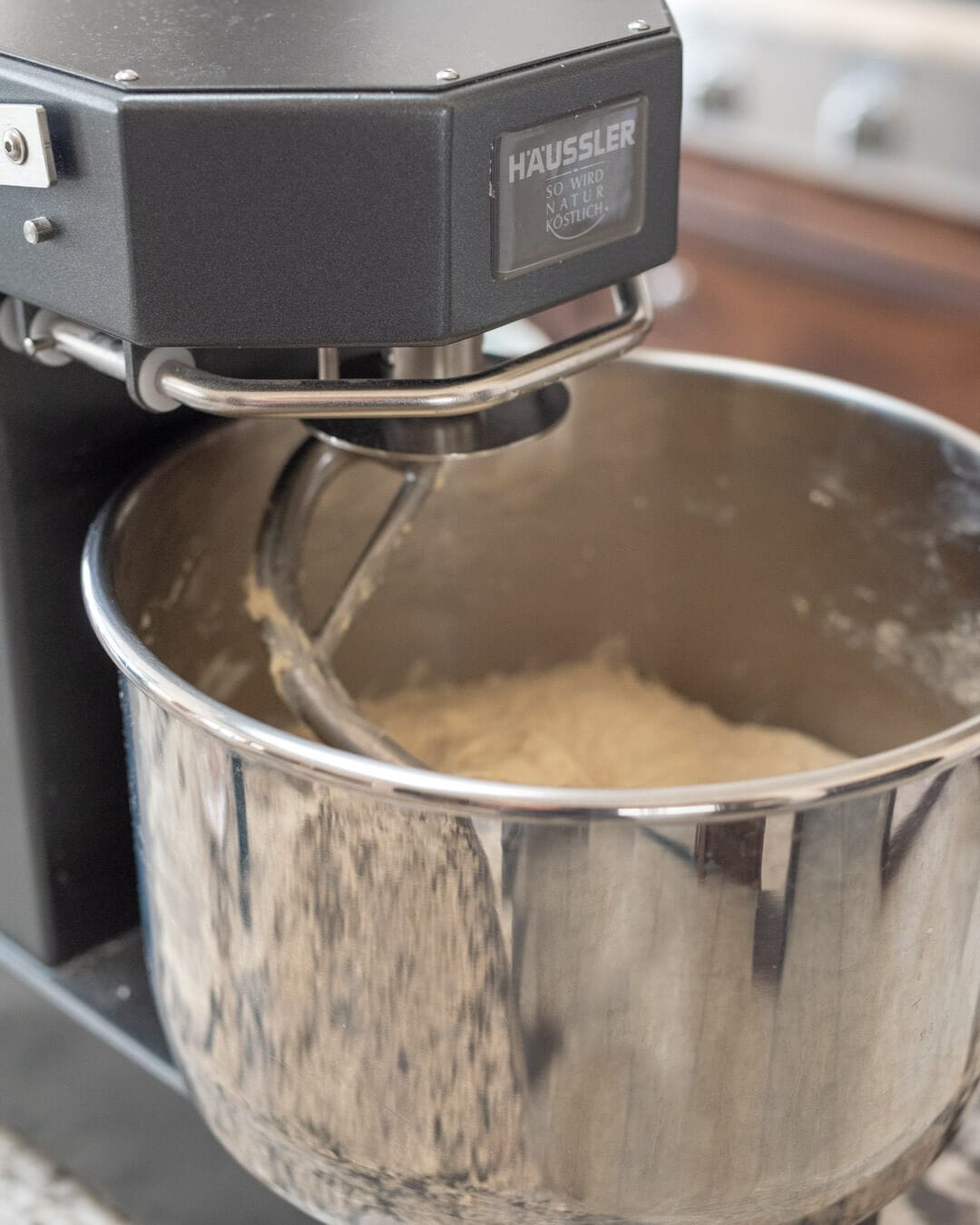
How to Mix Ciabatta with a Mechanical Mixer and By Hand
Mixing with a Mechanical Mixer
Due to its high hydration, this ciabatta dough benefits from mixing and kneading with a mechanical mixer such as a KitchenAid, Ankarsrum, or larger mixer like a Famag or Sunmix. These mixers are incredibly efficient at incorporating ingredients and developing the gluten in the dough, and when there’s a high water content, this is even more helpful.
Mixing By Hand
You can make this ciabatta dough all by hand, though. To do this, perform the autolyse as indicated in the recipe, perhaps extending it to 1 hour. This will help start the dough off with more strength. Then, slap and fold the dough on the counter or fold it in the bowl to strengthen it before adding more water—you want to lean into the bassinage technique when mixing by hand. Once you strengthen the dough significantly, add the water to the dough in stages while you’re mixing. Continue to mix the dough until it absorbs the remaining water.
At the end of mixing this dough by hand, it won’t be quite as smooth as it would be coming out of a mixer. To give the dough more strength, add in another set or two of stretches and folds during bulk fermentation.
Baking Schedule
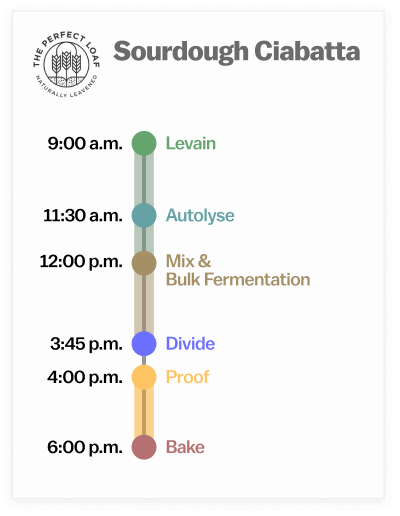
This sourdough ciabatta is a same-day, direct, recipe, meaning it’s mixed and baked in the same day. The fast levain can be created in the morning, the dough mixed 3 hours later, and then the ciabatta baked early evening for dinner.
If you’d like to do an overnight levain or change its timing, take a look at my options on my levain quicksheet reference.
Sourdough Ciabatta Bread Recipe
Recipe Update!
I recently updated this sourdough ciabatta to streamline the process and make the dough much more manageable—especially if you’re not using freshly milled flour. If you’d still like to follow the old recipe, I’ve saved it and have it for download. However, I urge you to try the new version below. I feel like the dough is more straightforward, and the results are even a little better!
Here’s a link to the old sourdough ciabatta recipe.
Use baker’s percentages to scale up or down this recipe. For example, if you’d like to make only two large ciabatta, divide all the ingredients in half (including the levain).
Vitals
| Total dough weight | 2,000 grams |
| Prefermented flour | 6.5% |
| Levain in final dough | 20.9% |
| Hydration | 80.0% (does not include olive oil) |
| Yield | 4 x 500g ciabatta (or 6 x 330g smaller ciabatta) |
Total Formula
Desired dough temperature: 78°F (25°C) (see my post on the importance of dough temperature).
| Weight | Ingredient | Baker’s Percentage |
|---|---|---|
| 945g | High-protein bread flour (King Arthur Flour Bread Flour, 12.7% protein) | 90.0% |
| 105g | Freshly milled whole-grain Khorasan wheat or hard red whole-grain wheat | 10.0% |
| 756g | Water 1 (levain, autolyse) | 72.0% |
| 84g | Water 2 (mix) | 8.0% |
| 21g | Extra-virgin olive oil | 2.0% |
| 20g | Fine sea salt | 1.9% |
| 68g | Ripe sourdough starter, 100% hydration | 6.5% |
Sourdough Ciabatta Bread Method
1. Prepare the levain – 9:00 a.m.
| Weight | Ingredient | Baker’s Percentage |
|---|---|---|
| 68g | High-protein bread flour | 100.0% |
| 68g | Water | 100.0% |
| 68g | Ripe sourdough starter (100% hydration) | 100.0% |
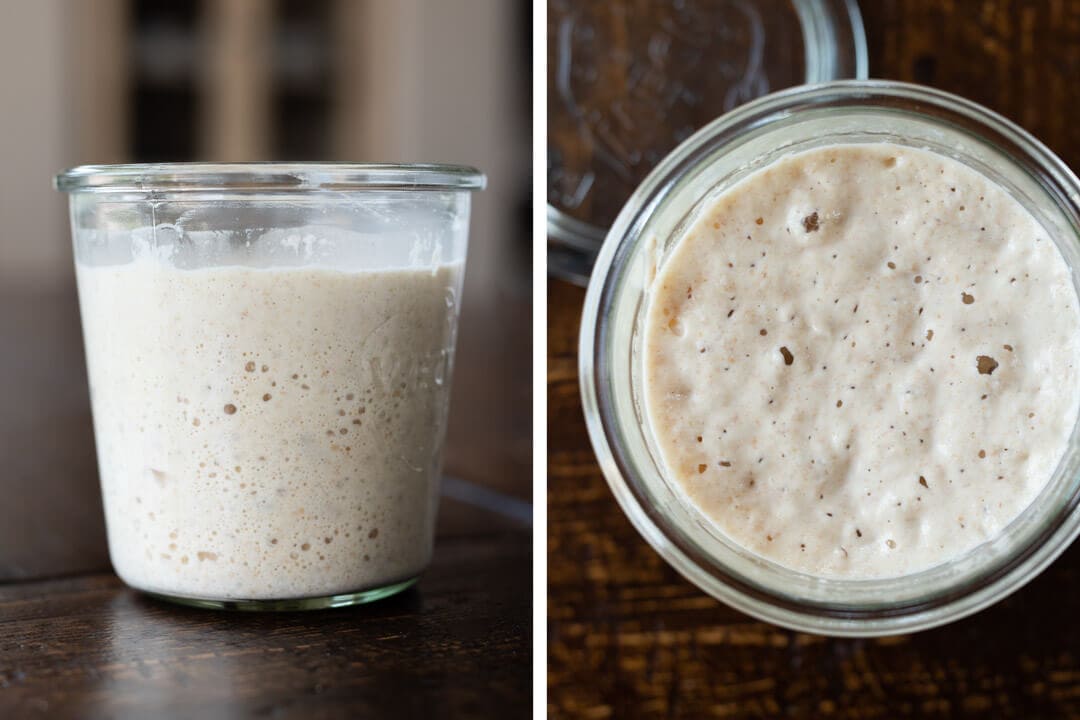
This is a fast levain build: we go from feeding to ripeness in only 3 hours. The high inoculation percentage and warm temperature expedite the ripening of this levain, but it also helps emphasize yeast activity for large volume in the final ciabatta.
Mix the above ingredients in a jar and leave them covered at 74-76°F (23-24°C) to ripen for 3 to 4 hours.
2. Autolyse – 11:30 a.m.
| Weight | Ingredient |
|---|---|
| 876g | High-protein bread flour (King Arthur Flour Bread Flour, 12.7% protein) |
| 105g | Freshly milled whole-grain Khorasan wheat or hard red whole-grain wheat |
| 687g | Water 1 (autolyse) |
I use the autolyse technique for this recipe to help reduce the total mixing time required, but I also find it helps aid in the dough’s extensibility.
Warm or cool the autolyse water so that the temperature of the mixed dough meets the final dough temperature (FDT) of 78°F (25°C) for this recipe. To do this, use my water temperature calculator to input the temperature of your kitchen and your ingredients to have it automatically calculate precisely what temperature to heat or cool the mixing water.
Place the flour and remaining water 1 (autolyse) in your mixer bowl or a large bowl (if mixing by hand). Turn the mixer on to low speed and mix for 2 minutes until no dry bits remain; the dough will be shaggy and loose. Use a bowl scraper to scrape down the sides of the bowl to keep all the dough in one area at the bottom. Cover and let rest for 30 minutes.
3. Mix – 12:00 p.m.
| Weight | Ingredient |
|---|---|
| 84g | Water 2 (mix) |
| 21g | Extra-virgin olive oil |
| 20g | Fine sea salt |
| 204g | Ripe levain (from step 1) |
To the mixer, add the levain, salt, and a splash of the reserved water. Mix on speed one until everything is incorporated, about 30 seconds. Then, switch the mixer to speed 2 and mix for 4 minutes. After 4 minutes, start adding the rest of the reserved water, a little bit at a time, throughout an additional 4 minutes for a total of 8 minutes mix time.
Turn the mixer to speed 1 and slowly stream in the olive oil. Continue to mix until the oil is absorbed and the dough is cohesive and shiny about 2 minutes.
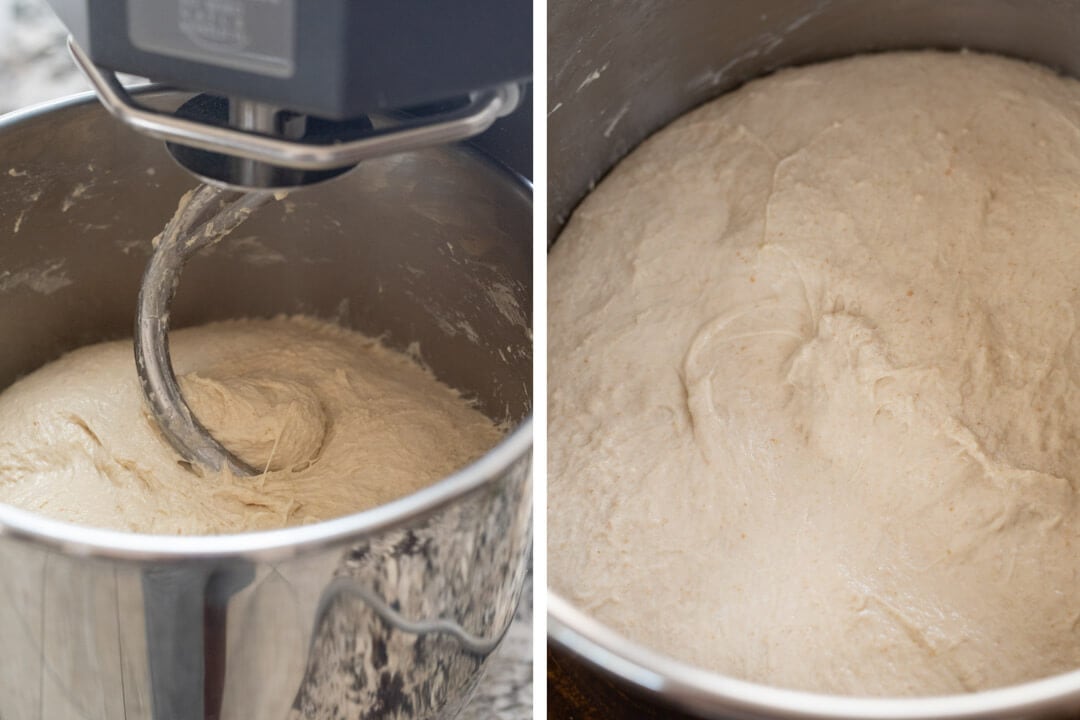
As you can see in the mixing progress images above (left: after mixing 4 minutes, and right: at the end of mixing), the dough will still be plenty wet and sticky by the end of mixing, but smoother and with some strength. At the end of mixing the dough will not pass a full windowpane test, but will come very close. Be sure to mix this dough sufficiently!
4. Bulk Fermentation – 12:15 p.m. to 3:45 p.m. (3 hours 30 minutes)
For bulk fermenting this dough I used the 11-quart Rubbermaid rectangular tub, which is the perfect size for 2 kg of dough (and more). It makes dividing the dough into four equal rectangles much more straightforward: when the container is inverted, it drops the dough into a perfect rectangle.
During this phase (of the two-step bulk fermentation phase), give the dough 3 sets of vigorous stretch and folds separated by 30 minutes each. The first set happens 30 minutes after the beginning of bulk. The dough will be very slack and wet. Use wet hands and perform the folds quickly.
After the last set of stretch and folds, let the dough rest for the remainder of bulk fermentation, covered.
5. Divide – 3:45 p.m.
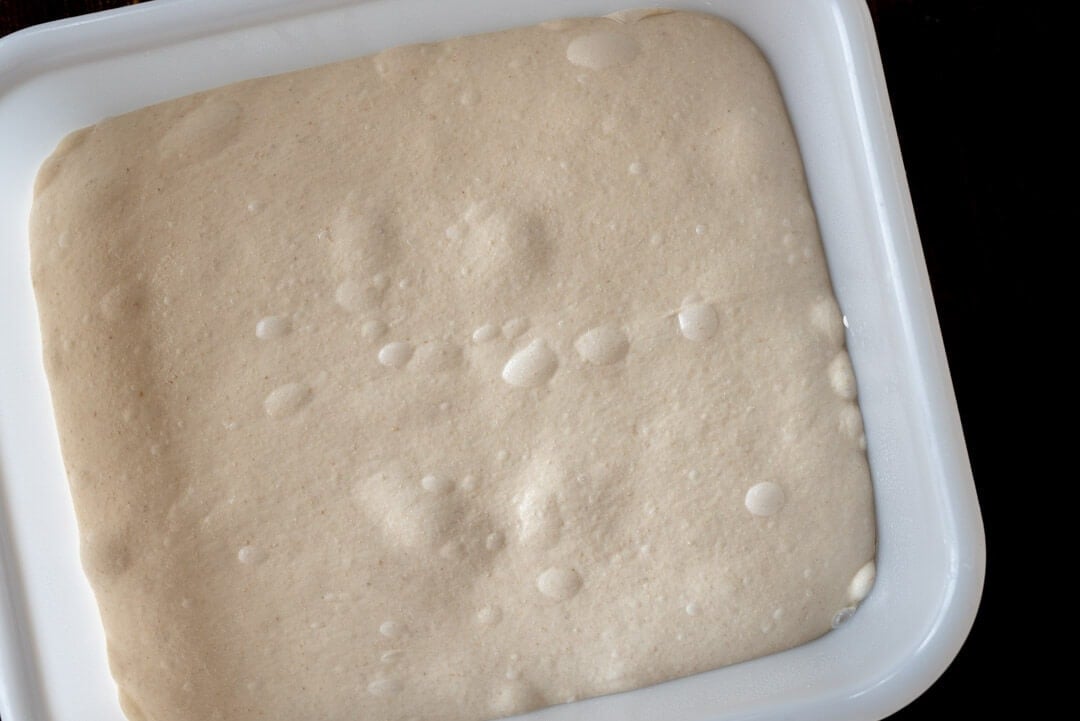
To maintain an open and light interior, try to handle this dough as little as possible.
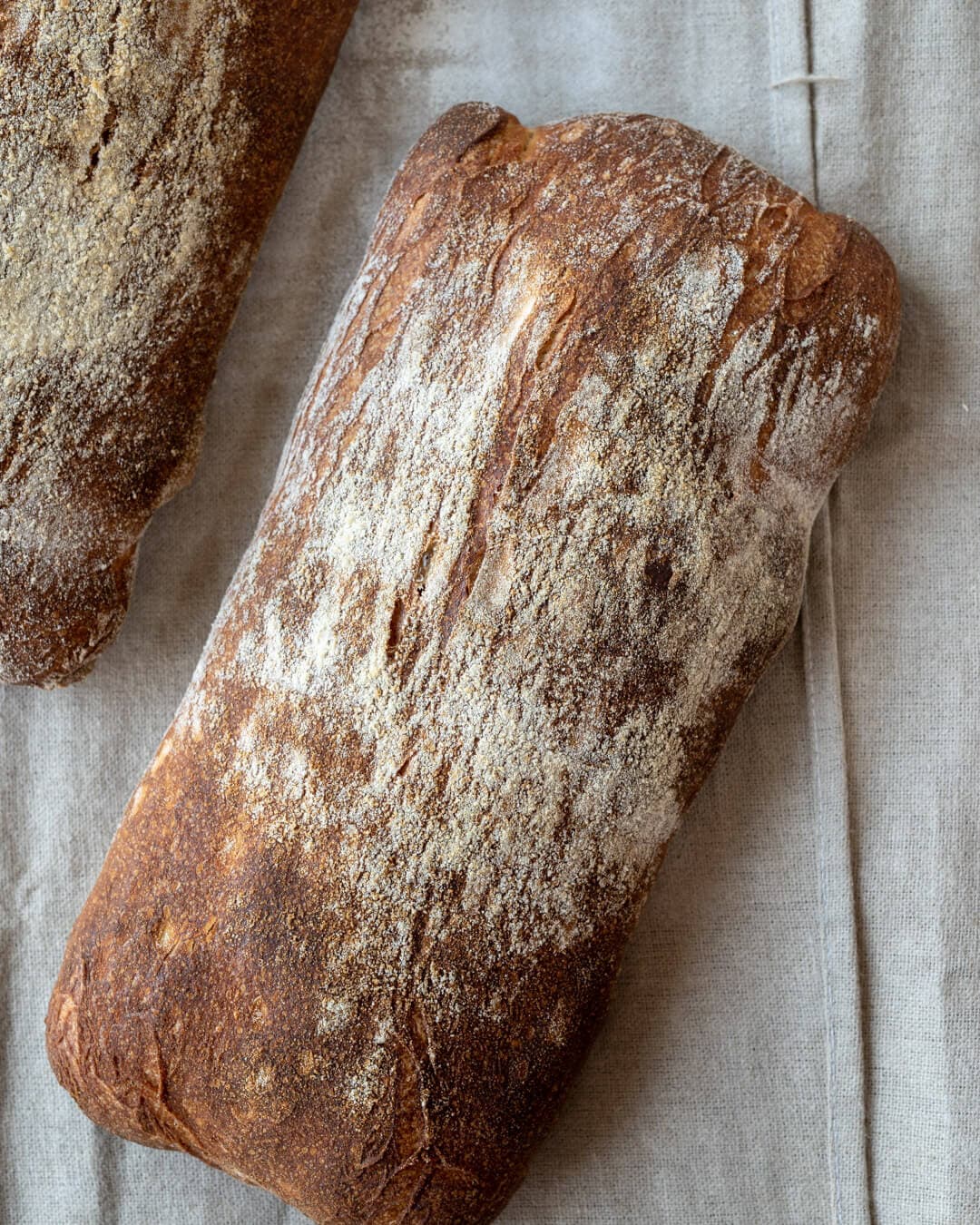
First, put aside any notion of using only a small amount of bench flour when handling this dough. The heavy use of dusting flour not only allows you to control the dough more naturally but also makes it possible. And anyway, the thin veil of flour on the crust adds to the classic look of ciabatta and adds visual appeal.
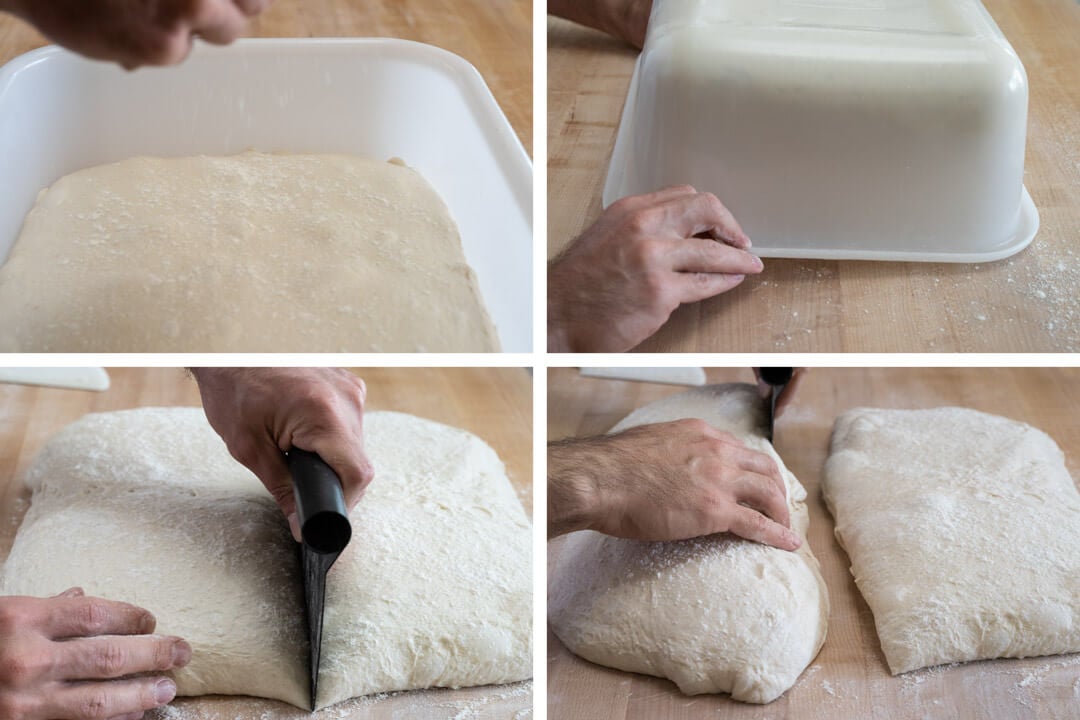
Heavily dust the top of your dough in the bulk fermentation container with white flour.
Using your bench scraper, loosen the dough from the sides (insert your scraper between the dough and the container). Then, in one quick motion, invert the rectangular bin and let the dough fall from the inside of the container down to your work surface (upper-right image above). Liberally flour the new top of the dough. Using your bench knife, cut the dough into four rectangles and separate them by dragging them apart.
You will use the couche in the same fashion as when making baguettes, but the “wells” are much wider to accommodate the pudgy ciabatta.
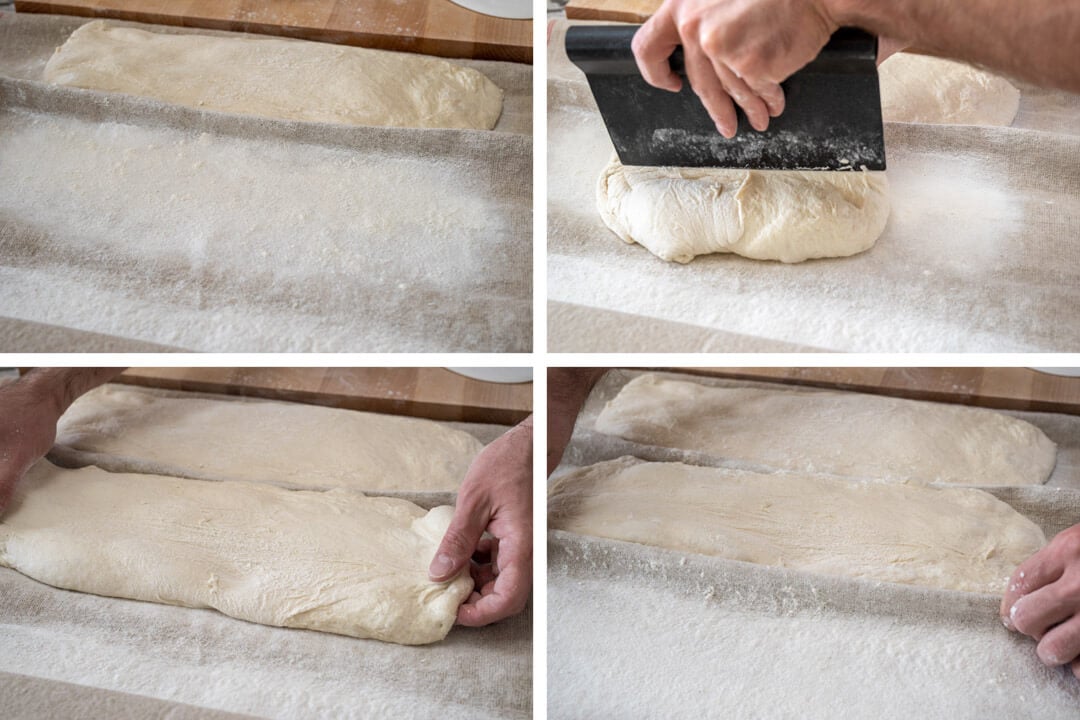
Lay your couche (a large kitchen towel also works well) out on your work surface and flour it very liberally (upper-left image, above). You want to be generous with the flour to avoid sticking.
Using your bench knife grab one of the four rectangles and transfer it to the couche. I like to keep the dough the same way it was resting on the work surface: the bottom stays on the bottom when transferring. Next, using your hands gently stretch the rectangle out as tall as you desire (for me this was about 14″ to fit my home oven).
Instead of stretching them out into long ciabatta, you can also keep them in smaller rectangles about 6-7 inches long.
Finally, make a crease in the couche and flour the new spot to get ready for the next piece.
6. Proof – 4:00 p.m. to 6:00 p.m.
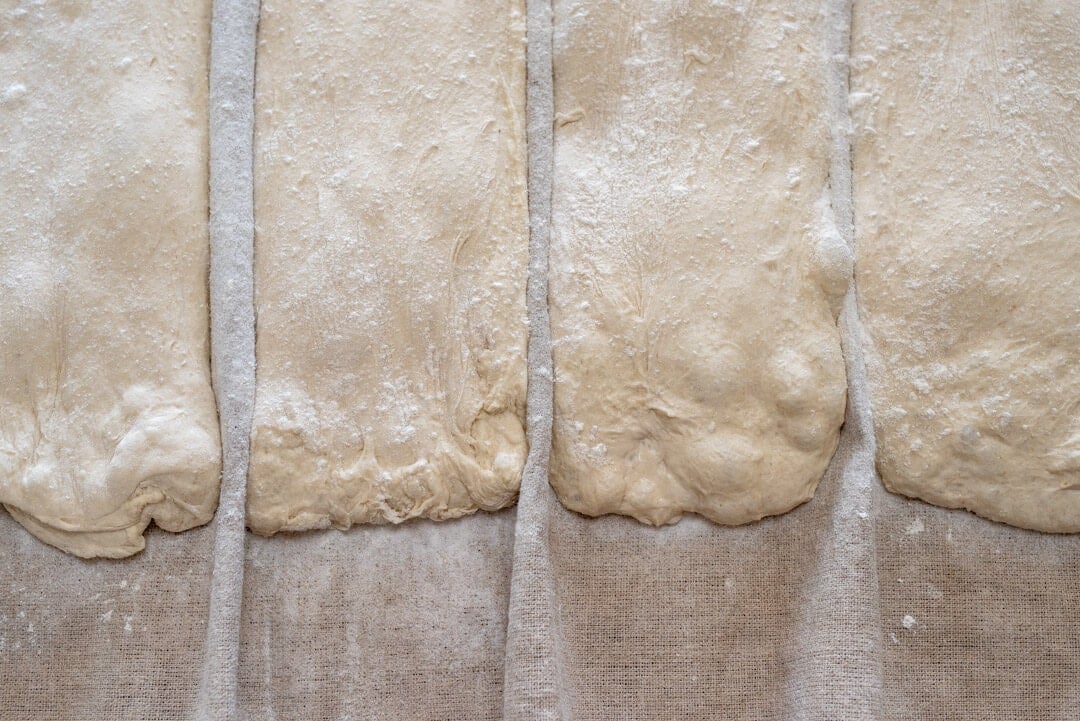
Cover your dough with the end of the couche or a food-safe plastic bag (be sure not to let the plastic touch the dough). Let your dough proof for around 2 hours. At the end of this time, the dough will look significantly fermented and bubbly all over, and when poked for the poke test, it will almost have little to no spring back.
7. Bake – 6:00 p.m.
There are two effective ways you can bake ciabatta in the home oven. The first is to transfer all the pieces of dough to a full sheet pan (21 x 15 inches) lined with parchment paper, then slide the pan into the oven on a baking surface (or empty oven rack). This is the easiest method, but it may (just may!) result in a little less rise in the oven due to the slightly less efficient heat transfer than baking directly on the baking steel.
The second option is to bake the pieces of dough directly on a baking surface such as a baking steel or baking stone. This is the method I will outline below.
Preheat your oven with baking stone/steel for half an hour at 450°F (230°C).
Prepare a single, large piece of parchment paper that will cover your entire baking stone or baking steel. Flour the top of the resting dough to ensure there are no sticky parts. Then, using a large, straight cutting board placed at the edge of a piece of dough, grab the couche and flip each portion out onto the cutting board: what was resting on the bottom is now on the top. Transfer the dough to the parchment paper by sliding it off the cutting board to one side of the parchment paper. The process for flipping the dough is the same as shown/described on my Kamut baguette post, only with a broader cutting board in place of the thin transfer peel.
Place the other two pieces of dough into your fridge; you will bake these after the first two.
Slide the parchment paper with dough onto your baking surface using a pizza peel. Once you’ve loaded the dough, steam the oven and bake for 20 minutes with steam. Then, remove the pans used for steaming, vent the oven, and turn it down to 425°F (220°C). Bake for an additional 15 to 20 minutes until done. The crust should be golden brown with no pale or white spots.
It’s important to bake this bread fully—if underbaked, it could result in a gummy and “wet” interior.
I steamed my oven in my usual way, described here in my post on how to steam your home oven when baking bread.
Print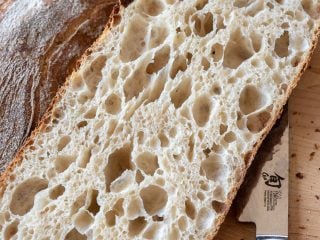
Sourdough Ciabatta Bread Recipe
- Prep Time: 9 hours
- Cook Time: 45 minutes
- Total Time: 9 hours 45 minutes
- Yield: 4 loaves
- Category: Bread, sourdough
- Cuisine: Italian
Description
Rustic bread with a thin crust, creamy and open crumb, and delicate flavor profile. Ciabatta is perfect for sandwiches!
Ingredients
Levain
- 68g high-protein white bread flour (King Arthur Bread Flour)
- 68g water
- 68g ripe sourdough starter (100% hydration)
Autolyse
- 876g high-protein white bread flour
- 105g freshly milled Khorasan or hard red whole wheat
- 686g water
Main Dough
- 84g water
- 21g extra-virgin olive oil
- 20g fine sea salt
- 204g ripe levain
Instructions
- Prepare the levain – 9:00 a.m.
Mix the levain ingredients in a jar and leave them covered at 74-76°F (23-24°C) to ripen for 3 to 4 hours. - Autolyse – 11:30 a.m.
Place the flour and autolyse water in your mixer bowl or a large bowl (if mixing by hand). Turn the mixer on to low speed and mix for 2 minutes until no dry bits remain; the dough will be shaggy and loose. Use a bowl scraper to scrape down the sides of the bowl to keep all the dough in one area at the bottom. Cover and let rest for 30 minutes. - Mix – 12:00 p.m.
To the mixer, add the levain, salt, and a splash of the reserved water. Mix on speed one until everything is incorporated, about 30 seconds. Then, switch the mixer to speed 2 and mix for 4 minutes. After 4 minutes, start adding the rest of the reserved water, a little bit at a time, throughout an additional 4 minutes for a total of 8 minutes mix time. Turn the mixer to speed 1 and slowly stream in the olive oil. Continue to mix until the oil is absorbed and the dough is cohesive and shiny about 2 minutes. - Bulk Fermentation – 12:15 p.m. to 3:45 p.m. (3 hours 30 minutes)
During this phase (of the two-step bulk fermentation phase), give the dough 3 sets of vigorous stretch and folds separated by 30 minutes each. The first set happens 30 minutes after the beginning of bulk. The dough will be very slack and wet. Use wet hands and perform the folds quickly. After the last set of stretch and folds, let the dough rest the remainder of bulk fermentation, covered. - Divide – 3:45 p.m.
Heavily dust the top of your dough with white flour. Loosen the dough from the sides using a bench scraper, then invert the container to let the dough fall onto your work surface. Flour the new top of the dough, cut it into four rectangles, and separate them. Lay out a floured couche (or kitchen towel) on your work surface. Transfer each dough rectangle to the couche, keeping the bottom side down. Gently stretch the dough to your desired length. If you prefer, leave them in smaller rectangles. Make a crease in the couche and flour it before placing the next piece. - Proof – 4:00 p.m. to 6:00 p.m.
Cover your dough with the end of the couche or a food-safe plastic bag (be sure not to let the plastic touch the dough). Let your dough proof for around 2 hours. At the end of this time, the dough will look significantly fermented and bubbly all over, and when poked for the poke test, it will almost have little to no spring back. - Bake – 6:00 p.m.
Preheat your oven with a baking stone or steel at 450°F (230°C) for 30 minutes. Flour the dough and flip each piece onto a large cutting board, then slide them onto parchment paper. Transfer two pieces to the fridge for later. Use a pizza peel to slide the parchment and dough onto the baking surface. Steam the oven and bake for 20 minutes, then remove steam pans, vent the oven, and reduce heat to 425°F (220°C). Bake for another 20-25 minutes until fully done to avoid a gummy interior.
Ciabatta FAQs
Can I mix this dough by hand?
It’s possible, but I do recommend using a mixer. If mixing by hand, hold back the reserved water (Water 2) until after mixing in the bowl or on the counter for a while to develop the dough. Once you strengthen the dough significantly, add the water to the dough in stages in a mixing bowl. Continue to mix the dough until it absorbs the remaining water.
Can I modify this recipe to make ciabatta rolls?
Small ciabatta panini are wonderful. I’d dump the rectangular dough out and divide it into six identical pieces (around 330g each). You could go even smaller if desired. Note that the bake time will likely change. Smaller pieces will bake faster.
Can I use a round bulk container for this dough instead of a rectangular one like you use?
You bet. Though, it will require more dough-handling to get each shape into rectangles.
Is ciabatta similar to focaccia?
They are pretty different. Focaccia can be high hydration like ciabatta, but it’s proofed in a pan, spread and dimpled out with fingers, and then topped (usually with salt and herbs) before baking. Conversely, Ciabatta is proofed on a flat surface or on a couche to give it structure, then transferred to the oven and baked.
What’s Next?
Now that you’ve mastered sourdough ciabatta, try your hand at another tast—and fun-to-make—Italian bread: filoncini (kind of like twisted baguettes).
Happy baking!


190 Comments
How can I make this into an artisan style ciabatta bread? Any thoughts
I’ve had no success with this recipe. I think the issue is my starter takes longer to get going at the 1:1:1 levain in three hours. Could I use a fed starter or just give the levain more time to get going. My kitchen is around 68 F in the winter. I put my starter in my microwave with a cup of hot water to keep it warm.
Ah yes, that’s very cold. For a fast levain like this, you really need to keep it warm. Use warmed water, to 90F, to make this levain. Then try to wrap it in a towel to keep it warm. You can use it at 4-5 hours, too, if it doesn’t look ripe enough!
Hello, I’m wondering, well hoping, you are planning on making a video making the ciabatta bread. You are aware that working with this dough is very different with the high hydration and a video would be very helpful and very much appreciated. Thank you!!
Getting to this very soon, Cecelia!
You mentioned in your newsletter today doing this with 00 flour. Would swap all of the bread flour or just a portion / and any other adjustments? I happen to have a bag of 00 that I need to use up and want to give it a try…
You could do a blend if you'd like. Keep in mind though that 00 will not absorb as much water so you might need to decrease the hydration depending on how much you use.
Hi Mauricio – looking forward to trying your ciabatta recipe but there are only 2 of us at home now. If I want to half the recipe, are there any special adjustments that you recommend or would I just cut each ingredient by 50%?
Nope, just divide everything by two!
My go-to bread flour these days is Cairnspring Glacier Peak, a T55 flour they rate as 13-14% protein. For my country loaf, I typically use 15% whole grain (usually rouge de Bordeaux and rye, both I mill with my Mockmill). For your ciabatta, would you recommend similar flour %?
Having a hard time finding Khorasan or hard red whole wheat. Any good more readily available subs? TIA!
Any whole wheat will work well!
Hi Maurizio,
Can i do a cold retard for the ciabata? If yes, please share the when do i start the cold retard and how long can i cold retart the ciabata. Thank you.
Yes, you can. After 2 hours in bulk fermentation, place the bulk container into the fridge.
How long should you leave out the dough on counter once you take out of the fridge? Or should I put it back into my proofing oven?
How long should you leave out the dough on counter once you take out of the fridge? Or should I put it back into my proofing oven?
Hi there! Any tips on baking these in a Rofco as far as temp and timing?
I tested these in my RackMaster, which should be similar to you for the Rofco, and I used my typical baking times listed on both pages!
What did my neighbors think when they saw me shaking out that white dust from my couche? It is a risk of baking ciabatta. I refrigerated the dough (after bulk ferment) in the early evening so I could devote the next day to complete the shaping and baking. I made 8 rolls and 2 loaves. Loaves proofed on parchment paper that I did not dust with flour – big mistake. This is how I learn. I probably baked the rolls too long but the flavor, open crumb and wonderful texture is all there. I will definitely bake this again.
Ha ha ha, love this, Phyllis. Glad they mostly worked out for you, these do always take a little fine tuning to get them right for your oven and environment. I trust improvements have been made!
Can I do part of the bulk (after the stretch and folds) in the fridge? If so, about how many hours? Was hoping to do that bit overnight.
Yes, usually I do 2 hours in warm bulk, then into the fridge.
Hello! I baked these and I thought all was going well… the dough seemed very well proofed. That being said, when I baked them they sprang up so much and the result was a very delicious and well made ciabatta on the bottom third with a dome of air and barely any bread on the top third. A giant disappointment as they looked amazing. The only change I made was that I kept the shorter initial proof with long cold proof from the old recipe, otherwise I followed this one exactly. Any ideas? Maybe too high of starter inclusion? Overproofed? I’ve never had an overproofed dough creat this shell… they usually just collapse.
This can often happen with ciabatta. My guess here is over hydration for your flour!
Hi Maurizio,
Many thanks for the recipe and of course this rich content website .
If I want to use "ready dry yeast" for this recipe , then how much would it be?
Thanks indeed
You're very welcome! I'm not sure, it really depends on your timeline. I would say maybe 1% yeast.