

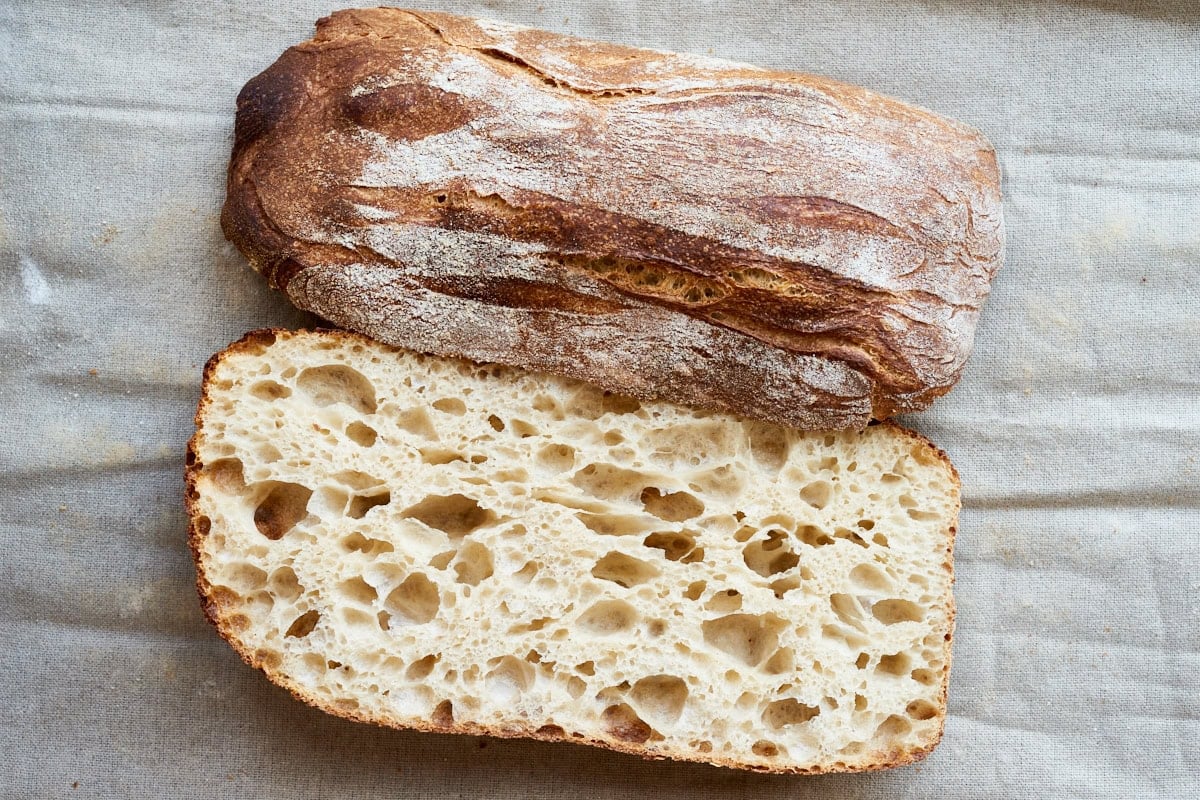
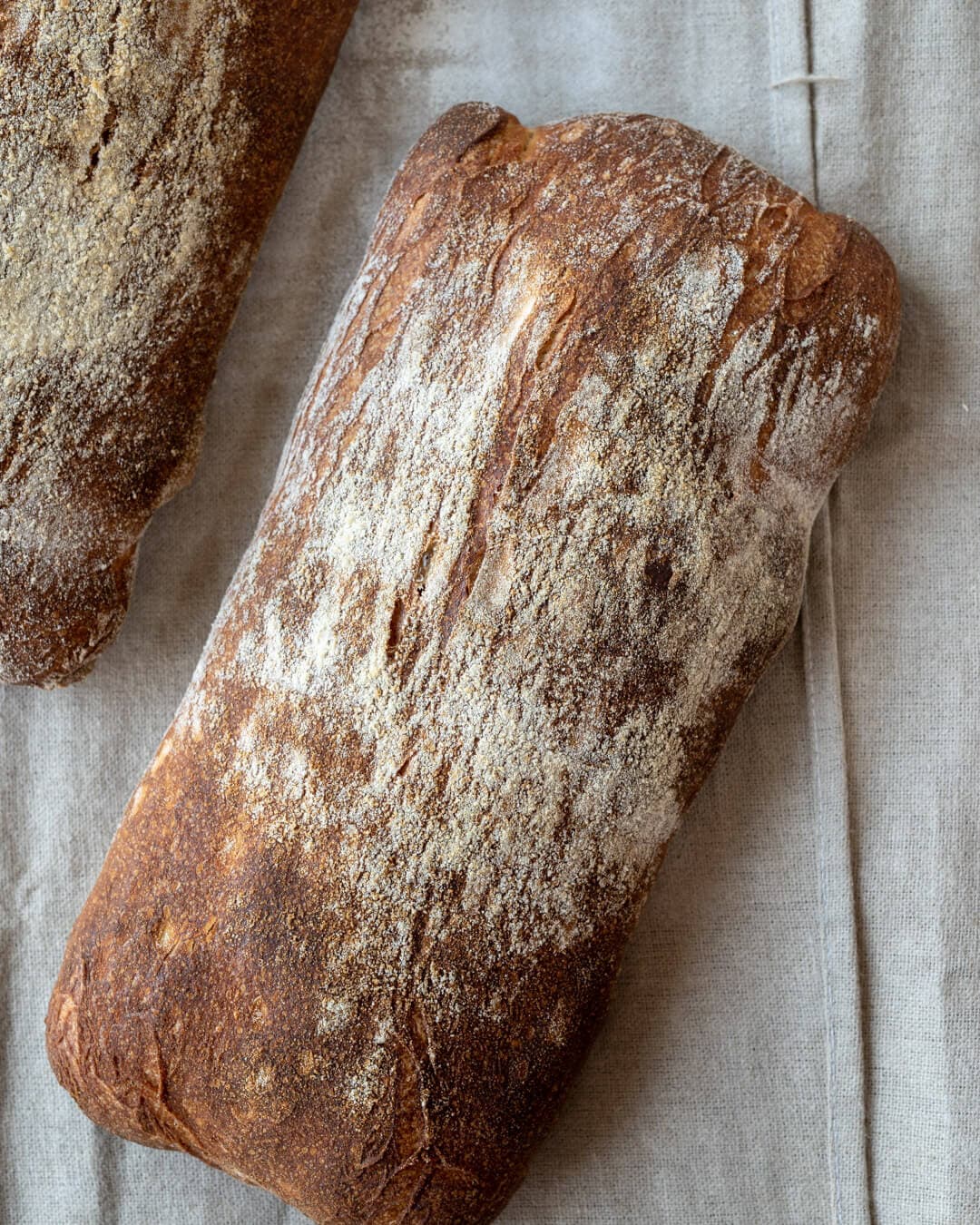
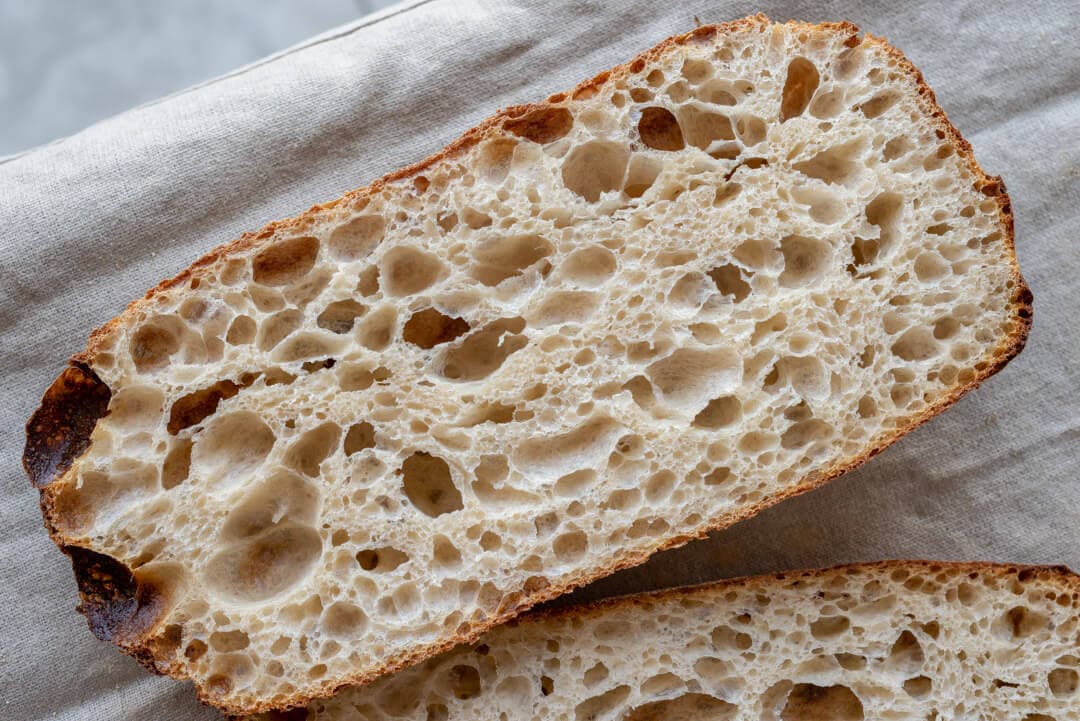
This bread is such a treat. It’s soft, incredibly open, and light in hand—almost like a bushel of puffy marshmallows bound together by a crust poised to shatter at the slightest pressure. It begs you to tear it with your hands and dunk it into the best olive oil in the pantry. That is, if you can stop cutting it in half and sandwiching delicious ingredients (I couldn’t, as you’ll see later). I hope this sourdough ciabatta bread recipe becomes a regular in your kitchen as it has been in mine.
Once you embrace its “hands-off” approach, you’ll find this is an incredibly easy bread to make.
While the appeal of this specialty bread is evident in its beautiful rustic crust and open crumb, working with a highly hydrated and wet dough can be challenging. But, once you embrace its “hands-off” approach, you’ll find this is an incredibly easy bread to make.
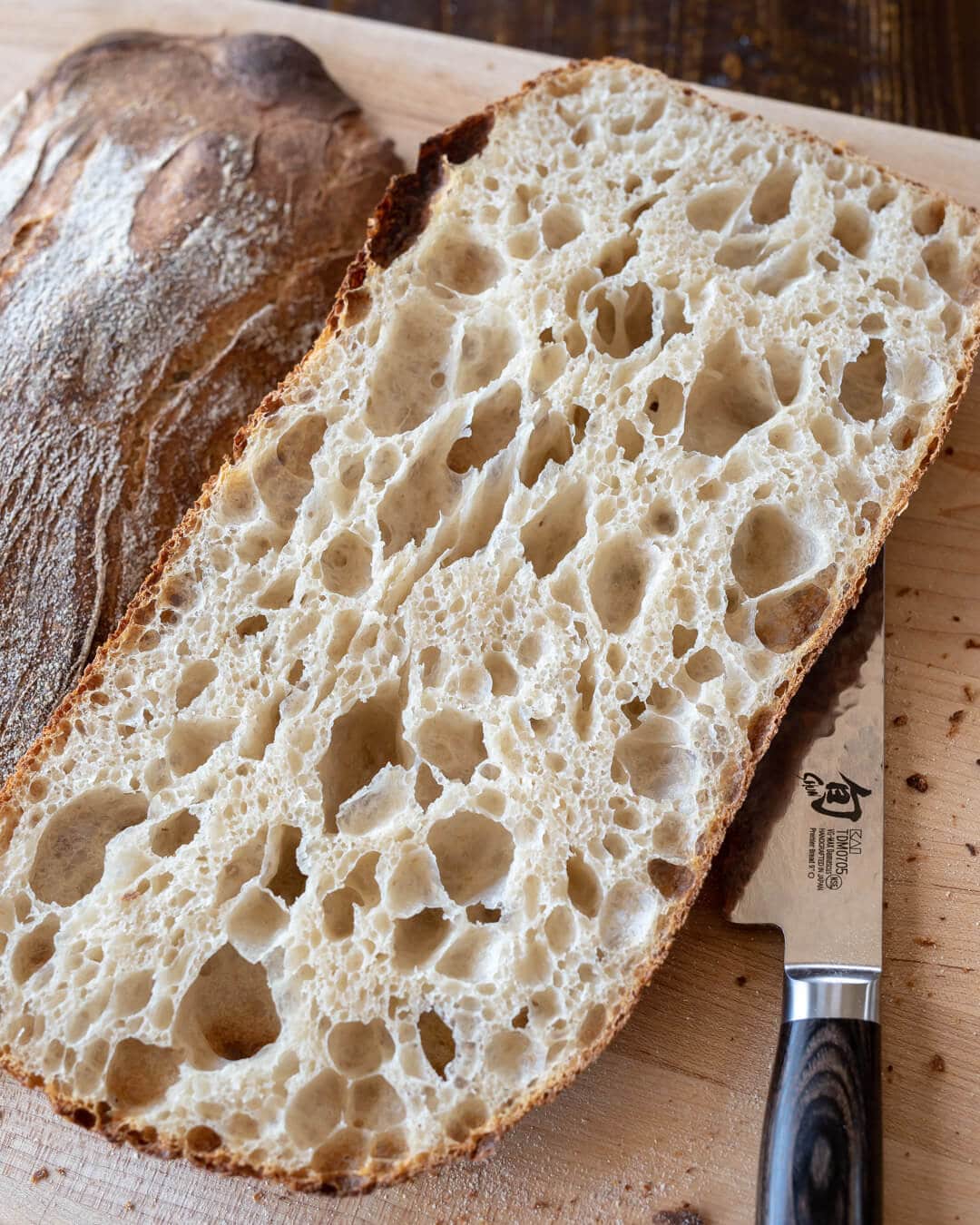
What is Ciabatta Bread?
Ciabatta is a rustic bread from Italy with a high hydration, chewy texture, thin crust, and wildly open crumb (interior). If you squint, you’ll see that the shape of the ciabatta loosely resembles a slipper (ciabatta means slipper in Italian) with a wide, sturdy crust and somewhat tubular shape. Smaller ciabatta panini are wildly popular in Italy, and even here in the United States, they’re the perfect little sandwich.
Flour Selection
Whole-Grain Flour for Ciabatta
I’ve iterated on this recipe utilizing a variety of grains, ranging from modern wheat to spelt to Khorasan (Kamut). When using 15% whole grain Khorasan, the grain imparts its characteristic golden hue and buttery, sweet flavor. The beauty of this formula is that the 15% can be used as a playground for whatever grain you fancy.
Whole-grain spelt sure was good—and you all know I have a soft spot for spelt—but I also enjoyed hard red whole wheat. So, if you don’t have Khorasan, swap that out for any whole wheat you have in your pantry.
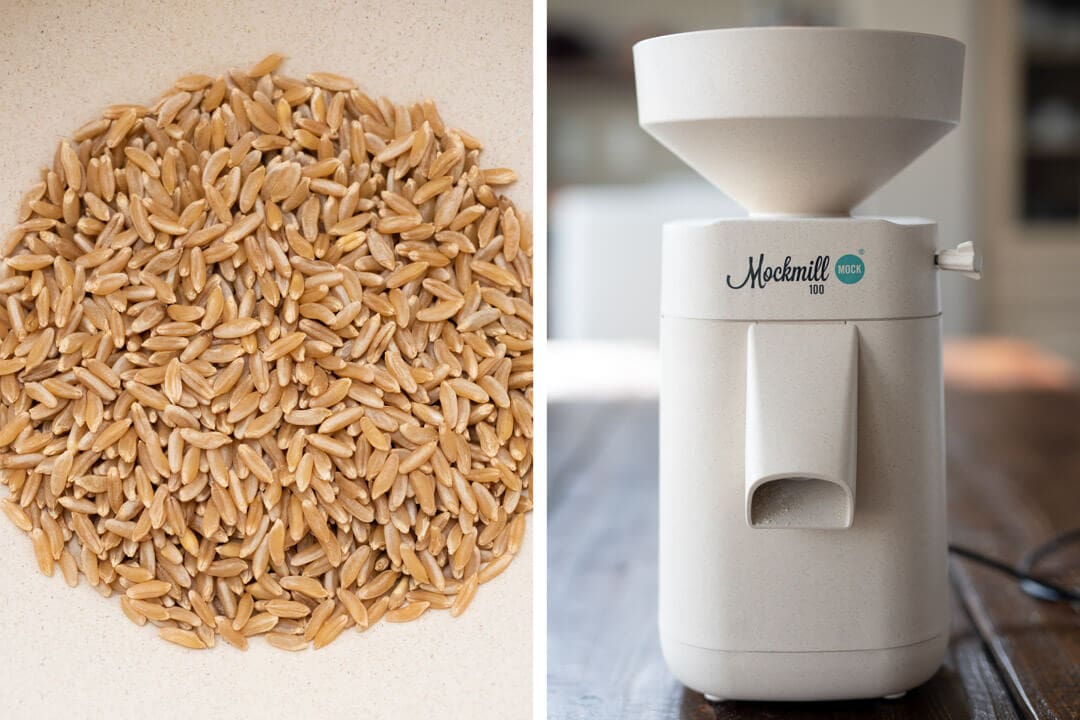
I milled the whole Khorasan berries into fine flour on my Mockmill 100 countertop mill. Because Khorasan is a relatively “hard” berry, it takes a bit longer to mill the grain, but it’s not a problem for the Mockmill.
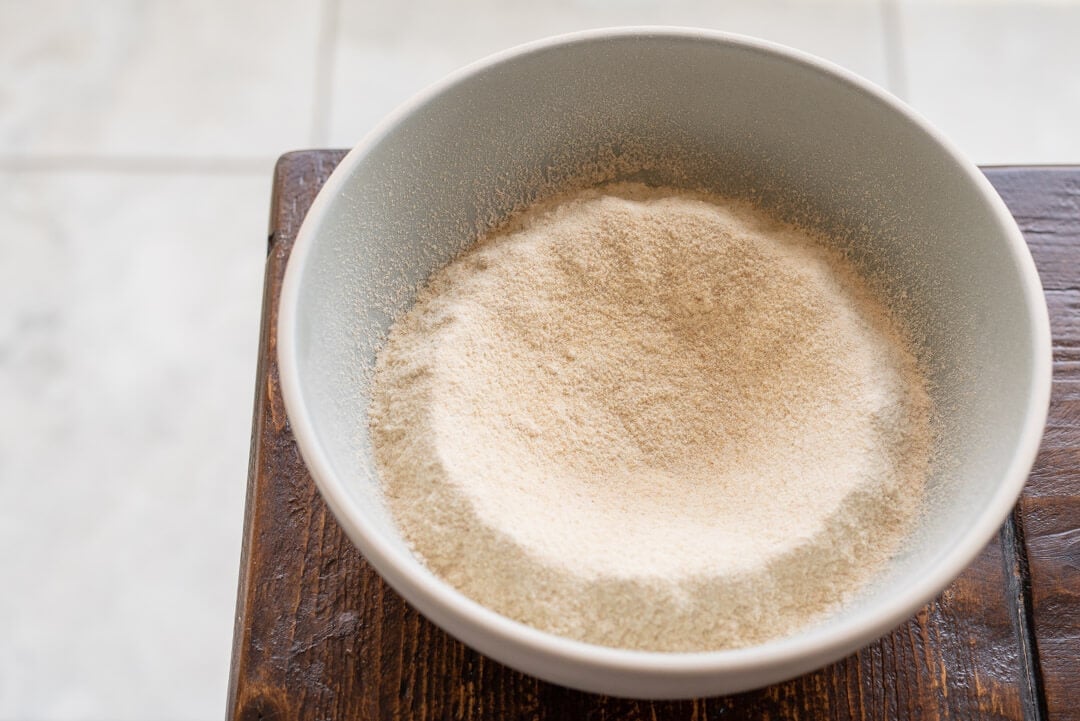
High-protein White Flour for Ciabatta
I also use a large percentage of high-protein white flour in this formula. Why? In testing, I found that the high-protein flour helps support the high hydration of this dough and the added olive oil enrichment.
Generally, with bread formulas, I like to use as little high-protein flour as possible to avoid an overly gummy crust and interior. With high hydration doughs that have lots of inclusions (like seeds and nuts), though, the higher protein content gives the dough more structure to achieve a taller rise and more open interior.
Always a balancing act.
Mixing and the Bassinage Technique
What is the Bassinage Mixing Technique?
Bassinage is a French term that describes the process of adding water in several stages during mixing and kneading. This is helpful when working with highly hydrated dough, such as this, to increase mixing efficiency—it’s easier to develop a dough’s gluten when it’s at lower hydration levels. Adding water in two or more stages also helps you judge the consistency of the dough as you mix and avoid over-hydrating the dough.
If you’re a frequent reader here, you already know I do this often. It shows up in my recipes as a “Water 1” and “Water 2” in the recipe formula. Water 2 is held back until the dough is strengthened and smooths out. Then, it’s slowly added at the end of mixing to adjust the dough’s consistency. Holding back this water to avoid over-hydration and make mixing more manageable and efficient is essential. If all of the water is added at the start, it takes much longer to mix the dough to the right level of strength.
How to Mix Ciabatta with a Mechanical Mixer and By Hand
Mixing with a Mechanical Mixer
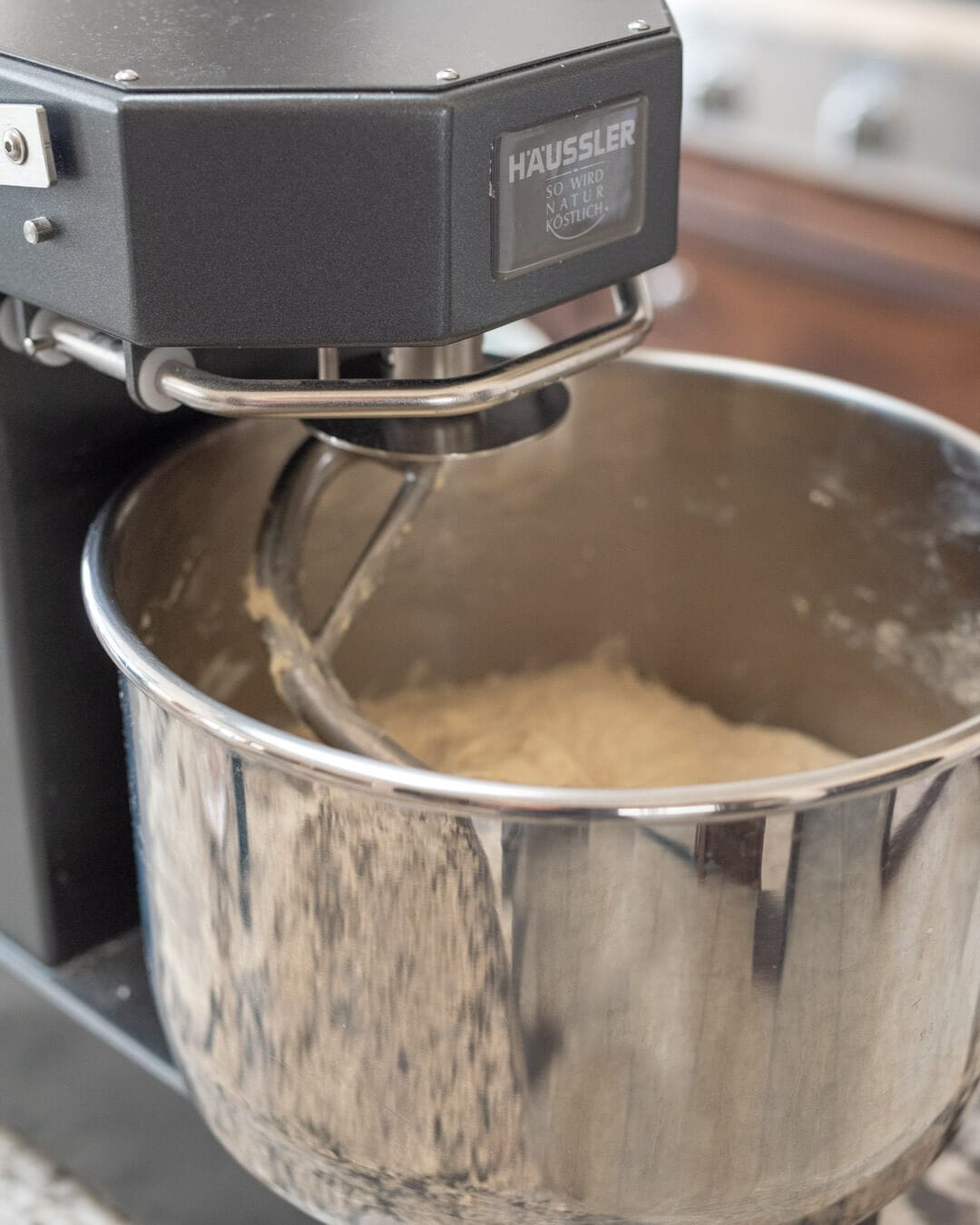
Due to its high hydration, this ciabatta dough benefits from mixing and kneading with a mechanical mixer such as a KitchenAid, Ankarsrum, or larger mixer like a Famag or Sunmix. These mixers are incredibly efficient at incorporating ingredients and developing the gluten in the dough, and when there’s a high water content, this is even more helpful.
Mixing By Hand
You can make this ciabatta dough all by hand, though. To do this, perform the autolyse as indicated in the recipe, perhaps extending it to 1 hour. This will help start the dough off with more strength. Then, slap and fold the dough on the counter or fold it in the bowl to strengthen it before adding more water—you want to lean into the bassinage technique when mixing by hand. Once you strengthen the dough significantly, add the water to the dough in stages while you’re mixing. Continue to mix the dough until it absorbs the remaining water.
At the end of mixing this dough by hand, it won’t be quite as smooth as it would be coming out of a mixer. To give the dough more strength, add in another set or two of stretches and folds during bulk fermentation.
Baking Schedule
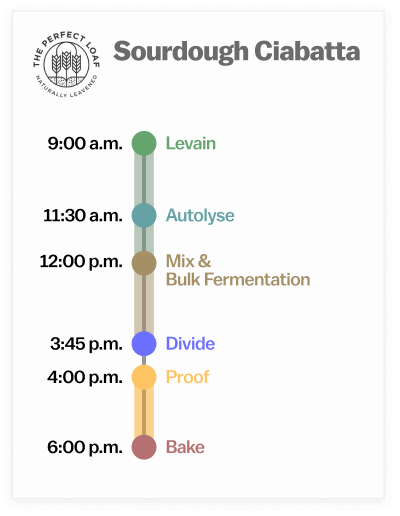
This sourdough ciabatta is a same-day, direct, recipe, meaning it’s mixed and baked in the same day. The fast levain can be created in the morning, the dough mixed 3 hours later, and then the ciabatta baked early evening for dinner.
If you’d like to do an overnight levain or change its timing, take a look at my options on my levain quicksheet reference.
Sourdough Ciabatta Bread Recipe
Recipe Update!
I recently updated this sourdough ciabatta to streamline the process and make the dough much more manageable—especially if you’re not using freshly milled flour. If you’d still like to follow the old recipe, I’ve saved it and have it for download. However, I urge you to try the new version below. I feel like the dough is more straightforward, and the results are even a little better!
Here’s a link to the old sourdough ciabatta recipe.
Use baker’s percentages to scale up or down this recipe. For example, if you’d like to make only two large ciabatta, divide all the ingredients in half (including the levain).
Vitals
| Total dough weight | 2,000 grams |
| Prefermented flour | 6.5% |
| Levain in final dough | 20.9% |
| Hydration | 80.0% (does not include olive oil) |
| Yield | 4 x 500g ciabatta (or 6 x 330g smaller ciabatta) |
Total Formula
Desired dough temperature: 78°F (25°C) (see my post on the importance of dough temperature).
| Weight | Ingredient | Baker’s Percentage |
|---|---|---|
| 945g | High-protein bread flour (King Arthur Flour Bread Flour, 12.7% protein) | 90.0% |
| 105g | Freshly milled whole-grain Khorasan wheat or hard red whole-grain wheat | 10.0% |
| 756g | Water 1 (levain, autolyse) | 72.0% |
| 84g | Water 2 (mix) | 8.0% |
| 21g | Extra-virgin olive oil | 2.0% |
| 20g | Fine sea salt | 1.9% |
| 68g | Ripe sourdough starter, 100% hydration | 6.5% |
Sourdough Ciabatta Bread Method
1. Prepare the levain – 9:00 a.m.
| Weight | Ingredient | Baker’s Percentage |
|---|---|---|
| 68g | High-protein bread flour | 100.0% |
| 68g | Water | 100.0% |
| 68g | Ripe sourdough starter (100% hydration) | 100.0% |
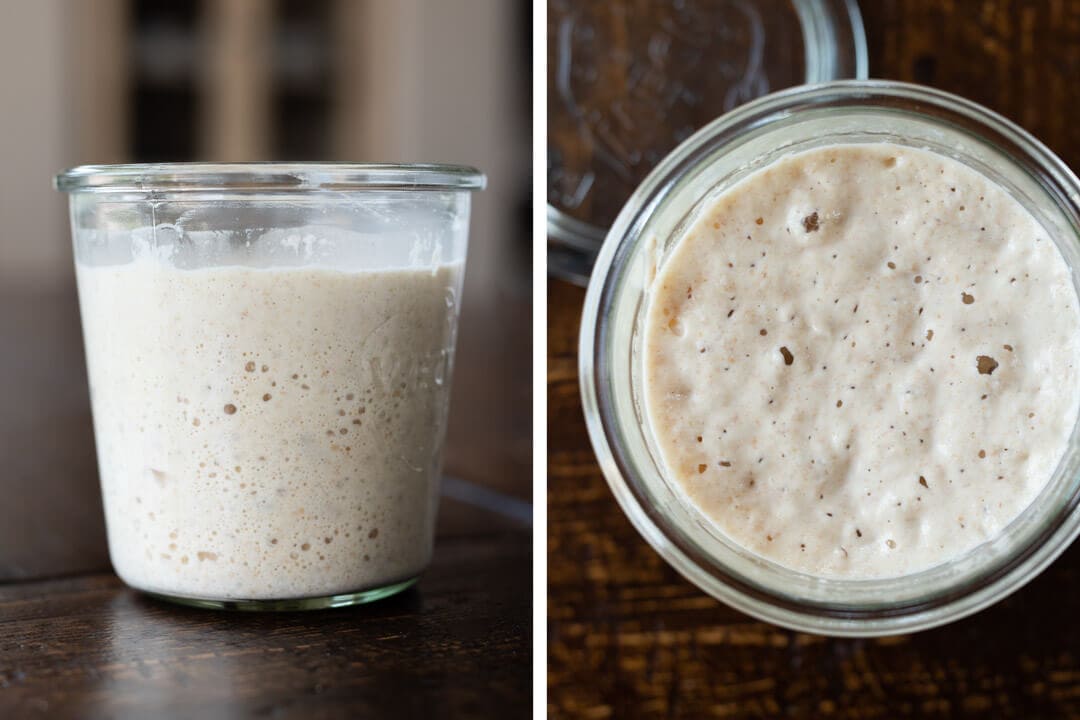
This is a fast levain build: we go from feeding to ripeness in only 3 hours. The high inoculation percentage and warm temperature expedite the ripening of this levain, but it also helps emphasize yeast activity for large volume in the final ciabatta.
Mix the above ingredients in a jar and leave them covered at 74-76°F (23-24°C) to ripen for 3 to 4 hours.
2. Autolyse – 11:30 a.m.
| Weight | Ingredient |
|---|---|
| 876g | High-protein bread flour (King Arthur Flour Bread Flour, 12.7% protein) |
| 105g | Freshly milled whole-grain Khorasan wheat or hard red whole-grain wheat |
| 687g | Water 1 (autolyse) |
I use the autolyse technique for this recipe to help reduce the total mixing time required, but I also find it helps aid in the dough’s extensibility.
Warm or cool the autolyse water so that the temperature of the mixed dough meets the final dough temperature (FDT) of 78°F (25°C) for this recipe. To do this, use my water temperature calculator to input the temperature of your kitchen and your ingredients to have it automatically calculate precisely what temperature to heat or cool the mixing water.
Place the flour and remaining water 1 (autolyse) in your mixer bowl or a large bowl (if mixing by hand). Turn the mixer on to low speed and mix for 2 minutes until no dry bits remain; the dough will be shaggy and loose. Use a bowl scraper to scrape down the sides of the bowl to keep all the dough in one area at the bottom. Cover and let rest for 30 minutes.
3. Mix – 12:00 p.m.
| Weight | Ingredient |
|---|---|
| 84g | Water 2 (mix) |
| 21g | Extra-virgin olive oil |
| 20g | Fine sea salt |
| 204g | Ripe levain (from step 1) |
To the mixer, add the levain, salt, and a splash of the reserved water. Mix on speed one until everything is incorporated, about 30 seconds. Then, switch the mixer to speed 2 and mix for 4 minutes. After 4 minutes, start adding the rest of the reserved water, a little bit at a time, throughout an additional 4 minutes for a total of 8 minutes mix time.
Turn the mixer to speed 1 and slowly stream in the olive oil. Continue to mix until the oil is absorbed and the dough is cohesive and shiny about 2 minutes.
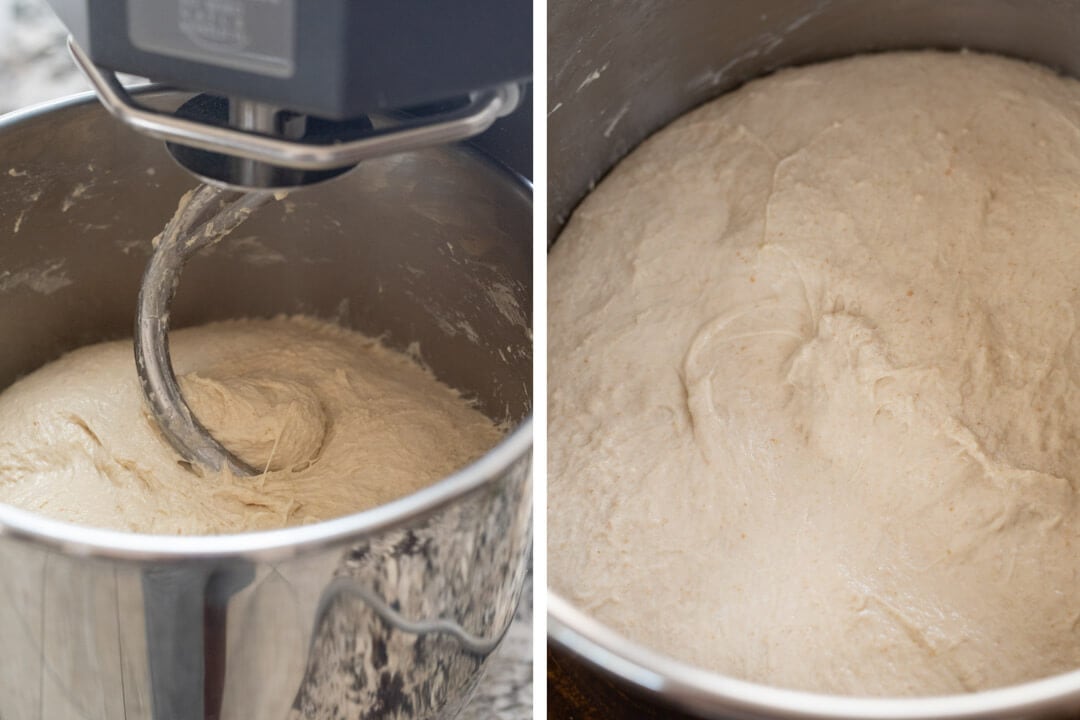
As you can see in the mixing progress images above (left: after mixing 4 minutes, and right: at the end of mixing), the dough will still be plenty wet and sticky by the end of mixing, but smoother and with some strength. At the end of mixing the dough will not pass a full windowpane test, but will come very close. Be sure to mix this dough sufficiently!
4. Bulk Fermentation – 12:15 p.m. to 3:45 p.m. (3 hours 30 minutes)
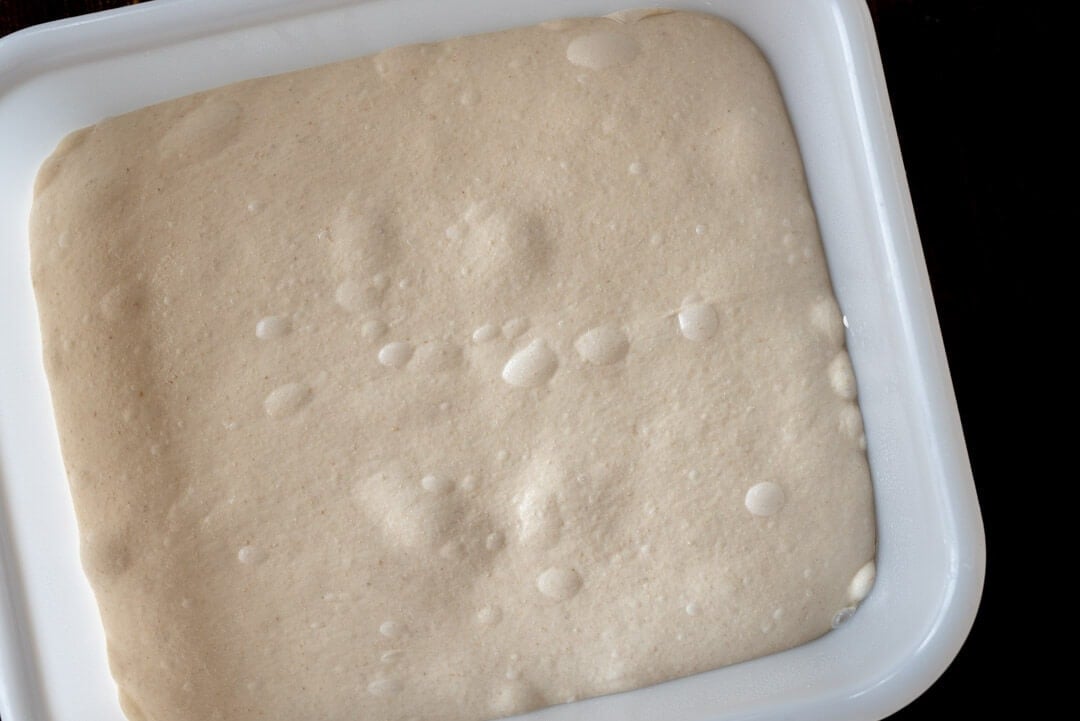
For bulk fermenting this dough I used the 11-quart Rubbermaid rectangular tub, which is the perfect size for 2 kg of dough (and more). It makes dividing the dough into four equal rectangles much more straightforward: when the container is inverted, it drops the dough into a perfect rectangle.
During this phase (of the two-step bulk fermentation phase), give the dough 3 sets of vigorous stretch and folds separated by 30 minutes each. The first set happens 30 minutes after the beginning of bulk. The dough will be very slack and wet. Use wet hands and perform the folds quickly.
After the last set of stretch and folds, let the dough rest for the remainder of bulk fermentation, covered.
5. Divide – 3:45 p.m.
To maintain an open and light interior, try to handle this dough as little as possible.
First, put aside any notion of using only a small amount of bench flour when handling this dough. The heavy use of dusting flour not only allows you to control the dough more naturally but also makes it possible. And anyway, the thin veil of flour on the crust adds to the classic look of ciabatta and adds visual appeal.
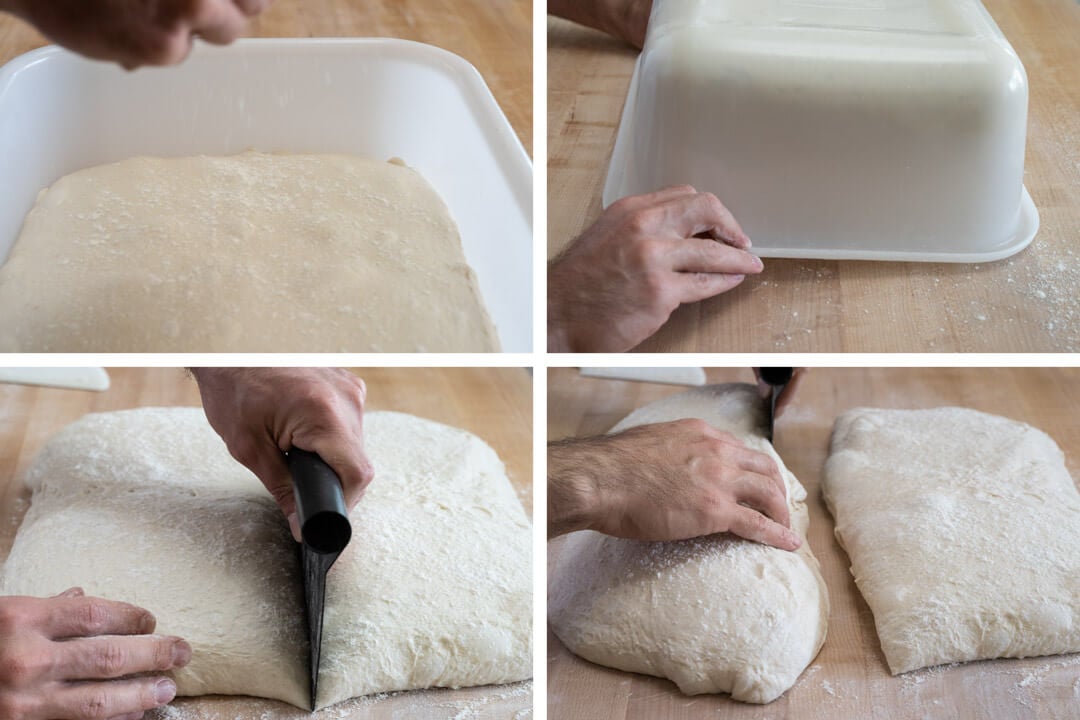
Heavily dust the top of your dough in the bulk fermentation container with white flour.
Using your bench scraper, loosen the dough from the sides (insert your scraper between the dough and the container). Then, in one quick motion, invert the rectangular bin and let the dough fall from the inside of the container down to your work surface (upper-right image above). Liberally flour the new top of the dough. Using your bench knife, cut the dough into four rectangles and separate them by dragging them apart.
You will use the couche in the same fashion as when making baguettes, but the “wells” are much wider to accommodate the pudgy ciabatta.
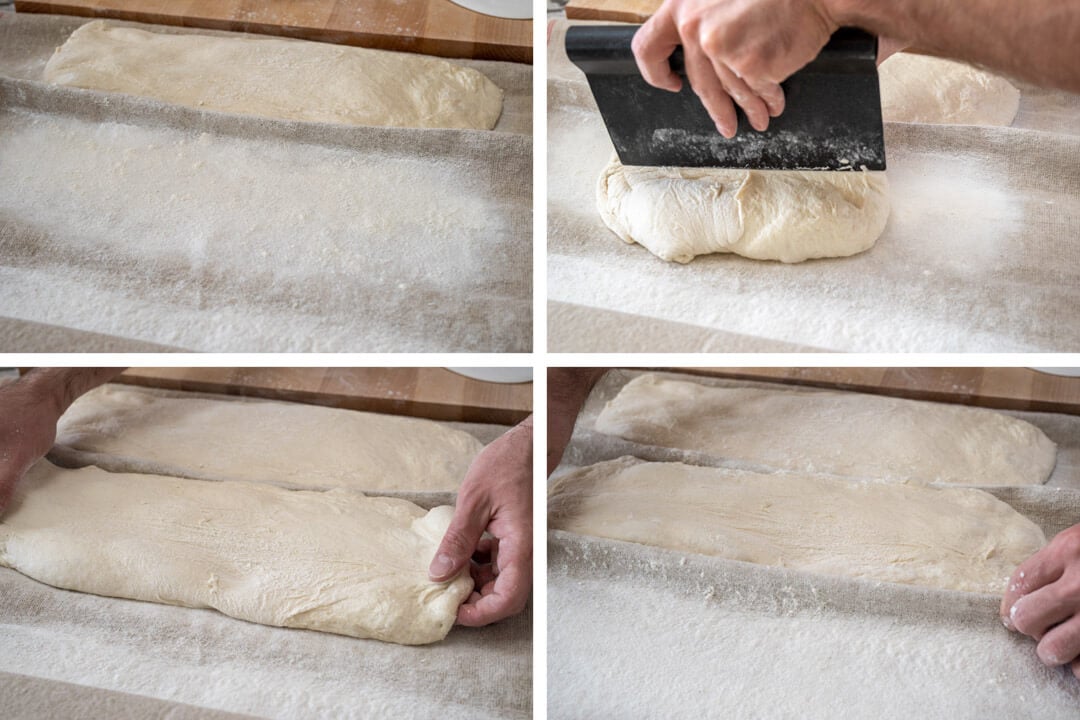
Lay your couche (a large kitchen towel also works well) out on your work surface and flour it very liberally (upper-left image, above). You want to be generous with the flour to avoid sticking.
Using your bench knife grab one of the four rectangles and transfer it to the couche. I like to keep the dough the same way it was resting on the work surface: the bottom stays on the bottom when transferring. Next, using your hands gently stretch the rectangle out as tall as you desire (for me this was about 14″ to fit my home oven).
Instead of stretching them out into long ciabatta, you can also keep them in smaller rectangles about 6-7 inches long.
Finally, make a crease in the couche and flour the new spot to get ready for the next piece.
6. Proof – 4:00 p.m. to 6:00 p.m.
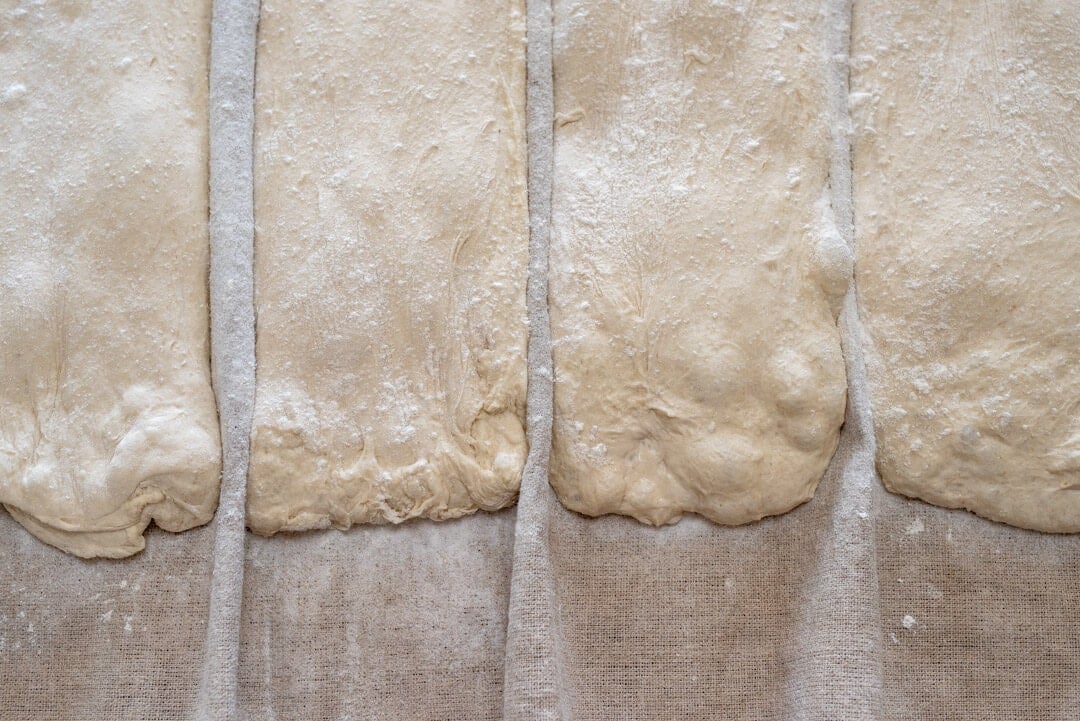
Cover your dough with the end of the couche or a food-safe plastic bag (be sure not to let the plastic touch the dough). Let your dough proof for around 2 hours. At the end of this time, the dough will look significantly fermented and bubbly all over, and when poked for the poke test, it will almost have little to no spring back.
7. Bake – 6:00 p.m.
There are two effective ways you can bake ciabatta in the home oven. The first is to transfer all the pieces of dough to a full sheet pan (21 x 15 inches) lined with parchment paper, then slide the pan into the oven on a baking surface (or empty oven rack). This is the easiest method, but it may (just may!) result in a little less rise in the oven due to the slightly less efficient heat transfer than baking directly on the baking steel.
The second option is to bake the pieces of dough directly on a baking surface such as a baking steel or baking stone. This is the method I will outline below.
Preheat your oven with baking stone/steel for half an hour at 450°F (230°C).
Prepare a single, large piece of parchment paper that will cover your entire baking stone or baking steel. Flour the top of the resting dough to ensure there are no sticky parts. Then, using a large, straight cutting board placed at the edge of a piece of dough, grab the couche and flip each portion out onto the cutting board: what was resting on the bottom is now on the top. Transfer the dough to the parchment paper by sliding it off the cutting board to one side of the parchment paper. The process for flipping the dough is the same as shown/described on my Kamut baguette post, only with a broader cutting board in place of the thin transfer peel.
Place the other two pieces of dough into your fridge; you will bake these after the first two.
Slide the parchment paper with dough onto your baking surface using a pizza peel. Once you’ve loaded the dough, steam the oven and bake for 20 minutes with steam. Then, remove the pans used for steaming, vent the oven, and turn it down to 425°F (220°C). Bake for an additional 15 to 20 minutes until done. The crust should be golden brown with no pale or white spots.
It’s important to bake this bread fully—if underbaked, it could result in a gummy and “wet” interior.
I steamed my oven in my usual way, described here in my post on how to steam your home oven when baking bread.
Print
Sourdough Ciabatta Bread Recipe
- Prep Time: 9 hours
- Cook Time: 45 minutes
- Total Time: 9 hours 45 minutes
- Yield: 4 loaves
- Category: Bread, sourdough
- Cuisine: Italian
Description
Rustic bread with a thin crust, creamy and open crumb, and delicate flavor profile. Ciabatta is perfect for sandwiches!
Ingredients
Levain
- 68g high-protein white bread flour (King Arthur Bread Flour)
- 68g water
- 68g ripe sourdough starter (100% hydration)
Autolyse
- 876g high-protein white bread flour
- 105g freshly milled Khorasan or hard red whole wheat
- 686g water
Main Dough
- 84g water
- 21g extra-virgin olive oil
- 20g fine sea salt
- 204g ripe levain
Instructions
- Prepare the levain – 9:00 a.m.
Mix the levain ingredients in a jar and leave them covered at 74-76°F (23-24°C) to ripen for 3 to 4 hours. - Autolyse – 11:30 a.m.
Place the flour and autolyse water in your mixer bowl or a large bowl (if mixing by hand). Turn the mixer on to low speed and mix for 2 minutes until no dry bits remain; the dough will be shaggy and loose. Use a bowl scraper to scrape down the sides of the bowl to keep all the dough in one area at the bottom. Cover and let rest for 30 minutes. - Mix – 12:00 p.m.
To the mixer, add the levain, salt, and a splash of the reserved water. Mix on speed one until everything is incorporated, about 30 seconds. Then, switch the mixer to speed 2 and mix for 4 minutes. After 4 minutes, start adding the rest of the reserved water, a little bit at a time, throughout an additional 4 minutes for a total of 8 minutes mix time. Turn the mixer to speed 1 and slowly stream in the olive oil. Continue to mix until the oil is absorbed and the dough is cohesive and shiny about 2 minutes. - Bulk Fermentation – 12:15 p.m. to 3:45 p.m. (3 hours 30 minutes)
During this phase (of the two-step bulk fermentation phase), give the dough 3 sets of vigorous stretch and folds separated by 30 minutes each. The first set happens 30 minutes after the beginning of bulk. The dough will be very slack and wet. Use wet hands and perform the folds quickly. After the last set of stretch and folds, let the dough rest the remainder of bulk fermentation, covered. - Divide – 3:45 p.m.
Heavily dust the top of your dough with white flour. Loosen the dough from the sides using a bench scraper, then invert the container to let the dough fall onto your work surface. Flour the new top of the dough, cut it into four rectangles, and separate them. Lay out a floured couche (or kitchen towel) on your work surface. Transfer each dough rectangle to the couche, keeping the bottom side down. Gently stretch the dough to your desired length. If you prefer, leave them in smaller rectangles. Make a crease in the couche and flour it before placing the next piece. - Proof – 4:00 p.m. to 6:00 p.m.
Cover your dough with the end of the couche or a food-safe plastic bag (be sure not to let the plastic touch the dough). Let your dough proof for around 2 hours. At the end of this time, the dough will look significantly fermented and bubbly all over, and when poked for the poke test, it will almost have little to no spring back. - Bake – 6:00 p.m.
Preheat your oven with a baking stone or steel at 450°F (230°C) for 30 minutes. Flour the dough and flip each piece onto a large cutting board, then slide them onto parchment paper. Transfer two pieces to the fridge for later. Use a pizza peel to slide the parchment and dough onto the baking surface. Steam the oven and bake for 20 minutes, then remove steam pans, vent the oven, and reduce heat to 425°F (220°C). Bake for another 20-25 minutes until fully done to avoid a gummy interior.
Ciabatta FAQs
Can I mix this dough by hand?
It’s possible, but I do recommend using a mixer. If mixing by hand, hold back the reserved water (Water 2) until after mixing in the bowl or on the counter for a while to develop the dough. Once you strengthen the dough significantly, add the water to the dough in stages in a mixing bowl. Continue to mix the dough until it absorbs the remaining water.
Can I modify this recipe to make ciabatta rolls?
Small ciabatta panini are wonderful. I’d dump the rectangular dough out and divide it into six identical pieces (around 330g each). You could go even smaller if desired. Note that the bake time will likely change. Smaller pieces will bake faster.
Can I use a round bulk container for this dough instead of a rectangular one like you use?
You bet. Though, it will require more dough-handling to get each shape into rectangles.
Is ciabatta similar to focaccia?
They are pretty different. Focaccia can be high hydration like ciabatta, but it’s proofed in a pan, spread and dimpled out with fingers, and then topped (usually with salt and herbs) before baking. Conversely, Ciabatta is proofed on a flat surface or on a couche to give it structure, then transferred to the oven and baked.
What’s Next?
Now that you’ve mastered sourdough ciabatta, try your hand at another tast—and fun-to-make—Italian bread: filoncini (kind of like twisted baguettes).
Happy baking!


192 Comments
Hi Maurizio, my high protein flour is 13.5%, would you try to lower that to 12.5% with AP, or will this do?
I would use that flour as it is!
sorry…continuing……wouth the Emile Henry Ciabatta Baker work well with this recipe? Thank you in advance.
Yes, you could definitely use that for this recipe, Julie!
Good morning, I have an Emile Henry Ciabatta Baker that I have not yet used. Would using this covered ceramic Baker work
Hello Maurizio, Prince of Loaves
Love your recipes and your have your book and have given it as several gifts. I have made probably twenty of your recipes over the last few years, including the recipe for ciabatta in the book. That said, this one almost never comes together for me. I have similar problems to what others have mentioned. I’m in very humid weather and my levain is poppin’ so I know it’s not the the starter.
1. I don’t automate since I keep getting the clumps everyone else mentioned.
2. The initial mix is always like soup using 90% KA bread flour and 10% spelt even with 10% of water withheld entirely. I have to add maybe 100g of flour to get it to something stretch and foldable. Stretch and folds don’t start showing bubbles after the 2nd set either, which makes me think something is up. Is it possible I have over mixed it in an attempt to get it to the right consistency? Would that kill the fermentation? In any event, after some futzing I at least get it to something I can work with.
3. Even with a 3 hour+ bulk fermentation, I barely get 10% rise. Look at this sadness. I usually pick up the clear plastic cold proof vessel I use and look at it from underneath to see if the crumb is developing (it seems to give a decent preview of whether you are going to get a nice crumb or not). And this started at just under 2 qts and after three hours barely got over the 2qt line. .
https://ibb.co/TtwQFyT
https://ibb.co/x6TL7zB
https://ibb.co/7Q1czTh
4. The end result is always full of large pockets, which I don’t think can be from under proofing since I seem to err on the side of over proofing. I know you don’t really use rise as a marker of much – I know you say to use the feel of the dough and the way it touches the edges of the container, but if I don’t see some dramatic rise in summer, something seems off. It can’t be from under strengthening the dough since I give it a good twenty minutes in the mixer, right? That leaves the hydration as the possible issue, but I always get it to a hydration level that I’ve made successful ciabattas with in the past.
I have made this a few times to try to spare you the pain of having to read yet another personal bread saga, but I’m stumped.
P.s. here is the final rise insanity that had taken over my life and my kitchen. I bake daily and my friends think I’m a little crazy.
https://ibb.co/JdLwjXv
Ha ha, not sure I've been called the Prince of Loaves before but I love it! Thanks so much, so glad you're enjoying my cookbook, so sorry for my late reply!
I'm way overdue from updating this recipe. It's on my list to do very soon. I'll be revisiting my formula from first priciples and hope to improve it. I would say wait a bit (or use my cookbook recipe), and I'll have a stellar update for you!
Hi Mauricio
Thanks for this recipe. I made a bit of a gaff switching up the long cold ferment while shaped in the couche, rather than in the rectangle bin. Result… complete disaster trying to transfer from couche to peel. They were fully stuck, I had to peel them off with my fingers, a spatula, a bench scraper… I really had to hold back the instinct to just chuck it all in the garbage. As it turned out, this dough recovers! I got the big clumps of dough finally into the peel, shaped as best as possible and when they hit that heat and your steam method, they puffed right up! They turned out great. The only thing I’d change is the salt content, taste is a bit bland but everything else is perfect. Thanks again.
So glad they worked out well for ya, Joey! Nice work on the mods there as needed.
so. . . . if I wanted to make ciabatta rolls, instead of loaves . . . . without messing around with the dough, just cut the loaves at shaping and bake them individually?
Yup, that’ll do it!
Love your recipes and instructions. Engaging stories, easy to follow directions. Transitioning from KA to Ankarsrum. First time at this recipe used the roller but came up with lumps during autolyse that stubbornly never went away. Tasted great, but funky structure. Should I switch from roller to bar and/or up the autolyse percentage of water. Using your exact mixture of flours. Thanks.
Thanks, John! You could even skip the autolyse with this recipe if it makes things easier with your mixer!
Hi Maurizio, what do you think about substituting durum flour for the khorasan?
I think it’s a fantastic idea. Durum will be a nice and strong flour for this, plus, it’ll give you a great crust!
Can I bake this in a Dutch oven instead of the whole steaming process? If so how long do I bake covered/uncovered if I am making about 14-15 inch loaves?
Yes, absolutely! Check out my guide to baking bread in a Dutch oven (which will apply to this ciabatta as well).
Yes, if you go with spelt (which is sensitive to too much water), I’d drop the hydro by 8-10%. If the crust is too well-done, dropping the temp of the oven next time, perhaps just 25°.
Hello,
This Ciabetta is exactly what I want to be able to make. I made it over the weekend, I used Spelt instead of the Kamut and it was very wet, would you recommend adjusting the hydration and if so how? Also, I baked these until the crust was very brown, but the crust was very rough, for lack of a better description. I cooked it with a cover for the first 20 minutes and then remainder of cook time was uncovered, close to 25 minutes. Would love any guidance or recommendations.
Yes, if you go with spelt (which is sensitive to too much water), I’d drop the hydro by 8-10%. If the crust is too well-done, dropping the temp of the oven next time, perhaps just 25 degrees.
Hi, would it be possible to make this with 100% spelt flour? I don’t eat regular wheat. The spelt I use has around 18% protein content. And, if so, how would you adjust the recipe? Thanks
Hey there! Definitely possible, but you’d have to drop the hydration significantly, depending on your spelt flour (which tends to be super extensible!).
OK, thanks. How much would you suggest dropping it to begin with?
Hi Maurizio! This is my first time making this ciabatta (I’ve loved making other recipes of yours, particularly the babka) and it turned out quite tasty – but there were massive air pockets at the top. I don’t think that it was overproofed, do you know what could be causing that? I saw that you mentioned the hydration could’ve been too high on another post (I did use rye flour, which probably didn’t help with that!) my white flours were Central milling ABC+ and King Arthur bread flour. Do you think I should perhaps lower the hydration next time?
Hey, Jamaal! Yes, I would drop the hydration 5% and try again. That separation is almost always due to hydration!
Hey Maurizio! This is my first time making ciabatta after making many of your recipes for the past year! Like others have experienced, I had giant air pockets in all 4 of my ciabatta loaves. I subbed spelt for your freshly milled flour but other than that followed recipe exactly. I found I needed to mix much longer than your 8 minutes to get the dough to almost pass windowpane test at the initial mix. I also had a bit of trouble transferring the rested dough to my pan… perhaps instead of saying to “very liberally flour” the couche you should say “LITERALLY USE HALF A BAG OF FLOUR” 😂 I will use much more flour next time!!!
Anyway, now I know what I’m going to bake for the next couple weeks until I get this right. Wondering if you have any recommendations for the giant air bubble? I doubt it was overproofed, I definitely erred on the side of underproofing, and when I baked the first two loaves, I left the other two on the counter (instead of fridge) just to make sure they weren’t under and all 4 basically came out the same. Sorry for the essay and thank you!!!
Ahhh, sounds crazy! So sorry about that, Caitlyn. Yes, it does take quite a bit of flour to ensure a couche is not sticking, but perhaps mine is well seasoned over the years (I don’t need much at this point, but add more to get that floured look on these).
It sounds to me like you need to drop the hydration to better suit your flour. I’d probably drop down 5% and see how it goes next time. Those large bubbles can be a sign the flour is over hydrated—and the fact that it took you many more minutes to strengthen the dough, that’s my best guess!
Sorry for the troubles with this recipe! Let me know how the next attempt goes, it really is a great bread 🙂
Thank you so much! I will try again this weekend (hopefully). Do you have any recommendations on what flour to sub instead of spelt? Perhaps just more bread flour or KA white whole wheat? Need something that’s able to handle the hydration!
Thank you made this today first time using my starter difficulty to handle tasted great
So glad to hear that, Gary! Enjoy 🙂
Thank you, thank you, thank you! This recipe is superlative! I made this as per your instructions. Turned out so good. I was wondering if you could half the amount of leaven and leave to proof in the fridge after the initial bulk for 48 hours. Looking to add more flavour. Thank you again.
So glad to hear that, Stewart! Half might be a bit much of a reduction, but you’d have to test. That would definitely get you toward a more sour flavor, though!
Ciao Maurizio! Your site is great, proud to be a compatriot of yours 🙂
I crossed my fingers and tried to make ciabatta today (made the focaccia and the pizza al taglio earlier which came out wonderful). I’m going to put the bulk in the fridge now but I didn’t check my schedule properly and I’m not going to be able to proof them until tomorrow afternoon. Do you think it will resist a 24 hours cold fermentation? I have not much of a choice: either 8 hours or 24 hours in the fridge. What would you recommend for this specific bread?
Thank you for your answer! Hope to hear from you soon otherwise I’ll split the batch and try out half of it with 8 hours and the other half 24. In that case I’ll let you know 😉
Continua così, sei grande!
A presto!
Grazie, Stefania! 24-hours is quite a long time, but it’ll likely be fine as long as the dough wasn’t too fermented going into the fridge. I would probably opt for 8-hours in the fridge instead of 24 with this dough.
Let me know how it turned out!
Ciao Maurizio,
Thank you, so happy I could bake ciabatta!
I divided the dough in two and baked the first one after 8h-ish and the other +24h. Both turned out wonderful! The crumb was slightly more even in the +24h fermentation otherwise you cannot notice a big difference. Maybe it helped my bread flour has 13% proteins so it could keep better?
Now I have another question to you: when are you going to publish a recipe for “rosetta”?
I usually find with dough that’s more well-fermented, you get a more even crumb as everything seems to even out. In fact, usually a sign of dough that’s under proofed is one that has large, gaping holes scattered throughout.
I’ve not heard of rosetta! I’ll have to look that up 🙂
Man, I made this and failed! Lol. My first try at bread using a levain. Plus, I’ve been using all home-milled einkorn wheat for health reasons. The house I’m in now is usually below 70F, so I improvise proofing with an old warming tray, a roasting pan with a small amount of water, and smaller containers that I cover.
Anyway, my levain took 15 hours. I totally missed the 2 ½ hour rest after the turns! Then I stuck in the fridge overnight. This morning there was no fermentation. It took a long while for the dough to get what I thought it should be from the overnight fridge experience. After another 3-4 hours I popped it I the oven and ended up in with rather flat thick crusted loaves of pretty tasty bread.
I’ll definitely practice this again.
Ahh, bummer, David! Sounds like some good pivots there but a lot of hurdles to jump through. Let me know how the next attempt goes!
Hi Maurizio, First, thank you so much for what you do! I discovered your site recently and have already learned a lot!
I’m in the middle of making this bread right now and I have to confess, I’ve never had any luck whatsoever doing a cold ferment overnight. I think my dough over ferments? In any event, I was wondering if you have any general recommendations for a “same day bake?”
As of this moment, I’m done with stretch and folds and my windowpane is perfect. I was going to continue the bulk ferment in my proofer and then shape and do a final proof the way I would with any other sourdough I’m making. We’ll see what happens! Wish me luck! 🙂
You’re welcome, Amy! A same day bake also goes really well with most of the recipes here at my site. I typically do 1-2 hours at room temp for the final proof, depending on the recipe and the temp in the kitchen. The “poke test” is generally pretty good for most whiter doughs, especially when at room temp. Let me know how it goes and have fun!
Just put my last two loaves in the oven. If I did this again, I would halve the recipe and do four smaller loaves. Lots of fun to make, and even more fun to eat with fresh tomatoes, and fresh basil from the garden 🙂
Ooh that sounds delicious!
Hi Maurizio, This is such an amazing recipe (and website)! I never thought that I could make such wonderful bread at home.
During the autolyse, I’m wondering if you are able to get the dough fully hydrated with a large amount of water held back? I’ve done it three times but there’s always lot of lumps that I had to break out by hand during the bassinage process. Thanks!
Thanks, Tina! I really appreciate that. It’s best to use as much water as necessary to get the flour fully hydrated—the goal when mixing for autolyse is no dry bits of flour remaining.
Maurizio, I have been making ciabatta using yeast for some time and am looking forward to try your recipe. Recently convinced by friends to use sourdough for some other projects and I am finding it less challenging than I thought. Just made your bagels which were the best I have had this side of NYC. Question – is it possible to substitute simpler flours since I’m not able to find some of your suggested ingredients locally? I typically use KA Bread and wheat, rye. If possible what proportions would you suggest? On a side note to overcome the really wet ingredients I use the paddle blade of my Kitchen Aid for the initial mix – Biga, water, yeast slurry then flour in stages – which brings things together then switch to the dough hook. Hope to try it with your recipe.
Super glad to hear that, Don! Yes, absolutely. I’d go with KA Bread flour for this recipe for the majority—even at 100% would be great. Yes, great suggestion with the paddle! Sometimes I’ll pop that on until the dough comes together, then switch to the hook. If you give/gave this a try, let me know how it goes/went!
Hey Maurizio! Thanks for sharing this recipe. I am warm bulk ferminting as we speak. My oven is not set up for steam. Surely it’s not ideal but it is possible to use my oval dutch oven to bake?
Evan, yes that would work as well! I hope they turned out great 🙂
Maurizio, I want to bake these on my baking steel but I have found even when following your steaming instructions to a tee (towels + lava rocks), the bottoms burn and the crust ends up very tough! What would you recommend? I’ve considered reducing the preheat time by at least half and increasing the steam time to allow the crust for more elasticity? What are your thoughts?
Yes, I’d reduce the preheat time and/or temperature. The baking steel can get super hot, and this will help. Also, adding a piece of parchment paper there might help insulate as well.
Tried this for the first time this morning (subbing spelt for kamut) and i got a huge hollow cavern on the inside of my loaves – they puffed up like footballs while baking and the upper crust basically separated from the rest. over prooved? too much heat?
Ben, this is a common issue with these highly hydrated loaves. I’d try reducing the hydration 5% and also reduce the proof time a little before baking, like you said, over proofing can also cause this issue. I think the biggest reason, though, is from over hydration for the flour you’re using!
This was my first foray into ciabatta making! The shaping was a bit fiddly and my loaves domed slightly during the baking – and for some reason my loaves turned out more tapered and slipper-shaped than the beautiful rectangles you have in your post 🙁 Was very pleased with the crumb and the crackly crust though, and the richly developed sourdough flavour. Used millet and rye in place of khorasan and it still turned out great. A beautiful recipe – as always, thanks for sharing your experiences and your wisdom 🙂 Here are some pictures of my loaf if you’d be interested to see!
https://ibb.co/2ZFBJYW
https://ibb.co/v4SWg0j
https://ibb.co/7YpPpdD
https://ibb.co/DQyks1y
One thing I’d like to ask though, how do you get the gluten structure of your bread so delicate and fine? Mine turned out a bit damp and squishy (for lack of a more elegant word) even after letting it cool thoroughly… it’s something I’ve noticed with my other loaves as well, that my loaves tend to be a bit chewier and more damp than commercially bought loaves, and even when there are large holes and the crumb structure is satisfactory, the layers in between the holes are always somewhat thick. (Not sure if I’m explaining this well.) Wondering if this could be attributed to the flour I use (I use high-protein Japanese bread flour), or the characteristic of my starter?
Still have to work on flipping my loaves off my couche though… the first time i probably deflated the loaf halfway and the second I ended up flouring my poor brother who was holding my baking tray for me…
Looking good! Using millet and rye, depending on the percentage, will likely lead to a denser ciabatta as these grains don’t have the same gluten characteristics of wheat. In other words, they won’t produce as light and airy of an interior — but what they lack for there, they make up in flavor and nutrition! Your Japanese flour and starter are likely just fine. I’d try reducing the hydration just a bit, perhaps just 2-5%, and then be sure you bake it thoroughly, if you don’t bake the loaf out completely (should be around 206F/97C internal time), you’ll end up with a “wet” interior. Finally, wait to cut! If you cut the loaves too early after baking, they’ll have a gummy interior — I like to wait 1-2 hours.
Keep at it!
Just tried this recipe. The ciabattas are delicious! But rather flat, didn’t rise much in the oven… Should I just ferment them in a smaller contained next time, and/or not stretch at all for proofing? Or could I have overproofed them, and how would I know? They have big bubbles in places with a sort of pocket in the middle of the crumb, I think that could a sign of overproofing? Thank you!
Hey! Yea, sounds like perhaps a little too far on the proof. But, you definitely want the couche, or whatever you’re using to proof, to hold the dough snugly. If they spread too much, you’ll get a flatter result. I’d say pull back the proof just a bit as well, this should make for a stronger dough and you should get a bit more rise!
https://photos.app.goo.gl/KoYuLcgYqvEhd7Yz7
https://photos.app.goo.gl/i3myCSMqWfc7cicy7
I just realized I could give links to show pictures 🙂 Hope they work.
Thanks a lot Maurizio, sounds right! Transferring them to bake was also a little tricky for me, they were just a tad too big for my cutting board… But regardless of (or maybe even thanks to) probable overproofing, they are really delicious and work so well for some simple sandwiches, just put some Brie-style cheese and cherry tomatoes, amazing lunch.
Looking good! Yes, I’d say try pulling back the proof a bit, you’ll get more spring and a little more openness. Keep at it!
Thanks a lot!
Hi Maurizio, I tried this again! I moved to a new flat, so all temperatures are different, and the oven too (seems to be better though!). I also adjusted the flours to match your protein content much closer (which made the crumb less chew I think). And the result is again delicious, but the crumb is quite closed! It’s also a little wet. Is it underfermented this time? https://photos.app.goo.gl/TWz2FpTzsL55ChwA8
Would appreciate your thoughts, thank you 🙂
I thought I had commented here, but evidently not… Anyway, I tried repeating this recipe with more closely matched protein content to what you use, and in the new flat, so temperatures are all a bit different. And the oven is different, but it seems to be better at retaining steam. I have also since got a baking steel 🙂 So everything changed haha. Anyway, this time the crumb is just quite closed, although just as delicious. Not really a ciabatta, although still great. Is it underproofed this time? The crumb is also a tiny bit wet.
https://photos.app.goo.gl/Ty5ii4d7aFXWX9MA7 here is a picture.
Also on a separate note, I found mixing this dough by hand quite challenging, I think 300g water set aside was too much – I could barely even hydrate all the flour for autolyse, and then adding the rest of the water was difficult. Throughout bulk I kept discovering clumps of dense dough with lower hydration that I had to squeeze to mix with the rest, like clumps of flour one has to break up sometimes when make pancake batter… I think next time I won’t reserve more than 200g water.
Maybe my flour is more thirsty?
Sounds good to me, use what you need to get the flour mixed!
Will the recip still work if i were to use KA specia patent flour 12%protein in place of the high mountain?
I’d say it would, I might reduce the hydration slightly to compensate, though!
Firstly, I just signed up to support The Perfect Loaf. I have made quite a few of your recipes and felt it was appropriate to do so. Today I’m making Ciabatta for the first time and boy is that dough wet. I used Central MIlling’s Khorasan (don’t have a flour mill – yet) and their Organic malted bread flour and Guistos HI Protein flour. I’m like many people who went absolutely crazy baking sourdough during this Pandemic. I had a heck of a time getting the right flours, but as luck would have it Guistos is in Petaluma and my local farm stand, Andy’s carries Guistos products. So I’m set for flour. I read down the thread and since haven’t a couche (ordered) I’ll try the parchment + foil box hack. I’ll let you know how it turns out. One question, my timing sucks and the cold fermentation will be a bit longer than you specified. Will adding a few hours to the cold fermentation time be a problem?
I added a week and a half to the cold fermentation because of work and life complications. I decided to bake it anyways and the result is amazing! A bit more flavourful than commercial ciabattas, but beautiful texture and crumb! 🙂
Jocelyn — sorry for the late reply! I do appreciate the support. Adding some time to the cold fermentation should be just fine, it should be cold enough to slow things down considerably. If you’re very worried, or are extending it significantly, cut that warm bulk by 15 min and get it into the fridge sooner. I hope they turned out great!
Good Morning I have tried a number of your recipes and have been very happy and have enjoyed your site. I have tried you ciabatta recipe twice over the past few days. I can only get my hands on All Purpose flour, using KA. It will not take anywhere near the water your recipe calls for. I have ended up with a thick sludge with plenty of free water and more than 100 grams of water still left to addd. I have tossed both batches in the garbage. Just curions if you have any ideas> Thanks
Yes, with a typical AP flour you’ll definitely have to reduce hydration. Hold back 200g of the water during mixing, only add it in if the dough looks like it can take it, it should be elastic and shiny, and definitely wet, but not soupy. Sorry to hear about the frustration!
I actually had the same problem as Kate. Big hole in the middle, the gluten looks like it just couldn’t hold for the breads rise and top tore away from the bottom. I used the exact formula but (big but!) I used Spelt flour. I know spelt can get overworked and the gluten can break down. I really don’t think I worked it too much but I did use a mixer and followed your technique. Spelt is difficult and I’ve had other issues with high hydration with it. Any tips for keeping Spelt in my ciabatta formula? I love what it brings to bread and can’t seem to quit adding it despite the headaches.
Hey, Jacob! Spelt is notorious for being picky with too much water. My guess is it was too much, and this recipe is already quite a high hydration. I’d say if you want to keep the spelt, drop the water in the recipe to accommodate the spelt, maybe start with a 5-10% reduction and see how it goes during mixing. If you give that a try, please report back if it works for you! I plan to make this again soon but am all out of spelt at the moment.
Thank you for the input. I did pull back on the water a little with this 3rd batch. I’m at about 82% plus whatever the olive oil adds to that and this batch was pretty solid despite an oven malfunction halfway through. In retrospect, I think some of the tunneling in that original batch might have been from over-handling as there was variation in the different loaves. It was a clumsy first attempt. Now, 3 attempts in and I’m getting more comfortable handling the dough or rather being efficient and not OVER handling it. Really appreciate this website. Thank you!
Hey! First of all, love your site/all the info you provide, and the other recipes we’ve made of yours! Just tried these this weekend — ended up with what LOOKED like ciabatta on the outside but when we cracked into them was more like a ciabatta shaped cracker 😀 totally hollow inside, big empty pockets, tops shattered when we cut in, etc.
Would really love to try again but wondering where we went wrong….variations that might be the culprit: we held back some of the 300g of water during the bassinage phase because our flour didn’t seem like it could take more, mixed it in the stand mixer a few more minutes (because the dough was still. VERY slack), maybe was working at a slightly higher ambient temp (hot day!), and had to push the cold ferment a little long while running an errand (maybe an extra hour?).
Would super appreciate any feedback!!
Hey, Kate! Good move holding back the water — I’d say it still might have been over hydrated. If you give this another try, reduce it another 5% from what you did and see if that helps. Usually tunnels like that are from over hydration (coupled with an under strengthened dough) or it can be a sign of under proofing (not likely given your description). I’m going to test this out more myself, with varying water percentages, and see if I can replicate the issue.
If you give it another try, please let me know how it goes!
Hi, I just want to say that I made your foccacia and it is absolutely fantastic. Wonderful recipe, thank you!
Caroline
Glad to hear that, Caroline! Enjoy 🙂
Hi! First thank you for all of your detailed recipes, they’ve made my first foray into the sourdough world possible. I baked this loaf last week and the flavor and crust was beautiful. However I ended up with a hollow loaf, it looked almost like the ciabatta overinflated and the pockets that were forming ripped apart. Would you have a sense of where I might have gone wrong?
It’s possible the dough might have been over proofed. I’d cut back on the bulk fermentation time 15-30 minutes and perhaps the final proof a bit as well!
Thank you! I’ll find some time to give it another try with some adjustments.
Hello, I am trying to order from Central Milling, but I can’t figure out exactly which flour you used. There are so many options and I am very new to all of this. I have tried a few of your recipes with much success and I am expanding, trying new ones.
Where I call for “medium protein bread flour” that would be CM Artisan Baker’s Craft Plus. When I call for “high gluten bread flour” that would be CM High Mountain.