

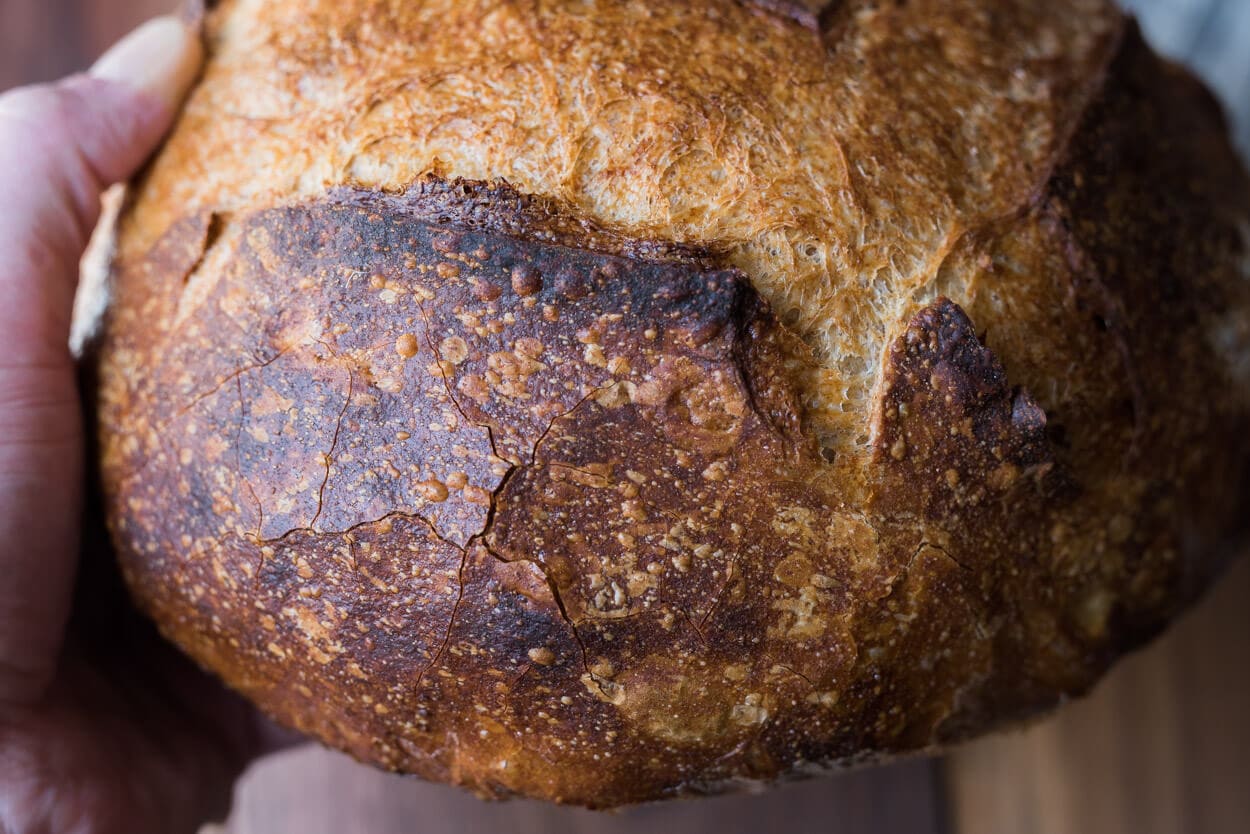
I was intimidated to make my first loaf of sourdough bread. I’d heard others talk about flat and dense loaves—dough that never rose. It wasn’t until I read a sourdough book cover to cover and painted it with post-it notes, highlights, and dog-eared pages that I felt ready to put my newborn sourdough starter to work. I bought flour. I filtered water. I measured. I mixed and kneaded. I folded ever-so-gently while I held my bread until, hours later, I pulled my first sourdough from the oven.
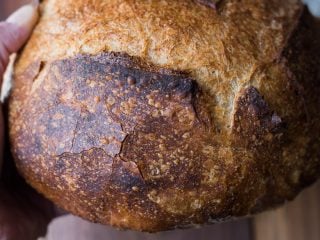
I had my wife taste it. “Pretty good,” she said. “Yeah, pretty good bread.” Only later did she fess up that it was “actually just okay, to be honest.” But all-in-all the bread had a nice rise, a crunchy and well-colored crust, and it did taste great considering it was my first loaf of any kind of bread. And you know what? We ate the entire thing.
This Beginner’s Sourdough Bread post has several videos where I walk you through each step of the sourdough bread-making process. Be sure to see the end for a complete video walkthrough of me making this recipe!
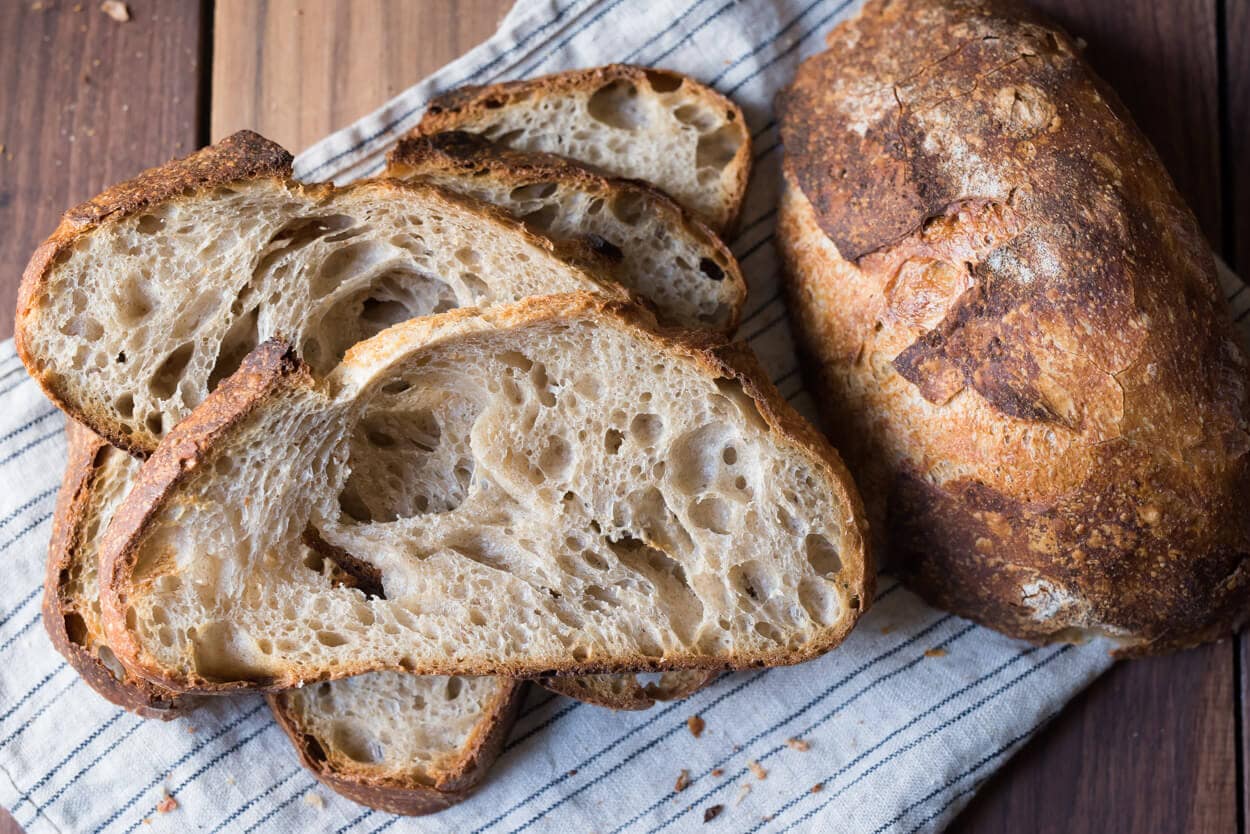
As the new obsession set in, I started making fresh sourdough bread for every meal. There was something about the whole bread-making process that I found captivating. It was–and still is–exciting to mix such elemental ingredients and to see them produce beautiful, life-giving sustenance: it is modern-day alchemy. It’s such a simple thing, and yet it brought me so much joy to see my family and friends tear into a freshly baked loaf that I wanted to bake every day of every week.
This recipe will give you confidence as you take your first steps in baking sourdough bread from your home kitchen.
Starting to make your first loaf of sourdough bread can be daunting. That’s why I’ve put together this beginner’s sourdough bread tutorial and recipe—it will give you confidence as you take your first steps in baking sourdough bread from your home kitchen. This how-to guide starts with explaining baking terms and definitions so that we will have a common vocabulary once we get to the recipe.
And then, each step of the process has lots of information to ensure you understand what is happening and what to do. But, before we go on this beginner’s sourdough bread recipe, let’s first take a look at what sourdough bread is.
What is Sourdough Bread?
Sourdough is a specific type of bread created through a natural fermentation process involving suitable bacteria and wild yeasts in the environment (i.e., the air and even a baker’s hands) and, most importantly, on the grain itself. A sourdough starter culture is used to seed fermentation in new dough when making sourdough bread.
Generally speaking, bacteria are primarily responsible for producing organic acids (lactic acid and acetic acid) that contribute to sourdough bread’s flavor, texture, and storage qualities. The wild yeasts produce carbon dioxide gas and ethanol during fermentation. When this gas becomes trapped in the dough’s airtight gluten matrix, the dough begins to rise, resulting in a final loaf of bread with a light and airy texture.
All recipes on The Perfect Loaf are naturally leavened; in other words, you won’t find any commercial yeast or instant yeast here. There’s nothing inherently wrong with commercial yeast, but I prefer to make bread this way because of the wonderful flavor and texture, the health benefits like increased bioavailability of minerals and nutrients, increased keeping quality thanks to the acids generated during natural fermentation, and the fact that it requires so few ingredients (just three!) to make something so delicious.
For a high-level look at each step of the sourdough process, read through the Beginner’s Guide to Sourdough Bread →
Creating a Sourdough Starter
It all begins with a sourdough starter. Before we look at how to make sourdough bread, you need to create a healthy sourdough starter that shows consistent signs of fermentation each day. Creating a sourdough starter is easy: mix flour and water for a few days in succession, and eventually, thanks to the bacteria and wild yeasts on the grain, natural fermentation will begin.
If you’d like to look at how I feed my starter daily, look at my sourdough starter maintenance routine. In this guide, you will see the visual and aromatic cues to look for when your starter is ready for refreshment (feeding).
While waiting for your sourdough starter, let’s look at some terms bakers often use to discuss the various parts of the bread-making process.

Baker’s Terminology
Sourdough starter
A starter is a mixture of flour and water you allow to ferment naturally. You’ll refresh (feed) the starter indefinitely to keep the fermentation active and healthy, and you will wait for it to become fully ripe before you use any of it to make bread.
When you want to make bread, you take a small amount of your starter to create an off-shoot called a levain (see below). See my post on starter creation to read more about the starter and learn how to make one.
Levain (or leaven)
A levain is made by mixing a small off-shoot of your ripe starter with water and flour and allowing it to ferment before mixing it into a dough. You can always use your starter directly to make sourdough bread, but a levain is a small off-shoot that allows you to adjust the flour, hydration, and ripening schedule (which have implications on the bacteria and wild yeast balance).
Also, unlike your sourdough starter, which lives on as its own entity, the entirety of the levain goes into the dough and has the same fate as the bread itself: to be baked in the oven. See my post on what a levain is and how it’s different from a sourdough starter for more information.
Autolyse
Some recipes utilize a step called autolyse (“auto-lease”). It occurs at the beginning of bread baking and is a step in which only flour and water are mixed together and left to rest. The goal of autolyse is to initiate enzymatic activity in the dough to help draw out sugars from the flour. Additionally, it helps increase dough extensibility (the ability for the dough to stretch out without tearing).
In most cases, increased extensibility is good as it helps the dough expand and fill with gasses, resulting in a light and airy loaf. See my in-depth post on the autolyse technique for more information.
Bulk fermentation
The dough’s first rise is called bulk fermentation. After mixing the flour, salt, and levain into a dough, you put it all into a bowl or container, cover it, and let it rest. The dough will undergo a fermentation process during this critical step. Bacteria and yeast begin to generate organic acids and alcohols and leaven the dough, which will translate to flavor and rise in your final bread.
For more on this critical step in the bread-making process, see my in-depth guide to bulk fermentation.
Proofing
The proof is the dough’s final, or second, rise after the dough has been divided and shaped and lasts until the dough is finally baked in the oven. During this time, the dough continues to ferment, further strengthening and leavening it. I typically proof at a cold temperature in the refrigerator (also called “retarding”).
In my ultimate guide to proofing, I talk about how to spot when the dough is finished rising and ready to bake, plus a whole lot more.
Final Dough Temperature
The final dough temperature (FDT) is the dough’s temperature after mixing all ingredients. The dough’s temperature is important because it’s the main factor that affects fermentation strength: a warmer dough will ferment faster than a cooler dough.
Naturally, each component (levain, the flour, the water, and the ambient environment) has a temperature. While most of these are out of our control, we can easily adjust the water temperature, which enables us to change the FDT of the entire dough to meet whatever the recipe calls for.
I have a handy water temperature calculator you can use to quickly figure out what you need to warm or cool your mixing water to get the dough to the right temperature.
Or, so you don’t have to do any calculations, here’s a quick cheat sheet for this Beginner’s Sourdough bread recipe:
| If your kitchen temperature is | Warm or cool the mixing water to |
|---|---|
| 68°F (20°C) | 98°F (37°C) |
| 70°F (21°C) | 94°F (34°C) |
| 72°F (22°C) | 90°F (32°C) |
| 74°F (23°C) | 86°F (30°C) |
| 76°F (24°C) | 82°F (28°C) |
| 78°F (25°C) | 78°F (25°C) |
| 80°F (26°C) | 74°F (23°C) |
If your kitchen is outside of these temperatures, my guide on the importance of dough temperature in baking will walk you through calculating exactly what to warm (or cool) your mixing water to so your dough meets the FDT for any recipe.
Baker’s Percentages (Baker’s Math)
Baker’s math, or baker’s percentages, helps bakers adjust the actual quantity of the ingredients up or down, depending on how much bread they want to make. I write all the formulas on The Perfect Loaf in baker’s percentages, where all ingredient weights are a percentage of the total flour weight, which always adds up to 100%. Read through my introduction to baker’s percentages for a more in-depth explanation (including how to scale up and down a bread recipe).
TPL Members (the baking community here) have access to all the recipes here at The Perfect Loaf in spreadsheet form, making scaling up and down recipes as simple as changing a few numbers.
Baking Tools
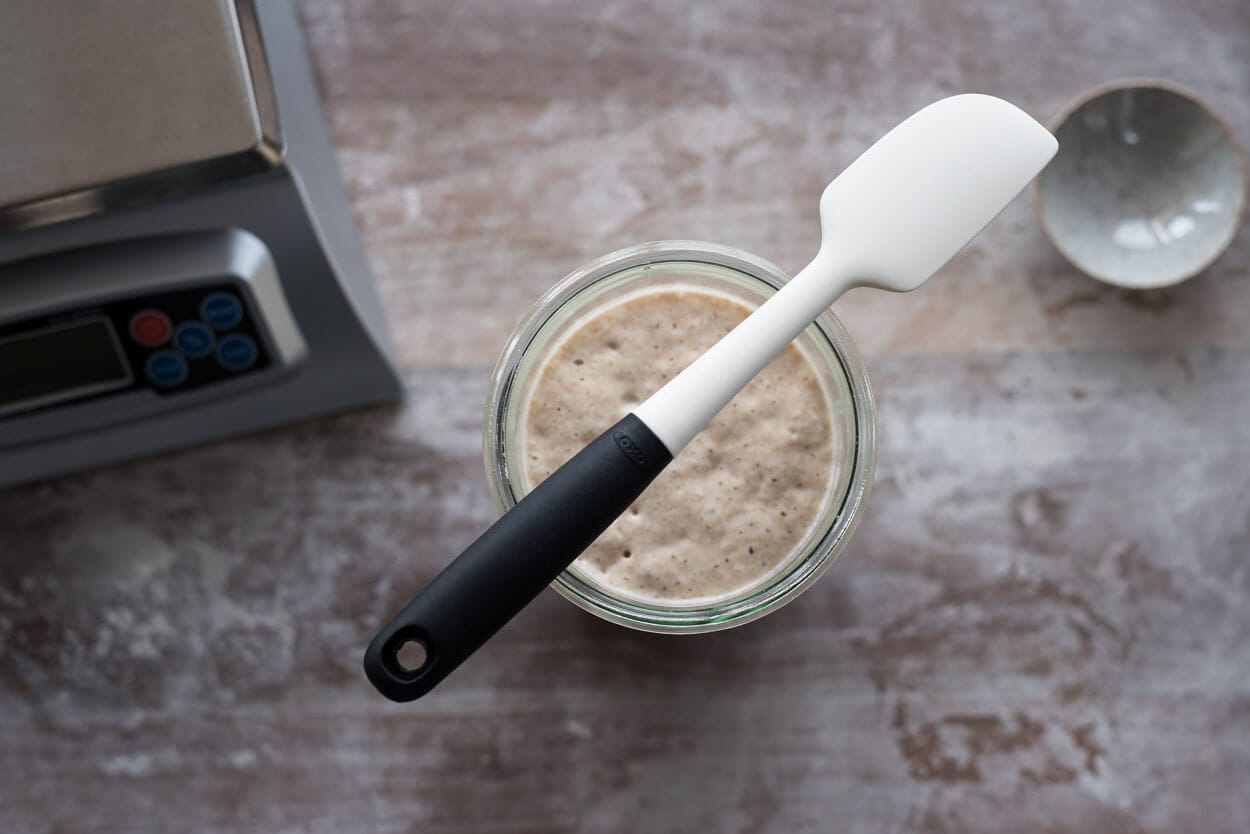
There are a few necessary tools for baking your first loaf of this beginner’s sourdough bread. The following might look like a long list, but you probably already have many of these in your kitchen—There are a few tools necessary for baking this beginner’s sourdough bread. Note that one item is absolutely necessary: a kitchen scale. If you don’t have a kitchen scale, please consider buying one. Measuring flour with cups and scoops is entirely inaccurate!
- combo cooker like a Lodge 3qt. cast iron combo cooker or a Le Creuset Dutch oven that can withstand 500°F (260°C) in the oven and has a well-sealing lid
- large mixing bowl to mix your dough by hand
- two medium kitchen bowls to proof your dough
- two kitchen towels or a tea towel to line the proofing bowls
- bench knife to cut and shape the dough
- plastic or silicone bowl scraper
- kitchen scale that measures in grams
- instant-read thermometer
- white rice flour for dusting proofing bowl
- blade for scoring your dough (a “lame”), or a razor blade, sharp knife, or scissors
- fine-grain sea salt
- parchment paper
- pizza peel (or cutting board)
- heavy duty oven mitt
- the best bread knife for cutting your sourdough bread
You can find a full list of all the tools I use when baking on my baking tools page.
The Importance of Dough Temperature
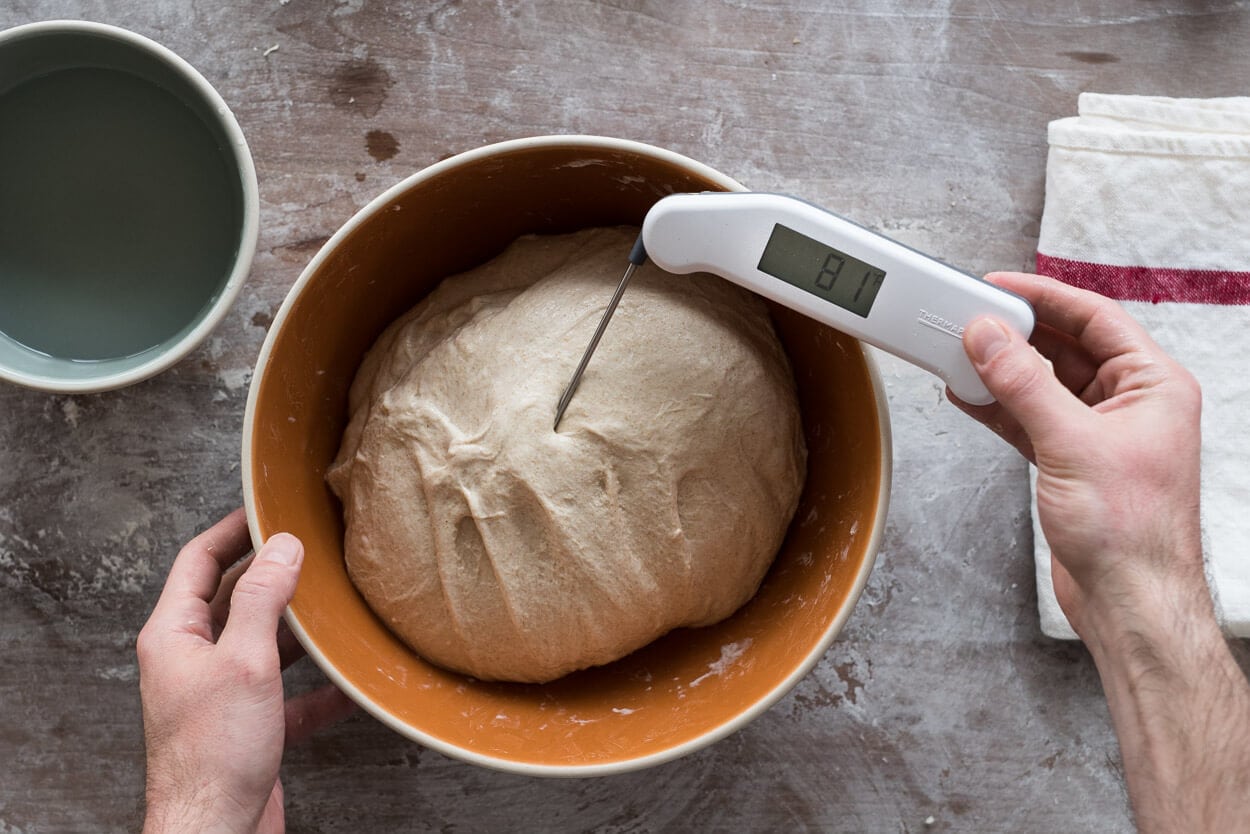
When I first started baking, I didn’t quite grasp how important temperature is in the bread-making process. I always like to say: Treat temperature as an ingredient, just as flour, water, and salt are ingredients. What I mean by that, practically, is that if one day you mix with water that is 70°F (21°C) and then a week later mix with water that is 80°F (26°C), you will get drastically different outcomes.
Temperature determines the amount of fermentation activity you’ll see. Lower temperatures generally mean less activity; therefore, things will take longer. Higher temperatures generally mean more activity; therefore, things will take less time. Working with consistent temperatures will ensure consistency in your bread baking, and you’ll get the desired results in terms of flavor, rise, texture–well, everything.
Treat temperature as an ingredient, just as flour, water, and salt are ingredients.
If it’s cold where you’re baking, see my tips on how to bake sourdough bread in the winter. And conversely, if it’s warm where you are, see my post on how to bake in the summer. These guides will help ensure your loaves have the best flavor and volume.
Flour For Baking Bread
I used commonly available supermarket flour for this recipe: Bob’s Red Mill Artisan Bread Flour, Bob’s Red Mill Whole Wheat Flour, and Bob’s Red Mill or Arrowhead Dark Rye Flour. These are great flour choices, but any of King Arthur’s offerings are equally suitable. I chose “bread flour” as it has a higher protein percentage than all-purpose flour, which helps bring significant strength to the dough so that less mixing and kneading is required–it also makes things a bit easier for your first loaf of bread.
As you’ll hear me mention throughout this site, I do like to use as little high-protein flour in my recipes as possible as I find it leads to a slightly chewier, gummy interior—or be sure to use it in the correct way.
Baking Schedule
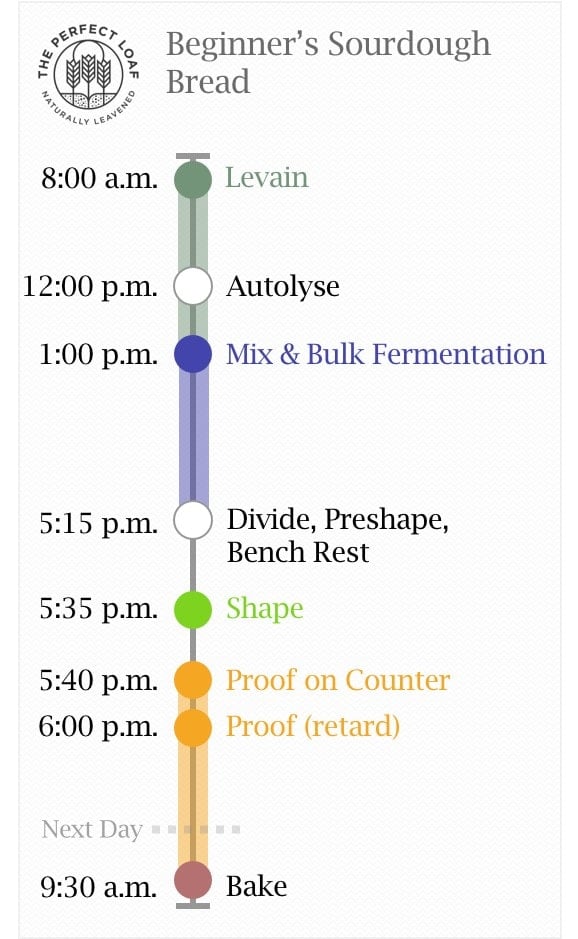
This beginner’s sourdough bread is a two-day-long process where the bread is mixed and prepared on day one, cold-proofed (retarded) in the fridge overnight, then baked on day two.
I love the convenience of this type of schedule: most of the work is done on the first day, then the dough can be left in the fridge until the next day, when it can be baked in the morning, afternoon, or even the evening.
The baking schedule to the right shows you a high-level view of what step takes place and when.
Beginner’s Sourdough Bread Formula
Now we get to the formula for the beginner’s sourdough bread formula. I start every recipe with two tables: Vitals and Total Formula. The Vitals table gives you a high-level view of the contents of the dough, as well as how much the recipe makes (in this case, two loaves). The Total Formula table lists the ingredients needed for the entire recipe and their respective amounts.
Vitals
| Total Dough Weight | 1,800 grams |
| Pre-fermented Flour | 7.5% |
| Levain in final dough | 20.3% |
| Hydration | 72.0% |
| Yield | Two loaves |
Total Formula
| Weight | Ingredient | Baker’s Percentage |
|---|---|---|
| 811g | Bob’s Red Mill Artisan Bread Flour | 80.0% |
| 152g | Bob’s Red Mill Stoneground Whole Wheat Flour | 15.0% |
| 51g | Bob’s Red Mill Dark Rye Flour | 5.0% |
| 730g | Water | 72.0% |
| 18g | Fine sea salt | 1.8% |
| 38g | Ripe sourdough starter, 100% hydration | 3.8% |
Beginner’s Sourdough Bread Method
1. Levain – 8:00 a.m.
| Weight | Ingredient | Baker’s Percentage |
|---|---|---|
| 38g | Ripe sourdough starter (100% hydration) | 50.0% |
| 38g | Bob’s Red Mill Stoneground Whole Wheat | 50.0% |
| 38g | Bob’s Red Mill Artisan Bread Flour | 50.0% |
| 76g | Water | 100.0% |
Remember: the levain is an off-shoot of your continually maintained sourdough starter and is likewise composed of bacteria and yeasts. You make this levain well before you mix the dough, so it has time to ferment, and eventually, it’s added to the dough to seed fermentation.
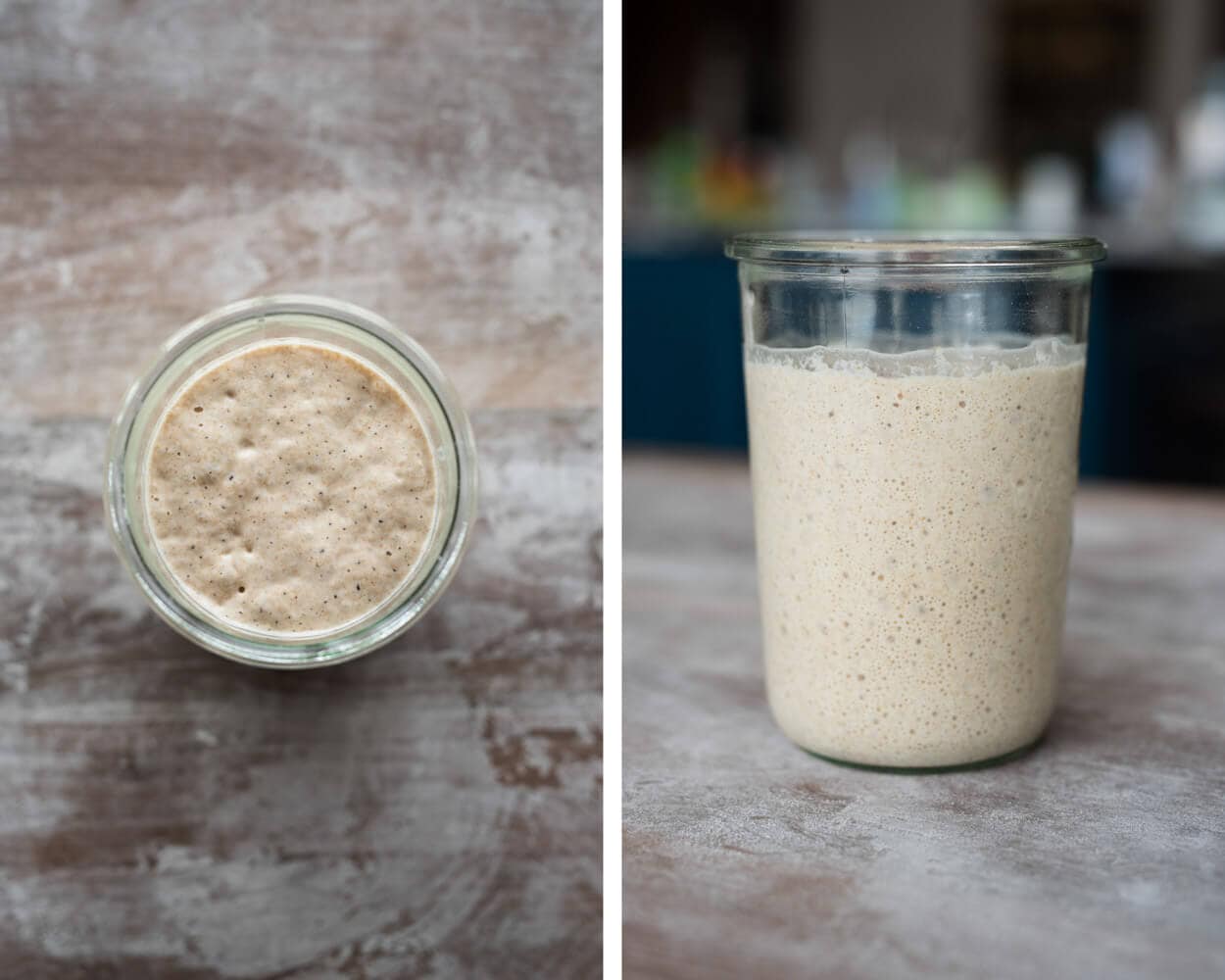
Mix the ingredients in the table above in a clean jar (I use the same sourdough starter jars) and leave it at warm room temperature, 74-76°F (23-24°C), for 5 to 6 hours. When it’s ready, it will be expanded, bubbly on top, inside, and at the sides, and have a slightly sour aroma. The photo below shows my levain before it goes into my dough mix.
2. Autolyse – 12:00 p.m.
| Weight | Ingredient |
|---|---|
| 773g | Bob’s Red Mill Artisan Bread Flour |
| 114g | Bob’s Red Mill Stoneground Whole Wheat Flour |
| 51g | Bob’s Red Mill Dark Rye Flour |
| 603g | Water (this has 50g less than the overall formula, reserved for Mix step below) |
The desired dough temperature (DDT) for this dough is 78°F (25°C). As described in the temperature section above, we will try to get the dough to this temperature right at the end of mixing (which is also at the beginning of bulk fermentation).
Warm or cool the autolyse water so the mixed dough reaches the FDT for this recipe. Place the flour and the water called for in the table above in a large bowl. Use wet hands to mix until no dry bits remain; the dough will be shaggy and loose. Use a bowl scraper to scrape down the sides of the bowl, keeping all the dough in one area at the bottom. Cover the bowl and place it near your levain for 1 hour.
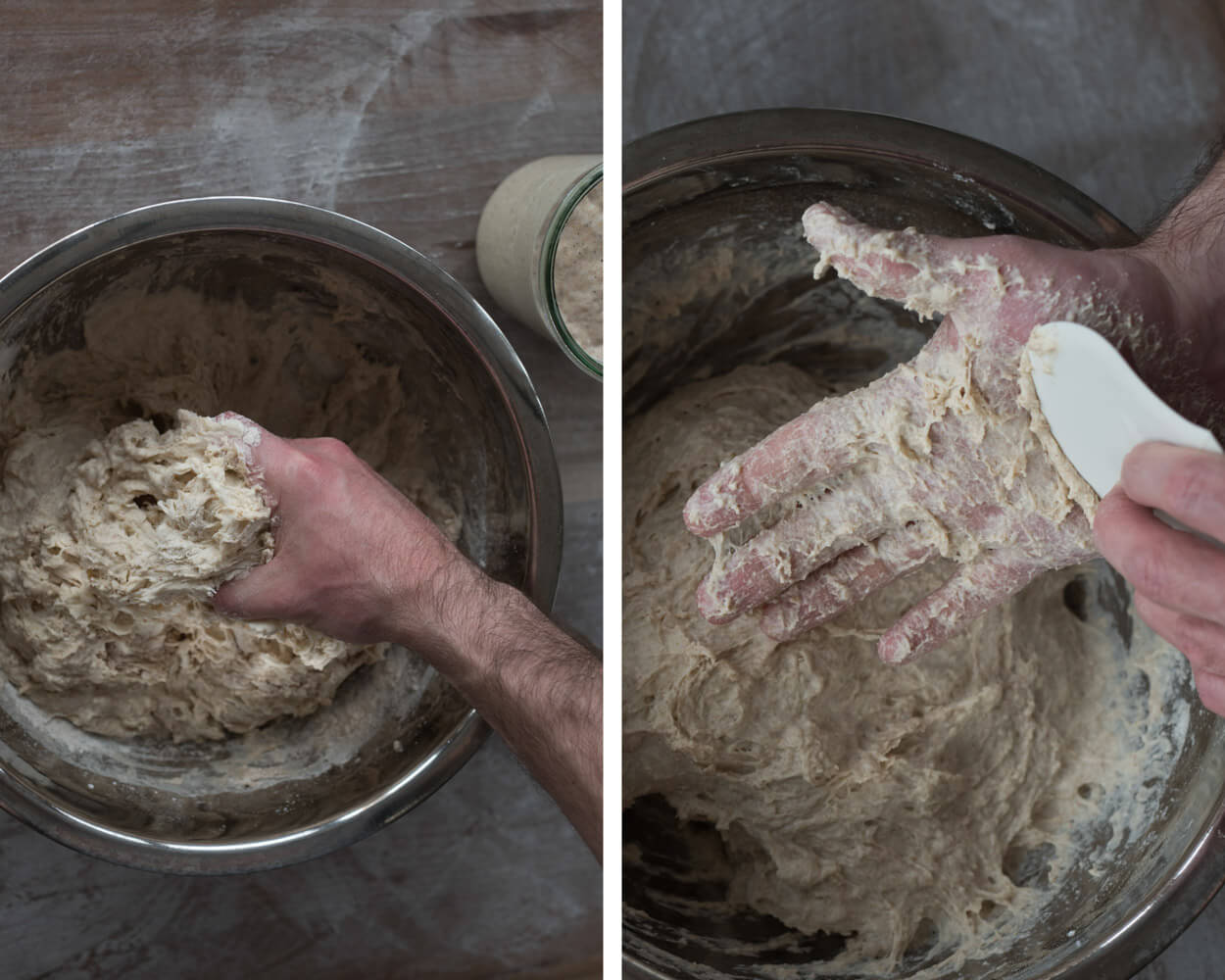
Note that the autolyse stage does not incorporate salt or the levain in any way since the autolyse is a long one hour. Adding the levain to the autolyse would mean fermentation would begin, which could end up overproofing the dough. Salt is rarely added to an autolyse because the salt would diminish enzymatic activity during this time, which is precisely why we are doing an autolyse. The autolyse and levain are two separate entities that will be mixed together later in the process.
3. Mix – 1:00 p.m.
| Weight | Ingredient |
|---|---|
| 50g | Reserved water (this water was held back in the Autolyse step) |
| 18g | Fine sea salt |
| 190g | Ripe, 100% hydration levain (from Levain, above) |
Use your instant-read thermometer to take the dough’s temperature and compare it to the FDT for this recipe. If it is higher, use cold water for the reserved water; if it is lower, use warm water.
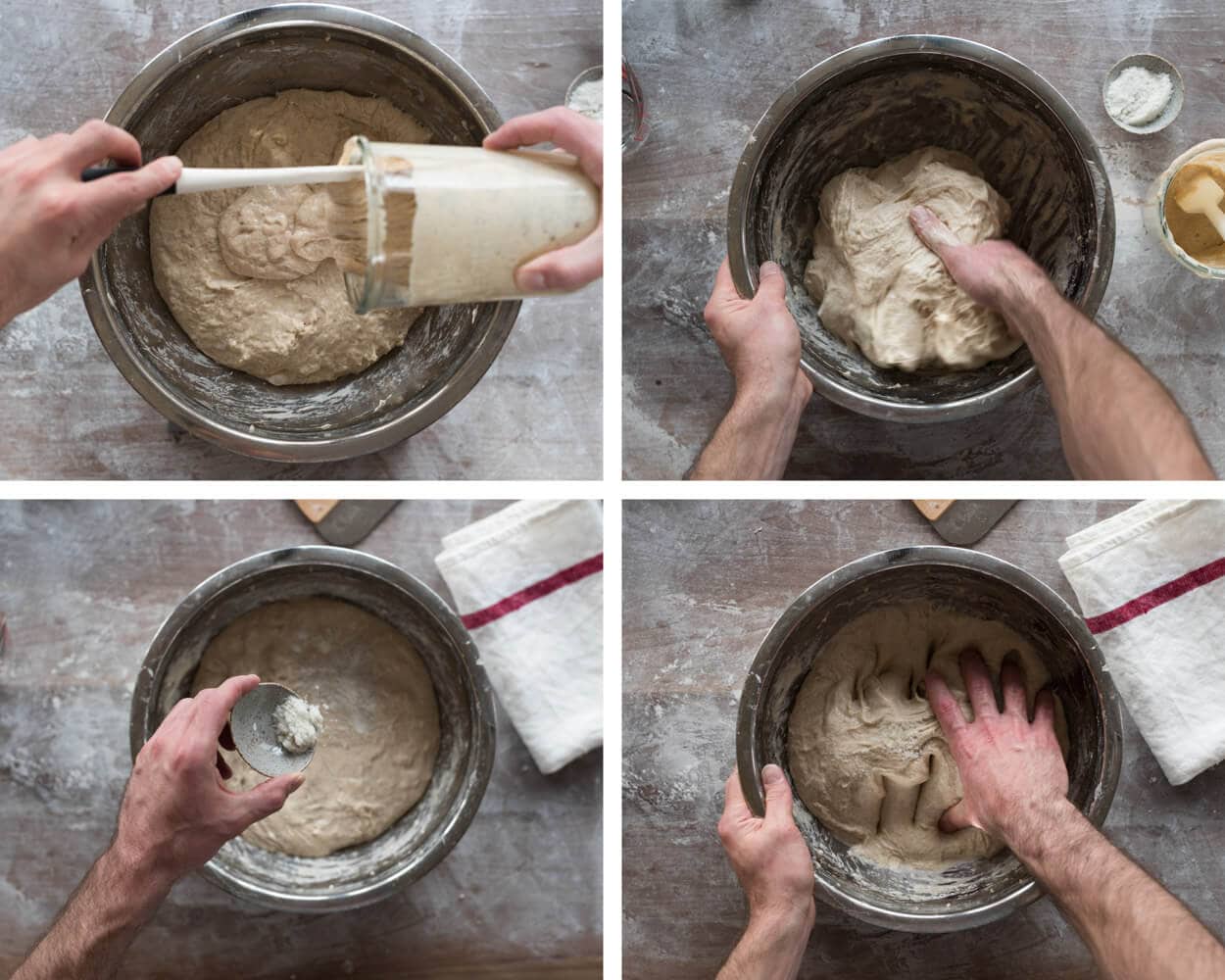
At this point, your autolyse is complete and your levain is ready—it’s time to mix and strengthen the dough. If the dough feels very wet and shaggy, do not use all of the reserved 50g of water; use only a splash to help incorporate the salt and levain. If the dough feels good to you, use all the reserved water.
To the autolyse, add the ingredients in the table above (salt, reserved water to help adjust dough hydration and consistency, and levain). I like to spread everything on top of the dough and use wet hands to pinch all the ingredients together. Transfer the dough to a container or thick-walled bowl for bulk fermentation.
Take the temperature of the dough to get your final dough temperature. If your FDT is below 78°F (25°C), next time use warmer water, and conversely, if it’s above 78°F (25°C), use cooler water. Cover the dough.
4. Bulk Fermentation – 1:10 p.m. to 5:10 p.m.
At 74-76°F (23-24°C) ambient temperature, bulk fermentation should go for about 4 hours. Perform 3 sets of stretches and folds during bulk fermentation, spaced out by 30 minutes.
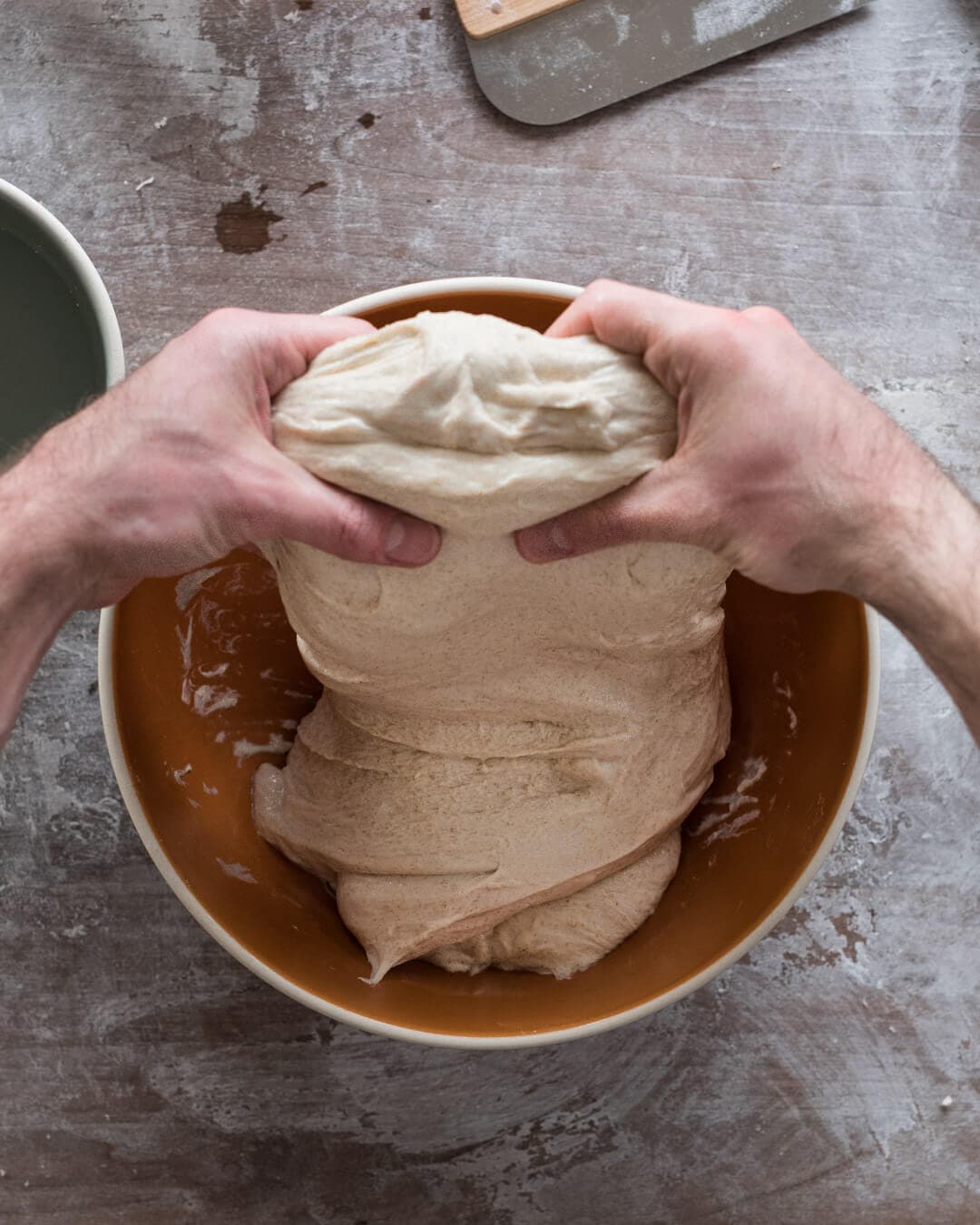
Each set of stretches and folds consists of 4 folds: one each at the North, South, East, and West sides. Wet your hands with a little water to prevent sticking, and then lift one side (North) of the dough with two hands. Stretch the dough high enough so you can fold it completely over to the other side. Rotate the bowl 180° and do the other side (South). Finish the other two sides (East and West) to complete the set. Let the dough rest for 30 minutes, covered, between sets.
In the video below, you can see how I stretch and fold this dough during bulk fermentation.
After the third set of stretch and folds, let the dough rest for the remainder of bulk fermentation. During this time, fermentation aerates the dough (making it rise), continues to strengthen it, and further develops its flavor.
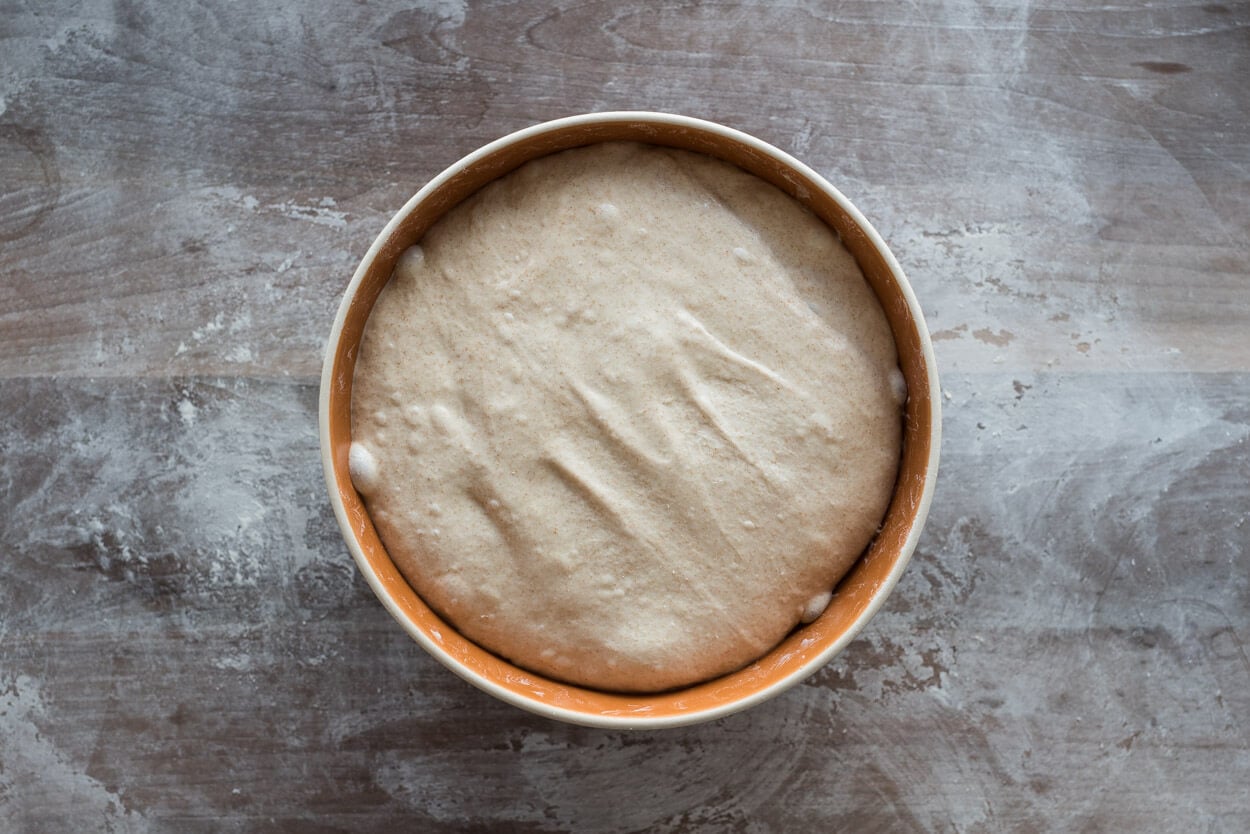
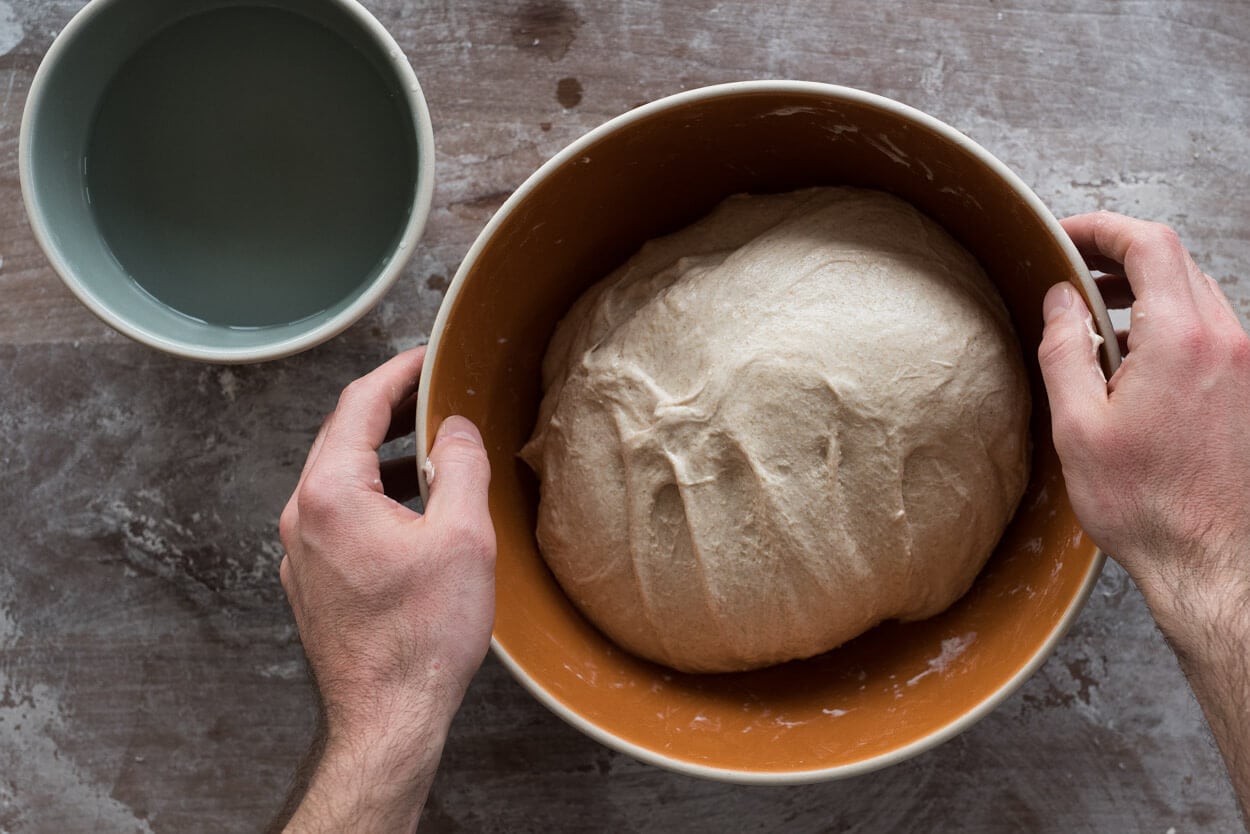
At the end of bulk fermentation, your dough should have risen by 20% to 50%. It should show some bubbles on the top and sides, and the edge of the dough where it meets the bowl should be slightly domed, which indicates strength. In the photo above, you can see all these signs. If you don’t see these signs, leave it for another 15 minutes in bulk fermentation and check again.
5. Divide and preshape – 5:15 p.m.
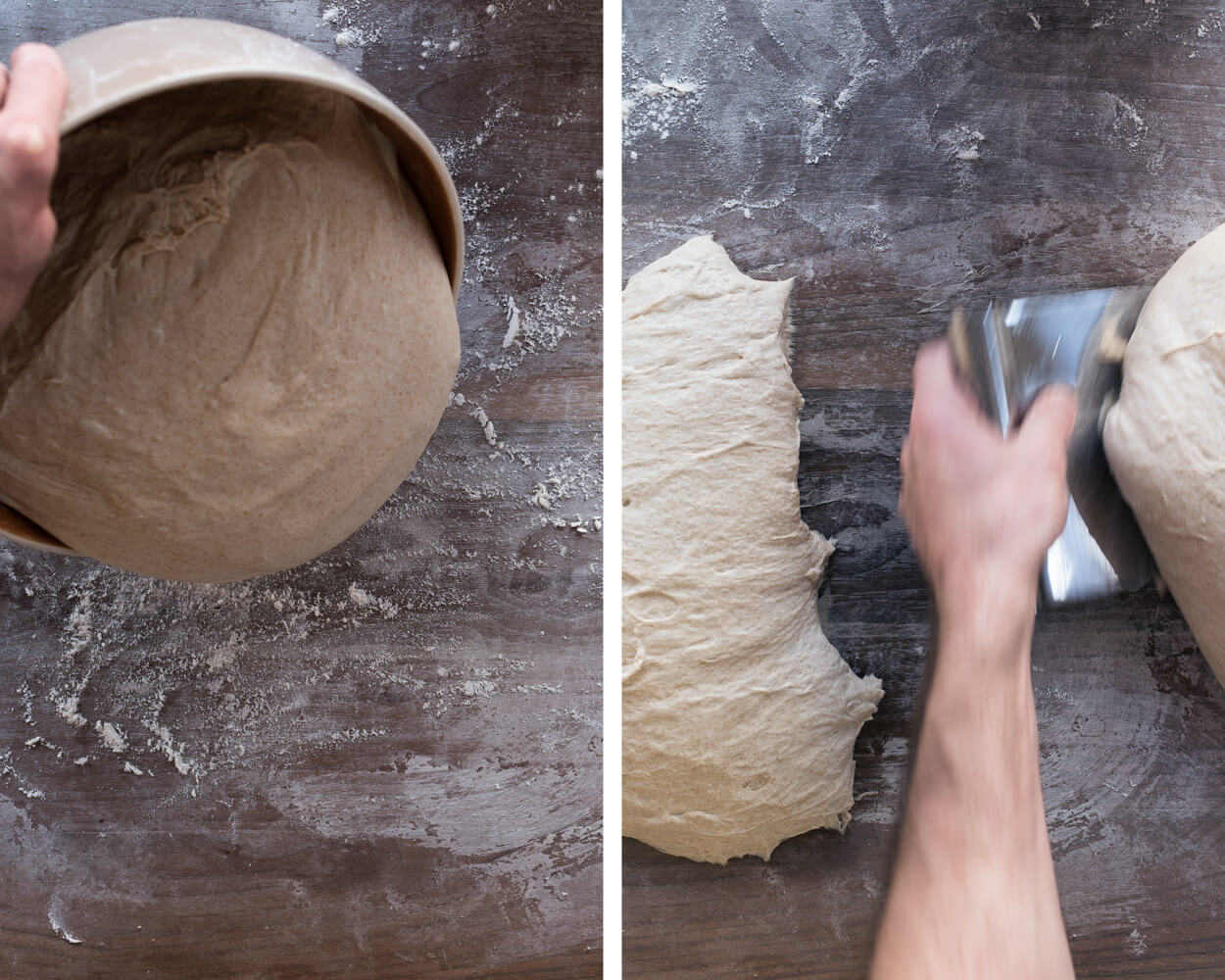
Lightly flour a work surface. Using a bowl scraper, gently scrape the dough onto the work surface and use your bench knife to divide the dough directly in half. Using your bench knife in your dominant hand, and the other hand wet (or floured, if you prefer) to reduce sticking, turn each half of the dough on the counter while lightly pulling the dough towards you. This gentle turning and pulling motion will develop tension on the dough’s top, forming a circle.
Preshaping bread dough is an often overlooked step, but it sets the stage for successful shaping later. See my guide to preshaping bread dough for more information.
Let the dough rest for 25 minutes, uncovered.
In the video below, you can see how I preshape this beginner’s sourdough bread dough:
6. Shape – 5:35 p.m.
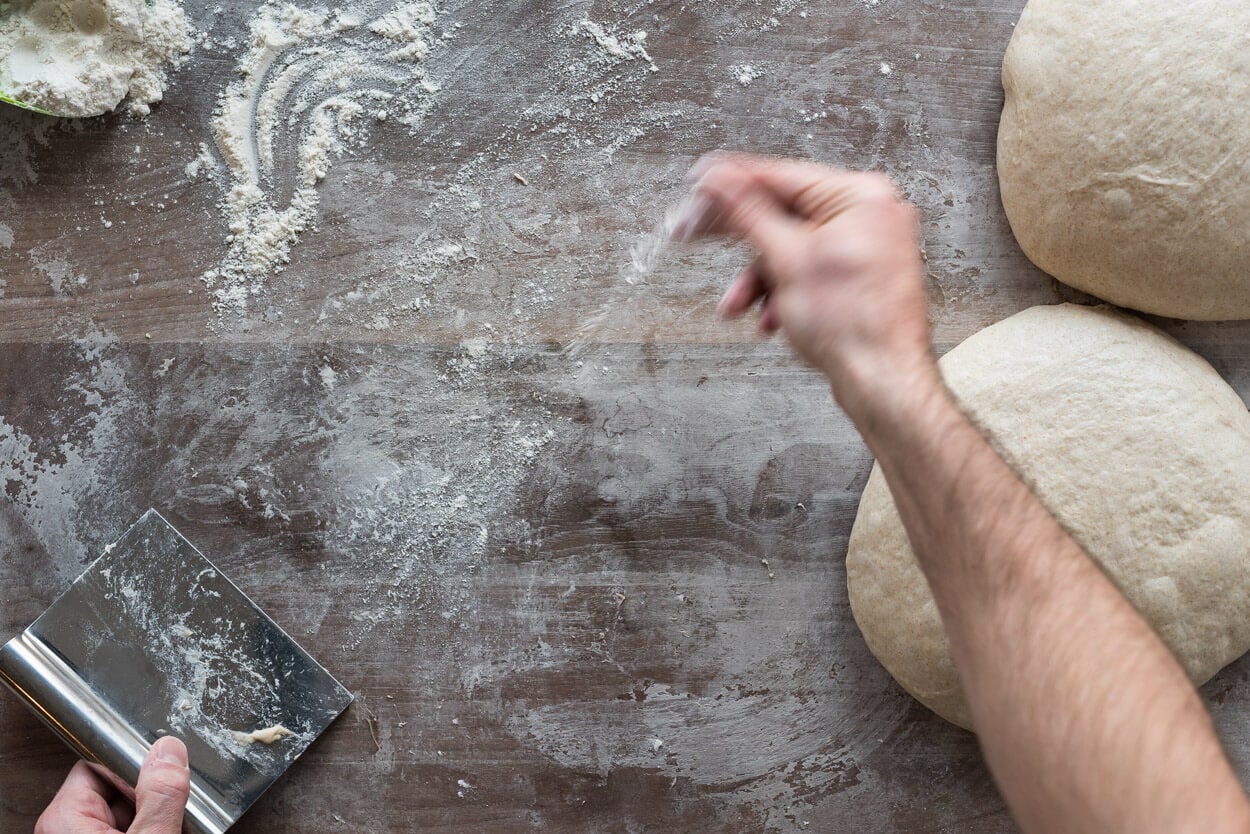
If you’re new to shaping bread dough, check out my guide to shaping a boule (a round) in addition to the steps below.
Lightly flour the top of your dough rounds and the work surface. Working with one round at a time, flip the round so the floured top is now down on the floured work surface.
As seen in the image below, with lightly floured hands, grab the bottom of the round and stretch it lightly downward towards your body, and then up and over about 2/3 of the way to the top.
Then, grab the left and right sides of the dough and stretch them away from each other. Fold one side over toward the other and repeat with the other side.
Then, grab the top of the circle, stretch it away from your body, and then fold it down to the bottom of the dough. You’ll now have a tight package that resembles a letter.
Finally, flip or roll down the dough so the seams are all on the bottom. Using both hands, cup the top part of the round and drag the dough gently towards your body to create surface tension on the dough. The angle of your hands will gently press the dough’s bottom on the counter. This dragging helps create surface tension on the dough, which helps keep it in shape during proofing.
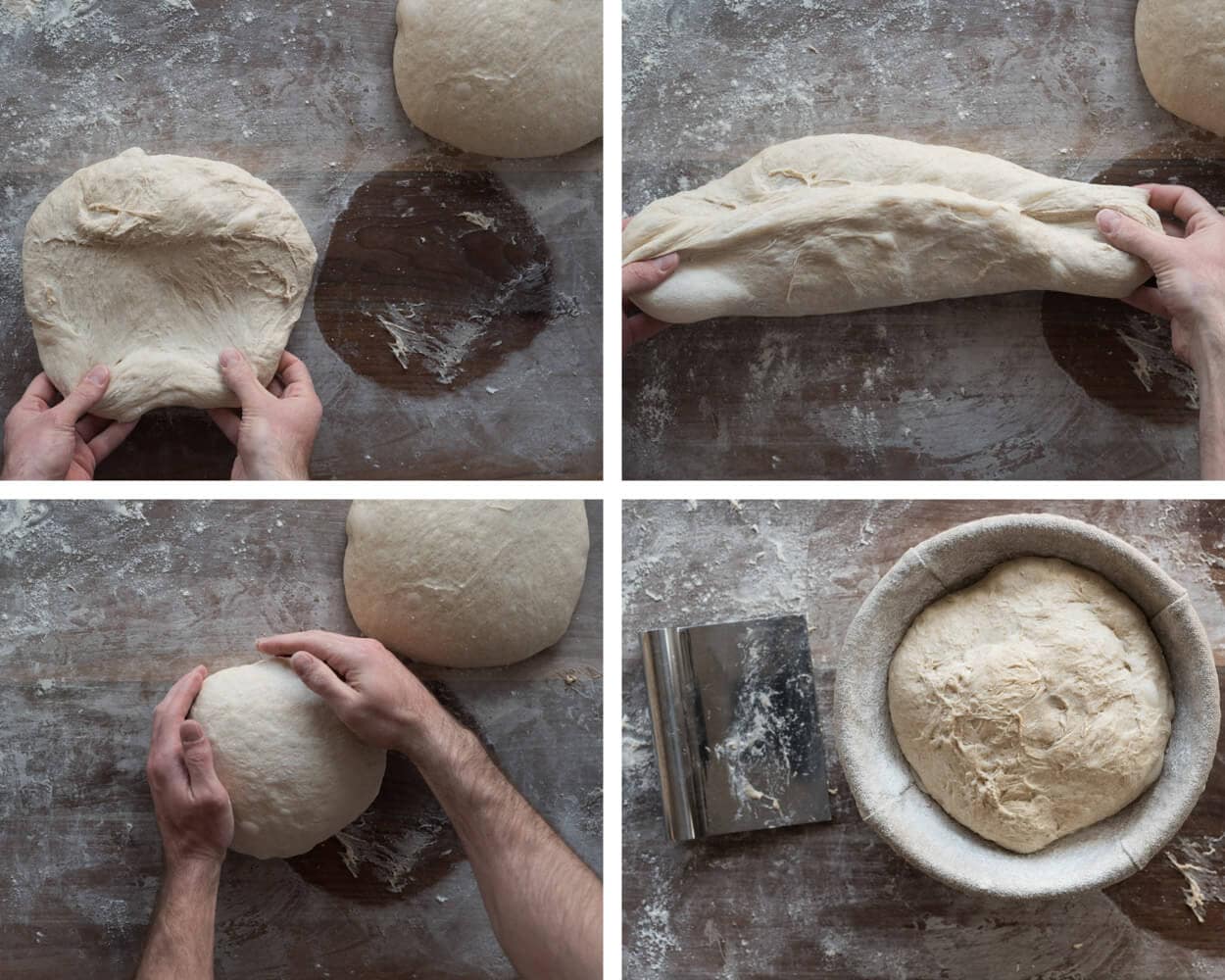
Let the dough rest on the bench for a few minutes to help the bottom seam seal.
In the video below, you can see how I shape bread dough into a boule shape.
Meanwhile, prepare your proofing baskets. Line two proofing baskets, kitchen bowls, or bannetons with clean kitchen towels. Dust lightly and evenly with plain white flour or white rice flour. Gently transfer each piece of shaped dough to a proofing basket, seam-side-up.
You can also top this dough with sesame seeds, sunflower seeds, pepitas, and much more—see my guide to topping bread dough for more ideas and instructions.
7. Rest and proof – 5:40 p.m. to 9:30 a.m. (next day)
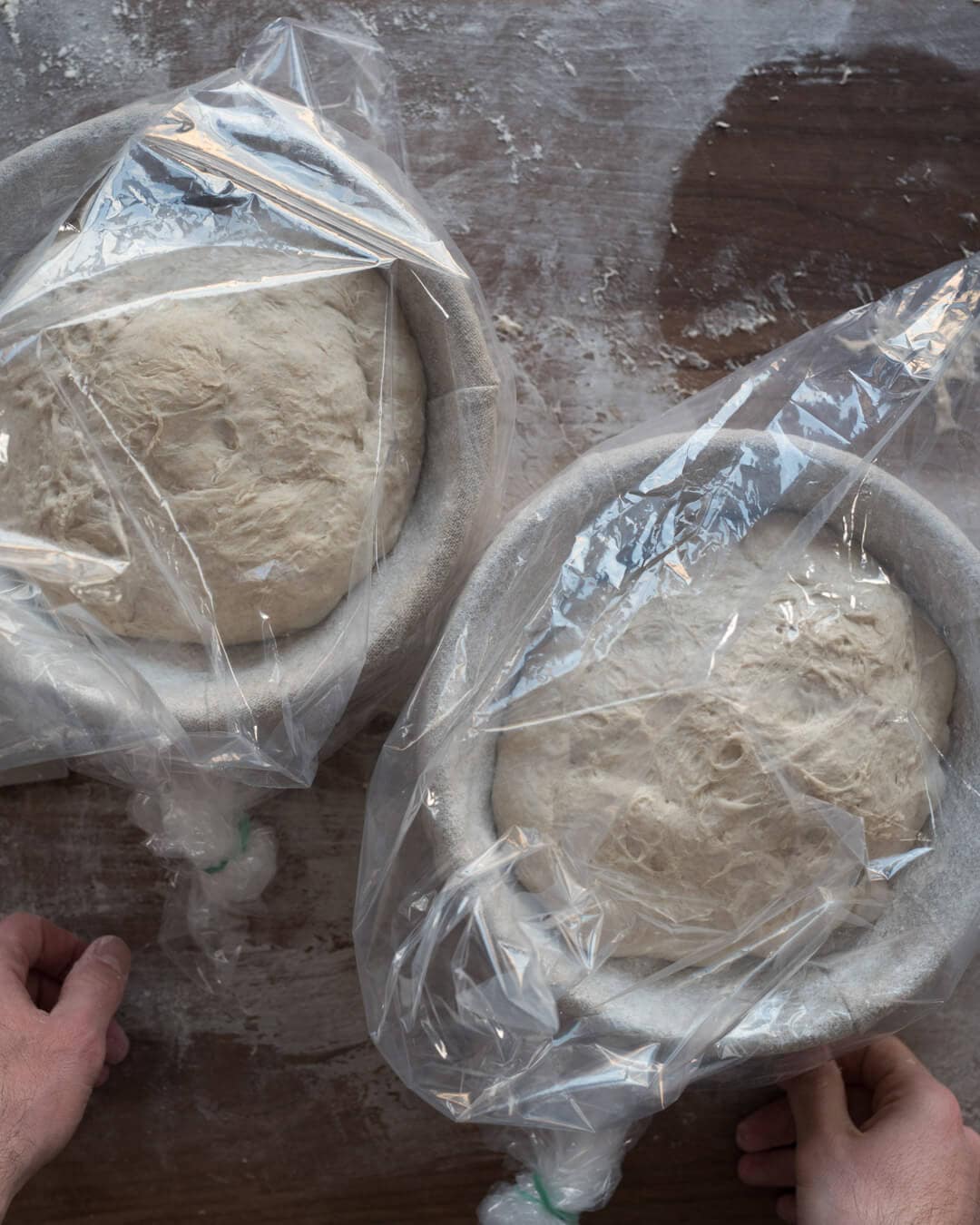
To prevent your dough from drying out overnight, place your bowls containing your shaped dough into reusable plastic bags and seal. I usually puff up the plastic bag around the bowl by opening it wide and then quickly closing it.
Let the dough rest on the counter for 20 minutes. Then, retard (a baker’s term meaning place into a cold area to proof) in the refrigerator at 38°F (3°C) for 16 hours (overnight).
During this time, overall fermentation will slow (especially yeast activity), but bacterial activity will continue at a reduced rate, resulting in a more complex flavor and, ultimately, deeper crust coloring.
8. Bake – Next morning: preheat oven at 8:30 a.m., bake at 9:30 a.m.
Now, it’s time to bake your sourdough bread. It’s not a difficult step, but there are some things to know. The oven needs steam for the best crust and tallest rise. I like to use a Dutch oven or combo cooker, which is very easy. These pots trap the steam released from the dough and provide the right environment for it to rise optimally.
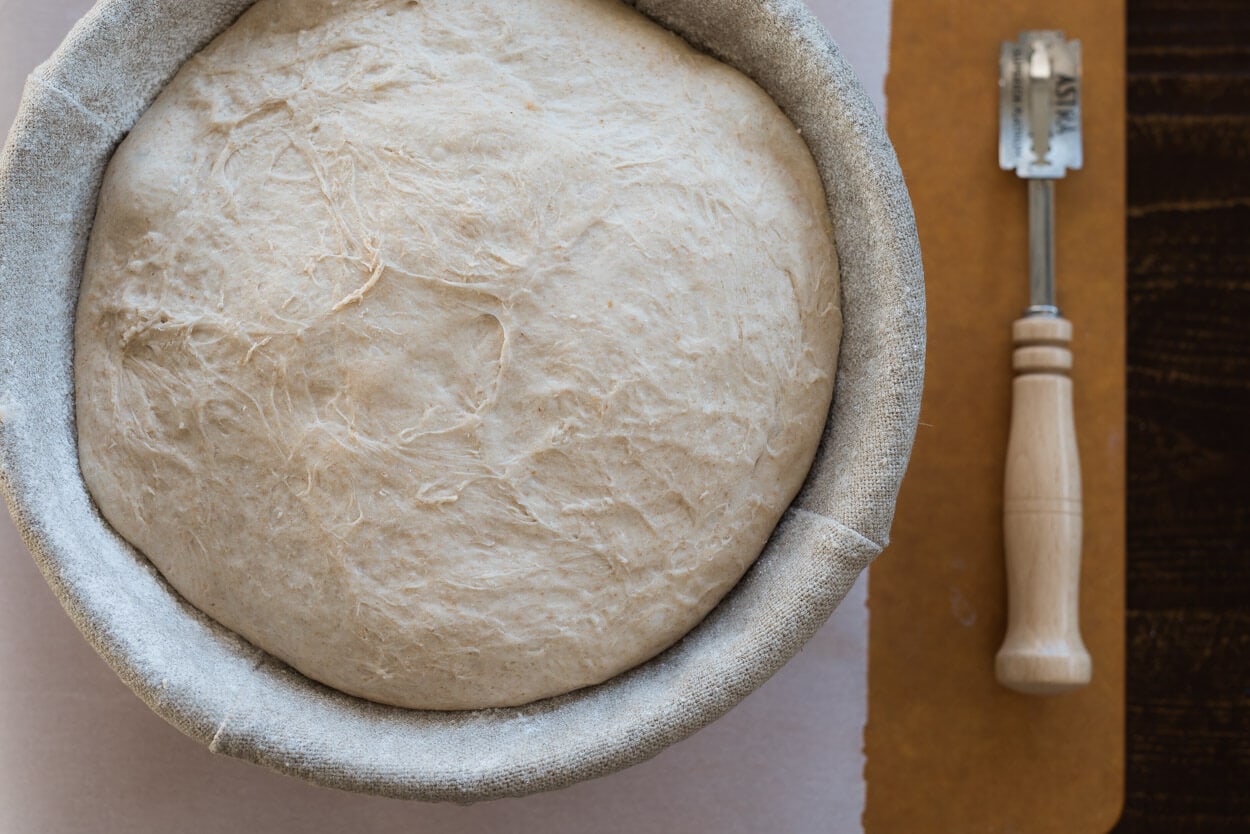
See my full guide to baking sourdough bread for tips on scoring your dough, pots, and steaming.
Place an oven rack in the bottom third of the oven with no rack above it. Put your combo cooker or Dutch oven on the oven rack, and preheat the oven to 450°F (232°C) for at least 30 minutes. If you’re using a combo cooker, place the shallow side face up on one side and the heavier, deep side face down on the other.
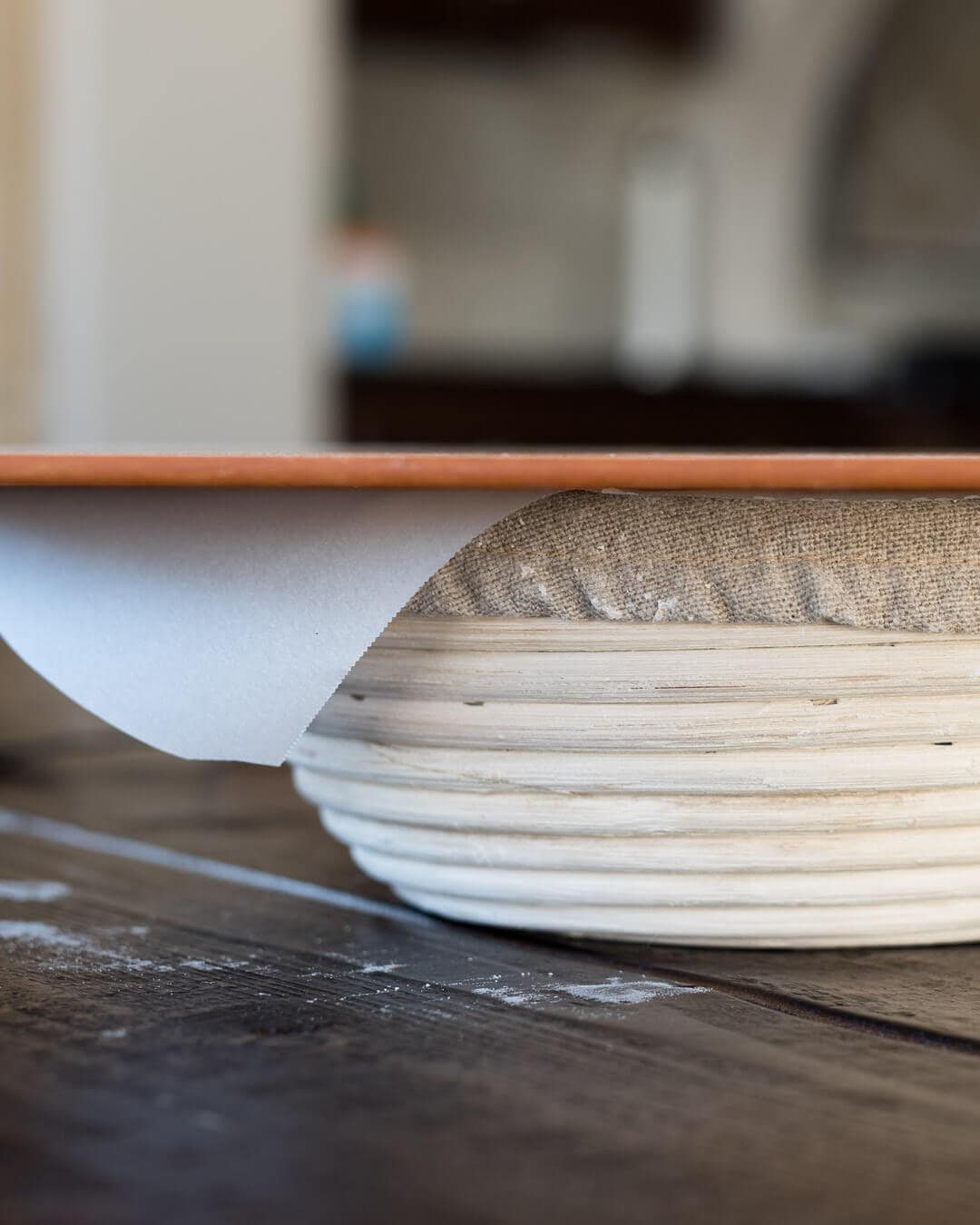
When your oven is preheated, remove one of the proofing baskets from the fridge, uncover it, and place a piece of parchment paper over it. Place a pizza peel, cutting board, or inverted baking sheet on top of the parchment and, using both hands, flip everything over. Gently remove the basket; your dough should rest on the parchment.
Using a razor blade, sharp knife, or baker’s lame, score the dough at a 90° angle between the blade and the dough. I chose to make a “box” pattern. If using scissors, snip the dough a few times at a very shallow angle between the scissors and the dough, forming a set of ridges down the dough’s center.
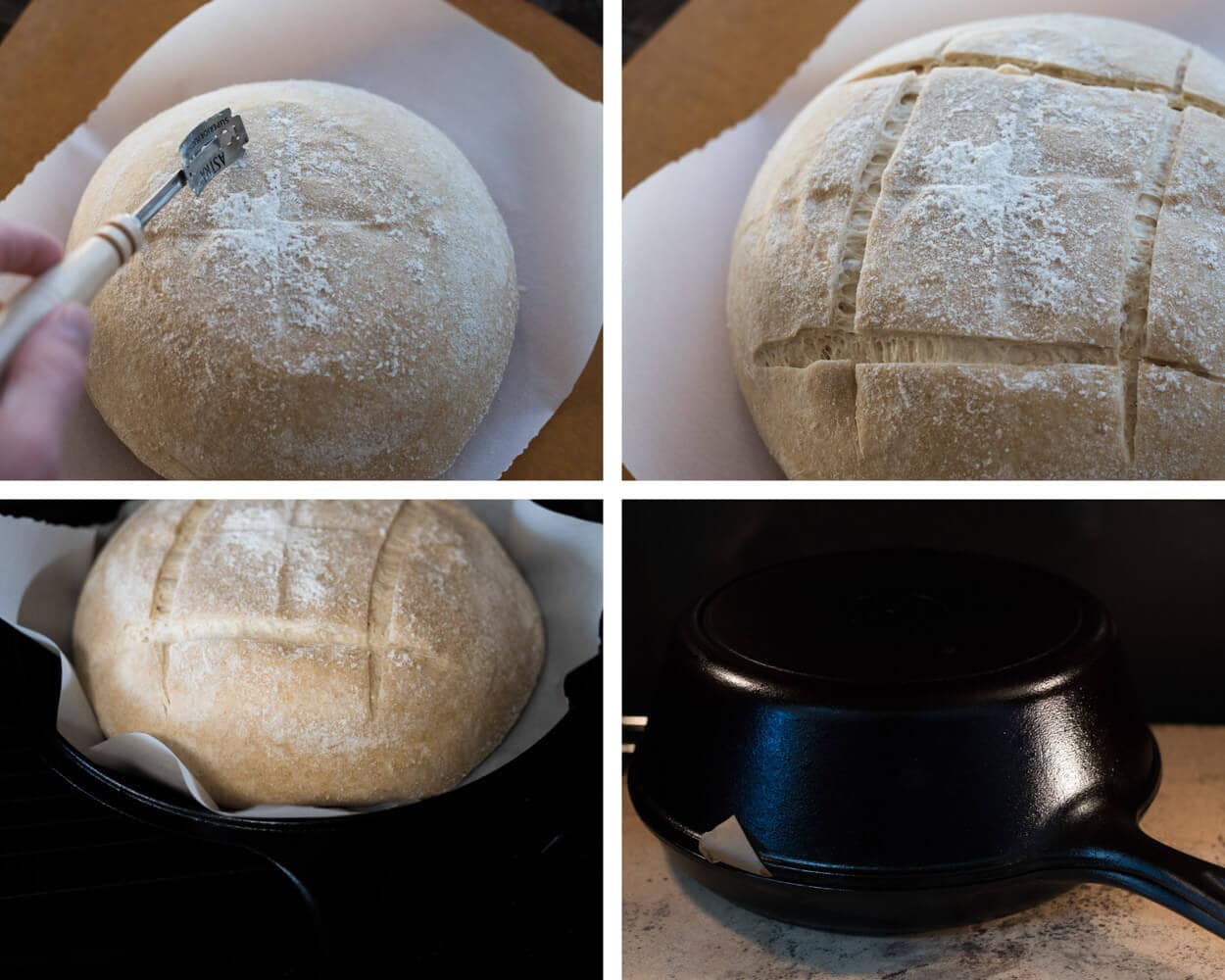
While wearing your heavy-duty oven mitt, and with caution, pull out your shallow side of the combo cooker and place it on a heat-safe rack or stovetop. Slide the dough into the combo cooker or Dutch oven. Place it back into the oven and cover the shallow side with the deep side, or put the lid on the Dutch oven. This sealed environment helps trap the moisture (escaping steam) from your dough to steam the loaf exterior as it bakes, which encourages maximal rise and a crunchy, shiny crust.
Bake for 20 minutes. Vent the oven of steam: use your oven mitt to very carefully remove the top of the combo cooker or Dutch oven. Leave the large side of the combo cooker in the oven to the side. Close the oven door and bake for 30 minutes more. When done, the loaf should have an internal temperature of around 208°F (97°C), and the crust should be a deep mahogany color and crackle/crunch when squeezed.
Use your oven mitt to transfer the bread to a wire rack carefully. Cool for 1 to 2 hours before slicing into your beginner’s sourdough bread. For the second loaf, preheat the combo cooker or Dutch oven for 15 minutes and repeat.
Follow my guide to storing bread to keep your loaves fresh for as long as possible.
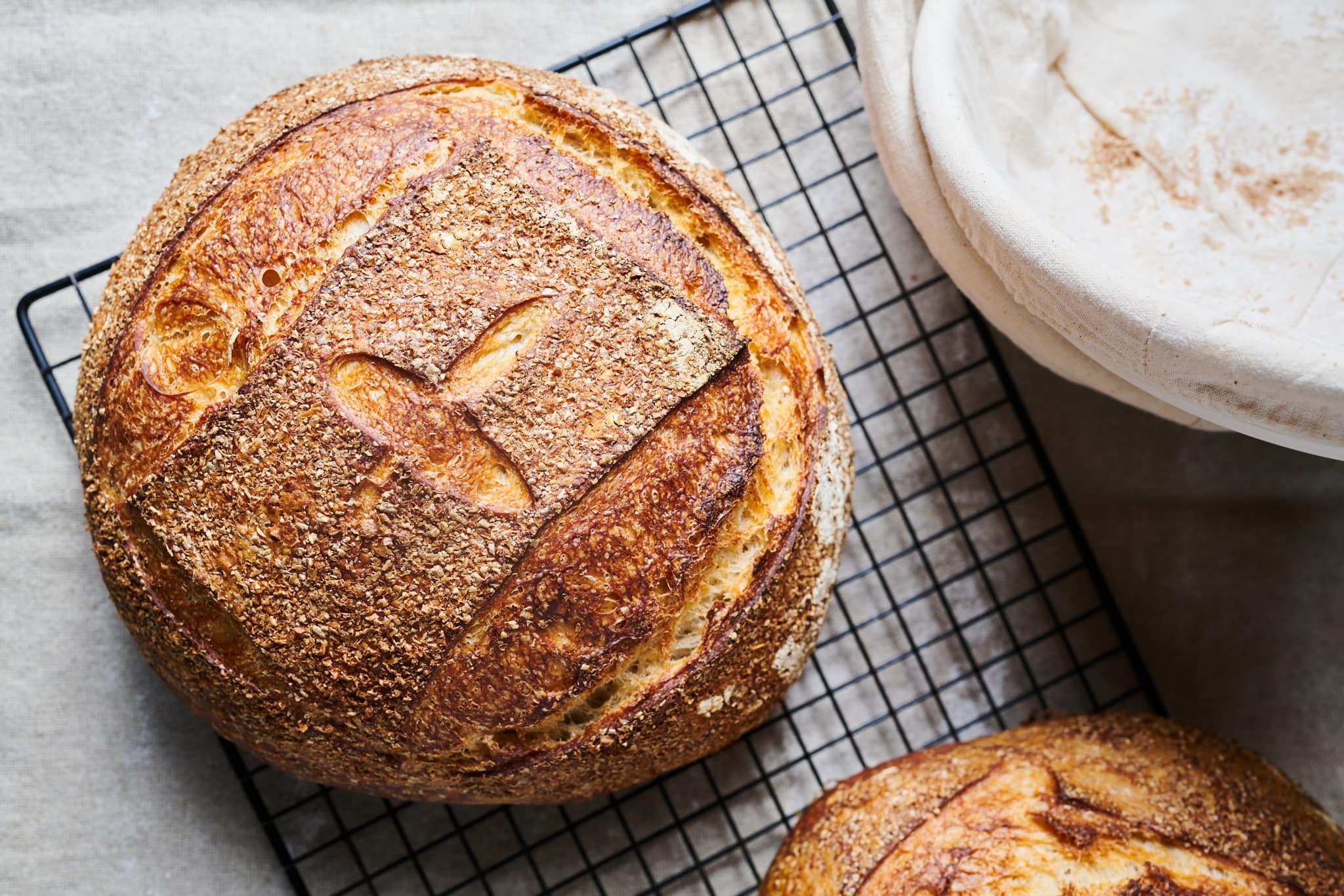
Once you get the hang of this beginner’s sourdough bread process and formula, you can endlessly modify it with add-ins like walnuts, cranberries, seeds, and a host of other ingredients bound only by your imagination. But the most important thing is to bake and have fun. Remember that sometimes bread doesn’t come out as you intended–but stick with it, and you’ll be rewarded time and time again.
And of course, buon appetito!
Watch me make this Beginner’s Sourdough Bread from start to finish
In my YouTube video below, you can see how I make my Beginner’s Sourdough Bread, from creating the levain to slicing the final loaves.
Beginner’s Sourdough Bread Recipe
- Prep Time: 23 hours
- Cook Time: 1 hour
- Total Time: 24 hours
- Yield: 2 loaves
- Category: Main course
- Cuisine: American
Description
The perfect bread to get started baking sourdough bread at home. This crusty, crunchy, and absolutely delicious loaf of bread is perfect for any lunch or dinner table.
Ingredients
Levain
- 38 grams stoneground whole wheat flour
- 38 grams bread flour
- 76 grams water
- 38 grams ripe sourdough starter
Main dough
- 773 grams bread flour
- 114 grams whole wheat flour
- 51 grams whole grain rye flour
- 653 grams water
- 18 grams fine sea salt
Instructions
- Levain (8:00 a.m.)
In a small container, mix the levain ingredients and keep at 74-76°F (23-24°C) for 5 to 6 hours. - Autolyse (12:00 p.m)
In a medium mixing bowl, mix the flour and 603 grams of water (reserve 50 grams until the next step). Cover and let rest for 1 hour. - Mix (1:00 p.m.)
To the mixing bowl holding your dough, add the salt, ripe levain (from step 1), and reserved 50 grams water. Mix by hand or with a dough whisk until incorporated. Transfer your dough to a bulk fermentation container and cover. - Bulk Fermentation (1:10 p.m. to 5:10 p.m.)
Give the dough 3 sets of stretch and folds at 30-minute intervals, where the first set starts 30 minutes after the start of bulk fermentation. - Divide and Preshape (5:10 p.m.)
Lightly flour your work surface and scrape out your dough. Using your bench knife, divide the dough in half. Lightly shape each half into a round shape. Let the dough rest for 25 minutes, uncovered. - Shape (5:35 p.m.)
Shape the dough into a round (boule) or oval (batard)—place in proofing baskets. - Rest and Proof (5:40 p.m. to 9:30 a.m. the next day)
Cover proofing baskets with reusable plastic and seal shut. Let the dough sit out on the counter for 20 minutes. Then, place both baskets into the refrigerator and proof overnight. - Bake (Preheat oven at 8:30 a.m., bake at 9:30 a.m.)
Preheat your oven with a combo cooker or Dutch oven inside to 450°F (230°C). When the oven is preheated, remove your dough from the fridge, score it, and transfer to the preheated combo cooker. Place the cooker in the oven, cover with the lid, and bake for 20 minutes. After this time, remove the lid (you can keep it in the oven or remove it) and continue to bake for 30 minutes longer. When done, the internal temperature should be around 208°F (97°C). Let the loaves cool for 1 to 2 hours on a wire rack before slicing.
Notes
While the recipe calls for 16 hours of total proof time, you could extend this time and bake the loaves in the morning, afternoon, or even the evening on day two. Leave the proofing dough in the fridge until ready to bake.
Beginner’s Sourdough Bread Frequently Asked Questions
Why is sourdough bread good for you?
Sourdough, and its lengthy natural fermentation process, can help break down the gluten in grain, which helps aid in the body’s digestion. Additionally, fermentation helps “unlock” the nutrition inherent in the grain, allowing for better absorption.
Is sourdough bread sour?
Sourdough isn’t super sour in the traditional sense—it’s not sour like taking a bit of a lemon. But it does have tanginess which is the byproduct of lactic acid fermentation. Sourdough bread will have more sourness than one made with 100% commercial yeast due to the acids created by natural fermentation.
How can I make sourdough bread more sour?
To increase the sour flavor of this sourdough bread, add more whole grains (both to your sourdough starter and the dough itself), keep the dough warm (78°F/25°C or warmer), and lengthen the total fermentation time by keeping the dough in the fridge to proof even longer than the 16 hours specified in the recipe—24 hours is a good starting point.
How can I get a more open crumb with my bread?
First, focus on your sourdough starter to get a more open crumb for this sourdough bread: it should be refreshed (fed) often, kept warm, and used when ripe. Next, strengthen the dough sufficiently during mixing and bulk fermentation by using stretches and folds. Finally, your dough must be fully proofed so that when you press a finger into the dough, it slowly springs back about halfway (if it springs back quickly, let it proof longer; if the finger indentation stays, bake immediately).
What’s Next?
After baking this beginner’s sourdough bread, check out my Baking Guides for more in-depth discussions on all parts of the sourdough bread-making process. If you’re looking to add mix-ins to your bread, have a look at my walnut cranberry sourdough bread—it’s one of the most popular recipes here at The Perfect Loaf—and for good reason! Or, have a look at my Simple Weekday Sourdough Bread for a way to squeeze sourdough bread baking into a busy workday.
Finally, now that you have your sourdough starter bubbling away on your counter check out my sourdough starter discard recipes for ideas on how to use leftovers!


3,370 Comments
Hey there! Thank you so much for this recipe – I’ve been making it for at least a year now and it’s the recipe I trust the most!
I just realized that I don’t have bread flour but I have some AP (less than the recipe calls for in terms of the bread flour) but I have plenty of wheat flour and a good amount of rye and spelt. Any suggestions on how I can sub? Would it just require more time at the bulk fermentation stage? I’ve already mixed the levain. Thank you!
Hi Joanna!
I’ve made this recipe over a dozen times with all different proportions of whole wheat to white flour to Rye and they’ve all come out great. As long as the total volume of flour combined is equal to the recipe you should be fine :))
Like Emily said, the recipe is super adaptable. Use the AP you have for the majority of the flour, then work in some spelt and rye 🙂
Thank you so much to the both of you!!
Nope, it does not have strong rye flavors!
Ciao! I’ve been making this recipe for a bit and never get the oven spring I hope for. My starter is a few years old, fed 1:5:5 twice a day with 80% bread flour and 20% rye flour. I temp my dough and keep it at 78/80 degrees with the Proof feature of my oven. I proof in a straight sided clear container so I can see the dough. I let BF go on for six hours and still wasn’t seeing a ton of bubbles in the sides although my dough doubled so I know it was fermenting. I was trying to use The Sourdough Journeys signs that BF was done but when it went so much longer than yours I just called it. Should this separate from the container easily like the all white flour loaves when BF is done? I found it was hanging on to the container for dear life when I tried to dump it out. Strands of gluten everywhere. Just trying to figure out if I have a weak starter issue or a timing issue… thanks for any help.
Hey there, Deborah! It almost sounds to me like your dough went too far in fermentation, especially if you're seeing strands and the dough feels week and overly aerated. I'm guessing it's too much. At that temperature for that long, I would have over-fermented dough here. I would say stick to your process there, but cut bulk at 4 hours max. It should be well-risen and aerated, puffy, smooth, and some bubbles (not excessively so though). It should pull from the container when you dump it out, but this is more of a sign of dough strength than fermentation level.
Keep me posted on how the next attempt goes. Here to help!
Hi there! I left a comment yesterday, but I don’t see it anymore. I have been following your simple sourdough recipe from the book, but I’m using King Arthur bread flour instead. I increased the water by 15-20g each time, and my dough seems pretty wet initially. My dough is taking much longer to bulk ferment than your book suggests even though I’m keeping the temp at 78 degrees. My dough gets some bubbles and smells like it’s fermenting, but isn’t getting the huge increase in volume even after sitting for 10 hours. Do you have any suggestions for where I may be going wrong? My starter is peaking with 4-6 hours with a 1:1:1 feed as it should be.
Your starter sounds good to me there. I wouldn't go by volume increase with this dough (I don't like to use that method because there are so many variables, like flour blend and type!). Instead, go by what I describe up in the post: some rise, smooth dough, defined edges, it jiggles in the bowl. It should be around 4-5 hours at 78F!
That makes sense. I just see that sourdough looks nice and pillowy when it’s done bulk fermenting, and I feel like mine doesn’t quite look that way.
Hi there! I have been using the beginner recipe from the book which is a bit different from this. Is one better than the other? One issue I have run into each time is after autolyse I add the levaine and additional water, and the dough is really wet/rubbery almost rope-like. It ends up coming together after a while of strengthening the dough with my hands, but something seems off. I also am doing stretch and folds accordigg mg to your instructions. My dough seems like it’s taking too long to ferment though. It gets some bubbles, but doesn’t always rise in the bowl or look really puffed up. I let it ferment for 8-10 hours and it definitely got jiggly by then. When I finally baked it, the bread had a dense crumb. Just want to know what I should do differently. My starter is 3 months old and seems pretty strong. I fed it a 1:10:10 feed today and it has pretty well peaked in 8 hours at 78 degrees.
No, I think the the flour is added for crust color. I've never tasted it.
Hi Maurizio, I've made this recipe a few times some with good results others with not … this time I made a mistake and put my levain in the oven with just the lights on. I'm in Central Florida and I didn't want the ac blowing on it. Well it got to a temp of 120° so I left that out and just added 152g of starter that had been fed when I made the levain. Everything looked great as far as proofing … it was a nice strong dough, it held its shape resting after pre-shape. When I baked for 20 min I took the lids off ant it didn't spring that much, but after I took the lids off it spung up more and one sealed the score up. They also have a shiny appearance to them. Do you have any insight as the what I missed?
It almost sounds to me like you over proofed the dough. There are a few signs your dough could have gone over: sluggish rise in the oven, the score on top of the dough might not open with a nice “ear” and instead just kind of fuse together, the interior will have lots of small holes and perhaps one or two large ones near the top (but no dense areas of unfermented flour), and finally the loaf could be a little on the sour side. Try reducing the proofing period.
Check out my guide to proofing for a bit more help, too:
https://www.theperfectloaf.com/guides/proofing-bread-dough/
Do you ever add ice cubes to your Dutch ovenon the back side of the parchment paper after you drop your bread in ?
Yes, that can help bring more steam!
I baked my very 1st sourdough loaves on 4-2-25 and used this beginner's recipe. I followed Maurizio's exact instructions, including water temperature and weighing ingredients on a scale to his specifications. The only change I made was substituting in 51 grams Wheat Montana whole wheat flour in place of the whole grain rye flour. My first sourdough loaves turned out perfect, thanks to Maurizio. My family devoured the first loaf of sourdough. We loved this recipe! Thank you for sharing this fabulous recipe Maurizio! It's the best for beginning sourdough bakers!
Thrilled to hear about your successful first bake, Becca! Your whole wheat substitution for the rye flour was perfect. Sounds like you paid attention to all the important details, which really makes a difference with sourdough. Thanks for sharing your experience – it's always wonderful to hear when new bakers have a positive introduction to sourdough. Happy baking 🙂
Hey Maurizio, I was conversing with you via on Youtube ( https://www.youtube.com/watch?v=GkwQR5CnM6Y&lc=UgwKuqFHa4uOiszpiP54AaABAg.AFH5EVuB4ksAFKYLNhhc-n ) My name is Matthew and I wanted to show you the issue I'm having, but YouTube doesn't allow links.
Having an issue with my loaves bursting making this recipe and am trying to diagnose what's happening. I pushed bulk fermentation on this bake to 75% and wondering if you think this issue is still from under-fermentation or perhaps too hot of an oven temp or lack of steam?
The crumb is dense and loaves seem heavy. Striving to create a really light open crumb and keep failing! I made a post last week about this issue and pushed the bulk fermentation longer this time hoping to cure it, but getting the same result.
Here's a video I made showing the issue: https://imgur.com/a/xrbWN7I
Thanks so much for your time,
Matthew
Oh yes, great to have you here!
If you’ve got a chance, I’d love for you to look at the video I linked above. Not sure if it’s a shaping issue/too much heat/proofing issue or what…but the beginner recipe loaves keep bursting on me and struggling to diagnose.
Cheers!
After the mixing the first dough, adding the starter, and salt and such. I mixed it but it felt kind of lumpy in thr original dough which I mixed as much as I could. Is this normal?
Yes. Your starter and your bread dough have different hydration consistencies at this point. Let them Fermentalyze (other people call it Autolyze) and it will smooth right out. It just needs time to balance. When you first mix it, you are only looking to make sure there are no pockets of flour hanging out. The dough should look shaggy and lumpy.
A slightly lumpy texture after adding your starter and salt is pretty normal, especially when first mixing. What's happening is the salt is tightening up the gluten network while you're incorporating new ingredients.
Don't worry about those initial lumps – they'll work themselves out during the stretch and fold process. Each stretch and fold will help integrate everything more thoroughly while developing dough strength. By your second or third set of stretches and folds, you should notice the dough becoming much more smooth and cohesive.
If you're really concerned about the lumps, you can give the dough a slightly longer initial mix, but don't stress about getting it perfectly smooth right away. The beauty of the stretch and fold method is how it gradually improves dough structure over time.
Hi there! I’m at higher elevation in Sparks, NV. I didn’t have rye flour so I replaced with all purpose. I read in comments to reduce hydration, but because at higher elevation I left the same as instructed. My bread got to 205 internal once baked – beautiful crust. But still felt a bit doughy! Please help
The doughy texture you're experiencing, Camille, likely points to underproofed dough rather than an elevation issue. While your internal temperature was good at 205°F, here are the key visual signs to look for that would indicate underproofing:
During bulk fermentation, the dough should be:
– Noticeably puffy and increased in volume (about 50%)
– Showing clear bubbles on the surface and sides of the container
– Light and airy when you do stretch and folds
– Domed on the surface rather than flat
After proofing, when you poke the dough with a wet finger, it should:
– Slowly spring back about halfway
– Leave a slight indentation
– Feel light and airy, not dense
For your next bake, try letting the dough develop these signs more fully before moving to the next step. You can also check out my proofing guide for more details.
Let me know how your next bake turns out!
Hello, I followed the beginner recipe in your book which calls for 100% white flour (I used King Arthur All Purpose). Can the beginner recipe in the book be made with all bread flour (King Arthur Organic Bread Flour) as well? What would need to be adjusted?
Yes, you can absolutely use King Arthur Organic Bread Flour for the beginner recipe! Since bread flour has a higher protein content than all-purpose, it'll absorb more water. I'd suggest increasing the hydration by about 15-20g to account for this. The extra protein will also give you a chewier crumb texture and potentially better oven spring.
Keep an eye on the dough during mixing and bulk fermentation – the higher protein content means it might feel a bit stiffer at first, but with proper hydration, it should develop into a lovely supple dough.
Let me know how you like baking with the bread flour!
This says to use bread flour but the beginner recipe in your book says to use all purpose or white flour? The recipe in the book, can I do that with all bread flour?
I can't find the beginner loaf from the cookbook here, but I'm confused. My levain doesn't thrive when I try to build it with KA AP. I am usually feeding my starter with 30% rye and 70% bread flour. Everything I read online says I should be able to switch flour for my levain with no issue, but I can't make it work 🙁
Sarah—you can swap to any flour for your starter/levain at any time without issue. The microorganisms in your starter are adaptable and can readily ferment different flour types.
For your situation with the KA AP flour levain builds not thriving, I'd suggest:
1. Make sure your starter is really active before building the levain
2. Check your water temperature (aim for around 80°F/27°C)
3. Keep the levain in a warm spot during its development
You're likely used to seeing much stronger fermentation activity with the rye in there. So adjust your expectations with a starter that's all white flour, it'll look and smell different but still might be just fine. Let me know if you want to troubleshoot this further!
Hi Maurizio, I am writing from Kolkata, India. I have purchased your book also. Need adcice on whether I can bake my sourdough in a steel container that is 8 inches in diametre and 4 inches deep. My OTG space inside is 12 inch by 17 inch. If I can? What would be the quantities of my ingredients. Please help.
That might work, but 4" is very shallow! 8" diameter sounds just fine, but you need to have a tall top that can handle maybe 5-6". You could invert a baking (oven safe) bowl over the pan if you have one.
Thank you. Noted.
Hi Maurizio, I followed this recipe and the loaves turned out beautifully with a lovely open crumb.
However, my crust softened after it cooled and I'm wondering how I can prevent this & get a thinner and crispy crust?
Hey, Jess! Check out my guide to getting a thinner crust . As for the softening, make sure you're not storing your bread in a plastic bag, leave it exposed to the air with the cut side of the bread facing down. Or keep it in a bread box! I talk about storing bread, here .
Hope this helps!
I made the Beginner loaf and it came out very salty. I weighed the salt (18g) so I am wondering if this is normal.
Thank you for any guidance.
I've been doing this recipe for years with the 18g of salt and it turns out alright. hmmm not sure why this happens to you, maybe try less salt to hit the taste that you like?
No, the bread shouldn't taste overly salty – I actually keep salt levels quite conservative in my recipes. Double-check your scale's accuracy and make sure it's properly calibrated, as there must have been a measuring error. Try reducing the salt next time if you find it too strong. Enjoy!
My loafs did not rise much at all. Not a lot in proof or in the oven. The Levain and the starter it was made from tripled in size in 5 hours. Ideas?
Paul, even with a strong starter and levain , there are several factors that could affect rise. Temperature is a big one – make sure your dough stays warm through bulk fermentation. Also check that you're developing enough strength during mixing and your stretch and folds. The dough should feel smooth and strong before shaping. Let me know how the next bake goes!
Hi, what size is your ceramic bowl for this recipe?
Thanks
Hey Suzi, it's the Heath Ceramics Large Serving Bowl. I believe 10" in diameter.
Hi! Just stumbled on your site and it’s amazing. Thank you for the incredible attention to detail! I’m looking forward to trying out your recipe. One question for you — have you tried this recipe with Costco brand organic AP flour, which has 11.7% protein and people say is essentially a bread flour? Can I use it in place of the bread flour in your recipe (any modifications?)?
Thank you!
Tamara
Tamara, that's a great find at Costco – at 11.7% protein content, this flour falls into what I consider a "medium-protein white bread flour." While it's not as high in protein as typical bread flour (12-13%), it will work well in this recipe without any modifications. Let me know how your bakes turn out!
Hi there! If i want to make a single loaf, is it as simple as cutting all weights in half or would that not work?
I am not the author but I have done just what you suggested and it worked perfect.
Yup, that's exactly how to do it!
Hi Maurizio- should the internal temp of the levain reach 74-76 or just the temperature of the room it’s in?
Ideally, the levain itself, too.
Hello, I was wondering how long to do the last fermentation if I wanted to bake the bread that evening? Also, if I only have one Dutch oven then do I just do one at a time? And will that affect the second load?
Usually it's 2-3 hours at around 74-76F. Make sure to use the poke test though to determine when it's ready.
Place that second one in the fridge 15m before you bake the first one. Then take it out and bake straight from the fridge when the first one is done, and the oven is back up to 450F.
How do you prevent the bottom from burning?
You can tip the hardened dough out of the Dutch oven for the last 5-10m of the bake!
how do you keep the bottom of the loaf from burning on the bottom?
Hello Maurizio, I really appreciate your work. I have a question: If I have a big glass ovenproof dish in which I usually bake yeast bread, and I do not want to divide the dough because I want to cook one big bread, will I encounter any problems with this recipe?
It'll work but you'll have to bake it for an hour or more to ensure the interior is fully baked.
How would this change if I only used bread flour instead of the whole wheat and the rye bread? Or did bread and wheat but not rye?
That'll work, but you might need to reduce the hydration just a bit and let bulk fermentation go an extra 15 minutes or so.
First of all, I really would like to thank you Maurizio for your excellent website! I'm really enjoying it! I've just ordered your book and I'm looking forward to read it!
I did my first loafs on thursday and the result was astonishing ! Nothing to add, just perfect! (but I didn't have time to bake it the next morning so I've left it nearly 22 hours proofing in the fridge … maybe that was the clue!
I did another one this weekend but with some flour less white ("mi-blanche" in french) , did a longer bulk fermentation (around 5h), and a cold proofing of 14 hours. I was disappointed , my loafs didn't rise as much as the first one and the texture is more "elastic" …
What do you suggest ? Was my 2nd proofing too short?
It was still a nice bread but flatter… no so rised than the first "missed" one…
Thanks for your comments!
Greatings from Switzerland 🙂
Marc
Thanks so much, Marc, appreciate the comments. Happy to help. Hard to say on that second one, I can't recommend if it's not fermented or over fermented based on your comments. It was surely one of those 🙂 I will say that when the dough is in the fridge not too much is going on, so my guess would be to look at your dough temperature at the end of mixing and focus on bulk fermentation !
Hey! Just wondering how I could make this with a slightly softer crust? I’ve adjusted my timing to bake 40 mins covered and 10 uncovered so the crust is pretty thin but still quite hard
I just posted a guide to this, Rishi! Check out how to get a thin/soft crust, here:
https://www.theperfectloaf.com/how-to-bake-sourdough-bread-with-a-thin-crust/
Hello. If I just want to use this recipe to bake only one loaf, can I cut the weight of the ingredients by half?
Yup, exactly!
In the “Easiest Sourdough” recipe you mention you can proof the bread at room temperature instead of overnight in the fridge. Does that work for this recipe as well?
And I’m thankful for this site. I started my starter from scratch 6 days ago. It’s cold in my kitchen so I am using a Sous Vide to keep it at 80 degrees and it’s about ready for prime time!
Yes, that works here, too, Brandon. Really means a lot to hear my site has been helpful!
Oh, here's more about splitting recipes in half:
https://www.theperfectloaf.com/reference/introduction-to-bakers-percentages/
I followed your recipe and the loaves, while tasting great, are quite dense. Not sure if it's a starter issue or something else. Your thoughts, please?
It sounds like perhaps your dough was slightly underproofed. There are a few indicators your dough could be under: explosive rise in the oven, dense spots in the interior with potentially scattered large holes, and a gummy texture to the interior. Finally, it’s possible the bottom of the loaf might be slightly bowed upward (like the letter “U” — the top will kind of dome).
Make sure to build your levain from a starter that’s strong and ripe (meaning it’s risen to it’s peak height before you take some to use). From there, bulk fermentation is very important! Make sure your bulk fermentation goes sufficiently far, you want the dough to look smooth, it should have risen considerably, and have bubbles here and there — it should look alive. If you tug on the dough a bit it should offer resistance to your tugging, it’ll feel stronger. Give the dough the time it needs in bulk fermentation! If you have to give it another 30m or hour to see these signs, do so. It's important for this step to go sufficiently far for the dough to have enough fermentation activity before its proof.
Check out my guide to proofing for a bit more help, too:
https://www.theperfectloaf.com/guides/proofing-bread-dough/
Hi! I’m wondering if I could do an overnight levain instead of the 5-6hour? Is there a reason why you didn’t do an overnight levain? I’m new to the sourdough journey and have had trouble with my dough rising during fermentation/proofing stage. Thank you so much
Erika
I do the shorter levain just to make this one day less work. Yes, switch to a 5-hr if you'd like. I have a good method for this (and switching between them) on my (free) starter quicksheet:
https://www.theperfectloaf.com/sourdough-starter-and-levain-quicksheet/
I love this recipe. I have made it several times with great results. I like the oven temperature because the loaf will brown but not become too dark. The loaves in this recipe are a bit smaller than other recipes. Can I use the same temperature for larger loaves too? I wasn't sure If this temperature worked because of the small loaf size.
Yes, you can use the same temp. If the dough weight is higher, it might need more time to fully bake, though.