

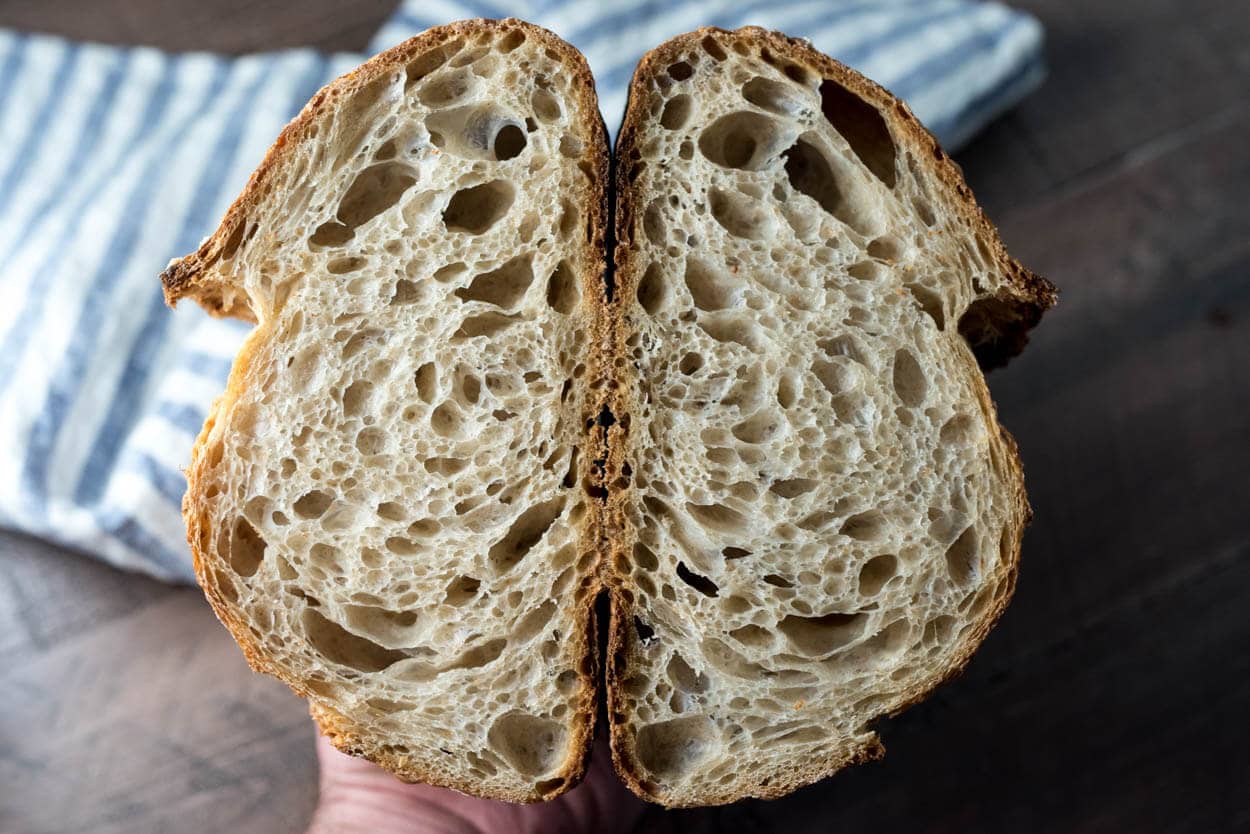
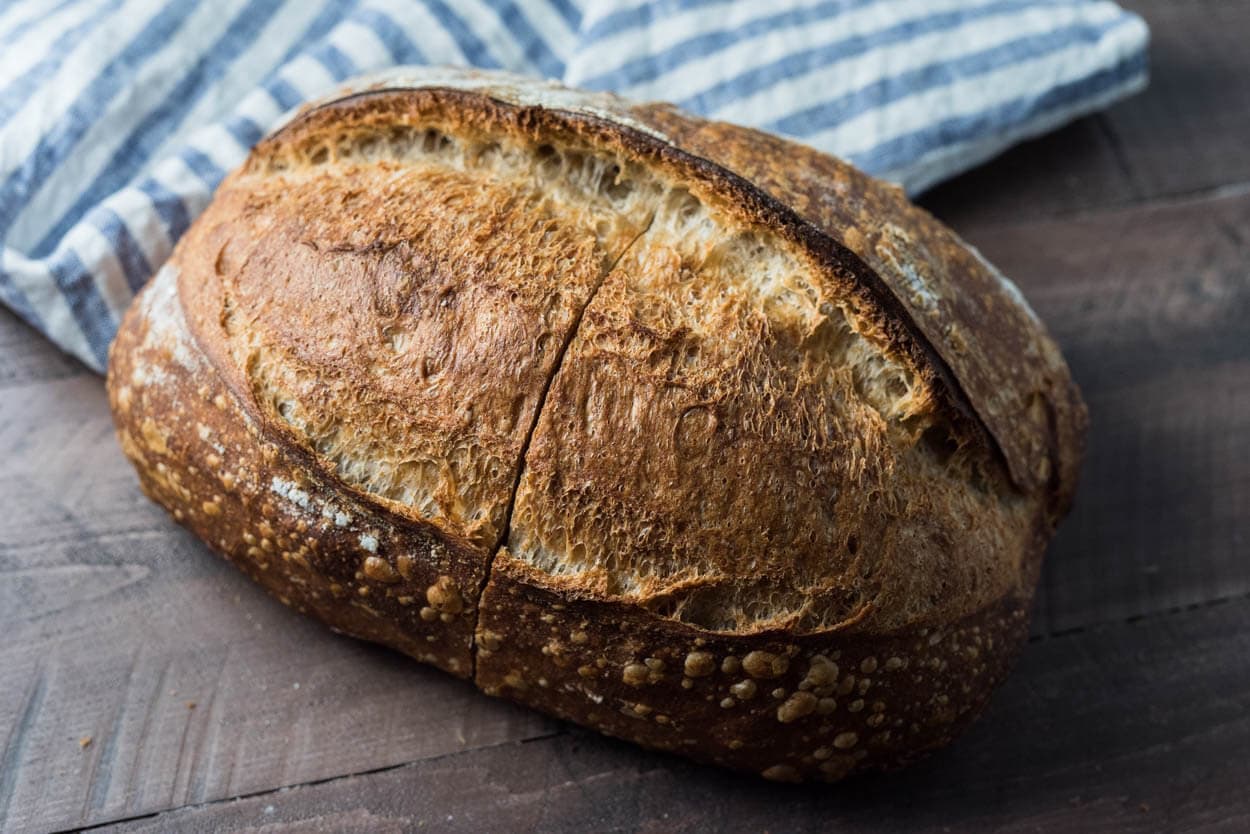
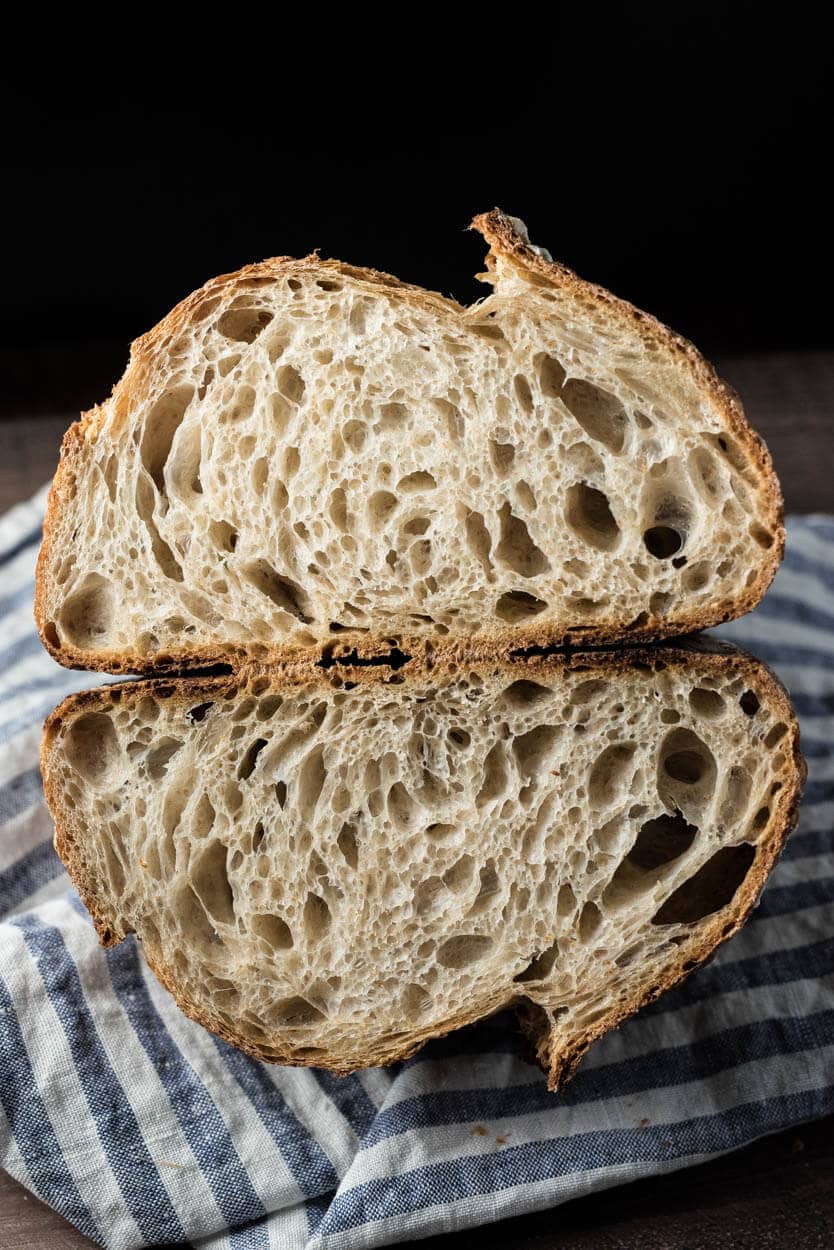
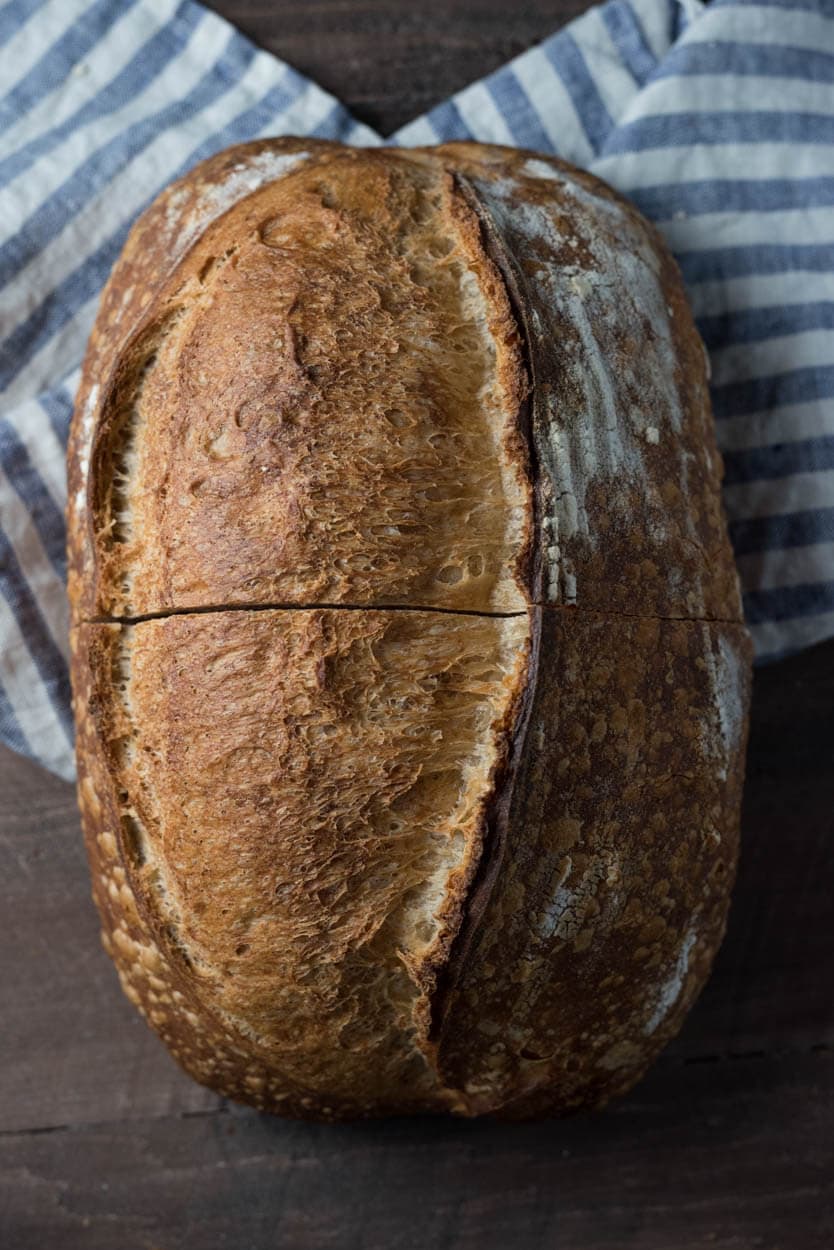
My baking focus has lately been predominantly on my sourdough starter maintenance and maximizing fermentation. And recently, I’ve made some of the best bread I can remember (I took all the bread pictures in this post with this starter). So this post is somewhat a continuation of my Managing Starter Fermentation, but in this post, I’ll focus more on the signs for spotting when a sourdough starter is ready for refreshment (ripe) and how to perform that refreshment.
Be sure to check out my post on what flour, water, and carryover ratios I’m currently using to feed my starter in my How Do I Feed My Sourdough Starter post.
There are many methods to keeping your starter healthy and in proper working order, likely as many methods as bakers. Each baker has a process for maintaining their starter according to what works for them and the bread they seek. Each starter is unique, after all: a distinctive blend of wild yeast and beneficial bacteria that has evolved in the temperature it’s kept at, the flour used for refreshments, and the time between those refreshments. I wanted to preface this article because the following is what works for me here in my kitchen and will most likely work for you as well, but I guarantee you’ll find yourself modifying my method to suit your environment. That’s to be expected. An essential requirement for a baker is flexibility and adapting techniques and inputs so everything performs optimally in your kitchen. In the end, your sourdough starter maintenance routine might be similar to mine, or it might be quite different.
I can remember back to when I first dabbled with creating my sourdough starter. I read all the books I could get a hold of; I searched online, anywhere I could find information. Once I got things up and running (using the process described in my seven steps to creating a sourdough starter entry), I followed refreshment schedules outlined in various books, and things seemed to work pretty well. But my bread didn’t improve until I modified things to suit my environment, schedule, and unique starter. As I refreshed my starter each day (feeding sourdough starter), I began to take note of things, how it looked when I neglected to refresh it for too long, how it looked after a few hours with new food, and how the smell of the starter changed throughout the day.
My goal for this entry is to convey the signs I look (and smell) for during the single-day microevolution of my sourdough starter. First, what does it seem and smell like right as I refresh it (at the start)? Then, what should it look like when I decide to refresh it again or use it for making bread? And finally, what does it look like if it’s gone too far and starts to become overly acidic? I receive frequent emails on this topic, and I hope this entry will be a visual guide to those wondering how I care for my starter.
With this post, I’m hoping to help you answer the following questions:
- What is feeding (I usually call it refreshing) a sourdough starter?
- How soon after feeding (refreshing) a sourdough starter can I use it?
- What does feeding my sourdough starter once (or twice) a day look like?
A quick note for those out there who follow my writing very carefully: you’ll notice this entire entry is about a liquid starter/levain and not about a “stiff” variety I had been baking with for almost a year. I recently shifted things back to using a liquid starter after a long while with a stiff variant, and I have to say I prefer how my bread is turning out with my change. If you use a stiff starter, some of this entry will be relevant to you, but the visual cues will be different as the consistency of your starter will be different. If you haven’t used a liquid starter/levain, I suggest you experiment with this and try it out, you might be surprised at the difference, and you might prefer it. I’m not suggesting one is better than the other, but rather a personal preference whereby I like the taste and performance of this liquid levain for the bread I’m currently baking.
If you’re curious and looking to dig more into preferments, see my guide to the differences between a sourdough starter and a levain.
Sourdough Starter Background
The key to coaxing out maximal fermentation with your starter is to be observant. Watch how it evolves throughout the day and note how long it takes to reach full ripeness: a strong sour aroma, a breakdown of the mixture, significant bubbles on top and at the sides. If it’s doing this too fast (for example, you refresh at 8 a.m., and it ripens at 2 p.m. when you’re at work), you can reduce the water temperature, change the ambient temperature, or reduce the amount of mature starter you carry over at each refreshment (this is what I do). You want to try to refresh your starter right when it’s at its peak ripeness or shortly thereafter.
The key to coaxing out maximal fermentation with your starter is to be observant.
Once you have a healthy starter showing the same signs of fermentation every day, you will be able to adopt a consistent sourdough starter maintenance schedule. I work this into my daily routine: I refresh my starter when I eat breakfast in the morning, and then I refresh again in the evening as I’m cleaning up the kitchen getting ready for bed. It only takes a few minutes (see my tips later on tools to make things easier).
Your starter will go through the following phases each day, but the times will most likely be different. For example, if fermentation is slow (due to temperatures or percentage of starter carryover, for example), then the signs I point out below might be at greater intervals, and conversely, if fermentation is fast, then the ranges will be tighter. As I mentioned initially, if you’ve not yet started your sourdough starter or received a portion from a friend, I have an intro article to creating a starter that will get you going in a few days.
Let’s look at a day in the life of my starter.
Sourdough Starter Maintenance Timeline
Before we dive into the timeline, I want to point out that below I refer to two things: my starter, which is what you’re here for in the first place, and also a levain. I talk about both almost interchangeably because mostly, they are the same thing. Your starter (mother, chef, etc.) refers to your yeast/bacteria culture you continue to refresh and care for indefinitely. In contrast, your levain is a splinter, or off-shoot, of your starter that you refresh and build only to be used in a bread recipe eventually.
For the timeline below, I used 30% whole grain dark rye flour and 70% medium-protein bread flour (similar to all-purpose, but geared toward bread baking). The percentage of flour types is really up to you; I used a little rye flour to help increase fermentation and acetic acid production, but you can use any ratio of flour you’d like (e.g., 100% whole wheat, 100% white, a mix of both, etc.). Just take note of how each flour type aids or slows fermentation.
10:00 a.m. – Sourdough starter maintenance beginning
The first step is to take your mature sourdough starter, discard some part of it, refresh it with fresh flour and water, and cover (I only loosely cover with a glass lid that does not seal tight). My kitchen is currently around 75°F (23°C), and my mixture is 70g white flour, 30g rye flour, 20g mature starter, and 100g room temperature water.
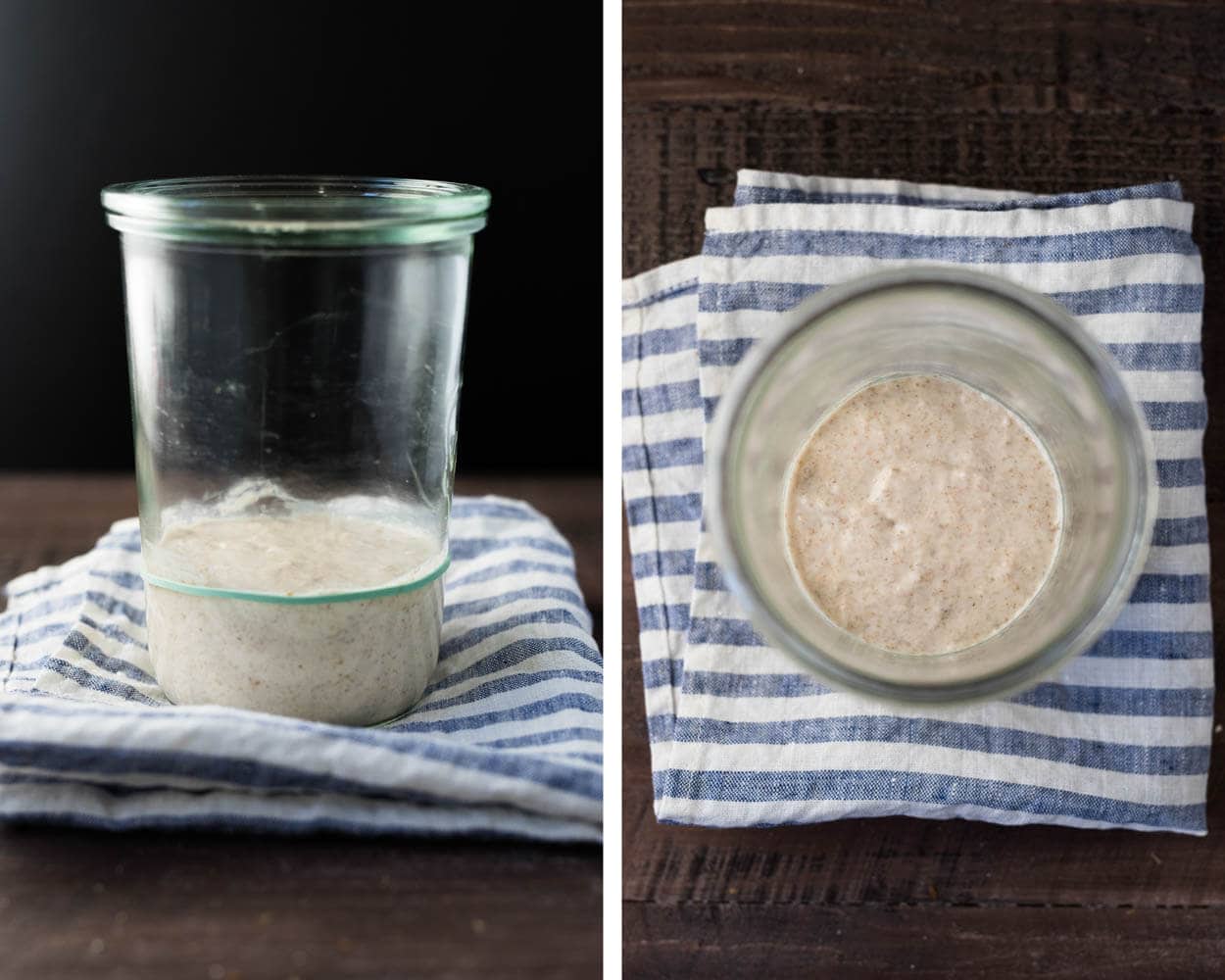
You can get a sense of how “stiff” my starter is after mixing. You want to make sure you mix everything thoroughly so it’s completely smooth with no visible clumps of dry flour.
I’ve placed the green rubber band at the beginning level of my starter so we have a good sense of how far it will rise throughout the day.
12:00 p.m.
After only a couple of hours, you can see only slight activity visible in my starter. The smell at this point would be very, very sweet, and practically the aroma of flour and water. So sit tight; things are about to get more interesting.
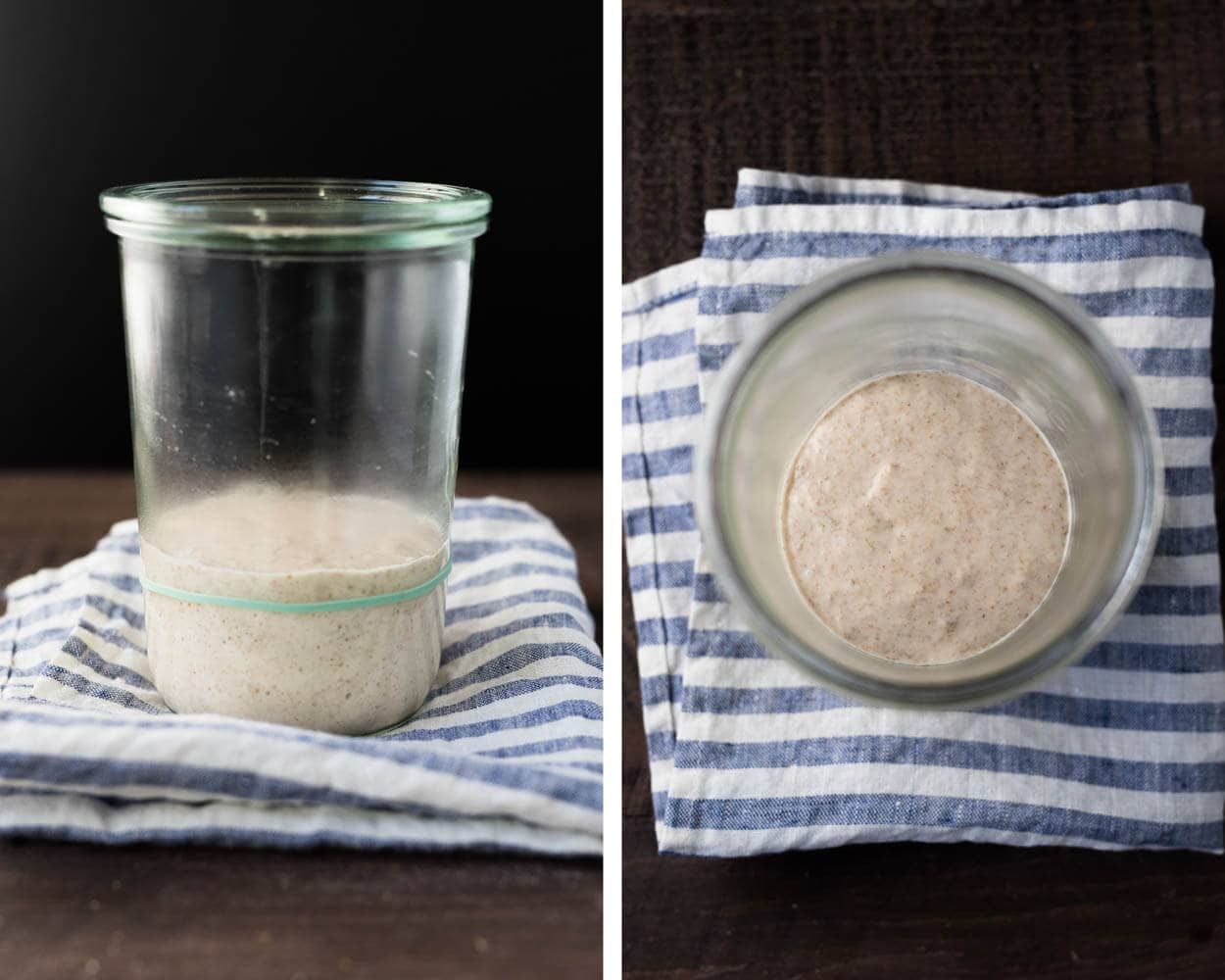
2:00 p.m.
As seen below, four hours after refreshment, we have a significant expansion, a tad over 100%. In the image at right, you can see that the top is domed with a few bubbles peeking through. The mass of dough is trapping quite a bit of the gas produced through fermentation. I like to use a glass container, particularly these Weck jars, not only because it allows me to see firsthand how fermentation is progressing but also because the flared top makes sticking your hand and spatula inside very easy. I not only use these tall jars for my day-to-day starter and refreshments, but I also use them to build my levain before baking.
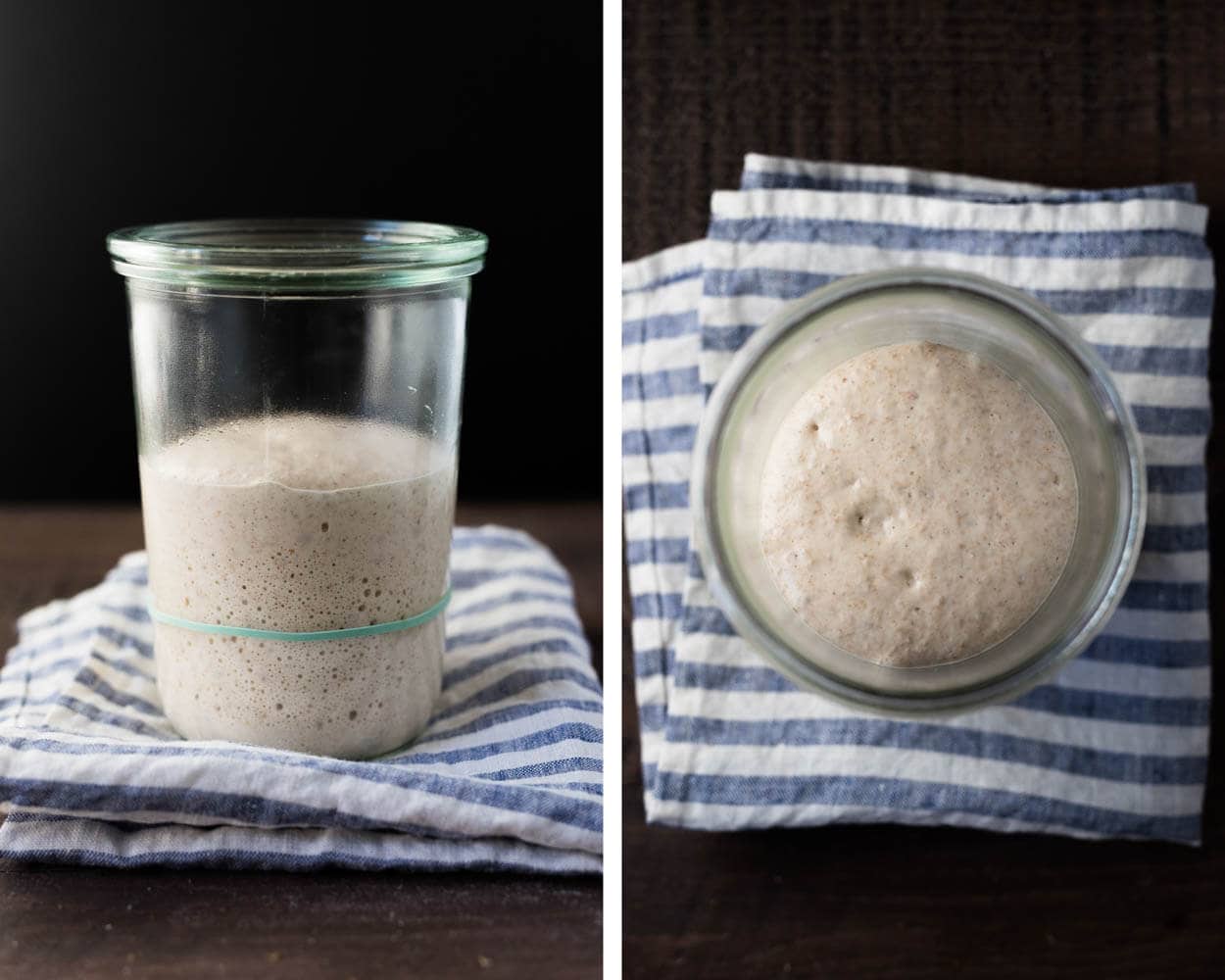
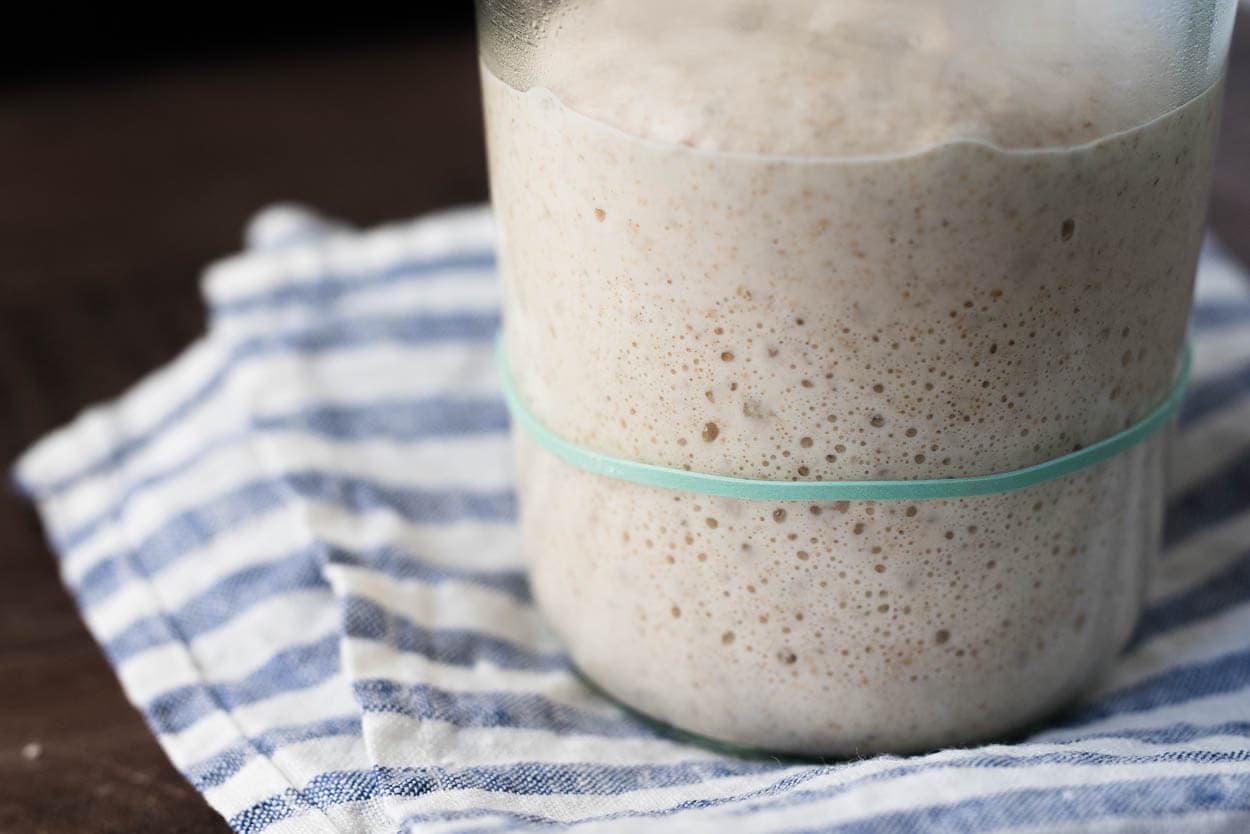
You’ll notice there’s quite a bit of activity already. Of course, after this initial explosive growth, things will slow down, but upward growth will continue for many hours.
3:00 p.m.
At this point, there’s only slightly more expansion than the last check-in. But, you can see many more bubbles on top and at the sides, showing signs of the momentous fermentation taking place. All of these are good signs.
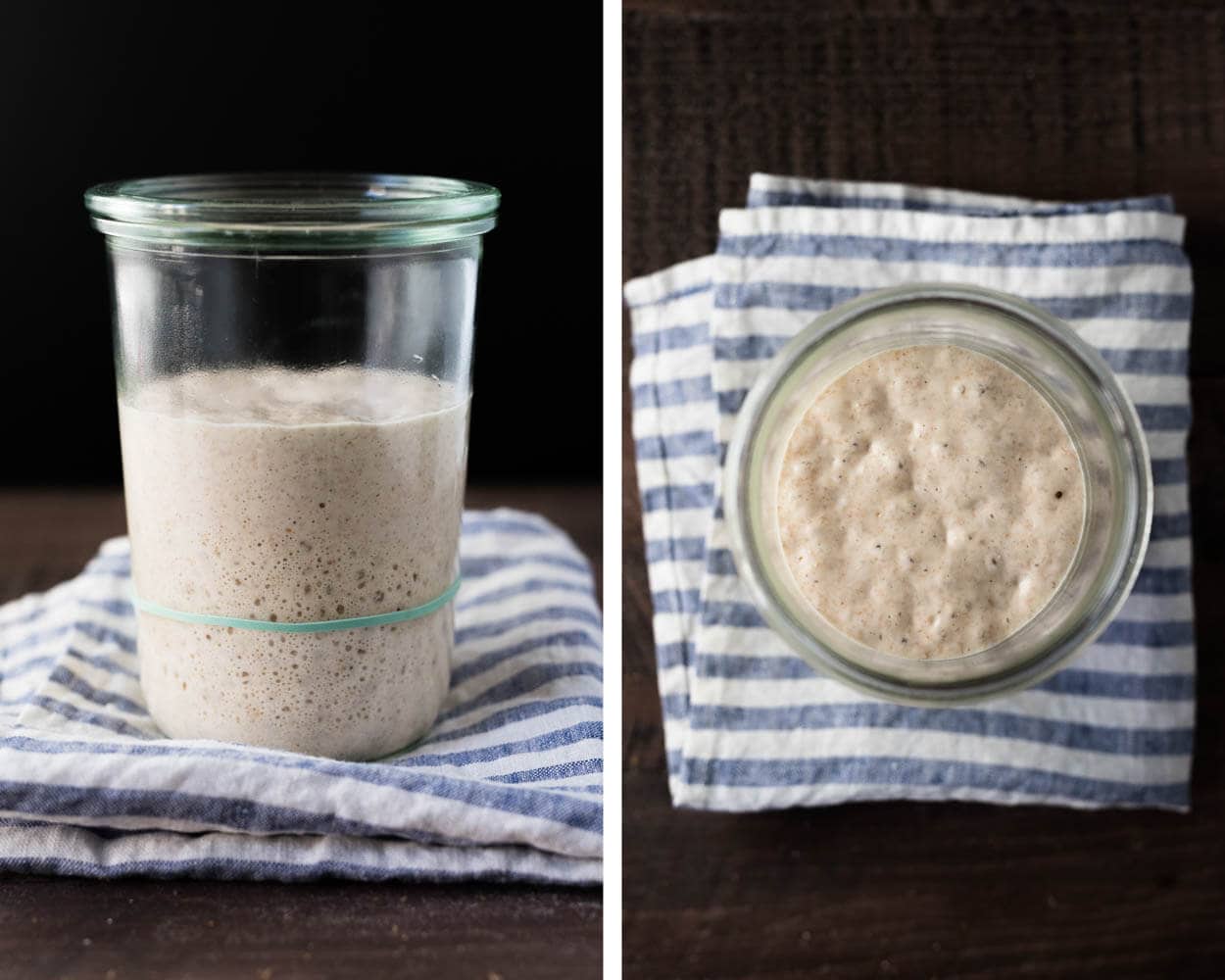
When you build your levain in preparation for baking, you may not always be able to see through the side of the container; the top-down view is sometimes all you have to judge your starter’s readiness. For example, bubbles and holes on top are a good sign, but my starter is not ready to be fed or used now. If this were a levain and not my starter, and I was attempting to use this at a “young” stage, this is most likely where I would use it for mixing my bread.
Another key indicator here is the aroma: how does it smell? Is it still sweet, sourer, or very acidic and vinegar-like? At this point, mine still has a sweet aroma to it, with a very subtle backdrop of sourness starting to creep in.
5:00 p.m.
By this time, we have significantly more bubbles at the sides and the top; overall fermentation activity is much higher. If I were to describe the aroma of the starter at this point, it would still smell quite sweet at it was at 3:00 p.m., but now the sourness is starting to escalate and build.
Given the look and aroma, I can expect my starter to rapidly come to ripeness very soon.
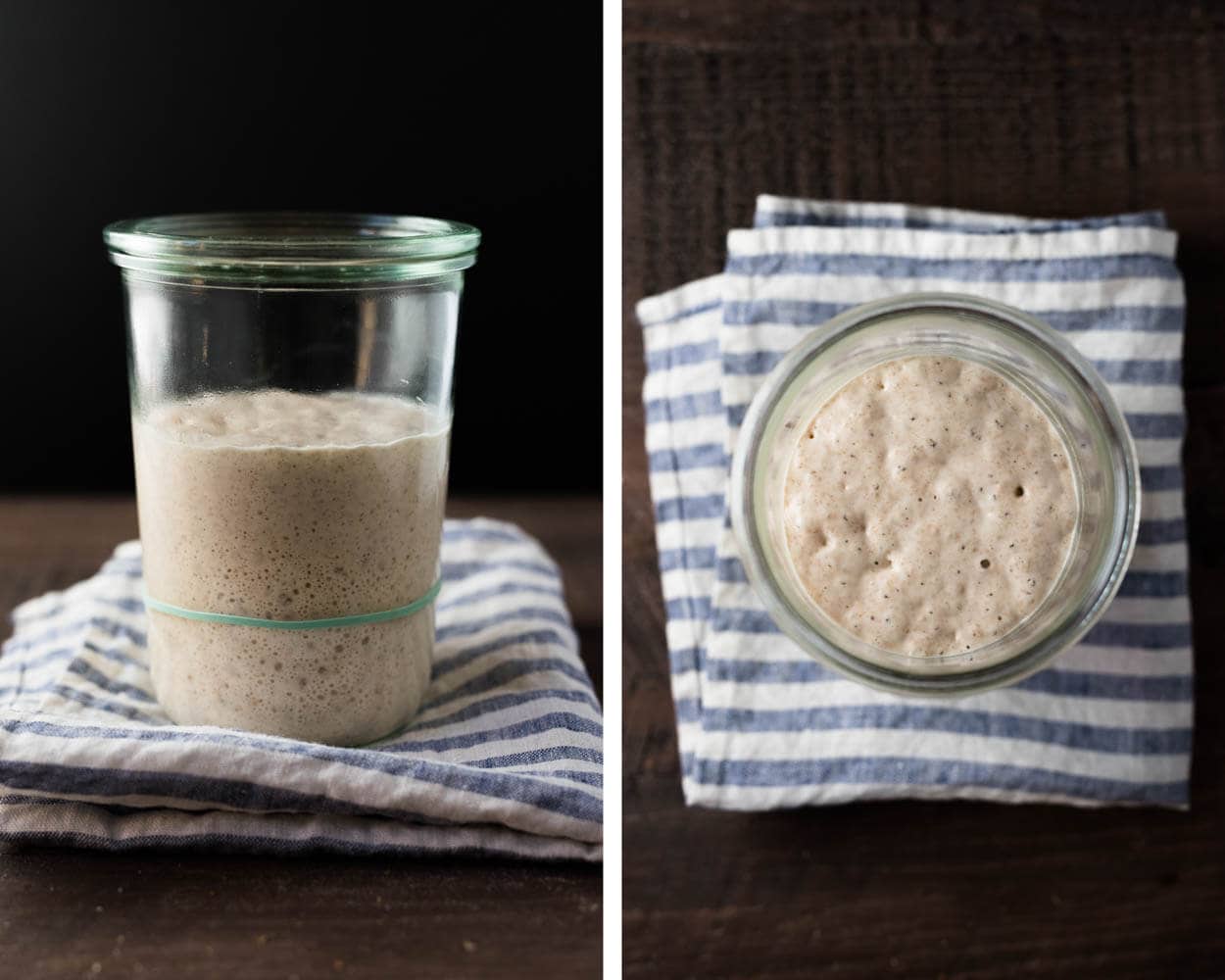
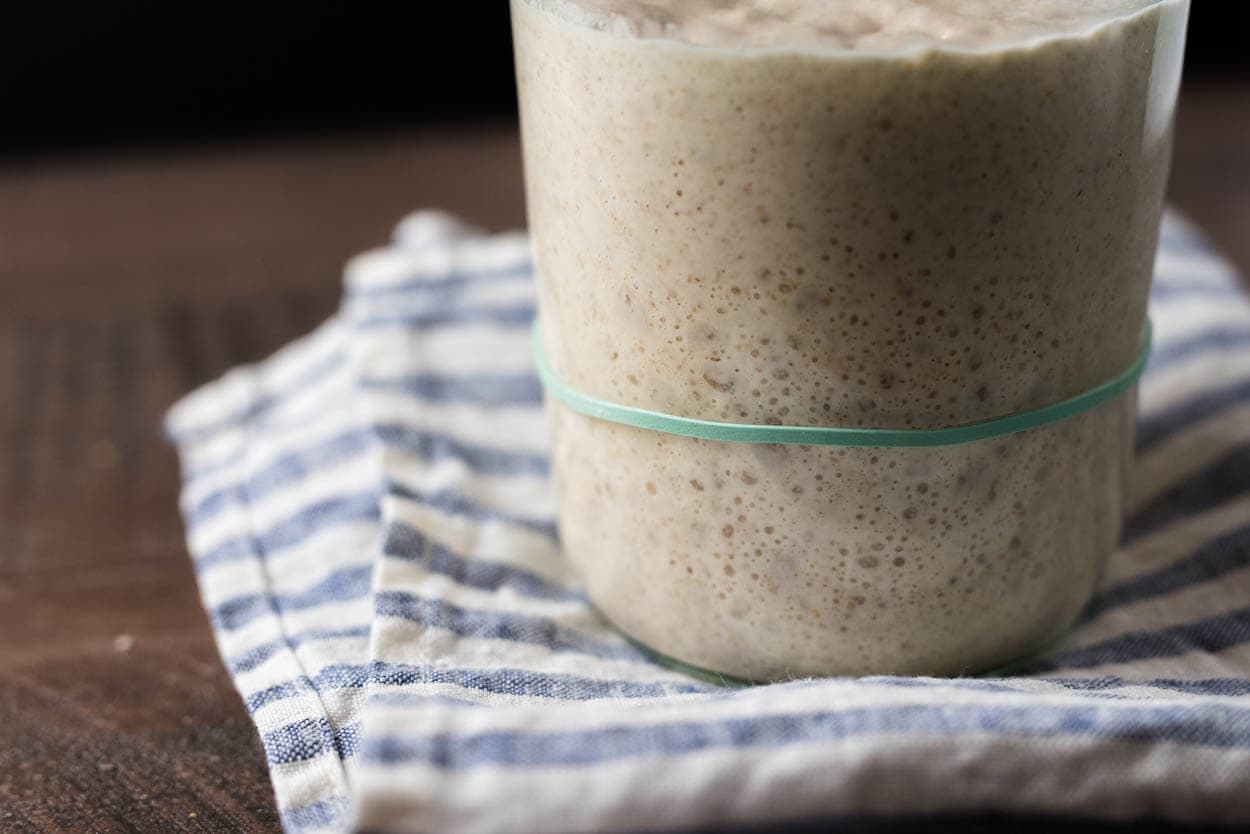
7:00 p.m.
You’ll notice here at 7:00 p.m. any dome that was once at the top of the starter is now gone, replaced by a reasonably flat surface. The flattening of the top usually indicates upward growth has significantly slowed, and upward movement won’t be as prominent—more holes on top and more fermentation visible at the sides. We’ll continue to let it ferment.
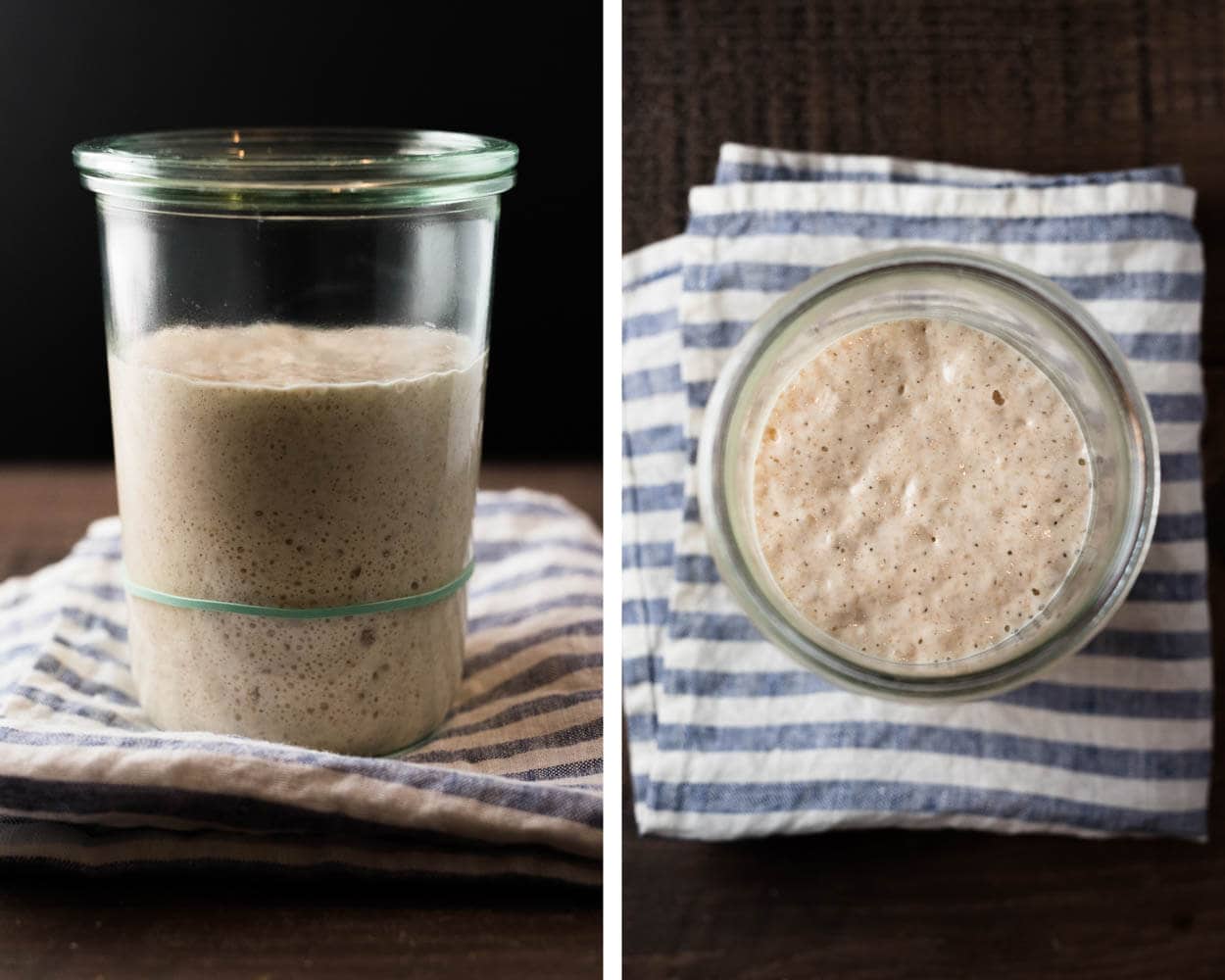
8:00 p.m. – Ripe, time to make a levain
As seen below, we still see some rise since 7:00 p.m., but not much. The top shows signs of more holes and bubbles, and the aroma is what I would describe as “ripe” and ready for use. If I were to pull back a little bit of the top, I would smell a slightly sour, vinegary smell with hints of sweetness still present.
At this point, I’d use some of the sourdough starter to make a fresh levain or use this starter directly in making bread. After making the levain, I would also refresh the starter by discarding and adding fresh flour and water.
While I find the “float test” to be misleading because it can sometimes give you false positives for when a starter or levain is ready to use, the float test would surely pass at this point.
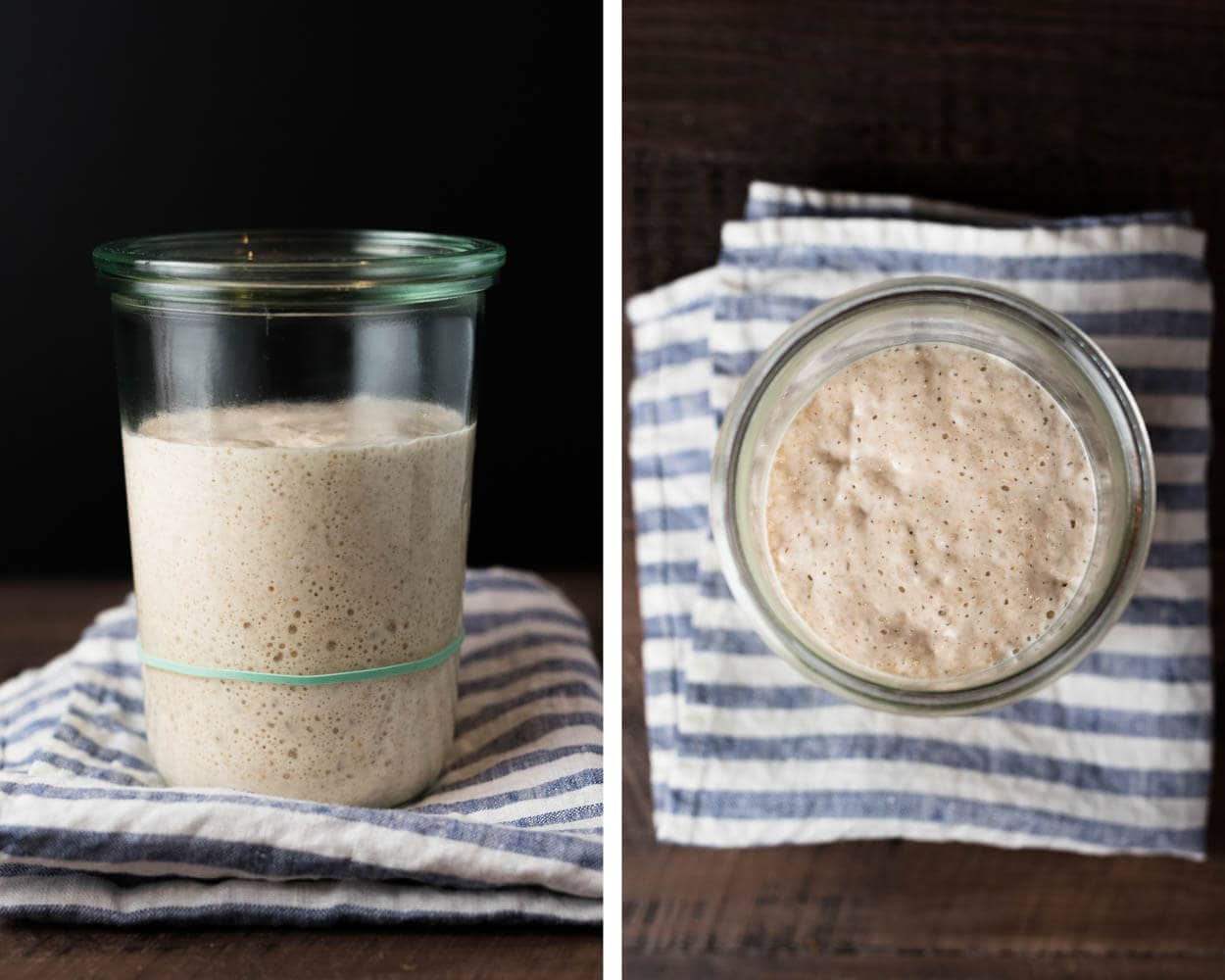
10:00 p.m. – Just past ripe
In the photo below, you can see the culture is beginning to show signs of ripeness. There are streaks at the top that indicate where the top of the starter once was, and in the top-down view, you can see the center is starting to collapse.
The fact that it’s starting to collapse is not the single most crucial factor in judging readiness. Instead, it’s the cumulative signs that are most important.
The fact that it’s starting to collapse is not the single most important factor in judging starter and levain readiness. Instead, the cumulative signs matter: a general breakdown of the mixture, a stronger sour aroma, and significant gas production.
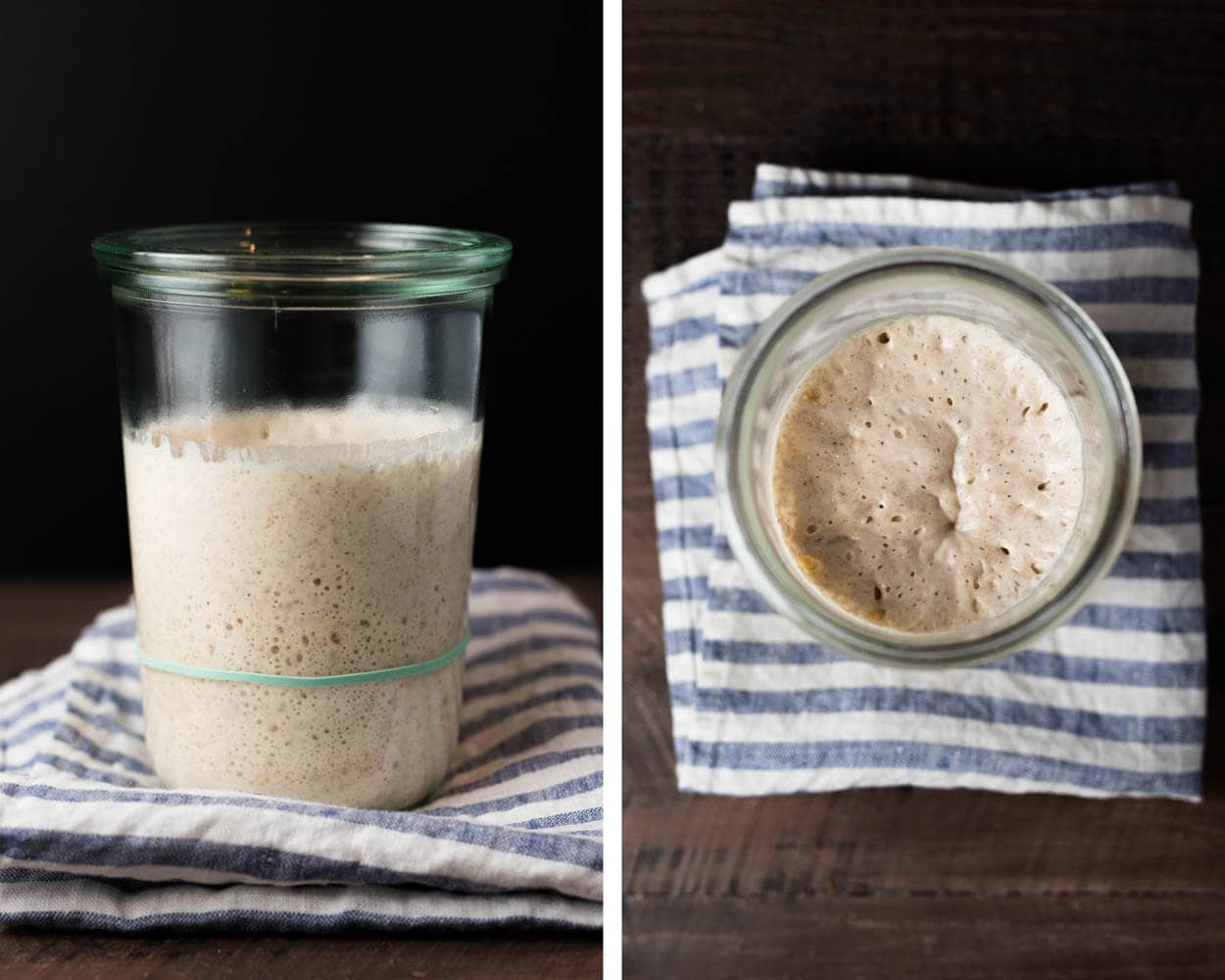
Again, if this were a levain I built in the morning to mix into bread, I would still feel comfortable using this to mix my dough. I’ve used my starter/levain at this point to make excellent bread. I’ve touched on the topic of a “young” levain in the past, but recently I’ve been using mine when it’s more fully fermented to achieve more flavor.
This time is also when you would want to refresh (feed) your starter. If you are using the correct mixture of inputs—water at a specific temperature, percentage of mature starter, and flour mixture—this time will coincide with when you want to feed it. For me, 10 p.m. is perfect as I start cleaning the kitchen in prep for bed (our little ones at home dictate my sleep/wake schedule, and thus my starter must conform).
If your starter has arrived at this point before you want it to, you can use a smaller percentage of ripe starter carryover or use colder water. If your starter is a bit sluggish and isn’t quite at this level, use a bit more ripe starter at the next feeding or use 2° to 8° warmer water.
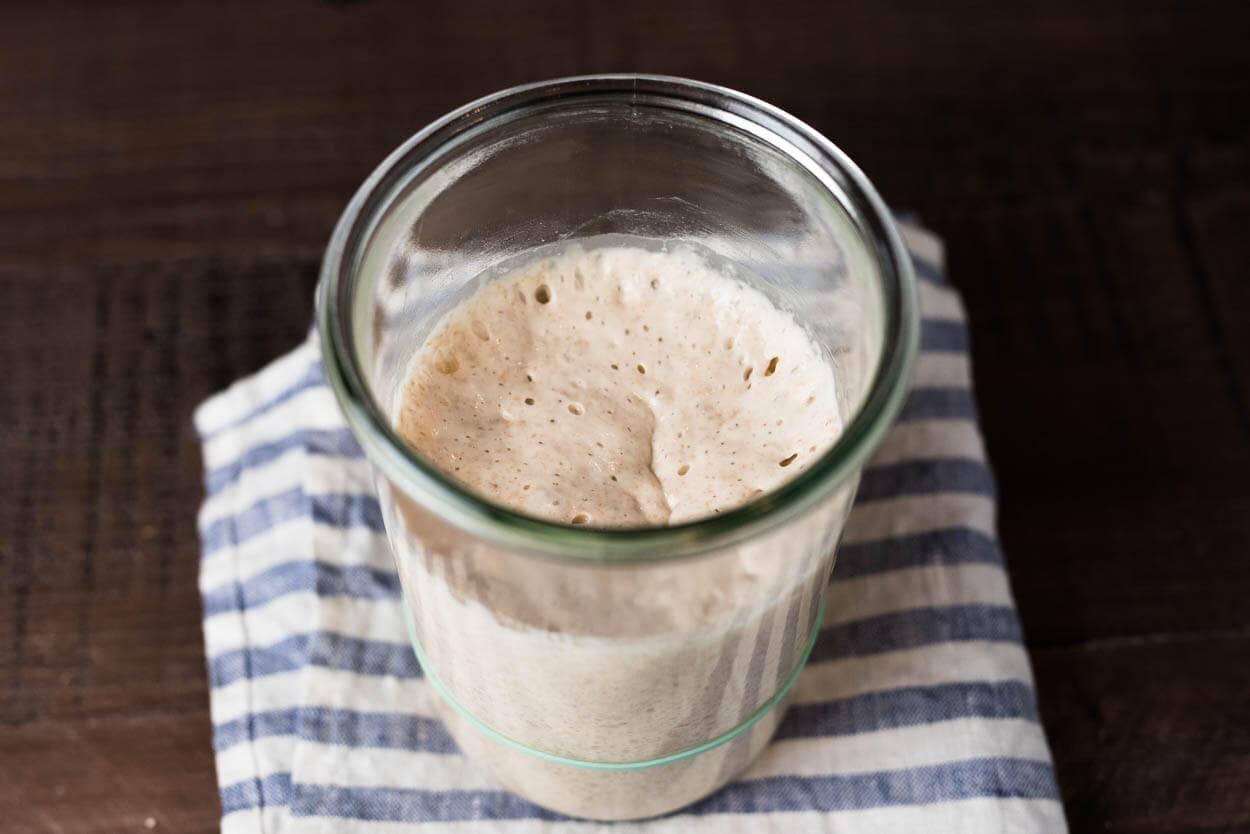
Being observant helps us help our starter to maximize fermentation activity. So, as you continue to care for your starter, take a moment before you rush through refreshments to observe the look and aroma of your starter—plan to adjust things either at the current refreshment or the next based on this observation.
11:00 p.m.
My starter continued to fall at this point, with longer streaks on the side, and the center has noticeably caved. I will normally have refreshed it by this point, but I continued to let this ferment until the morning so we can observe how it looks when it’s gone farther than I’d usually allow.
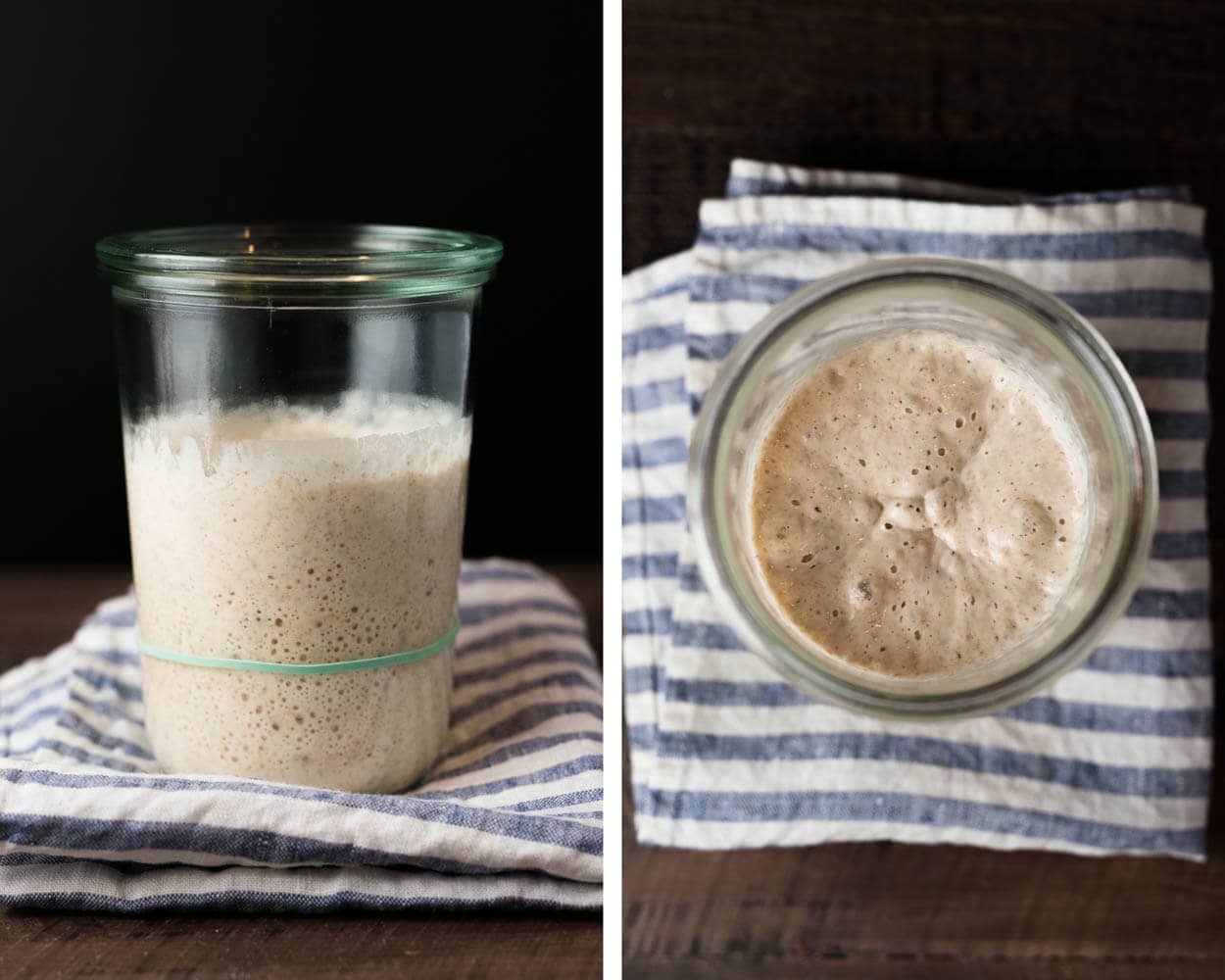
6:00 a.m. (next day)
What a drop overnight! The sides are entirely streaked with how far the starter has fallen, and the top was covered in small little bubbles. My starter has gone way too far at this point and needs a refreshment.
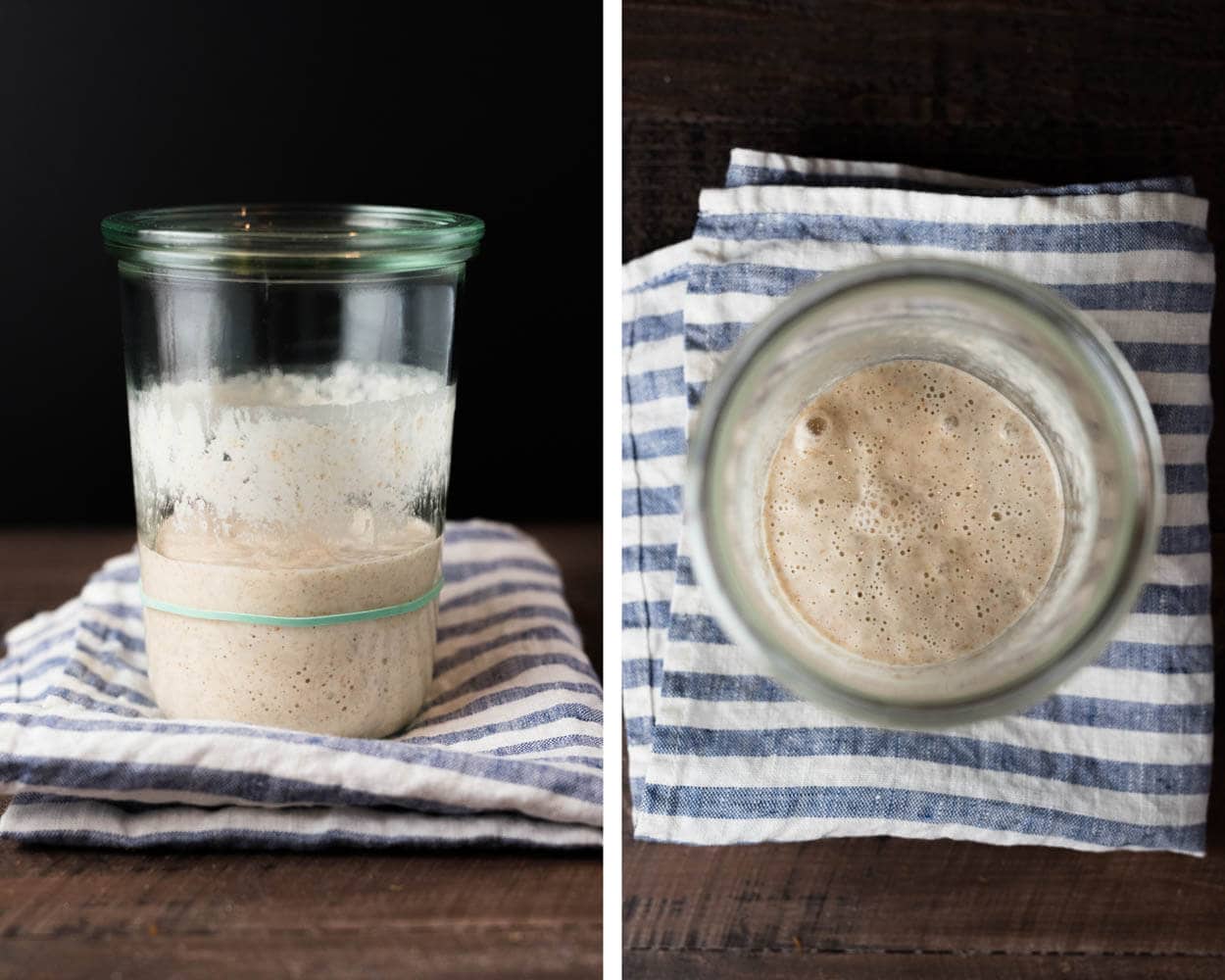
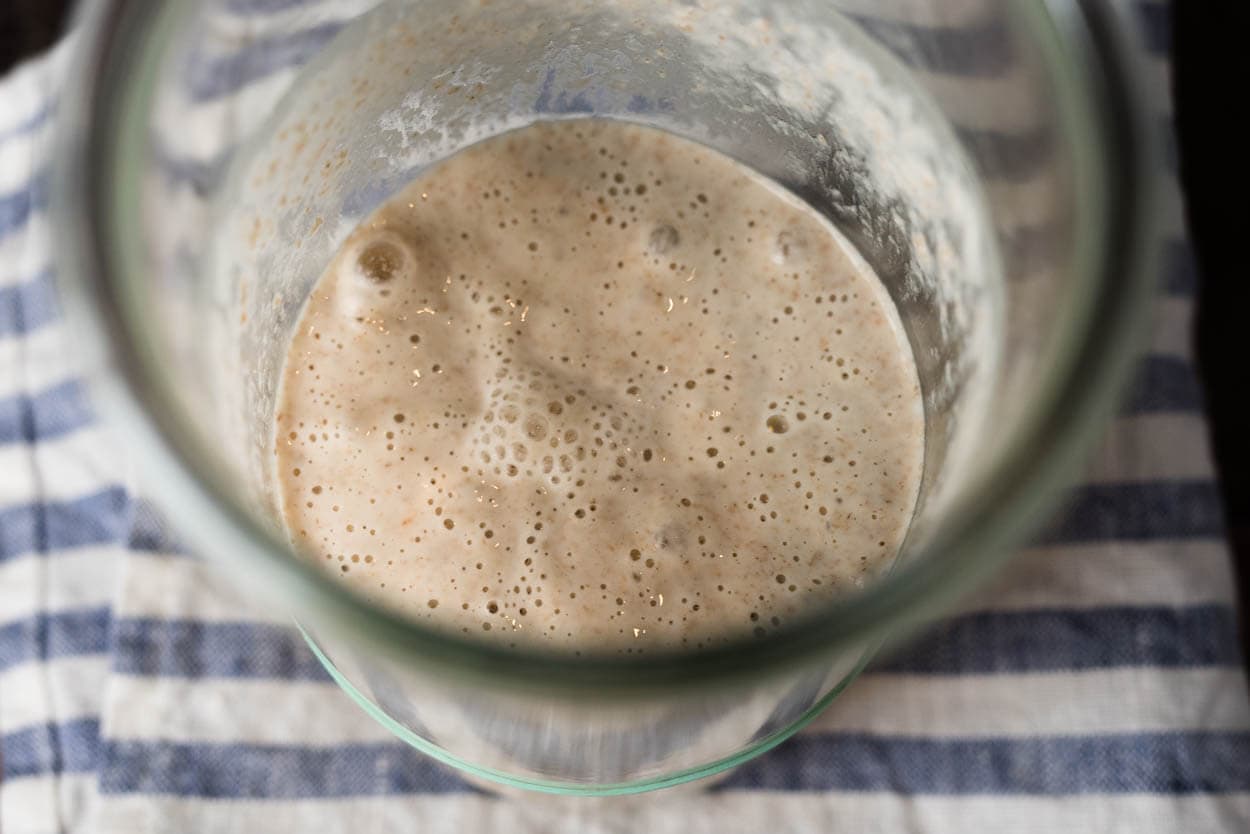
7:00 a.m.
Even more collapse and more small bubbles. At this point, the aroma was very acidic, vinegary, and quite strong.
8:00 a.m.
My final timeline entry shows just how far my starter has fallen after almost 24 hours. The acidity will continue to rise, and if left for even longer, a clear liquid will form on the top (commonly referred to as “hooch”) that will be alcoholic and bitter tasting. Your starter might also look this way if you’ve left it for a long period in the fridge in “hibernation,” as I like to call it. When reviving a starter in this condition, I will pour off the clear liquid, mix the remaining, and refresh as usual.
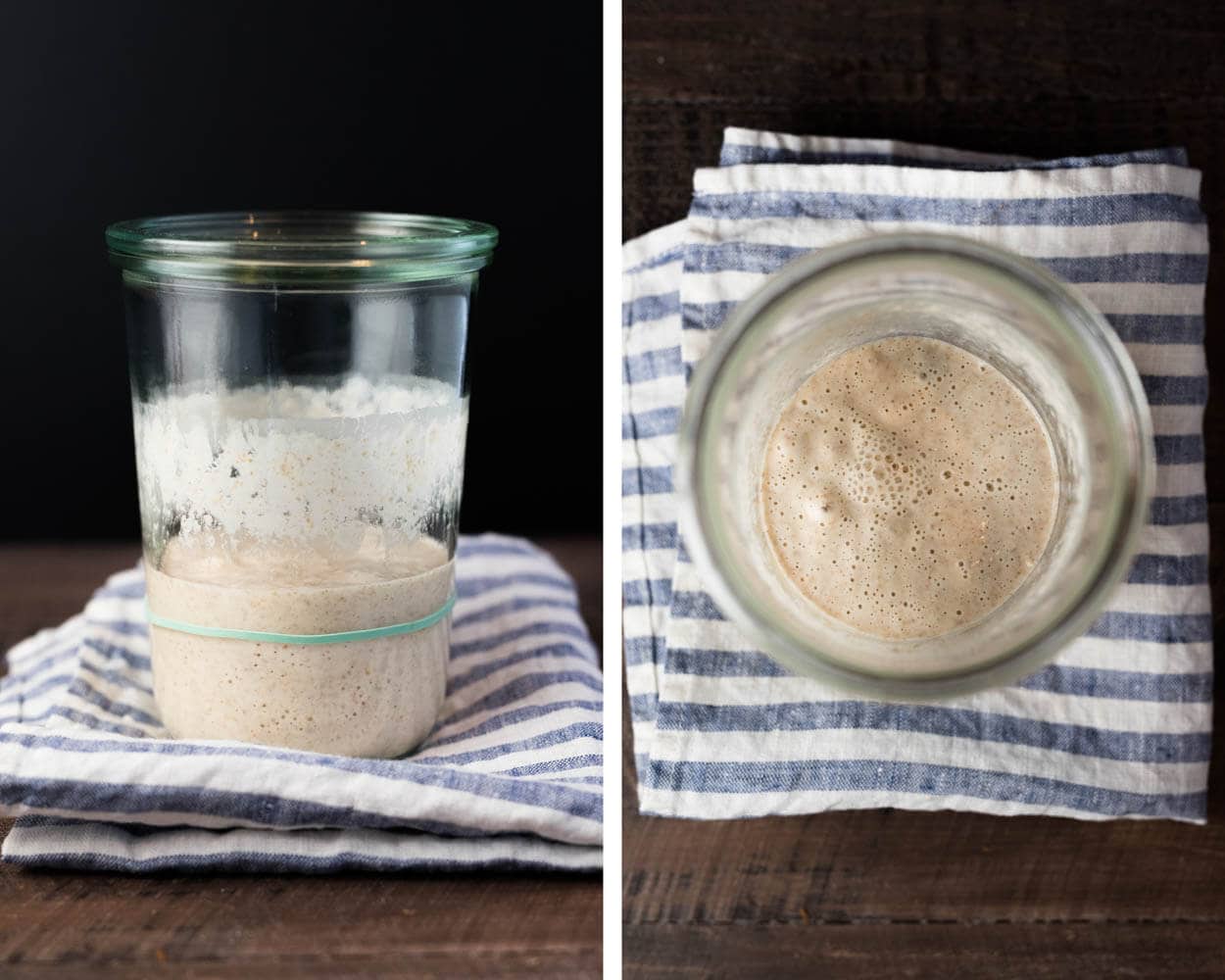
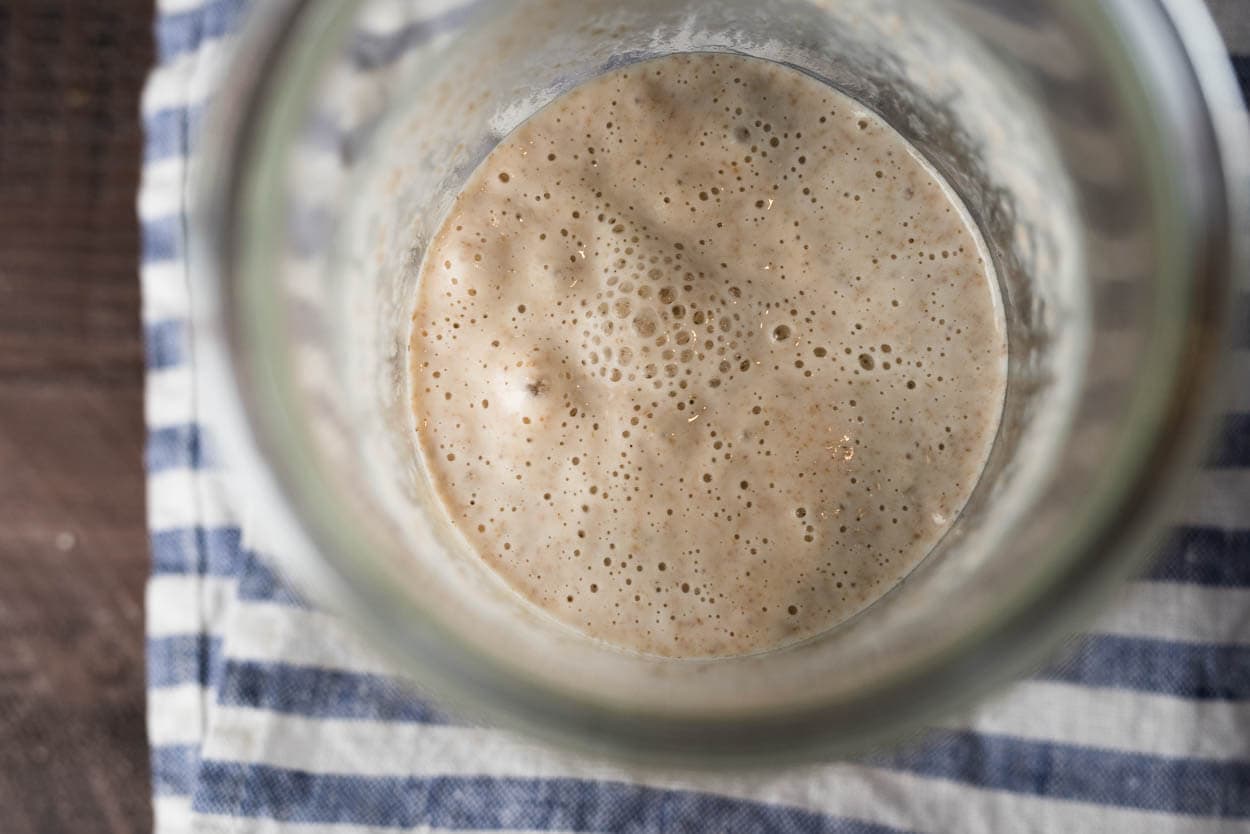
There have been times when my kitchen heated up unexpectedly, or I couldn’t get home before this had happened, and I mixed up my starter per usual, and it was just fine, but I try to avoid this scenario as much as possible.
Don’t panic if you forget to refresh your starter for a day or two! It will be just fine with a few timely refreshments and some attention.
General Sourdough Starter Maintenance Tips
See my sourdough starter frequently asked questions post for a long list of common issues, but here are a few tips that will prove helpful:
- Don’t let your starter collapse and sit for extended periods as excessive acidity will change the flavor of your resulting bread (sourer). If it’s a levain, not your starter, and it’s fermented much too fast for your schedule, you can always make an intermediate build (essentially discard and add new flour and water) and use the new build to mix
- Use your nose. Observe the aroma of your starter at each phase and get to know what a particular aroma indicates by drawing a connection between aroma and visual cues
- If your area has high chlorine levels in the water, use filtered (or distilled) water or let the water sit out on the counter overnight in a water bottle before using
- Stir your starter thoroughly until there are no clumps or dry bits of flour present
Above all, take a few seconds each time you refresh your starter to sit back and assess how things look, smell, and even taste (I don’t typically taste my starter, but many bakers do). Through constant observation and attention to small details, we can maximize fermentation in our sourdough starter maintenance routine.
Sourdough Starter Maintenance Tools
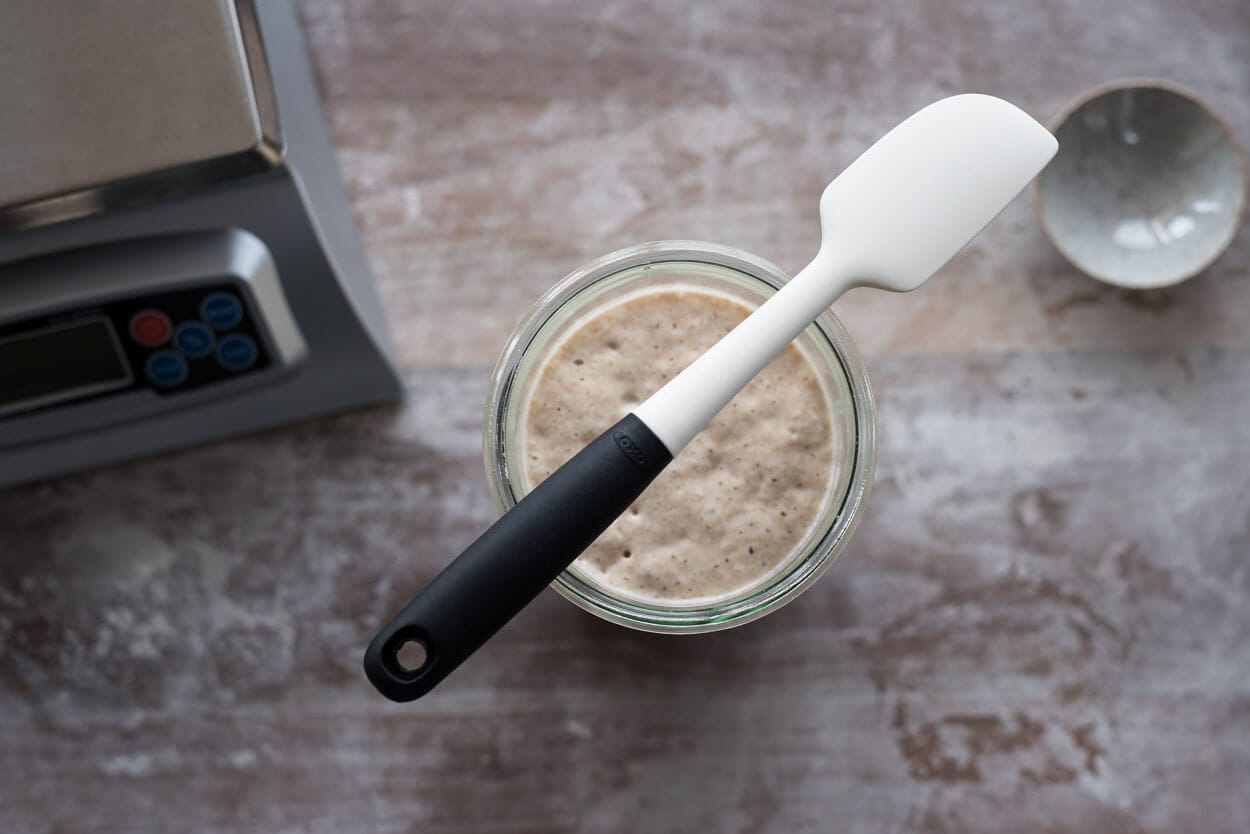
It’s funny how small tools make a huge impact when compounded over multiple times a day for every day of the year. I recently changed my stirring apparatus from an old Pyrex spatula to this newer Oxo spatula, and wow… So much wasted time cleaning that old multi-piece thing. This Oxo one is covered with silicone at the top with no seams or joints, it’s very sturdy (which helps act as a firm mixer), and you can also toss it into the dishwasher. Highly recommended.
Aside from the new spatula, I still use the same Weck jars, dark rye flour, and all-purpose flour. Head to my tools page if you’d like to see more of the tools I use for my sourdough starter maintenance.
Sourdough Starter Maintenance Wrap Up
There you have it, a day in the life of my starter and my sourdough starter maintenance routine. I hope this visual guide has helped convey the visual cues and aromas I look for at various points through the microevolution of my starter. The same signs shown above are also present when I build a levain when making bread.
Remember the methods we have to impact the fermentation rate: temperature of the water, inoculation percentage (amount of ripe starter left in the jar), flour selection (whole grain flours increase fermentation), and ambient temperature. If your starter is sluggish, increase these to speed things up or decrease them to slow things down. After a few days of experimentation, you’ll discover the right mix of each for your unique starter.
Now that your starter is on a regular maintenance schedule, don’t forget you can use the daily starter discard in many delicious things in the kitchen! Buon appetite!
For more sourdough starter guides, check out my sourdough starter guide roundup.


704 Comments
What a difference a bag makes! I had a bag of rye that smelled a little strong. Kept using it as starter looked good. 30g starter 30rye 70ap. Rose and fell at about 12h; rose to 3 cm from top of jar. My house is on the cool side so use a stock pot and covered glass of hot water
Got a new bag of rye and starter exploded. Today 16starter 25 rye 75ap 100gwater and overflow (Weck) at about 11.5 hours.
Glad to hear it, John. So your inkling was right, the flour was a little off. Sounds like you’re on the right track now!
Hi Maurizio,
My starter seems to have a second life. I came home today and after only 7 hours it had fallen 10mm. Then I raised the temperature a little (I put starter in a 12qt stock pot with a covered glass of warm water) and it is now even higher than ever. This has happened a few times. Is this to be expected? Should feed after first fall? Thanks, John
I suppose this is possible, although I’ve only seen something kind of related: if I knock the jar down the starter will fall, but eventually it’ll peak back up again, usually reaching above the first height it was at. My feeling is, if it reaches back up then you can feed at the second height.
Thanks for the advice. I did wait for the second rise. I also noticed a knockdown effect on other occasions, but this was different. The only change was an increase in temperature.
Hello,
This is great clear info! Just one question: if you feed your starter what will you do with all the discard? Just throw it away? I haven’t made the calculations, but with feeding twice a day this will be a lot of flour and water used!
Hey there! You can make lots of great things: banana bread, waffles, pancakes, or simply play to use that discard as a “levain” for a bake (in other words, use what you plan to discard to make a bread like a pain de mie, or sourdough pizza).
Also, and this can be hard, but try not to look at the discard as “waste” because it’s being used! The flour is being metabolized by the yeast/bacteria in your starter, it needs food to survive 🙂 Another option is to store your starter in the fridge for most of the week so you don’t have to feed it, then take it out a few days before baking and get it back up to strength. Check out my sourdough starter maintenance routine post for schedules.
Hope that helps and happy baking, Liselotte!
Hi, This is great information. My problem is that my starter does not rise at all. It smells good, but it develops hooch after even just 11 hours from feeding…in my very cold kitchen. I’ve tried feeding more frequently, adding less water etc…but no rise. I bought dehydrated starter a month ago and have been feeding regularly. Any thoughts? I would think it was dead, but it is bubbly…but no rise at all. I appreciate your time.
Hi Elaine, if your kitchen is really cold you might want to try using a seedling mat, very inexpensive on Amazon. I live in a cold climate and have the same problem with a sometimes cold kitchen, unless I’m baking. I have a commercial oven that keeps my kitchen warm anytime I’m cooking or baking— but when I’m not, the kitchen is quite cool. I purchased a seedling seedling mat by Vivosun that’s about 3” wide and costs about @$12.00. I wrap a washcloth around my jar then loosely wrap the seedling mat around the outside of the washcloth, it keeps my starter at roughly 79/80 degrees all of the time. It’s been a great solution for me, I have a very healthy starter. A proofing box is the best solution, but if you don’t want to spend the money this might work for you. Best of luck!
As PQ said below, if it’s too cold in your kitchen you’ll have a hard time keeping your starter active — it likely will need a longer time period between feedings and even then might be a little sluggish. If you can buy a seedling mat that will work or warm the water you use to feed and keep it in the warmest spot you can find.
Hello
Is it ok if I bake twice a week and i leave just scrapings of starter in the jar and when I’m about to bake I just take that jar with scrapings from the fridge feed it then wait for it to rise in size at least double and then use it to bake? And leave scrapings again in the jar inside the fridge for few days? Thank you
I would add some flour and a little water to the jar with the scrapings to give it a little more food while in the fridge.
Good day sir,
When would the best time to use your starter be, just after it starts to drop? OR when it reaches a point midway to the top end of the rise after feeding? I am a little confused with this issue. Thanks for responding and I must add after reading your posts on the starter and mainting the starter I have gained better insight with the sourdough process. Thanks GT
Hey there, Greogry! Glad my website has helped. I find the best time to use it is when it’s just about to, or just did, fall in the jar. There’s a little leeway there and really no exact, perfect time, just somewhere near there will be just right.
Hi Maurizio,
My starter looks good, but the times are either too long or too short, depending on how you look at it. 15-17 hours. Temp between 75-80. Sometimes up to 30g of starter. 25rye 75 ap.
Question. At 12 hours, even with 20 or 25g starter the mixture is almost to top of Weck. Thing is it still has a slight dome. The edge shows a very slight drop. When moving the jar I bumped it and the mixture collapsed by about 5cm.
Do you think it appears to be ready at 12hours?
Yesterday after 15 hours it dropped about 5mm. Then in 15min it dropped another 4cm.
Any ideas?
Thanks!
Sounds like to me it’s just about ready at 12 hours, and likely ready around 13-15 hours given the drop. Really, any time in there should be fine to do a feeding, it sounds mature to me!
Hi Maurizio
Loving your newly found website. I live in the Pilbara region of Western Australia so I’m constantly battling the high temps here and have had to adjust so many times due to high temps. Our average daily temps here are 111 deg ! Question
When feeding your starter how often do you discard?
Hey, Margot! Wow, that’s very, very hot. I usually discard and feed 2x a day. My best advice for you would be to try and keep your starter as cool as possible and if it’s still warm, a stiff starter (50-65% hydration) with a small (.5-1%) addition of salt might help temper fermentation if things are progressing too quickly!
Hi Maurizio,
I am a new baker and really excited to start my first bake tomorrow. I have a question about the daily feeding of my starter. I assume you feed at 10AM and 10PM approximately depending on how everything looks and smells. But I can’t find the amounts and ratios you use for these daily feedings- I only see that for the weekly feeds. I am loving this started I brought to New Orleans from Acme bakery in Berkeley and want to feed it at least once daily. Please advise!
Hey, Kim. Yes, that’s about right. When it’s warm in my kitchen, I might reduce the amount of starter I feed with, when it’s cool, I’ll increase it. Right now when it’s cool, I’m typically at 20g mature starter to 100g flour to 100g water. In the summer when it’s really hot, I might drop all the way down to 5g mature starter. Judge how your starter is doing each day when you go to feed it: has it just collapsed in the jar or did that happen hours ago? If it’s been too long then reduce the amount of mature starter in your jar for each feeding as it might be fermenting too quickly. And vice versa.
I hope that helps!
Hi Maurizio,
Excellent description of how to maintain a sourdough starter. I have one small question though. My starter is 100% rye. I experimented feeding (a part of it) by using 20 g from my starter, 25g rye flour, 75g bread flour and 120 ml water. I observed that the rise over time was broadly as described in your posting, but mine appeared to peak about 9 hours after starting the process, that is earlier than yours. I understand that times vary according to a number of variables, but would you say that I should be satisfied with my results? I should add that I took the starter that I used out of the fridge. So the 20g starter was pretty cold to begin with.
Sure, that will work just fine. The biggest player in all of this is temperature, so you might notice it take longer than 9 hours in the winter, and shorter in the summer. But as to whether this feeding schedule and ratios work: sure, they’ll work just fine. If you want to lengthen the time between feedings, carry over less mature starter at each feeding (or keep it cooler).
Just want to say thanks for all your work! I’m just building my first starter (day 5) and looking forward to all the adventures ahead.
You’re very welcome, I’m happy to help. Good luck with the process and here’s to many awesome loaves out of your oven!
I hope it is ok to ask another question. I have finally found a warm place in the house and seem to have an active starter. I am on day 11 now and have switched to 20g starter/25g rye/75g all purpose/100g water and it seems to be doing well. I wont be baking everyday and feel a bit guilty about the discarding twice a day. I read your three fav recipes for leftover starter and made the banana bread which was amazing (Thank you!) So my question is: can the discarded starter be stored in the fridge for a few days before being used in these recipes? And otherwise should I just get used to discarding a bit? Thanks again. I will try my first loaf at the weekend!
Hi, I’m not sure if my solution to this problem will suit you, but I collect the discarded starter, (and feed it just to keep it alive – rather than ‘active)’, and then simply incorporate it into the mix of a lightly yeasted loaf, either given to friends, turned into breadcrumbs, or filled with seeds and shared out on our bird-table. Whilst this is more expensive than simply discarding it, I take the view that at least “it shares the love” a little!
Thanks so much! I will give it a try.
Love this.
You can use the fridge, just know that overall it’s a “stressful” environment for your starter. I don’t like to keep it in there longer than a week unless I’m traveling and have no choice. You can certainly reduce your feedings down to once a day but keeping around less mature starter at each feeding, try going down to just 5g of your starter and see how long that lasts before you need another feeding — do know that this is temperature dependent (warmer = faster). If you kept it at cool room temp, maybe 72-74°C, with 2-5g left in the jar at each feeding, it should be just fine to go 24 hours between feedings.
Hi Maurizio,
I’m an intermediate baker. Old starter died. I’m on day 8 of making my own starter from your guide. Everything is going to plan, including the early whoosh of activity and now the day 8 slow down. I’m at 50g mix / 50g AP organic flour / and 50g rye / 100g water for now. Day 7 didn’t really show a lot of activity in my nearly 80 degree kitchen environment (light on in the oven). Should I just keep sticking to this ratio until a significant rise and fall happens? Or should I tweak it? Thank in advance or if there’s a FAQ that answers this, please just point me there. Cheers, thanks!!
Hey, Nancy! Yes, I’d say stick exactly to that feeding ratio and that temperature is just right. As you probably already know, sometimes it just takes a little while longer to get things going.
Also, if you still don’t see any activity after a few days, try switching to bottled spring water or distilled water from the market and use that for feedings.
Let me know how it’s going!
Hi! Thanks so much! Before I got your reply I thought maybe I should use less mix and this morning cut it to 25g with the rest being the same. I guess I’ll just see how it goes by tonight and go back to the original tomorrow if it doesn’t start a significant rise/fall. EDIT: IT’S 12:30pm here in LA and it’s already grown a bit better at this ratio than yesterday. But sort of tapered off after 2pm. So, I guess I’ll go back to the original ratio. Also, I had dinner at the Tartine Manufactory over the summer, saw Chad and totally geeked out. Mentioned your blog to him and he nodded with much approval. Keep up the awesome work!
Right on, sounds good! I’ve been to the Manufactory once so far, what an incredible place. That’s amazing you mentioned my website to him, thanks so much. If it weren’t for him, I likely wouldn’t be so obsessed with baking sourdough. Cheers Nancy, happy baking!
grrrr, still slow going…not inactive, just not lively. switched to spring water and upped the rye/white to 60/40. Just a wild guess. this is what happens to me when i troubleshoot, i just throw my hands up and start guessing. Thanks for the moral support though!
That’s actually a very good move, stick with that for a bit and see if things improve!
thanks a lot!
Definite improvement this morning! Bigger bubbles after 2 feedings yesterday. I stuck to the same ratio this morning and will do again tonight. I’ll @maurizio you on Instagram with a pic. Thanks and have a fab weekend!
Excellent!
Should I be keeping the carry over of the mix to 50g or should it be reduced to like 25g as I keep it alive? For instance, 25g mix/50g rye/50g AP/100g water. Thanks!
Do what makes sense for your starter, flour mix, and ambient temperature. I drop that 25g down lower in the summer, and increase it in the winter to keep my starter on track so it matures around the same time each day.
awesome, thanks so much
Hi! If the temperature inside is 82.4F I have to feed three times per day? The peak point it’s just three hours after feeding. Thank you
If it’s very warm activity will increase, yes. You could try feeding with cooler water, carry over less mature starter at each feeding (even down to like 2-5g!), or in the extreme case you could try adding a small percentage of salt to the starter (like 1%) to slow activity.
Hi Maurizio,
Thanks for the excellent site, it has long been my go to for all things sourdough. I was wondering if you can help: I created a new starter a couple of weeks ago and all seemed to perform per your predictions. I am using your refreshment ratios of 25g rye, 75g plain flour, 15g starter, 100g water and keeping it at 25 degrees celsius in a proofer. It seems to behave as you suggest with one issue: It matures and sinks back after just 6 hours. I’ve tried putting just 10g of starter, but to no avail. Any idea how I can get it to last to 11 or 12 hours without needing a refreshment? Is this normal at this temperature/ratios? What could be causing this?
You’re very welcome, Adam! Sorry for the late reply. Try going lower than 10g, see if 5g does the trick. If it’s warm in your kitchen (or you’re using warm water) activity will increase and speed things up, shrinking the time between feedings. I almost always adjust that amount of mature starter to lengthen or shrink the timeline: in the summer I keep much less in my jar, and in the winter I’ll swing the other way and keep more.
I hope that helps!
Hi Maurizio,
My question. 3 months ago, I made a starter per your instructions and to date, it has performed very well. I have stored in the fridge a couple of times for about a week each time. Taken it out and after 2 or 3 feedings, it continues to do very well. Last week, I ran out of rye flour (been using 25/75 rye/white) and so used 100% white flour for a day. After the second feeding of only white, the starter significantly slowed, and became lackluster. Will I only EVER be able to use the rye flour ratio to feed for good performance? And have you used white rye flour vs dark rye? PS. . . I fresh mill my dark rye.
Hey Marcy! Sorry for the delay. You don’t have to use rye at all, but you’ll see more activity for sure. If you drop the rye carry over a little more of your starter each time you do your feeding, this should help it get to the same level of activity you’re used to with rye in the mix. You could also use whole wheat flour if you keep that on hand as well.
Whole rye is chock full nutrients that your starter loves, but it doesn’t mean you have to use it — use what you have on hand and what you prefer, just adjust as necessary so it peaks (is mature) when you go to feed it each day.
I hope that helps!
Yes, it does. So the fact that I store grains, vs flour and fresh mill has minimal effect?
Freshly milled flour does tend to increase fermentation activity, in some cases quite drastically.
How do you store your flour and or grains?
I keep flour and whole berries in the fridge/freezer if I’m not going to use them for a while. Otherwise, I keep them in my cool pantry. I use the bins and boxes listed on my tools page.
Hi Maurizio, great article, very grateful for it!
I have maybe a silly question….do you always discard starter before feeding? Or do you discard only in the morning….thank you so much!
Thanks! You always want to discard before feeding. Check out my sourdough starter FAQ for answers to why this is necessary — and happy baking!
Hi, do you leave your Starter every day outside? ty Daniel
I do! I bake often (almost every day) so I like to have my starter ready to go and fermenting strongly.
Hi Maurizio, ok interesting! But you need your levain before baking? So after 12h fermenting your starter, you mix your levain for your bread?! Daniel
Your starter and levain really are the same thing, if you think about it. You don’t have to make a specific levain for a bake if you don’t want to, you can always just use part of your starter if you have enough, it’s the right hydration, and it’s at its right point for use.
Has anyone tried using a baking stone and just turning a dutch oven base upside down over the loaf?
Yes, that works very well!
Hi Maurizio,
you explain how the starter is fed and can keep going indefinitely. My question is should we transfer the starter to a clean jar periodically and if so, when?
I’ve noticed that a certain amount of dried gunge accumulates in the upper part of the jar and I try to scrape it into the starter at feeding time, but wonder if it’s in any way harmful?
I use a clean jar once the jar gets overly caked with dry flour, this is typically every 2 weeks or so. It’s ok to scrape the dry stuff into the starter, but I usually don’t do this. After I feed my starter I try to clean the jar as much as I can with my spatula and maybe a paper towel. After that, I just change the jar out every couple weeks once it gets excessive.
Hey Maurizio!
It’s been awhile 🙂 I’ve been unsuccessfully trying to google a question I have, so I thought I’d come to the ultimate place for answers- your blog!
My question is this: how would you describe the consistency of your 100% hydration starter?
I’m asking because I’ve noticed that after I decided to start a new starter up, the consistency changed quite a bit. It went from a bit of a soupy liquid mass (after peaking), to a very nice sticky consistency (so sticky that it’s actually difficult to coerce the right amount out into my dough). Both have been fed using the 2x daily schedule. Now, I’ve been getting superior results using this new starter (although very many other variables have changed), so I’m wondering what has actually been going on? Recently the starter started to return to a bit of a soupy consistency, and my past two bakes have been a bit less succesful.
So I’m starting to think my starter consistency (and thereby health?) has a big impact on my bakes. The thing is, even with varying consistency, they behave quite similarly. I.e., feeding with approx. 8g starter + 50g flour + 50g water yields a good doubling of volume and plenty of activity after 12h.
Could you give any insight to this? I’m assuming the more liquid consistency lends itself to a more acidic starter, so it starts to break down the gluten etc. However, you would think that after several feedings it would start to balance out again?
That’s very interesting. Usually I’d suspect different flours used in each, and thus a different consistency, but if you’re using the same flour then perhaps it’s simply a different set of microorganism in each — I’m guessing here. My guess is over the long run, using the same flour and feeing schedule, both starters will eventually converge to the same consistency, aroma, performance, etc. Essentially a survival of the fittest in your environment, with your flour.
Typically a looser consistency does mean fermentation has gone long enough to really break everything down (I’m assuming it’s not related to differences in hydration) — in fact this is something I usually recommend to new bakers, to try and let their starter go long enough to see how the consistency changes over the course of 8, 10, 12 hours.
I’m not sure this helps but those are my thoughts!
Hi Maurizio,really enjoyed listening to your podcast yesterday on The Sourdouhg Podcast, thanks for giving us home bakers a better understanding of what we should be looking out for! I have a small issue, initially I prepared my levain in the morning to be able to add to my dough in the evening and leave to proof overnight, however I didn’t end up having enough time. I decided to just prepare the dough in the evening and left it to autolyse overnight. However, this morning when I came to mix the levain into the dough I found that it had collapsed and smelt pretty sour. I now fed it again and I’m going to wait till it reaches it’s peak so I can use it.
Do you think this is the correct method or should I have done something else?
Will anything happen to my dough, as at the moment it is just sitting there?
Thanks for everything!!
That’s awesome, Suzi! Glad you liked the episode. Sorry for the delayed reply. Yes, that’s definitely the correct approach. I usually like to call that an “intermediate build” and this helps start new and avoid an overly acidic levain. Over the years I’ve been baking I attribute my best bakes to correctly timing my levain, it’s incredibly important to set the stage for the whole process!
It’s ok to do a long autolyse (just water + flour), but it can make mixing a little more difficult if it goes too long. I’d say just go ahead with the mix, it won’t turn out bad by any means, I just noticed the dough becomes more and more extensible the longer it sits in autolyse.
I hope that helps!
Help! I was so interested in making the fig and fennel bread that I forgot to save some of the levain as starter. So now my starter has some salt (but no figs or fennel) in it. What can I do to rescue it?
That’s not a problem. Just feed it per usual, with no salt from here on, and it’ll be fine. Salt will likely slow fermentation in your starter so just be sure to give it the time it needs to mature for the next feeding.
Thank you so much for the reassurance! I fed it with all rye, kept it warm and it has tripled since. When it is ready to feed I will use a mix of flours—and do it a couple more times before refrigeration. I will be baking the fig bread tomorrow, so won’t be baking again for awhile, since I try to use every “throw away” starter in something. With only two of us at home, I only bake every other week. Thanks again for the quick response and for a wonderful site.
Hi Maurizio, I’ve been working on my starter for about 14 days now. My kitchen was cold at 65 degrees so things were slow until my proofer arrived yesterday. So how do I really know when it’s become a “starter”? Also, do you feed it 2xdaily once it becomes a starter or do you just feed it 1x daily? Also, do you adjust the feeding ratio once it becomes a starter? Also, do you just continue to use the same jar removing the excess fermentation, or do you switch to a new jar daily? I’ve read everything twice and still seems to have questions so please forgive me. Thanks for your support in this endeavor. Hoping to move onto making a levin soon as I know this is ready!
Once your starter is rising and falling predictably each day, then it should be strong enough to use in a dough. You don’t have to feed it 2x a day, 1x is just fine. I do adjust my feeding once I have a stable starter as outlined in this post. I continue to use the same jar, I clean it after a week or two, or when it’s excessively dirty.
For lots more info about your starter, check out my Guides Page under Sourdough Starter Guides.
I hope that helps, sorry for the delay!
Hi Maurizio,
At the 10am -The Start that you posted, there seems to be some typo error confusion (don’t know if it’s my laptop). Is it correct to remove 20g from my mature starter and the rest that’s in the container from which I removed the 20g, I shall discard, put into compost or feed with flour and water and use to make or bake into something else? So this 20g that i feed and continue to feed becomes my new starter? What happened to the original “starter” wherein i removed the 20g from? Wasn’t that the Starter to begin with. Incidentally, I did a float test before I remove the 20g and it floated. Is this “starter” good to make sourdough pizza with? Thank you for your time and consideration.
At each step in the feeding process the first thing you do is remove everything except 20g in the jar. That means you’ll discard quite a bit and be left with only 20g in the jar. That discard can be composted. The remaining 20g in the jar doesn’t become your “new” starter, it’s the same starter, you’re giving that “seed” fresh flour and water (food) to ferment for the next time period.
Once you see reliable rise and fall from your starter each day, it’s ready to use for baking or pizza. Happy baking!
This is so helpful. Many thanks Maurizio!
What if I want a more sour loaf? Do I let it fall more before using it? In the summer I had no problem with the sour, now that my house is sometimes at 60 or a little lower, I’m having a hard time finding the right combination of starter to flour/water to get sour. I know in the summer there was a definite streak before I started the dough.
There are a few things you can do to try and increase the sourness of your bread. First, you want to use your starter, and levain, when it’s very ripe. If it rises up to a certain height, let it sit there for a bit before you use it. If it starts to fall that’s ok too, just try to catch it right before, or after, it falls. That mature, ripe starter/levain has much more acidity than if used when it’s more on the “younger” side. Just be weary that your dough fermentation rate might be a bit faster than previous, keep an eye on it during bulk fermentation and divide the dough when it looks ready.
Additionally, you could try using some rye flour in your final dough mix. Rye helps stimulate more acid production for a more sour flavor. I wouldn’t go overboard on the rye, though, as the more you include the more dense your loaf will be. It’s up to you on the percentage, but even 5% plays a big role.
Finally, if you can try to push the cold proof in the fridge. There’s a limit of course, but if you could go even a few more hours you should notice more sourness.
what happens next in your sourdough bread? Do you stir the starter and take a portion for leven, and how do you make your bread that evening?
Yes, that’s exactly what I do. I use my starter when it’s mature/ripe to make a leaven, then use the leaven (which is usually made up of different flour and water percentages) when it’s also mature. You’ll see this in all the posts here at my website!
I’m not sure if this was mentioned before. I had a hard time finding a warm place around the house with the right temperature for the starter to grow and finally found a place that works great. I put mine on top of the vents for the cable TV box. It doesn’t take up much room so it doesn’t hurt the box, but it gives off a consistent low level of heat that seems to work fine. Also, it’s constant throughout the year with heating and AC.
Such a good idea, Frank! In my old house I used to put it behind my TV, this was when I had a super old projection style TV, it sure was nice an cozy back there 🙂
Hey! I started my starter 16 days ago and I don’t think I’m seeing the activity that I should be seeing. I used your starter guide (as close as I could) and I’m feeding my starter twice per day around 8am and again around 8pm. I’m still following your “day 7” numbers from the starter guide – 75 grams of carryover, 50 grams whole wheat flour (I couldn’t get rye), 50 grams AP flour, and 125 grams of 80-85 degree water. It rises a little, but never to 100% or more. It looks most like your photo of “6am (the next day)” but without having risen higher first. That is the peak it is reaching before falling down. My kitchen is cool – around 70 degrees and I don’t have a better place to store it. I’m concerned that I’m not seeing enough activity to bake with it. Do you have any recommendations? My guesses would be to use more carryover, increase the ratio of whole wheat to AP flour, or increase the water temperature.
That’s ok if you’re not seeing dramatic rise, you just want to see consistency — the same rise and fall each day. It’s likely the flour and/or the temperature in your kitchen causing the difference here. When temps are around 70°F you’ll likely see different activity than what I show here at around 76-80°F. You could try warming the water you use to feed (which might get tiresome after a while) or, like you suggested, carryover more mature starter at each feeing. These things will both help speed up the process and is also what I’ll do here when temperatures drop from fall to winter.
It sounds like your starter is strong enough to bake with, especially since you’re seeing consistency. It’s ok if it’s not rising super high in your jar. Give it a shot!
Hi Maurizio, I have been on holiday so haven’t fed my starter for over 3 weeks. I fed it and left it overnight but I haven’t noticed much growth and bubbles don’t seem to be that many as they used to be during my usual maintenance process. Should I use more rye flour in order to get the fermentation going again?
Hopefully you kept it in the fridge during those 3 weeks! Yes, I’d feed with some extra rye flour to get things going again. Pay attention to it, feed it regularly, and keep it warm for the next week or so to nurse it back to health. If it was in the fridge, it should come back — it might take several days or up to a week of consistent feedings to return to strength.
Thanks! Yes I kept it in the fridge all the time, luckily!
I have seen a lot of references online to 50g mature starter/50g flour/50g water. I was curious why you prefer a 50g to 100 flour / 100g water?
I continued with your 50/100/100 formula till seeing this post which now says 20/100/100. What should I follow??
I like to give my culture a bit more “food” (flour/water) and let it sit for 12 hours before feeding again. You could go up to 50/50/50 if you’d like and if that works for you and your starter. Also, if your kitchen is very cold (< 70F) that would decrease the time between feedings if you find it's taking a long time to mature.
Really to answer both your questions: the more mature starter you leave in your jar after discarding the faster it will mature and need another feeding. Whether you do 20% mature starter, 50%, or some other percentage just note how fast it matures. If it's moving too quickly reduce that amount of starter in the jar so it slows the process down, lengthening the timeline. Conversely, if it's moving super slow, carryover more starter each time to speed things up. Temperature and flour choice will play a role in this as well, but that's the variable I usually like to play with since it's easiest to change.
Hope that makes sense!
I forgot my starter in the refrigerator for two months. It had a dark gray hooch and smelled really funky – not in a good way. I discarded the hooch and fed it twice in the last 24 hours. It is very bubbly, but still smells off. Can it be salvaged or should it be tossed and started again?
Your site is fantastic! Thank you for sharing all this valuable information.
Thanks, Margaret! Chances are it’s just fine as long as you haven’t noticed any typical signs for mold (white/pink/red colors, fuzz, etc). You could try feeding it regularly for a few days, up to a week, and see if that smell dissipates and a regular rise and fall returns. Discard down quite a bit at each feeding, just so a little is left in the jar.
Let me know how it goes!
Why do you have to discard some of the starter after each feeding? Why not just feed it until there is enough and then use the excess and reserve a portion to continue the starter? Also, How often do you switch jars? Or does it always sit in the same jar?
Thanks for your post, I am learning a lot!
Amber, check out my Sourdough Starter FAQ, I have answers to your questions there!
And even more starter information on my Guides page.
Hope this helps — happy baking 🙂
I was given a portion of a mature sourdough starter a few months ago and was instructed to remove 100g starter weekly and replace with 50g bread flour and 50g filtered water. I have been doing this weekly and storing my starter in the fridge. Is this the correct way to do it? I haven’t made anything with the starter because I can’t find any info online supporting this method am confused by your maintenance timeline. I don’t plan on making bread or anything with my sourdough starter weekly, but I would like to try making a sourdough loaf soon – how to I even start?!
Caty — sure, that’s definitely an ok approach. I’d say have a look at my weekend baking schedule post, it has kind of the same scenario you’re in: your starter is maintained in the fridge then taken out and used to bake with. In the post, check out the section starting on Thursday, this talks about removing the starter from the fridge and then feeding it a few times before baking with it on the weekend.
The key there is you want your starter showing strong signs of fermentation. The best indicator is that it starts to rise and fall in your jar about the same time each day. For example, on Thursday take your starter out of the fridge in the afternoon, let it sit out until night time, then discard about half of what’s in your jar and feed it 50g flour and water. The next morning, repeat that process (it should have risen in the jar to some height overnight as it fermented). Friday night, discard again as it should have risen to about the same height as Friday morning. This consistency is important. From there, you can use it to bake on Saturday or continue to feed it another day and use it Sunday.
Hope this helps!
Hi Maurizio!
My 3 weeks old starter is having multiple cycles of rise and fall. I’m feeding it twice a day. My kitchen is around 80ºF, and my mixture is 80g white organic flour, 20g rye flour, 16g mature starter, and 100g room temperature water. Six hours after feeding the starter is resting at its peak for just half an hour, then collapses and after 1 hour and a half starts rising again to its peak. Is this normal? I’m doing somenthing wrong? also what can i do to it takes longer to its peak (12 hours not 6 hours)? a small amount of inoculation or colder water?
Hey, Francisco! I’ve seen this type of behavior before so not to worry. I’d say try to slow things down by reducing that inoculation percentage, like you said, or use cooler water at each feeding. Typically I’ll reduce that inoculation down pretty far, especially if it’s 80°F, sometimes all the way down to 5%. If it’s still peaking too fast, cool the water just a bit.
Play with those two things to get it right where you need it!
Grazie mille per la tua risposta, seguirò il tuo consiglio. Congratulazioni per il tuo blog è stato molto utile, la tua è vera passione per il pane! per me sei un grande!
Grazie mille!
Thank you so much Maurizio, very helpful and detailed. I have a couple of questions if that’s OK?
1. When storing the starter in the fridge is it OK to close the lid properly so it’s sealed?
2. Also, looking at flour types for starters (mainly these 3: whole meal rye, whole wheat strong, white strong), which type would you say means that the starter needs less frequent feeding and is less fussy/more flexible?
J — answers below:
1. Yes, I would recommend closing the lid tightly so nothing inadvertently gets into your jar.
2. It’s really hard to answer that question and it’s subjective. For me, none of those flour choices lead to a “fussy” starter! In terms of flexibility, they will all work well to leaven your bread, you might find reading the signs of fermentation easier with a 100% white flour stater, but again, they all work. I’d say if you’re new to this, go with a white flour starter until you’re comfortable reading the signs of fermentation, times for feedings, and the results when baking. Then, change your starter to whatever flour mixture you’d like.
I hope that helps!
Hi Maurizio, thank you so much for replying and so quickly!
I had read that a rye starter might not need to be fed so often but I think trial and error might be the only way to know for my particular flours.
I think my only question at this point is about starter vs. levain. I am about to do my first run of a starter method, and I know that you will ultimately discard part and feed the other. Having not seen anything on this yet, my question is simply do you use the discard to form bread when you intend to make bread that day? And if so, do you feed that discard and let it ferment roughly to peak before usage? That question may be in here, but I have yet to encounter it. Thanks!
All good questions! I have answers to these (and more) over at my Sourdough Starter Frequently Asked Questions post. Take a look and let me know if you still have questions!