

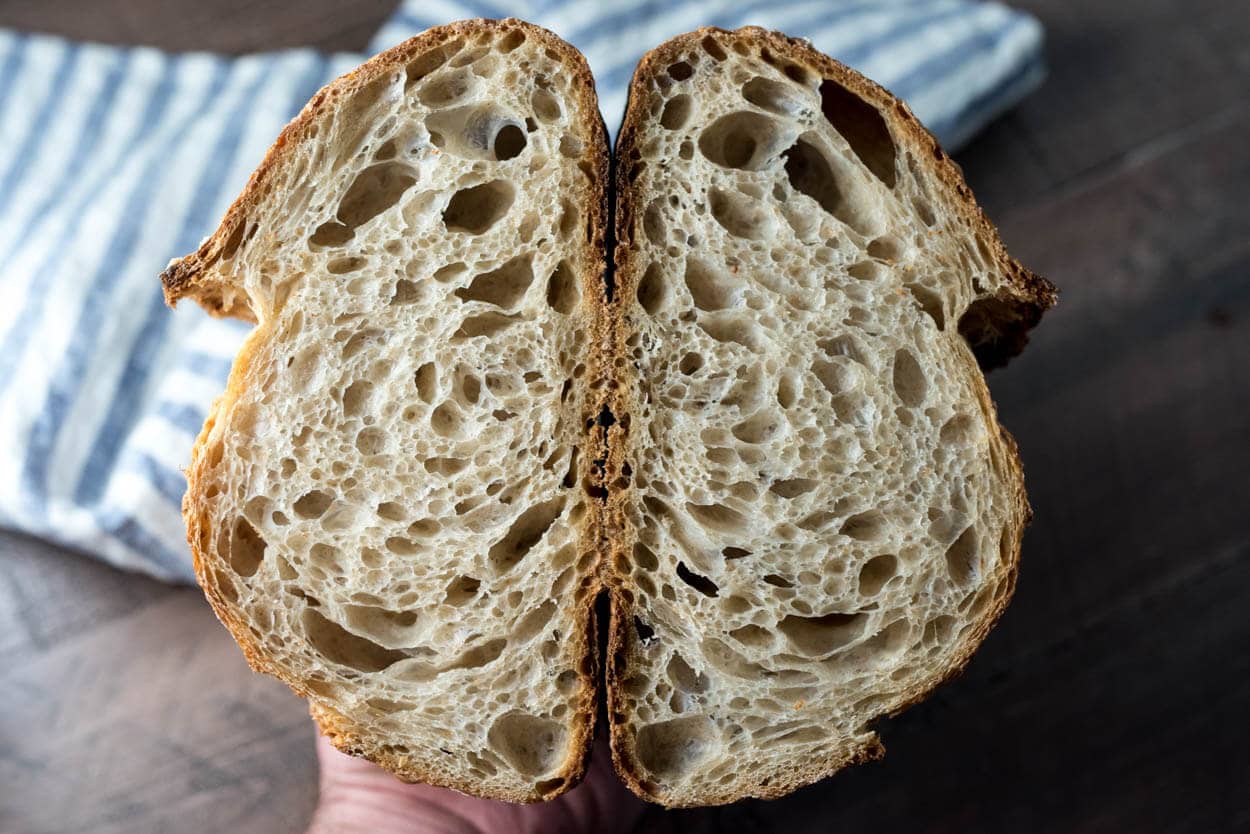
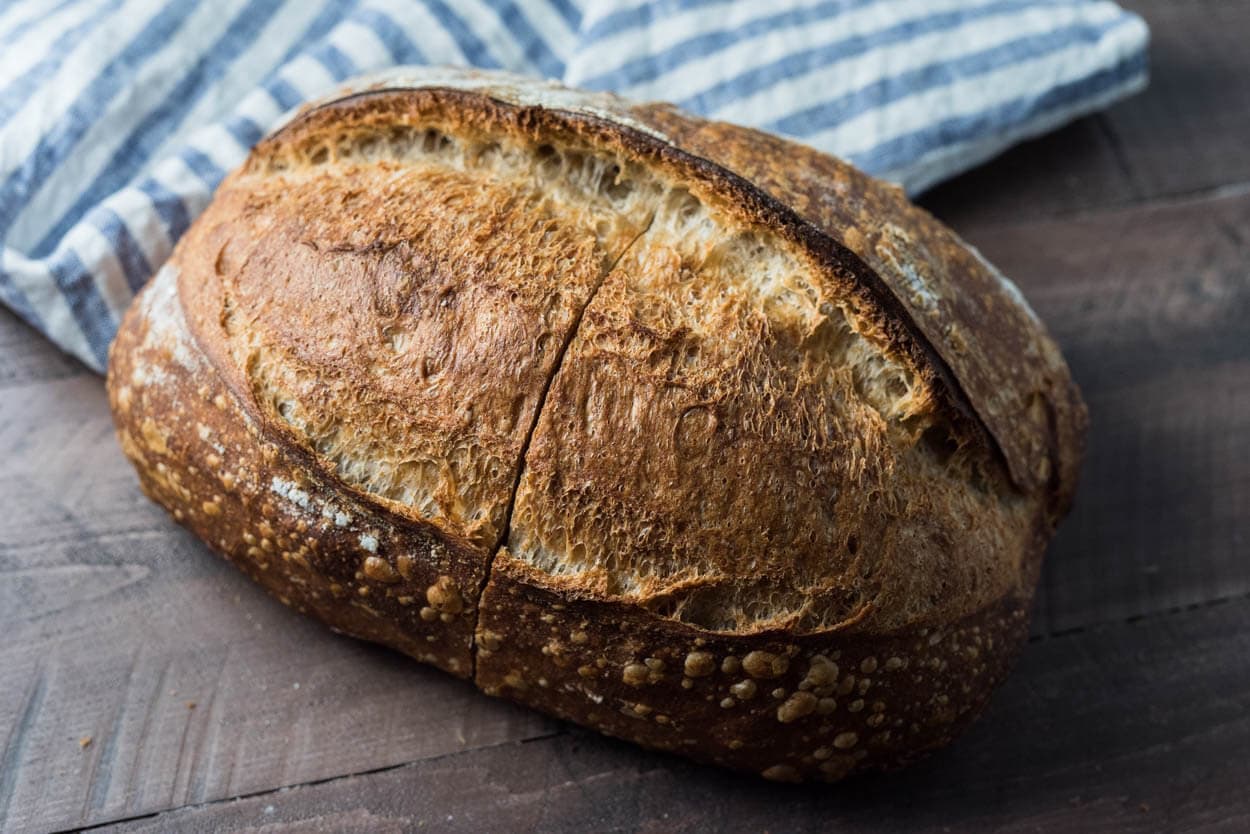
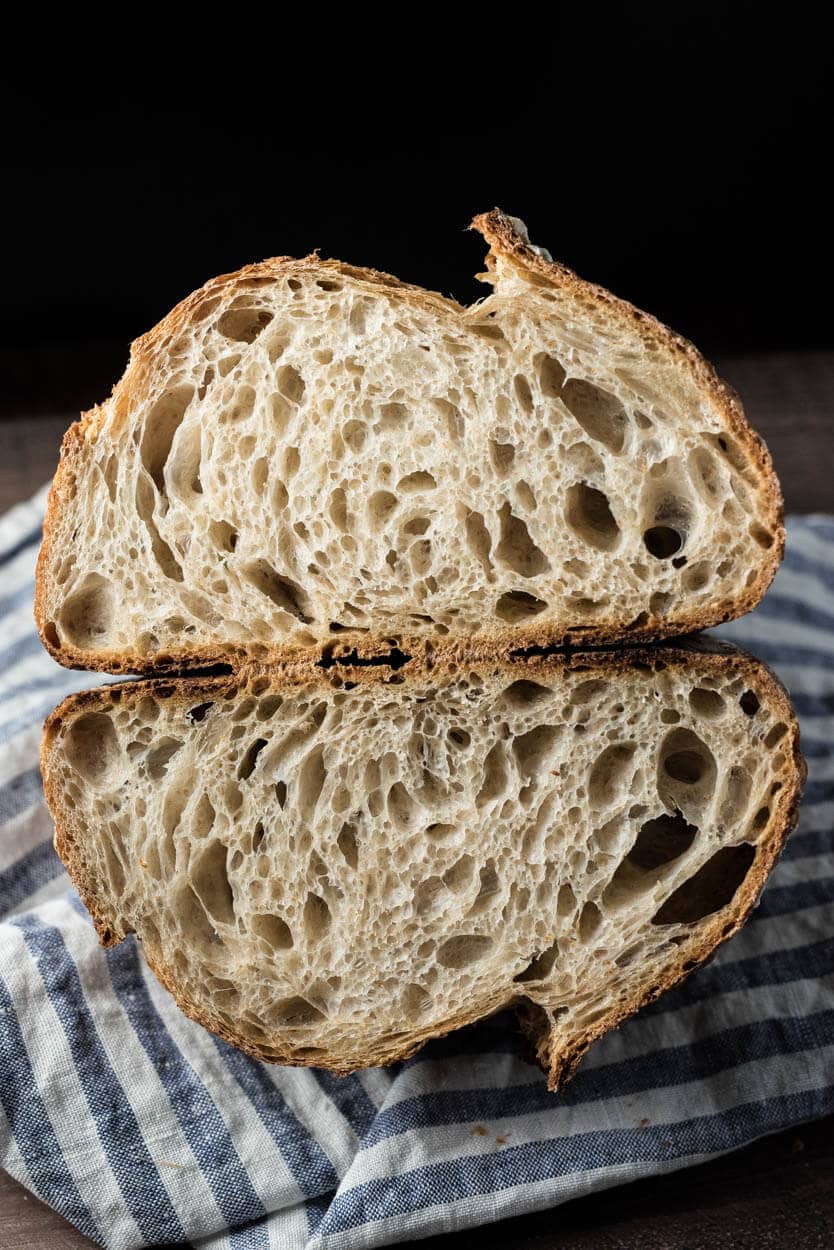
My baking focus has lately been predominantly on my sourdough starter maintenance and maximizing fermentation. And recently, I’ve made some of the best bread I can remember (I took all the bread pictures in this post with this starter). So this post is somewhat a continuation of my Managing Starter Fermentation, but in this post, I’ll focus more on the signs for spotting when a sourdough starter is ready for refreshment (ripe) and how to perform that refreshment.
Be sure to check out my post on what flour, water, and carryover ratios I’m currently using to feed my starter in my How Do I Feed My Sourdough Starter post.
There are many methods to keeping your starter healthy and in proper working order, likely as many methods as bakers. Each baker has a process for maintaining their starter according to what works for them and the bread they seek. Each starter is unique, after all: a distinctive blend of wild yeast and beneficial bacteria that has evolved in the temperature it’s kept at, the flour used for refreshments, and the time between those refreshments. I wanted to preface this article because the following is what works for me here in my kitchen and will most likely work for you as well, but I guarantee you’ll find yourself modifying my method to suit your environment. That’s to be expected. An essential requirement for a baker is flexibility and adapting techniques and inputs so everything performs optimally in your kitchen. In the end, your sourdough starter maintenance routine might be similar to mine, or it might be quite different.
I can remember back to when I first dabbled with creating my sourdough starter. I read all the books I could get a hold of; I searched online, anywhere I could find information. Once I got things up and running (using the process described in my seven steps to creating a sourdough starter entry), I followed refreshment schedules outlined in various books, and things seemed to work pretty well. But my bread didn’t improve until I modified things to suit my environment, schedule, and unique starter. As I refreshed my starter each day (feeding sourdough starter), I began to take note of things, how it looked when I neglected to refresh it for too long, how it looked after a few hours with new food, and how the smell of the starter changed throughout the day.
My goal for this entry is to convey the signs I look (and smell) for during the single-day microevolution of my sourdough starter. First, what does it seem and smell like right as I refresh it (at the start)? Then, what should it look like when I decide to refresh it again or use it for making bread? And finally, what does it look like if it’s gone too far and starts to become overly acidic? I receive frequent emails on this topic, and I hope this entry will be a visual guide to those wondering how I care for my starter.
With this post, I’m hoping to help you answer the following questions:
- What is feeding (I usually call it refreshing) a sourdough starter?
- How soon after feeding (refreshing) a sourdough starter can I use it?
- What does feeding my sourdough starter once (or twice) a day look like?
A quick note for those out there who follow my writing very carefully: you’ll notice this entire entry is about a liquid starter/levain and not about a “stiff” variety I had been baking with for almost a year. I recently shifted things back to using a liquid starter after a long while with a stiff variant, and I have to say I prefer how my bread is turning out with my change. If you use a stiff starter, some of this entry will be relevant to you, but the visual cues will be different as the consistency of your starter will be different. If you haven’t used a liquid starter/levain, I suggest you experiment with this and try it out, you might be surprised at the difference, and you might prefer it. I’m not suggesting one is better than the other, but rather a personal preference whereby I like the taste and performance of this liquid levain for the bread I’m currently baking.
If you’re curious and looking to dig more into preferments, see my guide to the differences between a sourdough starter and a levain.
Sourdough Starter Background
The key to coaxing out maximal fermentation with your starter is to be observant. Watch how it evolves throughout the day and note how long it takes to reach full ripeness: a strong sour aroma, a breakdown of the mixture, significant bubbles on top and at the sides. If it’s doing this too fast (for example, you refresh at 8 a.m., and it ripens at 2 p.m. when you’re at work), you can reduce the water temperature, change the ambient temperature, or reduce the amount of mature starter you carry over at each refreshment (this is what I do). You want to try to refresh your starter right when it’s at its peak ripeness or shortly thereafter.
The key to coaxing out maximal fermentation with your starter is to be observant.
Once you have a healthy starter showing the same signs of fermentation every day, you will be able to adopt a consistent sourdough starter maintenance schedule. I work this into my daily routine: I refresh my starter when I eat breakfast in the morning, and then I refresh again in the evening as I’m cleaning up the kitchen getting ready for bed. It only takes a few minutes (see my tips later on tools to make things easier).
Your starter will go through the following phases each day, but the times will most likely be different. For example, if fermentation is slow (due to temperatures or percentage of starter carryover, for example), then the signs I point out below might be at greater intervals, and conversely, if fermentation is fast, then the ranges will be tighter. As I mentioned initially, if you’ve not yet started your sourdough starter or received a portion from a friend, I have an intro article to creating a starter that will get you going in a few days.
Let’s look at a day in the life of my starter.
Sourdough Starter Maintenance Timeline
Before we dive into the timeline, I want to point out that below I refer to two things: my starter, which is what you’re here for in the first place, and also a levain. I talk about both almost interchangeably because mostly, they are the same thing. Your starter (mother, chef, etc.) refers to your yeast/bacteria culture you continue to refresh and care for indefinitely. In contrast, your levain is a splinter, or off-shoot, of your starter that you refresh and build only to be used in a bread recipe eventually.
For the timeline below, I used 30% whole grain dark rye flour and 70% medium-protein bread flour (similar to all-purpose, but geared toward bread baking). The percentage of flour types is really up to you; I used a little rye flour to help increase fermentation and acetic acid production, but you can use any ratio of flour you’d like (e.g., 100% whole wheat, 100% white, a mix of both, etc.). Just take note of how each flour type aids or slows fermentation.
10:00 a.m. – Sourdough starter maintenance beginning
The first step is to take your mature sourdough starter, discard some part of it, refresh it with fresh flour and water, and cover (I only loosely cover with a glass lid that does not seal tight). My kitchen is currently around 75°F (23°C), and my mixture is 70g white flour, 30g rye flour, 20g mature starter, and 100g room temperature water.
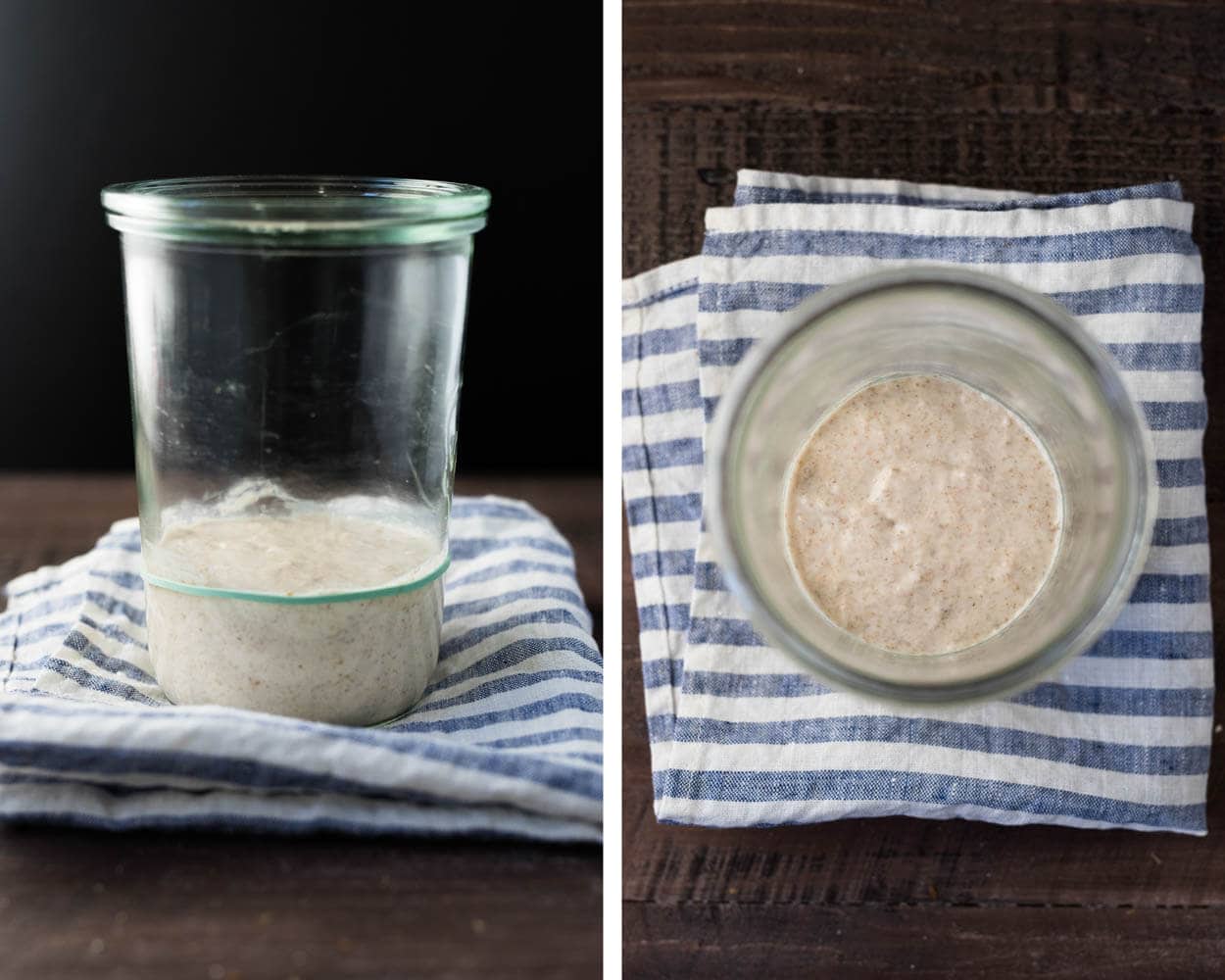
You can get a sense of how “stiff” my starter is after mixing. You want to make sure you mix everything thoroughly so it’s completely smooth with no visible clumps of dry flour.
I’ve placed the green rubber band at the beginning level of my starter so we have a good sense of how far it will rise throughout the day.
12:00 p.m.
After only a couple of hours, you can see only slight activity visible in my starter. The smell at this point would be very, very sweet, and practically the aroma of flour and water. So sit tight; things are about to get more interesting.
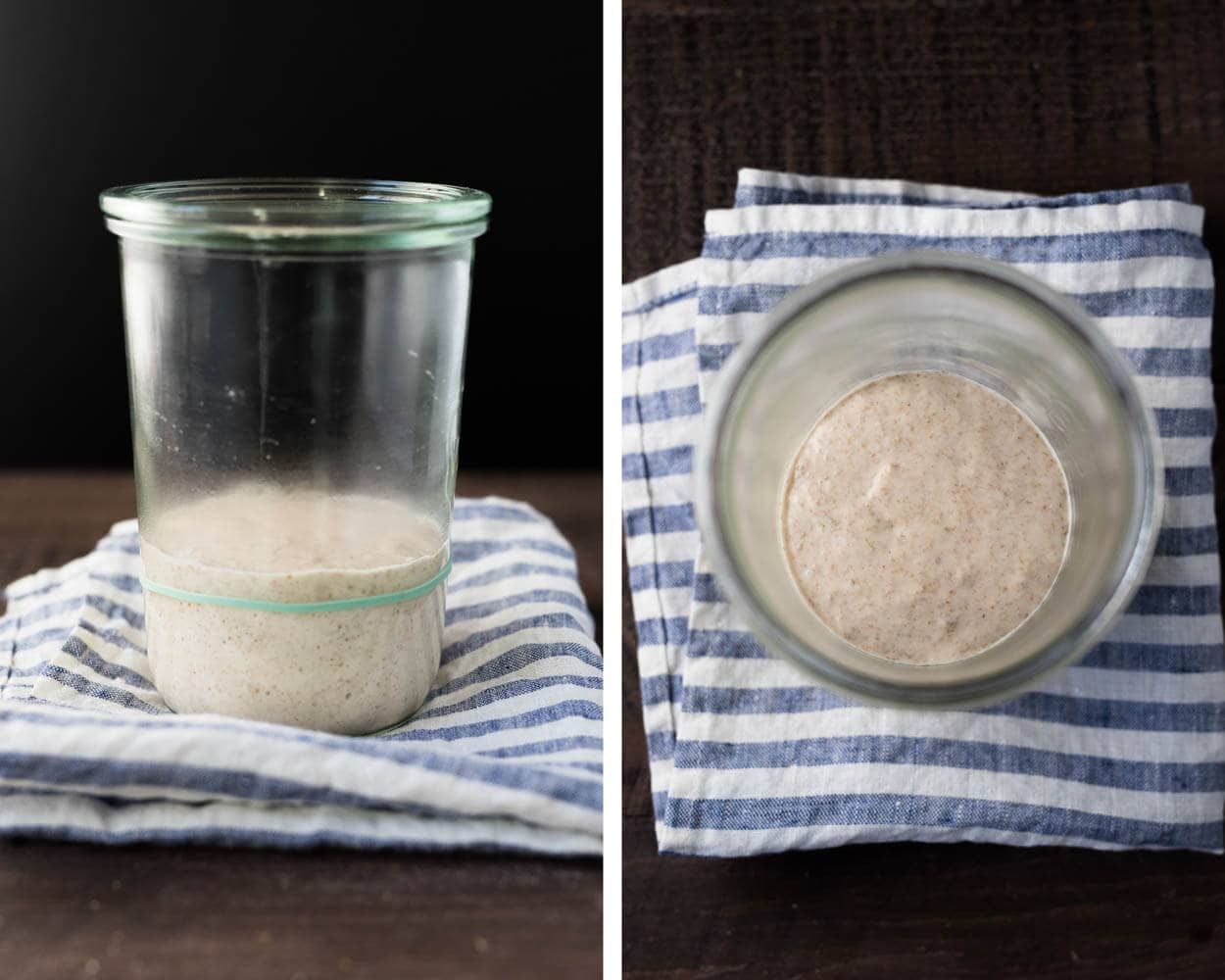
2:00 p.m.
As seen below, four hours after refreshment, we have a significant expansion, a tad over 100%. In the image at right, you can see that the top is domed with a few bubbles peeking through. The mass of dough is trapping quite a bit of the gas produced through fermentation. I like to use a glass container, particularly these Weck jars, not only because it allows me to see firsthand how fermentation is progressing but also because the flared top makes sticking your hand and spatula inside very easy. I not only use these tall jars for my day-to-day starter and refreshments, but I also use them to build my levain before baking.
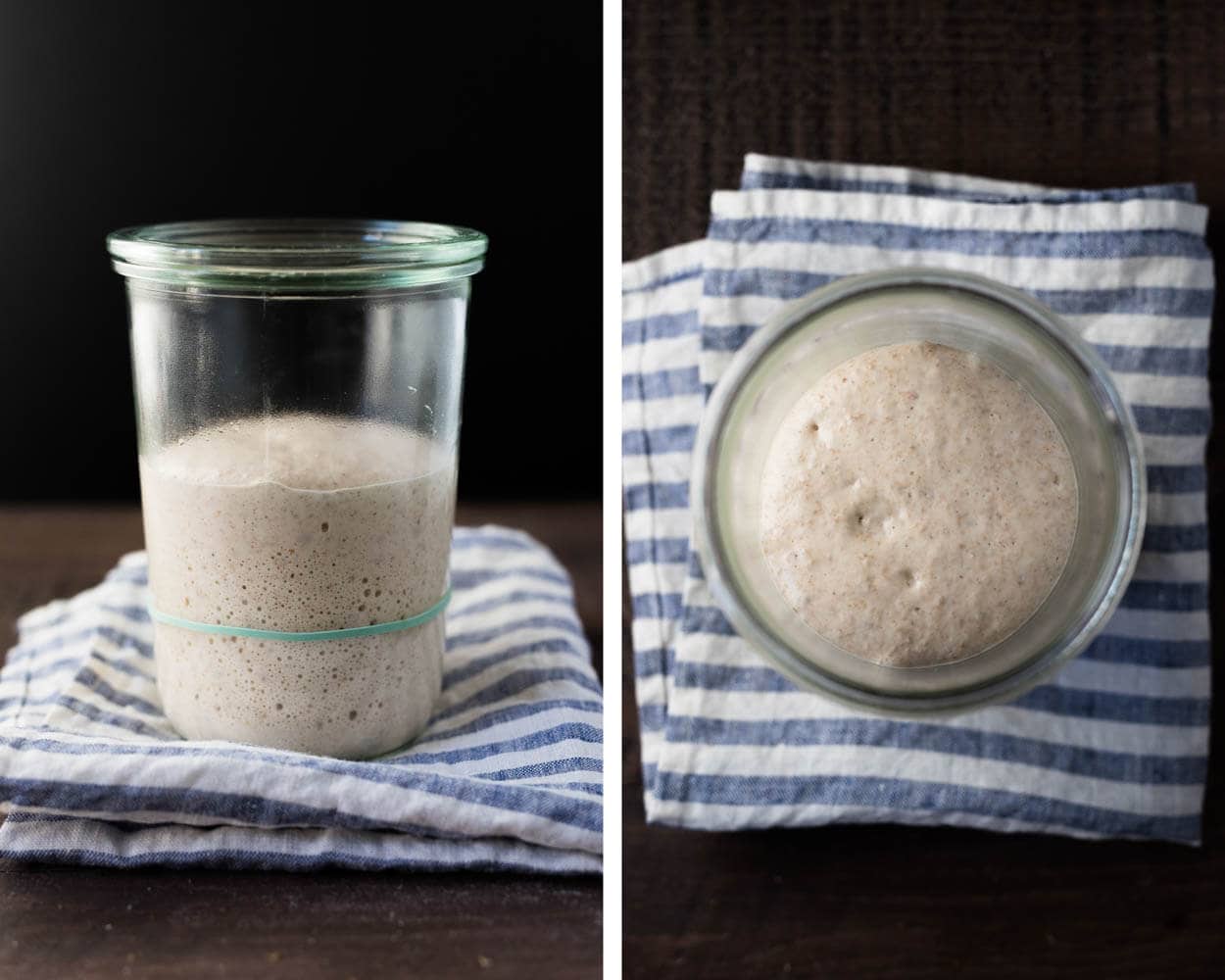
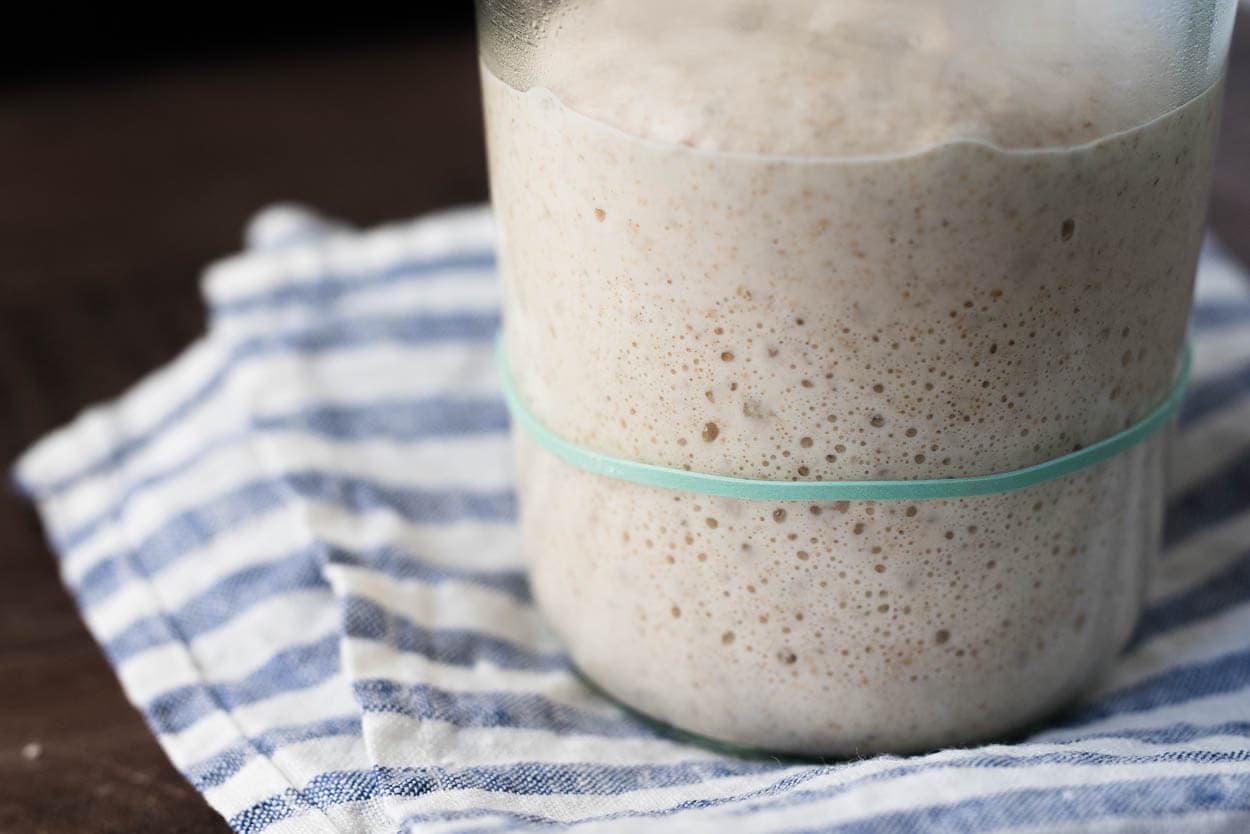
You’ll notice there’s quite a bit of activity already. Of course, after this initial explosive growth, things will slow down, but upward growth will continue for many hours.
3:00 p.m.
At this point, there’s only slightly more expansion than the last check-in. But, you can see many more bubbles on top and at the sides, showing signs of the momentous fermentation taking place. All of these are good signs.
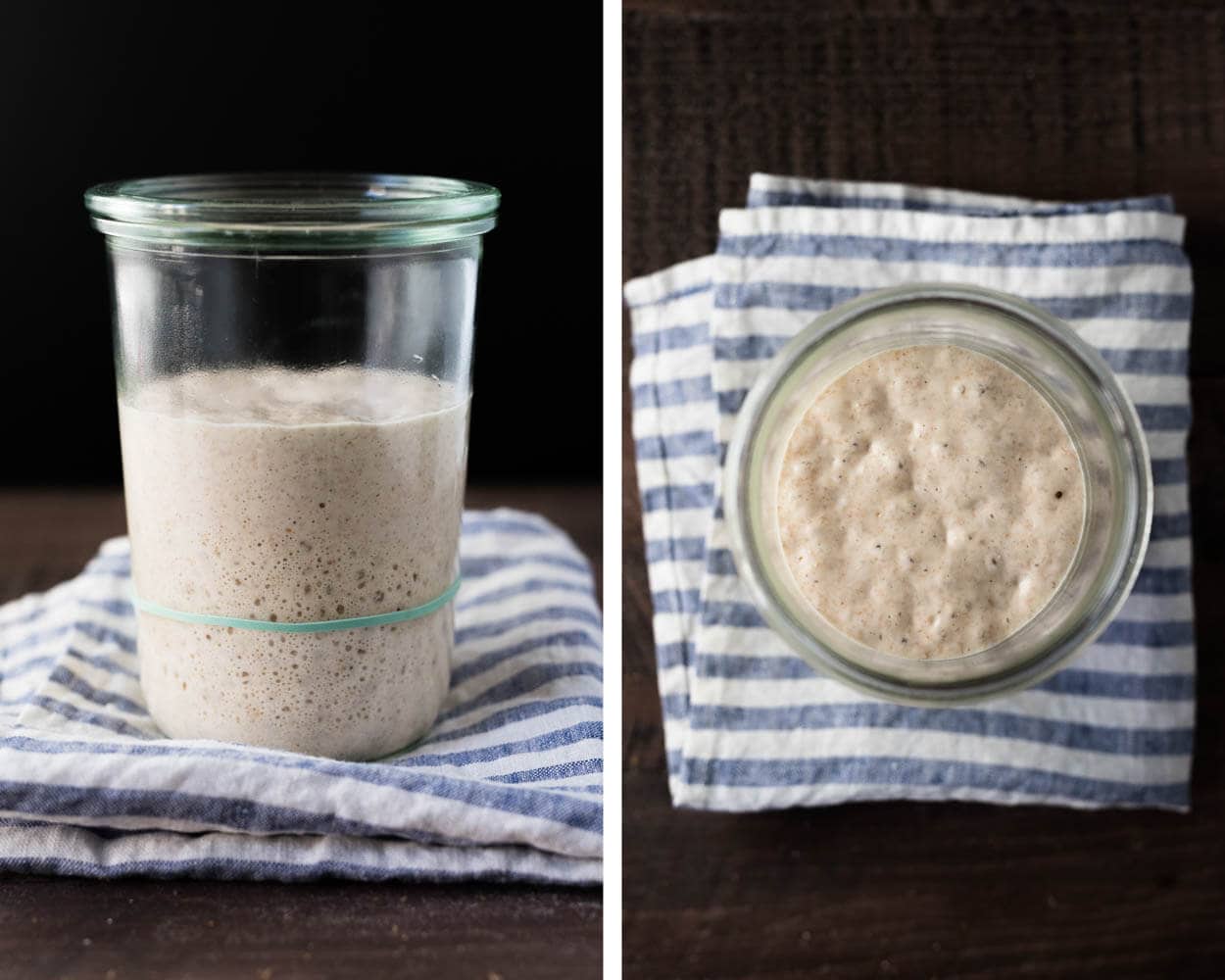
When you build your levain in preparation for baking, you may not always be able to see through the side of the container; the top-down view is sometimes all you have to judge your starter’s readiness. For example, bubbles and holes on top are a good sign, but my starter is not ready to be fed or used now. If this were a levain and not my starter, and I was attempting to use this at a “young” stage, this is most likely where I would use it for mixing my bread.
Another key indicator here is the aroma: how does it smell? Is it still sweet, sourer, or very acidic and vinegar-like? At this point, mine still has a sweet aroma to it, with a very subtle backdrop of sourness starting to creep in.
5:00 p.m.
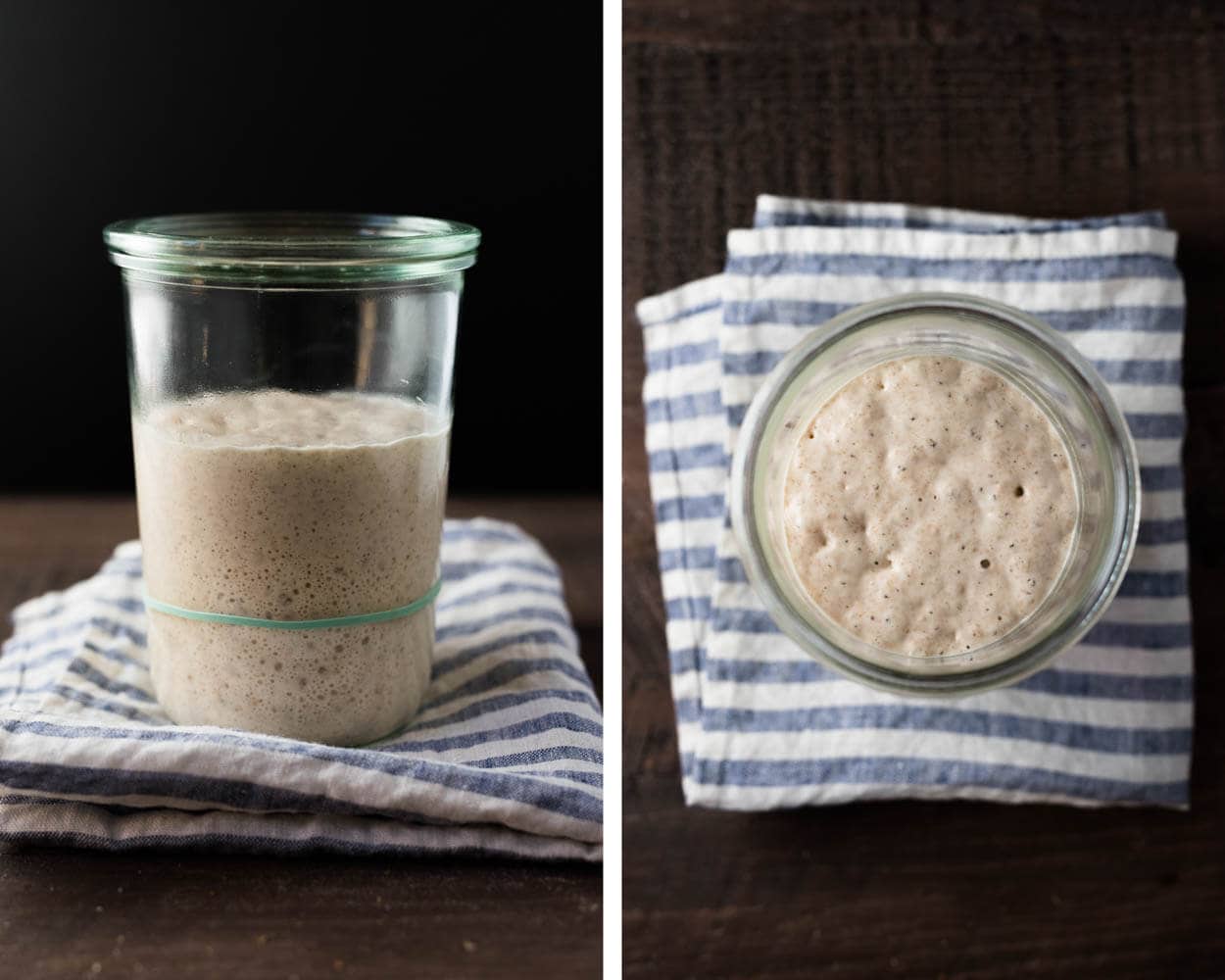
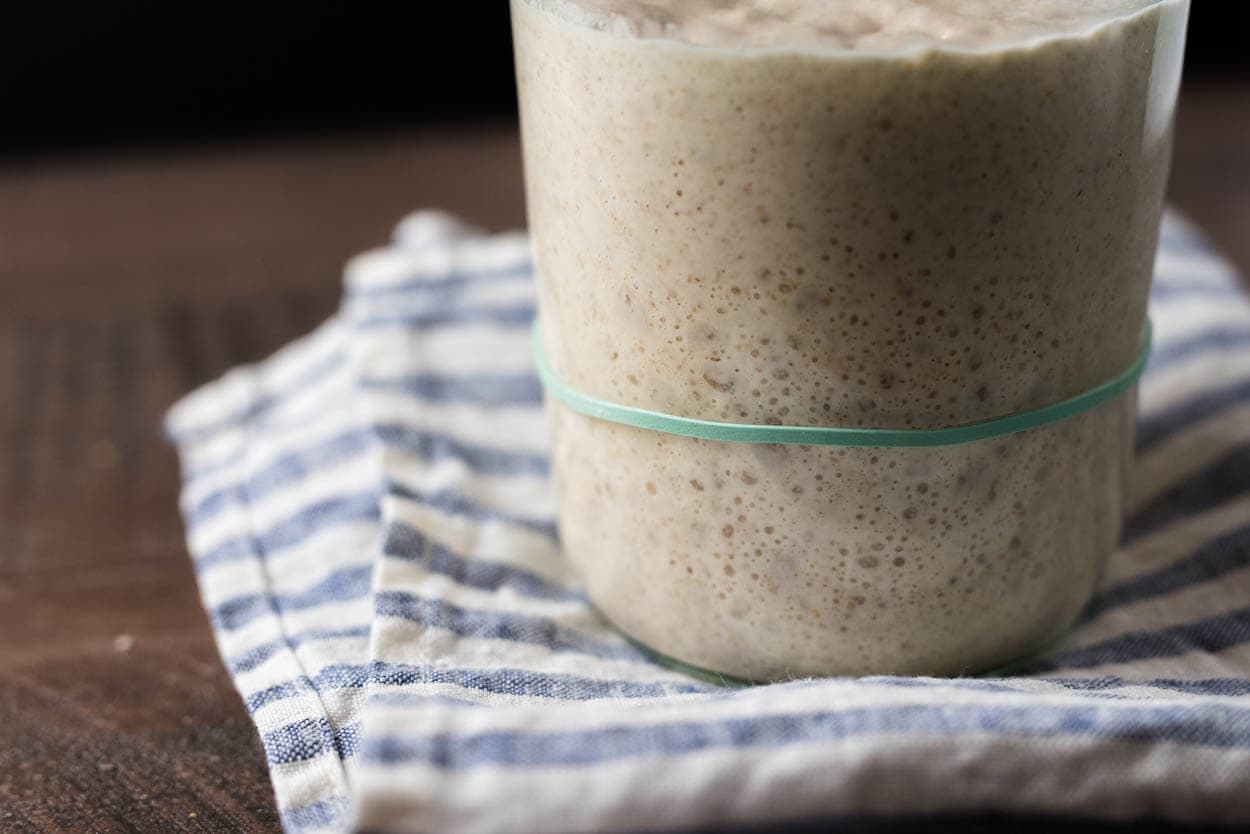
By this time, we have significantly more bubbles at the sides and the top; overall fermentation activity is much higher. If I were to describe the aroma of the starter at this point, it would still smell quite sweet at it was at 3:00 p.m., but now the sourness is starting to escalate and build.
Given the look and aroma, I can expect my starter to rapidly come to ripeness very soon.
7:00 p.m.
You’ll notice here at 7:00 p.m. any dome that was once at the top of the starter is now gone, replaced by a reasonably flat surface. The flattening of the top usually indicates upward growth has significantly slowed, and upward movement won’t be as prominent—more holes on top and more fermentation visible at the sides. We’ll continue to let it ferment.
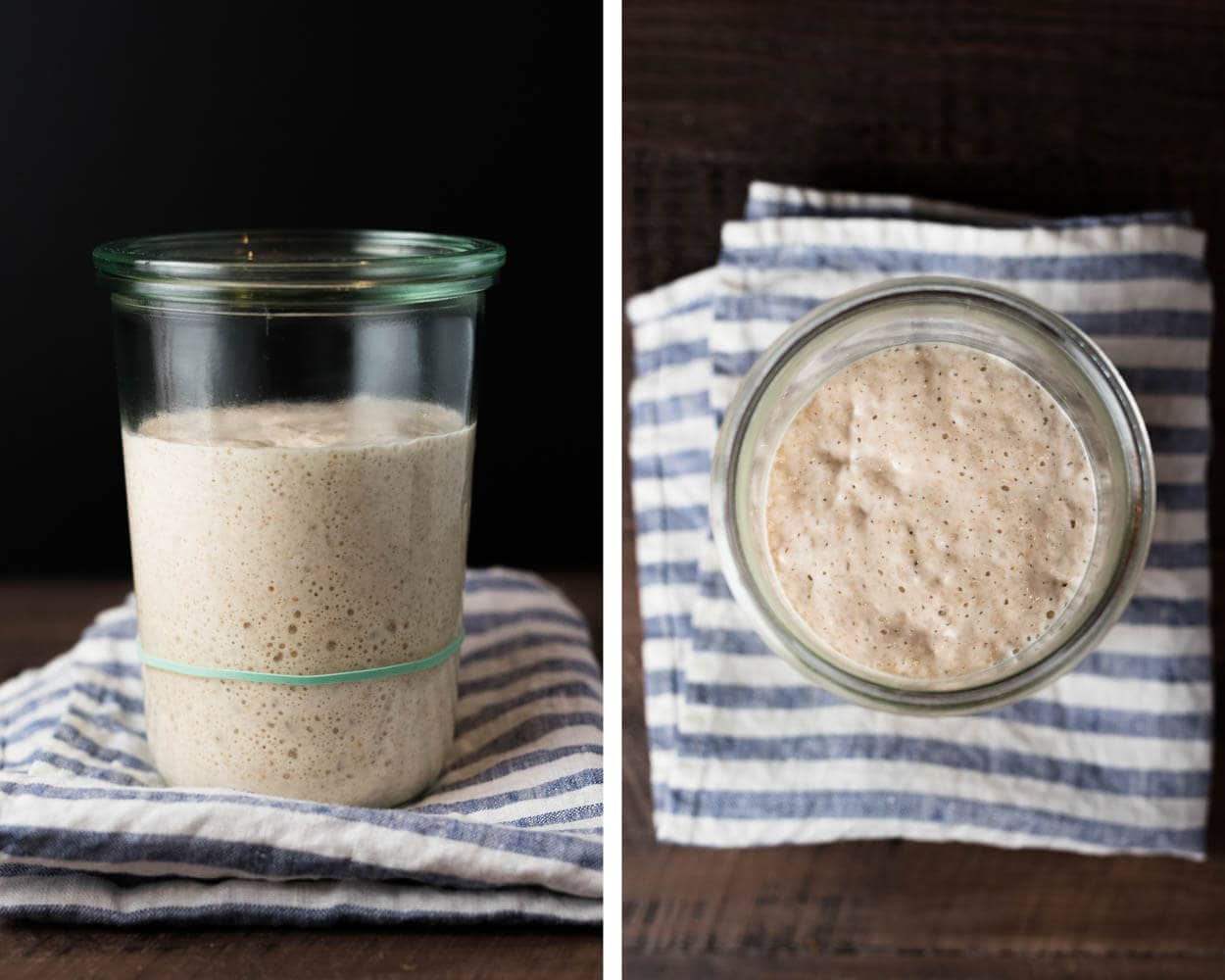
8:00 p.m. – Ripe, time to make a levain
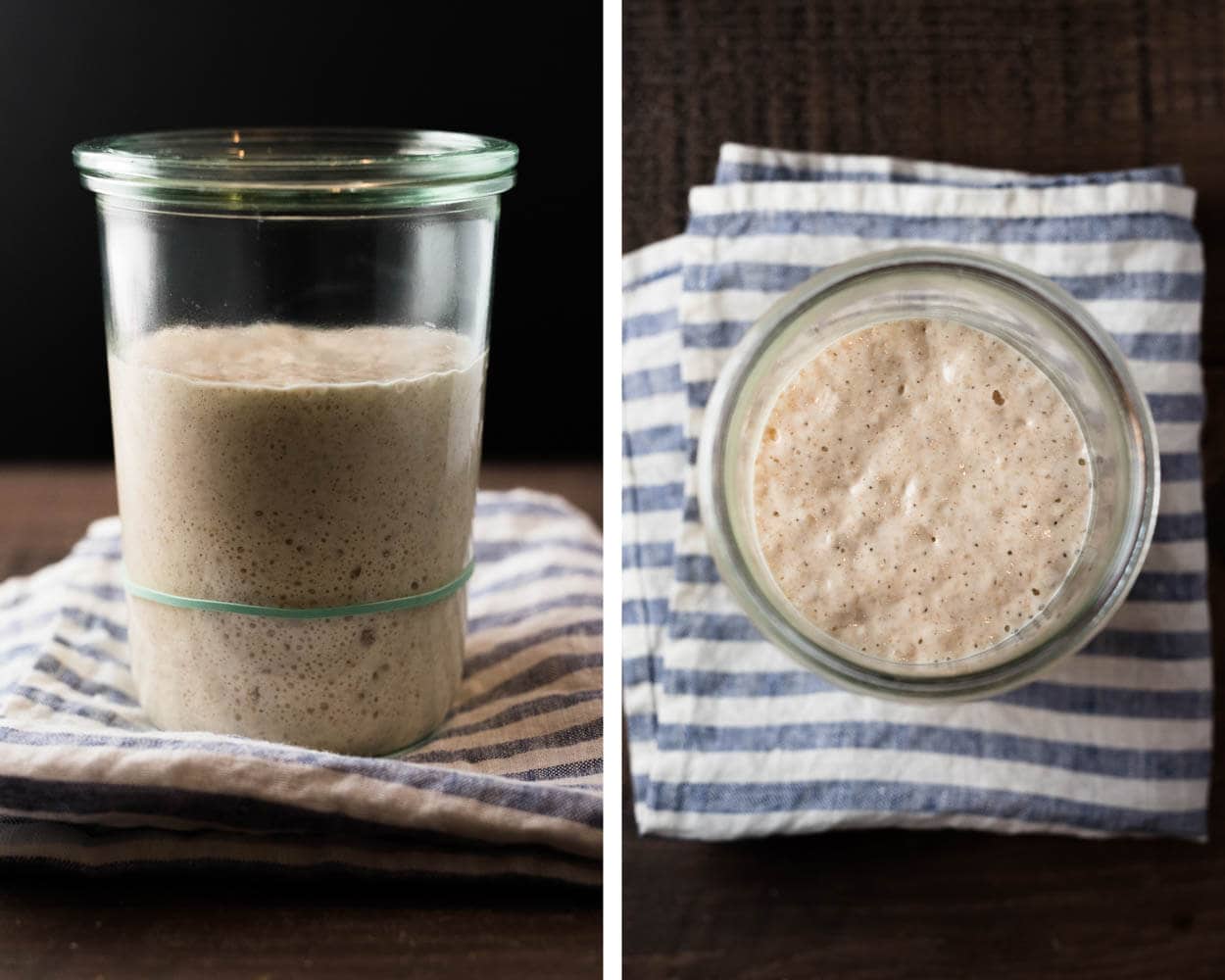
As seen below, we still see some rise since 7:00 p.m., but not much. The top shows signs of more holes and bubbles, and the aroma is what I would describe as “ripe” and ready for use. If I were to pull back a little bit of the top, I would smell a slightly sour, vinegary smell with hints of sweetness still present.
At this point, I’d use some of the sourdough starter to make a fresh levain or use this starter directly in making bread. After making the levain, I would also refresh the starter by discarding and adding fresh flour and water.
While I find the “float test” to be misleading because it can sometimes give you false positives for when a starter or levain is ready to use, the float test would surely pass at this point.
10:00 p.m. – Just past ripe
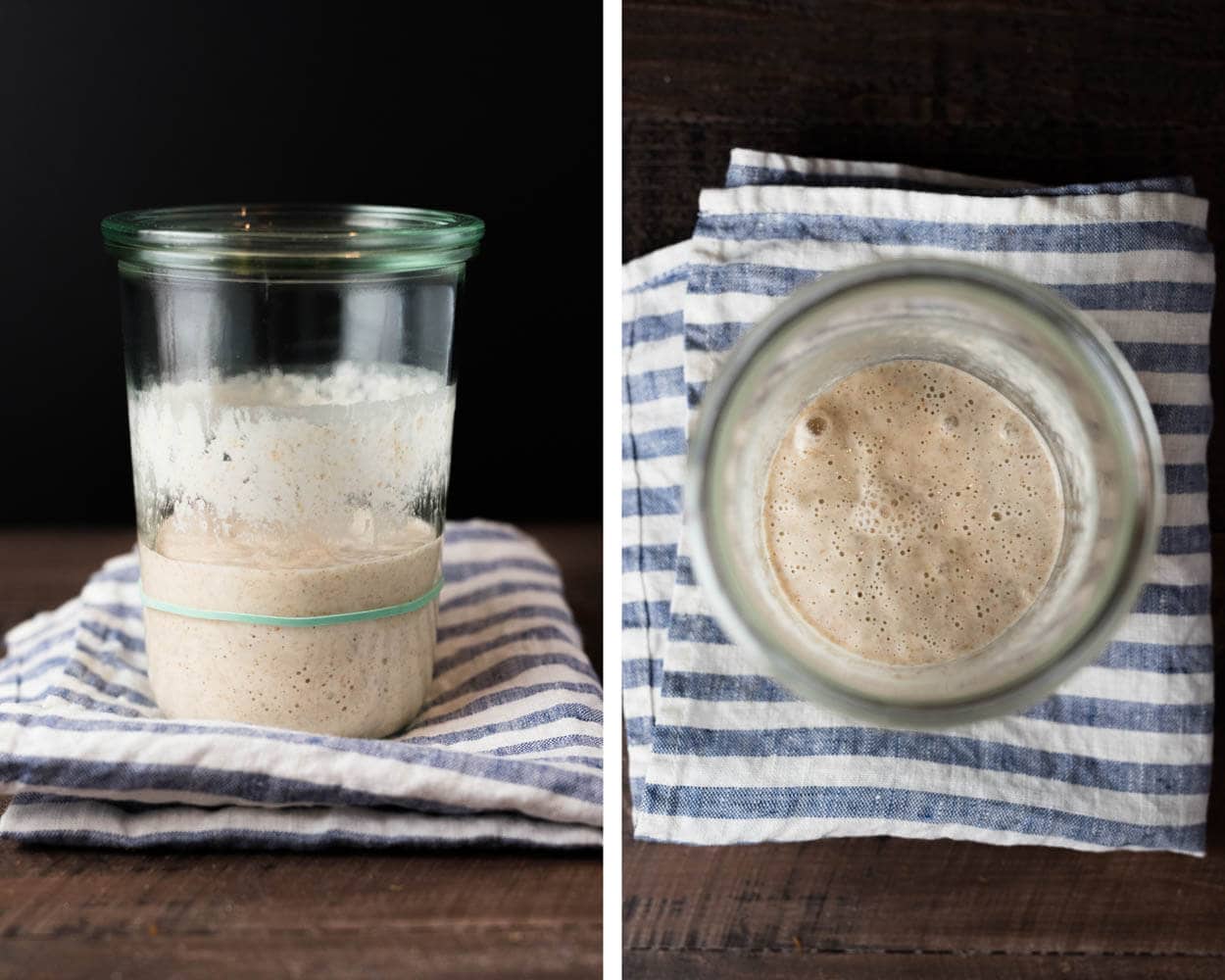
In the photo below, you can see the culture is beginning to show signs of ripeness. There are streaks at the top that indicate where the top of the starter once was, and in the top-down view, you can see the center is starting to collapse.
The fact that it’s starting to collapse is not the single most crucial factor in judging readiness. Instead, it’s the cumulative signs that are most important.
The fact that it’s starting to collapse is not the single most important factor in judging starter and levain readiness. Instead, the cumulative signs matter: a general breakdown of the mixture, a stronger sour aroma, and significant gas production.
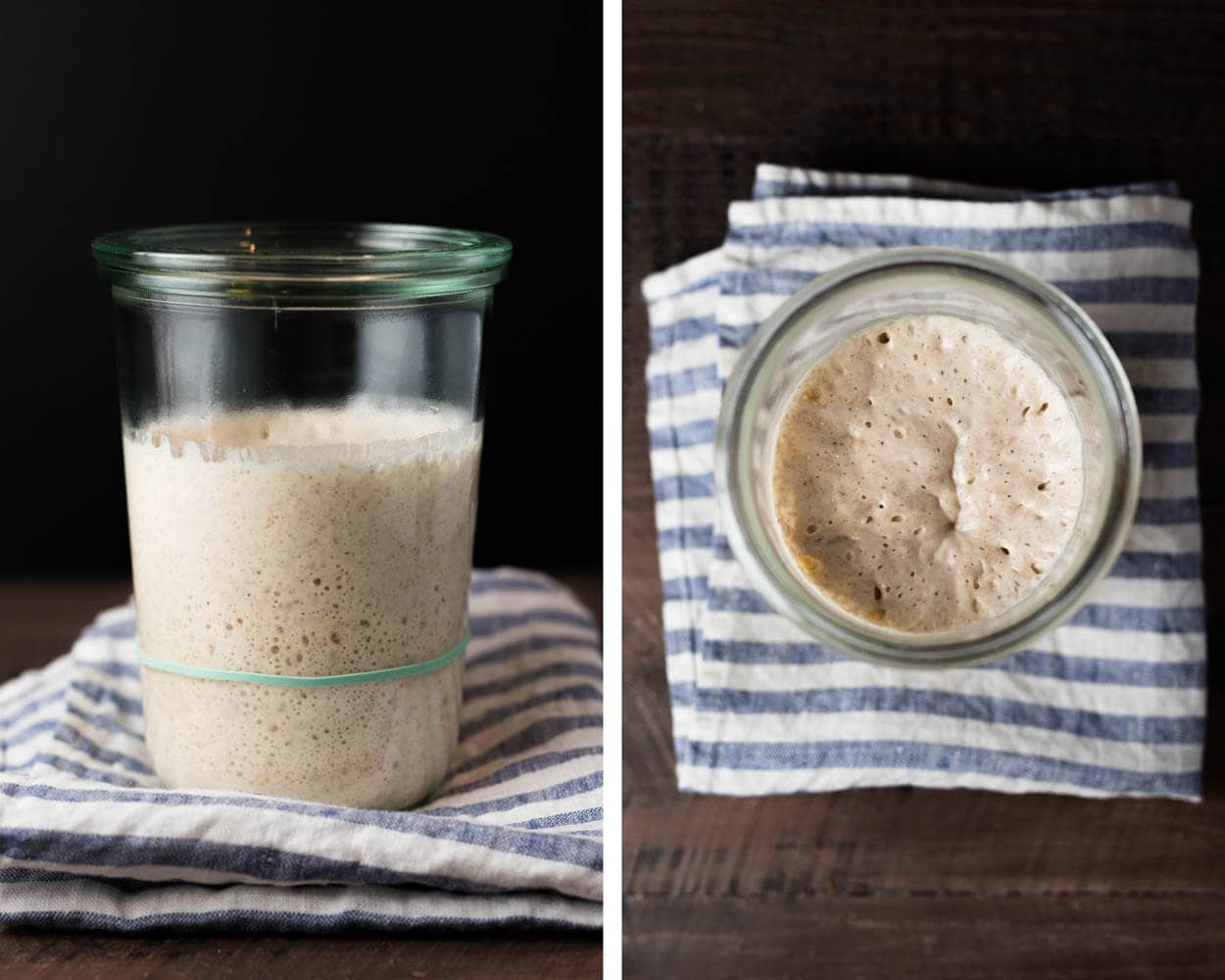
Again, if this were a levain I built in the morning to mix into bread, I would still feel comfortable using this to mix my dough. I’ve used my starter/levain at this point to make excellent bread. I’ve touched on the topic of a “young” levain in the past, but recently I’ve been using mine when it’s more fully fermented to achieve more flavor.
This time is also when you would want to refresh (feed) your starter. If you are using the correct mixture of inputs—water at a specific temperature, percentage of mature starter, and flour mixture—this time will coincide with when you want to feed it. For me, 10 p.m. is perfect as I start cleaning the kitchen in prep for bed (our little ones at home dictate my sleep/wake schedule, and thus my starter must conform).
If your starter has arrived at this point before you want it to, you can use a smaller percentage of ripe starter carryover or use colder water. If your starter is a bit sluggish and isn’t quite at this level, use a bit more ripe starter at the next feeding or use 2° to 8° warmer water.
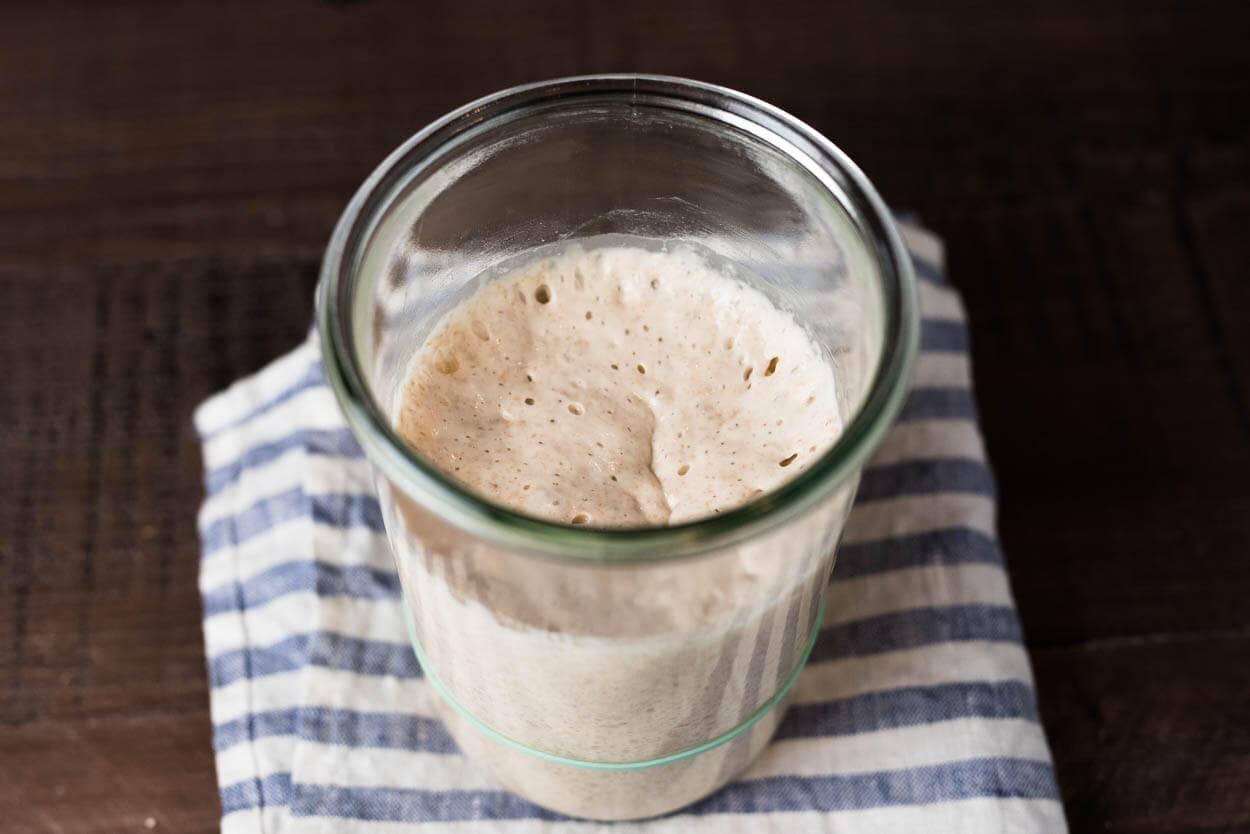
Being observant helps us help our starter to maximize fermentation activity. So, as you continue to care for your starter, take a moment before you rush through refreshments to observe the look and aroma of your starter—plan to adjust things either at the current refreshment or the next based on this observation.
11:00 p.m.
My starter continued to fall at this point, with longer streaks on the side, and the center has noticeably caved. I will normally have refreshed it by this point, but I continued to let this ferment until the morning so we can observe how it looks when it’s gone farther than I’d usually allow.
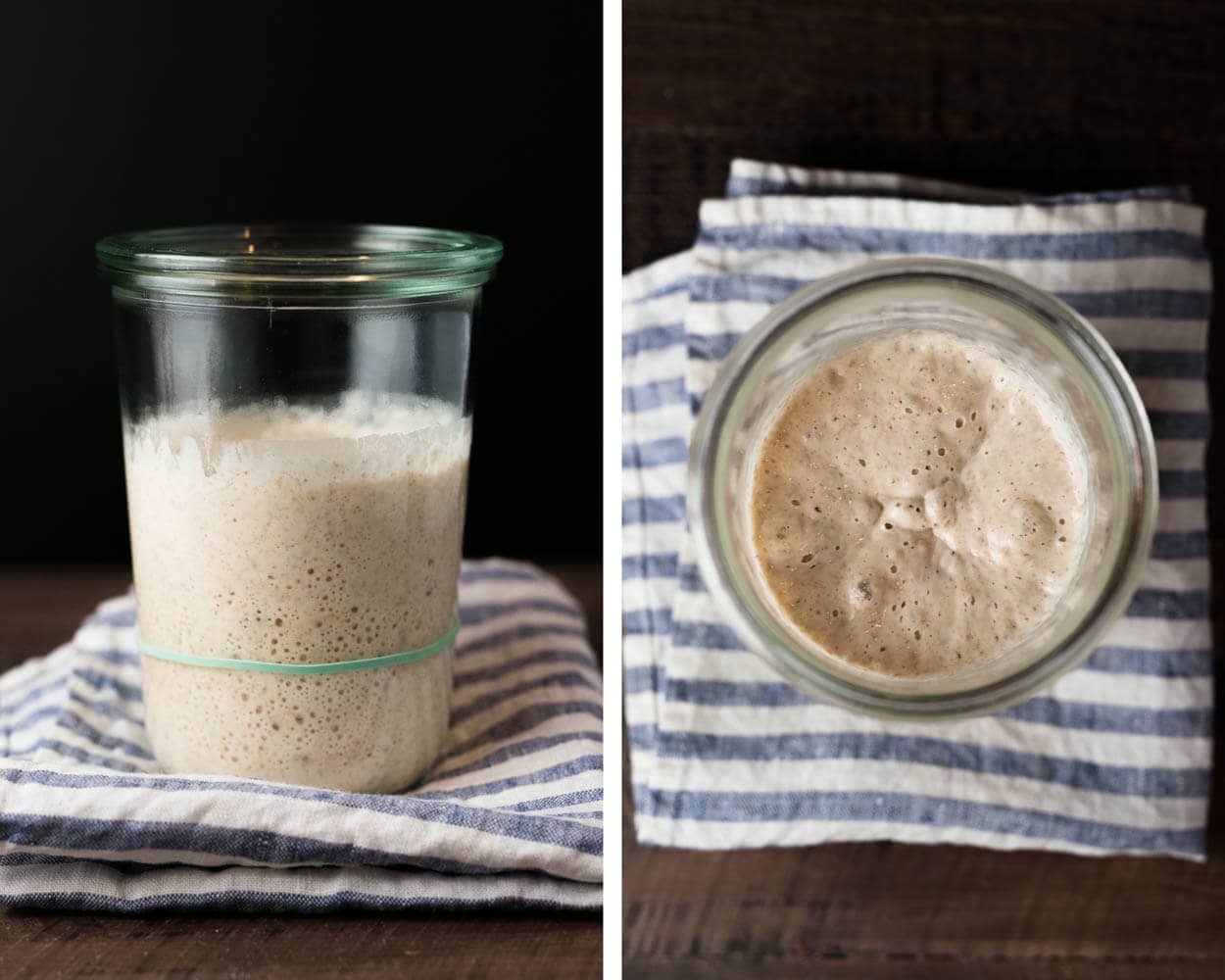
6:00 a.m. (next day)
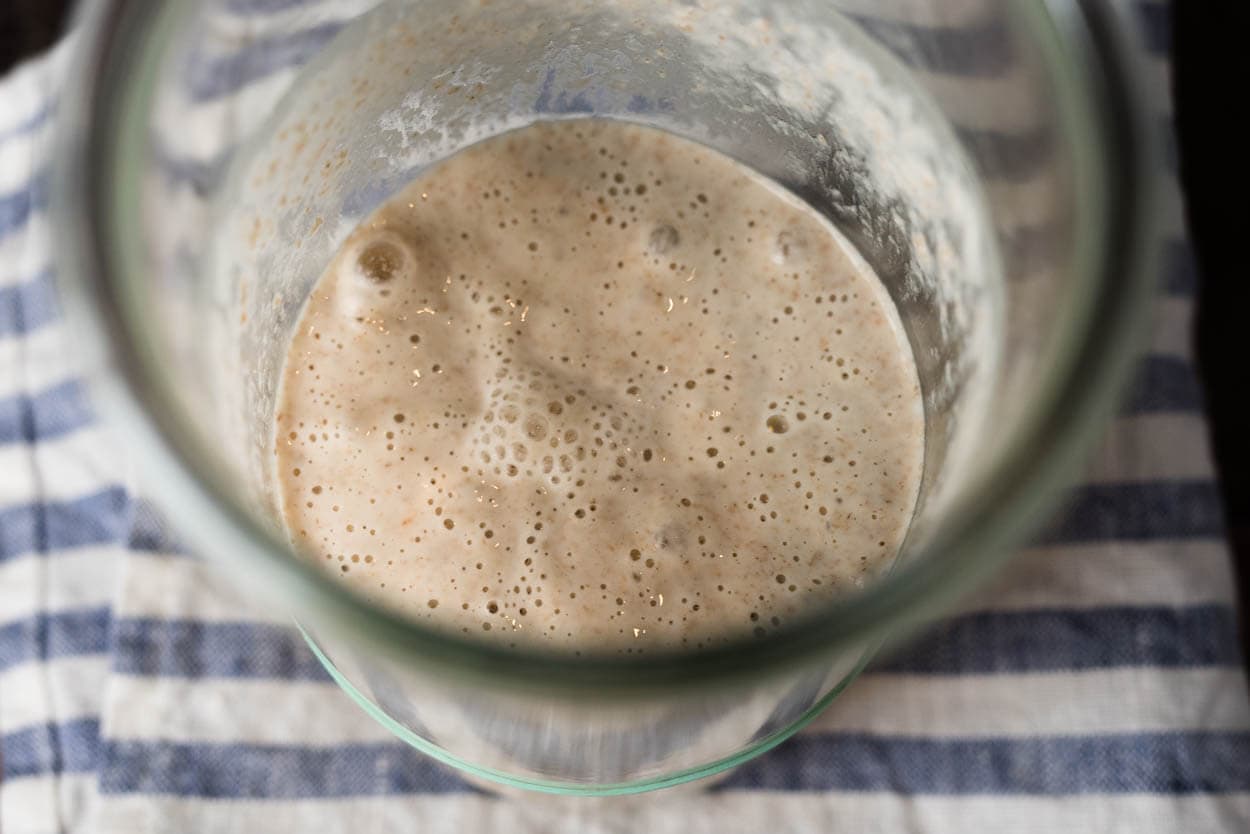
What a drop overnight! The sides are entirely streaked with how far the starter has fallen, and the top was covered in small little bubbles. My starter has gone way too far at this point and needs a refreshment.
7:00 a.m.
Even more collapse and more small bubbles. At this point, the aroma was very acidic, vinegary, and quite strong.
8:00 a.m.
My final timeline entry shows just how far my starter has fallen after almost 24 hours. The acidity will continue to rise, and if left for even longer, a clear liquid will form on the top (commonly referred to as “hooch”) that will be alcoholic and bitter tasting. Your starter might also look this way if you’ve left it for a long period in the fridge in “hibernation,” as I like to call it. When reviving a starter in this condition, I will pour off the clear liquid, mix the remaining, and refresh as usual.
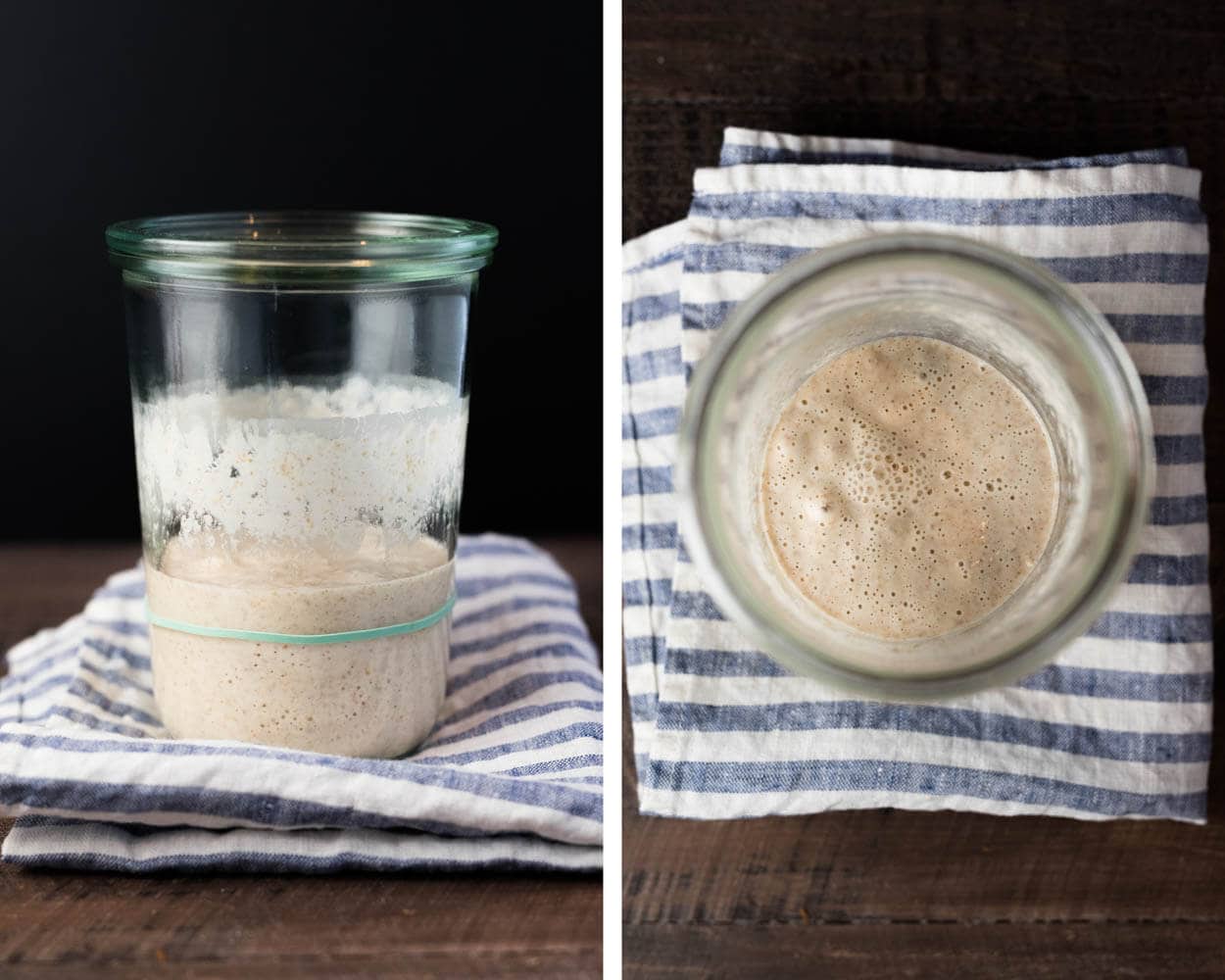
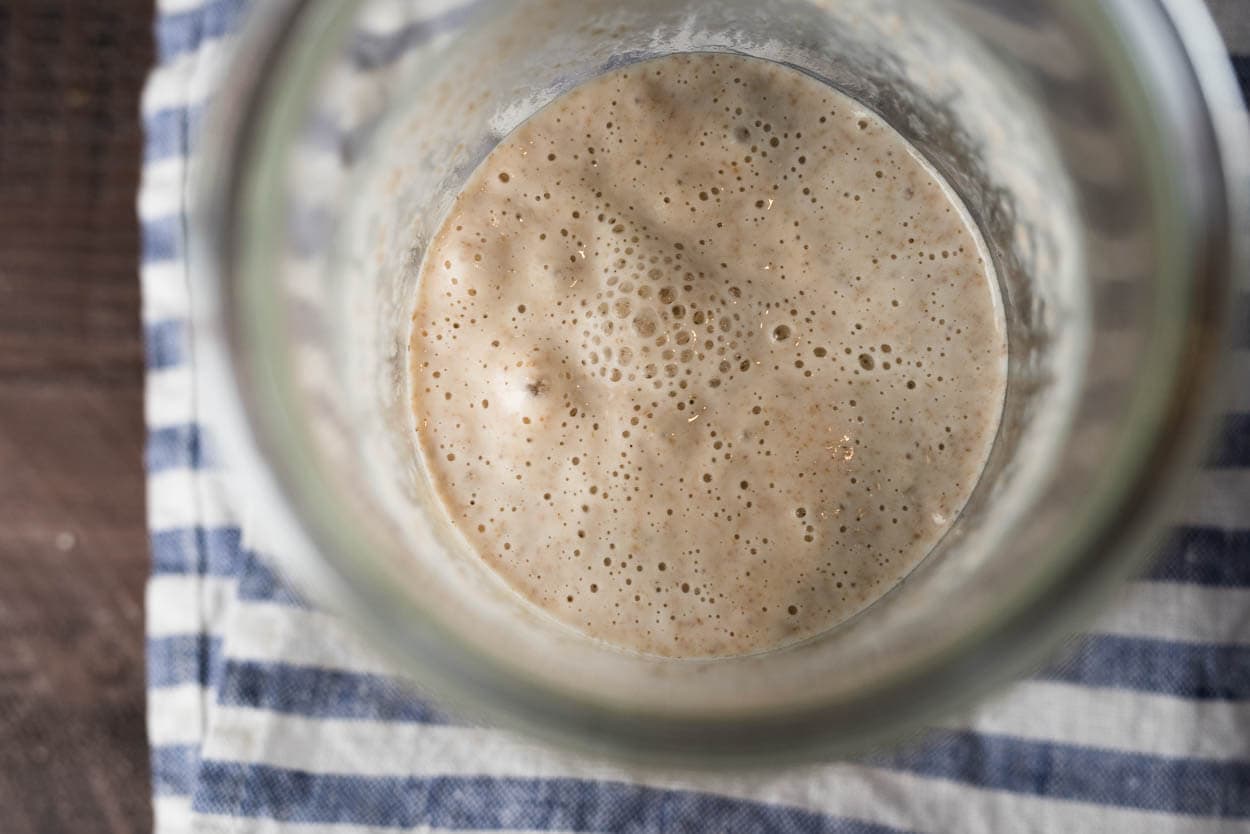
There have been times when my kitchen heated up unexpectedly, or I couldn’t get home before this had happened, and I mixed up my starter per usual, and it was just fine, but I try to avoid this scenario as much as possible.
Don’t panic if you forget to refresh your starter for a day or two! It will be just fine with a few timely refreshments and some attention.
General Sourdough Starter Maintenance Tips
See my sourdough starter frequently asked questions post for a long list of common issues, but here are a few tips that will prove helpful:
- Don’t let your starter collapse and sit for extended periods as excessive acidity will change the flavor of your resulting bread (sourer). If it’s a levain, not your starter, and it’s fermented much too fast for your schedule, you can always make an intermediate build (essentially discard and add new flour and water) and use the new build to mix
- Use your nose. Observe the aroma of your starter at each phase and get to know what a particular aroma indicates by drawing a connection between aroma and visual cues
- If your area has high chlorine levels in the water, use filtered (or distilled) water or let the water sit out on the counter overnight in a water bottle before using
- Stir your starter thoroughly until there are no clumps or dry bits of flour present
Above all, take a few seconds each time you refresh your starter to sit back and assess how things look, smell, and even taste (I don’t typically taste my starter, but many bakers do). Through constant observation and attention to small details, we can maximize fermentation in our sourdough starter maintenance routine.
Sourdough Starter Maintenance Tools
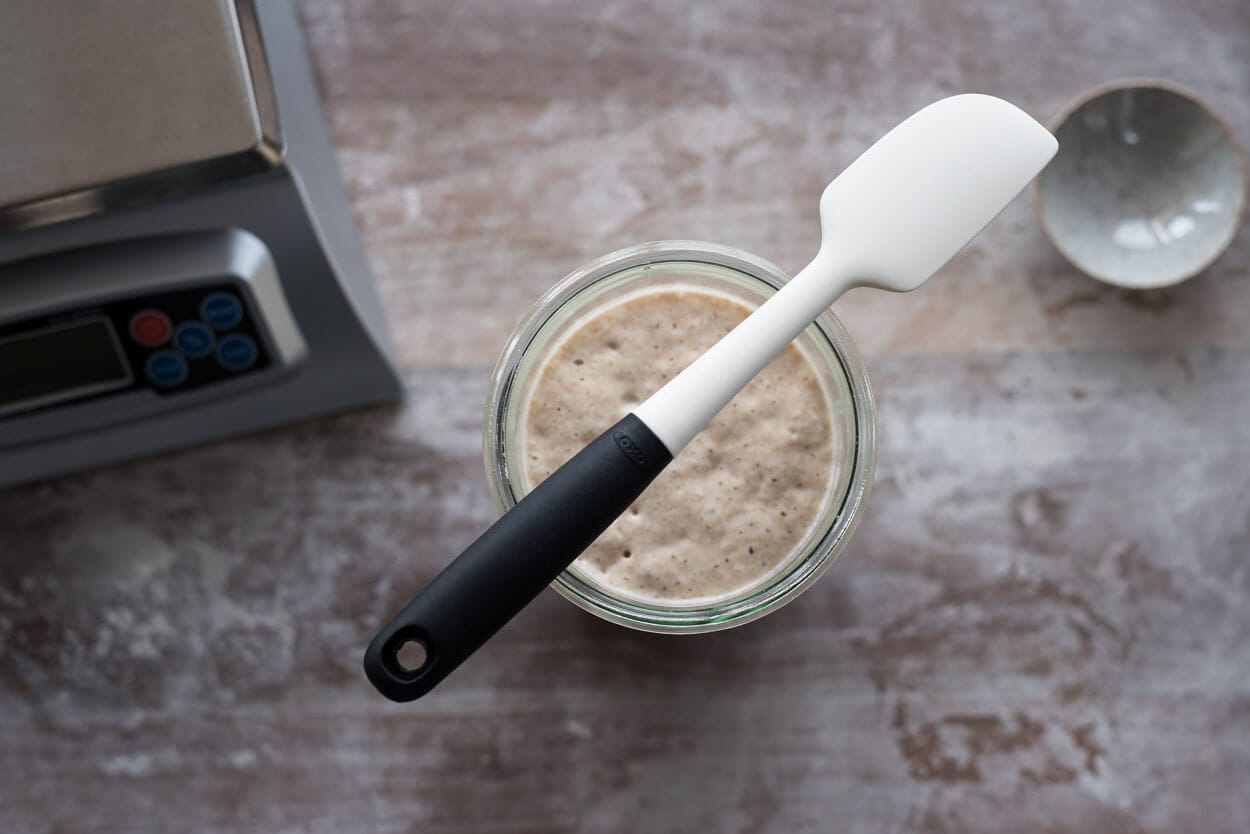
It’s funny how small tools make a huge impact when compounded over multiple times a day for every day of the year. I recently changed my stirring apparatus from an old Pyrex spatula to this newer Oxo spatula, and wow… So much wasted time cleaning that old multi-piece thing. This Oxo one is covered with silicone at the top with no seams or joints, it’s very sturdy (which helps act as a firm mixer), and you can also toss it into the dishwasher. Highly recommended.
Aside from the new spatula, I still use the same Weck jars, dark rye flour, and all-purpose flour. Head to my tools page if you’d like to see more of the tools I use for my sourdough starter maintenance.
Sourdough Starter Maintenance Wrap Up
There you have it, a day in the life of my starter and my sourdough starter maintenance routine. I hope this visual guide has helped convey the visual cues and aromas I look for at various points through the microevolution of my starter. The same signs shown above are also present when I build a levain when making bread.
Remember the methods we have to impact the fermentation rate: temperature of the water, inoculation percentage (amount of ripe starter left in the jar), flour selection (whole grain flours increase fermentation), and ambient temperature. If your starter is sluggish, increase these to speed things up or decrease them to slow things down. After a few days of experimentation, you’ll discover the right mix of each for your unique starter.
Now that your starter is on a regular maintenance schedule, don’t forget you can use the daily starter discard in many delicious things in the kitchen! Buon appetite!
For more sourdough starter guides, check out my sourdough starter guide roundup.


704 Comments
Hi Maurizio! Moving over from the Levain page to where this question belongs. Building on your points here and in your post on bread with a young levain, I’m wondering if you have a back-of-the envelope answer to a basic question: beyond flavor, what are the effects of using young vs. mature (vs. *very* mature) levain? I understand that sourness will increase with levain maturity, but will the correlation with fermentation be positive as well? What about dough strength? I am aiming to slightly increase the sourness of my bread (by letting my levain go further past peak) but want to anticipate any effects this will have on ideal time and temp for bulk and final rise.. Any hypotheses or pointers much appreciated, as always!
That’s a very deep discussion! In my experience, the more ripe the preferment the faster the main dough will ferment and the more flavor I seem to achieve in the final product—up to a point of course. In terms of dough strength, the preferment can play a role there as the acids built up during fermentation have a strengthening effect on the gluten in a dough. If taken too far, though, it will start moving in the opposite direction and degrading the gluten network as the pH in a dough drops significantly (this has more to do with the main dough itself, and you will see this as you proof longer and the dough rises less).
Keep in mind all of this does depend on how the preferment was made: what flour, what hydration, what temperature it was maintained at. All of these inputs go into determining the bacteria/yeast balance, how ripe it is when used, and other enzymatic implications (e.g. protease activity, etc.).
I hope that answers your question—this is a point of endless discussion, to be honest!
Thanks for this in-depth response, Maurizio! This helps me conclude, along with my last experiment, that I want to maintain a lower-acid starter and then push the acidity of any given levain by over-ripening. It occurs to me: an online tool that let users manipulate variables in a hypothetical dough to predict effects – e.g. increase levain % in mix decreases flavor, but what does it do to oven spring? – would be amazing. (Of course, with all the caveats about flour type, altitude, water quality, &c.) Now, if only someone with coding experience and a popular sourdough website agreed!
Sounds like a good approach, Hank! I may or may not be working on a tool already 😉 Stay tuned.
Hello!!! I recently change my rye starter to white, I’m feeding my starter with 90% strong white flour and 10% rye. I’m a bit obsessed with making it triple in size. I’ve been refreshing twice a day for 4 days now and it takes ages for it to even double, like 10h or so…is that ok? Shall I just keep going? Do you have any tip for it to triple in size? Is it important for you? Thanks so much!!!
That’s just fine. I don’t think it’s necessary for it to double, triple, etc.! Keep in mind that the physical height of your starter is going to depend on the flour you’re using. For example, if I refreshed my starter with 100% rye flour @ 100% hydration, which would result in a strong starter indeed, I’d probably struggle to even reach 50% volume increase. Yet this starter would work very well in my baking!
All that is to say the percentage of rise isn’t as significant as it might seem 🙂
One other question, looking at your day time average temperatures….I live where the average temp is 30 C….should I keep starter in the refrigerator all the time? I haven’t and its jumping out of the jar too often, as even in my pantry where its a little cooler, it’s still warmish.
That’s very warm, but not excessively so. I’ve never continually maintained my starter at those temperatures, but you could try leaving a super small amount of starter in the jar during each refreshment to slow things down. Additionally, you could try mixing with cooler water from the fridge, and try to keep it somewhere cool. You might also consider switching to a stiff consistency (50-65% hydration) for your starter, I’ve found a stiff mixture is a little more resilient when it comes to handling heat. Finally, if you’re still struggling to keep it under control, you could add a very small percentage of salt, I’d start with 0.25%, to your starter when you refresh to help temper fermentation.
Hi Maurizio,
Thank you so much for such detailed guidance on maintaining the starter. It soo important when you bake the bread.
I have been baking sourdough for about 6 months more or less regularly. But my approach was quite chaotic. Your photos and observations are very valuable resource indeed.
Question: I am experimenting with the wholemeal spelt flour. I have started a batch of starter with a portion of my old (but very capable to this point) rye starter. Then I was feeding it mainly with spelt flour (3 feeds during a week contained rye) twice a day. Temperature in the kitchen between 20-21C. I notice it ripens much slower than rye. Should I feed it on different schedule? Maybe giving it 14-16 hours between feeds? As a starter, it is very weak at the moment. Tried to make leaven with it, but it did not work. Thank you in advance!
You’re very welcome, Natalia! Yes, adjust as necessary with the different flour—and that’s totally expected, rye usually displays quite a bit of fermentation activity.
I’m curious about something I have noticed about your fermentation and proofing times versus what my bread seems to need. I have a stable starter that has been in use for 8 years. I am getting good bread with similar results to your photos, but my bulk fermentation times and proofing times are almost double your times! I use a proofing box set to 78-80 degrees, so that variable isn’t a factor. There is one difference though – I only feed my starter once every 24 hours, a habit I developed for no other good reason than sloth and indolence. Have I ‘trained’ my starter through this feeding schedule? Thoughts?
Sorry for the late reply, Clay! Very interesting. I do notice with my starter I get better performance when I give it two refreshments per day (I’ve also tried three, but I haven’t seen a huge difference between 2 and 3). My guess is this has to be the reason, especially if your bulk temperature is right on point. Very interesting!
I think the main takeaway is that you have to pay attention to your dough. I am very happy with my results, but I keep an eye on the fermentation and only start thinking about shaping the loaves when I get a doubling of volume and that ‘barely bouncing back’ resistance when I push it with a finger. One great thing I have learned from this blog is the ‘slap and fold’ technique in your videos. It really helps develop the strength of high hydration doughs early in the bulk fermentation process.
Hi Maurizio,
I am at my 120th loaf but unable to get consistent loaves at all.. =( I feed my starter 1:10:10 before I sleep if I am baking 2 loaves the next morning but I can NEVER cold retard a loaf beyond an hour without the risk of my loaf being overproofed.
Is my starter too active or am I feeding it wrong? I started in March and I used to feed it thrice a day (5g starter):
Morning: 1:1:1
Noon: 1:1:1
Night: 1:7:7
But I have dropped it to twice a day now:
Morning: 1:3:3
Night: 1:7:7
Weirdly, I am able to bake a good loaf using just the discard from my fridge without building a levain. So I am really confused right now. Will be great if you can help! Thank you! =)
Perhaps your fridge is warmer than you think it might be? I do know if the temp in my fridge is higher than 40F or so, I run a real risk of over proofing if the levain percentage in my dough is too high.
Hey Maurizio. I am following your 7 steps to sourdough starter. I am on day 5 and my starter is rising and bubbling in 6 hours of feeding. I am doing rye only flour.
Starter smells extremely sour.. can you please help what would be right way to correct it at this point ( day 5).. just a little lost.
M in Dallas Tx, Room temp 78 F
Maurizio, In your Weekend Baking Schedule article you talk about mixing 20g mature starter, 100g flour and 80g water for the starter that you will be putting back in the fridge. I don’t quite understand the science of it, but will 20g starter + 40g flour +36g water (1:2:1.8) work as well? In other words, what is the advantage of 1:5:4 (20g starter) over 1:2:1.8? Asking because I was trying to minimize discards. Thanks.
Maurizio – I have a nice mature starter that I think is ready for bread use. But I don’t think I want to have to maintain the starter twice a day as per your steps above. If I just want to feed my starter once a day going forward, what is your recommendation in terms of starter, flour and water proportions? Instead of 20/100/100, would I just reduce it to 10/100/100? I think a lot of people would be interested in knowing this. Thanks.
I’d like to know the answer to this too. Has anyone found a successful feeding ratio that works?
Yes, I drop down to 10/100/100 for 1x a day and keep it at a low room temp.
I think I got a real nice and workable starter. It is raising and falling with lots and lots of bubbles. I will take required portion of my starter and proceed to bake bread. Now my question is : Do I keep all the remaining starter and start feeding it to maintain it or do I take another small portion of the starter and start maintaining that by regular feedings? I am not very clear here what to do. I would appreciate if you can clarify this to me. Thanks
I think what I have learned reading though his posts the amount you keep and feed as your “mother starter” depends on how much you bake. You will need enough on hand to start your Levain. If you bake only a couple times a month then maintaining a small starter is sufficient. you can always build it up if you find you are baking more. If someone finds this not accurate, please correct.
Great article. I was wondering if after the 7th day of feeding the started and everything went well, would you put it in the refrigerator and then feed it in what time interval? Ones a week? And if so, after how many feedings would you put it back in refrigerator? Also, if you use some of it to make the bread, how many times would you feed it to put it back in the refrigerator for later use?
MK.
Great article with excellent visual queues and explanations. Thanks, this clears up a lot for me!
So for the next loaf I need to save a little of the levain. If I am going to make it three days later should the levain just sit in the fridge?
I prefer to keep mine out of direct sunlight — it gets too hot this way!
Hi, do I have to build a fresh levain for this dough(say take 30G starter from the starter in the bottle and then add 100gm flour and 100 gm water to mix or just use my sourdough starter(if I have sufficient starter in the bottle)? Will it be too acidic if I use straight from the sourdough starter? Thank you!
I’m not sure what dough you’re mixing, but if I list a levain in the recipe then that’s my preferred method. You could use your starter if you’d like, but the result might be different (many variables there!).
Hi. I am also encountering the same issue as your first question. I have been feeding my starter for almost two weeks and my schedule hasn’t allowed me to bake my sourdough bread. There was a lot of activity at first but the last couple of days have been less. Still feeding it twice a day. Is it ok to still use to bake bread? I hope Mauricio helps us with this point. Thank you Mauricio!
Hey, Margaret! As long as you’re seeing consistent signs of fermentation each day (bubbles, sweet to sour smell, some rise and fall), your starter should be just fine to bake with!
Hi, my starter is bubbly on top but ,don’t see many bubbles on the side. Is it okay to use? My starter is always active inside but on the side when I check.
It’s ok if you’re not seeing a lot of bubbles. As long as you’re seeing consistent signs of fermentation each day (bubbles, sweet to sour smell, some rise and fall), your starter should be just fine to bake with!
6-18-2020
I regard myself as a relative beginner although I have baked occasionally for a long time. Your discussion appears clear and commonsensical but I have the following specific questions I’m still not sure about:
1. You describe the appearance and odor of a healthy well-maintained starter at its “peak” after feeding– IS THAT ALSO THE OPTIMAL TIME TO ADD THE STARTER TO A RECIPE? Please offer an estimate of how long the window of opportunity remains open from before the peak until after it when you would say the outcome of baking will probably be about the same, anywhere during this period. Timing seems to be a chronic problem in my schedule– trying to synch the time of optimal maturity of the starter with the optimal time for me to begin a recipe. The two are rarely the same.
2. Suppose you want to maintain a relatively small volume of healthy starter– say about one cup, not more (to avoid discarding unnecessarily large volumes of starter and the waste inherent in the process– let’s ignore for a moment the option of using sourdough starter discard in other recipes to avoid waste); suppose further you come upon a recipe (or recipes) which calls for substantially more starter in optimal condition than you have on hand at the moment– let’s say you need 2-3 cups of starter for that recipe. HOW QUICKLY can one generate, say, 3 cups of robust starter from one cup of robust starter ready to go— and could you in simple brief terms offer the best strategy to accomplish this. This situation comes up in my schedule often.
Thanks so much.
Not sure if Maurizio will agree, but to your first question, I would say the best time to use the starter is when it is at its peak. In his case, it seems to peak at about 12 hours. I haven’t figured mine out yet. My work schedule is too erratic to maintain a 12 hour feeding ritual. I have found that as long as I feed it within 12 hours of its peak, it usually is still good within one feeding cycle. If its gone too long (24 hours or more) it takes a few cycles to bring it back to life.
As for your second question, I think it will take as long as it takes for your starter to mature, again in the case above, it’s 12 hours. As for volume, you can get 5x volume out of your starter if you use his proportions, but its really 4x if you take into account perpetuating your starter for the next day.
Hi. I am also encountering the same issue as your first question. I have been feeding my starter for almost two weeks and my schedule hasn’t allowed me to bake my sourdough bread. There was a lot of activity at first but the last couple of days have been less. Still feeding it twice a day. Is it ok to still use to bake bread? I hope Mauricio helps us with this point. Thank you a Mauricio!
George,
1) It’s ok if you’re a little before optimal ripeness and a little after, there’s some window there but it’s very hard to say how wide that window is because it’s specific to your starter and conditions. I’ve found as long as it’s not overly acidic and very sour smelling it’s just fine to use. If you’re worried it’s too acidic, you could do a levain build that ripens quickly and use that.
2) Check out my post on maintaining a smaller starter for tips on how to keep a small starter. From there, you can quickly build up a large levain or starter as needed, in most cases even in just one step.
Hello! Love your site. So thorough. I bake every week or every 2 weeks. If I keep my starter in the fridge how often should I feed it?Thank you!
Thanks! I don’t like to go past 1 week if kept in the fridge.
Hello Maurizio, would you consider 3:00pm & 5:00pm in this post to be a young starer and anything after that to be a mature starter? Also, would it be right to say that if we use the starter at 8:00-10:00pm, the bulking stage would be faster considering that the starter is fully fermented and is hungry again?
I have a lovely starter going on 50:50 mix of dark rye and white bread flour, sometimes with a touch of wholemeal. When I try and reduce the rye to create a purely wheat starter, he starts to smell a little unpleasant. The rye gives him a lovely floral/fruity smell. I thought initially he’d picked up a taint so used some old discard from the fridge to start over, but it’s definitely when I cut back the rye. If I power through, will the yeasts/bacteria balance out and come good? Or do wheat starters just smell a bit less pleasant?
wait sorry does this mean you have to feed your starter TWICE everyday? as it shows that your starters activity peaks at 12 hours?
That’s what I do! I feed once in the morning, once at night. However, you can also do once a day, that will work just fine.
Hi I love the way you describe maintenance inthis article. I notice you refresh you starter with 20g starter+100g flour+100g water. Until now I have worked with 25g starter +25g flour +25g water, which you read on many sites (1:1:1).
What is the benefit of your method? Which in essence is 1:5:5, right?
Thanks
Personally I use anything from a 1:2:2.5 to 1:4:5 ratios with no problems over past 10+ years. I would be very reluctant to use a 1:1:1 mix as I don’t believe the starter will have sufficient feed but that is just my opinion. I would concur there is little problem in using starter quantities of 25g but as I use a starter portion of the order of 200g find an initial dose of nearer 40g to 50g to me more convenient unless I need to build up in two stages when a 20 to 25g initial dose is more appropriate and less wasteful.
Either approach will work, it all depends on what you’re after in the end! At 1:1:1 my starter would be a little over-ripe for what I’m after. However, my approach with low seed results in a bread with a bit more sour flavor and complexity, in my experience.
That jar is ridiculously clean! Is it really that clean when you feed it each time? I mean I know you’re engineer (as am I by training) but that’s ridiculous. 🙂 Also, and I’m new to this, but you’re only saving 20g of starter?? That would be terrifying to me to go that low I think. I think that would be like pouring out my whole jar but then just scraping what starter is left off the sides of the glass. I mean what is 20g of starter equivalent to? 1 heaping Tbsp maybe? At any rate, this post helpful because I realize my feeding has only been a bit over a 1:1 ratio of new food (flour/starter) as opposed to your 5:1 ratio. So, whereas your starter peaked around 10 pm mine would have peaked around 2 pm. Anyway, good info. Please advise about the clean jar question and 20g reserve question. Thanks for this great resource!
I had the same trepidation but a small starter has worked well for me. I think of starter like a fire, you only need a drop and some fuel to keep it going.
I use 5g starter 25g flour and 25g water. My small starter is actually enough for building a levain for two loaves as well as maintain itself. I experimented a bunch and found that even 1g of starter with 25g flour and 25g water works great. The difference is that it takes longer for the starter to hit it’s peak with a smaller initial seed.
For storage I transfer the starter between two small jars at each feeding. I put 5g into a clean jar and add flour and water and then wash out the old jar. I don’t see the sense in mainlining the same jar, scraping sides etc. You’re more likely to grow unwanted bacteria on the sides if it’s not clean.
Thanks for your reply. Good info! Also, I just re-read my original post. Oof, I didn’t mean to sound so cranky and combative. Yikes… Anyway, I let go of my worry about too little starter carryover and realized how the larger ratio that this created led to more expansive, longer feeding time and thus a closer to 12 hour time til peak rise. But the bigger factor for that last part might have been my leaving the water out in an open container overnight to allow municipality-added chlorine to dissipate. Definite consideration for people who aren’t seeing their starter grow as vigorously as would be expected.
Help please! I’ve got my dough rising right now (about 3-4 hours) and it’s developing a brown liquid (Hooch I assume?). What do I do now? Why did this happen? Plus my dough looks like biscuit dough, not bread dough (I used mostly whole wheat flour, and a little sorghum flour). Thanks!
It’s likely just a hydration issue. Try dropping the water in each feeding 10-20g and see if that helps get a thicker consistency and eliminate that liquid pooling up top.
Can you comment on how best to store your starter in the fridge when your not baking often?
I have a healthy mature starter. I was feeding it once a day and it was doing great (I feed it exactly how you recommend with rye and AP). I put it in the fridge for almost a week because I was exhausted from feeds. And since taking it out, I find that it smells like vinegar quite often and is really bubbling much more than before and is growing much higher. So I now feed it twice a day. But find that by the 12 hour mark it is huge and starting to smell like vinegar again I think. Is this healthy/normal? Or am I doing something wrong? It just seems different than before it spent a week in the fridge. (It has now been out of the fridge for over a week). Thank you!
My sourdough starter falls very fast only after 4 hours after feeding, so your recommendation is to add less starter but keep the same amounts of water and flour, and then put in a colder place? Should I change the flour to whole wheat?
I followed your sourdough starter guide and have continued maintaining it with a 50/50 mix of Rye and All Purpose flour. What do you recommend as a mix for ongoing feedings once well established? What do you use?
You can really use any mix you’d like! I prefer a mix of 50% whole rye with 50% white flour.
Hi there! First of all thank you for your help. A strange thing is happening to me…I have created my starter following your recipe, and it is working quite well. The problem is that after each feeding, it grows for about 7-8 hours and then collapses a bit (but clearly and consistently), and then grows again, reaching the real peak (which is only slightly higher than previous) after about 10-11 hours total (about 3 hours after the collapse). I guess this is due to the different “working schedules” of different microorganisms (??). Is this ok? Any suggestion?
Hi! I am brand new to this but enjoying the process! I haven’t tried to make bread yet, but I’ve been feeding my starter and putting the discard in a separate mason jar in the fridge (I hate the idea of throwing it away). I’m not exactly sure how to use what’s in the fridge for recipes – do I need to take it out and let it get to room temperature? Feed it once it’s out? Or is it ready to use straight from the fridge? Thank you!
Thank you for this helpful information. I’m about a month in and have made a dozen or so different tasty recipes. I have a question about the feeding schedule. I have also been feeding twice a day- morning and evening. In the morning, the starter has deflated, so I remove part and make something like crackers. Then I feed it. When it’s doubled or tripled in size- 4- 6 hours later, I use some to make a loaf of bread. Here’s the question- do I feed it at that time? Or do I wait until the evening so there’s about 12 hours in between feedings? I don’t want to over feed. Thank you
There is probably a better answer to your question, because I had this question originally and I just decided to keep it simple and keep my starter feedings fixed to 12 hours. So what I mean is..for something like focaccia I just use mature starter, taking the surplus to mix in my focaccia dough at the 12 hour mark whether it be morning or night, and then feed my original starter per usual. If it’s an actual boule or another recipe I’d just prefer to make a levain. I’d start the levain at the 12 hour mark using part of my mature starter, and then rely on when the levain is ready to mix in my dough. I never take food away from my starter midday to start a recipe.
Here’s a question for the more knowledgeable: I have only used bread flour in my starter to this point. Most of the recipes on this site call for a mix of flour types in the levain. Would you suggest I keep using the type of flour I’ve been using in my starter (i.e. white bread) for my levain or can I build the levain using a different type of flour (e.g. whole wheat and AP flour in the “Return to Basics” recipe)?
Impressive! You must have a great kitchen environment to get such results with bread flour alone. Whatever you are doing, don’t stop. You can experiment with equal parts bread flour and wheat, rye or spelt. But whatever you do, don’t give up on your original levain. You’re going places!
Funny…I just changed to 1/2 WW and 1/2 white bread flour today before reading this! I figured since I use some WW in most of my recipes, it just made sense to add some to my mother starter. Either way, my levain build using WW and AP flour last week turned out great! Thanks.
Hi there, a friend mailed me a starter in a ziploc with detailed instructions about 10 days ago. Because I was not ready I kept it on the counter for a day, unsure how to proceed if one needs more time — and then put it in the fridge. After about a week I took it out and fed it, and it responded beautifully. I kept it out on the counter for one night and fed it again in the morning and it was rising and bubbling nicely. However I was still not ready to bake, and later that night it started to settle back down, so unsure of what to do I sealed the jar and put it in the fridge. When I am ready to bake, how much before that should I take it out of the fridge and feed it? How much flour/water should I feed it? Can I keep it on the counter for days or do I need to refrigerate again if I’m still not ready? Thanks so much for your help from a first time would-be baker.
Equal parts flour/water. I recommend 60-70 grams of flour. Don’t go crazy using too much flour, we know how hard is to get a bag nowadays! I further recommend that you get another container and place about 2 tbsp. of the starter and feed it 2 tbsp. equal parts flour and water. This will start a new batch. SAVE your original starter, feed it for 2 days and return to fridge….just in case. Use it for other baking projects. Good luck!
Hi Maurizio- when I build a levain, can I use my starter to build it if my starter is already beyond peak? It has fallen already a bit and isn’t passing the float test…but as long as my eventual levain passes the float test is that okay regardless of the starter itself?