

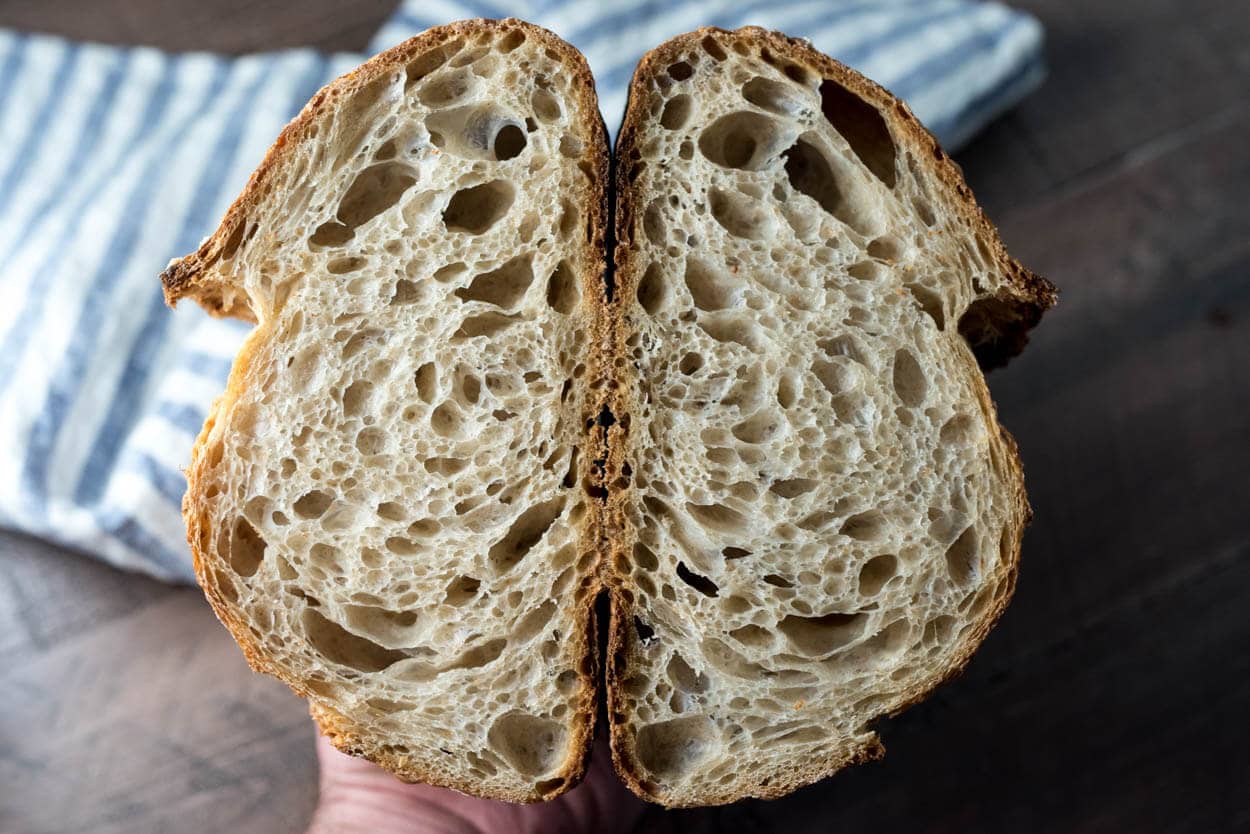
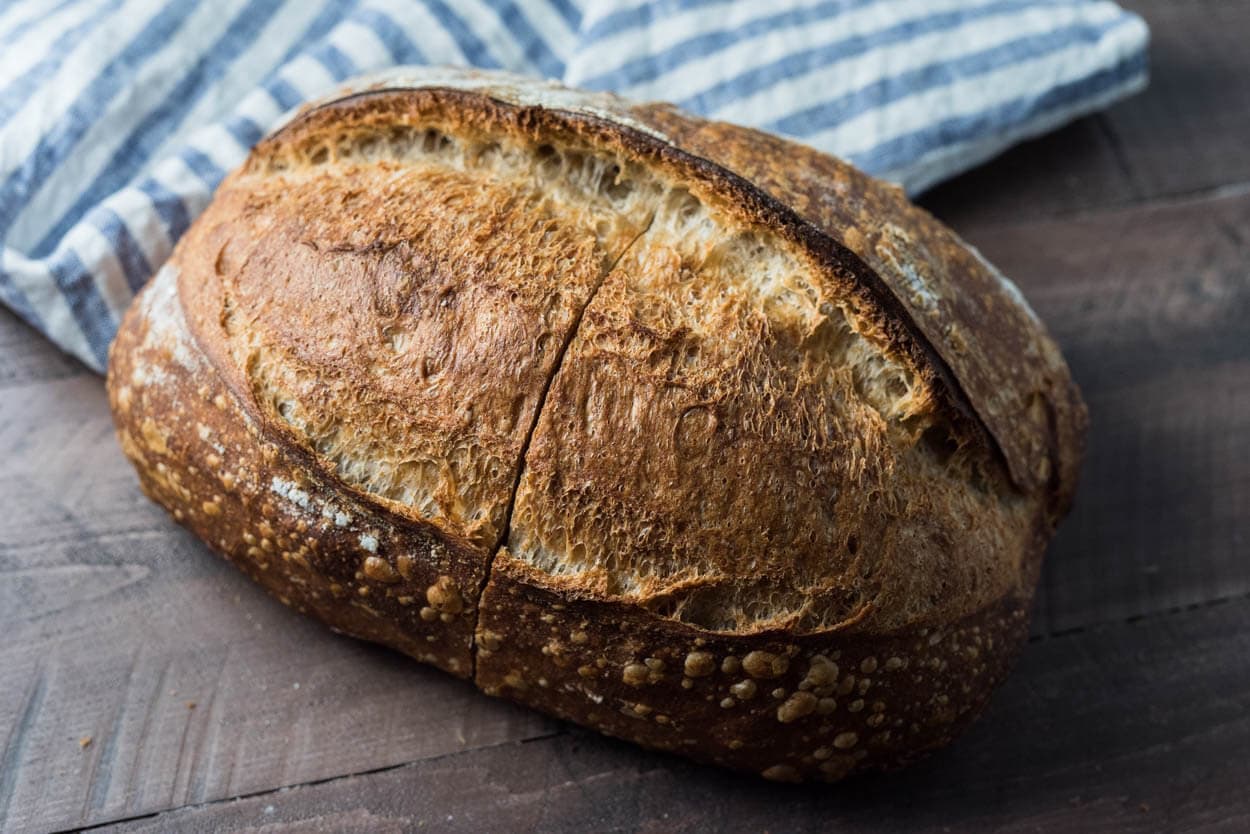
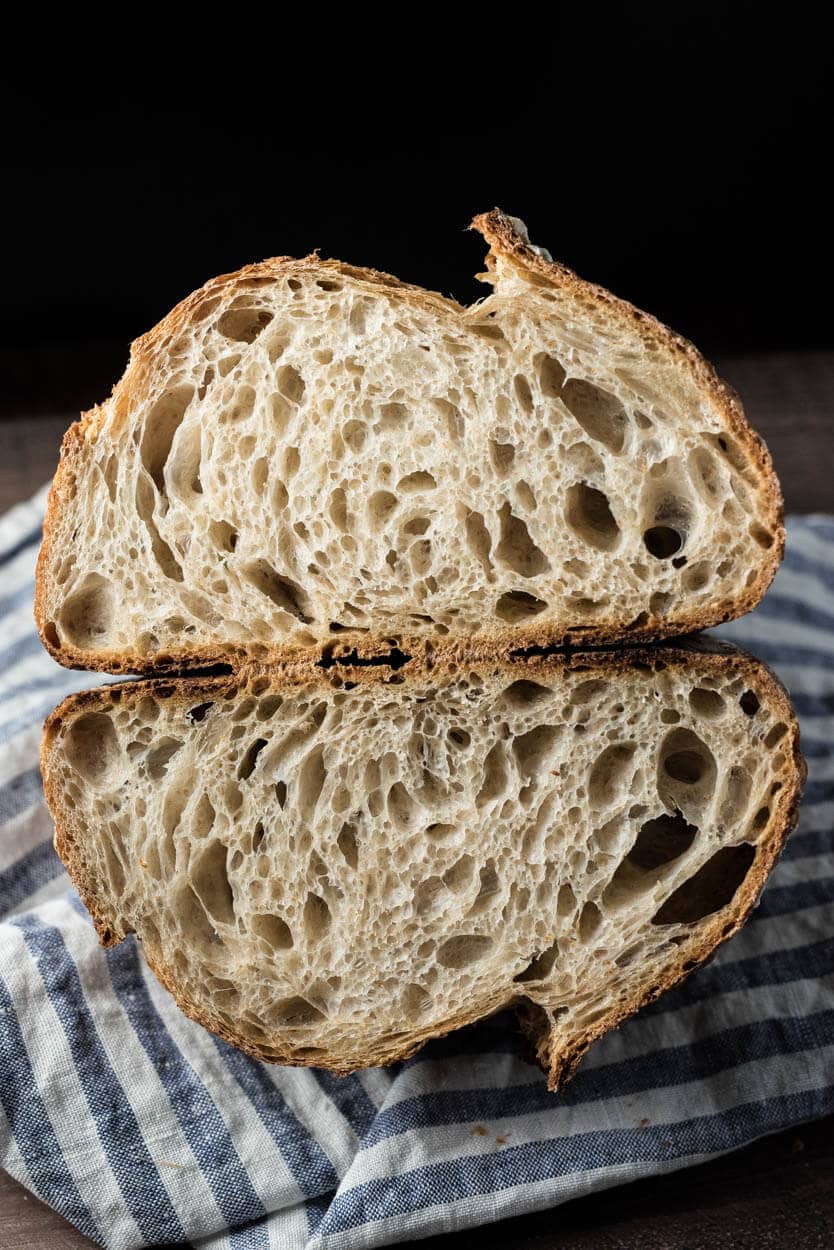
My baking focus has lately been predominantly on my sourdough starter maintenance and maximizing fermentation. And recently, I’ve made some of the best bread I can remember (I took all the bread pictures in this post with this starter). So this post is somewhat a continuation of my Managing Starter Fermentation, but in this post, I’ll focus more on the signs for spotting when a sourdough starter is ready for refreshment (ripe) and how to perform that refreshment.
Be sure to check out my post on what flour, water, and carryover ratios I’m currently using to feed my starter in my How Do I Feed My Sourdough Starter post.
There are many methods to keeping your starter healthy and in proper working order, likely as many methods as bakers. Each baker has a process for maintaining their starter according to what works for them and the bread they seek. Each starter is unique, after all: a distinctive blend of wild yeast and beneficial bacteria that has evolved in the temperature it’s kept at, the flour used for refreshments, and the time between those refreshments. I wanted to preface this article because the following is what works for me here in my kitchen and will most likely work for you as well, but I guarantee you’ll find yourself modifying my method to suit your environment. That’s to be expected. An essential requirement for a baker is flexibility and adapting techniques and inputs so everything performs optimally in your kitchen. In the end, your sourdough starter maintenance routine might be similar to mine, or it might be quite different.
I can remember back to when I first dabbled with creating my sourdough starter. I read all the books I could get a hold of; I searched online, anywhere I could find information. Once I got things up and running (using the process described in my seven steps to creating a sourdough starter entry), I followed refreshment schedules outlined in various books, and things seemed to work pretty well. But my bread didn’t improve until I modified things to suit my environment, schedule, and unique starter. As I refreshed my starter each day (feeding sourdough starter), I began to take note of things, how it looked when I neglected to refresh it for too long, how it looked after a few hours with new food, and how the smell of the starter changed throughout the day.
My goal for this entry is to convey the signs I look (and smell) for during the single-day microevolution of my sourdough starter. First, what does it seem and smell like right as I refresh it (at the start)? Then, what should it look like when I decide to refresh it again or use it for making bread? And finally, what does it look like if it’s gone too far and starts to become overly acidic? I receive frequent emails on this topic, and I hope this entry will be a visual guide to those wondering how I care for my starter.
With this post, I’m hoping to help you answer the following questions:
- What is feeding (I usually call it refreshing) a sourdough starter?
- How soon after feeding (refreshing) a sourdough starter can I use it?
- What does feeding my sourdough starter once (or twice) a day look like?
A quick note for those out there who follow my writing very carefully: you’ll notice this entire entry is about a liquid starter/levain and not about a “stiff” variety I had been baking with for almost a year. I recently shifted things back to using a liquid starter after a long while with a stiff variant, and I have to say I prefer how my bread is turning out with my change. If you use a stiff starter, some of this entry will be relevant to you, but the visual cues will be different as the consistency of your starter will be different. If you haven’t used a liquid starter/levain, I suggest you experiment with this and try it out, you might be surprised at the difference, and you might prefer it. I’m not suggesting one is better than the other, but rather a personal preference whereby I like the taste and performance of this liquid levain for the bread I’m currently baking.
If you’re curious and looking to dig more into preferments, see my guide to the differences between a sourdough starter and a levain.
Sourdough Starter Background
The key to coaxing out maximal fermentation with your starter is to be observant. Watch how it evolves throughout the day and note how long it takes to reach full ripeness: a strong sour aroma, a breakdown of the mixture, significant bubbles on top and at the sides. If it’s doing this too fast (for example, you refresh at 8 a.m., and it ripens at 2 p.m. when you’re at work), you can reduce the water temperature, change the ambient temperature, or reduce the amount of mature starter you carry over at each refreshment (this is what I do). You want to try to refresh your starter right when it’s at its peak ripeness or shortly thereafter.
The key to coaxing out maximal fermentation with your starter is to be observant.
Once you have a healthy starter showing the same signs of fermentation every day, you will be able to adopt a consistent sourdough starter maintenance schedule. I work this into my daily routine: I refresh my starter when I eat breakfast in the morning, and then I refresh again in the evening as I’m cleaning up the kitchen getting ready for bed. It only takes a few minutes (see my tips later on tools to make things easier).
Your starter will go through the following phases each day, but the times will most likely be different. For example, if fermentation is slow (due to temperatures or percentage of starter carryover, for example), then the signs I point out below might be at greater intervals, and conversely, if fermentation is fast, then the ranges will be tighter. As I mentioned initially, if you’ve not yet started your sourdough starter or received a portion from a friend, I have an intro article to creating a starter that will get you going in a few days.
Let’s look at a day in the life of my starter.
Sourdough Starter Maintenance Timeline
Before we dive into the timeline, I want to point out that below I refer to two things: my starter, which is what you’re here for in the first place, and also a levain. I talk about both almost interchangeably because mostly, they are the same thing. Your starter (mother, chef, etc.) refers to your yeast/bacteria culture you continue to refresh and care for indefinitely. In contrast, your levain is a splinter, or off-shoot, of your starter that you refresh and build only to be used in a bread recipe eventually.
For the timeline below, I used 30% whole grain dark rye flour and 70% medium-protein bread flour (similar to all-purpose, but geared toward bread baking). The percentage of flour types is really up to you; I used a little rye flour to help increase fermentation and acetic acid production, but you can use any ratio of flour you’d like (e.g., 100% whole wheat, 100% white, a mix of both, etc.). Just take note of how each flour type aids or slows fermentation.
10:00 a.m. – Sourdough starter maintenance beginning
The first step is to take your mature sourdough starter, discard some part of it, refresh it with fresh flour and water, and cover (I only loosely cover with a glass lid that does not seal tight). My kitchen is currently around 75°F (23°C), and my mixture is 70g white flour, 30g rye flour, 20g mature starter, and 100g room temperature water.
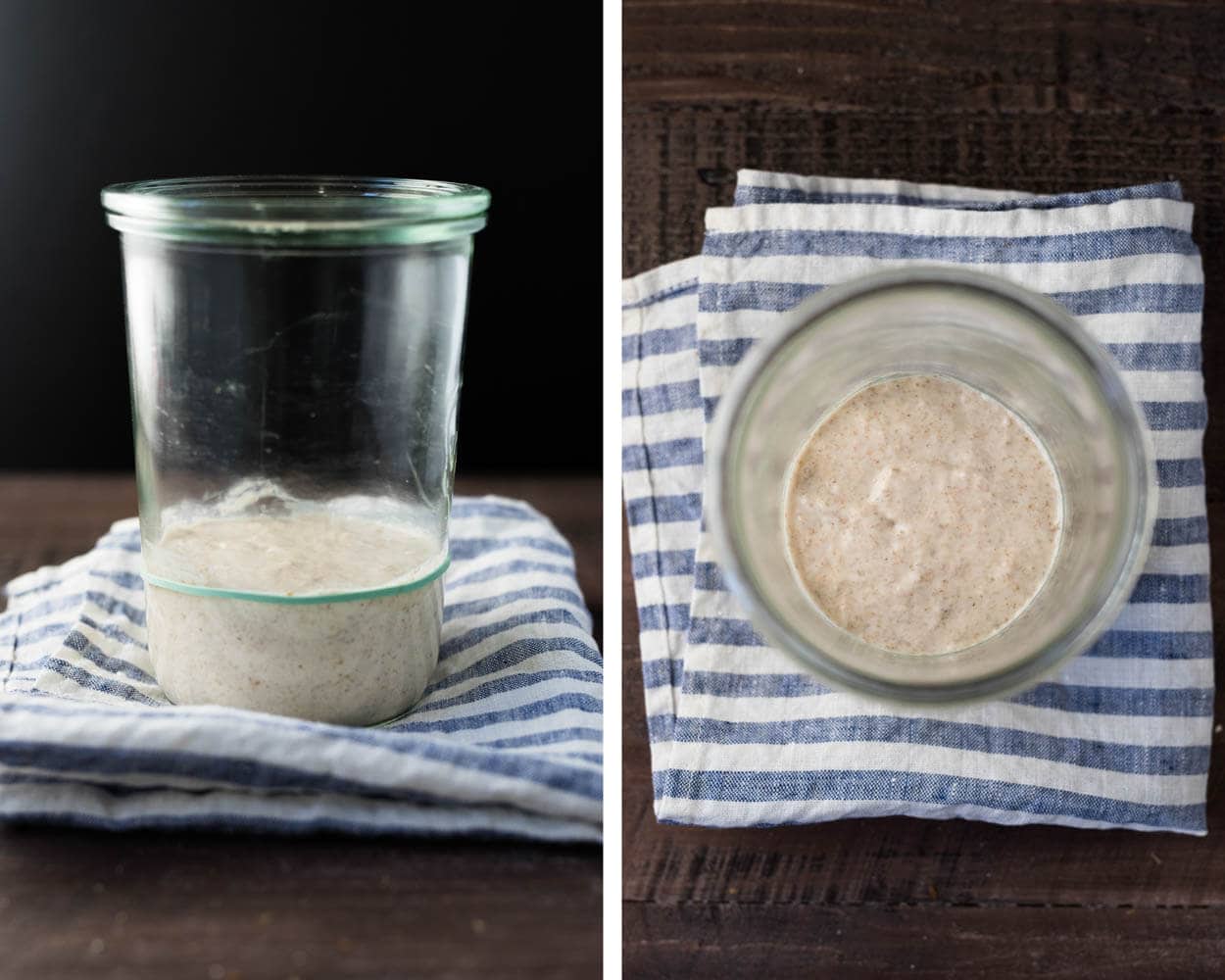
You can get a sense of how “stiff” my starter is after mixing. You want to make sure you mix everything thoroughly so it’s completely smooth with no visible clumps of dry flour.
I’ve placed the green rubber band at the beginning level of my starter so we have a good sense of how far it will rise throughout the day.
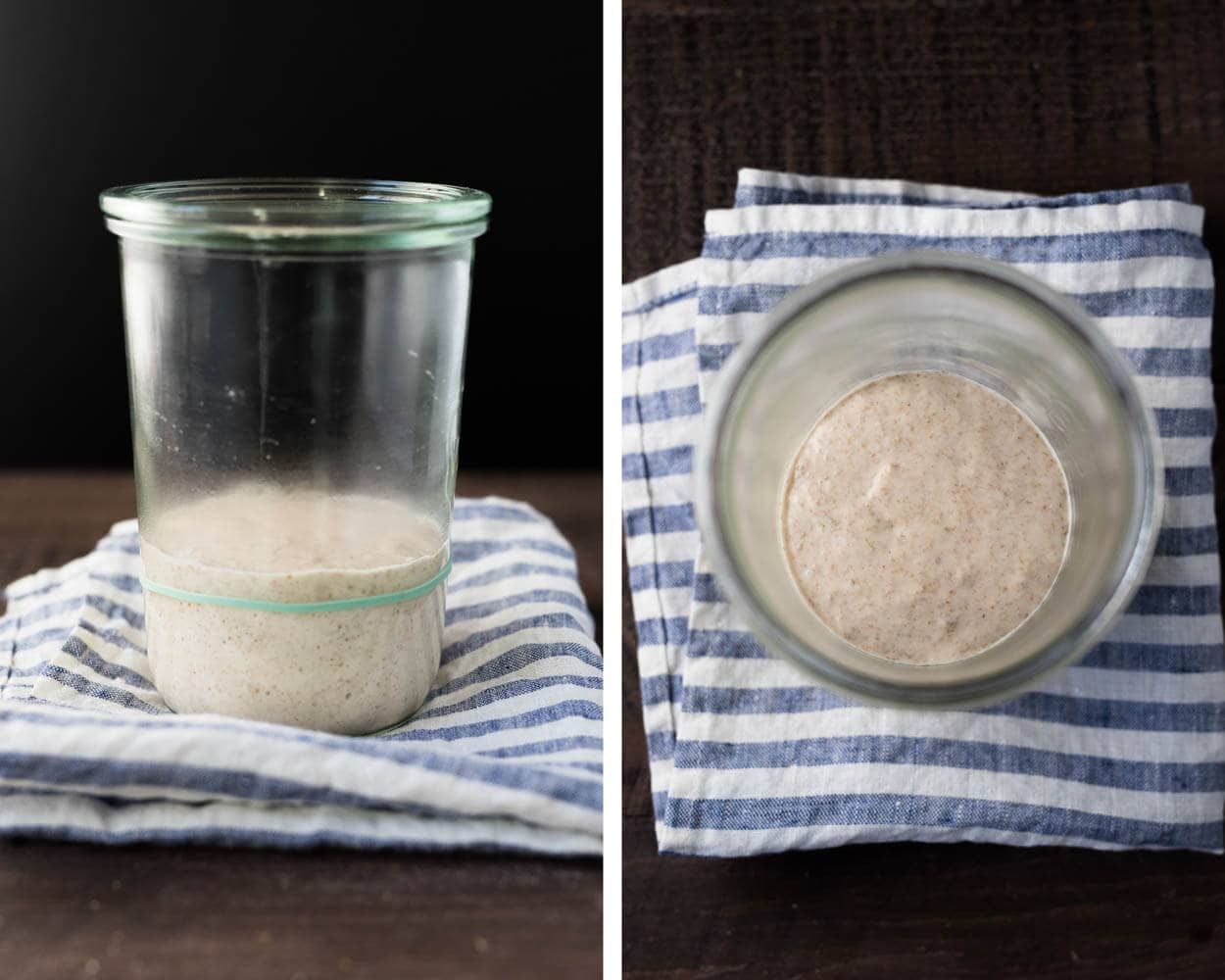
12:00 p.m.
After only a couple of hours, you can see only slight activity visible in my starter. The smell at this point would be very, very sweet, and practically the aroma of flour and water. So sit tight; things are about to get more interesting.
2:00 p.m.
As seen below, four hours after refreshment, we have a significant expansion, a tad over 100%. In the image at right, you can see that the top is domed with a few bubbles peeking through. The mass of dough is trapping quite a bit of the gas produced through fermentation. I like to use a glass container, particularly these Weck jars, not only because it allows me to see firsthand how fermentation is progressing but also because the flared top makes sticking your hand and spatula inside very easy. I not only use these tall jars for my day-to-day starter and refreshments, but I also use them to build my levain before baking.
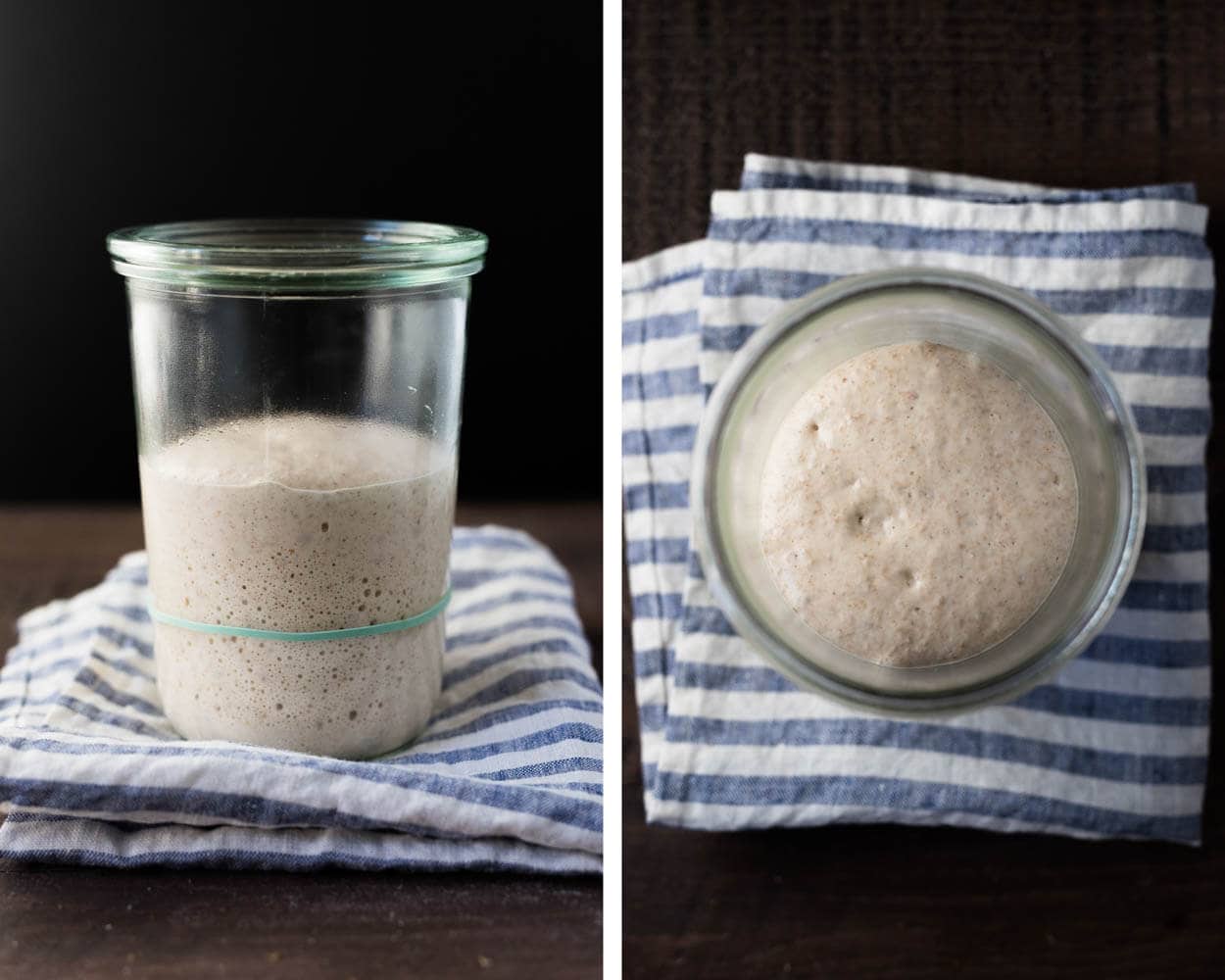
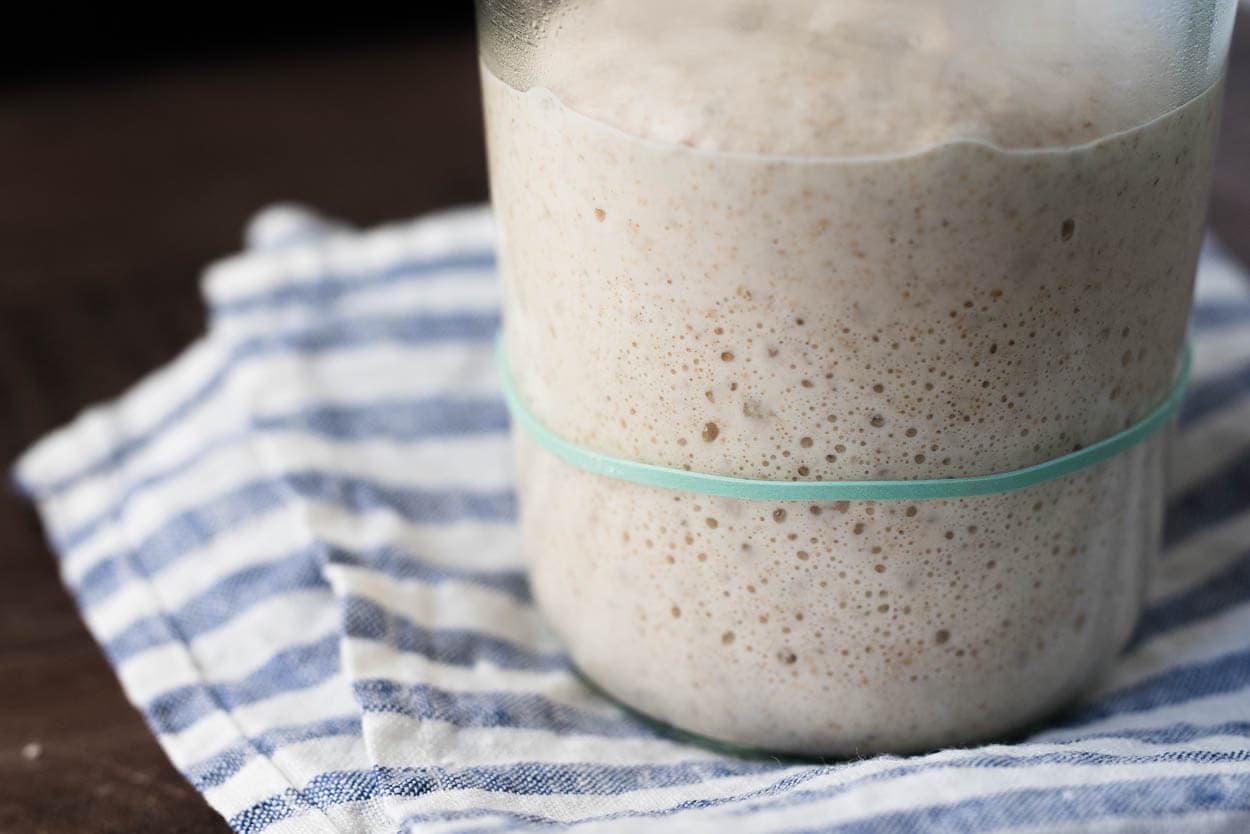
You’ll notice there’s quite a bit of activity already. Of course, after this initial explosive growth, things will slow down, but upward growth will continue for many hours.
3:00 p.m.
At this point, there’s only slightly more expansion than the last check-in. But, you can see many more bubbles on top and at the sides, showing signs of the momentous fermentation taking place. All of these are good signs.
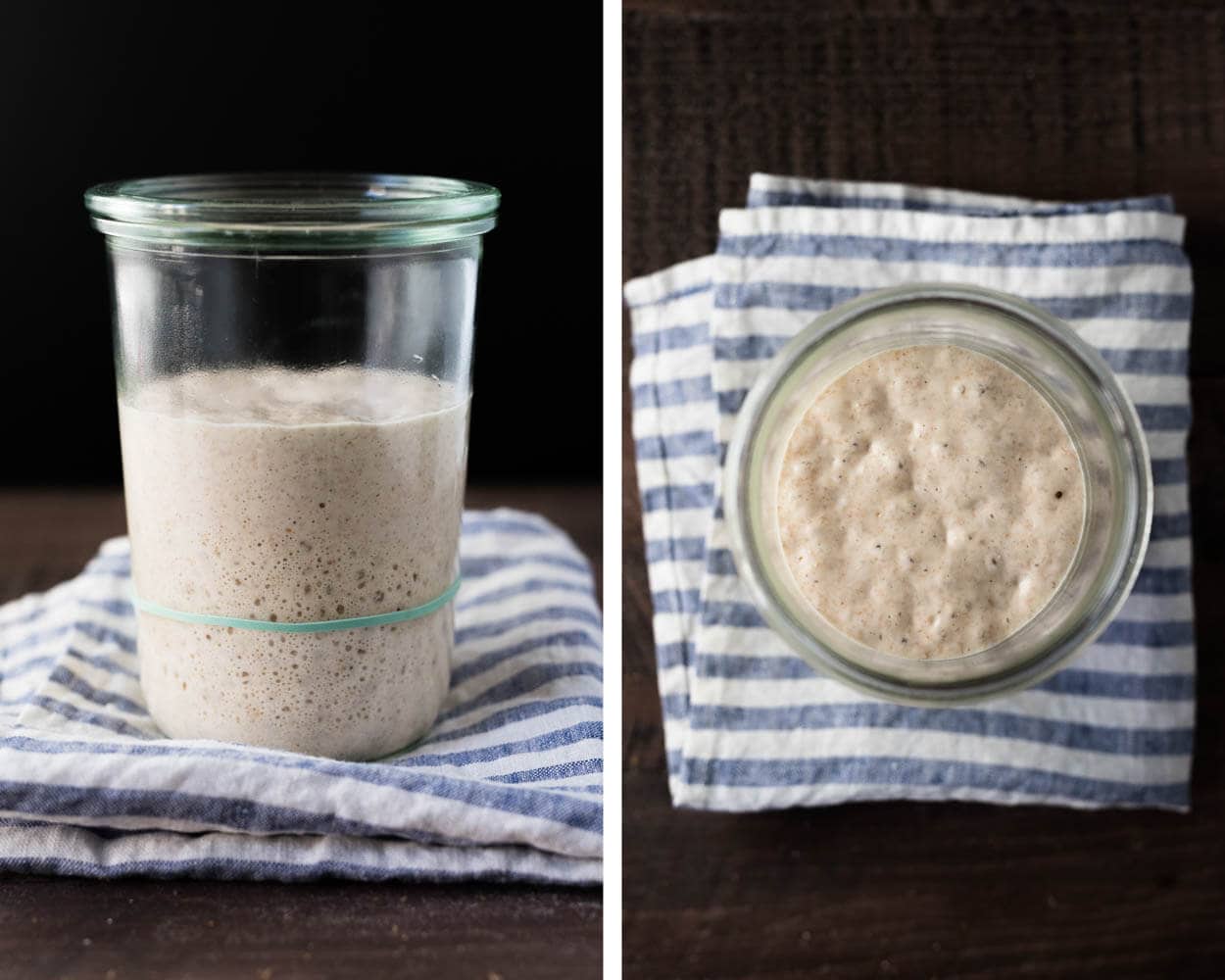
When you build your levain in preparation for baking, you may not always be able to see through the side of the container; the top-down view is sometimes all you have to judge your starter’s readiness. For example, bubbles and holes on top are a good sign, but my starter is not ready to be fed or used now. If this were a levain and not my starter, and I was attempting to use this at a “young” stage, this is most likely where I would use it for mixing my bread.
Another key indicator here is the aroma: how does it smell? Is it still sweet, sourer, or very acidic and vinegar-like? At this point, mine still has a sweet aroma to it, with a very subtle backdrop of sourness starting to creep in.
5:00 p.m.
By this time, we have significantly more bubbles at the sides and the top; overall fermentation activity is much higher. If I were to describe the aroma of the starter at this point, it would still smell quite sweet at it was at 3:00 p.m., but now the sourness is starting to escalate and build.
Given the look and aroma, I can expect my starter to rapidly come to ripeness very soon.
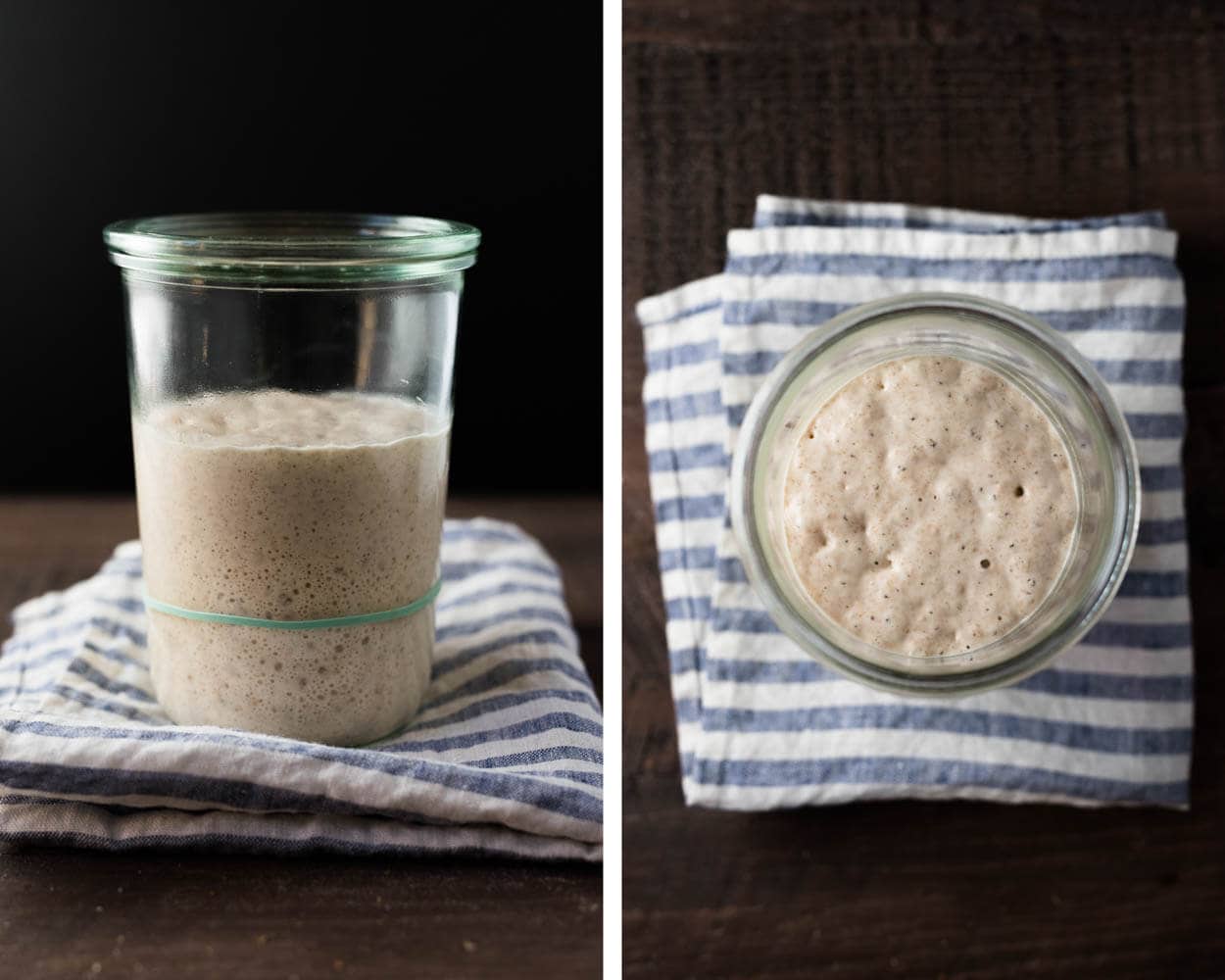
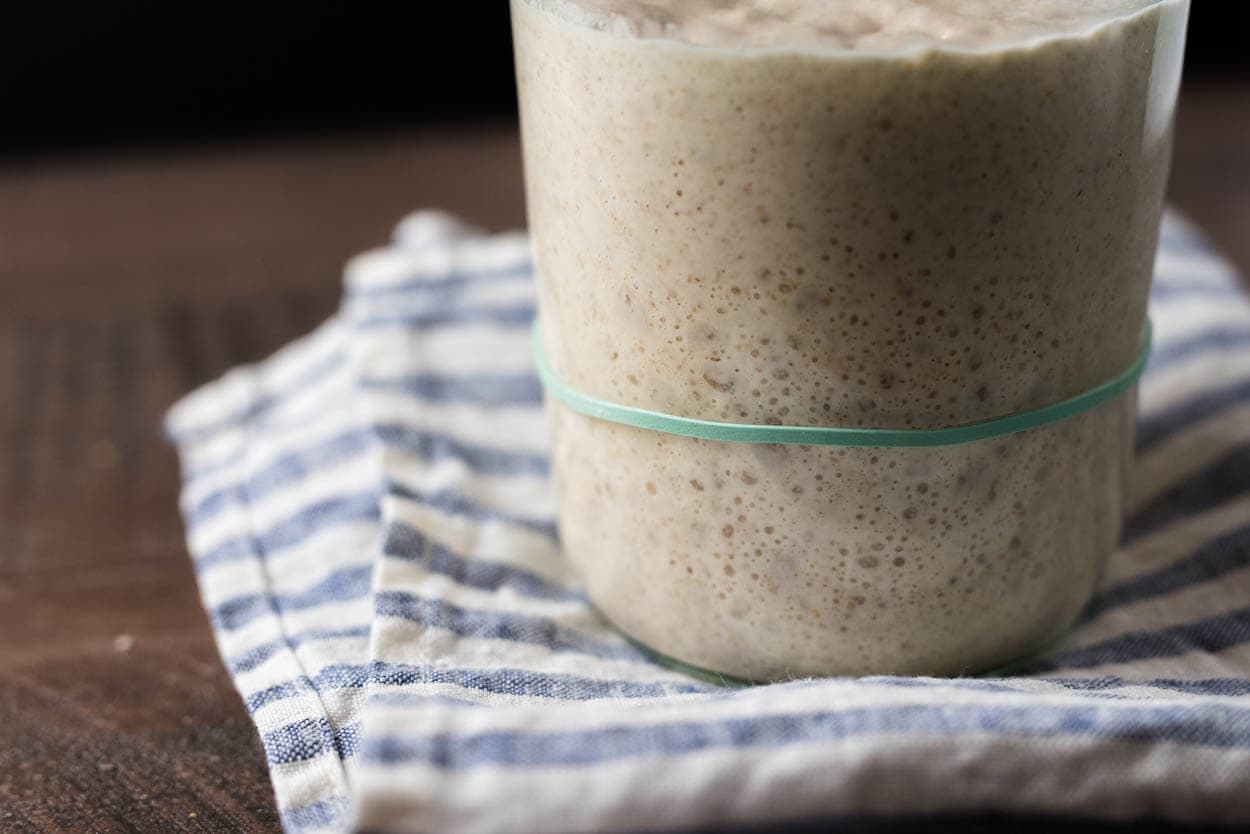
7:00 p.m.
You’ll notice here at 7:00 p.m. any dome that was once at the top of the starter is now gone, replaced by a reasonably flat surface. The flattening of the top usually indicates upward growth has significantly slowed, and upward movement won’t be as prominent—more holes on top and more fermentation visible at the sides. We’ll continue to let it ferment.
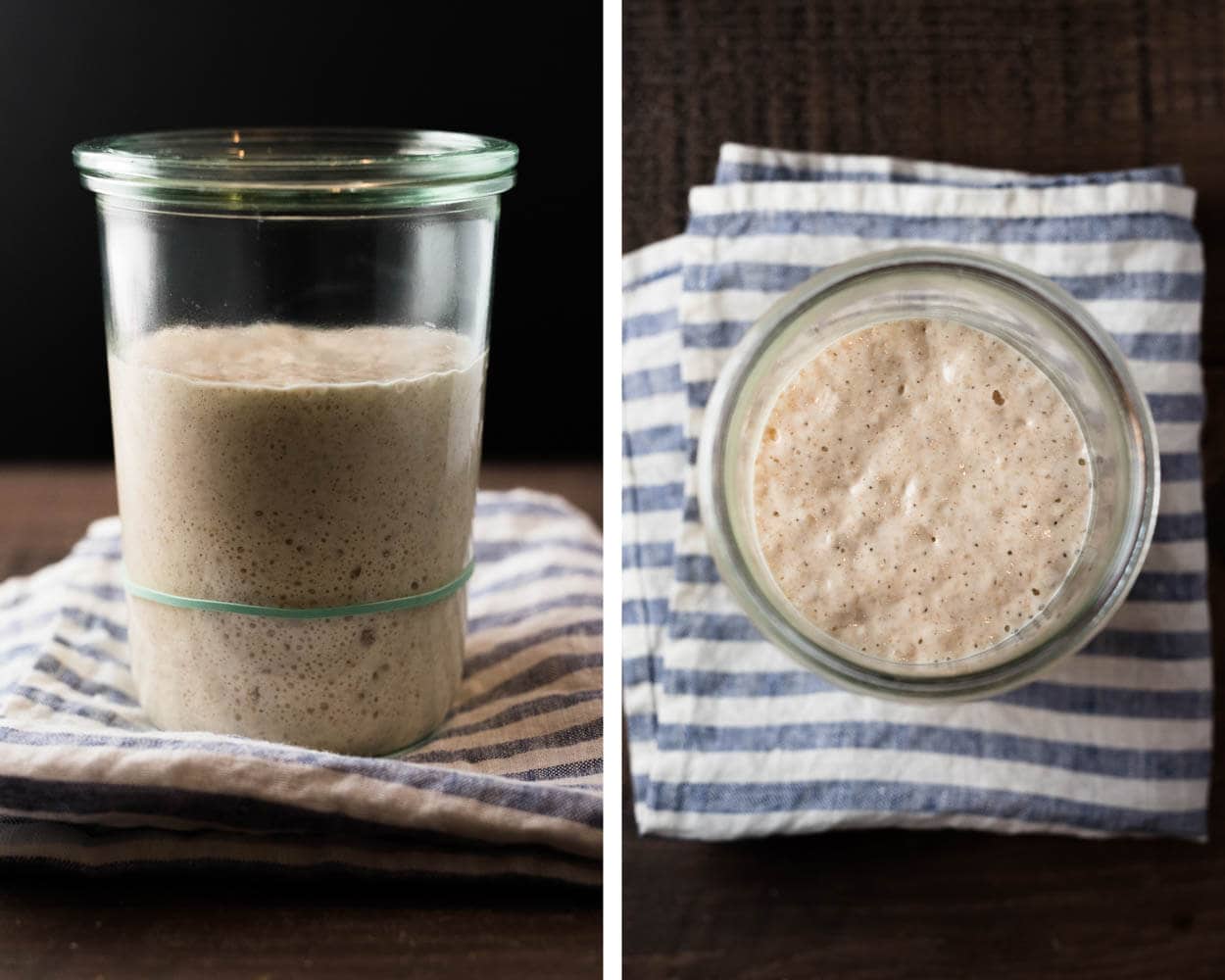
8:00 p.m. – Ripe, time to make a levain
As seen below, we still see some rise since 7:00 p.m., but not much. The top shows signs of more holes and bubbles, and the aroma is what I would describe as “ripe” and ready for use. If I were to pull back a little bit of the top, I would smell a slightly sour, vinegary smell with hints of sweetness still present.
At this point, I’d use some of the sourdough starter to make a fresh levain or use this starter directly in making bread. After making the levain, I would also refresh the starter by discarding and adding fresh flour and water.
While I find the “float test” to be misleading because it can sometimes give you false positives for when a starter or levain is ready to use, the float test would surely pass at this point.
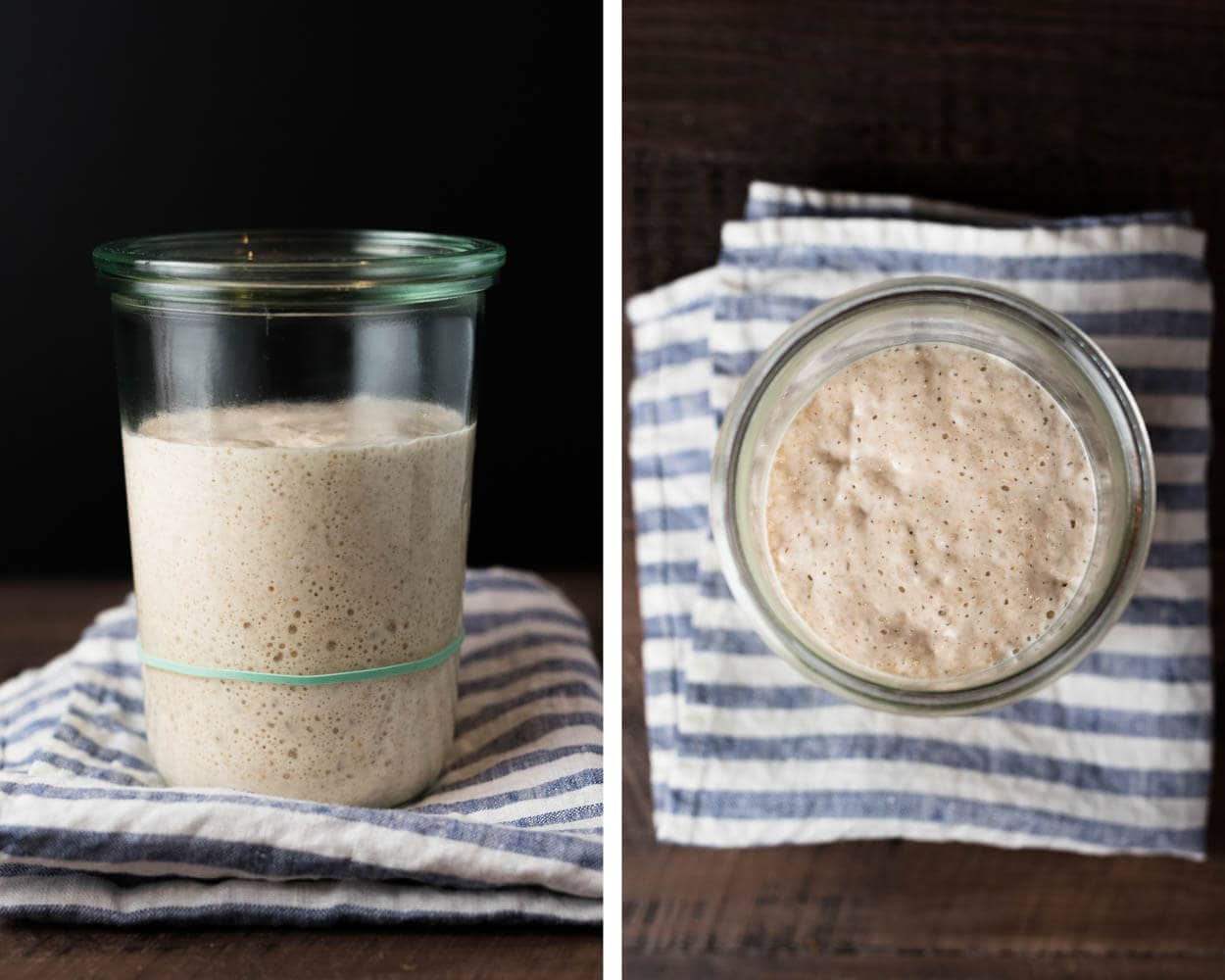
10:00 p.m. – Just past ripe
In the photo below, you can see the culture is beginning to show signs of ripeness. There are streaks at the top that indicate where the top of the starter once was, and in the top-down view, you can see the center is starting to collapse.
The fact that it’s starting to collapse is not the single most crucial factor in judging readiness. Instead, it’s the cumulative signs that are most important.
The fact that it’s starting to collapse is not the single most important factor in judging starter and levain readiness. Instead, the cumulative signs matter: a general breakdown of the mixture, a stronger sour aroma, and significant gas production.
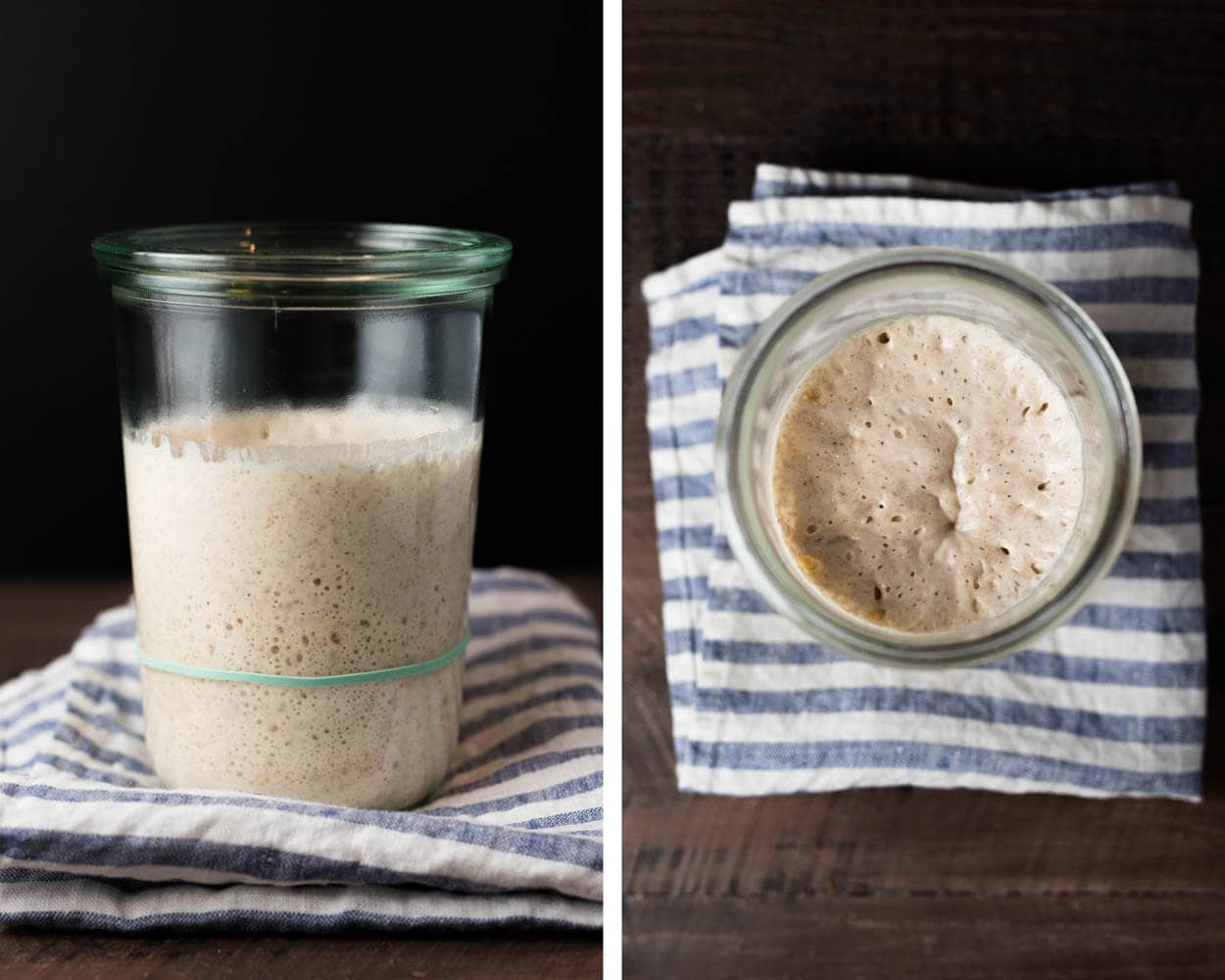
Again, if this were a levain I built in the morning to mix into bread, I would still feel comfortable using this to mix my dough. I’ve used my starter/levain at this point to make excellent bread. I’ve touched on the topic of a “young” levain in the past, but recently I’ve been using mine when it’s more fully fermented to achieve more flavor.
This time is also when you would want to refresh (feed) your starter. If you are using the correct mixture of inputs—water at a specific temperature, percentage of mature starter, and flour mixture—this time will coincide with when you want to feed it. For me, 10 p.m. is perfect as I start cleaning the kitchen in prep for bed (our little ones at home dictate my sleep/wake schedule, and thus my starter must conform).
If your starter has arrived at this point before you want it to, you can use a smaller percentage of ripe starter carryover or use colder water. If your starter is a bit sluggish and isn’t quite at this level, use a bit more ripe starter at the next feeding or use 2° to 8° warmer water.
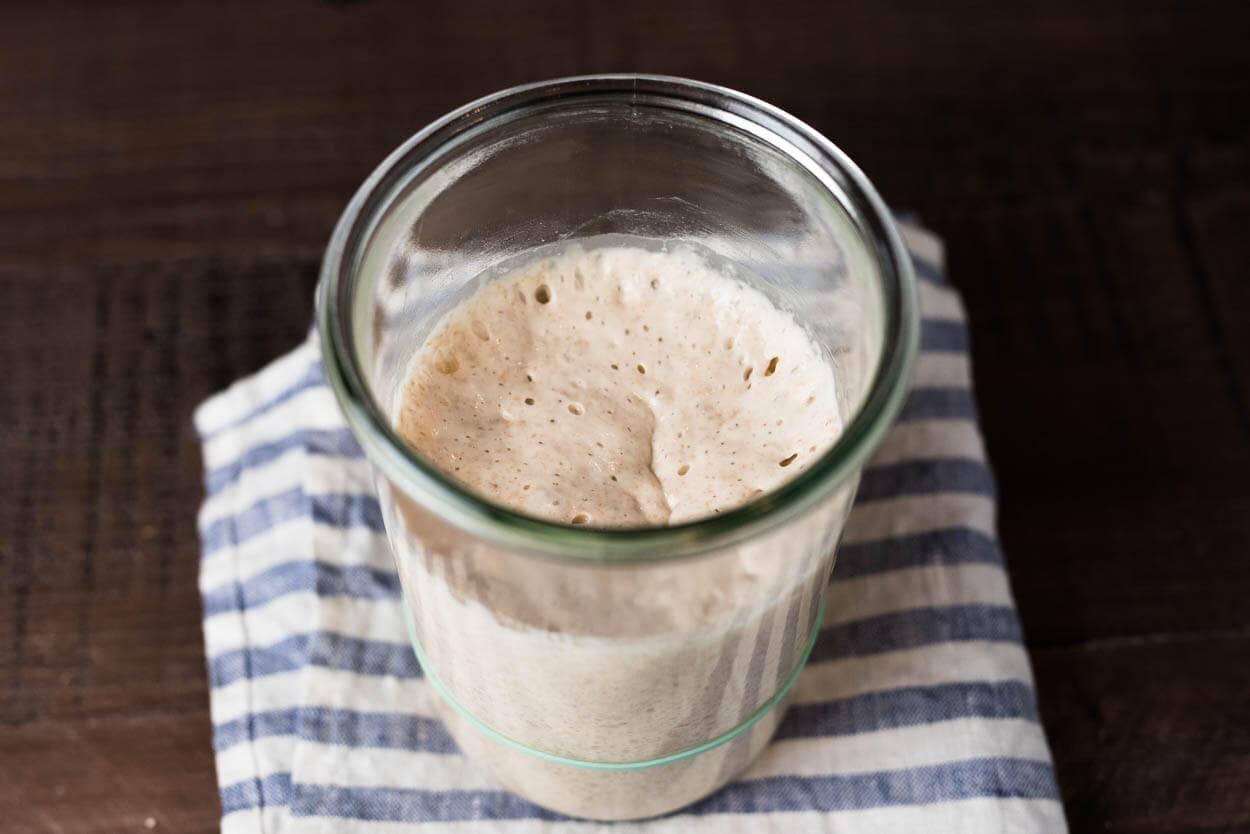
Being observant helps us help our starter to maximize fermentation activity. So, as you continue to care for your starter, take a moment before you rush through refreshments to observe the look and aroma of your starter—plan to adjust things either at the current refreshment or the next based on this observation.
11:00 p.m.
My starter continued to fall at this point, with longer streaks on the side, and the center has noticeably caved. I will normally have refreshed it by this point, but I continued to let this ferment until the morning so we can observe how it looks when it’s gone farther than I’d usually allow.
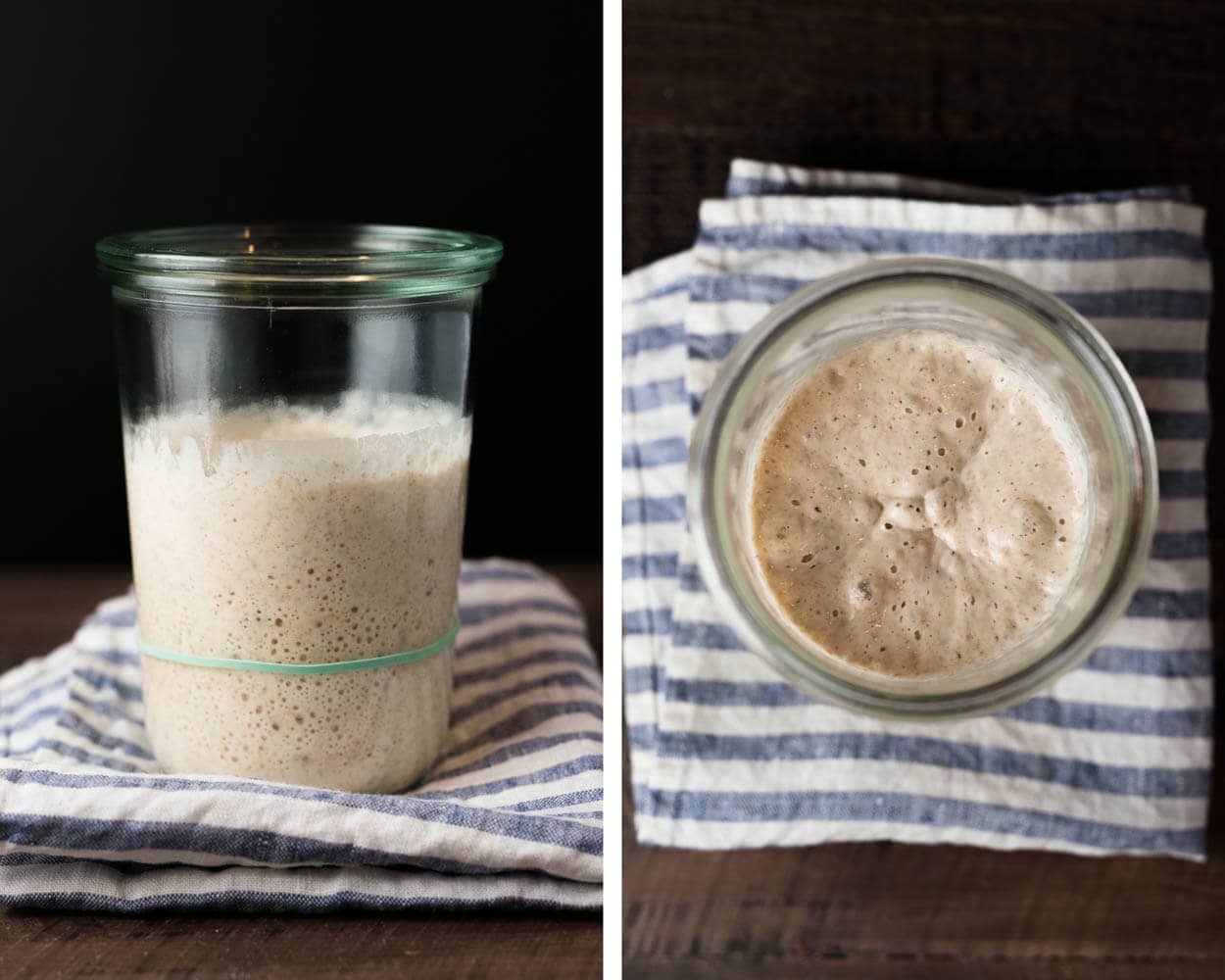
6:00 a.m. (next day)
What a drop overnight! The sides are entirely streaked with how far the starter has fallen, and the top was covered in small little bubbles. My starter has gone way too far at this point and needs a refreshment.
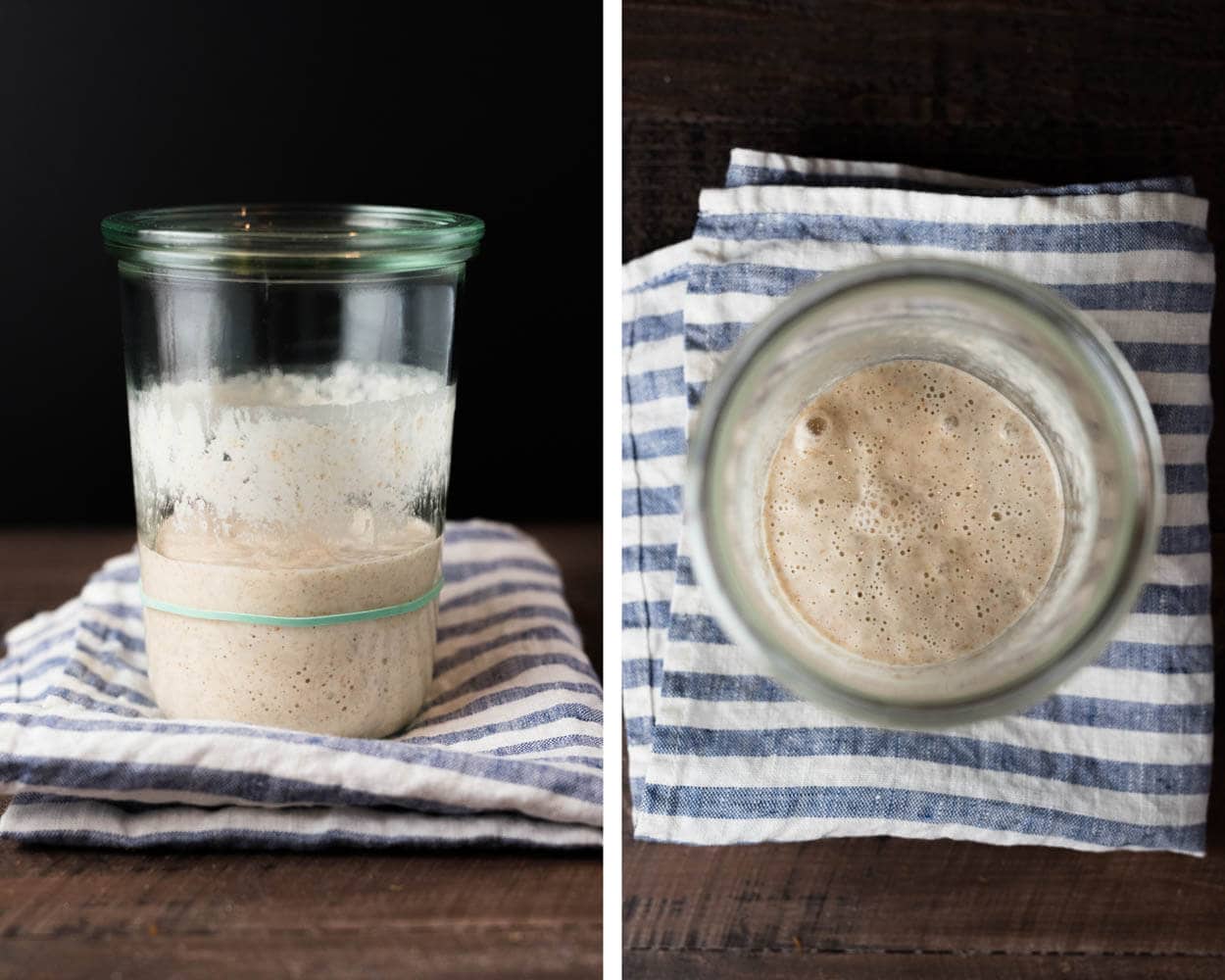
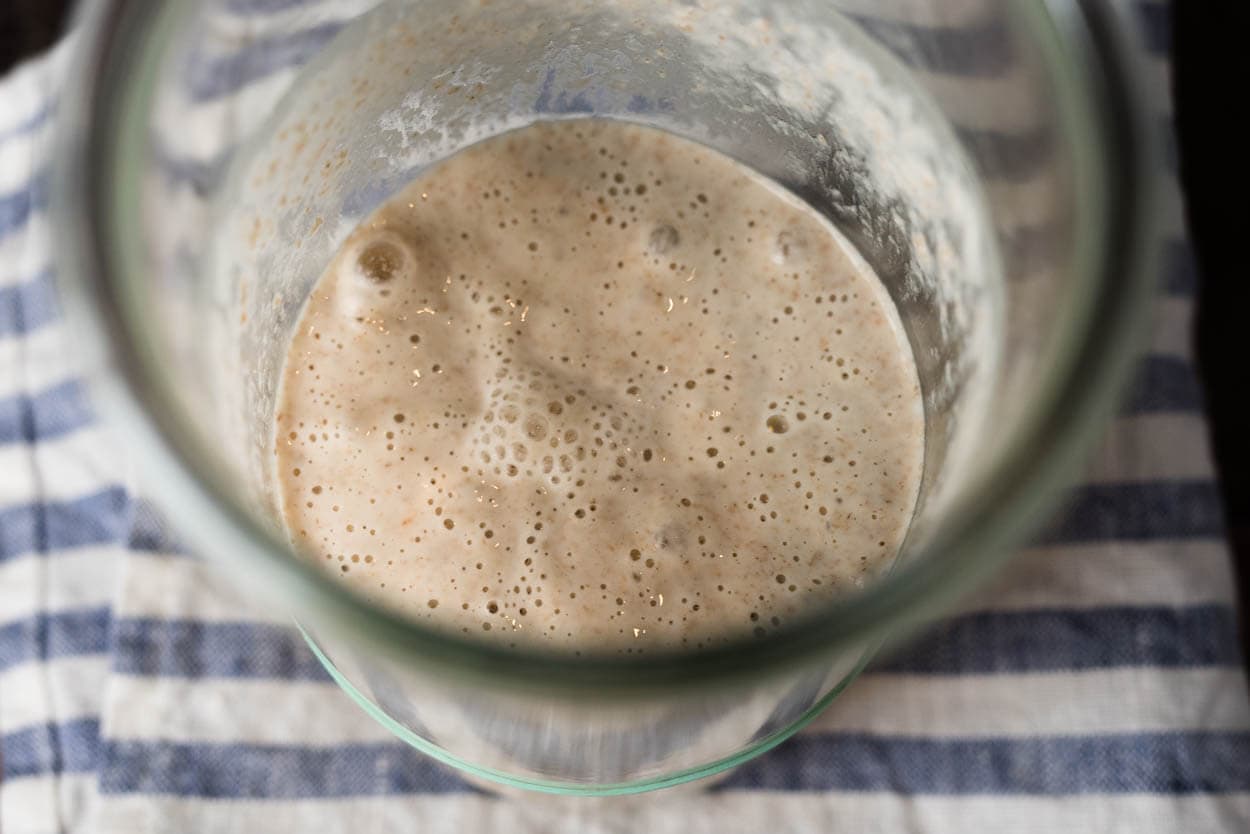
7:00 a.m.
Even more collapse and more small bubbles. At this point, the aroma was very acidic, vinegary, and quite strong.
8:00 a.m.
My final timeline entry shows just how far my starter has fallen after almost 24 hours. The acidity will continue to rise, and if left for even longer, a clear liquid will form on the top (commonly referred to as “hooch”) that will be alcoholic and bitter tasting. Your starter might also look this way if you’ve left it for a long period in the fridge in “hibernation,” as I like to call it. When reviving a starter in this condition, I will pour off the clear liquid, mix the remaining, and refresh as usual.
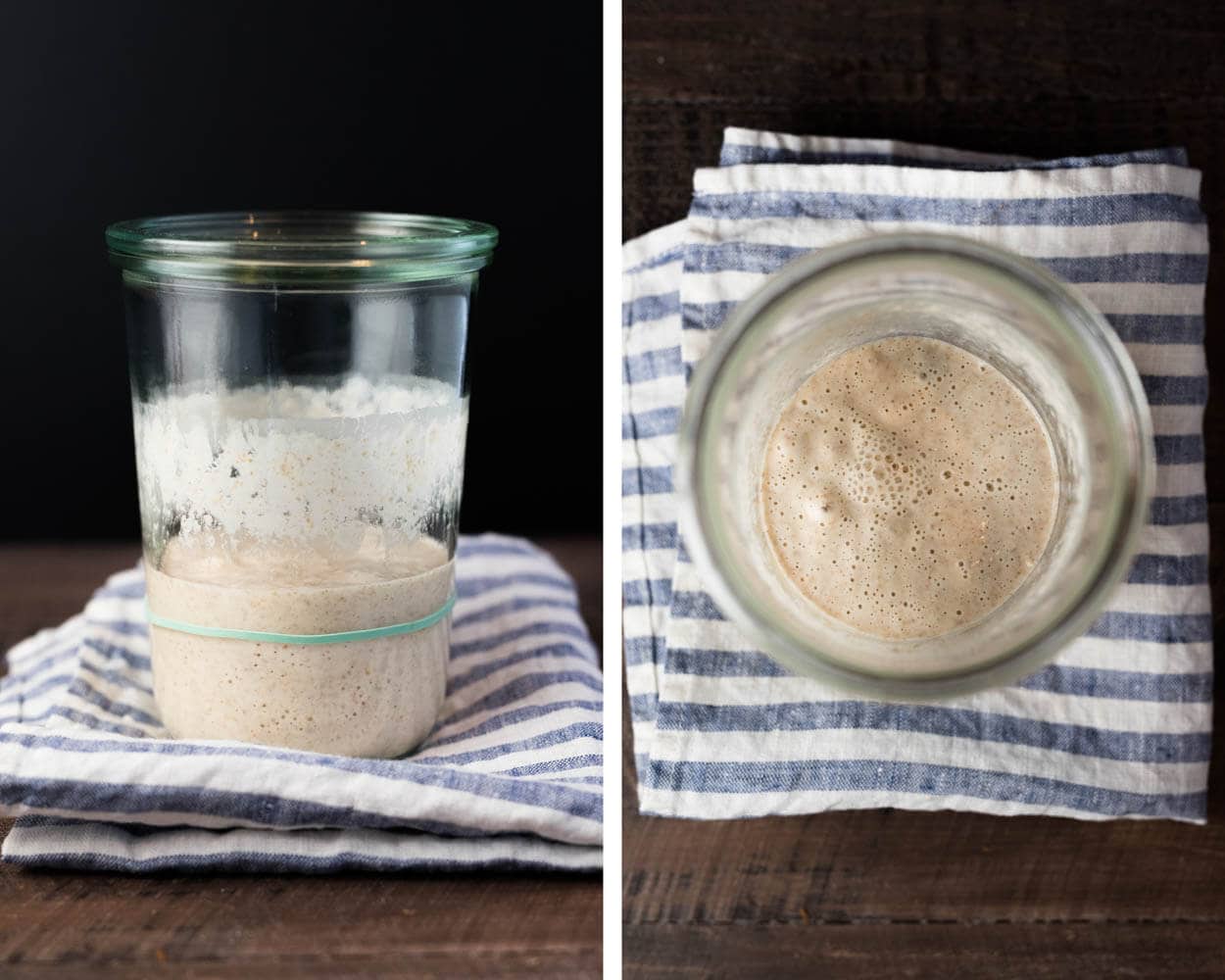
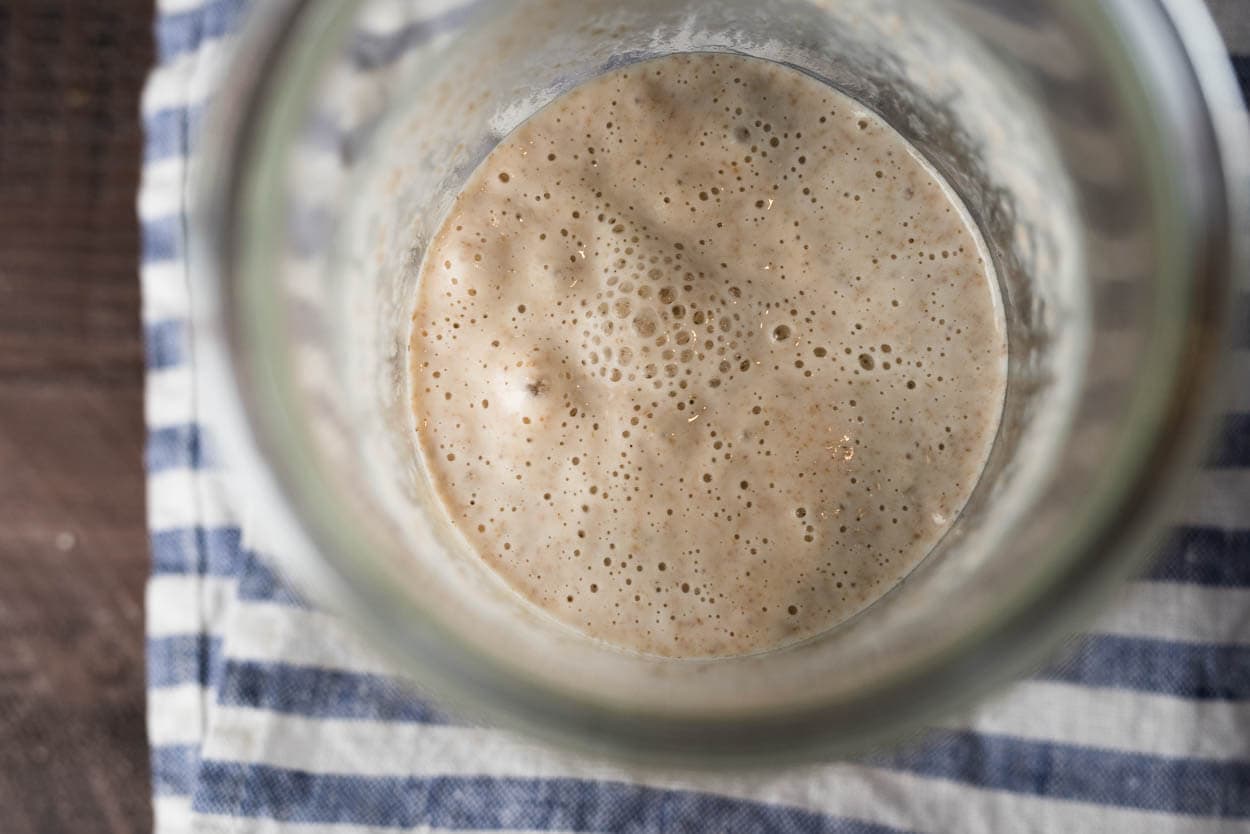
There have been times when my kitchen heated up unexpectedly, or I couldn’t get home before this had happened, and I mixed up my starter per usual, and it was just fine, but I try to avoid this scenario as much as possible.
Don’t panic if you forget to refresh your starter for a day or two! It will be just fine with a few timely refreshments and some attention.
General Sourdough Starter Maintenance Tips
See my sourdough starter frequently asked questions post for a long list of common issues, but here are a few tips that will prove helpful:
- Don’t let your starter collapse and sit for extended periods as excessive acidity will change the flavor of your resulting bread (sourer). If it’s a levain, not your starter, and it’s fermented much too fast for your schedule, you can always make an intermediate build (essentially discard and add new flour and water) and use the new build to mix
- Use your nose. Observe the aroma of your starter at each phase and get to know what a particular aroma indicates by drawing a connection between aroma and visual cues
- If your area has high chlorine levels in the water, use filtered (or distilled) water or let the water sit out on the counter overnight in a water bottle before using
- Stir your starter thoroughly until there are no clumps or dry bits of flour present
Above all, take a few seconds each time you refresh your starter to sit back and assess how things look, smell, and even taste (I don’t typically taste my starter, but many bakers do). Through constant observation and attention to small details, we can maximize fermentation in our sourdough starter maintenance routine.
Sourdough Starter Maintenance Tools
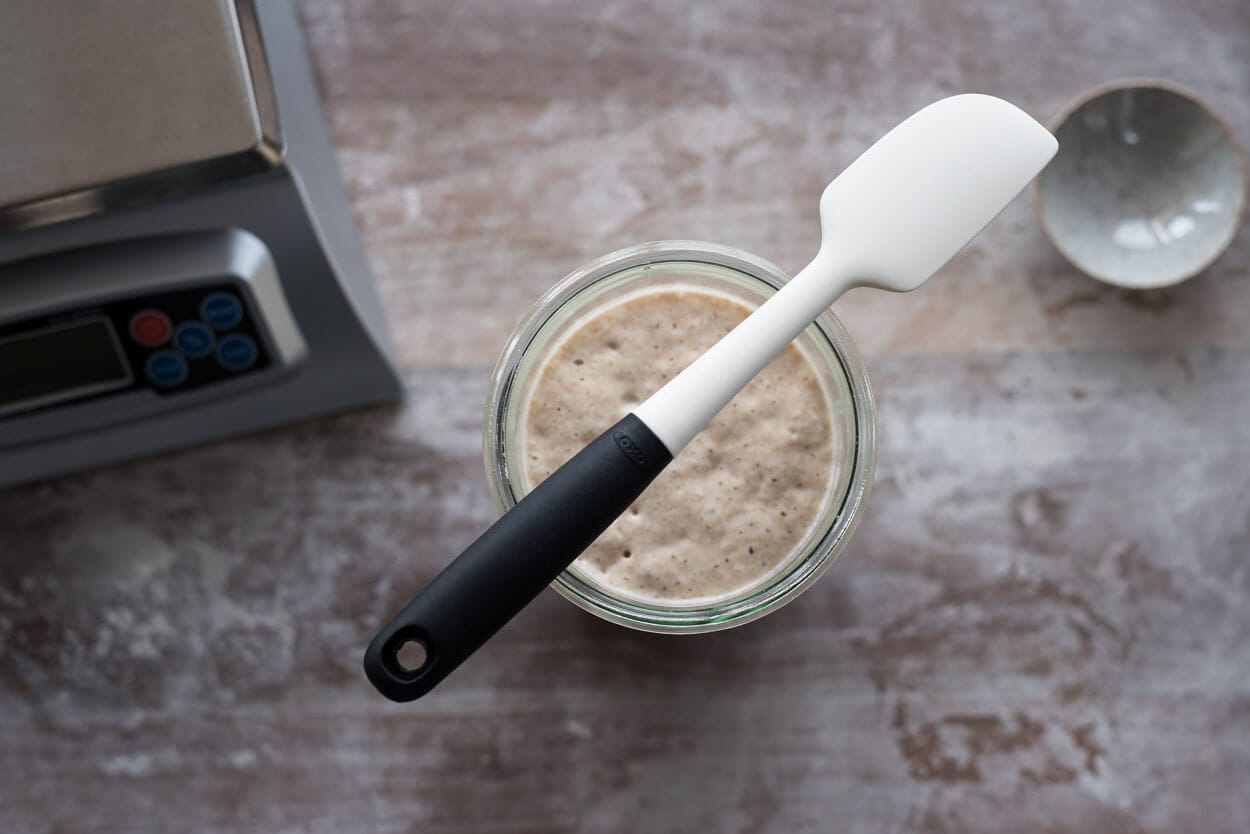
It’s funny how small tools make a huge impact when compounded over multiple times a day for every day of the year. I recently changed my stirring apparatus from an old Pyrex spatula to this newer Oxo spatula, and wow… So much wasted time cleaning that old multi-piece thing. This Oxo one is covered with silicone at the top with no seams or joints, it’s very sturdy (which helps act as a firm mixer), and you can also toss it into the dishwasher. Highly recommended.
Aside from the new spatula, I still use the same Weck jars, dark rye flour, and all-purpose flour. Head to my tools page if you’d like to see more of the tools I use for my sourdough starter maintenance.
Sourdough Starter Maintenance Wrap Up
There you have it, a day in the life of my starter and my sourdough starter maintenance routine. I hope this visual guide has helped convey the visual cues and aromas I look for at various points through the microevolution of my starter. The same signs shown above are also present when I build a levain when making bread.
Remember the methods we have to impact the fermentation rate: temperature of the water, inoculation percentage (amount of ripe starter left in the jar), flour selection (whole grain flours increase fermentation), and ambient temperature. If your starter is sluggish, increase these to speed things up or decrease them to slow things down. After a few days of experimentation, you’ll discover the right mix of each for your unique starter.
Now that your starter is on a regular maintenance schedule, don’t forget you can use the daily starter discard in many delicious things in the kitchen! Buon appetite!
For more sourdough starter guides, check out my sourdough starter guide roundup.


704 Comments
Wow! Amazing guide, congratulations! Very much detailed and illustrated. I loved it.
It has really cleared some things up for me about starters, feeding schedule, etc.
Thank you very much and keep up the amazing work you are doing!
Cheers!
I’m very glad it’s helped, Gabriel! Happy baking 🙂
Hey Maurizio, upon finding your Pizza recipe I have also been checking the health of my sourdough starter and it seems not as active as yours. I get a 50% rise in volume after 8hrs using a 1:4 mixing ratio of starter to flour-water. Your rise is clearly stronger with about 65-70% rise in volume.
Jean Pierre (my Brutus) lives in the fridge as I only bake on the weekends and do not want want to keep throwing away so much starter on a daily basis. Do you ever refrigerate Brutus and how do you wake him properly to get him nice and active again? EDIT: Just saw your reviving techniques. Useful!
I have been doing this method for years following my french father in law’s recipe and get good bread results. So I never saw a need to change. But now with the Pizza I see that it can be done better.
I will try a 1:3 mixing ratio with slightly warm water today and see what happens.
Regards!
Phillip from Germany
Hey, Phillip! Yes, my post on storing (and reviving) a sourdough starter has my entire process for storing and reviving my starter in various conditions for various amounts of times — hope it helps you!
Pizza is quite a bit different than bread and it might take you some adjustment to your normal schedule. I’d suggest you try to feed your stater for a week or so without refrigeration to get it up to full strength and see if that helps!
I’ve been following your instructions of making a starter to the letter. No one in my country bakes sourdough bread they buy it so I decided to try my hand at it. I feed my starter twice a day. It is only about two weeks old I never get that rise like you do after the feedings why is that? I place it in my oven with the light turned on. I get bubbles, it has that sour scent. I use the same measurements as you specified. Its only about 2 weeks old now. Is that the reason?
It’s most likely the flour (or flour + hydration) you’re using for your starter. The important thing is not the height of the starter after a feeding, you just want to be sure you have consistent rise and fall with all the signs of strong fermentation — this is essential. It’s ok if your starter doesn’t double or triple in volume, you just want to see the same activity each day when kept around the same temperature. If you see this, it will leaven and flavor your bread just fine!
Thank you for your very detailed and helpful article on starting and maintenance of sourdough starter. I am new to baking bread and all the more to sourdough bread. Had baked a few not very great loaves, luckily edible though. After reading this article, I tried again to resuscitate my dormant starter following the given instructions but I do noticed a build up thin skin-like layer on the surface of my starter after about 12 hours of feeding. I lift it up and discarded it and the underneath starter looks and smells normal with light smell of fermentation. However I never experienced this when I started at my old house a few months ago. Is there something not right here?
It’s most likely just fine. If you’re not keeping your starter loosely covered I would recommend doing so. If you notice in my pictures above I keep my Weck jars covered with their glass lid just resting on top (this lets gasses escape if necessary). Keeping it covered like this helps prevent a thin skin from developing in top, which could be caused by dry air. Hope that helps!
Thank you so much for this great article. I am very new to sourdough and am trying to understand “discard”. To be clear, we must always discard with every feeding, correct? I have been reading up on what to do with discard to keep from having “waste”. Would it be fine to keep a bowl of discard in the fridge? Pouring off into that bowl each time. Thank you for your time.
That’s correct, we always discard a portion of our fully mature starter at each feeding. You can certainly keep a collection bowl of discard in the fridge, then use that to make my leftover starter waffles, pancakes, or banana bread — all are delicious!
Right on, really interesting to hear all that. Have fun with the pizza dough, it’s delicious!
Please help!
I started a sourdough starter two weeks ago, Its built using 100% hydration and King Arthur All Purpose Flour. It definitely has some “movement” and it gets too look like your pictures (id say the 7pm picture) above as far as the top of the starter goes, meaning there are a lot of holes and “soapy” bubbles, it even pasts the “float test” (I’m not sure if that is a good indicator). My problem is that is definitely does not “rise” in the jar remotely to double, I d’ont know if it is rising at all!
In addition the size of the bubbles along the side of the jar are much smaller than the ones you show on yours.
My doughs seem to rise so sluggishly and durring a three hour bulk, they do not feel airy, sort of like freshly mixed dough.
I feel any rise I have been getting is more due to “ovenspring” than the proofing stage, its quite depressing (no pun intended).
Any Advice? Much Thanks for your time and consideration.
It’s not a problem if your starter doesn’t double in size between feedings. There are a lot of factors that go into the amount a starter will rise and it might be the flour you’re using, the hydration of the starter, the amount your stirring and developing gluten, or other factors. For example, if the hydration is very high for your flour (100% hydration for you might be more “wet” than it is for me) it might not rise very high because it’s so wet. The important thing is to be observant of how your starter is passing through the phases of maturity during the time between feedings. The increased presence of bubbles, the change in smell from sweet to slightly sour, and some rise, all indicate sufficient fermentation.
Try to stick to a consistent feed schedule and keep your starter warm, it will perform just fine!
I wish I went to college and gotten my PHD so I too could bake a G-DDDD DAMMMNNNN sourdough. HOW IS BAKING BREAD UP THERE WITH BEING AN ASTRONAUT?? I have a starter.. flour.. cast irons.. I keep circling around.. reading things.. and never jumping in. THIS IS CRAZY.
It’s basically like having a plant you can only harvest at specific times. Also instead of watering it you snip off a leaf, replant said branch, and throw away the rest of the plant.
Yeah it’s not the simplest thing in the world.
The best thing is to just jump in and get your hands dirty. The first few times follow a recipe exactly, and I guarantee after the first or second you’ll have a firm grasp of the process. It’s not overly difficult!
Thanks for the useful info!
I’m in a bit of an odd spot: I’ve started my first culture (using a dry starter packet – San Fran strain) and for whatever reason the amber-colored hooch has somehow layered itself *under* the bubbly top part of the mixture, though atop what appears to be a thin denser layer of flour and slowly travelling upwards. Do you have any advice on how to deal with this?
For additional background; the jar’s contents have a fairly sharp odor, and despite the dry starter’s instructions stating that you “may be able to see some small bubbles” after the initial 24 hours it spent at around 88 degrees it seemed to have undergone an entire rise/collapse cycle instead. Also I’m keeping it in a somewhat inconveniently-tapered 2L mason jar until I acquire a more suitable container.
Hey! That’s probably normal, I’ve seen a bunch of strange things over the years and with a little maintenance and care things usually sort themselves out — starters are very resilient! I’d say if you’re seeing a lot of clear liquid on top, just stir it down (or pour it off) the first time and then try to give your starter a feeding earlier next time. Usually this is a sign that it’s gone too long without a needed refreshment. You could do this over the weekend or a day when you’re home, this way you can just keep it on your counter and peek in on it throughout the day. You’ll get an idea how fast/slow it’s moving through the food you’ve given it so you can judge when your next feeding should be.
Keep me posted!
Thanks for the response!
The weird separation issue got resolved after re-mixing and another feeding cycle. I suspect the mature-ish lower volume of starter that I added more flour and water to just never got properly mixed together due to that oversized and heavily necked-down 2L jar I was using (which I have since replaced with a more reasonable straight-walled 650mL model).
Had a bit of a scare where an attempt at refrigeration resulted in it going seemingly dormant save for a rather aggressive smell growing back with each feeding, but a few more cycles and reducing the wetness down to ~90% seems to have brought it back to normal. The pizza dough’s coming out great now!
(I’ve also made a backup culture that’s chilling in the freezer, just in case the main branch gets ruined somehow.)
Thanks for posting this! I’ve been working on the starter from the Tartine cookbook and didn’t understand what I was looking for with the rise and fall. Now I have my starter, Penelope, sitting on my desk and am watching her profusely!
You’re very welcome. Have fun and happy baking!
Hi Maurizio. Love your blog. I have a question regarding the leaven. I use a young leaven usually based on the tartine method. You describe using a more mature leaven. Could you give me a reason why one would use the leaven when it is more mature?
Thanks, Anjali! I like a mature levain as I find I have increased flavor in the end result, and it performs more vigorously. A mature levain has more acidity which contributes to the added flavor, but if the amount of levain used in the dough mix isn’t overly high it won’t result in a super sour bread (which I’m not a fan of). Also, when it’s mature you’re using it at a state when populations of bacteria/yeast are at their highest, which usually translates to higher fermentation activity right out the gate. In the end I think different formulas can utilize different levain types and it’s really up to you and your preference.
Hope that helps!
Thank you Maurizio. Very helpful indeed. My next loaf will be with a more mature starter.
Hi Maurizio, what a great and helpful site this is. Thank you! I have a question about the second feeding: would you again only use 20 grams of the sourdough (perhaps in a new jar?) and discard the rest or simply add the flour and water on top of what you already have in the jar?
Thanks, Zoé! You should always discard from your starter when you feed it. I always discard everything down to 20g (or around there depending on the season and temperatures) and to that feed it with fresh water and flour. With that discard you can make other food like waffles, pancakes, and more! Hope that helps, happy baking.
I have a question, i don´t bake everyday, so can i feed my starter and put him into the fridge? or should i let him out?
Have a look at my Weekend Baking Schedule for a way to keep your starter in the fridge and take it out to bake on the weekends!
So, I understand from the introduction to this AMAZING article, that the starter and the levain are basically the same thing; this makes me think that the home baker, who tipycally needs just a tiny portion of mature stuff to raise his bread, could get it directly form the starter (that would otherwise be discarded), provided, indeed, that the timings match.
Haven’t found much on this topic, but it makes a lot of sense to me.
Thank you and yes, you’re exactly right. Since they are essentially the same thing you can totally just bake directly with your starter (just make sure you keep some to perpetuate the culture!). Happy baking!
I am becoming a convert to sourdough thanks to your magnificent blog. I have a query for which I’ve not been able to find an exact answer in your FAQs and other instructions (I may not have looked hard enough) – I only bake once a week and the rest of the time I keep my starter in the fridge, taking it out the day before and feeding it until it is ready for the levain. Am I doing the correct thing? The results I’m getting are generally good but a bit variable (perhaps also due to temperature factors, which I’m trying to control). Thanks very much for any suggestion, long may you bake!
Really glad to hear that, thank you! I have a super nice, concise guide on baking exactly like this. Have a peek at my Weekend Baking Schedule Guide!
Just thinking about starting this process of making the starter, but I am still not clear what the difference is between the levian and the starter, do I take some of the starter to make the levian and how do I make it and use it for bread.
Hey! The starter is an on-going mixture of stable bacteria/yeast — it’s often called the mother, chef, or just starter. In other words, we always have this mixture fermenting somewhere and continue to feed it.
From this starter we build what’s called a “levain” (or leaven) which ultimately dies off in the oven after a single bake. It’s what’s created to leaven, or make rise, a particular batch of dough.
For more on this have a look at my sourdough starter FAQ.
Hope that helps and happy baking, John!
so from the starter i would take what i need and add it to the recipe, if the recipe called for 2 cups proofed starter? then I would use 2 cups of starter which seems like a lot
Sure, that’ll do it. Hard to say if “that’s a lot,” it depends on what the recipe calls for and what the overall percentage of starter is needed.
I think I understand now many thanks looking forward to making my own multigrain sourdough bread.
Maurizio,
I just completed the “old” 40g gram starter from your site and made my first loaves. They turned out great – thank you for the great resource. One question though, now that I’ve got a starter that looks stable, I’d like to maintain it, but you’ve removed the old starter-recipe maintenance page. Can you tell me how you maintain your old 40G starter? Once a day? What flour mixture? Thanks.
Right, on glad to hear that! You can maintain it with the process above, or any ratio of flour and water, really. Whatever works for your environment, flour, and starter. The key is to just feed it when it’s “ready” (as shown in the post above).
If you head to my post on creating a sourdough starter you’ll see a link to the “old” instructions there at the top (right before the second image in the post).
Happy baking!
Ciao Maurizio, I want to make a chocolate sourdough bread but I haven’t found a recipe I like. Do you have recommendations? Thank you! My starter is 8 days old and is pretty active. I am feeding it 50% rye and 50% all purpose flour twice a day 🙂
Glad to hear your starter is up and running! I’ve never made a chocolate sourdough, and in fact, I can’t recall any recipes that I’ve written down to try. My initial thought would be to use a percentage of cocoa powder, but I wonder if small chips would also hold up well enough in the dough… either way I’m sure it’d be delicious!
I’m having issues with my bread tasting sour. I use half wheat/white king aurthor flour to feed my starter. And watch it carefully before it colappses. And right when it peaks I make the levain. Is that the wrong way? I’ve tried a variety of ways to make it sour, that i’ve read on the internet. I also tried making the dough and leaving it in the fridge for 3 days before baking. Which I won’t be doing again. After baking it tasted like a old sponge. I’ve been obsessed with making homemade sourdough bread. The bread I make taste really good. Its just lacking the sour taste. Any advice would be appreciated. Thanks.
There are a few things you can do to try and increase the sourness of your bread. First, you want to use your starter, and levain, when it’s very ripe. If it rises up to a certain height, let it sit there for a bit before you use it. If it starts to fall that’s ok too, just try to catch it right before, or after, it falls. That mature, ripe starter/levain has much more acidity than if used when it’s more on the “younger” side. Just be weary that your dough fermentation rate might be a bit faster than previous, keep an eye on it during bulk fermentation and divide the dough when it looks ready.
Additionally, you could try using some rye flour in your final dough mix. Rye helps stimulate more acid production for a more sour flavor. I wouldn’t go overboard on the rye, though, as the more you include the more dense your loaf will be. It’s up to you on the percentage, but even 5% plays a big role.
Finally, if you can try to push the cold proof in the fridge. There’s a limit of course, but if you could go even a few more hours you should notice more sourness.
This comment does not subtract from this great and most helpful site but the 2:00 PM picture description says 50% rise. Actually the increase is at least 100%
Yup, you’re totally right, Pat. I’ve fixed the description and thank you!
Hello again! I have 2 starters going. The one with bread flour is doing great and has produced some wonderful loaves. The rye starter also is filled with bubbles and rises and falls as it should. However, when I do the float test it always sinks. Because it’s rye, should it float or doesn’t that test apply to a rye starter?
Thanks for you ur advice!
Hey! That’s correct, a 100% rye starter won’t really float. Since rye doesn’t have the same gluten properties (and thus the ability to trap as many gasses) as wheat, it won’t readily float. However, this doesn’t mean it isn’t able to leaven your bread, you just need to look to other signs for determining when it’s ripe (smell, cracks on the surface, etc.).
Hope that helps!
I would say feed it only once a day if it doesn’t look like it’s up to full strength. Sometimes if we feed too early, before it needs it, we can slow things down in the long run. Keeping it warm is a great idea. If you have a thermometer take the temp of your starter when you do a feeding and see what it’s at: I like to keep my between 75-78°F if possible.
You could also try feeding with a percentage of whole grain rye flour for a week (perhaps 25% of the flour) and see if that helps perk it back up.
Definitely don’t give up on it!
I have been having issues with underproof bread despite extending my bulk fermentation/proof time. For example, my last loaf BF for 5 hours between 75-80 degrees fahrenheit but it doesn’t seem ready (not as “bubbly” or voluminous). Baker % used for levain was 20% which I built over 12 hours. Starter was fed twice a day leading up to the levain build.
I am trying to diagnose my issue and I have a feeling it could be weak starter. I feed my starter once/twice per day at 20g WW / 20g H2O. Does the fact that i use only 20g of flour during the feed make a difference? Since I use very little and keep my starter in a glass bowl, i don’t see a lot of rise, but there are a lot of bubbles throughout when I observe through the glass. However, I am not sure if using 20g is too little such that it peaks too early (it doesn’t smell overly acidic at every 12 hour though).
Thanks!
That’s interesting. That should definitely be sufficient time for bulk, especially at those temperatures, and the percentage of levain used in the mix. In fact, I’d be worried that might be too long.
20g is a small amount for your starter. It might be going too long with out food. Have you tried feeding it with 100g flour, 100g water, and perhaps 20g mature starter? I’d say try that so you can visually see the fermentation transformation each day, it should help you get a better sense for how your starter is doing.
Also, be sure to keep it warm! I hope that helps.
hello Maurizio!!! I want to thank you for all your post! thanks to your posts my starter became very strong and active!!!!!!! today I baked one of the best breads I have ever baked!!! thank you so much!
Super glad to hear that, Elena! Thanks for that update and happy baking!
Hello, thank you for your tutorials, they are very helpful. Can you tell me the best way to keep the starter off the sides of the jar? I find that when I stir, a ton of it gets on the sides of the jar and I think it is leading to the mold that is killing my attempts at starting a starter. Do you mix it in a different container then put it in the jar? Or do you change jars every day? Or just scrape down the sides with the spatula? Thank you.
Hey! What I do is scoop out any discard from the jar I need to get rid of. Then, I use my spatula (this one is amazing at this) to thoroughly scrape and clean down the sides as best I can. After that I get a single paper towel and fold it up, then I use the paper towel to clean the rim of the jar and down the sides as far as I can reach. This usually cleans up the jar really well and gets rid of enough of the starter so the sides are clean all the way down to below where my starter will rise up the next day (which kind of cleans it).
Hope that helps!
Absolutely helps! Thanks so much, I will definitely try it.
Hi Maurizio, Do you still follow the same maintenance routine or are there any changes to it? I am just curious, I have been using Central Milling’s T85 to feed the starter. Do you recommend, 20% starter inoculation, 100% Flour and 100% Water (10g starter, 50g flour, 50-55g Water)– twice a day? My kitchen temperature is usually between 75-77 F. Just trying to get the starter to be more vigorous and healthy.
Hey! I do continue to feed my starter these days with 100% type 85 flour. I like the performance, flavor, and timetable using this flour. That’s about the same temperature mine is at as well.
I typically do 15-20g mature starter, 100g type 85, and 100g water at each feeding. I feed about every 12 hours when it’s kept around 78°F.
The key is to just adjust things as demanded by your starter and you want to do a feeding right when it starts to ripe or slightly thereafter (when it falls in your jar). Try to avoid feeding too early, this can weaken things in the long run.
Hope that helps!
Thanks Maurizio, that is about how I have been trying to maintain my starter as well. I have also noticed that it is the most happy when kitchen temperature stays around 77-78° F.
Also, I think those little details like feeding it after it matures fully are really important… Thank you for that… 🙂
Hi Maurizio, thank you for this post! I have recently inherited a 15 year old whole wheat starter and started baking bread. My bread is beginning to come out quite good, but I’m still in trial and error mode so it’s taking up way to much of my time (unfortunately I still have to work as a software developer). I live in a very warm and humid climate, so my starter must stay in the fridge. Keeping it on the counter will make the entire process from feed to fall last about 3-4 hours. I have time to bake once a week, and I want to waste as little as possible. Basically what I’ve been doing is feeding my starter the night before, leaving it in the fridge, using half of it the next day for baking, then keeping (the remaining starter) in the fridge until the next week. The thing is after about two-three days in the fridge she is already really hungry (sourish alcoholic smell and some liquid on top) and by the time I’m ready for the next feed and bake she seems really neglected. Is there a way I can maintain a strong healthy starter with one feed a week? Or any other way I can feed more frequently but without throwing away too much of that precious organic flower?
Some technical details: I feed 200g of old starter with 120g water and 80g whole wheat organic flower (Totaling 400g. I don’t know how to use the proper bakers’ terms, but it’s a wet starter). Thanks, Daphna.
Hey there fellow software dev! Try maintaining your starter by feeding it with less old starter. Instead of feeding with 200g try going down to something like: 10g old starter, 100g water, 100g flour. With this very small amount of old starter carried over it should last quite a bit longer before needing a feeding. You can decrease this 10g even further if necessary, sometimes I go down all the way to 5g when it’s very hot here.
Another thing you might want to keep in mind is you can experiment with adding salt to your starter. Adding a small percentage of salt, perhaps 0.5%, will help slow the entire fermentation process down further and make things more manageable for you if it’s overly warm out.
I hope this helps!
Hi Maurizio! First of all, thank you so so much for the guidelines provided on your website! I am currently struggling with my fresh starter, it’s day 6 with daily feedings following your instructions, however there’s very little activity 🙁 would you recommend expanding the periods between feedings to 36/48 hours or discarding less? Or should I just be a bit more patient? I know that the process takes time, especially with fairly low temperatures at the moment. Trying to keep it in warm places and feed with warm water… best wishes from Germany 🙂 Lara
Hey, Lara! Hopefully things have picked up by now, but I would stick to one feeding a day and try to keep your mixture as warm as possible (80°F would be ideal). When it’s too cool in the kitchen it really slows the process down. Sounds like you’re already doing this, though!
I’d say stick to one feeding until you see enough activity to bump up to two — and stick with it!
Thanks for your answer 🙂 Things really changed on about day 7 – at two feedings now, excited to try baking in a couple of days!!
I just found your website and it was definitely informative, props! I don’t usually use starters when makings pizzas, I decided I would try it out. Have you used this starter in pizzas before? If so would you change the flower you use to feed your starter. Typically cake flower isn’t used in the pizza making, because of the low protein content. I read why you chose the flowers you did, but when you bake I am assuming you use higher protein flower. Did you find that to be useful in flavor texture etc. Why not use a higher protein flower in our starter? what did you find?
Thanks! My starter is something I always have ready to use in a bake (bread and/or pizza). I feed my starter with a mix of whole wheat and lower protein flour (not pastry flour, but around 11.5-12% protein) because i like the performance this flour gives and the flavor I achieve. I typically avoid excessive use of high protein flour because I find it imparts a “chewy” or “rubbery” texture to the end product. Hope that helps!
Hi there! I am stumped with my starter. I typically keep it in the fridge as I don’t bake often enough, and am trying to figure out the best way to wake it up. I have been feeding it once a day with 75g whea, 75 bread and 150g water. Sounds like I could reduce the quantity of bread and water, only carry over 30g of the previous starter- but how many days to do this for? And feed twice a day?
Hi, Chris! I like to recommend feeding your starter when you notice it needs a feeding, but at least once a day when it’s on the counter.
Have a look at my Weekend Baking Schedule Guide where I talk about how I keep my starter in the fridge from time-to-time and “wake it up” with a few feedings before using it!
Hello Maurizio, Although all the signs are good (rising/falling of starter, regular feeding, floating lavein, etc), I feel like my starter is not strong enough because after 4 – 5 hours of bulk fermentation, my dough is not rising enough. I currently feed twice a day with 50/50 white flour/whole wheat flour. The ambient temp is around 80F. Do you think that I have a starter problem?
Depending on how much levain/starter you’re using in your dough, at 80°F you should see plenty of activity in your dough during bulk fermentation.
Focus on getting your starter strong. I would give it two feedings a day for a solid week, perhaps with some percentage of rye or whole wheat flour to help nurse it back to full strength. After this week you should see a reliable rise and fall pattern. Then, use this starter when it’s mature to build a levain for your dough.
Hopefully this extra care will get your starter back on track!
Maurizio, thanks for your patience! If I have a starter in the fridge, I presume it needs to be fed at some stage. From what I’ve read, it should be fed after a couple of weeks. So I discard and feed with flour and water. What if I’m not ready to bake more bread for another couple of weeks? Do I just place it back into the fridge after discarding and feeding? Or do I have to let it come to room temperature first, then feed for a couple of days before returning it to the fridge?
Ideally, if you have the time and are willing to do so, keeping your starter fed at least once a week from the fridge will really help. What you could do is take it out for a full day on the 7th day and give it one feeding, then another feeding just before placing it back into the fridge for another 6 days. If you want to do a two week schedule that’ll most likely be ok as well, I would take it out, let it come up to temp for an hour or so, feed it, and then give it another hour before placing back into the fridge.
Hope that helps!
great post, thanks!
I’m curious — have you come across any recipes that take advantage of over-ripe starter? i.e., I would assume the big acidity of over-ripe starter comes from a higher bacteria count. So in theory, a recipe could inoculate a levain with over-ripe starter (i.e., lots of bacteria)…if it also used a second source of healthier yeast to ensure good proof / rise?
I haven’t come across any recipes. When my starter is over ripe, especially if it’s very ripe and has fallen for quite a while, I’ll hold off baking until I can do a refreshment. If it’s just a little over ripe I’ll still use it and things will be just fine, perhaps the final baked product is a touch more sour. I also do notice that an over ripe starter/levain will cause the dough to ferment at a faster pace, so keep an eye on it!
Thanks for a great article. I have one question as what a “young” starter is, do I understand it correctly that at 8:00 p.m in your schedule the starter is young, using it at that stage would be considered young, you catch my drift?
The term “young” refers to a starter (or levain) that’s not fully ripe. This means it still has some time before it reaches its peak height and maturity and will still smell on the sweet side, perhaps with just a bit of sourness. Hope that helps!
Hola Maurizio, First I want to thank you for sharing with us all your knowledge and passion for baking. My question is: how do you maintain a starter on the fridge for long periods of time? Do you have to feed the starter once a week? Did a lot of research on that but still confused…
Thanks a lot!
Martin
Martin, you bet, I’m glad to help! Ideally the least refrigeration time needed the better — your culture will change when it’s kept in the fridge for extended periods. What I’d recommend is reducing the hydration of your starter, perhaps all the way down to 65%, if you plan to refrigerate your starter for long periods. I’ve successfully refrigerated, and refreshed, my starter after it had been in the fridge for about 3 weeks. There’s a lot of confusing information out there on this and it’s no wonder you found conflicting information. I think each person has probably tried a different approach and it may, or may not, have worked for them.
I can say at reduced hydration 3 weeks in the fridge has worked for me several times. Hope that helps!
Thanks a lot! I’ll do that, I truly appreciated your help! have a great day!