

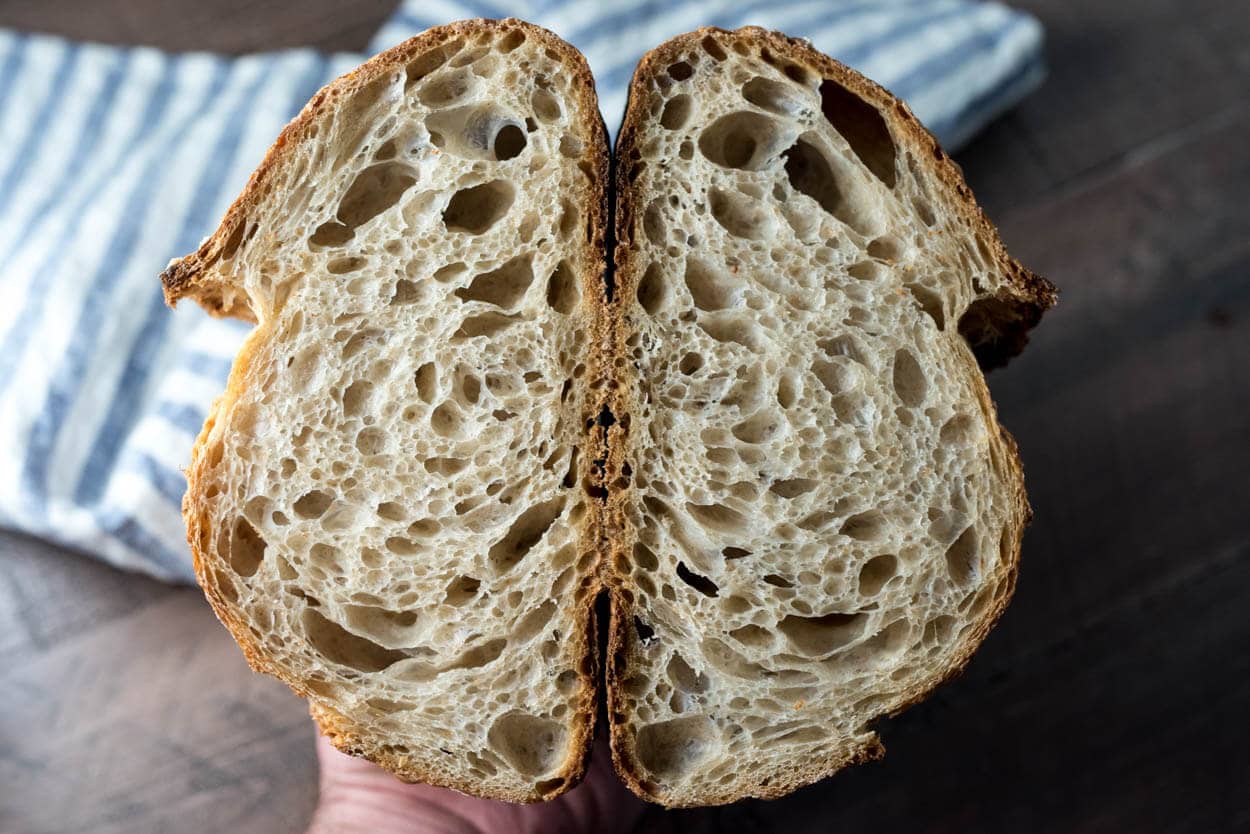
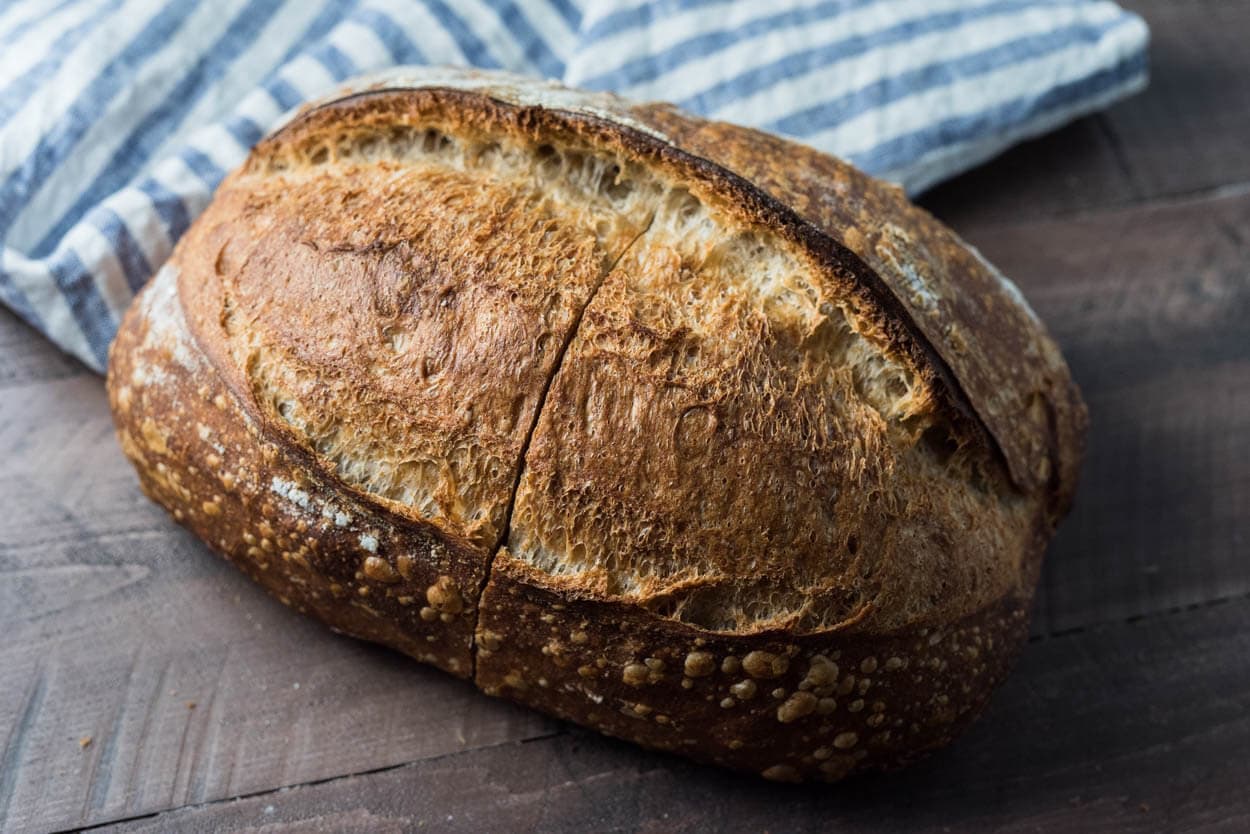
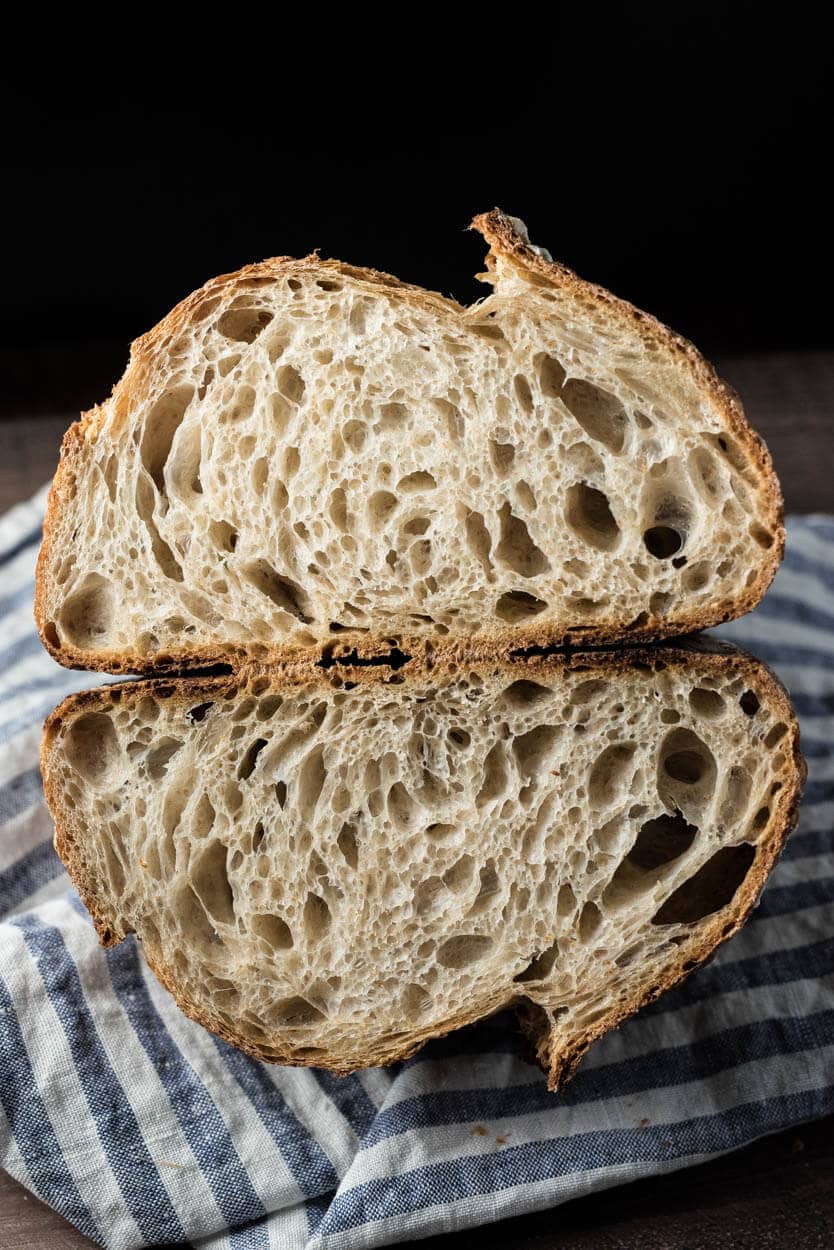
My baking focus has lately been predominantly on my sourdough starter maintenance and maximizing fermentation. And recently, I’ve made some of the best bread I can remember (I took all the bread pictures in this post with this starter). So this post is somewhat a continuation of my Managing Starter Fermentation, but in this post, I’ll focus more on the signs for spotting when a sourdough starter is ready for refreshment (ripe) and how to perform that refreshment.
Be sure to check out my post on what flour, water, and carryover ratios I’m currently using to feed my starter in my How Do I Feed My Sourdough Starter post.
There are many methods to keeping your starter healthy and in proper working order, likely as many methods as bakers. Each baker has a process for maintaining their starter according to what works for them and the bread they seek. Each starter is unique, after all: a distinctive blend of wild yeast and beneficial bacteria that has evolved in the temperature it’s kept at, the flour used for refreshments, and the time between those refreshments. I wanted to preface this article because the following is what works for me here in my kitchen and will most likely work for you as well, but I guarantee you’ll find yourself modifying my method to suit your environment. That’s to be expected. An essential requirement for a baker is flexibility and adapting techniques and inputs so everything performs optimally in your kitchen. In the end, your sourdough starter maintenance routine might be similar to mine, or it might be quite different.
I can remember back to when I first dabbled with creating my sourdough starter. I read all the books I could get a hold of; I searched online, anywhere I could find information. Once I got things up and running (using the process described in my seven steps to creating a sourdough starter entry), I followed refreshment schedules outlined in various books, and things seemed to work pretty well. But my bread didn’t improve until I modified things to suit my environment, schedule, and unique starter. As I refreshed my starter each day (feeding sourdough starter), I began to take note of things, how it looked when I neglected to refresh it for too long, how it looked after a few hours with new food, and how the smell of the starter changed throughout the day.
My goal for this entry is to convey the signs I look (and smell) for during the single-day microevolution of my sourdough starter. First, what does it seem and smell like right as I refresh it (at the start)? Then, what should it look like when I decide to refresh it again or use it for making bread? And finally, what does it look like if it’s gone too far and starts to become overly acidic? I receive frequent emails on this topic, and I hope this entry will be a visual guide to those wondering how I care for my starter.
With this post, I’m hoping to help you answer the following questions:
- What is feeding (I usually call it refreshing) a sourdough starter?
- How soon after feeding (refreshing) a sourdough starter can I use it?
- What does feeding my sourdough starter once (or twice) a day look like?
A quick note for those out there who follow my writing very carefully: you’ll notice this entire entry is about a liquid starter/levain and not about a “stiff” variety I had been baking with for almost a year. I recently shifted things back to using a liquid starter after a long while with a stiff variant, and I have to say I prefer how my bread is turning out with my change. If you use a stiff starter, some of this entry will be relevant to you, but the visual cues will be different as the consistency of your starter will be different. If you haven’t used a liquid starter/levain, I suggest you experiment with this and try it out, you might be surprised at the difference, and you might prefer it. I’m not suggesting one is better than the other, but rather a personal preference whereby I like the taste and performance of this liquid levain for the bread I’m currently baking.
If you’re curious and looking to dig more into preferments, see my guide to the differences between a sourdough starter and a levain.
Sourdough Starter Background
The key to coaxing out maximal fermentation with your starter is to be observant. Watch how it evolves throughout the day and note how long it takes to reach full ripeness: a strong sour aroma, a breakdown of the mixture, significant bubbles on top and at the sides. If it’s doing this too fast (for example, you refresh at 8 a.m., and it ripens at 2 p.m. when you’re at work), you can reduce the water temperature, change the ambient temperature, or reduce the amount of mature starter you carry over at each refreshment (this is what I do). You want to try to refresh your starter right when it’s at its peak ripeness or shortly thereafter.
The key to coaxing out maximal fermentation with your starter is to be observant.
Once you have a healthy starter showing the same signs of fermentation every day, you will be able to adopt a consistent sourdough starter maintenance schedule. I work this into my daily routine: I refresh my starter when I eat breakfast in the morning, and then I refresh again in the evening as I’m cleaning up the kitchen getting ready for bed. It only takes a few minutes (see my tips later on tools to make things easier).
Your starter will go through the following phases each day, but the times will most likely be different. For example, if fermentation is slow (due to temperatures or percentage of starter carryover, for example), then the signs I point out below might be at greater intervals, and conversely, if fermentation is fast, then the ranges will be tighter. As I mentioned initially, if you’ve not yet started your sourdough starter or received a portion from a friend, I have an intro article to creating a starter that will get you going in a few days.
Let’s look at a day in the life of my starter.
Sourdough Starter Maintenance Timeline
Before we dive into the timeline, I want to point out that below I refer to two things: my starter, which is what you’re here for in the first place, and also a levain. I talk about both almost interchangeably because mostly, they are the same thing. Your starter (mother, chef, etc.) refers to your yeast/bacteria culture you continue to refresh and care for indefinitely. In contrast, your levain is a splinter, or off-shoot, of your starter that you refresh and build only to be used in a bread recipe eventually.
For the timeline below, I used 30% whole grain dark rye flour and 70% medium-protein bread flour (similar to all-purpose, but geared toward bread baking). The percentage of flour types is really up to you; I used a little rye flour to help increase fermentation and acetic acid production, but you can use any ratio of flour you’d like (e.g., 100% whole wheat, 100% white, a mix of both, etc.). Just take note of how each flour type aids or slows fermentation.
10:00 a.m. – Sourdough starter maintenance beginning
The first step is to take your mature sourdough starter, discard some part of it, refresh it with fresh flour and water, and cover (I only loosely cover with a glass lid that does not seal tight). My kitchen is currently around 75°F (23°C), and my mixture is 70g white flour, 30g rye flour, 20g mature starter, and 100g room temperature water.
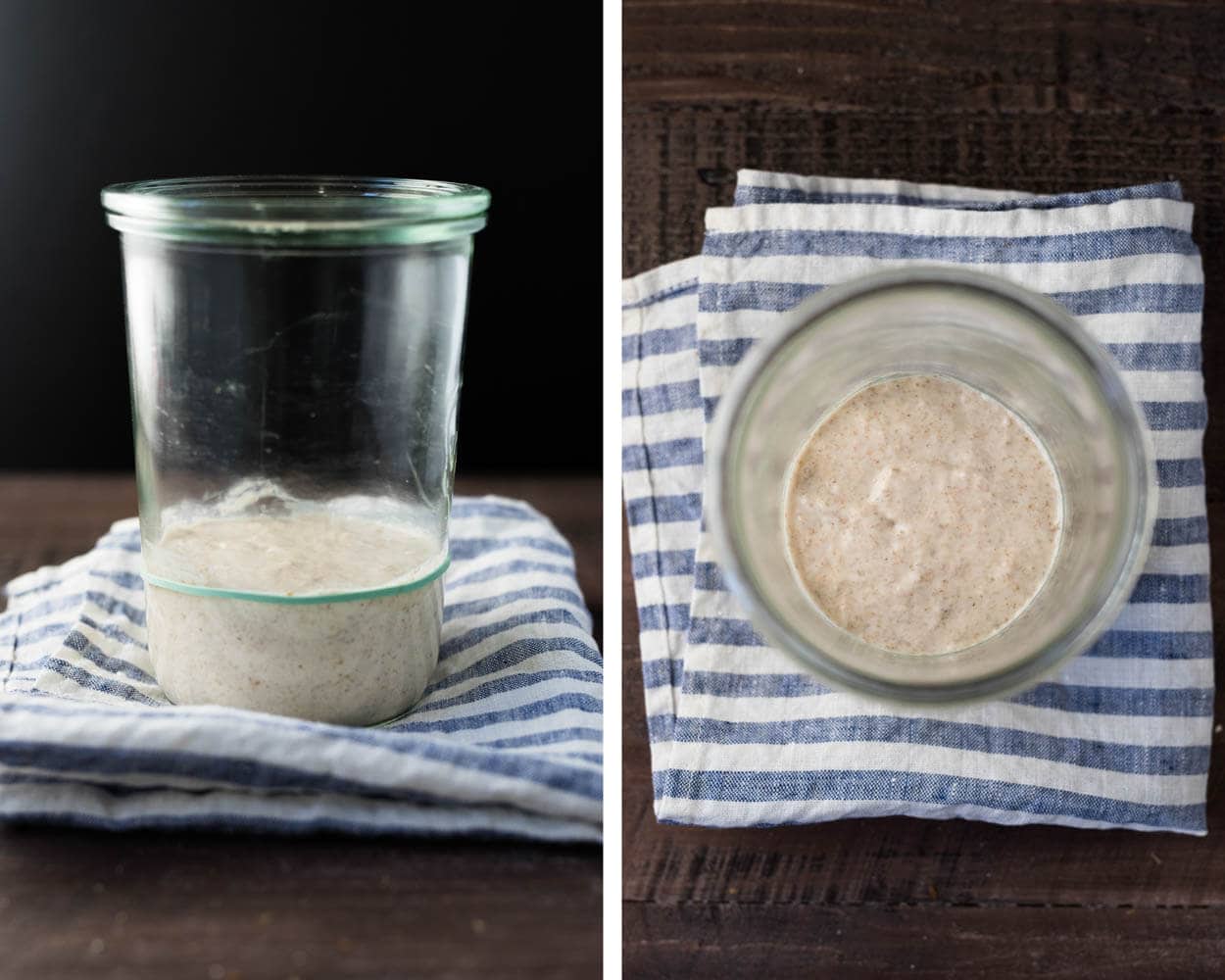
You can get a sense of how “stiff” my starter is after mixing. You want to make sure you mix everything thoroughly so it’s completely smooth with no visible clumps of dry flour.
I’ve placed the green rubber band at the beginning level of my starter so we have a good sense of how far it will rise throughout the day.
12:00 p.m.
After only a couple of hours, you can see only slight activity visible in my starter. The smell at this point would be very, very sweet, and practically the aroma of flour and water. So sit tight; things are about to get more interesting.
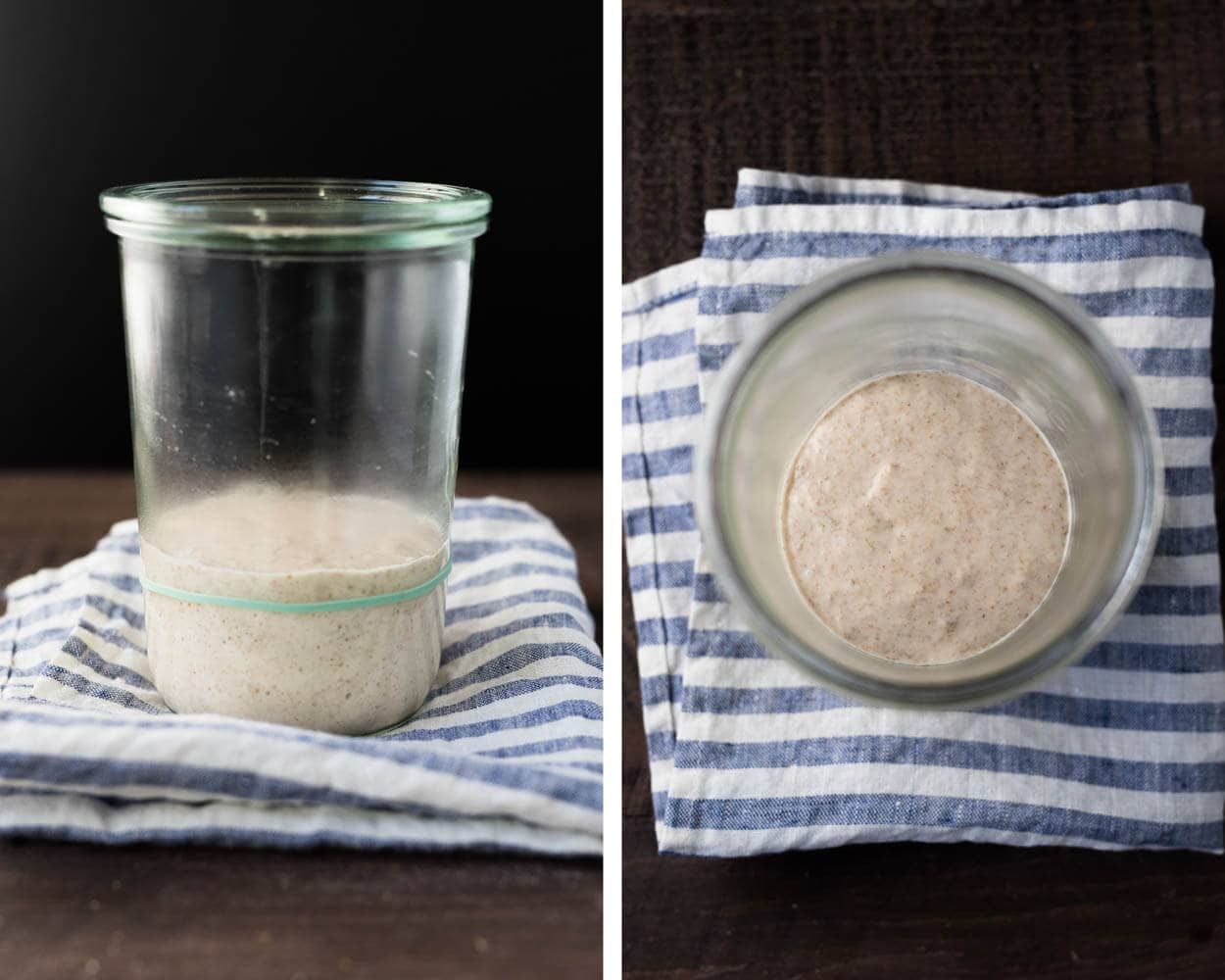
2:00 p.m.
As seen below, four hours after refreshment, we have a significant expansion, a tad over 100%. In the image at right, you can see that the top is domed with a few bubbles peeking through. The mass of dough is trapping quite a bit of the gas produced through fermentation. I like to use a glass container, particularly these Weck jars, not only because it allows me to see firsthand how fermentation is progressing but also because the flared top makes sticking your hand and spatula inside very easy. I not only use these tall jars for my day-to-day starter and refreshments, but I also use them to build my levain before baking.
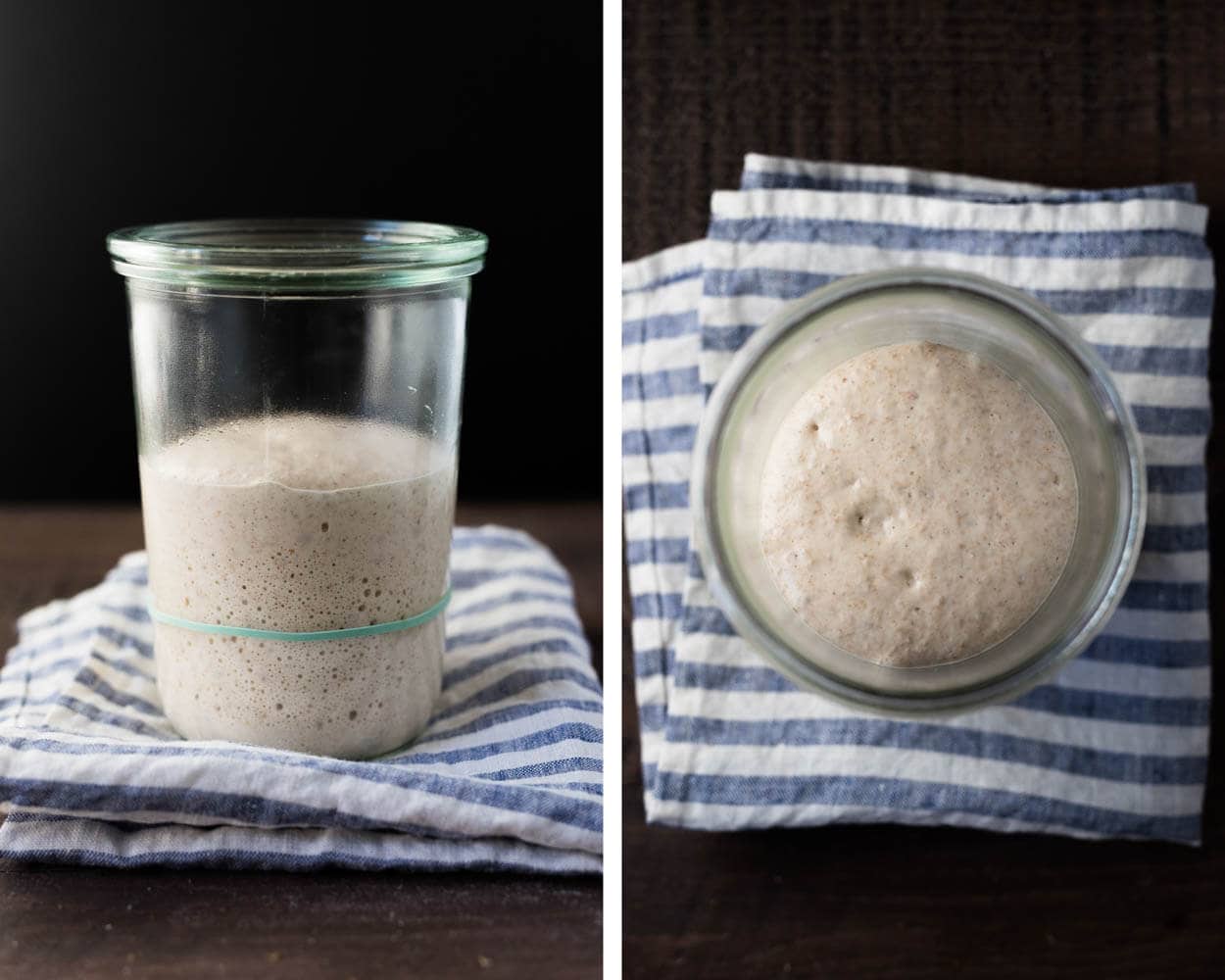
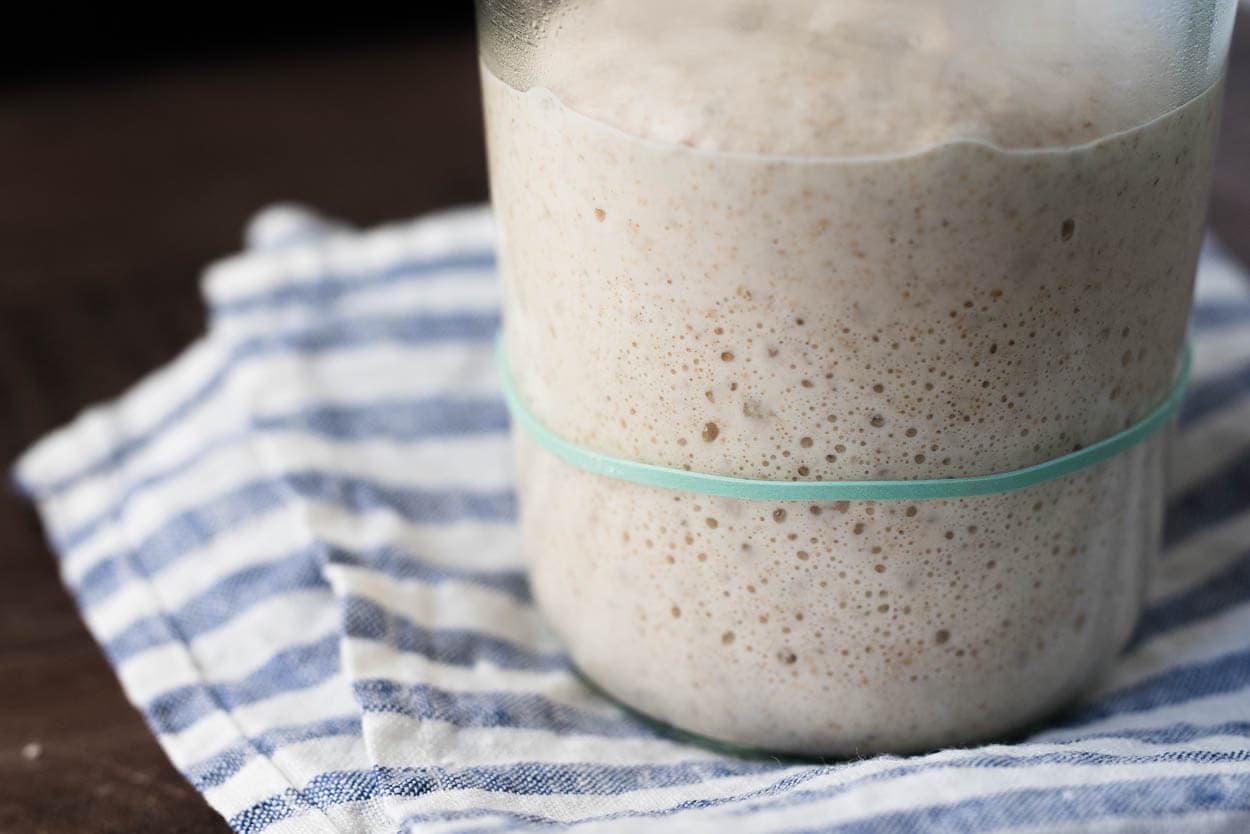
You’ll notice there’s quite a bit of activity already. Of course, after this initial explosive growth, things will slow down, but upward growth will continue for many hours.
3:00 p.m.
At this point, there’s only slightly more expansion than the last check-in. But, you can see many more bubbles on top and at the sides, showing signs of the momentous fermentation taking place. All of these are good signs.
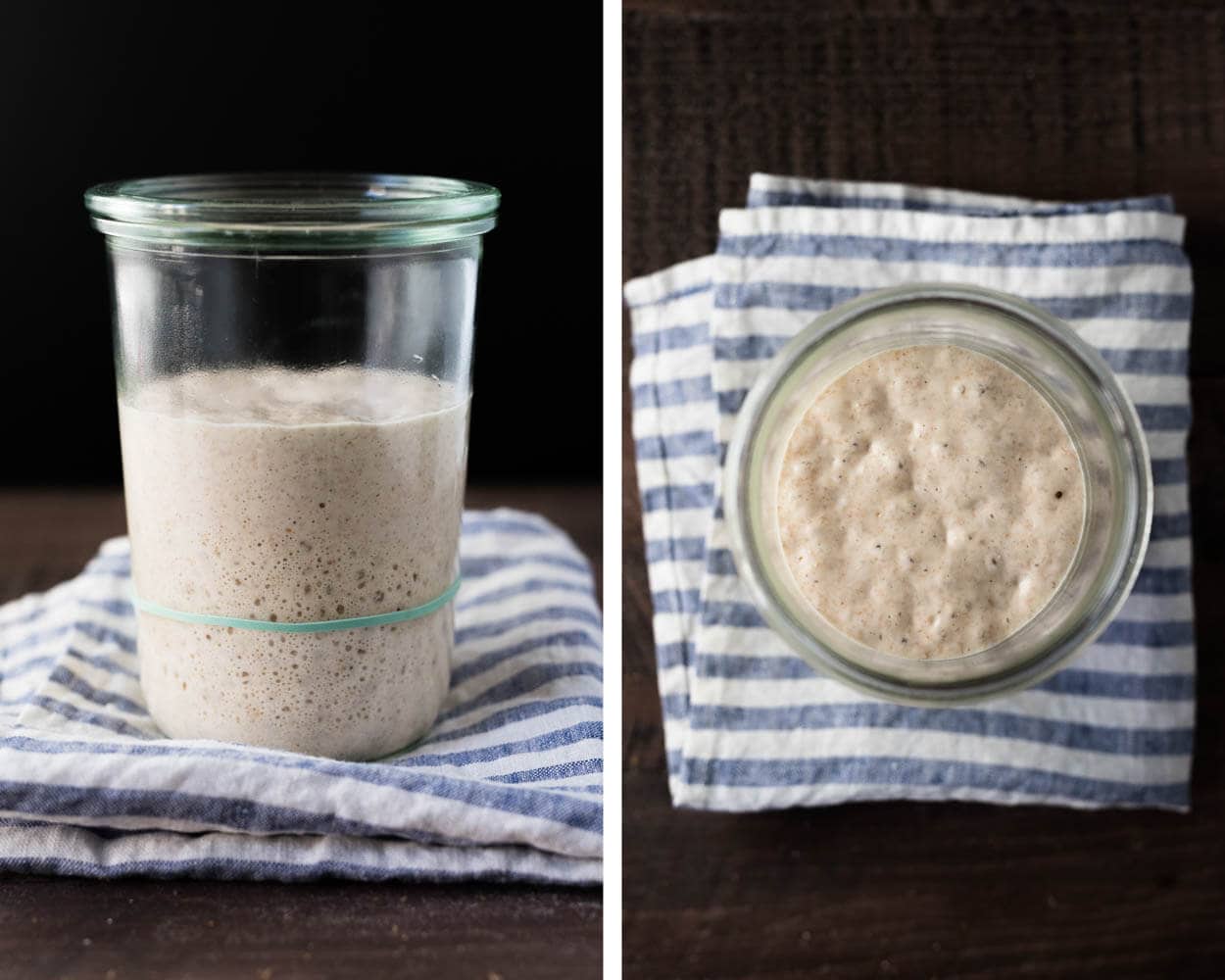
When you build your levain in preparation for baking, you may not always be able to see through the side of the container; the top-down view is sometimes all you have to judge your starter’s readiness. For example, bubbles and holes on top are a good sign, but my starter is not ready to be fed or used now. If this were a levain and not my starter, and I was attempting to use this at a “young” stage, this is most likely where I would use it for mixing my bread.
Another key indicator here is the aroma: how does it smell? Is it still sweet, sourer, or very acidic and vinegar-like? At this point, mine still has a sweet aroma to it, with a very subtle backdrop of sourness starting to creep in.
5:00 p.m.
By this time, we have significantly more bubbles at the sides and the top; overall fermentation activity is much higher. If I were to describe the aroma of the starter at this point, it would still smell quite sweet at it was at 3:00 p.m., but now the sourness is starting to escalate and build.
Given the look and aroma, I can expect my starter to rapidly come to ripeness very soon.
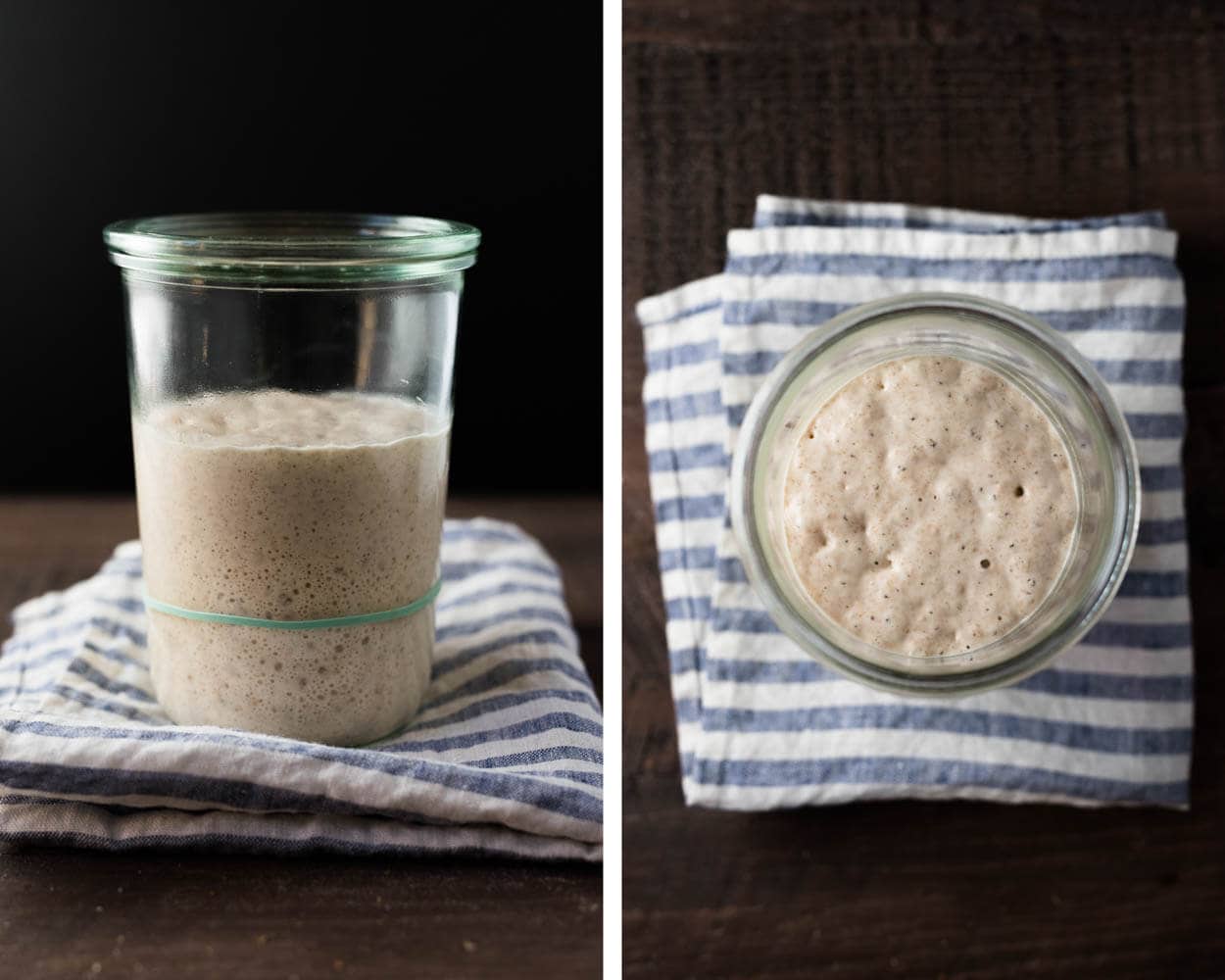
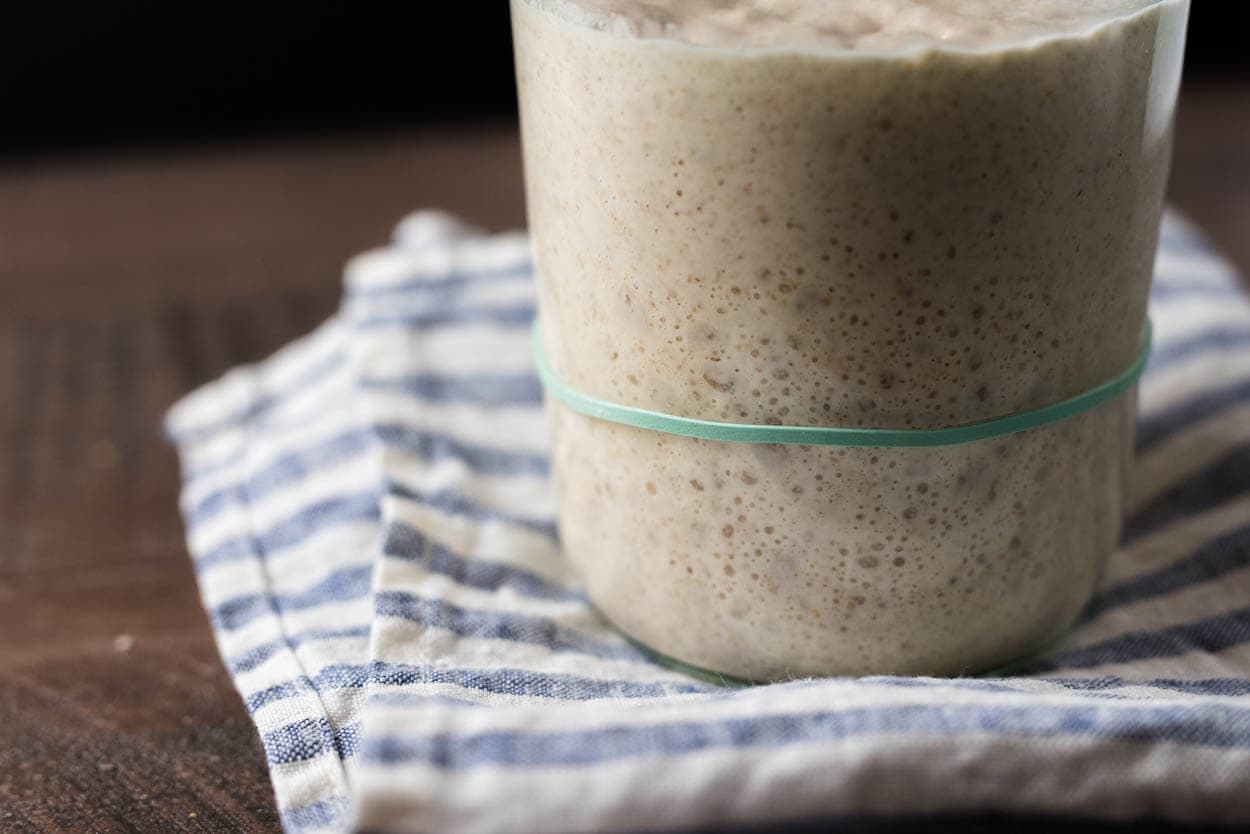
7:00 p.m.
You’ll notice here at 7:00 p.m. any dome that was once at the top of the starter is now gone, replaced by a reasonably flat surface. The flattening of the top usually indicates upward growth has significantly slowed, and upward movement won’t be as prominent—more holes on top and more fermentation visible at the sides. We’ll continue to let it ferment.
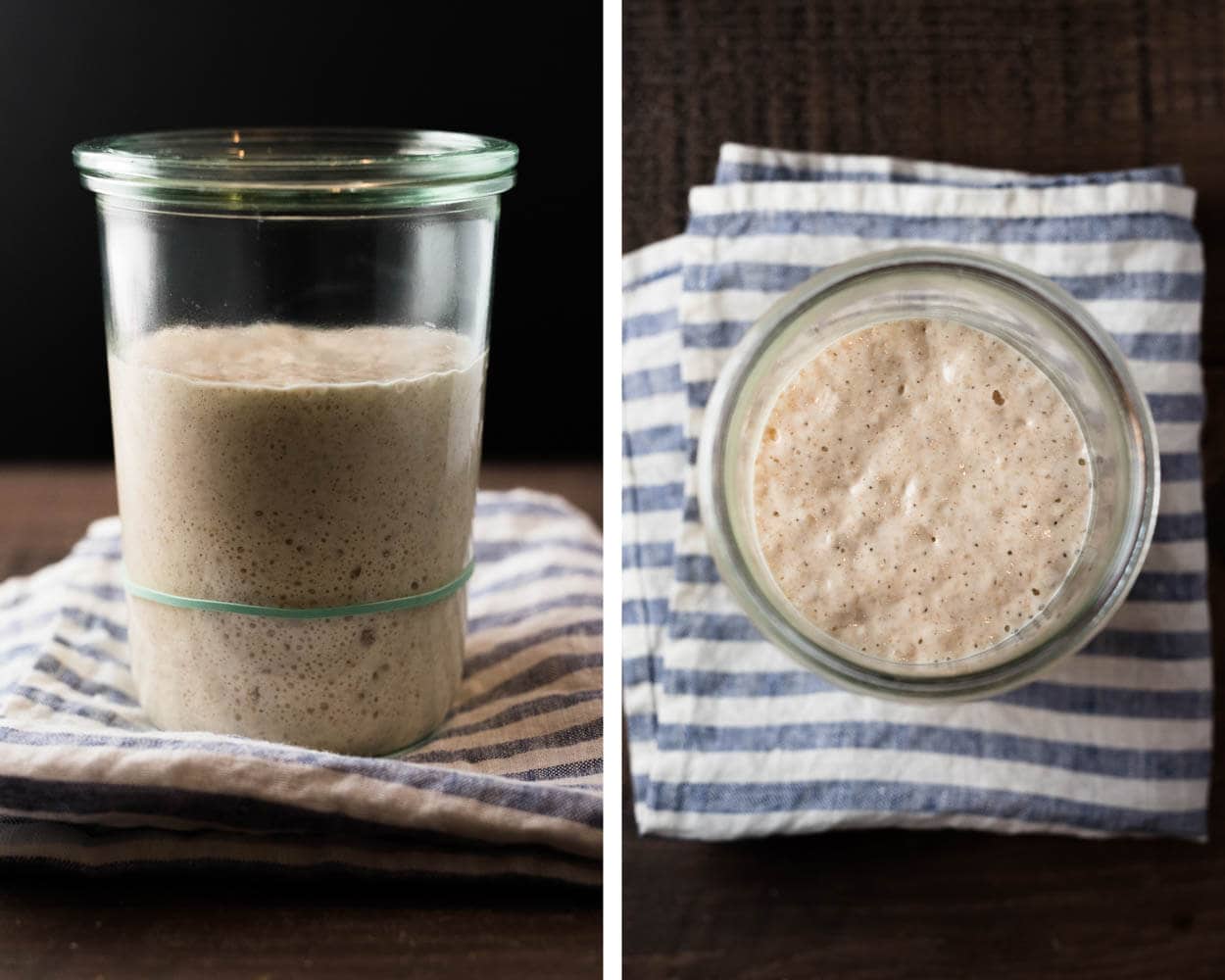
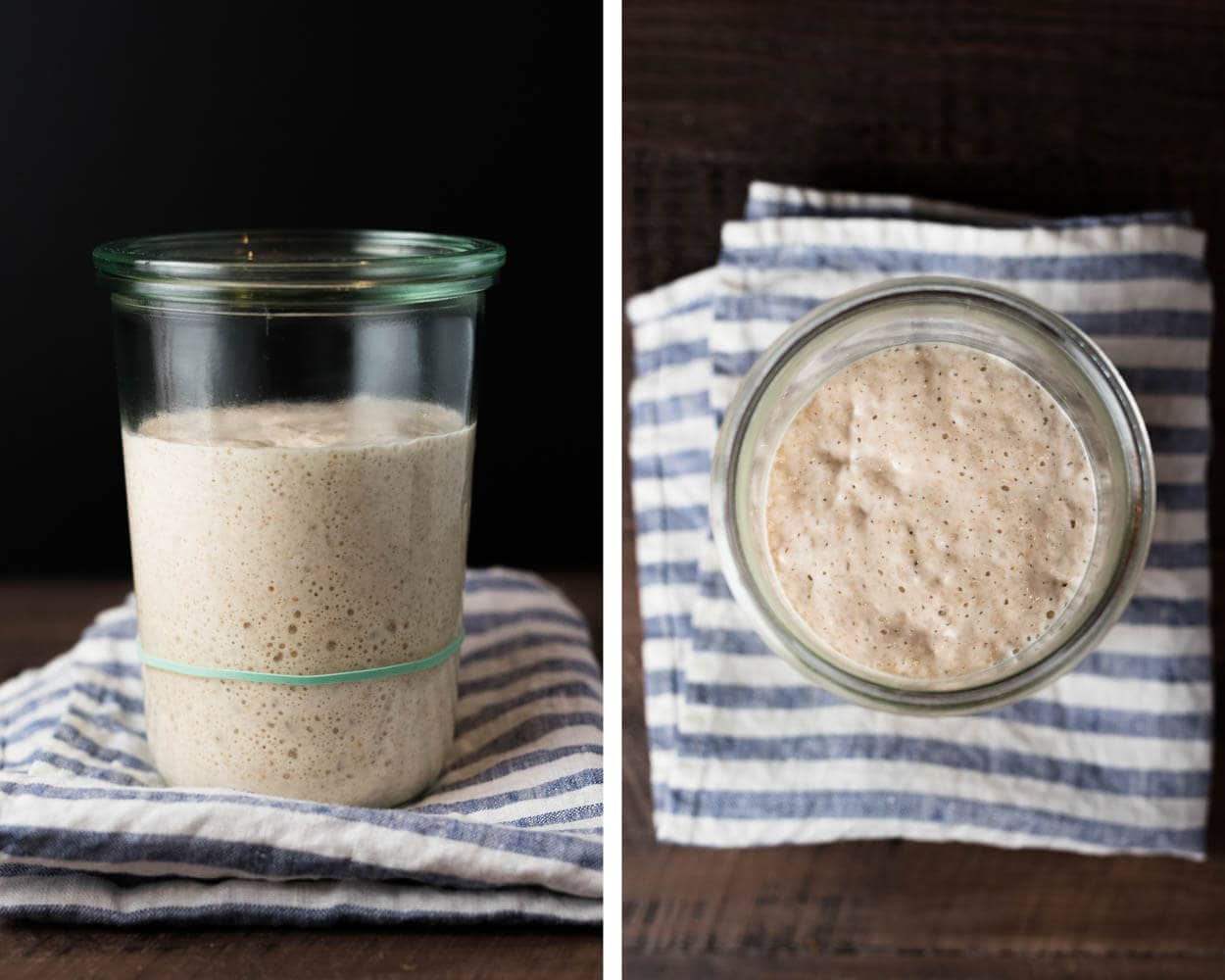
8:00 p.m. – Ripe, time to make a levain
As seen below, we still see some rise since 7:00 p.m., but not much. The top shows signs of more holes and bubbles, and the aroma is what I would describe as “ripe” and ready for use. If I were to pull back a little bit of the top, I would smell a slightly sour, vinegary smell with hints of sweetness still present.
At this point, I’d use some of the sourdough starter to make a fresh levain or use this starter directly in making bread. After making the levain, I would also refresh the starter by discarding and adding fresh flour and water.
While I find the “float test” to be misleading because it can sometimes give you false positives for when a starter or levain is ready to use, the float test would surely pass at this point.
10:00 p.m. – Just past ripe
In the photo below, you can see the culture is beginning to show signs of ripeness. There are streaks at the top that indicate where the top of the starter once was, and in the top-down view, you can see the center is starting to collapse.
The fact that it’s starting to collapse is not the single most crucial factor in judging readiness. Instead, it’s the cumulative signs that are most important.
The fact that it’s starting to collapse is not the single most important factor in judging starter and levain readiness. Instead, the cumulative signs matter: a general breakdown of the mixture, a stronger sour aroma, and significant gas production.
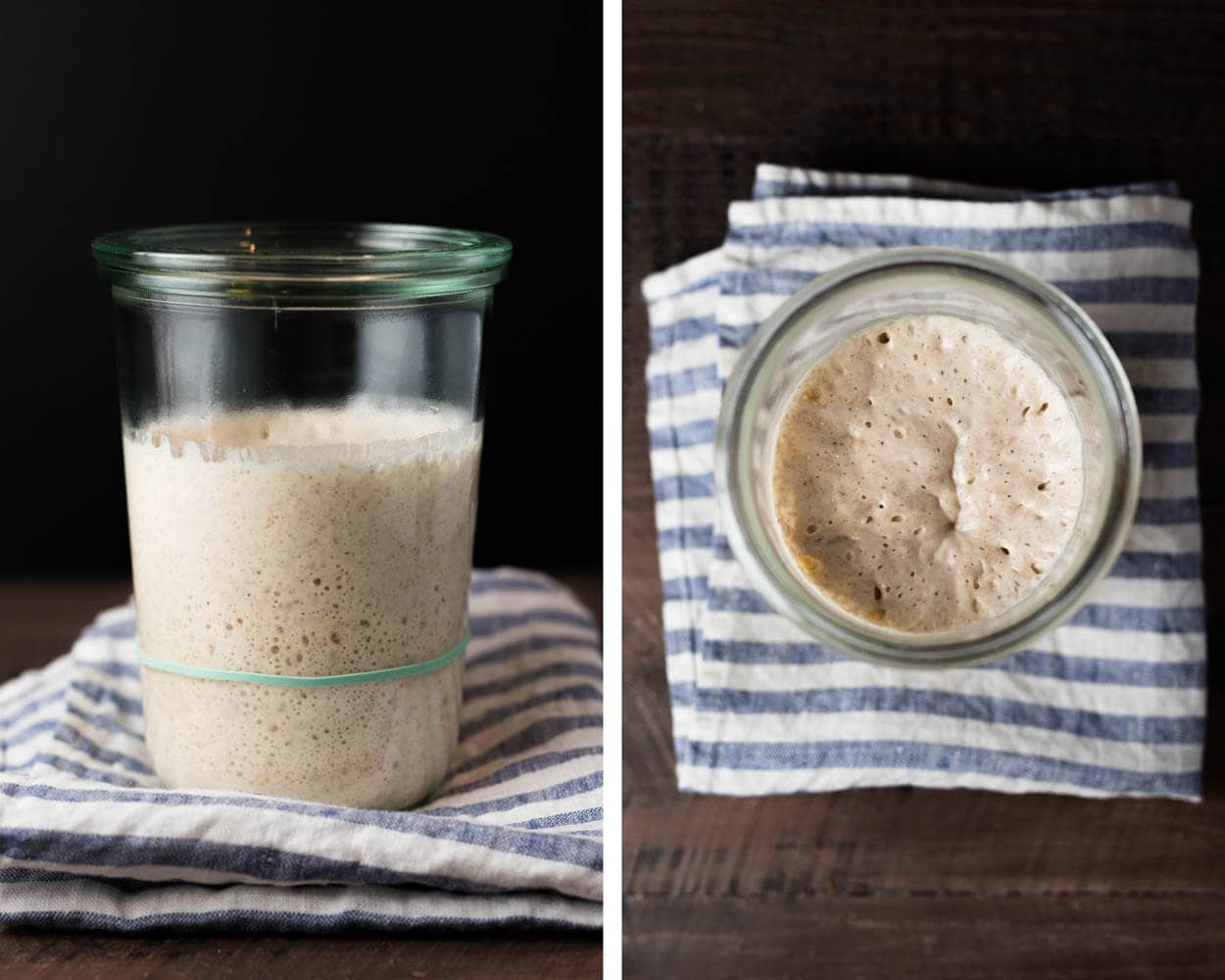
Again, if this were a levain I built in the morning to mix into bread, I would still feel comfortable using this to mix my dough. I’ve used my starter/levain at this point to make excellent bread. I’ve touched on the topic of a “young” levain in the past, but recently I’ve been using mine when it’s more fully fermented to achieve more flavor.
This time is also when you would want to refresh (feed) your starter. If you are using the correct mixture of inputs—water at a specific temperature, percentage of mature starter, and flour mixture—this time will coincide with when you want to feed it. For me, 10 p.m. is perfect as I start cleaning the kitchen in prep for bed (our little ones at home dictate my sleep/wake schedule, and thus my starter must conform).
If your starter has arrived at this point before you want it to, you can use a smaller percentage of ripe starter carryover or use colder water. If your starter is a bit sluggish and isn’t quite at this level, use a bit more ripe starter at the next feeding or use 2° to 8° warmer water.
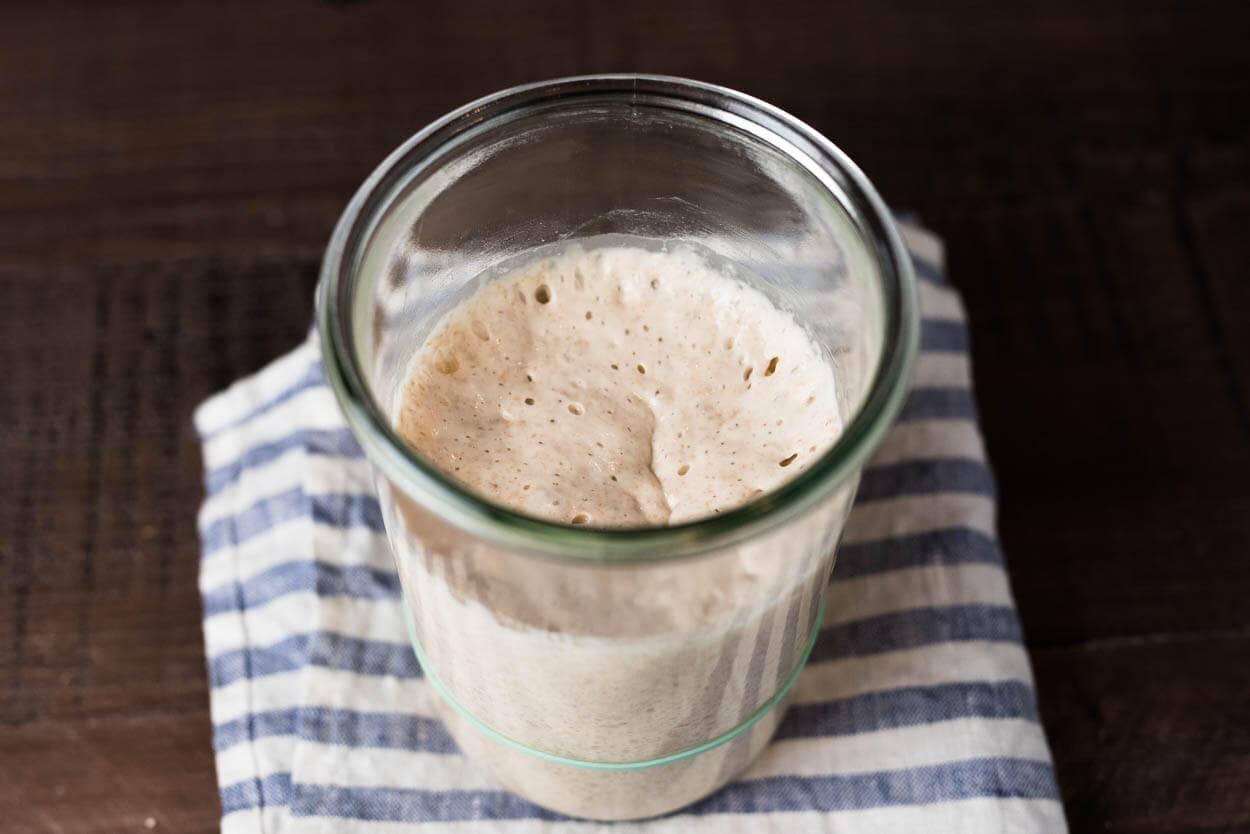
Being observant helps us help our starter to maximize fermentation activity. So, as you continue to care for your starter, take a moment before you rush through refreshments to observe the look and aroma of your starter—plan to adjust things either at the current refreshment or the next based on this observation.
11:00 p.m.
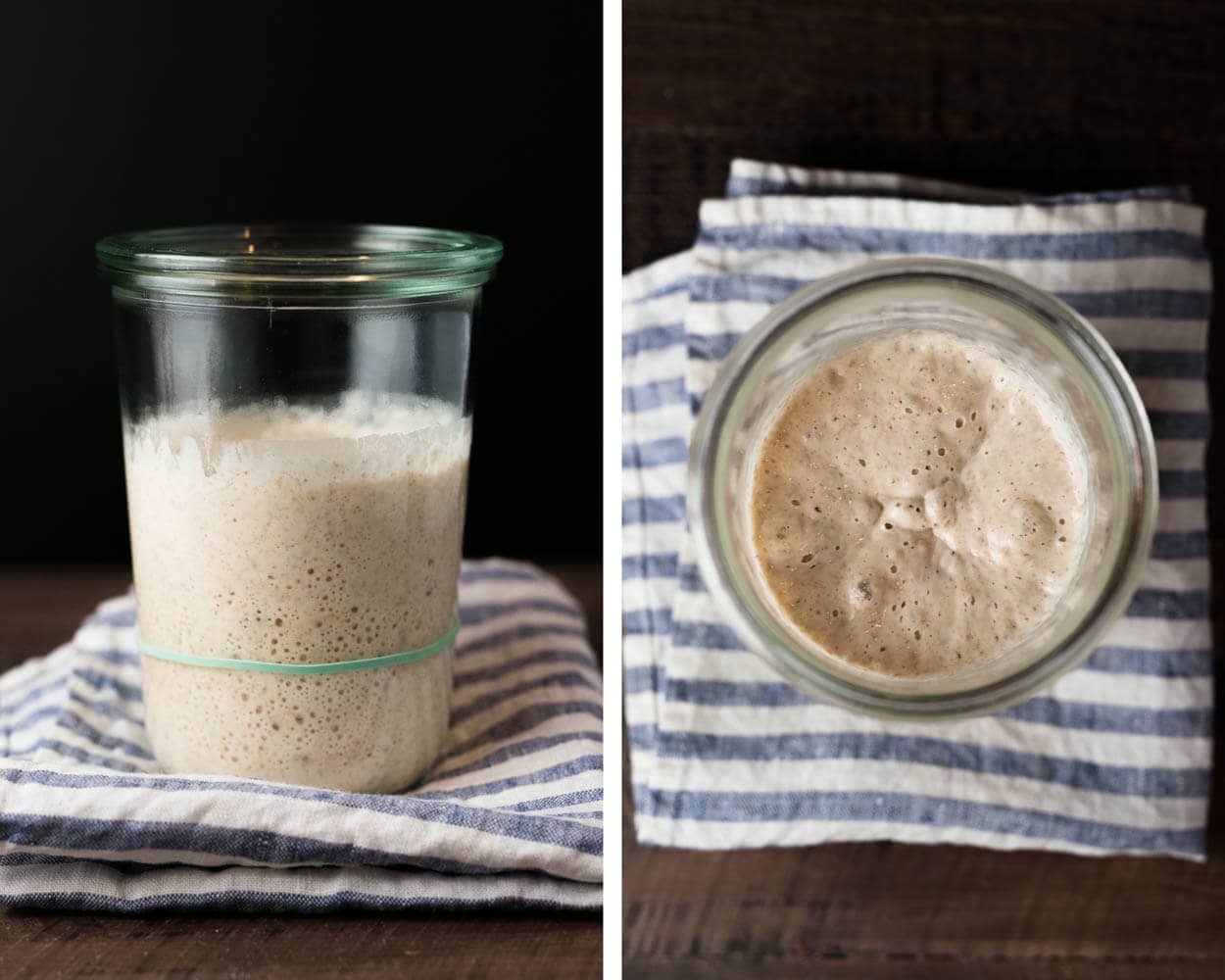
My starter continued to fall at this point, with longer streaks on the side, and the center has noticeably caved. I will normally have refreshed it by this point, but I continued to let this ferment until the morning so we can observe how it looks when it’s gone farther than I’d usually allow.
6:00 a.m. (next day)
What a drop overnight! The sides are entirely streaked with how far the starter has fallen, and the top was covered in small little bubbles. My starter has gone way too far at this point and needs a refreshment.
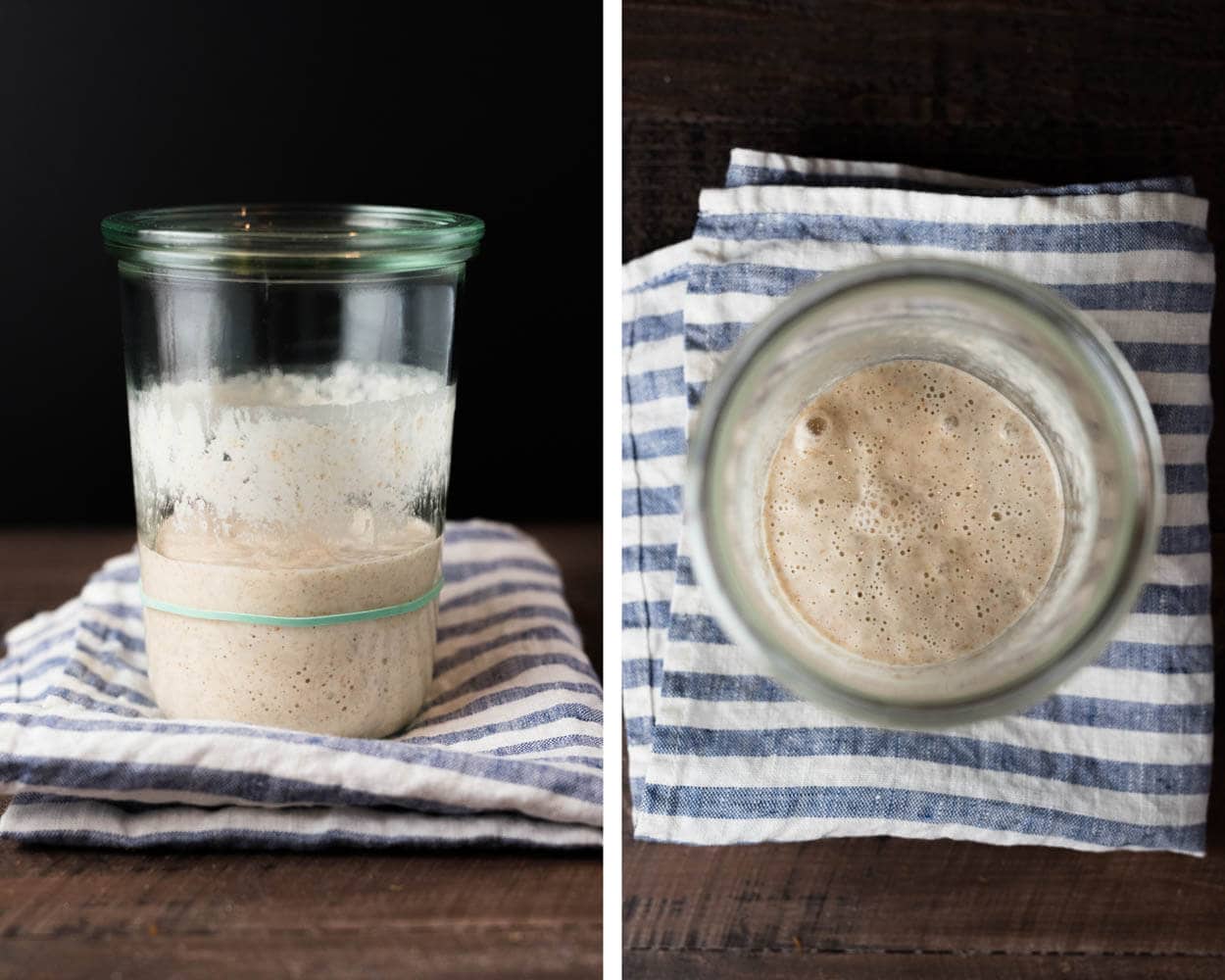
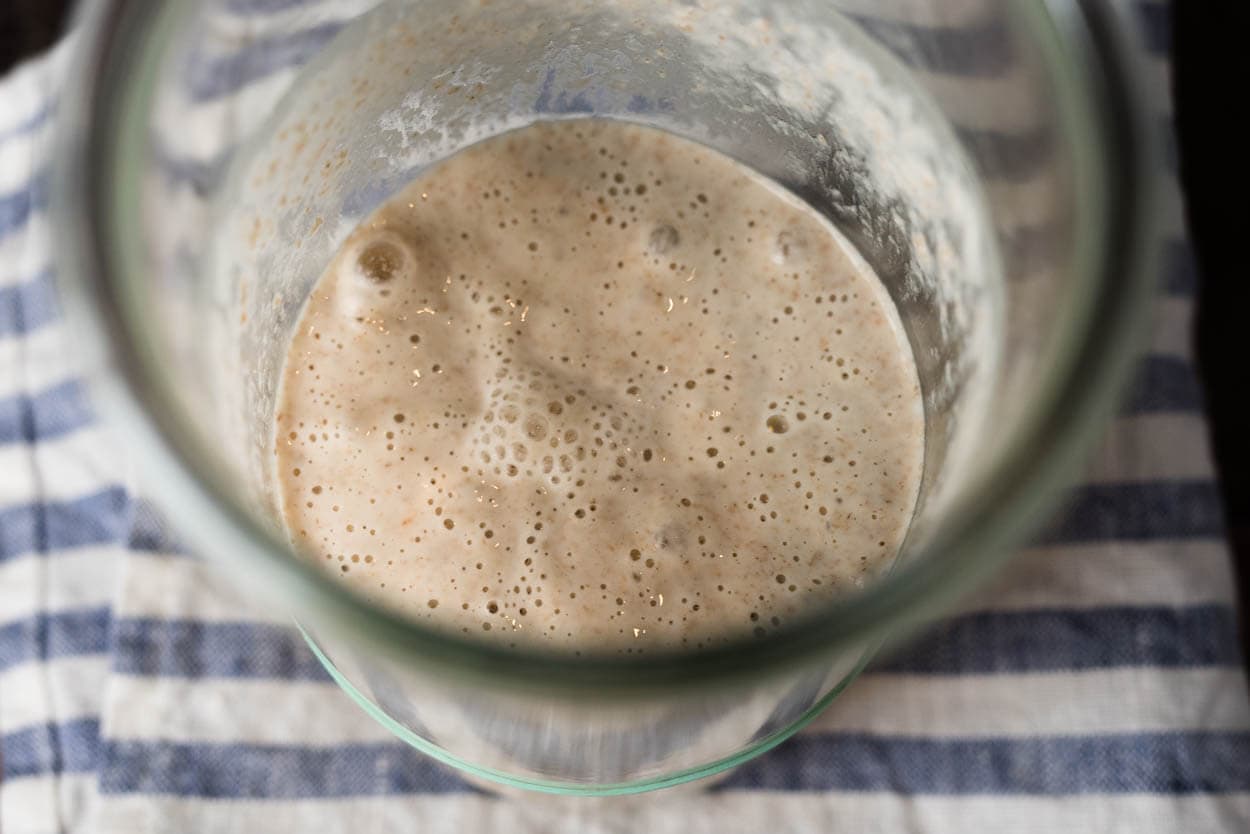
7:00 a.m.
Even more collapse and more small bubbles. At this point, the aroma was very acidic, vinegary, and quite strong.
8:00 a.m.
My final timeline entry shows just how far my starter has fallen after almost 24 hours. The acidity will continue to rise, and if left for even longer, a clear liquid will form on the top (commonly referred to as “hooch”) that will be alcoholic and bitter tasting. Your starter might also look this way if you’ve left it for a long period in the fridge in “hibernation,” as I like to call it. When reviving a starter in this condition, I will pour off the clear liquid, mix the remaining, and refresh as usual.
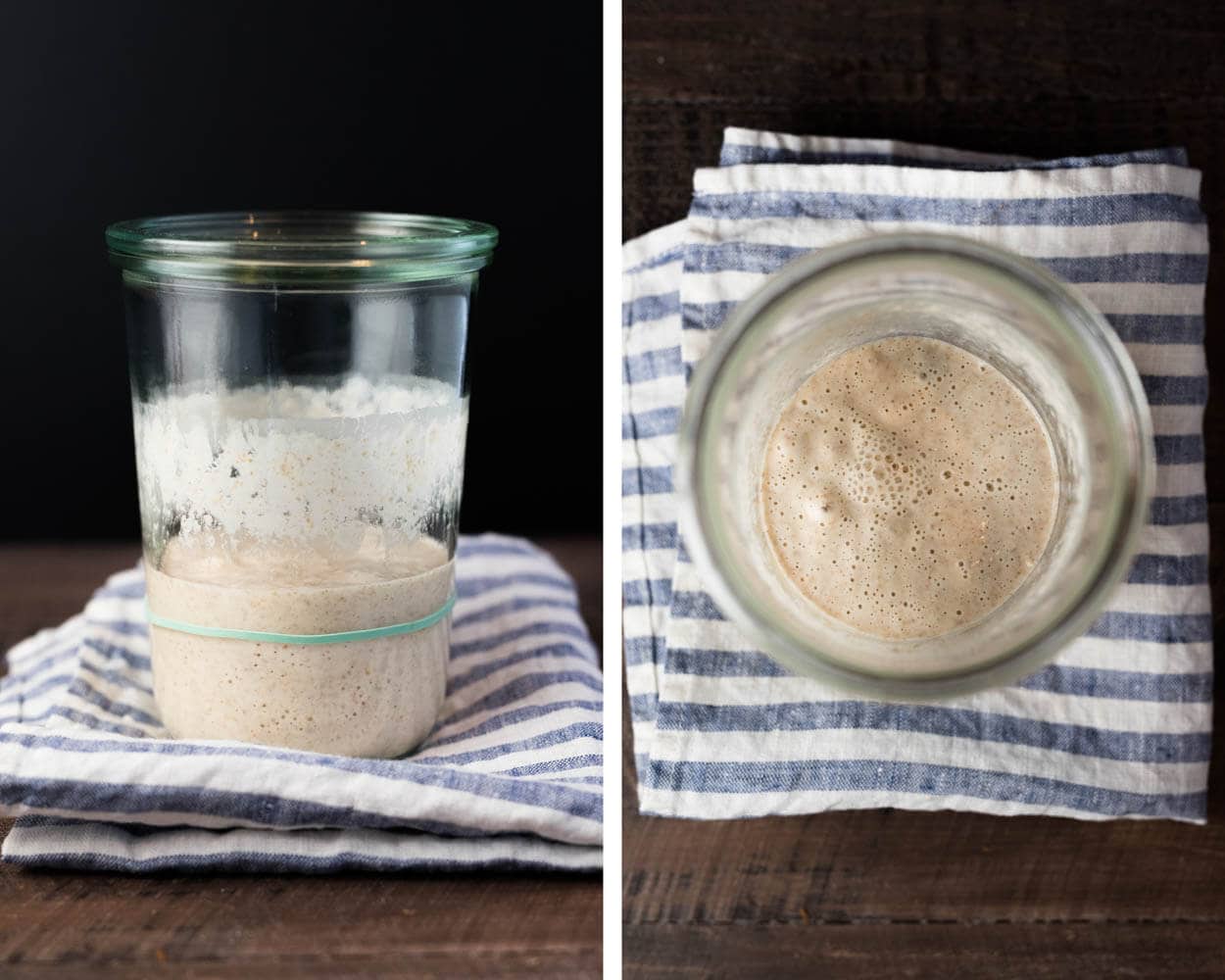
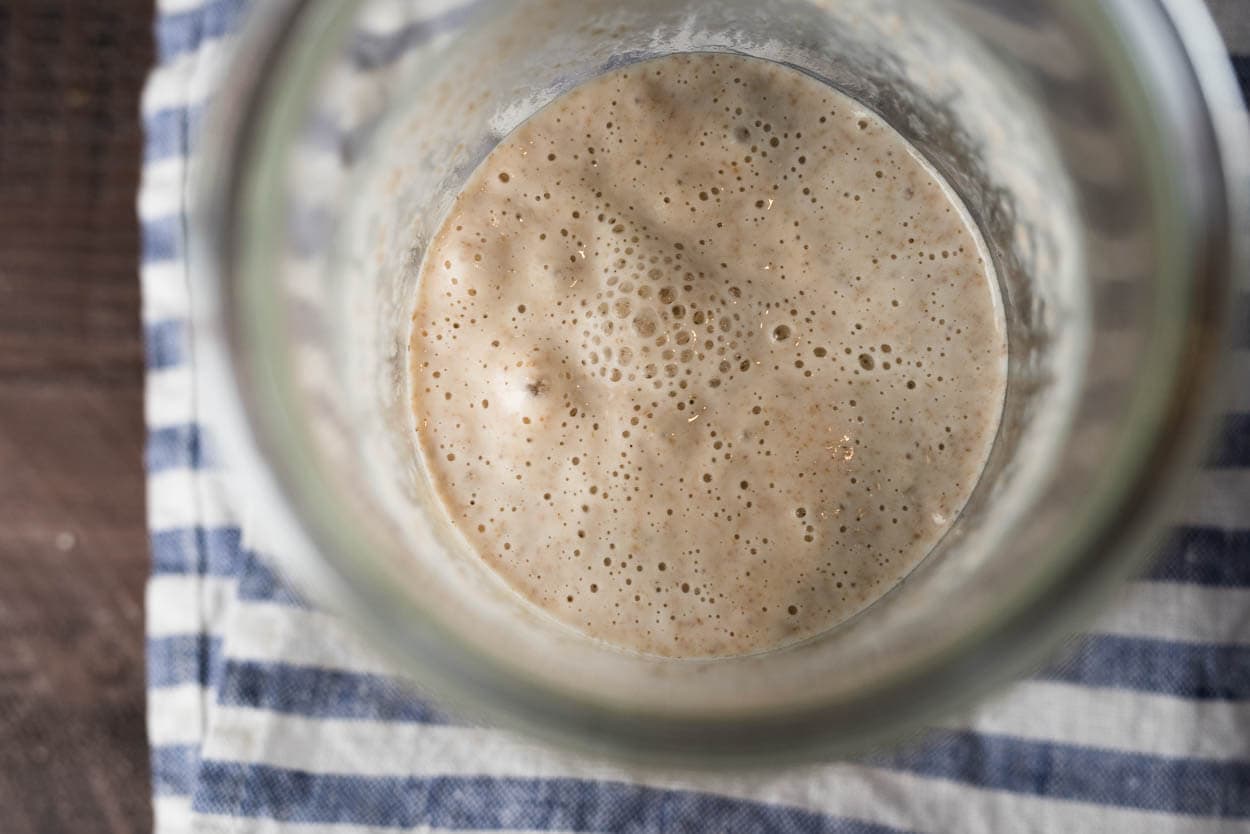
There have been times when my kitchen heated up unexpectedly, or I couldn’t get home before this had happened, and I mixed up my starter per usual, and it was just fine, but I try to avoid this scenario as much as possible.
Don’t panic if you forget to refresh your starter for a day or two! It will be just fine with a few timely refreshments and some attention.
General Sourdough Starter Maintenance Tips
See my sourdough starter frequently asked questions post for a long list of common issues, but here are a few tips that will prove helpful:
- Don’t let your starter collapse and sit for extended periods as excessive acidity will change the flavor of your resulting bread (sourer). If it’s a levain, not your starter, and it’s fermented much too fast for your schedule, you can always make an intermediate build (essentially discard and add new flour and water) and use the new build to mix
- Use your nose. Observe the aroma of your starter at each phase and get to know what a particular aroma indicates by drawing a connection between aroma and visual cues
- If your area has high chlorine levels in the water, use filtered (or distilled) water or let the water sit out on the counter overnight in a water bottle before using
- Stir your starter thoroughly until there are no clumps or dry bits of flour present
Above all, take a few seconds each time you refresh your starter to sit back and assess how things look, smell, and even taste (I don’t typically taste my starter, but many bakers do). Through constant observation and attention to small details, we can maximize fermentation in our sourdough starter maintenance routine.
Sourdough Starter Maintenance Tools
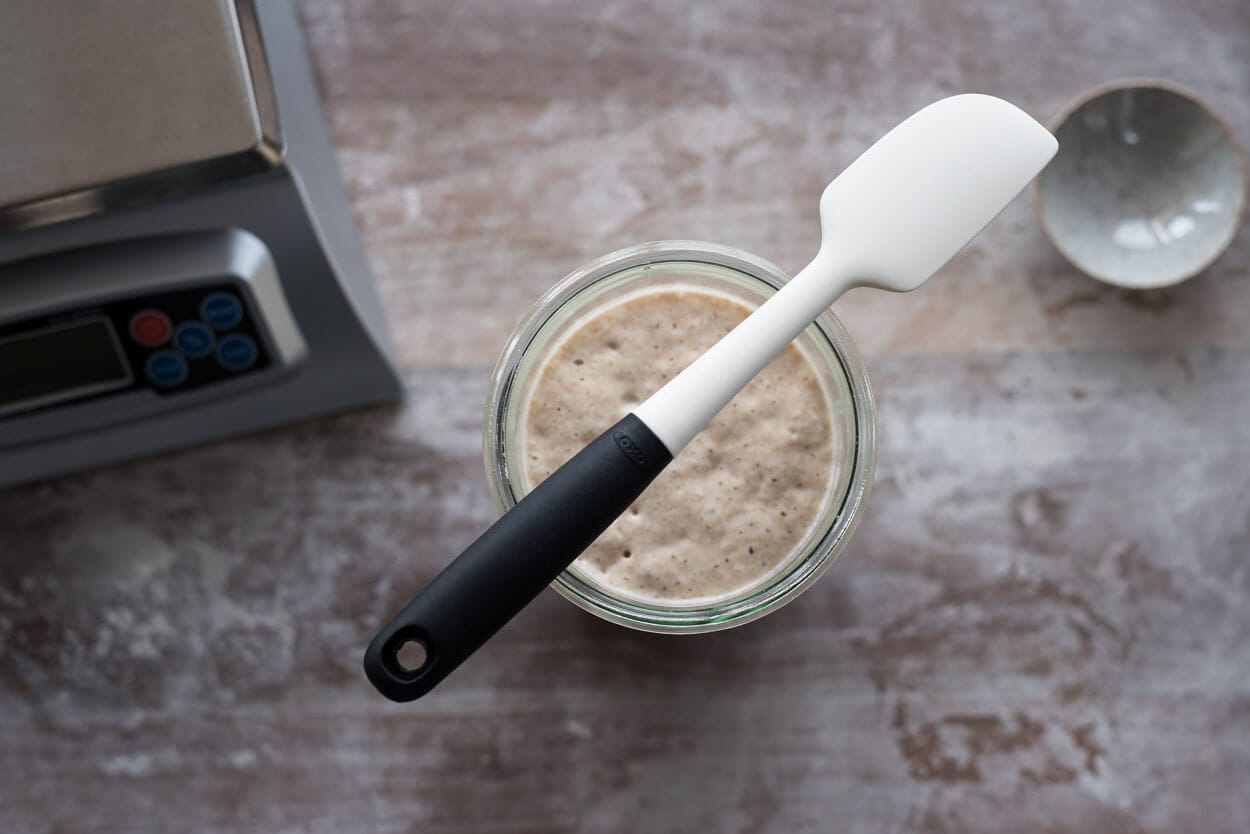
It’s funny how small tools make a huge impact when compounded over multiple times a day for every day of the year. I recently changed my stirring apparatus from an old Pyrex spatula to this newer Oxo spatula, and wow… So much wasted time cleaning that old multi-piece thing. This Oxo one is covered with silicone at the top with no seams or joints, it’s very sturdy (which helps act as a firm mixer), and you can also toss it into the dishwasher. Highly recommended.
Aside from the new spatula, I still use the same Weck jars, dark rye flour, and all-purpose flour. Head to my tools page if you’d like to see more of the tools I use for my sourdough starter maintenance.
Sourdough Starter Maintenance Wrap Up
There you have it, a day in the life of my starter and my sourdough starter maintenance routine. I hope this visual guide has helped convey the visual cues and aromas I look for at various points through the microevolution of my starter. The same signs shown above are also present when I build a levain when making bread.
Remember the methods we have to impact the fermentation rate: temperature of the water, inoculation percentage (amount of ripe starter left in the jar), flour selection (whole grain flours increase fermentation), and ambient temperature. If your starter is sluggish, increase these to speed things up or decrease them to slow things down. After a few days of experimentation, you’ll discover the right mix of each for your unique starter.
Now that your starter is on a regular maintenance schedule, don’t forget you can use the daily starter discard in many delicious things in the kitchen! Buon appetite!
For more sourdough starter guides, check out my sourdough starter guide roundup.


704 Comments
Hi,
This is a super helpful site and I’m new to sour dough baking. I bought Jim lacey’s Sullivan Street Bakery cook book and am trying to get his liquid starter up and running using only all purpose as per his recipe. I am trying to get a hold of rye as i heard its a lot more helpful but scare at the moment due to the pandemic. The only difference i notice between yours and his, is he asks for it to completely collapse and hooch and he just calls a separation of flour and water before you refresh it. You are suggesting not to do that?
If I feed my sourdough starter this way, do I need to do something to adjust it for a recipe that calls for a 100% hydration starter?
As long as you’re feeding your starter equal weights of flour and water, it’s at 100% hydration and correct for that recipe.
Thank you so much! I was wondering if maybe that was the case, but some things I read seemed to indicate that the starter had to also be the same weight as the flour and water.
Once I have what I believe is a mature starter, what are the simple steps to a) maintain it, and b) bake with it?
Your starter goes through cycles of maturity. A starter is ‘mature’ once or twice a day for a few hours, usually directly before feeding. A mature starter will have grown. At that point, you can use it to make a levain or use it in a recipe. A starter is, most of the time, not mature, and there is no way to change that. Hope this helps.
Hello Maurizio,
Hugo from France , I’ve got a levain for more than a month. I’m baking 1 loaf everyday , but i’ve got a probleme with my starter and my levain . They are super slow to rise. I use a 1 – 2 – 2 method of feeding and water at 86°. I’ve also tried to add more rye but it doesn’t change anything in my slow schedule . .
Do you avec any tips for me ( :
Thanks a lot
Try placing your starter in a styrofoam cooler with warm water (110-120 degrees F) in jar adjacent. Check rise every 4 hours or so. Make sure not to place hot water jar right next to starter. I cover my jar with a moist cloth. Remember to keep lid closed, no frequent peeking!
I have fed my starter now after a week and in 7-8 hours it is almost doubled. When can I actually use for baking. Do I need to feed it 1 more to make a more active starter. Thanks
You should never use a starter directly after feeding. Depending on the starter, a ‘float test’ may work – drop about a half teaspoon in water. If it floats, you should use it. If not, wait another hour or two.
Thank you, I fed it twice and when I was comfortable that it is okay, I baked it. Thank you very much for your reply. will test this next time.
Hello, I believe if the starter doubles its volume within 4hours after feeding is strong enough to use in bread recipe.. You can feed in the morning 75 matured starter with 75gwater +75 g flour, after 4 hours if doubled volume use in bread. The rest of starter which you won’t use in bread recipe, feed with ratio 25g +100g+100g
Can anyone help me? I am in the VERY early stages of building a starter – day 4, and its very liquidy, almost soupy. It also has a very acidic smell. There is a hooch. In the original “how to make a starter” post, it is said to just mix it in and continue with the feeding schedule, but in another post, it says to pour off the hooch. I have been mixing it in, and I wonder if that’s why my starter is more liquidy. I also think I’m keeping it too warm – overnight in the oven with the light on (around 90 degrees F). Is my starter garbage now because of the awful smell? If not, how do I move forward with ratios to get it back to the thicker consistency? Thank you al so much!
In the early days, an “awful smell” is fairly normal – but if it makes you want to gag even after you’ve let the initial CO2 wave dissipate, it may be time to try again… You don’t want to start a starter in the oven – 90° is very hot for baby yeasts and bacteria, and from everything I’ve read and done (3+ years of learning), the oven trick is more for when you want to rise a dough more quickly (e.g. for commercial yeast breads or pizza dough). Too much heat is going to cause Team Sourdough to eat too quickly and that’s why you have hooch – no food left for them. For your starter, you should be leaving it on the kitchen counter, loosely covered. If the smell is more funky (a bit savoury, pungent and astringent) than horrifying (cheesy, complex, and you think you’re going to throw up), you’re fine. I stir in my hooch with the next feeding – partly because that keeps it at the same hydration level as I’ve banked on, and partly because I hate wasting anything…!
Hi Maurizio, I have been baking sourdough for 2 years but after reading your guides here feel like I’m not taking it seriously enough! I went to a sourdough masterclass at Bourke Street bakery here in Sydney which has a very good reputation, they gave me some of their famous starter and I have been feeding it every day with 50:50 plain white flour and water, keeping it in a plastic Tupperware like container with a screwtop lid in the fridge; taking it out once a week and making bread. No watching the rise and fall or paying much attention to it! Sometime I leave it out and it has bubbles, it also gets bubbles in the fridge. When Covid 19 lockdown started I had to use wholemeal flour to feed it, looked up google and it seemed that would be fine, and quite liked the texture so have alternated a bit with wholemeal and white as supply of white came back. Lately I have noticed the starter is quite rubbery, a different texture that it has always been. Can you help me with what has happened and how I can fix it, if it needs fixing please.
Hi, i have a starter that is all purpose flour, and lately i have been having some problems with it, i feed it 1:2:2 (20gr starter, 40gr flour, 40gr water) and after 6 hours aprox the rise stars to fall, and it keeps going, it doesn’t reach to 12 hours, i put it warmer places around my house but its just the same, i have been changing the amounts like you said in a post but i doesn’t make a difference, it grows and falls, i just wanted to know if had any tips that may help me or if i should start another starter, I haven’t bake any bread with it cause it doesn’t have a consistent grow like i hope to,
I would really appreciate your help.
Hi Maurizio! Thank you so much for all your tips and guidance!! Question, how can I grow my starter? Can I double the amount I keep so I can use more on my bakes?? Also, if my starter is more stiff and I want to make it more liquid, would you recommend to in increments?
Hello! My local bakery had home baking kit that included flour and 12gram of starter. I followed your feeding directions but reduced by 50% amount because of not having 20 grams starter. For evening feeding, can I keep feeding WITHOUT removing starter since I have so little? Thanks for the helpful information here!
You always add about 5 times as much flour or water as you have starter. Removing any is only to reduce the total amount that you have (for instance, if you have 12g starter, then do not remove any and just add 60g water and 60g flour, but if you have 100g starter at the start of the next feeding, reduce to lets say 20g and add 100g flour and 100g water.
Hi from Portugal ! I’m feeding my starter as you recommended, twice per day 50g starter 50g ap flour 50g rye flour and 100g water. It’s developing super well and has made excellent bread but is it possible to reduce my feeding schedule to only once a day ? Would I have to change my ratios ? Thanks and great blog !!
Is it possible to discard a high quantity of mature starter (say 120g), refrigerate and subsequently use it for levain the next morning?? Just wanted to know if the discard could be sealed air tight and placed in fridge or freezer and then used for breadmaking later.
Hi- so when you feed your starter 2x per day, do you throw out 200 g (ish) every time, so that you get down to 20g starter?
Do you weigh it out so that you get 20g starter left?
Thanks!
Blythe,
Yes, when feeding your starter you remove the excess starter, so you only have the desired amount left. In his article, it is 20g, but it could be more or less for you, in your environment and for your schedule.
To be consistent it is best to be precise. Especially when you are working with yeast, which is alive and can be a variable. It is always a good idea to weigh.
Good luck in your baking.
Hi Maurizio, I’m not sure I understand the difference between a levain and a starter. I currently have a mature levain that I was provided from a local bakery, and I have been feeding it before use – but I don’t understand how I would be scheduling feeds if I’m only using it once a week. I can’t seem to find information on how a levain is different from a starter, so I don’t know how to treat it. Can you point me in the right direction on how to feed my mature levain?
Miriam,
Levain and starter are pretty much the same thing, they just have different names because of their uses. Lots of the time people use them interchangeably. Your sourdough starter is what you keep and continue feeding, you can even retard it in the fridge or the freezer for less frequent feeding. Your levain is made from your starter and is used in your sourdough bread recipe or etc. You can customize your breads or whatever else you are making by adding different flours and such into your levains, but have a consistent starter. In reference to the bakery where you got your starter/levain, in a commercial setting there is no reason to continuously feed a starter at the same time that you are using a levain on a daily basis. Most likely that is why they called it a levain, because they are directly using that in their recipe. Commercially and even now I always have a frozen starter and a fridge starter, these are on top of whatever room temp levain I needed/was using. For me I consider a sourdough starter and a levain different. A levain is a pre-ferment, to be directly used in a recipe. Other pre-ferments are biga, polish, sponge… Some pre-ferments are used for leavening, some flavour development, texture, structure… etc
For feeding, just treat your levain as your starter. 1 to 1 flour water, you can use various wheat flours. I find yeast likes a whole wheat flour, so if you have a sluggish starter or are trying to refresh/revive an exhausted starter it is a good choice. For the amount of starter you use in the feeding and the temperature of the water (I have successfully used ice before), that all depends on your life schedule, baking schedule, humidity, temperature… etc
This article is very informative and explains that you most likely have to customize to your specific scenario. Baking requires specificity to be consistent, but remember yeast is alive, it is a variable. You should learn to know what your entire process should look like, smell like, feel like, sound like, taste like, as well what it should be. If you are able to do this you will be able to make corrections when needed, speed things up, slow things down and know when it is not salvageable.
Good luck and have fun with the baking.
Hello Maurizio- I have been using Ken Forkish’s SD starter formula and keeping it alive for about 2.5 years. I’m wanting to try a more regular feeding cycle and using the weck jars you recommend. His usual feeding is 200g white flour, 50g wheat and 200g water. Today, I took your feeding cycle of 20g of the Forkish starter with 75g white flour an 25g wheat flour and 100g water as you suggest in the post above. Any reason why this shouldn’t work? I’ve kept some of my original starter in the fridge, so nothing lost from trying it. Just wondering if it’s possible to take a previously established starter and adapt it to your feeding cycle and proportions? Any advice or recs greatly appreciated!
Greg,
I doubt there would be any issue at all. The flour is the same and the flour ratio is only slightly different so at most the flavour would change just a bit and possibly the fermentation time.
The major issue I see is the difference in hydration. This article is 1 to 1 flour to water and your starter is 1.25 to 1 flour to water. The difference would be negligible, if you use your starter to make a levain, which you then use to make your dough. I assume that if you make a levain your ratio would be the same as your current starter, which is 1.25 to 1. If you do not make a levain and just bulk up your starter to use in a recipe or you update the levain ratio to match the starter (1 to 1), then your downs and subsequent breads that you use this for will change because you will have more hydration in the dough.
This is not necessarily a bad thing and it doesn’t mean your current recipes won’t work, but you might notice a difference in dough texture/stickiness, crumb size, rise, the general structure and abilities to hold its shape. Because of the difference in hydration, the dough fermentation time may change as well.
Good luck with the baking.
Hi Maurizio,
Is it normal if my starter is bubbling, rising and peaking but doesnt show any bubbles on the surface? Does that mean it needs more feeding or change in ratios or it is ok to use?
Mine is a 100% hydration rye starter, fed twice a day for the past 10 days. Lots of activities but never notice bubbles on the surface, just the sides, and the texture is not as gooey, more like stiffer than usual? Not sure how else to troubleshoot.
Thanks
Ginger,
If I understand correctly, from the date you posted your starter is only 10 days old. Have you used it to bake anything yet?
I do not know the kind of rye flour or your flour ratios used if using more than one, but I’m guessing that you have a fairly high bran content. When using a whole grain/whole wheat the product will be stiffer and more dense when compared to a white, but it should still be fairly gooey and only slightly more viscose. Usually with a higher bran content the fermentation process does speed up. No matter the flour used, there should be bubbles on top, because that is gas escaping.
When creating a starter from scratch I usually recommend 100 percent white or minimum 75 percent white to 25 percent whole wheat. After you have successfully made a usable starter, the kinds of flour you feed it can be more flexible. I recommend white, because when making a starter you don’t want to add too many variables since the wild yeast and present bacteria are already variables.
You say that you have been feeding it twice a day. Do you need to? That may work for some people, but that is very dependent on your environment. Temperature, humidity…
My go to answer would be that if the starter is useable, you are leaving it under fermented. When it is under fermented, you still have un-used flour that is making your starter thick or chunky. You did say it is peeking though, so that is why I am not certain. I would recommend to make a disposable batch and to see it through from feeding to exhaustion. I would only feed it once and record times, activity and smells, very similar to what the author does in the article. This way you will be able to know the life cycle of your starter and understand if it is viable.
Good luck with your baking.
Hi!
Question for you. If I am feeding my starter simply for maintenance and not planning to bake in the next 24hrs, how long after feeding it can I put it back in fridge? Thanks for your help!
Andrea,
When I am just trying to keep the starter going I have put it in the fridge or freezer immediately after mixing with no problem. This is if I have no plans to bake or mix doughs in the next 24 hours.
If I plan on slow fermenting the starter/levain and using it immediately (or after warming up a bit) after removing it from the fridge, I leave it for about an hour at room temp (roughly half a dozen tiny bubbles on the top), before putting it in the fridge.
Depending on how cold your fridge is, a roughly once a week feeding should keep your starter good and healthy. When you do keep your starter in the fridge it does tend to separate out the liquid, but as long as you see air pockets and bubbles you are ok. “Hooch” separation, as stated in the article is different though. You can tell because the flour portion in this separation will have little to no bubble or air activity meaning p, you are in dire need of a feeding to try to refresh/revive your starter.
Good luck with the baking.
Hi! I am Chelsea from Hong Kong. I had just made my first sourdough few days ago, and start read through more websites to learn more about the sourdough making. I find your website very very useful! Thanks a lot! However, I have some questions about the starter maintenance to ask,
1. Will you keep your starter in the fridge ( my fridge ard 1 degree) ? as I will not bake as often as you or others, so if I keep feeding it but not using seems will accumulate alot of starter. So I see some website that they will keep the starter inside fridge and feed them once every three days ( in a regular interval)
2. Let say I will take some starter for making levain. As I keep my starter inside fridge at this moment, so I will take out the needed portion of starter from fridge and then mix with the flour and water the night before I make the sourdough the next day , and wait till the next day I start doing my sourdough. Is it ok? if not, any better suggestion for me? as my main concern is whether I need to keep my starter in fridge? as the temerapture in HK will be getting hotter one to two months later to ard 30-32 degree while now is 23-25 degree! Thanks alot! seems a lot of questions sorry !!
Hey, Chelsea! Answers:
1. Check out my weekend baking schedule, sounds exactly like what you’re looking for.
2. Once it starts to get super hot you’ll have to adjust how much of your starter you leave in the jar each time you feed it. If it gets to 32C, I would likely leave a very, very small amount in the jar, perhaps just 1-5g. If your starter is still very, very active you can also add 1% salt to your starter. Don’t add too much salt, just 1g to 100g flour, this will help slow fermentation even further. If it’s still too active, try 2% salt.
Hope this helps, let me know how it goes this summer!
Hi from Ireland Maurizio. I was wondering if you had any advice for following situation, as I’ve tried tweaking water temp etc and don’t seem to be seeing any differences: my starter (25g/30g starter, 100g strong bread flour, 100g room temp water), which I am feeding twice per day, for the past week, seems to rise slightly less than 100%, unlike yours, and takes longer to get to that point, more like
7 hours!! And then falls much more quickly and peaks more like 10 hours, not 12, which is my goal… Any advice on how to get a higher rise (I’m not sure exactly which element creates this) and it to rise sooner and for longer (again, unsure which element causes this, to tweak) would be much appreciated, Aisling
Ugh, I am in the same boat! I cant figure out how to get my rise to 100%. I’m currently at 1:2:2 ratio and my kitchen is about 75°F through the day. Dont have the option of keeping it in a warmer. I’m actually working on two at once with a different balance of flours, one being WW the other 50/50 WW/UAP. Neither one gets to 100%. I saw you mention before to someone about it being too acidic perhaps? How do you correct that?
See my reply, above!
Amazing! Thank you!
Hey there! You don’t need 100% rise in your starter! The amount it rises up isn’t super important, it’s just that it’s consistent each day and you’re seeing some strong signs of fermentation, which it sounds like you certainly are. Don’t worry so much about the rise, your starter is perfectly fine.
If it’s peaking too fast, leave less in the jar, perhaps 20g, and it’ll last a bit longer. If it’s still not long enough, drop down to 15g.
You’re doing all the right things here!
Oh!! Okay thank you very much 🙏🙏🙏
I just started a starter that starts with dry active yeast – but there is nothing about feeding it until after 4-8 days, AFTER I’ve taken out what I want to use in a recipe. Is this normal? Or should I be feeding it regularly like the starters that don’t start with yeast being added. I’m not sure what to do with it?
Sorry, I don’t know, I’ve never created a starter this way, I have only used the method here at my website 🙂
Hi Maurizio. i have a starter that is 8 days old that consists of 100% whole wheat flour; when i feed it in the morning i see that after 3-4 hours it starts to double in size and when i do the water test, it floats on the surface. after 6/7 hours it starts to fall a bit so would i consider doing the levain after 4hours?
If it starts to fall around 5-6 hours, that’s precisely when I’d use the starter to make a levain.
Hi Maurizio! Just a quick question- my starter is about 4 months old and typically I have always kept it in the fridge full time, only leaving it out to build a levain. However, I noticed that you and I think most people leave their starter out all the time. If I leave mine out, it ferments super quickly and I cannot keep on top of it, with it almost always collapsing, causing me to discard, feed and put straight back into the fridge. I think this is because our kitchen is too warm? so can I keep it in the fridge most of the time? what do you recommend – is it much better to keep it at room temp?
Thank you! I recently discovered your blog and have been reading avidly, it is amazing and so helpful.
It will definitely speed up activity if kept at warm temperature. To combat this, leave less starter in the jar each time you refresh it, you can even go all the way down to like 5% (sometimes I even go less!) — for me that means 5g of leftover starter to 100g flour to 100g water. Leaving less in the jar will lengthen the time period between just-refreshed and mature.
I personally don’t like to keep my starter in the fridge longer than a week or so, I’ve noticed it acts less-than-stellar when I keep it in there that long. But if that works for you and it makes bread you enjoy, by all means keep with it! Do what works for you and your schedule.
Hope this helps and happy baking, Georgie!
Hi Maurizio! I have a proper sourdough starter- mature and all- I have a question though : every time I feed the starter I need to discard almost all of it except for 20 grams? and add 100grs of flour? and 100gr water? Its just a bit confusing, for me anyway, how to keep your starter alive and happy every day once its reached maturity- baking with it 2 times per week- without keeping it in the fridge- I would like to feed the starter once a day- so I should remove 1 tbsp of starter and throw it and and 1 tbsp of new flour and water? thats would be ok?
thanks for your help!,
Hey, Clara. Yes, that’s right. You discard down to very little left in the jar. Adding fresh flour and water gives the mixture more “food” which it will use for fermentation that day. If you want to feed it once a day, leave very little in the jar, perhaps 5g, and see how it does over the next 24 hour period.
Essentially leave less starter in the jar each time you feed it if you want that period between feedings to be longer.
Hope that helps!
Hi Maurizio! I really like your website and learned a lot! I just have one questions. For every feed, twice a day, you use a lot of flour and water but only a little carry over. If I bake only once or maybe twice a week, that seems like a lot of starter/flour been thrown away.
Is there a better ratio for feeding to reduce the waste for 1 or 2 times baking per week.
Thanks a lot and greetings from the Netherlands!
Check out my new post to keeping a smaller starter 🙂
Hello Maurizio! I just ran onto your website, and hope you can help. I am just starting to bake breads, and I am a bit confused – I have a mature starter that’s been ongoing, with regular feedings, in my fridge for a couple of months now, and I am trying to use some of the starter to bake a pain de campagne loaf out of the “Flour Water Salt Yeast” book by Ken Forkish. My confusion is with the mature starter refreshing step to prepare for baking on a Sunday morning. On the Friday before (in the morning per his steps), he has you feed/refresh 200gms of the levain/starter you got from the fridge. Then he says to cover and let rest in a warm spot overnight. Does this mean to leave it on the counter/warm spot for almost 24 hours (all day Friday until Saturday morning)? Then Saturday, you feed it again, and move to the dough mix step after about 6-8 hours. I’m clear on the steps starting on Saturday morning (day before baking), but not clear about the Friday step.
I’m not super familiar with his methods for that bread, but it sounds like he wants you to give it a feeding and let it rest just overnight, so around 12 hours. Then the next morning, feed it again, then use it once it’s mature to make the bread. So two feedings it sounds like.
Hello Maurizio! I’m a little confused about starting a levain. When would be the best time to take from the mother to begin a levain build? At peak? If so, would you feed your mother at this point too? I’m trying to time my feeding schedule with how often i make bread. So i keep the mother in my fridge feeding it 1x week (1:1:1). It generally peaks/starts to slight recede by the end of the week. I would go on to take some of the mother to produce bread, discard some, and take some to refeed. So would i continue this same process but just start feeding as well as start my levain at peak stage? hope i make sense! lol I would love your help!!
Yes, you’d take a bit of your starter when it’s mature to create your levain. At this time you’d also refresh your starter (mother) so it has “food” to ferment until the next refreshment.
HI Maurizio, question re levain build ratio and tanginess. A lot of recipes call for levain build based on 1:2:2 and I find that the resultant loaves are more sour than i’d like (cold retard usually ~12hours). Tried your walnut cranberry recipe which called for a 1:4:4 levain build and it was a lot less tangy (same 12h cold retard). If our preference is for a less sour bread, should I adjust the levain build ratio to lower mature starter or do I need to “fix” my starter by feeding it more regularly than once a week to reduce the acid load?
Thanks again for your generosity in terms of time and sharing of knowledge to the sourdough community. Your website is an invaluable resource!
When I go about this I always like to perform timely refreshments leading up to a bake, especially when I’m trying to reduce sourness. So yes, regular refreshments going into making a levain, then for a less sour loaf I’d likely make a levain that’s actually 1:1:1. This will mature in 3-5 hours, depending on flour and temperatures, and then I’d be sure to use it when it’s right at it’s peak height in the jar.
Hope that helps!
Thanks! instead of refreshing my starter just twice out of the fridge, I have been giving it 4 refreshments and that’s helped. Will follow your suggestion re 1:1:1 for 3-5h levain build to peak and taste. 🙏
Maurizio, I have been judging my starter as matured at your 3-5PM images. If maximum yeast activity (not acidity) was your goal, at which point would you consider ideal?
Your 24 hr. timeline is super nice and very informative.
Another question. AP flour is almost always recommended for starter feed. Wouldn’t BF help with dough degradation? I’m not sure if it helps, but lately the starter and long fermented levains have been feed Bread Flour in hopes of introducing a source of stronger gluten to the final mix dough. Although not a huge fan of high gluten flours for breads, I have been using it for starters and levains. Please share your thoughts on this, pro or con.
I appreciate your investment of time and your willingness to share…
Danny Ayo
Hey, Dan! Sorry for the late reply (behind in messages 🙂). This is a great question because, really, the acidity buildup would be the primary reason for your starter to begin falling (there are assumptions there, but generally). If I was looking for maximum yeast activity I’d likely build a levain/starter with a high inoculation that would ripen faster as yeast populations grow faster than bacterial. To that end, I’d use the levain earlier just before it began to fall in my jar.
In the end I think using higher protein flour for starter feeds is likely just fine. You’re right, those flours tend to handle longer fermentation times a little better. Usually with my starter, I tend to use up any stray bits of flour lying around, especially if it’s a flour I don’t really want to bake with but I still have some 🙂
Hope that helps, let me know what you find!
You wrote something, that stimulated my interest. You said, “the acidity buildup would be the primary reason for your starter to begin falling”.
I always assumed that the reason the starter receded was because the food source had become depleted, and consequently the fermentation ceased. But if I understand you correctly, I think you are saying that the starter became too acidic and because of this the gluten broke down and could no longer contain the gas that was being produced by the microbes. If this is the case, should we expect continued yeast activity even though the starters cannot rise?
Is my understanding correct?
Bread baking and all aspects related, are absolutely amazing to me…
Danny
Hi again Maurizio, at last my starter has a spongy look, just like yours! I think this is because I moved it to a warmer spot and it’s really got going. I haven’t baked anything with the starter yet but will be visiting my sister this weekend so hope to finally taste the fruits of my labour when we finally get to bake a wondrous loaf. I plan to pass on some starter to my sister, just hope I can control it until then. It’s Wednesday evening now so I aim to give it a feed and hope to make pancakes tomorrow morning with the surplus.
Thanks for your great enthusiasm and generosity in sharing your knowledge.
Cheers
Christine
Glad to hear it! Yes, warm temperatures will help dramatically, as will increasing the hydration, if you’re looking for that frothy, high activity. Hope you’re bakes are going well — have fun!
Hello Maurizio, I love your blog. I’m based in the UK, unfortunately we don’t have such a following for sourdough bread as the USA, but I was recently given a starter and am trying to nurse it so I can soon bake a delicious loaf. The starter is quite runny but does have some bubbles however it is no way as frothy as your starter, is this normal? Can I also please ask about varying the flour used for feeding? I would like to try wholewheat flour instead of the white flour I have used to feed the starter, should I only change it at the levain stage to make a wholewheat loaf and keep feeding the starter with white flour? Kindest regards, Christine
Hey, Chistine! Replying to your comment above.
Hi! I’m brand new to all this and a little confused – in your Beginner’s Sourdough Bread recipe, you mentioned that the levain can be mixed into the dough 5 – 6 hours after; but here it says that at 8 pm, or 10 hours after feeding, “…if this were a levain build, I created in the morning, and not my starter, I would feel comfortable using this levain at this point to mix my dough.” Is there a reason for this difference? Also, does it matter what state / how active my starter is when I use it to make the levain? Thanks! 🙂
Oh wait just saw what you wrote about the inoculation percentage- this makes way more sense now!
Ok, glad to hear that, Charmaine! Have fun and let let me know if you have any questions.
This was such an extremely helpful article. While I get that what your saying is to observe closely and experiment, I’m wondering practically where to start experimenting if my goal is to slow the fermentation down enough that I only have to feed it once a day. I don’t want to keep it in the fridge because I would like it to be ready when I am and not need several feedings after taking it out to get active enough for baking. And I do want to sometimes use recipes like the ones you have posted which use discarded starter, but I don’t know how often, and I’d rather not be discarding quite so much starter. Once a day would be perfect. Is that a realistic goal? would you start out with reducing the temp or using less starter? Thank you!!
Happy it has helped, Nicole. Yes, you can totally make it so you’re only discarding once per day. When your starter is mature and in need of a feeding, discard all but a very small amount in the jar, perhaps only 2-5g (it will seem like very little, but that’s the point!). Then, give it your normal feeding and keep it at room temperature (try around 70-72F or so). Depending on the flour you’re using, this should last quite a while and even if it falls before you get to feeding it, that’s just fine.
You could try using 100% white flour for your starter feedings as well, this will decrease fermentation activity and give you a wide window for when it needs a feeding.
There are even more things we can do if necessary, such as reducing the hydration of the starter anywhere from 60-75% to slow it down even further (in this case it becomes more firm and when mixing a feeding you have to almost knead it in a bowl).
Hope that helps, let me know how it goes!
Thank you! I will start with the small amount of starter!
Thanks so much for this abundance of information. My starter was a couple of weeks old, regular feeds and just not rising. I switched up what I was doing and followed your directions and started feeding it with rye+unbleached all-purpose- only two feeds later and it’s more than doubling in size. It really needed that boost!! I’m hoping I can make bread this weekend. On day 20 of feeding this starter so I’m glad to finally see some success. This blog post is so insightful and the images are really helpful- so thank you!
Ah so glad to hear you found it helpful, Adele! Rye flour really does help, especially when you’re getting one going from scratch. Happy baking!
Hi Maurizio,
Your site is such a great resource for those of us just starting out – thank you! I’ve made a couple of starters and they double in size within about four hours as yours does – but the issue I’m facing is that they then start to collapse very soon after that, rather than maintaining the peak volume for many hours as yours does. If I feed them at 10am as you do above (using the same ingredients in the same quantities) and if I keep them steady at the same temperature that you describe here, then by 2pm they look about the same as yours does at 2pm – but by 3pm they look like yours does at 10pm or 11pm. Adjusting the proportion of starter in the initial formula doesn’t seem to make a difference – the resulting starter may take longer to double in size but it’s still the case that once it’s done so, it then immediately starts to collapse in on itself. I fear this means my starters are running out of steam very quickly and that this could be contributing to problems with proofing dough. Any thoughts would be really appreciated!
Mike
Mike, that’s very interesting. My guess, though, is that it could also be the flour you’re using. Have you tried a different flour?
Thanks for the suggestion – I’ll certainly try experimenting with different flours and see what happens. Again, love the site – it’s such a treasure trove and your bread gives us all something to aspire to!
I have the same problem! I tried different flours, using still bottled water, I bought the Brod& Taylor proofer! Please let me know if you find the problem! Thank you!
hello there…
I’m a new baker and I’ve a question.
I’ve made my starter from scratch following your guide.
Well, I can see more activity on my starter when I feed it in a 1:2:3 ratio (15g starter: 30g water:45g flour) than when I feed 1:2:2. A 100% hydrated feeding doesn’t even double my starter. Is that normal?
I also want to thank you for your valuable informations. (Sorry, english isn’t my first language, feel free to correct me)
Hey, Felipe! It might be that the added flour to your starter is weakening the entire mixture so you’re not seeing the same signs for strength, but it might still be there. As long as you see reliable rise and fall each day, your starter should be plenty strong to leaven!