

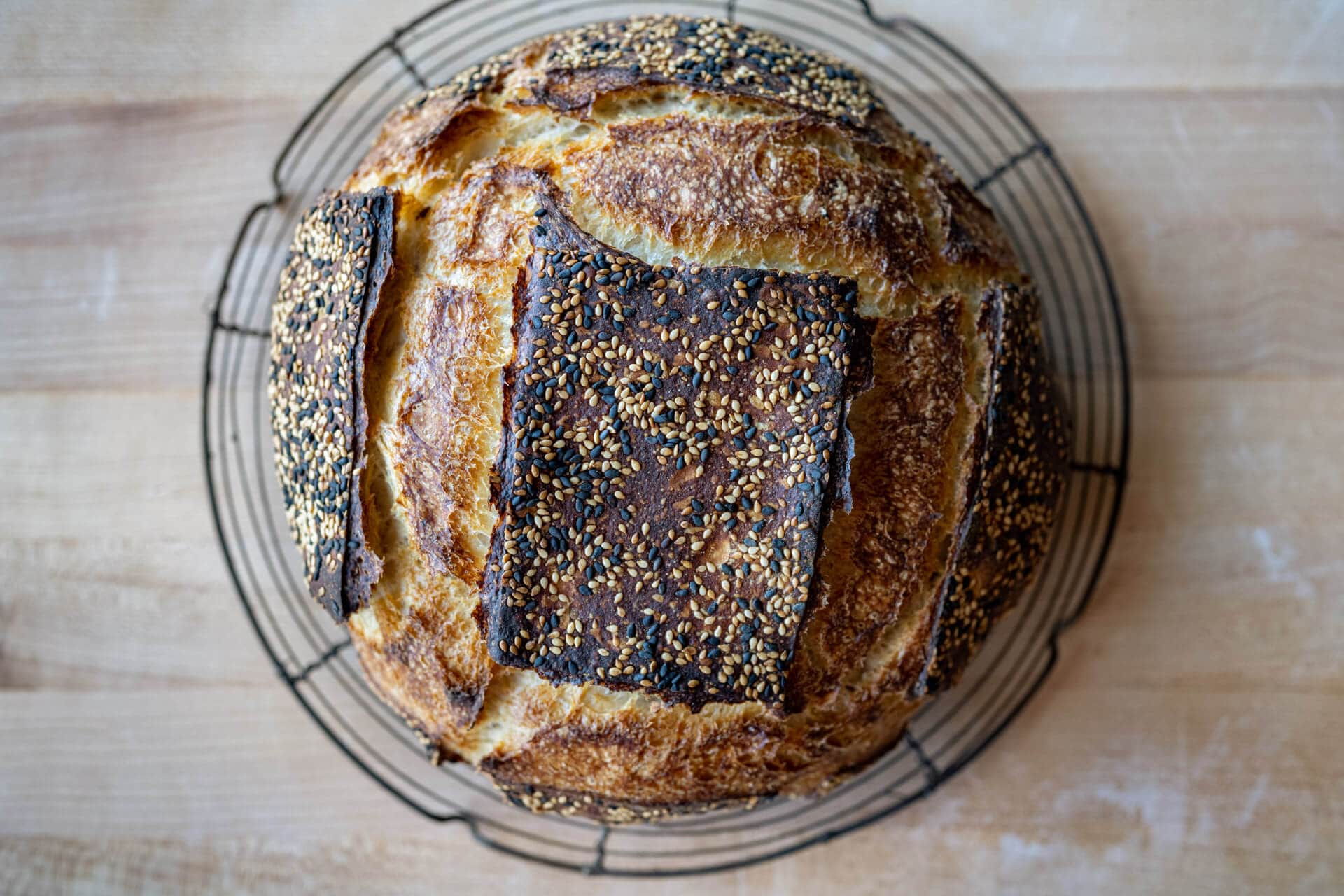
Flour at the market is hard to come by these days, but even if it is at the market, this recipe comes together so quickly and with such little effort it’s hard to imagine not wanting to throw this together every day during the week (since we’re home anyway, right?). I’ve received many emails and comments from readers asking for a straightforward recipe using 100% all-purpose flour since that’s what many of us have in the pantry right now. But even when abundant flour choices return to the market, this same-day sourdough bread with all-purpose flour might become a weekly staple in your kitchen.
This recipe makes a single 900g loaf of bread all in a single day. It begins with your mature starter in the morning and ends in the late afternoon with a fresh loaf of bread ready for dinner. What could be better? And while it’s similar to my recent simple weekday sourdough, it’s just a bit different, using different flour and a modified timeline. They’re different, but both practical ways to sneak baking in more often than not.
What Makes This Sourdough Bread Recipe Easy?
- It uses only one type of flour: all-purpose white flour
- It’s a same-day bread, meaning the day you mix is the day you bake
- There is no need for a levain, use your sourdough starter in the mix
- It makes a single loaf of bread, no scaling or dividing dough
- You can add up to 15% mix-ins: walnuts, pecans, seeds, or dried fruit
- You can substitute flour: use 5% (23g) whole grain rye, or 10% (46g) whole wheat flour (remove that amount of AP flour) without modifying the rest of the formula
Flour Selection
One essential modification in this recipe versus my simple weekday sourdough (which uses all high-protein bread flour) is slightly reducing the hydration, especially if there are no whole grains in the recipe. Because all-purpose tends to mix up to a softer, slack dough, lowering the hydration brings strength and makes for a loaf with more rise and a crunchier crust.
Additionally, I reduced the autolyse time for this recipe. If you’d like to give this dough a little more strength and reduce mixing time (which is already minimal!), you could autolyse the dough for 30 minutes: Mix the flour and water in the mixing bowl and let sit, covered, until your sourdough starter is ripe and ready to use.
Flour note: If your “all-purpose” flour is lower in protein than the flour I used, King Arthur Flour Unbleached All-Purpose at 11.7% protein, you might want to keep an eye on the hydration as you’re adding water in the mix and add less if the dough feels overly wet. Also, strengthen the dough up front, either through folds in the fold or a more intensive strengthening technique.
Baking Schedule
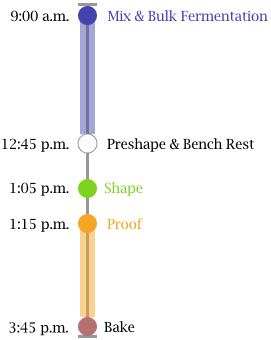
The intention for this recipe is for it to be a same-day dough, meaning you mix in the morning, and you bake in the late afternoon. However, you can also place the shaped and covered dough into the refrigerator to finish the proof overnight (instead of on the counter). This way, you can have fresh bread for dinner on day one or fresh bread for lunch on day two.
Sourdough Bread with All-purpose Flour
For tips on how to calculate baker’s percentages or how to modify this formula, see my post on baker’s percentages (baker’s math).
| Total Dough Weight | 900 grams |
| Pre-fermented Flour | 10.0% |
| Hydration | 76.0% (this takes the water in the sourdough starter, which is about 50%, into account) |
| Yield | One 900g loaf |
Total Formula
My final dough temperature for this dough was 78°F (26°C). See my post on the importance of dough temperature for more information.
| Weight | Ingredient | Baker’s Percentage |
|---|---|---|
| 460g | All-purpose white flour, ~ 11.7% protein (King Arthur Unbleached All-Purpose Flour) | 100.0% |
| 340g | Water | 74.0% |
| 9g | Salt (sea salt) | 1.9% |
| 92g | Ripe sourdough starter (100% hydration) | 20.0% |
Sourdough Bread with All-purpose Flour Method
1. Mix – 9:00 a.m.
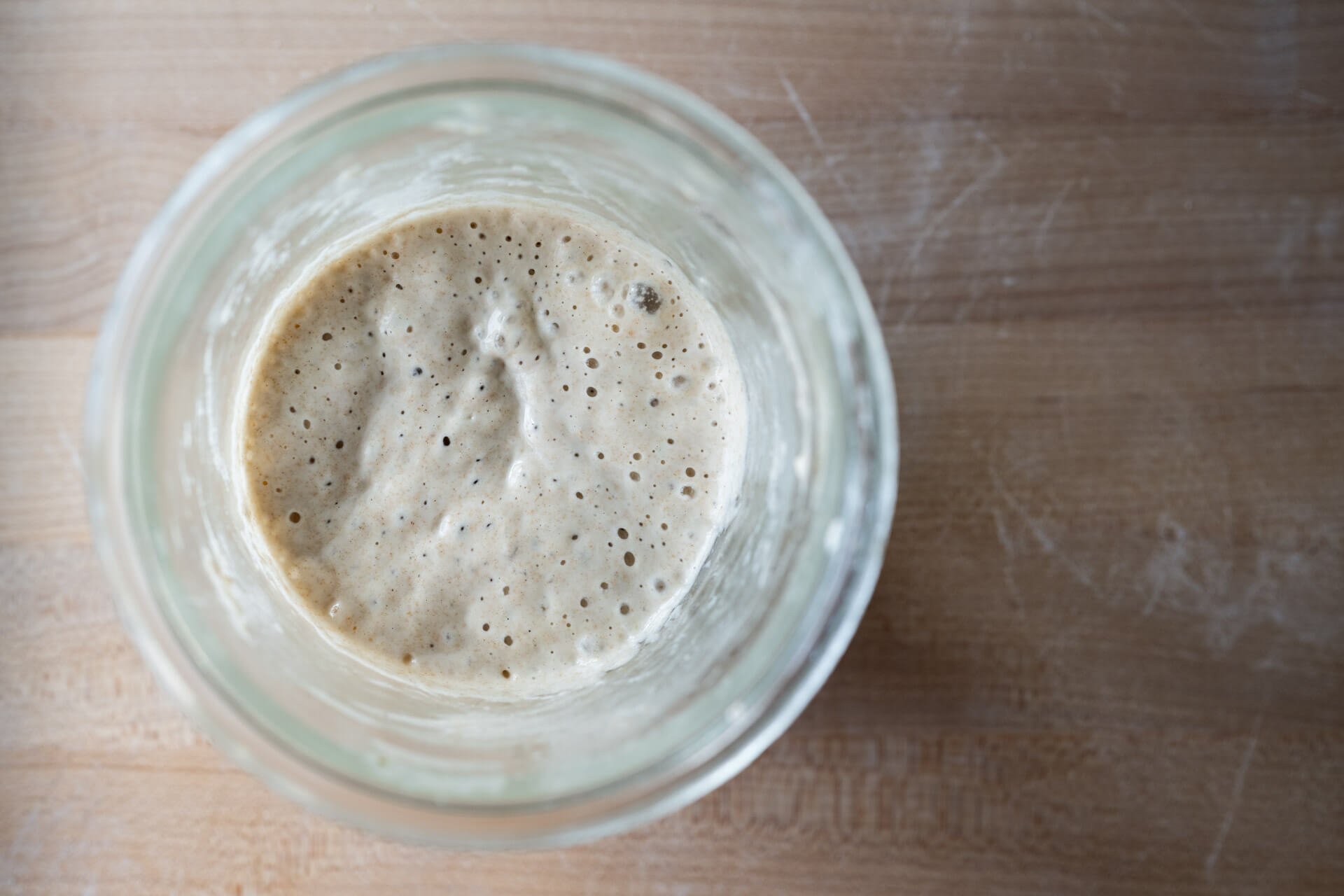
When your sourdough starter is mature (see the image, above), add the ingredients below to a large mixing bowl:
| Weight | Ingredient |
|---|---|
| 460g | All-purpose white flour (King Arthur Unbleached All-Purpose Flour) |
| 340g | Water |
| 9g | Salt (sea salt) |
| 92g | Sourdough starter (100% hydration) |
Using wet hands, mix everything — except 50g of the water (add 290g and hold back 50g) — until it comes together into a shaggy mass. I like to hold back a little of this water when mixing to pause and assess the dough: does it feel super wet and “soupy?” If so, omit the reserved 50g. If it still feels manageable, add it in slowly as your strengthening the dough in the bowl with folds.
This dough doesn’t require intensive kneading (like slap and fold) but do give it a series of folds (pickup one side and fold it over, rotate the bowl and repeat) in the bowl for 2-5 minutes until it smooths slightly and comes together in a cohesive ball.
I like to fold this dough more than my simple weekday sourdough, even though they both don’t require kneading on the counter, because this recipe is comprised of 100% all-purpose flour. I find this dough benefits from a little extra strength before bulk fermentation by performing these folds.
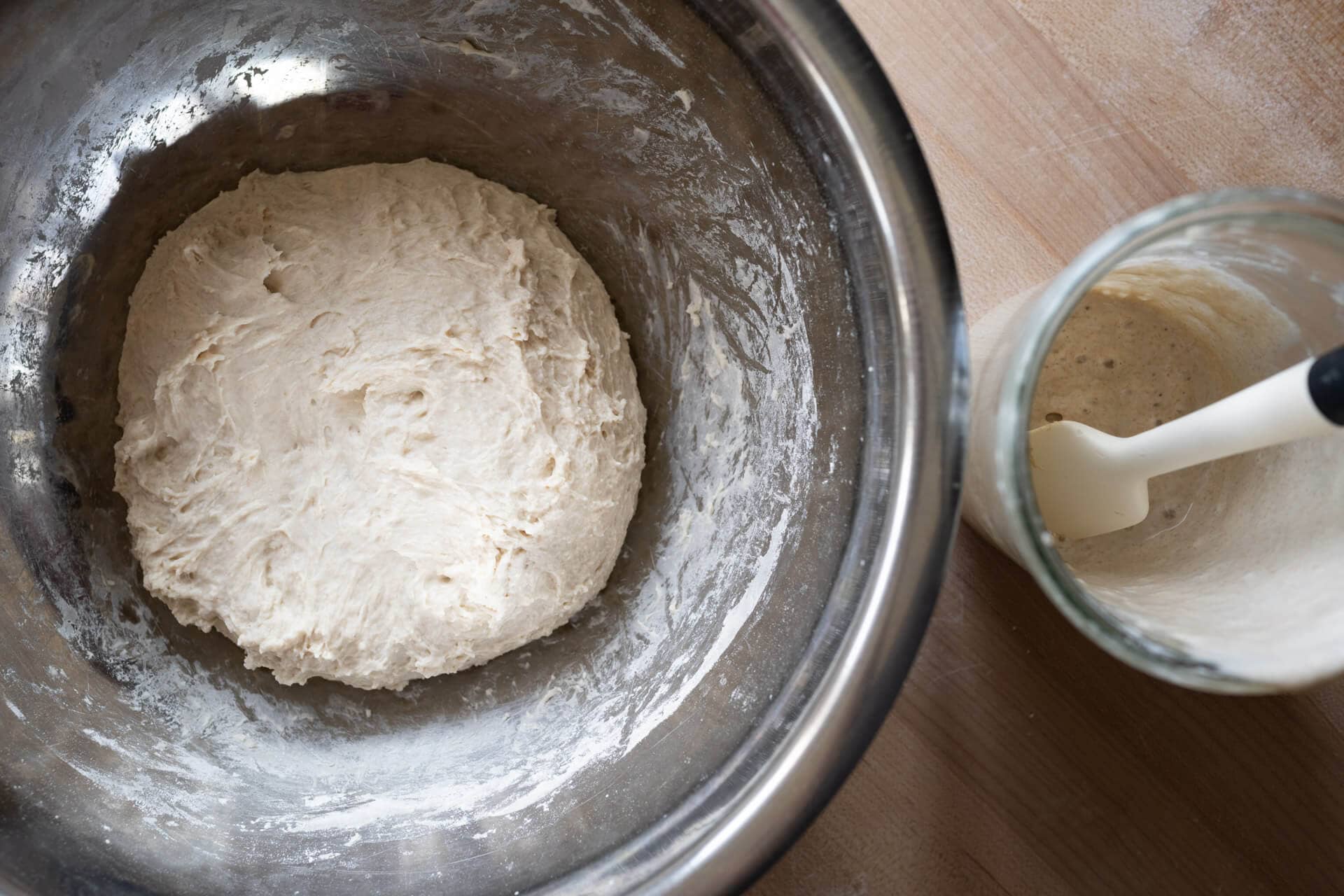
Cover the bowl with reusable plastic and keep somewhere warm in your kitchen for bulk fermentation.
2. Bulk Fermentation – 9:15 a.m. to 12:45 p.m. (3.5 hours)
At 75°F (24°C), bulk fermentation should take 3.5 hours. During this time, we will strengthen the dough through a series of stretch and folds directly in the bowl.
For each set wet your hands, grab one side and stretch it up and over the dough to the other side. Rotate the bowl 180° and perform another stretch and fold (this forms a long rectangle in the bowl). Then, rotate the bowl 90° and do another stretch and fold. Finally, rotate the bowl 180° and do one last stretch and fold.
Give the dough 4-5 sets of stretch and folds as indicated below:
| Set | Time |
|---|---|
| Fold set 1 | 9:30 a.m. (15 minutes after the start of bulk fermentation) |
| Fold set 2 | 9:45 a.m. (15 minutes after fold set 1) |
| Fold set 3 | 10:15 a.m. |
| Fold set 4 | 10:45 a.m. |
| Fold set 5 (as needed) | 11:15 a.m. (if the dough still looks slack, weak, and not showing any signs of defined edges, give it this fifth set) |
After the last set of stretch and folds, let the dough rest, covered, until the next step.
3. Preshape – 12:45 p.m.
After 3.5 hours, the dough should have risen in your bulk fermentation container, smoothed out, and show bubbles on the sides and surface. You want the dough to feel more elastic and strong. It should also feel alive and aerated. I also like to look at the edge of the dough in the bulk container: it should be domed, not flat, indicating the dough needs more time to rise. A flat surface with bubbles on the dough can also indicate it was over-hydrated and too slack/weak.
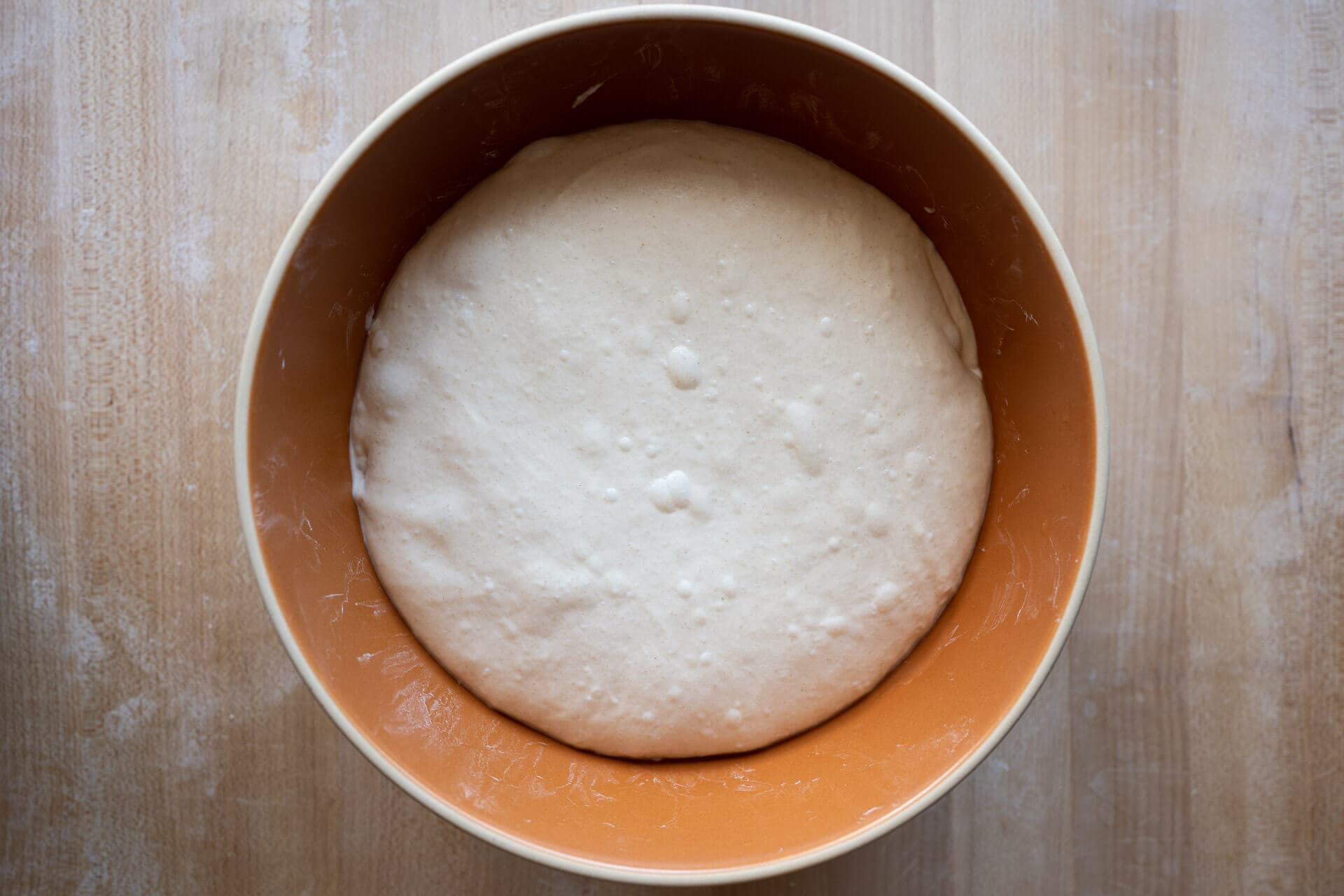
Fill a bowl with some water and place it on your work surface — I use water to keep the dough from sticking on my hands and my bench knife. Scrape out your dough from the bulk container onto your dry counter. Wet your hand and top of the bench knife and gently preshape the dough into a loose round.
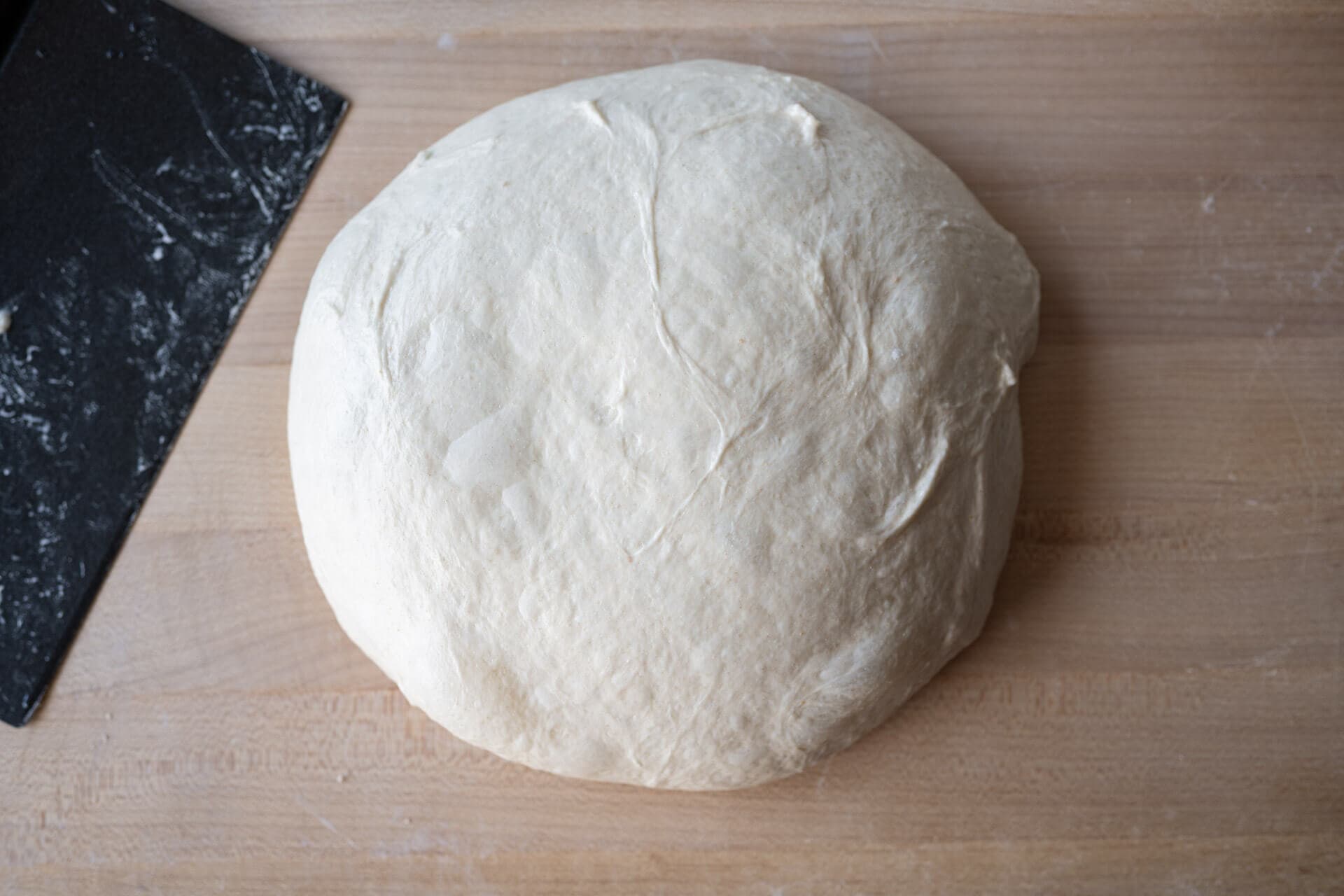
Let the dough rest, uncovered, for 20 minutes until its relaxed outward.
4. Shape – 1:05 p.m.
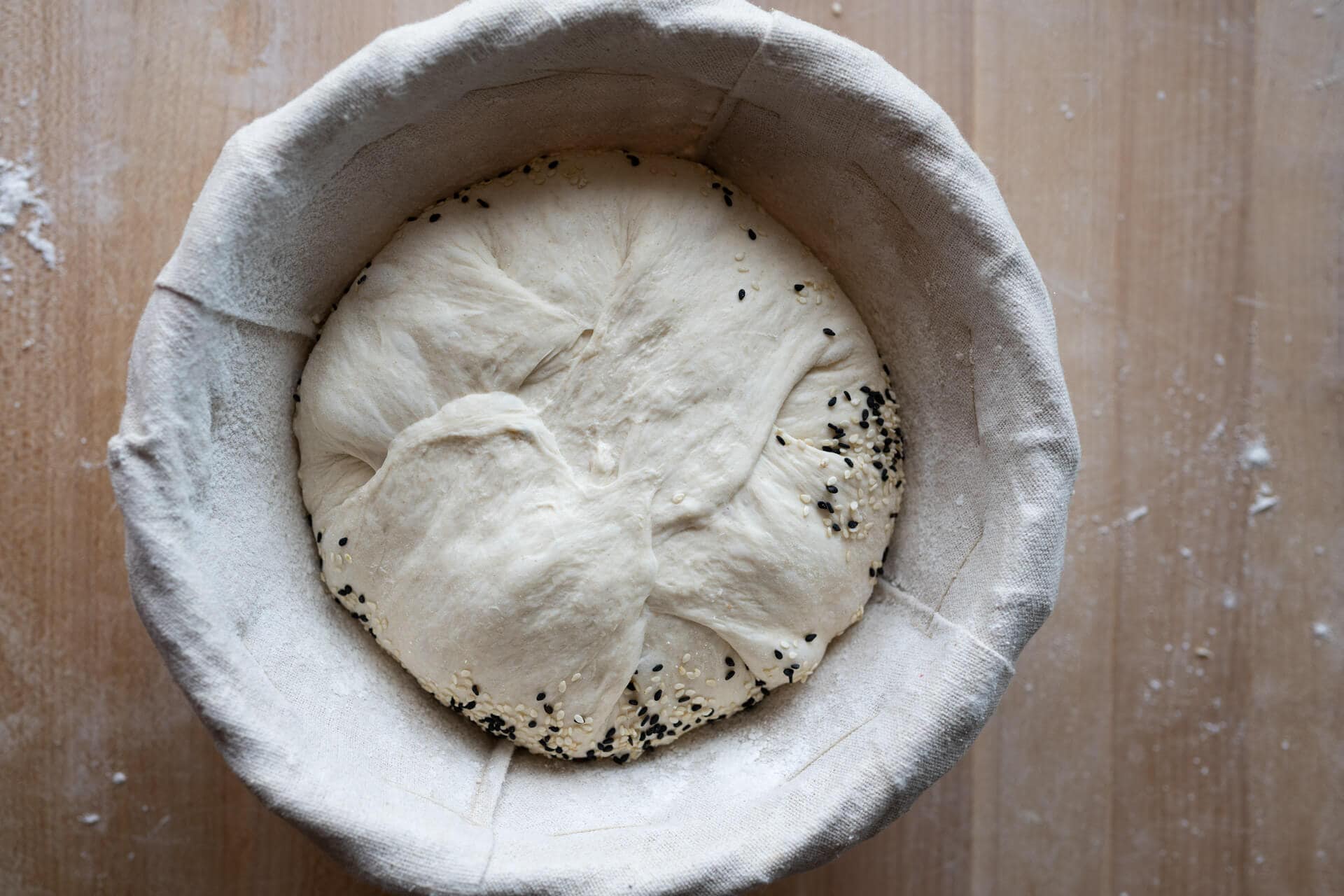
I went an extra step with this dough and coated it with a mixture of black and white sesame seeds for flavor. You can omit toppings altogether or use sesame as I did, rolled oats, flaked barley, pumpkin seeds, or anything you think would taste wonderfully toasted in the oven. Lay a towel next to your work surface and spread the topping out thinly. After you shape the dough, roll the smooth side on the towel to pick up these toppings (as shown in the video below).
Flour the work surface, your hands, and the top of the rested dough. Using your bench knife flip the round over onto the floured work surface. Next, take the left edge and fold it over midway to the right. Take the right side and fold it over the left. Take the top edge and fold it down to the middle. Pick up the bottom edge (closest to you) and fold it up over to the top of the dough but keep going until it touches the work surface, flipping everything over so the seams are now on the bottom.
Next, using both hands drag the dough down toward your body using your pinky fingers to pinch the dough between your fingers and the work surface. Rotate the dough and continue dragging to create tension on the top and outside of the dough. It’s not necessary to excessively tighten this dough (unless it feels fragile and slack to you), and as you can see in the video below, my dough was strong and did not require a firm hand to fully shape.
Read through to my guide to shaping a boule for more in-depth instruction on shaping boules.
5. Proof – 1:15 p.m. 3:45 p.m. (or when dough is ready)
Cover the proofing basket entirely and let it sit out on the counter for 2 to 4 hours, temperature depending. My dough was ready after 2.5 hours at about 75°F (23°C).
Overnight option: At this point, you can also place the covered proofing basket directly into your refrigerator and continue the process the next morning, afternoon, or even the next evening.
Use the “poke test” (as seen below) to determine when the dough is ready. While this test is not appropriate for all doughs, it’s a good test for this one because it’s made from all-white flour, has moderate hydration, and was proofed at room temperature. Notice how my pokes slowly spring back and don’t always fill in the indentation. Additional signs it’s ready are that it is well-risen in the proofing basket and quite gassy.
6. Bake – 3:45 p.m. (pre-heat oven at 3:00 p.m.)
Preheat your oven with the rack at the bottom third to 450°F (232°C). Place your combo cooker or Dutch oven inside, open, with the lid and bottom side-by-side. Review my guide to baking in a Dutch oven for in-depth details.
Cut a piece of parchment paper to fit over the proofing basket and place a pizza peel (or large cutting board) on top. Using both hands, flip the entire stack over and remove the basket.
Score the dough and load it into the Dutch oven; then, bake for 20 minutes covered. After this time, remove the lid and finish baking for 30-35 minutes or until done. The internal temp should be around 205-210°F (96-99°C).
Remove the loaf to a cooling rack for 1-2 hours before slicing. Follow my guide to storing sourdough bread to keep it fresh for the next week (or freeze for longer!).
Conclusion
What a wonderfully simple loaf of sourdough bread. I rarely bake a single loaf (unless it’s a miche), but this was so simple and so easy to put together I wonder what keeps me from making a loaf like this every day. Baking sourdough bread doesn’t have to be overly complicated; it can be as easy as mixing flour, water, salt, and your sourdough starter and giving it some guidance and time to mature into a delicious loaf of bread.
Crust
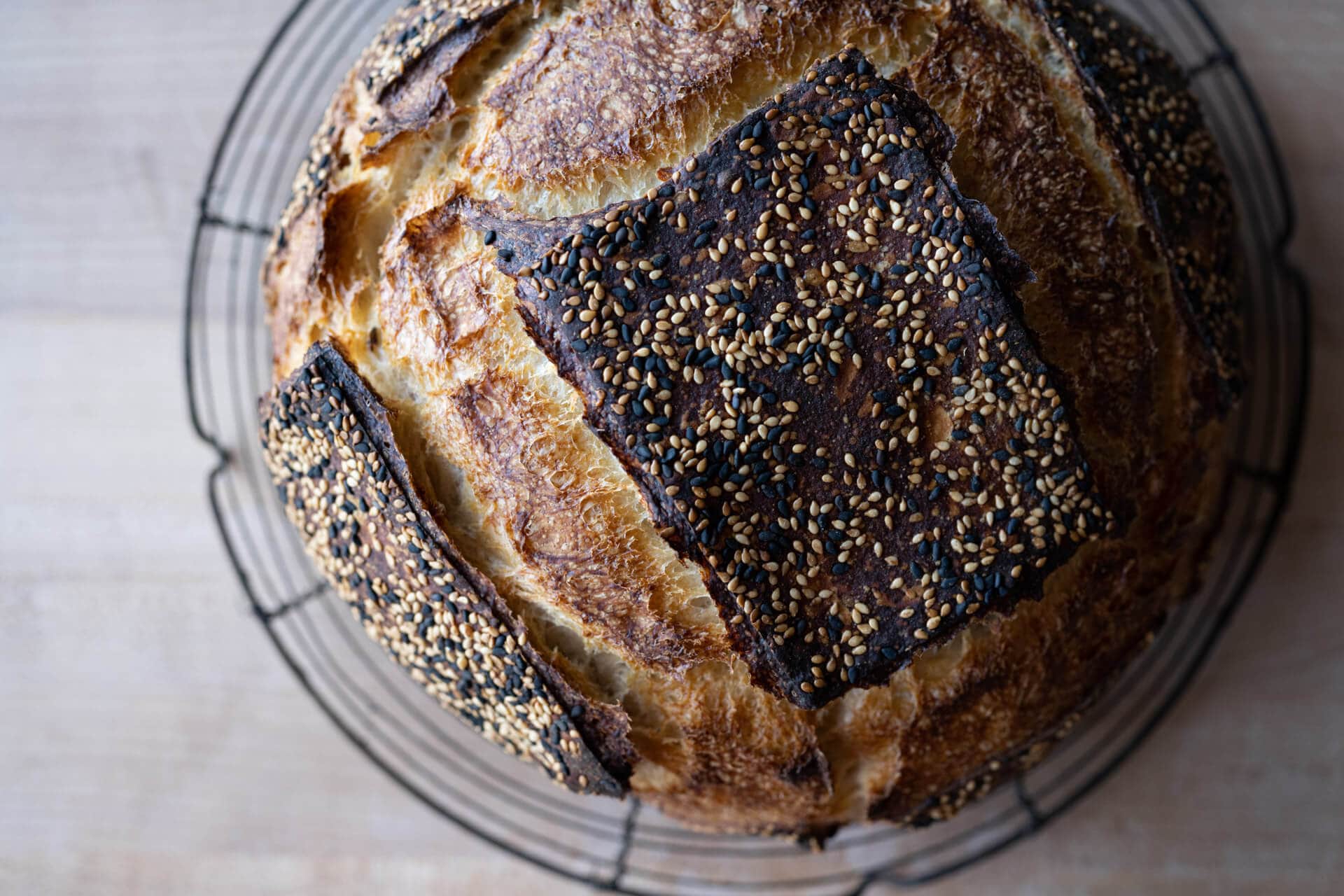
The crust was a rugged one, something I don’t mind one bit. The variegated colors from the sesame add some visual interest—not to mention tons of umami—but the color on the crust would be enough to satisfy my visual appetite. And the crust itself has all the appreciable crunch I look for in one of my sourdough loaves. And perhaps most importantly, the crust tastes incredible dipped in some olive oil—this has me yearning for the middle of summer when tomatoes will be ready in the garden.
Crumb
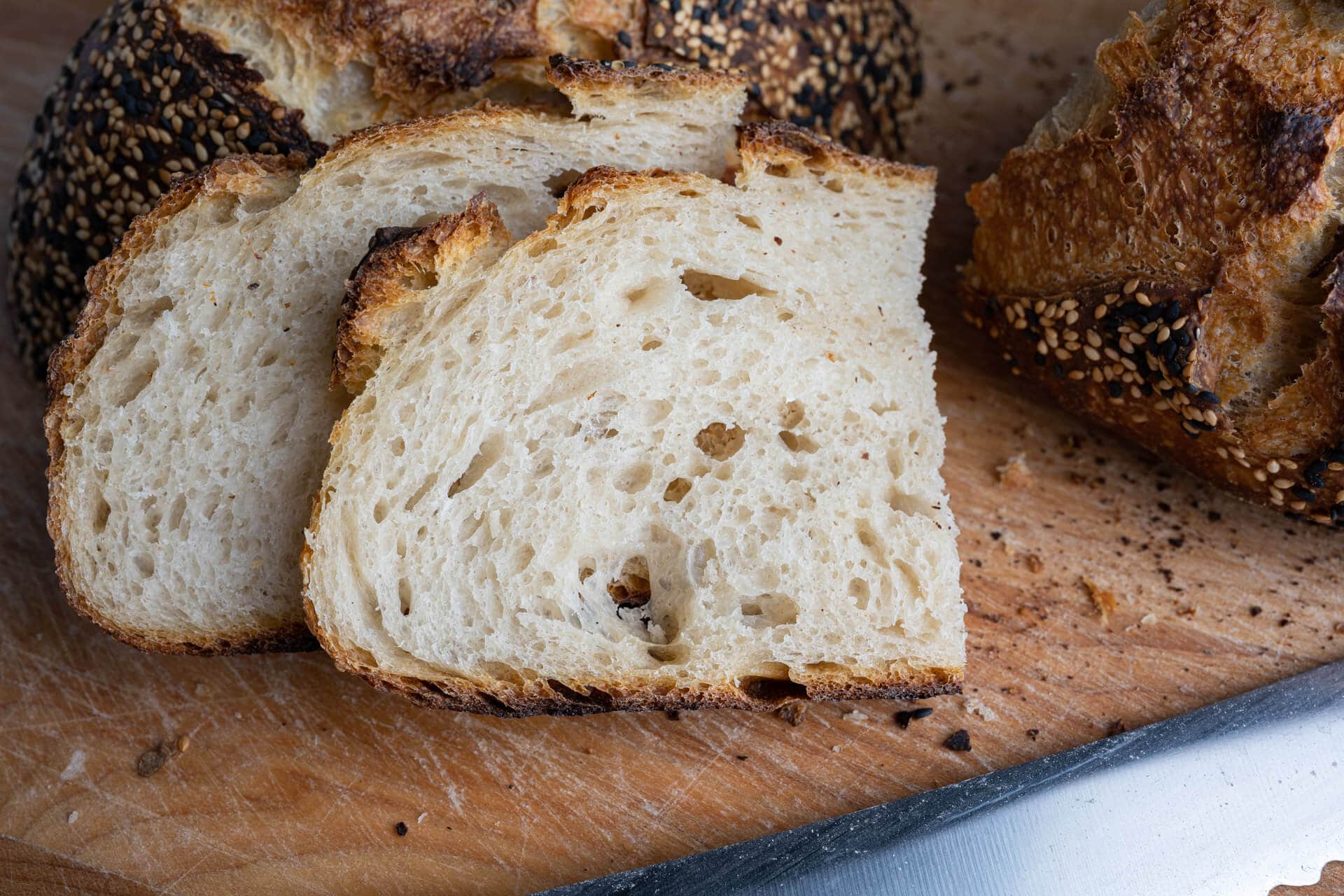
The crumb was tender, light, and wonderfully chewy. A good honest loaf of bread this is, and while not dramatically open, it’s evenly fermented and just what you’d expect—and want—from a straightforward bread recipe with minimal fuss.
Taste
Same day sourdough loaves tend to exhibit a milder flavor with reduced sourness and complexity — but this doesn’t mean it is flavorless. It’s a delicately flavored loaf with wheat flavor standing tall at the front. It still has some tinge of sourness to it, one that arrives at the very end of a bite and serves to remind you of the natural fermentation process, how healthy this bread is, and how delicious it can be when we give the dough the time to ferment properly.
Print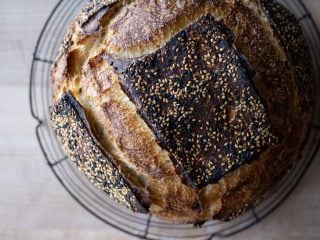
Sourdough Bread with All-Purpose Flour
- Prep Time: 12 hours
- Cook Time: 1 hour
- Total Time: 13 hours
- Yield: 1 loaf
- Cuisine: American
Description
My recipe for an easy loaf of healthy and nutritious sourdough bread made with all-purpose flour—all made in one day. No complicated levain steps with this recipe; just get mixing with your ripe sourdough starter!
Ingredients
Main Dough
- 460g all-purpose flour
- 340g water
- 9g salt
- 92g ripe sourdough starter
Instructions
- Mix (9:00 a.m.)
Add the Main Dough ingredients, reserving 50g of water, to a mixing bowl and mix with wet hands. Mix and strengthen the dough for 2-5 minutes, pinching the ingredients together and folding the dough over itself repeatedly until it’s cohesive and smooths. During this time, slowly add in the 50g of the reserved water if the dough feels like it can handle it: it shouldn’t be soupy or extremely wet, if it is, don’t add the remainder of the reserved water. - Bulk Fermentation (9:15 a.m. to 12:45 p.m.)
This dough will need 4 to 5 sets of stretch and folds during bulk fermentation, the first set 15 minutes after bulk fermentation begins, the second set 15 minutes after that. Then, perform the rest of them at 30-minute intervals as needed. After the last set, let the dough rest the remainder of bulk fermentation. - Preshape (12:45 p.m.)
Lightly flour your work surface and scrape out your dough. Using your bench knife, lightly shape the dough into a round shape. Let the dough rest for 20 minutes, uncovered. - Shape (1:05 p.m.)
Shape the dough into a round (boule) or oval (batard), then place the dough in proofing baskets. - Proof (1:15 p.m. to 3:45 p.m.)
Cover the proofing basket entirely and let it sit out on the counter for 2 – 4 hours, temperature depending. My dough was ready after 2.5 hours at about 75°F (23°C). - Bake (3:45 p.m., preheat oven at 3:00 p.m.)
Preheat your oven with a baking surface or combo cooker/Dutch oven inside to 450°F (230°C).When the oven is preheated, remove your dough from the fridge, score it, and transfer it to the preheated baking surface or combo cooker. Bake for 20 minutes with steam. After this time, vent the steam in the oven or remove the lid (you can keep it in the oven or remove it) and continue to bake for 30 minutes longer. When done, the internal temperature should be around 204°F (95°C).
Let the loaves cool for 2 hours on a wire rack before slicing.
Notes
- The dough can be placed into the refrigerator at the Proof step in its proofing basket and sealed bag to proof overnight. The next day, take it out and bake it straight away in a preheated oven as indicated in the Bake step.
If you use this recipe, tag @maurizio on Instagram so I can take a look!
What’s Next?
This sourdough bread with all-purpose flour is straightforward, but no less delicious, than those with complicated flour blends. If you want an even more hands-off approach to baking sourdough bread, check out my no-knead sourdough bread recipe.
On the other hand, it can be fun to experiment and discover what other flavor profiles we can draw out with a whole wheat sourdough sandwich loaf, or a fifty-fifty sourdough with 50% whole wheat—that is, once we readily have these flour choices at the market!


442 Comments
Made this today, after 2 very dense (and disaster sourdough) and I had the best bread ever.
As I m in Italy i used ‘Farina 00’ and 5% rye flour. I wonder if i Could do the same with Farina 1 (which i guess is the same as strong bread flour in UK & Us)
Thanks again !
P.s. waiting for your book to been delivered 👍👍
Fantastic, Silvia! Thanks so much for ordering my book out there, let me know what you think after you’ve had a chance to read through 🙂
I’m so sorry if you’ve already answered this, but can this be doubled and then divided for two loaves? Thanks!
Yes, absolutely Christine!
Hi Maurizio! What is your general rule of thumb for an overnight proof time? In other words, would a loaf be better proofed 2-4 hours on the counter or cold proofed 7-8 hours in the refrigerator? Although not truly overnight, I wondered which would be more successful as a general rule (knowing that all doughs behave differently!). Thanks, as always, for your help!
Both work very well, Kristen! It really depends on your schedule and the style/flavor you’re after in the end. I find a direct dough (proofed on the counter) has a more mild flavor overall. Dough retarded (proofed in the fridge) has more complexity and deeper flavor in most cases, but it’s also convenient for me, too.
They are both excellent ways to make bread!
Hi Maurizio, you have probably answered this question somewhere on your site, but I hope you won’t mind answering it again. I have a very resilient starter that I store in the fridge and feed every week or two. I’m not sure where my starter fits into your definition of “mature”. Should I feed it, and leave it at room temperature for a couple of hours before using it in the recipe? Or do you have other guidelines? Thanks.
I would take it out of the fridge, feed it and let it ferment for 12 hours. Then, feed it again for another 12 hours. Finally, after that 12 hrs it should be ready to go!
Just making sure I did this right. We can make this bread and let it proof/raise on the counter, without being refrigerated before we bake? The instructions say to leave on the counter but then to “remove from the refrigerator.” This should be an either/or scenario, correct? Thanks, I love trying your recipes.
Yes, either way will work! Will check and edit this to make it correct. Sorry about the confusion!
Thanks for this recipe! It’s really simple and made me feel like a “pro” sourdough home baker for the first time 😄 I usually use bread flour and always feel the hydration and baking part of sourdough bread : tricky and difficult. At some points I wanna give up on sourdough, but this recipe really encouraged me to continue my sourdough journey.
I don’t have dutch oven so I used an old baking pan, water, ice cubes (I add it to the baking pan that already had hot water in it when I put the dough in the oven) and iron cast pan for placing the dough. It worked! I wish I could post the bread pic here. Thanks again, Maurizio!
So glad to hear that, Henny! Sounds like you’re well on your way there, makes me happy to hear my recipe has helped you make wonderful bread in your home kitchen.
(Sorry I don’t have picture posting capability here, if you feel inclined, join our membership! Lots of photo sharing going on in there 🙂)
I have the sourdough starter in my fridge since last winter….close to a year old. Can it still be used?
Hmmm, that’s a long time! If it doesn’t look like there are any signs of mold…
thanks for the recipe! So i tried the poke test and it didn’t work for me..also it didn’t really look like my dough was doubled. Should i leave it a little longer?
Hmm, yes it sounds like it needed more fermentation time. Be sure your starter is ripe when you go to use it!
Hey, Maurizio!
Such a simple bread recipe! I just love it! And it got me thinking! Can we use saved leftover discard? For example save the discard three days before baking and then in the weeken bake not one but three or four loafs. Sounds like a win win. No waste, more tasty bread. Is this possible? If so how to prepare the discarded starter? Bring it to room temperature few hours before mix or the night before?
I wouldn’t recommend doing this because your starter likely won’t be in a strong, healthy state. It’ll likely be very acidic!
HI there, I have made every sourdough recipe that you created! They are all great. I am in occupational therapy school and am researching the effects of baking on student’s wellbeing. To do so, we are holding sessions Monday morning, afternoon, and Wednesday. I love the way you create timelines/schedules. However, I cannot figure out how to incorporate them into my schedule. Does anyone have tips for sourdough, allowing for starter feeding + autolyse + kneading on monday. Then on wednesday, would it be best to knead and bake? The session allows for 1 hour. However, I am able to go in early and take the dough out of the fridge so it is at room temp for the participants. I’m just not sure how to go about this. Any advice would be helpful!
Hey, Julie! You could follow the recipe all the way to where the dough is placed in the refrigerator (do this all Monday), then leave it in the fridge to proof all the way until Wednesday, when they’re baked. The dough will likely last and be just fine, with a slightly reduced rise and more pronounced sour flavor (but likely not all that much). Give it a test before committing to this, though, and see how it works for you!
I will test try it this weekend and let you know. Thanks for the advice!
Hi Julie! How did your 2 day proof in the fridge go? Was the rise reduced? Thinking of trying myself… Thanks!
I make this and top with a “Everything but the bagel” mix. A little different than just Sesame.
Sounds delicious!
After countless bakes that has never happened to me, and I almost always bake from cold. I don’t think it’s significant enough of a temperature shock.
If I wanted to double this recipe, making for T-day, should I make 2 batches or double the ingredients in one batch? Made this many times and loved the results.
Glad to hear that! I would double everything and make one large batch, then divide it into four portions at divide time. Just be sure you use a container large enough to hold it all during bulk!
Hi Maurizio! Because I am dieting and need to track calories, do you have any idea of the calorie count per serving of bread? I know there are a lot of variables, but if made a published? Thank you!
Hey, Sherill! Unfortunately, I’m not sure of the nutritional content, I’ve never tried to run the numbers for this. Sorry about that!
Hi Maurizio! Just wanted to say thanks for this recipe. It has made weekly sourdough bread a reality for our house. I have also used this recipe three different times to teach others how to make sourdough! I’m still working on how to score my loaves correctly so they don’t grow a tumor but they turn out delicious each time! 🙂
You’re very welcome, Christy! I’m happy to hear this has helped you bake more bread from home (and teach others!)–that’s why I started this website almost 10 years ago 🙂 No worries about the scoring, it’ll come with time. Stick with all of this and above all else, enjoy your wonderful bread!
During Bulk fermentation, I find that the dough breaks into 2 when doing stretching. it does not fold. My dough gradually turns “wet” and very soggy even thou water level is correct. Not sure if it is due to humid weather. The bread is very hard to cut after baked. Sigh. Not sure if my oven is the caused of it as it does not have the steam function.
That should be expected perhaps at the beginning of bulk fermentation, but after a while, it should become cohesive and strong. As bulk progresses, it should become stronger and stronger. My feeling is you might have too much water in the mix—if there’s too much your dough might never come together and thus the wet and soggy feeling. I’d try dropping 50g of water from the mix and see how the dough feels. If it still feels soggy and never strengthens, you might want to try using another flour, just as a test (any flour from the market should work). Stick with it, Jane! I know it’s frustrating at the start, but you’ll get the hang of it 🙂
I am perplexed and disappointed… I followed the instructions very closely, checked in every half hour, but the dough didn’t rise or hold its shape, and I ended up with a completely flat thing that almost looks like focaccia (???). It has large holes and a gummy interior texture but surprisingly an excellent crust. Although my starter was fed and super bubbly and active, this dough did not rise (temperature indoors was 73 degrees F, windows open to an 80 degree F day). My dough seemed really slack and wet, even without adding all of the extra water. I kept the dough out for max. amount of time suggested (but not refrigerated overnight). I also baked it in the Dutch oven. I am really not sure what happened here 🙁
Ahh so sorry to hear that, Catherine! My feeling is, based on your description, it might have been a few things: over hydration and either over or under proofed. If you’re up for trying this again, I’d suggest hold back the additional water (as you did), but also hold back another 50g and see if that helps bring more strength to your dough. It should also help tame fermentation if it’s running a bit fast right now during the summer.
Thank you for the suggestion! I will have to try that for next time, I really want to get it right 🙂
Hi Maurizio,
I tried baking this yesterday but have a feeling it might have had too short a bulk fermentation. My end result came out very gummy/spongey with a thick hard crust (baked with the lid on for 30, off for about 20). It tastes good but the texture isn’t quite right and the oven spring wasn’t all that impressive (plus no “ear” on my loaf even though I scored relatively deep). I followed your recipe almost exactly. Used all the water in my dough, and even bulk fermented an extra hour over your timeline. I had bubbles but no dome when I did my pre-shaping but I was pressed for time so I couldn’t wait any longer. I also put it in the fridge overnight (about 19 hours) before baking in the morning). It seems with every sourdough attempt I’m either under or over-fermenting so I’m hoping to trouble-shoot to figure out what I might be missing. Thanks.
Sounds like it could have been under fermented. It sounds like perhaps your dough was slightly underproofed. There are a few indicators your dough could be under: explosive rise in the oven, dense spots in the interior with potentially scattered large holes, and a gummy texture to the interior. Finally, it’s possible the bottom of the loaf might be slightly bowed upward (like the letter “U” — the top will kind of dome).
Make sure to build your levain from a starter that’s strong and mature (meaning it’s risen to it’s peak height before you take some to use). From there, bulk fermentation is very important!
Make sure your bulk fermentation goes sufficiently far, you want the dough to look smooth, it should have risen considerably, and have bubbles here and there — it should look alive. If you tug on the dough a bit it should offer resistance to your tugging, it’ll feel stronger. Give the dough the time it needs in bulk fermentation! If you have to give it another 30m or hour to see these signs, do so. It’s important for this step to go sufficiently far for the dough to have enough fermentation activity before its proof.
Hey Maurizio, is it ideal to use the starter/levain at its peak or once it has fallen completely, or somewhere therein? I ask because up until I found your blog, I had read it was better to let it fall completely where the yeast will be most “hungry”? Not sure if that logic is sound or not…
Hi Maurizio,
Have 2 questions: 1) I have my Brod & Taylor proofer in my garage with the temp set at 72. However, the digital thermometer reads 69.5 so I had to bump it up to 77 for it to reach my desired temp of 72. I would have thought irrespective of ambient temp, the internal proofer temp would be at 72? 2) How often should one change the container of the “Mother” starter? Or never and just make sure that this always clean swept on the inside/outside? Thanks
Hey there! Check out my guide to the Brod and Taylor proofer for an answer to this exact question 🙂
Hi Mauricio,
I have been baking some of your loafs the last few months, and they all have been amazing. I can appreciate the time you have put into perfecting your recipes. Thank you for sharing!
The recipe for all purpose flour sourdough for add ins was 15% notes nuts and fruits. Could I add cheddar and some Jalapeño’s?
Thank you
Hello Maurizio, Wanted to tell you thank you for posting the recipe. This recipe was my first attempt at sourdough and it worked very well! I did end up putting my loaf in the dutch oven seed and score side down (whoops!) but it came out very tasty.
You’re welcome, Eric! Glad to hear I could help. No worries about that, easy fix next time. Happy baking 🙂
This is the second sourdough loaf I have ever tried and it is perfect for my family and lifestyle. I have been baking it a few times a week for months (I now bake two loaves at once to minimize cleanup!) and it makes a wonderful all purpose bread for really cheap. It would cost about twelve times as much in a bakery. I don’t aim for perfect (yet it often is!), but even though I do not always have the time to give it the care it needs with the kids around, it always turns out great. I do like a softer crust, so I bake it for 40minutes lid on. Thanks for what you do!
Your comments mean a lot to me, Marie! Thanks so much, I’m happy to help you bake such wonderful bread in your kitchen. Enjoy!
The timing was not going to work for me so I moved it to the fridge to finish rising overnight. AM it was still sluggish so I gave it a couple of hours in the oven with the light on. Shaped it quickly and into the banneton for a couple more hours and it was out of the oven in time for lunch. It was perfect and tasted fine but you are so right: the flavour exploded a few hours later. Oh, and I baked it on the stone with a cup of water in a pan for steam. Sprayed 3 more times at 2-minute intervals. Thank you for the recipe!
Really nice adjustments, Gina! That’s such an important part with baking: adjust as necessary based on the dough that day! Glad to hear you liked the loaf and enjoy!
Made this one today and it turned out pretty good! However, while it did have some oven spring, it wasn’t a crazy amount and this seems to be a recurring issue for me. It passed the poke test and the dough was pretty strong and really easy to handle all the way through – I could drag it into a tight ball with my pinky fingers no problem – but it did flatten out a bit when taken out of the banneton after only 2 hours of proofing at 24-25 degrees celsius. It seems like it’s risen slightly more on one side than the other if that can give you any clue about what I’m doing wrong? Is it my starter, my bulk fermentation, my shaping or something else?
I actually took a picture of it to make it easier to judge: http://imgur.com/a/TFTcmTJ
I wouldn’t say it’s bad, but I think theres room for improvement in terms of height. What do you think? Also I substituted 5% of the AP flour with whole grain rye
Thanks, love the site and it’s taught me all I know about the amazing world of sour dough baking. A great resource that I recommend to everyone
Keep experimenting! (Thank you for the tip about Imgur.com.)
Thank you, I appreciate that! Shaping looks good from here. It’s hard to say why you didn’t get much rise there. Usually a reduced spring means a dough that might have fermented too long in bulk and/or proof. I’d say try to pull back that proof a little bit and eke out a bit more rise.
I made this loaf today…the crumb turned out somewhat gummy? Why?
It sounds like perhaps your dough was slightly underproofed. There are a few indicators your dough could be under: explosive rise in the oven, dense spots in the interior with potentially scattered large holes, and a gummy texture to the interior. Finally, it’s possible the bottom of the loaf might be slightly bowed upward (like the letter “U” — the top will kind of dome).
Make sure to build your levain from a starter that’s strong and mature (meaning it’s risen to it’s peak height before you take some to use). From there, bulk fermentation is very important! Make sure your bulk fermentation goes sufficiently far, you want the dough to look smooth, it should have risen considerably, and have bubbles here and there — it should look alive. If you tug on the dough a bit it should offer resistance to your tugging, it’ll feel stronger. Give the dough the time it needs in bulk fermentation! If you have to give it another 30m or hour to see these signs, do so. It’s important for this step to go sufficiently far for the dough to have enough fermentation activity before its proof.
Hi Maurizio,
thanks and will be making another loaf tomorrow so will let you know how it turns out.
Best,
My husband is a home brewer so I substituted 50g of spent grain. This is absolutely the best bread I’ve ever made. Thank you for the recipe!
That sounds hearty and delicious, Dawn! So glad you like the recipe (and I”m going to have to try that modification, too) 🙂
This recipe was my 4th bake attempt and hands down the best result. Great taste and amazing crust. However the bottom of the loaf wasn’t exactly how i wanted it to be. It was a lighter color tone than the rest of the bread. I baked it on the lower rack of the oven at 230c in a Pyrex combo. Any trick or tip appreciated!!
Interesting! To remedy, you could always take the loaf out of the pan and finish baking it right on the oven rack. I’m wondering if that pan you used insulated the bottom too much and essentially dropped the baking temp compared to the rest of the crust exposed to air.
Love this recipe! It’s become my go to as I’ve been learning. Question – I was just gifted an Emile Henry Italian Bread Loaf/Pullman Baker ( https://www.emilehenryusa.com/products/italian-bread-loaf-baker ) and I’m thinking of trying this recipe to be baked in this pretty new pan. Any reason it wouldn’t work?
Super glad to hear that, Chris! I’ve not personally used one, but others have and said it works well!
Thanks for all the great info here. How much should the volume of the dough increase in the proofing stage for this recipe? I baked a loaf (my first sourdough loaf ever with my starter – thanks for instructions on that too!) and the crumb was a bit gummy although it looked pretty good. I’m wondering if I didn’t let it proof long enough. I just moved to the northeast, and I’m learning how to bake in a colder climate.
You’re very welcome! It shouldn’t rise a whole lot in the fridge, but it will look puffy and have risen more. If you think it was a little under proofed, in the morning let it sit out a bit on the counter—perhaps 20-30 minutes—to warm up and have more fermentation time at room temperature. Alternatively, you could let the dough sit out on the counter, covered, for 20 minutes after you shape before you place it in the fridge. Because you’re likely seeing cooler temps, my guess is that yes, it was under proofed. Let me know how the next attempt goes!
I baked a second loaf, and it turned out great! Both times I proofed the dough in a warm room, but I let it proof for a full four hours the second time. The volume of the dough increased more the second time. The crumb in this loaf is lighter and consistently airy throughout; this loaf is about an inch taller than the first one. I also baked it at 425 and the crust is very good. The crust on the first loaf was too dark, almost burnt. Bake, observe, modify, learn. Thanks again for all the info.
Maurizio, I truly appreciate the time and effort you put into your website, videos, newsletters etc. I am a very new sourdough baker, finally getting comfortable with building and maintaining a sourdough starter and beginning to get comfortable, though not quite proficient with mixing and baking techniques. I just finished your all purpose flour recipe, added some rosemary to the dough and sesame seeds and it looks good to me, as a novice.
One thing I am doing differently than you and many others instruct is that I am not pre-heating the oven or my Dutch oven. I have an older Dacor built-in oven with a “pure convection” option, which I like much more than the bake setting because it is a more even heat and the bottom of my loaf doesn’t burn. I bake at 450 with the lid on for 30” and then lid off for 15 minutes.
Thank you again for sharing your expertise and recipes.
You’re very welcome, Gus! Glad to hear you’re well on your way with sourdough baking, it takes a little time but is so worth the investment. I’ve been meaning to test baking with out preheating my Dutch oven, I’ve also heard it yields pretty good results that way. Thanks for the suggestion, I’ll add this to my to do list and then report back with how it works for me here! A side-by-side comparison would be great.
Happy baking!
Hello, and thanks again for the great site. This is the one and only place I’ve used to learn sourdough baking, and it’s the only place I need. Hopefully you haven’t already addressed this: Is there a reason that your only “one-day” recipe is an all-purpose flour recipe? Obviously bread gets better with a long proof, but could I, on days I suddenly realize I need a loaf of bread tonight, do a single day recipe with all bread flour, or any other “normal” recipe flour instead of all-purpose? Or is there something inherent with all-purpose that lends it to single day baking?
Thanks!
Thanks, Zach! I plan to do more same day recipes in the near future—it’s a great way to make certain breads and can lead to a different flavor profile in the end. Yes, you can always skip the cold proof: proof the dough on the counter, covered, at room temp until ready to bake. Use the “poke test” for most breads to determine when the dough is ready.
Thanks for the kind words and I hope that helps!
Hi Maurizio,
I used a different flour for this which I think has lower protein than king Arthur flour. When I added the 290g of water it seemed to stiff so I added the rest and then it was way too wet. I’m not getting a good rise now and I’m concerned that it might be too much hydration. Internal dough temp is 73°F. Any advice on what I should do? Still bake or throw in the fridge overnight? I’m going to get some KA flour for the next one!
Thanks!
I’d keep at it! The dough is rather cool, so you’d need to extend bulk quite a bit there to compensate. Perhaps 1-2 hours even. I hope it turned out great! Next time hold back that way and add it in only if the dough feels like it can handle.
hello! I love this recipe and have made it a few times with success. I am wondering if the shape matters..can I make a baguette with this recipe?
hello..I love this recipe and have made it a few times with great success. does the shape matter? can I make a baguette with this recipe?
You could make any shape you’d like, but with different shapes come different bake times and temperatures. Adjust as necessary!
Hi maurizio!
You say,
“One essential modification in this recipe versus my simple weekday sourdough (which uses all high protein bread flour), is to slightly reduce the hydration….”
But all-purpose flour you use here has even more protein content than flours listed in your baking tools:
– King Arthur Unbleached All-Purpose Flour – 11.7% protein
– Organic Artisan Bakers Craft Plus – 11.5% protein
– Giusto’s artisan bread flour – 11.5% protein
Or am I missing something?
You’re right, Blaz. In this recipe I’m using KA All-purpose, which has a higher protein content than some of the other flours I use. But the naming gets confusing: Giusto’s calls their flour “bread flour” meaning it can be used to make bread. But other millers use the name “bread flour” to indicate higher protein flour.
Hi maurizio, the recipe calls for 460g flour but the yield is a 900g loaf? Did I miss something?
Hey, Matt. The total yield for a recipe also includes all the other ingredients going into the dough: flour, water, levain, any other mix-ins (nuts, seeds, butter, etc.).