

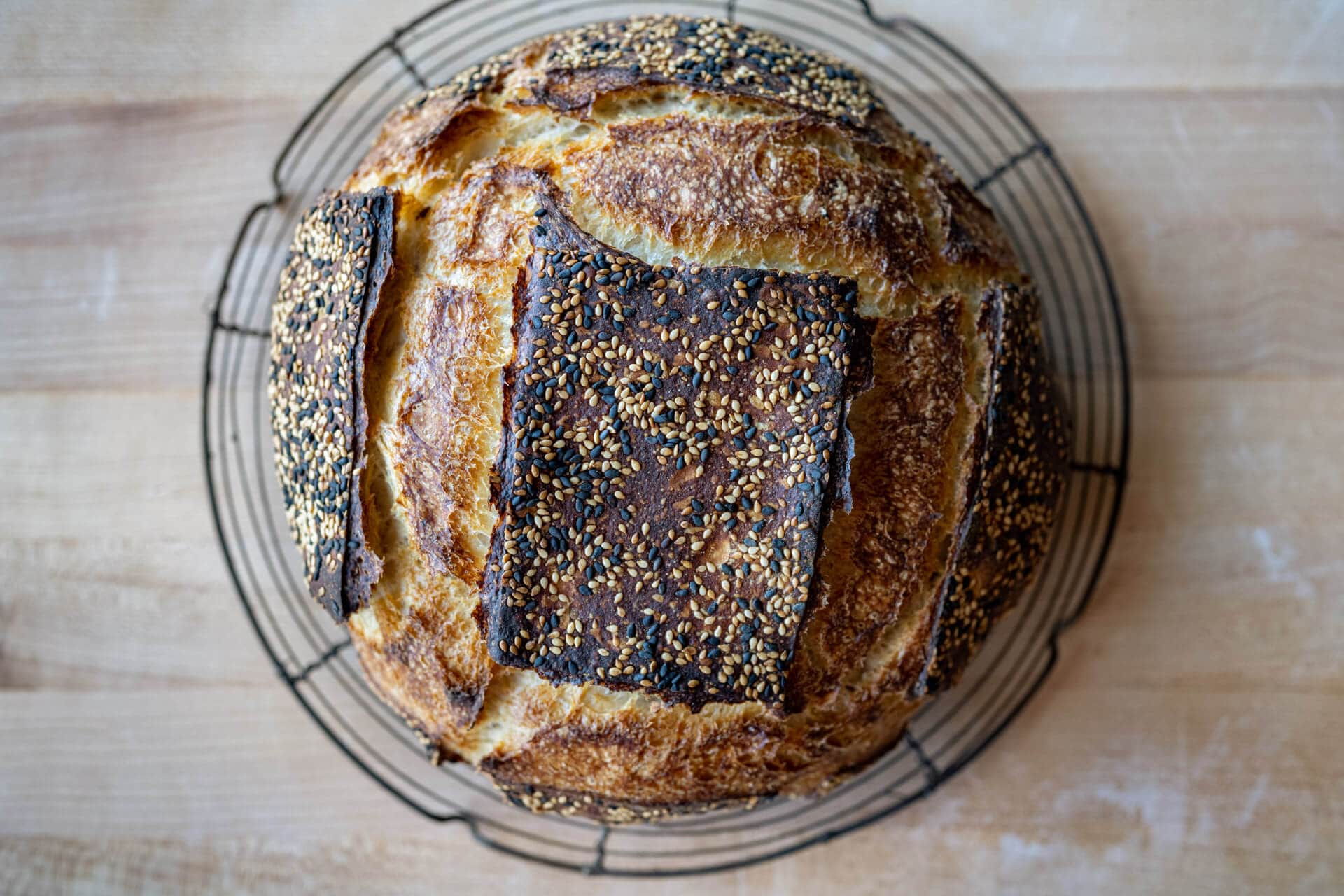
Flour at the market is hard to come by these days, but even if it is at the market, this recipe comes together so quickly and with such little effort it’s hard to imagine not wanting to throw this together every day during the week (since we’re home anyway, right?). I’ve received many emails and comments from readers asking for a straightforward recipe using 100% all-purpose flour since that’s what many of us have in the pantry right now. But even when abundant flour choices return to the market, this same-day sourdough bread with all-purpose flour might become a weekly staple in your kitchen.
This recipe makes a single 900g loaf of bread all in a single day. It begins with your mature starter in the morning and ends in the late afternoon with a fresh loaf of bread ready for dinner. What could be better? And while it’s similar to my recent simple weekday sourdough, it’s just a bit different, using different flour and a modified timeline. They’re different, but both practical ways to sneak baking in more often than not.
What Makes This Sourdough Bread Recipe Easy?
- It uses only one type of flour: all-purpose white flour
- It’s a same-day bread, meaning the day you mix is the day you bake
- There is no need for a levain, use your sourdough starter in the mix
- It makes a single loaf of bread, no scaling or dividing dough
- You can add up to 15% mix-ins: walnuts, pecans, seeds, or dried fruit
- You can substitute flour: use 5% (23g) whole grain rye, or 10% (46g) whole wheat flour (remove that amount of AP flour) without modifying the rest of the formula
Flour Selection
One essential modification in this recipe versus my simple weekday sourdough (which uses all high-protein bread flour) is slightly reducing the hydration, especially if there are no whole grains in the recipe. Because all-purpose tends to mix up to a softer, slack dough, lowering the hydration brings strength and makes for a loaf with more rise and a crunchier crust.
Additionally, I reduced the autolyse time for this recipe. If you’d like to give this dough a little more strength and reduce mixing time (which is already minimal!), you could autolyse the dough for 30 minutes: Mix the flour and water in the mixing bowl and let sit, covered, until your sourdough starter is ripe and ready to use.
Flour note: If your “all-purpose” flour is lower in protein than the flour I used, King Arthur Flour Unbleached All-Purpose at 11.7% protein, you might want to keep an eye on the hydration as you’re adding water in the mix and add less if the dough feels overly wet. Also, strengthen the dough up front, either through folds in the fold or a more intensive strengthening technique.
Baking Schedule
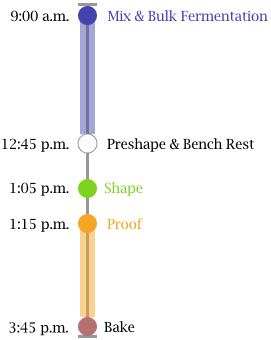
The intention for this recipe is for it to be a same-day dough, meaning you mix in the morning, and you bake in the late afternoon. However, you can also place the shaped and covered dough into the refrigerator to finish the proof overnight (instead of on the counter). This way, you can have fresh bread for dinner on day one or fresh bread for lunch on day two.
Sourdough Bread with All-purpose Flour
For tips on how to calculate baker’s percentages or how to modify this formula, see my post on baker’s percentages (baker’s math).
| Total Dough Weight | 900 grams |
| Pre-fermented Flour | 10.0% |
| Hydration | 76.0% (this takes the water in the sourdough starter, which is about 50%, into account) |
| Yield | One 900g loaf |
Total Formula
My final dough temperature for this dough was 78°F (26°C). See my post on the importance of dough temperature for more information.
| Weight | Ingredient | Baker’s Percentage |
|---|---|---|
| 460g | All-purpose white flour, ~ 11.7% protein (King Arthur Unbleached All-Purpose Flour) | 100.0% |
| 340g | Water | 74.0% |
| 9g | Salt (sea salt) | 1.9% |
| 92g | Ripe sourdough starter (100% hydration) | 20.0% |
Sourdough Bread with All-purpose Flour Method
1. Mix – 9:00 a.m.
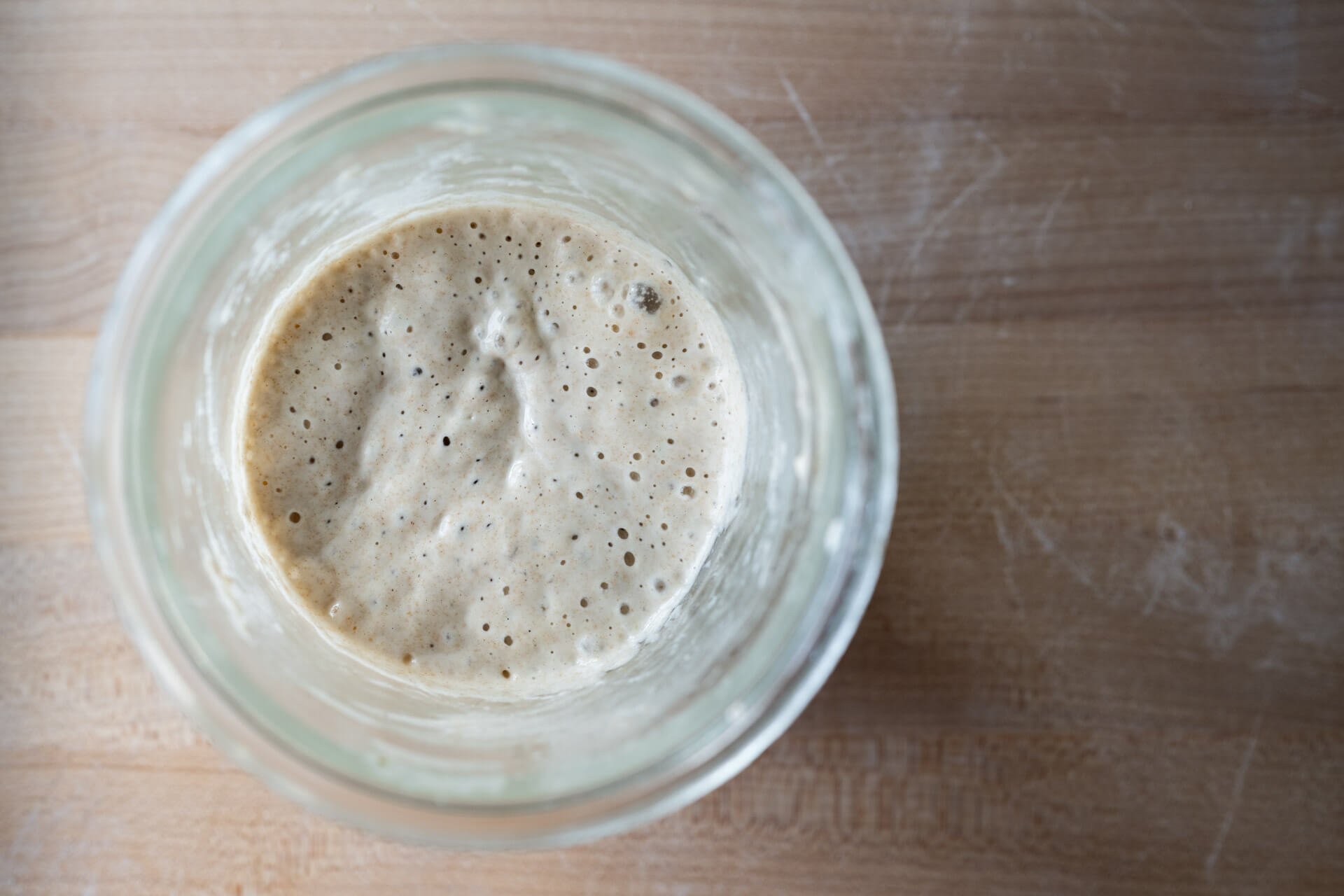
When your sourdough starter is mature (see the image, above), add the ingredients below to a large mixing bowl:
| Weight | Ingredient |
|---|---|
| 460g | All-purpose white flour (King Arthur Unbleached All-Purpose Flour) |
| 340g | Water |
| 9g | Salt (sea salt) |
| 92g | Sourdough starter (100% hydration) |
Using wet hands, mix everything — except 50g of the water (add 290g and hold back 50g) — until it comes together into a shaggy mass. I like to hold back a little of this water when mixing to pause and assess the dough: does it feel super wet and “soupy?” If so, omit the reserved 50g. If it still feels manageable, add it in slowly as your strengthening the dough in the bowl with folds.
This dough doesn’t require intensive kneading (like slap and fold) but do give it a series of folds (pickup one side and fold it over, rotate the bowl and repeat) in the bowl for 2-5 minutes until it smooths slightly and comes together in a cohesive ball.
I like to fold this dough more than my simple weekday sourdough, even though they both don’t require kneading on the counter, because this recipe is comprised of 100% all-purpose flour. I find this dough benefits from a little extra strength before bulk fermentation by performing these folds.
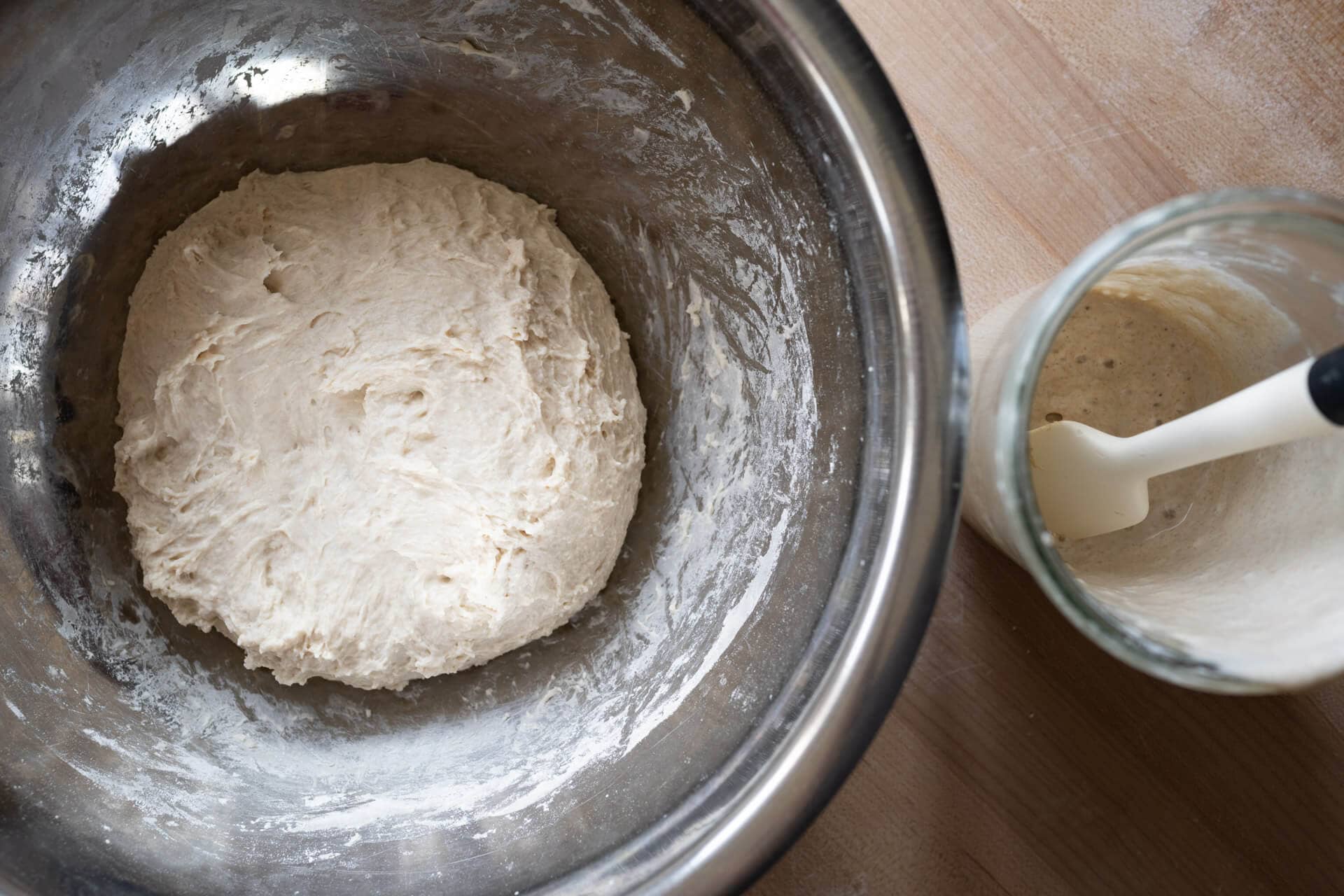
Cover the bowl with reusable plastic and keep somewhere warm in your kitchen for bulk fermentation.
2. Bulk Fermentation – 9:15 a.m. to 12:45 p.m. (3.5 hours)
At 75°F (24°C), bulk fermentation should take 3.5 hours. During this time, we will strengthen the dough through a series of stretch and folds directly in the bowl.
For each set wet your hands, grab one side and stretch it up and over the dough to the other side. Rotate the bowl 180° and perform another stretch and fold (this forms a long rectangle in the bowl). Then, rotate the bowl 90° and do another stretch and fold. Finally, rotate the bowl 180° and do one last stretch and fold.
Give the dough 4-5 sets of stretch and folds as indicated below:
| Set | Time |
|---|---|
| Fold set 1 | 9:30 a.m. (15 minutes after the start of bulk fermentation) |
| Fold set 2 | 9:45 a.m. (15 minutes after fold set 1) |
| Fold set 3 | 10:15 a.m. |
| Fold set 4 | 10:45 a.m. |
| Fold set 5 (as needed) | 11:15 a.m. (if the dough still looks slack, weak, and not showing any signs of defined edges, give it this fifth set) |
After the last set of stretch and folds, let the dough rest, covered, until the next step.
3. Preshape – 12:45 p.m.
After 3.5 hours, the dough should have risen in your bulk fermentation container, smoothed out, and show bubbles on the sides and surface. You want the dough to feel more elastic and strong. It should also feel alive and aerated. I also like to look at the edge of the dough in the bulk container: it should be domed, not flat, indicating the dough needs more time to rise. A flat surface with bubbles on the dough can also indicate it was over-hydrated and too slack/weak.
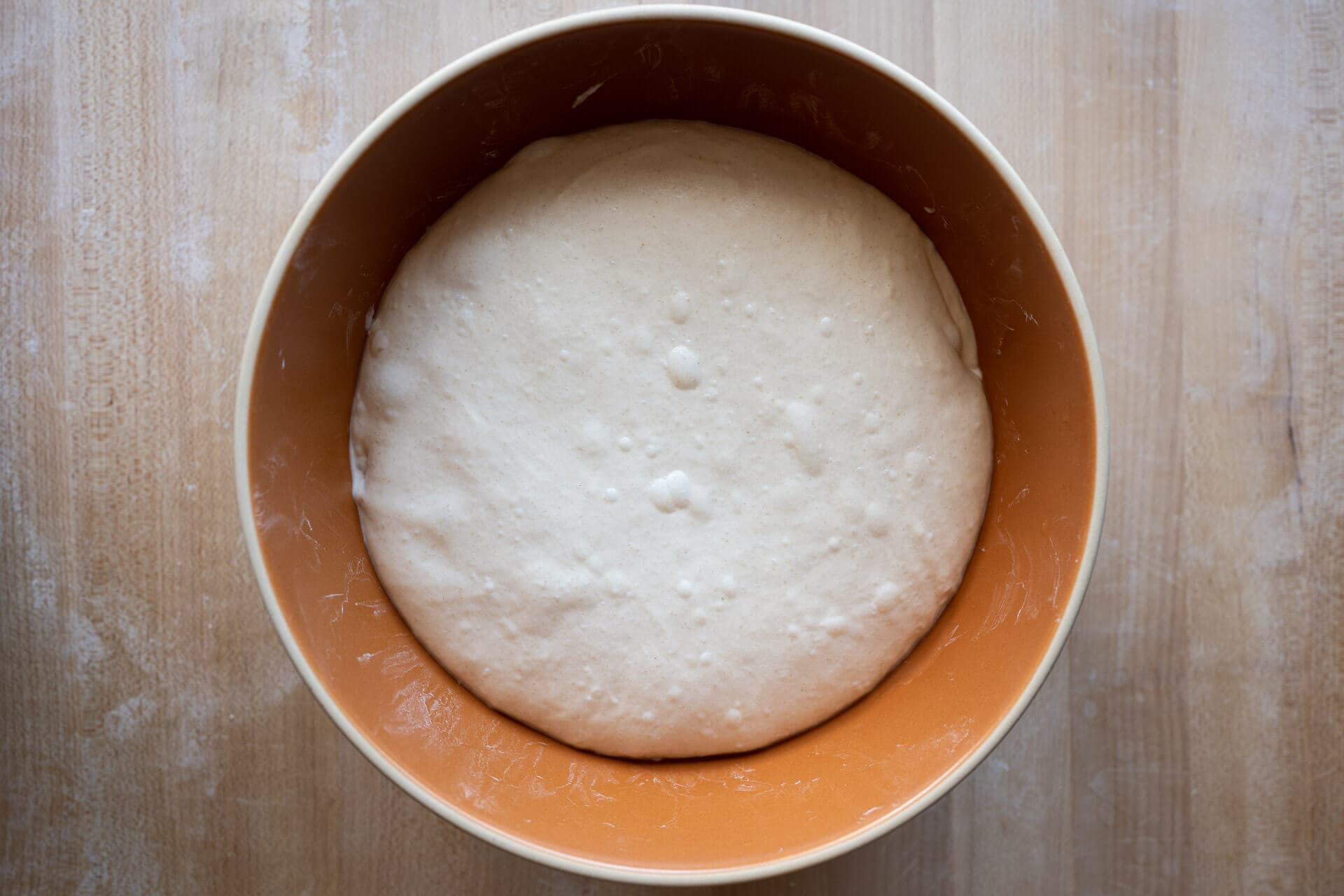
Fill a bowl with some water and place it on your work surface — I use water to keep the dough from sticking on my hands and my bench knife. Scrape out your dough from the bulk container onto your dry counter. Wet your hand and top of the bench knife and gently preshape the dough into a loose round.
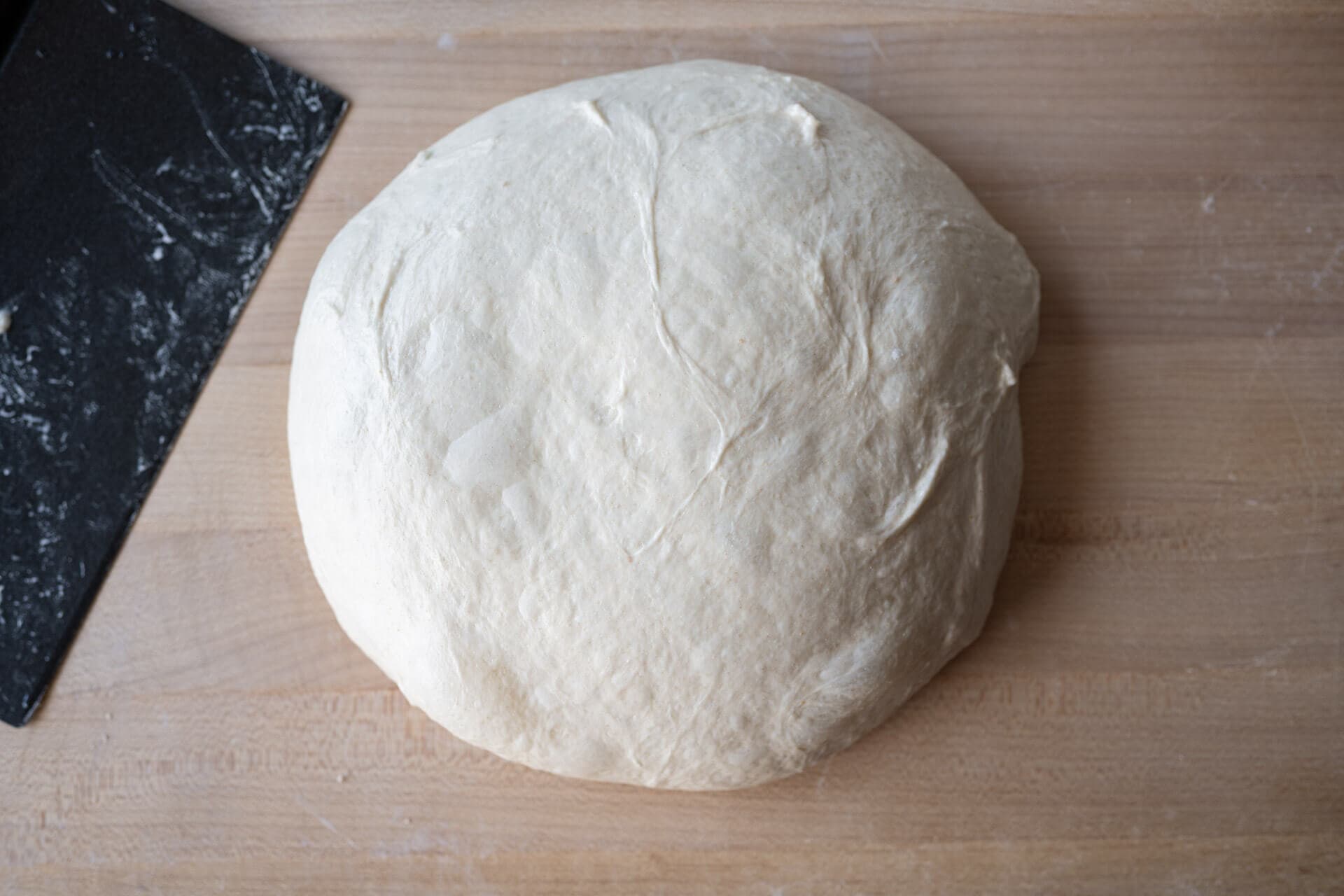
Let the dough rest, uncovered, for 20 minutes until its relaxed outward.
4. Shape – 1:05 p.m.
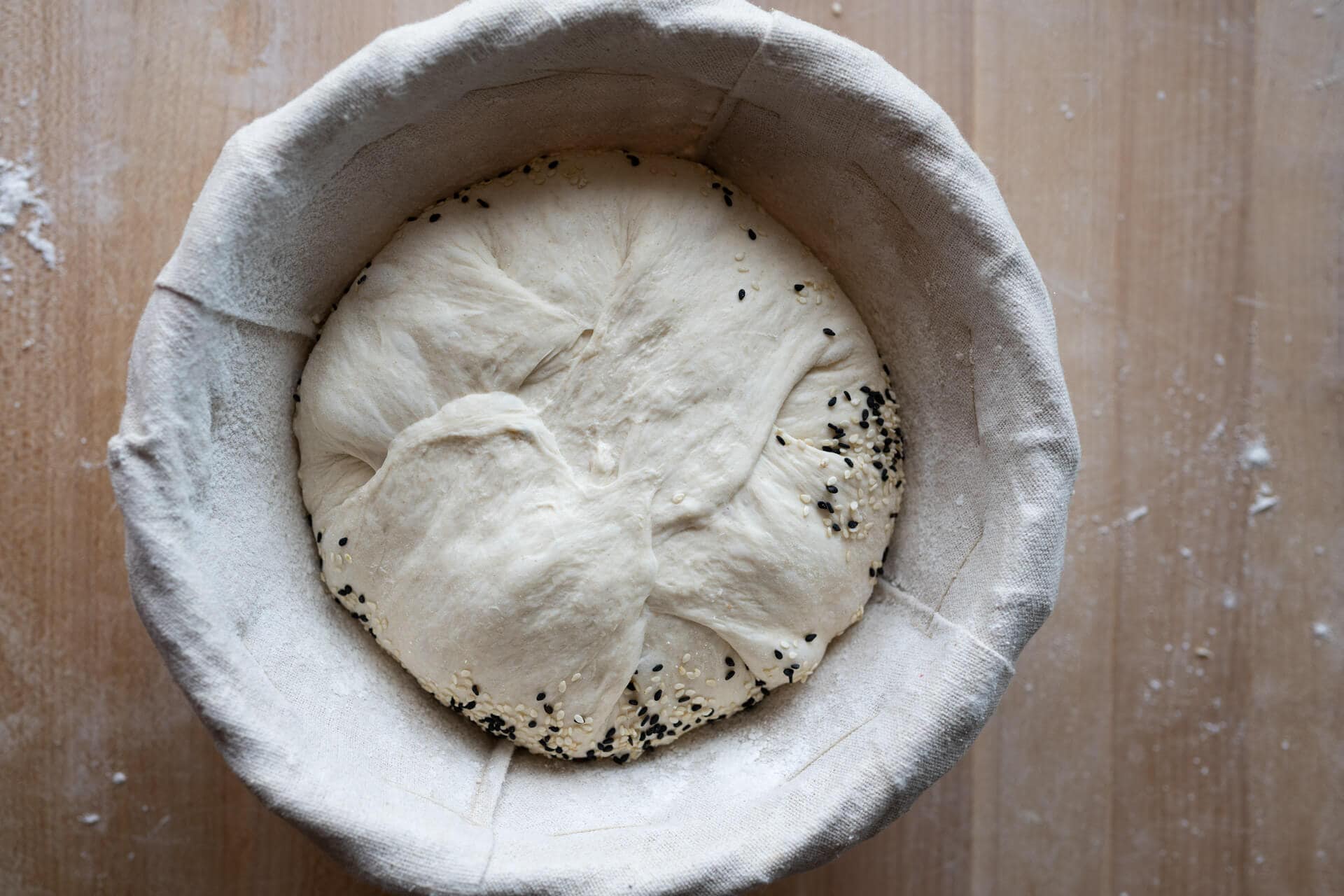
I went an extra step with this dough and coated it with a mixture of black and white sesame seeds for flavor. You can omit toppings altogether or use sesame as I did, rolled oats, flaked barley, pumpkin seeds, or anything you think would taste wonderfully toasted in the oven. Lay a towel next to your work surface and spread the topping out thinly. After you shape the dough, roll the smooth side on the towel to pick up these toppings (as shown in the video below).
Flour the work surface, your hands, and the top of the rested dough. Using your bench knife flip the round over onto the floured work surface. Next, take the left edge and fold it over midway to the right. Take the right side and fold it over the left. Take the top edge and fold it down to the middle. Pick up the bottom edge (closest to you) and fold it up over to the top of the dough but keep going until it touches the work surface, flipping everything over so the seams are now on the bottom.
Next, using both hands drag the dough down toward your body using your pinky fingers to pinch the dough between your fingers and the work surface. Rotate the dough and continue dragging to create tension on the top and outside of the dough. It’s not necessary to excessively tighten this dough (unless it feels fragile and slack to you), and as you can see in the video below, my dough was strong and did not require a firm hand to fully shape.
Read through to my guide to shaping a boule for more in-depth instruction on shaping boules.
5. Proof – 1:15 p.m. 3:45 p.m. (or when dough is ready)
Cover the proofing basket entirely and let it sit out on the counter for 2 to 4 hours, temperature depending. My dough was ready after 2.5 hours at about 75°F (23°C).
Overnight option: At this point, you can also place the covered proofing basket directly into your refrigerator and continue the process the next morning, afternoon, or even the next evening.
Use the “poke test” (as seen below) to determine when the dough is ready. While this test is not appropriate for all doughs, it’s a good test for this one because it’s made from all-white flour, has moderate hydration, and was proofed at room temperature. Notice how my pokes slowly spring back and don’t always fill in the indentation. Additional signs it’s ready are that it is well-risen in the proofing basket and quite gassy.
6. Bake – 3:45 p.m. (pre-heat oven at 3:00 p.m.)
Preheat your oven with the rack at the bottom third to 450°F (232°C). Place your combo cooker or Dutch oven inside, open, with the lid and bottom side-by-side. Review my guide to baking in a Dutch oven for in-depth details.
Cut a piece of parchment paper to fit over the proofing basket and place a pizza peel (or large cutting board) on top. Using both hands, flip the entire stack over and remove the basket.
Score the dough and load it into the Dutch oven; then, bake for 20 minutes covered. After this time, remove the lid and finish baking for 30-35 minutes or until done. The internal temp should be around 205-210°F (96-99°C).
Remove the loaf to a cooling rack for 1-2 hours before slicing. Follow my guide to storing sourdough bread to keep it fresh for the next week (or freeze for longer!).
Conclusion
What a wonderfully simple loaf of sourdough bread. I rarely bake a single loaf (unless it’s a miche), but this was so simple and so easy to put together I wonder what keeps me from making a loaf like this every day. Baking sourdough bread doesn’t have to be overly complicated; it can be as easy as mixing flour, water, salt, and your sourdough starter and giving it some guidance and time to mature into a delicious loaf of bread.
Crust
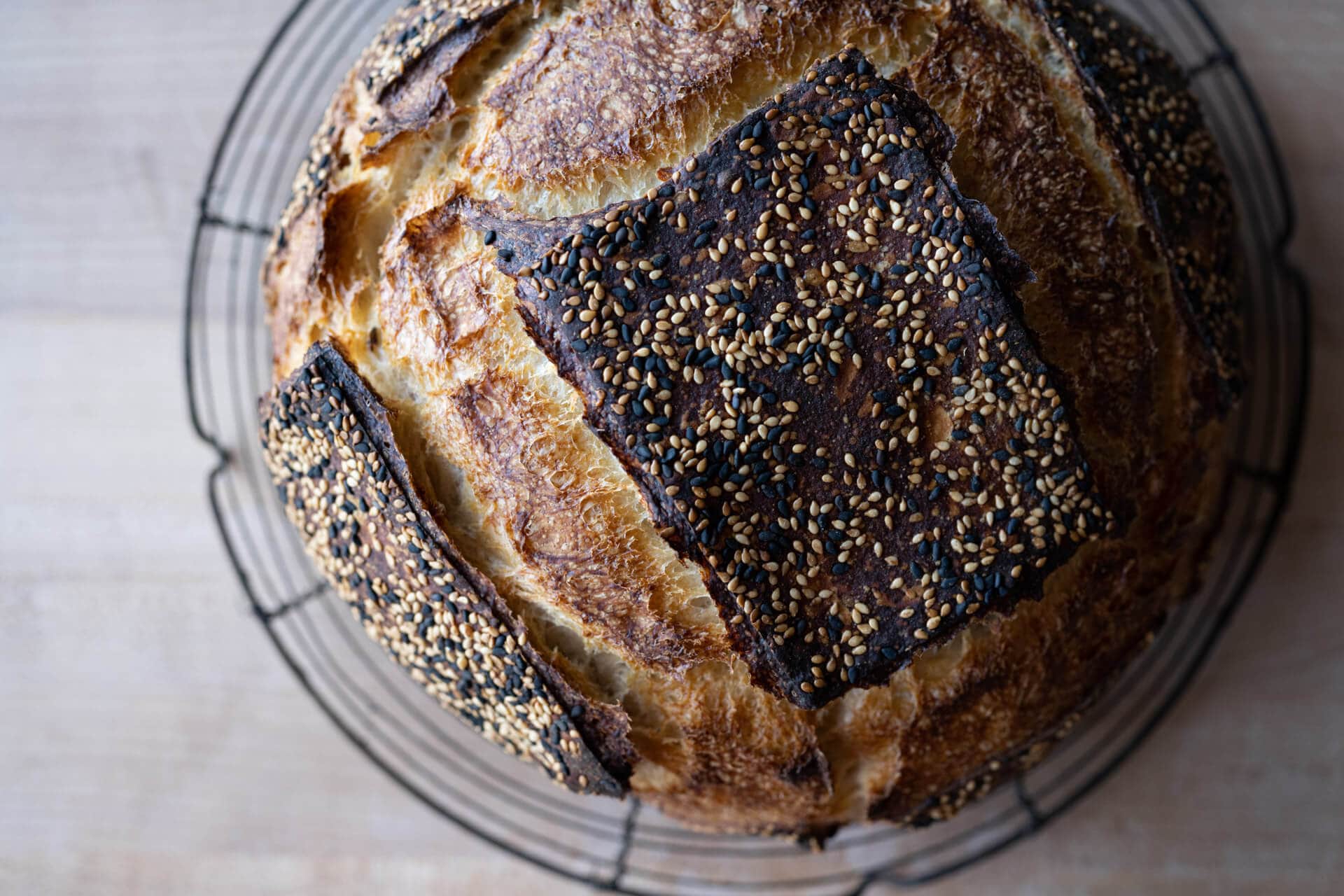
The crust was a rugged one, something I don’t mind one bit. The variegated colors from the sesame add some visual interest—not to mention tons of umami—but the color on the crust would be enough to satisfy my visual appetite. And the crust itself has all the appreciable crunch I look for in one of my sourdough loaves. And perhaps most importantly, the crust tastes incredible dipped in some olive oil—this has me yearning for the middle of summer when tomatoes will be ready in the garden.
Crumb
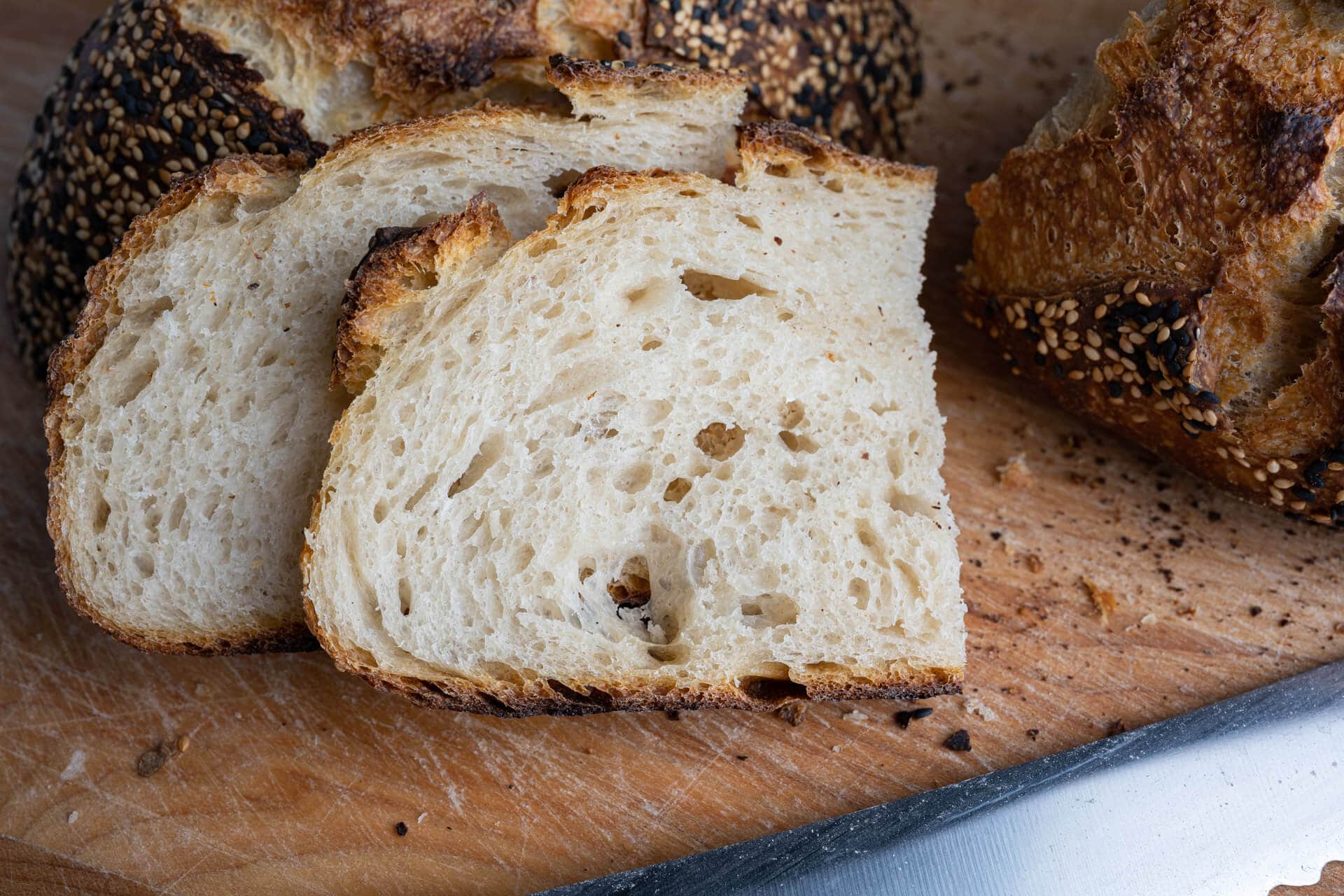
The crumb was tender, light, and wonderfully chewy. A good honest loaf of bread this is, and while not dramatically open, it’s evenly fermented and just what you’d expect—and want—from a straightforward bread recipe with minimal fuss.
Taste
Same day sourdough loaves tend to exhibit a milder flavor with reduced sourness and complexity — but this doesn’t mean it is flavorless. It’s a delicately flavored loaf with wheat flavor standing tall at the front. It still has some tinge of sourness to it, one that arrives at the very end of a bite and serves to remind you of the natural fermentation process, how healthy this bread is, and how delicious it can be when we give the dough the time to ferment properly.
Print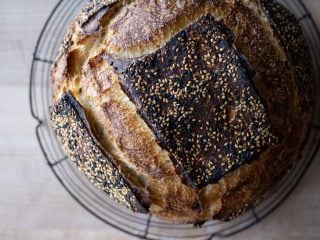
Sourdough Bread with All-Purpose Flour
- Prep Time: 12 hours
- Cook Time: 1 hour
- Total Time: 13 hours
- Yield: 1 loaf
- Cuisine: American
Description
My recipe for an easy loaf of healthy and nutritious sourdough bread made with all-purpose flour—all made in one day. No complicated levain steps with this recipe; just get mixing with your ripe sourdough starter!
Ingredients
Main Dough
- 460g all-purpose flour
- 340g water
- 9g salt
- 92g ripe sourdough starter
Instructions
- Mix (9:00 a.m.)
Add the Main Dough ingredients, reserving 50g of water, to a mixing bowl and mix with wet hands. Mix and strengthen the dough for 2-5 minutes, pinching the ingredients together and folding the dough over itself repeatedly until it’s cohesive and smooths. During this time, slowly add in the 50g of the reserved water if the dough feels like it can handle it: it shouldn’t be soupy or extremely wet, if it is, don’t add the remainder of the reserved water. - Bulk Fermentation (9:15 a.m. to 12:45 p.m.)
This dough will need 4 to 5 sets of stretch and folds during bulk fermentation, the first set 15 minutes after bulk fermentation begins, the second set 15 minutes after that. Then, perform the rest of them at 30-minute intervals as needed. After the last set, let the dough rest the remainder of bulk fermentation. - Preshape (12:45 p.m.)
Lightly flour your work surface and scrape out your dough. Using your bench knife, lightly shape the dough into a round shape. Let the dough rest for 20 minutes, uncovered. - Shape (1:05 p.m.)
Shape the dough into a round (boule) or oval (batard), then place the dough in proofing baskets. - Proof (1:15 p.m. to 3:45 p.m.)
Cover the proofing basket entirely and let it sit out on the counter for 2 – 4 hours, temperature depending. My dough was ready after 2.5 hours at about 75°F (23°C). - Bake (3:45 p.m., preheat oven at 3:00 p.m.)
Preheat your oven with a baking surface or combo cooker/Dutch oven inside to 450°F (230°C).When the oven is preheated, remove your dough from the fridge, score it, and transfer it to the preheated baking surface or combo cooker. Bake for 20 minutes with steam. After this time, vent the steam in the oven or remove the lid (you can keep it in the oven or remove it) and continue to bake for 30 minutes longer. When done, the internal temperature should be around 204°F (95°C).
Let the loaves cool for 2 hours on a wire rack before slicing.
Notes
- The dough can be placed into the refrigerator at the Proof step in its proofing basket and sealed bag to proof overnight. The next day, take it out and bake it straight away in a preheated oven as indicated in the Bake step.
If you use this recipe, tag @maurizio on Instagram so I can take a look!
What’s Next?
This sourdough bread with all-purpose flour is straightforward, but no less delicious, than those with complicated flour blends. If you want an even more hands-off approach to baking sourdough bread, check out my no-knead sourdough bread recipe.
On the other hand, it can be fun to experiment and discover what other flavor profiles we can draw out with a whole wheat sourdough sandwich loaf, or a fifty-fifty sourdough with 50% whole wheat—that is, once we readily have these flour choices at the market!


442 Comments
You might need to use less water in the dough, depending on the flour itself. You might also see increased fermentation activity, so keep an eye on the dough. If you find it is just too active, reduce the levain percentage to keep it manageable.
Hi Maurizio! This is a great recipe and so easy to make. My wife just said this was the best loaf iI’ve baked so far. Quick question and please forgive my ignorance, but when you say you can add 15% add ind, how do you figure that out? I’d like to add olives to this recipe but I am a bit unsure as to how much to add. Any advice?
That’s great to hear, Ethan! I know when my wife and kids give me good feedback, I’m heading in the right direction.
Check out my guide to working with baker’s percentages for how to calculate that 15%.
Hi Maurizio, I have the same question as Mark Vincent, regarding the room temp being 28-30 degrees C here. I have already started this recipe because I love what I have tried on your site so far! But would appreciate your thoughts on any modifications needed for higher room temperatures 🙂 thank you!
If the room temp is higher, your dough *might* be warmer, but always take the temp of the dough! If it’s warmer, expect to cut short earlier, you’ll have to see how the dough is doing to determine when. I’d say at 28C, probably 20-30 shorter bulk.
Hello Maurizio,
I was hoping to find an answer in the comments but it seems few have the same concern.
I live in a hot and humid climate so room temps would range from 28 to 32C (82-90F), averaging at 30C on most days. Thus my starter usually triples in 3 to 4 hours. My go-to sourdough recipe uses 20% levain. Would you have any tips for me for the length of bulk ferment and final proofing?
My usual method is:
Bread, WW, rye flour mix at 74.3% hydration
3 to 4 hour autolyse (waiting for the starter)
Inoculation
Bulk ferment (3.5 to 4 hours)
Stretch and fold 3 times
Coil-Fold 3 times
Final shape (no preshaping since i only do 1 loaf)
Quick counter proof (20-30 mins)
cold retard of 12-14 hours.
I’ve pushed this bulk ferment to 6 hours. The dough has become more slack but the poke test reassures me that it hasn’t overproofed.
Also, It’s still difficult for me to judge how much the dough has risen during bulk ferment as well. I’ve never had a 750g dough fully fill a 10″ oval banneton. Should the banneton be full? It’s almost always 2-3 rings below.
Thank you. Any comment or tip would be great.
Hey, Mark! Sorry for the delay. I’d say at those much warmer temps, expect to cut bulk short for this recipe given the levain percentage. I’d probably expect around a 3 hour bulk, assuming your dough temp is up around 28C (it might not be!). If you’re running into issues with over proofing (very slack dough in the morning, no rise, dense areas), you might want to reduce the levain percentage in the dough to compensate. This should let you still do around a 3-3.5 hr bulk.
No, at 750g I wouldn’t expect the dough to fill the banneton—and that’s ok!
Thanks very much, Maurizio! I’ll try your suggestions on my next bake!
Hi Maurizio,
I don’t have King Arthur Flour but i have Sir Galahad Atisanal Flour and Gold Medal Unbleached All purpose flour. Will any of those two work as good as your King Arthur unbleached app purpose flour?
Either of those will be great substitutes.
Tried this again today. Not quite as wet, I used 290g of water instead of the 340. Everything worked fine until I released the dough from the banneton. It flattened out and as it’s now in the oven I hope it has a superb oven spring or I’ll have fairly thick crackers instead of bread. I don’t know what to do to make this recipe work for me. Any help would be appreciated
I had some early issues with this recipe the first couple of times I followed it. I too had excessively slack dough (but fortunately had great oven spring.). I have since made sure to keep the water at 290g, add in the full available 10% of whole wheat flour (KA 14.0%), add extra folds/do slap & fold (either/or, not both), and, if starting before my starter is mature, autolyse for 20-30 minutes. I also add a little more tension when shaping than Maurizio does and I always make sure that the time between releasing from the banneton/proofing container and putting in my dutch oven is as small as possible, and the transition is as gentle as possible (oven spring can’t save you when you knock all that airy goodness out putting it into the pan!).
Great suggestions, Patrick!
Thanks Maurizio! Love the recipes you come up with, however I realized rather quickly that there would be some changes needed due the the climate differences between ABQ (Cold Semi-Arid. How they got cold from ABQ, I don’t know!) and Maine (Humid Continental).
In Dallas, I’ve found success by staying at 290 and adding some vital wheat gluten when I’m doing just all-purpose, since whole wheat has a higher protein content.
Jolly—I’d say drop the water even further! Try going down to 250g, that should bring quite a bit more strength to the dough. Also be sure you’re using your starter when it’s nice and ripe!
Hi Maurizio,
Love the blog and especially this recipe. I’ve done it 8 times and have experimented with several variables, mostly learning basic techniques. I keep my starter in the fridge and only feed it once the night before, then use it in the morning. The best flour combo so far – 95% AP + 5% dark Rye. I tried using Bread flour in place of AP and did not like it. The crust was noticeably softer and not as brown. Today’s variation is a combination of your 1-day method with pre-dough method described on Breadwerks blog. Night before: feed starter and premix flour+salt+water (very cold, to avoid spurious fermentation). Leave overnight at room temp. By morning the gluten is fully developed. Add starter, mix and proceed to bulk fermentation etc. One question: you mention that max rye percentage is 5% without changing the basic recipe. What would need to change to bump up rye to slightly higher percentage? Would love to try as much as 20% rye. Thanks very much
Thanks, Mark! Sorry for the late reply. Love the modifications, and a bit of rye always seems to do wonders. You could probably go up to 8-10% rye without too much modification, but the higher the rye I’d expect you would need more water in the dough, and you’ll have to keep an eye on the dough during bulk fermentation and proof: rye will cause an increase in fermentation activity. I think you could go to 20% rye, but you might have to reduce the levain percentage in the dough.
Hi Maurizio,
I just finished my bake yesterday and really enjoyed the process. There is one thing I could use your advice on. I baked at 450 in preheated covered clay baker for 20’ and then baked uncovered at 30’. The crust is very tough and hard to chew. Internal bread temp was 210 when I finished baking. What should I do next time to have a less tough crust?
Thanks for your help in advance.
Hey, Bruce! Try to bake it for less time to reduce the thickness of the crust. Shoot for 206F internal. Additionally, more steam at the beginning of the bake will help.
Hey all, I made a handy dandy Google Sheets file that lets you input start time and when you do the steps, if you aren’t starting at 9am, or are trying to hit a certain time to get it in the oven. You can’t edit my copy (mine’s mine, don’t muss mah schedule!) but if you’re logged into your own gmail, you can click file: make a copy, then make your own copy to play with. Just change the yellow box to your start time, and the other values should update.
https://docs.google.com/spreadsheets/d/1_yyJ2N1MPjYOro2kBPjrHiVBIaPKJ6pnBDzPLi-jX0I/edit?usp=sharing
Am not new to bread nor baking, having first baked yeasted breads with one of my grandmothers starting at age 7. Have decades of baking and blue ribbons behind me and an artisan bread baking daughter. That said, I happened upon your recipes and after successes with other sourdough recipes, was excited to give my Lodge a “go,” as my daughter’s loaves at home in her Lodge, were gorgeous (different recipe). Alas, I could not believe my eyes and mess which faced me. I do not understand the chemistry behind a nearly 1:1 ratio of flour to liquid! By this I mean your 460 grams of flour to 340 mils of water, plus 92 mls of sourdough starter, which I consider liquid. When your ingredients are mixed, they equated to far more than a “shaggy mess.” What faced me in my bowl and on my hands was something that I couldn’t even make into biscuits – it was a massively under floured dough. From there, I had to guess how much more flour to add. Believe me, I know what I’m doing, as I’ve made more bread than I can count. *When I first visited the recipe section, I pulled the Babka recipe and had in mind to make it tomorrow, 8/25/20. Based on my experience several days ago, I need you to understand that I’ve chosen not to embrace that creation. A lot of time, ingredients, creative energy and experience goes into each bake and I simply cannot abide working with an “iffy” recipe. As a retired educator, I beg you to look at the “Sourdough Bread with All-Purpose Flour” recipe with new eyes, in order to provide your followers, especially beginners, with new guidance re the 1:1 ratio, which is indeed not do-able. Thank you for reading my missive.
Hey, Rebecca! Thanks so much for the feedback. Most of my recipes here tend to be a little higher in hydration, but every recipe will need some measure of adjustment in your own kitchen! Each environment and each bag of flour will be different. The above recipe, which is around 76% hydration, isn’t wildly high in terms of water content, but it might be a wet dough for you depending on the flour you’re using. Not a worry, just hold back some of the water (as I discuss in the post) and only add it in if the dough feels like it can handle it. It sounds like your flour might need 100g or so held back.
For some, 76% hydration will be too dry. For others, such as yourself, it might be too wet. Where’s the solution? My approach is to try to explain the reasons for holding back water during mixing, only adding it in during this time if the dough feels good to the baker. But what feels “good?” That’s a feeling the baker will need to develop over time, and as their experience grows my hope is they are able to make these adjustments (as many have!) in the kitchen as necessary depending on how the dough is feeling that day.
I hope that helps and sorry to hear about your shaggy mess of a dough! If you feel up for trying this again with 100g water held back, I’d encourage you to give it another go. Please report back if you do! Happy baking 🙂
I tried this recipe for the first time a few days ago. And what a shaggy mess it was! My hands were absolutely coated in sticky wet dough. I was convinced it was a disaster. But I kept going and followed the directions because I figured I was in too deep to turn back. To my utter delight it produced the most amazing loaf I’ve ever made (in my short few months of experience). What a lesson for me to not give up on it!
Glad to hear that, Carol!
Is there any reason I can’t just double this recipe to make two loaves?
No reason at all, just double everything!
Hi – thank you for keeping us busy during covid times!! Though I’ve been making sourdough since long before it was the thing to do. Sometimes I have great success in terms of airy bread with big but not-too-big holes and a firm, crispy crust, but other times the bread is denser and the crust is less crisp. I know sooooo many variables affect the bread, but what would you say are the most important factors in achieving that beautiful, airy bread?
Fermentation! It’s the cornerstone of great bread. Focus first on getting a strong starter, using it at the right time to encourage maximal fermentation, keeping things warm, and giving it the time it needs. So many variables like you said, but that’s the most important one, in my opinion 🙂
Hi there! Thanks for all these fantastic and detailed recipes! I am at the moment trying this recipe for the second time, the first time did turn out great, although I think it was just a little but overproofed! This is a recurring problem for me as my starter rises/ferments very fast, which makes the bulk and final proofing a lot shorter. Because of that, I did not yet succeed with an overnight retard because the loaf turns out flat everytime due to what I think is overproofing. Also, is it possible that a quick ferment leaves not enough time for the dough to build a sufficient gluten structure to hold itself and deliver a good oven spring? Do you have any tips regarding this problem that you could share? Greetings from the Netherlands!
You could try using your starter/levain a little earlier, keeping it cooler, or using less “seed” when you build a levain. This should help slow it down and help you use it before it gets overly ripe!
Hi there, I’m absolutely loving your blog, thank you so much for sharing your expertise 😊
My entire family is addicted to this incredibly delicious 😋 bread and they hound me continually to make more lol.
Can you please tell me what to do when you have it in the fridge overnight? I don’t know how long to leave out before baking it.
Have a fantastic day!
Nattie
Glad to hear all this, Nattie! I bake it straight from the fridge in the morning, it’s rarely necessary to let it warm to room temp.
Thank Maurizio! I have another question on the /my-sourdough-bread-with-a-young-levain recipe.This Part— Carefully take out the shallow side of your Dutch oven from the preheated oven and drag in your dough resting on parchment. Quickly place the pot back in the oven, cover with the deep end of the Dutch oven…. do you mean start the loaf on the cover of the dutch oven and then cover with the bottom? Basically cook with dutch oven upside down bread on lid pot covering it then remove after 30 min?
Also if I don’t have Sangre de Cristo Flour should I use King Arthur Bread Flour?
I have been making 2 of your sourdough recipes and also the pizza dough
ABSOLUTELY FANTASTIC!!! THANKS SO VERY MUCH FOR YOUR GREAT INSTRUCTION AND RECIPES…U DA BEST 🙂
That was baked using a combo cooker, which has two sides, a deeper one and a shallow one, but either can be used to cook or bake items inside. For a proper Dutch oven, which has a very deep side and a lid, always place the dough in the deep side.
Yes, King Arthur Bread Flour will work!
Happy things are going well for you, Natalie—happy baking!
Hey there, love the blog! I am wondering if this recipe can be done with a Rye flour sourdough starter? Thank you so much!
Yes, absolutely!
This was my first sourdough! I think my starter may not have been ready enough, though I’ve been feeding it for 2 weeks. It floated it water for a minute or so before sinking. Anyhow, I don’t think my loaf rose enough during proofing overnight but I decided to bake it anyway. It was good but really chewy and difficult to cut through at the bottom. There were some air bubbles so I think my starter did something, maybe just not enough. Not sure where to go from here with my starter! My dream is to make sourdough with roasted garlic cloves throughout!
Yes, sounds like it could have been under proofed. There are a few indicators your dough could be under: explosive rise in the oven, dense interior with potentially scattered large holes, and gummy texture to the interior. Finally, it’s possible the bottom of the loaf might be slightly bowed upward (like the letter “U” — the top will kind of dome).
Make sure to build your levain from a starter that’s strong and mature (meaning it’s risen to it’s peak height before you take some to use). From there, bulk fermentation is very important! Make sure your bulk fermentation goes sufficiently far, you want the dough to look smooth, it should have risen considerably, and have bubbles here and there — it should look alive. If you tug on the dough a bit it should offer resistance to your tugging, it’ll feel stronger. Give the dough the time it needs in bulk fermentation! If you have to give it another 30m or hour to see these signs, do so. It’s important for this step to go sufficiently far for the dough to have enough fermentation activity before its proof.
Awesome thanks for sharing this one. Sometimes a day is all you’ve got!!
You’re very welcome — and agreed!
Hello! I am a newbie, this is my first loaf. After the 5 folds and then resting during bulk fermentation, it’s been almost 5 hours now including the folds, and I am still not seeing any bubbles. Should I just keep waiting to see bubbles before the next step, the preshape? I cut the water and only used 290g but it seems pretty sticky. The thermometer in my house just reached 75 degrees, it is a rainy day and cooler than usual. My starter doubled and fell slightly before using it so that shouldn’t be the problem. I was hoping to bake today, suggestions please? Should I add a touch of flour and do the folds again? Thanks so much!!
I would have just kept with it! You could have given it another fold or two, and then given it more time. It sounds like it might have been on the cool side which would slow the process down and require a longer bulk fermentation. I hope it turned out ok!
Made this as written except that I cooked it in a loaf pan and it was amazing! It was done at 20 minutes. Spread the top with butter right out of the oven and it stayed soft. Just a slight tang, slight chew. Will be my weekly loaf! Thank you!
Right on! I haven’t tried this but should work just fine. Thanks for reporting back, Dawn, and enjoy!
Hey Maurizio! Thanks for this recipe, here where I live all purpose is pretty much the only flour I can easily find (quarantine or not), so it’s really helpfull. Just made it, and though the flavour is great I have some issues. Since my flour is pretty weak (only 9% protein) I went with half an hour autolyse (with only 250gr water and 10% whole wheat flour), then added the starter (plus other 30 gr water) and after 15 min I added salt (plus 20 gr of water, since the flour could handle it). Since here in Chile we’re in winter and it’s pretty cold I didn’t reduce this time from bulk time (so from autolyse to end of bulk were 4 hours and 15 min). All the way through, the dough felt just right, was relaxed but firm, wasn’t soggy, did´t spread out when pre-shaped and the shapping were right. I started late so I went for overnight option and baked around 15 h later. Again, the bread didn’t spread when I put into the oven and it seemed ok. Oven spring looked good and the “ear” was opening just right on the first 15 min but then stopped. It did rise some but did’t get a really open crumb. My main problem is that, though it was flavoufull and did rise some, inside was too gummy. As I said, I think the amount of water was right and I baked it for more than an hour, so acording to what I have read on internet it could be that it was under or over proofed? but wich one. Maybe I under worked the dough? My starter was’t ready? What else do you think can cause a gummy crumb?
Anyway, here is a photo. You can’t really appreciate it, but I hope I explained myself.
https://ibb.co/cgq6pVP
My first suggestion is to make sure to bake your loaves completely. The interior should register around 208°F (98°C) or higher.
Like you speculated, if your loaf is under proofed then this will typically lead to a gummy or “wet” textured interior. Make sure your starter and levain are very vigorous and strong when you use them. This is very important! From there, make sure to bulk ferment your dough fully (use the images you see in my posts to guide you on what the dough should look/feel like). You want the dough to be alive and aerated before you divide and shape. From there, a full and complete proof is also very important.
Hi friends! Thanks again for all your help, Maurizio. You’ve made this ex-San Franciscan very homesick with all this sourdough. I’m wondering if I can keep this in the refrigerator for two nights more a more delicate crumb structure and sour taste, or if that will overdo it? Thanks again.
Another night in proof should work! Expect a little less rise, more sourness.
Hi! I am curious to know from your experience, what have you found to be the optimal hydration level for sourdough bread recipe using 100% all-purpose flour, based on taste (crust and crumb) and rise (I don’t want to sacrifice a good rise due to the high hydration)? I am up to 80% hydration and I am wondering how much higher should I be pushing it
There’s no set hydration, it’s all very flour-specific! We could be using the same flour and be at very different numbers 🙂
Hi! I’ve baked this bread twice (delicious), but the bottom has burned both times. My oven does not run hot. First time, I baked uncovered for 30 minutes, and second time I baked uncovered for 25 minutes. Will try 20 minutes next time. Bread is great once I cut the burnt bottom off. Any idea what might cause this? Used Dutch oven both times.
Burnt bottoms are common with dutch ovens. I’m no expert but burnt bottoms is one problem I haven’t had. I put two baking sheets on the rack just above the heating element but below the dutch oven
Maurizio’s post How to Bake Bread in a Dutch Oven has some solutions to this. Some options include: reduce preheat temp, protect your dutch oven from the bottom element by putting a baking stone on the bottom rack, protecting the bottom of your loaf with coarse cornmeal or wheat bran, and using a double layer of parchment paper. I recommend reading his post!
Hello! My question is how do you get your starter to be mature by 9:00 am? Do you feed it the night before? And again in the morning?
Thank you!
Typically you can change when your starter is ready by changing the ratio of starter you are using to the amount of water & flour you feed it. So if your normal feeding is a ratio of 1:2:2 (starter : water : flour), and you feed every X hours, if you want to increase the amount of time before your next feed, you’d increase the amount of water & flour, and keep the starter the same. So you’d increase to 1:3:3. I usually feed once in the morning at 1:4:4 and once in the evening 1:4:4. So when I want a mature starter at 9:00 am, I just feed at my normal evening time (9:00pm) at 1:4:4, and then it’s mature at 9:00 am. But if I want to use my starter in the afternoon, I’ll make my 9:00am feeding 1:2:2 ratio, and it’ll be ready to go around 2pm. You’ll have to play around with what works for your starter. You can also alter the temperature a bit, warmer will make your starter mature faster, cooler goes slower. I’m sure Maurizio will have more to say, but figured I’d let you know what I do!
Hi Maurizio! I wanted to ask about the overnight option – is the overnight option after proofing on the counter, or is it a replacement for proofing on the counter?
I’ve made this recipe several times and when I proof overnight it’s *instead* of the countertop proof. So at step 5, *instead* of any time on the counter, it goes straight into the fridge. It can then come straight out of the fridge and into the oven. The overnight proof can help develop more flavor, and make scoring easier too!
Sounds good – thank you!
Hello! I have been baking sourdough for a few months and have made numerous loaves from your site, thank you! I wanted to try the All Purpose Flour Sourdough bread loaves that you do within a day and am just wondering about the proofing…if I simply proof overnight in the fridge as with your Simple Weekday loaf rather than on the counter, would that work or do you still recommend on the counter proofing for that loaf?
Step 5 says “Overnight option: At this point, you can also place the covered proofing basket directly into your refrigerator and continue the process the next morning, afternoon, or even the next evening.” That’s what I do, and it works great for me! So no countertop proof, only proofing overnight in the fridge.
Thanks Bob, I prefer this option as well as I have been taught other ways which include the need to proof on counter, however with Maurizio’s recipes so far, I have used them multiple times without counter proofing only fridge overnight with great success.
That will also work, Sammy!
TY! I made it a few days ago and was one of my favorites!
Hi Maurizio! I’m a huge fan of your site, and this recipe in particular gave me my best loaf yet! I am, however trying to make a loaf that is more tangy and sour than it appears you prefer, based on other posts you’ve written. To that end, I’ve iterated on this recipe to try to achieve that. Strangely enough, vastly different methods/environments have resulted in no real difference in taste. I wonder if you have recommendations. I’ve tried this now 3 different ways (in addition to how you’ve written it).
I heard that warmer temps and an “overripe” starter encourage sourness, so tried it but with a starter that I had consistently been letting get “overripe” (vinegar-y) before feeding (and used it at an “overripe” state). I also keep the dough warmer throughout the process (at 82 degrees) and doubled the time between stretch & folds. Proofed closer to 2 hours (at which point it already seemed a bit overprooved).
Then I tried the same thing but much colder, keeping the dough around 60 degrees, used a 70% hydration, 50/50 white/wheat starter (adjusting the water in the dough accordingly), and used 15% whole wheat flour. I proofed the dough overnight in the fridge at 38 degrees. (16 hours actually. Once again, seemed overprooved).
Today, I did one where I used a similar 70% hydration starter, mixed that with 33% of my flour and enough water to make it around 70% hydration, let that sit in the fridge overnight, mixed the rest of the flour (10% whole wheat), water, and salt, and then followed your directions, but keeping dough at 60 degrees, and doubling times. I proofed overnight.
With such different approaches, each of which I had read makes the bread more sour, can you think why they all came out essentially the same? Any tips for making my loaves a bit more sour? Thanks for any advice!
Thanks for an amazing website with so many great resources and recipes! This recipe is the one I’ve had the most success with out of all the ones I’ve tried, so now I’m just iterating off it to get *my* perfect loaf! The one thing I’m stumped on is that my loaf NEVER gets to 205 degrees. I am in Denver, so at 5280′ altitude, but I’m pretty sure that’s your altitude as well, so am curious if you have thoughts about that. Thanks again!
Whoops: I can get my loaf to 202, but never beyond, if that is helpful
That’s totally fine, at higher altitude it might be difficult to get to those top-end temperatures. Your loaf is likely baked thoroughly at 202F.
Thank you for asking about this; I’m also in Denver and can’t seem to get my loaf temps above 203-deg but the taste and texture is fine.
I see elsewhere on your site that you’re also a mile high in altitude. Are you really able to get temps that high, or have you adjusted your recipes for sea level? I can’t get over 200 degrees without burning.
Such a great recipe! I’ve made this with KA AP flour, and recently used the AP plus 10% KA whole wheat and loved the results. I do find it’s best when I hold back about 20 g of the water. I’d like to make two loaves tomorrow – this might be a very novice question but how does this recipe work with doubling?
You should just be able to double everything, but if you want more info, Maurizio’s got a great post on how to use baker’s percentages here!
Just made this, my first sourdough ever! Used Trader Joe’s APF which I read has a protein content of 13%? (Still learning a lot on that front.) Was a little nervous about the rise since it was a bit cold in our apartment today but let it proof on the counter for an extra hour or two and it seemed to come out great. Thank you so much for the detailed instructions and all of the resources on your site. My husband and I ate half the loaf as our dinner and will probably eat the other half for brunch tomorrow 🙂
Baked this recipe a few times and I think I nailed it. I used KA APF and achieved best results when 1) autolysed for 30 min 2) proofed overnight in the fridge, 3) held back 50g of water. Easy and delicious!
Glad to hear that, RK! The important thing is you adjusted for the flour you have on hand, that’s the way to go — enjoy!
Hi Maurizio, thank you for this timely recipe. I’ve baked it twice now and it was delicious both times. The first time I baked it the same day and I thought the flavor wasn’t as complex as I like. Also, the crumb wasn’t very satisfactory. I realized that my APF was on the lower end of protein – it’s Central Milling organic unbleached – which I’ve been able to buy reliably at Costco. So the second time I added 10 gms of vital wheat gluten and retarded the shaped loaf overnight for about 15-16 hours. The crumb was lovely – soft, stretchy and even. The taste was complex, more sour than I usually get, but still sweet. Very very satisfying! As my lone bag of bread flour gets depleted, I might experiment with using a touch of vital wheat gluten more. Thank you!
Thanks for the feedback, Nivedita! Another approach might be to slightly reduce the water in the recipe, omit the VWG, and knead the dough a bit upfront before bulk fermentation. This should help bring significant strength to the dough without needing an additional ingredient 🙂 Either way, enjoy and happy baking.
Hi @maurizioleo:disqus! I’ve made this loaf 5 times now and it’s been delicious!!!!! I have some Central Milling T85 Malted (12.5% Protein) and a Central Milling High Mountain (13.5% protein) flour laying around. Can I use a mix of those with AP or are the proteins too high? Thanks!
Those will work well and are flours I use often here. CM High Mountain (HM) is high protein which I find might need require an adjustment ot the hydration (up), and similarly, I find T85 needs an increase as well. That’s easy, though, just mix with whatever ratios you’d like and see how the dough feels compared to your successful AP-only loaves — if the dough feels more stiff and dry, add a splash more water to loosen as you’re mixing. Take note of how much you’re adding and adjust up next time. This iterative process is how I end up with my formulas here, testing, testing, testing 🙂
I am having issues with the amount of water in the Every day Sour dough recipe. After the automate I am having a very difficult taking the dough from excessive slackness to where it can hold a disc shape. This is despite employing both the slap and fold method and the more conventuales folding technique. It seems the more folds I do, the funnier and stickier the dough becomes. Is it possible to overwork the dough? Should I holdback some of the water to see if this helps? Should I add additional flour. I am flummoxed because I have great success with the AP Flour sourdough. Please help!!
Yes, I’d hold back water instead of adding more flour. Try holding back 50-100g and see if that helps bring strength!