

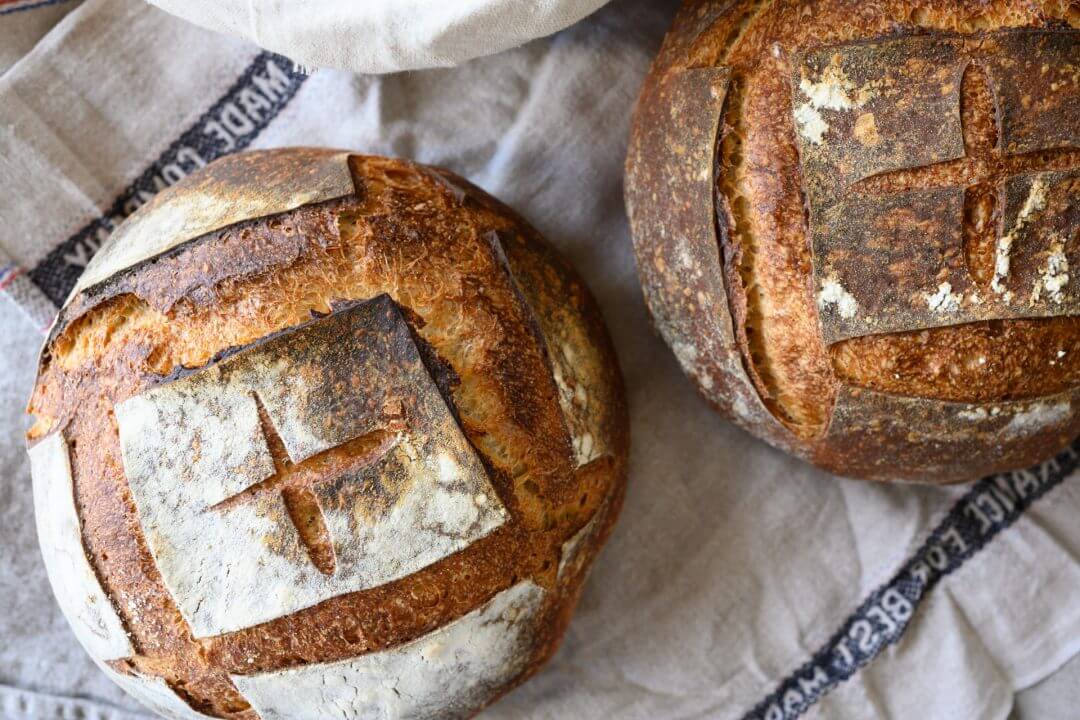
Baking a healthy and nourishing loaf of sourdough bread with your sourdough starter is gratifying, to be sure, but what if you’re not home all day to check in on the long-fermented dough? I mean, some of us do have to work, right? This simple weekday sourdough bread recipe and schedule are uncomplicated for mixing and baking a loaf of bread during the busy workweek.
This post includes pictures and videos that clearly and concisely convey the full sourdough bread-making process. But why is this recipe so easy compared to others?
Real Quick: Why is This Sourdough Bread Easy?
- It’s a no-knead sourdough bread recipe: mix everything in one bowl
- It uses only two types of flour: bread flour and whole-wheat flour
- It’s moderate hydration—no messy dough or counters
- It’s baked in a Dutch oven or combo cooker
- Timing is extremely flexible
Let’s go over the workweek schedule.
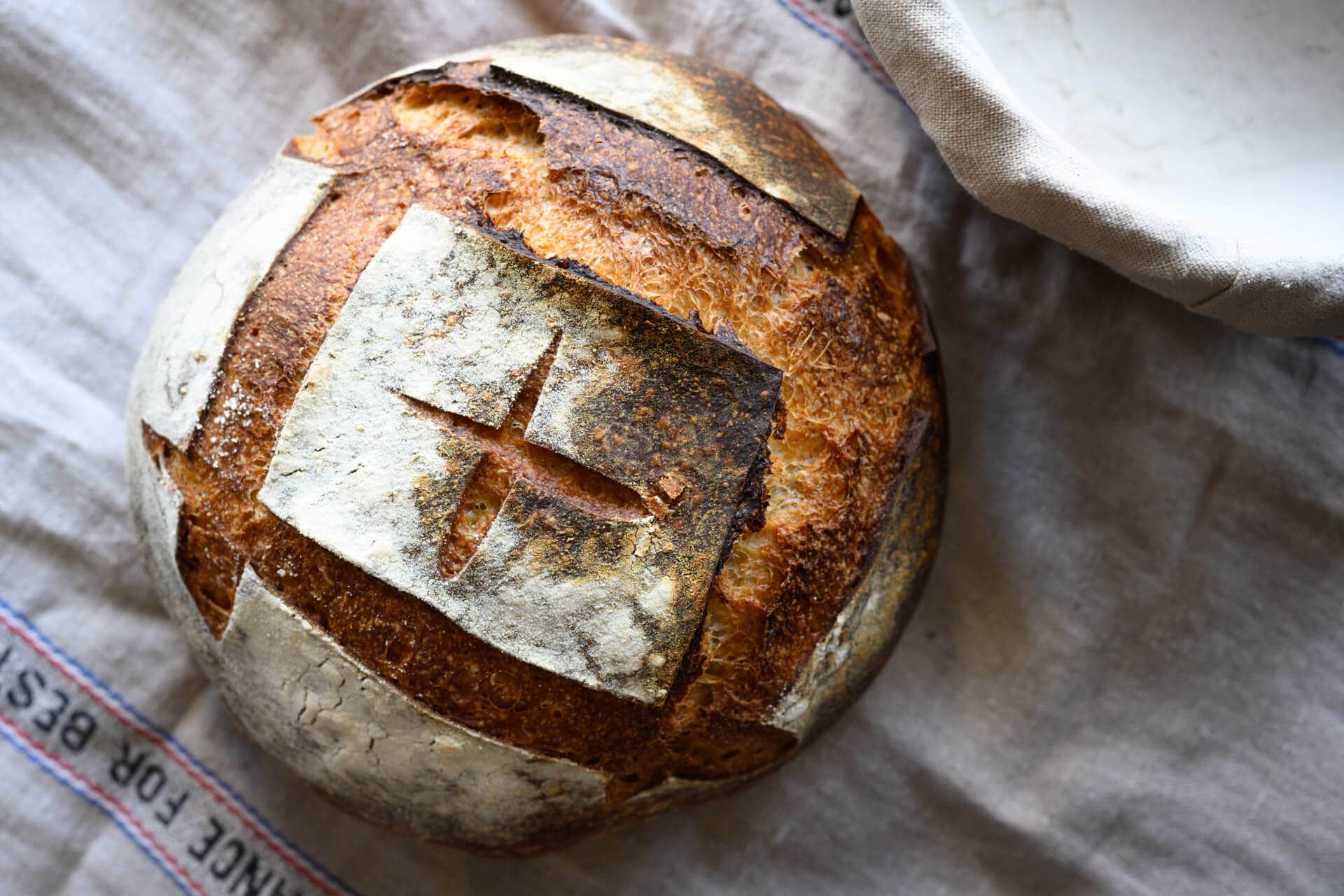
A simple weekday sourdough bread schedule
In the past, I’ve discussed a weekend baking schedule that outlines a schedule for low maintenance during the week with a bake on the weekend. The following schedule, however, allows baking during the week around a typical nine-to-five workday. It’s also quite flexible, and you always have the option to place the dough in the fridge longer to bake when you get a chance.
Read through my ultimate guide to dough proofing for more information on adjusting the proofing period for this sourdough bread.

| Time | Step |
|---|---|
| 7:00 a.m. (before work) | – Make the 10-hour levain (ready ~5:00 p.m.) – Save time later, scale-out flour & salt into bowls and cover |
| 5:00 p.m. (after work) | When levain ready, mix dough for autolyse |
| 5:30 p.m. | Finish mixing and begin bulk fermentation |
| 9:00 p.m. | Divide, pre-shape, and bench rest |
| 9:30 p.m. | Shape and place into the refrigerator to proof overnight |
| 7:00 a.m. (next day) | – Bake the next day before work – Alternatively, bake after work |
The schedule above has example times, so shift the timeline to earlier or later according to your schedule. Don’t worry if you don’t hit the times precisely as they’re written. There’s some flexibility there.
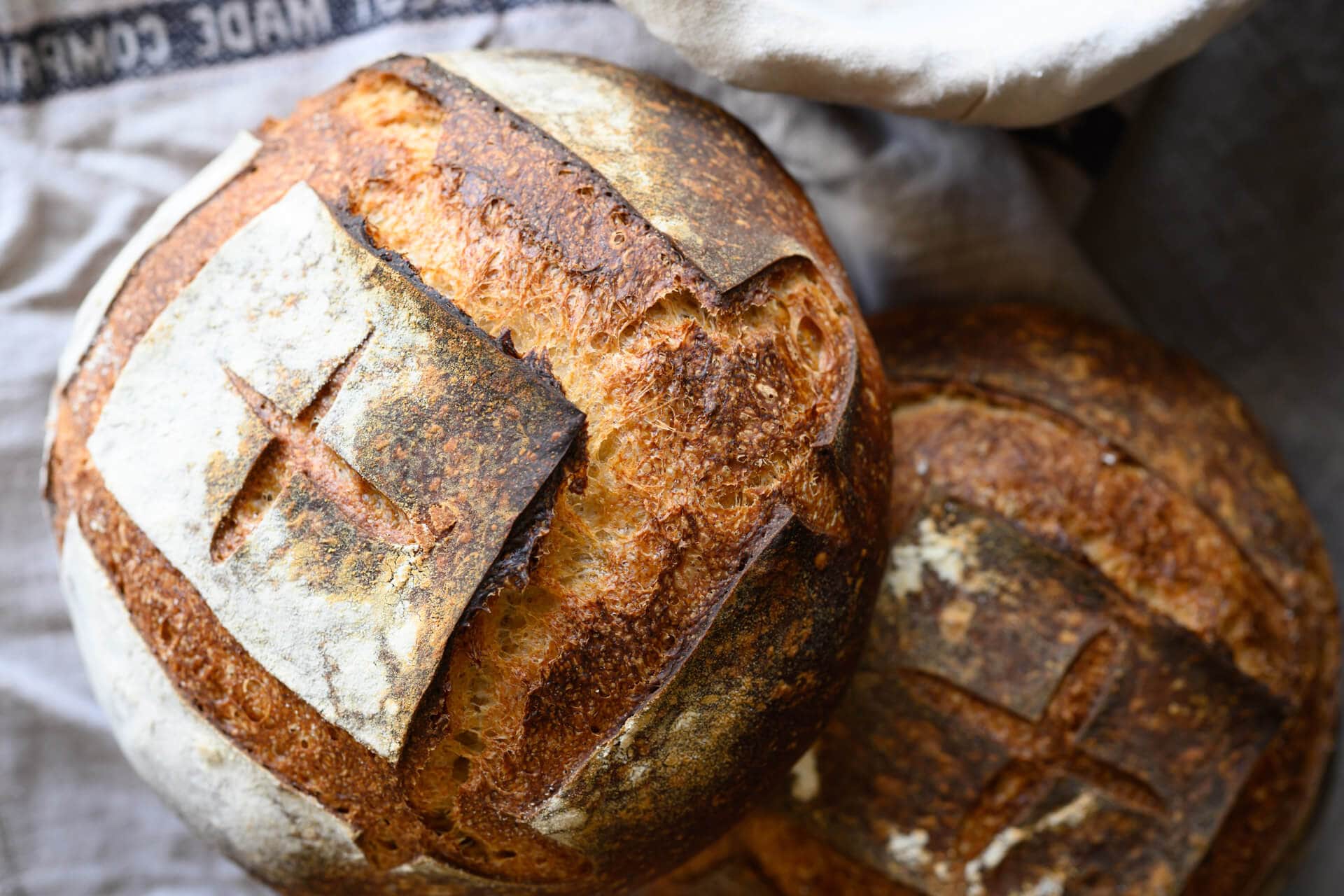
A Simple Weekday Sourdough Bread Recipe
Vitals
| Total Dough Weight | 1,800 grams |
| Pre-fermented Flour | 8.0% |
| Hydration | 76.0% |
| Yield | Two loaves |
Total Formula
The following table shows all the ingredients needed to make this bread. Each ingredient will be called out as needed in the method steps below.
My final dough temperature for this simple weekday sourdough bread was 75°F (24°C). For more information, see my post on the importance of dough temperature.
| Weight | Ingredient | Baker’s Percentage |
|---|---|---|
| 806g | High-protein white bread flour, malted (King Arthur Bread Flour) | 80.0% |
| 202g | Whole wheat flour (King Arthur Whole Wheat Flour) | 20.0% |
| 766g | Water | 76.0% |
| 19g | Fine sea salt | 1.9% |
| 8g | Ripe sourdough starter (100% hydration) | 0.8% |
Method
1. Prepare levain – 7:00 a.m., before work
A levain is simply an off-shoot of a sourdough starter. A sourdough starter is never used up completely; it’s continually fed day after day indefinitely. A levain is created with a small bit of a sourdough starter and left to mature (ferment) until ready to be mixed into a dough. Ultimately, it meets the same fate as the dough: baked in the oven.
In the morning before work, mix in a jar:
| Weight | Ingredient |
|---|---|
| 40g | Bread flour |
| 40g | Whole wheat flour |
| 81g | Water |
| 8g | Mature sourdough starter |
Loosely cover the jar; it should be ready after about 10 hours at room temperature, 72-75°F (22-24°C).
2. Autolyse with Levain – 5:00 p.m. after work
Performing an autolyse gives our dough a chance for the flour to fully hydrate and begin the gluten development process (all without kneading). I typically don’t do an autolyse with the levain included, but we’ll do that in this simple weekday sourdough bread recipe because it’s a short period.
Add all the ingredients below to a mixing bowl. Mix with wet hands until all the dry bits are incorporated. Cover and keep somewhere warm at room temperature for 20 minutes.
Note: the water in the table below is 50g less than the total water for this recipe; the water (and the salt) are held back for the next mixing step.
Dough Mix
| Weight | Ingredient |
|---|---|
| 766g | High protein bread flour, malted (King Arthur Bread Flour) |
| 161g | Whole wheat flour (King Arthur Whole Wheat Flour) |
| 635g | Water, Autolyse |
| 169g | Ripe levain (created in Step 1) |
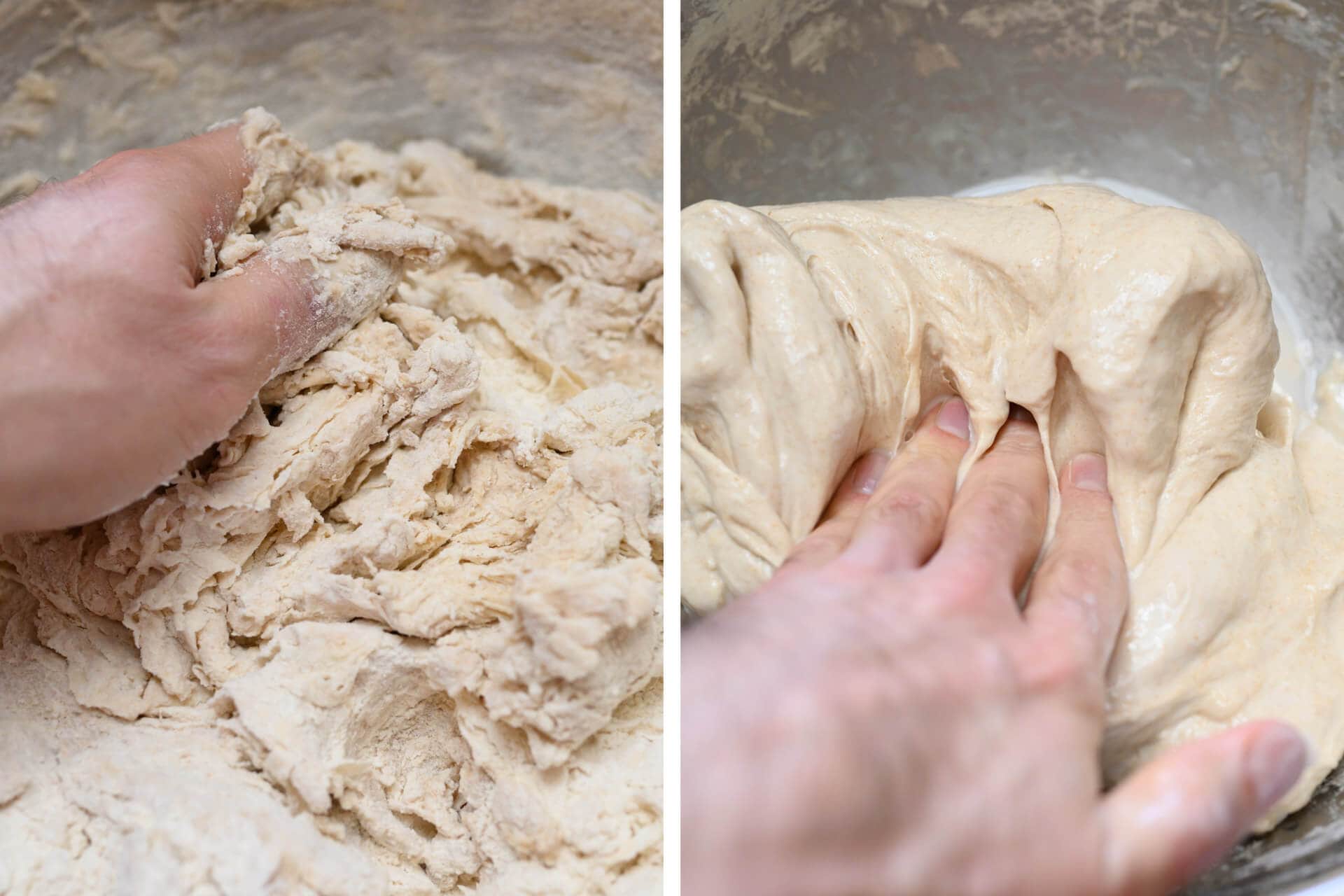
The image above shows the direct result of even a short autolyse. The left image shows the shaggy mass just before I finished incorporating everything. The right image shows how smooth and strong the dough becomes simply by resting. Let’s take this further with a little mixing.
3. Mix – 5:20 p.m.
Add the ingredients in the table below to the top of the dough: first, add the salt and then add the reserved water slowly to help dissolve the salt. Add the water a little at a time, depending on how the dough feels: it should be shaggy and loose, but not “soupy.” You can pause midway through pouring the water to incorporate it with a wet hand. If it feels like the dough can handle the rest of the water, add it all.
| Weight | Ingredient |
|---|---|
| 50g | Water, Mix (as needed) |
| 19g | Salt |
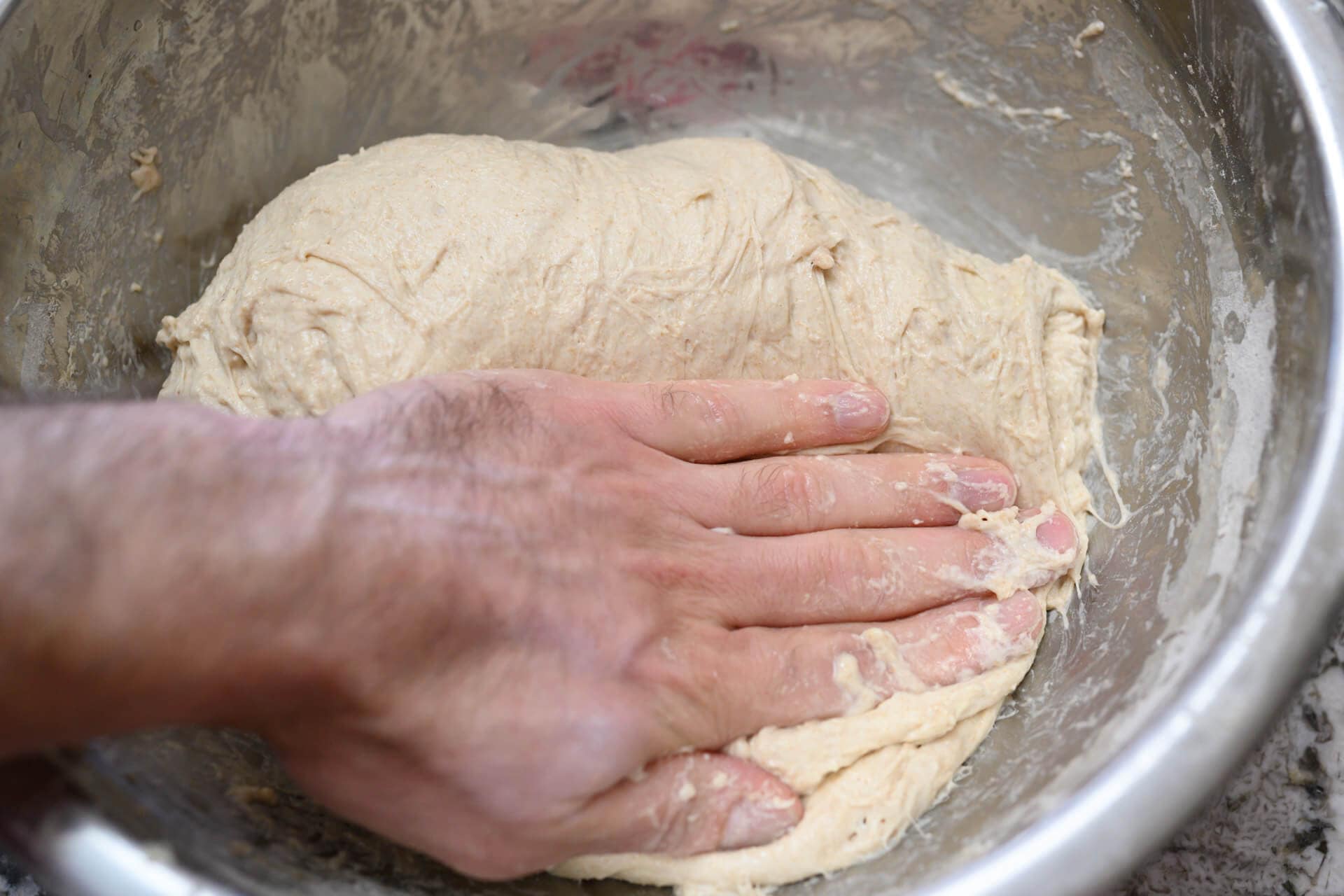
Since this dough uses a fair amount of high-protein white bread flour, it doesn’t require extensive mixing or kneading.
Using wet hands, mix everything until it comes together into a shaggy mass. This dough is rather strong and doesn’t require intensive mixing or kneading, but give it a few folds in the bowl, perhaps 5-10, until it smooths slightly (see the image, right).
Cover the bowl with reusable plastic and keep it somewhere warm in your kitchen for bulk fermentation.
3. Bulk Fermentation – 5:30 p.m. to 9:00 p.m.
Bulk fermentation, or first rise, occurs when the dough is leavened (through the production of carbon dioxide gas) and flavored (through the production of organic acids) as a result of natural fermentation. Below, you can see how much my dough rises during this 3-hour and 30-minute bulk fermentation at 75°F (24°C).
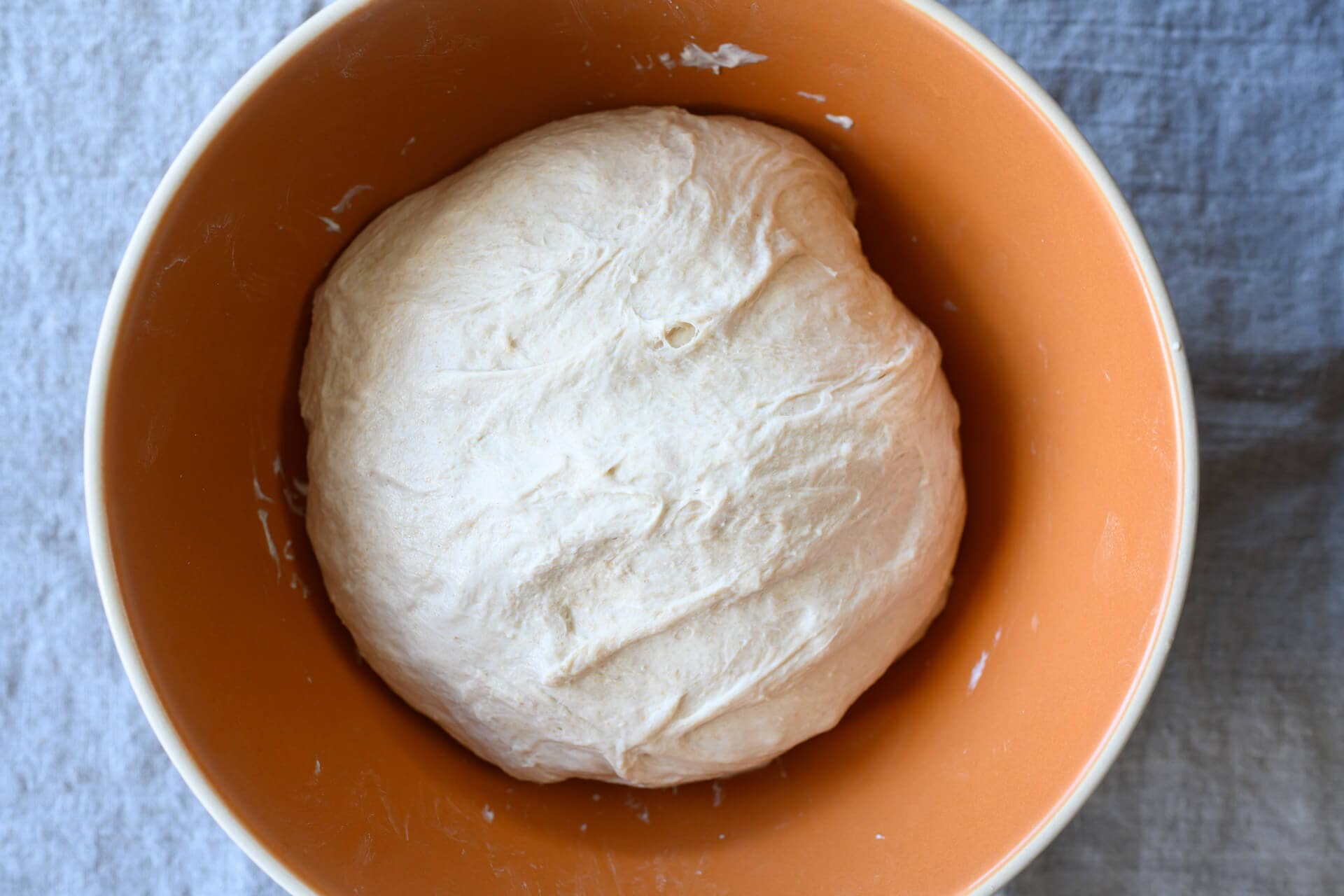
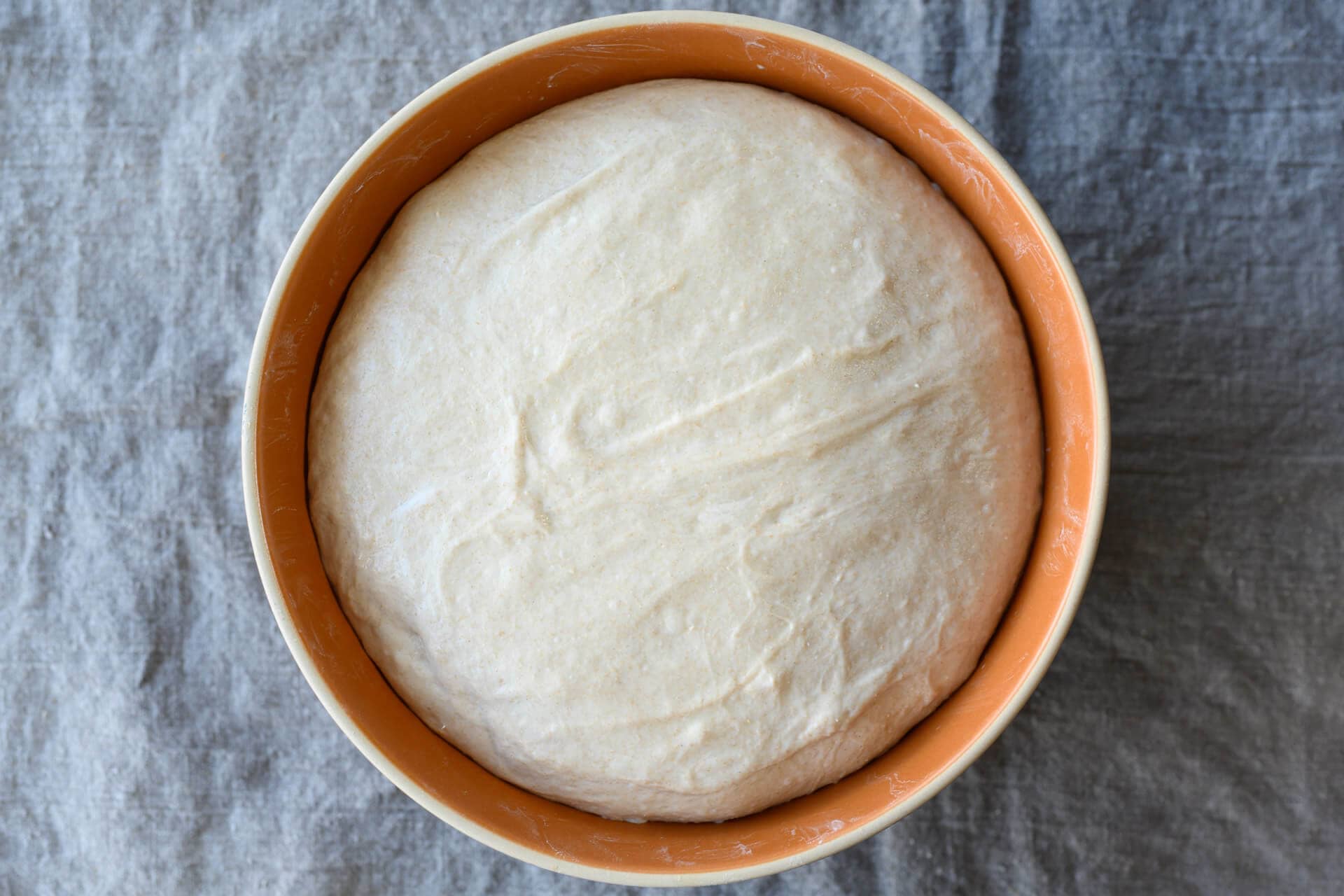
During this time, give the dough 2 sets of stretch and folds: the first set is 30 minutes after the beginning of bulk fermentation, and the second set is 30 minutes after the first. After the second set, let the dough rest, covered, until the next step.
As you can see in the video above, each set of stretches and folds is simple: With wet hands, grab one side and gently stretch it up and over to the other. Perform this fold in each direction: North, South, East, and West.
4. Divide & Preshape – 9:00 p.m.
Fill a bowl with some water and place it on your work surface. Scrape out your dough from the bulk container onto your dry counter. Divide the mass in half using a bench knife. Using a wet hand and the knife in the other, gently preshape each half into a loose round. Let the dough rest, uncovered, for 30 minutes until it’s relaxed outward.
See my guide to preshaping bread dough for a video and more instructions.
5. Shape – 9:30 p.m.
As seen in the video below, flour the top of the round with your hands and flip it over. Take the bottom edge and fold it up to about the middle. Take the left and right sides in your hands and fold the right over to about 2/3 of the left side. Repeat for the left side. Then, take the top and fold down to about the middle and gently seal. This should form a little envelope shape.
Now, flip over the entire thing and begin dragging and sealing the dough underneath itself (top-right, above). Using both hands, rotate and drag the mass toward you to create tension on the top. Repeat the dragging if necessary.
Read through my guide to shaping a boule for more instruction.
6. Proof – 9:45 p.m. to 7:00 a.m. or 6:00 p.m. (the next day)
Cover both proofing baskets entirely and put them in the fridge to proof overnight. The fridge allows us to slow fermentation to bake before or after work the next day.
7. Bake – 7:00 a.m. (pre-heat oven at 6:00 a.m.)
Preheat your oven with the rack at the bottom third to 450°F (230°C). Place your Dutch oven inside, with the lid and bottom side-by-side.
Take one basket out from the fridge and uncover it. Your dough might not have risen considerably in the fridge, but that’s fine. Cut a piece of parchment paper to fit over the basket and place a pizza peel (or large cutting board) on top. Using both hands, flip the entire stack over and remove the basket.
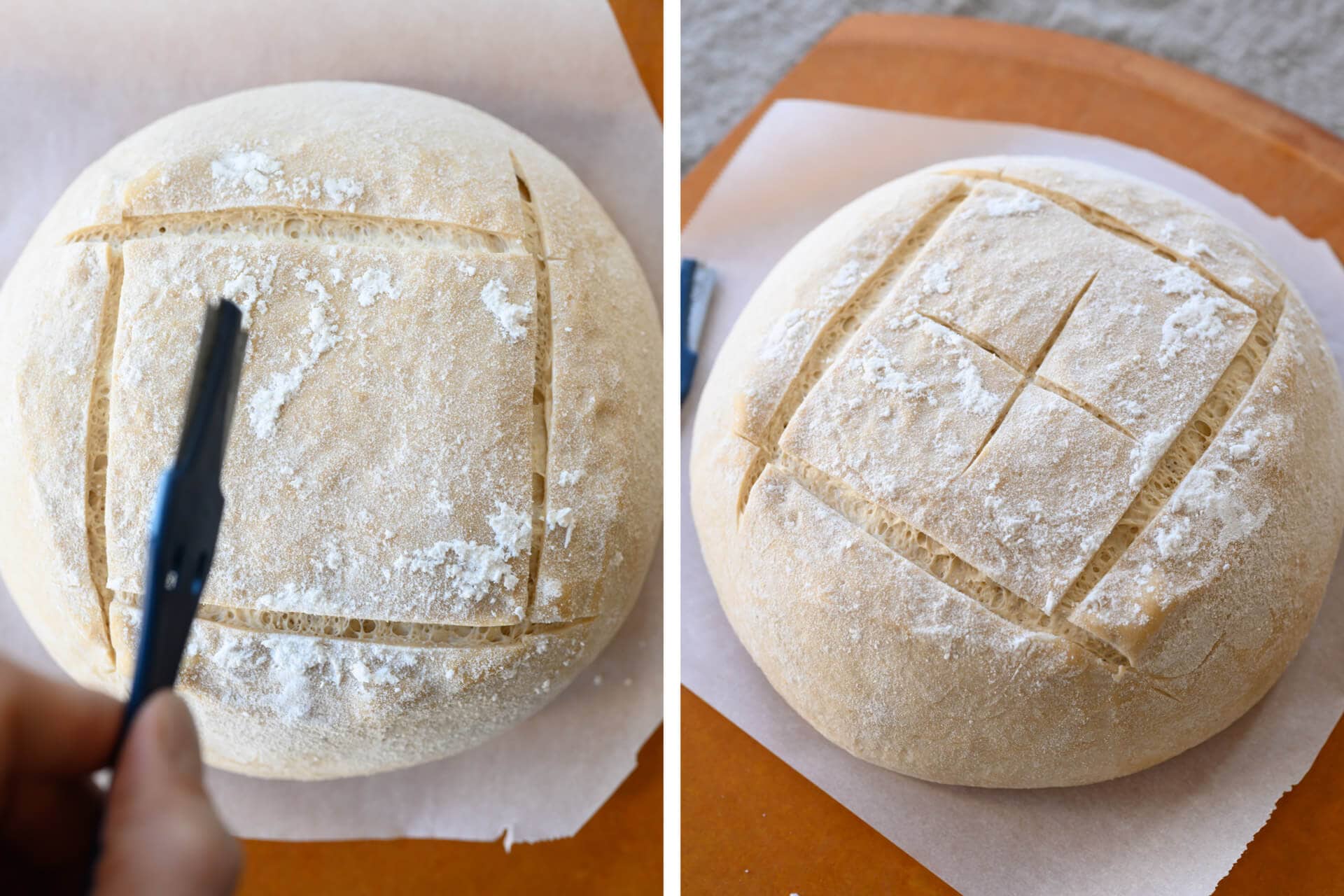
Score the dough using your favorite design. As you can see above, I love the “box top” score. Check out this video of me scoring this style (and a few others) below:
Now that your dough is scored, carefully slide it into the Dutch oven and bake for 20 minutes, covered.
After this time, remove the lid and bake for 30-35 minutes or until done. The internal temperature should be around 205-210°F (96-99°C).
(Note that If you’d like a thinner crust on this bread, increase the covered bake time to 30 minutes and reduce the second half of the bake (without steam) by 10 minutes. This increased baking time with steam can help reduce the thickness of the crust.)
Remove the loaf to a cooling rack for 2 hours before slicing. This lets the crust and crumb fully set and the flavor develop. Return the Dutch oven to the oven (without parchment) and bring it back to temp to bake the second loaf.
Follow my guide to storing sourdough bread to keep it fresh for the next week (or freeze it for longer!).
Print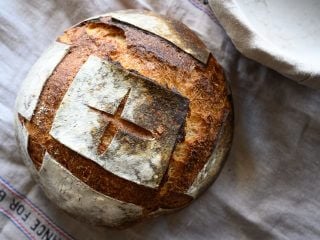
Simple Weekday Sourdough Bread
- Prep Time: 24 hours
- Cook Time: 1 hour
- Total Time: 25 hours
- Yield: 2 loaves
- Category: Bread, Sourdough
- Cuisine: American
Description
A loaf of delicious sourdough bread designed around a busy workday. The levain is prepared for this bread in the morning and left to ripen while you’re at work. When you get home, continue with the baking process. The dough can then be baked at night or the next day in the morning, or after work.
Ingredients
Levain
- 40g bread flour
- 40g whole wheat flour
- 81g water
- 8g ripe sourdough starter
Main Dough
- 766g bread flour
- 161g whole wheat flour
- 19g salt
- 685g water
- 169g ripe levain
Instructions
- Levain (7:00 a.m. before work)
In a small container, mix the Levain ingredients and keep it at a warm temperature for 10 hours. - Autolyse with levain (5:00 p.m after work)
In a medium mixing bowl, add all of the levain, 766g bread flour, 161g whole wheat flour, and 635g water (50g was reserved for mixing, later) and mix until no dry bits remain. Cover the bowl and let rest for 20 minutes. - Mix (5:20 p.m.)
To the mixing bowl holding your dough, add 19g salt and some of the reserved 50g water (or all if the dough feels like it can handle it). Mix thoroughly and strengthen the dough for about 5 minutes. Using wet hands, mix everything until it comes together into a shaggy mass. This dough is relatively strong and doesn’t require intensive kneading (like slap and fold), but give it a few folds in the bowl, perhaps 5-10, until it smooths slightly. Transfer the dough to a bulk fermentation container and cover. - Bulk Fermentation (5:30 p.m. to 9:00 p.m.)
This dough will need 2 sets of stretch and folds during bulk fermentation, the first set 30 minutes after bulk fermentation begins. Perform the second set 30 minutes after the first, and then let the dough rest the remainder of bulk fermentation. - Divide and Preshape (9:00 p.m.)
Lightly flour your work surface and scrape out your dough. Using your bench knife, divide the dough in half. Lightly shape each half into a round shape. Let the dough rest for 30 minutes, uncovered. - Shape (9:30 p.m.)
Shape the dough into a round (boule) or oval (batard), then place the dough in proofing baskets. - Proof (9:30 p.m. to 7:00 a.m. or 6:00 p.m. the next day)
Cover proofing baskets with reusable plastic and seal shut. Then, place both baskets into the refrigerator and proof overnight. - Bake (The next day, bake at 7:00 a.m. before work, or 6:00 p.m. after work)
Preheat your oven with a baking surface or combo cooker/Dutch oven inside to 450°F (230°C). Remove your dough from the fridge, score it, and transfer it to the preheated baking surface or combo cooker. Bake for 20 minutes with steam. After this time, vent the steam in the oven or remove the lid (you can keep it in the oven or remove it) and continue to bake for 30 minutes longer. When done, the internal temperature should be around 204°F (95°C). Let the loaves cool for 2 hours on a wire rack before slicing.
Notes
- This recipe is wonderful left plain, or you could top the dough with rolled oats, white sesame seeds, or flax seeds.
If you use this recipe, tag @maurizio on Instagram so I can take a look!
What’s Next?
There you have it; this simple weekday sourdough bread can be made daily and adjusted to fit your schedule. Now, there’s no reason not to bake. This recipe is also a great place to experiment: mix 125g of nuts like walnuts and pecans and dried fruit like cranberries, cherries, or raisins.
Many recipes on my site can be adapted to this simple weekday sourdough bread schedule, most notably my Beginner’s Sourdough. Both recipes use flexible doughs, and the fridge provides even more.
For a more hands-off approach, check out my easy no-knead sourdough bread recipe. It can also be adapted to bake in a single day or ferment longer for an easier schedule.
Happy baking!


903 Comments
Found this recipe very easy to follow. Made up a half batch so I can experiment.
Only issues are that by the time I put the levan in with everything to autolyse, I already had a very stiff dough. And by the time I got to the stretch and folds, it looked nothing like the stretch and fold video. It also didn’t rise much during bulk, but I’m also horrible at judging the doubling of dough. Not sure what I did wrong but its gonna get baked tonight, we shall see the results.
Hope it turned out well for ya, Bryce! The dough might have needed more water when mixing.
How would i know that? like what are the signs it needs more water?
Usually a super stiff dough that's not extensible can mean a higher hydration can help. Also, the autolyse technique may help, too:
https://www.theperfectloaf.com/guides/how-to-autolyse/
Hello Mauricio the fridge wich temperature to put de dough in the basket? thanks
Hi – I’m a nurse who works F-S, and three 12 hour shifts. If I wanted to bake the loaves before work at 4:30 or 5 tomorrow morning, is there a recipe (like this one) that I could adapt for a less than perfect, but still decent, loaf?
I’ve done what feels like every possible variation on how long to let the dough rise at each step – especially in the first autolyse and the period between shaping and baking. If you’re worried about 4:30 instead of 7:30 I’d say it will be no problem and I would expect far better than decent.
Hi…..I have a question about the evening baking time as that is what would work for my schedule. Would the extra hours in the fridge not cause the bread to ovenproof? Thanks for your help!
Does the starter have to be ripe or at a certain stage when the levain is made?
Maurizio, thank you for all of your teaching. One quick question, Can I refrigerate my “ready” levain overnight and make my bread the following day? Would this affect the proofing time or flavor in the final product?
I used this recipe to make sourdough by myself for the first time and let me tell you it made things so easy! I will continue to use this recipe. As someone with a constantly busy schedule it it wonderful to have a sourdough recipe that fits perfectly into a busy weekend. The only thing I did differently was the cooking method. Instead of using steam and preheating the dutch oven I just simply placed the dough (on parchment paper) into the cold dutch oven and put it in the oven. I set the oven to 450 F degrees and set a timer for 50 minutes. After the 50 minutes is up I removed the lid and baked until it had a color I was happy with. I got this method from McKenna Pulda on Instagram.
Love this recipe!! Thank you so much!
I have a few of newbie questions. Where should the dough be stored between the 20 minutes of rest at room temp during autolyse in the morning and the addition of the salt and water at 5 pm? Does it go in the fridge for those 10 hours? If I am home all day, do I still need that 10 hour pause before incorporating the salt and water, or can I proceed and then move to bulk fermentation?
I’m confused by one part of the instructions, where you say, “ Mix thoroughly and strengthen the dough for about 5 minutes. Using wet hands, mix everything until it comes together into a shaggy mass. This dough is relatively strong and doesn’t require intensive kneading (like slap and fold), but give it a few folds in the bowl, perhaps 5-10, until it smooths slightly. Transfer the dough to a bulk fermentation container and cover.” Is “strengthen” the mixing and folding process that follows? It doesn’t seem like 5-10 folds would take 5 minutes, so I wondered if “strengthen” meant another rest period to absorb the water before doing the folds.
Thanks for your help! I’m glad I found your page!
All of my doughs using whole wheat flour have ended up too sticky to use.
I am still working to get this on right. I would love your input. I am at about 1000ft elevation.
When I use your recommended whole wheat + King Arthur high gluten (malted) flour the crust is the chewy&christ texture I love but the inside gets gummy. If I substitute regular King Arthur flour instead of their high gluten then it is not gummy in the center but the crust is dry.
Also, when I bake at the 450 the crust gets too brown before my time is up—about 15 min to spare. I have also tried starting at 450 then when I take the lid off turning down to 425. That gets me through the entire recommended time. Both end with an internal temp over 204–about 207 usually.
Next I think I’ll try 50/50 high gluten and regular bread flour. With the whole wheat.
What do you think?
Weekday Sourdough is fun and easy, I also like 50/50, and My Best Sourdough, which is higher hydration.
They’re my 3 favorites.
At what point do you add the nuts and fruits?
At divide and preshape
Can this be done just using bread flour instead of the addition of whole wheat ?
Can I double the bread flour in this recipe instead of using whole wheat in the leavin stage ?
This is very simple to follow but I might have missed this part – what time (and how) do you feed the starter so that it’s ready and ripe at 7 am?
Thanks so much for the recipe, it’s definitely my favourite and fits in well with a busy schedule. When I make this recipe I use one boule and one batard. The batard always turns out perfectly, but the boule is always flat and doesn’t have much rise. Am I doing something wrong in the shaping process or is this recipe just better suited to the batard shape?
So glad you’re liking this one, Jess. Hmm, very interesting. I’d say it’s likely due to shaping there. Be sure to shape tightly enough so it springs up more than it spreads out! This recipe is suitable for many different shapes.
I’m at 8,000 in elevation and am a little concerned about the 450 degree oven. Anytime i’ve cooked something at that temp it doesn’t do well. Do you think I should lower the temp or not? Thank you.
Definitely adjust to suit your altitude, though usually, higher altitude means you need a hotter oven or a longer bake! Check out my guide to baking at high alt for more tips.
This is my favorite, go-to sourdough recipe– and I’ve tried a lot. I like it even better than your best sourdough recipe. I start everything earlier (I can’t stay up that late) and then bake after work the next day. The long cold fermented gives it such great flavor. Thank you!
Amazing to hear that, Trista! It’s all about finding the recipe that works best for you 🙂
I use and love this recipe and would like to add olives. Are there any adjustments before adding the olives?
Nope, should be good to go. I’d add up to 10% to total flour weight.
I’m just getting started in terms of sourdough and only have unbleached all purpose flour on hand. Would the recipe turn out with this flour or should I make a point to wait until after my next grocery trip?
Thanks so much!
AP flour will work just fine for this one!
Hello,
I’d like to ask if I can use a high protein bread flour that isn’t malted?
And when making levain, should the bread flour be the same flour used for the dough mix?
Yes, that flour will work just fine. For the levain, it doesn’t have to be the same flour, but that’s typically what I do.
To make this recipe with starter as opposed to levain, would you use the same amount of starter as the combined weight of the levain recipe eg. 169g of starter?
Thanks
Yes, same amount of starter!
1. How much does your dough rise at the end of bulk fermentation?
2. I used a combination of whole and white spelt flour. I allow the dough to double during bulk fermentation (this took 4.5 hrs total at 78 deg F ambient temp) but didn’t get a good oven spring.
3. What are your thoughts on bringing the dough out of the fridge to room temp before baking? It is easier to apply the poke test that way…There are some videos on the internet suggesting that the crumb is more open that way too.
4. If going directly from fridge to oven how to confirm that proofing is complete, because the poke test can’t be used on cold dough.
Answers:
1. Hard to say exactly, but I’d say around 30% rise.
2. You’ll get less rise with whole spelt (but more flavor!!)
3. You can take your dough out to let finish proofing, but be aware it may overproof the dough depending on how bulk fermentation was performed.
4. It should be ready if proofed overnight at regular home fridge temps. If it’s not, let it proof longer on the counter next time after shaping before placing it into the fridge.
Just to say that this is my basic go-to bread which is simple to make, bakes up perfectly, and is a hit with *every* single person who tries it. In fact I bake 3 loaves twice a week, and at each bake it’s two for the family and one to giveaway to family or friends. They all hope it’s gonna be their turn this week!
I’m slowly working my way through your book. Today I baked Five Grain sourdough and I’m having it for lunch. I can’t wait. Thank you for your book and for the amazing knowledge that you share with amateur/home bakers.
Julia.
Makes me happy to read your comments, Julia 🙂 Happy baking and enjoy my cookbook!!
Hi @mau@maurizioleo:disqus – I have a question that I struggle with when mapping out baking schedules: If a starter takes 4 to 8 hours after feeding to be bubbly (fed), how do you start building a levain at 7am? When do you feed the starter? Thank you – and *love* this recipe!
Hey there, Doreen. You can just offset the schedule as you need. But I typically feed at night before bed, then again in the morning. It’s pretty flexible, you should have an hour or two window on either side of your levain as there is no perfectly ripe point (I talk about this in my cookbook quite a bit)!
Also, check out my in depth guide to how I feed my starter:
https://www.theperfectloaf.com/how-do-i-feed-my-sourdough-starter/
Hello! I’m new to this and am at the autolyse step..however I times this poorly and if I follow the time guide here for the bulk fermentation step, I’ll be shaping my dough around 1:30am 😬 my own fault, but any chance I can pop it in the fridge for overnight bulk fermentation?
Yes, just put the dough in the fridge around 2-2.5 hours into bulk fermentation!
Thank you!!