

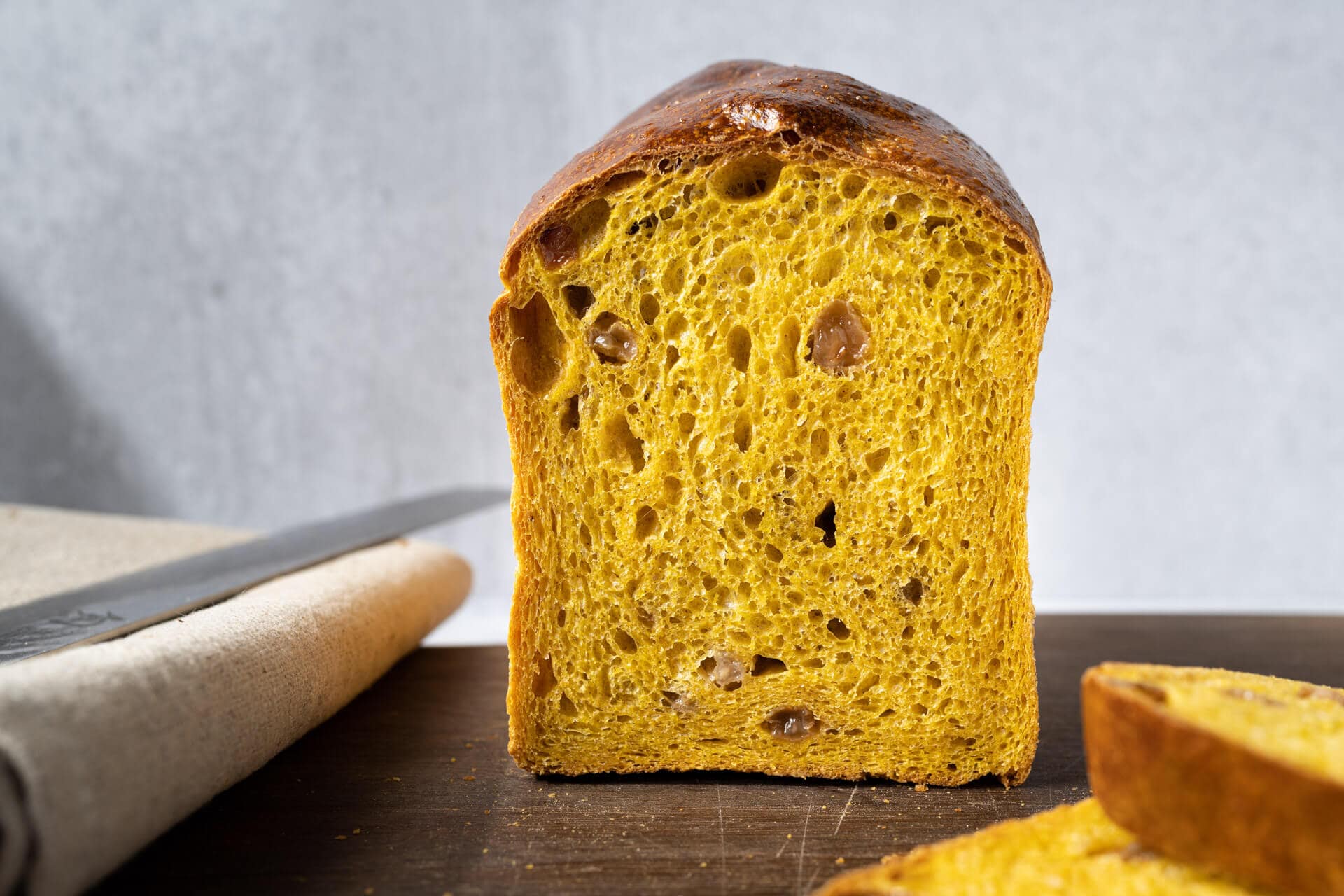
When most people read the words”pumpkin” and “bread” in the same sentence, a mélange (pun intended) of strong spices—cinnamon, nutmeg, ginger, and clove—and sweet concoctions come rushing to mind. But this recipe doesn’t quite follow the usual connection between our beloved fall-time squash and those pungent spices. Instead, this pumpkin cinnamon sourdough bread is lofty and light, tender, a touch sweet, and deeply colored by the addition of smooth pumpkin puree. And while the cinnamon is just a small hint, but that, in combination with the creamlike pumpkin and sweet raisins, is enough to ensure you’re ushering in fall with the right spices and the right flavors.
I’m not really a sweets person—except for that personal batch of cinnamon rolls on the weekend (I know you’ve at least thought about it)—but this sweet-ish bread really hits the cool-weather spot. The falling leaves and shorter days awaken that urgency for something a little sweet, and this tall, stunning loaf of pumpkin bread on the cutting board feels right. And if you’re like me, you might still have that stash of canned pumpkin puree ready to go already in your pantry.
If you’re a diehard pumpkin spice fan, you could add nutmeg, ginger, and clove to taste.
If you’re a diehard pumpkin spice fan, you could adapt this recipe to include a touch of nutmeg, ginger, and clove—but I’d recommend keeping it light (perhaps only 0.25% of each?). These are powerful spices indeed, and can quickly overwhelm.
This pumpkin cinnamon sourdough bread is drastically different than a typical pumpkin quick bread. To me, the latter is closer to a banana bread, which is dense, ultra-moist, and typically sweeter. This is lofty, airy, and light, but still has the same warmth with a subtly sweet slant.
Using a Sweet Starter
This bread uses what’s sometimes called a “sweet starter.” I first heard about this technique a while ago from the extremely knowledgeable baker Ian Lowe (check out his Instagram feed and get ready for an immeasurable amount of baking inspiration), and have been using it in a variety of sourdough bakes here in testing.
A sweet starter (or levain, as I optionally call it), is a preferment with added sugar. To me, it’s similar to how naturally leavened panettone is made. Panettone is made with a series of builds (primo impasto, secondo impasto, etc.) that gradually increase sugar and other enrichments before making the final dough.
For this pumpkin cinnamon sourdough bread, a sweet starter helps to reduce the sourness in the final loaf and lets the flavors of pumpkin and cinnamon really shine through. Additionally, I also find it helps keep the fermentation on schedule with a bonus of increased yeast activity for a strong rise.
Flour Selection
After testing many iterations on this formula, I eventually settled on half medium-protein bread flour and half high-protein bread flour. The added pumpkin puree and enrichments (butter and sugar) make the dough especially soft and almost mousse-like. Using 50% higher protein flour helps the dough develop strength early, making for an easier dough to handle with no discernable side effects in the end.
King Arthur Baking Bread Flour will work well for the high-protein bread flour in this pumpkin cinnamon sourdough bread recipe. Any medium-protein bread flour (around 11% protein) or all-purpose flour will work well for the medium-protein bread flour. I’ve made this with King Arthur Baking All-purpose and Central Milling Artisan Baker’s Craft Plus with equally great results.
I considered using the tangzhong technique with this bread, but I don’t believe the added step would bring many benefits. Why? The dough is already incredibly soft with the added puree. Adding any more tenderness to this bread might be too much.
Preparing the Pumpkin
Me being who I am, I was tempted to roast my own pumpkin for this bread. But, I pretty quickly dismissed the idea. I’ve done this many times when making pumpkin pie, and while it’s totally an option, I find buying canned pumpkin puree to be just as good and a heck of a lot easier. That said, if you want to roast your own pumpkin (or you have some leftover from pumpkin pie), it will work well with this recipe. Just be sure to let the puree cool thoroughly before mixing it into your dough.
I ended up using the classic Libby’s Canned Pumpkin, and to me, it’s a wonderful puree for this bread. It’s always my go-to for pumpkin pie, and now, this pumpkin cinnamon sourdough bread is no different.
Baking Schedule

This pan bread is a direct bake, meaning it’s baked the same day you mix (except for the levain, which is created the night before).
Be sure to use your levain when it’s very ripe: it should be extremely bubbly, frothy, and well-risen. The dough might move a little slow in proof, give it extra time if necessary.
Overnight proof option: while I don’t call for this dough to be retarded (cold proof overnight), this can be done if it’s better for your schedule. Simply place it in the fridge after it’s shaped and in the Pullman pan, then bake first thing in the morning once fully proofed.
Pumpkin Cinnamon Sourdough Bread Formula
If you want to bake two loaves instead of one, double all the ingredients. For tips on how to calculate baker’s percentages or how to modify this formula, see my post on baker’s percentages (baker’s math).
| Total Dough Weight | 950 grams |
| Pre-fermented Flour | 11.50% |
| Levain in final dough | 33.79% |
| Yield | 1 x 950g pan loaf |
I used my 9x4x4″ USA Pan Pullman pan (without the lid) for this square loaf. The silicone liner on the inside ensures no sticking, and the straight sides make for nice slices.
But, if you’re looking for how to make this recipe work in a different pan, see my post on shaping a sandwich loaf.
Total Formula
Desired dough temperature: 77°F (25°C). See my post on the importance of dough temperature for more information on dough temperatures.
| Weight | Ingredient | Baker’s Percentage |
|---|---|---|
| 199g | Medium-protein bread flour or All-purpose flour (~11% protein, Central Milling Artisan Baker’s Craft or King Arthur Baking All-Purpose) | 50.00% |
| 199g | High-protein bread flour (~12-13% protein, King Arthur Flour Bread Flour) | 50.00% |
| 120g | Pumpkin puree | 30.00% |
| 80g | Raisins (golden or Thompson) | 20.00% |
| 64g | Butter, unsalted | 16.00% |
| 40g | Sugar, caster | 10.00% |
| 3g | Cinnamon, ground | 0.75% |
| 140g | Water | 35.00% |
| 80g | Milk, whole | 20.00% |
| 8g | Fine sea salt | 1.90% |
| 18g | Sourdough starter | 4.60% |
Total Yield: 238.25%, 950.0 grams.
NOTE: You’ll also need one egg and a splash of milk for the egg wash right before baking.
Pumpkin Cinnamon Sourdough Bread Method
1. Prepare Levain – Night before mixing, 9:00 p.m. (Day one)
Mix the following ingredients in a container and leave covered to ripen at about 77°F (25°C) for 12 hours overnight.
| Weight | Ingredient | Baker’s Percentage |
|---|---|---|
| 46g | Medium protein bread flour or all-purpose flour | 100.00% |
| 46g | Water | 100.00% |
| 9g | Sugar, caster | 20.00% |
| 18g | Ripe sourdough starter | 40.00% |
Total Yield: 260%, 119.2 grams.
2. Mix – 9:00 a.m. (Day two)
There is no autolyse step for this dough. Because I’m mixing the dough in a mechanical mixer with cold ingredients, it’s easy enough to develop the dough sufficiently without overshooting the final dough temperature. An autolyse would also be tricky here with the pumpkin puree, milk, and how everything is added during mixing. See my guide to the autolyse technique for more information.
I used my KitchenAid stand mixer to mix this dough, which I highly recommend. The pumpkin puree and butter makes for a very soft dough with lengthy mix times.
Because most of the ingredients are cold from the refrigerator, you might need to expect to warm the water slightly to hit the final dough temperature listed above.
| Weight | Ingredient |
|---|---|
| 154g | Medium-protein bread flour or All-purpose flour (~11% protein, Central Milling Artisan Baker’s Craft or King Arthur Baking All-Purpose) |
| 199g | High-protein bread flour (~12-13% protein, King Arthur Flour Bread Flour) |
| 120g | Pumpkin puree |
| 80g | Raisins (sultana or Thompson) |
| 64g | Butter, unsalted |
| 31g | Sugar, caster |
| 3g | Cinnamon, ground |
| 94g | Water |
| 79.7g | Milk, whole |
| 7.6g | Fine sea salt |
| 119.2g | Ripe levain (see above) |
First, take out your butter and cut it into 1/2″ pats. Set the butter on a plate to warm to room temperature and reserve until the end of mixing.
Use the paddle attachment to develop this dough efficiently.
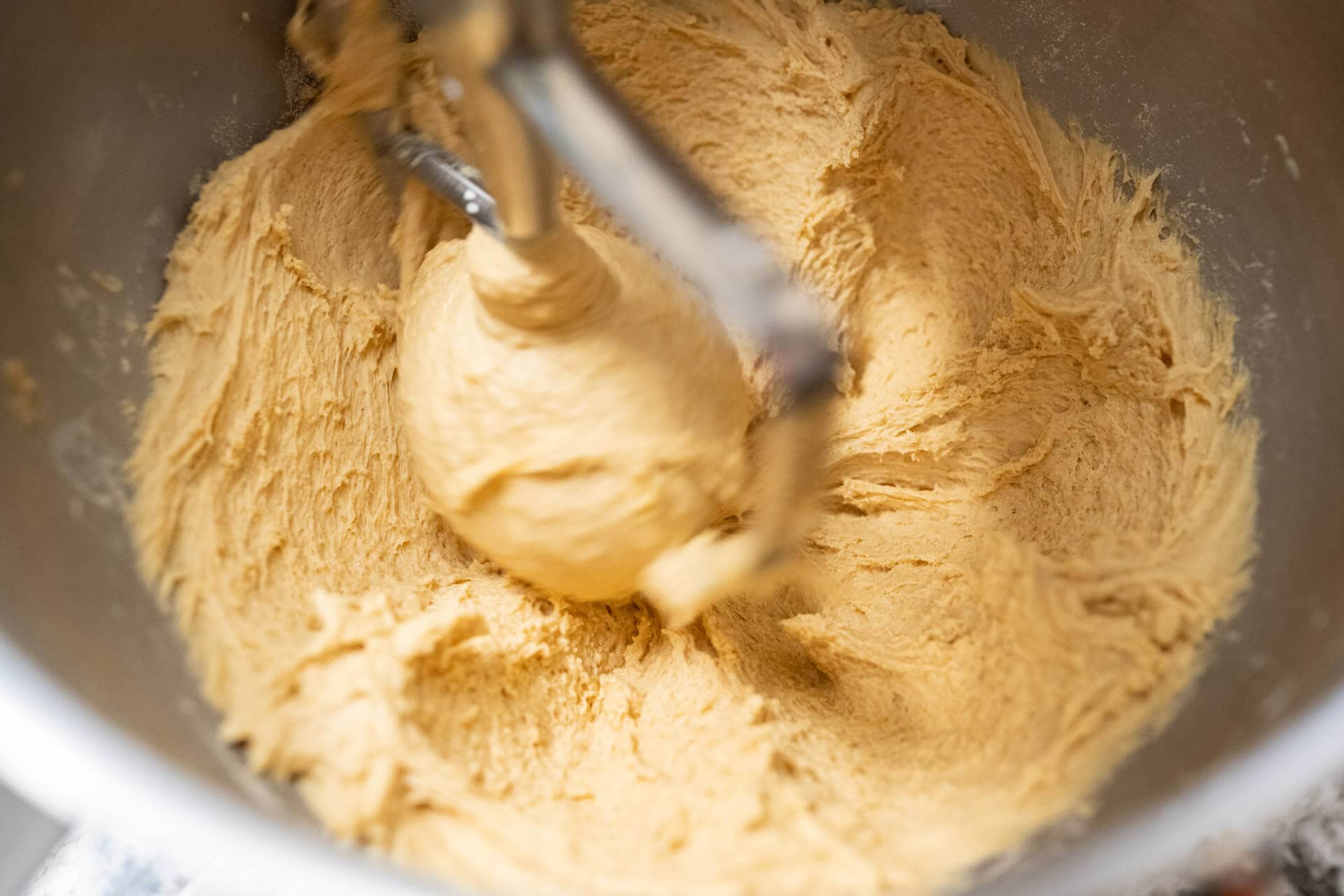
To the bowl of a stand mixer fitted with the paddle attachment, add the water, milk, flour, ripe levain, sugar, cinnamon, pumpkin puree, and salt. Mix on speed 1 (STIR on a KitchenAid) for 1 to 2 minutes until the ingredients come together and no dry bits remain. Increase the mixer speed to medium (2 on a KitchenAid) and mix for 8 minutes until the dough starts to strengthen and clump around the paddle. It won’t completely remove from the bottom of the bowl, and it will still be shaggy.
Let the dough rest in the mixing bowl for 10 minutes.
If your dough is cohesive and elastic enough, you could now switch to using the dough hook (I did). Your butter should now also be at room temperature; a finger will easily slide in and leave a depression. Turn the mixer on to speed 1 and add the butter, one pat at a time, waiting to add each pat until the previous one is fully absorbed. Adding all the butter might take 5 to 8 minutes. In the end, the dough should be glossy and soft, but cohesive and showing some strength.
Finally, add the raisins to the dough and mix on low until just incorporated. It’s unnecessary to mix aggressively here; just get them mostly distributed.
Transfer your dough to a bulk fermentation container and cover.
Don’t be alarmed if your dough is softer than you’re used to—this is a very soft dough! It’ll gain significant strength through bulk fermentation.
3. Bulk Fermentation – 9:30 a.m. to 1:00 p.m.
At room temperature, around 77°F (25°C), bulk should take about 3 1/2 hours. If your kitchen is cooler, place the pan to rise in a small proofer, or extend bulk fermentation as necessary. If your kitchen is around 74°F (23°C), I’d say closer to 4 hour or 4 hours and 15 minutes.
Give this dough three sets of stretch and folds during bulk fermentation (first rise) at 30-minute intervals. The first set starts after 30 minutes from the start of bulk fermentation. For each set, wet your hands, grab one side and stretch it up and over the dough to the other side. Rotate the bowl 180° and perform another stretch and fold (this forms a long rectangle in the bowl). Then, rotate the bowl 90° and do another stretch and fold. Finally, turn the bowl 180° and do one last stretch and fold. You should have the dough neatly folded up in the bowl.
After the third set, let the dough rest, covered, for the remainder of bulk fermentation.
4. Chill Dough – 1:00 p.m. to 1:15 p.m.
Your dough should be puffy and light at the end of bulk fermentation (as seen below), but still elastic and not overly gassy. If your final dough temperature was lower than the 77°F (25°C) for this recipe or your dough is still tight, dense, and not smoother, give it another 15 to 30 minutes and check again.

Uncover your bulk fermentation container and place the dough in the refrigerator for 15 to 25 minutes. This time will help firm up the dough to make shaping and transferring to the pan much easier.
5. Shape – 1:15 p.m.
First, lightly oil your Pullman pan with butter. While this isn’t strictly necessary when using a USA Pan Pullman pan, it’s a little insurance just in case.
I shaped this dough in my typical method for shaping a pan loaf. Check out my guide to shaping pan loaves for detailed instructions.
Remove your bulk fermentation container from the fridge and gently scrape the dough out of the bowl onto a floured work surface. Fold the dough’s left side over to the middle, the right side up and over to meet the left. Finally, roll the entire rectangle down to form a taut tube.
Once the dough is shaped into a long tube, transfer it to the pan, seam-side-down.
6. Proof – 1:30 p.m. 3:30 p.m. (2 hours at room temperature)
Cover the pan with a large, reusable plastic bag and seal it shut. Let the dough proof at a warm temperature, around 77°F (25°C), for 2 hours.
Overnight proof option: before the 2-hour counter proof, cover the pan with an airtight bag and place it in your refrigerator to proof overnight. Bake the loaf the next morning, as indicated below.
7. Bake – 3:30 p.m. (pre-heat oven at 3:00 p.m.)
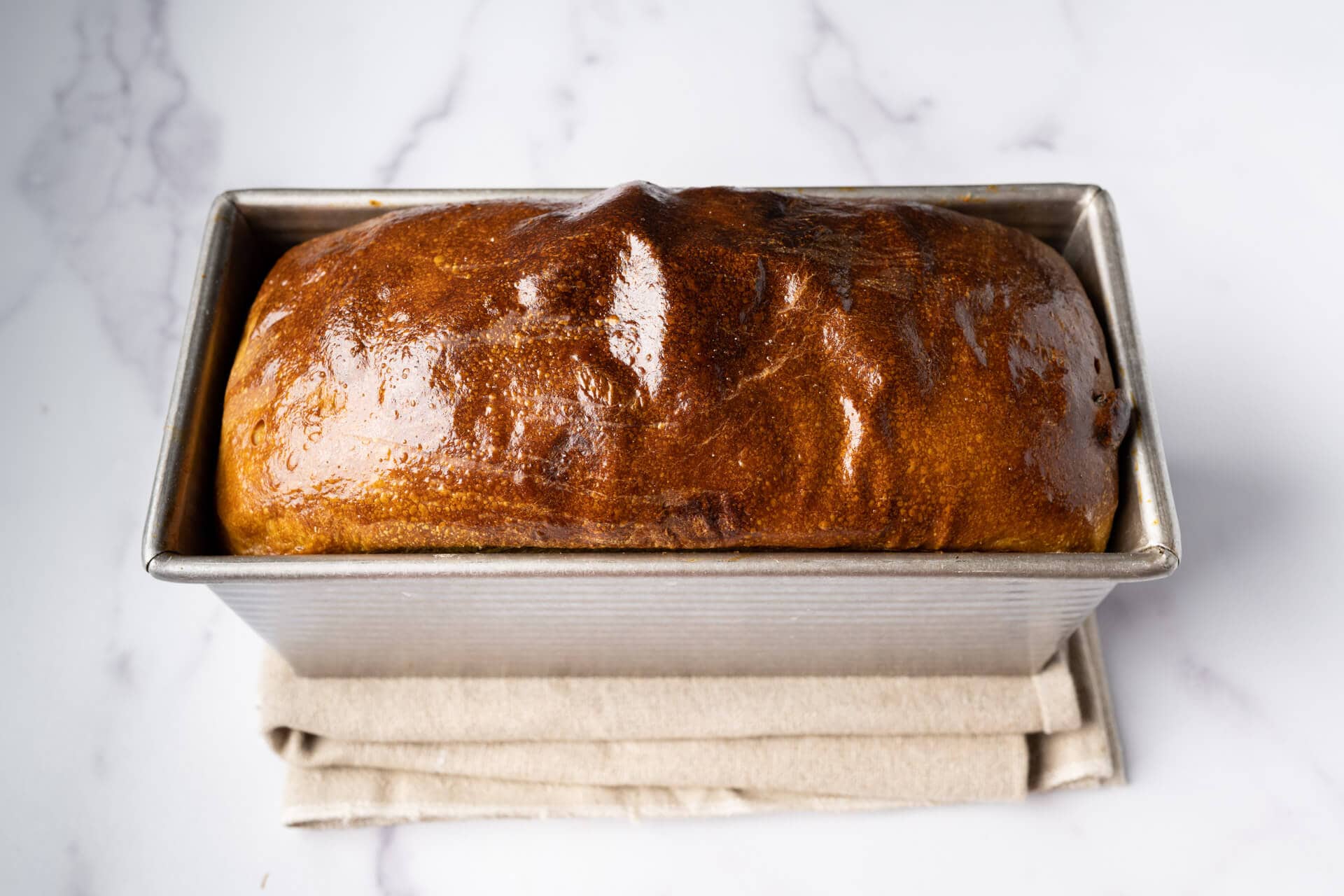
Check on your dough: it should have risen just above the top of the Pullman pan and be extremely light and airy to the touch (see image below). If it’s not quite there, give it another 15 minutes and check again.

There’s no need to steam the oven for this bake because we’ll use an egg wash to top the dough. In a small bowl, whisk together a whole egg and a splash (about 1 tbsp) of whole milk.
Preheat your oven, with rack in the middle, to 400°F (205°C).
Once your oven is preheated, remove your pan from its bag, evenly brush on the egg wash, and slide the pan into the oven.
Bake at 400°F (205°C) for 20 minutes. After this time, rotate the pan 180° in the oven and reduce the temperature to 375°F (190°C). Bake for an additional 30 minutes until the top is well-colored. Remove the pan from the oven and gently knock the loaf out to a wire rack. Return the loaf (without pan) to the oven to bake for an additional 5 to 10 minutes to add extra color to the bottom and sides. The loaf is done when the internal temperature is around 205°F (96°C)—check with a discrete poke with your instant-read thermometer.
Let the loaf cool for 2 hours before slicing to ensure the interior is fully set. This bread keeps well for about a week if stored according to my post on how to store bread.

Conclusion
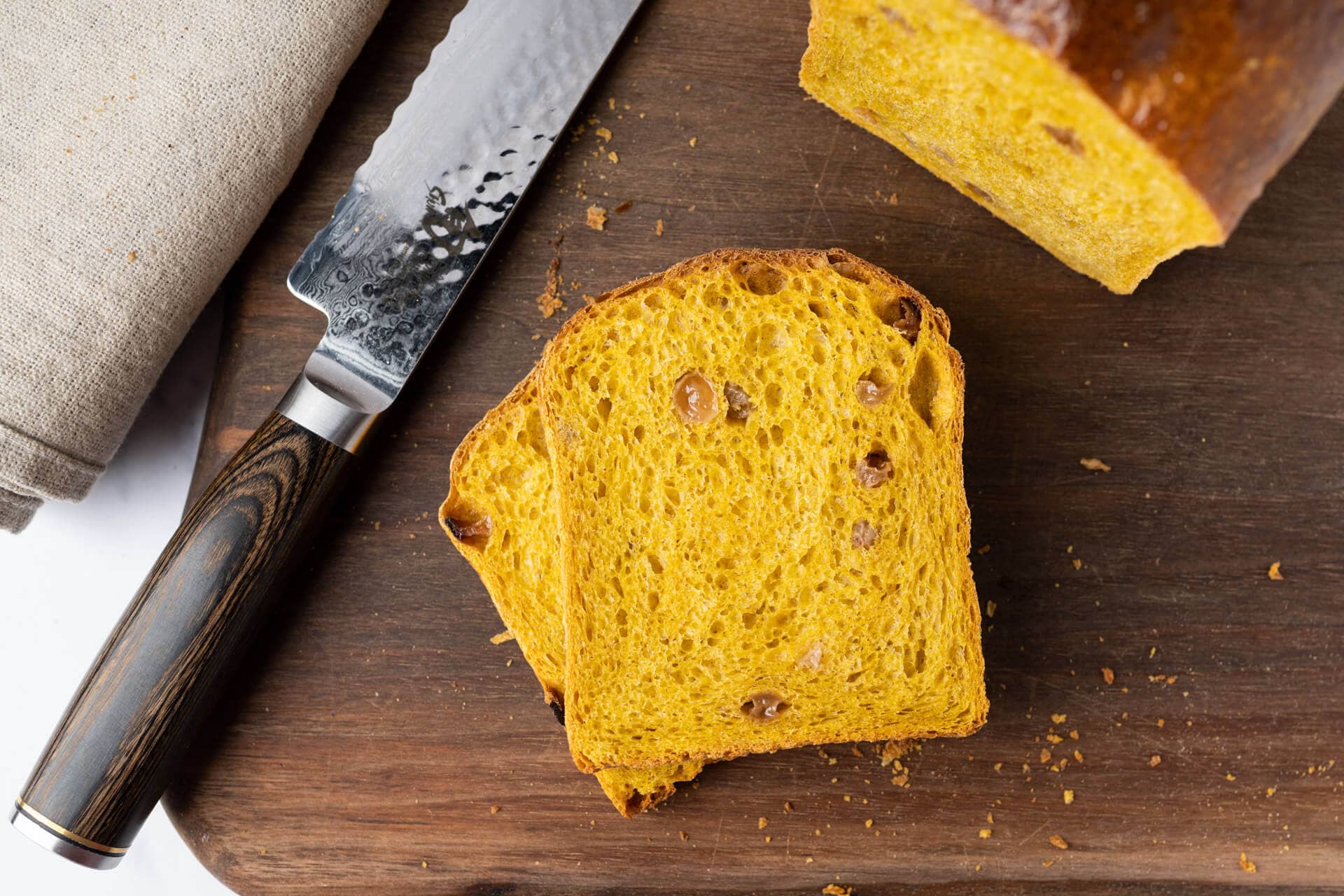
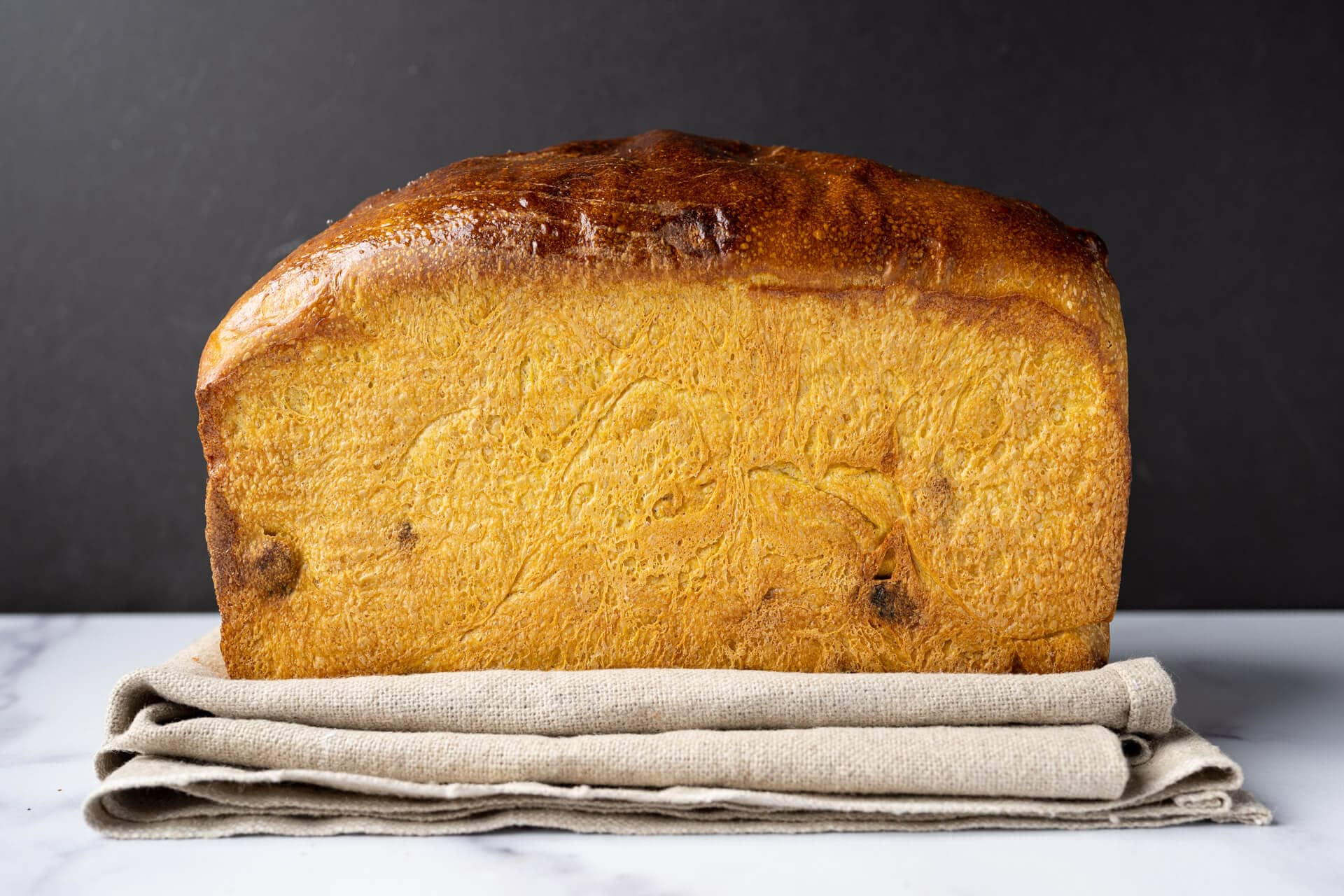
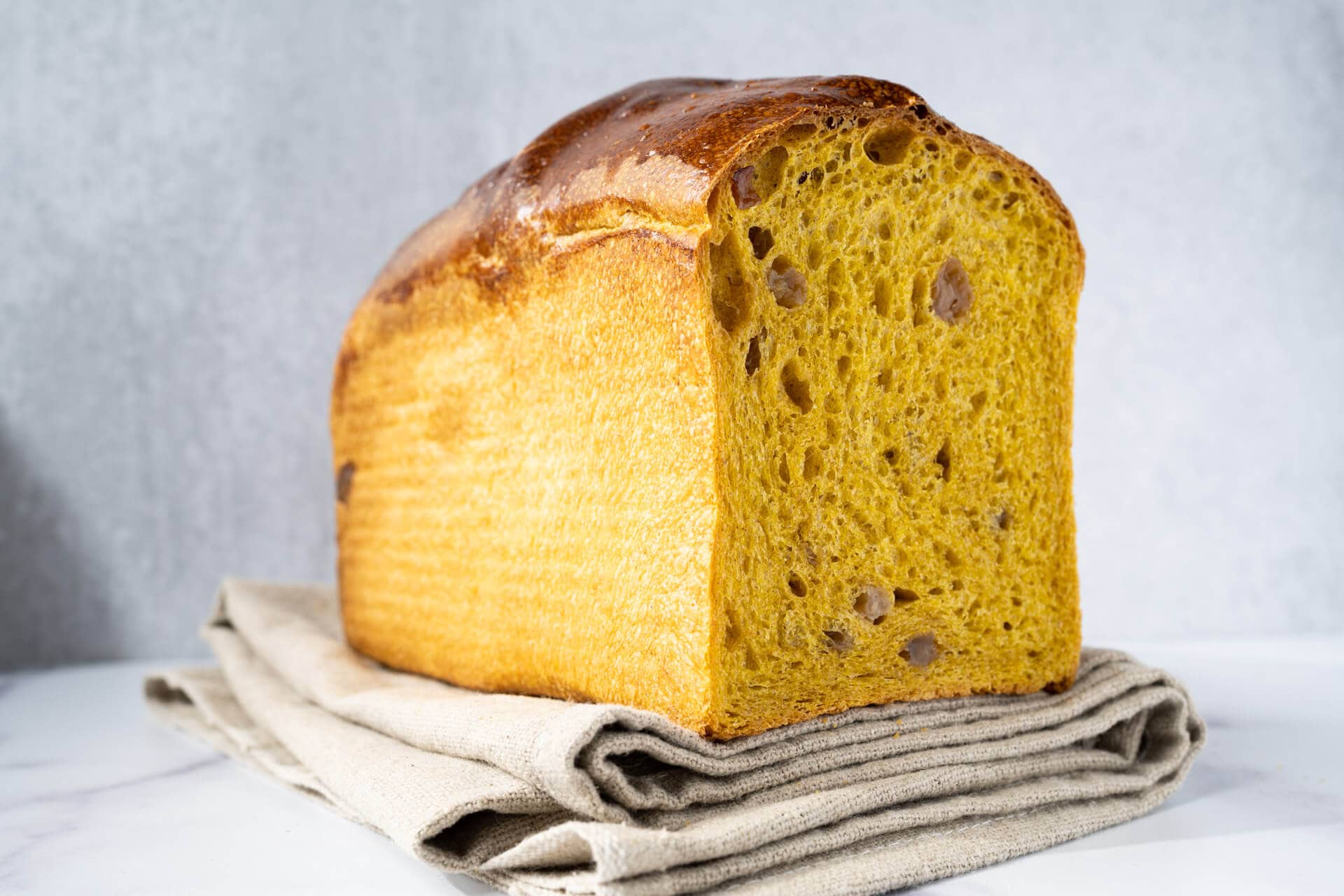
This pumpkin cinnamon sourdough bread is tender, light, sweet, and just spicy enough. The deep coloring from the pumpkin puree is showy and gives the crust and undeniable charm. The egg wash on top takes this further with intense caramelization and a delicious sheen. Finally, the flavor of this loaf is seductively warm, and the pop of sweetness when you snag a juicy raisin makes the mouth tingle—a seductively charming bread from every angle.
I think the perfect treatment for this pumpkin cinnamon sourdough bread might be to toast it and spread on some homemade apple butter. Let’s go all-in on fall. But frankly, a simple adornment of salted butter is always in season, isn’t it?
Buon appetito! 🎃
If you’re looking for more ways to use up that pumpkin puree, check out my sourdough starter discard pumpkin pancakes or my super soft and chewy pumpkin dinner rolls.
Pumpkin Cinnamon Sourdough Bread Recipe
- Prep Time: 15 hours
- Cook Time: 50 minutes
- Total Time: 15 hours 50 minutes
- Yield: 1 loaf
- Category: Sweet, Sourdough
- Cuisine: American
Description
This pumpkin cinnamon sourdough bread is tender, light, sweet, and just spicy enough. The deep coloring from the pumpkin puree is gorgeous and gives the crust this undeniable charm. The egg wash on top takes this further with intense caramelization and a delicious sheen. The flavor of this loaf is seductively warm, and the pop of sweetness when you snag a juicy raisin makes the mouth tingle with joy.
Ingredients
- 199g medium-protein bread flour or all-purpose flour
- 199g high-protein bread flour
- 120g pumpkin puree
- 80g raisins (sultana or Thompson)
- 64g butter, unsalted
- 39g sugar, caster
- 3g cinnamon, ground
- 140g water
- 80g milk, whole
- 8g fine sea salt
- 18g sourdough starter
Instructions
Prepare levain (the night before mixing, 9:00 p.m.)
In a small container, mix together the following and keep at 77°F (25°C) for 12 hours.
46g medium protein bread flour
9g sugar
46g water
18g ripe sourdough starter
Mix (9:00 a.m.)
Cut butter it into 1/2″ pats and let warm to room temperature. To the bowl of a stand mixer fitted with the paddle attachment, add:
154g medium-protein bread flour
199g high-protein bread flour
120g pumpkin puree
31g sugar
3g cinnamon
94g water
80g milk
8g salt
119g ripe levain (from step 1)
Mix speed 1 (STIR for KitchenAid) for 1 to 2 minutes until homogenous. Then, mix speed 2 for 8 minutes until dough clumps around the paddle.
Let the dough rest in the mixing bowl for 10 minutes.
Next, add the 64g butter, one pat at a time, while the mixer is running on speed 1 (STIR). Continue this for 5 to 8 minutes until all the butter is added to the dough and it’s glossy and soft.
Finally, add the 80g raisins at the very end of mixing and mix on low just to incorporate.
Transfer your dough to a bulk fermentation container and cover.
Bulk Fermentation (9:30 a.m. to 1:00 p.m.)
Give the dough 3 sets of stretch and folds at 30-minute intervals, where the first set starts 30 minutes after the start of bulk fermentation.
Chill dough (1:00 p.m. to 1:15 p.m.)
Place the bulk fermentation container, uncovered, in the refrigerator for 15 minutes to make shaping easier.
Shape (1:15 p.m.)
Butter or grease the baking pan. Scrape the dough out of the bulk fermentation container to a floured surface and shape the dough as a tube. Place into baking pan and cover.
Proof (1:30 p.m. to 3:30 p.m.)
Proof the dough at 77°F (25°C) for 2 hours.
Bake (3:30 p.m.)
Preheat your oven to 400°F (200°C). For the egg wash, whisk together one egg and a splash of whole milk. When the oven is preheated, brush on the egg wash and bake for 20 minutes. Then, rotate the pan 180° in the oven and reduce the temperature to 375°F (190°C). Bake for an additional 30 minutes until the top is well-colored. Remove the pan from the oven and gently knock the loaf out to a wire rack. Return the loaf (without pan) to the oven to bake for 5 to 10 minutes. The internal temperature should reach around 205°F (96°C). Let the loaf cool for 2 hours on a wire rack before slicing.
Notes
I used Libby’s canned pumpkin puree for the pumpkin, but you could also roast your own. If you want this loaf to have a more “pumpkin pie” flavor, add a small percentage of nutmeg, ginger, and clove.
If you use this recipe, tag @maurizio on Instagram so I can take a look!


291 Comments
I had made this bread, and I am making it again. I forgot to make the levain. I have one ready, but it is not a sweet one. Can I add the sugar to the dough?
Perfect balanced flavors. Love this recipe. I had made it as written, but next time, some nuts and a swirl. Mine took some time to prove even though I live in a hot climate location.
Prepped and baked a double batch today. I modified the recipe just a bit: replaced the cinnamon with pumpkin spice, brown instead of caster sugar in the dough and increased the raisins to 100g (i do enjoy a nice raisin bread), adding 1/2 during fold #2 and laminated the remaining as fold #3.
I must say, wow! What a lovely bread. I enjoyed a slice as-is. I think with salted butter is next!! Will share with friends tomorrow. Photos posted on IG and tagged @maurizio
I modded this bread into my favorite sandwich bread. 30 grams of wheat and 14 grams of rye and 110 of medium protein flour(in place of the 154 grams fo flour),cut out raisins and cinnamon, cut the sugar in half and it makes the best sandwich bread. It is great year round but makes the best turkey sandwiches with leftovers during the holidays and also makes a fantastic french toast where more sweetness and the cinnamon is added back in the egg batter and syrup.
Sounds really great, Scott. I like the rye add, and I could see how that would make some killer French toast! Thanks for the comments.
I flubbed this recipe from the get go, yet by some miracle, or perhaps several miracles, it turned out to be a prized loaf of deliciousness! By accidentally adding an entire stick of butter, it had to be remedied by doubling the recipe. However, I was short of active starter and had to supplement with discard! Continuing on, yet running short on time, I opted for an overnight CR. The dough was ignored in the fridge several more hours the next day before setting it out on the counter to knock off the chill, then gave it a few hours in a 77F proofer to let it rise just above the rim. Baked as directed, and expected it to fail due to the series of errors…yet it’s a party for the senses! Since I’d added toasted, crushed pecans and golden raisins to the dough; once the slices were toasted and buttered, those flavors combined with the airy & soft texture of the bread, plus the mild notes of pumpkin and cinnamon- made it a true joy to savor with coffee! I’m utterly astonished at how forgiving the recipe was! This recipe will replace several lesser sourdough pumpkin bread recipes that now no longer come close to comparing with such a delightful treat!!
Whew, that was a wild ride, Pamela! But, I’d say you did a great job with the modifications and pivots—nice work 🙂
Hi can I add a cinnamon brown sugar swirl to this bread or glazed peacans?
Hi Heather, I've added a cinnamon sugar swirl to this bread a couple times and it works well. The soft dough can be a little hard to roll up, but I rolled it as best I could and folded it over itself a couple times and the finished swirls inside were beautiful. For what it's worth, I've also made this dough into cinnamon rolls which are also incredible.
This works really well. I refrigerate the dough a little before rolling out and it helps ensure it’s not too sticky to handle.
Hi! I only have bread flour and wheat flour. Can I use both of these for this recipe?
Thank you!
Yes, for sure. The bread flour will work quite well.
Made this this week. Made a couple adjustments. About 1/3 Whole wheat flour. Mixed by hand, gradually added butter as I mixed in flour to water and starter. Cold kitchen made proof a hour longer. Turned out great !
Love the mods, Norman!