

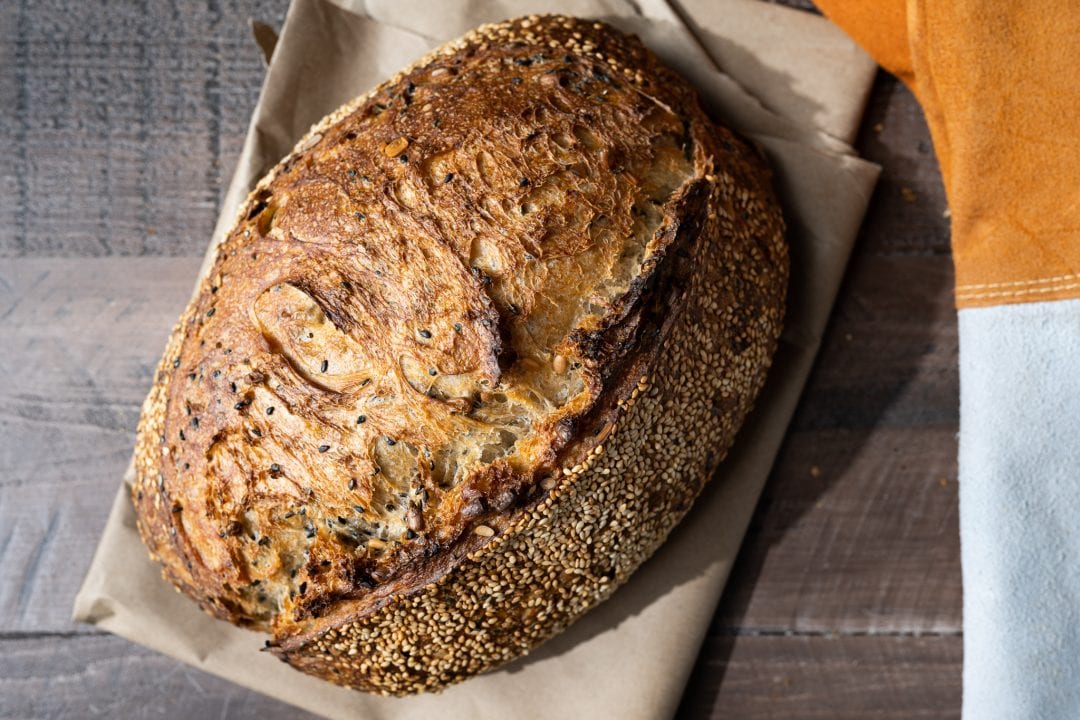
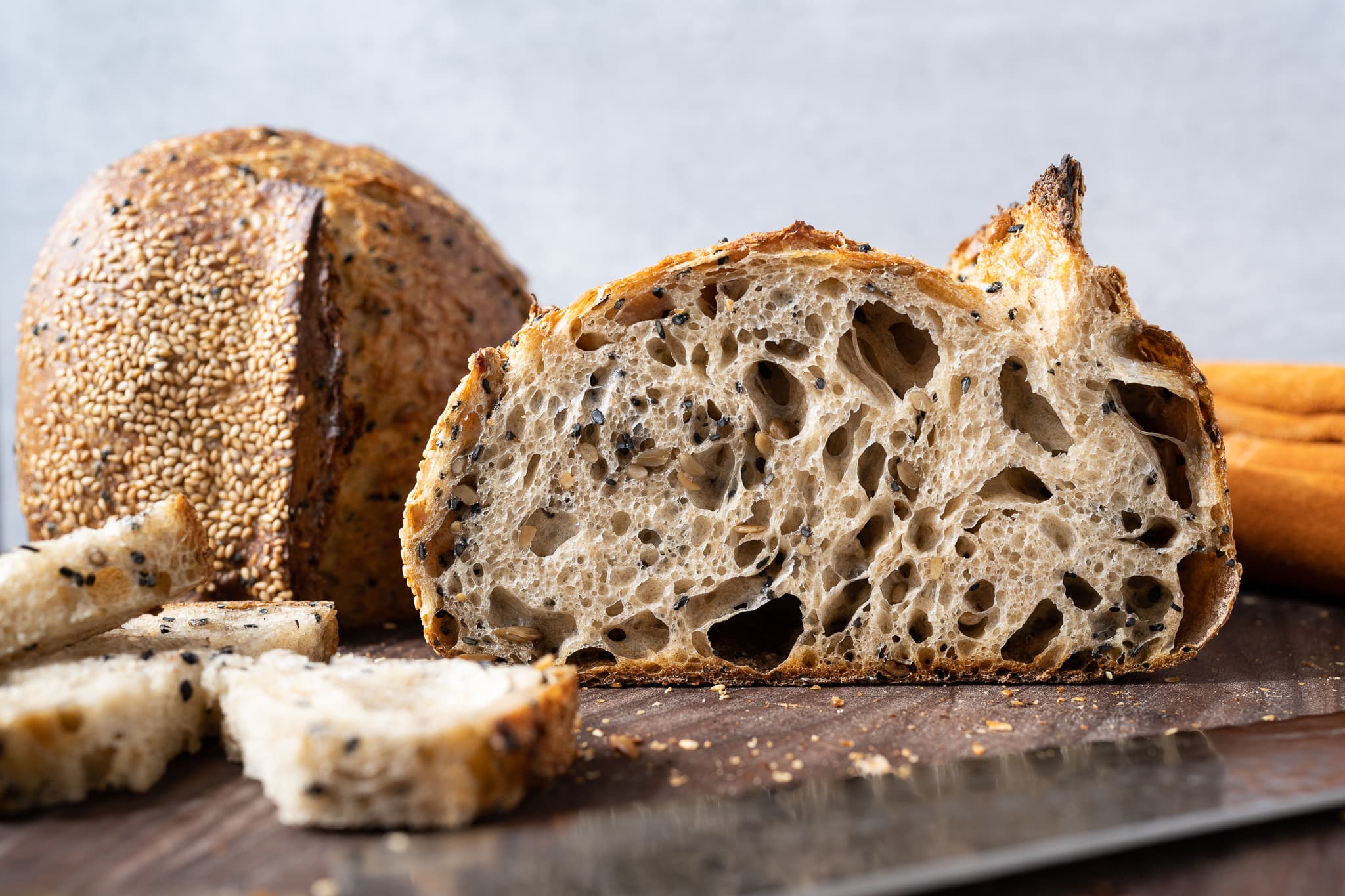
Every once in a while, a bread comes along that surprises you with its wholesomeness. Add in a little more whole grains, a few handfuls of nutritious seeds, a little sweetness from natural honey, and with sufficient natural fermentation, the result is a loaf that tastes as good as it is healthy. Nutty sunflower seeds—something I’ve surprisingly often overlooked in my baking—and my often-used and never under-appreciated sesame seeds are a winning combination I need to turn to more often. And this sunflower and sesame sourdough bread is so easy to put together! The loaf has the flavor of these rich seeds, in concert with the dash of mellow and warming honey, makes for a delightful loaf.
I just love eating my way through a slice of this bread. Toasting takes the whole package up a notch, making it—especially the crust—crunchy like a boot through fresh, crisp snow left overnight to harden. There’s something a seed soaker brings to a loaf that seems to conjure this crunchiness; whether it’s the water in the soaker or the seeds themselves, it has the potential to turn me into a seed fanatic. I mean, it is easy to add them into a dough, and their nutrition is always welcome—perhaps I should do it more often.
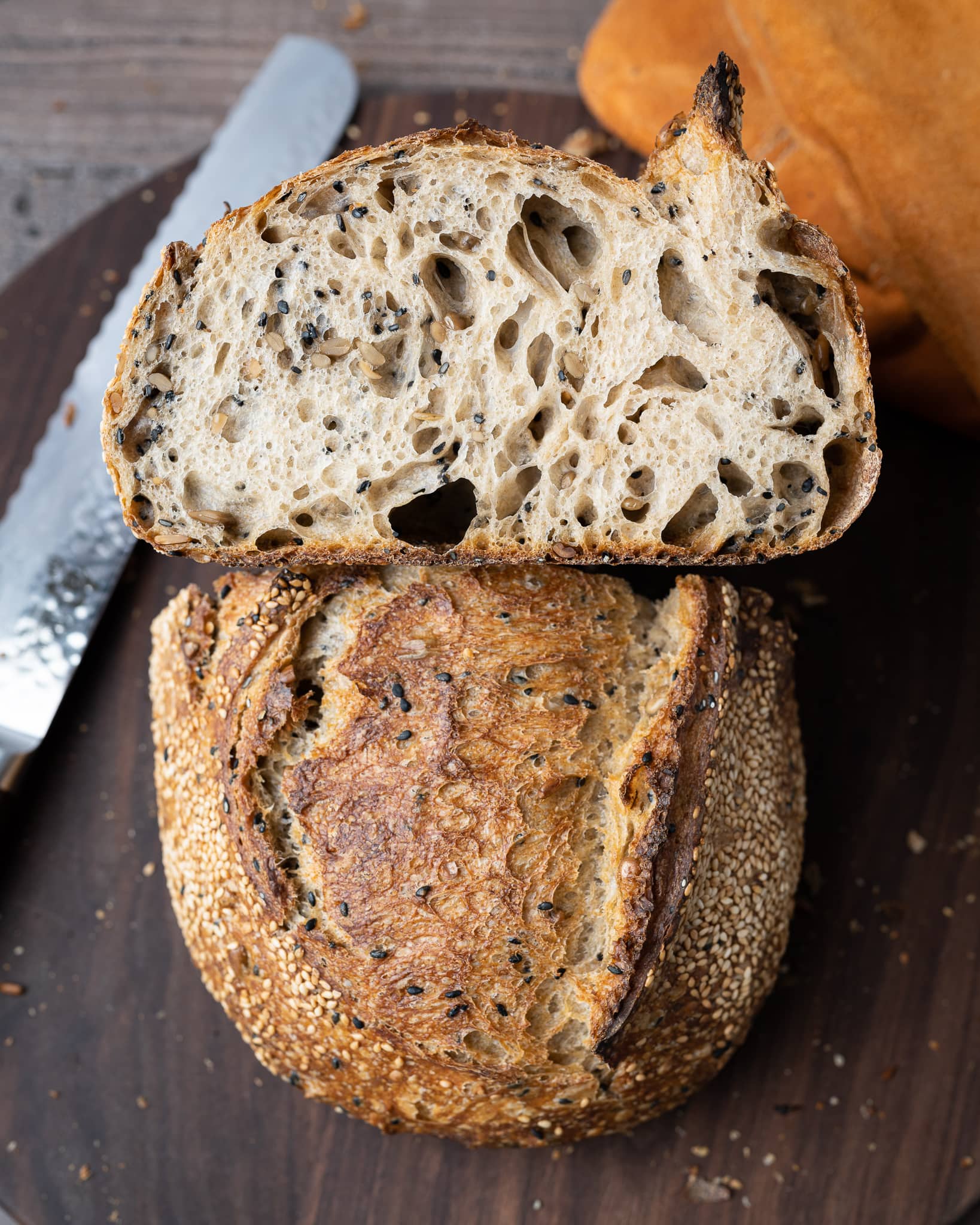
The flavor of sunflower seeds will always remind me of summers spent digging through bags of salt-covered shells, cracking each one to get the prized kernel. They’re an addictive lot, these seeds, a snack for mindless consumption. I always found myself quickly polishing off an entire bag before realizing I’ve even started. That is, until the inevitable salt overload kicks in, compelling you to chug a few bottles of water and swear next time you’ll take it easy. But of course, you don’t. And the wonderful cycle repeats.
I’ve since curbed my appetite for salted sunflower seeds, but my appreciation for their flavor never left. This bread is chock full of the tasty little morsels, and roasting them beforehand amplifies their nutty flavor. The 30% whole grain in the formula brings an earthiness that works well with the added seeds, and I could see going even higher to bring even more flavor.
Let’s first look at how to prepare the sunflower and sesame seeds.
Choosing and preparing sunflower and sesame seeds
I used roasted and unsalted sunflower seeds from the market, but raw, unsalted sunflower seeds with a quick toast—10 minutes should do it—in the oven at 350°F (175°C) would work well. Roasting/toasting the seeds amplifies their nutty (isn’t it interesting we say sunflower seeds have a nutty flavor when they’re seeds?) flavor.
I’m a huge sesame seed fan, and I always have a jar of white and black sesame seeds in my pantry ready to be used on the outside of any loaf. I prefer using white sesame seeds on the outside; when they are toasted in the oven while the bread is baking, they take on a deliciously subtle nutty flavor. By contrast, black sesame already has a vibrant flavor thanks to its dark hull. Because of this, I prefer to use them mixed into a dough (and the look is quite striking!).
This recipe uses a seed soaker to prepare the black sesame seeds, which have their hull intact. Soaking seeds like this for a time period helps to soften them and make them more palatable. The water for the soaker is taken from the overall hydration of the formula. This way, no unaccounted for water is added to the recipe.
Baking schedule
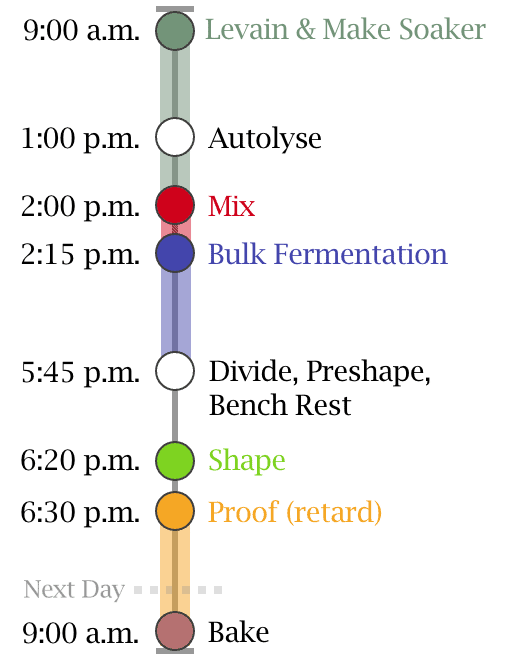
This sunflower and sesame sourdough bread is made over the course of two days. Cold proofing this dough brings additional flavor, but as always, a same-day bake can be done as well. Instead of placing the shaped dough into the refrigerator to proof overnight, leave it out, covered, to proof for 1-3 hours (depending on kitchen temperatures) until ready to bake.
Sunflower and sesame sourdough bread formula
Vitals
| Total Dough Weight | 1,800 grams |
| Hydration | 77% |
| Pre-fermented Flour | 6.25% |
| Levain in final dough | 16.67% |
| Yield | 2 x 900g loaves |
This recipe makes two loaves. If you’d like to make a single loaf of sunflower and sesame sourdough bread, divide all the ingredients in half. See my guide to using baker’s percentages for further help with scaling.
Total formula
Desired dough temperature: 78°F (25°C). See my post on the importance of dough temperature for more information on dough temperatures.
The table below shows the total ingredients needed for this entire bake. In each of the Method steps below, I’ve broken out each ingredient as they’re needed in the recipe. If you’re baking in the kitchen, follow the Method steps and it’ll tell you what you need, and when.
| Weight | Ingredient | Baker’s Percentage |
|---|---|---|
| 615g | Medium-protein bread flour or All-purpose flour (~11% protein, Central Milling Artisan Baker’s Craft or King Arthur Baking All-Purpose) | 70.00% |
| 264g | Whole wheat flour (Giusto’s Whole Wheat or King Arthur Baking Whole Wheat) | 30.00% |
| 132g | Sunflower seeds, roasted and unsalted | 15.00% |
| 35g | Black sesame seeds | 4.00% |
| 35g | Honey | 4.00% |
| 632g | Water 1 (soaker, levain, and autolyse) | 72.00% |
| 44g | Water 2 (reserve for mixing) | 5.00% |
| 16g | Fine sea salt | 1.80% |
| 27g | Sourdough starter | 3.13% |
Sunflower and sesame sourdough bread method
1. Prepare the levain – 9:00 a.m.
This is a relatively fast levain, ripening in five hours. Mix the following ingredients in a container and leave covered to ripen at a warm temperature, about 76-78°F (24-25°C) for 5 hours.
| Weight | Ingredient | Baker’s Percentage |
|---|---|---|
| 27g | Medium-protein bread flour or all-purpose flour | 50.00% |
| 27g | Whole wheat flour | 50.00% |
| 55g | Water | 100.00% |
| 27g | Ripe sourdough starter | 50.00% |
2. Prepare the seed soaker – 9:10 a.m.
To soften the seeds and make them more palatable when eating the final loaf of bread, soak them in boiled water while the levain is ripening, about 5 hours.
Right after making the levain, prepare the seed soaker. Add the 35g black sesame seeds to a heat-proof bowl and pour 35g boiled water over the seeds. Stir to combine and ensure all the seeds have been wet. Cover the bowl and let rest until called for in bulk fermentation.
3. Autolyse – 1:00 p.m.
This recipe uses the autolyse technique to increase the extensibility of the dough and make mixing by hand easier. In a small way, the increased extensibility also helps with incorporating the seeds.
Add the following to a mixing bowl and mix until incorporated. Let the mixture rest, covered, for 1-hour.
| Weight | Ingredient |
|---|---|
| 587g | Medium-protein bread flour or all-purpose flour |
| 236g | Whole wheat flour |
| 542g | Water 1 (this is the remaining water 1 after taking some for levain and soaker) |
4. Mix – 2:00 p.m.
Gather the following ingredients for mixing. The remaining water (water 2) should only be added through mixing and kneading if your dough feels like it can handle the addition. Use a splash to work in the levain and salt, adding the rest if the dough feels cohesive.
| Weight | Ingredient |
|---|---|
| 35g | Honey |
| 44g | Water 2 |
| 16g | Fine sea salt |
| 137g | Ripe levain (from step 1) |
I strengthened this dough by hand using the slap and fold kneading technique, which quickly develops the dough. Alternatively, you could use a bread dough mixer, or even a KitchenAid would work with this dough.
Add the honey and levain to the top of your dough already in the mixing bowl, and use a splash of the reserved water to moisten. Mix the levain thoroughly and slap and fold (or do folds in the bowl) for 5 minutes until the dough begins to smooth out and become elastic.
Let the dough rest in the mixing bowl for 10 minutes.
Sprinkle the salt over the dough, then dissolve with a splash of the reserved mixing water. Mix thoroughly. If the dough still feels very slack, continue to strengthen the dough in the bowl by stretching and folding (or do slap/fold on the counter) for a few minutes until it begins to tighten and come together.
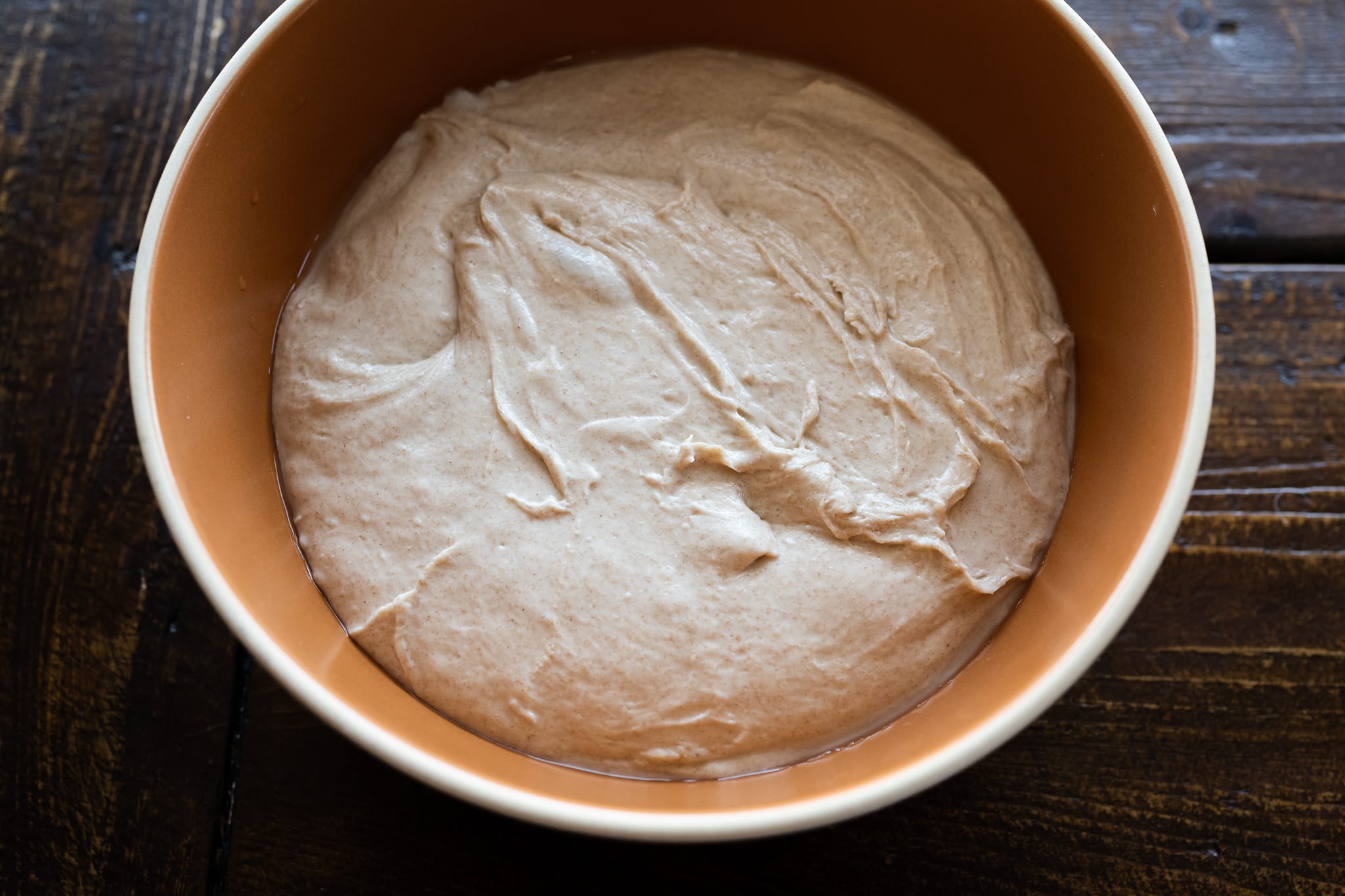
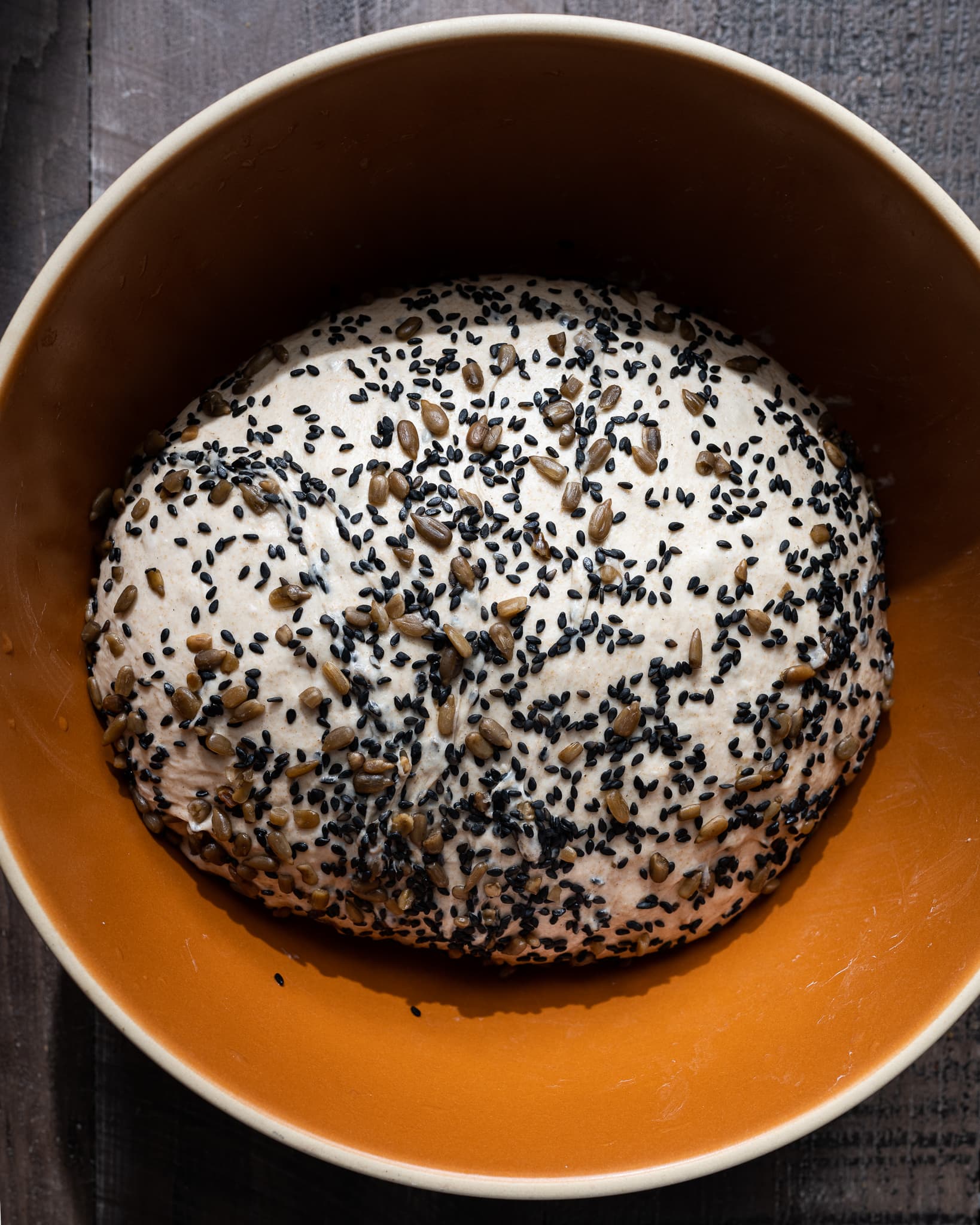
As you can see above, at the end of mixing, expect this dough to be rather firm, smooth, and elastic. Hold back the sesame and sunflower seeds until just before the first set of stretch and folds during bulk fermentation.
Transfer the dough to a container for bulk fermentation and cover.
4. Bulk fermentation – 2:15 p.m. to 5:45 p.m.
At warm room temperature, around 74-76°F (23-24°C), bulk should take about 3 1/2 hours. If your kitchen is cooler, place your bulk container in a small home dough proofer, or extend the bulk fermentation time to give the dough more time to ferment. This dough needs about three sets of stretch and folds during the 3-hour bulk.
Combine the 132g sunflower seeds and the black sesame seed soaker (approximately 70g) in a large bowl.
Before you give your dough its first set of stretch and folds, spread about 1/4 of the mix-ins over the top of the dough. Then, grab one side of the dough and stretch it up and over the dough to the other side. Spread on another 1/4 of the mix-ins to the new top. Rotate the bowl 180° and perform another stretch and fold. Spread on another 1/4 of the mix-ins, then rotate the bowl 90° and do another stretch and fold. Finally, spread on the last of the mix-ins, turn the bowl 180° and do one last stretch and fold. It would be best to have the dough neatly folded up in the bowl with all the mix-ins tucked into the dough.
The remaining two sets of stretch and folds should be more gentle. After the third set, let the dough rest, covered, for the remainder of bulk fermentation.
5. Divide and preshape – 5:45 p.m.
First, check on the dough in the bulk fermentation container. This dough can be sluggish if the dough temperature came in below the FDT listed in the recipe, or it cooled during bulk fermentation. If the dough looks flat, shaggy, and doesn’t jiggle some when you shake the bowl, give it another 15 minutes and check again.
Fill a bowl with some water and place it on your work surface. Scrape out your dough from the bulk container onto your dry counter. Divide the mass in half using a bench knife. Using a wet hand and the knife in the other, gently preshape each half into a loose round.
Let the dough rest (also called a bench rest), uncovered, for 35 minutes until its relaxed outward. Because this dough was strong and firm for me, a slightly longer rest period of 35 minutes was helpful (see why in my guide to preshaping bread dough).
6. Shape – 6:20 p.m.
I like to shape this sunflower and sesame sourdough bread as a batard shape, but a round boule would also work well. Shape each by first flouring the top of the rested rounds and your work surface, flip the dough over to the floured space, and then shape them into your desired shape.
This sunflower and sesame sourdough bread is wonderful topped with white sesame seeds. Spread out a thin layer of seeds on a clean kitchen towel or on a sheet pan. After shaping the dough into a batard or boule, roll it, smooth side down, on the seeds so they stick.
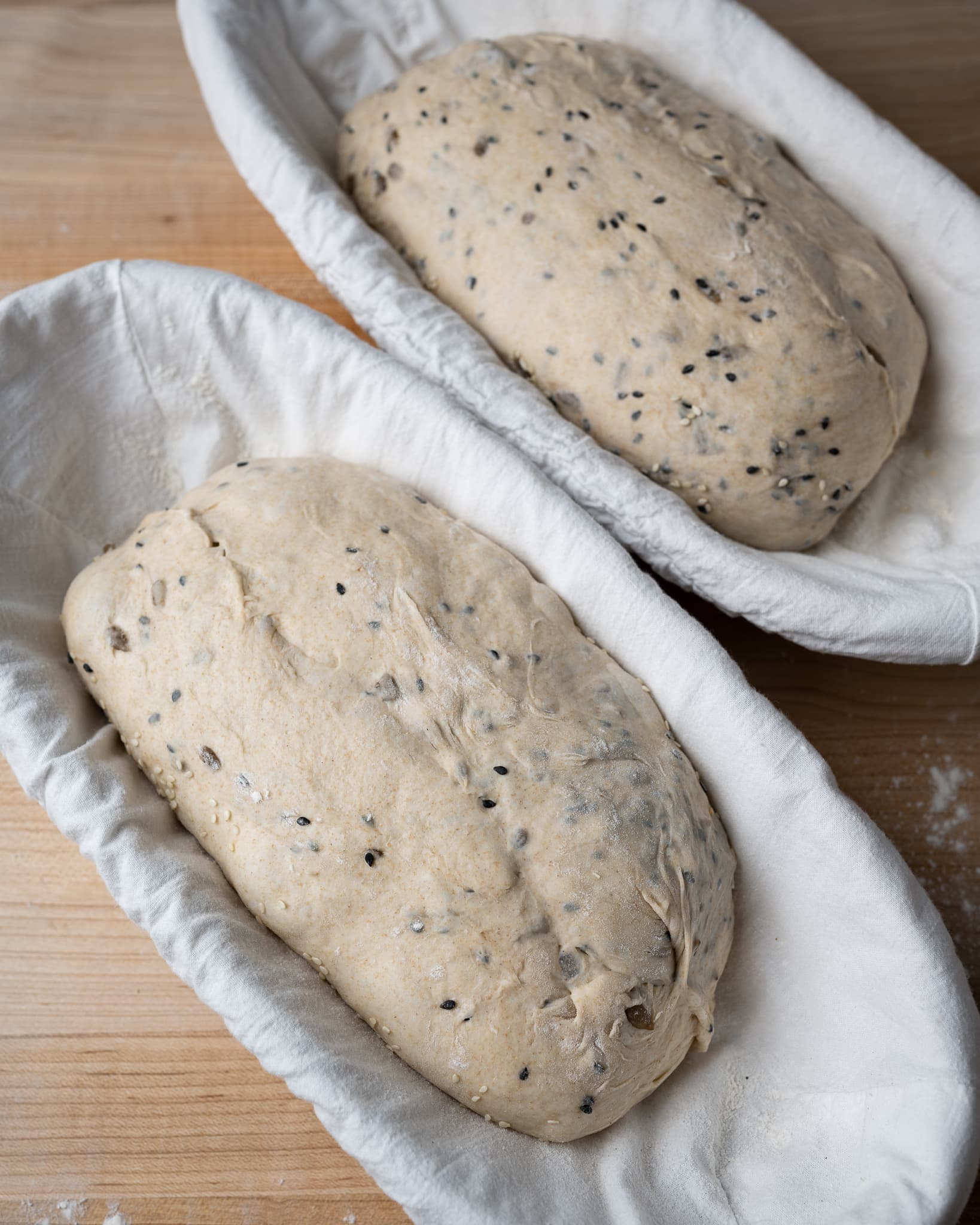
After each dough piece is shaped and optionally topped with seeds, place it seam side up in a proofing basket lined with canvas or a clean kitchen towel.
7. Proof – 6:30 p.m. to 9:00 a.m. (overnight)
Cover the baskets with a large, reusable plastic bag and seal it shut. Place the baskets into your refrigerator to proof overnight.
8. Bake – 9:00 a.m. (next day)
Preheat your oven with a baking stone or Baking Steel inside to 450°F (230°C).
I baked these loaves in my Challenger bread pan, but you could also follow my guide to steaming an oven for baking bread.
Score each piece of dough and slide it into the oven—bake for 20 minutes with steam. Then, remove the steaming pans from inside the oven (or remove the lid to your baking pan) and bake for an additional 30 minutes, or until the crust is deeply colored and the interior temperature registers around 204°F (95°C).
Once fully baked, cool your loaves on a cooling rack for 1-2 hours. See my post on the best way to store bread to keep it fresh for a week or longer.
Print
Sunflower and Sesame Sourdough Bread Recipe
- Prep Time: 24 hours
- Cook Time: 1 hour
- Total Time: 25 hours
- Yield: 2 loaves
Description
This delicious sourdough bread is chock full of healthy roasted sunflower seeds and black sesame, finished off with a touch of honey. The sunflower seeds bring a rich, nutty flavor, and the umami-forward sesame adds depth and complexity. A wonderful bread for lunch, dinner, or any snack!
Ingredients
Levain
- 27g medium-protein bread flour or all-purpose flour
- 27g whole wheat flour
- 55g water
- 27g ripe sourdough starter
Seed Soaker
- 35g black sesame seeds
- 35g water, boiled
Main Dough
- 587g medium-protein bread flour or all-purpose flour
- 236g whole wheat flour
- 132g sunflower seeds, unsalted and roasted
- 35g honey
- 16g sea salt
- 542g water 1 (autolyse)
- 44g water 2 (reserved for mix)
- 137g levain
Topping
- White sesame seeds to top dough (optional)
Instructions
- Levain (9:00 a.m.)
In a small container, mix the Levain ingredients and keep it at a warm temperature for 5 hours. - Prepare soaker (9:10 a.m.)
Right after making the levain, prepare the seed soaker. Add the soaker ingredients to a heat-proof bowl. Cover the bowl and let rest until called for in bulk fermentation. - Autolyse (1:00 p.m)
In a medium mixing bowl, add the 587g medium-protein bread flour, 236g whole wheat flour, and 542g water 1 and mix until no dry bits remain. Cover the bowl and let rest for 1 hour. - Mix (2:00 p.m.)
To the mixing bowl holding your dough, add the honey and levain and a splash of water. Mix thoroughly and strengthen the dough for about 5 minutes. Let the dough rest for 10 minutes in the mixing bowl. Add the salt, another splash of water, and mix until incorporated. Strengthen the dough further if necessary until it’s elastic and smooth. Transfer the dough to a bulk fermentation container and cover. - Bulk Fermentation (2:15 p.m. to 5:45 p.m.)
This dough will need 3 sets of stretch and folds during bulk fermentation. First, mix together the soaked and cooled sesame seeds with the sunflower seeds. Before you give your dough its first set of stretch and folds, spread about 1/4 of the mix-ins over the top of the dough. Add the rest of the mix-ins in the same way through the remaining folds for the first set. Perform two more sets of gentle stretch and folds during this 3 1/2 hour period, then let the dough rest the remainder of bulk fermentation. - Divide and Preshape (5:45 p.m.)
Lightly flour your work surface and scrape out your dough. Using your bench knife, divide the dough in half. Lightly shape each half into a round shape. Let the dough rest for 35 minutes, uncovered. - Shape (6:20 p.m.)
Shape the dough into a round (boule) or oval (batard) and roll in the white sesame seeds to top, if desired. Then, place the dough in proofing baskets. - Proof (6:30 p.m. to 9:00 a.m. the next day)
Cover proofing baskets with reusable plastic and seal shut. Then, place both baskets into the refrigerator and proof overnight. - Bake (The next day, bake at 9:00 a.m.)
Preheat your oven with a baking surface or combo cooker/Dutch oven inside to 450°F (230°C).When the oven is preheated, remove your dough from the fridge, score it, and transfer it to the preheated baking surface or combo cooker. Bake for 20 minutes with steam. After this time, vent the steam in the oven or remove the lid (you can keep it in the oven or remove it) and continue to bake for 30 minutes longer. When done, the internal temperature should be around 204°F (95°C).
Let the loaves cool for 2 hours on a wire rack before slicing.
What’s Next?
Sometimes it’s the simplest approach to baking that yields the best loaf. I originally started this recipe with a complex blend of flours, seeds, and other additions and, through testing, slowly pared it back until just the essentials remained. While I’m all about exploring different ingredients and techniques (like sift and scald) to see if they yield an improvement, oftentimes, great sourdough bread is simply beginning with a strong starter, using good flour, attention to detail, and a few seeds you might already have in the pantry.
If you liked this sunflower and sesame sourdough bread but want to take it even further with more additions, check out my seeded sourdough, which is chock full of seeds (including flaxseed) and also sure to delight.
Buon appetito!


215 Comments
LA MIEL A ESTA HOGAZA PARA QUE SE INTEGRA ademas de aportar COLOR O SABOR , Y LA TOMAS COMO PORCENTAJE DE AGUA SI LA RETIRO ?
https://uploads.disquscdn.com/images/0886a8b26f3a788b97b3d25c418e7228e26efaadcdc304eda28ed81966693851.jpg This is probably the best sourdough I have ever had. The nuttiness from the toasted sesame seeds, the delicate crumb. This is the kind of bread you’d write stories about.
How would you adjust the levain to an overnight levain and still achieve the same results?
Looks really great! Nice bake. If you want to do an overnight levain, instead of adding 50% starter to the lev, add 20% and let it go for 12 hours or so. The calculations will be slightly off when doing this, but it's a quick way to covert.
Perfect. Thanks so much for the quick reply.
The volume of levain going into the final dough stays static, but ratio of flours to levain changes to 80/20….
I was at the King Arthur shop in Vermont and bought a bag of their Harvest Grains. I’m excited to use them and thought I might try this loaf using the Harvest Grains, which contain whole oats, rye flakes, sunflower seeds, sesame seeds, poppy seeds, and hulled millet. I need some advice! Should I reduce any of the other ingredients? Should I still presoak? If not, do I need to adjust the amount of water I use? Thank you 🙏
I'd pre-soak those grains. You could probably swap all the seeds and such in this loaf with that mix!
I absolutely love this recipe! I bake this bread every week to eat with cream cheese and cucumbers as my morning breakfast. I slice it once it's cooled and freeze it. The slices toast up great from frozen! The only note I have is that the addition of water in step 4 has always resulted in a poorly risen loaf for me. I leave it out and seem to get results more consistent with your photos. Love the bread, thank you for sharing your recipe! ❤️
Fantastic, Shelby. Sounds like you're making all the right moves (great work adjusting by leaving out). Enjoy!
Why do some recipes soak sunflower seeds while others (like this one) do not? Is there a good rule of thumb? Also can you speak about the pros/cons of toasting certain seeds beforehand?
I find that sunflower don't need soaking usually because they're soft enough. Generally, you don't need to soak if the seed/inclusion isn't hard. Soaking helps eliminate tough to chew bits in the final loaf.
Hi Maurizio! I just revived my long-neglected starter and tried out this recipe. I baked it on the baking steel with a metal bowl overturned on top for the first part of the bake, and then uncovered for the rest. The bread turned out a bit burnt or “bien cuit” – with other recipes I typically turn the oven temp down after removing the lid, but I didn’t this time since your recipe didn’t specify. Would you recommend turning down the temperature after releasing the steam? Thanks!
Yes, sounds like a lower temp would have helped here, Abby!
Absolument délicieux avec du beurre de peanuts. Merci pour cette belle recette.
❤️
I haven’t had success with my gas oven baking in Dutch ovens or various sizes and shapes — all my bread burns on the bottom in spite of numerous adjustments tried. I can however bake loaves in tins. And this was outstanding in Pullman pans. Honestly our favorite bread. So delicious.
I put 2 baking pans, one inside the other, under the dutch oven, & I no longer have burnt bottoms.
It's definitely hard to bake with steam in a gas oven! Glad this pan loaf turned out well for you, Anita!
Hi Maurizio! Finally trying this recipe that I’ve had my eye on for a long time. Looking great so far—and oh, my, the smell of the seed mixture!
Quick question for you on adjusting timing. I’m always much slower than you at each step. For example, today: Started mixing the autolyze at 1:00 and It was 1:20 by the time was done. Started my mix at 2:15, but needed a lot of slap and fold and it was close to 3:00 before I had the salt mixed and it was covered for bulk. You get the idea. How do you adjust timings, especially for bulk once the levain is in? Time bulk from the time the levain goes in or from the time you finish the step?
General principles would be helpful!
Thanks!
Update: well, I waited waaayyy longer because n o t h i n g was happening. This dough just wasn’t rising, so I just threw timing out the window and watched it. 7:30 and still almost nothing, so I went ahead with pre-shaping, shaping and retard. Saw your note that this one can be sluggish if the temp drops, and that’s probably it. Wound up giving it almost 2 hours more proofing out of the fridge in the morning, and OH MY: two of the tallest, most wonderfully textured, delicious loaves I’ve baked. Total success.
AND: I’d still love to hear your thoughts on the timing question above 🙂
Thanks for another phenomenal recipe!
Hi! Can I use KA bread flour for this recipe, or should I go to the store and grab KA all purpose? Excited to give this one a try 🙂
Bread flour will work, Rebecca!
So happy to have found this bread recipe! It has become a staple in our house and our son and his family request it regularly. Comes out beautifully ever time! Thank you!
So glad to hear that, Katherine! I really do think this is one of my best…
Hi Maurizio, I have just baked a pair of these loaves from your book (which has been my sourdough Bible since it came out) and they are awesome! I was afraid that I would get a dense crumble because of the added seeds, but it turned out to be extremely light and delicious! It’s one of my new favorites from the book, along with Rustico 😀 Next time I’ll surely give the seeded sourdough a try!
Fantastic, Rafael!!
Seriously one of the tastiest and best breads ever.
Thanks so much, Paula!
Really enjoyed this recipe – fabulous flavor! I’m a “same day” baker and so prepared the levain and seed soaker the night before (12-14 hrs @ 70 degrees). After the autolyse I added 1.5 gm of instant yeast to the bowl along with the levain (0.2% per Jeff Hamelman’s technique). Still needed a 3 hr bulk fermentation and then 90 minutes proofing following the bench rest. Baked on my stone. Wonderful results. Thanks for a great recipe!
Quick question to teach me: Why do you do the bench rest uncovered? Due to the higher hydration?
Hi Maurizio, if I use white sesame seeds instead of black, do I have to soak them?
Thank.
Yes, I would still soak them!
Hi Maurizio! First of all love your recipes and can’t wait for your book! I was wondering what temp you keep your fridge at? I feel like my dough does well until it comes out of the fridge, and I’m wondering if it’s too cold?
Thanks so much, Abby! My home fridge is typically 39F/4C. If you find your loaves are underproofed when you pull them out, let them sit on the counter (after shaping, and covered) for 15 to 20minutes (or more as necessary) before putting them in!
Hope you love my cookbook (and this recipe is in there!!).
Nerd question: You lost me on the 6.25% prefermented dough. Can you explain your calculation? Thanks so much!
Hah! No worries, check out my guide to baker’s percentages for a full run down of everything there.
This has been a family friend and personal favorite. I’ve also switched out seeds used although used black sesame recently and agree delicious. Have used pumpkin inside with black sesame and sunflower on top. Have recently also played around with decorative scoring and found a pretty daisy pattern on top with cut petals ear nicely with sunflower seeds in the middle adding texture. Fun and delicious. Thank you, Maurizio!
So glad to hear you guys are liking this loaf, I love that scoring idea!!