

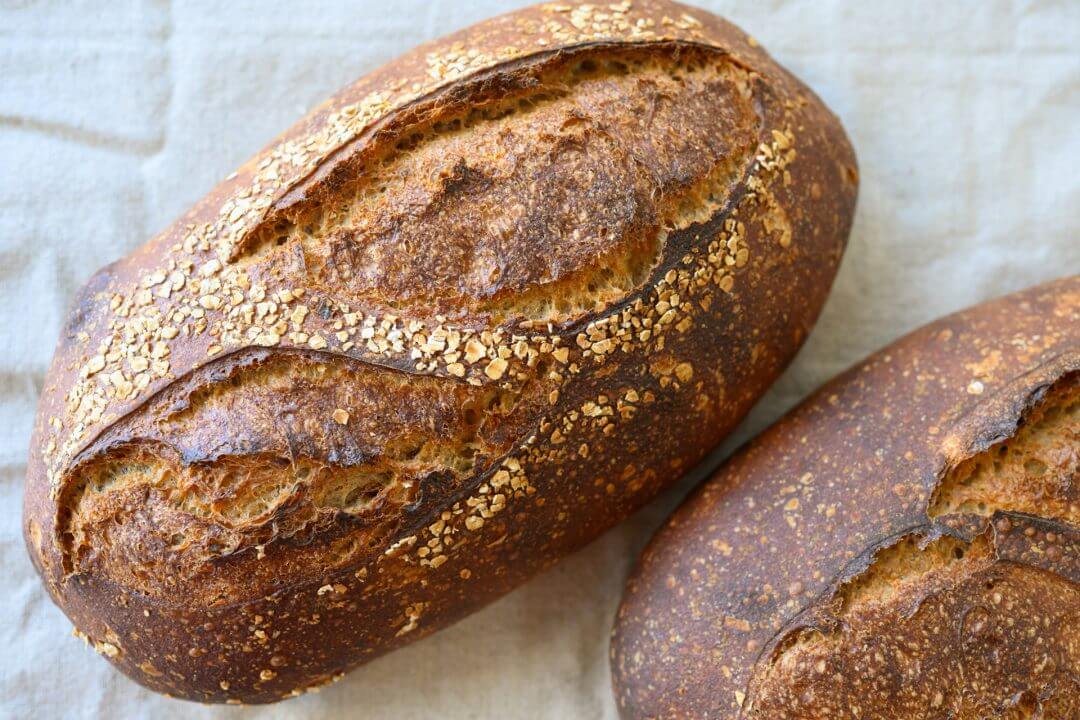
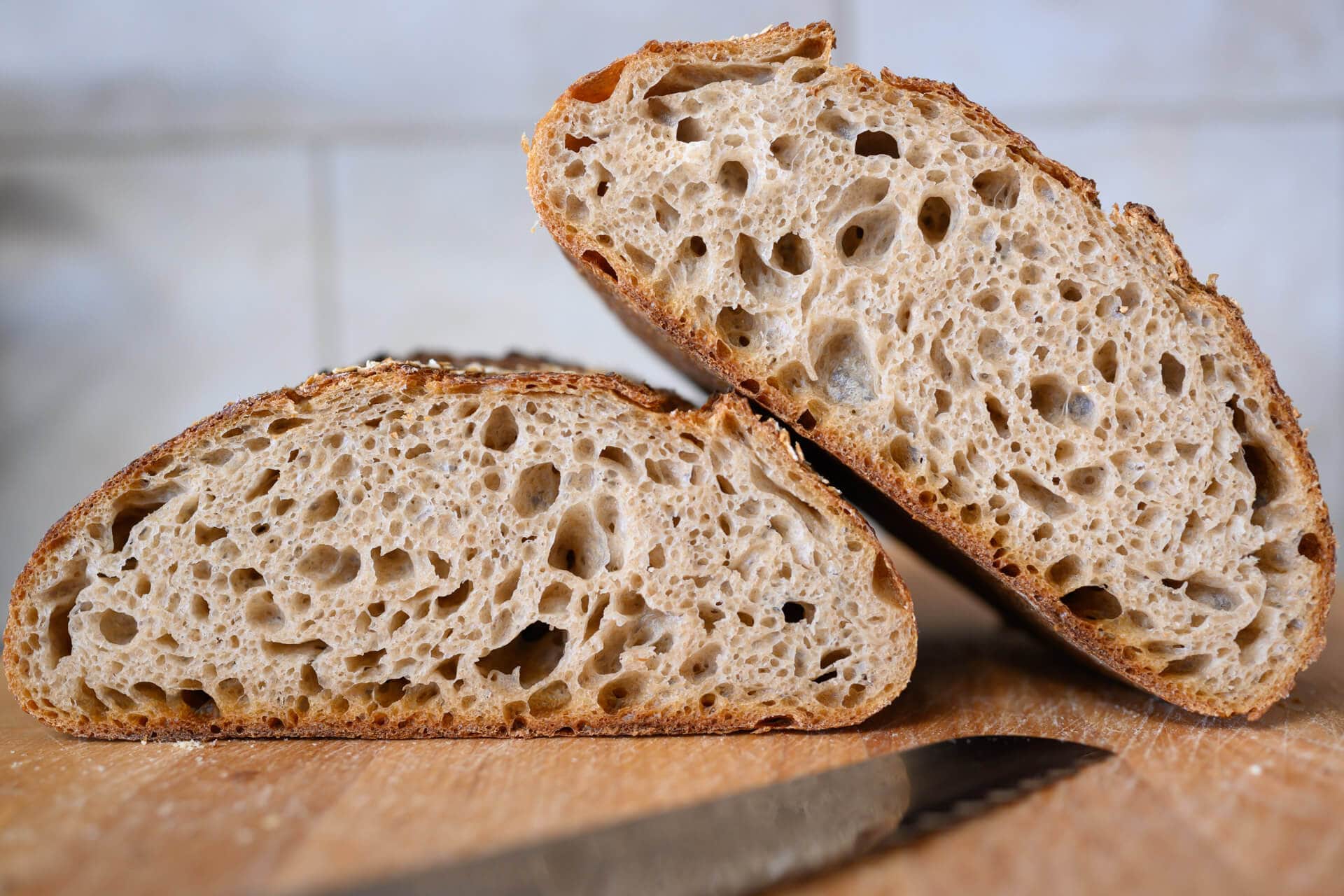
As the chill of winter sets in, I find myself drawn to this recipe. Vibrant and flavorful, healthful yet comforting, it is excellent at combating the cold weather, warming both your body and your kitchen at the same time. Winter urges me to bake anything and everything bread more than any other season. There’s nothing more wonderful to me than the aromas of freshly baked bread from a hot oven in contrast to the snow and howling wind outside. For this bread, I baked, tweaked, and baked again, ultimately landing on a mixture of white, spelt, rye, and whole wheat flours that produced a very craveable, satisfying sourdough bread that I cannot stop baking.
Part of this loaf’s abundant flavor is due to a little more sourness than you find in my typical recipe: a welcome addition that elevates the wholesome character of the crumb and crust. Sure, it has all the usual zest that comes with increasing the whole grain percentage, but it also has something more.
But what? What is that “something”? Is it the crust’s texture or the crumb’s tenderness altering my taste, or is it the perception of the loaf itself? Sometimes I wonder if the full range of textures, colors, and flavors I experience are genuinely there–visible to my eyes, present on my palate–or if I manufacture them when I see something mouthwatering. Perhaps this is the same way a barista might salivate at the sight of a properly pulled espresso, the aroma conjuring that recent summer strawberry, the allusion of toffee or black licorice. That “something more” seems to evolve as the loaf cools, hardens, and matures—an ever-changing kaleidoscope of flavors and textures.
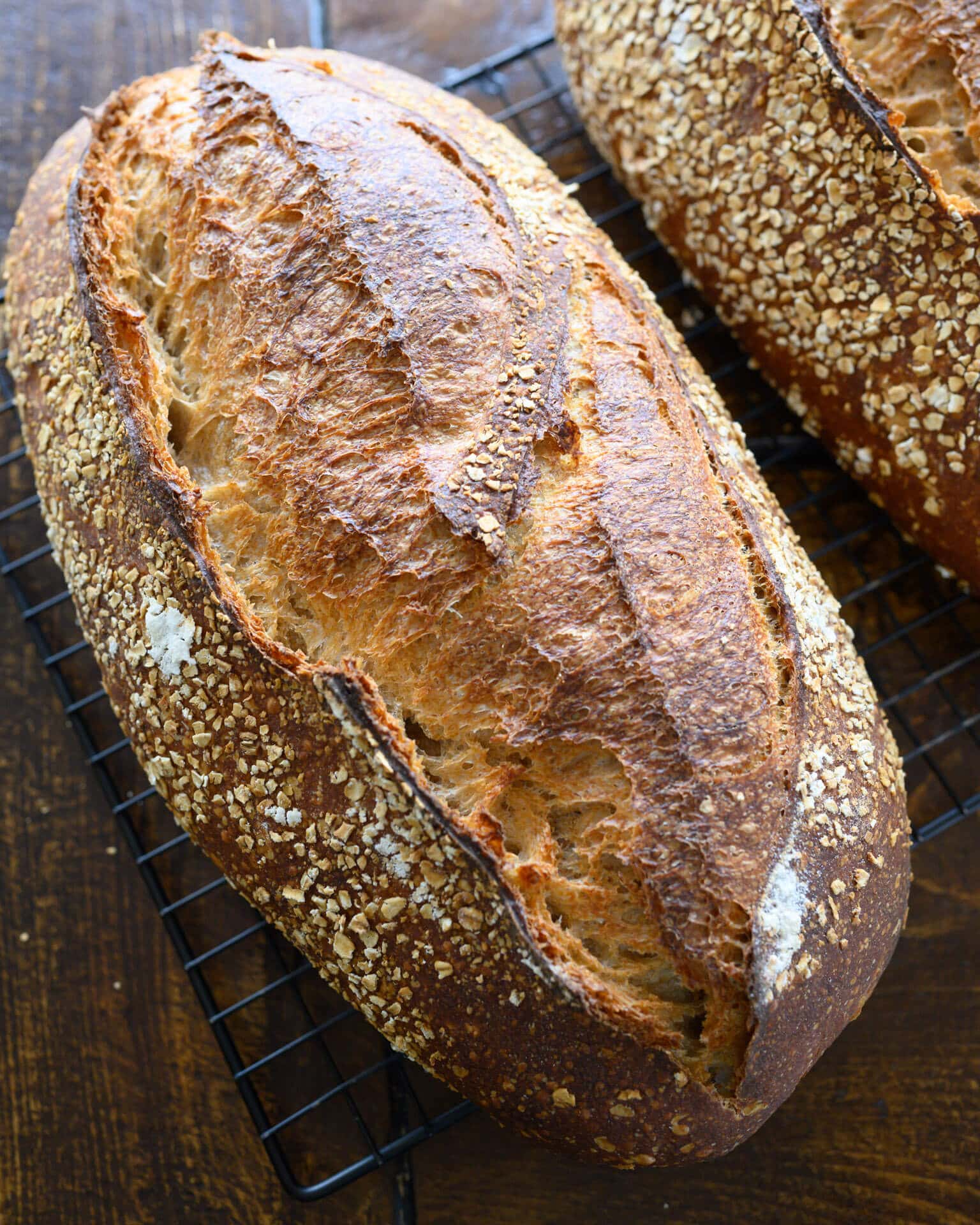
Baking a loaf of sourdough seems to be the only thing that has this effect on me. I think it has something to do with the art of the craft, the work that goes into it, and the satisfaction that results. It’s like a woodworker sitting in their precisely constructed no-nail design chair, corners fitting just so and pieces curved where they’re to be curved, straight where they’re to be straight. The pleasure of a well-executed bread is undoubtedly more than the aesthetic of it; it is also in the culmination of a detailed, devoted process that amplifies everything. Tasting how every piece is in the right groove, how the flavors and textures shift like fragments of colored glass from one bite to the next, is exhilarating.
Of course, it’s likely all of this is simply a result of my obsession with baking naturally leavened bread. But! I do proclaim that this is a great recipe that will make those who eat it smile, and you may even spy a split-second closing of their eyes as they savor the moment. This little, often overlooked token is what I look for when my kids are eating, indicating they deeply enjoy something. And I imagine that this bread will push its way to the top of your baking priorities more often than not.
Flour Selection
I love the small addition of rye flour in this recipe–it’s something you also see in my Beginner’s Sourdough Bread recipe. Even in a small percentage, rye seems to bring loads of flavor and color to the crust. And this loaf is all about flavor.
I use whole grain Red Fife for the whole wheat part of this recipe, which adds significant character to this already flavorful bread. If you have Red Fife, I’d recommend it, but if not, any whole wheat variety will also work very well.
Whole grain spelt brings a nutty, almost sweet character to the flavor profile. I use spelt often because of this addition, and in this bread, even though it’s in small quantity, it’s still a significant contributor to the overall complex flavor profile.
The white flour I use in this recipe is medium protein at around 11-12%. This would be a typical all-purpose flour or a base white flour used for bread-making. If you wanted to increase the strength of this dough and bring additional flavor and nutrition, you could substitute this white flour for a high-quality type 85 flour.
Baking Schedule
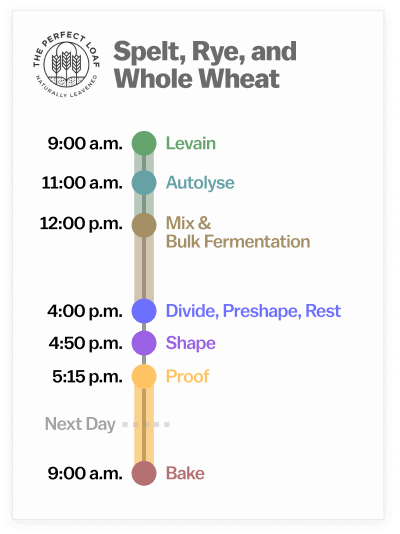
This sourdough bread recipe is made over two days, which gives the dough plenty of fermentation time, which results in a deeply complex and flavorful bread.
It’s also possible to bake this loaf all in a single day by allowing the dough to proof on the counter, shaped and covered, until the dough is puffy, relaxed, and passes the dough poke test.
Spelt, Rye, and Whole Wheat Sourdough Bread Recipe
If you want to make only a single loaf or scale this recipe up to make many more, see my guide to baker’s percentages to modify this formula.
Vitals
| Total Dough Weight | 2,000 grams |
| Pre-fermented Flour | 5.3% |
| Levain in final dough | 16.6% |
| Hydration | 85.0% |
| Yield | 2 x 1000g loaves |
Total Formula
The desired dough temperature for this recipe is 78°F (25°C).
| Weight | Ingredient | Baker’s Percentage |
| 520g | White flour (about 11.5% protein; Central Milling Artisan Baker’s Craft Plus) | 50.0% |
| 260g | Whole spelt flour (Central Milling Whole Grain Spelt) | 25.0% |
| 208g | Whole-grain wheat flour (Flourist Whole Grain Red Fife) | 20.0% |
| 52g | Whole-grain rye flour (Central Milling Whole Rye Flour) | 5.0% |
| 781g | Water 1 (levain and autolyse) | 75.0% |
| 104 | Water 2 (mix) | 10.0% |
| 20g | Fine sea salt | 1.9% |
| 55g | Ripe sourdough starter, 100% hydration | 5.3% |
Additional ingredients
Instant or rolled oats, for topping (optional)
Spelt, Rye, and Whole Wheat Sourdough Bread Method
1. Prepare the levain – 9:00 a.m.
| Weight | Ingredient | Baker’s percentage |
| 27g | White flour | 50.0% |
| 27g | Whole spelt flour | 50.0% |
| 55g | Water 1 (levain) | 100.0% |
| 55g | Ripe sourdough starter, 100% hydration | 100.0% |
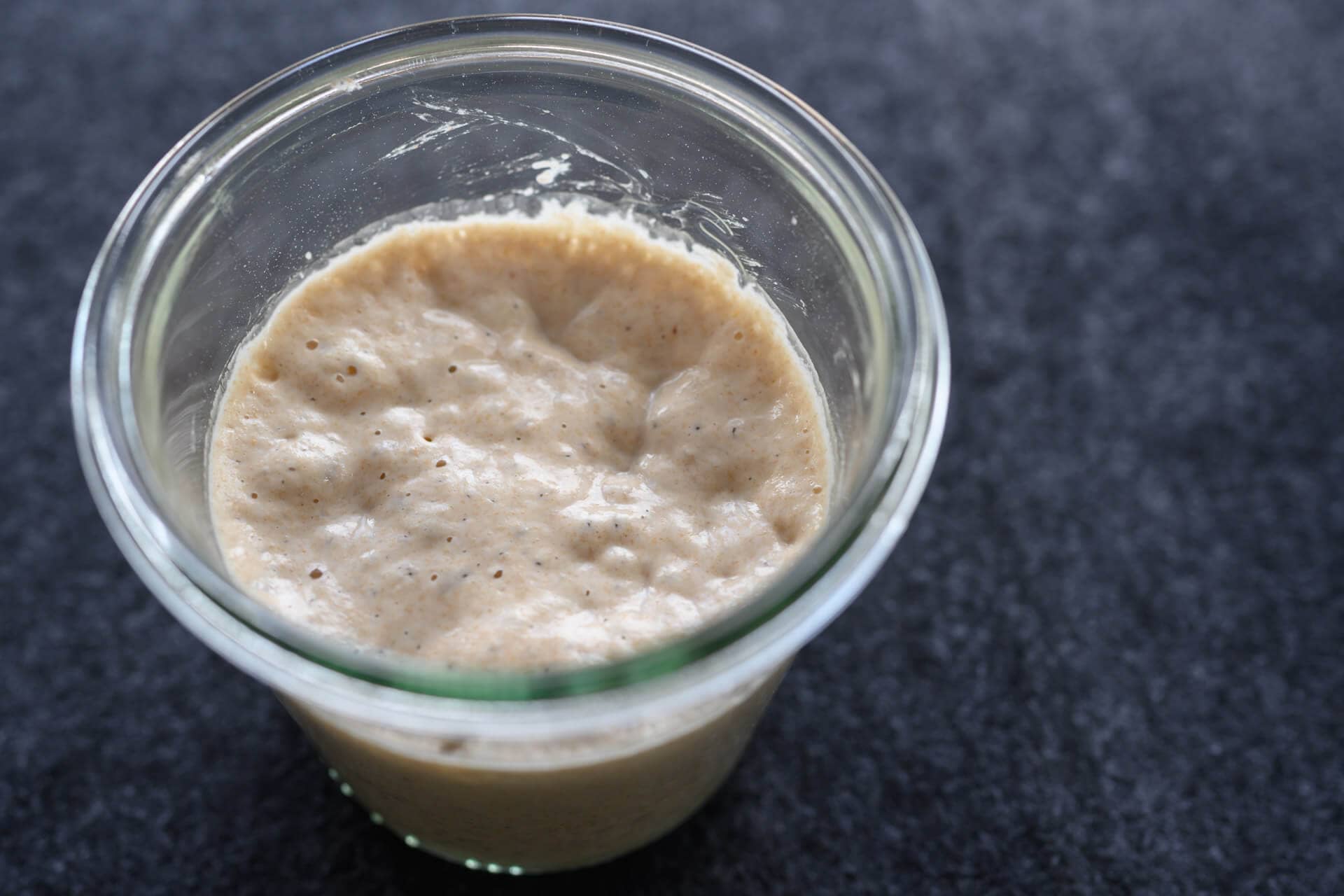
Mix the above ingredients in a jar and leave them covered at a warm temperature, 74-76°F (23-24°C), to ripen for 3 hours.
2. Autolyse – 11:00 a.m.
| Weight | Ingredient |
| 493g | White flour |
| 233g | Whole spelt flour |
| 208g | Whole wheat flour |
| 52g | Whole rye flour |
| 726g | Water 1 (autolyse) |
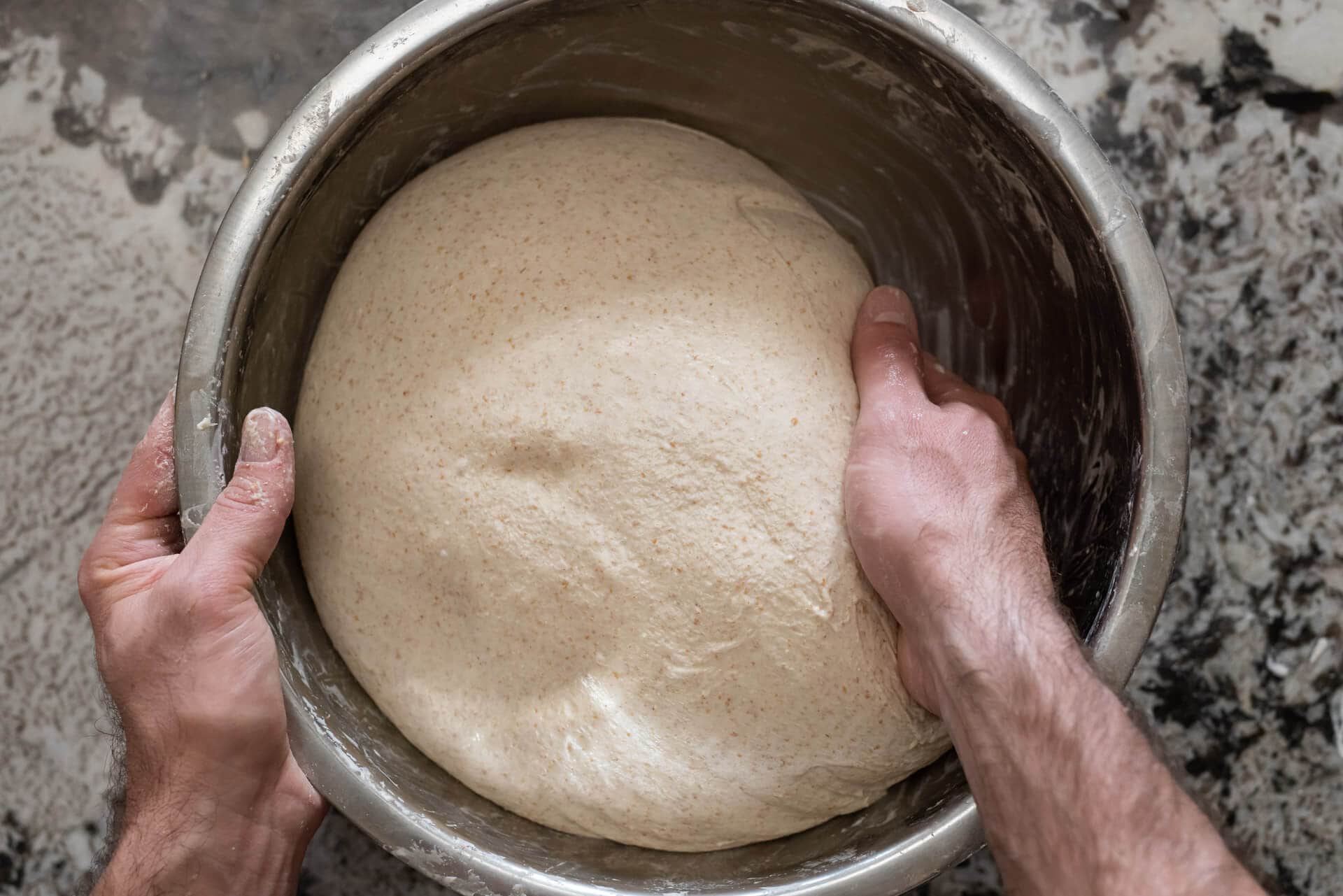
Warm or cool the autolyse water so that the temperature of the mixed dough meets the FDT (final dough temperature) of 78°F (25°C) for this recipe. Place all of the flours and water 1 in a large bowl. Use wet hands to mix until no dry bits remain; the dough will be shaggy and loose. Use a bowl scraper to scrape down the sides of the bowl to keep all the dough in one area at the bottom. Cover the bowl and place it near your levain for 1 hour.
3. Mix – 12:00 p.m.
| Weight | Ingredient |
| 104g | Water 2 (mix) |
| 20g | Fine sea salt |
| 164g | Ripe levain (from Step 1) |
Add the salt and levain to the top of the dough in autolyse, and use a splash of water 2 to moisten. With wet hands, mix thoroughly. Add the remaining water if the dough feels cohesive and it can handle the rest. Next, knead the dough for a few minutes using either the slap and fold technique or folds in the bowl. For this dough, I kneaded for about 5 minutes until the dough smoothed and became elastic.
Transfer the dough to a bulk fermentation container and cover.
4. Bulk fermentation – 12:30 p.m. to 4:00 p.m. (3 1/2 hours)
At a warm room temperature, 74-76°F (23-24°C), bulk fermentation should take about 3 1/2 hours.
This dough will require 3 sets of stretches and folds during bulk fermentation. After the first 30 minutes, wet your hands, grab one side of the dough, and lift it up and over to the other side. Rotate the bowl 180 degrees and repeat. The rotate the bowl a quarter turn and stretch and fold that side. Rotate the bowl 180 degrees again and finish with a stretch and fold on the last side. The dough should be neatly folded up in the bowl. Cover and repeat these folds every 30 minutes for a total of 3 sets of stretches and folds. Then let the dough rest, covered, for the remainder of bulk fermentation.
5. Divide and preshape – 4:00 p.m.
After 3 1/2 hours, the dough should be well-risen in the bulk fermentation container and puffy to the touch. The edge where the dough meets the container should be domed downward, showing strength and rise.
Fill a small bowl with water and place it next to your work surface. Scrape the dough onto a clean counter. Divide the dough into two equal pieces and prehsape each into a tight round.
Let the dough rest, uncovered, for 20 minutes. This is a shorter bench rest because the dough will be looser and slacker than most breads, spreading faster than usual.
6. Shape – 4:50 p.m.
I like to top this spelt, rye, and whole wheat sourdough bread with instant or rolled oats, but this step is optional. Spread an even layer of rolled oats on a clean kitchen towel or sheet pan.
I love to shape this recipe as a long, tapered batard (oval). See my process for shaping a batard or watch me shaping below for a quick tutorial.
Flour the top of each preshaped round and your work surface. Using your bench knife, flip one round over onto the floured area and shape it into a batard. Using two hands, transfer the dough top-side down to the oats, gently rocking the dough back and forth so that the oats stick. Then, flip the dough and place it seam-side-up into a prepared proofing basket.
Repeat for the other preshaped round.
7. Proof – 5:15 p.m. to 9:00 a.m.
Cover the baskets with a large, reusable plastic bag and seal shut. Let proof overnight in the refrigerator.
8. Bake – 9:00 a.m. (the next day)
Due to the large size of these loaves, they may not fit inside of a typical Dutch oven or Combo cooker. I prefer to bake them directly on a baking surface and steam my oven. See my guide to steaming a home oven for bread baking for instructions.
Place an oven rack in the bottom-third of the oven. Preheat your oven with a baking surface inside to 450°F (230°C).
Take the proofing baskets out of the fridge, uncover them, and put a piece of parchment paper over the basket. Place a pizza peel or inverted baking sheet on top of the parchment and, using both hands, flip everything over. Gently remove the basket and score the dough. I like to score these long ovals with a single long slash or a double slash.
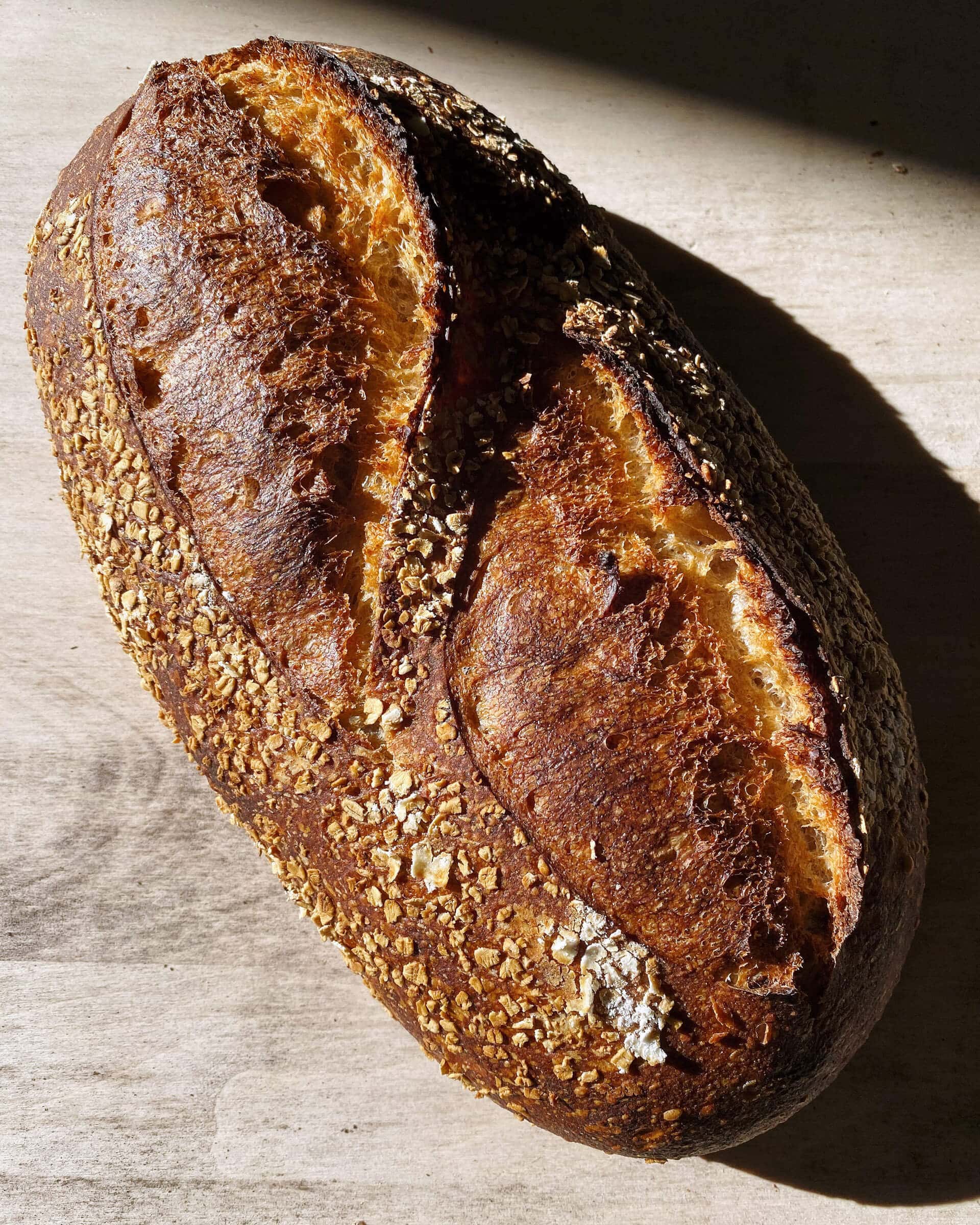
Slide the dough into the oven. Steam the oven by pouring ice into the preheated pan at the bottom of the oven. Bake for 20 minutes. Vent the oven of steam by removing the steaming pans. Continue to bake for 35 minutes more. When done, the loaf should have an internal temperature of around 204°F (95°C), and the crust should be deeply colored.
Let the loaf cool on a wire rack for 3 to 4 hours before slicing. This bread will keep well for a week or more if stored properly.
Print
Spelt, Rye, and Whole Wheat Sourdough Bread
- Prep Time: 24 hours
- Cook Time: 1 hour
- Total Time: 25 hours
- Yield: 2 loaves
- Category: Sourdough, Bread
- Cuisine: American
Description
A flavorful—and wholesome—loaf of sourdough bread with whole spelt, whole rye, and whole wheat.
Ingredients
Levain
- 27g white flour (about 11.5% protein)
- 27g whole spelt flour
- 55g water
- 55g ripe sourdough starter, 100% hydration
Autolyse
- 493g white flour
- 233g whole spelt flour
- 208g whole wheat flour
- 52g whole rye flour
- 726g water
Mix (final dough)
- 104g water
- 20g fine sea salt
- 164g ripe levain
Instructions
- Levain (9:00 a.m.)
In a small bowl or jar, mix the Levain ingredients. Cover the jar and keep it at a warm temperature for 3 hours. - Autolyse (11:00 a.m)
In a mixing bowl, add the autolyse ingredients until no dry bits remain. Cover the bowl and let rest for 1-hour. - Mix (12:00 p.m.)
Add the salt and levain to the top of the dough in autolyse, and use a splash of water to moisten. With wet hands, mix thoroughly. Add the remaining water if the dough feels cohesive and it can handle the rest. Next, knead the dough for a few minutes using either the slap and fold technique or folds in the bowl. For this dough, I kneaded for about 5 minutes until the dough smoothed and became elastic.Transfer the dough back to the bowl or to a container for bulk fermentation and cover. - Bulk Fermentation (12:30 p.m. to 4:00 p.m.)
This dough will require 3 sets of stretches and folds during bulk fermentation. After the first 30 minutes, wet your hands, grab one side of the dough, and lift it up and over to the other side. Rotate the bowl 180 degrees and repeat. Then rotate the bowl a quarter turn and stretch and fold that side. Rotate the bowl 180 degrees again and finish with a stretch and fold on the last side. The dough should be neatly folded up in the bowl. Cover and repeat these folds every 30 minutes for a total of 3 sets of stretches and folds. Then let the dough rest, covered, for the remainder of bulk fermentation. - Divide and Preshape (4:00 p.m.)
Use water and a wet hand or lightly flour your work surface (whichever you prefer) and scrape out your dough. Using your bench knife, divide the dough in half. Lightly shape each half into a round shape. Let the dough rest for 20 minutes, uncovered. - Shape (4:50 p.m.)
Lightly flour the top of your preshaped rounds and using floured hands, shape the dough into an oval (batard) shape, then place the dough in proofing baskets, seam side up. - Proof (5:15 p.m. to 9:00 a.m. the next day)
Cover proofing baskets with reusable plastic and seal. Then, place both baskets into the refrigerator and proof overnight. - Bake (The next day, 9:00 a.m.)
Preheat your oven with a baking surface inside to 450°F (230°C). When the oven is preheated, remove your dough from the fridge, score it, and transfer it to the preheated baking surface. Bake for 20 minutes with steam. After this time, vent the steam in the oven and continue to bake for 35 minutes longer. When done, the internal temperature should be around 204°F (95°C). Let the loaves cool for 3 to 4 hours on a wire rack before slicing.
Notes
If you want to bake only a single loaf, divide all the ingredients in half.
What’s Next?
If you love the nutty, almost sweet flavor of spelt flour as I do, check out my whole grain spelt pan loaf which is 100% whole spelt.
If you want to use some more rye in your baking, check out our Light Deli Rye which uses a scalded rye porridge to bring even more flavor.
Buon appetito!


354 Comments
Hi Maurizio I just place my loaf in the basket. It is still extremely wet and isn’t holding shape. It took 20 minutes of the slap and fold phase for the dough to become manageable as in the slap and fold phase in your video. I continued for an additional 5 minutes at that point but am thinking maybe I should have continued for a full additional 20 minutes? Your thoughts? I will let you know how it comes out when I bake it tomorrow
I’d say try dropping the hydration next time — sorry about that. Hold back another 100g of the water and see how the dough feels when you’re doing the slap and fold. I would probably not add it in.
More pressing, though: in the morning, if the dough just feels super, super slack and you’re sure it’s just going to spread in the oven, you could lightly shape it again then bake it. Alternatively, you could shape it and place it in a loaf pan to make sandwich bread.
Hope this helps!
Hey! I’ve been building up my Rye and Wheat starter and now I’m looking to bake my first loaf. I have all purpose, rye, and whole wheat flour. Just wondering what percentages should I use in proportion to my levain build? Also a lot of levain build’s I see are 1:2:2 but yours seems to be 1:1:1 which is how I currently feed my starter. Will that affect the end results of my loaf, I would like to have a higher hydration! Thanks so much for this!
You can increase the water of the levain if you’d like, but be aware this might make your dough more slack — in which case I’d likely hold back some of the mixing water I call for in this recipe, but that’s up to you and how the dough feels when you’re mixing!
Hello – I’d like to try this bread but do not have any rye flour. What would be a close alternative from what I currently have? I currently have white all-purpose, whole grain wheat, spelt, tipo/soft white wheat and a few pastry flours. I look forward to trying it with Rye when this comes back in stock. Many thanks, Gretchen
In place of the rye I’d go with more spelt or the whole grain wheat — either would be great!
Hi Maurizio, I haven’t tried this recipe yet. With the shortage of flours now a day I was wondering what are some substitutions I can make. I have some strong white bread flour, whole rye and also whole wheat but I cannot get my hands on spelt at this moment. What do you recommend I change in the recipe to make out for it. I also have Einkorn, some sprouted whole wheat, barley, and high gluten flours. Any suggestions? Thank you so much!!!
I’d say you can sub out the spelt for einkorn, just be cautious with the hydration of the formula, perhaps hold back a little more and add it in if it feels like the dough can handle it. Einkorn, as you probably know, is incredibly delicious but it can result in a stickier and more dense crumb — worth it for the flavor, it just means we have to alter our expectations. Happy baking and I hope that helps!
Maurizio, I could use a few suggestions. I’ve tried many of your formulas. All taste great. My biggest challenge is achieving oven spring. Everything seems to go according to plan until I open my oven to remove the steaming pan. I am frequently disappointed. What are the variables that contribute to oven spring? Perhaps I can work on addressing them one at a time. I do have much more success using a dutch oven…and I am working with a full size (accepts full sheet pan) oven. I’m not sure if that could be an issue. Thanks!
Generally I notice more oven spring with loaves that are on the less-proofed side: there’s more “gas in the tank” as they say. But in addition to this, you want to have sufficient dough strength to ensure the loaf springs up and doesn’t spread out. This might be your issue, especially if you’re seeing good rise in a Dutch oven, but not on a baking stone. The reason is the DO will help contain the loaf so it doesn’t spread excessively, whereas on a baking surface there’s nothing at the sides to stop it from spreading. You might want to try shaping the dough a bit tighter to see if that helps. Happy baking!
This bread is fantastic! I halved the recipe and made a sandwich loaf as opposed to a batard. I did not use all the water, I believe I ended up with a hydration level in the low 70s. I guess the types of flours available here in Norway act differently than the ones in the US. For one, we don’t actually have a brand of high protein “bread flour” here, so I am always searching for substitutes, which may or may not measure up. It certainly adds to the challenge.
As for the baking process itself: the dough was very sticky and I struggled a bit with the slap and folds, even with wet hands. The dough would come together, then stick to the counter (or me), and sort of “fall apart” again. I believe I struggled for almost 20 minutes. This may be due to my technique and lack of experience. Do you have any tips for how to deal with sticky and wet doughs when doing slap & folds? It seems like the strength of the dough breaks down as soon as it sticks to something and “rips”. Anyway, I stopped at a point when the dough was finally (somewhat) coming together again, and let it ferment. It seemed very slack during this time, so I gave it an extra set of stretch & folds. Still quite slack before shaping – I tried to preshape as tightly as possible. When scoring my blade kept sticking to it – it looked quite a mess before entering the oven – and I felt pretty sure it would just collapse. But the oven spring was great, and while it certainly looked clumsy (or lets just go with rustic for the sake of my self-esteem😝) it tasted divine! Lots of irregular air pockets, a soft interior and a thin, crackling crust. I shall continue to practice!
That’s great to hear, Marlene! I’m happy you made the modifications you needed for the ingredients you have on hand — great work.
When doing slap and fold, hold back more water from that first set of kneading on the counter. This should give you a stronger, more cohesive dough that will strengthen up faster. Then once you’re done with this initial strengthening, put the dough back in the bowl and you can add the water there. The dough will break apart again when you do this, but that’s ok, mix again in the bowl with folds until it comes back together and smooths out.
If the dough is too wet then I find slap and fold on the counter to really be a chore (it’s still possible, though!) 🙂
I hope that helps your next attempt — have fun!
I made the bread again, this time holding back water like you suggested. After a few slap and folds, I put the dough back in the bowl and mixed in some more of the water, returned it to the bench, did slap and fold until the dough felt cohesive as you said, then gave it a 5 minute rest. After this short rest, the dough seemed like it could handle more water (I think I am finally getting a feel for this!), so I repeated the process several times until all the water was mixed in (I even surprised myself!). The dough was very wet and sticky, but I think by gradually adding the water and the 5-minute rest intervals made it possible. I was surprised by how it still held most of its initial strength. I also watched your video where you do slap and folds, and I think I gradually got the hang of it. I tried to be gentle yet confident, and I felt like me and the dough were finally on the same team, haha. I guess I could have built up even more strength after all the water was added in, but at one point I decided to just stop as I didn’t want it to start tearing apart like it did the last time.
With such high hydration (and perhaps not enough strength built up?), the dough did spread out a bit, even after bulk. I shaped it into a batard and baked it in my dutch oven, and while I did pre-shape it as tightly as I could (this was very difficult), it expanded more sideways than upwards while baking. It did not look quite as tall as the loaves in the pictures, but still acceptable. The crumb was light and open with lots of irregular air pockets, the crust amazing, and the taste, as always, divine. I love this bread.
Thank you for your suggestions, I really feel that I am improving each time I bake.
Thank you so much Maurizio for this recipe. I have just tried it for the first time and the result is superb. I had to use sprouted whole grain spelt as this was the only type available where I live but it does not seem to affect the final product – great crust and open crumb
Awesome, Gordon! This is certainly one of my favorite breads, and I keep it on heavy rotation here. Happy baking.
Maurizio, your blog has been so perfect for me! I started making bread last summer, and every recipe of yours I make is better than the last!!! After reading this recipe, I ordered some red fife flour online. I made Simon (that’s my name for your spelt, wheat and rye recipe:) once before I got the red fife, and it was so beautiful!: high rise, open crumb, amazing structure; so good. But, when I used the red fife for the whole wheat portion, it was a disaster: squat and wet and dense. I tried again and I made sure to do extra stretch and folds. Still a disaster. Have you noticed the need to use a lower hydration or more strengthening when using red fife flour?
That’s great to hear, Bonnie! I’ve seen both with Red Fife: sometimes it’s really not able to take on much water at all, but it really depends on the sources (I got some from up in Canada and it was able to take quite a bit of water, but other sources, not so much). So yes, it sounds like to me you might wanna drop the hydration when using that flour, then work it up slowly. I hope your recent bakes have gone smoother!
Oh, wow. This is so very tasty! Thanks for sharing this recipe with us all. I love sour sourdough, and have been making a whole wheat rye version. I found some spelt flour lurking nearby, and borrowed some ap white flour to try out this recipe. I gave most of the bread away so that I can start making more, sooner! (Plus, I’ve just scored major points with my friends.) On my shopping list for La Montañita: bread flour. So curious to see the difference!
Glad to hear that! I hope all is well and your bakes have been wonderful.
Busy morning schedule so want to make a slow maturing levain that works with this recipe. Say make levain at 7 instead of 10. Any hints on amounts?
I’d go with something close to my latest simple weekday bread post, typically with 50% whole wheat and at room temp, I shoot for 7-10% seed and that works very well.
Thanks. half ap half spelt?
Something like start 14, water 76 ap 38 spelt 38
Yes, half ap and half spelt. I’d do 8g starter (10%), 76 water, 38 spelt, 38 ap and that should get you pretty close!
My normal starter: 15g mature seed, 25rye 75 ap 100water takes 12 hours to start falling. Do you think the above will be good in 6?
It really depends on the temperature you keep your starter at: warmer = faster, colder = slower (within reason). My suggestion at room temp might take somewhere around 8-10 hours, but each starter is different and that’s a ballpark. The best way is to mix up a test and see how it goes!
Thanks. Just popped them into the fridge. How critical is fridge time? Can I leave them in an extra hour or two?
Short answer: should be just fine.
Longer answer: it really depends on how far you’ve pushed the dough during bulk fermentation, if you’d left it out much before placing into the fridge, and how fast your fridge can cool the dough down. Even if pushed pretty far, chances are slim it’ll drastically over proof on you, you just might see a little less rise but it’ll be extra tender and perhaps a touch more sour.
Kept to time schedule. Levain 15 / 40 40 80 water at 90degrees and about 6 hours. Dough standard except minus about 140g. Kept bulk at about 80 degrees. I is great!!! Thanks for the help!
Made this today, but didn’t do the overnight. Did my levain last night and proceeded with the recipe this morning. I didn’t have malted bread flour, but used KA AP flour and added 0.2% (2.1 grams) yeast. Bulk fermentation: 2 hrs 45 min @ 74 degrees. Final proof: 1 hr 15 min. I’m very glad you suggested holding back 200 cc of water – I ultimately only used 60 cc of the 200 that I held back, making the final hydration around 76%. Very pleased with the results!
Wish that I could figure out how to add a photo to this!
Sounds great, Mary! Yes, this is a pretty wet dough and using AP instead of bread flour likely would have made it even looser — good move holding back. Glad things worked out well for you and thanks for reporting back, it’s great to hear how things turned out 😀
Excellent flavor! This will be one of my go to blends!
Glad to hear that and thanks for reporting back. Of course, I totally agree with you 🙂
Hi
I baked two loaves using a dutch oven. One rose very high but the top two thirds was a huge air bubble, and inside looked like a cave with threads trying to rise up. The other is much flatter and has normal bubble holes. I imagine this is because I made much deeper cuts in the second one. Anyway, the bread is a little dense. I soldiered through with all the water, but the dough was extremely wet. Maybe should have reduced water content. Is this also an overproofing thing?
It tastes great!
It sounds to me like the dough was likely over hydrated. The issue with large holes up top sounds like it could also be under proofed (or even over proofed in extreme circumstances) dough, but I’d first try this again with lower water, perhaps drop it by 10% and see how it goes. If the dough feels like it can handle more water, increase it a couple percent each time to test the limit.
Let me know how the next attempt goes!
Hi! Have learned a lot from your blog. Long-time reader, first-time commenter.
Q: Before the cold, overnight proof, my dough always seems to be doing well with high hydration, holding shape and staying strong. After the overnight proof, however, the dough is often very slack and wants to spread out… I imagine the dough “relaxes” quite a bit after 8-12 hours of not being worked, but my dough looks slacker than what I’ve seen in videos. Sometimes I try to pull the skin a bit tighter before flipping out of the banneton. I still get a pretty good oven spring regardless, whether on a stone or in the dutch oven, so maybe it’s not a big issue. Thoughts?
Glad to hear that, Adam! Yes, some relaxation during proof is expected and desired — we want the dough to relax out some so it can rise up without constriction. If you want to try and get it to keep shape a little better, try strengthening the dough a bit more and/or shaping just a bit tighter. Additionally, the proofing basket you use makes a pretty big impact: if it’s too large and the dough isn’t strengthened sufficiently tight, it’ll spread to fill the basket.
There’s a balance between all these things. You want the dough just strong enough, shaped just tight enough, and in just a large enough basket to spread slightly but not so much it spreads out to a flat pancake.
I’d say next time either drop the hydration of the dough a small amount (2% perhaps), give it another set of stretch and folds, and shape it just a bit tighter. See if those help!
Hi! did you sift out some of the bran?
Hey, Nikolai. No, no bran was sifted out in this bake (but I have done this in the past many times with great results).
This recipe looks amazing! Before I give it a go this weekend, I wanted to get clarification on the ambient temperature you’re using for the levain development and bulk fermentation. Somewhere in the 75-80F range in your proofer? Thanks!
Thanks, Garrett. Yes, that’s correct, I kept my levain in my B&T proofer the entire time. You can also keep the dough in there in bulk. Have fun!
Made this today. I think it might be the tastiest bread I have made so far. My sourdough journey only began in April so I am still very much a beginner. I used fresh milled wheat, spelt and rye for the whole grain parts and I think I will try grinding finer next time. Loaves were flatter than most (as mentioned by others) but nice structure, amazing texture and the crust was serious perfection. Absolutely making it again in 2 days.
That’s great, Tennille! I have to say, this is certainly one of my favorite loaves in a long, long time. The flavors are pretty incredible — I’m glad to hear you’ve found the same! Yes, they’re a little more squat, but that’s just fine, lots of whole grain in here! Thanks for the feedback and enjoy 🙂
Hi Maurizio,
I don’t understand what the “malted” means that is mentioned after the bread flour portion. Is there an easy way to substitute adequately?
Frank — “malted” just means the flour contains malted barley flour from the miller. Almost all bread flour has this already mixed in, you can check by looking at the ingredients on your bag of bread flour, if it mentions malted flour or barley flour then you’re good. You can also buy malted barley flour (diastatic) and add it yourself in small percentages to this dough, I’d say somewhere near .25%. The last option is to simply omit the malted flour and your loaf will be just fine!
If anyone is interested, I used fresh milled flour for the whole grain and I didn’t have to alter the bulk fermentation at all
I followed the timing as suggested and they came out very nice. This combination is tasty and I received many good comments from people who were enjoying it.
I always appreciate your feedback/comments, Larry!
Hi Maurizio
Have followed you starter regime meticulously and I have to say, it has worked a treat ! Do you have any experience of using a dough improver with any 9f your recipes ? I ask, as there are only 2 of us in the house that eat bread and if I could preserve it a little longer, it would help enormously, I would just hate to kill the starter by using some !
Fantastic, informative website, thank you
Stu
Glad to hear that, Stu! I’ve never used any improver/conditioners in my dough and I don’t have any experience in baking with them. One of my sourdough loaves will easily last a week out on the counter, and if I find I need to extend the life longer I’ll freeze it.
I usually use a bread box to store my bread after it’s been cut. If I’m using a bread box I won’t place the bread in anything — just straight into the box. The purpose of the box is to keep just enough humidity in there to keep the bread soft but not too soft. If I’m not using my bread box then I’ll either be sure to keep the crumb side of the loaf down on the cutting board so the crust naturally surrounds the entire loaf. Imagine cutting a loaf directly in half and then turning those halves down.
When freezing, I’ll wrap an entire loaf several times in plastic wrap and then place it into a freezer ziplock. When I want to eat it I’ll take it out the night before and let it thaw in the fridge. Then, you could pop it into the oven to warm up the next day or slice and toast the slices.
If you plan to eat it somewhat in the near term, you could slice the entire loaf then place the slices in a freezer ziplock bag. Using a toaster (like this awesome toaster from Breville) you can thaw and toast the slices in one step and they come out fantastic.
Those are some ideas!
Hi Maurizio.
Thanks for the recipe. I baked it this morning and it looks amazing ( I haven’t cut into it as of yet). I reread the recipe and this part intrigued me: “An interior that practically melts in your mouth, the stark opposite of gummy or tough. Using lower protein white flour (without any stronger flour mixed in) helped, but so too did the increased levain percentage”. It got me thinking, what is the impact of having more or less levain in the dough. I always added more or less depending on the temperature of the room (I think it also can increase fermentation speed, I am not too sure), but I never thought about its impact on the texture of the bread. So how does the quantity of levain impact the texture of the bread? Thanks again for the recipe and help.
Louis
Awesome, Louis! Great question. I too modify the levain percentage mainly to adjust schedule (to a degree and for other reasons as well) but in my comments above I simply meant the added levain contributed to more fermentation overall in the dough, leading to a softer texture, something more well fermented. In my experience there are few things in baking that have a singular, direct result (e.g. saying “higher hydration bread gives you a more open interior”) — you have to take into account all parts of the whole, and in this case the flour, hydration, bulk/proof/levain, and temperatures all pushed this bread in the direction I wanted it to go. Hope that makes sense, not sure it’s a clean answer, but my feelings nonetheless!
Thanks again, Maurizio, for a great formula and procedure! I baked this bread this weekend. It was an instant hit with me and my family. My only challenge was that my loaves spread quite a lot after removing from the proofing basket. Perhaps my home-milled whole-grain flours would’ve preferred less water. However, the crumb. crust, proof and bake were excellent – what a beautiful sight when I cut the first one. I will try again with less water and see if that makes an improvement in the structure. Thanks for the smiles and all you do!
Awesome to hear that, Jim! Yes, perhaps less hydration and/or more strengthening might help a bit next time. This is a pretty highly hydrated loaf, but, with my grain at least, it really wanted all that water! No worries, it’s all about the flavor in the end anyway, easy fix next go. Enjoy and I’m happy to help!
Hi Maruzrio. I just wondering if I can substitute for the red fifle flour 🙏🙏🙏🤔
Absolutely. As I mentioned in the Flour Selection section I used other varieties of wheat and it came out really well. I’ve tried just standard hard red wheat and even King Arthur Flour Whole White Wheat and they came out fantastic.
Thank you Maurizio
Hi! Would love to try this new recipe. Just have one question. Why is the levain build in a ratio of 1:1:1 and sometimes in your other recipes it’s 1:2:2 of even 1:6:6? What will it mean for my final bread to use different ratios?
Thanks!
Liselotte
Hey, Liselotte! In my experience typically the higher inoculation (the more mature starter used to build the levain) the less sour the end bread will be — BUT this assumes other factors in the process as well. As I wrote in the post, this bread is more sour tasting to me than my other loaves, but it has more to do with a combination of factors: the maturity level of the levain when it’s used, the whole grains in the mix, the temperature it’s bulked at, and the duration of proof, etc. I did a higher inoculation build for this recipe to avoid a loaf that’s too sour for my liking.
Additionally, I also change the build ratio of the levain to adjust the schedule: a higher inoculation of sourdough starter to speed things up and a lower amount to slow things down (all within reason, of course). But this is more of a side effect of seeking another effect when changing the build ratio.
As is the case with many things in baking bread, they’re all related (and it can be dangerous to simply state that a higher inoculation levain will always lead to a less sour bread, because that’s just one piece!). One cannot draw conclusions from looking at just one slice of the entire puzzle, you have to look at the starter, levain, mix, etc., to get a full picture of how the bread will turn out. And even then, sometimes nature takes it’s own path 🙂
I hope that helps!
Hi! Love your blog, thanks for sharing all that recipes, I think I have made almost all. Got a question though… I always struggle with whole wheat, always turn out very wet/moist inside, really gummy, even after more than 1 hour baking, but as it starts to burn, I have to take it out of the oven. Maybe it’s just the flours I use wich can’t handle lots of liquid, because here in Chile it’s kind of hard to find good quality flours so maybe I should reduce the amount of water. Anyway, thanks for the recipe again, I’m definitely trying it this weekend. By the way, I made your pain de like this week and dude, it was incredible, my hole family loved it, even those who don’t enjoy sourdough!
That’s awesome! Happy to help. Yes, sounds like you might want to try decreasing the hydration a bit and see how it goes. Pick a recipe and stick with the same one for a few bakes (and try to use the same flour) and see how it responds to decreased hydration. And with whole grain loaves, it certainly is important to fully bake it out so you were making the right move there! One more thing: try to avoid cutting into the loaf for several hours after baking to the interior sets.
Glad you liked the pain de mie, it’s a fav here, too!
Happy baking 😊
Thank you for the recipe! I’ve been using a similar blend of flours recently and agree that it makes for a terrific bread! Do you think this bread could handle add-ins? I love mixing seeds/nuts/fruit into my loaves.
You’re welcome, Ilene! This bread does seem like it would be a natural combination of grain varieties — so flavorful. Yes, I do think this could handle mix-ins really well. I’d star with a low percentage, maybe 10%, of something like walnuts/pecans and see how it handles. Have fun!
What a great post! Your joy for baking, as well as your perfection of process, come shining through 🙂 I also will be baking this wonderful bread this weekend. Thanks again Maurizio for sharing your passions with us.
Thank you Margie, I appreciate your feedback as always! As I’ve told you about this bread, it’s been on repeat for so long I felt it was time to post it (and my joy for it) here. I’m happy to help and have fun with it this weekend!
This loaf looks wonderful! Since I am a novice bread baker, I find making one loaf at a time is more manageable when trying a new recipe. If I want to make just one loaf, do I simply use half of all ingredients? Would the baking times remain the same? Thanks.
Thanks so much, Jerrilee. I like your approach. Yes, halve the entire formula to make one loaf. Happy baking!
I ended up making two loaves. I divided the dough before the slap and fold step, so I was dealing with half of the dough at a time. I also held a plastic dough scraper in one hand, which made it easier for me to minimize sticking as I lifted and slapped the wet dough. It took a little longer, but each loaf tightened up nicely. The interior was tender and flavorful. Thank you so much for sharing this wonderful recipe… whole grain bread that is moist, tender and flavorful!
I’ll be making it this weekend…were any of your trials with fresh milled flour? I would suspect that would alter the timing…I may have to get up pretty early Sunday morning to make sure it doesn’t overproof in the fridge…looks like a fabulous recipe..can’t wait to try it ❤️
Donna — yes, I subbed in 20% freshly milled whole wheat for the Red Fife at least on one occasion. You are right to be weary of over proofing, in that case I had to drop the final proof time to about 8 hours to avoid over proofing. I’d say if you’re using freshly milled, shift the schedule to the right several hours to help offset this and keep an eye on the dough in bulk, perhaps cutting it a tad short! Let me know how it goes 🙂
Looks delicious, I’ll try making it next week!
Right on, Renee! Let me know what you think, I can’t get enough. Have fun!
I made it–delicious! Photo on Instagram and I tagged you. Not the best shot ever since someone cut into it before I could take a picture of the whole loaf. Those sourdough eaters, you know!
They’re an inconsiderate lot, aren’t they? 😀 Your loaves look super nice, love the color, rise, and interior! Thanks for sharing and reporting back — enjoy!