

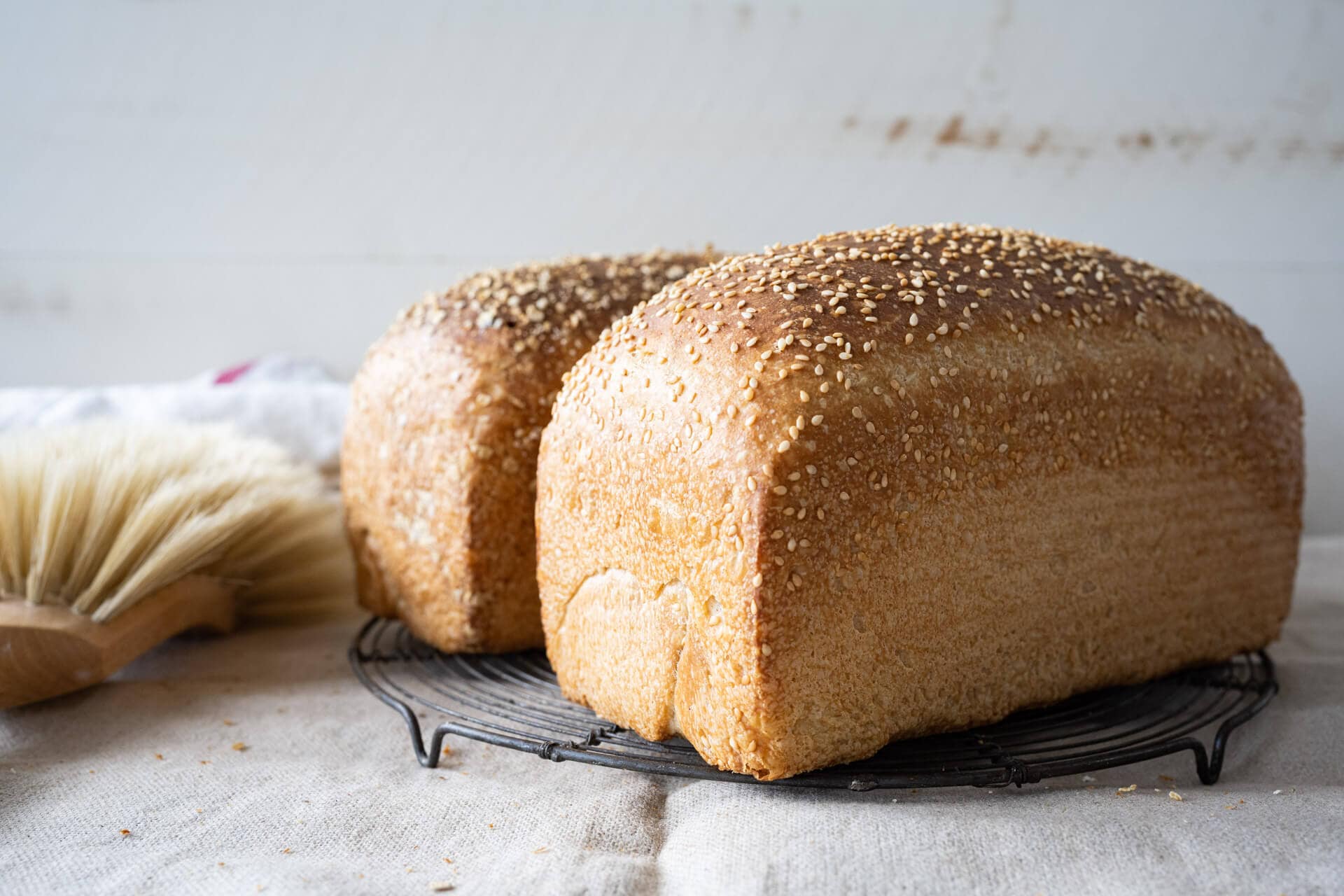
It’s back to school for most, and planning for speedy and healthy lunches is imperative whether your kiddos are physically attending school or staying home. And if you’re like us here, easy lunches are the best lunches. Enter the mighty sandwich. Sandwiches slathered with crunchy peanut butter—you’re not eating smooth peanut butter, are you?—and homemade jelly, a mozzarella, tomato, and basil layer-cake-sandwich, or a classic tuna salad sandwich are always on rotation here.
But taking the humble sandwich to the next level requires the ideal bread. It helps the mundane transcend the standard measure. And while this site has pan bread recipes abound (I guess I do love good pan bread), this tangzhong sandwich bread is so delightful it’s quickly floated to the top choice for, as my kids call it, “square bread.”
That’s not to say my classic pain de mie or whole-grain pan loaf isn’t a treat, but this bread brings a certain softness to the crumb that’s hard to achieve without high hydration or added enrichments. And yet, in pre-cooking a portion of the total flour used in this recipe, you’ll do just that.
This pre-cooking technique, commonly called tangzhong, is classic for enriched bread such as Japanese-style shokupan (milk bread), and it’s a handy technique for bringing a level of softness to a loaf without excessive fat or oil addition. A healthier version, if you will.
What is Tangzhong (Pre-cooked Flour)?
The tangzhong technique (also known as water roux or simply pre-gelatinized flour) is cooking raw flour and a liquid to approximately 150°F (65°C). At this temperature, the starches in the flour will gelatinize, similar to how the exterior of a bagel gelatinizes when you boil the dough. This process turns the mixture into a sticky starch paste added to the dough during mixing and brings incredible softness to the final baked bread.
This upfront cooking is a small step at the beginning of this recipe, but one that results in more tender and fluffy bread without the need for other enrichments such as butter, oil, or eggs.
A quick roundup of the benefits of incorporating pre-cooked flour (or tangzhong) in your bread dough:
- Adds tenderness and an open interior without the use of eggs, butter, or sugar
- The dough can have lower hydration but still achieve a soft texture
- Prolongs the shelf life of the bread (and coupled with natural fermentation, which already preserves, this might be the best sandwich bread yet)
Check out my guide to making tangzhong for more information on this technique.
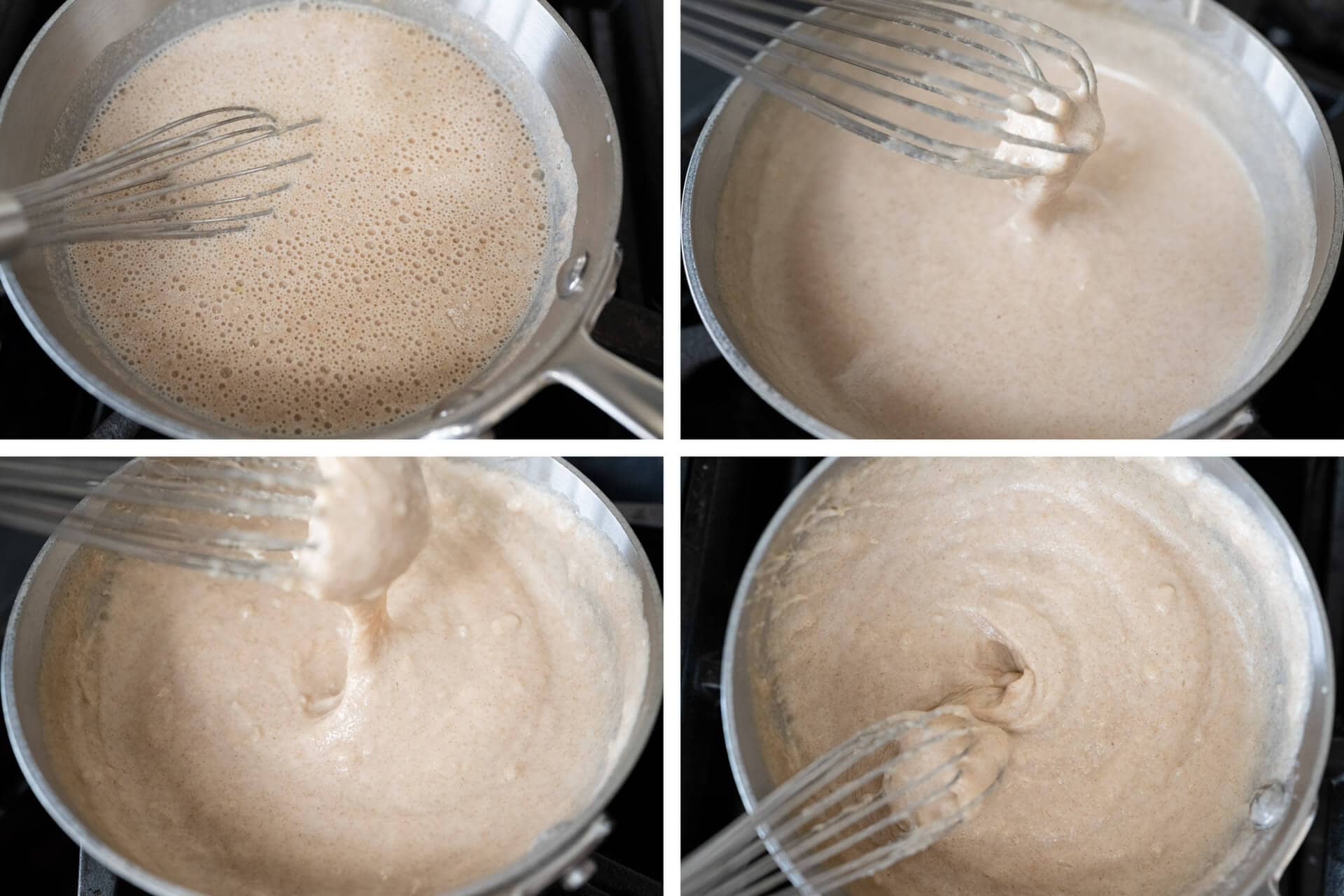
In the top left, the flour and milk are combined and whisked vigorously over medium-low heat. After a few minutes, the top-right shows the mixture starts to thicken. Continue to whisk, and don’t worry if you find small clumps here and there. The bottom-right shows the mixture sufficiently thickened and ready to remove from the flame. It will feel similar to a cooked porridge and be hard to whisk any further. Then, let the tangzhong mixture cool and add it as any other ingredient during mixing.
Flour Selection
Any medium-protein bread flour (around 11% protein) or all-purpose flour will work well in this recipe. I’ve made this with King Arthur Baking All-purpose with excellent results. And similarly, for the whole wheat portion, any whole wheat flour will work well.
Baking Schedule
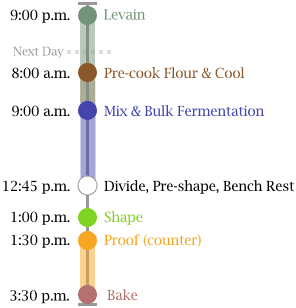
This tangzhong pan bread is a direct bake, meaning it’s baked the same day you mix (except for the levain, which is created the night before).
Overnight proof option: while I don’t call for this dough to be retarded (cold proof overnight), this can be done if it’s better for your schedule. Simply place it in the fridge after it’s shaped and in the Pullman pan, then bake first thing in the morning.
Tangzhong Sandwich Bread Formula
For tips on how to calculate baker’s percentages or how to modify this formula, see my post on baker’s percentages (baker’s math).
| Total Dough Weight | 1,800 grams |
| Pre-fermented Flour | 11.00% |
| Levain in final dough | 25.96% |
| Yield | 2 x 900g pan loaves |
I love using my 9x4x4″ USA Pan Pullman pan (without the lid) for sandwich bread. Not only does the nonstick liner mean the loaves always remove cleanly, its straight sides mean neat slices perfect for sandwiches or toast.
But if you’re looking for how to make this recipe work in a different pan, see my post on shaping a sandwich loaf.
Total Formula
Desired dough temperature: 77°F (25°C). See my post on the importance of dough temperature for more information on dough temperatures.
The rows marked tangzhong below are the two ingredients cooked ahead of time, but they are still counted toward the formula’s overall percentages. In other words, the 8% whole wheat flour is still counted toward the total flour in the formula and is not an “extra” addition.
| Weight | Ingredient | Baker’s Percentage |
|---|---|---|
| 74g | Tangzhong: Whole wheat flour (Giusto’s Whole Wheat Flour) | 8.0% |
| 296g | Tangzhong: Whole milk | 32.0% |
| 693g | Medium-protein bread flour or All-purpose flour (~11% protein, Central Milling Artisan Baker’s Craft or King Arthur Baking All-Purpose) | 75.0% |
| 157g | Whole wheat flour (Giusto’s Whole Wheat) | 17.0% |
| 65g | Olive oil | 7.0% |
| 37g | Honey | 4.0% |
| 453g | Water | 49.0% |
| 17g | Salt | 1.8% |
| 10g | Sourdough starter | 1.1% |
Tangzhong Sandwich Bread Method
1. Prepare Levain – Night before mixing, 9:00 p.m. (Day one)
| Weight | Ingredient | Baker’s Percentage |
|---|---|---|
| 101g | Medium protein bread flour or all-purpose flour | 100.0% |
| 101g | Water | 100.0% |
| 10g | Ripe sourdough starter | 10.0% |
Mix the following ingredients in a container and leave covered to ripen at about 78°F (25°C) for 12 hours overnight.
2. Prepare the tangzhong (pre-cook flour) – 8:00 a.m. (Day two)
| Weight | Ingredient |
|---|---|
| 74g | Whole wheat flour |
| 296g | Whole milk |
Be sure to do this ahead of time to give the pre-cooked flour time to cool before mixing.
Milk alternative: If you want to avoid using milk in this recipe, substitute out the dairy milk in the roux, below, for water (or something like oat milk).
To a medium saucepan, add the flour and milk listed above. Turn the heat to medium-low and cook, whisking continuously, until the mixture thickens and becomes like a paste, about 5-8 minutes. In the beginning, whisk vigorously to break up any flour clumps, and be diligent about this near the end to avoid burning. The mixture won’t seem to do anything until it reaches a critical heat point, be patient; it will thicken.
Once it transforms into a viscous paste (something like oatmeal porridge), remove the pan from the heat and spread it out on a small plate to expedite cooling. Set the tangzhong aside until called for when mixing.
3. Mix – 9:00 a.m.
I used my KitchenAid stand mixer to mix this dough, but it’s possible to make this bread without a stand mixer by mixing everything together by hand in a mixing bowl. To do this, you’ll need to mix for around 10-15 minutes, depending on your technique (slap and fold will work really well!).
| Weight | Ingredient |
|---|---|
| All | Tangzhong (see Tangzhong above) |
| 591g | Medium-protein bread flour |
| 157g | Whole wheat flour |
| 65g | Olive oil |
| 37g | Honey |
| 351g | Water |
| 17g | Salt |
| 213g | Levain (see Prepare Levain, above) |
Mixing water temperature note: I used cold water from the fridge to mix this dough, mostly because my pre-cooked flour was not fully cool by the time I needed to mix. Be sure to take the temperature of the pre-cooked flour and other ingredients into account to get close to the final dough temperature listed for this recipe.
Use my mixing water temperature calculator to quickly help you determine what to heat or cool your water to so it meets the desired dough temperature for this recipe.
To the bowl of a stand mixer fitted with the dough hook attachment, add the pre-cooked flour, flour, water, ripe levain, honey, olive oil, and salt. Mix on low speed for approximately 2 minutes until the ingredients come together, and no dry bits remain. Increase the mixer speed to medium (2 on a KitchenAid) and mix for 8-10 minutes until the dough starts to clump up around the dough hook. It won’t completely remove from the bottom of the bowl, and it will still be shaggy. See the image of my dough right after transferring to its bulk fermentation container.
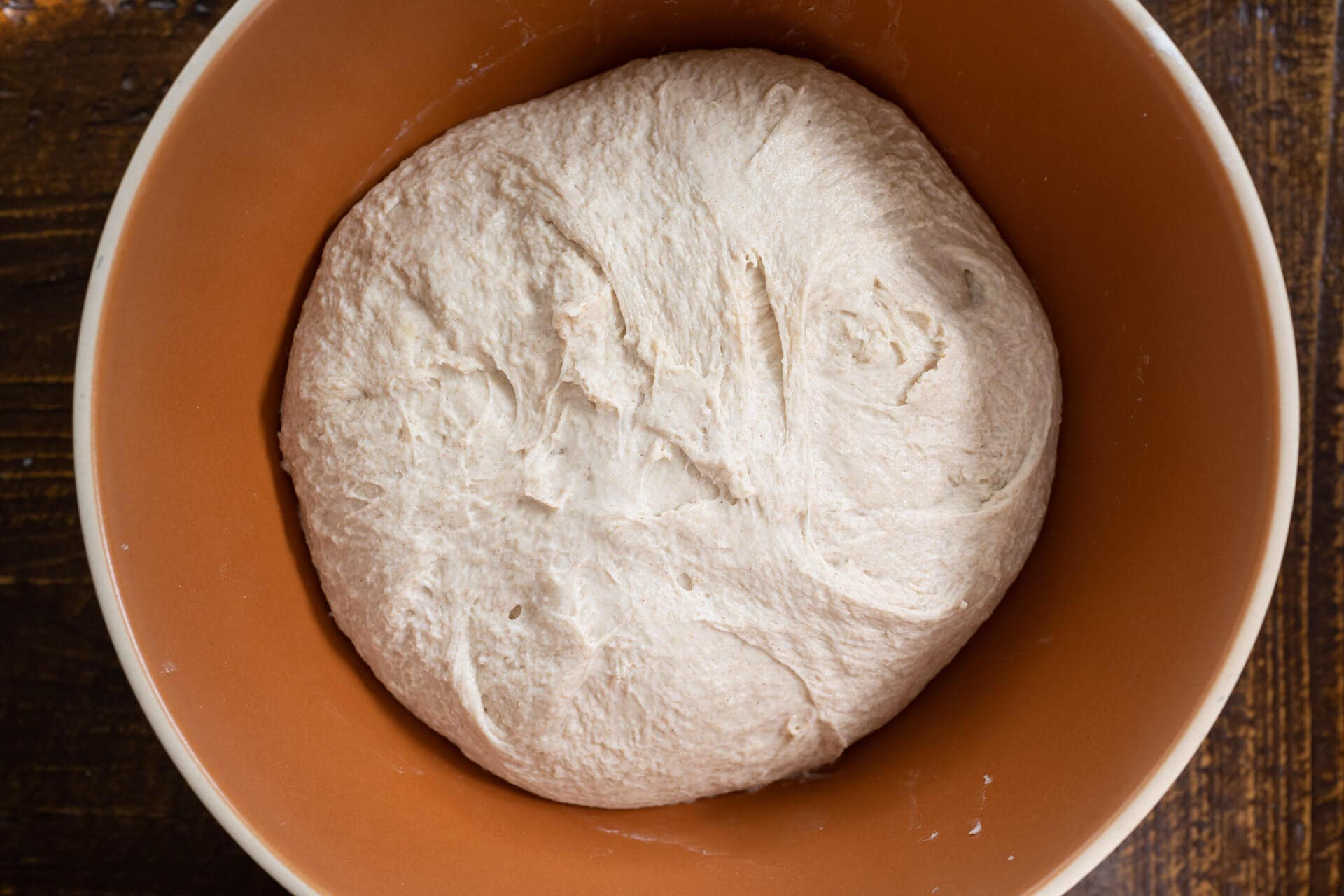
Transfer your dough to a bulk fermentation container and cover.
4. Bulk Fermentation – 9:15 a.m. to 12:45 p.m.
At room temperature, around 72-74°F (22-23°C), bulk should take about 3 1/2 hours. Give this dough three sets of stretch and folds during bulk fermentation (first rise) at 30-minute intervals, where the first set starts after 30 minutes from the start of bulk fermentation. For each set, wet your hands, grab one side and stretch it up and over the dough to the other side. Rotate the bowl 180° and perform another stretch and fold (this forms a long rectangle in the bowl). Then, rotate the bowl 90° and do another stretch and fold. Finally, turn the bowl 180° and do one last stretch and fold. You should have the dough neatly folded up in the bowl.
After the third set, let the dough rest for the remainder of bulk fermentation.
5. Divide and Pre-shape – 12:45 p.m.
Uncover your bulk fermentation container and gently scrape the dough out of the bowl onto a clean work surface. Using a bench knife, divide the dough directly in half and pre-shape each piece into a loose round. Let the rounds relax uncovered for 30 minutes.
6. Shape – 1:15 p.m.
First, lightly oil your Pullman pans with olive oil or another neutral oil. While this isn’t strictly necessary when using a USA Pan Pullman pan, it’s a little insurance just in case.
I shaped this dough in my typical method for shaping a pan loaf. Check out my guide to shaping pan loaves for detailed instruction.
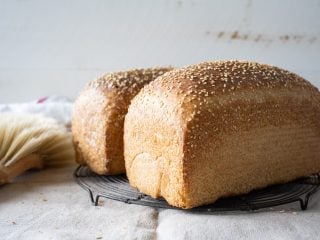
Once the dough is shaped into a long tube, transfer each to their pan, seam-side-down. At this point, you can sprinkle on any toppings you’d like, I added white sesame seeds to one loaf, and instant oats to the other.
7. Proof – 1:30 p.m. to 3:30 p.m. (2 hours room temperature)
Cover the pans with a large, reusable plastic bag and seal shut. Let the dough proof at room temperature, around 72-74°F (22-23°C), for 2 hours.
Overnight proof option: before the 2 hour counter proof, cover the pans with bags and place them in your home refrigerator to proof overnight. Bake them the next morning as indicated below. Expect a slightly more sour flavor.
8. Bake – 3:30 p.m. (pre-heat oven at 3:00 p.m.)
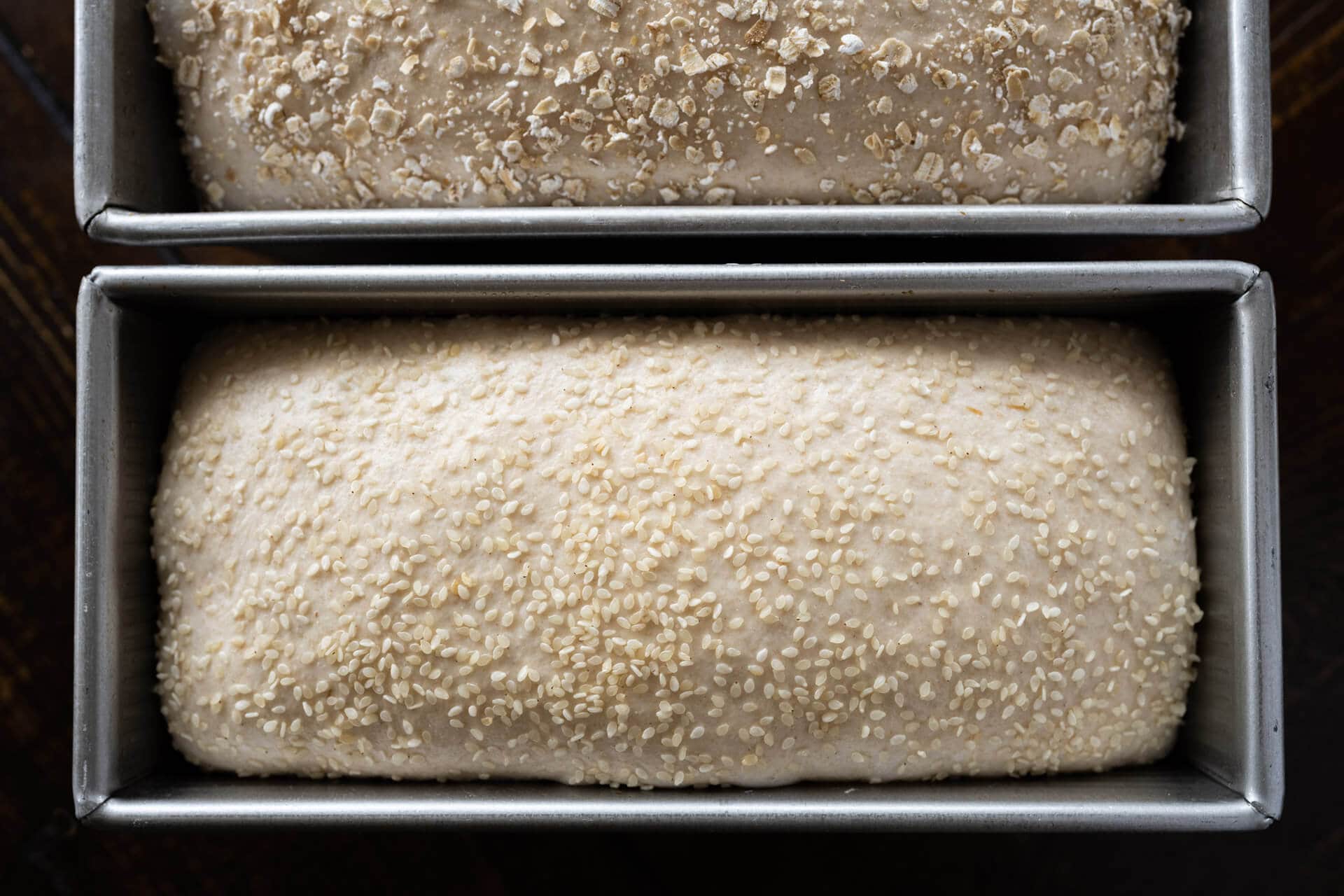
Check on your dough: it should have risen just below the top of the Pullman pan and be very light and airy to the touch (see above). If it’s not quite there, give it another 15 minutes and check again.
I steamed the oven for this bake as described on my post on baking with steam in a home oven.
Preheat your oven, with rack at the bottom third run and a pan with lava rocks on the bottom, to 400°F (205°C).
Once your oven is preheated, remove your proofed loaves from their bags and slide them into the oven. Carefully pour a cup of ice into the pan with lava rocks at the bottom of the oven and quickly close the oven door.
Bake at 400°F (205°C) for 20 minutes with steam. After this time, vent the oven, remove the steaming pan(s), and close the oven door. Bake for an additional 30-35 minutes until the top is well-colored and the internal temp is around 205°F (96°C). Remove the pans and gently knock out the loaves onto a wire rack. Return the loaves to the oven to bake for an additional 5 minutes without their pans to add extra color to the bottom and sides.
Let the loaves cool for 2 hours before slicing to ensure the interior is fully set. These will store incredibly well as described in my post on how to store bread.
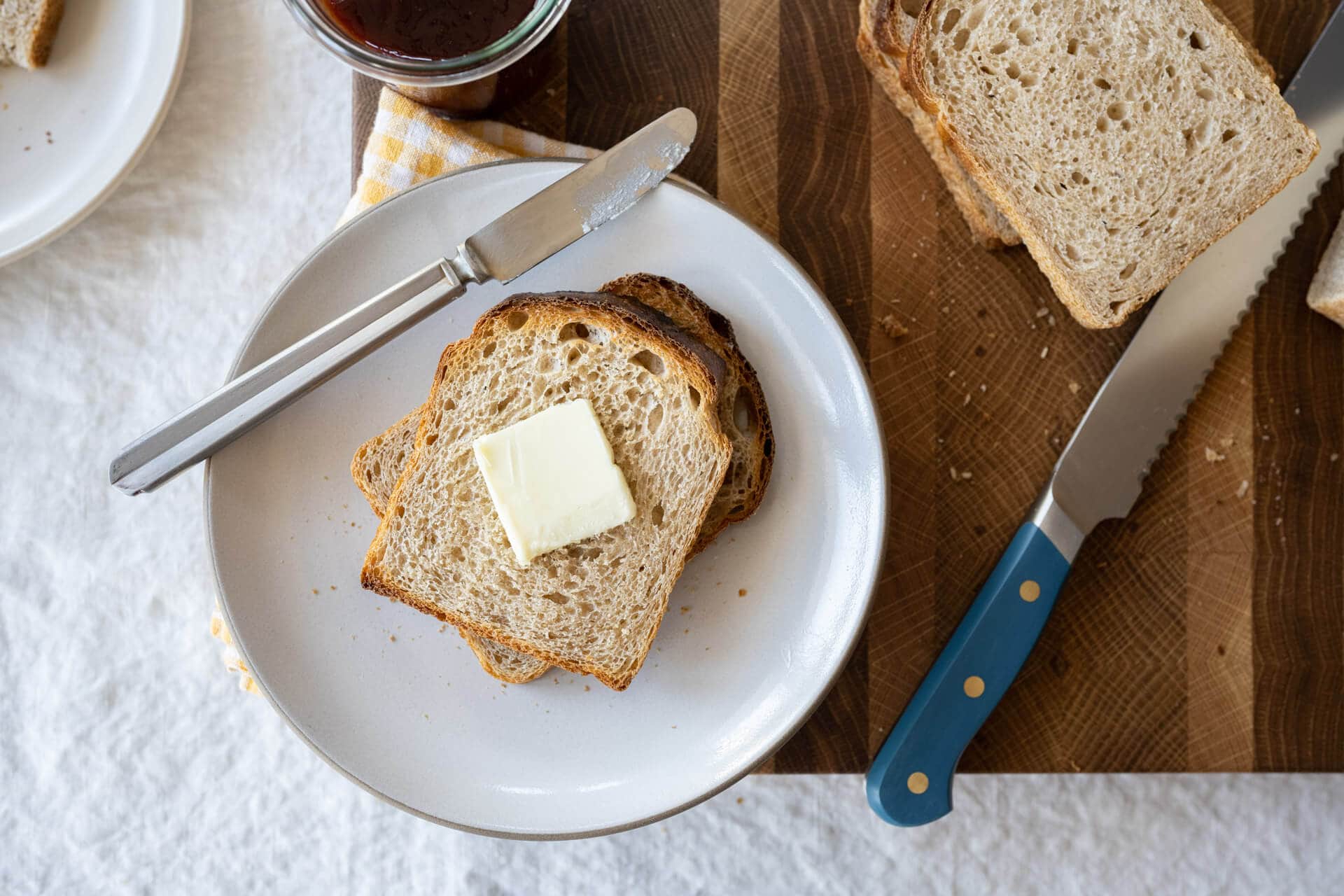
This bread has a delightful flavor that has little sourness. The overnight, mild levain with all white flour helped to this end as did the direct bake (no overnight cold-proof). The sourness that does slyly peek through comes at you at the very end of each bite, a gentle, but welcome, pop of flavor.
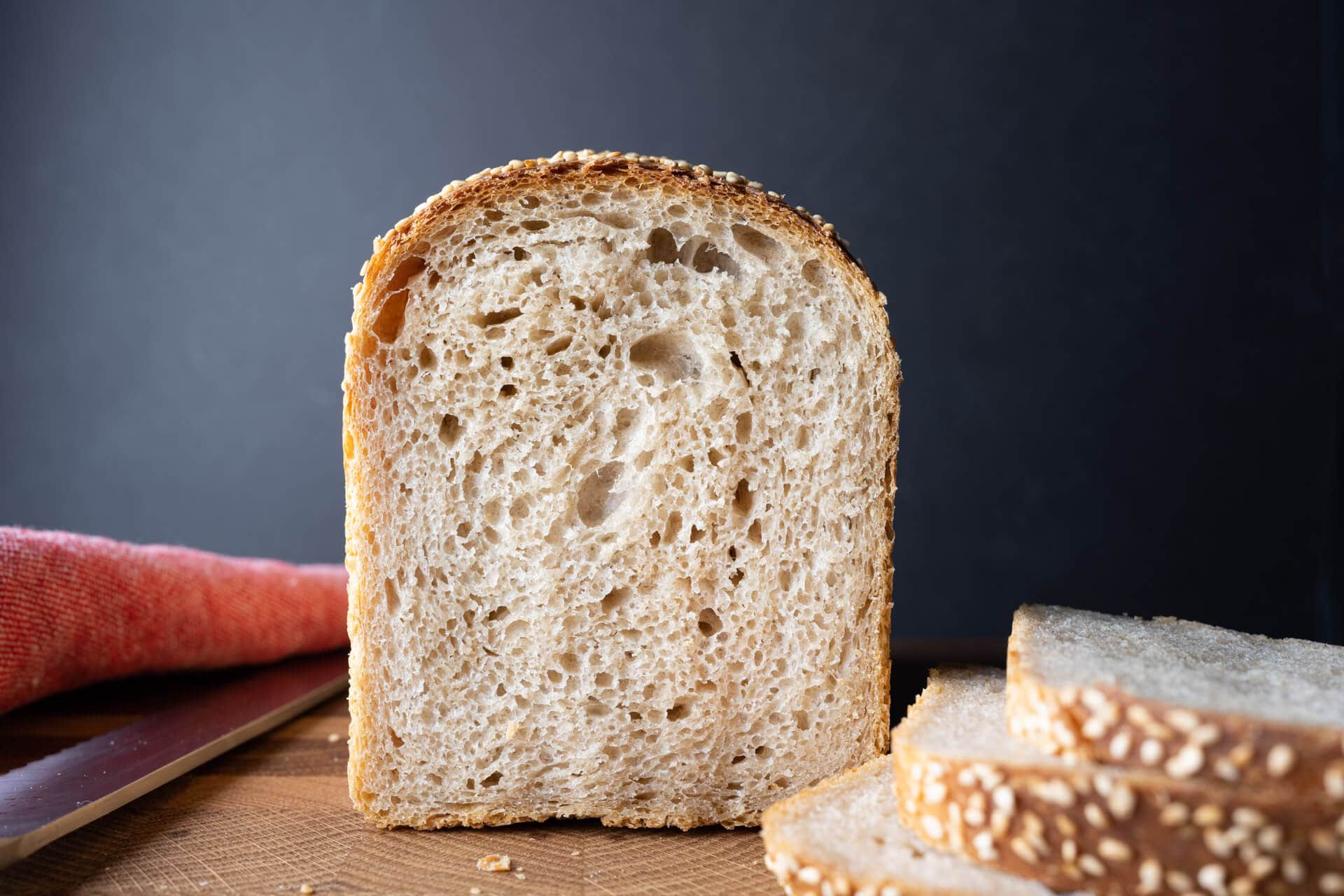
What I love about this bread—besides the tender interior, flavors created through natural fermentation, and flavorful, wheaty abundance, of course—is the shatteringly thin crust that forms when a slice is toasted (see above). We have the Pullman pan to thank here, and while a mouth-melting slice of bread is delightful, the added crunch in each slice is downright satisfying. And I think this might be the secret success of this bread: it’s soft, without excessive oil, eggs, or butter, for kiddos to love it, but still shores up enough strength to carry any ingredient you throw at it.
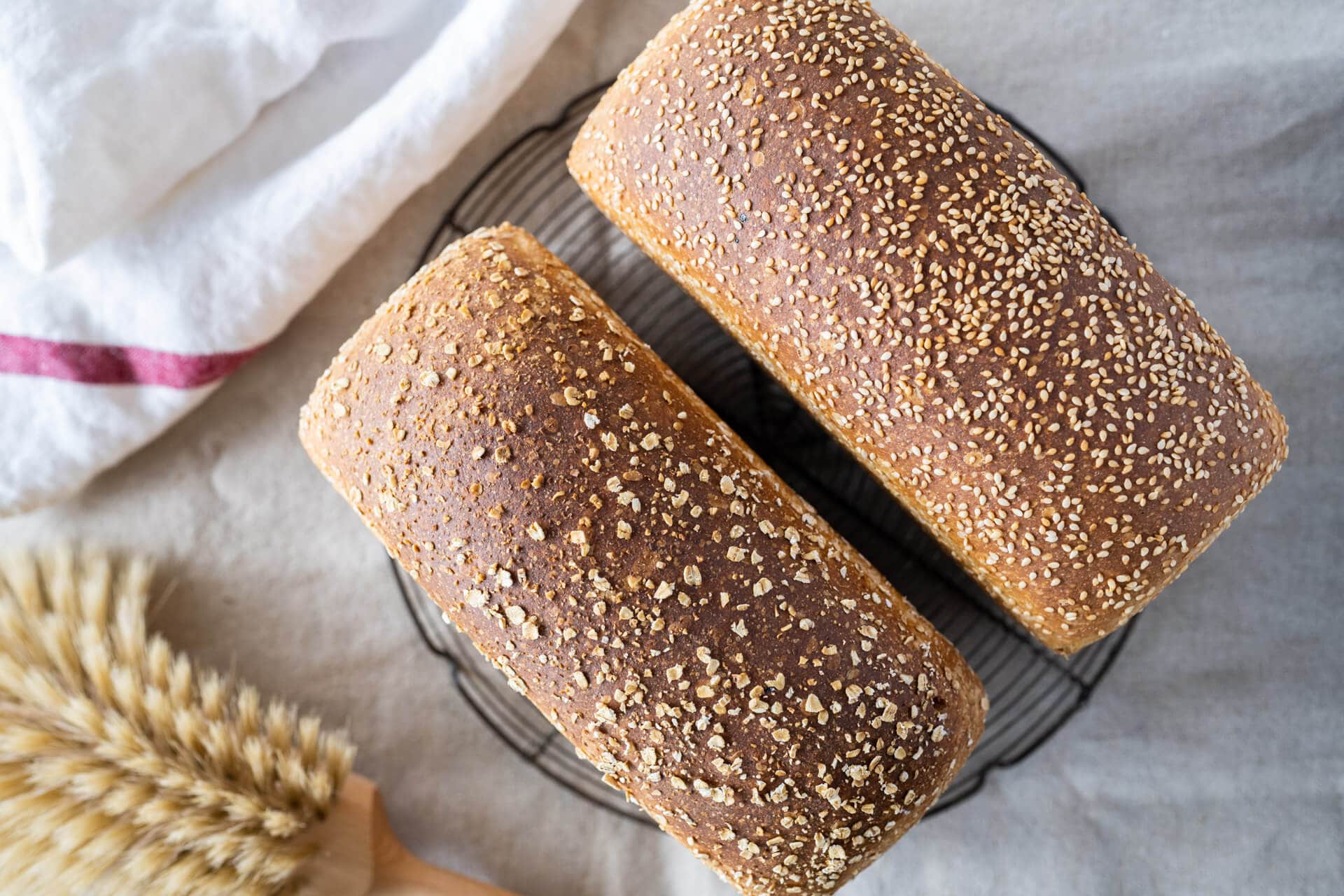
As I finish typing up these final words, I still can’t get the idea of crunchy peanut butter out of my mind. Shall we confess it’s time, yet again, for another amped-up PB&J? Buon appetito!
Tangzhong Sourdough Sandwich Bread
- Prep Time: 19 hours
- Cook Time: 55 minutes
- Total Time: 19 hours 55 minutes
- Yield: 2 loaves
- Category: Sourdough, Sandwich Bread
- Cuisine: American
Description
This bread has a delightful flavor that has little sourness. The overnight, mild levain with all white flour helped to this end as did the direct bake (no overnight cold-proof). The sourness that does slyly peek through comes at you at the very end of each bite, a gentle, but welcome, pop of flavor.
What I love about this bread—besides the tender interior, flavors created through natural fermentation, and flavorful wheaty abundance, of course—is the shatteringly thin crust that forms when a slice is toasted (see above). We have the Pullman pan to thank here, and while a mouth-melting slice of bread is delightful, the added crunch in each slice is downright satisfying. And I think this might be the secret success of this bread: it’s soft, without excessive oil, eggs, or butter, for kiddos to love it, but still shores up enough strength to carry any ingredient you throw at it.
Ingredients
Levain
- 101g medium-protein bread flour
- 101g water
- 10g ripe sourdough starter
Tangzhong
- 74g whole wheat flour
- 296g whole milk
Main Dough
- all the tangzhong
- 591g medium-protein bread flour or all-purpose flour
- 157g whole wheat flour
- 65g extra virgin olive oil
- 37g honey
- 351g water
- 17g salt
- all the levain
Instructions
- Prepare levain (Day one, the night before mixing, 9:00 p.m.)
In a small container, mix together the levain ingredients and keep at 78°F (26°C) for 12 hours. - Prepare the Tangzhong (Day two, 8:00 a.m.)
Add the tangzhong ingredients to a medium-size saucepan. Turn the heat to medium-low and cook, whisking continuously, until the mixture thickens and becomes like a paste, about 5-8 minutes. - Mix (9:00 a.m.)
To the bowl of a stand mixer fitted with the dough hook attachment add the Main Dough ingredients. Mix on low speed for approximately 2 minutes until the ingredients come together, and no dry bits remain. Increase the mixer speed to medium (2 on a KitchenAid) and mix for 8-10 minutes until the dough starts to clump up around the dough hook. It won’t completely remove from the bottom of the bowl, and it will still be shaggy. Transfer your dough to a bulk fermentation container and cover. - Bulk Fermentation (9:15 a.m. to 12:45 p.m.)
Give the dough 3 sets of stretch and folds at 30-minute intervals, where the first set starts 30 minutes after the start of bulk fermentation. - Divide and Preshape (12:45 p.m.)
Scrape out the dough, divide it in half, and preshape each half into a loose round. Let rest for 30 minutes, uncovered. - Shape (1:15 p.m.)
Lightly oil two 9x4x4-inch Pullman pans with olive oil or neutral oil. Shape each piece of dough into a tube shape and transfer it to the pan. Top with sesame seeds, rolled oats, etc. - Proof (1:30 p.m. to 3:30 p.m. at room temperature)
Cover the pans with reusable plastic and seal shut. Let the dough proof for 2 hours at 72-74°F (22-23°C). - Bake (3:30 p.m.)
Preheat your oven, with a rack at the bottom third run and a pan with lava rocks on the bottom, to 400°F (205°C). Bake at 400°F (205°C) for 20 minutes with steam. After this time, vent the oven, remove the steaming pan(s), and close the oven door. Bake for an additional 30-35 minutes until the top is well-colored and the internal temp is around 205°F (96°C). Remove the pans and gently knock out the loaves onto a wire rack. Return the loaves to the oven to bake for an additional 5 minutes without their pans to add extra color to the bottom and sides. Let the loaves cool for 2 hours on a wire rack before slicing.
Notes
This bread can also be proofed overnight to bake the next day. At the proof step (#7), instead of proofing on the counter, retard the dough to the fridge (covered). Any time the next day, remove the dough from the fridge and bake straight away.
A full-fat nut or oat milk or water can be used to make the tangzhong.
What’s Next?
For another tangzhong recipe, check out our ultra-soft and delectable sourdough cardamom rolls.


520 Comments
Thanks for the recipe! Planning to make two vegan loaves for my friend who’s due to have her baby any day now. Could I also make the tangzhong the night before and let it cool overnight? Either in the fridge or on the counter? Just trying to simplify the morning part since mornings are hectic around here.
Yes, you certainly can. I let it cool, then cover and place it into the fridge overnight. Next AM, take it out and let it warm a bit before adding to your dough (just to keep the final dough temp on target).
Would you mind sharing what you used as a substitute for the milk in this recipe, and whether it was successful? I’m not vegan, but am avoiding going to the stores as much as possible. I have coconut milk on hand. Failing that, I have heavy cream, but that seems…extreme.
I’ve used (shop bought) oat milk- easy to make at home with a strong blender
Boy, am I confused! Can you help me out?
In the section, “Total Formula”, you list 693g of medium-protein bread flour, with 453g water.
In the section, “3. Mix – 9 am” you list 591g medium-protein bread flour, with 351g water.
On the recipe for printing, the “Ingredients” list 693g flour + 453g water, but in the “Instructions” it shows 591g flour + 351g water.
I’ve just mixed together one loaf (half the recipe) using the lower amounts of flour & water, after discovering this discrepancy halfway through mixing. The consistency of the dough seems okay, but I am confused and hoping this loaf comes out okay. It is currently in its bulk fermentation phase.
What are these weights REALLY supposed to be? Did I miss something?
Hi Laurie B, the lower flour and water weights you used are correct. For the full recipe, 101g of medium protein bread flour from the total of 693g and 101g water from the total of 453g goes into the levain in Step 1, leaving 591g bread flour and 351g water for the mix in Step 3. Maurizio gives us an extra gram in his measurements for errors in weighing ingredients. Hope you were happy with how your loaf turned out 😊.
Thanks so much, Robyn, I really appreciate your help and answer 🙂
Thanks! I should have noticed that…
The bread turned out wonderfully. I proofed it overnight, and it’s one of the best sandwich loaves I’ve ever made.
Amazing to hear that, Laurie! Enjoy 🙂
Thanks for the recipe, Maurizio! I’m just addicted to this bread.
I have one question: after baking, sometimes my loaf wither away in the inside, even if i let it rest for 2 hours or more before slicing. I can’t find my mistake. Do you know what’s going on?
Another doubt is about when I put some nuts for filling, I put after pre shape and before shaping, is it right? It’s the best momento to do it?
Thank you for all recipes and teachings
Greetings from brazil <3
Happy to hear that, Maria! That’s interesting. It might be over hydrated dough or over proofed dough, especially if you see the loaf collapsing after it’s been baked. I like to add mix-ins after the first set of stretch and folds during bulk fermentation, generally.
Thank you, Maurizio! I think that’s it, it’s over proofed dough. I will try to add the mix-ins as you said!
Thanks again for your attention! 🙂
Do you have to leave the levain for 12 hours or can you do 6 hours before you use it
You do need to let it run its full course unless you change the amount of ripe starter added.
Hi, can I use all-purpose flour only (i.e no wheat flour) for this recipe? Would I need to change the amount of water?
Yes, you can! You might want to hold back some of the water when mixing, but I wouldn’t modify the tangzhong at all.
The bread came out great. Although I live a low carb life, my husband and son enjoy the results of my new hobby. I didn’t have lava rocks to make steam so I sprayed the top of the loaf with water and covered it with a dutch oven to cook. My hack seemed to work out fine. I’ve been trying to buy a small Rofco oven, but they are not available. Debating on a Nero vs Haussler brick oven. Any thoughts?
Glad to hear they came out great, Deborah! I’ve not tried the Nero or Haussler ovens, but I do have a Haussler mixer and I can only say it’s incredibly high quality. I’d expect the same from anything else from them!
Maurizio,
I am thoroughly enjoying this recipe. I just baked batch #4. Here are my results:
Batch 1: Followed the recipe exactly including the use of the Kitchen Aid Stand Mixer for mixing and kneading. It turned out great but had a little bitter note that I think came from the Olive Oil.
Batch 2: One tweak to the recipe for this batch. I replaced the Olive Oil with Clarified Butter. Worked great and the bitter note was gone.
Batch 3: Same recipe as Batch #2 but ended up with a void at the top of the loaf. I suspect that is from over-proofing as I am letting it proof overnight in a 63 degree Fahrenheit kitchen. The flavor is amazing.
Batch 4: Another tweak to the recipe. Still using the Clarified Butter in place of the Olive Oil. This time, however, I used Whole Wheat only for the pre-cooked flour portion. For the main mix I used half Bread Flour (King Arthur) and half All-Purpose Flour (King Arthur). It turned out very good with a nice sour note but this recipe works better with the Whole Wheat in the main mix. I will go back to the recipe I used for Batch 3 and proof a little less time because I still had a bit of a void at the top of the loaf.
This is an excellent recipe that has quickly become a mainstay in our household.
Thank you!
I finally nailed this bread! It rose beautifully after an overnight proof in the pantry (I think my levain was less vigorous than ideal). The interior is delightfully soft and it makes the loveliest sandwiches. I think for me it came down to giving the dough enough time. I will say that even before I nailed it I knew this bread was a hit. My girlfriend liked it so much she asked me to make an ice cream sandwich with it
Ice cream sandwich! Ha ha, love that. Thanks so much for the feedback, Rebecca. Enjoy (with or without ice cream)!
Hi, can I make this with 100% wholegrain spelt flour? would I need to change anything in the recipe? Thanks
You’d have to change quite a bit about the recipe (hydration, preferment, maybe salt). I do have a 100% whole wheat spelt pan loaf recipe, though!
With steaming the loaves, do you put them on a pizza stone like you described in your baking with steam post? Or do you skip that since they are in the pan and just do the lava rocks/wet towels?
That’s correct, no pizza stone with these, but usual steaming method.
Hi there, I have a few questions first… why is the starter only 10g and the flour and water 101g each in the levain when a lot of your starters in your levain are a higher percentage? next question could you do your levain in the morning? I had an issue with the cooked flour i didnt get enough it ony weighed 333 grams instead of 370g., some was in the pot which it was cooked in and the plate where it was cooling i tried to get most of it out but im not sure it would have added up to be enough any way. So if i were to add 30 grams each of the flour and milk and only add 370g that shouldn’t make any difference or would it.
One of my solutions to this was to do part of the mixing in the pot I cooked the flour in. That seemed to work pretty well
Thanks, Ill try that next time
It’s ok if it was a little under, no worries there!
Hi Maurizio. Thanks once again for an amazing recipe. I have been wondering how to use tangzhong with sourdough and your recipe was just what I was looking for. I’ve been try to replicate Indian Pav at home. This is a soft, fluffy bun that’s used a lot in mostly savory applications, although a toasted and buttered Pav with a cup of chai is also a classic. The ones you get in India have a mild tang, not dissimilar to sourdough. Would it be possible to make this dough into buns, and how many do you thing I could get out of one recipe?
You’re very welcome, Jay! That sounds delicious, I’ve not had pav. Yes, I think you could adapt this to make buns. I’d probably divide the dough into 120g pieces and proof them on a baking, similar to how I do my soft sourdough potato buns. I think that’d work well!
Hello Maurizio. I adore this recipe and now I am doing for the 5th time:) I just have a little question. I am confused about the percentage of the water. The whole amount of flour is 924g (74+693+157) and %100. Percentages of the all other ingredients are according to the whole amount of flour I guess. The only problem for me %53 of water is written as 453g but I guess it should be 490g and I know this water includes the amount of water(101g) for the levain. Maybe I am the one who is confused:)
Thank you so much. Have a nice day
That’s awesome to hear, Hasan! Nope, you are absolutely correct, I had an error in my Total Formula table. The water percentage is actually 49%—I’ve now fixed this! Thank you for pointing that out and sorry for the confusion 🙂 All of the weights were correct, I just had the percentage listed wrong (53% when it should have been 49%).
@maurizio leo
Hi Maurizio,
Amazing recipe, was anticipating a recipe from you with the use of tangzhong, my expectation was fulfilled! And what a recipe, I tried it and the sandwich bread turned out neat and tasty BUT it suffered a huge rupture on its top side, all along its horizontal axis during oven spring. I had steamed my oven and assume scoring should not be performed either. Any recommendations to prevent it? Lower baking temperature? More vigorous shaping to create a more taut surface? Anything else?
Thanks so much, Nikos! Usually those large ruptures like that are due to under proofing. My guess is your dough likely needed more time in bulk fermentation and/or proof. When a dough is slightly under, it will usually have erratic rise in the oven, sometimes bursting on the top or the sides. I would also say be sure you steamed sufficiently to allow that loaf to rise up and expand gracefully.
Let me now how the next attempt goes!
Thanks! in my second attempt I sprayed some additional water on top before throwing into the steamed oven. Combined with abt 20 mins of additional proofing, the rupture was reduced but not prevented. So I will try extending my total bulk and proofing duration compared to the original recipe, it seems that for my flour type it takes a little longer, even though I left it to proof wrapped in a bag by a closed window with direct sunlight, allowing to have an increased temperature (roughly the a little less than 28degreesC) great taste and tenderness despite the rupture!
Sounds good! Yes, the rupture is usually just cosmetic. Another thing you could try is increasing your levain percentage just a bit. Try making your levain a little bigger, perhaps just 5-10g more of water and flour, this way you’ll speed up the fermentation process.
Hi Maurizio,
Is it possible to halve the recipe for 1 loaf? I really want to try this recipe out but feel we will struggle to get through 2 loaves.
Yes, absolutely. Just halve everything! Check out my post on baker’s percentages for a step by step guide to this if you need some pointers!
In step 5, do you really want the dough uncovered for 30 minutes? Won’t that dry it out?
I always do! It will dry out if you have a strong draft or air conditioner running in your kitchen, otherwise the slight drying of the top actually helps facilitate shaping.
I made this last week and it was very successful – thank you! I made it for a gentleman who needs to have a softer crust.
I would like to speed up the process a little so thought I could make the precooked flour (porridge) the night before. Does anyone see any problems with this? Would it become too dry?
Thank you!
So glad to hear that, Claire! No problem with that. Just let it cool, then cover and I’d likely pop it into the fridge. The next day, let it come to room temp then mix it into your dough at the right spot. Check out my guide to tangzhong (pre-cooked flour) for more info on all of that!
Hi Maurizio, could I add more starter next time as the levain did not seem very bubbly this morning after making it last night. Or do you think I should make the levain earlier the day before? I live in the UK.
I am just waiting for it to prove but gone over the time because it hasn’t risen. I will take the advice you have given other people on here with regards to temperature and try again.
If the levain doesn’t seem ripe enough (little rise, no sour smell, etc.), definitely give it more time to ripen and then mix it in.
Hi Mauricio can I use bread flour 14.9% protein
That’s very strong flour, but it might work just fine. You might need to increase the hydration of the dough, but see how it feels when you’re mixing. Also, you might want to consider doing a 30 minute autolyse as well (without the precooked flour added in).
Hello Maurizio!
We are in love with this bread! Thank you! I’m in doubt about the “25,96%” levain in final dough, “25,96%” of what? If I calculate 25,96% of 1800g it is 467,28g.
That’s the percentage of levain with respect to the total flour in the recipe (that 1800g weight is total dough weight, which includes liquids and everything). Check out my post on baker’s percentages for an in-depth explanation on this!
Hi Maurizio!!!
I think I’m having some math issues with this recipe! Lol
Could you help me, please?
I’m a beginner who is trying to calculate the right quantities to bake 1 loaf using a 13x4x4 pan and I just found out that the water quantity (or percentage) was mistyped…could you check which one is correct?
453g water -> 50% (instead of 53% that it’s in the recipe)
And talking about numbers, did you round up the total in weight? From 1802g to 1800g? I know those differences are very small, almost nothing, but I really would like to fully understand the right way to calculate the baker’s percentage! 😉
Thank you so much! You’re the best!
Hey, Claudia! The water is 53% in this recipe (479.6g in total, which includes the levain). No, the total dough weight is precisely 1800.0g, even 🙂
Check out my post on baker’s percentages for lots of info calculating all these numbers and let me know if you’re still having issues!
Hi Maurizio!
I’ve just reviewed the baker’s percentage post and everything makes sense to me but when I try to calculate the numbers using this pre cooked recipe still not 100% clear to me (sorry for that! 🙁).
So please, see if you can help me.
1-) If I sum all the numbers showed in the total formula table it gives me the total yield of 198.9% and 1802g instead of 194.9% and 1800g written below the table. I couldn’t get why/how you got this numbers or what am I doing wrong…
Same in the ingredientes table: summing all the ingredients weight, the total is 1801g and I couldn’t get why the levain quantity there is now 213g and not 212g. 🤯
2-) Water content: if the total flour is 924g, 53% wouldn’t be 489.72g?
And reducing 101g used to build the levain we supposed to have the difference of 388.72 of water, no?
I really didn’t understand those water numbers presented in the total formula and ingredients table, considering 53% hydration.
Thank you so much for being so kind and patience!
Hi Maurizio, I’m in the middle of my first time making this bread. The dough came together very easily, but it still seems much stiffer about 2/3 of the way through proofing then your other sourdough recipes. It seems like the milk in the roux didn’t contribute all that much to final hydration. Any thoughts on what might have gone wrong, or am I on the right track?
It’s probably just fine, but I wouldn’t say it’s a very stiff dough—it’s still rather soft, but as you said, not quite as soft as other doughs here on my site. The roux does help the dough keep a strong feel to it even with the added liquids. It’ll still bake up nice and soft. I’d say keep going with it and see how it turns out—maybe we’ll be surprised!
Hii I just love the detailed procedure explained by your for the breads.i am a beginner and mix the dough by hand .Will my breads be good if I half the ingredients as I have a small oven too . Thank you
Vinny
The recipe is for 2 loaves, so if you halve it, it will make one loaf. I’ve done it before with no issues! It’s a great recipe. Enjoy and happy baking!
Thanks Dan
Yes, halving will work just fine. Check out my post on baker’s percentages for a step-by-step on halving and other ways to modify this formula!
Thank you so much
Hi, I’m was just wondering if it was possible to substitute the olive oil for butter (If yes how much do I substitute it for) and also wondering whether I could make the levain in the morning and start the rest of the process in the afternoon? Thanks
You’ll get similar effects from the two, but different flavors and aromas. I’d say give it a try, but you’ll likely have to adjust the quantity—I’d have to test to suggest a percentage!
thank you
You’re very welcome, Jaimee!
I don’t have Pullman pans, so I baked this in a regular pan and tossed the rest into a small clay baker for a round. We can’t do dairy, so it was unsweetened macadamia milk for the milk. Worked beautifully and it came out wonderful in both the loaf and the round, but I’m going to try it again tomorrow, sized up about 33% so I can just bake 2 regular 9×5 loaves at the same time. We’ve had this with peanut butter, as toast, and with vegan chive cream cheese (the kite hill brand) and it was fantastic with all. I hope you put a book out soon – I would love to buy one!!
Oh that sounds great, Adrianne! I’ve heard back using plant-based milks has worked well—I’ll be trying almond milk soon. I also love the Kite Hill brand! I use their cream cheese on my sourdough bagels—just awesome. I do have a book in the works, getting there 🙂
What size are your pans? I also don’t have pullman pans so I am considering baking them in my 8″ pans. Did you let them rise until they reached the lip of the pan?
I love this recipe! I haven’t been able to get much of a rise after shaping either time I made it. The bread was still delicious just a little on the small side. Do you have any advice? I might not be hitting the FDT. The first time I made them, they proofed overnight in my pantry and still didn’t rise anywhere near the edge of the pan. I am keeping my starter scaled down and feeding it less frequently so maybe I need to make the levain earlier or add more start to the levain. I’m not entirely sure
Jeremiah—was your dough temp warm enough? Hitting that final dough temp listed in the recipe is very important, if it’s cooler, then the dough will take longer in bulk fermentation to get to the right point!
Hey, Rebecca! You definitely want to try and hit the FDT for the recipe, especially since it’s not getting cooler, which will slow the dough dough considerably. Aside from that, you could try adding a bit more levain into the mix to offset the sluggishness. But regardless, be sure to use your starter and levain when they’re nice and ripe! You want maximal activity in those preferments going straight into the dough.
Let me know how it goes, we’ll get you there!
Thank you so much for the advice! I tried again today and this time I made sure to hit the FDT and it looked like everything was working out but I’m in the proofing phase now and it’s been an hour and 40 min and the dough isn’t even halfway up my pan. I really don’t know what I should do at this point. I’ve kept an eye on the temp throughout the proof and it has been within the desired range.
I might need to make my levain much earlier because it wasn’t super bubbly by the time I went to mix but it had already sat for 12 or 13 hours and I didn’t see any evidence that it had risen and started to fall.
It looks like maybe the Pullman pan was cool, slowing the fermentation. I placed the pan in a zippered cooler with slightly damp kitchen towels that I tossed in the microwave to heat up and put a germination mat under the cooler which caused things to speed up quite nicely. I’m still going to experiment with leaving the levain longer to get it to a higher activity.
Yes, I would have let it go longer until risen fully!
Love this recipe! I have a quick question: The loaves don’t seem to rise much after shaping them. They rise incredibly slowly. The last time I made these, I pushed the proof to about 4 hours. The loaf still tastes great, but definitely has that distinct sourdough taste. Any tips on how to make this faster? I’m wondering if swapping the levain with 50% WW instead of Bread Flour might help? Has anyone tried it? Thank you!!
Hey, Amna! First, be sure to use your starter and levain when they’re nice and ripe. They should be bubbly, well-risen, and soft textured. From there, you could try extending bulk fermentation an additional 30 minutes before preshaping. Keep in mind, it’s always important to try to his the final dough temperature (FDT) listed up in the recipe to keep the dough moving on schedule (and this is especially important now with the impending cool weather). Let me know how this goes!
Hey Maurizio – Thanks for much for your input. This time I made sure to hit the FDT, the loaves did rise significantly faster but still not close to the edge of the Pullman. I did go ahead and bake them instead of waiting since I didn’t want that sour flavor. The bread tastes great but the next time I’ll try adding a little extra levain to the mix to speed up the process. Thanks so much!
Hi Maurizio!
I just made this recipe, but it’s such a failure…:((
I’ve respected the recipe with all the details, still the loafs aren’t very raised and the inside is still raw/wet :O
The only thing I could think is the steaming of the oven. I’ve put in a tray with water while heating the oven and then put the hot towel cover with hot water.
I have no idea what did I miss?!…
Other recipes were all wonderful!
Hey there! So sorry to hear that. Is it possible the dough was under-fermented or under-baked? It’s also possible it was over hydrated, but I’d say less of a chance of this.
Hi Maurizio,
This is now “my perfect loaf”. I’ve been making shokupan and Hokkaido loaves for quite some time, and this far surpasses those. I’ve wanted a sourdough version so thank you for this! Perhaps a few notes that you may find interesting. The traditional Hokkaido loaf uses milk (either dried or regular), butter, and may use eggs. I have used your recipe with just water (no milk) and more white (only whole wheat for the tangzhong) and have been pleased with the softness of the crumb – slightly chewy as my sourdough breads tend to be (over instant yeast). This was as good as (better, in my humble opinion) than the traditional recipe with milk and butter (and egg variation). I have even made this where I forgot to fold during bulk – though I did use the KitchenAid mixer and sprouted whole wheat flour for the tangzhong- to no ill effect.
Re: tangzhong and yudane – my non-scientific research shows that you could indeed use either method interchangeably, though some swear that yudane provides a more tender loaf. I haven’t found that to be true. Tangzhong is typically 7% of the total flour and water weight; yudane can be 20%.
Thanks for this recipe and all that you have and continue to do for the bread community!
That’s so great to hear! I really feel like this bread is a great balance between the extremes when it comes to sandwich breads. Hokkaido are wonderful, and a straight sourdough pan loaf is, too, but this is somewhere placed right in the middle 🙂
I’m going to be testing more with yudane soon. I want to try a few of my ideas using that method and then compare it to my experience now with tangzhong. Bumping up to 20% pre-cooked flour will be quite an increase, but I’m game!
Thanks so much for all the feedback, I appreciate that!
Can this be made without a Kitchen Aid Mixer?
Definitely! Just be sure to mix the dough sufficiently upfront or add in more sets of stretch and folds during bulk fermentation.
Hello Maurizio! I just baked these loaves this morning and had a few questions on it. It tastes wonderful! So I bulk fermented a bit over 4 hours, reduced the mix amount of water to 275 g, did the overnight method so no counter proofing and my pans do not have covers and I don’t have the lava rocks so I did a melted coconut oil wash instead of an egg wash. Its not as airy as yours and feels a bit heavy and I had just a bit of gummy texture on the bottom of the loaf in the middle. Do you think I should have bulk fermented longer (its a bit colder now and less humidity)? Also, perhaps doing the one day method will have different results? Finally, how do you get your seeds to stay on? I’ve tried your method with the tea towel for other loaves and for this one I sprinkled it on. Thank you for any feedback that you may have!
Hey, Sammy! Yes, sounds like it could have used a little more fermentation time. I would have extended the proof a bit farther to see if that helps. Try to hit that final dough temperature listed in the post, and then keep the dough warm to keep it’s timing on track.
For these seeds, you can just sprinkle them on top of the dough after you shape and place it in the pan. Then, when the dough proofs, it’ll rise upward in the pan and create space between the seeds.
Hope that helps!
Many thanks Maurizio, I will try this again soon with a longer bulk. I’ve just baked your Country loaves with long autolyse and reduced levain, I was concerned because I’m not accustomed to proofing on the counter and can’t discern well when its proofed well, but it went well as the loaves look beautiful and rose wonderfully. Can’t wait to slice it soon!
Question – there are two different flour amounts in the recipe… 693g in the total formula section and 591g in the recipe section. Is this intentional or maybe a typo?
Hey, Megan! That’s correct. The 693g up top is for the total formula, whereas the amount below in the Method is the flour just for the dough mix, some of that 693g was removed to make the Levain. Hope that helps!
I made this yesterday and baked it today…seems very soft! Can’t wait to try it. I used 01 italian flour, some white and and Whole Foods organic whole wheat (no milling for me right now. Moc Mills are on the fritz). I used coconut sugar instead of honey because I decided to do the longer refrigerated ferment time. Will cut into it tmw. Can’t wait!
Hey, Gina! I hope the loaf turned out great. Yes, definitely a soft loaf, but the crust should still be a little crunchy, which I love! Enjoy 🙂
It was delicious and perfect for sandwiches. I purchased some prosciutto cotto from Supermarket Italy, so it was perfect timing! Will definitely do this again!
It took two tries, but well worth the effort. This is an awesome sandwich bread.
Ah so glad to hear that!