

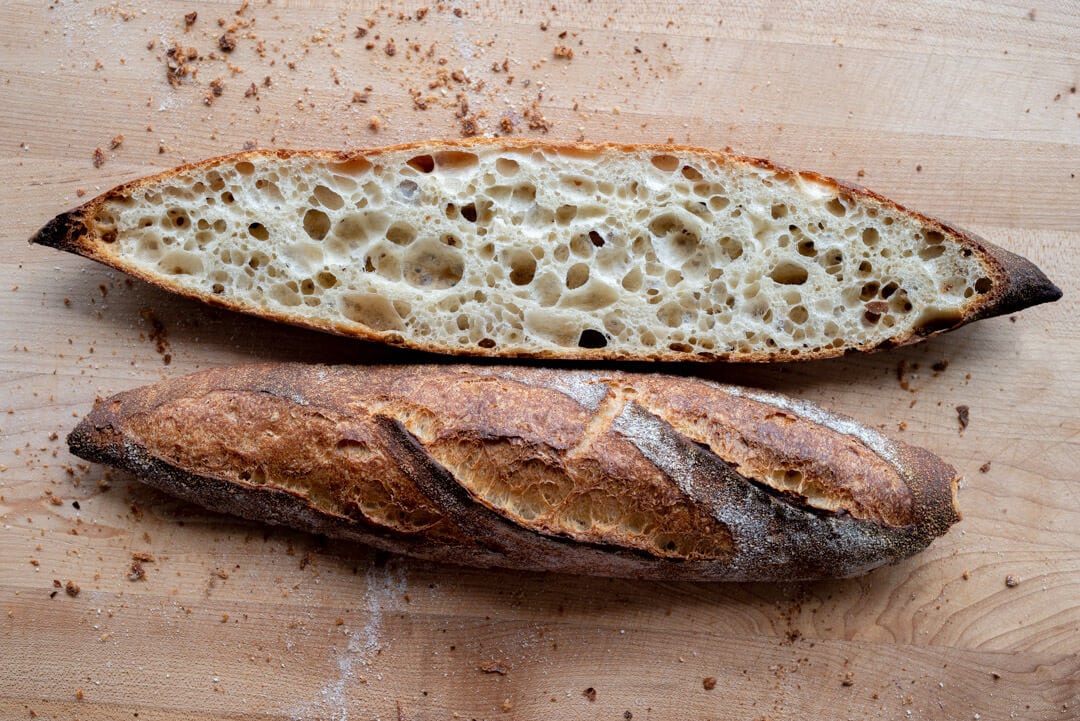
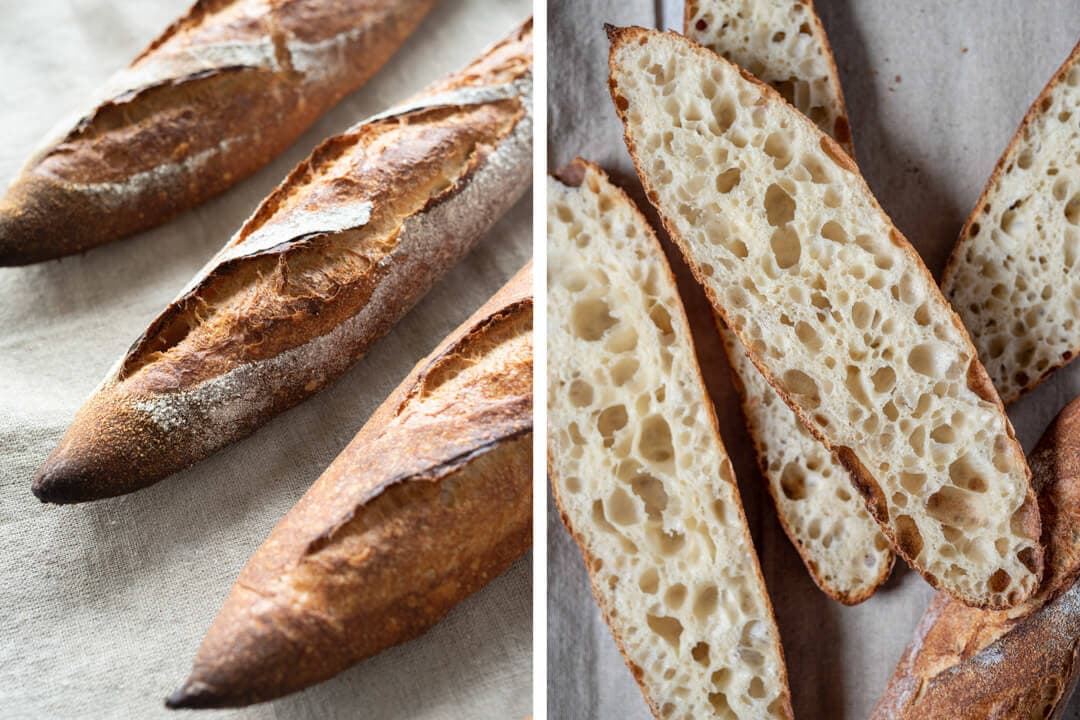
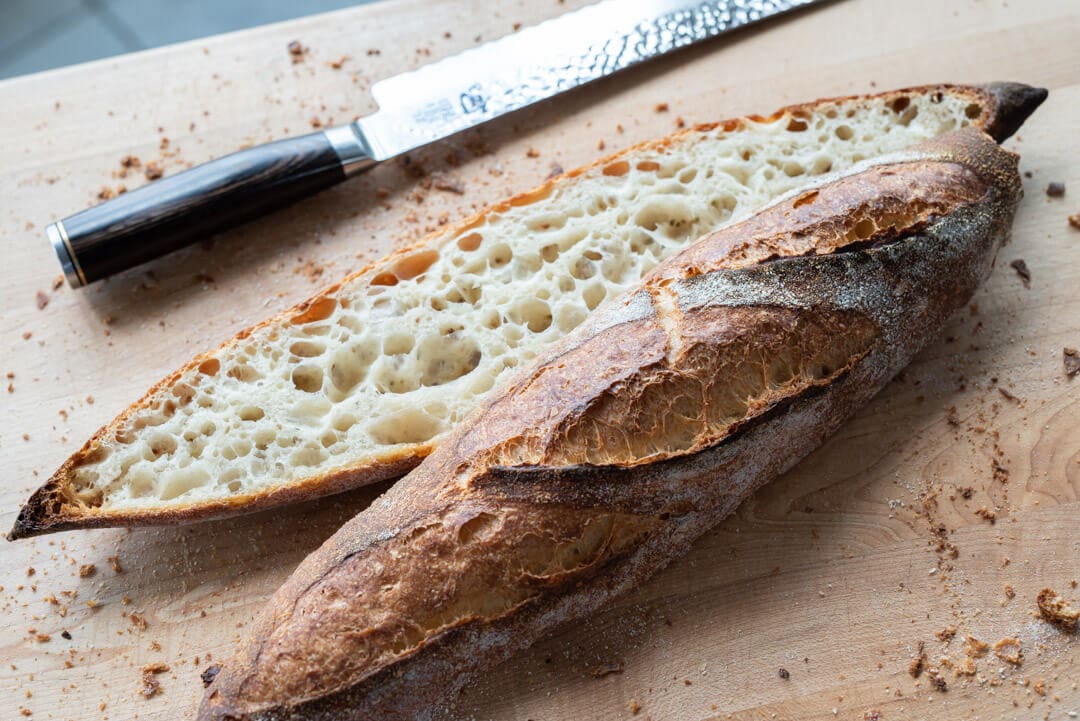
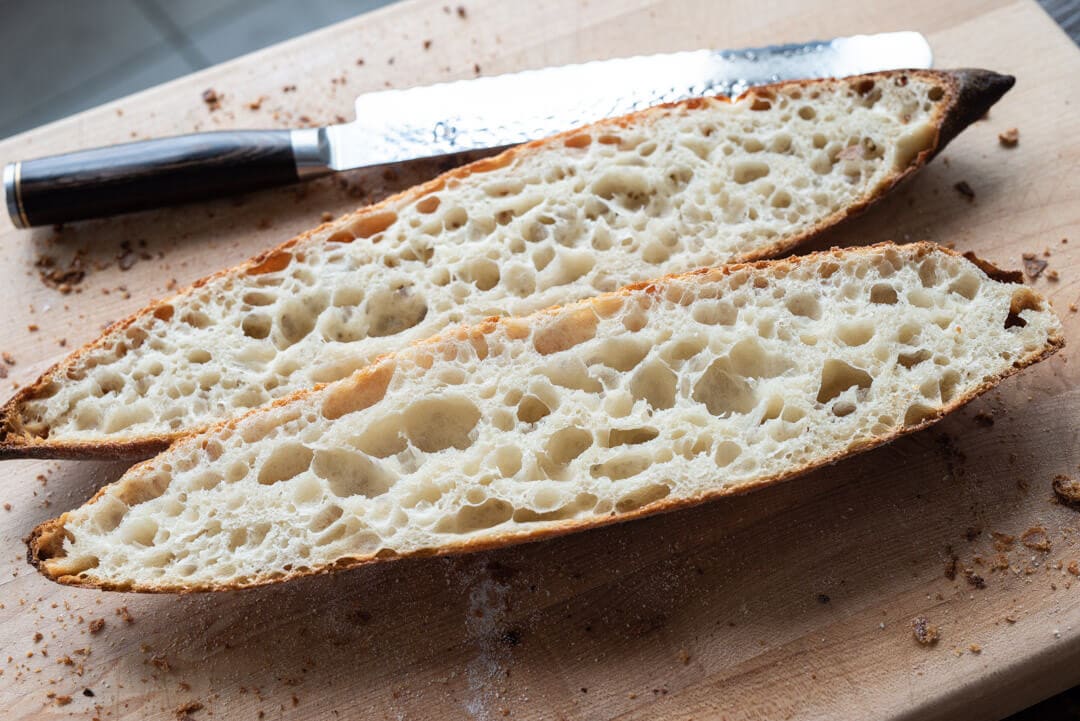
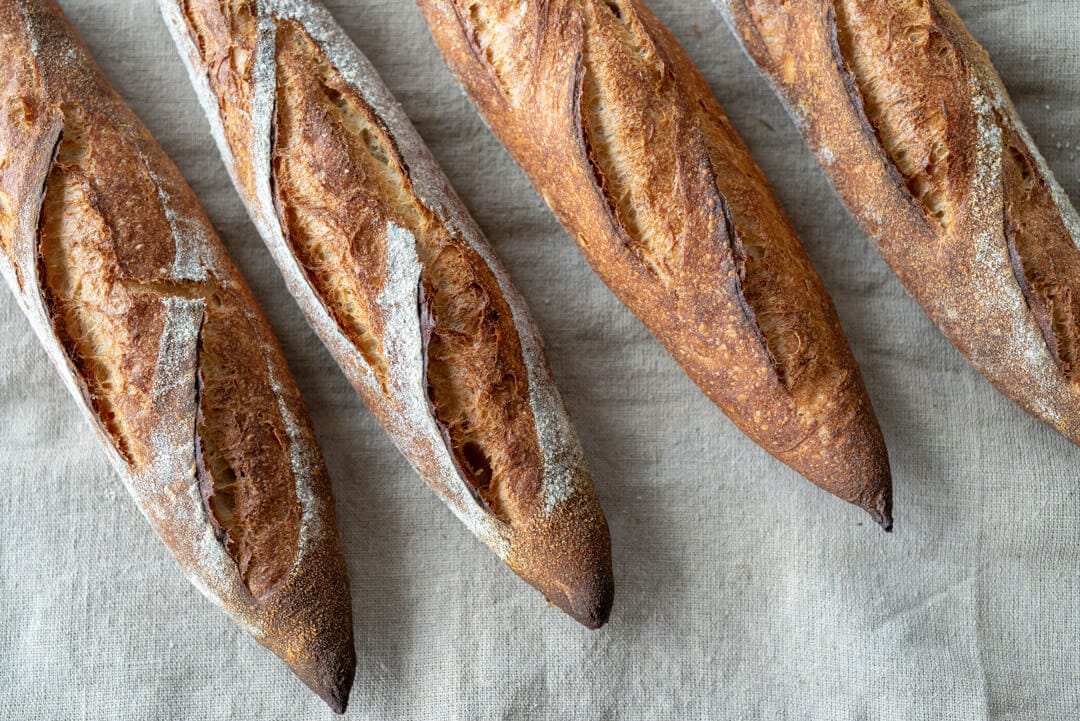
I’ve fallen hard for these pointy sticks. Their beautifully exaggerated shape starts with a thick center and transitions into dangerously sharp ends. Crust color ranges from the periphery of black to almost-too-light, a contrast that elicits stares. A creamy and tender interior that’s so porous it soaks the butter inevitably spread thick during moments of eager anticipation. A sourdough baguette recipe is a tricky thing, but when everything lines up just right, all your past shortcomings discovered in testing vanish in an instant.
As with many things with baking, they simply require practice.
These sourdough baguettes do take concerted effort and practice, but the results are absolutely worth the work. Ok, technically, these are demi-baguettes, given their shorter stature and reduced dough weight, but the nature of this bread holds to the ideal. The slender shape, thin crust, and delicate interior simply exude baguette, even if their specs are a little skewed.
I’ve been working on this recipe relentlessly, and if you follow me on Instagram, you know this, but all the work put into these revolves around the simple fact baguettes are just plain challenging.
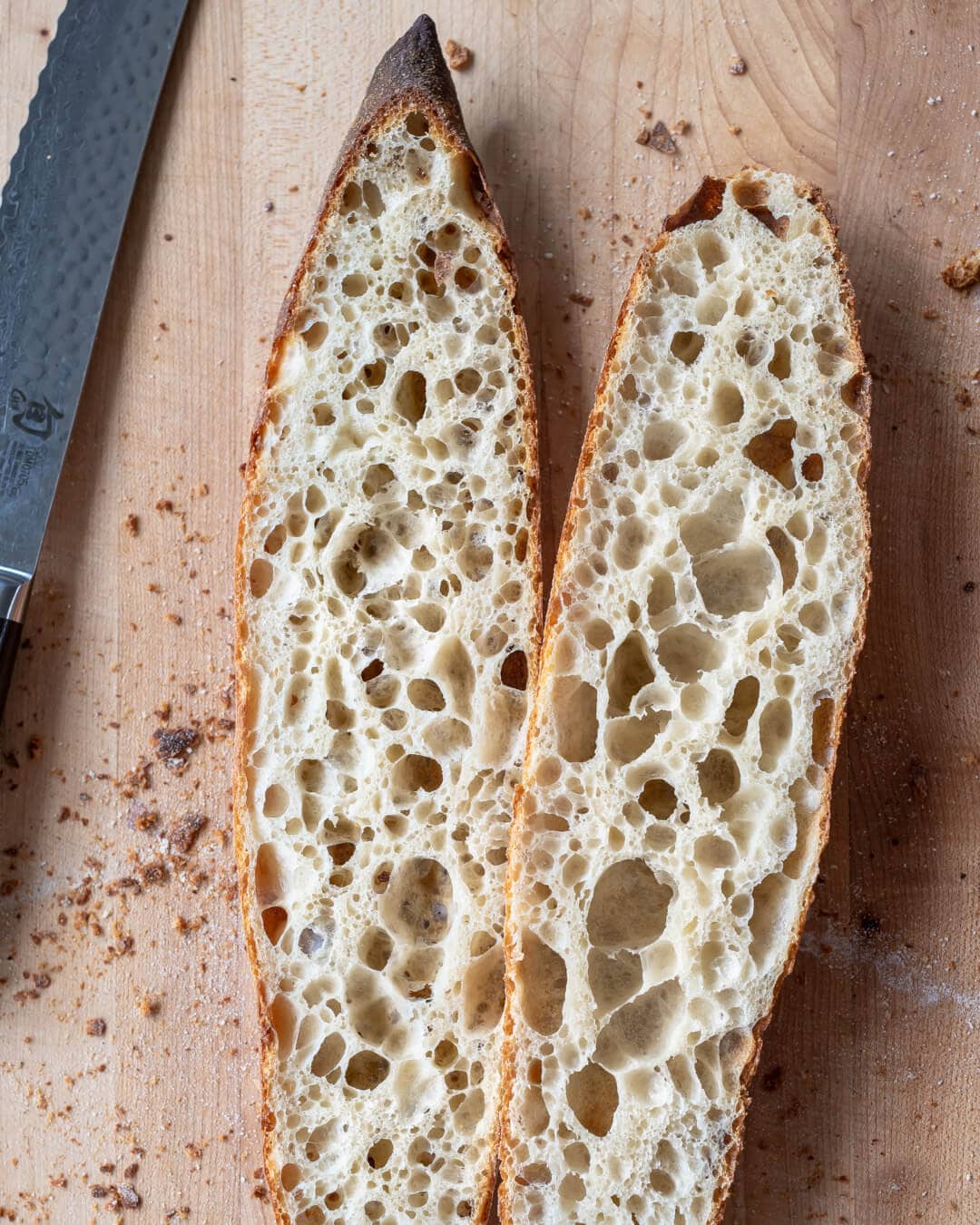
I find that beyond the required attention to fermentation, flour selection, hydration adjustments, cold versus warm bulk decisions, and seeking that correct proof point, there’s the matter of coercing the dough delicately into the correct shape.
As with many things with baking, they simply require practice.
Their challenge stems from the fact that even small shaping mishaps will show themselves quite clearly in the end result. There’s a reason why many bakers consider baguettes to be one of the hardest breads to make. A benchmark of sorts. But even if the shape or the interior isn’t exactly perfect, they’re always delicious. Plus, the more you make them, the more the process slows down internally, and the more all the small adjustments add up to large improvements.
Because shaping these sourdough baguettes can be frustrating at times, I’ve written an entire guide to shaping baguettes—complete with a video (which is also included below) to help illustrate things in real time. Be sure to give that a read—and even a bookmark—for when you’re in the kitchen and need a helping (virtual) hand.
Let’s talk about flour.
Sourdough Baguette Flour Selection
In my early iterations of this formula, I worked in 10% spelt flour. My intention was to introduce more extensibility in the dough along with the classic and wonderful flavor of spelt. After many trials, I decided to drop the spelt mostly because, with medium-protein white flour and hydration at around 70%, coupled with a length autolyse, this dough had plenty of extensibility.
Baking Schedule
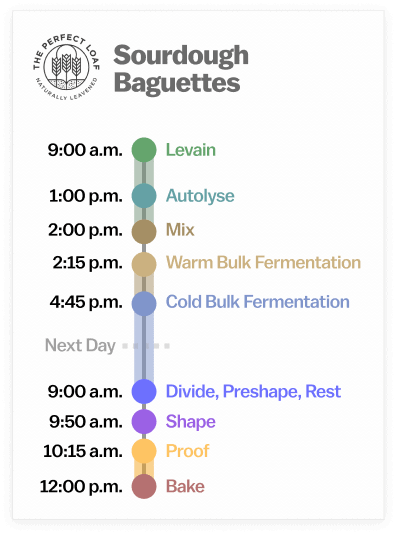
The entire process is split up over the course of two days. This affords you the option to bake the baguettes the next day when you want them—for breakfast, lunch, or even dinner.
Similar to my Kamut demi-baguette recipe, I utilized a short warm bulk fermentation followed by a longer, cold bulk fermentation. When I tested cold-proofing these baguettes in shape, the results always yielded a slightly thicker crust compared to a warm final proof. Further, a cold bulk also adds to the flexibility and convenience of this dough.
Sourdough Baguette Recipe
Update: I recently updated this sourdough baguette. It is now the same recipe that’s in my sourdough cookbook—and believe me, the results are significantly better than the previous version!
Vitals
| Total Dough Weight | 2,000 grams |
| Pre-fermented Flour | 6.5% |
| Hydration | 70.0% |
| Levain in the final dough | 17.4% |
| Yield | 6 x 325g sourdough baguettes (appx 14″ long) |
Total Formula
Note that this is the Total Formula which lets you know all the ingredients, in baker’s percentages, that you need for this recipe. Scroll down to the Method section for what you need in each step.
Desired dough temperature: 78°F (25°C) (see my post on the importance of dough temperature).
| Weight | Ingredient | Baker’s Percentage |
|---|---|---|
| 1143g | White flour (about 11.5% protein; Central Milling Artisan Baker’s Craft Plus) | 100.0% |
| 743g | Water 1 (Levain and autolyse) | 65.0% |
| 57g | Water 2 (Mix) | 5.0% |
| 21g | Salt | 1.8% |
| 37g | Ripe sourdough starter, 100% hydration | 3.3% |
Method
1. Prepare the levain – 9:00 a.m
| Weight | Ingredient | Baker’s Percentage |
|---|---|---|
| 74g | White flour (about 11.5% protein; Central Milling Artisan Baker’s Craft Plus) | 100.0% |
| 74g | Water 1 | 100.0% |
| 37g | Ripe sourdough starter, 100% hydration | 50.0% |
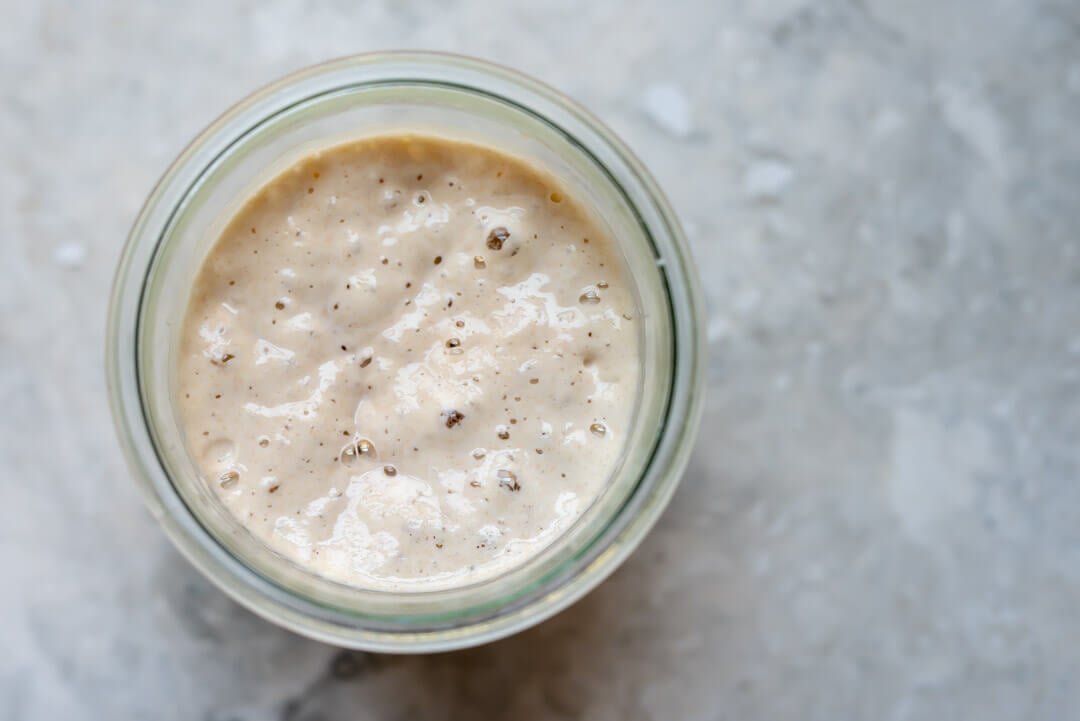
Use your sourdough starter when ripe, mix the above ingredients in a jar, and leave them covered at a warm temperature, 74-76°F (23-24°C), to ripen for 5 hours.
2. Autolyse – 1:00 p.m.
| Weight | Ingredient |
|---|---|
| 1068g | White flour (about 11.5% protein; Central Milling Artisan Baker’s Craft Plus) |
| 668g | Water 1 |
Warm or cool the autolyse water so that the temperature of the mixed dough meets the FDT (final dough temperature) of 78°F (25°C) for this recipe. Place the flour and water 1 in a large bowl. Use wet hands to mix until no dry bits remain; the dough will be shaggy and loose. Use a bowl scraper to scrape down the sides of the bowl to keep all the dough in one area at the bottom. Cover the bowl and place it near your levain for 1 hour.
When making sourdough baguettes, I like to use the autolyse technique to help gain extensibility in the dough and also reduce the total mixing time.
3. Mix – 2:00 p.m.
| Weight | Ingredient |
|---|---|
| 57g | Water 2 |
| 21g | Fine sea salt |
| 186g | Ripe levain |
Add the salt and levain to the top of the dough that was just in autolyse and use a splash of water 2 to moisten. With wet hands, mix thoroughly. Add the remaining water if the dough feels like it can handle it. Next, knead the dough for a few minutes using either the slap and fold technique or folds in the bowl. For this dough, I kneaded for about 5 minutes until the dough smoothed and became elastic.
With sourdough baguettes, I find spending a few more minutes developing the dough upfront helpful in achieving a more open crumb. A spiral mixer can help mix this dough quicker and more effectively.
Transfer the dough to a bulk fermentation container and cover.
4. Warm Bulk Fermentation – 2:15 p.m. to 4:45 p.m.
This warm bulk fermentation will last a total of 2 hours and 30 minutes. During this phase (of the two-step bulk fermentation phase), give the dough three sets of stretch and folds, starting 30 minutes after the beginning of bulk. After the last set, let the dough rest untouched until the full two and a half hours.
5. Cold Bulk Fermentation – 4:45 p.m. to 9:00 a.m. (next day)
After the warm bulk fermentation, place the covered bulk fermentation container in the refrigerator overnight.
6. Divide and Preshape – 9:00 a.m. (next day)
My baguette dough, when removed from the fridge, had plenty of activity but was not exceedingly gassy or risen. The dough was active yet relaxed.
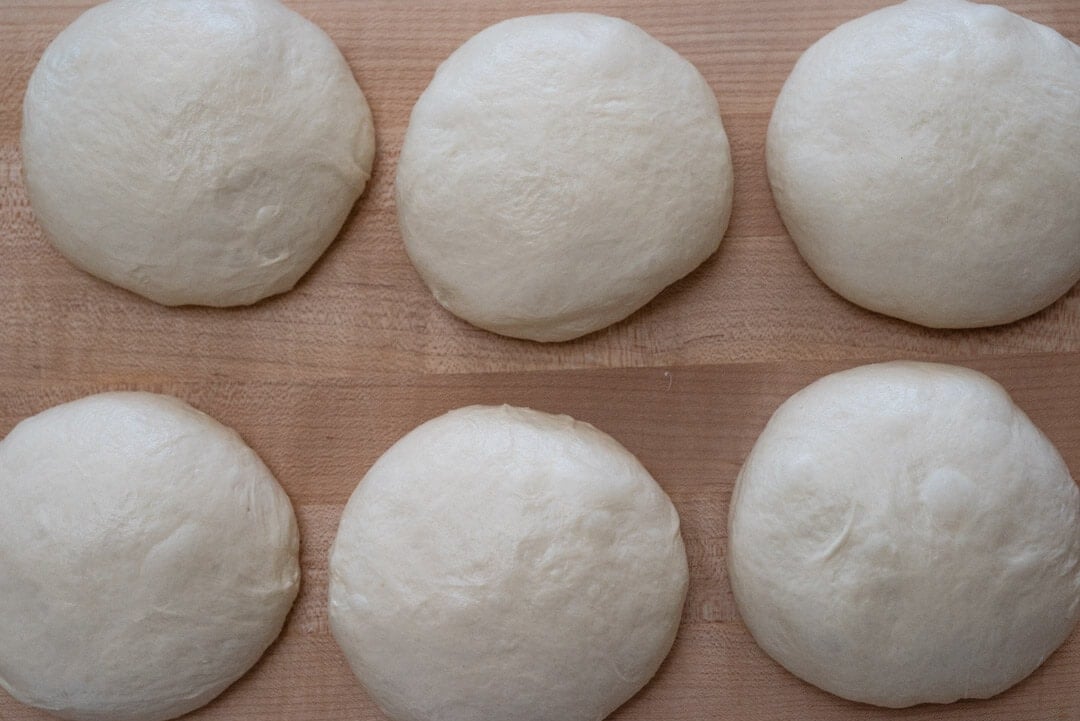
Gently scrape the dough from the bulk container to an un-floured work surface. The dough will feel cold, slightly damp, and firm. Divide into 325g pieces and preshape the pieces of dough into rounds (my preference) or rough tubes. Because the dough is cold and firm, very little bench flour is needed to pre-shape.
Let the preshaped dough rest for 35 minutes, uncovered.
7. Shape – 9:50 a.m.
Prepare a board with a couche (aka baker’s linen) or a large kitchen towel and place this next to your work surface.
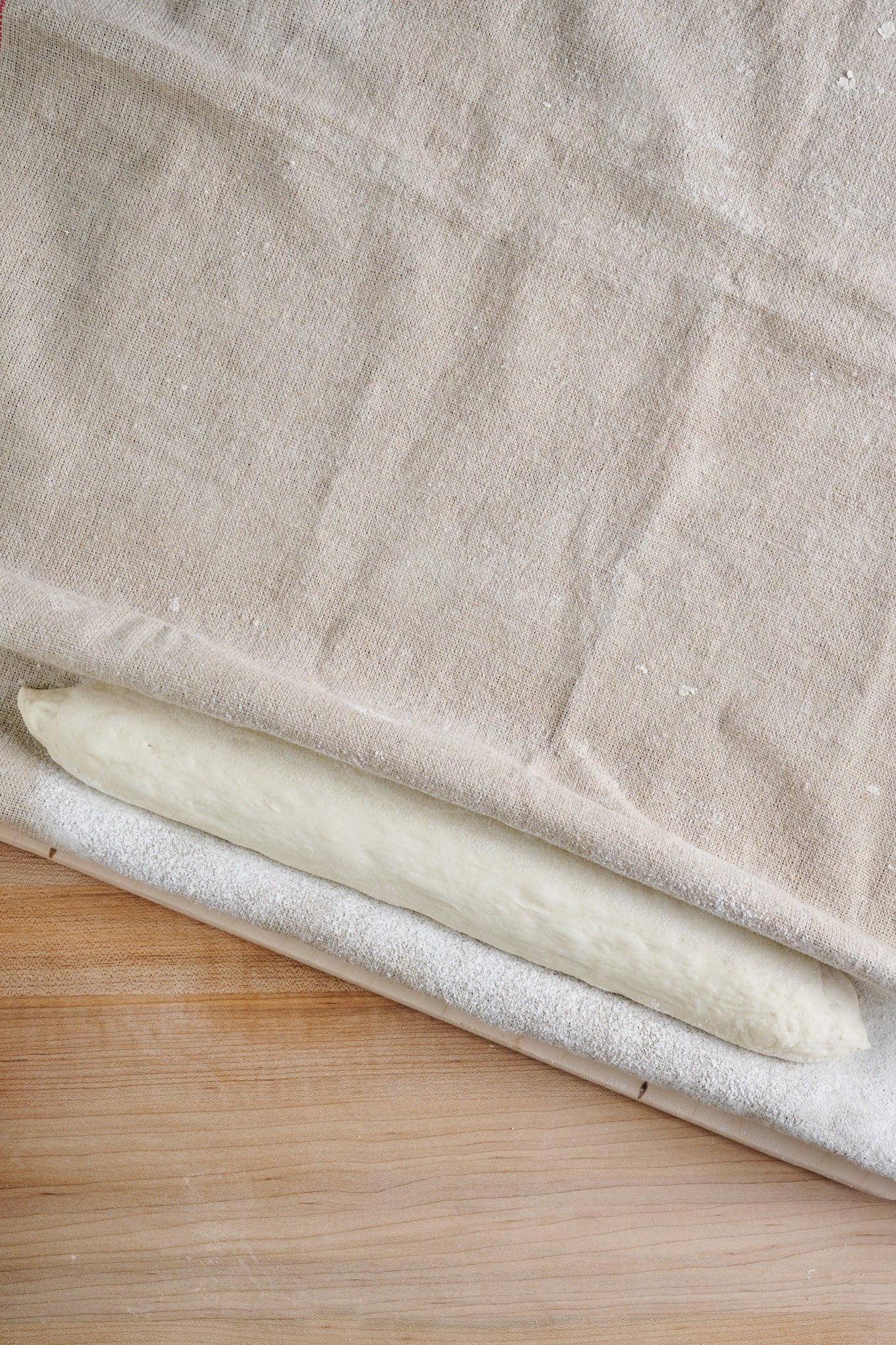
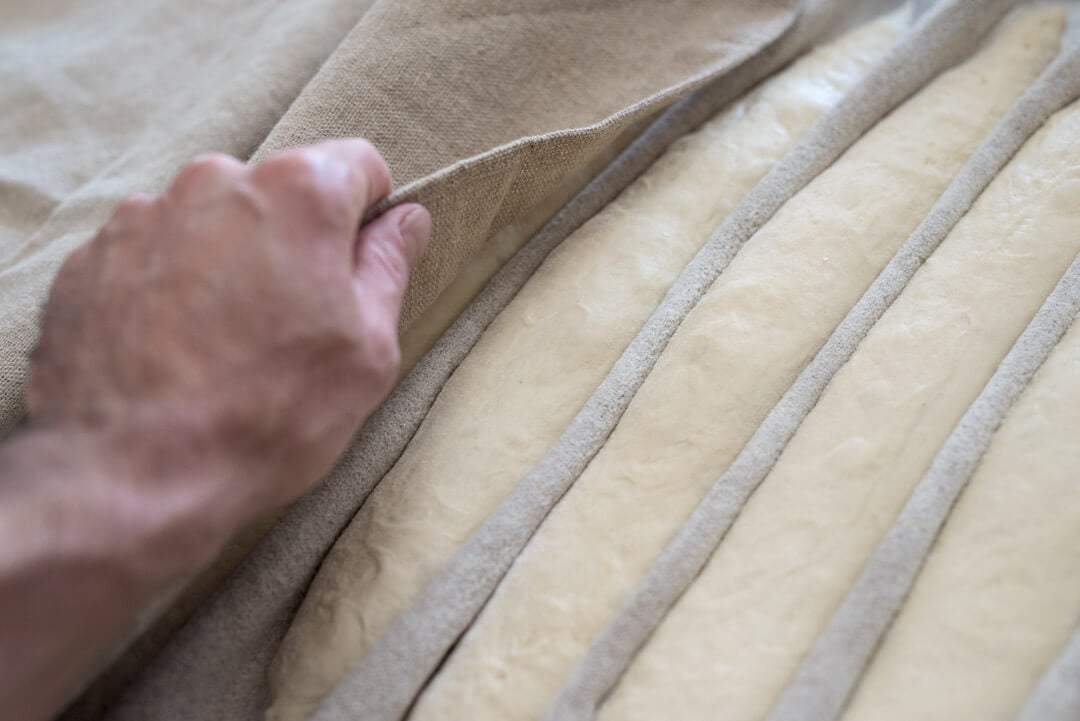
At one side, where you will start laying down shaped baguettes, roll a section so that it stands up by itself, creating a strong edge (see above). Then thoroughly and evenly dust flour on a 3- to 4-inch-wide strip down the couche, from farthest from you to nearest, where the first piece of shaped dough will sit.
After the preshaped rounds have rested for 35 minutes, shape each piece into a long baguette, approximately 14″ long for the home oven (or as wide as your baking surface).
Watch the quick video below for my step-by-step approach to shaping.
Once you’ve shaped a piece, place it in the flour-dusted channel on the couche, seam side up. Then, using both hands at the edges, pick up and drag a little of the couche toward the dough (like making a pleat in the couche) to form a matching wall of the channel to hold the dough while it’s proofing. Once the new wall is formed, it will look like the dough is nestled between two straight walls.
Flour a new strip down the couche on the other side of the newly formed wall in preparation for another piece of dough. Repeat this process for all the preshaped rounds.
Shaping baguettes requires practice through repetition (see my baguette shaping guide page for more instructions). Try not to get discouraged when shaping; take it slow and focus on one motion at a time.
8. Proof – 10:15 a.m. to 12:00 p.m.
Keep your proofing board away from drafts, as the dough can quickly develop a crust on the outside. It may help to drape the edges of your linen over the shaped baguettes or cover them loosely with plastic. If you cover it with plastic, be aware the dough may stick.
Proof the pieces until they pass the poke test, about 1 hour and 45 minutes at room temperature.
9. Bake – 12:00 p.m.
Preheat your oven to 450°F (230°C) for an hour with baking stone/steel inside.
If you only have one baking surface, divide the baking into two sessions. Bake three baguettes first, and chill the rest in the fridge for the second session.
Prepare a pizza peel with parchment paper matching the width of your baking surface.
Grab the end of the couche and pull it out, moving the piece of dough away from the rest. Then, using a dough transfer board (a smaller pizza peel or a small cutting board could also work), place the board inside the baguette (the side closest to the rest of the dough pieces). With the hand holding the couche, quickly flip the dough onto the peel by tugging up and slightly over the transfer board. The baguette should now be seam-side down on the transfer board.
Repeat until you have three pieces on the peel.
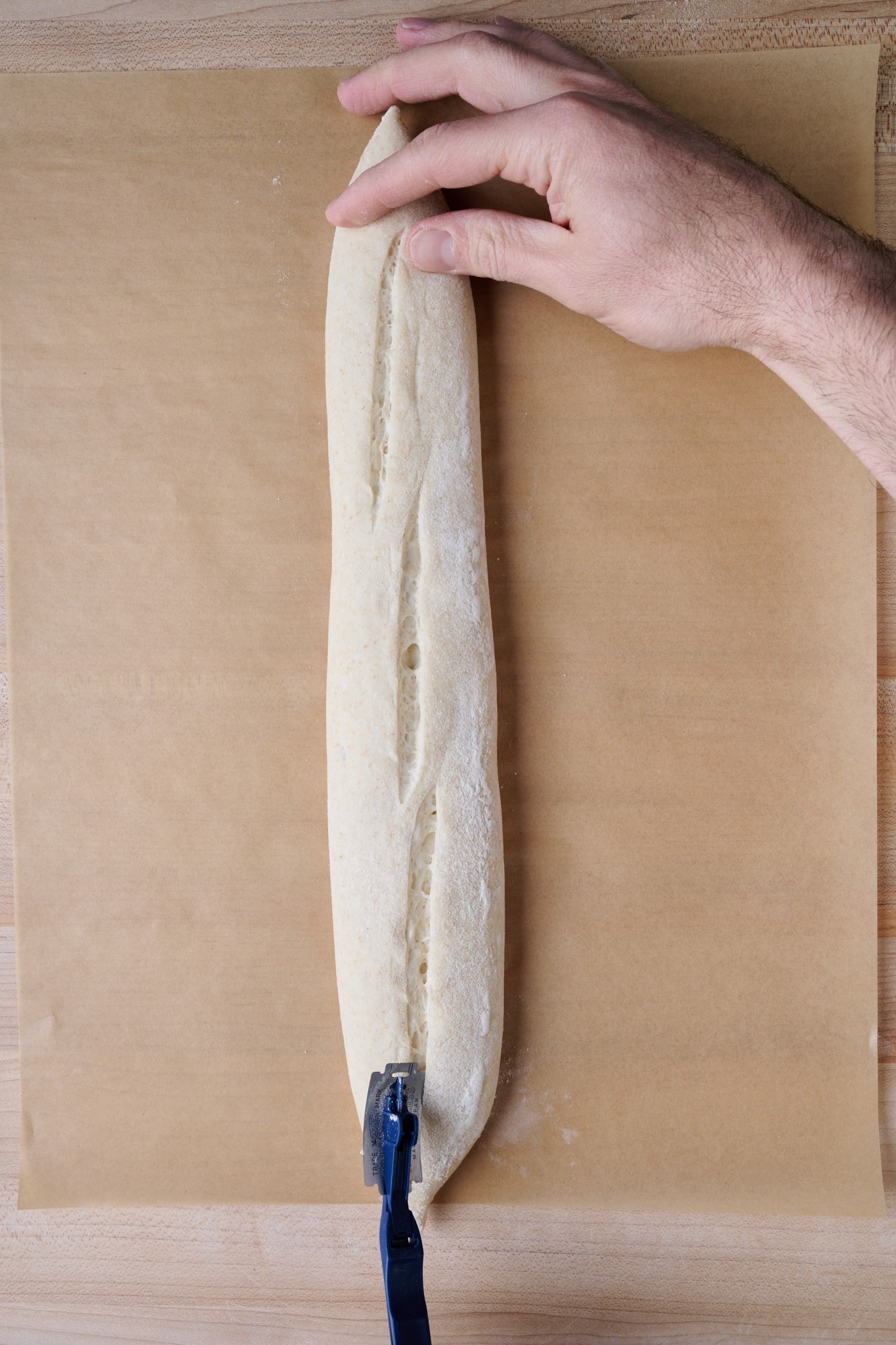
Score each baguette with three overlapping slashes (see below).
Transfer the dough onto the baking surface in the oven using the parchment paper. Next, steam the oven and bake for 20 minutes. Remove the steaming pans and bake for another 20-25 minutes until done.
Cool on a rack. Repeat the process for the remaining baguettes in the fridge.
I steamed my oven in my usual way, described here in my post on how to steam your home oven for baking.
Sourdough Baguette Recipe
- Prep Time: 24 hours
- Cook Time: 45 minutes
- Total Time: 24 hours 45 minutes
- Yield: 6 baguettes
- Category: Lunch, dinner, snack
- Cuisine: French
Description
These exquisite sourdough baguettes have a delicate wheaty flavor with malty notes from the caramelized crust. They’re perfect for breakfast (pan con tomate anyone?), lunch, or even just a snack with a spread of butter on top.
Ingredients
Levain
- 74g white flour (about 11.5% protein)
- 74g water
- 37g ripe sourdough starter, 100% hydration
Autolyse
- 1068g white flour (about 11.5% protein)
- 668g Water
Main Dough
- 57g water
- 21g fine sea salt
- 186g ripe levain
Instructions
- Levain (9:00 a.m.)
In a small bowl mix the Levain ingredients. Cover the jar and keep it at a warm temperature for 5 hours. - Autolyse (1:00 p.m)
In a mixing bowl, add the Autolyse ingredients until no dry bits remain. Cover the bowl and let rest for 1-hour. - Mix (2:00 p.m.)
Add the salt and levain to the top of the dough in autolyse and use a splash of the remaining water to moisten. With wet hands, mix thoroughly. Add the remaining water if the dough feels like it can handle it. Knead the dough for a few minutes using either the slap and fold technique or folds in the bowl until the dough smooths and becomes elastic. Transfer the dough back into the bowl. Transfer the dough to a bulk fermentation container and cover. - Warm Bulk Fermentation (2:15 p.m. to 4:45 p.m.)
This dough will require 2 sets of stretches and folds during bulk fermentation at 30-minute intervals. After the second set, let the dough rest, covered, for the remainder of bulk fermentation. - Cold Bulk Fermentation (4:45 p.m. to 9:00 a.m.)
After the warm bulk fermentation, place the covered bulk fermentation container in the refrigerator overnight. - Divide and Preshape (9:00 a.m., the next day)
Gently scrape the dough from the bulk container to an un-floured work surface. Divide into 325g pieces and preshape the pieces of dough into rounds (my preference) or rough tubes. Because the dough is cold and firm, very little bench flour is needed to pre-shape. Let the preshaped dough rest for 35 minutes, uncovered. - Shape (9:50 a.m.)
Prepare a couche and dust it with flour. Shape each piece of dough into a baguette shape. - Proof (10:15 a.m. to 12:00 p.m.)
Proof the pieces until they pass the poke test, about 1 hour and 45 minutes at room temperature. - Bake (12:00 p.m.)
Preheat your oven to 450°F (230°C) for an hour with baking stone/steel inside. Divide the bake into two sessions if you only have one baking surface. Bake three baguettes first, and chill the rest in the fridge for the second session. Prepare a pizza peel with parchment paper matching the width of your baking surface. Grab and end of the couche and pull it out, moving the piece of dough away from the rest. Then, using a dough transfer board (a smaller pizza peel or a small cutting board could also work), place the board to the inside of the baguette (the side closest to the rest of the dough pieces). With the hand holding the couche, quickly flip the dough onto the peel by tugging up and slightly over the transfer board. The baguette should now be seam-side down on the transfer board. Repeat until you have three pieces on the peel. Score each baguette with three overlapping slashes. Transfer the dough onto the baking surface in the oven using the parchment paper. Next, steam the oven and bake for 20 minutes. Remove the steaming pans and bake for another 20-25 minutes until done. Cool on a rack. Repeat the process for the remaining baguettes in the fridge.
Sourdough Baguette Recipe FAQs
Why are these scaled to 325g?
This dough weight makes for baguettes that fit my home baking surface at 14-inches long. It makes for a fatter baguette in the end, but one that’s perfect for the home oven.
Why is scoring difficult with baguettes?
One (of the many) reasons I like to do a cold-proof with almost all my other doughs is because scoring is much easier. When the dough is warm, it’s easy for your blade to drag and get stuck. My best advice is to use a new, super-sharp blade and make your cuts as smooth and fast as possible. If you notice you didn’t cut through the skin of the dough sufficiently in the first pass, lightly drag the blade inside the cut to give it a little help.
Why do cold bulk fermentation with baguette dough?
Doing two-day fermentation is a great schedule for home bakers (and pro bakers, too!), so I do like to use the fridge; it brings a little more flavor. This means you’d either have to do cold bulk or cold proof in shape. Doing the latter gives these a slightly thicker crust since the dough will be exposed to cold temps when they’re in their final shape. Therefore, I opt for cold bulk fermentation to keep a thin crust (it’s also easy to shape cool dough!).
What’s Next?
This sourdough baguette recipe results in exquisite delicate baguettes. The brittle crust grounds the eating experience and gives added body to the otherwise tender bread. It’s through this contrast that the bread is elevated to the next level—a baguette with a soft, flimsy crust would be a sad baguette indeed.
I’ve said it before, and I’ll probably say it a million times more: fermentation is a mysterious and beautiful thing. I hope you try this recipe and you show up to your next gathering with an armful of exquisite and incredibly delicious pointy sticks.
To continue with the baguette theme, try your hand at my green olive filoncini, which are kind of like an Italian version of baguettes‚ but twisted!
Or, if you’re looking for a large, crusty loaf, my sunflower and sesame sourdough has loads of flavor and are a go-to recipe when you want to impress.
Buon appetito!


458 Comments
question is on levain timing and autolyse. There have been a few occasions where my autolyse gets a small late start (15-30 minutes). Is it better to extend the levain fermentation time or cut the autolyse short?
Always best to adhere to levain scheduling to ensure proper fermentation schedule.
I'm curious how you'd bake these in a Rackmaster 2020. Would you follow your approach for hearth loaves? Thank you!
Hey Maria. I preheat the oven to 220C, load baguettes, steam, and turn the dials down to 150C. Bake for 20m. Then vent the steam, turn the dials up to 220C and bake for 10-12m more.
Absolutely beautiful recipe! Beautiful moderately open crumb achieved the first attempt! Thanks again, Maurizio!
Right on Nicole, glad to hear it!
Can I cold proof for 36 hours ??? Thanks
Should work just fine with these.
If using.a fan oven should I adjust the temperature? So lower it by 20 degrees.
You don’t want to use convection when baking the bread. It can affect the shape of the bread. Regular bake is best for bread
Hello! I have tried this recipe twice now, days apart from each other. Both bakes had amazing taste, crust and had a great open crumb, however, the crumb was gummy. I cannot figure out why. I have no issues with other sourdough breads I bake. I did add all the water in the final mix as the dough handled it just fine. I mixed it with my Ankarsrum. The warm bulk was in my B&T proofer. Proofing was done in oven with a temp of 77-79. The first set could have been slightly overproofed but not the second go round. Maybe I need slightly longer bulk fermentation? Thoughts?
If the crumb was gummy, you didn’t let them totally cool (ie you cut into them when still warm and they hadn’t finished baking)>
I'm also in love with these! In the last couple weeks it went from 80s to 40s and everything (and everyone) is moving slowly. How much help does using really hot water (150 or more) in the autolyze do? Is there a chemical change after some point that damages or causes bad results? And related to that I often find myself getting to mix the autolyze late. Is it better to mix with the levain when it is done (shorting the time for the auto) or should a give the full time to autolyze and let the levain run long? Would manipulating the temperature of the water help here? As always thanks for your guidance!
Hi! Just fyi, the article mentions three stretch and folds during warm bulk fermentation, but the recipe only calls for two. I'm doing three just to be safe.
Also, it says to proof for 1:45, then to preheat the oven for an hour. So is the total proof time 2:45 minutes, or do you preheat the oven 45 minutes into the proof so the total proof time ends up being 1:45?
Love everything you do – keep up the great work!
My proofer only goes down to 80°F, not the 78°F recommended for the warm fermentation. Will 80°F be ok? Also, this recipe says to bake for a total of 40-45 minutes, but the same one on your instagram says 20-22 minutes. I've generally baked my baguettes for 17 minutes, so 40 seems like an awful lot. Thanks!
Exactly that. I do 2 lb loaves for 40 minutes. These baguettes should be 20-22 min max. Surprised there was no reply prior to me.
I have tried the recipe, but my baguettes came out flat. I noticed that after the cold bulk fermentation, should I let the dough warm up at room temperature before I divide? The dough seems very cold and stiff?
Hi Maurizio,
just tried your recipe for making baguettes for the first time! Loved the instructions and the finished baguettes taste amazing but they turned out quite dense. There are a few bigger holes, but the rest is quite "chewy" (but not raw). Any idea on how to avoid this and get a more lighter and airy bread? 🙂
Hi there. Sounds like you didn't ferment it long enough. The dough needs a proper rest – if you wake him up early he will be angry and won't feel like working! Sourdough recipes are difficult because it really is all about the ambient temperature. The cooler your kitchen is, the longer the dough will take to ferment and also proof. Try letting it rest a little longer – for both the fermentation and the proofing. Obviously we all want beautiful oven spring but let me tell you something – I rather have bread that is over fermented than under fermented.
Over fermented dough will still come out light and have a great crust. Under fermented dough will be dense and gummy.
Hope your next try is successful!
I am on a mission to bake — for once in my life — a good baguette. I'm on batch 7, and getting closer and closer to something to be proud of. I recently had a breakthrough around batch 4. Until then my baguettes' crusts were always thick and gray with poor oven spring. I tried every method to steam up my gas oven, to no avail. Decently shaped and well-proofed loaves disappointed every time. Aargh! I bake sourdough boules in a dutch oven with great results, but the baguette form factor needs a different approach. I didn't want to spend a fortune for a giant roasting pan or bespoke cover, when I discovered a $30 STAINLESS STEEL KITTY LITTER PAN on Amazon that fit exactly on my 14×20" baking steel. Though I'm still working on shaping and slashing and timing and temperature my sourdough baguettes are now golden and blistered and sprung!
Can this be made in a gas oven?
Yes!!
One thing that is not clear in this recipe is the definition of "warm bulk fermentation". Does that mean room temperature (which would be warm compared to the cold bulk in my fridge), or do you mean that it should be warmer than room and if so how warm?
Hi Maurizio! I love this recipe! I started a batch this morning (Monday morning) with the expectation of having it with tomorrow's (Tuesday's) dinner before realizing we had dinner reservations for tomorrow.
I've read through the comments below and I think I'm gathering that it's okay to extend cold bulk by 24 hours OR to pre-shape on the published schedule and push it back into cold for another 24 hours before baking. In other words, leave it in cold bulk for all of Tuesday, pre-shape and bake Wednesday OR pre-shape Tuesday, return to cold, shape and bake Wednesday. Am I reading this correctly?
Thanks for your great recipes!!
Sorry for the late reply and thanks so much for the kind words about the recipe!
For your schedule, I'd definitely go with extending the cold bulk fermentation through Tuesday and then pre-shape/shape/bake on Wednesday. This is the simplest approach and the dough will develop some fantastic flavor during the extra time in bulk.
Enjoy those baguettes! I hope they turned out great.
Hello Maurizio! Love your book and use it often! I made the dough for these baguettes today – I used Central Milling Organic Type 70 Malted. I'll be baking them tomorrow in an Anova oven. Should I use 100% steam for the first 20 minutes? As for the heat options – rear, bottom, top, top/bottom? I usually bake my sourdough loaves on different heat sources and steam percentages during the bake. Thank you for any advice you can give.
Yes, more steam the better with baguettes! I would do top and bottom.
I'm sorry, I meant before or after the final proof..
I would freeze them after baking for the best results!
Hi!
Thank you for this amazing site.
One question : Can we freeze the baguettes for a next bake? And if so, at what point ? Before or after the final shape?
And of course, how would you recommend to defreeze them?
Love these. They turned out perfect. I did, however, use T45 French flour (croissant flour). The inside is creamy white and the crust perfectly crispy.
They did stay out about 2 hours.. spent too much time at the dog park. It didn't look like it sat too long. I'm in WI. The kitchen isn't that warm. I actually froze the second batch of loaves for 15 minutes. They baked beautifully.
Love your recipes and I will continue to sing your praises.
Dreamy flour choice there, Rebecca 🙂 Thanks so much, glad they turned out well for ya!
Hi Maurizio! I love your work, thank you for sharing so much of your experience and knowledge!
My Levaine doubles in size in 4 hours and looks very active, but the dough is barely risen after the recipy bulk time. I needed to let the dough stand for almost 4 hours after the final stretch and fold before it shows signs of being ready (domed top, bubbles, letting go of the container wall).
This is similar to all recipes Ive attempted, and I dont understand whats wrong.
1. Room temp is average 23C, that will of course cause longer rise time.
2. The flour Im using for the baguette recipe is not shaggy after autolyse-mix, but somewhat firm and smooth. Perhaps I need to increase hydration?
3. My sour dough starter just not strong enough? Im feeding it daily (or when it stops rising), and it looks very active. Is there any way I can make it even stronger, or do I simply need a differet strain of yeast?
Id appreciate any advice.
Kind regards,
Arnstein