

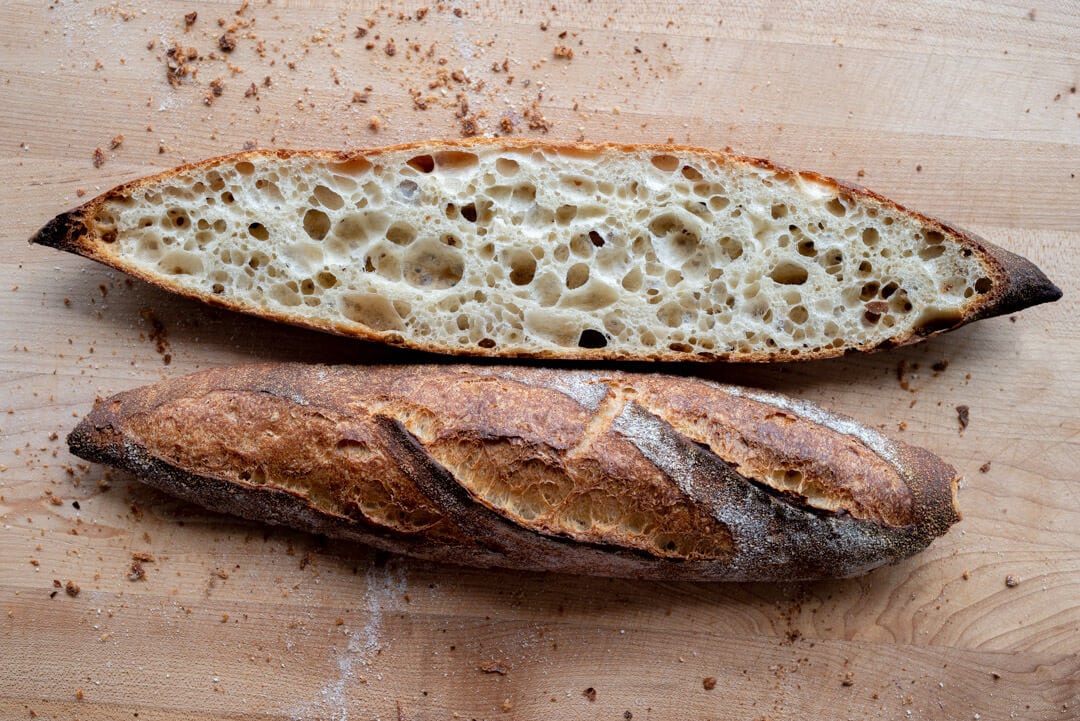
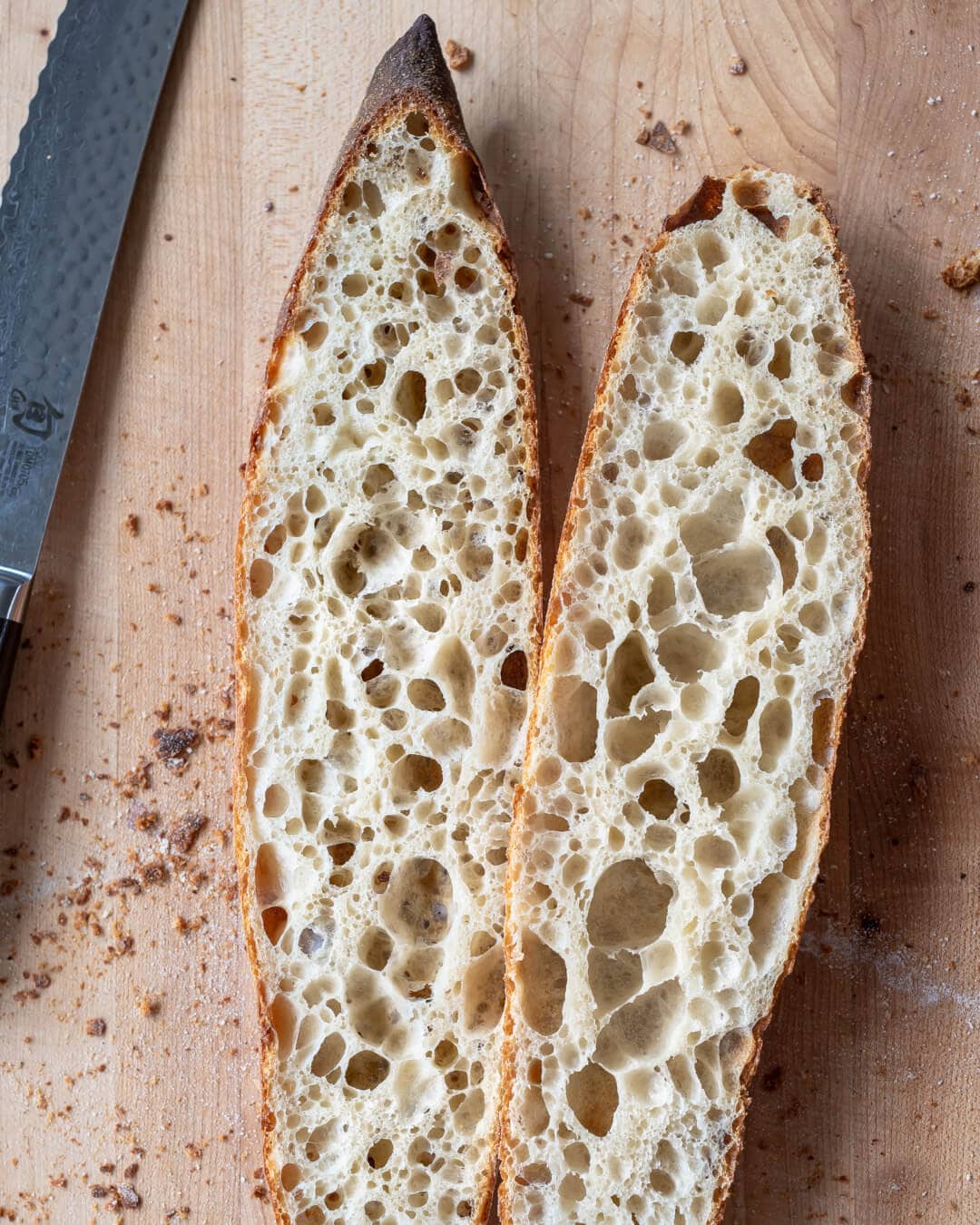
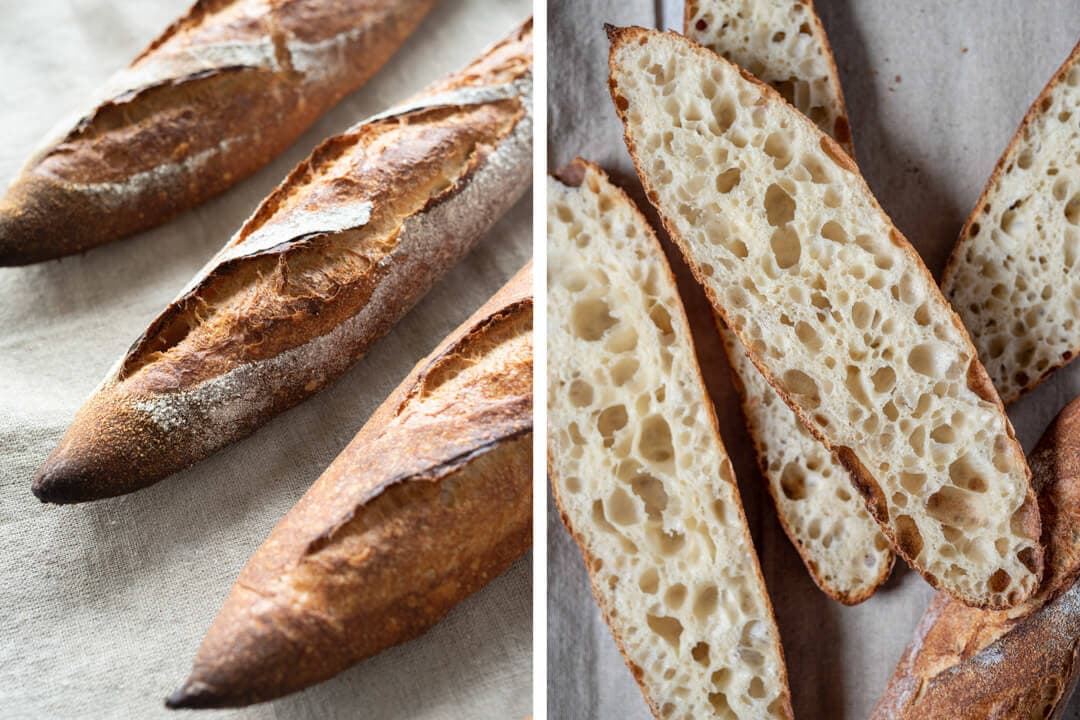
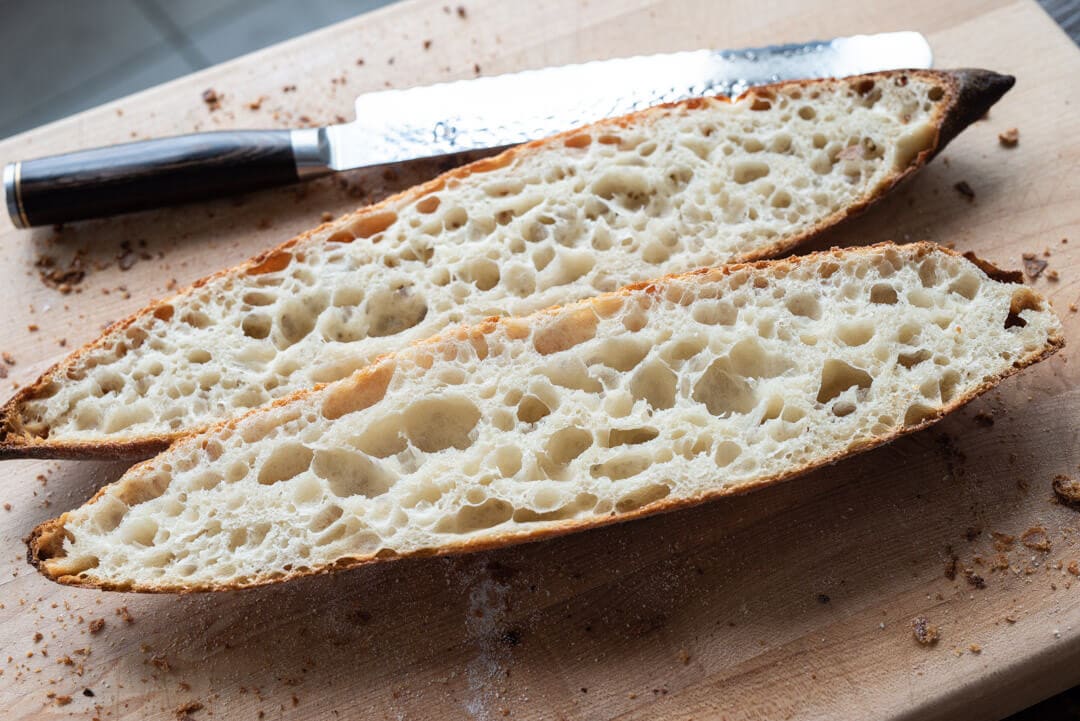
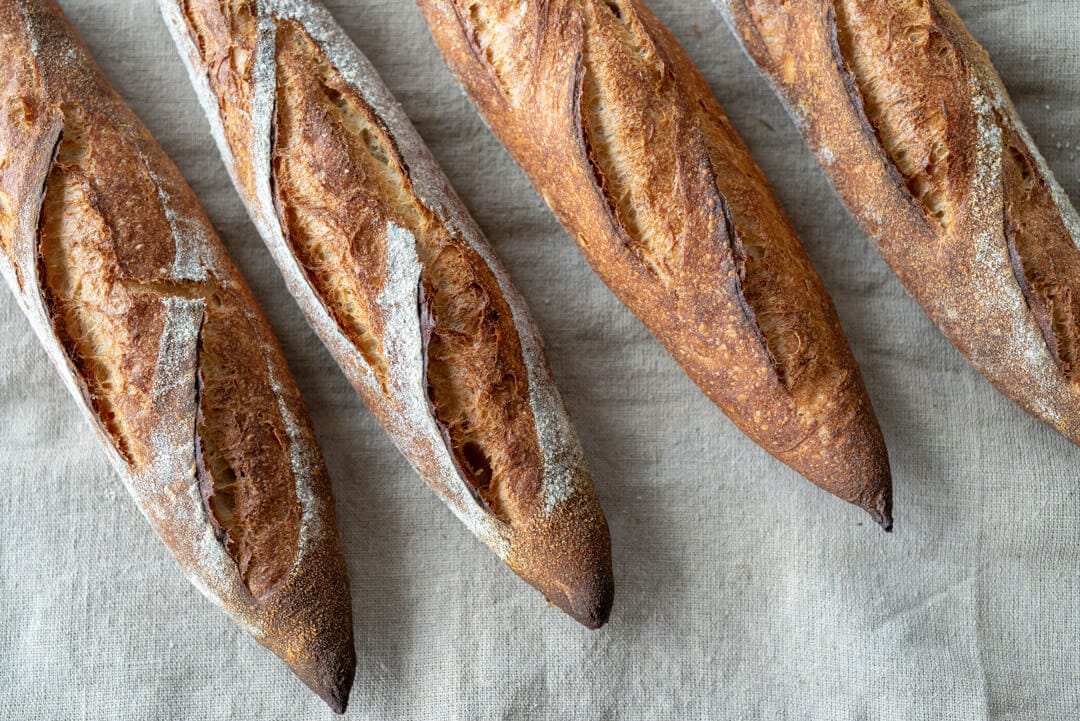
I’ve fallen hard for these pointy sticks. Their beautifully exaggerated shape starts with a thick center and transitions into dangerously sharp ends. Crust color ranges from the periphery of black to almost-too-light, a contrast that elicits stares. A creamy and tender interior that’s so porous it soaks the butter inevitably spread thick during moments of eager anticipation. A sourdough baguette recipe is a tricky thing, but when everything lines up just right, all your past shortcomings discovered in testing vanish in an instant.
As with many things with baking, they simply require practice.
These sourdough baguettes do take concerted effort and practice, but the results are absolutely worth the work. Ok, technically, these are demi-baguettes, given their shorter stature and reduced dough weight, but the nature of this bread holds to the ideal. The slender shape, thin crust, and delicate interior simply exude baguette, even if their specs are a little skewed.
I’ve been working on this recipe relentlessly, and if you follow me on Instagram, you know this, but all the work put into these revolves around the simple fact baguettes are just plain challenging.
I find that beyond the required attention to fermentation, flour selection, hydration adjustments, cold versus warm bulk decisions, and seeking that correct proof point, there’s the matter of coercing the dough delicately into the correct shape.
As with many things with baking, they simply require practice.
Their challenge stems from the fact that even small shaping mishaps will show themselves quite clearly in the end result. There’s a reason why many bakers consider baguettes to be one of the hardest breads to make. A benchmark of sorts. But even if the shape or the interior isn’t exactly perfect, they’re always delicious. Plus, the more you make them, the more the process slows down internally, and the more all the small adjustments add up to large improvements.
Because shaping these sourdough baguettes can be frustrating at times, I’ve written an entire guide to shaping baguettes—complete with a video (which is also included below) to help illustrate things in real time. Be sure to give that a read—and even a bookmark—for when you’re in the kitchen and need a helping (virtual) hand.
Let’s talk about flour.
Sourdough Baguette Flour Selection
In my early iterations of this formula, I worked in 10% spelt flour. My intention was to introduce more extensibility in the dough along with the classic and wonderful flavor of spelt. After many trials, I decided to drop the spelt mostly because, with medium-protein white flour and hydration at around 70%, coupled with a length autolyse, this dough had plenty of extensibility.
Baking Schedule
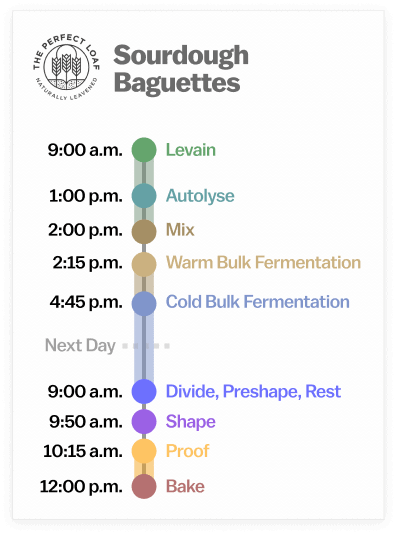
The entire process is split up over the course of two days. This affords you the option to bake the baguettes the next day when you want them—for breakfast, lunch, or even dinner.
Similar to my Kamut demi-baguette recipe, I utilized a short warm bulk fermentation followed by a longer, cold bulk fermentation. When I tested cold-proofing these baguettes in shape, the results always yielded a slightly thicker crust compared to a warm final proof. Further, a cold bulk also adds to the flexibility and convenience of this dough.
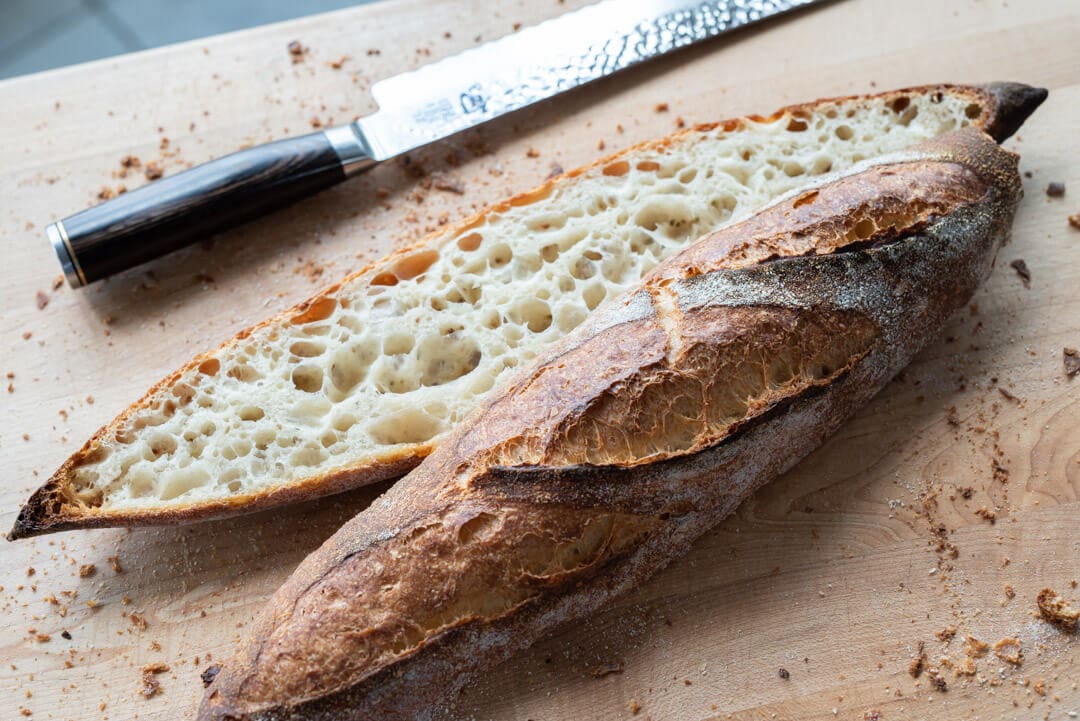
Sourdough Baguette Recipe
Update: I recently updated this sourdough baguette. It is now the same recipe that’s in my sourdough cookbook—and believe me, the results are significantly better than the previous version!
Vitals
| Total Dough Weight | 2,000 grams |
| Pre-fermented Flour | 6.5% |
| Hydration | 70.0% |
| Levain in the final dough | 17.4% |
| Yield | 6 x 325g sourdough baguettes (appx 14″ long) |
Total Formula
Note that this is the Total Formula which lets you know all the ingredients, in baker’s percentages, that you need for this recipe. Scroll down to the Method section for what you need in each step.
Desired dough temperature: 78°F (25°C) (see my post on the importance of dough temperature).
| Weight | Ingredient | Baker’s Percentage |
|---|---|---|
| 1143g | White flour (about 11.5% protein; Central Milling Artisan Baker’s Craft Plus) | 100.0% |
| 743g | Water 1 (Levain and autolyse) | 65.0% |
| 57g | Water 2 (Mix) | 5.0% |
| 21g | Salt | 1.8% |
| 37g | Ripe sourdough starter, 100% hydration | 3.3% |
Method
1. Prepare the levain – 9:00 a.m
| Weight | Ingredient | Baker’s Percentage |
|---|---|---|
| 74g | White flour (about 11.5% protein; Central Milling Artisan Baker’s Craft Plus) | 100.0% |
| 74g | Water 1 | 100.0% |
| 37g | Ripe sourdough starter, 100% hydration | 50.0% |
Use your sourdough starter when ripe, mix the above ingredients in a jar, and leave them covered at a warm temperature, 74-76°F (23-24°C), to ripen for 5 hours.
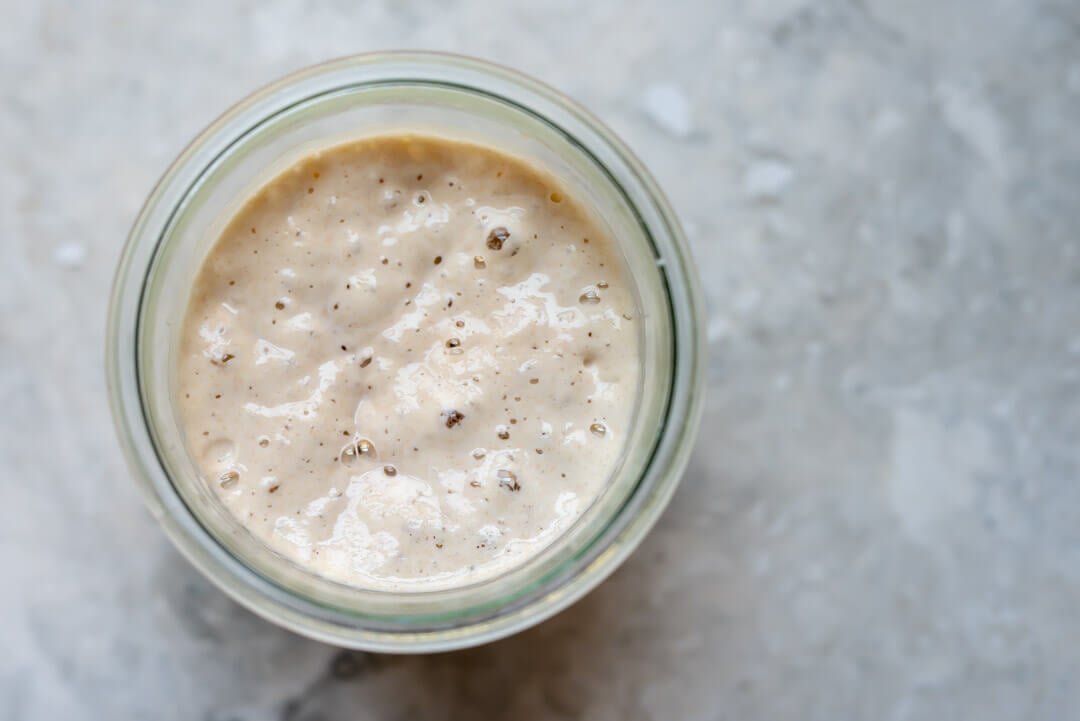
2. Autolyse – 1:00 p.m.
| Weight | Ingredient |
|---|---|
| 1068g | White flour (about 11.5% protein; Central Milling Artisan Baker’s Craft Plus) |
| 668g | Water 1 |
Warm or cool the autolyse water so that the temperature of the mixed dough meets the FDT (final dough temperature) of 78°F (25°C) for this recipe. Place the flour and water 1 in a large bowl. Use wet hands to mix until no dry bits remain; the dough will be shaggy and loose. Use a bowl scraper to scrape down the sides of the bowl to keep all the dough in one area at the bottom. Cover the bowl and place it near your levain for 1 hour.
When making sourdough baguettes, I like to use the autolyse technique to help gain extensibility in the dough and also reduce the total mixing time.
3. Mix – 2:00 p.m.
| Weight | Ingredient |
|---|---|
| 57g | Water 2 |
| 21g | Fine sea salt |
| 186g | Ripe levain |
Add the salt and levain to the top of the dough that was just in autolyse and use a splash of water 2 to moisten. With wet hands, mix thoroughly. Add the remaining water if the dough feels like it can handle it. Next, knead the dough for a few minutes using either the slap and fold technique or folds in the bowl. For this dough, I kneaded for about 5 minutes until the dough smoothed and became elastic.
With sourdough baguettes, I find spending a few more minutes developing the dough upfront helpful in achieving a more open crumb. A spiral mixer can help mix this dough quicker and more effectively.
Transfer the dough to a bulk fermentation container and cover.
4. Warm Bulk Fermentation – 2:15 p.m. to 4:45 p.m.
This warm bulk fermentation will last a total of 2 hours and 30 minutes. During this phase (of the two-step bulk fermentation phase), give the dough three sets of stretch and folds, starting 30 minutes after the beginning of bulk. After the last set, let the dough rest untouched until the full two and a half hours.
5. Cold Bulk Fermentation – 4:45 p.m. to 9:00 a.m. (next day)
After the warm bulk fermentation, place the covered bulk fermentation container in the refrigerator overnight.
6. Divide and Preshape – 9:00 a.m. (next day)
My baguette dough, when removed from the fridge, had plenty of activity but was not exceedingly gassy or risen. The dough was active yet relaxed.
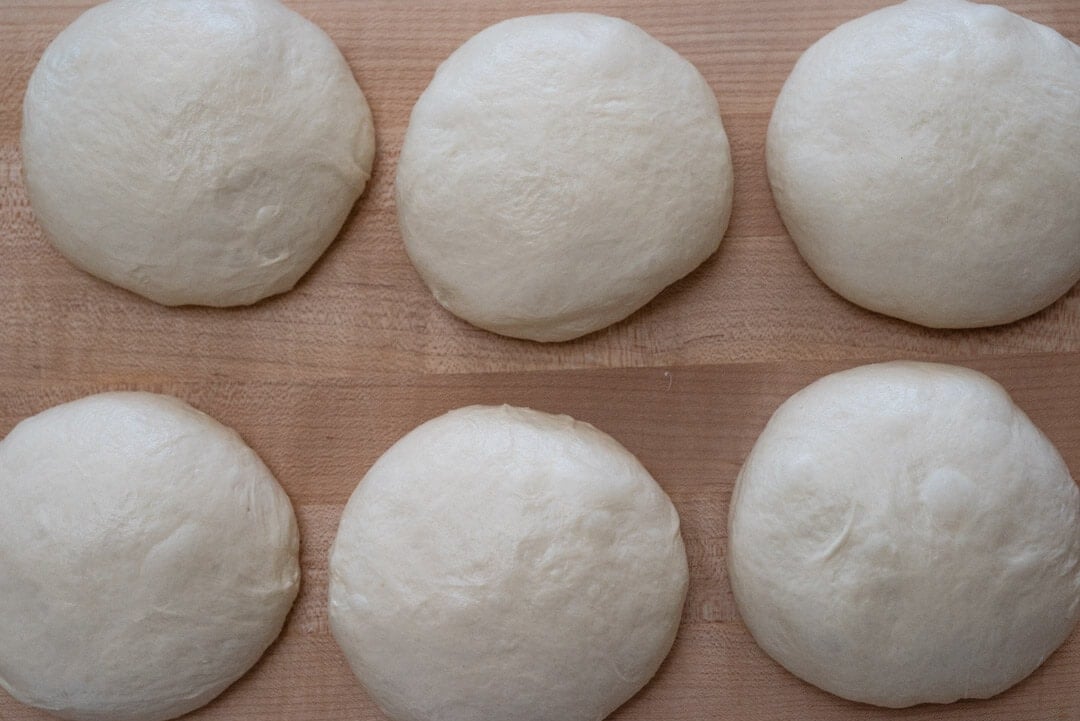
Gently scrape the dough from the bulk container to an un-floured work surface. The dough will feel cold, slightly damp, and firm. Divide into 325g pieces and preshape the pieces of dough into rounds (my preference) or rough tubes. Because the dough is cold and firm, very little bench flour is needed to pre-shape.
Let the preshaped dough rest for 35 minutes, uncovered.
7. Shape – 9:50 a.m.
Prepare a board with a couche (aka baker’s linen) or a large kitchen towel and place this next to your work surface.
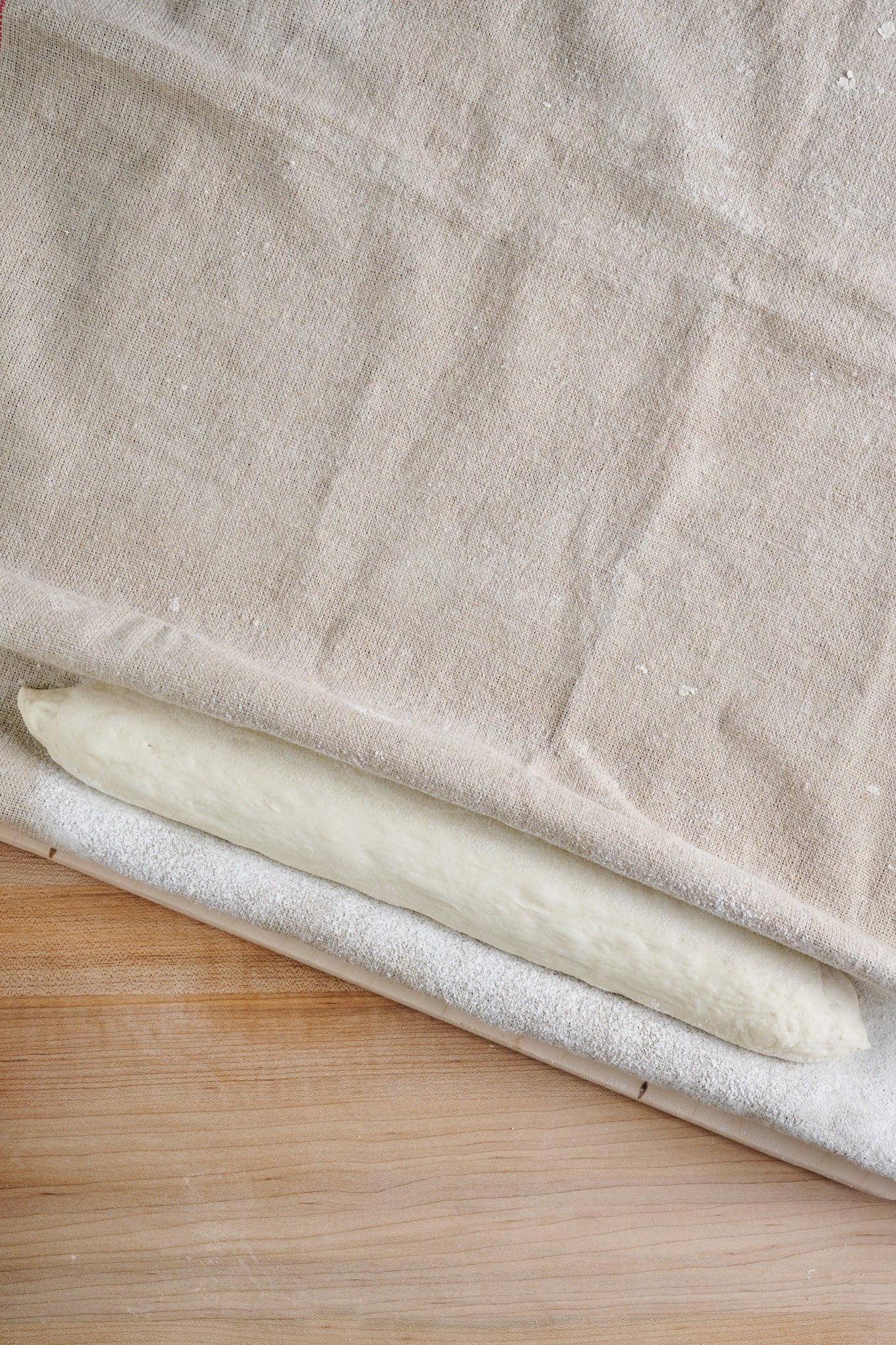
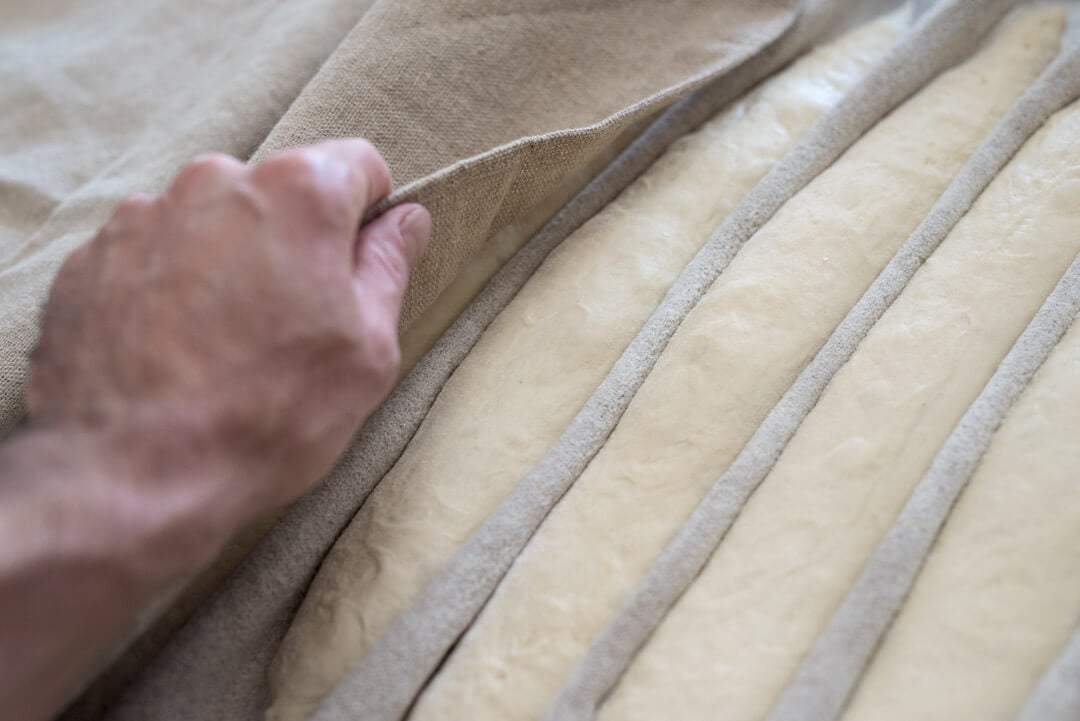
At one side, where you will start laying down shaped baguettes, roll a section so that it stands up by itself, creating a strong edge (see above). Then thoroughly and evenly dust flour on a 3- to 4-inch-wide strip down the couche, from farthest from you to nearest, where the first piece of shaped dough will sit.
After the preshaped rounds have rested for 35 minutes, shape each piece into a long baguette, approximately 14″ long for the home oven (or as wide as your baking surface).
Watch the quick video below for my step-by-step approach to shaping.
Once you’ve shaped a piece, place it in the flour-dusted channel on the couche, seam side up. Then, using both hands at the edges, pick up and drag a little of the couche toward the dough (like making a pleat in the couche) to form a matching wall of the channel to hold the dough while it’s proofing. Once the new wall is formed, it will look like the dough is nestled between two straight walls.
Flour a new strip down the couche on the other side of the newly formed wall in preparation for another piece of dough. Repeat this process for all the preshaped rounds.
Shaping baguettes requires practice through repetition (see my baguette shaping guide page for more instructions). Try not to get discouraged when shaping; take it slow and focus on one motion at a time.
8. Proof – 10:15 a.m. to 12:00 p.m.
Keep your proofing board away from drafts, as the dough can quickly develop a crust on the outside. It may help to drape the edges of your linen over the shaped baguettes or cover them loosely with plastic. If you cover it with plastic, be aware the dough may stick.
Proof the pieces until they pass the poke test, about 1 hour and 45 minutes at room temperature.
9. Bake – 12:00 p.m.
Preheat your oven to 450°F (230°C) for an hour with baking stone/steel inside.
If you only have one baking surface, divide the baking into two sessions. Bake three baguettes first, and chill the rest in the fridge for the second session.
Prepare a pizza peel with parchment paper matching the width of your baking surface.
Grab the end of the couche and pull it out, moving the piece of dough away from the rest. Then, using a dough transfer board (a smaller pizza peel or a small cutting board could also work), place the board inside the baguette (the side closest to the rest of the dough pieces). With the hand holding the couche, quickly flip the dough onto the peel by tugging up and slightly over the transfer board. The baguette should now be seam-side down on the transfer board.
Repeat until you have three pieces on the peel.
Score each baguette with three overlapping slashes (see below).
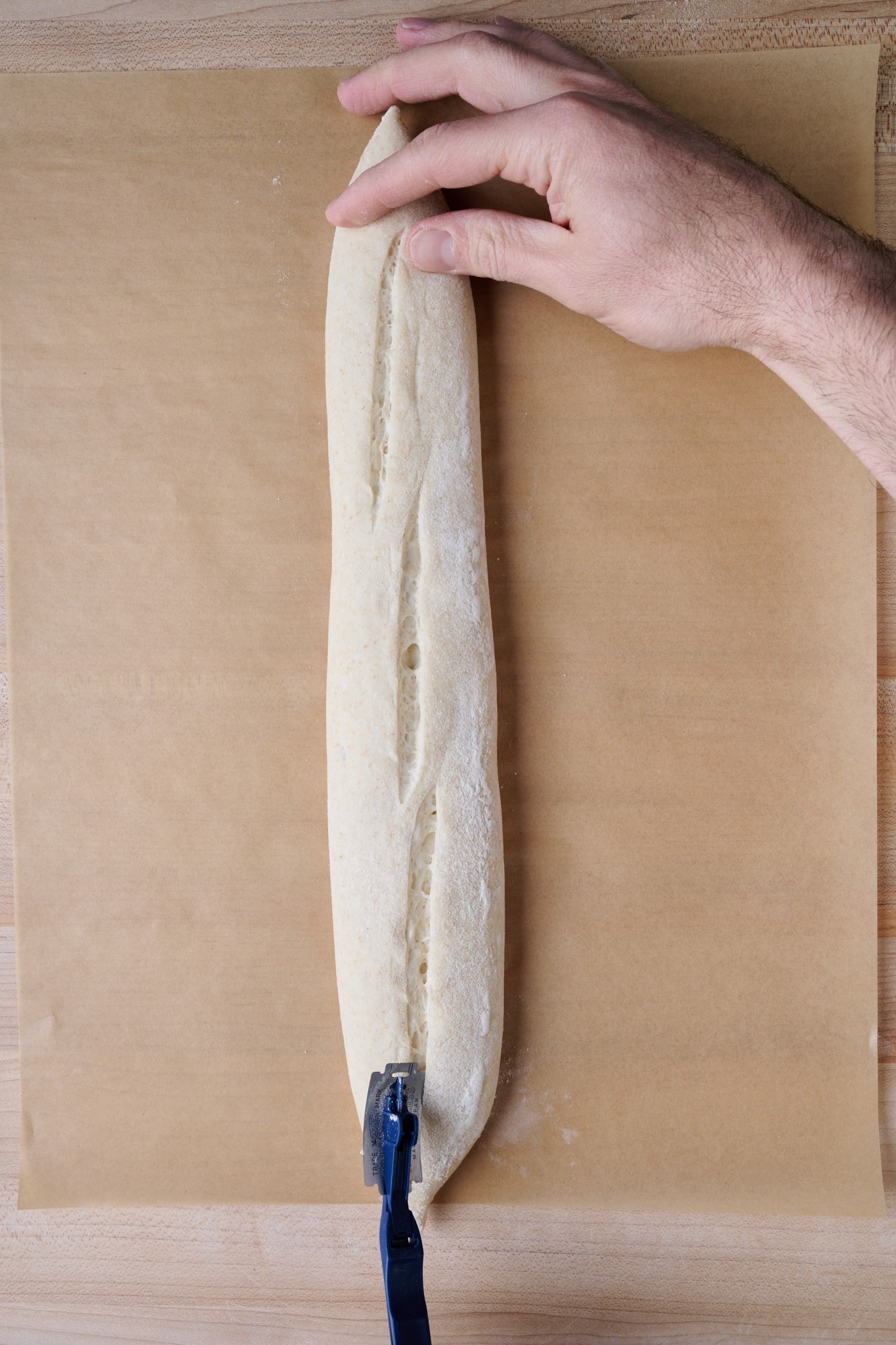
Transfer the dough onto the baking surface in the oven using the parchment paper. Next, steam the oven and bake for 20 minutes. Remove the steaming pans and bake for another 20-25 minutes until done.
Cool on a rack. Repeat the process for the remaining baguettes in the fridge.
I steamed my oven in my usual way, described here in my post on how to steam your home oven for baking.
Sourdough Baguette Recipe
- Prep Time: 24 hours
- Cook Time: 45 minutes
- Total Time: 24 hours 45 minutes
- Yield: 6 baguettes
- Category: Lunch, dinner, snack
- Cuisine: French
Description
These exquisite sourdough baguettes have a delicate wheaty flavor with malty notes from the caramelized crust. They’re perfect for breakfast (pan con tomate anyone?), lunch, or even just a snack with a spread of butter on top.
Ingredients
Levain
- 74g white flour (about 11.5% protein)
- 74g water
- 37g ripe sourdough starter, 100% hydration
Autolyse
- 1068g white flour (about 11.5% protein)
- 668g Water
Main Dough
- 57g water
- 21g fine sea salt
- 186g ripe levain
Instructions
- Levain (9:00 a.m.)
In a small bowl mix the Levain ingredients. Cover the jar and keep it at a warm temperature for 5 hours. - Autolyse (1:00 p.m)
In a mixing bowl, add the Autolyse ingredients until no dry bits remain. Cover the bowl and let rest for 1-hour. - Mix (2:00 p.m.)
Add the salt and levain to the top of the dough in autolyse and use a splash of the remaining water to moisten. With wet hands, mix thoroughly. Add the remaining water if the dough feels like it can handle it. Knead the dough for a few minutes using either the slap and fold technique or folds in the bowl until the dough smooths and becomes elastic. Transfer the dough back into the bowl. Transfer the dough to a bulk fermentation container and cover. - Warm Bulk Fermentation (2:15 p.m. to 4:45 p.m.)
This dough will require 2 sets of stretches and folds during bulk fermentation at 30-minute intervals. After the second set, let the dough rest, covered, for the remainder of bulk fermentation. - Cold Bulk Fermentation (4:45 p.m. to 9:00 a.m.)
After the warm bulk fermentation, place the covered bulk fermentation container in the refrigerator overnight. - Divide and Preshape (9:00 a.m., the next day)
Gently scrape the dough from the bulk container to an un-floured work surface. Divide into 325g pieces and preshape the pieces of dough into rounds (my preference) or rough tubes. Because the dough is cold and firm, very little bench flour is needed to pre-shape. Let the preshaped dough rest for 35 minutes, uncovered. - Shape (9:50 a.m.)
Prepare a couche and dust it with flour. Shape each piece of dough into a baguette shape. - Proof (10:15 a.m. to 12:00 p.m.)
Proof the pieces until they pass the poke test, about 1 hour and 45 minutes at room temperature. - Bake (12:00 p.m.)
Preheat your oven to 450°F (230°C) for an hour with baking stone/steel inside. Divide the bake into two sessions if you only have one baking surface. Bake three baguettes first, and chill the rest in the fridge for the second session. Prepare a pizza peel with parchment paper matching the width of your baking surface. Grab and end of the couche and pull it out, moving the piece of dough away from the rest. Then, using a dough transfer board (a smaller pizza peel or a small cutting board could also work), place the board to the inside of the baguette (the side closest to the rest of the dough pieces). With the hand holding the couche, quickly flip the dough onto the peel by tugging up and slightly over the transfer board. The baguette should now be seam-side down on the transfer board. Repeat until you have three pieces on the peel. Score each baguette with three overlapping slashes. Transfer the dough onto the baking surface in the oven using the parchment paper. Next, steam the oven and bake for 20 minutes. Remove the steaming pans and bake for another 20-25 minutes until done. Cool on a rack. Repeat the process for the remaining baguettes in the fridge.
Sourdough Baguette Recipe FAQs
Why are these scaled to 325g?
This dough weight makes for baguettes that fit my home baking surface at 14-inches long. It makes for a fatter baguette in the end, but one that’s perfect for the home oven.
Why is scoring difficult with baguettes?
One (of the many) reasons I like to do a cold-proof with almost all my other doughs is because scoring is much easier. When the dough is warm, it’s easy for your blade to drag and get stuck. My best advice is to use a new, super-sharp blade and make your cuts as smooth and fast as possible. If you notice you didn’t cut through the skin of the dough sufficiently in the first pass, lightly drag the blade inside the cut to give it a little help.
Why do cold bulk fermentation with baguette dough?
Doing two-day fermentation is a great schedule for home bakers (and pro bakers, too!), so I do like to use the fridge; it brings a little more flavor. This means you’d either have to do cold bulk or cold proof in shape. Doing the latter gives these a slightly thicker crust since the dough will be exposed to cold temps when they’re in their final shape. Therefore, I opt for cold bulk fermentation to keep a thin crust (it’s also easy to shape cool dough!).
What’s Next?
This sourdough baguette recipe results in exquisite delicate baguettes. The brittle crust grounds the eating experience and gives added body to the otherwise tender bread. It’s through this contrast that the bread is elevated to the next level—a baguette with a soft, flimsy crust would be a sad baguette indeed.
I’ve said it before, and I’ll probably say it a million times more: fermentation is a mysterious and beautiful thing. I hope you try this recipe and you show up to your next gathering with an armful of exquisite and incredibly delicious pointy sticks.
To continue with the baguette theme, try your hand at my green olive filoncini, which are kind of like an Italian version of baguettes‚ but twisted!
Or, if you’re looking for a large, crusty loaf, my sunflower and sesame sourdough has loads of flavor and are a go-to recipe when you want to impress.
Buon appetito!


458 Comments
Hi Maurizio!
Thank you so much for all of this great content! I was wondering if you could do a guide or video about the scoring of the bread or in particular these baguettes? Every time I’ve tried I have been unsuccessful… it seems like my razor blade sticks to the dough too often creating no score or just holes after baking.
Thank you!
Hey Mathieu! Scoring baguettes definitely takes practice — it’s one of the most challenging breads to score, in my opinion. I’ll add this to my to-do list for a post here, thanks for the suggestion!
Hey Maurizio,
just copying the recipe to my notebook, gonna give it my first try. I noticed a detail that needs correcting. In the sentence “In the image below you can see the top of my cold-bulked dough right when pulled from the fridge,” it should say “above” instead of “below” I believe, since below there are the pre-shaped rounds already.
Thank you for pointing that out, Martin! I’ve fixed it.
Maurizio,
I’ve tried this recipe several times now, and my loaves are beginning to appear similar to yours on the outside (good ears opening wide), but inside, the crumb still isn’t close to what you achieve. I have fewer, larger holes and the crumb itself seems too dense. Also, the crust itself seems somewhat too thick (but I’m not really sure how thick or thin it should be). Do you have any idea what might be causing these two issues? I did buy some high gluten flour which I intend to try next time (so far I’ve just been using all bread flour). Any suggestions?
thanks, Dan
Dan — that’s great! If you’re confident you have strong and sufficient fermentation in your dough it’s likely either the flour and/or mixing or your shaping method. Your flour definitely needs to be strong enough to support an open interior (there’s a balance here, though, if you use too much high protein flour I find the texture can be a bit too chewy — this is why I try to use as little of this flour as possible), and you also need to strengthen the dough enough as well. You could try kneading a bit longer or adding in another set or two of stretch and folds during bulk.
With regard to shaping, these require just enough handling to get them into the right shape, but not more. You want to be somewhat gentle with them. There’s a common believe with baguettes that you can either have a beautiful exterior OR a beautiful interior, not always both. I find a balance can be achieved, but it really takes practice. You could try practicing on a batch where you half with less intensive handling and half with your current approach. Then, compare the results and see if it is indeed shaping causing the dense interior.
Hope this helps — let me know what works for ya!
Thanks for the advice Maurizio! I’ll try those suggestions. One question: can you elaborate on what you mean by “less intensive handling”? I’ve watched various baguette shaping videos, including yours. I think I’m doing it the same way (they all seem fairly similar), but maybe I’m missing something.
You bet. I didn’t mean to say you were being rough on the dough, I just meant baguettes require so much practice to shape them just right; in my opinion they are one of the most, if not the most, difficult breads to make. Fermentation has to be just right, handling through the entire process, and then the final shape needs to be just sufficient to achieve a nice exterior shape without degasing at all. I’m confident you’ll get where you want to go, it will just take consistent practice and effort. I’m still working on my to be sure!
Nicholas:
1) I use water from my tap but it is filtered. As long as the water is drinkable it is fine to use, though.
2) Sometimes bursting at the bottom can indicate scores not sufficiently deep enough to direct expansion. If you’re also seeing dramatic oven spring with uncontrollable bursting it might be that they are slightly underproofed. It could also be a combination of the two of these things.
I hope that helps!
Hi Maurizio, I’ve tried searching through the comments to see if this question was already answered but is there something I could subsitute for the malted flour? I see people have added some kind of malt to their flours, but I am having trouble finding any kind of malt or malted flour. I typically use King Arthur Flours. What would you recommend? Thanks in advance!
Hey, Andie. You could use King Arthur All Purpose Flour which includes a small percentage of “malted barley flour” already mixed in — exactly what we’re looking for. Happy baking!
Good afternoon Maurizio…
I’ve made these baguettes several time in the last week, and I’d like to say I’m getting better at it. I’m certainly learning that the shaping is a critica step!
I have two ovens, one with baking steel and one with a baking stone and bake three baguettes in each oven. My oven temperatures are the same, but the loaves using the stone never rise as well as the ones using the steel. The difference is very noticable.
Is this somthing I can work around with temperture or humidity changes? Or might it be something I’m not noticing having nothing to do with baking surface?
Thanks in advance,
David
Hey, David! Sorry for the delay. It might simply be due to the fact that the steel is getting hotter, helping that initial oven spring. There’s definitely a reason why professional bakeries have ovens with thick, heavy decks that are able to store and transfer quite a bit of heat. I definitely see better results using a Baking Steel!
Thanks. I went ahead and ordered another baking steel for the second oven.
Fantastic recipe – followed precisely, including reviewing the linked pages, videos and images. Was very satisfied with the result. Crust, crumb, and flavor exceeded all my expectations.
Thanks for that update, Brian! Glad to hear my recipe and process worked out well for you. Happy New Year and happy baking!
Made this a few weeks ago and it turned out lovely. For some reason I couldn’t get the dough to take shape by hand when I mixed the autolyse, starter, water, and salt together. My stand mixer saved the day.
Right on Aaron, glad to hear that! It probably would have come together eventually, sometimes it just takes a little extra time mixing. Perhaps holding back some more of the water when hand mixing would have also helped. Either way, happy to hear they turned out great. Enjoy!
I found that dissolving the salt in the 100 grams of water helped distribute it better… first time I baked this there were some very salty spots
Yes, that’s a great approach as well!
Made these today. The crumb was glossy, but not as open as i hoped. and they didn’t puff up as much. is that because of the flour i used (all king arthur bread flour)? it was also quite sticky, even after the cold fermentation.
Awesome! I find the open interior of these really comes down to strong fermentation, proper handling (shaping), and flour choice. KAF BF should work but it might be a bit too strong of a flour for baguettes. I’d recommend you do 50% KAF AP and 50% BF and see if you get an improvement, if you do then you could continue to add more AP flour and see how that works.
My baguette dough is a little on the wet side compared to other recipes and this is why the dough might feel a little sticky. You could try reducing the hydration 3-5% and see if that helps.
Also be sure you have strong signs of fermentation in your starter, levain, and the dough. If your dough is not sufficiently fermented you could end up with a dense, gummy baguette.
I hope this helps. If you try this again take photos of the result and send them over if you’re still having issues — I’ll do my best to help. Happy baking!
what ts mature liquid starter in the leaving? there is no recipe for it above, please let me know
“Mature liquid starter” is a 100% hydration sourdough starter that’s ripe/mature and ready for a refreshment. See my instructions on creating a sourdough starter to create one!
Hey, I’d like to ask for some advice. I’ve tried my hand at making baguettes for a while now, and while I’ve had no trouble making regular sourdough boules or even brioche, my baguettes always turn out flat. I followed these instructions pretty much to the letter, but they still completely deflated after shaping and proofing. The taste was phenomenal, but they were rather dense and unimpressive-looking.
Is this an issue with the shaping? Should I do more folding (I usually fold and shape about as much as you did in the video)?
The lack of bubbles implies ineffective rising, so should I have it in the fridge longer? Or allow it to ferment at room temperature for a couple of hours before putting in the fridge (which is how I usually make bread, except I shape them before putting in the fridge, while people seem to always shape baguettes right before baking).
Any help would be appreciated.
It might be that your dough is over proofed, not strong enough (as you guessed), or not shaped sufficiently tight. I don’t like to place shaped baguettes in the fridge because I find they get a slightly thick crust if proofing this way overnight, I like to shape them, proof, and then bake.
My guess would be your dough might be going over, especially if you see a dense interior with little to no rise. I’d have to see pictures with more information to give you concrete advice, though!
Great recipe, Maurizio! I followed all instructions, but used 120g whole spelt and 30g rye flour. They came out wonderfully, although your scores opened up way more than mine (as usual). Even so, the loaves disappeared quickly.
Right on, Dan! Glad to hear that. I haven’t played with rye flour in baguettes much, but I’m a huge fan of spelt — I try to sneak some in everywhere I can 🙂
The lack of spring in the scores could be shaping, proofing, or the actual scoring. You could try cutting back that final proof time 15-30 mins and see if they pop a bit more.
Enjoy!
Hi there, Thank you for sharing your baking tips which I have referenced. My baguettes came out looking and tasting great this morning although a bit too sour by my taste. It’s probably because my sourdough starter was not active enough. It was super active when I mixed it with the dough mixture. They ended up sitting on the kitchen counter proofing for 15 hours before I can shape it. Originally I intended to do the warm bulk fermentation but I waited and waited and decided to leave it on the counter when I went to bed last night. I wish I can send you a picture of them. they really look great.
I would like to have some quick tips for making it less sour. I could only achieve that by using yeast to increase the proofing time and I know it kills the purpose of using sourdough. Thank you!
Hey, Jennie! It sounds like your dough might be undergoing fermentation for too long. Try to use your starter and your levain when they are ripe, then stick to the timetable I have outlined in the post above — this should lead to baguettes that have just the slightest hint of sourness (which I love). If your dough proofs for too long, even if it’s at cold temps, acidity can build up in the dough creating a more sour flavor profile. Let me know if that works for you!
Hi Maurizio,
I’m glad to report that I’ve managed to make a batch of NOt too sour baguettes with purely my sourdough culture, by using very active starter. My rough measurement:
Starter~
– around 1.8 cup of active sourdough levin (all purpose flour, water and sourdough starter)
– 2.5 cups of all purpose flour
– 0.25 cup wheat gluten
-0.25 cup semolina flour
– 1 tsp of salt
– 1.5 cup of water
It yields me 4 x 250g baguettes (roughly)
Thank you again.
PS> I have replaced semolina flour with rye flour. It’s equally good.
Hi Maurizio, Regarding the malted flour, you use it often in your recipes. Is it necessary? If not is there a certain flour that would be a good substitute? I did notice someone added diastolic malt to their flour. What does the malt do for the fermentation and the bake?
Thanks
It’s not necessary but I find it helps with dough undergoing long fermentation times. I’ve found diastatic malt to help bring nice coloring to the crust (due to increased enzymatic activity in the dough) and increased fermentation activity. However, it’s not 100% necessary, your baked goods will still turn out great without the malt.
Hello! Do you think I could push the cold bulk fermentation to 34 hours? I know the sourness may increase but other than that what are your thoughts? I’d like to fit this into my baking schedule but I need to increase the cold bulk fermentation time to do that. Thanks!
It’s hard to say, it really depends on your particular batch of dough. 36 hours would have me worried, but it’s certainly worth a test to see how they turn out! Likely they’ll turn out just fine, perhaps with a bit more acidity as you said and also a slightly reduced rise in the end — they’ll still be delicious 🙂
Maurizio Sourdough Baguettes.
My main goal for this bake was to
replicate this recipe without a sour starter; using a negligible amount
of commercial yeast. On that front, it was a great success.
The bake:
In a desperate effort to save this bake, I brushed the loves with
copious amounts of water, just before loading. Slashing was a complete
fail. My razor was sticking to the dough. I was lucky not to have the
loves split. The loaves were cooked at 500F with steam for a straight 40
min. I did not bother to vent the steam. At this point, my faith in my
baking prowess is restored! While far from a grand success, a very
respectable first try. I was even able to achieve a few small blisters!
Thanks for this recipe Leo. You inspired me to get a sour starter up and running! I am going to blog this bake. For now if your interested I posted a photo of my results. Of course I linked to your site for the recipe!
https://goodcookingfortheheartandsoul.blogspot.com/2018/08/sourdough-baguettes.html
Best regards,
The Roadside Pie King
You had me worried there for a bit, Will! Glad to hear things turned out well in the end. Yes, scoring warm dough can definitely be a challenge, especially with this dough which can be a little “wet” for baguettes. Your baguettes sure look great, a nice job I’d say!
Thanks for posting that update and happy baking!
Thank you for the vote of confidence, Leo! I finished my photo journal for the entire bake. From Poolish to cutting board. I am no Fellini, however, I am liking the result! https://goodcookingfortheheartandsoul.blogspot.com/
I’d say you did an awesome job — they look great!
Do you think it’s possible to freeze the dough in portions after the cold fermentation and then shape/cook individual baguettes?
It’s possible but I fear you might see a reduction in rise in the oven. The freezer tends to have adverse effects on natural leavening, but I’m sure you’d still see some rise as long as they weren’t in the freezer too long…
Maurizio,
Just wanted to thank you, This website has guided me on my sourdough journey from the beginning. I never want to use commercial yeast again XP. I work at a research facility in the rocky mountains where my team feeds a hundred people three meals a day, so I’ve been doing your recipes X6 or X8, everyone is a big fan and i found my new favorite food hobby! Anyway, my baguettes are in the final proof right now. My starter’s name is “Seymour”. That is all. Peace and Love
Right on, Ben! That’s quite a bit of bread feeding lots of people — I love that! Glad I could be a (small) part of that, somehow 🙂 Hopefully the baguettes turned out great for you, they’d be awesome for a large meal like the ones you host; there’s no doubt they’ll all be eaten in a single sitting. Here’s to many more awesome bakes for you and Seymour 🙌🏼
These look incredible, next family gathering I’m going to have to make these.
Thanks! Let me know how they turn out for ya — so delicious 🙂
Great looking bread! I’ve got a batch of it bulk fermenting now.
Question about your Baker’s Percentages: why isn’t the amount of flour in the starter (the seed starter that is used to inoculate the levain) included in the overall flour calculations? I see that Hamelman and the BBGA also don’t include it, but from what I gather, Hamelman removes an amount of the final levain (to perpetuate it) equal to the amount of seed he used, so there’s no net effect on the overall amounts. But that’s not the case with your recipes (same with mine — I build a levain for each use). You could argue that it’s a negligible amount, but if I use more or less seed starter, that does affect the overall amount of pre-fermented flour. For example, you use 47g flour and 47g seed starter for your levain. Your overall formulas only take the 47g of flour into account. But if I use only half the amount of seed starter (23.5g) to extend the time until levain maturity (like you suggested as an option), that changes the flour added to the levain build to 58.75g. Wouldn’t it be better to include the seed starter in the overall formula? Then you’d have 70.5g of total flour in the levain (141g levain total at 100% hydration, so 50% = 70.5g), so however you adjust the seed starter amount, the total recipe formula stays the same?
Just trying to see if I’m missing something here… not trying to troll. Honest.
Right on, Steve! I’ve been making these so often these days, they’re so good.
That’s not a troll question at all, it’s totally valid. I accidentally left out my starter row in my Total Formula table above, I added it in just now for clarity (thanks for spotting that, this is the first time I’ve included that table). Yes, if one were to adjust the levain build for this bread they’d technically have to adjust the rest of the flour amounts to compensate (there would be more or less flour in the levain, thus more or less needed in the final mix). My suggestion was more of just an off handed one, saying what is possible. I should probably clarify that the flour would have to be adjusted to suit.
When I do my calculations (I adhere to the Bread Baker’s Guild of America guidelines and table structure) I do take all the flour used into account, so the total weight of levain is important. Even if it’s a rather small levain, as is the case with this formula, when you scale things up and start adjusting the levain you’ll have large discrepancies that do need accounting for.
Thanks again for pointing all this out, I should be a little more clear when suggesting modifications. I hope the bake turns out great, let me know how it goes!
Thanks, Maurizio. I see that the BBGA guideline/format has the seed starter listed as its own line item in the total formula, but I’m still not sure why they don’t use the components of the original seed starter for calculating things like overall hydration (unless you’re in a production environment where the amount of seed starter you put is then taken out for the next batch). Do you know why? If I use a massive amount of seed starter for batch #1, and a tiny amount for batch #2, but the total levain used in both are the same, the overall hydration calculations (according to the BBGA guideline) would be different. I’m sure I’m missing something here.
Got another question, if you don’t mind… I just divided my baguette dough after bulk fermentation, and this is the first time I’ve weighed the portions (usually I just divide the dough evenly into whatever quantity I’m after). I weighed out 5 baguettes at 350g. Then, the remaining portion was only 250g! I freaked out for a bit, going back over my notes to see if I’d left out 100g of water or something, but the hydration seems right. Could there really have been 100g of evaporation through the mixing, kneading, and (overnight) bulk fermentation?
OK, baguettes shaped and proofing. Time to get my oven ready! Thanks again for the great site. And insight.
Steve — my tables and the BBGA do take the hydration of the levain into account, but yes, it doesn’t typically take the seed starter hydration into account. I’m actually not sure why they’ve chosen to leave that out (it might be a good question for someone over there!). For all of my recipes here it’s usually a really small percentage of the overall hydration and I feel like it can safely be ignored (especially since my levain percentages are typically really small), but I agree, at scale it likely could cause issues.
If I were to open a bakery and had hundreds of loaves to bake each day I’d likely create a new spreadsheet that took starter hydration into account.
Re: your baguette question: usually there’s a slight discrepancy when you get to the end of dividing — either you’re a bit over or under (in your case). There’s definitely going to be some “loss” during production, whether it be the bits of flour left in the bowl, on your hands, in the mixer, or in the bulk container, but 100g is quite large. Is it possible there was an error in scaling?
One thing you can do to remedy this is to scale things up slightly so you over produce, perhaps by 50g, to offset any issues like this. I’m almost always left with just enough to eek out that last-divided piece, sometimes it’s a bit under. I do make sure to keep my mixing bowl, hands, and bulk container as clean as possible when moving the dough around, the benefit here is two-fold: first it means less dough in the trash/sink and makes cleanup easier, and second, we hit our desired divisions as close as possible. It’s rarely ever spot on, though!
Hopefully this helps. Great questions and observations!
Maurizio, in step 2 you are saying to add the flour and the 100g of water. that cause chunks of flour to developed that are hard to get rid of after you add the rest of the water. What am I doing wrong?
In step 2 you should be adding all the flour and all the water except 100g of water (reserve this water for mixing, later). If you find the mixture is overly dry, use some of that reserved water until it’s manageable — it’s possible your flour needs additional hydration than what I am using here. And that’s just fine!
Thanks you! sorry, I missed the word “but”…..oh man. Anyway, everything is stable now. soon the dough is going to the fridge for the cold fermentation. Next week I will be more careful.
I used the the process you gave but subbed “pizza flour” instead because I was too impatient to get the fancy flour! I noticed the word “malted” in the flour you used, so I added a couple of tablespoons of diastatic malt to the flour for my dough. Turned out good flavor-wise https://twitter.com/angelotrivelli/status/1024966970553319424, but my shaping needs work and I got to stop using scissors for scoring. Thanks for all the inspirational writing and pictures, Maurizio!
I am transitioning a batch of levain to make these tomorrow! Have you considered using baguette pans like these: https://www.kingarthurflour.com/shop/items/baguette-pan? I was thinking to use parchment paper to line the pan and then remove it half way through the bake. Seems like an easier transfer method. Your thoughts?
Excellent! I’ve seen those pans and they could work really well, I just haven’t had a chance to try them out. They won’t get the thermal shock of hitting a super hot baking steel or baking stone, but I bet they would still bake up really nice!
Thanks, Tim! After years of baking on granite, metal, and walnut wood I finally found the perfect surface: the maple wood board I use today (and what you see in the photos here). This board is a large maple board from Boos Block and it’s just perfect. I’d highly recommend seeking one out online, you’ll be amazing at how good of a surface it is. I can’t remember the website I bought it at, but I believe it was https://www.cuttingboard.com/.
Hope that helps and happy baking!
Yes, it’s the biggest one they offer. You might be able to find another brand that’s local to you. Boos Block is a really popular manufacturer of blocks here in the USA and are readily available (although not really cheap by any means). I hope you find one and happy baking, Tim!
Yes, I use Boos Block Mystery Oil to oil the surface a couple times a month or so, depending on how dry it gets. I gently scrape it down to remove any caked on dough, then wipe it down with a towel and water. After that dries, I apply the butcher block oil and wipe it off after a few minutes. Looks brand new after!
Tim, have you been able to find the one in EU?
Thanks so much, Marisa! You’ll love working with your sourdough starter — so much potential! Happy baking 🙂
Staggeringly beautiful… only understood about half of the instructions but I guess something to aim for! 😀
Thanks, John! Perhaps this post did get a little wordy… They’re challenging but after you do it once or twice you’ll have the process down pat. Happy baking!
Brigitte, I’ll send some flour back with my parents next time they’re down here for a visit.
A video of how you move the loaves from the proofing board to the oven would be great!
Ah yes, that’s a great idea. I’ll have to take one and add it to this post and my baguette shaping guide!
I look constantly at pics of your sourdough and can’t help but admire the beautiful crumb re: open crumb. I’ve been making sourdough for about 4 years now and feel I’ve mastered the techniques but a very open crumb eludes me. Do you have any tips please? I source my flour from a local baker its 12.3 protein and I’ve been baking your beginners bread lately to the exact recipe!
Hey, Patti! That sounds like great flour, which is very important, of course. The best advice I have on the topic would be to really ensure your starter is ramped up and very active. From there, the dough needs to be equally active and alive by the time you go to shape. You want as much fermentation activity in there as possible.
From there, it’s very important to have a gentle hand when shaping. You want to impart just enough structure on the dough to hold shape until bake time, but not so much it can’t relax and expand out when rising in the oven. The more you handle the dough, the more dense the interior. A balance.
There’s so much that goes into achieving a uniformly open interior, but these are the two I focus heavily on!
Thank you very much for your reply, shaping may be my problem, I like the Batard shape. I will endeavour to handle the dough less. Thank you so much for your advice and keep posting those wonderful pic of your bakes….they are amazing ! 😊
“really ensure your starter is ramped up and very active”
Maurizio, How often do you feed your starter?
I feed 2x a day when kept around 76-78°F.
Lovely baguettes, congratulations.
I’ve been doing the same for the last year or so, perfecting my technique and yes, it is a challenge. What I’m still not fully happy with is horizontal wrinkling appearing on the bottom of my baguette. As I have not much choice if it comes to flour, I bake only with strong 13% protein flour.
Thanks for sharing, happy baking Maurizio.
Thanks, Lukas! These take quite a bit of practice, indeed. That’s quite a strong flour, if I were working with 100% high protein flour I’d extend the autolyse time longer than 1 hour and likely push the proof longer and longer until the dough started to feel just right. One of the challenges with these is when the dough is too elastic — they become hard to roll out, always wanting to snap back. The longer autolyse and increased proof would likely help with that issue.
Have fun!
Sorry to hear that, Brigitte! Maybe you can email the miller for specs on the flour? I know many millers here in the USA are happy to share that info if they don’t already. You might also be able to find King Arthur flour where you are, if so their All Purpose would be a great substitute! In any case, have fun and enjoy 🙂
So pretty! That crumb is absolutely amazing! I might just try these at the beach when we go in September for whatever meal I’m cooking….haven’t given it much thought yet. A luscious soup or past dish with a deep, rich sauce are playing in my mind. Both Myrtle and Essie are prepped (I dried them and they’re in my pantry in jars) to travel.
Thanks, Gina! Baguettes are so, so perfect for beach-side sandwiches — now I just need a beach! Soup would be fantastic, too. I’ve been eating them with stews here and they go so well, no toasting required. Have fun on you travels and let me know how the baguettes turn out 🙂
This arrived in my email box as I was eating a “baguette” from Wegmans, wondering how they are able to get away with calling it a baguette. Looking forward to giving your recipe a whirl.
Hah! I can attest to the rather sad looking baguettes here at our local stores as well… That’s one reason I started baking in the first place! Have fun and happy baking 🙂
Be still, my heart…I’ve been waiting for you to give us a sourdough baguette. I have my own version, but picture me leaping to refresh my starter, because I will be giving yours a spin tomorrow! Here’s a suggestion for avoiding any drying out when proofing the loaves in the couche: Overturn a rectangular plastic bin to cover the couche and proofing board. This is the kind of bin you’d buy at a big-box store, with a lid, about 16″ x 23″ footprint and 6.5″ deep. In winter, I put a little cup of warm water inside for some moisture. If you get a perfectly clear bin, you can monitor visually, and no need to drape with linen or plastic wrap. Thank you, as always, for taking sourdough to a high art form!
Great idea!
Brilliant.