

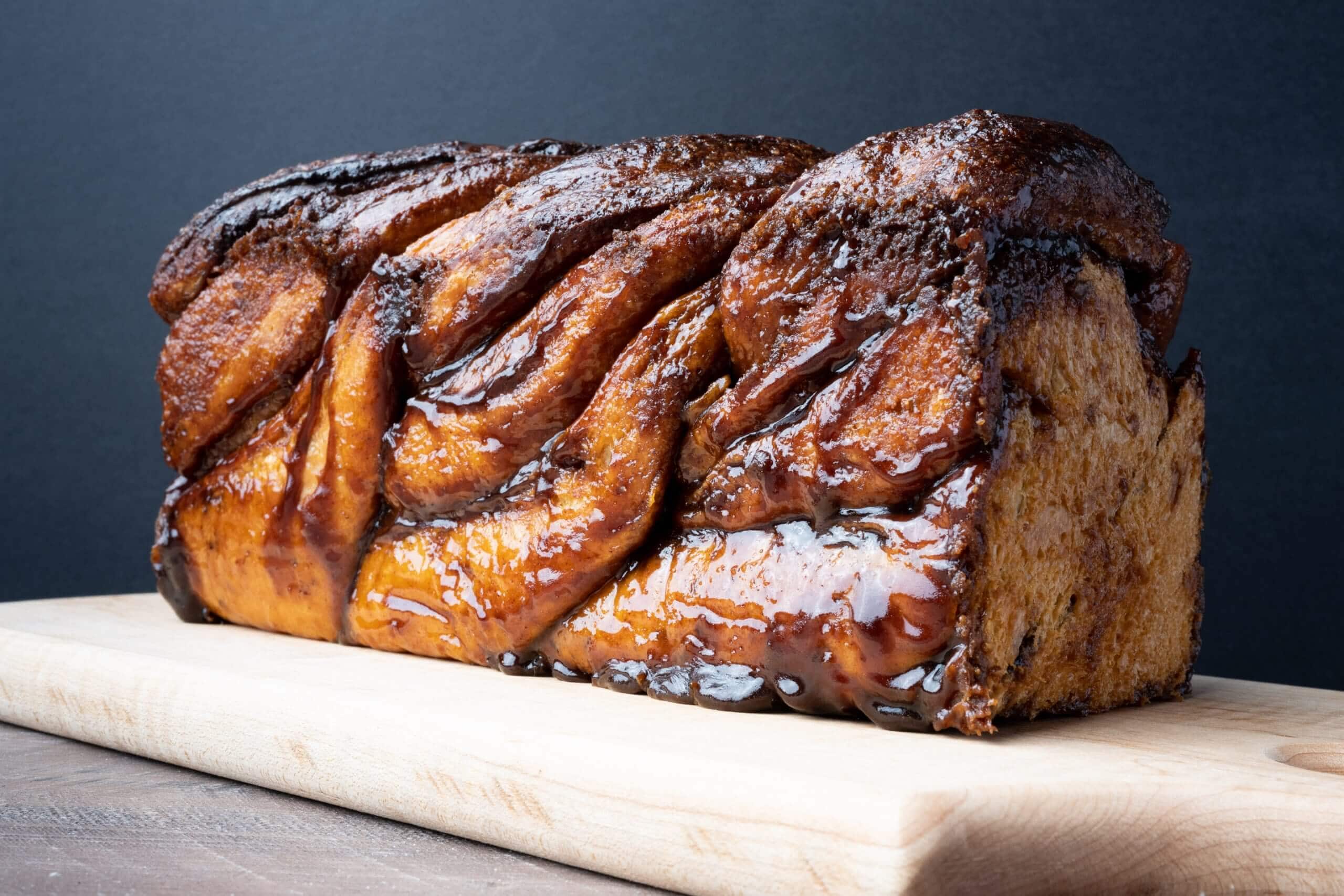
Right now, I’m front-row seat at the best kind of concert: ogling at the twisted cacophony of an enriched naturally leavened dough with sharp cinnamon and warm brown sugar (or chocolate, read on), all topped with a luxurious, simple syrup. This sourdough babka is sitting there cooling on a wire rack, but I swear I hear it singing. If there ever was such a thing as too much anticipation, right now surely qualifies; it’s as palpable as any musical instrument in an empty music hall. And I’d pay a hefty sum to cut in, take a bite, and end the concert a little early.
But let’s be completely clear: this is a sticky, gooey, and sinfully delicious treat.
I’ve stepped up my baking research and development for this babka to get this recipe out after the enthusiasm displayed on my recent Instagram post. This dough is straightforward, playing at not quite the enrichment level of brioche (or my cinnamon rolls), but not precisely lean, either. I feel it’s just right: not cloying, not overly rich, and certainly not dry or under-flavored. And while it unquestionably looks drenched, the interior is not—the interplay between the crust and crumb is wonderfully balanced.
But let’s be completely clear: this is a sticky, gooey, and sinfully delicious treat.
And the timing for making something like this is perfect; right now, we can all use a little joy, a dab of sunshine through the clouds, the sweet, tangible canto of a sourdough babka (with all of its buttery deliciousness) humming to itself on a cooling rack.
Sourdough Babka Recipe
Equipment
Pullman Pan
This recipe will work with many different pans, but I eventually turned to my trusty 9 x 4 x 4-inch Pullman Pan in testing. The reason is twofold: I love the resulting straight-sided and presentable sourdough babka. Second, the USA Pan has a natural silicone lining, which, combined with parchment paper, makes cleanup a snap.
If you don’t have a Pullman pan, a typical 8.5 x 4.5 x 2.75-inch loaf pan will also work well.
Rolling Pin
You’ll need a standard rolling pin/dowel to roll out this dough, and this rolling dowel is my favorite (and made in the USA).
Vitals
| Total Dough Weight | 800 grams |
| Pre-fermented Flour | 13.0% |
| Yield | One babka |
Total Formula
Desired dough temperature: 76°F (24°C) (see my post on the importance of dough temperature).
| Weight | Ingredient | Baker’s Percentage |
|---|---|---|
| 357g | All-purpose flour (11-12% protein; King Arthur All-Purpose Flour) | 100.0% |
| 107g | Whole milk (cold from the fridge) | 30.0% |
| 107g | Large eggs (about 2, cold from the fridge, plus one more egg in reserve for the egg wash) | 30.0% |
| 100g | Unsalted butter (Kerrygold; room temperature) | 28.0% |
| 46g | Water | 13.0% |
| 29g | Caster sugar (superfine white sugar) (if you don’t have caster sugar, use the finest sugar you have) | 8.0% |
| 8g | Fine sea salt | 2.3% |
| 46g | Sourdough starter (100% hydration) | 13.0% |
Instead of All-purpose flour, feel free to use high-protein white flour (“bread flour”) in its place if that’s all you have in your pantry.
Sourdough Babka Method
1. Levain – 10:00 a.m. (or when your starter is ripe)
In the morning, mix the following in a small jar:
| All-purpose flour | 46g |
| Water (warm) | 46g |
| Ripe sourdough starter, 100% hydration | 46g |
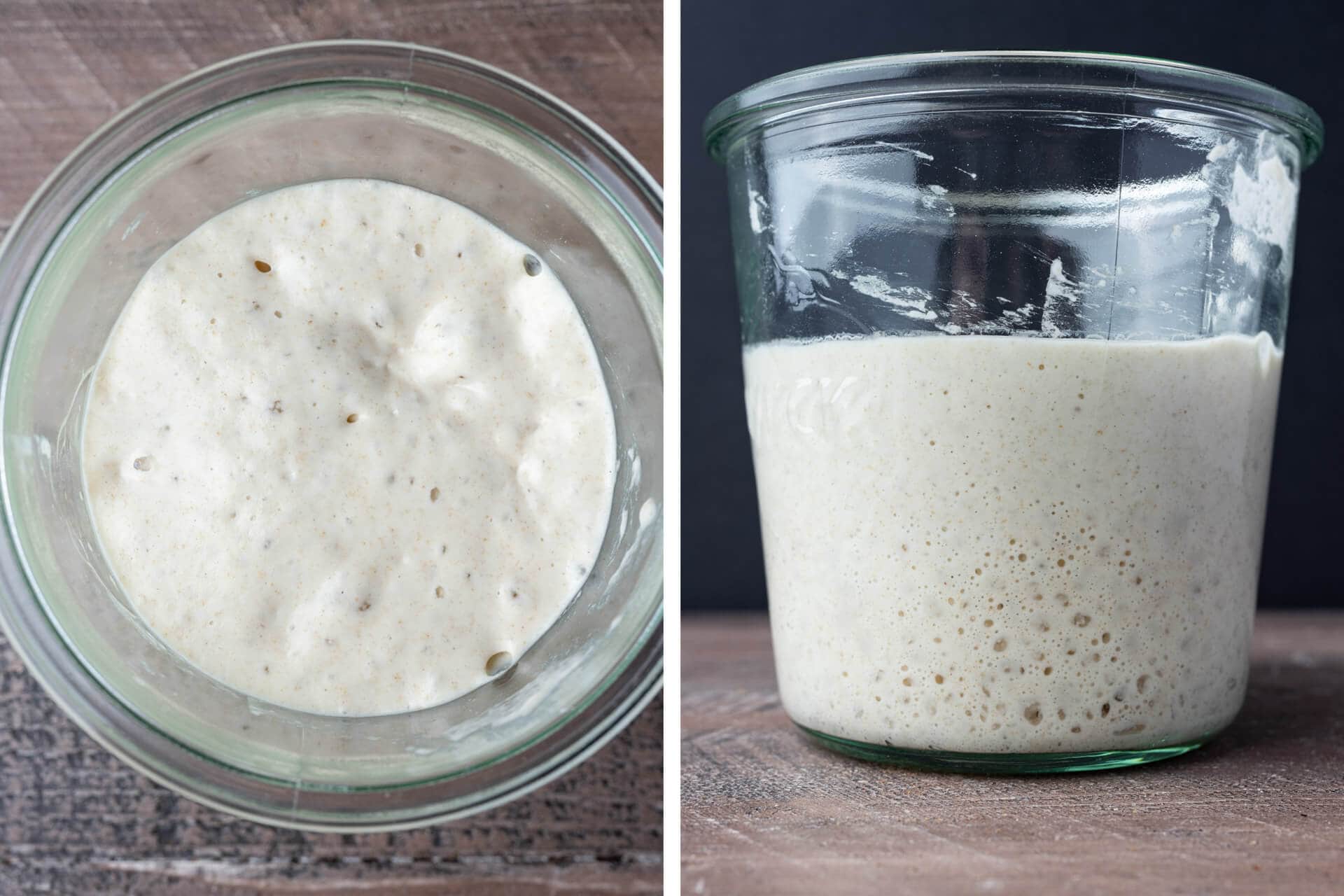
Loosely cover the jar; it should be ready after about 3 hours at a warm temperature, 78-80°F (26-27°C). If it’s cold in your kitchen, warm the mixing water for this levain to get close to 80°F (27°C) (see my post on baking in the winter for more tips).
If you’re new to making a levain, see my post on the differences between a levain and sourdough starter.
2. Mix – 1:00 p.m.
| Weight | Ingredient |
|---|---|
| 310g | All-purpose flour (11-12% protein; King Arthur All-Purpose Flour) |
| 107g | Whole milk (cold from the fridge) |
| 107g | Large eggs (about 2; cold from the fridge) |
| 100g | Unsalted butter (Kerrygold; room temperature) |
| 29g | Caster sugar (superfine white sugar) |
| 8g | Salt |
| 138g | Ripe levain |
First, cut the butter into 1/2″ pats. Set them on a plate to warm to room temperature.
I used my KitchenAid stand mixer to mix this dough. To the bowl of a stand mixer fitted with the dough hook attachment, add the flour, milk, egg, half of the sugar, salt, and levain. Set the mixer to low and mix until everything is incorporated. Let the dough rest, uncovered, for 10 minutes.
After the 10 minute rest, turn the mixer up to medium and mix for 5 minutes until the dough starts to pull from the sides of the mixing bowl. At this point, slowly stream in the remaining sugar while the mixer is running. Mix for another 1-2 minutes until the dough comes back together.
With the mixer still set to medium, add the butter, one pat at a time, waiting to add the next until the previous is absorbed into the dough. It might take around 5 minutes to mix all the butter into the dough. After all of the butter is added, continue mixing for another few minutes until the dough smooths out and once again begins to cling to the dough hook. The dough should be almost fully developed at this point (it won’t completely pass the windowpane test, but almost).
Transfer the dough to a container for bulk fermentation and cover.
3. Warm Bulk Fermentation – 1:30 p.m. to 3:30 p.m. (or longer, as needed)
At warm room temperature, 74-76°F (23-24°C), this portion of bulk fermentation should take 2 hours. During this time, give the dough two sets of stretches and folds where the first set is 30 minutes after the beginning of bulk fermentation and the second set is 30 minutes after the first. After the second set, let the dough rest, covered, until the next step.
4. Cold Bulk Fermentation – 3:30 p.m. to 8:00 a.m. (next day)
Assess the dough: has it risen a little in the bowl during the warm bulk fermentation? It should be a little puffy and smoothed out. If it looks like there’s no activity at all, give the dough another 30 minutes to 1 hour and check again.
Once you see some rise in the dough, place the covered bulk fermentation bowl into the refrigerator overnight.
Same day option: Let the dough finish bulk fermentation for 2 to 3 hours on the counter. When the dough has risen around 50% and feels puffy, proceed with the rest of the steps below. However, I recommend placing the dough in the fridge for at least 1 hour after this warm bulk fermentation to chill to make rolling and filling easier.
5. Roll, freeze, cut, and shape – 8:00 a.m.
Before taking the dough out of the refrigerator, make one of the fillings below and keep covered.
Brown Sugar Cinnamon Filling
| Dark brown sugar | 200g |
| Unsalted butter, melted | 42g |
| All-purpose flour | 15g |
| Ground cinnamon | 8g |
| Salt | 1/4 tsp (small pinch) |
Mix all of the ingredients above in a bowl and cover until ready to use.
Chocolate Filling
| Granulated sugar | 110g |
| Unsalted butter | 75g |
| Bittersweet chocolate, chopped | 70g |
| Unsweetened cocoa powder (Dutch-processed) | 25g |
In a medium saucepan, melt the butter. Remove from the heat and add the sugar and chocolate; stir everything together while the chocolate melts until everything comes together and smooths. Add the cocoa powder and stir to incorporate. Set aside to cool until ready to use.
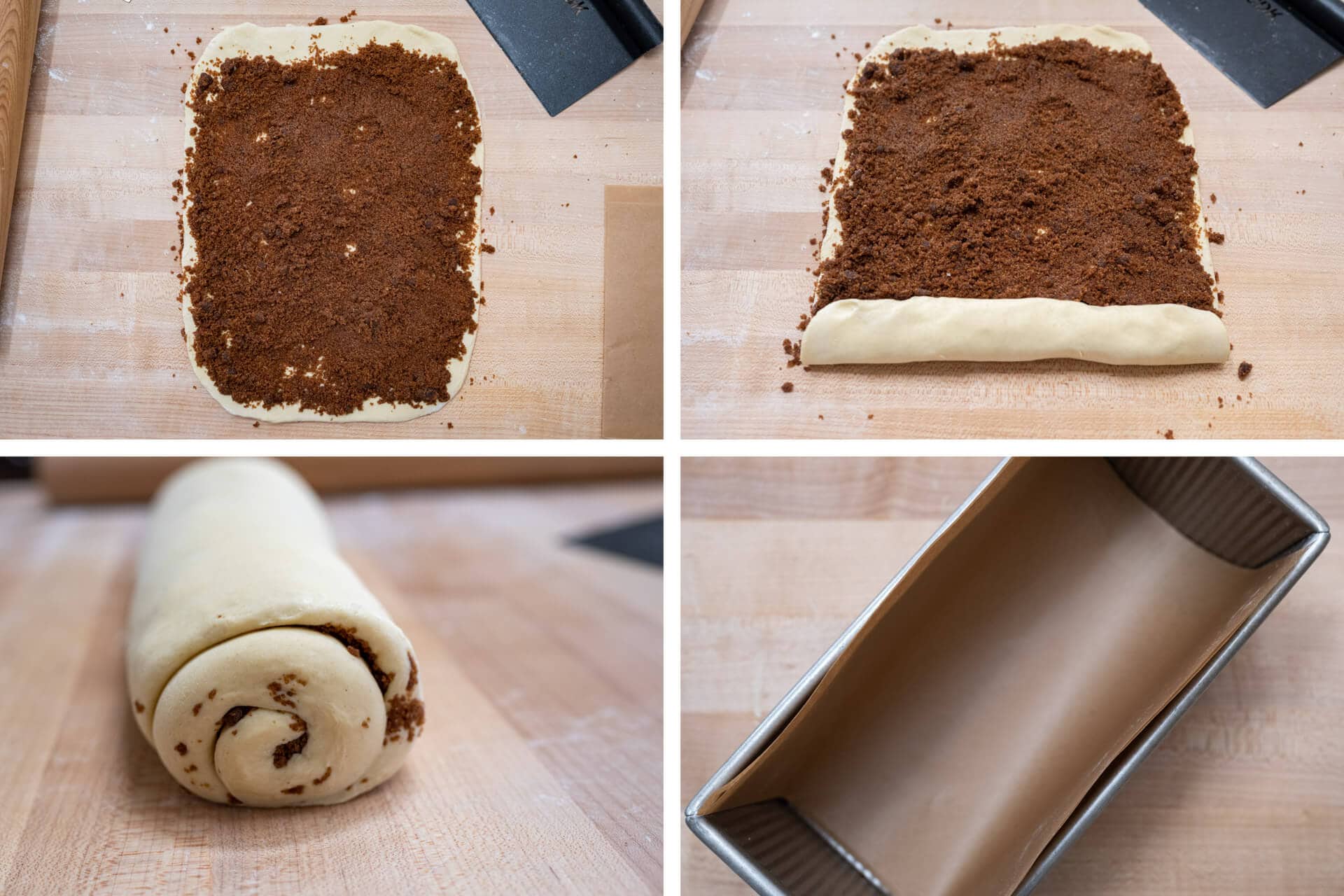
In the morning, take the dough out of the refrigerator and scrape the dough out to a floured work surface. Flour the top of the dough, and using a rolling pin (or dowel), roll the dough out to a rectangle approximately 10″ x 24″ in size (if you want fewer layers and more filling pooled between them, roll to 10″ x 12″, instead) in size with a short edge closest to your body.
If you want a less-sweet, less-sticky babka, spread less filling over the rolled out dough.
Using your hand or an offset spatula, spread the filling over the dough, leaving about 1″ clean on the short side farthest from you. Then, starting at the side closest to you, roll up the dough into a tight cylinder. The dough needs to be rolled up rather tight, so pull the dough at each revolution of the cylinder.
Important: Place the rolled-up log on a baking sheet and place it into the freezer for 15 minutes (this makes it much easier to cut and braid).
Prepare your baking pan by inserting a piece of parchment so two “handles” stick up at the long sides of the pan (see photo above). The parchment will drape down one long side, over the bottom, and up the other. Once it fits, take it out and place it on the counter next to your pan.
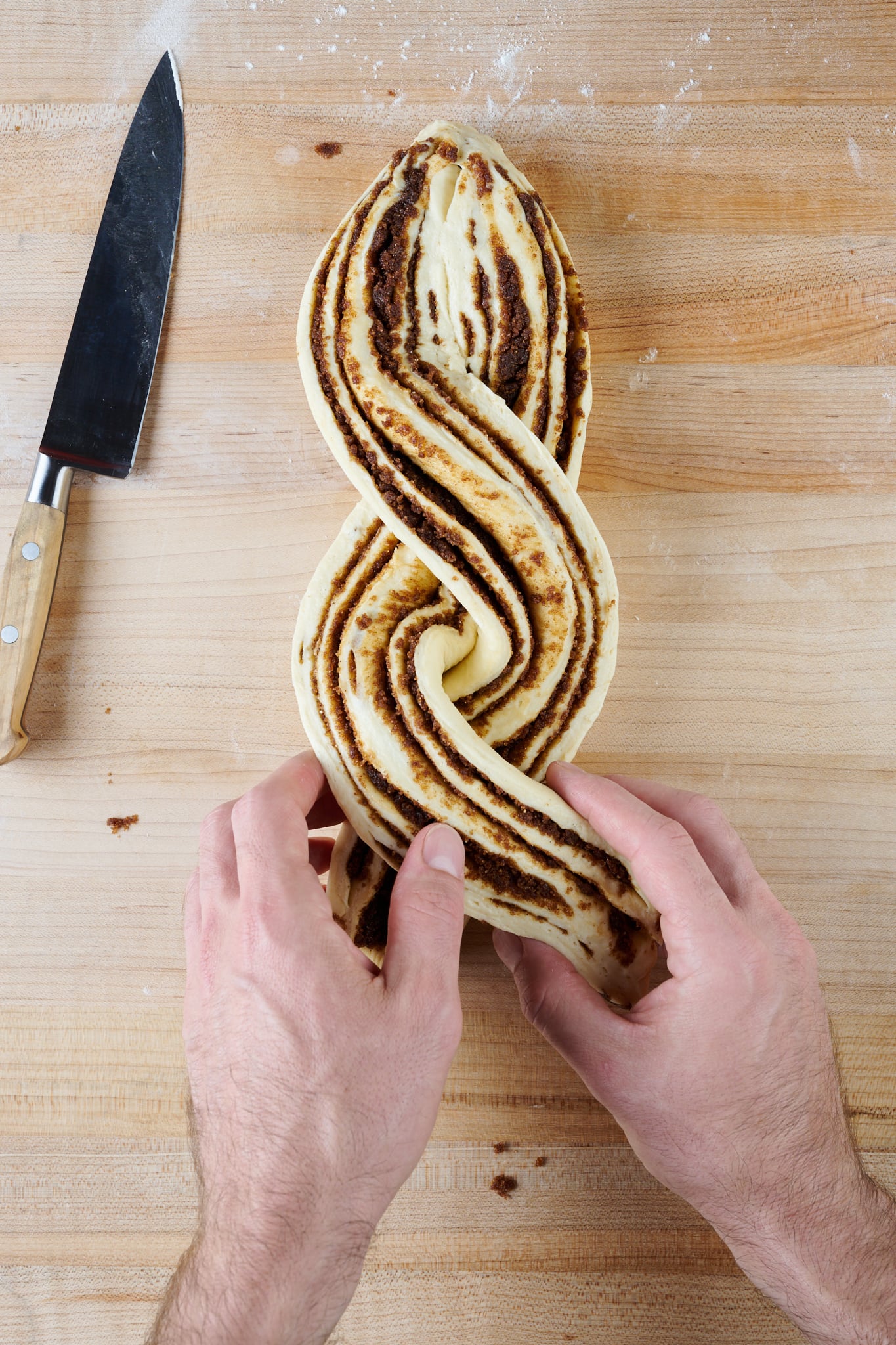
After the 15-minute freezer rest, take the baking sheet out of the freezer and return the dough log to the counter. Using a sharp knife, cut the log to split open the log from one side to the other. Next, pinch the two top halves together and braid the dough one strand over the other. At the bottom, pinch the two halves together again. Don’t worry if filling spills out or things get messy.
After the dough is braided, pick up the braid and place it on the parchment right in the middle, then pick up the sides of the parchment and lift the dough and drop it into the pan.
Cover the pan and place it somewhere warm, ideally, 78-80°F (26-27°C), to proof.
6. Proof – 8:30 a.m. 12:00 p.m. (or until ready)
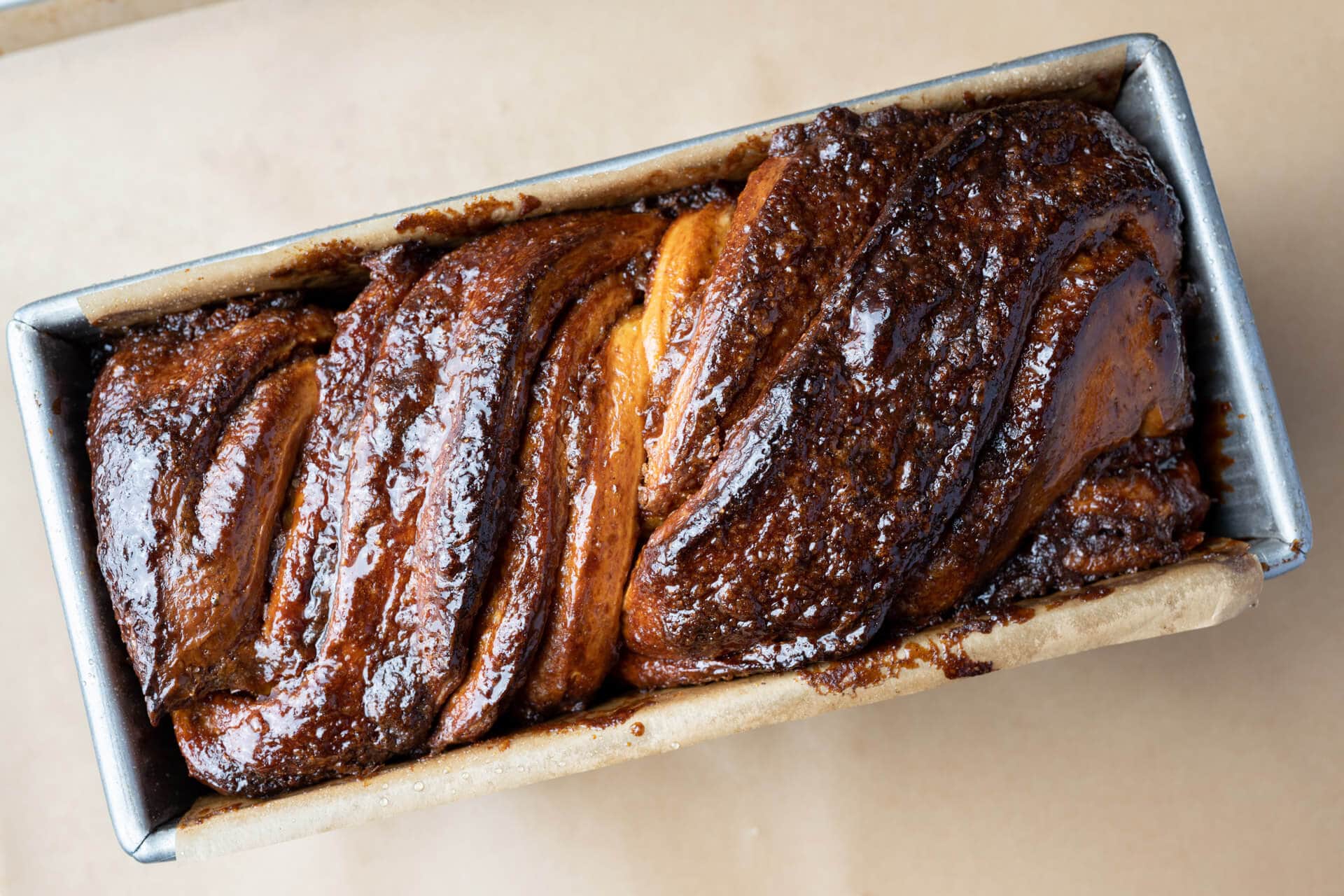
This dough can be slow to rise so give it the time it needs to rise within 1/2″ below the rim of the Pullman pan. For me, at 78°F (26°C), it took about 3.5 hours. See the image below for how high my dough filled my pan.
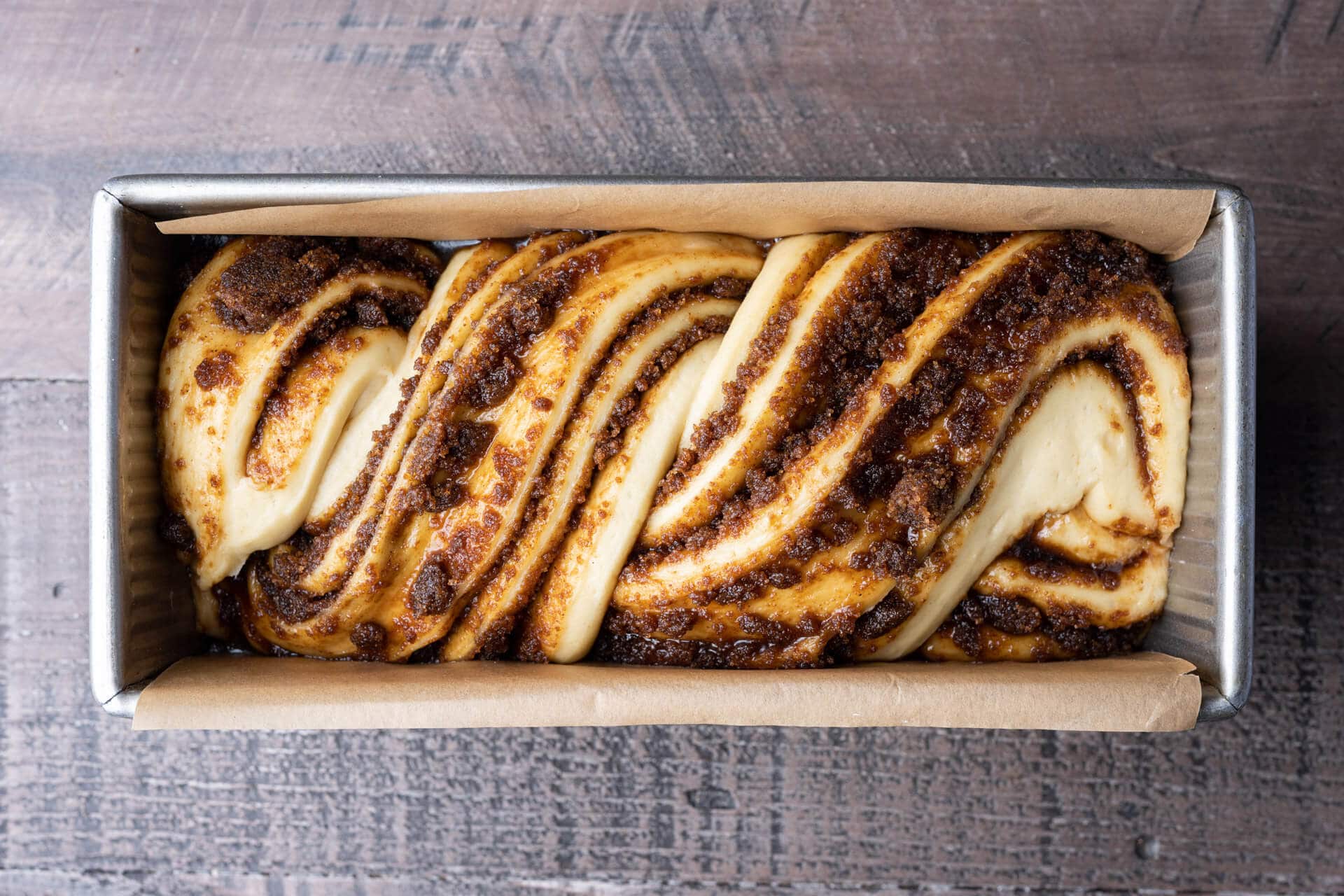
7. Bake – 12:00 p.m.
Preheat your oven with the rack in the middle to 350°F (176°C), non-convection.
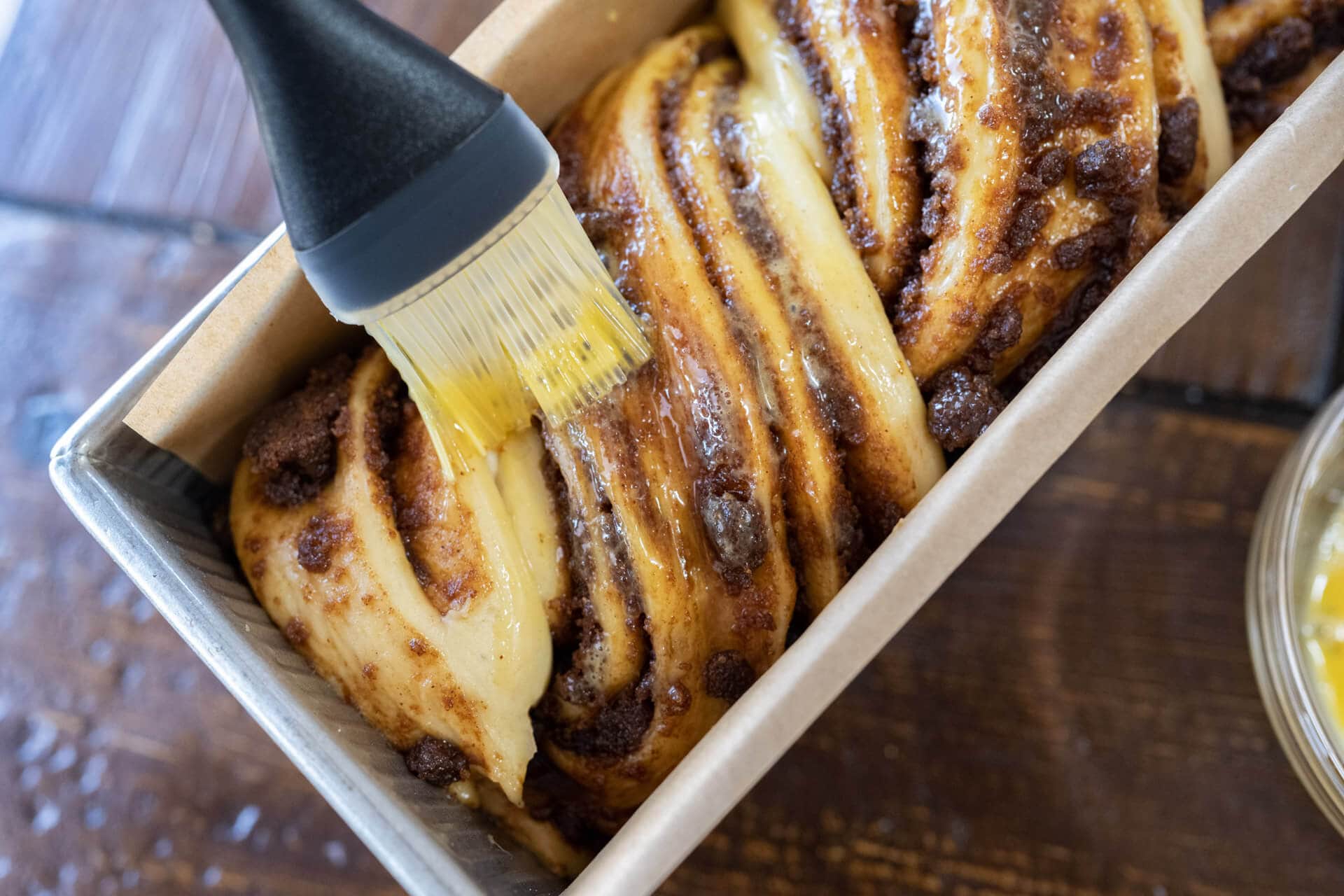
When the oven is preheated and the babka dough is fully proofed, place the pan on a baking sheet lined with parchment paper (to catch any sugar spilling over). In a small bowl, whisk together one whole egg and 1 Tbsp water and brush a thin layer of the egg wash on the top of the dough. Then, slide the baking sheet into the oven and bake for 40-45 minutes until the center of the babka reaches 200°F (93°C). Keep an eye on the babka in the last 10 minutes of the bake; if it’s coloring too quickly, drop the temperature to compensate.
While the babka is baking, make the simple syrup. Heat over low 52g (1/4 cup) granulated sugar with 59g (1/4 cup) water in a small saucepan. Heat until the mixture bubbles a bit and occasionally stir until the sugar fully dissolves in the water. Transfer this simple syrup to a container to cool. If covered, it will keep indefinitely in the fridge.
Remove the pan to a cooling rack. Using a plastic spatula, free the short sides of the babka (the sides without parchment) from the sides and bottom of the pan by pressing the spatula down from top to bottom.
Using a pastry brush, brush on a thin layer of the simple syrup (the more you brush on, the sweeter the crust). Let rest for 10 minutes in the pan. Do not let the babka rest for longer than 10 minutes, or it’ll be hard to remove from the pan.
After the rest, lift the sourdough babka out of the pan using the parchment paper sticking up as a set of handles.
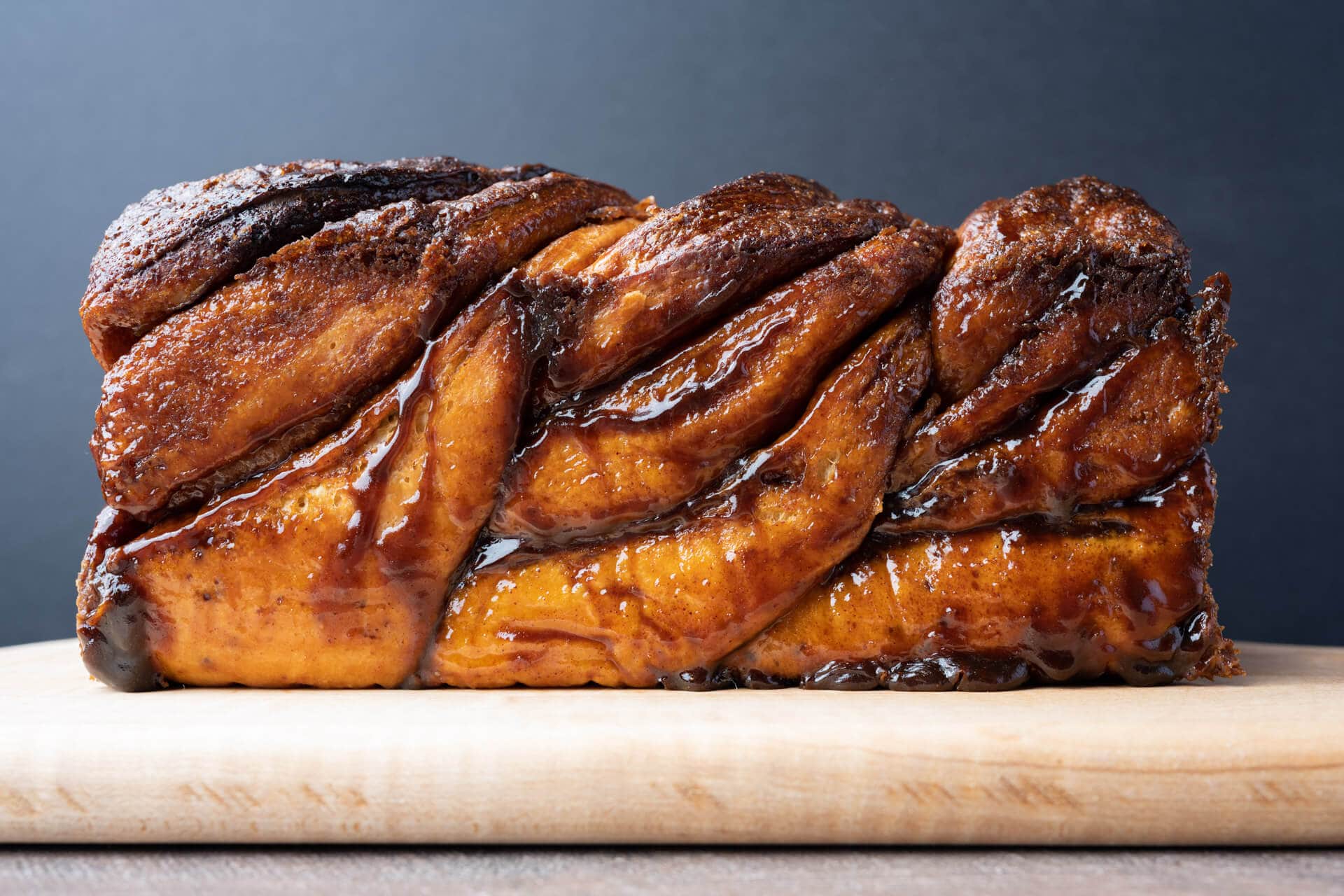
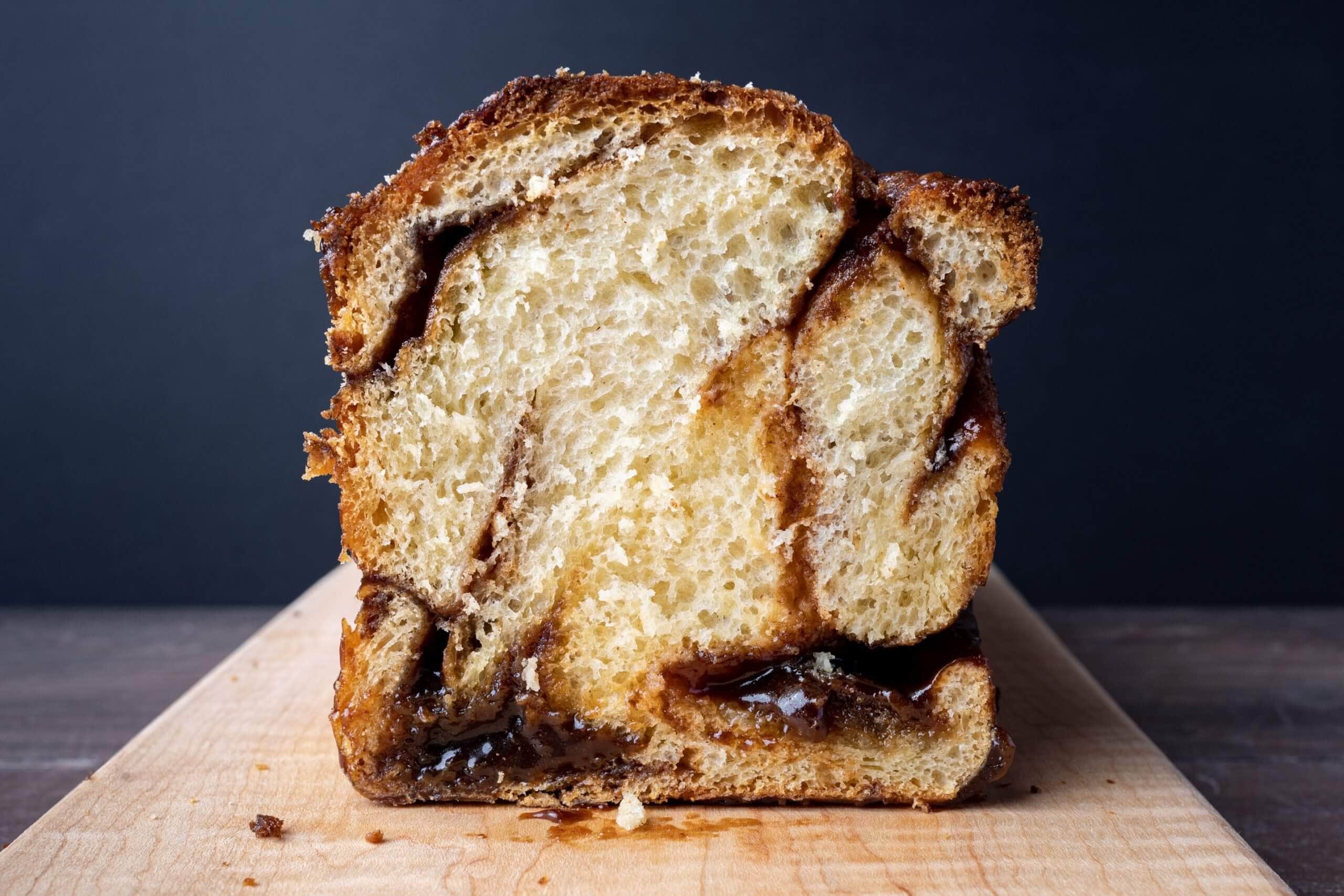
The flavor of this babka is just wicked. The exterior looks intense, gooey, perhaps even glutinous—but once the babka cools, it turns into a thin and crunchy layer of pure enjoyment. Because of the way I braid the dough, pushing the cut-side to mostly face up out of the pan, the interior is a little shy, with fewer pockets of the filling. I enjoy this balance, making each bite sweet but not too sweet.
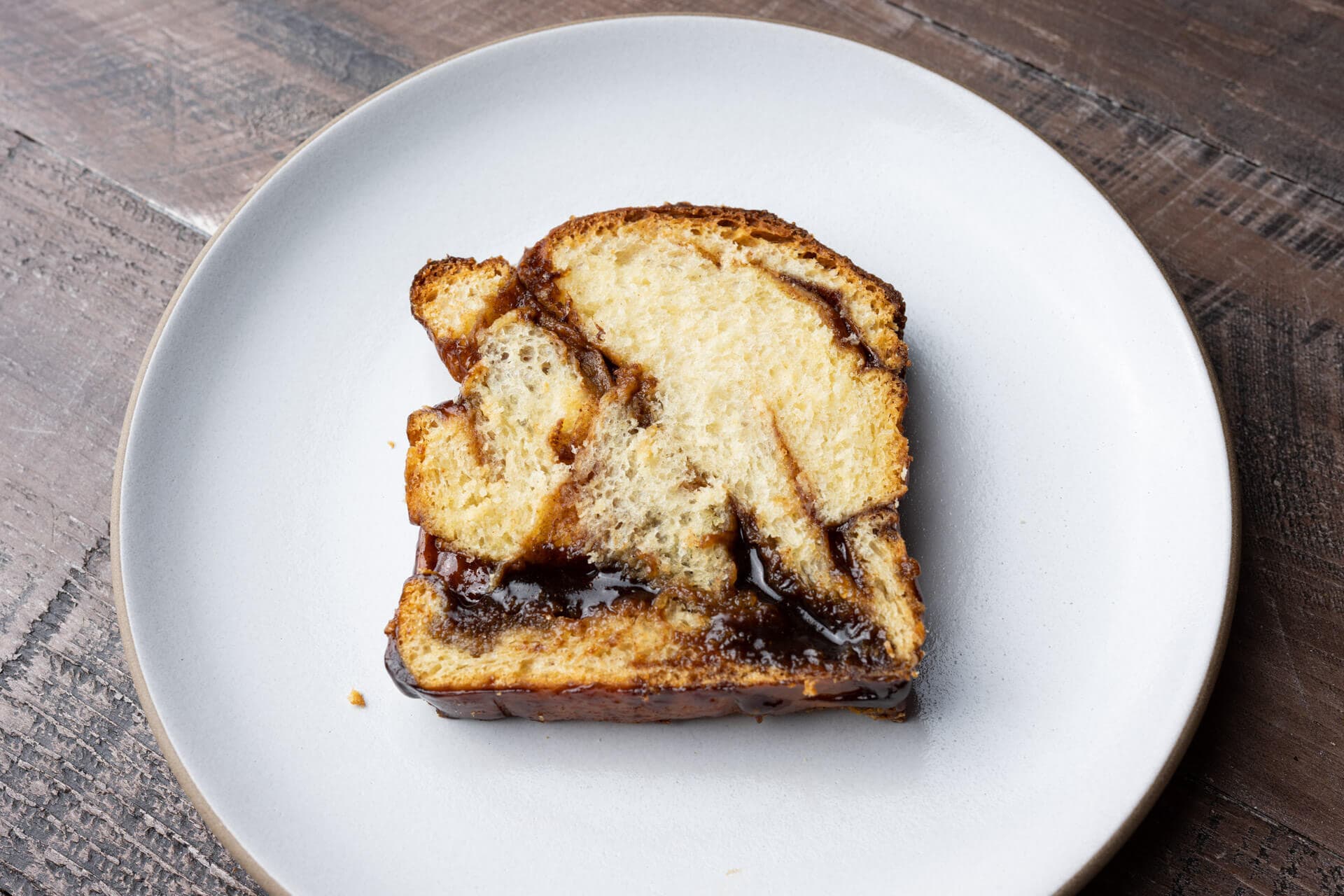
And your babka will undoubtedly look different (isn’t that the beautiful thing about baking by hand, anyway?), as the filling ebbs and flows its way through each slice. Looking at a slice is like pretending you’re a palm reader: you subconsciously trace the dark lines as they wind here and there, trying to see the future, to plan each bite to land you right in the next delicious zone of brown sugar and cinnamon.
Print
Sourdough Babka
- Prep Time: 26 hours
- Cook Time: 45 minutes
- Total Time: 26 hours 45 minutes
- Yield: 1 babka
- Category: Sweet
Description
Sticky and decadent, this cinnamon (or chocolate, choose which filling you’d like more) babka is sure to please.
Ingredients
Levain
- 46g all-purpose flour
- 46g water
- 46g ripe sourdough starter, 100% hydration
Main dough
- 310g all-purpose flour
- 107g whole milk
- 107g egg (about 2 large)
- 100g unsalted butter, room temperature
- 29g superfine sugar (caster)
- 8g fine sea salt
- All of the levain
Brown sugar-cinnamon filling
- 200g dark brown sugar
- 42g unsalted butter, melted
- 15g all-purpose flour
- 8g ground cinnamon
- 1/4 tsp fine sea salt
Chocolate filling (Optional, instead of the brown sugar-cinnamon filling)
- 110g granulated sugar
- 75g unsalted butter, melted
- 70g bittersweet chocolate, chopped
- 25g unsweetened cocoa powder (Dutch-processed)
Egg wash
- One egg
- 1 tablespoon whole milk or heavy cream
Simple syrup glaze
- 52g granulated sugar
- 59g water
Instructions
- Levain (10:00 a.m.)
In a medium jar mix together the Levain ingredients. Cover the jar and keep it at a warm temperature for 3-hours. - Mix (1:00 p.m.)
To the bowl of a stand mixer fitted with the dough hook attachment, add the flour, milk, egg, half of the sugar, salt, and levain. Mix on low speed until incorporated and let rest, uncovered, for 10 minutes. Turn the mixer up to medium speed and mix for 5 minutes until the dough pulls from the sides of the mixing bowl. Stream in the remaining sugar while the mixer is running and mix for another 1 to 2 minutes until the dough comes back together. While continuing to mix, add the butter, one pat at a time. Mix for another few minutes until the dough smooths out and clings to the dough hook. Transfer the dough to a container for bulk fermentation and cover. - Warm bulk fermentation (1:30 p.m. to 3:30 pm)
At warm room temperature, 74-76°F (23-24°C), the warm bulk fermentation should take 2 hours. Give the dough two sets of stretch and folds where the first set is 30 minutes after the beginning of bulk fermentation and the second set is 30 minutes after the first. After the second set, let the dough rest, covered. -
Cold bulk fermentation (3:30 p.m. to 8:00 a.m. the next day)
Place the covered bulk fermentation bowl into the refrigerator overnight. - Roll, freeze, cut, and shape (8:00 a.m.)
Choose a filling and make it: stir the ingredients in a medium bowl and cover. Remove the dough from the fridge and roll to a 10 x 12-inch rectangle with the short edge closest to your body. Spread the filling over the dough, leaving about 1″ clean on the short side farthest from you. Roll the dough into a tight cylinder. Place the rolled-up log on a baking sheet and freeze for 15 minutes. Fold and place a piece of parchment inside your baking pan to make two “handles.” After 15-minutes, take the sheet pan out of the freezer and using a sharp knife, cut the log in half lengthwise. Pinch the top of the two halves together and braid the dough one strand over the other. At the bottom, pinch the two bottoms together again. Pick up the braid and place it on the parchment right in the middle, then pick up the sides of the parchment and lift the dough and drop it into the pan. Place the pan in a bag and seal. - Proof (8:30 a.m. to 12:00 p.m., or until ready)
Let the dough rise at a warm temperate, 78°F (26°C), for 3 1/2 to 4 hours, or more. The dough should rise to within 1/2-inch below the rim of the pan. - Bake (12:00 p.m.)
Preheat the oven with the rack in the middle to 350°F (176°C), non-convection. Line a half baking sheet with parchment paper. In a small bowl, whisk together the egg wash ingredients. Brush a thin layer of the egg wash on the top of the dough. Then, slide the babka on the baking sheet into the oven, bake for 40-45 minutes until the center of the babka reaches 200°F (93°C). While the babka is baking, make the simple syrup by combining the ingredients in a small saucepan, heat until the mixture bubbles a bit, and occasionally stir until the sugar fully dissolves in the water. Cool the mixture. When baked, remove the babka to a cooling rack. Using a plastic spatula, free the short sides of the babka (the sides without parchment) from the sides and bottom of the pan by pressing the spatula down from top to bottom. Brush on a thin layer of the simple syrup and let rest for 10 minutes in the pan. After resting, remove the babka from the pan using the parchment paper “handles” and let cool on a wire rack.
Notes
- The simple syrup can be saved in the refrigerator indefinitely (and is great for more babka or cocktails).
What’s Next?
If you love chocolate, check out my dark chocolate-cherry sourdough bread for even more. Or, for something lighter (but no less delicious) and still in pan form, my sourdough shokupan (Japanese milk bread) is just the thing.
If you use this recipe, tag @maurizio on Instagram so I can take a look!


559 Comments
Hi Maurizio, when i rolled the dough, it stuck to the surfaces even though i floured them very well, the dough was very stick and extremely difficult to get a tight roll, i constantly had to use a spatula to get it to leave the surface, any tips on why that may have happened? It had a really good rise during the cool bulk ferment, maybe too much even if thats possible?
I still managed to roll it and its currently proofing, beyond excited to try this!
Perhaps the dough wasn’t strong enough after mixing and bulk fermentation, but the cold temps in the fridge should have definitely helped with this even if it was a bit sticky. I find that cold temp + ample flour on the work surface to make this a really easy dough to work with if you’re quick. If you think the dough was too fermented by the time you put it in the fridge, cut back a little time next time to offset this — but I haven’t had this issue as it’s a pretty slow moving dough! I hope it turned out great.
I saw a savoury wild garlic pesto version recently on Instagram that I really want to try!!
Ooh I like that idea, savory sounds awesome.
I just made this and it came out pretty darn good. Here are some notes that might help others: the dough is pretty slack and never fully pulled away from the bowl during mixing. I ended up mixing a bit longer to try and develop some strength in the dough. For the bulk rise I used an electric blanket to keep warm and got very little rise, if any. Instead of putting it in the fridge overnight I just left it on the counter. (not in the blanket). To my surprise it was puffy in the am! Since it was not cold, the rolling was tricky, (couldn’t get it very tight) but nothing i couldn’t fix after the spell in the freezer. I used the blanket again for the final proof and it rose to the top of the pan. The rest went according to plan and it is delicious. I made the chocolate just like i used to have growing up in NJ. Actually better. Thanks, Maurizio
Great modifications, Samuel! We always have to adjust to the dough and how it’s progressing, that extra time was a good move. Next time pop it in the freezer before rolling for 10 minutes, that’ll help quite a bit (just don’t forget about it!).
Thanks for the comments and the feedback!
I made this bread and your Pain de mie this weekend, both were wonderful! The babka took much longer to proof than yours. Not much rise in the cold bulk proof. I filled and shaped the loaf, and the second proof was over 10 hours. I almost gave up, but in the end the result was totally worth it! One of the best sweet breads I’ve made. My starter seems very active. What could cause the long proof time?
Glad to hear it turned out well, Clare! Using your starter and levain at max maturity is very important, as is the amount of fermentation in the dough before going into the fridge. Next time, push bulk fermentation a little farther until it’s well-risen to give it a good start before halting that in the fridge. This will get a good base for the next day!
Thank you for this recipe! I tweaked it to be plant based as we have egg and dsiry allergies. So, so good.
Right on, glad to hear this (with mods) turned out so well!
what did you replace eggs and dairy with? im plant based and would love to know the options that worked for you!
Equal weight of applesauce for the eggs, almond milk instead of milk, and earth balance instead of butter. For the egg wash, I mixed 2 Tbs almond milk with 1 Tbs maple syrup and brushed it on. It turned out beautifully.
Great recipe! Due to variations in ambient temp, as you always note, had to proof about an hour longer. It didn’t rise up quite as high as yours but it passed the poke test and after it was baked the dough didn’t look underproved. As others noted, had to bake longer, just toggled between 350 and 325 to manage browning and inner temp. Total time in oven was about an hour.
It turned out delicious! Rich, tender, beautiful. I did the cinnamon and it came out like the Platonic ideal of monkey bread. Superior to any babka I’ve had.
Fantastic, Jon! Yes, many others have said it was similar to monkey bread as well (I’ve actually never made this!). Thanks for reporting back!
Hi Maurizio, I just wanted to let you know that I am a big fan! I started my sourdough journey last summer when I tried to catch a wild yeast (didn’t work) but I have moved on to creating some great bread using your recipes, guides, and methods. I just wanted to let you know how much I have appreciated the processes you have developed, the information you share and the clarity of your directions. Thank you so much!
You’re very welcome, Debbie! Happy to help and happy baking!
Hi Maurizio. Not sure about the final proofing. Mine has proofed 4 hrs and hasn’t risen a lot. Baking it now but it does not seem to be rising. Everything else in the recipe went according to instructions
Try to keep it warm and give it more time! I should definitely rise up 3/4 of the pan (if you’re using the same dimensions as mine).
Thanks Maurizio…any tricks you can share how to deal with Doug climb (maybe just turn off and scrape down?) would be greatly appreciated.
Your site has become my primary source of learning/information since I got into bread years ago. I have to tell you are not only an artist with bread but an incredible teacher/ instructor. Maybe some day you can add some comments on how you use the mixer for certain dough types.
I always hand mixed all my doughs but some dough types may come out better with a mixer.
Thanks
Yes, just stop the mixer periodically and scrape down the dough off the hook and sides of bowl.
Thanks for the kind words, I really appreciate that. I do plan to have some resources here for working with a mixer — I have a few and I know many might have the same!
Happy baking, Karen!
Maurizio, after years of enjoying hand mixing my doughs I find certain gluten development become a real challenge in high hydration and heavy low hydration doughs. Do you ever use mixers and if so which ones can you recommend. I have looked at Haussler as well as FARMA but as always there are pros and cons. I appreciate your feedback
I assume you mean the FAMAG, but both mixers are really great! The Haussler doesn’t have a breaker bar so the dough will climb the hook, but it’s built like a tank. The FAMAG has a breaker bar, but the bowl is a little harder to work with since it’s a smaller diameter. Like you said, pros and cons with each…
Maurizio, I made your SD Ciabatta Panini recipe following your recipe step by step. I even used the Haussler mixer. They came out great !
Hi! This is an amazing recipe! Made it last weekend and turned out super!
I want to try the cinnamon rolls but wondered what’s the difference between the doughs, as you don’t make a levain for the cinnamon rolls.
Thanks!
S.
Glad to hear that, Sahar! I use a levain with this to precisely control the preferment in an attempt to reduce sourness in the end result. The cinnamon rolls are ok to just use some starter, the dough mix, filling, and icing offset any sourness that might show up. Honestly, these are such sweet results, it’d be fine to go either way.
Thanks for replying! I tested the cinnamon as well and indeed could feel some of the sourness which can be nice. But for some reason I find the babka dough a bit more manageable and nice to work with.
About the pan size, it’s 2Ib right?
I have the dough weight listed up in the Vitals section for this recipe!
Wonderful recipe and thank you for the very detailed description of your process! Even timing! Wow!! This was my very first chocolate babka, but not the last one for sure. I ended up using my madre that I always use for sweet breads like this, so I had to adjust the liquid a little bit . One mistake I made : I let the dough come to room temperature when I took it out of the fridge and I could not roll it up very tight. Nevertheless, it came out very VERY tasty, although not picture perfect. I can’t wait to make more! I would probably add a pinch of cinnamon to the chocolate , that is just to my liking. Thank you again!!
Right on, glad to hear this Piroska! Yes, that cold dough is pretty important, makes things so much easier. But it’s not impossible when room temp, either! Thanks for the feedback and happy baking.
I messed up big time. I added the butter in with everything else in the stand mixer at the beginning, instead of waiting until it had been mixed and rested a few times. I’m still going ahead with it. Is there any hope????
Definitely still hope! Keep with it.
When you take it out definitely give it time to warm and finish proofing!
This turned out really great! But I also found it needed at least another 10 minutes in the oven. Thanks for listing the target temperature. That saved the bake for me!
Glad to hear that, Hanno! Yes, lots of variable times there with the bake. I think that’s good feedback, I might up the bake time just a touch. Enjoy!
For what it’s worth, I also needed 5-10 minutes beyond the 40 to hit 200 degrees!
Instead of sourdough starter, what would be the equivalent of using the equivalent of just yeast/water/flour into the dough?
Another brief question, and apologies if this has been asked elsewhere and I’ve failed to find it. How do you factor in friction temperature when using a mixer? I have KitchenAid max watt 300 3qt. Thanks again!
Check out my post on baking temperatures for more information on this. However, with this dough the cold ingredients from the fridge really do offset the temperature generated through friction when mixing. I haven’t had a problem with this dough even when mixing for many minutes (as long as you’re not mixing on high speed).
Instead of sourdough starter, what would be the equivalent of just flour/water/yeast to add into the dough?
Hard for me to say, I’ve not made this with commercial yeast!
Hey, so the Babka is just a version of a very traditional dough we make in my country every Easter and we make it with yeast.
The recipe I used to make 3 smaller babkas is the following:
500gr flour
10gr yeast
3 eggs
100gr butter melted
125gr sugar
125gr warm milk
Pinch of salt
Filling to your liking
Warm the milk and add a bit (~25gr) to the yeast together with a pinch of salt, sugar and flour. Stir and let it sit for a good 10mins.
Melt the butter.
Whisk the eggs.
Dissolve the sugar in the remaining milk.
Sift the flour, add the salt and make a well (even in the mixer metal cup if you’re using one). Add the eggs and start stirring. Slowly pour half the butter. Add the milk & sugar and yeast and stir everything until very well incorporated. Then add the remaining half of the butter and mix VERY well. If you’re using any spices add them last and stir (e.g. lemon/orange zest; vanilla or anything else of the sort; not including fillings).
The dough becomes sticky, but don’t add additional flour to it, just mix some more.
It’s ready once it starts to form a smooth skin and becomes light (gluten has developed).
Leave to prove somewhere very warm, it’ll need a good 3-4 hours for the 1st proof. Should be double in size and bubbly.
Once proofed shape it and fill it in any way you want and leave to proof again for about an hour – again somewhere warm.
Put some egg wash and crystal sugar before baking.
Bake on 180C no fan(~300F I guess) until a skewer comes out clean and it’s golden on the top.
P.S. – Don’t use water 🙂 It’s delicious precisely because of the eggs/butter/milk 🙂
Hope this helps and you’ll enjoy it 🙂 Cheers and stay healthy!
Hi Maurizio, thank you for sharing this lovely recipe, I can’t wait to experiment with it tomorrow. I was rummaging through the larder and came across some regular cocoa powder, unsweetened, but not Dutch-processed. Since we’re trying to do our part and avoid the stores, I was wondering if, besides the taste factor, it would make any difference? Is the acidity in normal cocoa powder something that would interfere with fermentation at all?
You’re very welcome, Ally. That’ll work just fine but it might be a bit stronger tasting — which might not be a bad thing 🙂
THE Best Babka in the WORLD!!! Just made it and it’s cooling and I CANNOT wait to dive into it 😀 I divided mine in half, because I’m using a half size loaf tin from Jamie Oliver, but it’s perfect, because the other one I’ll send over as gift to my parents 🙂 THANK YOU for this recipe! I’ll be making it again!
Happy to hear it turned out so well for you, Dimana! Thanks for the feedback and enjoy, I know you’ll love the flavor 🙂
Hi Maurizio, I am planning to do same day put in filings and shaping then put in fridge overnight to proof and bake in early morning, do you think this will work? TIA
Yes, that’ll work well. Just be sure to fully proof the dough the next day!
can you leave the egg out? substitute it with something else?
what is the eggs purpose and what do you expect will happen if you leave it out?
It adds to the enrichment of this dough, bringing fat, along with the butter, to add a depth of flavor and tender texture. If you leave it out your dough will be ever closer to just normal bread: more crusty, sturdy, less “warm” tasting. I know there are vegan substitutes that supposedly work well, such as “flax eggs,” but I’ve never tried them. Perhaps another approach would be to take the eggs out and use another high fat ingredient such as heavy cream in their place, but I haven’t tried this.
Is the dough a sourdough brioche basically? Can I bake it without filling to use as brioche bread?
It’s close, not quite to typical brioche enrichment levels, but I have a feeling this would be a delicious loaf 🙂
Thank you so much! I made it today! Best recipe ever! I loooooove it! How can I make it into brioch? At which point do I put it in th me pan? Does it need to proof over night.
Glad to hear that, Arwa! Instead of rolling it out, shape it as a cylinder and place in a loaf pan. Proof until very soft to the touch, might be a few hours, or more depending on temperature, on the counter.
Hi Maurizio,
I tried this recipe last week, and I kind of knew, halfway through the process that it would be a fail (which it was).
I believe my issue started after adding the butter and sugar. After adding the butter & sugar, my dough never really came together. I was not sure if it was supposed to form into a ball or climb up the dough hook (I think it might help to have this included in the instructions), as has been my experience with other enriched doughs like brioches. The final dough was still sticky, although it did not break apart when I pinched off a piece between my fingers and stretched it. When I was stopped the mixer, I was not able to pick up the dough with my hands to transfer into a clean bowl, and it ultimately barely rose. I took a chance and baked it regardless, and it was a waste of my homemade chocolate hazelnut spread, unfortunately. Do you know where I might have gone wrong?
Thanks!
Jessica
Ahh sorry to hear that, Jessica. First off be sure your starter is at its peak and strong when you use that to make your levain, and similarly, your levain should be nice and bubbly when you go to use it — fermentation strength is very important with an enriched dough like this.
You definitely want to strengthen the dough significantly before adding in the butter and the reserved sugar. It sounds like you probably needed to mix for much longer before those steps, the dough should be clinging to the dough hook and, while not completely, removing from the sides of the bowl. If you never get to a stronger dough at this point, try adding in a little flour (maybe 1 TBSP) and mix for a bit until the dough strengthens and comes together. Once your dough is strong then you can start adding the sugar, wait for it to come back together, and then the butter, one pad at a time.
At the end the dough will not form a full windowpane, but it’ll get close. You should be able to spread a pinch of the dough out to form a translucent sheet that’ll tear, but still spread out somewhat.
I hope this helps, let me know how it goes the next time!
I’m new to baking in general, but have become obsessed with the nuances of sourdough science and your site specifically. I’m 6 loaves in (all beginners sourdough so far to get it right with temperature management) but was wondering if there was a way to get 2 things: 1.) a much more sour flavor (I read your sour candy comment every time I start and imagine the tangy coastal sourdough of my dreams), and 2). a more delicate crust (less tank-armor, more chewy and/or sliceable). I could not find specific information/recipes on your site, but If you have anything to read or any tips I would be super grateful. Thank you.
Gear: Dutch-oven and basically every link you recommend for everything else.
Glad to hear you’re a fan, thanks for the feedback! There are a few things you can do to try and increase the sourness of your bread. First, you want to use your starter, and levain, when it’s very ripe. If it rises up to a certain height, let it sit there for a bit before you use it. If it starts to fall that’s ok too, just try to use it after it falls. That mature, ripe starter/levain has much more acidity than if used when it’s more on the “younger” side. Just be weary that your dough fermentation rate might be a bit faster than previous, keep an eye on it during bulk fermentation and divide the dough when it looks ready.
Additionally, you could try using some rye flour in your final dough mix. Just know that the more rye you include the more dense your loaf will be as rye does have the same gas-trapping capabilities as traditional wheat. It’s up to you on the percentage, but even 5% plays a big role.
Finally, if you can try to push the cold proof in the fridge. There’s a limit of course, but if you could go even a few more hours you should notice more sourness.
For a more thin crust, try adding an ice cube or two inside your Dutch oven when you go to bake or spray the dough a few times with a handheld mister. Unfortunately with a Dutch oven I do usually notice a thicker crust, but I think adding in a bit of extra steam will help!
Thanks. Tried the ice today. First loaf actually over-baked? 3 ice cubes, no spray, no time or temp adjustments… Toast. 2nd loaf: one ice cube, cut 4min& 5deg from ‘lid-off’ portion of bake; just came out of oven, looks/feels perfect so far. Better and more even-coloring all around, with a nice crackly crust that I can feel a little bounce(?) in, instead of previous hollow-block-of-wood feel. Jury is still out on the sourness until it cools but thanks for the tips man! Next up, the perfect pizza crust recipe
I’m sorry but I’m confused, there are 2 formulas, one says
Sorry, I wasn’t done typing.
…says 357g flour and the other 310g flour. Which formula do I use?
The top formula is the total amount in the recipe; the lower one is the dough mix. If you look at the levain feeding instructions, you’ll find the other 47g of flour!
The 357g refers to the total amount of flour, including your levain / sourdough.
Use the Dough Mix table when you’re at the counter mixing the dough. The other Total Formula table is the rollup of ALL the ingredients.
Thank you. I made it and it tastes amazing!!
I made this with almond milk and it turned out delicious!
I did end up baking it a bit longer than the recipe said – about 50min. I actually think it could have gone longer – the side where I temped was 200 degrees but the other side was gooier once I cut into it. Not so gooey that I’m not going to eat it, though 🙂
Excellent, Katie! Lots of people using alternative milks, I need to try it out. You might also try rotating the pan 180° midway through the bake to ensure even temperature across the pan. Enjoy and thanks for the feedback!
Hi Erin, what was your final timeline like. I’m hoping to start to make it this week someday!!
Thanks! I’ll let you know how it turns out!
It turned out really well! It didn’t rise as much as I would have liked, but in the end it didn’t really matter! Everyone loves it. Thanks Maurizio for the recipe and Erin for the modifications.
I made this over the past 2 days and it was by far the best babka I’ve ever made. Admittedly it was only my third homemade babka but I was delightfully surprised what a rich brioche dough it was from my sourdough starter. But I’ve been wanting to comment for some time. I’m a long term tho not necessarily technically advanced baker, on and off for decades and I knew for some time that I wanted to climb Bread Olympus and make a real sourdough bread. I’ve made bread from a poolish and a biga and have made bread that I retarded overnight before baking and yet I was sooo intimated by levain bread making. In fact I was so intimidated by it that I found your blog here a few years ago, thought it was all too technical, started a starter before abandoning it for “another time.” Well I finally committed to the process Christmas Eve, the date I started my own sourdough starter from your recipe. Since that time, I’ve made your beginner sourdough bread recipe using a lodge cast iron dutch oven and words can’t express the joy and pride I felt when I opened that lid for the first time. It looked and tasted great! I’ve made your favorite sourdough bread, your olive sourdough bread, and your pizza dough recipe. I bought “Flour Water Yeast and Salt” learned more about the process and have made several bread recipes from that book as well (his walnut bread was personal fave so far). So far, this bread recipe, because it was surprising rich and sweet (not sour at all) and your pizza dough recipes are my favorite and I’ve made your pizza dough several times using Caputo flour, making darned near pizzaria quality pizza in my simple oven with a mere pizza stone and water bottle! The crust is out of this world and you can taste the difference between 00 and AP flour. You are an amazing baker and teacher. You’ve inspired me to climb Bread Olympus and take my baking knowledge and game to new heights. Thank you for sharing your skills and your recipes with us. I’m a very big fan of your work. I just wish it didn’t take me THREE years to get over my fear. In that 3 years though, I did alot of baking. Thank you, Maurizio! I’ve been meaning to say that for some time.
Hey, Celeste! Your message really put a smile on my face — your comments are exactly the reason I started this site so long ago. I think many have an initial apprehension toward sourdough, but I think with a few tips here and there it’s easy to move past and make some really wonderful bread right from home. I’m happy to hear you’re baking such wonderful bread and again, thank you for the kind words, I really appreciate that. I’m happy to help and happy baking, Celeste!
I made this over the last two days and OMG it is amazing! I couldn’t decide between cinnamon and chocolate so I made up half batches of each filling and spread half the rolled out dough with each. It turned out absolutely fantastic! Amazingly soft and tender crumb with a deliciously crunchy brown top. I love both the sweet fragrant cinnamon where you can taste the subtle sourness as well as the rich dark chocolate. Thanks for sharing such a wonderful recipe with detailed and easy to follow instructions perfect Easter iso-treat!
That’s so great to hear, Marion! You know, I have not thought about doing two different fillings, best of both worlds right there (and this way I could satisfy both my kids with one babka!). Thanks for the feedback and enjoy 🙂
Hi. Instead of using AP flour, how would this turn out if I used bread or pastry flour or a combo of the both? Thanks, looking forward to making this.
I’m no expert but have used bread flour (it’s all I have right now) and it worked well for me 🙂
I tried this with bread flour and it came out just fine (mine was a little more tight inside but still super delicious). You could try a mix, perhaps 75% bread flour and 25% pastry — I like that idea!
Hello! I’ve made the chocolate version of this twice, and it tastes fantastic but my finished shape looks so exploded compared to yours, and what I see scrolling through #theperfectloaf. It looked perfect going in, just starting to crest over my 1lb loaf tin, and just massive oven spring. https://imgur.com/a/B5F8VVh
Hey there! Glad it tastes wonderful 🙂 Usually explosive rise in the oven like this is due to under proofing. Give the dough longer in final proof until it rises very high in the pan, like the photos you see above in the post. If it did rise that high, I’d try letting it proof longer, regardless. Let me know how the next attempt goes!
Hey, Erin — thank you! Yes, I would do exactly as you said (and much like we’d do a loaf of bread). Know that I do like to let the dough chill an hour or two until it firms up before rolling out, otherwise you’ll have a warm dough to deal with. If you start the process early in the day you could have the shaped babka in the fridge before too long. I would put the shaped dough in the fridge right after cutting and braiding, and then in the morning take it out to finish proofing until ready to bake (this might take a few hours, depending on temperature). Hope that helps and have fun!
Just perfect, nice work Erin! You’re very welcome and I appreciate you reporting back — I’ll have to use this timeline soon myself 🙂
Hi Maurizio,
I tried this recipe the other day, and it was a complete failure :/ I believe the problem is either hydration/ gluten development. the final product texture has no gluten, there are air pocket structure, but it is very chalky and dry.
My leaven passed the float test. I was using a stand mixer with the kind of dough hook that splits in two. I think I would have benefitted more from a longer autolyse before I added in the second half of the sugar and butter. I kneaded the dough for about 20min and there is still very little development. I went on with the rest of the recipe, the dough did have a relative good proof in turns of volume increasing. And it needed about 50-55min for it to be completely baked. The final product still taste okay, however the texture is not babka at all. Anyway, I will still be eating it lol, but maybe you have more tips on how to fix my mistakes.
My roommates and I have been joking about how this is the complete opposite time to be baking a babka, since its passover and it was not going to work. Anyway, I would try this recipe at some point again, will let you know the result!
Sorry to hear that, Henry! It sounds like the dough was over hydrated but then I’m not sure why the result would be chalky/dry — perhaps it was over baked? It should be ultra tender and moist. I would suggest holding back some of the milk in this recipe when you go to mix the dough, perhaps 25-30g, and see if that helps. When mixing a dough with enrichments (butter and sugar) it’s tricky, you don’t want to add too much liquid because after you add that butter in the end, the dough will relax and slacken.
Be sure not to add the reserved sugar and butter until the dough is nice and strong, those two will interfere with gluten development and it’ll be harder for the dough to come together.
Let me know how the next attempt goes!
This recipe is fantastic… made the cinnamon version last night and it’s heavenly. Thank you!
Glad to hear that, Leanne! Thanks for reporting back and enjoy (if there’s any left!) 🙂
The first one didn’t last long so I’m making another two today!! I love cinnamon but hubby wants to try the chocolate version so I’m doing one of each. The dough is currently in the fridge awaiting the next steps 😀
Hey Maurizio,
First of all, thank you so much for this recipe. I really appreciate it. What I was wondering about is if I could cool the dough, prior to cutting the log, in the fridge instead of the freezer. My freezer is packed with food, so I won’t be able to fit a baking sheet in there. In addition, German refrigerators are way smaller than American ones so a baking sheet wouldn’t fit anyways.
Another question I have is, if I could bake it with convection. My oven only has that function and I tend to drop the temperature by around 20°C and in almost every case it turns out exactly the way it should be. Even if it darkens too fast I would wrap the top with aluminum foil.
I hope you can help me out!
Yes, the fridge will work just fine. That step isn’t 100% mandatory, either, but it does help when twisting the dough. Totally optional.
Yes, you can use convection, but be sure you add the egg wash and lower the baking temperature like you suggested — that’ll work well. Be sure to do the egg wash and use that aluminum foil tent if necessary.
You got this!
Thank you for the fast reply. I guess I will make some babka tomorrow. 🙂