

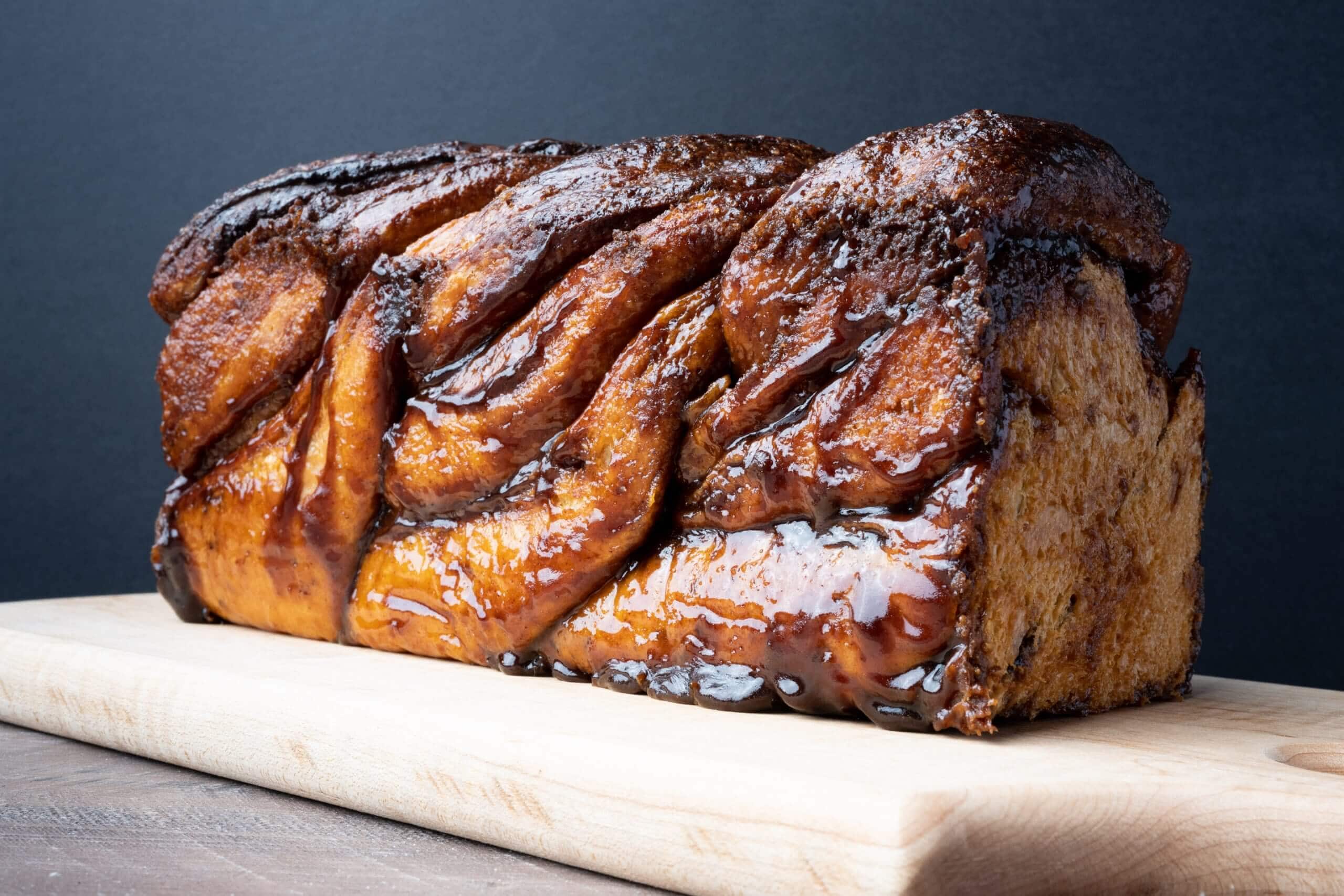
Right now, I’m front-row seat at the best kind of concert: ogling at the twisted cacophony of an enriched naturally leavened dough with sharp cinnamon and warm brown sugar (or chocolate, read on), all topped with a luxurious, simple syrup. This sourdough babka is sitting there cooling on a wire rack, but I swear I hear it singing. If there ever was such a thing as too much anticipation, right now surely qualifies; it’s as palpable as any musical instrument in an empty music hall. And I’d pay a hefty sum to cut in, take a bite, and end the concert a little early.
But let’s be completely clear: this is a sticky, gooey, and sinfully delicious treat.
I’ve stepped up my baking research and development for this babka to get this recipe out after the enthusiasm displayed on my recent Instagram post. This dough is straightforward, playing at not quite the enrichment level of brioche (or my cinnamon rolls), but not precisely lean, either. I feel it’s just right: not cloying, not overly rich, and certainly not dry or under-flavored. And while it unquestionably looks drenched, the interior is not—the interplay between the crust and crumb is wonderfully balanced.
But let’s be completely clear: this is a sticky, gooey, and sinfully delicious treat.
And the timing for making something like this is perfect; right now, we can all use a little joy, a dab of sunshine through the clouds, the sweet, tangible canto of a sourdough babka (with all of its buttery deliciousness) humming to itself on a cooling rack.
Sourdough Babka Recipe
Equipment
Pullman Pan
This recipe will work with many different pans, but I eventually turned to my trusty 9 x 4 x 4-inch Pullman Pan in testing. The reason is twofold: I love the resulting straight-sided and presentable sourdough babka. Second, the USA Pan has a natural silicone lining, which, combined with parchment paper, makes cleanup a snap.
If you don’t have a Pullman pan, a typical 8.5 x 4.5 x 2.75-inch loaf pan will also work well.
Rolling Pin
You’ll need a standard rolling pin/dowel to roll out this dough, and this rolling dowel is my favorite (and made in the USA).
Vitals
| Total Dough Weight | 800 grams |
| Pre-fermented Flour | 13.0% |
| Yield | One babka |
Total Formula
Desired dough temperature: 76°F (24°C) (see my post on the importance of dough temperature).
| Weight | Ingredient | Baker’s Percentage |
|---|---|---|
| 357g | All-purpose flour (11-12% protein; King Arthur All-Purpose Flour) | 100.0% |
| 107g | Whole milk (cold from the fridge) | 30.0% |
| 107g | Large eggs (about 2, cold from the fridge, plus one more egg in reserve for the egg wash) | 30.0% |
| 100g | Unsalted butter (Kerrygold; room temperature) | 28.0% |
| 46g | Water | 13.0% |
| 29g | Caster sugar (superfine white sugar) (if you don’t have caster sugar, use the finest sugar you have) | 8.0% |
| 8g | Fine sea salt | 2.3% |
| 46g | Sourdough starter (100% hydration) | 13.0% |
Instead of All-purpose flour, feel free to use high-protein white flour (“bread flour”) in its place if that’s all you have in your pantry.
Sourdough Babka Method
1. Levain – 10:00 a.m. (or when your starter is ripe)
In the morning, mix the following in a small jar:
| All-purpose flour | 46g |
| Water (warm) | 46g |
| Ripe sourdough starter, 100% hydration | 46g |
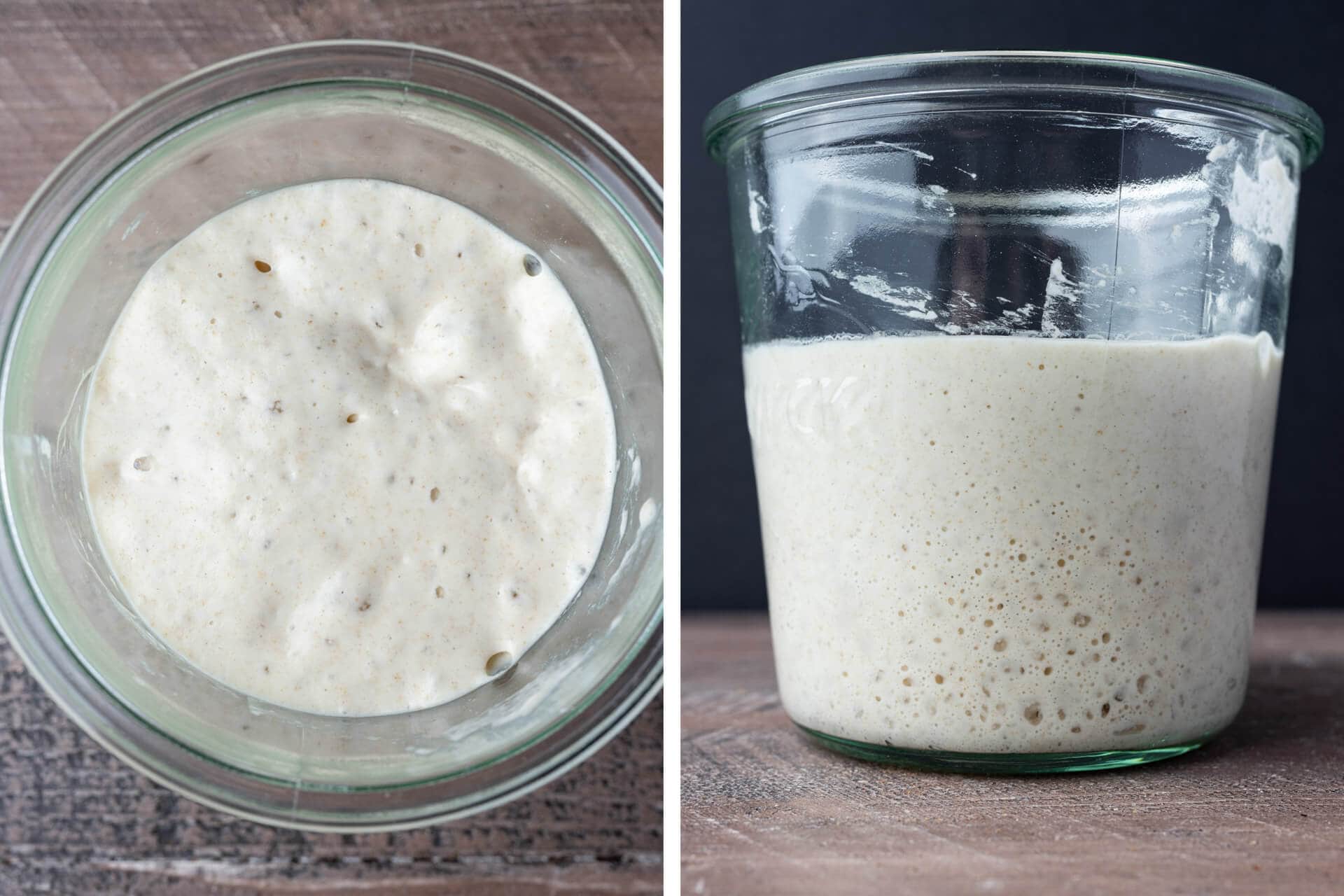
Loosely cover the jar; it should be ready after about 3 hours at a warm temperature, 78-80°F (26-27°C). If it’s cold in your kitchen, warm the mixing water for this levain to get close to 80°F (27°C) (see my post on baking in the winter for more tips).
If you’re new to making a levain, see my post on the differences between a levain and sourdough starter.
2. Mix – 1:00 p.m.
| Weight | Ingredient |
|---|---|
| 310g | All-purpose flour (11-12% protein; King Arthur All-Purpose Flour) |
| 107g | Whole milk (cold from the fridge) |
| 107g | Large eggs (about 2; cold from the fridge) |
| 100g | Unsalted butter (Kerrygold; room temperature) |
| 29g | Caster sugar (superfine white sugar) |
| 8g | Salt |
| 138g | Ripe levain |
First, cut the butter into 1/2″ pats. Set them on a plate to warm to room temperature.
I used my KitchenAid stand mixer to mix this dough. To the bowl of a stand mixer fitted with the dough hook attachment, add the flour, milk, egg, half of the sugar, salt, and levain. Set the mixer to low and mix until everything is incorporated. Let the dough rest, uncovered, for 10 minutes.
After the 10 minute rest, turn the mixer up to medium and mix for 5 minutes until the dough starts to pull from the sides of the mixing bowl. At this point, slowly stream in the remaining sugar while the mixer is running. Mix for another 1-2 minutes until the dough comes back together.
With the mixer still set to medium, add the butter, one pat at a time, waiting to add the next until the previous is absorbed into the dough. It might take around 5 minutes to mix all the butter into the dough. After all of the butter is added, continue mixing for another few minutes until the dough smooths out and once again begins to cling to the dough hook. The dough should be almost fully developed at this point (it won’t completely pass the windowpane test, but almost).
Transfer the dough to a container for bulk fermentation and cover.
3. Warm Bulk Fermentation – 1:30 p.m. to 3:30 p.m. (or longer, as needed)
At warm room temperature, 74-76°F (23-24°C), this portion of bulk fermentation should take 2 hours. During this time, give the dough two sets of stretches and folds where the first set is 30 minutes after the beginning of bulk fermentation and the second set is 30 minutes after the first. After the second set, let the dough rest, covered, until the next step.
4. Cold Bulk Fermentation – 3:30 p.m. to 8:00 a.m. (next day)
Assess the dough: has it risen a little in the bowl during the warm bulk fermentation? It should be a little puffy and smoothed out. If it looks like there’s no activity at all, give the dough another 30 minutes to 1 hour and check again.
Once you see some rise in the dough, place the covered bulk fermentation bowl into the refrigerator overnight.
Same day option: Let the dough finish bulk fermentation for 2 to 3 hours on the counter. When the dough has risen around 50% and feels puffy, proceed with the rest of the steps below. However, I recommend placing the dough in the fridge for at least 1 hour after this warm bulk fermentation to chill to make rolling and filling easier.
5. Roll, freeze, cut, and shape – 8:00 a.m.
Before taking the dough out of the refrigerator, make one of the fillings below and keep covered.
Brown Sugar Cinnamon Filling
| Dark brown sugar | 200g |
| Unsalted butter, melted | 42g |
| All-purpose flour | 15g |
| Ground cinnamon | 8g |
| Salt | 1/4 tsp (small pinch) |
Mix all of the ingredients above in a bowl and cover until ready to use.
Chocolate Filling
| Granulated sugar | 110g |
| Unsalted butter | 75g |
| Bittersweet chocolate, chopped | 70g |
| Unsweetened cocoa powder (Dutch-processed) | 25g |
In a medium saucepan, melt the butter. Remove from the heat and add the sugar and chocolate; stir everything together while the chocolate melts until everything comes together and smooths. Add the cocoa powder and stir to incorporate. Set aside to cool until ready to use.
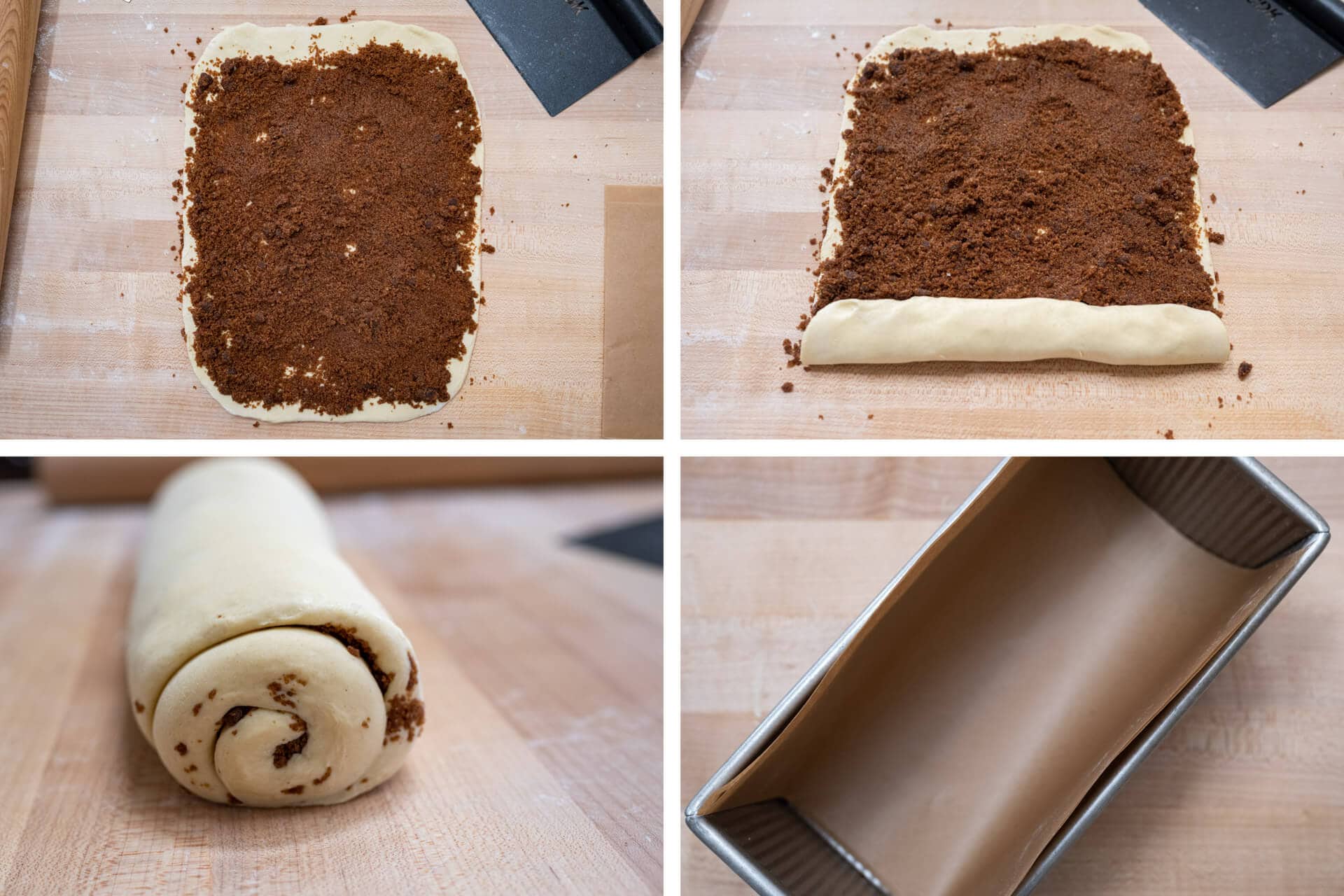
In the morning, take the dough out of the refrigerator and scrape the dough out to a floured work surface. Flour the top of the dough, and using a rolling pin (or dowel), roll the dough out to a rectangle approximately 10″ x 24″ in size (if you want fewer layers and more filling pooled between them, roll to 10″ x 12″, instead) in size with a short edge closest to your body.
If you want a less-sweet, less-sticky babka, spread less filling over the rolled out dough.
Using your hand or an offset spatula, spread the filling over the dough, leaving about 1″ clean on the short side farthest from you. Then, starting at the side closest to you, roll up the dough into a tight cylinder. The dough needs to be rolled up rather tight, so pull the dough at each revolution of the cylinder.
Important: Place the rolled-up log on a baking sheet and place it into the freezer for 15 minutes (this makes it much easier to cut and braid).
Prepare your baking pan by inserting a piece of parchment so two “handles” stick up at the long sides of the pan (see photo above). The parchment will drape down one long side, over the bottom, and up the other. Once it fits, take it out and place it on the counter next to your pan.
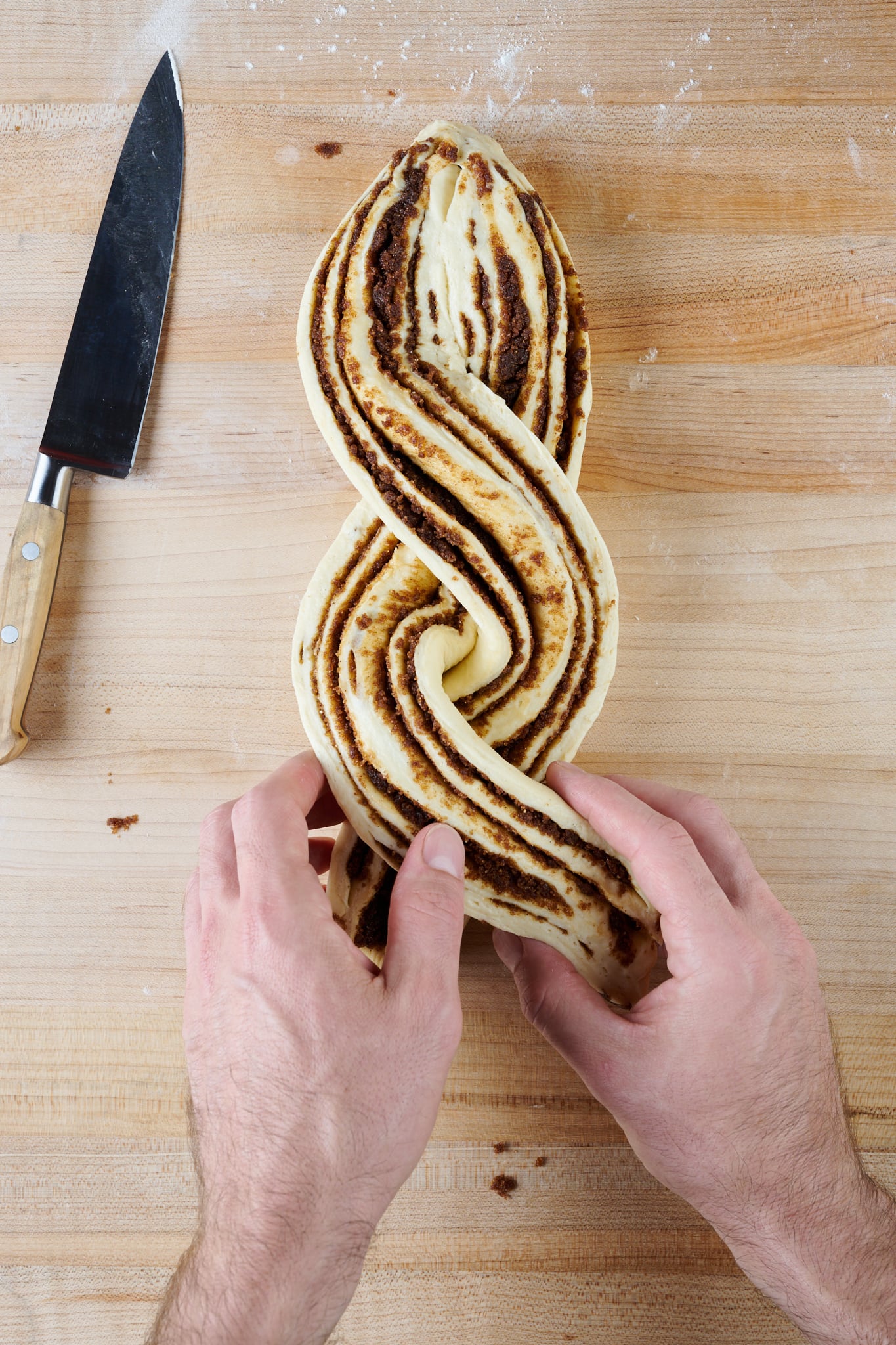
After the 15-minute freezer rest, take the baking sheet out of the freezer and return the dough log to the counter. Using a sharp knife, cut the log to split open the log from one side to the other. Next, pinch the two top halves together and braid the dough one strand over the other. At the bottom, pinch the two halves together again. Don’t worry if filling spills out or things get messy.
After the dough is braided, pick up the braid and place it on the parchment right in the middle, then pick up the sides of the parchment and lift the dough and drop it into the pan.
Cover the pan and place it somewhere warm, ideally, 78-80°F (26-27°C), to proof.
6. Proof – 8:30 a.m. 12:00 p.m. (or until ready)
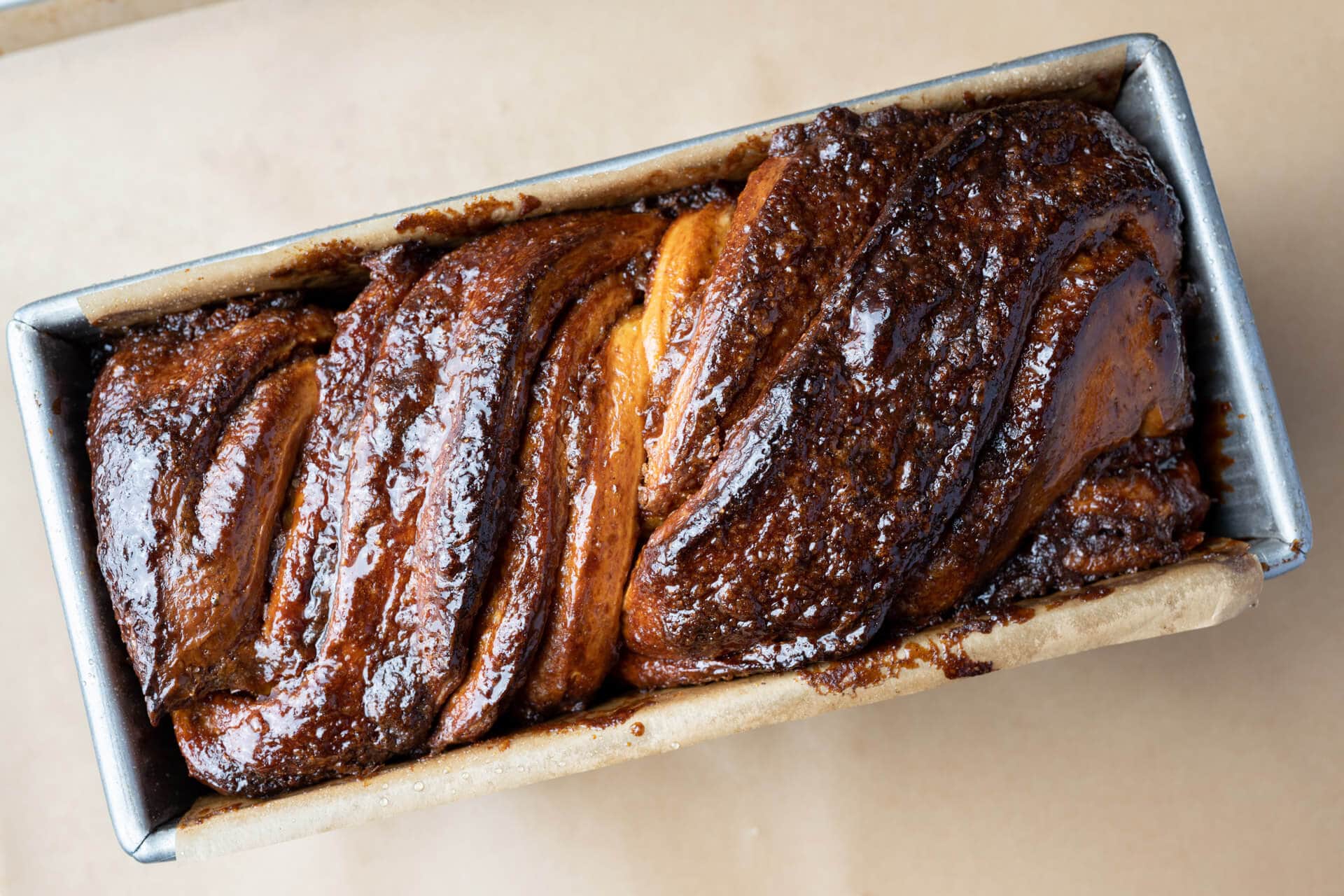
This dough can be slow to rise so give it the time it needs to rise within 1/2″ below the rim of the Pullman pan. For me, at 78°F (26°C), it took about 3.5 hours. See the image below for how high my dough filled my pan.
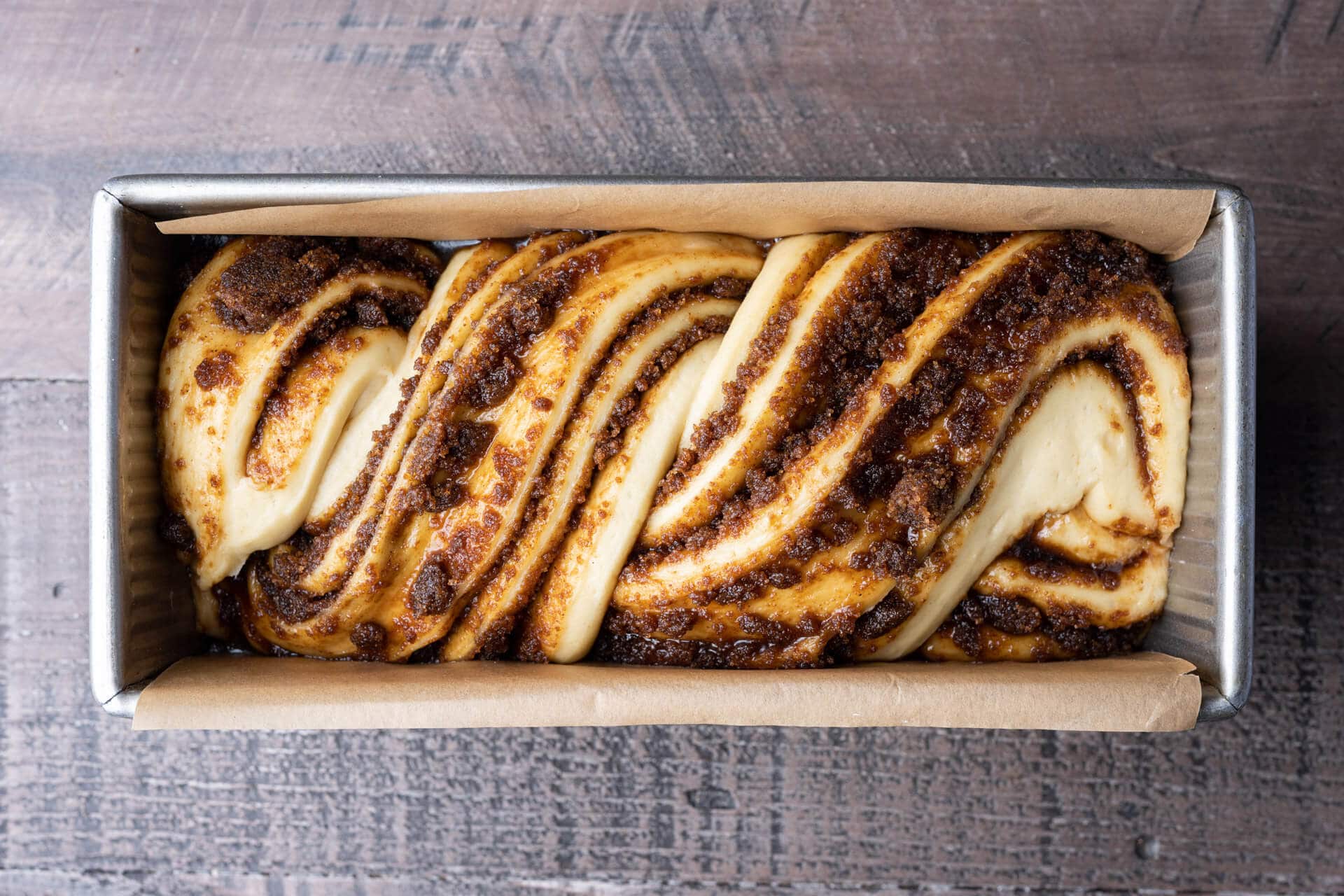
7. Bake – 12:00 p.m.
Preheat your oven with the rack in the middle to 350°F (176°C), non-convection.
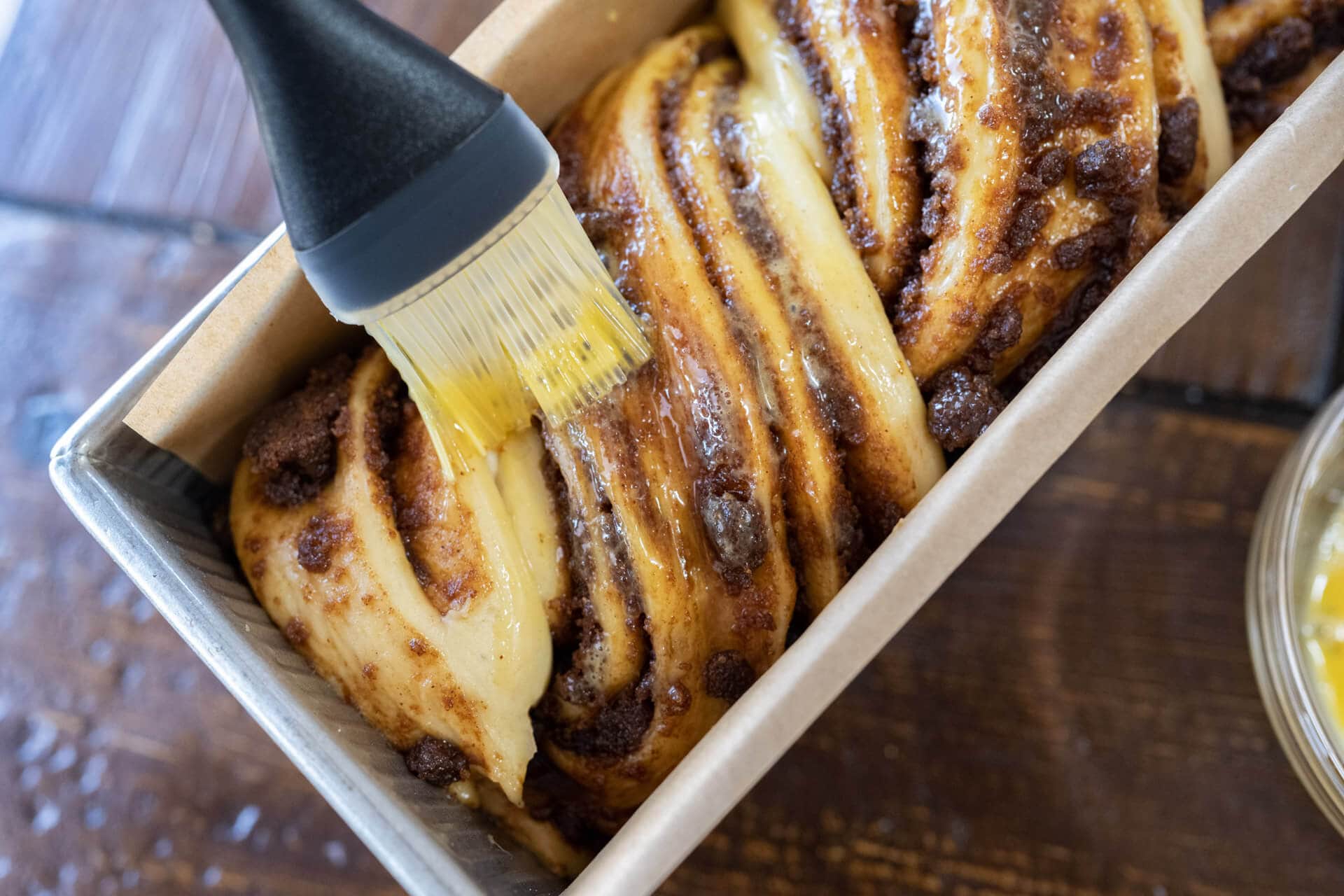
When the oven is preheated and the babka dough is fully proofed, place the pan on a baking sheet lined with parchment paper (to catch any sugar spilling over). In a small bowl, whisk together one whole egg and 1 Tbsp water and brush a thin layer of the egg wash on the top of the dough. Then, slide the baking sheet into the oven and bake for 40-45 minutes until the center of the babka reaches 200°F (93°C). Keep an eye on the babka in the last 10 minutes of the bake; if it’s coloring too quickly, drop the temperature to compensate.
While the babka is baking, make the simple syrup. Heat over low 52g (1/4 cup) granulated sugar with 59g (1/4 cup) water in a small saucepan. Heat until the mixture bubbles a bit and occasionally stir until the sugar fully dissolves in the water. Transfer this simple syrup to a container to cool. If covered, it will keep indefinitely in the fridge.
Remove the pan to a cooling rack. Using a plastic spatula, free the short sides of the babka (the sides without parchment) from the sides and bottom of the pan by pressing the spatula down from top to bottom.
Using a pastry brush, brush on a thin layer of the simple syrup (the more you brush on, the sweeter the crust). Let rest for 10 minutes in the pan. Do not let the babka rest for longer than 10 minutes, or it’ll be hard to remove from the pan.
After the rest, lift the sourdough babka out of the pan using the parchment paper sticking up as a set of handles.
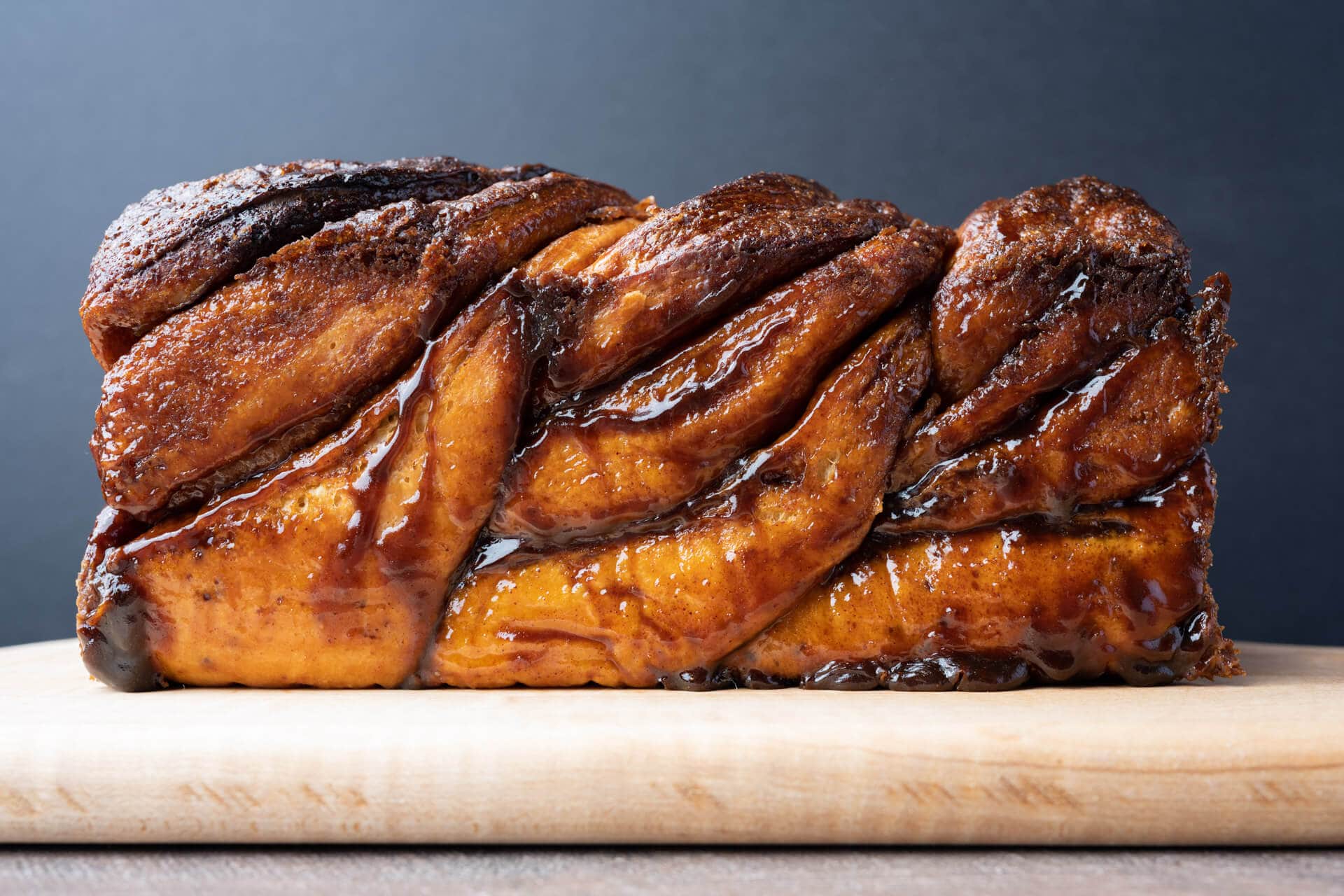
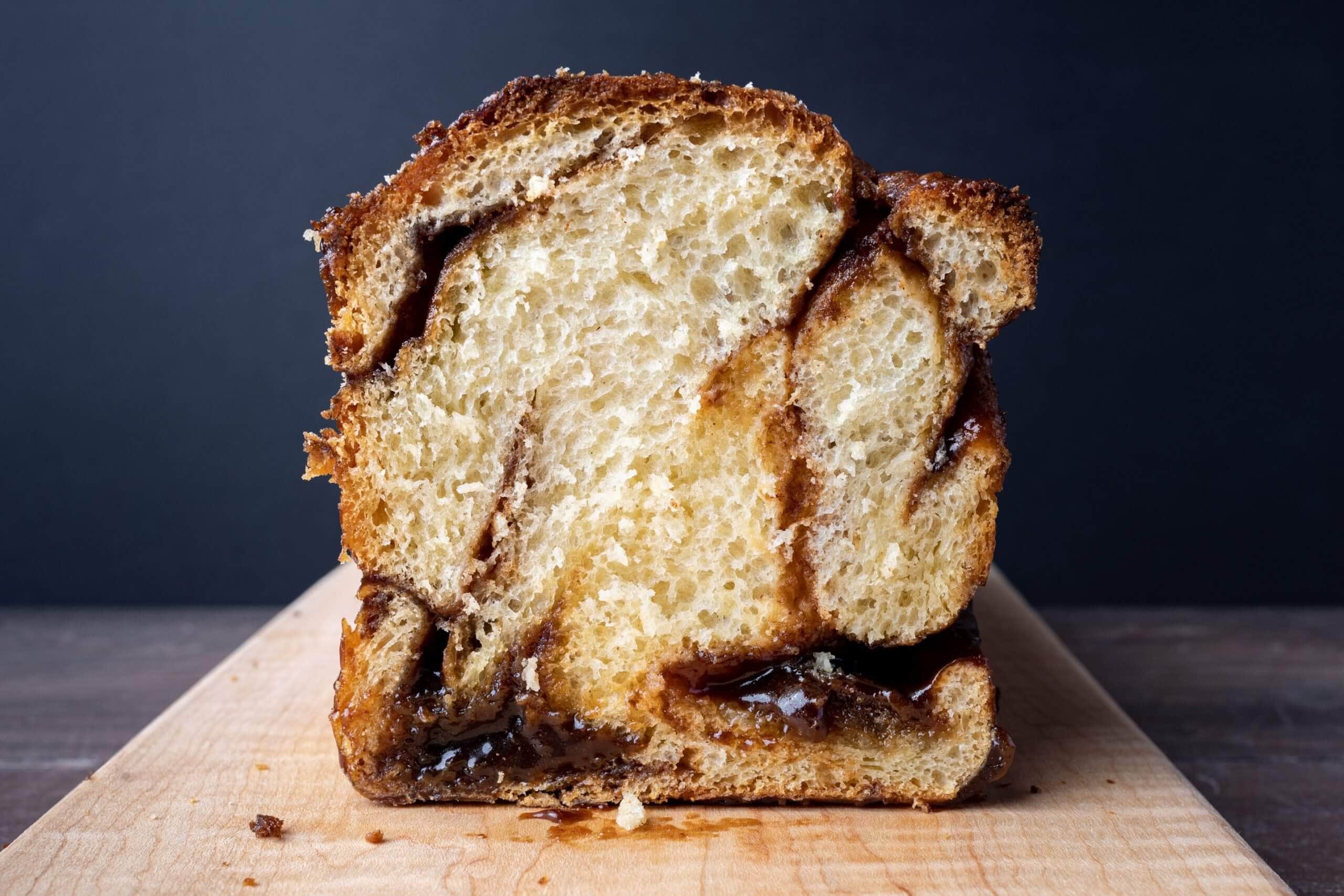
The flavor of this babka is just wicked. The exterior looks intense, gooey, perhaps even glutinous—but once the babka cools, it turns into a thin and crunchy layer of pure enjoyment. Because of the way I braid the dough, pushing the cut-side to mostly face up out of the pan, the interior is a little shy, with fewer pockets of the filling. I enjoy this balance, making each bite sweet but not too sweet.
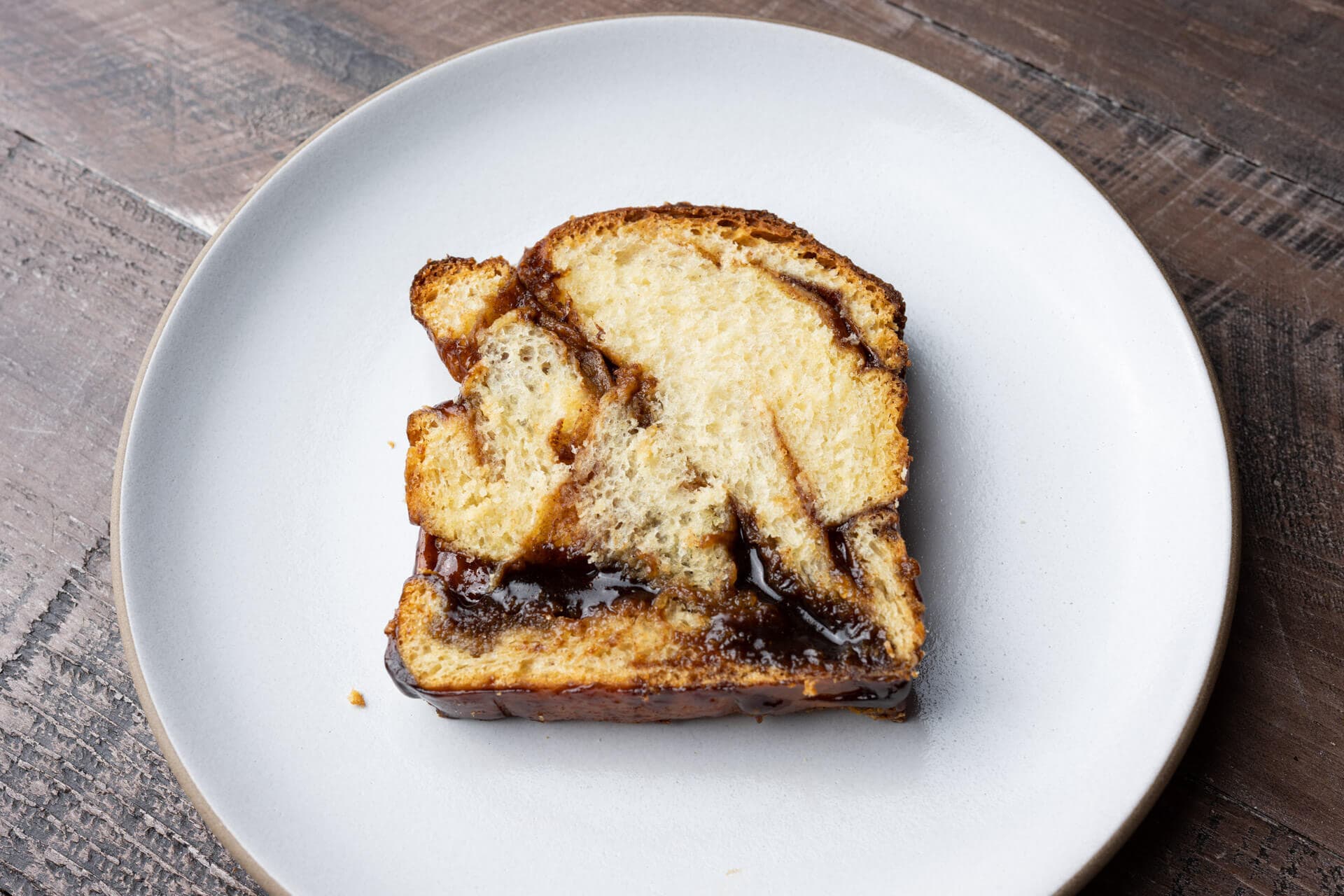
And your babka will undoubtedly look different (isn’t that the beautiful thing about baking by hand, anyway?), as the filling ebbs and flows its way through each slice. Looking at a slice is like pretending you’re a palm reader: you subconsciously trace the dark lines as they wind here and there, trying to see the future, to plan each bite to land you right in the next delicious zone of brown sugar and cinnamon.
Print
Sourdough Babka
- Prep Time: 26 hours
- Cook Time: 45 minutes
- Total Time: 26 hours 45 minutes
- Yield: 1 babka
- Category: Sweet
Description
Sticky and decadent, this cinnamon (or chocolate, choose which filling you’d like more) babka is sure to please.
Ingredients
Levain
- 46g all-purpose flour
- 46g water
- 46g ripe sourdough starter, 100% hydration
Main dough
- 310g all-purpose flour
- 107g whole milk
- 107g egg (about 2 large)
- 100g unsalted butter, room temperature
- 29g superfine sugar (caster)
- 8g fine sea salt
- All of the levain
Brown sugar-cinnamon filling
- 200g dark brown sugar
- 42g unsalted butter, melted
- 15g all-purpose flour
- 8g ground cinnamon
- 1/4 tsp fine sea salt
Chocolate filling (Optional, instead of the brown sugar-cinnamon filling)
- 110g granulated sugar
- 75g unsalted butter, melted
- 70g bittersweet chocolate, chopped
- 25g unsweetened cocoa powder (Dutch-processed)
Egg wash
- One egg
- 1 tablespoon whole milk or heavy cream
Simple syrup glaze
- 52g granulated sugar
- 59g water
Instructions
- Levain (10:00 a.m.)
In a medium jar mix together the Levain ingredients. Cover the jar and keep it at a warm temperature for 3-hours. - Mix (1:00 p.m.)
To the bowl of a stand mixer fitted with the dough hook attachment, add the flour, milk, egg, half of the sugar, salt, and levain. Mix on low speed until incorporated and let rest, uncovered, for 10 minutes. Turn the mixer up to medium speed and mix for 5 minutes until the dough pulls from the sides of the mixing bowl. Stream in the remaining sugar while the mixer is running and mix for another 1 to 2 minutes until the dough comes back together. While continuing to mix, add the butter, one pat at a time. Mix for another few minutes until the dough smooths out and clings to the dough hook. Transfer the dough to a container for bulk fermentation and cover. - Warm bulk fermentation (1:30 p.m. to 3:30 pm)
At warm room temperature, 74-76°F (23-24°C), the warm bulk fermentation should take 2 hours. Give the dough two sets of stretch and folds where the first set is 30 minutes after the beginning of bulk fermentation and the second set is 30 minutes after the first. After the second set, let the dough rest, covered. -
Cold bulk fermentation (3:30 p.m. to 8:00 a.m. the next day)
Place the covered bulk fermentation bowl into the refrigerator overnight. - Roll, freeze, cut, and shape (8:00 a.m.)
Choose a filling and make it: stir the ingredients in a medium bowl and cover. Remove the dough from the fridge and roll to a 10 x 12-inch rectangle with the short edge closest to your body. Spread the filling over the dough, leaving about 1″ clean on the short side farthest from you. Roll the dough into a tight cylinder. Place the rolled-up log on a baking sheet and freeze for 15 minutes. Fold and place a piece of parchment inside your baking pan to make two “handles.” After 15-minutes, take the sheet pan out of the freezer and using a sharp knife, cut the log in half lengthwise. Pinch the top of the two halves together and braid the dough one strand over the other. At the bottom, pinch the two bottoms together again. Pick up the braid and place it on the parchment right in the middle, then pick up the sides of the parchment and lift the dough and drop it into the pan. Place the pan in a bag and seal. - Proof (8:30 a.m. to 12:00 p.m., or until ready)
Let the dough rise at a warm temperate, 78°F (26°C), for 3 1/2 to 4 hours, or more. The dough should rise to within 1/2-inch below the rim of the pan. - Bake (12:00 p.m.)
Preheat the oven with the rack in the middle to 350°F (176°C), non-convection. Line a half baking sheet with parchment paper. In a small bowl, whisk together the egg wash ingredients. Brush a thin layer of the egg wash on the top of the dough. Then, slide the babka on the baking sheet into the oven, bake for 40-45 minutes until the center of the babka reaches 200°F (93°C). While the babka is baking, make the simple syrup by combining the ingredients in a small saucepan, heat until the mixture bubbles a bit, and occasionally stir until the sugar fully dissolves in the water. Cool the mixture. When baked, remove the babka to a cooling rack. Using a plastic spatula, free the short sides of the babka (the sides without parchment) from the sides and bottom of the pan by pressing the spatula down from top to bottom. Brush on a thin layer of the simple syrup and let rest for 10 minutes in the pan. After resting, remove the babka from the pan using the parchment paper “handles” and let cool on a wire rack.
Notes
- The simple syrup can be saved in the refrigerator indefinitely (and is great for more babka or cocktails).
What’s Next?
If you love chocolate, check out my dark chocolate-cherry sourdough bread for even more. Or, for something lighter (but no less delicious) and still in pan form, my sourdough shokupan (Japanese milk bread) is just the thing.
If you use this recipe, tag @maurizio on Instagram so I can take a look!


559 Comments
This was great. I’m curious if it’s possible to make a cream cheese guava paste version?
Do you think I could use a Tangzhong to increase the stability/storage life…? How much would I replace of flour milk if so? Thanksssss :)))
Hi,
Reading the comments is depressing because there don't seem to be many people struggling with this like I did! But alas, I will persist! 🙂
We are new to KitchenAid stand mixer life so maybe I just don't know how to use that yet, but what do you mean by low and medium mixing speeds etc? Ours is on 10-speed scale, not low, medium, high, and I read in the instructions to only use the dough hook on Speed 2. So that's one area of confusion. The other is, when you say mix "until the dough comes back together." I probably should know what that means at this point (I regularly make your Best Sourdough recipe by hand and with generally good success rate) but alas, I'm not certain; does that mean the dough should be spinning in the bowl like a ball? My dough did that for a short while but then quickly collapsed to a sticky mess. I followed your times and mixing steps and gram weight ingredients etc.
Anyway, I added the softened butter pats, one by one, to my dough mix when it was still a sticky mess – should I have not done that? When it was still a complete sticky mess at the time of the first stretch and fold, it was so sticky and undeveloped that I put in back in the mixer and ran the mixer on Speed 2 for another 4 minutes. Never formed a ball. After another half hour in bulk container (in oven with light on around 78-80F) I tried a stretch and fold and the dough was still a complete sticky mess so I chucked it in the trash much to my chagrin.
Any tips for what I might have done wrong? I did the 'dime' test on my mixer and ended up raising the bowl a smidge but honestly not much and I can't imagine that would explain everything. Anyway, super bummed to have wasted all that time on a day off from work, but hopefully I can still learn something from this.
Would appreciate any guidance Maurizio or others can provide!
Cheers,
Joe
Second time success! However, I won’t sugar coat it (even though I literally did coat it with sugar!): this bake was a complete pain in the you know what! But … it was so worth it in the end. I'm gonna answer my own questions from above in case it helps anyone.
I had typed up a lengthy step-by-step approach that no one, not even my mother, would read so instead here’s the gist: the mix time is going to take WAY longer than the instructions here suggest. For me at speed 2 w/ dough hook on a KitchenAid mixer, the mix time is more like 20+ minutes before adding the butter. This includes occasional pause the mixer and scrape dough down from the sides of the bowl. Then when you add the room temp butter — mixing in completely after a few pats of butter at time — you will ultimately have mixed for probably 25-28 minutes before the dough is ready. And don’t be surprised if it doesn’t form a ball or pull away from the sides of your bowl. It probably won’t. Just look for slightly smoothed out dough and see if it would pass the window pane test.
Also, as others have noted, bake time will likely go closer to a full hour to approach the 200F internal temp. That’s fine. Don’t freak out. But this is not a time to ignore the advice to check internal temp with your thermometer.
And there you go, when you’re all done, your sourdough babka will be absolutely gorgeous to behold and scrumptious to consume! It won't have as much rise as the one in the photo because, really, how in the hell does he do that(!), but it will be amazing anyway.
Hi – did you used to have a part of this post about % if you have a bigger loaf pan etc?
Making this recipe today. FYI – if you don't have caster sugar, just grind plain sugar in a spice grinder. Fine, but not into dust.
Loving your cookbook and recently tried this recipe. I'd like to give it a bit of a fall taste and try pumpkin puree and pumpkin spice. Any suggestions?
I have followed your blog for a while but this is the first recipe I have tried! It turned out beautiful and delicious. It did sink in the middle after cooling through — any idea why that might be? I did substitute fresh-milled hard wheat flour for part of the all purpose, not sure if that would have done it. Otherwise I followed the recipe pretty exactly.
I have your book and was trying to figure out what to do with the other half of the sugar. This paragraph was left out of your cookbook.
“After the 10 minute rest, turn the mixer up to medium and mix for 5 minutes until the dough starts to pull from the sides of the mixing bowl. At this point, slowly stream in the remaining sugar while the mixer is running. Mix for another 1-2 minutes until the dough comes back together.”
This is really interesting, You’re a very skilled blogger. I’ve joined your feed and look forward to seeking more of your magnificent post. Also, I’ve shared your site in my social networks!
If we would like to use active starter that was fed and at peak, how much should we use instead of the levain?
If we want to use active starter instead of levain, how much starter should we use?
Hey there!
Could I use Nutella as the filling for this?
Hi, I’ve had your book for almost two years now and it has been an amazing sourdough journey! Just one question with this recipe, may I refrigerate for an hour after warm bulk fermentation and shape /fill the dough and then refrigerate until tomorrow and bake after a few hours at roon temperature????
i messed up and thought the warm fermentation was until 8pm………it’s in the fridge now but is there any hope this isn’t wildly overproofed????? it had risen a lot before i put it in the fridge
Making this for the first time, and my chocolate filling is suuuuper runny. How can I fix this? Thanks!
So there is a huge problem with this recipe… it is Sooooo delicious that I've already devoured the first loaf and I'm immediately getting started on making a second one🤣
I adapted this recipe to make a Povatica and was pretty happy with the results.
The dough is the same as above, but the filling is: 511g finely chopped walnut, 86g melted butter, 168g evaporated milk, 312g brown sugar, 128g honey, 3 egg whites, beaten stiff, 1/2 zested lemon, 1/2 tsp lemon juice, 1 tsp vanilla, 1/4 tsp cinnamon, 35g brandy. Mix nuts, butter, milk, brown sugar, and honey over medium heat. Add remaining ingredients and fold in egg whites.
Roll the dough into a paper thin rectangle over a lightly floured surface. This takes about 40 minutes of hard work. Spread the filling, leaving about 6" at one end. Roll up the dough like a jelly roll, using a bench knife. It will tear a bit. Press to seal the end. Cut into 3 pieces and fold each piece into separate loaf pans. Proof and bake as per above recipe.
Whoa, that sounds awesome, Jack. I've never heard of that dessert, but now I want to try. I love the addition of walnuts (I'm a walnut fanatic). Thanks for sharing this!
Can I do the second proof in the fridge overnight as well? I’m trying to figure out my timing for Passover and would like to have this fresh for Sunday. Thank you for your wonderful book, my family has greatly enjoyed all the beautiful bread!!
I'd like to know this as well. I'd much rather bake this first thing in the morning.
See my reply above, Karl!
yes, you can. It'll make the babka slightly more sour, but I dont think it would be bad! Super glad to hear you're enjoying my book, sorry for the delay, Liza 🙂
Hi, could I replace the caster sugar by maple syrup? If so … should I reduce the amount of water?
Thanks 😊
Keep in mind that maple syrup isn't quite as sweet as sugar, so you might want to use about 25% more maple syrup than the sugar called for. The maple flavor will also come through in the final babka, which can be wonderful with certain fillings but might compete with others!
Hi there!
For the cold bulk fermentation, your book mentions the duration time as 12 hours; however, here it is longer. How long is too long?
Angie, for cold bulk fermentation, you can definitely extend beyond 12 hours safely. The cold temperature (around 38°F/3°C) significantly slows down fermentation activity, making the timing quite flexible. You can add about 8 hours to the suggested time without much impact on dough quality or flavor development. Check out my guide to cold fermentation: https://www.theperfectloaf.com/guides/the-ultimate-guide-to-bread-dough-bulk-fermentation/
Thank you so much! I gave up on sourdough a couple years ago. I found your book last year and it has helped me tremendously. Your book is great along with the videos.
Means a lot to hear that, Angie! Thank you 🙂
I have tried this dough so many times but it always comes out SOOOO sticky and is nearly impossible to roll up. I don’t know what I’m doing wrong because I follow every single step to the T!
If your dough is feeling too sticky to handle, try reducing the water a bit in your next mix. Also, a short 30-45 minute rest in the fridge can really help make it more manageable before shaping. Don't get discouraged – finding the right hydration for your flour and environment takes some trial and error!
Eating my first slice right now of Cinnamon Brown Sugar SD Babka, and I have to say it’s beyond delightful! I had my doubts most of the way through the process because the dough was incredibly sticky and wet, and super s l o w to rise even in a proofer with controlled temps. But that may have been my fault because I was stubborn enough to use my ripe & tripled starter (1:5:5) instead of the recipe’s levain. Next time I’ll try the prescribed levain to see if that helps strengthen the dough enough to make it easier to work with, especially when rolling up the log and braiding it. Nevertheless, it turned out soft and light, delicate and delicious, and a pure joy to eat! Makes this home baker thrilled for the experience and my taste buds as well! Thank you for another great recipe and tutorial, Maurizio!!
Pamela, thrilled to hear you're enjoying that first slice! The babka can definitely be tricky to handle, and yes, using the levain as written will help with dough strength. But it sounds like you persevered beautifully – that soft, light texture is exactly what we're after. Thanks for sharing your success story, even with the sticky challenges along the way. All that patience during the slow rise paid off 🙂
Hello Leo.
This is my first time baking the babka 😀 and I put it in the fridge last night before waiting to show some signs of rising. Now I took the dough out of the fridge and still no rise :(( should I put it somewhere warm to rise? Or proceed with the rolling and filling? 😅
Hi! Yes, it's totally normal not to see much rise in the fridge overnight. If your dough still feels tight and hasn't puffed up, let it warm up and continue fermenting at room temperature until it's noticeably puffy before proceeding with rolling and filling. Patience is key with this babka!