

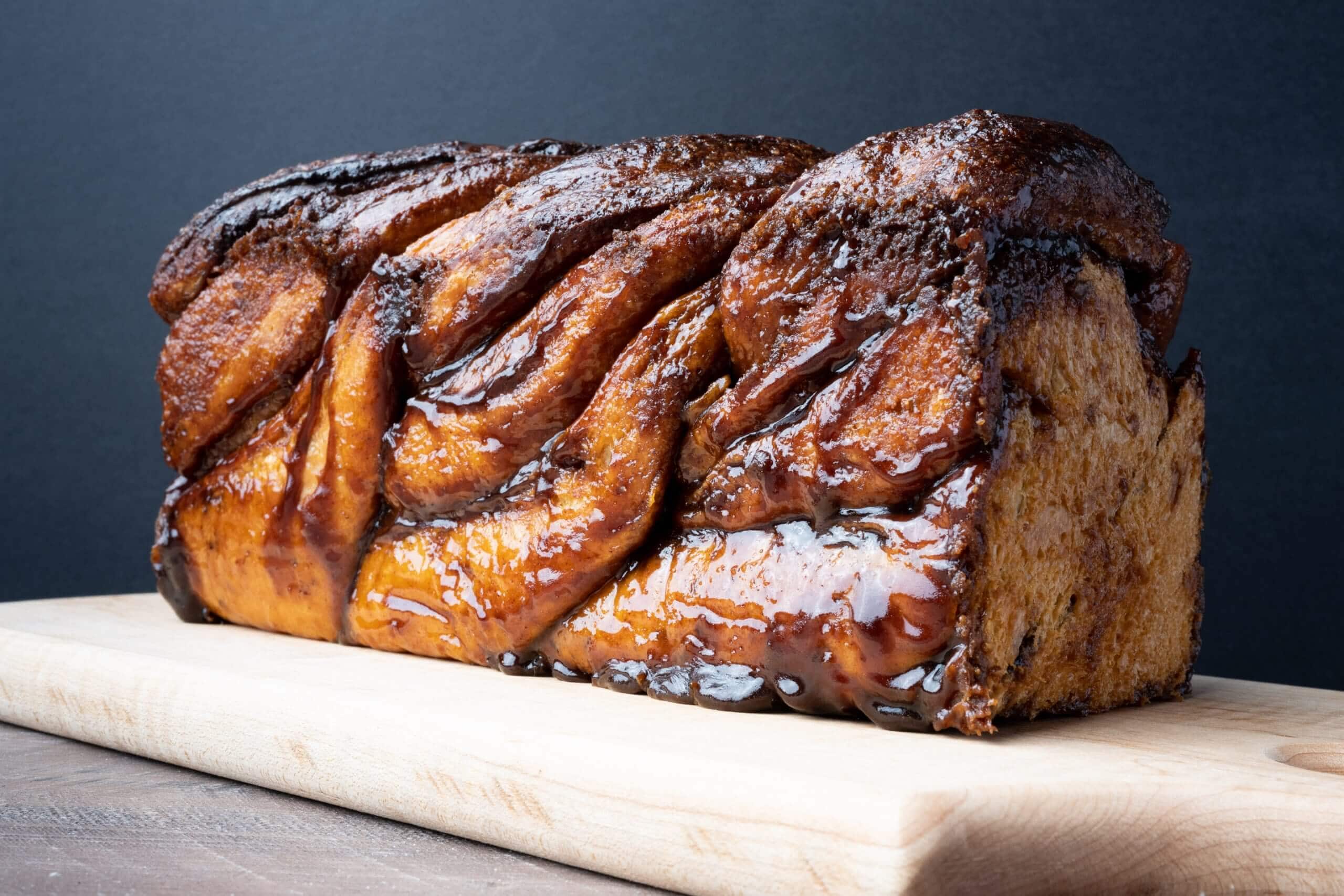
Right now, I’m front-row seat at the best kind of concert: ogling at the twisted cacophony of an enriched naturally leavened dough with sharp cinnamon and warm brown sugar (or chocolate, read on), all topped with a luxurious, simple syrup. This sourdough babka is sitting there cooling on a wire rack, but I swear I hear it singing. If there ever was such a thing as too much anticipation, right now surely qualifies; it’s as palpable as any musical instrument in an empty music hall. And I’d pay a hefty sum to cut in, take a bite, and end the concert a little early.
But let’s be completely clear: this is a sticky, gooey, and sinfully delicious treat.
I’ve stepped up my baking research and development for this babka to get this recipe out after the enthusiasm displayed on my recent Instagram post. This dough is straightforward, playing at not quite the enrichment level of brioche (or my cinnamon rolls), but not precisely lean, either. I feel it’s just right: not cloying, not overly rich, and certainly not dry or under-flavored. And while it unquestionably looks drenched, the interior is not—the interplay between the crust and crumb is wonderfully balanced.
But let’s be completely clear: this is a sticky, gooey, and sinfully delicious treat.
And the timing for making something like this is perfect; right now, we can all use a little joy, a dab of sunshine through the clouds, the sweet, tangible canto of a sourdough babka (with all of its buttery deliciousness) humming to itself on a cooling rack.
Sourdough Babka Recipe
Equipment
Pullman Pan
This recipe will work with many different pans, but I eventually turned to my trusty 9 x 4 x 4-inch Pullman Pan in testing. The reason is twofold: I love the resulting straight-sided and presentable sourdough babka. Second, the USA Pan has a natural silicone lining, which, combined with parchment paper, makes cleanup a snap.
If you don’t have a Pullman pan, a typical 8.5 x 4.5 x 2.75-inch loaf pan will also work well.
Rolling Pin
You’ll need a standard rolling pin/dowel to roll out this dough, and this rolling dowel is my favorite (and made in the USA).
Vitals
| Total Dough Weight | 800 grams |
| Pre-fermented Flour | 13.0% |
| Yield | One babka |
Total Formula
Desired dough temperature: 76°F (24°C) (see my post on the importance of dough temperature).
| Weight | Ingredient | Baker’s Percentage |
|---|---|---|
| 357g | All-purpose flour (11-12% protein; King Arthur All-Purpose Flour) | 100.0% |
| 107g | Whole milk (cold from the fridge) | 30.0% |
| 107g | Large eggs (about 2, cold from the fridge, plus one more egg in reserve for the egg wash) | 30.0% |
| 100g | Unsalted butter (Kerrygold; room temperature) | 28.0% |
| 46g | Water | 13.0% |
| 29g | Caster sugar (superfine white sugar) (if you don’t have caster sugar, use the finest sugar you have) | 8.0% |
| 8g | Fine sea salt | 2.3% |
| 46g | Sourdough starter (100% hydration) | 13.0% |
Instead of All-purpose flour, feel free to use high-protein white flour (“bread flour”) in its place if that’s all you have in your pantry.
Sourdough Babka Method
1. Levain – 10:00 a.m. (or when your starter is ripe)
In the morning, mix the following in a small jar:
| All-purpose flour | 46g |
| Water (warm) | 46g |
| Ripe sourdough starter, 100% hydration | 46g |
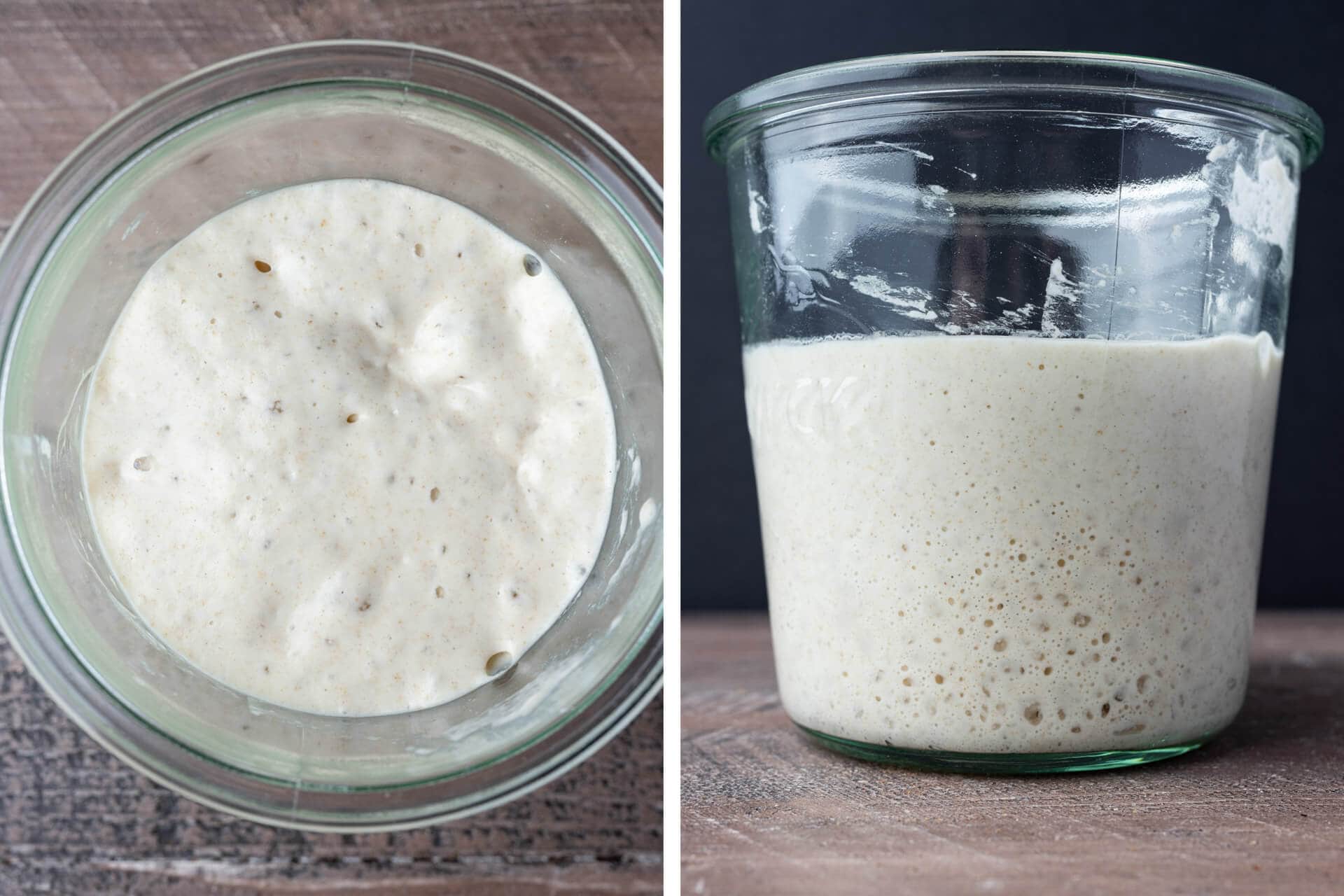
Loosely cover the jar; it should be ready after about 3 hours at a warm temperature, 78-80°F (26-27°C). If it’s cold in your kitchen, warm the mixing water for this levain to get close to 80°F (27°C) (see my post on baking in the winter for more tips).
If you’re new to making a levain, see my post on the differences between a levain and sourdough starter.
2. Mix – 1:00 p.m.
| Weight | Ingredient |
|---|---|
| 310g | All-purpose flour (11-12% protein; King Arthur All-Purpose Flour) |
| 107g | Whole milk (cold from the fridge) |
| 107g | Large eggs (about 2; cold from the fridge) |
| 100g | Unsalted butter (Kerrygold; room temperature) |
| 29g | Caster sugar (superfine white sugar) |
| 8g | Salt |
| 138g | Ripe levain |
First, cut the butter into 1/2″ pats. Set them on a plate to warm to room temperature.
I used my KitchenAid stand mixer to mix this dough. To the bowl of a stand mixer fitted with the dough hook attachment, add the flour, milk, egg, half of the sugar, salt, and levain. Set the mixer to low and mix until everything is incorporated. Let the dough rest, uncovered, for 10 minutes.
After the 10 minute rest, turn the mixer up to medium and mix for 5 minutes until the dough starts to pull from the sides of the mixing bowl. At this point, slowly stream in the remaining sugar while the mixer is running. Mix for another 1-2 minutes until the dough comes back together.
With the mixer still set to medium, add the butter, one pat at a time, waiting to add the next until the previous is absorbed into the dough. It might take around 5 minutes to mix all the butter into the dough. After all of the butter is added, continue mixing for another few minutes until the dough smooths out and once again begins to cling to the dough hook. The dough should be almost fully developed at this point (it won’t completely pass the windowpane test, but almost).
Transfer the dough to a container for bulk fermentation and cover.
3. Warm Bulk Fermentation – 1:30 p.m. to 3:30 p.m. (or longer, as needed)
At warm room temperature, 74-76°F (23-24°C), this portion of bulk fermentation should take 2 hours. During this time, give the dough two sets of stretches and folds where the first set is 30 minutes after the beginning of bulk fermentation and the second set is 30 minutes after the first. After the second set, let the dough rest, covered, until the next step.
4. Cold Bulk Fermentation – 3:30 p.m. to 8:00 a.m. (next day)
Assess the dough: has it risen a little in the bowl during the warm bulk fermentation? It should be a little puffy and smoothed out. If it looks like there’s no activity at all, give the dough another 30 minutes to 1 hour and check again.
Once you see some rise in the dough, place the covered bulk fermentation bowl into the refrigerator overnight.
Same day option: Let the dough finish bulk fermentation for 2 to 3 hours on the counter. When the dough has risen around 50% and feels puffy, proceed with the rest of the steps below. However, I recommend placing the dough in the fridge for at least 1 hour after this warm bulk fermentation to chill to make rolling and filling easier.
5. Roll, freeze, cut, and shape – 8:00 a.m.
Before taking the dough out of the refrigerator, make one of the fillings below and keep covered.
Brown Sugar Cinnamon Filling
| Dark brown sugar | 200g |
| Unsalted butter, melted | 42g |
| All-purpose flour | 15g |
| Ground cinnamon | 8g |
| Salt | 1/4 tsp (small pinch) |
Mix all of the ingredients above in a bowl and cover until ready to use.
Chocolate Filling
| Granulated sugar | 110g |
| Unsalted butter | 75g |
| Bittersweet chocolate, chopped | 70g |
| Unsweetened cocoa powder (Dutch-processed) | 25g |
In a medium saucepan, melt the butter. Remove from the heat and add the sugar and chocolate; stir everything together while the chocolate melts until everything comes together and smooths. Add the cocoa powder and stir to incorporate. Set aside to cool until ready to use.
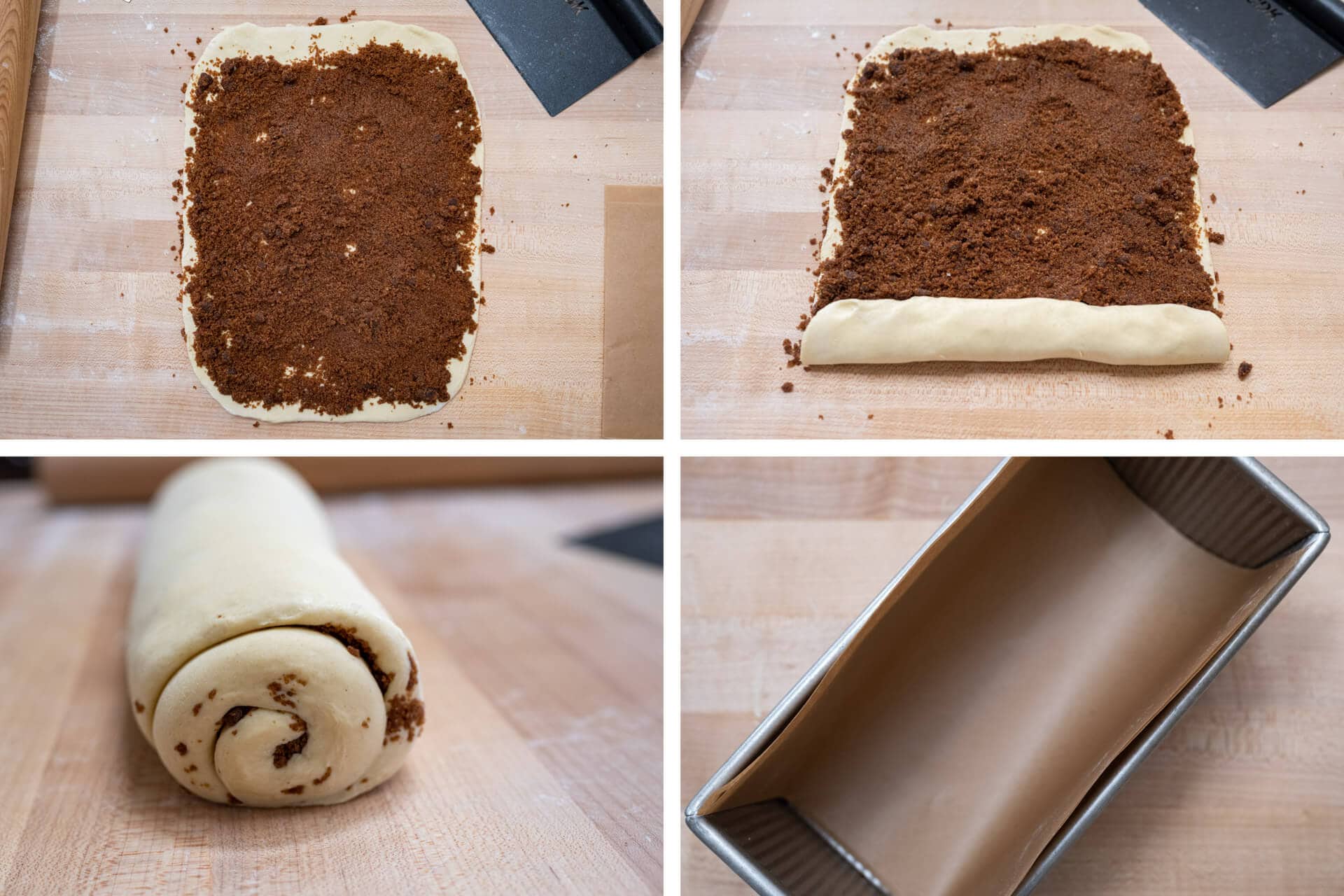
In the morning, take the dough out of the refrigerator and scrape the dough out to a floured work surface. Flour the top of the dough, and using a rolling pin (or dowel), roll the dough out to a rectangle approximately 10″ x 24″ in size (if you want fewer layers and more filling pooled between them, roll to 10″ x 12″, instead) in size with a short edge closest to your body.
If you want a less-sweet, less-sticky babka, spread less filling over the rolled out dough.
Using your hand or an offset spatula, spread the filling over the dough, leaving about 1″ clean on the short side farthest from you. Then, starting at the side closest to you, roll up the dough into a tight cylinder. The dough needs to be rolled up rather tight, so pull the dough at each revolution of the cylinder.
Important: Place the rolled-up log on a baking sheet and place it into the freezer for 15 minutes (this makes it much easier to cut and braid).
Prepare your baking pan by inserting a piece of parchment so two “handles” stick up at the long sides of the pan (see photo above). The parchment will drape down one long side, over the bottom, and up the other. Once it fits, take it out and place it on the counter next to your pan.
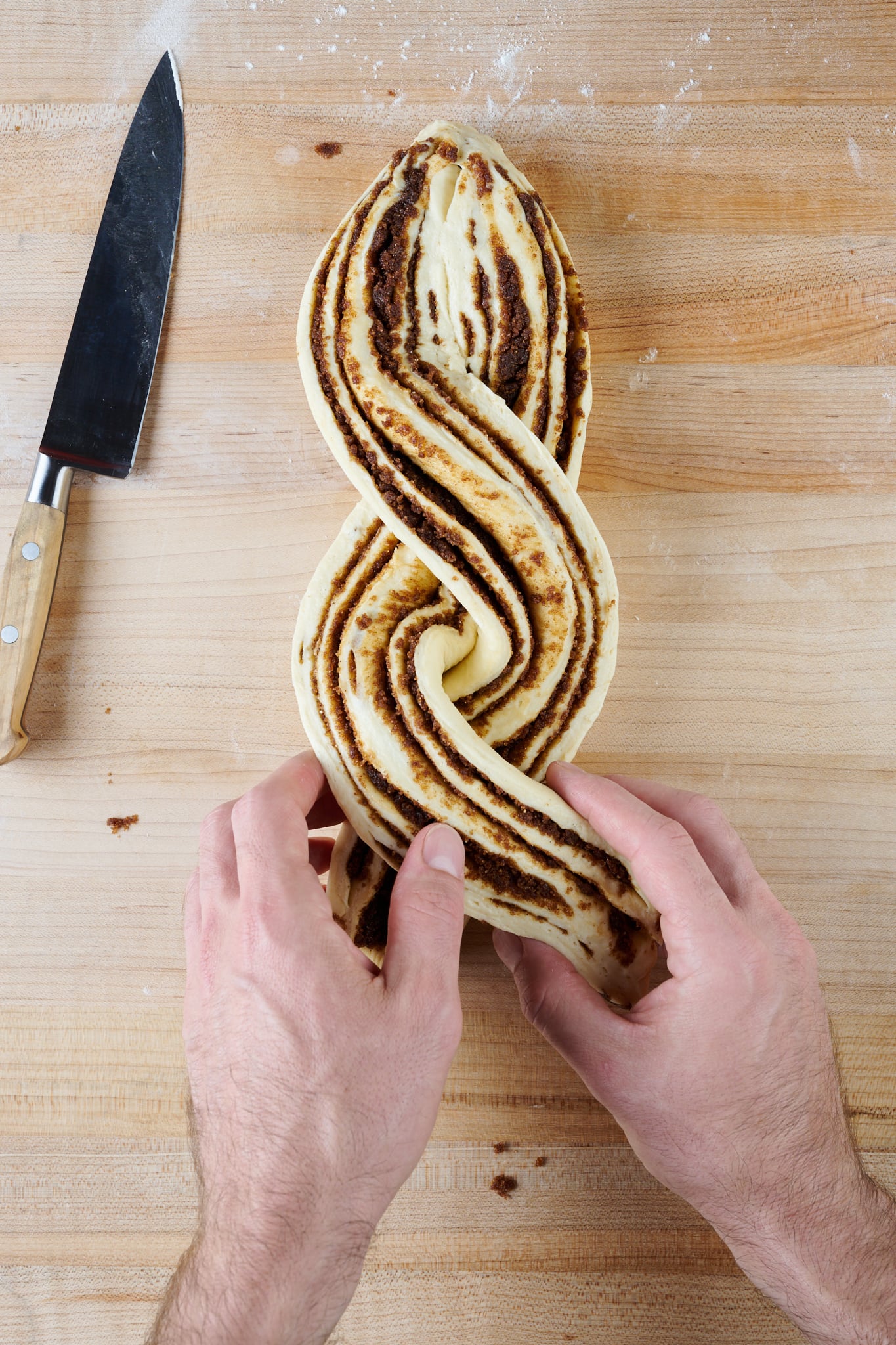
After the 15-minute freezer rest, take the baking sheet out of the freezer and return the dough log to the counter. Using a sharp knife, cut the log to split open the log from one side to the other. Next, pinch the two top halves together and braid the dough one strand over the other. At the bottom, pinch the two halves together again. Don’t worry if filling spills out or things get messy.
After the dough is braided, pick up the braid and place it on the parchment right in the middle, then pick up the sides of the parchment and lift the dough and drop it into the pan.
Cover the pan and place it somewhere warm, ideally, 78-80°F (26-27°C), to proof.
6. Proof – 8:30 a.m. 12:00 p.m. (or until ready)
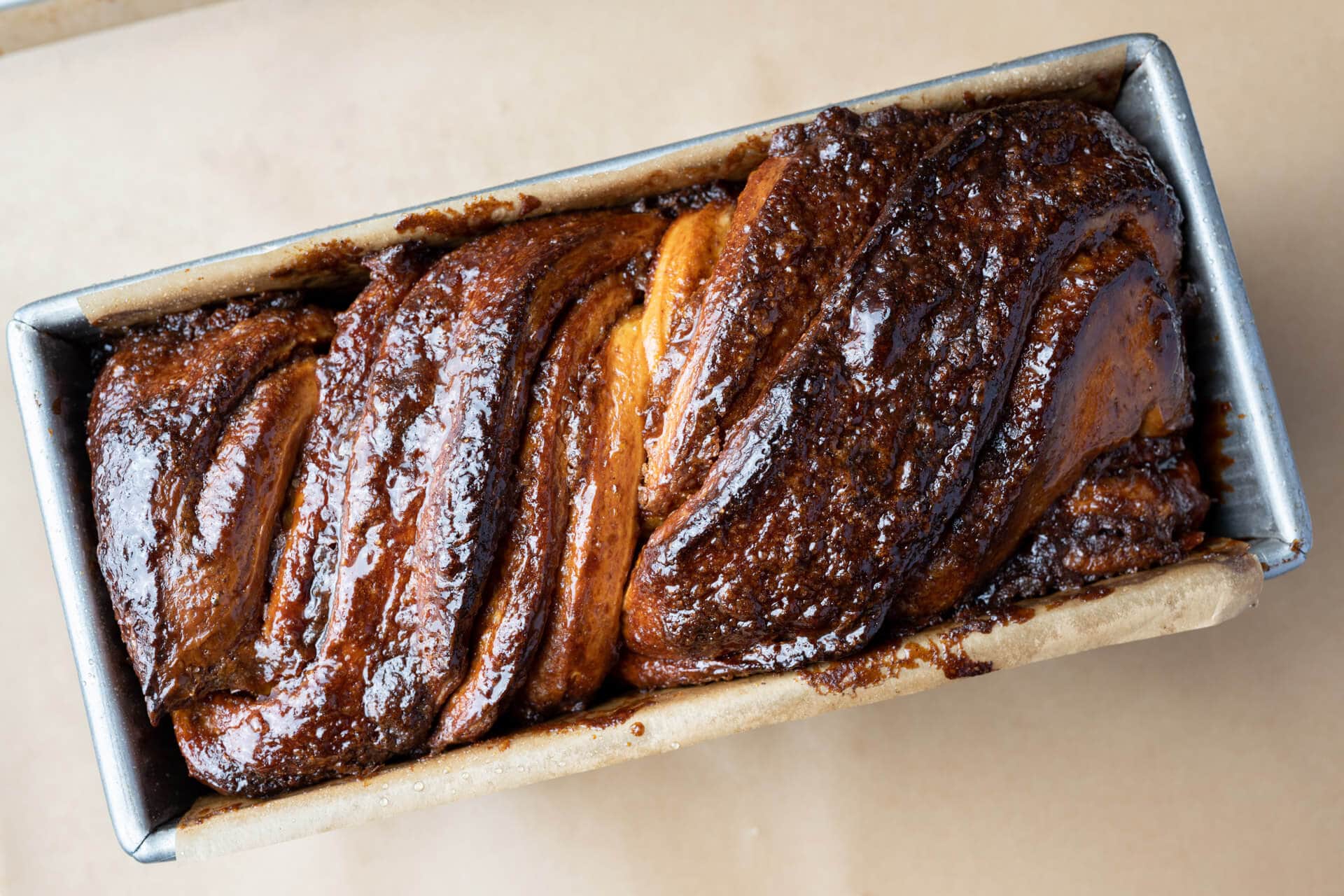
This dough can be slow to rise so give it the time it needs to rise within 1/2″ below the rim of the Pullman pan. For me, at 78°F (26°C), it took about 3.5 hours. See the image below for how high my dough filled my pan.
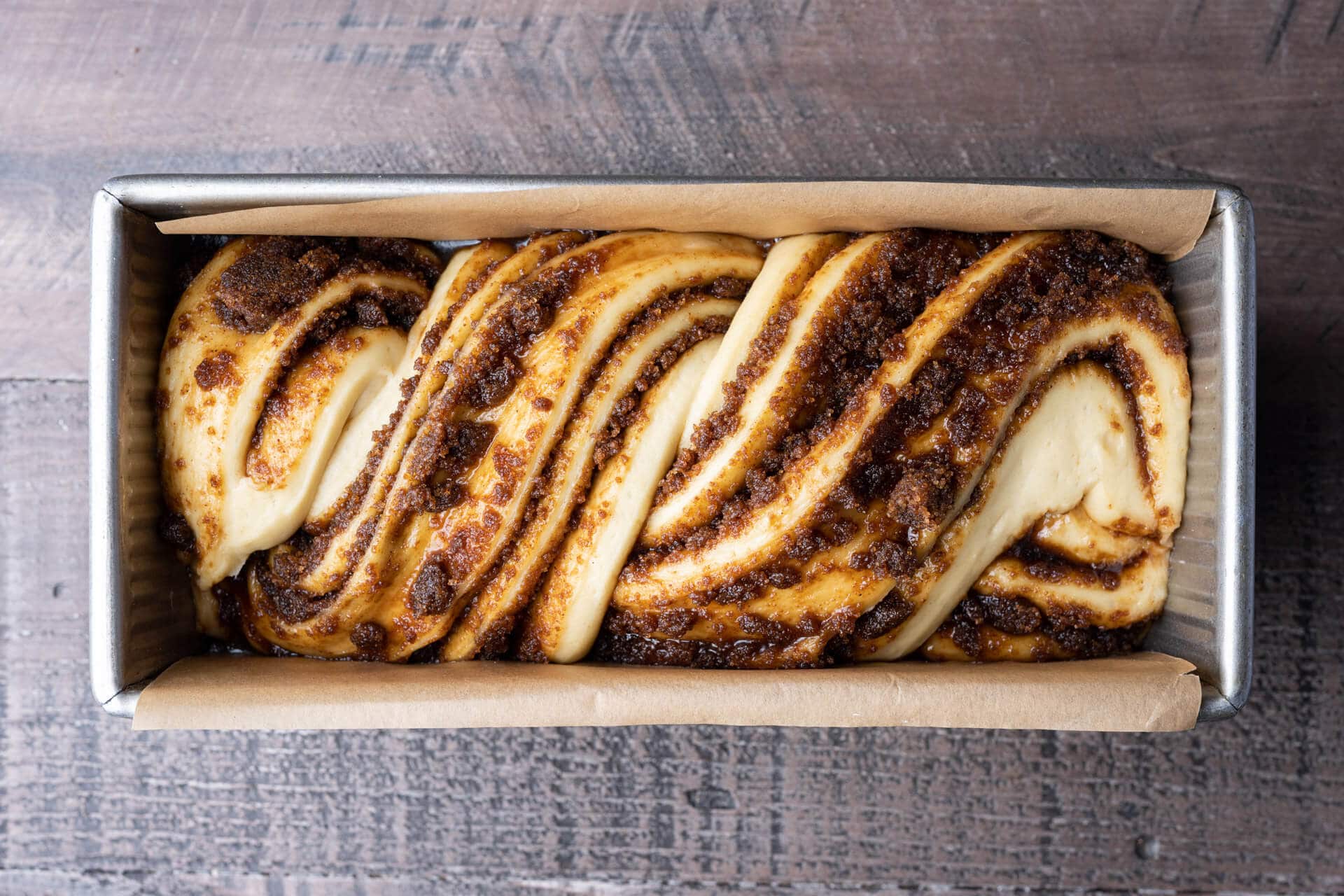
7. Bake – 12:00 p.m.
Preheat your oven with the rack in the middle to 350°F (176°C), non-convection.
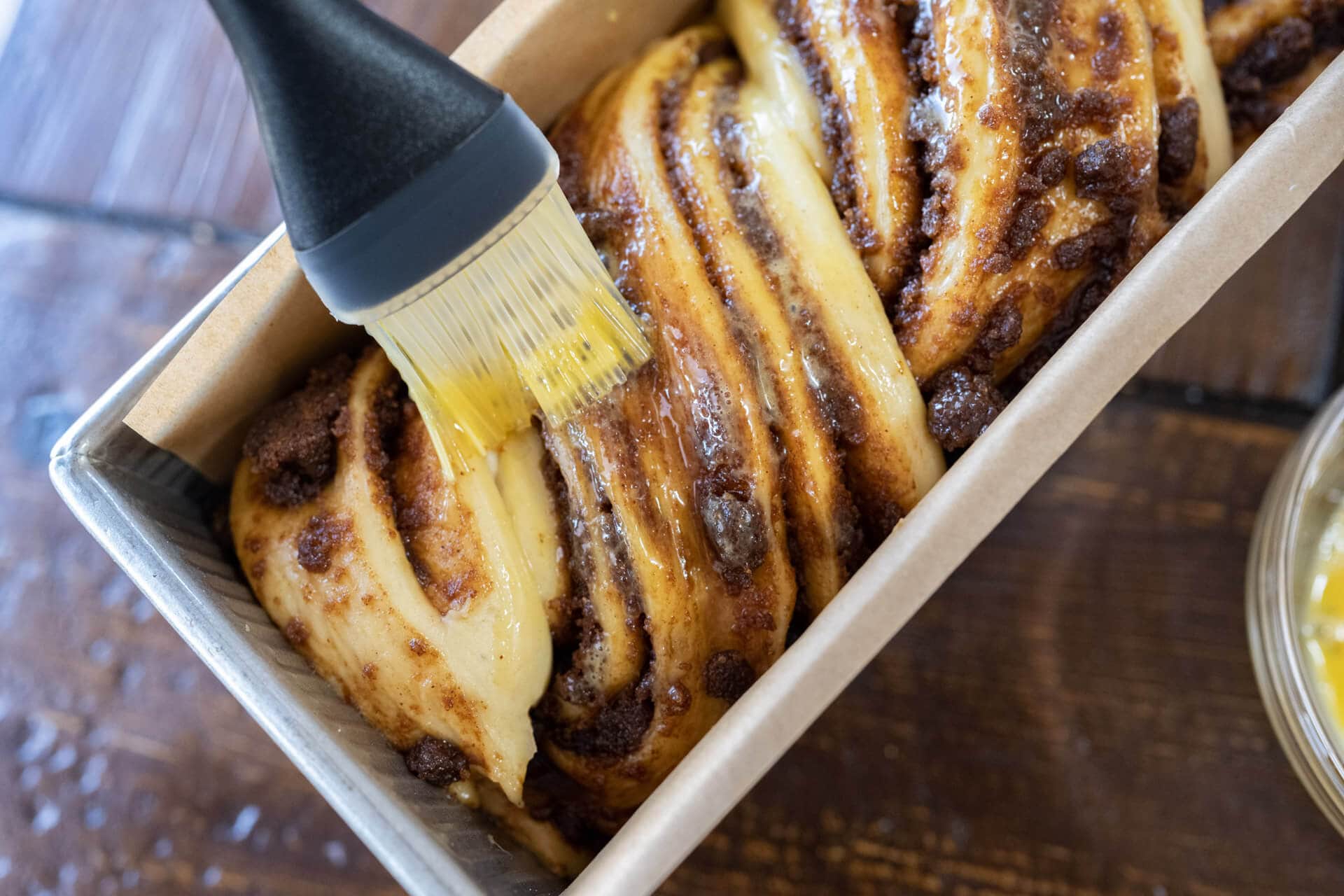
When the oven is preheated and the babka dough is fully proofed, place the pan on a baking sheet lined with parchment paper (to catch any sugar spilling over). In a small bowl, whisk together one whole egg and 1 Tbsp water and brush a thin layer of the egg wash on the top of the dough. Then, slide the baking sheet into the oven and bake for 40-45 minutes until the center of the babka reaches 200°F (93°C). Keep an eye on the babka in the last 10 minutes of the bake; if it’s coloring too quickly, drop the temperature to compensate.
While the babka is baking, make the simple syrup. Heat over low 52g (1/4 cup) granulated sugar with 59g (1/4 cup) water in a small saucepan. Heat until the mixture bubbles a bit and occasionally stir until the sugar fully dissolves in the water. Transfer this simple syrup to a container to cool. If covered, it will keep indefinitely in the fridge.
Remove the pan to a cooling rack. Using a plastic spatula, free the short sides of the babka (the sides without parchment) from the sides and bottom of the pan by pressing the spatula down from top to bottom.
Using a pastry brush, brush on a thin layer of the simple syrup (the more you brush on, the sweeter the crust). Let rest for 10 minutes in the pan. Do not let the babka rest for longer than 10 minutes, or it’ll be hard to remove from the pan.
After the rest, lift the sourdough babka out of the pan using the parchment paper sticking up as a set of handles.
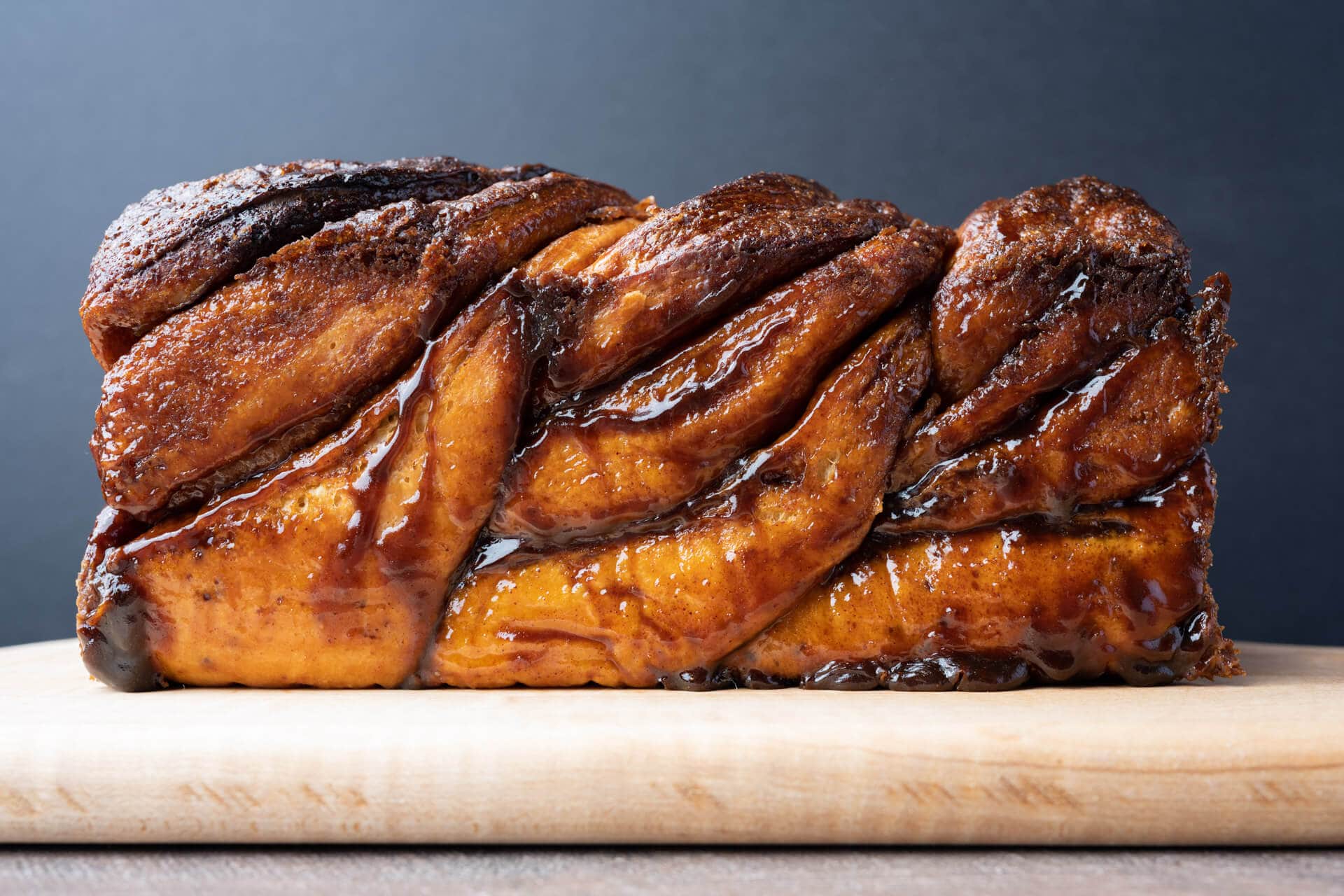
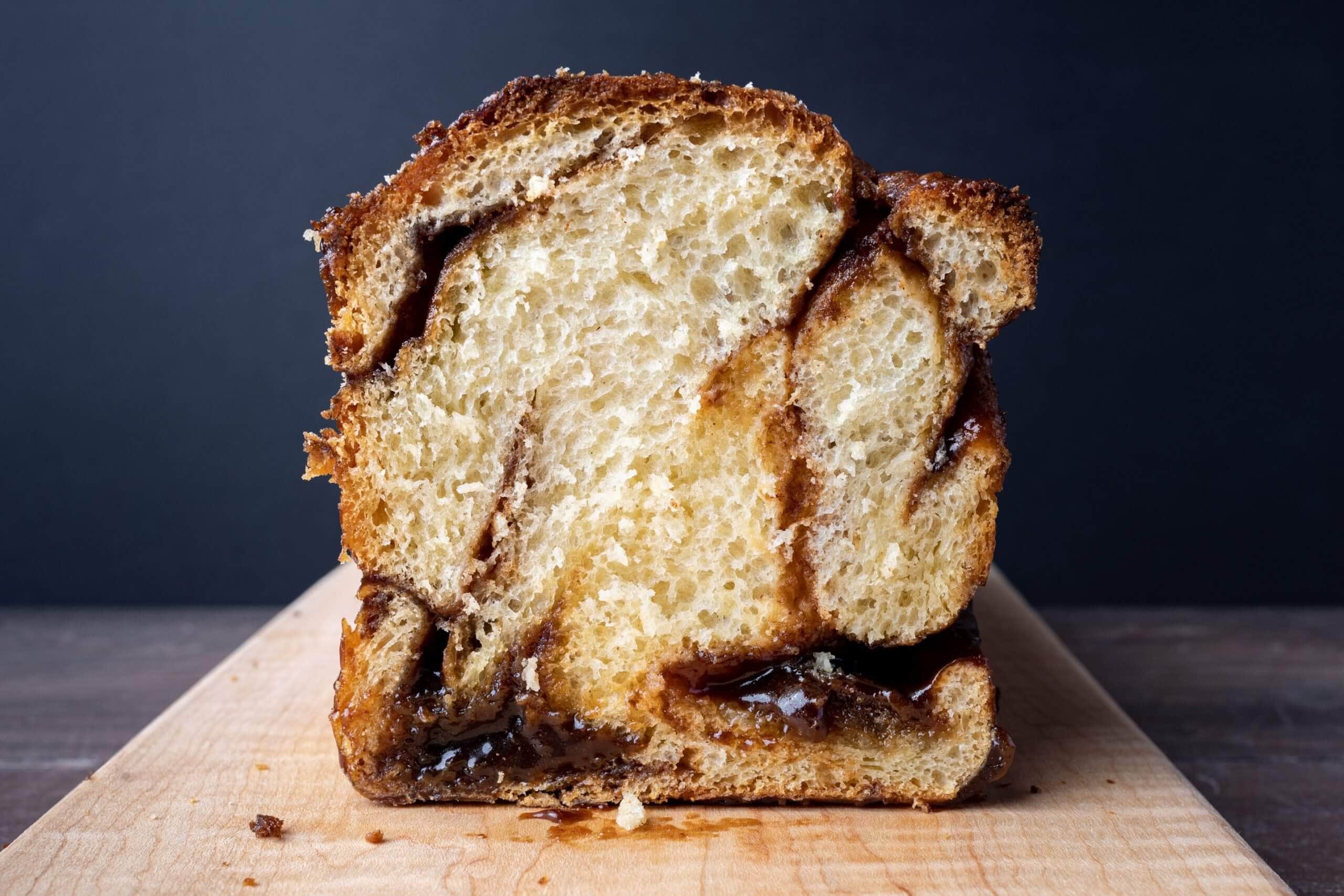
The flavor of this babka is just wicked. The exterior looks intense, gooey, perhaps even glutinous—but once the babka cools, it turns into a thin and crunchy layer of pure enjoyment. Because of the way I braid the dough, pushing the cut-side to mostly face up out of the pan, the interior is a little shy, with fewer pockets of the filling. I enjoy this balance, making each bite sweet but not too sweet.
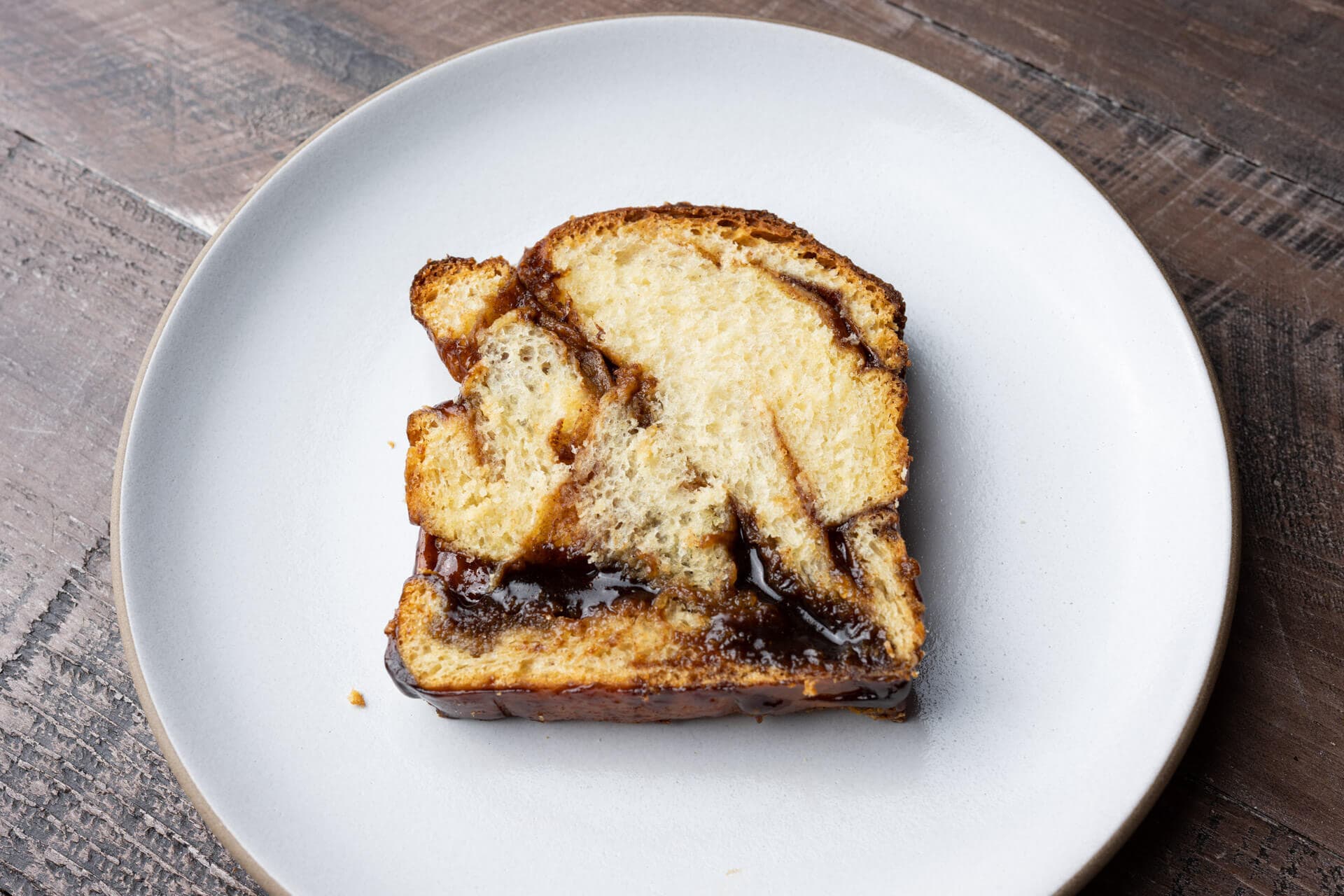
And your babka will undoubtedly look different (isn’t that the beautiful thing about baking by hand, anyway?), as the filling ebbs and flows its way through each slice. Looking at a slice is like pretending you’re a palm reader: you subconsciously trace the dark lines as they wind here and there, trying to see the future, to plan each bite to land you right in the next delicious zone of brown sugar and cinnamon.
Print
Sourdough Babka
- Prep Time: 26 hours
- Cook Time: 45 minutes
- Total Time: 26 hours 45 minutes
- Yield: 1 babka
- Category: Sweet
Description
Sticky and decadent, this cinnamon (or chocolate, choose which filling you’d like more) babka is sure to please.
Ingredients
Levain
- 46g all-purpose flour
- 46g water
- 46g ripe sourdough starter, 100% hydration
Main dough
- 310g all-purpose flour
- 107g whole milk
- 107g egg (about 2 large)
- 100g unsalted butter, room temperature
- 29g superfine sugar (caster)
- 8g fine sea salt
- All of the levain
Brown sugar-cinnamon filling
- 200g dark brown sugar
- 42g unsalted butter, melted
- 15g all-purpose flour
- 8g ground cinnamon
- 1/4 tsp fine sea salt
Chocolate filling (Optional, instead of the brown sugar-cinnamon filling)
- 110g granulated sugar
- 75g unsalted butter, melted
- 70g bittersweet chocolate, chopped
- 25g unsweetened cocoa powder (Dutch-processed)
Egg wash
- One egg
- 1 tablespoon whole milk or heavy cream
Simple syrup glaze
- 52g granulated sugar
- 59g water
Instructions
- Levain (10:00 a.m.)
In a medium jar mix together the Levain ingredients. Cover the jar and keep it at a warm temperature for 3-hours. - Mix (1:00 p.m.)
To the bowl of a stand mixer fitted with the dough hook attachment, add the flour, milk, egg, half of the sugar, salt, and levain. Mix on low speed until incorporated and let rest, uncovered, for 10 minutes. Turn the mixer up to medium speed and mix for 5 minutes until the dough pulls from the sides of the mixing bowl. Stream in the remaining sugar while the mixer is running and mix for another 1 to 2 minutes until the dough comes back together. While continuing to mix, add the butter, one pat at a time. Mix for another few minutes until the dough smooths out and clings to the dough hook. Transfer the dough to a container for bulk fermentation and cover. - Warm bulk fermentation (1:30 p.m. to 3:30 pm)
At warm room temperature, 74-76°F (23-24°C), the warm bulk fermentation should take 2 hours. Give the dough two sets of stretch and folds where the first set is 30 minutes after the beginning of bulk fermentation and the second set is 30 minutes after the first. After the second set, let the dough rest, covered. -
Cold bulk fermentation (3:30 p.m. to 8:00 a.m. the next day)
Place the covered bulk fermentation bowl into the refrigerator overnight. - Roll, freeze, cut, and shape (8:00 a.m.)
Choose a filling and make it: stir the ingredients in a medium bowl and cover. Remove the dough from the fridge and roll to a 10 x 12-inch rectangle with the short edge closest to your body. Spread the filling over the dough, leaving about 1″ clean on the short side farthest from you. Roll the dough into a tight cylinder. Place the rolled-up log on a baking sheet and freeze for 15 minutes. Fold and place a piece of parchment inside your baking pan to make two “handles.” After 15-minutes, take the sheet pan out of the freezer and using a sharp knife, cut the log in half lengthwise. Pinch the top of the two halves together and braid the dough one strand over the other. At the bottom, pinch the two bottoms together again. Pick up the braid and place it on the parchment right in the middle, then pick up the sides of the parchment and lift the dough and drop it into the pan. Place the pan in a bag and seal. - Proof (8:30 a.m. to 12:00 p.m., or until ready)
Let the dough rise at a warm temperate, 78°F (26°C), for 3 1/2 to 4 hours, or more. The dough should rise to within 1/2-inch below the rim of the pan. - Bake (12:00 p.m.)
Preheat the oven with the rack in the middle to 350°F (176°C), non-convection. Line a half baking sheet with parchment paper. In a small bowl, whisk together the egg wash ingredients. Brush a thin layer of the egg wash on the top of the dough. Then, slide the babka on the baking sheet into the oven, bake for 40-45 minutes until the center of the babka reaches 200°F (93°C). While the babka is baking, make the simple syrup by combining the ingredients in a small saucepan, heat until the mixture bubbles a bit, and occasionally stir until the sugar fully dissolves in the water. Cool the mixture. When baked, remove the babka to a cooling rack. Using a plastic spatula, free the short sides of the babka (the sides without parchment) from the sides and bottom of the pan by pressing the spatula down from top to bottom. Brush on a thin layer of the simple syrup and let rest for 10 minutes in the pan. After resting, remove the babka from the pan using the parchment paper “handles” and let cool on a wire rack.
Notes
- The simple syrup can be saved in the refrigerator indefinitely (and is great for more babka or cocktails).
What’s Next?
If you love chocolate, check out my dark chocolate-cherry sourdough bread for even more. Or, for something lighter (but no less delicious) and still in pan form, my sourdough shokupan (Japanese milk bread) is just the thing.
If you use this recipe, tag @maurizio on Instagram so I can take a look!


559 Comments
Has anyone had any success with plant based milks or greek yogurt substitutes? I don’t typically have cow milk on hand, but these substitutes usually work in most recipes.
If those usually work, go for it! I’d imagine something like full fat Oatmilk would be pretty awesome (and something I’ve wanted to experiment with…)!
Thank you! I used Vanilla Oatmilk as it’s what we had in the house and proofed for close to 8 hours. It came out absolutely perfect. Thank you so much.
Oh, and I used slightly thinned maple syrup instead of simple syrup. If you have access to the real thing, delicious
Love this idea!
How did you thin the maple syrup, how much and how much did you use?
I don’t recall too well. I think i put about 1/4 cup of syrup in a bowl and added a couple tsp maximum of water, just enough to make it easy to brush on. I did not brush heavily. Just enough to get a hint of maple. The flavor of the brioche dough and cinnamon should be front and center in my mind.
Super good Maurizio, I too had way longer times. And I had really been perking up my starter for days with frequent feeding and 80 degrees in my proofer. Warm bulk I quit at 3 hours because I had to sleep. Then after shaping coming out of the fridge and brief stay in the freezer, it took 6 hours at 80 degrees to proof sufficiently. That aside, this is delicious! Shaping with the sugar filling was a bit more challenging than I though as the filling did not really hold the layers together. I wanted extra hands.
Great job adjusting, Wouter. Yes, that final proof time is pretty variable, it really depends on your starter/levain and how the dough is moving that day. Glad it turned out well for you! That rolling and twisting part is certainly the only tricky bit here, it takes a little practice but even in the worst case, “just get it in the pan!” as I like to say 🙂 Enjoy!
Hi Maurizio,
Another great recipe–thank you! My proofing time (in a proofing box at 78º) was much longer than yours, but the visual cues you offered were very helpful. The eventual outcome is crazy delicious, including all the post-baking ooze in and out of the loaf pan. I think next time I’ll work for a tighter braid. And I am looking forward to trying the chocolate filling I just found here in the notes. Can’t wait!!!/Users/exbassoonist/Desktop/IMG_4346.jpeg
Glad to hear this, Ken! Yes, that final proof time can be quite variable, it really depends on how your dough was going into that cold fridge. I’m glad you adjusted as necessary — an important baker’s skill! The chocolate variant is pretty amazing, I have to say. Thanks for reporting back and happy baking!
Hi Maurizio,
Thank you for the recipe. I’ve baked a babka today for 47 minutes, I tested the temperature and it was 92 C. At the ends it was ok, but at the center where the filling was, it looked unbaked. You think I should have baked it more? And also it wasn’t as light and airy as your dough looks. I’ve proofed it for 2.5 hours, and it looked proofed.
Hey, Ana! It seems the bake time for this varies a bit from baker to baker, I’m not sure if this is because of typical oven discrepancies, pan differences, or elevation. This is why I give the guidance for the internal temp. If you found the interior to be soft and gummy, it could be under baked or it could be under proofed. This is a slow moving dough given the enrichments, I would try proofing it a little longer next time and also baking it a touch more, perhaps to 95°C and see how that goes!
Hi Maurizio. Firstly, thankyou so much for posting this recipe! I’ve always wanted to try baking a bubka and today I did using your recipe…it’s cooling as I type this. I do have a question for you – are the oven temperatures that you quote fan-forced or without fan? Mine got dark very quick so I’m wondering if the fan assist in my oven made things a bit too hot. Many thanks!
I did not use convection (fan assist) — sorry about that. I’ll make this clear in the recipe!
No worries at all! When I saw it getting dark so quickly I adjusted the temperature accordingly. The bubka came out beautiful! Time to bake another as the first one is all gone 🙂
Glad to hear that! The next one will be even better 🙂
Baked another one of these yesterday, this time at the called for temperature….and it was absolutely perfect! Thank you for this wonderful recipe!
Does anyone have any suggestions about replacing the filling with chocolate – or just use a chocolate filling like I’d find on other yeasted ones and have at it? Thank you! I have my starter fed and ready to go for the morning levains! (doing the “my perfect sourdough and this babka this weekend – and I’m very excited).
I’m hoping to hear the same thing. Would love to know how I could do this with chocolate. Suppose I could just try and see if it screws it up 🤷🏼♀️
I think I’m going to use Smitten Kitchens better babka filling recipe – – the steps are almost identical (of course with the exception of she uses yeast) – the dough is in stage one, I’ll report back tomorrow!
Check out my reply to @disqus_hIuZEHp86p:disqus above, it’s my latest test with chocolate!
I just posted to Instagram a chocolate babka version I’ve been testing, it came out incredible! Here’s the filling:
110g granulated sugar
75g unsalted butter
70g bittersweet chocolate, chopped
25g unsweetened cocoa powder (Dutch-processed)
In medium saucepan, melt the butter. Remove from the heat and add the sugar and chocolate, stir everything together while the chocolate melts until everything comes together and smooths out. Add the cocoa powder and stir to incorporate. Set aside to cool until ready to use.
Just made this and it turned out BEAUTIFULLY. Absolutely perfect. Thank you for the fabulously detailed instructions.
Made this today and it turned out BEAUTIFULLY. Thank you for the fabulously detailed directions; this loaf is going to be demolished in record time.
Glad to hear that, Jennie! I’m happy it turned out so well for you — they go quick here, believe me. In fact, I made one again yesterday and it’s already half gone. Dangerous! Enjoy 🙂
Hi Maurizio! Thank you so much for this recipe, I was so excited to make it over my weekend! However, I think I might have just made a huge mistake, and I’m hoping it doesn’t cost me this babka… I was in a rush to leave the house so I accidentally forgot to take it out of the proofer. I just got back home, and it’s unfortunately been sitting in the proofer at 80 degrees for about 6.5 hours (instead of the called for 2 hours, yikes). I immediately put it into the fridge to rest overnight, but I’m worried that I’ve over proofed it (it looks like it rose a lot!). Should I continue on with the steps and maybe just let it proof less in the loaf pan tomorrow? Thank you for any feedback!
Hey Carissa! It might still be just fine, this is a pretty slow moving dough. Yes, take it out in the morning (as early as you wake up if possible) and proceed with the steps. I’d proof it until about 1 or 1.5″ below the rim of the pan and bake. I’m sure it’ll turn out fantastic! You might get a little less rise but it’ll be delicious nonetheless. Let me know how it goes!
Just thought I’d give you an update, it turned out wonderfully!! I woke up early to work on it, so it ended up being in the fridge for about 12 hours overnight. I let it proof in the pan for just an hour at 80 degrees since it was already pretty big at that point (even before the hour long proof). I was worried it might not have any oven spring left in it, but oh man was I wrong! It came out better than I could have hoped! I did have to bake it quite a bit longer to get it up to an internal temp of 200 degrees, but I’m glad I didn’t rush it because the crumb turned out perfect! Thank you again for the help! Can’t wait to make this again 🙂
Right on Carissa! Thanks for reporting back, so happy it turned out how I had intended it would 🙂 Enjoy and here’s to many more babka!
Today I made my first ever babka using your Sourdough Babka recipe. The results were incredibly delicious! I had never had babka before and with your very clear instructions and pictures I managed to make mine look pretty close to yours..I’m a new forever babka fan
My husband and I had it as an appetizer…and dessert. It doesn’t get any better…
So glad to hear that, Jude! I just made this again today (why not?) and it’s just such an easy going dough thanks to the chill in the fridge. Glad you guys liked it and thank you for the feedback!
Yes, I’ve tested it with Bread Flour and it works very well. Given the increased protein in that flour, the dough might take less time to mix — adjust as necessary. Let me know how it goes and happy baking!
As the beautiful twisted symphony clamored for attention, my roommate and I couldn’t help it anymore. We disrupted the concert and sliced right through the strings section. Gooey violinists scattered to escape our mouths, and the lead cellist dripped back into the pan, averting its end for a short time. We knocked the tuba player upside-down. As we chomped into the deliciously imperfect babka, we started cracking up. We couldn’t believe how good it was, and for some reason that made us even more slap-happy after a wonderful dinner and a successful April Fools evening.
Love that. Sounds like it hit all the “high notes” 😉
Excellent to hear that, Aesa! Yes, that cold temp really firms it up. And this all makes for a super tender dough. Enjoy and thanks for the feedback!
Hi Maurizio, thank you for this wonderful receipe. I’m curious as to why only the 2 hour bulk fermentation? I saw minimal rise when trying this receipe. What kind of rise did you see in your dough after the 2 hour bulk? Thanks ofr your time.
That two hour rise was sufficient for me as it was then covered and placed in the fridge. It would still continue to rise in there until fully cold, then likely slow quite a bit until removed in the morning. After several tests, as long as the final dough temp was hit properly, that was enough rise to ensure plenty of activity going into the proof the next day. However, if you’re not seeing any rise at all, feel free to extend that bulk time as needed.
In writing this I actually debated whether or not I should extend that bulk a bit assuming some people would have less activity in the dough… I might do this.
I mixed this up again today and I made a mistake and missed the final dough temp, I came in at 75F instead of around 78F, to compensate I extended that bulk on the counter an additional hour until I saw a little more rise in the dough.
I hope yours turns out great!
Many thanks to your reply and helpfulness.
Sunday morning breakfast, here I (babka) come!
The best breakfast to be sure! Let me know how it goes, Gina, have fun 🙂
Great looking recipe! Was hoping you got around to babka, and you did! 😀
I have two questions, though. Some other recipes (not yours) for doughs with milk in them, call for scalding the milk before adding it. Is there any reason you don’t do that?
And did you try baking this with any percentage of whole wheat flour? I could imagine that a small percentage of whole wheat would taste good with the cinnamon, and rye might work well with a chocolate babka.
Thanks, Benjamin! I didn’t scald the milk, perhaps they’re trying to denature it for some reason. I could see making a roux for this, though, similar to the tangzhong method to create an even softer, more tender interior — but honestly, with all the enrichments in here I don’t think it was necessary!
I have not tried this with whole wheat flour but I agree, it would be wonderful. Because this was intended to be a light dessert with very little sourness I opted for 100% white flour.
Hope that helps and let me know what you think if you get around to baking it!
Supposedly there’s a protein or enzyme in milk that negatively affects gluten development, which gets deactivated by scalding the milk.
And to be honest, I had a hard time getting good gluten development following some of your other recipes for enriched doughs with milk in them. (Although this could also be because I was kneading by hand, and upping the whole wheat ration slightly, from 40% to 50%).
The milk I use is always pasteurized but non-homogenized, I wonder if this could also have an effect.
That’s interesting. I cant recall many bread recipes (with my canelé it helps with the interior) needing for a scald in this way, but maybe it’s something to work on.
When working with enriched doughs it’s important to get the gluten strengthened early on before adding too many of the fat inclusions, and it also helps to hold back the sugar as well (which acts almost like a liquid). I always hold back butter until the very end because the fat in butter will play a big role in preventing dough development, but it sounds like you already do that. I don’t usually have an issue with milk, though! I use whole, homogenized milk.
Wow this looks incredible!! A perfect baking project for these long days at home. I’m curious about your comment regarding babka being an Easter dessert- I’ve always known it to be a traditional Jewish pastry 🙂
Hey, thanks Carly! Yes, it is certainly a Jewish pastry — I’ve updated the post to remove the reference to Easter after so many comments on this! I’m not Jewish so I know it as a dessert that I’ve typically seen around this time of the year. Sorry for the confusion 🙂
Thanks Maurizio; I appreciate your update! I was looking into it yesterday because I’ve also always known babka to be of Jewish origin as my family often gets it. It looks like there are two types of babka. This style (the twisted bread with sweet filling) is of Ashkenazi Jewish origin. There’s also an Easter babka from Eastern Europe that seems to be a raisin-filled cakey bread baked in a bundt pan. Maybe that’s why we see babka around more this time of year? It’s funny because Easter is right around Passover when Jewish people traditionally don’t eat leavened bread!
Anyways, really looking forward to trying this recipe! I’ve made Ottolenghi/Tamimi’s recipe from the Jerusalem cookbook so many times and have often wondered about adapting it to sourdough. Thanks for posting!
Yes, my knowledge of it comes from Easter Europe, now it makes sense why there’s some confusion here. Thanks for that info!
Let me know how you like it, I haven’t tried Ottolenghi’s recipe but I do love all of his work!
I grew up in Poland and can confirm that babka there is a cake in a bundt pan popular around Easter, but it doesn’t necessarily have raisins! In fact, most people I know hate the raising filling (the older generations likes it though…)
Hey Maurizio, what’s the science/reason behind the caster sugar? Eager to give it a try but would love to hear more on the ‘why’!
I’ve done many mixes with larger, granulated sugar and also caster sugar — I’ve found caster to absorb better into the dough when mixing (with perhaps a little less impact on gluten development as well). If you don’t have caster, another baker suggested just tossing granulated sugar into the food processor for 30s to make it more fine (great idea), or just use the finest sugar you have.
Thanks! Makes sense.
Great recipe! Never made a babka before so got to have an adventure. I don’t have a KitchenAid so made with Cuisinart, hopefully it works okay. It did seem to need a longer baking time. Posted a photo on Instagram. Haven’t bitten into it yet but it smells amazing…
No worries, any mixer should work theoretically. It’s fun to stretch a bit, to try something new, right!? It’ll turn out delicious I’m sure of it, thank you for reporting back!
Just to let you know that I baked my first Babka. Amazing recipe! Your directions are so clear. Thanks for sharing!
Thank you for reporting back, Eliane! I’m happy to hear it turned out so well for you and thank you for the kind words. Enjoy your babka 😀
Hi! I was only able to find whole wheat flour at the store. Will this recipe work with King Arthur Whole Wheat flour? Thank you!
It’ll work, but you won’t have the same tall rise and perhaps not as open an interior. I bet it would be darn delicious, though 🙂
Thank you! I’ll try it out!
Hi, Maurizio! I’’ in the warm proof stage and I find the dough pretty liquid. I checked the ingredients and haven’t missed any and used the required amounts. Should the dough be a little ‘levain‘ density? Will it get harder in order to stretch it once in the fridge or should I add more flour? What should the proofed dough look like? Thank you!
Ana — it’s a soft dough for sure. I wouldn’t add flour at this stage, rely on the long cold proof to help firm up the dough. When you take it back out, make sure it’s very cold and firm to the tough. Then roll it out quickly without letting it sit out too long (then it’ll get more soft and be hard to handle). If it’s taking you a while, transfer the dough to a baking sheet and place it in the freezer for 5-10 minutes to firm back up and continue.
Once you have it rolled up, be sure to freeze the dough for 15 minutes before cutting.
Then take it out, cut quickly, braid, and into the pan to proof. If you scroll up you’ll see a picture of my braided dough fully proofed, it’s just below the rim of the pan.
If you found the dough just too wet, next time hold back some of the milk and only add it in if you feel confident the dough can handle it.
Let me know how it goes!
Great reply! Thanks, Maurizio! Tomorrow is THE day! I’ll follow these instructions by the letter!
Hi,
What’s the different between total formula and dough mix? The amount of flour in both recipes are different. Which one should I use to make this bread? With 46g sourdough starter or 139g levain?
Thanks!
Use the Dough Mix when you’re at the counter to make this. The Total Formula is everything together: it’s Dough Mix + Levain and is a typical way for me to show everything in a formula (all the flour, water, etc. you’ll need).
Thank you!
Ahh typo, sorry. It took mine 3.5 Hours, but give the dough the time it needs. Yours might be faster or slower, use my photo as a guide for how much rise you should see. Ok, looking forward to seeing the result!
I’m really excited about this recipe…..I’m making it now, and finding the first couple steps of building the dough a little difficult. The dough was so dry when I mixed the first ingredients that I thought I must have weighed the milk improperly, but when I double-checked my math everything looked good. Adding the egg to such dry dough is making a lot of dry chunks that I’m having to break up by hand. I’m using a kitchenaid for this, and watching the chunks get moved around by the dough hook just feels wrong. Is there a strong argument for mixing the first round of ingredients without the eggs if this is what happens to the dough? Am I missing something? Thanks!
I had a very similar experience in my Bosch mixer (which is new to me, so I thought I may not know all the ins and outs of it). Then once I added the eggs and butter as specified, the dough was so slack it was only a few steps removed from a batter. I added a little whole wheat flour to compensate. It seemed fine after the overnight rise and rolled out easily this morning though.
hmm yeah! interesting. it definitely looked better after adding everything else, but my mixer got pretty hot because it took a long time to break down the dry chunks, which didn’t fully break down. i may tweak my method for next time. but i’m sure it’ll still be pretty damn good either way.
Hey, Katie! Thanks for reporting back on that. Very interesting you and @disqus_1xsAZZdxY6:disqus had this issue — I’ve made this a bunch of times now in testing without problems. I’ll adjust the method to move the eggs earlier in the process to help get everything incorporated. Really the only thing we need to hold back is the butter, but I also like to hold back the sugar (it almost acts like a liquid in a dough).
It’s also important to make sure you mix as long as needed to get the dough nice and strong before adding the butter. It sounds like you did this, but in case anyone else is reading, developing the gluten early on is important!
Please report back on how it bakes up for you, I sure love this babka! Happy baking 🙂
Same here. I got very stiff and dry dough after the first mix. It was pretty to mix in eggs into it, some chunks remained.
Hey! Did you put the eggs with the flour in the first part of the mix? I’ve moved this up in the process to help the dough come together a bit easier.
I didn’t, most likely I followed the older version of recipe with milk only on first step. Thanks for the recipe anyway, the result was delicious!
Glad to hear that! Thank for reporting back 🙂
Hi! when you say the levain should be mature, but mild, what do you mean by mild? Mine is a bit slow at the moment.. its been 4 hours and it hasnt doubled
Essentially right when it reaches the peak height in your jar, right before it starts to fall. You can see in the levain photo in my post, it’s right at the peak: some bubbles on top, at the sides, but no evidence of it yet to fall. If it starts falling a little that’s ok, too, you just don’t want it super acidic.
Do you think this would keep well for a couple days? Considering mailing treats to a friend and would love for them to open a box and find a whole babka inside!
The loaf on my counter is now 3 days old (it’s been loosely wrapped) and it’s still great. They could always reheat it in the oven just briefly to warm it up 🙂
This looks terrific Maurizio. Any reason I could not swap out the cinnamon and use chopped chocolate instead? Or maybe a bit of both!
Thanks, Mark! No reason at all — in fact, there are many combinations you could come up with for the filling: chocolate, orange, pistachio, Nutella… Enjoy!
Thanks! Yes, that will work just fine — definitely unbleached.
Hi Maurizio, as a UK baker, we don’t use the term all purpose flour , but grade our plain white flours by protein level – – – – what is the protein of your apf please?
Thanks
John
John — sorry about that, the protein level should be listed in the recipe (I’ll update the post). For this I used King Arthur All Purpose which is typically around 11.7-12% protein.
Ooops! (Now I’m worried I missed it in your original recipe!!!!)
But many thanks indeed, Squire!
Thanks for this recipe Maurizio – do you think it’s possible without a mixer?
You’re welcome, Rob! It’s possible to be sure, but it’ll be a bit of work to get the butter mixed in. If I were doing this by hand I’d use the slap and fold technique to work the butter in after strengthening the dough sufficiently on the counter with the same method (or folds in the bowl). So yes, it’s possible!
I too had to mix it by hand – it was quite a workout. To mix in the butter I added them one-by-one, using my fingers to smush the squares and twisting the dough around to make sure it was fully incorporated. I might have had a few small clumps of butter at the end of it, but it tasted so delicious that I don’t think anyone noticed.
Looks fantastic Maurizio, I don’t have a mixer, any tips for hand mixing, thanks, Louise
Thank you, Louise! See my comments to Rob, above.
Caster sugar can be made by placing the granulated sugar in a processor and processing it for about 30 seconds after which it becomes caster sugar or bakers sugar which is finer than granulated sugar.
I’m not sure why I’ve not thought of this, thank you Helen!
While I want to call this post a serendipitous find, in reality you hit the nail squarely on the head. This is the ideal type of project for our long days at home. I was beyond delighted to read your post around 10 a.m. Eastern and find that the timelines for making the bread synced perfectly. I promptly emerged from our basement hideaway to mix my levain. Anyway, I really just wanted to say thanks for creating such detailed and thoughtful content, and an extra thanks for giving me a great project. It’s been too long since I’ve made a babka, and a naturally leavened one is a new step.
Glad to hear that, Lauren! I’ve made this many times now since the lock-in, it’s certainly a nice treat to have around the house for the long hours mulling about 🙂 You’re welcome and happy baking!
I can’t wait to try this! How important is the all purpose flour and the caster sugar? Is hard to get my hands on different flours right now. Basically I have the malted bread floor from Central milling and granulated sugar. Will this work?
Caster isn’t mandatory, but see Helen’s tip above: process granulated sugar in the blender for 30s to make it much finer. The malted bread flour from Central Milling will work very well! Happy baking, Heather 🙂