

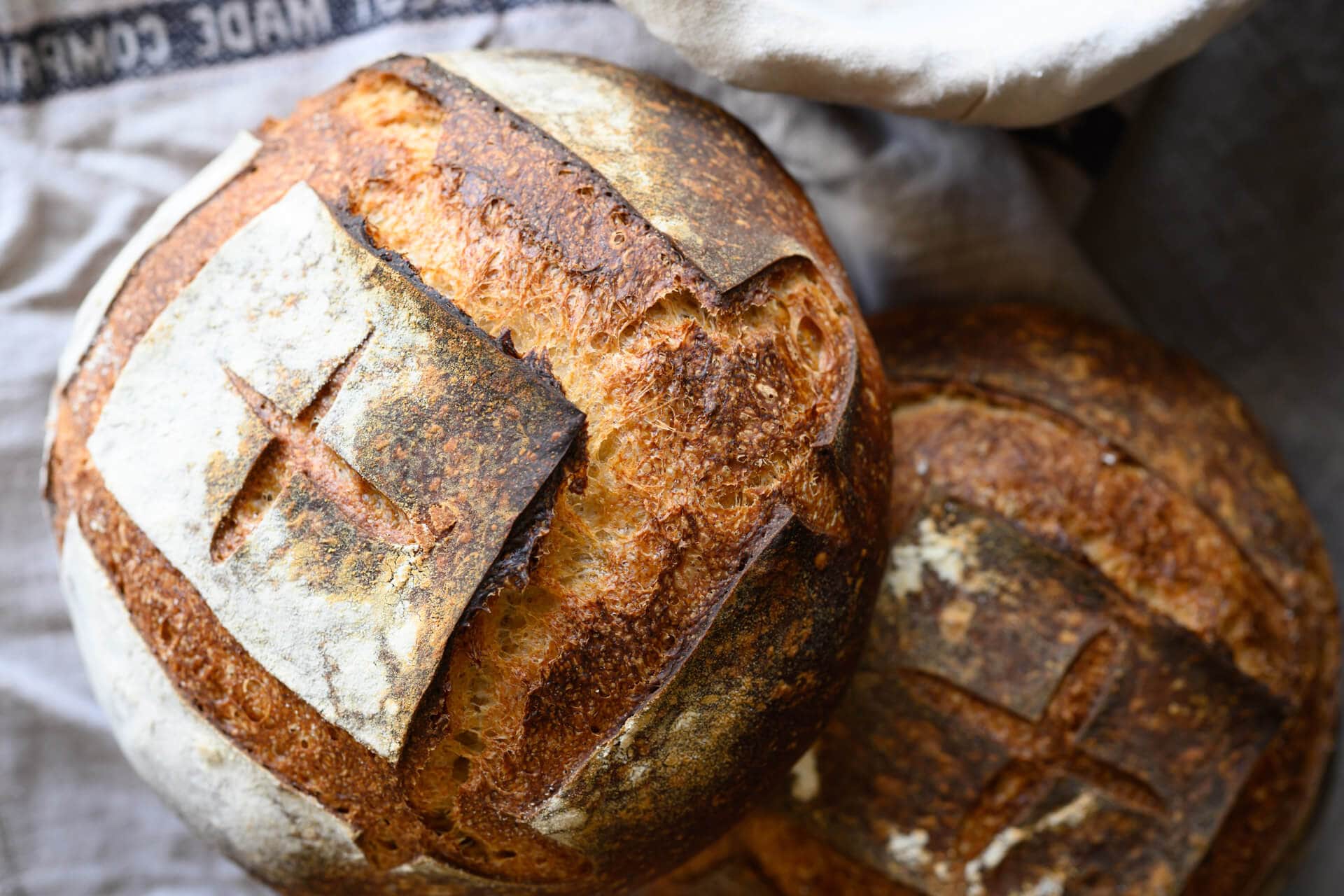

Hey there, new baker! My name is Maurizio, and I’m the baker here; welcome.
This new baker, start here page has a rollup of resources that’ll help you get baking sourdough bread quickly in your home kitchen. It begins with creating a sourdough starter from scratch (just flour and water!), your first sourdough bread, a few guides, and some of my favorite (and reader’s favorite) recipes.
Sourdough can be intimidating for new bakers, but it doesn’t have to be. With a few essential basics, you’ll be baking crusty and healthy loaves of bread in short order. And if you get stuck? I’m almost always lurking around here, answering questions and providing help—leave a comment, and I’ll get back to you.
Step 1. Create Your Sourdough Starter
A sourdough starter is the most important aspect of baking sourdough bread at home, and without it, you’d have flour and water mixed. It takes a little care to keep it alive, but it’ll reward you with countless loaves of bread, pizza, and more.
It takes about 5-7 days to get a starter going from scratch, using only flour and water. But, of course, if you have a friend who is a sourdough baker, you can always ask if they’ll give you a bit of theirs to get going. If not:
Check out my guide to creating a sourdough starter from scratch →
Step 2. Review the Baking Process
While your sourdough starter is starting up, review my eight steps to making sourdough bread. In this beginner’s guide, you can see a high-level view of each step of the bread-making process with detailed explanations of each step.
Read the Beginner’s Guide to Sourdough Bread →
Step 3. Bake Your First Loaf of Bread
Here. We. Go!
Once your sourdough starter consistently shows the same signs of fermentation each day, it should be strong enough to bake a loaf of bread. I have two recipes here that are great introductions to baking sourdough at home.
Most Detailed Recipe: Bake my Beginner’s Sourdough Bread Recipe →
If you want a more condensed recipe that gets straight to baking, have a look at my simple weekday sourdough bread:
Easiest: Bake my Easy No-knead Sourdough Bread →
Step 4. Review More Baking Guides
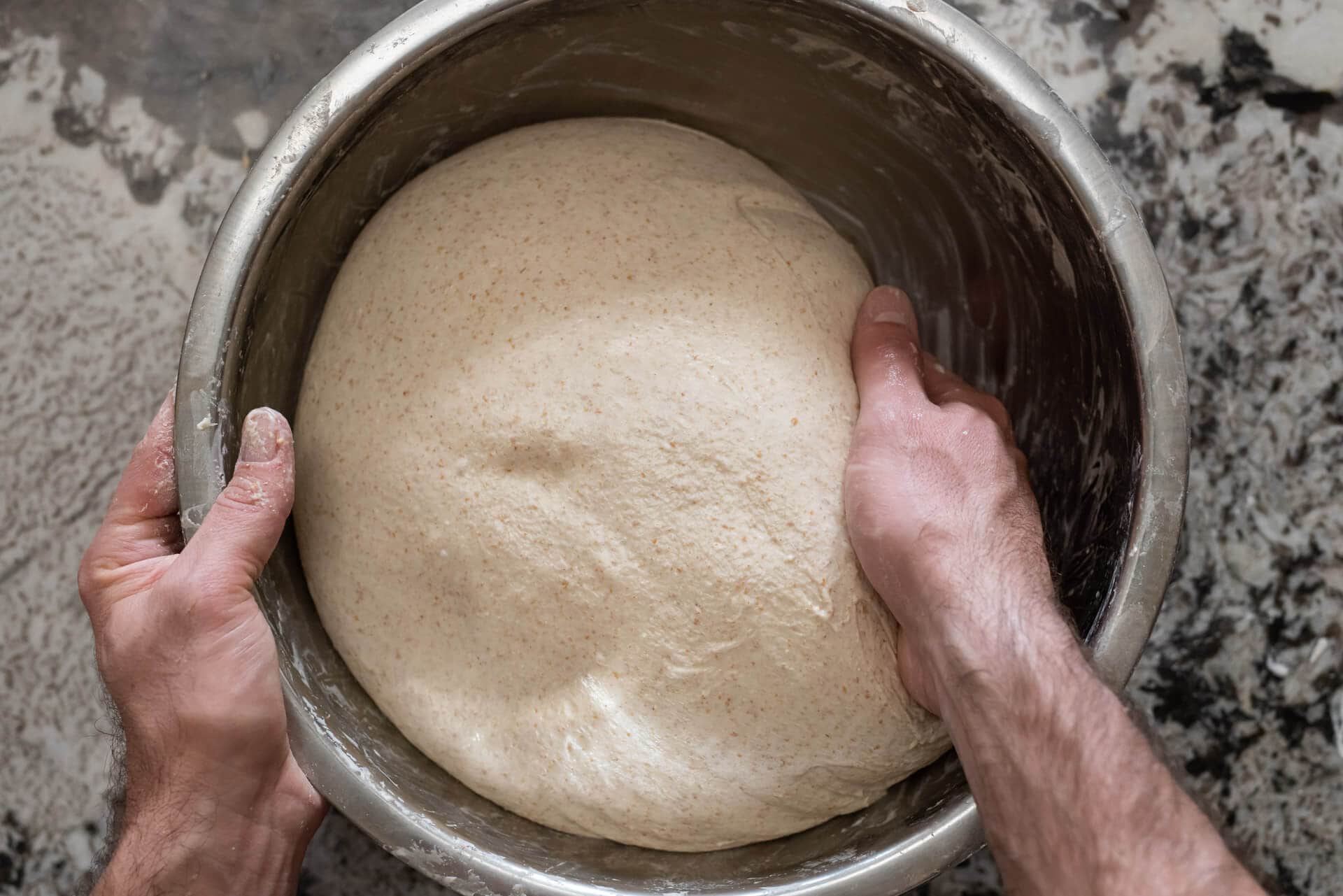
Once you have that loaf of bread crackling on the counter as it cools, review more of my baking guides to increase baking consistency and confidence. These guides have in-depth tips on maintaining a sourdough starter (with video walkthrough), creating baking schedules around your busy work week, working with baker’s percentages (baker’s math) to scale up and down recipes, and numerous guides to shaping bread dough.
My Guides Page is a great place to bookmark and return to from time to time to review the basics and expand your baking toolset:
Explore my baking guides page →
Step 5. Use Your Sourdough Starter For Other Things

Because a sourdough starter requires fresh flour and water each day (or less if you’re keeping it in the fridge), we tend to have sourdough starter discard—don’t throw it away! Instead, I like to save up the discard in a container in the fridge during the week, then use this to make sourdough pancakes, sourdough waffles, and sourdough banana bread.
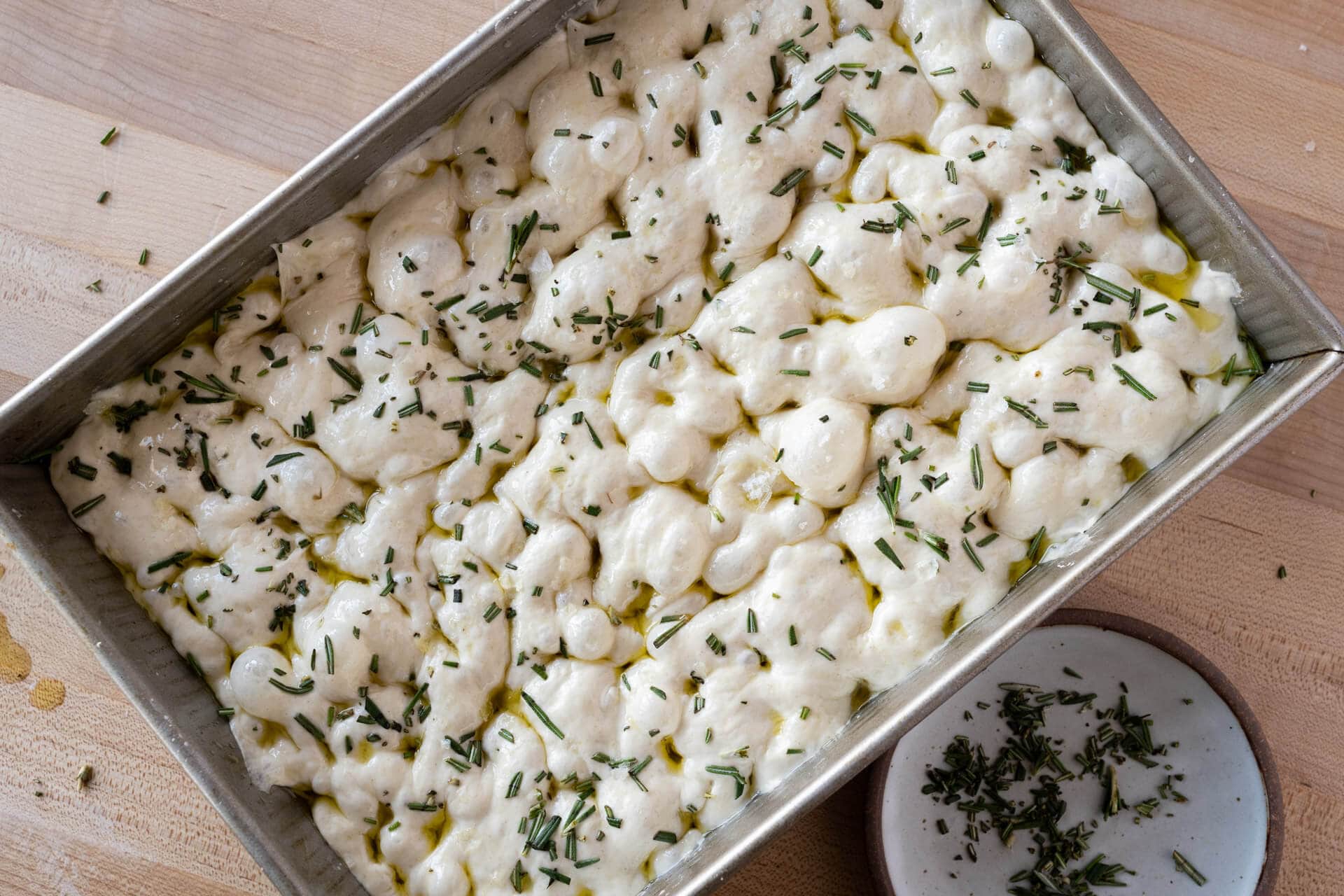
I’m also a huge fan of focaccia. This is one of the most-baked items in my kitchen, and my recipe couldn’t be easier. Use all of your sourdough starter discard one morning, and you’ll have fresh sourdough focaccia for dinner (and it’s an amazing canvas for any veggies in season!).
See my collection of sourdough starter discard recipes →
Step 6. Upgrade Your Baking Tools
One of the challenges of baking at home is consistency. It can be hard to bake consistently great loaves when the environment—our hectic home kitchens!—is always changing. I’ve collected my tried-and-true tools in one place, and they’ll help you make the bread easier and more repeatable in your home kitchen.
My top 3 recommended tools (read: if you’re going to buy anything, get these):
- A simple kitchen scale to accurately measure ingredients
- An instant-read thermometer to quickly and accurately measure dough temperature
- A foldable dough proofer to keep your dough warm and fermentation activity high
Explore all my favorite baking tools →
Step 7. My Top 10 Favorite Sourdough Recipes
- A Simple Weekday Sourdough Bread
- My Best Sourdough Bread Recipe
- Spelt, Rye, and Whole Wheat Sourdough Bread (50% whole grain)
- Fifty-fifty Whole Wheat Sourdough (50% whole grain)
- Sourdough Pizza
- Pain de Mie (super soft sandwich bread)
- A Simple Focaccia
- Whole Grain Spelt Pan Loaf
- Super Soft Sourdough Rolls
- Sourdough Cinnamon Rolls
Step 8. Join The 2500+ Member Community and Come Chat

Want to take your baking to the next level or get help with an issue you’re running into? Join the community here at The Perfect Loaf and get:
- Remove all ads from the website
- Instantly download my recipe archive and baking spreadsheets, plus other baking tools
- Join our private community to share photos, talk baking tips, tricks, and get help (I’m chatting there daily!)
- Access exclusive tool and flour discounts
- First access to live baking events
- And more!
Check out the baking community and membership →
Step 9. Experiment, Have Fun, and Happy Baking
One last note: don’t be afraid to experiment and have fun—after all, what’s the worst that can happen? No matter what comes out of your oven in almost every case, it’s perfectly edible and delicious. Some of my most significant baking improvements came from accidents that turned into opportunities for me to learn and grow as a baker.
Happy baking!

372 Comments
Hi Maurizio, you probably already know this, but your website isn’t working correctly since a couple of days. The menu “blocks” the screen, so I’m not able to read any recipe unfortunately.
Ive since fixed this, I hope it’s working well for you now!
Is there a way to determine nutritional value for what is baked?
I don’t currently have a way to do this, sorry!
Hello Maurizio,
I love your sourdough website! It has been so much fun learning everything there is to know about sourdough bread baking. I am new at this and have a question. I am currently working on my second try at making sourdough bread. I am using your “No Knead Sourdough Bread” recipe. My first try was okay except that my dough did not rise. So, I thought my starter wasn’t very active. On this second attempt I fed my starter the night before and then again twelve hours later. I left it alone for a couple hours and when I came back to check on it, it was quite active. I then started working on the recipe. As of this writing, my dough is still not rising. What is going on with my starter/dough?
Thanks so much, Pamela! You want to use your starter after it’s had a number of hours to ferment, for me, that’s usually 12 hours (overnight). Once it’s ripe after this time, you can use it to mix into your dough. Try to follow my starter maintenance guide for a week, using it in the morning to bake with after it’s fermented for a long while, is bubbly, and has a sour aroma.
It could be that you’re simply not giving your dough enough time to ferment, which will be longer if you use your starter too early before it’s ripe (again, check out that guide above, I go into detail on what to look for!).
Hey Maurizio, your website is a blessing to me, thank you so much for all your guidance.
In my latest 3 bakes I have been disappointed in getting my bread moist in the sense that I have to wash away from the bread knife sticky crumb after every slice I cut. At first I blamed it on the hydration as I dared go up from 75% to 78% – 80%. But going down to 75% made no improvement. So what I’m wondering if it’s EITHER the flour: I use Caputo but whereas before I was using Chef with 13g protein, now that’s it not in stock anymore, had to turn to Pizzeria that’s 12.5g protein. Mind you I mix this flour with semola rimacinata di grano duro, 14g protein, and whole wheat, 11g protein, to get an end result of 50% whole grain mix.
OR it’s because I retard my bread in ceramic pan loafers Emile Henry overnight in the fridge so when I put them in the pre-heated oven 250 degrees to bake, obviously the pan loafers are also cold. in fact I bake high at 250 deg. for the first 45′, then 10′ @ 230 degrees- all the time covered. Finally I switch off, uncover and crank the oven door for 10′. The internal temp reaches 210 degrees & with a beautiful golden brown colour, but the thermometer needle does not come out clean.
The funny thing is that this only happened lately, that is why I tend to blame it on the flour, even if the protein difference is minimal. Both taste and texture are delicious but there’s something wrong. Btw with the same dough I also made a free standing batard and the alveoli is evenly distributed, got the oven spring, the ear and dark crust colour. Although not as much as the pan loafers but it still dirtied my knife with sticky, moist crumb.
I would greatly appreciate any enlightenment as to what I should do.
thanks in anticipation,
Brgds,
Malu
So glad my site has helped you, Malu! It sounds like your dough may be over hydrated—your flour likely isn’t able to take on quite a much water, and that’s ok! Try reducing the hydration by 5% and give it another go—the reduced water should bring strength to the dough and you’ll feel it immediately. Once you find a suitable hydration, you can try to push it back up (if desired), but as you do, take note of how the consistency of the dough changes: the dough will start to slacken out as you add more and more water, this means you’ll likely have to mix more upfront or add another set or two of stretch and folds during bulk fermentation.
Generally, with an increased hydration, you need to mix longer to develop the gluten in the dough to sufficiently support the water added, but this only goes so far. At some point, the flour you’re using just isn’t able to take on any more water and you’ll essentially have a weak and slack dough. It’s always best to start conservatively and work your way up with hydration as you feel out your flour. This is typically why I recommend holding back water during mixing, adding it in as the dough handles it.
Also, do be sure to leave your loaves for 1-2 hours after baking before cutting, otherwise you’ll get a gummy interior!
Try to keep everything else as consistent as possible and let me know how the next attempt goes!
THANK YOU! I’m just starting out and keep hesitating so i need all the help I can get!
You got this!! Email me if you have any questions, you’re going to do great.
I added salt to the autolyse. I realized my mistake before adding the water. I would not like to waste all that flour … Is there some other use for it?
I will be measuring out a new bunch of flour for the autolyse.
Just continue with it!
Hi Maurizio. I mill my own flours so they really absorb all the water called for in a recipe. Dough is then stiff, not very pliable. Question, about how much extra water, a starting point amount, to add above what the recipe calls for so dough is more like it should be. Would that starting point amount be the same for soft, hard white, hard red and einkorn flours? I saw this question asked before but now can’t find the post. Thanx for your wealth of knowledge. Cindy
Hey, Cindy. Yes, fresh flour tends to require more water. Add as much water as necessary to get the dough to the correct consistency.
Check out my guide to baking with freshly milled flour, I discuss this (and more)!
Excellent article. My Komo mill does an excellent job of grinding. Really like using fresh milled flour. I do miss not having the big holes that look so delicious in the photos. Would adding vital wheat gluten or a natural dough enhancer help create some holes? Thanx oodles for the reference article.
It really is all about the flavor and nutrition on the end! Adding stronger flour will help you open it up, yes. I wouldn’t personally use VWG, but a strong bread flour (about 12% protein) will definitely help. Even just 10%.
Yes, overall the flavor, and nutrition, is what counts. I did cheat and purchase some San Francisco yeast on ebay earlier this year. Quite pleased with it and that particular flavor is what I like, really tangy sour. Making a loaf tomorrow with hard white berries and will be excited to see the outcome with the water experiment. Then on to cinnamon buns, Thanx again Maurizio for your wealth of knowledge and sharing it with us beginners.
Hello,
I’m new here and love this website and all your recipes! Can’t wait to try some! I love baking sourdough everything!! Since most sourdough recipes don’t require much kneading, why do a lot of bakers have a dough kneading machine? Asking because my children would like to get me one for my birthday, but wondering if I would use it & would like your advice? I do have an upright kitchenaid but with the sourdough recipes I have used there’s no kneading involved.
Thanks so much!
Mary Beth
A mixer is definitely a great investment! The KitchenAid you have should work well enough. If you’re looking for a more advanced/professional style bread dough mixer, a Famag or other is a great choice. Check out my in-depth guide to the Famag mixer to see if that’s what you’re looking for!
are courses scheduled at your place?
I do not have any classes at the moment.
New at making bread. How can I prevent over proofing my dough if I added my Leavin in at the autolyse?
Keep it cool!
Started using my IP pot as my bulk fermenting place. Works really well with a consistent temp of 27°C.
Love that idea!
I downloaded the app for discord and was able to join the conversation. Thanks
I joined TPL about a month ago. I joined the first day I found this site because I could tell it was special I’m learning so much here, just having some trouble joining the discord conversation. I have signed up with discord also. I have a user name which shows whether I’m online or not. Just don’t see a way to send a message When I signed up with discord and tried to follow TPL it said I must have the 4 digits to be able to follow. I’m still looking for the link to get in but keep getting sidetracked reading these questions and answers. So interesting! I’d still like to be able to post pictures on discord with questions. It’s probably easy and I’m missing something
Welcome, San! Glad to hear you go Discord up and running.
Hello. I’m fairly new to this awesome site. I’ve baked the beginners sourdough bread and sourdough waffles, pancakes and sourdough banana bread. My question is how do I join the conversation on discord? I’ve signed up and have a user name that is listed as online. I just don’t see a way to add a comment. Thanks
Hey, San! Glad my site has helped! To chat on Discord, you need to become a TPL Member, once you do, an email will be sent over to you with a link to the community chat. Here’s more info on the membership:
https://www.theperfectloaf.com/membership/
I hope you’ll join! See you there 🙂
Thanks. Now I need to have the #four digits for the perfect loaf to be able to dial it up. I’ve been searching over the website for a link to the community so I can find the four digits
As so many others have said, I want to start out and thank you for such a wealth of information on sourdough baking. I have a question: I have tried your “My Best Sourdough Bread Recipe” several times and my loaves, while tasting VERY GOOD, fail to get much spring at all. In fact they seem to spread out like a pancake and the score looks like a bad gaping scar after the loaf is baked. That was NOT the case when I made your loaf using the Beginner’s recipe. I believe it isn’t my starter– that thing triples in size with no difficulty, and before baking, I feed it several times. I am using KA flour (bread, AP, and WW). Is there just too much water? My brother experienced the same thing. We both use the Challenger bread pan. What is going on?? Thanks in advance for your response. Much appreciated!
You’re very welcome, Carren! Sorry for the late reply. It sounds like your dough is most likely over hydrated—your flour likely isn’t able to take on quite a much water, and that’s ok! Try reducing the hydration by 5% and give it another go—the reduced water should bring strength to the dough and you’ll feel it immediately. Once you find a suitable hydration, you can try to push it back up (if desired), but as you do, take note of how the consistency of the dough changes: the dough will start to slacken out as you add more and more water, this means you’ll likely have to mix more upfront or add another set or two of stretch and folds during bulk fermentation.
Generally, with an increased hydration, you need to mix longer to develop the gluten in the dough to sufficiently support the water added, but this only goes so far. At some point, the flour you’re using just isn’t able to take on any more water and you’ll essentially have a weak and slack dough. It’s always best to start conservatively and work your way up with hydration as you feel out your flour. This is typically why I recommend holding back water during mixing, adding it in as the dough handles it.
Try to keep everything else as consistent as possible and let me know how the next attempt goes!
Thank you Maurizio, for your amazing recipes. I have been baking for almost two years according to your recipes and can’t stop. My husband and I have long retired and bakig bread is like a small holiday for us. Thanks a lot and good luck to you.
You’ bet, Anna! Thanks so much for the comments and glad you’re enjoying my site! (sorry for the late reply.)
Love your site! Beginner here. Tried some a while ago in clay baker where you proofed in the clay pot then put in cold oven so it wouldn’t crack then baked. Have your simple recipe bulk fermenting now. That work ok with this recipe? Thanks!
That should work just fine with most of my recipes here, Bruce!
Ciao Maurizio, I have been following you for quite some time and have also bought the Famag dough mixer after reading your article. I have tried your Rustic Italian sourdough loaves was very disappointed as they turned out heavy, moist and gummy. I don’t know if I can send you a photo to show you the result but I so wish to find out where I went wrong as I followed your recipe step by step.
Very interesting, Malu! I wonder if there was a lack of fermentation or it over proofed. I have my email address on the About page, you can send there, or join the membership and send to the group of us!
Hi Maurizio. Just baking your soft dinner rolls for the first time. Could you just confirm whether your oven temperatures are for fan assisted or convection please? Thanks.
Hey, Richard. All my recipes here are without convection (no fan assist), unless otherwise specified. Happy baking!
Thanks Maurizio. Brilliant result from your recipe – I have no trouble with my S/D loaves but rolls have never been right. These were lovely and very straightforward.
So glad to hear that, Richard! Enjoy 🙂
I am thrilled with the breads I make with your starter and recipes. I’ve tried 11 different recipes so far, and repeated our favorites several times. I’m wondering if you have a recipe for English Muffins. Thanks!
So happy to hear my site has helped and you’re liking the recipes! English muffin work in progress 🙂 Until then, happy baking and enjoy!
Just made your “best sour dough” for the second time, after the first was a bit flat. This time it is truly perfect! The difference was paying attention by eye to bulk fermentation, instead of just timing it. Thanks for the videos and photos. Those were key in getting my awesome results this time.
Hello Maurizio! Thank you so much for The Perfect Loaf. I baked sourdough years ago and was just starting to get some decent loaves when I learned that I was gluten intolerant. I have since discovered I can eat spelt and einkorn flours, so I wanted to try again. I found your site and was able to get a very active starter going on the first try. I’ve made four loaves so far – the first two came out better than the second two! I’m working on the Spelt sourdough now, but after I built the levain and was re-reading the recipe I caught the bit about changing the levain percentage of the recipe if you don’t grind your own flour. I don’t grind my own flour. And even though I’m happy to do math and not afraid of it, I can’t figure out how to go from 10% levain to 15%. I think you must include the percent of flour that was in the orginal starter? What am i doing wrong?
oh dear. I guess I was tired. I just looked again at the recipe and saw the levain percentage in the second table….sorry. I’m all set! (one loaf is out of the oven as I type, the second is just finishing. They’re okay, but not great. I need to adjust the hydration for using all spelt flour or using spelt and einkorn only.)
No worries, Kathy! Sounds like you’re on the right track with a few adjustments needed (always the case with baking!). Let me know how it goes and happy baking 🙂
Hi SD community, I`m trying to create my first starter with Bob`s Redmill Dark Rye flour. On day 1. In a one quart mason jar, I mixed 100gm of flour and 125 gm of water using a good scale that tartars the container. I`m questioning on how thick this mixture is. It is most pasty. Is this OK? In Florida with AC set to 76 degrees. Thanks…
I answered you on your other comment.
Thanks for the confirm. I marked initial level with a rubber band. keeping my fingers crossed…
I have never had luck with sourdough starter. Neither has my food scientist/baker husband. But I tried your method and for the first time found success!!! I’m currently on day 5 of some very nice looking starter and my husband is impressed.. Those glass jars work perfectly and and your detailed instructions were easy to understand (I pegged you as a software engineer just by reading them 🙂 ). I can’t wait until I can actually try some bread with it!
Software engineer indeed! So glad to hear you guys are on track with all of this. It’s a bit of work in the beginning, but not too bad! Happy baking, Amy 🙂
Hi Maurizio:
I love making sourdough, but have such a problem with the fruit flies, that it attracts. Any recomendations for how to keep your starter (especially in warmer weather), without the constant agrivation of these pest?
Hey, Ben! Yes, they do love anything acidic it seems. I keep my starter covered 100% of the time, never allowing them to have a chance to get in my jar. I also keep the sides of my jar completely clean of any starter so they’re not attracted. I use those Weck jars which have a glass lid that sits on top and closes my starter off completely from ambient air so there’s no chance for them to get inside.
Hi there Maurizio! I’m currently working on the oat porridge sourdough. In the recipe it shows that at 12:30pm, at the start of bulk fermentation, the dough rests for a half hour. However, in your schedule, you show the first set of folds at 12:30. I will do the six sets, a half hour apart each, but then I don’t know how much longer to leave the dough to rest before pre-shape. Can you please clarify this schedule? Thanks!
As well, at the end of shaping, it says to leave out on the counter for an hour. Is this only for same day bakes? Or is this before placing in the fridge until morning? It says nothing about refrigerating, but I am assuming….
I don’t usually leave the dough out for “bench time” as it’s called, but sometimes it requires a little more room temperature fermentation time before going into the fridge.
Thanks for your responses Maurizio. I just baked the loaf and it looks great; can’t wait to cut into it! I ended up lowering the temp to 425 because it seemed like it would need a bit more than the 35min for the second part of the bake. Based on instructions for your other loaves I’ve made, I pulled it out based on internal temp, though the thermometer was a bit sticky, but assuming that’s because of the oats? Internal temp was apx 98C.
That temperature should be high enough to ensure it’s baked through. The oats definitely bring increased moisture retention to this loaf, though. I’d say if left to rest it should be fine when slicing.
As always, be sure to let the loaf fully cool before slicing!
Thanks. Making the loaf again this week, and it’ll be too late by the time I get your answer, but… About to cook the oatmeal with your ratio of 1:2 oats to water by weight. In measurements however, this is apx 1:1 — have a bit more than a cup of each. Is this right as oats are usually cooked at 1:2 by measurements which mean I’d use double the water — I didn’t last time, but I did have to add more water as the oats had absorbed the water quickly but did not have the consistency of oatmeal — ie were still individual and “dry.” I guess I’ll see how it goes…may end up like last time having to add more water.
If they need more water to cook, add in a little as necessary. Some oats are much more thirsty than others!
Baked the porridge loaf today. It’s definitely the most enjoyable to make, and the one my family loves most, of all the great sourdough recipes of yours I’ve tried so far (we also love the cranberry walnut, but that disappears way too quickly). So this time less additional water cooking oats, and none of the extra water after the autolyse. But ended up 100g short of white bread flour — opened a new bag of flour which was not usable* — so added an extra 50g of the whole wheat and 50g of AP. Very happy with the results. It’s such a delicious and moist bread! Just have to work on my shaping as it wasn’t a perfectly shaped boule.
*As for the flour issue — there was a live beetle in the new bag — added a bit of drama to an otherwise chill afternoon making sourdough. (was not at all happy about this)
A fav of mine as well! Nice pivot working with the flour you have, I like the addition of more whole wheat, too. Yikes, I bet that beetle was not well-received… It happens, though!
Happy baking, Karen!
The first set of stretches and folds should be after 30 minutes from the start of bulk fermentation. I’ll take a look and see if there’s a typo!
Hi Maurizio, thanks for the great site. It’s really beautiful and makes me want to bake bread all day long:) I have just followed your recipe for” beginner’s sourdough bread.” I made the starter (it’s now about 8 days old) and prepared the levain. I did not get 190grams of levain, I only got about 170g. I removed the top 10 grams because it was dry so I only used about 160grams in the recipe. I am not yet at the end of the recipe, it is in bulk fermentation right now, so I don’t yet have the outcome. How can I be sure to get more levain? I followed your instructions step by step. Tania
You’re very welcome! It’s common to come in a little under, no worries. If you want to scale it up a bit, just add 5g of each component (flour, water, and ripe starter) to the levain build. That should give you 15g extra or so to cover any deviation. Hope the bake turns out great–enjoy!
Great Website. Thank you. I’m just getting started and this is the most organized page for us getting started folks. I’m wondering, as you get your starter going, if you can combine the discard from day to day to use in my daily baking. I hate throwing it away. Suggestions? I can also keep it in separate jars each day?
You’re welcome, Jerry! Yes, your discard is essentially ripe sourdough that’s ready to mix into a dough right then. I wouldn’t keep it around for too long, though, because it will get overly acidic. It’s best to use it close to when you refresh your starter.
I am new to sourdough baking, but an experienced baker and cook. Over the weekend, I used your beginner sourdough recipe to bake 2 very delicious loaves of bread. I was concerned they were not going to be good as I had a small problem with the levain. It was growing and bubbling along just fine and at about hour 4, it just stopped and almost seemed to fall a bit. My starter seemed strong as I had beefed it up with rye flour for several days. The levain did not pass the float test. The bread turned out okay but I am inquiring about what you think might have happened with the levain so for future baking I can adjust so it doesn’t happen again. Also, I had no where near the 190g of levain the recipe calls for and I followed all of your percentages/weights in the recipe. Thanks so much for your help and also for all of the terrific information about sourdough baking,
Hey, Corinne! It might have been that the levain went a little too far and you might have over proofed (hard to say without more info). If you think it’s ready at hour 4, bump up the schedule and use it as soon as you can. Maybe it was a little warm in your kitchen, or some other factor. If the levain comes in short, add a little buffer to each ingredient (i.e., 5g more flour, water, starter) to keep everything in the same ratios, but scaling everything up.
Great. Thank you so much. I will watch it more carefully. Very appreciative of your help.
I am a big fan of yours and love this blog. Your recipes and formulas always work for me. This is just a suggestion but I would love to hear more about the different type of wheat flours and protein content. There are so many variations I get lost. What difference does it have in the bread when you use medium or high protein ? This is a topic I have never understood well and would love to know more. Thank you!
I have this on my list of things to work on, Maribel! It is a complicated topic.
I have done the second refreshment on day 4 and in only 3 hours the starter has tripled in volume. I had it in the oven with the light on and I’ve taken it out now so it’s cooler. Should I refresh it when it’s ripe even though it/s early? I think the oven got warmer than I expected.
Yes, I would refresh earlier if it’s looking (and smelling) very ripe. But, if you choose to wait until the next scheduled refreshment, that will also work well. Either way it’ll be just fine!
Hi Maurizio, in reading other posts, I really appreciate how patient you are with all of us who are new to sourdough and have many questions. For that reason, I have read extensively on how to make sourdough starter and bread more sour from other sites before asking this question, and the direction is all over the map. I have stiffened my starter, used primarily rye and/or whole wheat for my starter, raised my water and room temp for my starter, and waited longer to feed my starter. I have also bulk fermented final dough longer (at 78-80 degrees), and have done a longer retard in the fridge. (24 hours) My final dough is your recipe for Beginner Sourdough. Not seeing anything but a very, very mild hint of sourdough. I have read extensively on your site and have picked up that you prefer a more subtle sourdough. If you have time, could you suggest a few tips or recipe technique that would increase sourdough flavor? Many thanks!
You’re very welcome, Laura. Happy to help! I’m actually working on a very extensive post on this exact topic right now (two actually!). I should have this out in the next week or two, if all goes well. The things you mentioned are all things I do to increase sourness as well. But there are a few more things you can do such as try using a very small amount of levain in your final dough, a levain that’s very, very ripe and made from 100% whole wheat flour. Keep that warm as well, overnight. A longer, warmer bulk is the way to go as well.
Hi Maurizio, thank you for all you do! Have you published those posts you mentioned in your response to Laura? As I said to her, I have the exact same problem she has: successful and sour starter but not much tanginess in the final loaf even after making changes suggested by various bakers. Thank you in advance!
Still working on it, testing, testing, testing. 🙂
Hi Laura, I’m happy to read your post as I experience the exact same thing: healthy, happy, and sour starter but not much tanginess in the final loaf even after making the changes you mention in your post. Personally, I don’t necessarily like my bread very sour at all as I like to focus on the flavor rather than the amount of sourness, but a lot of people who eat my bread would love it even more if it was more sour. So I was wondering if you have tried Maurizio’s suggestion (100% whole wheat levain but less of it and very, very ripe. If you have tried it, have you had much luck with it? Thank you in advance!
Hi Nathalie, thanks for your post. I did try Maurizio’s suggestions, but I did not notice that much of an increase in sourness. I do think, overall, that my starter is more sour now than it was when I first started a few months ago. I kind of gave up on the sour factor as it was hard to control my bulk ferment with such a small amount of starter. Under proofed/over proofed etc. (I don’t build a separate levain. I just use my starter so that I can cut down on the time) I did notice that 100% whole wheat does produce more hooch and more sourness and I always mixed in any of that as it collected. I am looking forward to Maurizio’s promised post on making sourdough more sour as well.
Still working on it!! 🙂
Hi Laura & Natalie,
I too love a strong- tangy sourdough.
I home make yogurt, meaning I can come up with a cup or two of yogurt whey whenever I want. I made a loaf the other day and have to say it was the best!! Whey is the liquid that arises on top of your container of full milk unflavored yogurt. Home made making yogurt is very easy. I use organic whole milk, brought to a low boil, cooled pour into glass jars, add 2 tablespoons of plain full milk yogurt per quart of milk and keep at a temperature 110-114 f for 4-7 hours. My loaf was small, used 1 cup of whey to a cup filtered water.
Hi Maurizio! I’ve very much appreciated all the sourdough info from your web site. I’ve made sourdough pancakes and sourdough waffles with great success. However, when backing sourdough white bread in full loaves, the results are always very flat loaves. I use a Lodge Cast Iron double dutch oven at 500 degrees in my home electric oven. I’ve trie and tried, re-reading your guides and I’m totally frustrated. I use a very lively starter at its rising height. Any suggestions will be appreciated.
Glad to hear that, Larry! It’s hard to say without more details. Do you have photos of your bread? If so, head to my About page and shoot me over a few of those so I can help diagnose. If not, what’s the inside like? How long was bulk fermentation and at what temp appx?
Hi Maurizio! I’ve had a starter going for a few months now, but have mostly been makings smaller things (crackers, rolls, etc). I am ready to move on to full loaves! I want to try the 50/50 whole wheat recipe, but it seems to be pretty set for a baking steel, which I don’t have. I do have a dutch oven and a baking stone… would the recipe work as written for either of those? Or would I need to adjust temp/time? Thank you so much for this amazing resource!
Yes, you can absolutely use a Dutch oven (see my guide to baking in a DO) with that dough! I’d recommend shaping it as two boules (rounds) as those are easier to bake in a round DO. You’re very welcome and happy baking, Pam!
Hi Maurizio,
Thanks so much for your sourdough starter recipe. It’s easy to follow and it works well for me. But I have some questions. On your recipe to make a starter, you wrote how to feed the starter, and the recipe is like this: 50 gr starter, 50 gr rye flour + 50 gr ap flour + 100 gr water (day 7 to infinity). My starter was so healthy when I fed it with that formula. However the discard was too much for me and I only bake on the weekend. So I checked your other article about how to downsize the starter. Your formula is 20% starter + 100 % flour + 100% water. So I choose to feed my starter like this: 10 gr starter + 50 gr ap flour + 50 gr water. However the starter doesn’t rise double or triple like before. And the starter is a little bit loose. Is that normal? And also 50 gr+100 gr flour + 100 gr water, is not the same with 20% starter :100% flour: 100% water formula. Because to follow that formula, the starter should be 20 gr (not 50 gr) for 100 gr flour and 100 gr of water. Before I read your article about how to reduce the discard, I was thinking to feed my starter like this: 25 gr starter with 50 gr flour and 50 gr water. But it’s not the right calculation if I follow your other formula 20%:100%:100%. So which one is the best formula? Thanks to you again.
Your 10/50/50 should work just fine. It sounds to me like you might need to reduce the amount of water, though, especially if you want it stiffer. There’s no “best” formula! It’s what works for you and your starter. The more starter you carryover each refreshment, the faster your starter will ripen. In the summer, I usually reduce carryover quite a bit as it’s much warmer. If it’s colder, I do the opposite and increase the amount left at reach refreshment. Adjust the amount of water you use to adjust the consistency of the mixture however you’d like–sometimes just 5g less or more will make it feel more “right” to you (again, there’s no right answer there, it’s just what you prefer).
I hope this helps!
My guide to using the Famag is now up, Chris! Hope that helps.
Wow, that’s awesome, Chris! Yes, I use CM Artisan Baker’s Craft Plus all the time, it’s kind of like my staple flour here for most tasks. It’s great flour.