

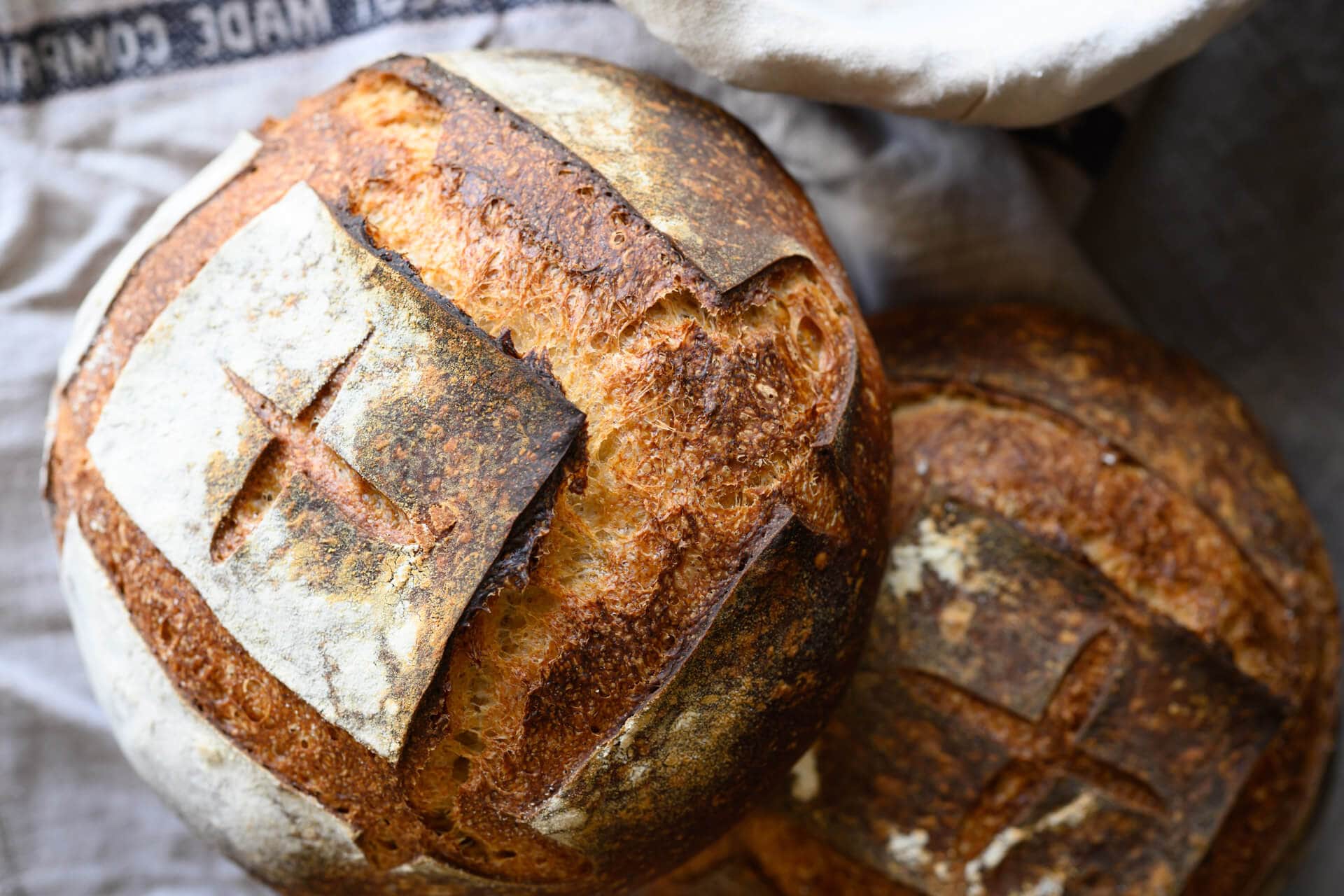

Hey there, new baker! My name is Maurizio, and I’m the baker here; welcome.
This new baker, start here page has a rollup of resources that’ll help you get baking sourdough bread quickly in your home kitchen. It begins with creating a sourdough starter from scratch (just flour and water!), your first sourdough bread, a few guides, and some of my favorite (and reader’s favorite) recipes.
Sourdough can be intimidating for new bakers, but it doesn’t have to be. With a few essential basics, you’ll be baking crusty and healthy loaves of bread in short order. And if you get stuck? I’m almost always lurking around here, answering questions and providing help—leave a comment, and I’ll get back to you.
Step 1. Create Your Sourdough Starter
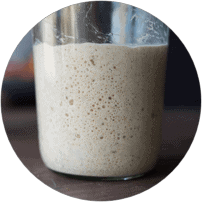
A sourdough starter is the most important aspect of baking sourdough bread at home, and without it, you’d have flour and water mixed. It takes a little care to keep it alive, but it’ll reward you with countless loaves of bread, pizza, and more.
It takes about 5-7 days to get a starter going from scratch, using only flour and water. But, of course, if you have a friend who is a sourdough baker, you can always ask if they’ll give you a bit of theirs to get going. If not:
Check out my guide to creating a sourdough starter from scratch →
Step 2. Review the Baking Process
While your sourdough starter is starting up, review my eight steps to making sourdough bread. In this beginner’s guide, you can see a high-level view of each step of the bread-making process with detailed explanations of each step.
Read the Beginner’s Guide to Sourdough Bread →
Step 3. Bake Your First Loaf of Bread
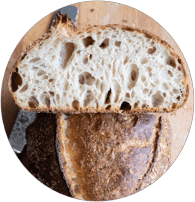
Here. We. Go!
Once your sourdough starter consistently shows the same signs of fermentation each day, it should be strong enough to bake a loaf of bread. I have two recipes here that are great introductions to baking sourdough at home.
Most Detailed Recipe: Bake my Beginner’s Sourdough Bread Recipe →
If you want a more condensed recipe that gets straight to baking, have a look at my simple weekday sourdough bread:
Easiest: Bake my Easy No-knead Sourdough Bread →
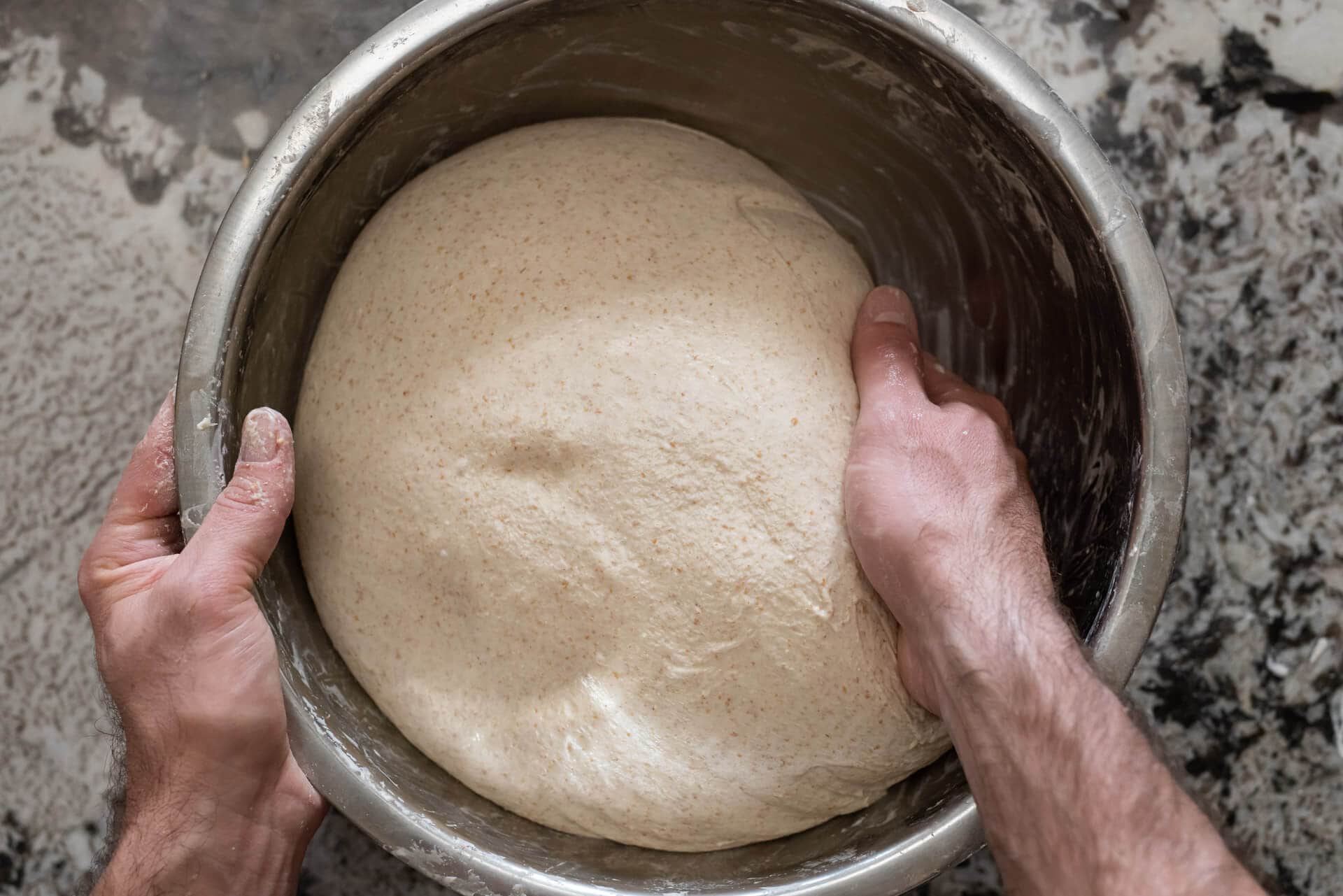
Step 4. Review More Baking Guides
Once you have that loaf of bread crackling on the counter as it cools, review more of my baking guides to increase baking consistency and confidence. These guides have in-depth tips on maintaining a sourdough starter (with video walkthrough), creating baking schedules around your busy work week, working with baker’s percentages (baker’s math) to scale up and down recipes, and numerous guides to shaping bread dough.
My Guides Page is a great place to bookmark and return to from time to time to review the basics and expand your baking toolset:
Explore my baking guides page →
Step 5. Use Your Sourdough Starter For Other Things
Because a sourdough starter requires fresh flour and water each day (or less if you’re keeping it in the fridge), we tend to have sourdough starter discard—don’t throw it away! Instead, I like to save up the discard in a container in the fridge during the week, then use this to make sourdough pancakes, sourdough waffles, and sourdough banana bread.
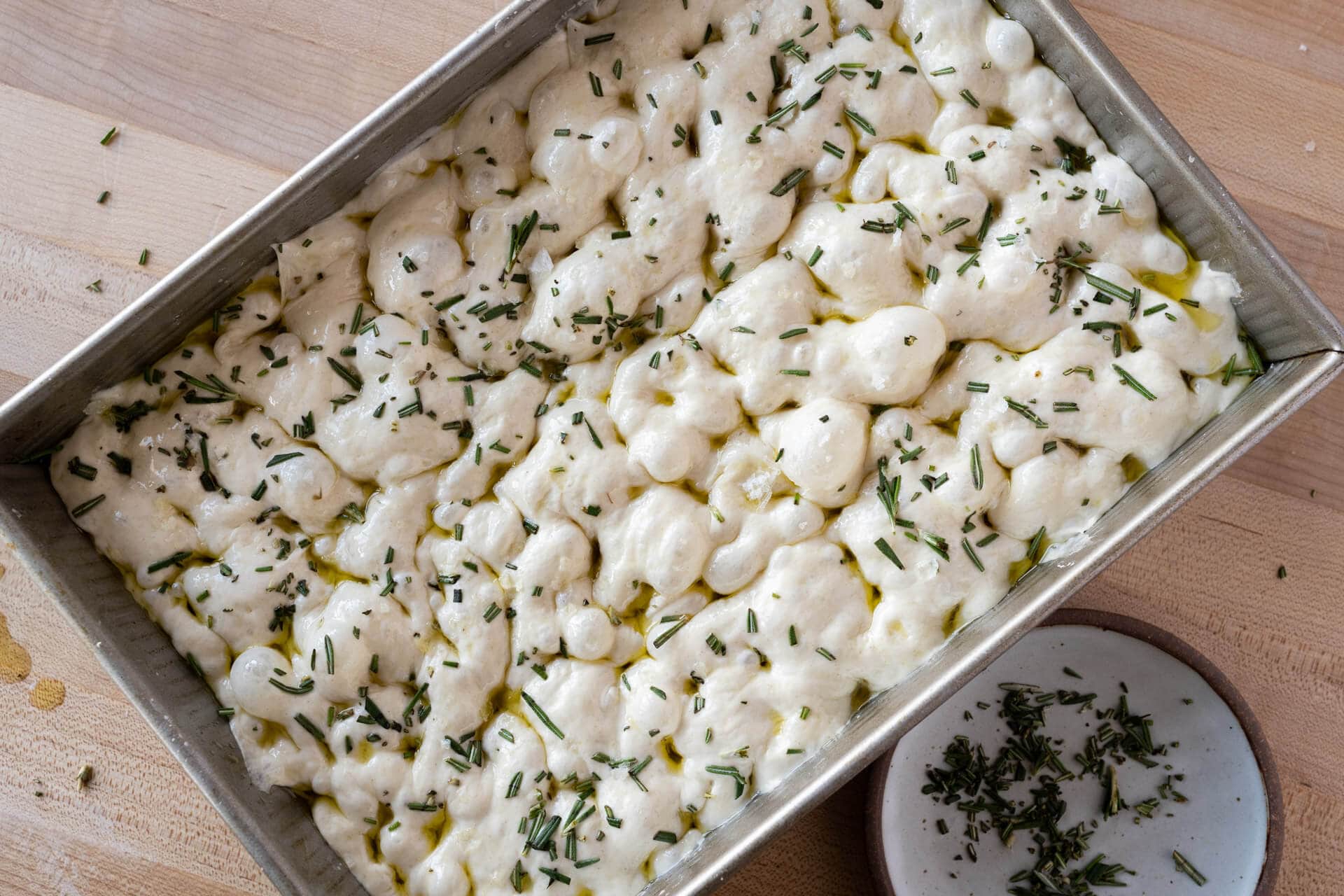
I’m also a huge fan of focaccia. This is one of the most-baked items in my kitchen, and my recipe couldn’t be easier. Use all of your sourdough starter discard one morning, and you’ll have fresh sourdough focaccia for dinner (and it’s an amazing canvas for any veggies in season!).
See my collection of sourdough starter discard recipes →
Step 6. Upgrade Your Baking Tools
One of the challenges of baking at home is consistency. It can be hard to bake consistently great loaves when the environment—our hectic home kitchens!—is always changing. I’ve collected my tried-and-true tools in one place, and they’ll help you make the bread easier and more repeatable in your home kitchen.
My top 3 recommended tools (read: if you’re going to buy anything, get these):
- A simple kitchen scale to accurately measure ingredients
- An instant-read thermometer to quickly and accurately measure dough temperature
- A foldable dough proofer to keep your dough warm and fermentation activity high
Explore all my favorite baking tools →
Step 7. My Top 10 Favorite Sourdough Recipes
- A Simple Weekday Sourdough Bread
- My Best Sourdough Bread Recipe
- Spelt, Rye, and Whole Wheat Sourdough Bread (50% whole grain)
- Fifty-fifty Whole Wheat Sourdough (50% whole grain)
- Sourdough Pizza
- Pain de Mie (super soft sandwich bread)
- A Simple Focaccia
- Whole Grain Spelt Pan Loaf
- Super Soft Sourdough Rolls
- Sourdough Cinnamon Rolls
Step 8. Join The 2500+ Member Community and Come Chat

Want to take your baking to the next level or get help with an issue you’re running into? Join the community here at The Perfect Loaf and get:
- Remove all ads from the website
- Instantly download my recipe archive and baking spreadsheets, plus other baking tools
- Join our private community to share photos, talk baking tips, tricks, and get help (I’m chatting there daily!)
- Access exclusive tool and flour discounts
- First access to live baking events
- And more!
Check out the baking community and membership →
Step 9. Experiment, Have Fun, and Happy Baking
One last note: don’t be afraid to experiment and have fun—after all, what’s the worst that can happen? No matter what comes out of your oven in almost every case, it’s perfectly edible and delicious. Some of my most significant baking improvements came from accidents that turned into opportunities for me to learn and grow as a baker.
Happy baking!

372 Comments
Glad to hear that, Chris! I’m working on a guide to using the Famag which I hope will be up soon. That might cover your question, but if you’ve found anything puzzling with the mixer feel free to email your Q over (and I can include my answer in the post for others, too)!
Yes please – Famag best methods for home!
The Famag has made my crumb structure awesome but it’s completely upended my approach for shaping… I need help, haha.
Thx!
Sean, it’s now up, check out my guide to using the Famag spiral dough mixer!
Re 50/50 Loaf, lastest recipe: I may have missed it, but what water temp should I use for the levain and the loaf?
Hey, Don! Warm/cool the water as needed so the dough reaches the final dough temperature for the recipe. Typically, my FDTs are usually around 78°F (26°C).
Thanks. I just referred to your prior recipe and got great results. BTW, the high altitude email was useful. I forwarded it to two pals I’ve turned on to your site, 1st timers.
FYI, living at 7400’, I too found it difficult to get the internal temp to 200 with over-browning the crust. Decided that 198 or 199 was good enough.
Don
PS: We need a local source for good flour. Shipping is killing me.
Whew, yeah 7400ft is really up there! Thanks for sending that out to your friends, hopefully it helps! I’ve heard we might be getting more flour choices here in NM, but it might be a few years out. I think some growers in northern NM./southern CO might help us there! I’ll keep you posted if I hear anything.
Hi Maurizio,
Ironically, having dabbled with sourdough for a while, i’ve finally upped my sourdough game and become a regular baker because my child has a wheat intolerance 😖 – and because i’m breastfeeding I also have to give up wheat.
it breaks my heart that Fen (said child) won’t be able to enjoy bread the way i do – so i’m trying my hardest to bake bread to feed him- so far mostly rye, but it’s a very earnest loaf indeed – not much fun for a one year old although he does eat it all the same…
If you were able to develop any wheat free recipes for breads and starter discard that would be incredibly helpful – note he is wheat NOT gluten intolerant (thank goodness) – so rye, sprouted wheat and buck wheat are all good – sadly spelt is not!
thanks for your wonderful website – here’s hoping Fen grows out of the wheat intolerance so i can try a wider range of your fab recipes! – and you’ve brought new zest to my rye starter (named Ryan!) already.
cheers
Emma
Will work on this, Emma! I replied to your other comment 🙂
That’s the book I have as well, I’m saving it for the project when I’m able! Happy to help and enjoy the mixer, I know you will. Happy baking!
Hey there, Chris! An Alan Scott oven… On my list of things to accomplish in the near future! I have a Famag IM-8S, and it’s a fantastic mixer for the home bakery. It’s certainly smaller than the 20, which he recommended to you, but I’ve had great experience with the Famag after more than a year of using it in my kitchen.
Yes, you certainly could do bulk in the mixer bowl and then turn it to “0” speed for a very, very gentle rotation of the dough in the bowl.
I’m working on a post about the Famag where I go into detail on everything about the mixer, but it’s going to be a bit before I can finish it up.
So yes, I do recommend the Famag mixers! Keep in mind I haven’t used the 20, but my 8S is great.
Happy baking and keep in touch, I’d love to hear more about your baking!
Where can I get a recipe
Check out my recipes page!
I have been using your guides to bake boules but would like to try a batard. I’m guessing I need to get a different shaped iron baking pan for this? any tips? Thanks!
Never mind! Just found your post about the Challenger and the Staub … 😊
Two great options!
Do you ever use potato flour in recipes?
You know, I don’t use it often! But it’s a great way to get more softness (starches!) into a dough without many hydration adjustments.
Maurizio, I really enjoy your site and I have baked many of your breads. My loaves look great but I’m getting too dark on the bottom; might be a bit thick as well. I have baked with a pretty heavy duty stone as well as just leaving them on the rack. I use a dutch oven, any idea?
doug from Durango
Thanks, Doug! Check out my post on baking in a Dutch oven for a bunch of tips on how to resolve that issue!
Hi, Maurizio. Thank you for your pizza making detailed explanation, awesome! Just one question… Regarding your pizza sauce, what size is the whole peeled tomato can in your recipe? Thanks!
You’re very welcome! They are 28oz cans. Happy baking!
Thank you! Greatly appreciate your kind reply. Pizza cheers!
Hi, Maurizio
I enjoyed reading your website and learned so much from it!!! Thank you very much for sharing your expertise! I just baked my first sour dough by following your starter recipe. I have a question about final proofing in the refrigerator. Is it normal that the dough did not seem ferment whole lot in the refrigerator? How much should it rise in the final proofing stage? Also, my dough did not spring a whole lot in the oven as well. Was it something I did not do it right? Up till the final proofing, everything seemed right ……
Yes, that’s common, Sophia. You won’t see a ton of rise from the fridge overnight, that’s just fine. If you didn’t see any spring in the oven, it might have either been over proofed or underproofed.
There are a few signs your dough could have gone over: sluggish rise in the oven, the score on top of the dough might not open with a nice “ear” and instead just kind of fuse together, the interior will have lots of small holes and perhaps one or two large ones near the top (but no dense areas of unfermented flour), and finally the loaf could be a little on the sour side. Try reducing the time the dough sits out before placing it in the fridge, and/or reduce the total proof time as well.
Hope that helps!
Thank you!! I will try again this week and pay attention to the proofing time.
Hi! I’ve now baked about 15 sourdough loaves thanks to your recipes, and we’ve thoroughly enjoyed them! They seem to be getting better and better! Could you please post a section on the many types of flours, their protein percentages, which ones can be substituted for others, and which can be used for which baked products? I’d really appreciate it, and bet others would too. I know I’m asking a lot, but when searching for flour online it gets very confusing at times.
Glad to hear my site has helped, Mare! Yes, that’s something on my list — been working on ideas for this for a while now. I’ll keep at it!
Thanks a million!
Maurizio, I too thank you for all your great recipes and tips. I just about made all your recipes and all tasted great even if I did not achieve your perfection. Here is my question, coming from Europe I also enjoy making many breads typical to that part of the world. A rather unique bread comes from Switzerland made with Ruchmehl. It’s a unique grind of wheat flour which contains some of the hulls but not all. It is anywhere between a German DIN 850 to 1050 referring to ash content. I try to achieve that by grinding hard red winter wheat which I with a 40 mesh sieve and blend that with KA or Central Milling AP flour. I mix those flours with 50/50 proportion.I am wondering whether you have ever experimented with Ruchmehl and if so, what formula did you use to make it.
Thanks …
Hey, Walter! Unfortunately, I don’t have any experience in baking with Ruchmehl. In a quick search, I think that flour has a wide range of equivalents here in the US, but I’d probably try something like Central Milling Type 110 flour. I think Type 85 will still be too low of an ash content, but T110 will probably get you closer! You might even try emailing Central Milling directly and asking them, they are very responsive!
do you have a recipe for gluten free starter
I don’t, sorry!
Hi Maurizio, thanks for this amazing recipes! Can you share your câmeras configuration? Your photos and videos are awesome 🙂
Thanks, Matheus, I appreciate that! I shoot most of the photos here with my Nikon Z7 — a wonderful camera!
I just want to say thanks for showing me how to do the slap and fold method. It has really saved the day on some wet doughs where I was trying to get the salt and more water in. Also, I just used it on a big lump of challah that wasn’t really high hydration, but was unpliable and really sticky at the same time (if that makes sense). I got it on the counter, and then back off the counter by scraping it up a lot and folding with my scraper, then started slap/fold, which was pretty messy for a minute or two, but I did that until it got nice and stretchy and quit sticking to the counter. I couldn’t have kneaded it the traditional way with the heel of my palm because it was too sticky. In earlier days I would just have put down a lot of flour, but like you I live in a high altitude dry climate, and more flour just makes a brick loaf. Thanks again!
Glad to hear that, Mary! It certainly is my favorite way to strengthen a dough — a little messy, but fun at the same time. I use it almost every time I bake these days 🙂 Have fun!
The bottom of my loaf is always quite hard and makes it hard to cut. Is there something I’m doing wrong?
Are you baking in a Dutch oven? If so, check out my guide to baking in a DO for some help with that. Generally, it’s cause by too hot of a baking surface or excessive bottom heat.
I used the pizza stone and parchment paper and next bread was perfect. thanks for the suggestions. And for begin so responsive.
You bet — glad it worked out well for you!
Hi Maurizio, I’ve got the beginners loaf in the fridge to bake in the morning but I can’t bake at the 15hour mark. Will it matter if I bake it an hour later (16hr) or should I do it earlier (13hours)? Thank you!! The dough looks gorgeous, can’t wait to try
I’d say either will be fine, but my preference is to bake later. Hope it turns out great and enjoy!
Thank you so much!
Hi, Maurizio. I added too much of the 50 g of water at the mixing stage
and now my dough is slick and a bit sticky. (Over-hydrated?) Is there
anything that can be done to save it?
Hi, Is it possible to bake your sourdough bread on a gas grill ?
Absolutely. I’d use a Dutch oven or Combo Cooker on the grill to make it easy.
So glad I asked about the grill …80 degrees in the kitchen is great until it’s time to bake …used a Dutch Oven with a great result !
Glad to hear that, Susan! Much better outside 🙂
HI Maurizio, Do you think it is Ok to begin with the first step of making the bread in the evening and do the second step in the next morning and bake in the evening?
Sure, that could work just fine.
Why do you use store bought rye and AP flour, rather than mill you’re own for the starter?
I use freshly milled and aged flour depending on what I have on hand. I buy rye sometimes because I’m testing many bakes or am out of berries. It all just depends on what I have in the pantry 🙂
Mare Schmitz Williams • 6 days ago
Hi Maurizio, I know how busy you must be! Using your recipes, I’ve made 3 loaves of bread so far and we are certainly enjoying them! Here is my situation – I want to make 2 loaves of really rye-tasting bread. I have a mature all-rye starter, as well as a mature AP starter. I just started yesterday to add “Four Star Special Flour,” from Bakers Authority to the AP starter, because the description said, “the 4Star Special Flour is a carrier for mixing with specialty flours like pumpernickel, rye, whole wheat and spelt to improve the rise and texture of flours by balancing the gluten.” So, my questions are 1 – to make the most rye-tasting bread, which starter(s) would I use? and 2 – which recipe of yours should I use? PS – We also love pumpernickel bread, would that be easier? Thanks in advance!
You could use either starter, whatever you’d like. Serious rye bakers do like to use a 100% rye starter to make rye bread, but I don’t always take that path. I’ve been working on a vollkornbrot recipe for the site but it’s not quite ready yet. In the meantime, check out my other rye bread recipe!
Question. Will Levain “delayed” overnight in a fridge be good for baking the next morning?
I got a late start in the 24hour cycle yesterday, didn’t start my Levain until about noon and then my schedule wentn off kilter and I couldn’t do the first rise yesterday.
So I just put the Levain in the fridge overnight.
Should it still be active and useable this morning.?
Or should I start from scratch? (Which is not a huge deal obviously. I guess I am more just curious)
Replied to your other comment!
Hi Mauricio! Your site has been very helpful for a beginner like me and I have been relatively successful in my attempts thus far! However, my friends in Singapore where humidity is around 90% are not finding success. The bread doesn’t achieve the height although the crumb seems fine. How should they adjust for the humidity?
You will likely need to reduce the hydration of the dough from the recipes you see here — this will bring more strength to the dough and might eek out a bit more rise. That should help!
Hi, Mauricio! Your knowledge is amazing. I’m on day 6 of starting out and my starter doesn’t seem to have recovered after the initial bacteria burst. I just ran out of rye flour and am trying straight AP in the 2x/day feeding schedule. Should I just stay the course?
Yes, stay the course. You could drop back to 1x feeding a day and that might help. Also, try to keep it in a warm spot in your kitchen!
Hi Maurizio, thank you for the very comprehensive guides and recipes. Please are you able to post or point me to a basic sourdough recipe for a small loaf about 400g or 500g flour? Or guide me as to how to half your beginners sourdough recipe? I’m just attempting your starter recipe and will need a small loaf recipe as we are unable to finish 2 x 900g loaves and I prefer baking frequently rather than freezing one. Thanks a lot!
Hey there! I’d say go with my beginner’s sourdough recipe and just halve everything (as I mention in the post) to make just one loaf. that’ll work very well for you!
Hey Maurizio! Thanks for everything you do. 🙂 Hoping you have some advice. I have a super strong starter, my leaven was super strong as well — increase by 3, passed the float test, etc. My issue I think is during bulk fermentation, I am definitely seeing some small bubbles, but I feel like I am not getting the growth (definitely does not seem to be doubling). My dough also seems wetter than most (watching videos) … I am following your beginners recipe. Lastly, the biggest comment I have about the end result is the texture… just seems to be too “doughy.” Any advice?! Thank you again!
P.S. Your pancakes, waffles and focaccia all turned out AMAZING. Family favs.
It sounds perhaps like a lack of fermentation overall, but it’s hard to say. I’d say try reducing the hydration of the mix a little (5%) and be sure you’re hitting the Final Dough Temp (FDT) listed in the recipes here — it’s important to get a nice warm condition for the dough if you’re going to follow the prescribed timetable for bulk fermentation and proof. If your FDT comes in lower than listed on the recipe, expect your dough will need more time in bulk fermentation!
Glad the pancakes and the rest have been so well received! It’s nice to have another outlet for sourdough 🙂
Good Morning Mario! Thank you so much for your website. It truly is THE most comprehensive that I have encountered thus far for baking instruction. My starter is on it’s 7th day, and although it is tangy tasting, it is seemingly very loose. It has not risen or fallen–I know this because I put a purple rubber band around the jar at the post-refreshed starter level and at 12 hours there are no tell tale signs of movement. I keep the starter in my oven with the light on. The temperature inside is 81 degrees. Since today is day 7 and the refreshment ratio changes, should I continue with the refreshment ratios from day 6 and wait for activity or continue with the new refreshment schedule?
You’re very welcome, Maureen. Yes, I’d continue with the process there, it’ll come around. If you still don’t see any activity, try introducing a bit more rye flour, perhaps 25%, back into the feedings. If it feels overly wet and loose, you could also reduce the hydration just a bit to mix up firmer, this might help you see the rise and fall more clearly.
Maurizio, is is correct to assume that all your recipes are based on baking at your high altitude (around 6000’)? Living at sea level I certainly started to hold back on the liquid, run lower baking temps and durations. I noticed the King Arthur site has an altitude adjustment table as a guideline but I find adjustments by dough look and feel during development more useful.
Yes, they’re all recorded here at 5280ft or so. At lower altitudes (and especially locations with more humidity) holding back the water is likely necessary and you will also likely need a shorter bake time for many of the recipes here (although this always requires some modification in the kitchen!).
Maurizio, I noticed in your blog that you are using occasionally the Häussler mixer for more challenging doughs incl hi hydration. As I am looking to buy a mixer I am also looking at Famag as they have a Dough breaker bar. Have you found the lack of a breaker bar in the Häussler a problem with “dough hiking” ?
The HA mixer is extremely well built, but the dough will likely climb the hook as mine does. I get around this “problem” by keeping a wooden spatula in the bowl while it’s running, acting as a breaker bar. Even with this inconvenient it’s a fantastic mixer, built like a tank and it really does the job. They’re both great, though!
Thanks for the tip. I just purchased a HA so hope I can manage this “climbing” issue. I assume you hold the spatula during mixing. I wonder whether a permanent “knife blade/bar” could be retro fitted to fix this issue. Have you heard of anyone attempting that?
Hi Maurizio,
Question, can you describe the difference in flavor between staying at 50 rye / 50 AP and 50 whole wheat / 50 AP? I was gifted a starter and by the time I got into the store the rye flour had sold out, so now I’m wondering what will change. Thanks!
If you’re referring to starter maintenance, I’d say both those options will work equally well. Really the biggest impact you’ll see is when you make your levain (the flour, temp, times in the build) and the dough mix itself.
Oh no, maybe I made a mistake. I thought since I had an established starter, i thought I had a levain and I could move straight to the weekend maintenance schedule. In fact, since today was Monday, I fed based on that schedule and it’s currently in the fridge waiting for Thursday after work. Did I make a mistake? And Can I fix it?
It’ll be just fine. Just take it out of the fridge a day before you want to bake, give it a couple usual feedings, and it’ll be ready the morning you want to bake.
Hi Maurizio,
I am struggling to make SD starter even if I tried to do everything right. I tried to follow every precise steps about timing, temperature, digital scale, etc. I found organic Rye flour for this purpose, I used it on Day 1 and onward. The result of Day 1 was amazing, it had so much bubbles and doubled itself quickly, Day 2 was also promising but after these 2 days it started to lose lots of bubbles and volume and it followed rise & fall action like your descriptions said. Today is Day 9 of my SD starter, I keep feeding with Rye flour but I do not want to continue feeding with white all purpose flour and I started to use organic whole wheat flour after day 7 instead of all purpose white flour because I think that white flour could be caused this ( maybe it is not quality enough like organic rye and whole wheat flour). Therefore I keep feeding with 50 gr Rye, 50 gr whole wheat flour, 50 gr SD starter and 100 gr spring water. Is there anything that I am doing wrong in this process? Does it make sense to use whole wheat flour instead of white flour? Should I keep feeding with rye flour & whole wheat together? How can I understand when it is ready?
Looking forward to hearing your advise.
Sorry to hear that! Sometimes it does take longer than others, usually if it’s cold in your kitchen. Using whole wheat and rye is just fine, and spring water is a good idea, too. You should see the same rise and fall in the starter each day, this will indicate when it’s ready to be used. This might be hard to see given your flour mixture (white flour shows more rise than others, typically), but you should see signs: bubbles on top and sides, a sour smell that increases as the day goes on, and eventually it might fall to some degree in your jar. Really the key is that consistency each day.
If you’re not keeping things warm, try doing this, it will really help. I’ve found 78-80F is very helpful, and if you can’t find a spot that warm in your kitchen, warm the mixing water to 80F when you use it to mix.
I don’t think you’re doing anything wrong, it all sounds right. Sometimes it just takes longer depending on your flour and other conditions. Frustrating, I know! Keep with it, it’ll happen.
After I have changed my White Flour Brand, it started to have bubbles. I think this happened because of the poor quality of flour. In this way I understand how white flour and its quality is important. Thanks a lot for your quick and informative reply. I hope it’ll happen after that 🙂
With Covid, I only have AP flour, can’t get anything else. What advice do you have? I have a sourdough starter I’m working on.
Check out my simple sourdough bread recipe, that will do well with just 100% AP flour! You could also make the focaccia listed in this post, that’s great as well.
No changes or things to be aware of with just AP?
Should work just fine. Be cautious with the withheld water, perhaps, as sometimes AP can’t take quite as much as bread flour. If the dough still feels slack/weak after the last set of stretch and folds, add one more set to the total.
I find the instructions here VERY precise, maybe intimidatingly precise (especially since I am COVID-stranded without my digital scale, and only have an analog scale).
Which makes me wonder, is it really necessary to measure down to the gram (80g flour to 81g water?)
for instance, my analog scale will not measure 5g (of mature starter) for the slimmed down minimalist version.
How did bakers manage before the advent of the digital scale?
The strange non-round numbers for many of the formulas here are a result of baker’s percentages and me creating a formula the way bakers do — round percentages but non-round weights (I’m working on a post about all this to explain more, coming soon!).
It’s ok if things are a few grams off here and there, 5g won’t be a huge deal. Bakers have been baking for thousands of years without a scale, but with a scale I guarantee your bakes will be much more consistent and repeatable. You definitely don’t have to use a scale to make amazing bread, but I find it helps make amazing bread over and over and over 🙂
Hope this helps and don’t be intimidated — get your hands in some dough and have fun, and in the process, enjoy the results!