

I could probably pull out hundreds of gems from Hamelman’s essential reading, Bread, and each time I go back to reference something my eye catches one that strikes a chord. Attentiveness, now that is an essential thing with baking. You don’t realize just how vital it is to step back for a second and observe what you, and the dough, is doing from time to time. Does it look alive and puffy? Does it look like it has enough strength? Are you mixing to sufficient development and enough rise during bulk fermentation? In this post on country sourdough with less levain and a longer autolyse we’ll look at all of this.
First learn the basics—good mixing techniques, proper fermentation, and skillful baking. How do you learn these? By repetition and attentiveness. Make sure patience is part of your ingredient list.
Jeffrey Hamelman
Baking can be a haphazard endeavor: you can measure out the ingredients, throw them into a bowl, get your hands dirty, and watch as the magic happens later in the oven. You’ll get good bread, better than what you’d get in most grocery stores in those plastic bags for sure. But when does good bread become great bread? I believe it comes with a little time, some practice, gathered experience, attentiveness, and if you are lucky, hands-on instruction. If you’re like me and have never had formal baking training, most of these things have to come from within, from your practice & process.
When it comes down to it, baking is a personal thing. I’ve read many places and listened to many talks where bakers can be quoted saying something of the sort: “no two bakers bake alike.” Reading books on baking and flipping through many pictures of those open crumb loaves with nice dark glistening crusts, you start to tell yourself “hey I can do the same thing right from home.” Well maybe you can, maybe you can’t, but the important thing is to find your process and your method, and make bread how you like it. That’s great bread.
There are so many variables to baking it’s impossible to lay down a set of rules that, when followed, will result in the same loaf each time. It just won’t happen. The best we can do is increase the consistency of creating great bread. Every loaf won’t be the same, every crust won’t shine the same way, and every crumb structure won’t line up the same way, but we do our best to stay consistent and make the most excellent bread we can. And in the very end of things, bread is bread; it’s a staple of food that’s been around for almost as long as we have. It’s meant to provide sustenance and nourishment, not sit on the wall like art.
With all that said, I still search… I still work at my process and my technique. I always read and research. That’s part of the fun for me as a home baker; it’s a science experiment that never ends and one that makes me and others around me happy to eat the results.
In this entry, I baked upwards of 8 loaves over the past few weeks with the following process in search of that great bread. Testing, reading, experimenting and talking bread with some of you out there (hat tip to the ever-helpful Margie). All this research and experimentation has produced some of the best loaves I’ve churned out yet. The following entry catalogs my findings with increased autolyse time, decreased pre-fermented flour, and building more strength at the front of the process instead of later during bulk fermentation.
An excessive use of yeast will always be to the detriment of the finished product. Rather than giving your bread a lot of yeast and a little bit of time, reverse that and give them a little yeast and a lot of time. The results will be worth the change made.
Jeffrey Hamelman
Thoughts on increasing autolyse
As mentioned in my whole wheat post increasing your autolyse time will change the way your dough feels when you start to mix as you’ll notice it has elasticity and strength early on even before intensive mixing/kneading. It starts the gluten formation process early and begins to smooth the dough, but it also helps bread with a higher percentage of whole grain to fully hydrate before fermentation begins.
Reducing levain
When I started out baking, and you can see this in many of my beginning Tartine posts, I would typically increase the levain percentage sometimes all the way up to 25%. This was partly to compensate for my starter not having enough strength, but also because I had this idea in my head that more levain means a more open crumb. That’s not true, as it turns out. I’ve found that with only 15% levain (that’s 150g) I get just as much rise and fermentation activity with the possibility of having a more open crumb. It may mean you have to let the fermentation go just a bit longer, but it will be worth it to take your time and let your baking assistant (read: starter) leaven that dough and build up some exceptional taste.
First, if you’re brand new to baking sourdough, you might want to check out my Beginner’s Sourdough recipe, it has longer in-depth explanations on every step in the baking process!
Prepare the levain – 6:30 a.m.
Prepare the following right after you get up in the morning:
| Weight | Ingredient |
|---|---|
| 25g | Ripe starter |
| 50g | Giusto’s whole wheat flour |
| 50g | Giusto’s artisan bread flour (medium protein bread flour at 11-12% protein) |
| 90g | Water |
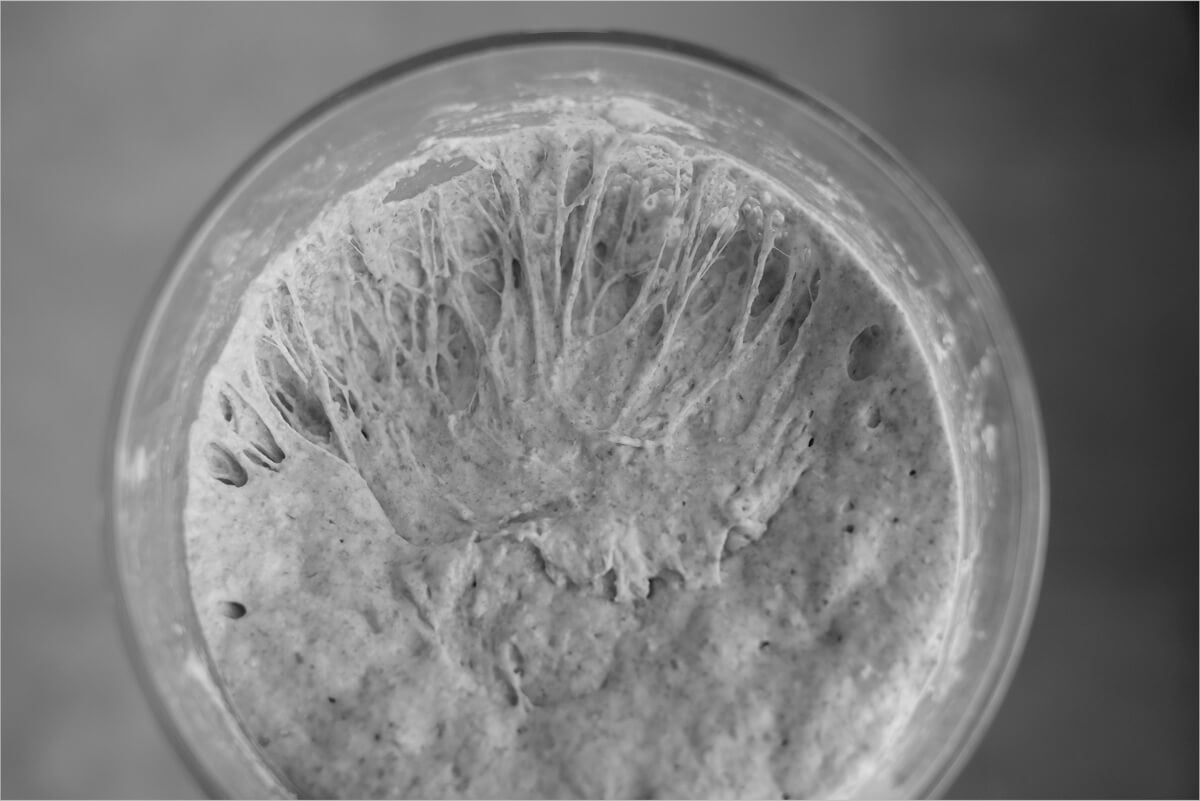
Keep it in a warm area in your kitchen for about 6 hours if your kitchen is around 78°F (26°C) if it’s a bit cooler where you are you might need to go a little longer. Watch your levain and read the signs: smell, bubbles on top, volume.
Autolyse & Mix – 9:30am
We’re going for a 3 hour autolyse for this bake. You might want to experiment with autolyse times to suit your flour and preference — I’ve found an autolyse really helps with doughs that have high whole grain percentages or high amounts of strong high protein flour. Take notice how different the flour feels when you autolyse for an extended period like 3 hours versus a short 40 or even 60-minute duration. It’s quite astonishing.
Note that this autolyse is without any levain (or salt) added to it as your levain isn’t even ready yet—it is only flour and water. We start the autolyse 3 hours before we anticipate our levain to be ready. You should be good to go doing this at 9:30 a.m. and if your levain isn’t ready at 12:30 p.m. or so no worries, keep the autolyse going until it is ready.
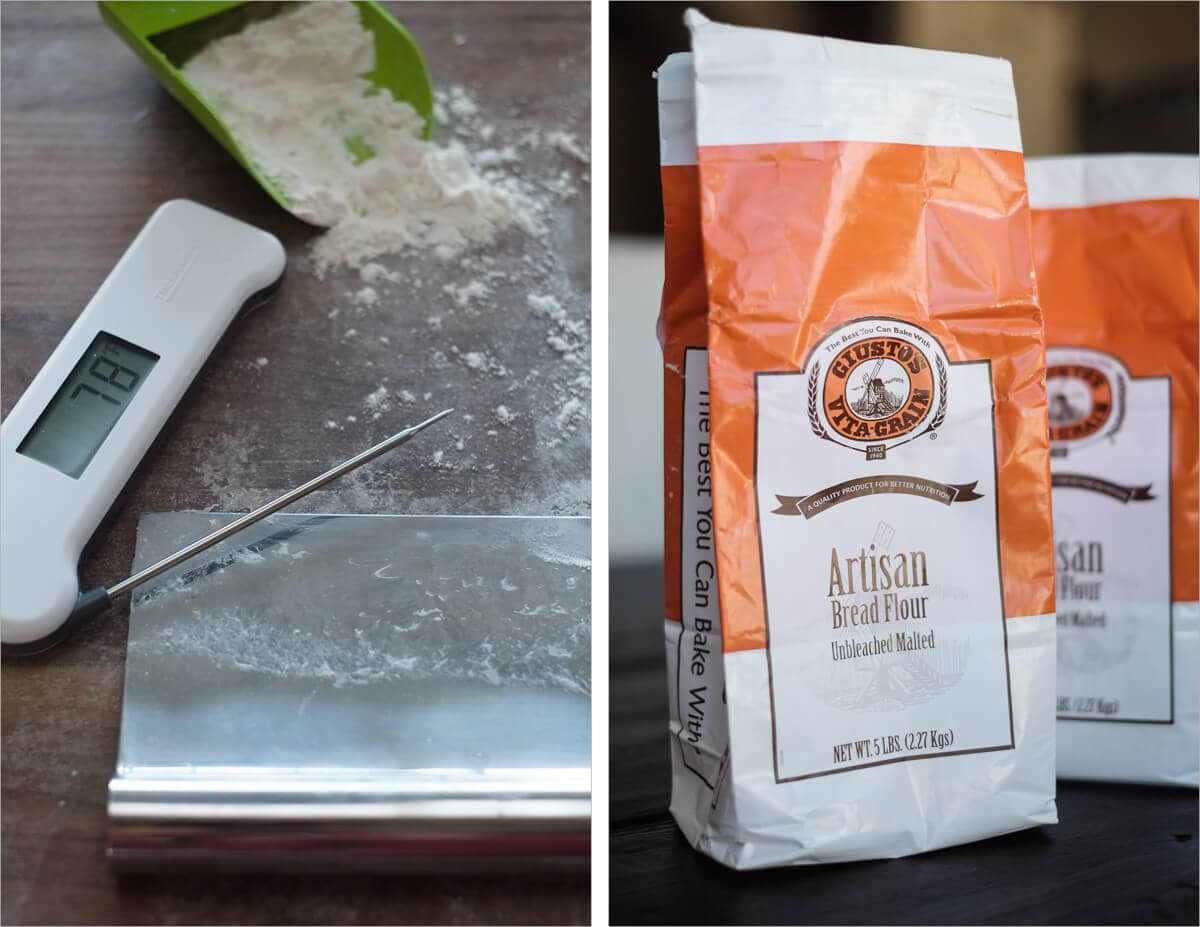
By the way, I just recently picked up a Thermapen after many days contemplating the purchase. Wow. I can’t believe I’ve been baking this long without this thing; it’s a real piece of equipment. No longer do I have to wait for the cheaper thermometer to settle down and finally arrive on a temp, this thing is instant!
Ingredients:
Gather the following:
| Weight | Ingredient | Baker’s Percentage |
|---|---|---|
| 100g | Giusto’s whole wheat flour | 10% |
| 900g | Giusto’s Artisan Bread Flour | 90% |
| 800g | Water | 80% |
| 20g | Fine sea salt | 2% |
| 150g | Ripe levain | 15% |
Perform the following for the autolyse:
- In a thick bowl add your 900g white bread flour and 100g whole wheat flour
- Add 700g of your water (the rest, 100g, is reserved until later when we add in the levain & salt after the autolyse)
- Mix these ingredients by hand until incorporated. Remember at this stage we are not looking for any gluten development really, make sure all the dry bits of flour are hydrated
- Cover with wrap and keep near your levain for 3 hours or so
Mix after your 3 hour autolyse – 12:30 p.m.
First, a little info on my new mixing experiment I alluded to earlier…
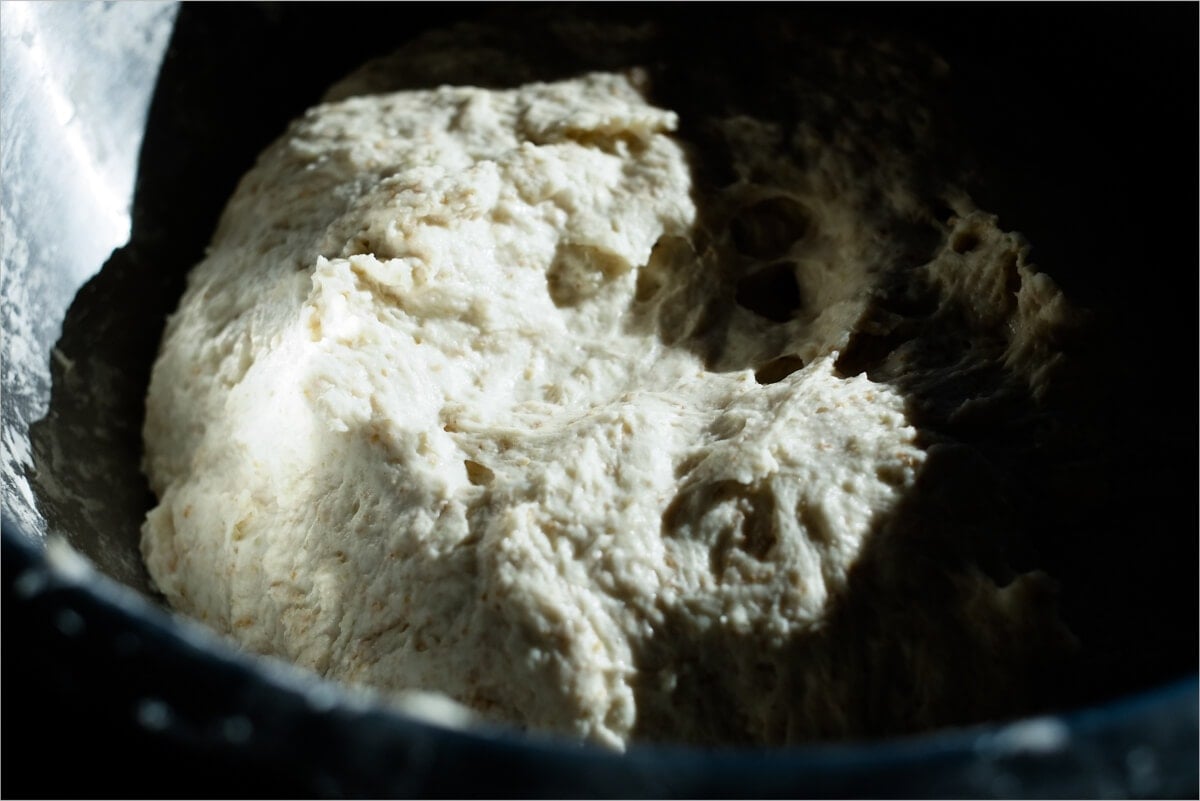
I mentioned, in the beginning, we were going to develop the dough a little bit farther at mix than usual. The goal is to develop the gluten in the dough early instead of later, just enough so it has enough strength to hold onto any gases produced during fermentation. Enough so that we only need two or three more normal sets of stretch and folds during bulk (instead of the typical 6). What does this mean for us and the dough? Well, this means we would leave our dough untouched in the bulk container for much longer near the end. My thoughts and the thoughts of many books & bakers out there is that if you’re looking for a more open crumb, you want to handle the dough even less towards the end of bulk.
After reading posts online, and discussions with a few other bakers out there, I’ve been experimenting with different mixing techniques. Lately, I’ve been successfully using the “slap and fold” method publicized by Richard Bertinet. This method is a great way to develop the gluten in your higher hydration dough. I’ve done it many times now, and it does take practice — at first, it’s tricky as the dough breaks apart, sticks to your hand, and generally acts like a savage animal. With each successive attempt, it gets easier and easier as your confidence builds. At every, well, slap and fold, the dough just starts to feel stronger and stronger, it begins to take on some cohesion and a subtle sheen on the outside. You need to work it until you get to this level, which for me was around 6 minutes in total.
If you’re not interested in trying a new mixing technique, you can do the same method as you would during stretch and folds at bulk time. Grab under the dough and fold it back over itself, then turn the bowl a bit and repeat. Keep doing this until the dough comes together and starts to feel a little bit stronger and a bit more sticky. You’ll notice how it starts to get a little harder to stretch out and fold over.
Now, let’s get started.
Add your 150g levain to the top of your dough and cut it in with your hand. It will kind of break apart but then come back together again after some mixing. Use a little of your 100g water reserve to get things going. Once this is mixed in, add your 20g salt on top and repeat. If it feels like your dough is super sloppy and breaking apart, don’t add the entire 100g reserve.
Now is the time to do your slap & fold (or your preferred mixing technique) to the point where the dough starts to show a bit of strength to it. Stay attentive and watch as you’re proceeding with the mix, the dough will change right in front of your eyes. After mixing the following were my measured temperatures:
| Final dough temperature: | 76°F (24°C) |
Bulk Fermentation – 12:40 p.m.
Transfer your dough to a clear container to be used during bulk fermentation and let rest for the first 30 minutes. After the first 30 minutes do a few sets of stretch and folds until the dough feels and looks strong enough. For me it was:
- 1:10 p.m. – Turn Set 1 (reach under with one hand and pull up and over to the other side, rotate your bowl and do this four times for a set)
- 1:40 p.m. – Turn Set 2
- 2:10 p.m. – Turn Set 3
At this point the dough started to hold its shape in my container— it was holding together a little bit in the center of the bowl, and you could see some defined lines and edges. It is possible one more set would have worked out just fine, but I decided to stop and let the dough rest untouched for the rest of the bulk step.
Pre-shape – 5:10 p.m.
Take the dough out of the container onto your work surface. Divide into two halves and lightly spin the dough in little circles across your work surface with your bench knife in one hand and your other empty hand—kind of like turning a car’s steering wheel. Let this pre-shape rest, covered with a damp towel or inverted bowl, for 20 minutes. My dough had a nice taut skin on the outside with bubbles just wanting to escape but couldn’t quite make it out of the gluten jail I’ve built for them. Sorry guys.
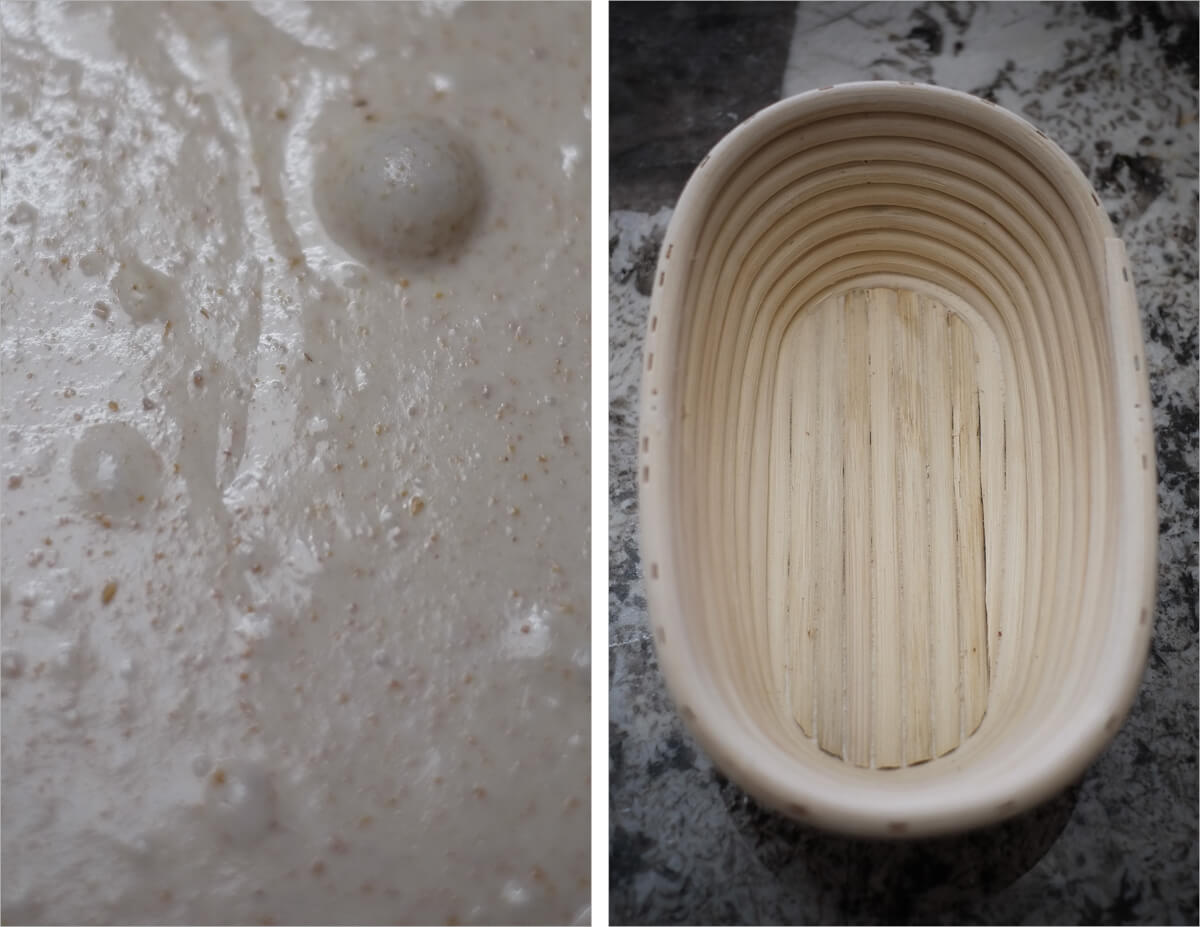
Lightly dust your proofing bannetons with white rice flour in preparation for the next step. If you don’t have bannetons, you can just use any small bowl around your kitchen.
Shape + Proof – 5:30pm
Shape each half of the dough as you’d like (I chose batards, I can’t get enough of that shape). You want a gentle and confident hand here to shape in as few touches as possible but still get that taut skin on the outside. I know that’s easier said than done, especially at this high of hydration. Practice!
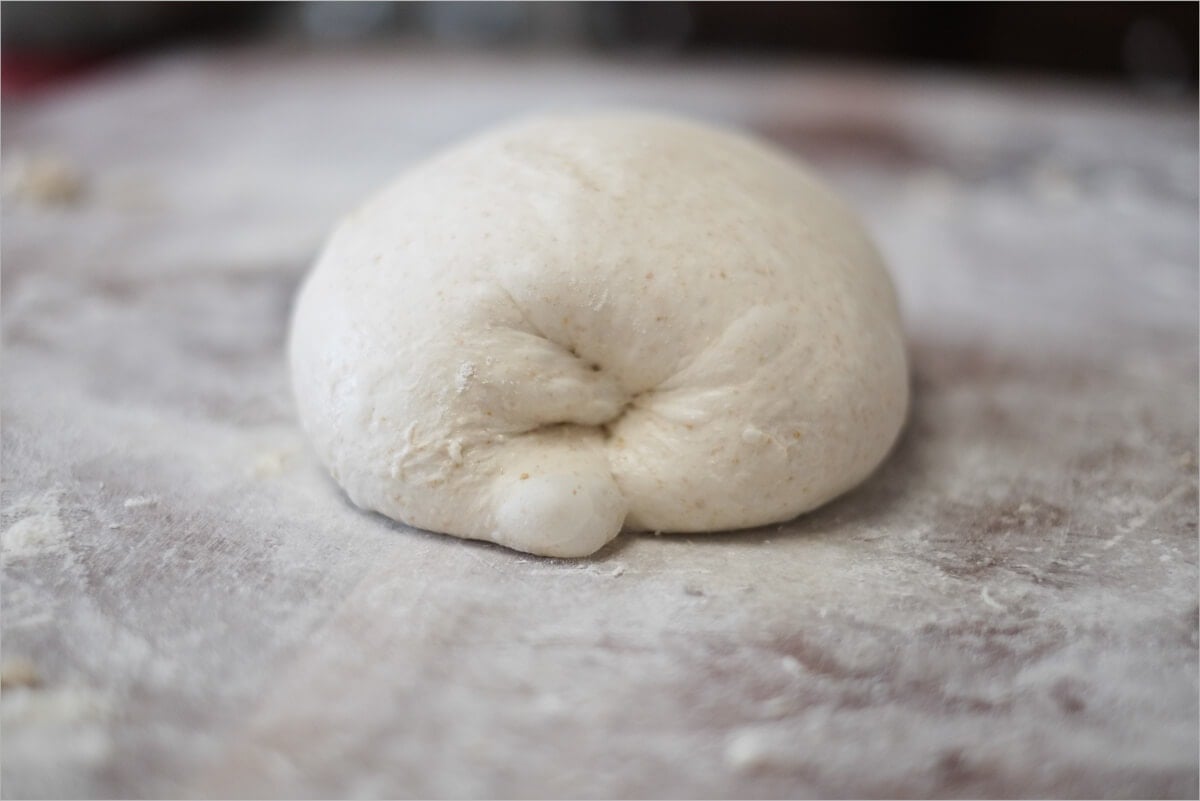
After shaping, I let my two batards rest on the counter for 2 hours at room temperature (around 76°F/24°C, a little on the warm side even). Because we’ve reduced the amount of levain from the typical 20% to 15%, we give these a little extra time here to develop flavor, gas, and even some strength. More time is always a better thing when making bread. Don’t rush things but keep an eye on your dough, you don’t want it to go to full proof otherwise you won’t get any oven spring in the morning.
After about two hours on the counter, place your baskets in plastic bags and into the fridge to proof overnight, we will bake these in the morning.
Score + Bake – 8:30am
See my post on baking with a Dutch oven (or combo cooker) for a more in-depth discussion on the baking process below.
In the morning, preheat your oven to 450°F (232°C). I usually leave the shallow side facing up on the left, and the deeper side on the right facing down but I’m also left-handed.
After one hour, take one of your baskets out of the fridge and cut a piece of parchment paper to place on top. Take your peel and then put it on top of those two and quickly invert it, so the dough is now resting on the parchment paper and the peel. If, like me, the dough had risen over my small banneton and I couldn’t rest the pizza peel on top without squishing the dough. No worries just use your hands and quickly turn the banneton over and lightly drop your dough onto the peel. Don’t squish, compact, drop, smash, bite, lean on or punch down your dough.
Score the top of the loaf with your desired pattern. If you’re following my lead with the typical “crescent” slash, make sure it’s very horizontal to the dough, move quickly, and score rather deeply.
Take out the shallow side of your Dutch oven and drag in your dough. Quickly place the pan back in the oven, cover with the deep side, and bake for 20 minutes. After 20 minutes, open the oven and take off the deep lid of the Dutch oven (set it next to the other half inside the oven). Then, bake for an additional 35 minutes or so, until the bread is to your desired doneness.
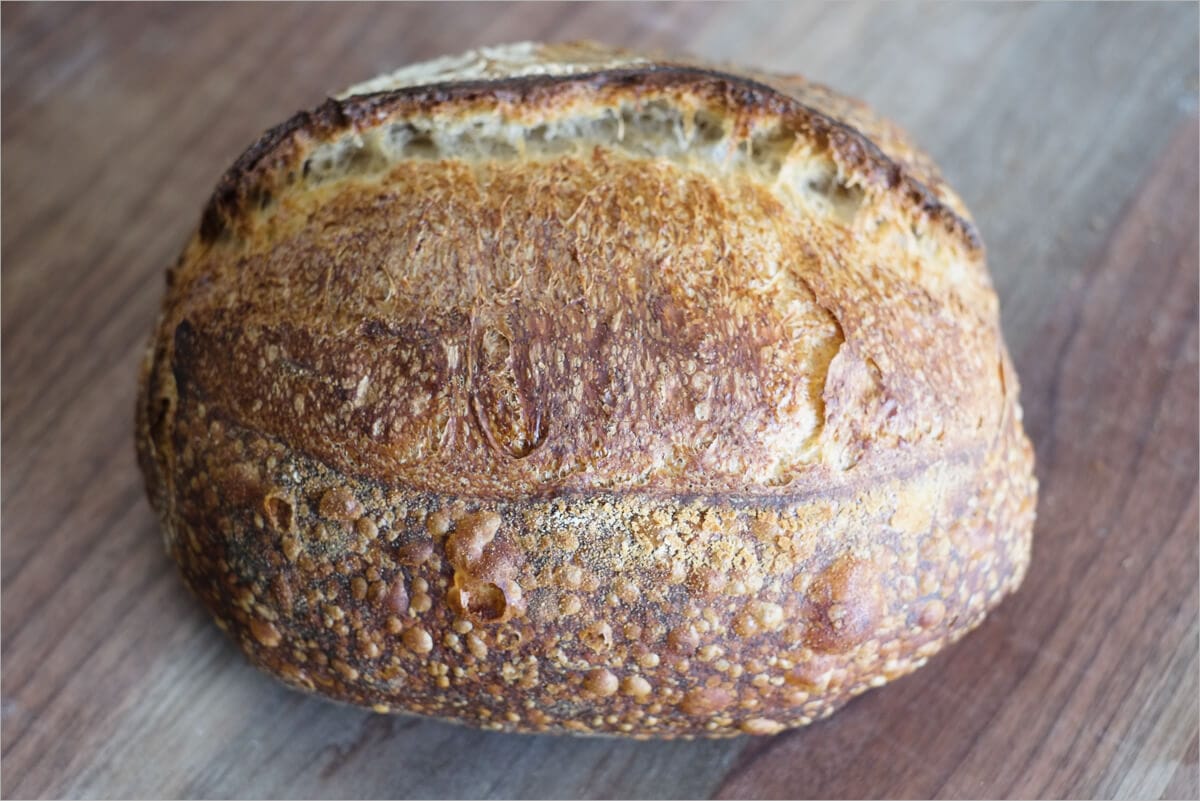
When your finished, the loaf should almost float in your hands. It will be very light, airy, and with a crackling crust.
Conclusion
I’m impressed with this Giusto’s Artisan Bread flour. I have a few more millers (some with organic flour) I’m going to try here coming soon, just for comparison and experimentation, but this is my leading favorite.
“Don’t rush your bread,” I could hear Chad Robertson or Jeffrey Hamelman tell me right now. Well, I think their whispers are correct. A long autolyse, a healthy mix, a lengthy bulk with low levain, and a long overnight proof led to a great bake. And while I don’t think a lengthy autolyse is good for every bread and every style of baking, it sure worked with this loaf.
Crust
Thin, cracks abound, crunchy and yet somehow soft. The colors were eye-catching and ran the gamut from dark at the flat areas to super light in the fissures. The bottom of the loaf was cooked well, almost too well. It might do to turn the heat down just a tad near the end, for my oven at least.
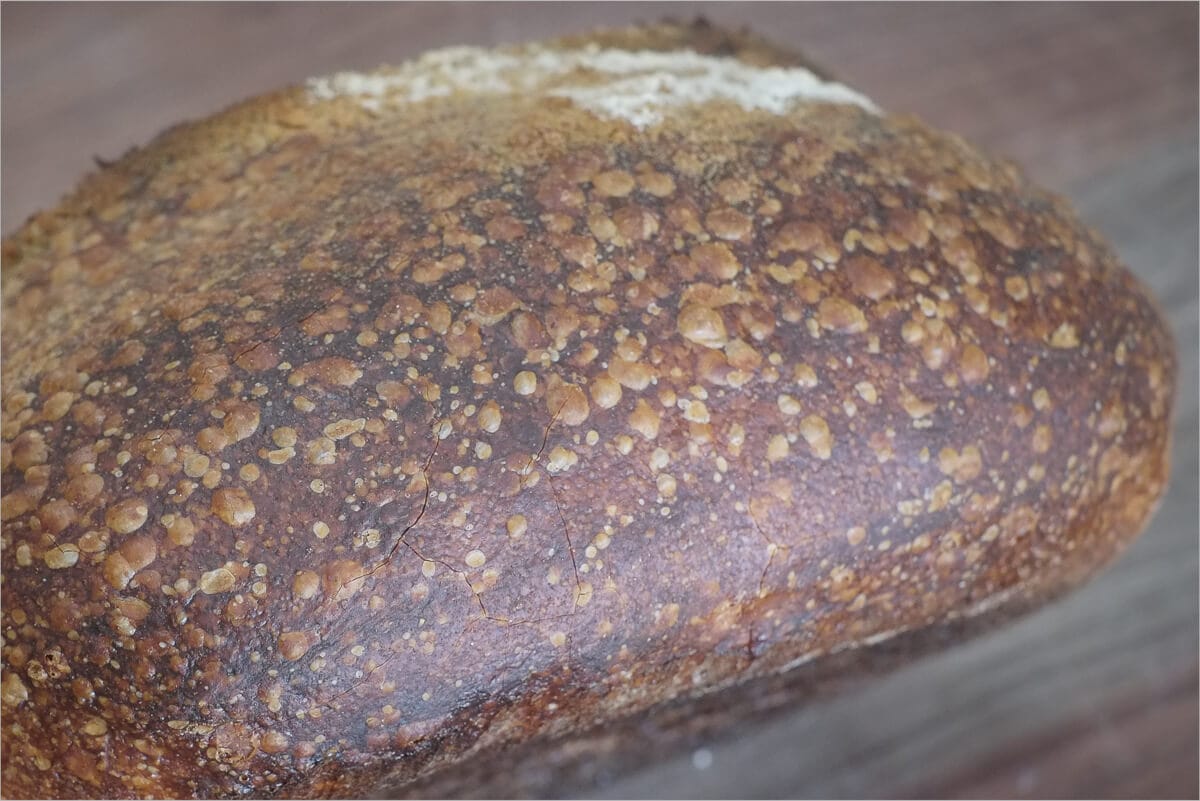
I took so many pictures of the final loaves that I couldn’t quite decide which were the best to post, and thus the abundance you see here. I can’t get over the look these–the colors, the detail–they have that texture that seems to defy my camera — almost too much detail going on.
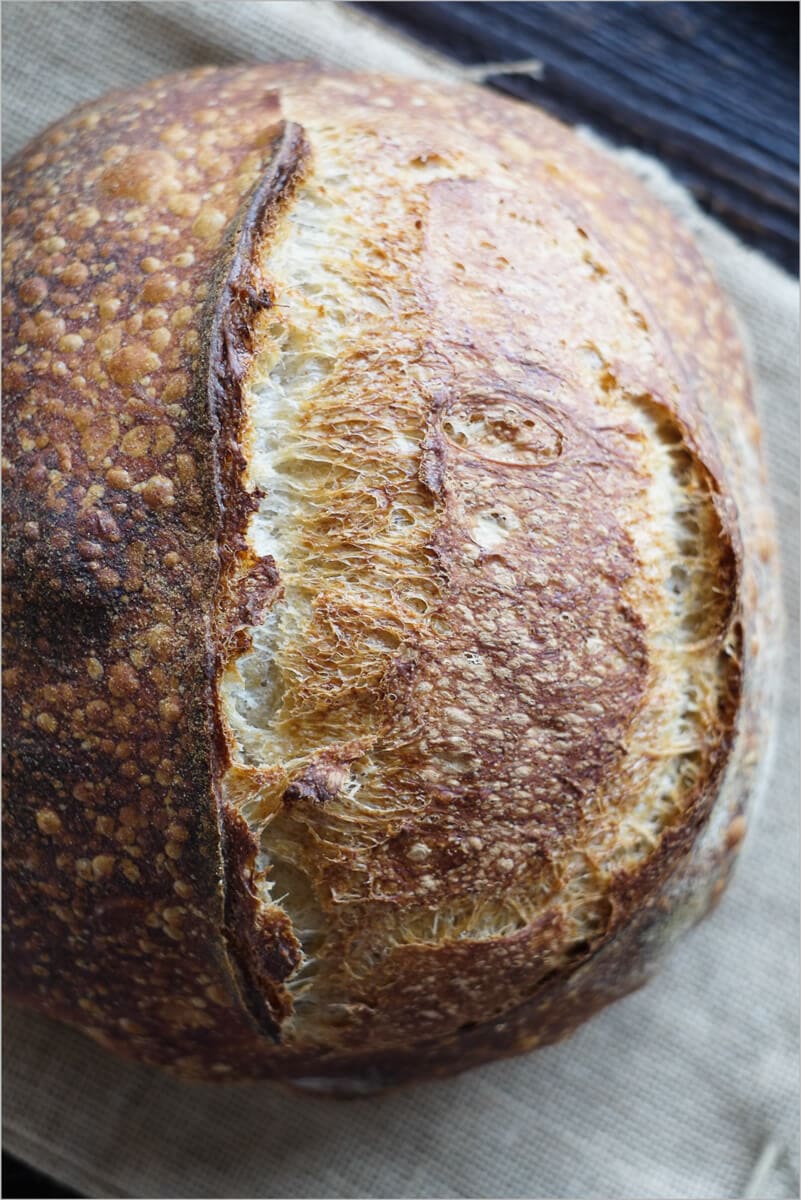
Now that’s some movement, wouldn’t you say? Awesome! It almost looks like the surface of some unexplored distant planet.
Crumb
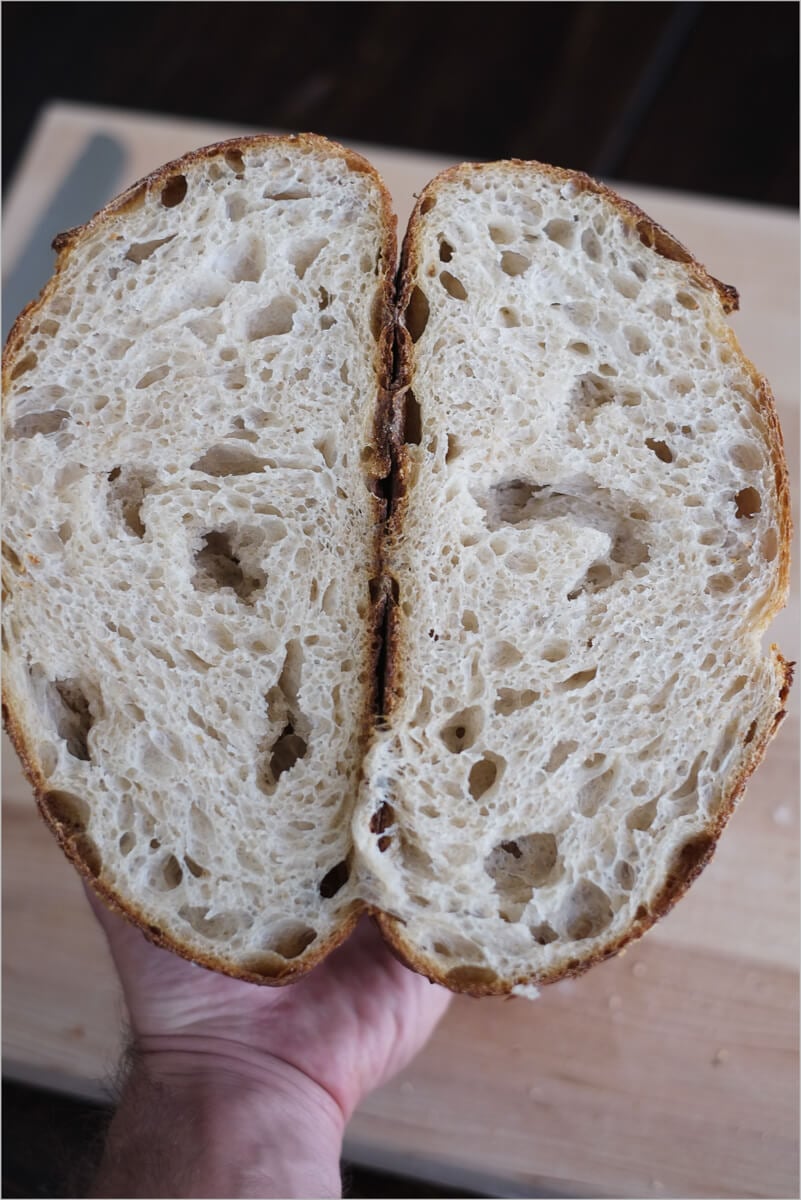
Soft, light and open. Holes all over the place: some large, some small, but very scarce are the areas that were just dense dough. I could do with some more of the large variety, and I’m confident I’ll get more of those as I practice with this method. The reduced levain and longer duration without any interaction helped open things up and create a more airy crumb than I’ve previously been able to achieve. All while keeping the sourness to an absolute minimum.
Taste
The best tasting white country loaf I’ve ever made. No doubt about it. The reduced levain, increased autolyse time and high-quality flour have helped to make these loaves some of the greatest I’ve produced. There was the subtlest of sour flavor present, so subtle that my family asked if these were even sourdough loaves. I’ve mentioned it before, but this is how I like bread.
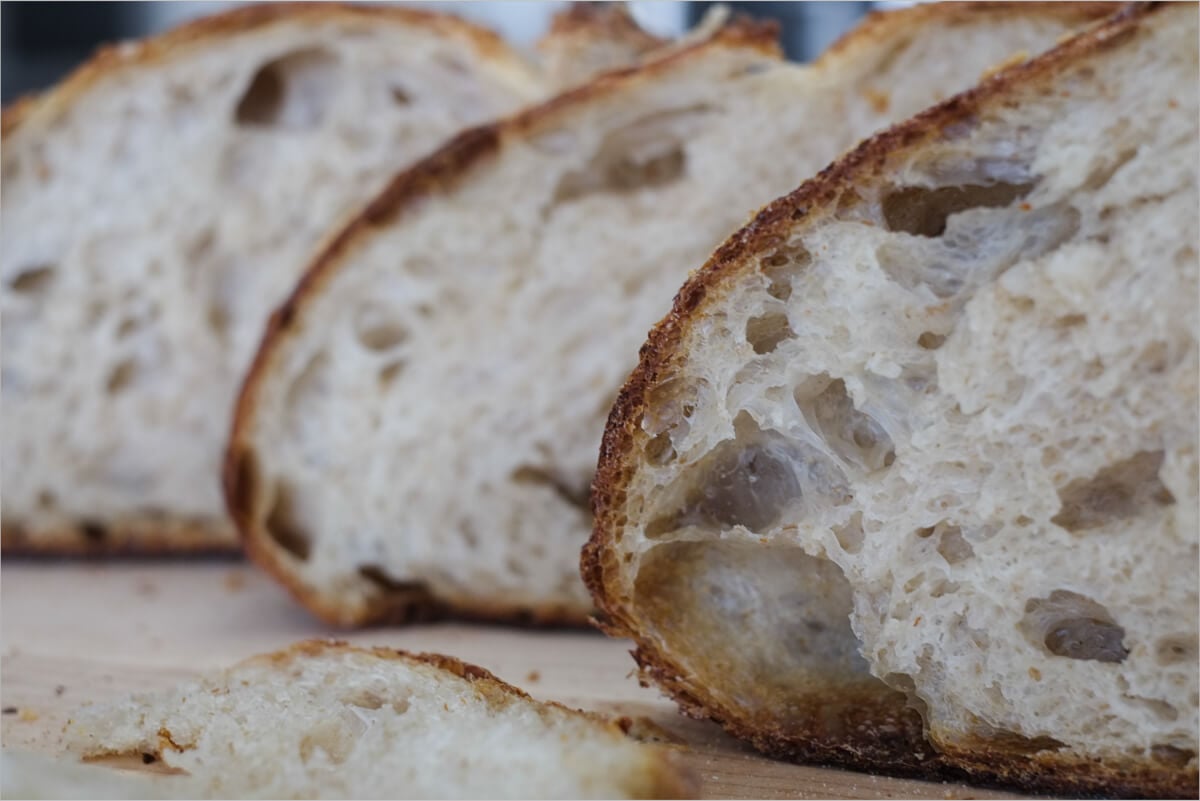
I don’t know how many loaves of bread I’ve tossed into, and pulled out of, my oven at this point but I can say to me this is great bread — what does great bread mean to you?
If you use this recipe, tag @maurizio on Instagram so I can take a look!


246 Comments
A beginner question. How do I print off this Country Sourdough recipe. I do not have the patience for scrolling up and down on my iPad. ?
Maurizio, you mentioned that your family asked if this bread was even sourdough, that is how I like my sourdough bread also; not sour at all (I just love baking bread and want the healthy benefits of sourdough bread). Everything I have read says not to use whole wheat flour and not to proof it in the refrigerator overnight as those things make it more sour. I would love to be able to fit baking bread easier into my schedule so can you explain what makes this recipe work to produce the "subtlest of sour flavor"? Thanks.
A few things help keep this bread mild: using a young and vibrant levain, keeping dough temperatures moderate during bulk fermentation, and having a relatively short proof in the fridge (or no cold proof at all). While whole wheat flour and long cold proofs can increase acidity, they don't have to make bread overly sour – it's all about managing fermentation through time and temperature. Let me know if you need any other fermentation tips!
I am new to your website and there are so many great articles and recipes to read, so yes, please point me in the direction of more fermentation tips. But in general, if I were to follow this recipe and temperatures exactly as written with a short or no cold proof, it should be quite mild? [if I keep my fingers crossed :)] What is considered a short cold proof? Thanks.
@maurizioleo:disqus, this has been my go to recipe for sourdough for the last couple of years. One question. It feels like my bread is a little wet and sticky out of the oven. It's pretty good after its dried out a bit but an hour out of the oven its a little wet spongy. I'm in Seattle so I grab my starter and flour (Trail Blazer T85) from Seawolf. I also use a proofer. I tend to do 8 hours on the levain with 25g starter. 1 hour of autolyse before I mix the two. Any tips?
Amazing, really great to hear that Jason!
If the hydration is too high for your dough it can lead to an overly wet or gummy interior. If the dough feels "soupy" or very "slack" then try pulling back the water percentage by 5% and see if that helps.
Make sure to bake your loaves completely. The interior should register around 204-206°F (95-96°C) or higher.
If your loaf is under proofed then this will typically lead to a gummy or "wet" textured interior. Make sure your starter and levain are very vigorous and strong when you use them. This is very important! From there, make sure to bulk ferment your dough fully (use the images you see in my posts to guide you on what the dough should look/feel like). You want the dough to be alive and aerated before you divide and shape.
From there, a full and complete proof is also very important.
A few ideas there for you, let me know how the next attempt goes!
When you take out of fridge after overnight proof, do you score and bake the loaf in it's chilled state, or do you let the dough acclimate to room temp first? Would baking a cold dough result in an underdone or gummy crumb?
Yup, bake from cold, no need to warm up.
I have been trying to of course like everyone else to make the “perfect loaf”. I am getting there but I am having a difficult time with I guess the bulk fermentation. I get through the stretch and folds (3@15 minutes , 2@30 minutes) the dough looks perfect- smooth, silky and holding shape. I let it sit for the remaining time then into the fridge. The next day it is shiny and bubbly but I can’t form it and if I turn it out I have a pancake blob. The only difference is I don’t use the whole wheat flour I do not care for the texture. I do use it to feed my starter as well as rye flour. Any suggestions on this would be appreciated. I have truly enjoyed your recipes and come back to your site often. Thank you for sharing your passion!
Hmm. It sounds like maybe the dough is not fermenting correctly there. I would say skip the cold bulk fermentation. Let the dough go for the 3-4 hour bulk time on the counter, divide, shape, and then place the dough in the fridge to proof overnight. Bake the next day.
A cold bulk works, but it's more tricky!
What doing you think about using Central milling ABC+ flour for this bread?
Would work perfectly, Patty.