

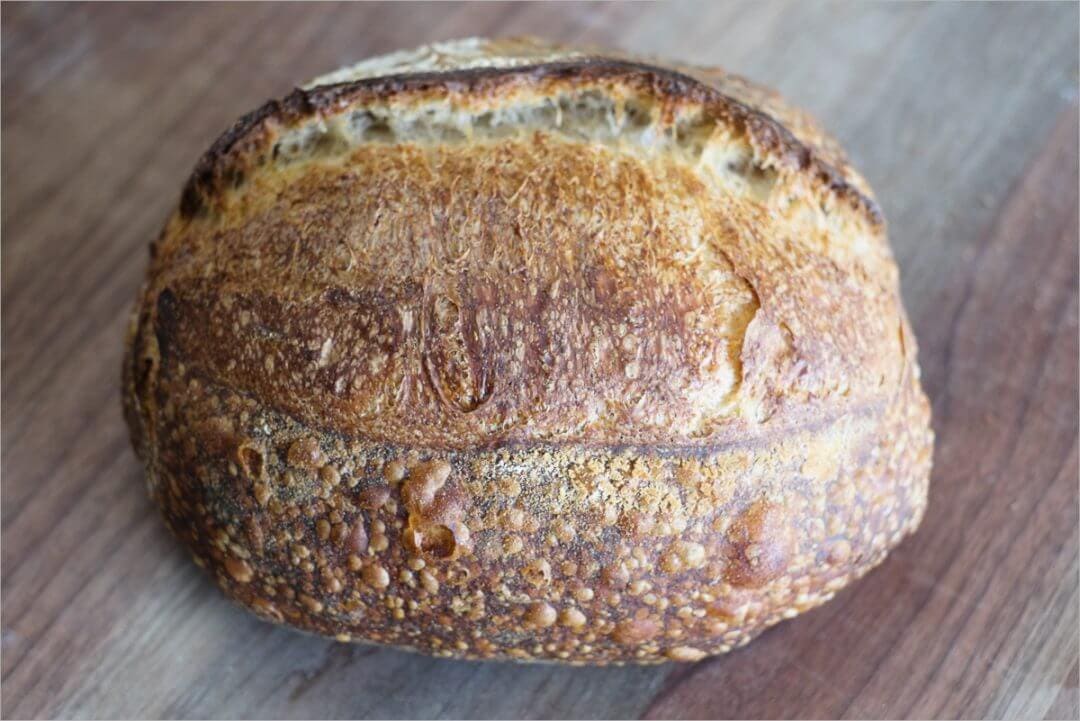
I could probably pull out hundreds of gems from Hamelman’s essential reading, Bread, and each time I go back to reference something my eye catches one that strikes a chord. Attentiveness, now that is an essential thing with baking. You don’t realize just how vital it is to step back for a second and observe what you, and the dough, is doing from time to time. Does it look alive and puffy? Does it look like it has enough strength? Are you mixing to sufficient development and enough rise during bulk fermentation? In this post on country sourdough with less levain and a longer autolyse we’ll look at all of this.
First learn the basics—good mixing techniques, proper fermentation, and skillful baking. How do you learn these? By repetition and attentiveness. Make sure patience is part of your ingredient list.
Jeffrey Hamelman
Baking can be a haphazard endeavor: you can measure out the ingredients, throw them into a bowl, get your hands dirty, and watch as the magic happens later in the oven. You’ll get good bread, better than what you’d get in most grocery stores in those plastic bags for sure. But when does good bread become great bread? I believe it comes with a little time, some practice, gathered experience, attentiveness, and if you are lucky, hands-on instruction. If you’re like me and have never had formal baking training, most of these things have to come from within, from your practice & process.
When it comes down to it, baking is a personal thing. I’ve read many places and listened to many talks where bakers can be quoted saying something of the sort: “no two bakers bake alike.” Reading books on baking and flipping through many pictures of those open crumb loaves with nice dark glistening crusts, you start to tell yourself “hey I can do the same thing right from home.” Well maybe you can, maybe you can’t, but the important thing is to find your process and your method, and make bread how you like it. That’s great bread.
There are so many variables to baking it’s impossible to lay down a set of rules that, when followed, will result in the same loaf each time. It just won’t happen. The best we can do is increase the consistency of creating great bread. Every loaf won’t be the same, every crust won’t shine the same way, and every crumb structure won’t line up the same way, but we do our best to stay consistent and make the most excellent bread we can. And in the very end of things, bread is bread; it’s a staple of food that’s been around for almost as long as we have. It’s meant to provide sustenance and nourishment, not sit on the wall like art.
With all that said, I still search… I still work at my process and my technique. I always read and research. That’s part of the fun for me as a home baker; it’s a science experiment that never ends and one that makes me and others around me happy to eat the results.
In this entry, I baked upwards of 8 loaves over the past few weeks with the following process in search of that great bread. Testing, reading, experimenting and talking bread with some of you out there (hat tip to the ever-helpful Margie). All this research and experimentation has produced some of the best loaves I’ve churned out yet. The following entry catalogs my findings with increased autolyse time, decreased pre-fermented flour, and building more strength at the front of the process instead of later during bulk fermentation.
An excessive use of yeast will always be to the detriment of the finished product. Rather than giving your bread a lot of yeast and a little bit of time, reverse that and give them a little yeast and a lot of time. The results will be worth the change made.
Jeffrey Hamelman
Thoughts on increasing autolyse
As mentioned in my whole wheat post increasing your autolyse time will change the way your dough feels when you start to mix as you’ll notice it has elasticity and strength early on even before intensive mixing/kneading. It starts the gluten formation process early and begins to smooth the dough, but it also helps bread with a higher percentage of whole grain to fully hydrate before fermentation begins.
Reducing levain
When I started out baking, and you can see this in many of my beginning Tartine posts, I would typically increase the levain percentage sometimes all the way up to 25%. This was partly to compensate for my starter not having enough strength, but also because I had this idea in my head that more levain means a more open crumb. That’s not true, as it turns out. I’ve found that with only 15% levain (that’s 150g) I get just as much rise and fermentation activity with the possibility of having a more open crumb. It may mean you have to let the fermentation go just a bit longer, but it will be worth it to take your time and let your baking assistant (read: starter) leaven that dough and build up some exceptional taste.
First, if you’re brand new to baking sourdough, you might want to check out my Beginner’s Sourdough recipe, it has longer in-depth explanations on every step in the baking process!
Prepare the levain – 6:30 a.m.
Prepare the following right after you get up in the morning:
| Weight | Ingredient |
|---|---|
| 25g | Ripe starter |
| 50g | Giusto’s whole wheat flour |
| 50g | Giusto’s artisan bread flour (medium protein bread flour at 11-12% protein) |
| 90g | Water |
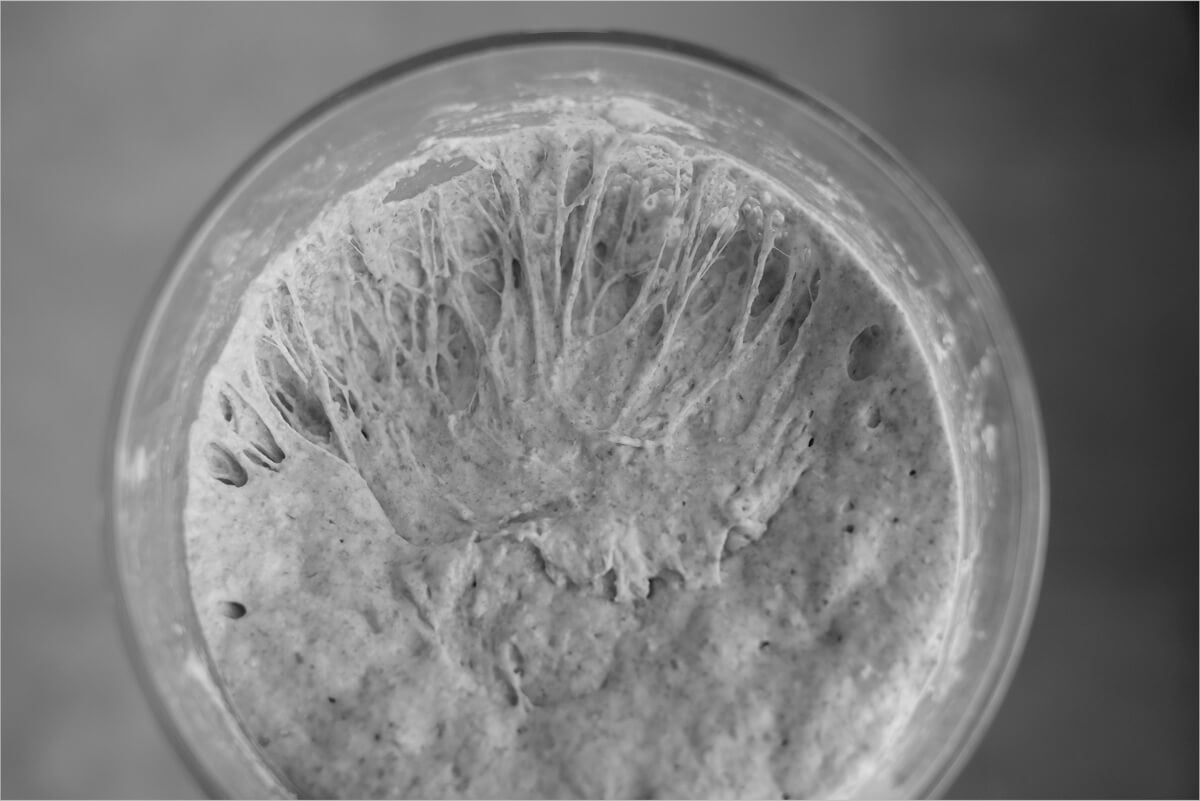
Keep it in a warm area in your kitchen for about 6 hours if your kitchen is around 78°F (26°C) if it’s a bit cooler where you are you might need to go a little longer. Watch your levain and read the signs: smell, bubbles on top, volume.
Autolyse & Mix – 9:30am
We’re going for a 3 hour autolyse for this bake. You might want to experiment with autolyse times to suit your flour and preference — I’ve found an autolyse really helps with doughs that have high whole grain percentages or high amounts of strong high protein flour. Take notice how different the flour feels when you autolyse for an extended period like 3 hours versus a short 40 or even 60-minute duration. It’s quite astonishing.
Note that this autolyse is without any levain (or salt) added to it as your levain isn’t even ready yet—it is only flour and water. We start the autolyse 3 hours before we anticipate our levain to be ready. You should be good to go doing this at 9:30 a.m. and if your levain isn’t ready at 12:30 p.m. or so no worries, keep the autolyse going until it is ready.
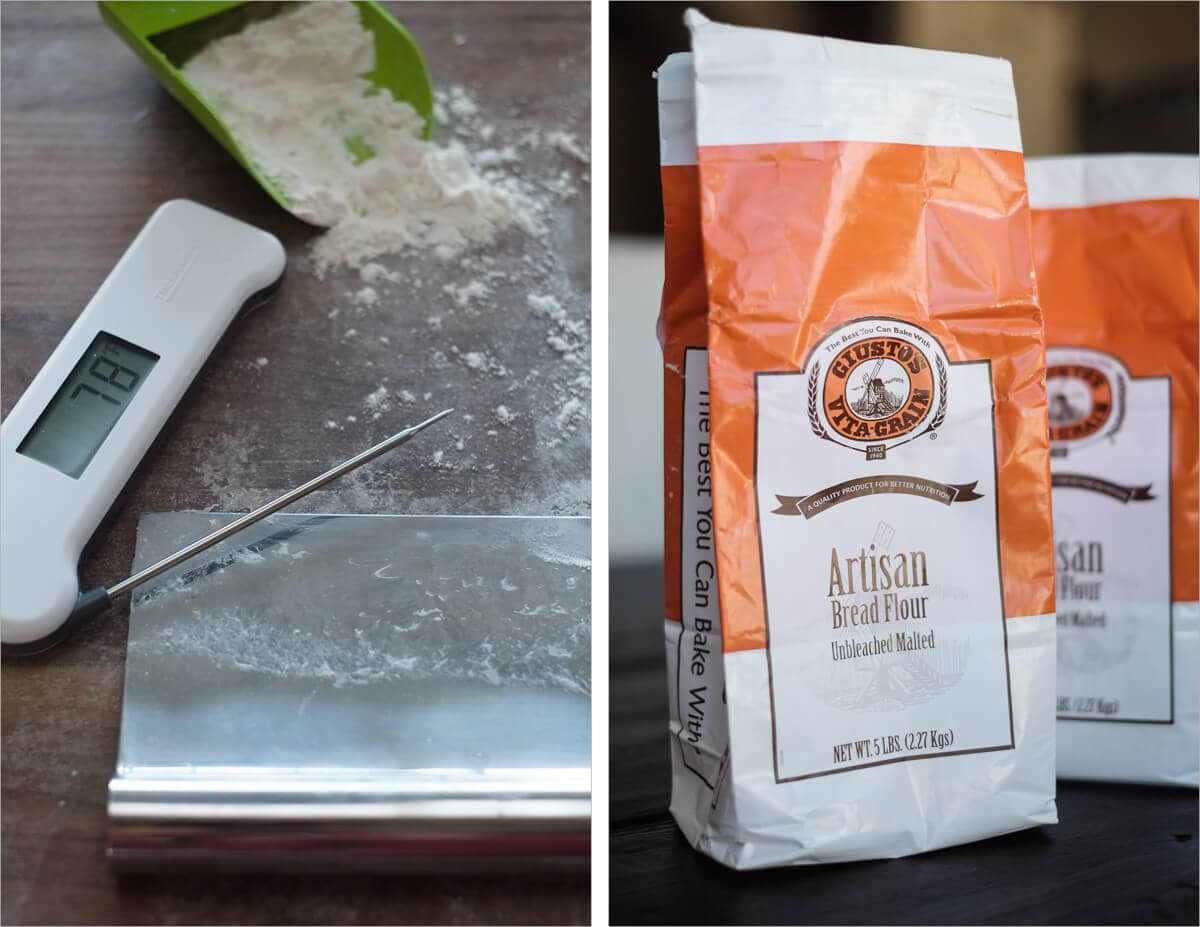
By the way, I just recently picked up a Thermapen after many days contemplating the purchase. Wow. I can’t believe I’ve been baking this long without this thing; it’s a real piece of equipment. No longer do I have to wait for the cheaper thermometer to settle down and finally arrive on a temp, this thing is instant!
Ingredients:
Gather the following:
| Weight | Ingredient | Baker’s Percentage |
|---|---|---|
| 100g | Giusto’s whole wheat flour | 10% |
| 900g | Giusto’s Artisan Bread Flour | 90% |
| 800g | Water | 80% |
| 20g | Fine sea salt | 2% |
| 150g | Ripe levain | 15% |
Perform the following for the autolyse:
- In a thick bowl add your 900g white bread flour and 100g whole wheat flour
- Add 700g of your water (the rest, 100g, is reserved until later when we add in the levain & salt after the autolyse)
- Mix these ingredients by hand until incorporated. Remember at this stage we are not looking for any gluten development really, make sure all the dry bits of flour are hydrated
- Cover with wrap and keep near your levain for 3 hours or so
Mix after your 3 hour autolyse – 12:30 p.m.
First, a little info on my new mixing experiment I alluded to earlier…
I mentioned, in the beginning, we were going to develop the dough a little bit farther at mix than usual. The goal is to develop the gluten in the dough early instead of later, just enough so it has enough strength to hold onto any gases produced during fermentation. Enough so that we only need two or three more normal sets of stretch and folds during bulk (instead of the typical 6). What does this mean for us and the dough? Well, this means we would leave our dough untouched in the bulk container for much longer near the end. My thoughts and the thoughts of many books & bakers out there is that if you’re looking for a more open crumb, you want to handle the dough even less towards the end of bulk.
After reading posts online, and discussions with a few other bakers out there, I’ve been experimenting with different mixing techniques. Lately, I’ve been successfully using the “slap and fold” method publicized by Richard Bertinet. This method is a great way to develop the gluten in your higher hydration dough. I’ve done it many times now, and it does take practice — at first, it’s tricky as the dough breaks apart, sticks to your hand, and generally acts like a savage animal. With each successive attempt, it gets easier and easier as your confidence builds. At every, well, slap and fold, the dough just starts to feel stronger and stronger, it begins to take on some cohesion and a subtle sheen on the outside. You need to work it until you get to this level, which for me was around 6 minutes in total.
If you’re not interested in trying a new mixing technique, you can do the same method as you would during stretch and folds at bulk time. Grab under the dough and fold it back over itself, then turn the bowl a bit and repeat. Keep doing this until the dough comes together and starts to feel a little bit stronger and a bit more sticky. You’ll notice how it starts to get a little harder to stretch out and fold over.
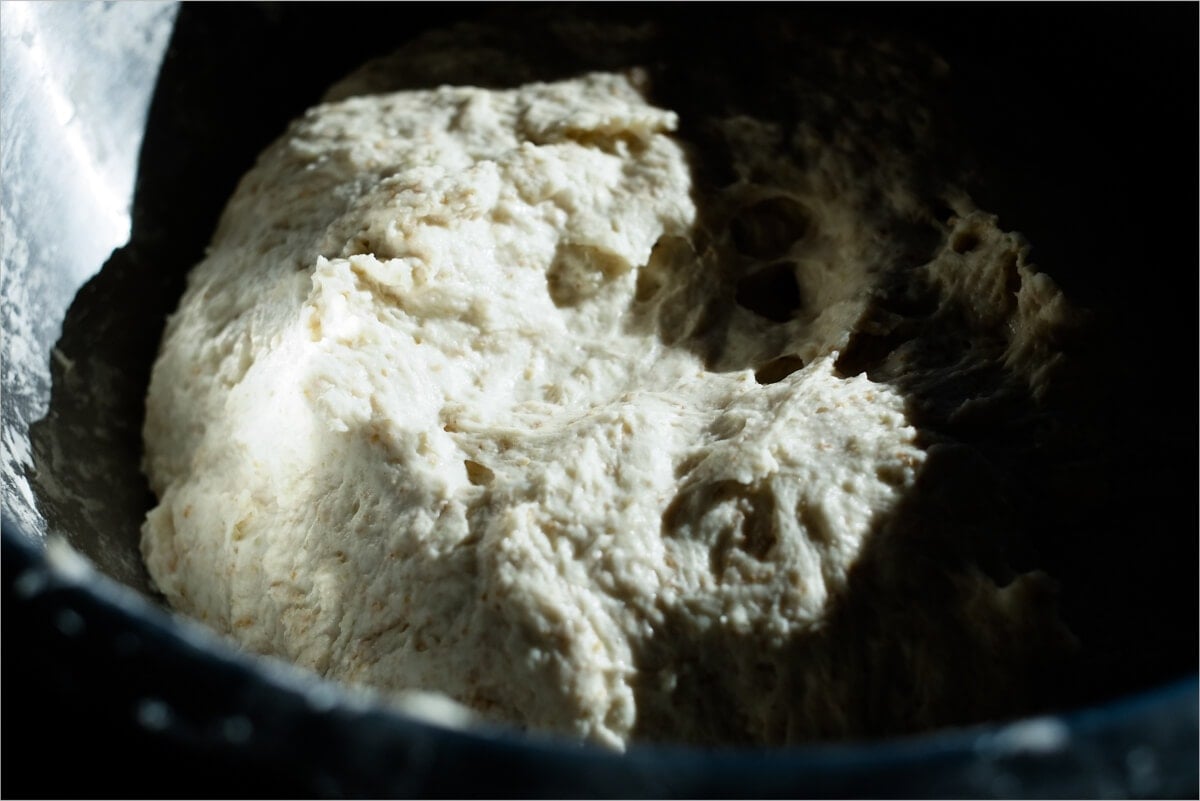
Now, let’s get started.
Add your 150g levain to the top of your dough and cut it in with your hand. It will kind of break apart but then come back together again after some mixing. Use a little of your 100g water reserve to get things going. Once this is mixed in, add your 20g salt on top and repeat. If it feels like your dough is super sloppy and breaking apart, don’t add the entire 100g reserve.
Now is the time to do your slap & fold (or your preferred mixing technique) to the point where the dough starts to show a bit of strength to it. Stay attentive and watch as you’re proceeding with the mix, the dough will change right in front of your eyes. After mixing the following were my measured temperatures:
| Final dough temperature: | 76°F (24°C) |
Bulk Fermentation – 12:40 p.m.
Transfer your dough to a clear container to be used during bulk fermentation and let rest for the first 30 minutes. After the first 30 minutes do a few sets of stretch and folds until the dough feels and looks strong enough. For me it was:
- 1:10 p.m. – Turn Set 1 (reach under with one hand and pull up and over to the other side, rotate your bowl and do this four times for a set)
- 1:40 p.m. – Turn Set 2
- 2:10 p.m. – Turn Set 3
At this point the dough started to hold its shape in my container— it was holding together a little bit in the center of the bowl, and you could see some defined lines and edges. It is possible one more set would have worked out just fine, but I decided to stop and let the dough rest untouched for the rest of the bulk step.
Pre-shape – 5:10 p.m.
Take the dough out of the container onto your work surface. Divide into two halves and lightly spin the dough in little circles across your work surface with your bench knife in one hand and your other empty hand—kind of like turning a car’s steering wheel. Let this pre-shape rest, covered with a damp towel or inverted bowl, for 20 minutes. My dough had a nice taut skin on the outside with bubbles just wanting to escape but couldn’t quite make it out of the gluten jail I’ve built for them. Sorry guys.
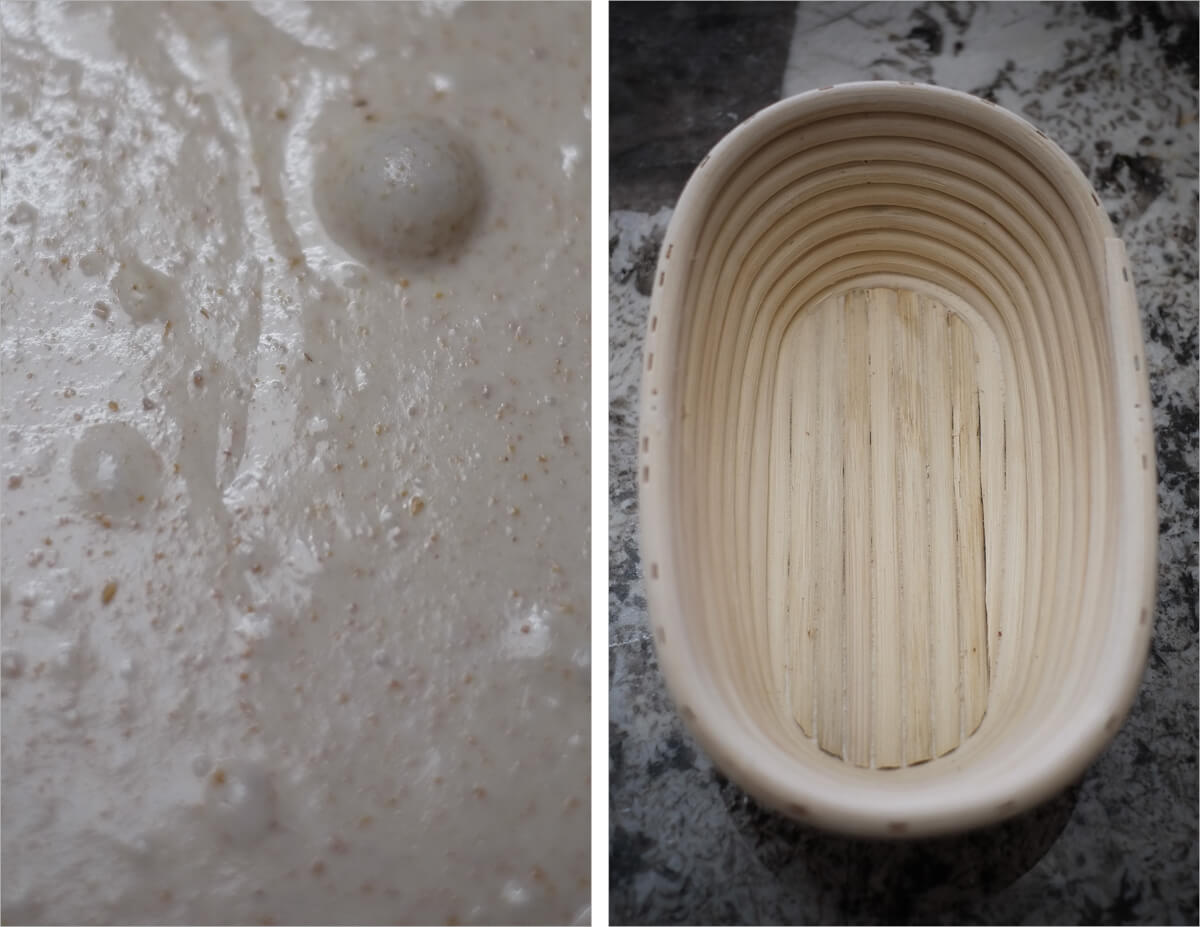
Lightly dust your proofing bannetons with white rice flour in preparation for the next step. If you don’t have bannetons, you can just use any small bowl around your kitchen.
Shape + Proof – 5:30pm
Shape each half of the dough as you’d like (I chose batards, I can’t get enough of that shape). You want a gentle and confident hand here to shape in as few touches as possible but still get that taut skin on the outside. I know that’s easier said than done, especially at this high of hydration. Practice!
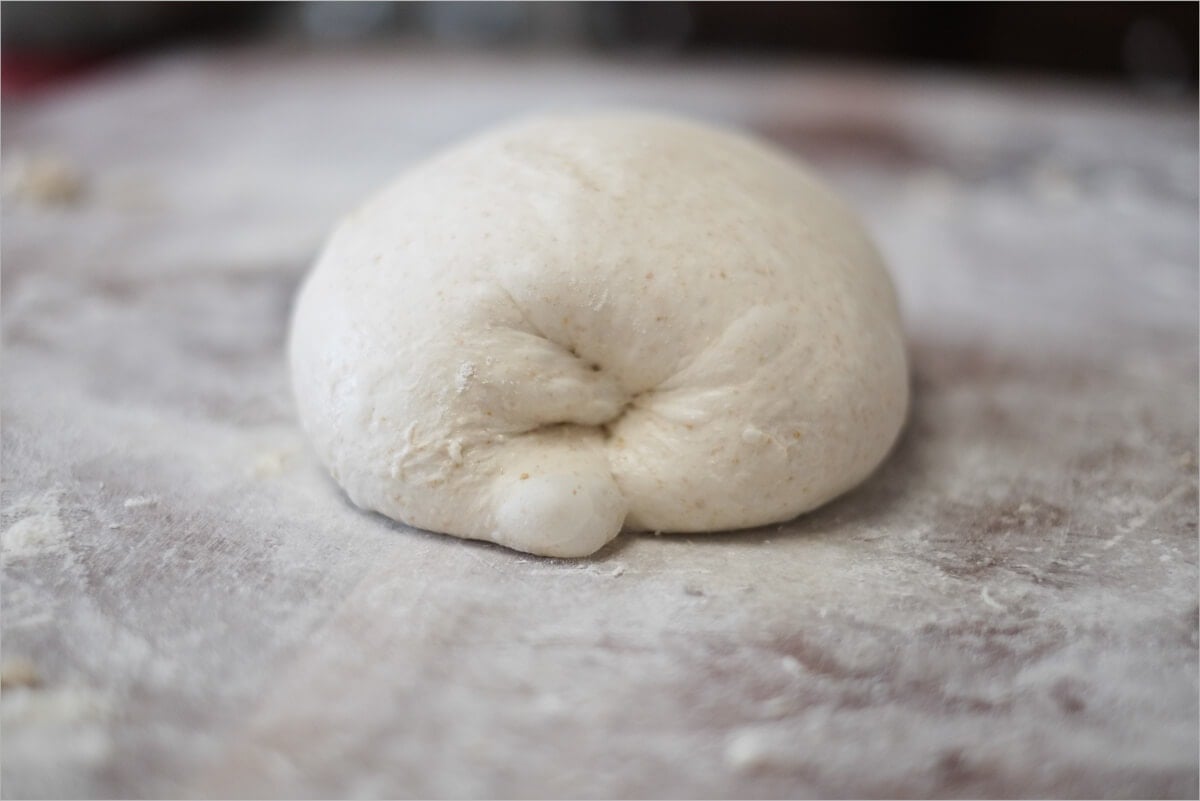
After shaping, I let my two batards rest on the counter for 2 hours at room temperature (around 76°F/24°C, a little on the warm side even). Because we’ve reduced the amount of levain from the typical 20% to 15%, we give these a little extra time here to develop flavor, gas, and even some strength. More time is always a better thing when making bread. Don’t rush things but keep an eye on your dough, you don’t want it to go to full proof otherwise you won’t get any oven spring in the morning.
After about two hours on the counter, place your baskets in plastic bags and into the fridge to proof overnight, we will bake these in the morning.
Score + Bake – 8:30am
See my post on baking with a Dutch oven (or combo cooker) for a more in-depth discussion on the baking process below.
In the morning, preheat your oven to 450°F (232°C). I usually leave the shallow side facing up on the left, and the deeper side on the right facing down but I’m also left-handed.
After one hour, take one of your baskets out of the fridge and cut a piece of parchment paper to place on top. Take your peel and then put it on top of those two and quickly invert it, so the dough is now resting on the parchment paper and the peel. If, like me, the dough had risen over my small banneton and I couldn’t rest the pizza peel on top without squishing the dough. No worries just use your hands and quickly turn the banneton over and lightly drop your dough onto the peel. Don’t squish, compact, drop, smash, bite, lean on or punch down your dough.
Score the top of the loaf with your desired pattern. If you’re following my lead with the typical “crescent” slash, make sure it’s very horizontal to the dough, move quickly, and score rather deeply.
Take out the shallow side of your Dutch oven and drag in your dough. Quickly place the pan back in the oven, cover with the deep side, and bake for 20 minutes. After 20 minutes, open the oven and take off the deep lid of the Dutch oven (set it next to the other half inside the oven). Then, bake for an additional 35 minutes or so, until the bread is to your desired doneness.
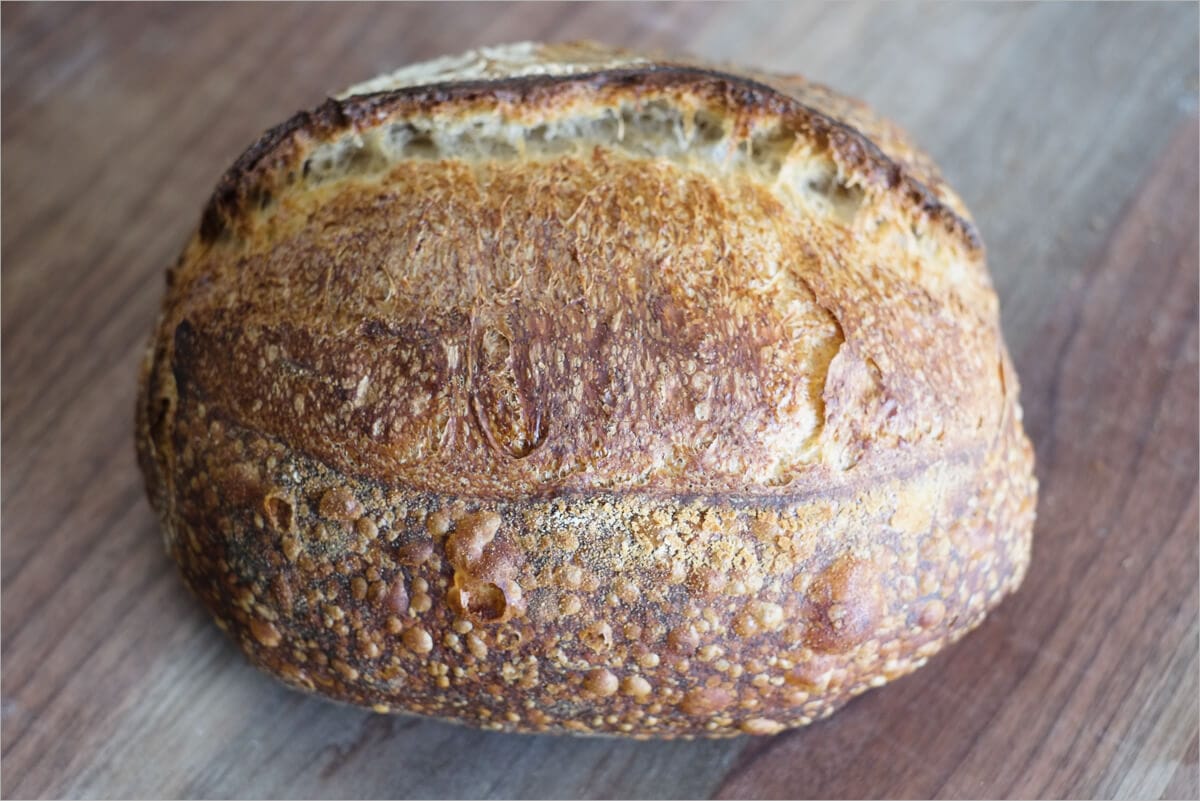
When your finished, the loaf should almost float in your hands. It will be very light, airy, and with a crackling crust.
Conclusion
I’m impressed with this Giusto’s Artisan Bread flour. I have a few more millers (some with organic flour) I’m going to try here coming soon, just for comparison and experimentation, but this is my leading favorite.
“Don’t rush your bread,” I could hear Chad Robertson or Jeffrey Hamelman tell me right now. Well, I think their whispers are correct. A long autolyse, a healthy mix, a lengthy bulk with low levain, and a long overnight proof led to a great bake. And while I don’t think a lengthy autolyse is good for every bread and every style of baking, it sure worked with this loaf.
Crust
Thin, cracks abound, crunchy and yet somehow soft. The colors were eye-catching and ran the gamut from dark at the flat areas to super light in the fissures. The bottom of the loaf was cooked well, almost too well. It might do to turn the heat down just a tad near the end, for my oven at least.
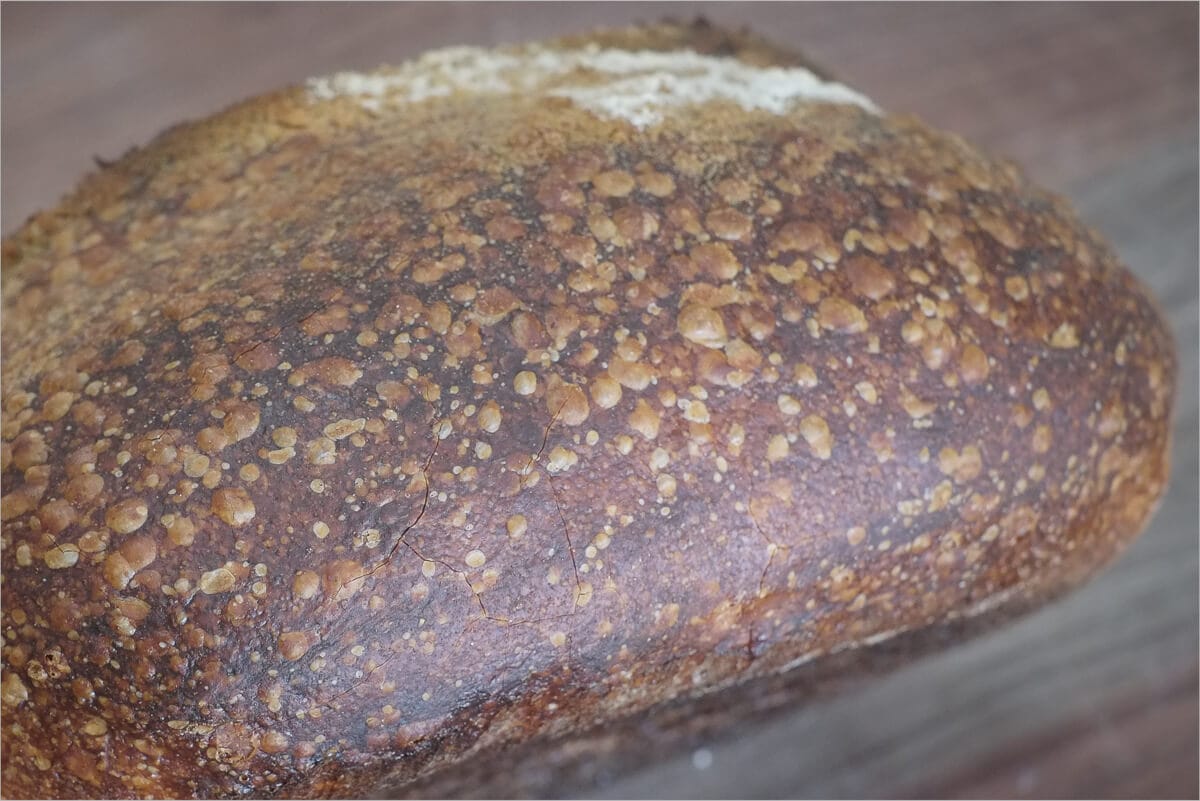
I took so many pictures of the final loaves that I couldn’t quite decide which were the best to post, and thus the abundance you see here. I can’t get over the look these–the colors, the detail–they have that texture that seems to defy my camera — almost too much detail going on.
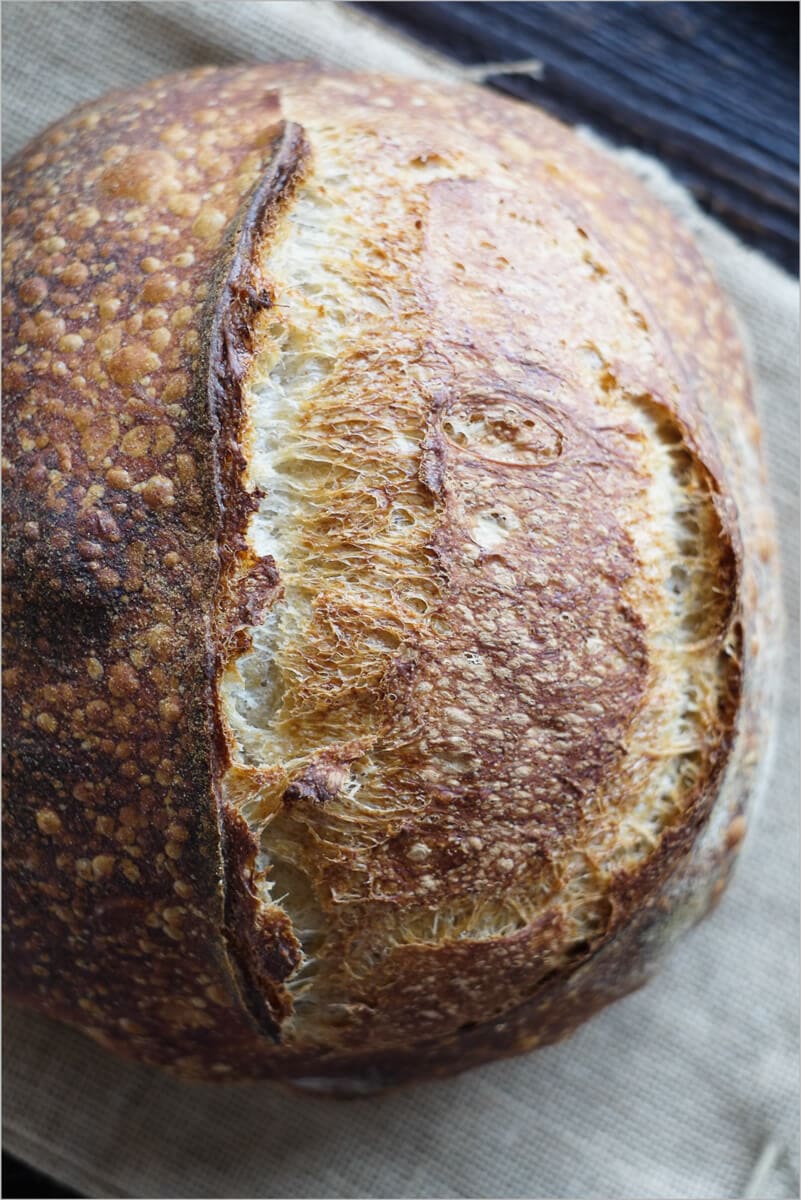
Now that’s some movement, wouldn’t you say? Awesome! It almost looks like the surface of some unexplored distant planet.
Crumb
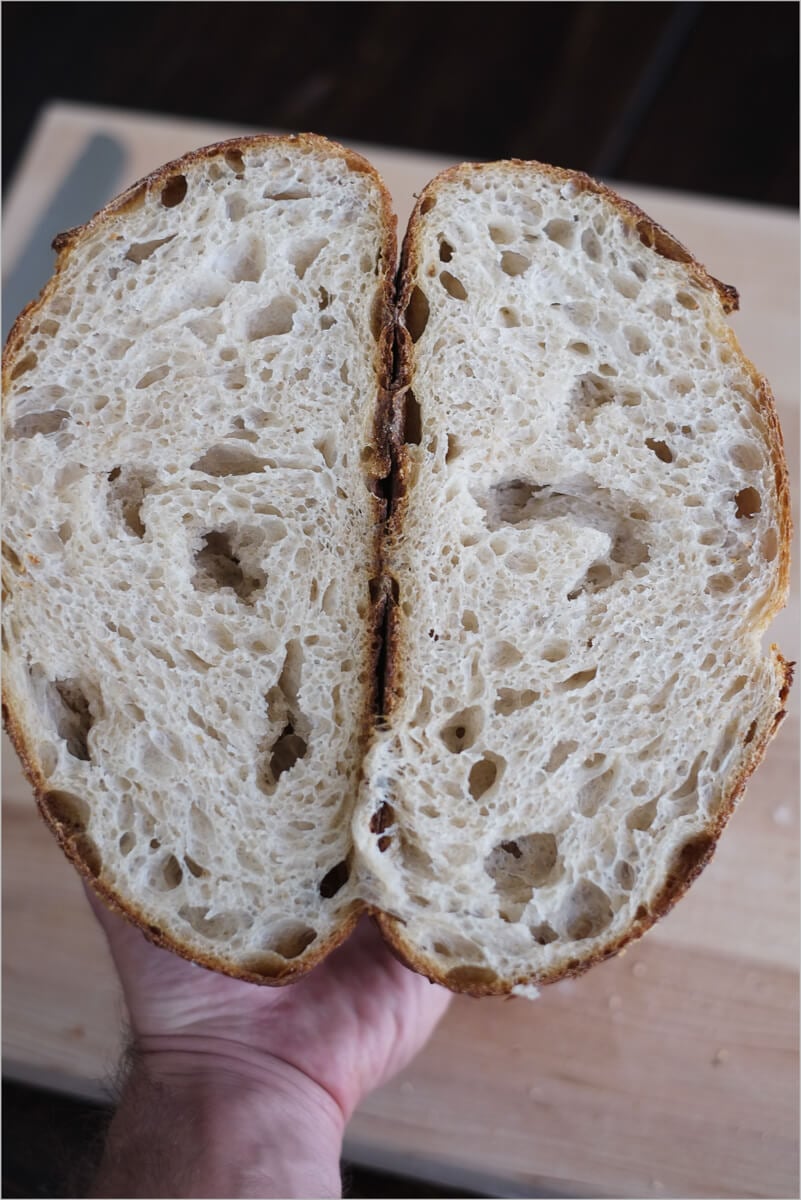
Soft, light and open. Holes all over the place: some large, some small, but very scarce are the areas that were just dense dough. I could do with some more of the large variety, and I’m confident I’ll get more of those as I practice with this method. The reduced levain and longer duration without any interaction helped open things up and create a more airy crumb than I’ve previously been able to achieve. All while keeping the sourness to an absolute minimum.
Taste
The best tasting white country loaf I’ve ever made. No doubt about it. The reduced levain, increased autolyse time and high-quality flour have helped to make these loaves some of the greatest I’ve produced. There was the subtlest of sour flavor present, so subtle that my family asked if these were even sourdough loaves. I’ve mentioned it before, but this is how I like bread.
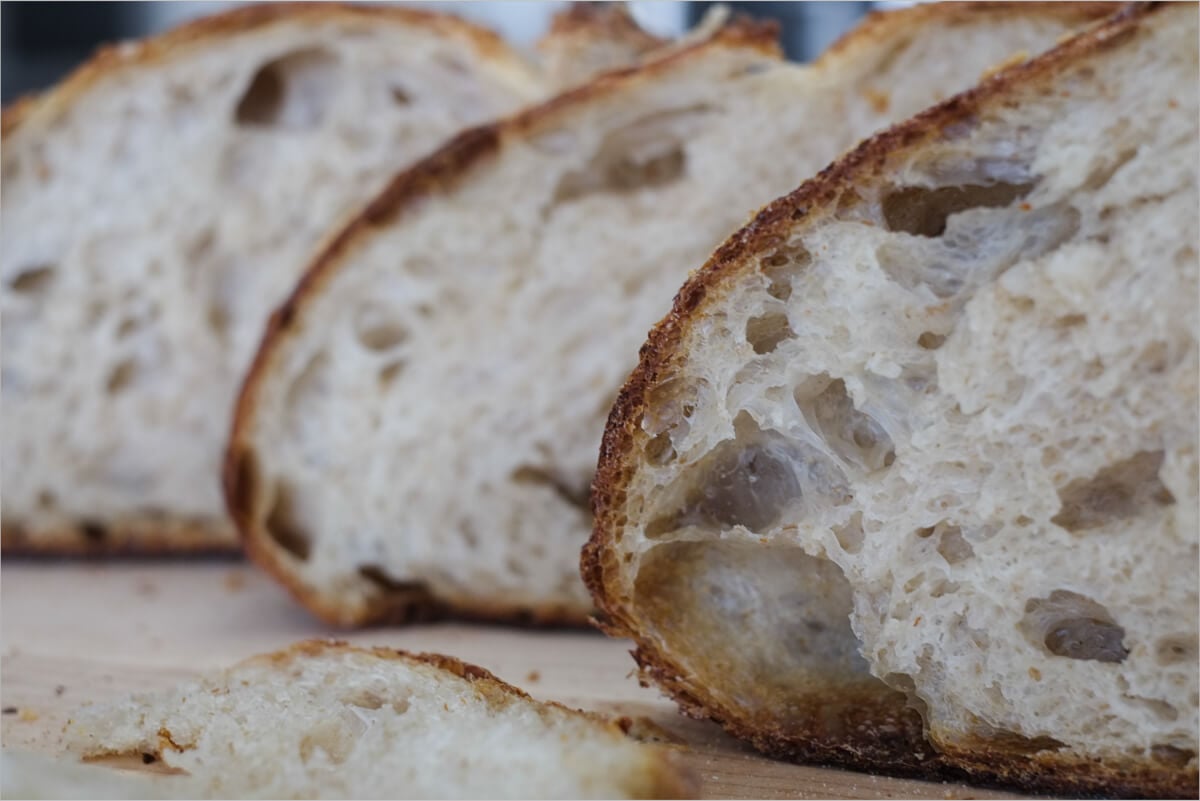
I don’t know how many loaves of bread I’ve tossed into, and pulled out of, my oven at this point but I can say to me this is great bread — what does great bread mean to you?
If you use this recipe, tag @maurizio on Instagram so I can take a look!


245 Comments
Hi, Maurizio,
What’s the weight of each loaf? Or, what size proofing basket will work for this recipe (and others of yours)?
I’ve baked many boules using your recipes but would like to try the batard shape. Thank you!
I usually use 11" or 14" oblong baskets for oval loaves.
@disqus_svpaJEHa7n:disqus also, how does this compare to your “Best Sourdough Recipe” (https://www.theperfectloaf.com/best-sourdough-recipe/)?
That one is much more highly hydrated!
@maurizioleo:disqus could I use King Arthur organic bread flour for this one too? Or adjust it in some way to be able to?
Yes, you can definitely.
Maurizio, would this loaf be your best choice for bruschetta? We usually use baguettes, but a low-sour sourdough sounds like a good alternative to me.
Yes, either would be fantastic!
Thanks, and I’m loving the new book! Best results I’ve had on a sourdough loaf in over a year of trying.
I’m trying this recipe out for the first time. I did not use the additional 100 g of water because this dough is very, very wet and didn’t need it. I’m currently doing bulk fermentation post folding. It’s shaping up fine but my question is regarding baking. You did not specify steaming in this recipe. I’m baking batards and I thought they would need steam. Should I just bake them in a combo cooker?
Hello Jocelyn. I tried this recipe yesterday using a cast iron pan with a lid. I sprinkled some water inside the pan before covering it. My bread was almost as beautiful and tasty as Maurizio’s 😉
I’ve since had much better luck with this loaf. I bake in a Challenger and add two ice cubes and quickly cover. Works like a champ.
The Challenger is a must-have for home bakers! I just got mine recently.
It’s the best!
A Dutch oven like the Challenger will work really well!
This just came up on my feed. Looks a bit old but some nice loaf work. I used to muck around with autolyse and staged approach to adding salt. Now I just stick it all in together with a large levain contribution. Seems to work for me.
Single loaf is 400g bread flour 50g whole wheat 25g rye 330g water and 12g salt. I’d post a photo but can’t work out how.
Thanks, Paul! Yes, adding salt at the same time works just fine. I’ve gone back and forth on this over the years, and sometimes I do change it up depending on my process and the dough I’m mixing that day. Adding salt, though, does tend to have a tightening effect on the dough during mixing. Sorry, I don’t have a way to post pictures here, only over at the community chat!
Why do you create a larger amount of levain than you need to use? I’ve seen other recipes do this as well but never understood why and I’d be very interested to know
This post needs updating, it’s rather old and was how I used to bake! No need to make a larger levain than needed to cover the preferment for a recipe.
What percentage of weight are you losing doing this method?
Not sure I understand your Q, William!
I am asking about the weight of all of your ingredients before and immediately after the bake expressed as a percentage. I use this to tell me how good or my bake time was. The theory being that when I alter the process the “perfect” bake will cook out a certain amount of moisture or weight. I could be waaay off.
Ah, that’s a great question and good approach. Unfortunately, I never do this! I should give this a try and compare.
Gorgeous bread! Very true what you say about each loaf and each baker being unique. I’ve been on the quest for 15 years, and I am still not getting the kind of openess and holes I’d like. I’m going to try this method! I am a bit confused with the two beginning steps-the levain starts at 6:30, and is supposed to ferment for 6 hours, but the next step is at 9:30 a.m. Thanks for clarifying!
Hey, Patricia! Sorry for the delay. Give the levain 5-6 hours to ripen, that’s at typo! I’ll update the post 🙂 Shift everything back from when your levain is ripe and ready to go.
Ive been baking these loaves a few times and today I just noticed that the levain I prepared from the recipe is 215 grams, but the recipe wants 150 grams. I have been adding all the levain without measuring and the bread is coming out beautiful! Just wondering about this.. also, thanks for the instruction and recipes so easy to follow, the bread is a hit around here!
No worries there, Steve! If your bread is turning out great with the added levain, keep it in there, it might be necessary for your starter and/or location. If you find the dough over proofs on you (especially if it’s very warm in your kitchen), drop that levain back to what’s outlined in the recipe.
I got a big empty whole at the top of the crumb. What causes this to happen?
It sounds like you likely over proofed the dough. There are a few signs your dough could have gone over: sluggish rise in the oven, the score on top of the dough might not open with a nice “ear” and instead just kind of fuse together, the interior will have lots of small holes and perhaps one or two large ones near the top (but no dense areas of unfermented flour), and finally the loaf could be a little on the sour side. Try reducing the proofing period.
I baked a couple of these this morning. Mine was highly hydrated and I thought it was going to be a failure when I took them from the fridge because they looked flat. But when I took the cover off the cloche, they had sprung back beautifully. I haven’t cut them yet, still waiting to cool. One interesting note: Since they were very wet, I did not score them and to my surprise, they did not crack open.
Hi,
I picked up Hamelman’s essential reading, Bread, and was a bit disappointed. The information is good, but when I got to a recipe I had a few issues. One, I’m used to metric and was surprised to see pounds and cups and such. I built an excel spreadsheet to convert to the amounts I’m used to.
Then, a lot of reference to mixing with a stand mixer, compared to your ‘hand’ mixing. I have a KA, not a super expensive stand mixer! Instructions to use ‘8 seconds of steam’ when loading the oven (not my home oven!) and finally recipes with huge amounts. Even the ‘home’ amounts are for 2 large loaves sometimes and I’ve been making one loaf, as I just can’t eat that much bread.
I understand a lot of that is for the professional baker, which I am not nor will ever be.
Perhaps I can come back to it down the road and it will be more useful.
Rob G.
Hey, Rob! Yes, his book is geared more toward the pro baker, with very large quantities and strangely includes volumetric measurements (although, there are metric equivalents in the book, too, so I’m not sure why you had to convert!). I know Hamelman is working on a third edition of the book due out next year (I think), so I’m hoping a lot of those things are redone in the new version.
As for the large quantities, once you have a spreadsheet setup for baker’s percentages, you can scale his recipes as needed.
Even with those “issues” in the book, I still think it’s one of (if not the) best book I have on baking bread. The scientific information, practical information, and even his little anecdotes throughout the book are incredibly useful when baking in the kitchen. I find myself using his book for reference and practical advice more often than any other book I own (and I have a lot of baking books!).
But, that’s just my opinion! Thanks for the feedback and comments, I think you’re spot on with a lot of that.
I followed this a few days ago and I wanted to comment on how much I enjoyed the process, both reading it and practicing it. I liked the slowness, not rushing things and letting it happen, but all the while paying close attention. I have only had my starter since April (I am in Bologna, Italy and my starter was born during lockdown) and the temperatures here have meant faster rising times, etc. This is the first time I have proofed in the fridge and I don’t know why I hadn’t done that before! It made scoring so much easier. The end result was quite nice as well, I liked the soft inside, which was not too sour. I use half wholegrain spelt and half white spelt, which I find is a good combination for me when making bread. 🙂
So glad to hear that, Tina! Bread certainly is a great way for us to slow down and focus on something—that’s one of the things I love most about the process. Very cool to hear you’re from Bologna, that’s where some of my family lives and my brother used to live there when he was attending university. I’ve been there many times to visit and travel, such a beautiful city. Have a cappuccino at Terzi for me! Ciao ciao.
Maurizio, you legend! Your website has taught me so much and I have been slowly working my way through you delicious bakes – only had one ‘successful failure’ as NASA would say and that was totally my fault (overproofing). In a nutshell what’s the main difference txt this method and formula and your perfect sourdough? The long autolyse?
Thanks so much, Alex! The long auto plus the makeup of the formula—flour, water, salt—is different. Small things that add up!
Is this recipe also for high altitude, like the other one you wrote up, or is this for normal altitude baking?
It will work well at both! As always, keep an eye on the dough near the end of the bake and adjust the baking time as necessary.
Please help! What should the water content be if there’s no whole wheat flour added? I didn’t have any on hand so used 900 gr bread flour and 100 gr rye but forgot that I would need to reduce the water! I now find myself in a bit of a pickle with a super wet dough (sigh.) Should I reduce the water by 100 gr or 50 gr?
I’d start by holding back 100g. Mix the dough up and see how it feels. If it feels super stiff and like it can take more water, add a bit in at a time and mix it up to see how it feels!
Thank you so much for the suggestion! I was thinking in that direction. In a sort of miracle, my super wet batch came out wonderfully. I kept gently adding flour with each stretch and fold and was delighted when it built enough tension to hold its shape. Did not expect that! In the meantime I’ve stocked up on whole wheat.
By a major mistake, I used 75g levain for 1000g of flour (instead of 500)- what do you think will happen? I’m leaving it out in my AC room overnight to extend the fermentation time, but I actually have no idea what I’m doing/should be doing. Cannot believe I did this!! (I’m in India, by the way).
Happens to us all! Yes, just give it a lot longer to ferment until the dough catches up with how it looks in my post.
Hi Maurizio,
I have been baking exclusively 100% whole wheat sourdough. I usually do an overnight autolyse (15+ hours) of the flour in the fridge. But for my upcoming loaf, i plan to use the sift-bran method in your 100% whole wheat loaf recipe. As such, while soaking the bran with boiling water, i also plan to do a long autolyse of the flour, of about 8 hours at room T° (~20°C/69°F). I have done lots of reading, and it seems that usually 3-4 hours of autolyse at room T° is considered long. Do you think 8 or more hours is too long? My reasoning of doing such a long autolyse is to help maximising the extensibility of the whole wheat flour. What do you think? Thanks!
Thanks very much for sharing your knowledge and expertise all these years! I have learned immensely from your work.
Sorry for the delay, Vera! See my new guide to the autolyse technique, you’ll find your answer there! If not, let me know and I’ll dig in a little deeper.
Thank you Maurizio! I appreciate immensely your follow-up: The guide is very informative, thanks for sharing your knowledge & experience!
Recently i have created a recipe where i sift out the bran, then pre-ferment it with about 1/4 (by weight relative to the bran) of starter and 4 times of water, for 36 hours. Then i add the bran preferment — including all the water — to the flour (90% spelt, 10% wheat), extra water, and levain to form the dough. I have thus far baked 2 loaves, and they turn out beautifully! (if you are interested, go see it on my instagram post @virzeia) I have read from some scientific research papers that prefermenting the bran not only helps soften it optimally, but also (more importantly for me) removes up to 90% of phytic acid, thereby making the minerals much more bioavailable and hence super-nutritious sourdough bread.
When baking loaves with a high percentage of whole grain I often sift the bran/germ, then later reincorporate them, to lighten the loaf (here’s my recipe for this method). I’ve never thought of fermenting those sifted pieces ahead of time, though, what a great idea!
Did I read the recipe right, it only uses 25 grams of starter?
25g of starter to make the levain, which scales up the pre-ferment before mixing into the final dough!
I LOVE this recipe. I didn’t love it the first time I baked it because I had trouble with the slap and folds with such a high hydration dough. To remedy this, I have chosen to hold back only 25 grams of water, not the 100 grams recommended, and it has resulted in a dough that is far easier to work with. I autolyse with 775 grams of 84 degree water and the flour has no problem absorbing it all. The remaining 25 grams is sufficient to help dissolve the salt. I also have found that the Giusto’s bread flour is so much better than the King Arthur bread flour for its ability to absorb water and quickly build strength. It is more expensive, but it is worth it. When I take the loaves out of the fridge the next morning and out of their baskets, they do spread a little more than lower hydration loaves, which is disconcerting at first, but they make up for it in the oven with tremendous oven spring. So don’t be alarmed if they spread a bit more than usual. Thanks Mauricio for a great recipe. I don’t even use the original Tartine Country loaf recipe because this one is so superior. Also, to remedy over- baking the bottom of the bread, invert a half sheet pan and put it directly underneath the rack with your baking stone. It helps dissipate the heat and prevent over browning!
Thanks so much for all the feedback, Maureen! Yes, as that hydration gets higher and higher the dough becomes hard to handle, but holding back water really helps there. And I find the same thing: the dough looks scary in the morning, but springs up nicely! Happy baking 🙂
Great recipe and technique descriptions. I was wandering, can one take this further and add olive oil and chopped olives and rosemary to it for an olive loaf. If so, do you add these just before bulk fermentation when you mix the auto lyse and the levain and salt, or during shaping /proofing stage. I expect it would be at the start of bulk fermentation but not sure how the addition of oil would affect the rise… Thoughts?
Yes, absolutely. I’d add those mix-ins right before the first stretch and fold in bulk. You don’t have to work them in aggressively, just spread them on the top and down the sides of the container, then do your folds. That set, and subsequent sets, will work them through the dough.
What a fine blog, with great instructions. Before I try the extended-autolyse approach, can you tell me whether I should halve the levain for 500 grams of flour (half what you use) ?
Thank you! Yes, if you’re baking half the rest of the recipe, divide the levain in half as well.
thanks so much, Maurizio. I just made a loaf from the Tartine recipe that I’ve used many times, halved, and this time it came out like a large hockey puck. I do think the flour wanted more autolyse.
Thanks again.
The only problem with the timing and baking in the morning is when things go bad, it (almost) ruins the rest of the day. Oh well.
Flip this around: when things go bad, you can use that as a learning exercise and see where improvements can be made!
So funny, don’t bite the dough 😀 I can actually relate as I’ve been helping my Mum and she can get heavy handed at the end of the process, I can imagine saying that list to her.
One question, do you think it will work with an extended cold autolyse in the fridge overnight or would 2 nights in the fridge in total (after the proofing in the fridge the second night) be too much? Thank you
You can use that excess to make waffles, banana bread, or pancakes!
One question please. Your levain build is 215 gm. Why if you only use 150 gm? what do you do with the remaining. 65 gm of levain, do you return it to your starter jar?
See my reply above!
Maurizio,
Retaining the scaffolding of this recipe, how should I change temperature or bake time + lid on and/or off time, with the goal of making the crust thinner. I like the thick crunch shell, but what can be done to make it less “rock-like”.
Secondly, based on your experience, how long do you let cool, where ideal flavor and texture are marginally unaffected? I have read one hour is sufficient, but i want warm bread asap! Lol
Thanks for all you do!
Best,
Kyle
Increase the amount of steam in the oven to help with a thinner crust. Also, bake it hotter for a shorter time period. I like to wait 1-2 hours, usually 2!
Ciao Maurizio,
Thank you for all the effort you put into this site. I am learning a lot. Today I tried this recipe, including, for the first time, the “slap and fold” technique. At first it went well, but then rather than making a neater package, it actually got stickier and stickier, and harder to lift off the surface to slap. Any thoughts? Thanks!
Hi, thanks for the wonderful website. I made this recipe yesterday and have a question.
At the end of shaping, I felt that my dough wasn’t strong enough, so I used the pinch method to try to give it more tensions.
Then, at the end of the overnight proofing, my dough had barely risen and felt a bit leathery. The last time this happened, I got super dense bread with no rise.
So this time, I took it out of the refrigerator and let it proof on the countertop for another 4-5 hours. By the end of that time, it no longer felt leathery and it had risen more and showed some bubbles. So I baked it and got reasonable results. Quite a bit of oven rise, very good flavor. The crumb was a little less open and a little moister and chewier than I’d like. You can see pictures here (the first picture shows the size and crust, the second the crumb):
https://www.instagram.com/p/CAifdwmlgeB/?utm_source=ig_web_copy_link
My theory is that
1. I didn’t bulk ferment long enough and then sort of “made up” for it with the addition of a long countertop proof. I followed your time guidelines (though I did 4 stretch and folds because the dough felt weak). But I didn’t get a ton of rise during the bulk ferment even though my levain was very active (it tripled in size during the six hours and passed the float test).
2. I perhaps didn’t get enough structure when I did the slap and fold.
Does this seem right? Any guidance would be most welcome.
Again, thanks for all the work you’ve put into the website. It is such a help.
I suggest you have a separate line item for the reserve water as your recipe is very length…the measurements get confusing and invite adding the wrong amount
I over added the water…and it was just a sloppy mess…with a flat loaf. One of my lesser attempts.
I am deciding whether to attempt again…as using a massive double loaf recipe to experiment leads to waste! Sorry but I found the process overly complex, waste, and confusing.
I get the idea what you are doing…but wasn’t happy.
How many loaves does this recipe make? I can’t seem to find the yield anywhere 😬
I believe it is two, right? based on the weights. And it seems to be a common practice to make two at a time.
hi Maurizio, love your site & am learning a lot! excited to try this recipe & just wondering if you would make significant changes to this recipe based on altitude (i know you’re at 5,000ft; i’m at 7,500), or if you have a definitive guide on adjusting based on altitude and/or seasonal changes in humidity. thanks so much!
Hoping maybe someone can help me brainstorm what went wrong with my bread: My dough looked great until I turned it out of the proofing baskets. I used the slap and fold until the dough felt nicely elastic and had quite a bit of strength, then did four sets of stretch and folds. By the last set, the dough was very cohesive and extensible, so I feel reasonably confident that the gluten was pretty well developed. I did a cold overnight bulk fermentation (around 50-55 degrees, it rose probably 40% or so) and separated it when the poke test left an indent that sprang back partially. The dough did spread a bit on the counter when I was shaping it, but I got it into the baskets and it rose nicely, with lots of bubbles. Again I poked it and the indent partially filled back in, so I decided it was ready. I had floured the proofing baskets well, but when I went to turn the dough out it stuck and basically “poured” out of them into the dutch ovens. It got almost no oven spring (probably because sticking to the baskets eliminated any surface tension) and basically filled the bottom of the dutch oven, creating a round with a foccacia-like thickness. The bread got a great crust and the crumb inside was actually nice, but does anyone have an idea of why it had structural issues? Was it a proofing issue? The overnight bulk fermentation? I know it stuck tp the baskets, but even if it hadn’t it would have had problems.
I’ve made this recipe weekly for a long time. I go immediately from bulk ferment to pre-shaping/shaping per the directions. Then the baskets go into the fridge *after* a rest and further proofing on the counter until I think it’s mostly proofed. That, to me was a key difference. I once thought I under-proofed my loaves and brought them out, in the baskets they had been overnight in the refrigerator, for about 2 hours before baking. Same thing: the dough poured out. No spring. Good bread, just no spring.
Suggest you try doing bulk ferment earlier in the day and get the loaves in baskets before the cold overnight proof. Move directly to score and dutch oven.
Allison, I believe the problem you experienced resulted from an overnight bulk fermentation that was not cold enough. Most recipes call for overnight bulk fermentation at 36 to 39 degrees (F). If at 50-55 degrees, your dough over-proofed and the gluten structure broke down. The outer skin of the dough retained some spring because it dried out, but the inside essentially liquefied (sort of like a water balloon).
Second time around for this loaf. It is great. Have become a huge fan of slap and fold–really fun! My wife imagines I am saying her name when I throw the dough down, but I’m not.
Hah! Yes, it really is a good way to get some stress out — and the dough likes it! Have fun, John 🙂
Hi Maurizio,
Thanks for providing this recipe! I truly enjoy reading , and exploring your sight! I have been trying a couple of your recipes fro the past month and have been really happy with the outcome of most recipes I tried. However I wanted to specifically thank you for this recipe. It is the first time my bread came out closest to the consistency I am trying to aim for. Continuing forward I am excited to try “harder” recipes.
Thank you so much Chaya, I really appreciate the kind words and feedback — that really means a lot. It makes me happy to know I’ve helped you thus far and happy baking!