

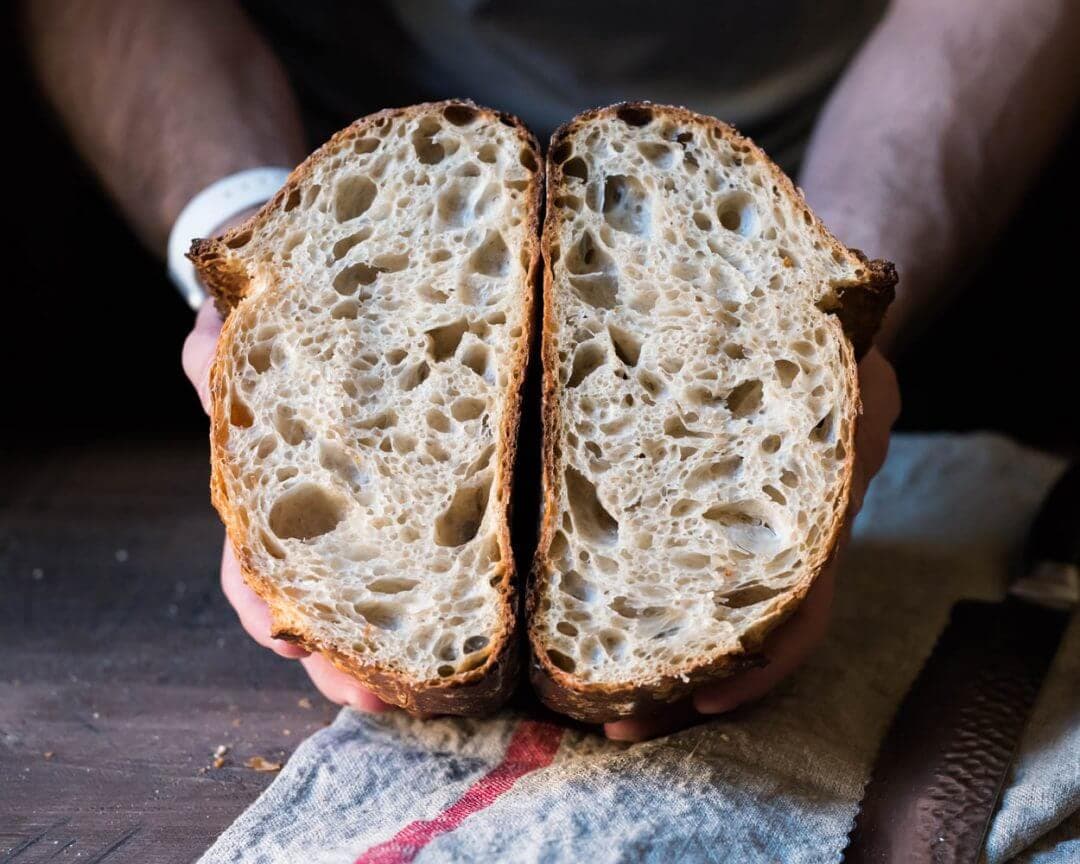
I’ve baked this loaf, or some variant of it, so many times I’ve lost count. This bread was born when I first got my hands dirty with flour and water. Its parent—if you could call it that—was originally Chad Robertson’s Tartine loaf with his liquid levain, brought to life, not with intensive kneading, but rather a series of folds during bulk fermentation.
My best sourdough recipe has grown since then. It has developed a personality of its own as I’ve expanded my baking repertoire and investigated the many facets of baking naturally leavened sourdough. It’s taken on and lost traits from many great bakers out there, borrowing from their inspiration and giving me a direction to raise this bread into something of my own. This bread is one that doesn’t entirely taste like anything else I’ve had, and yet, still employs many of the same processes and ingredients.
That’s one of the greatest things about bread: it can taste and look dramatically different just by changing the two hands that create it. Calling this post “my best sourdough recipe” is a lofty claim, but honestly, I do believe this is the best bread I’ve made thus far.
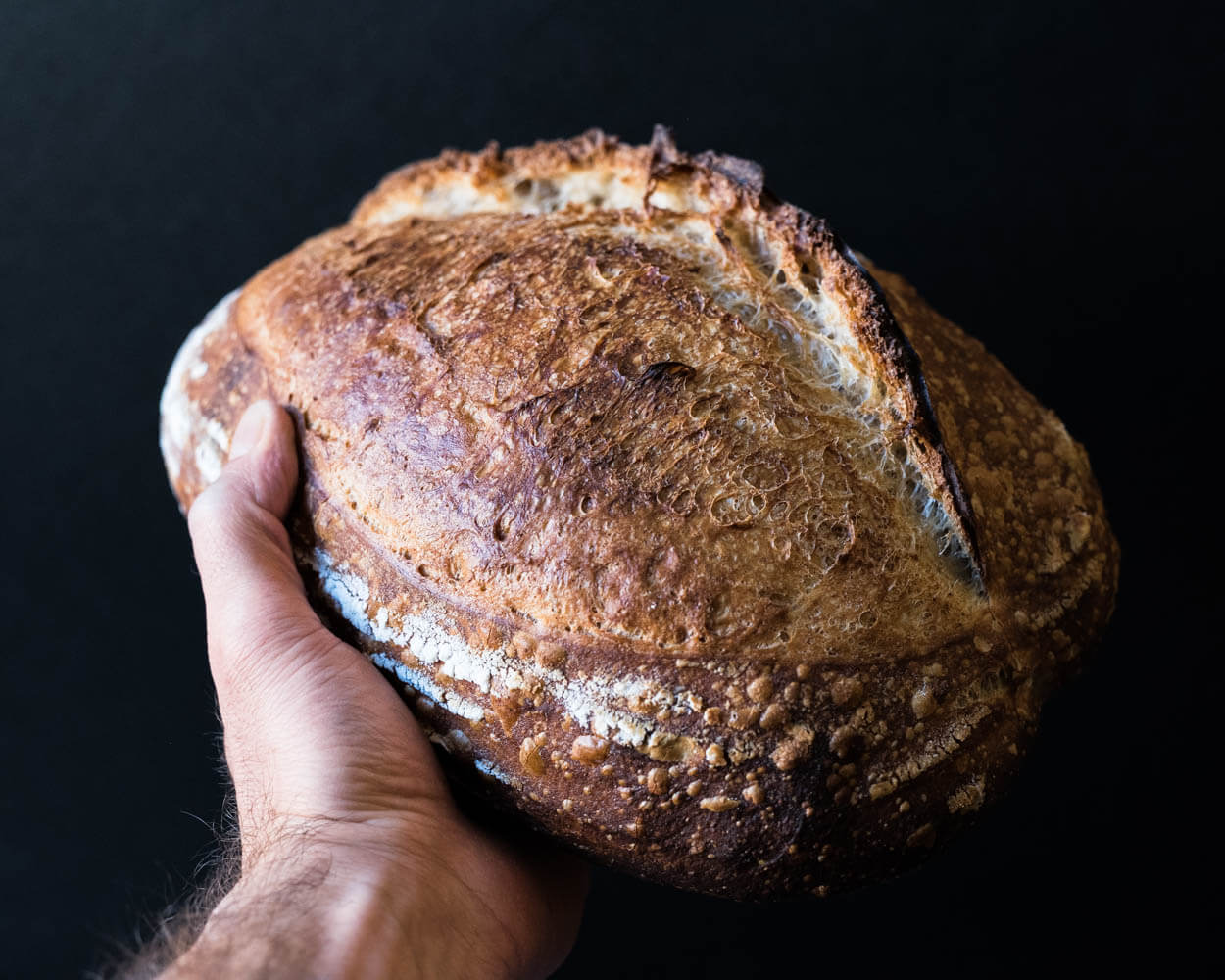
I sometimes revisit a discussion I had with a few readers of this site and their comments: “bread is just bread, it’s something to be eaten and is something life-giving, isn’t that enough?” I agree, but when something becomes a passion for you it’s important to set lofty goals and get excited when breakthroughs are made. Isn’t that the definition of a craft and the relentless honing required?
I’ve taken my best sourdough recipe from its most nascent form to its current stage and can trace through the years each change to its formula or process — and I’m sure I’ll be changing things well into the future as it continues to evolve — a work-in-progress.
Yes it’s excessive in some way, but there’s an excessiveness to ambition as well.
John Mayer
Maybe the actual recipe for this bread isn’t the most important part, but rather, the lessons and insights learned along the way as I continually hone my baking proficiency. I’m not claiming this recipe will yield the perfect loaf every single time, but I dare say it comes the closest for me—and that’s exciting.
This bread is the bread that I want to make the most often, the one my family asks for the most often, and the one I share most often. I have a special place for whole wheat bread, and taste-wise, it might make me want to call that my favorite one day, but the versatility of this bread is pretty hard to beat. In fact, I bake this so often that my freezer has an entire shelf lined with pre-sliced loaves wrapped and in bags labeled pane perfetto.
While the actual formula for my best sourdough recipe is simply a mix of flour, water, salt, and levain, there are many nuances here to pay close attention to; here are a few key things to successfully making this bread:
- An active starter
- An autolyse
- A high hydration
- Sufficient dough strength
- A warm and complete bulk fermentation
- A long, cold proof
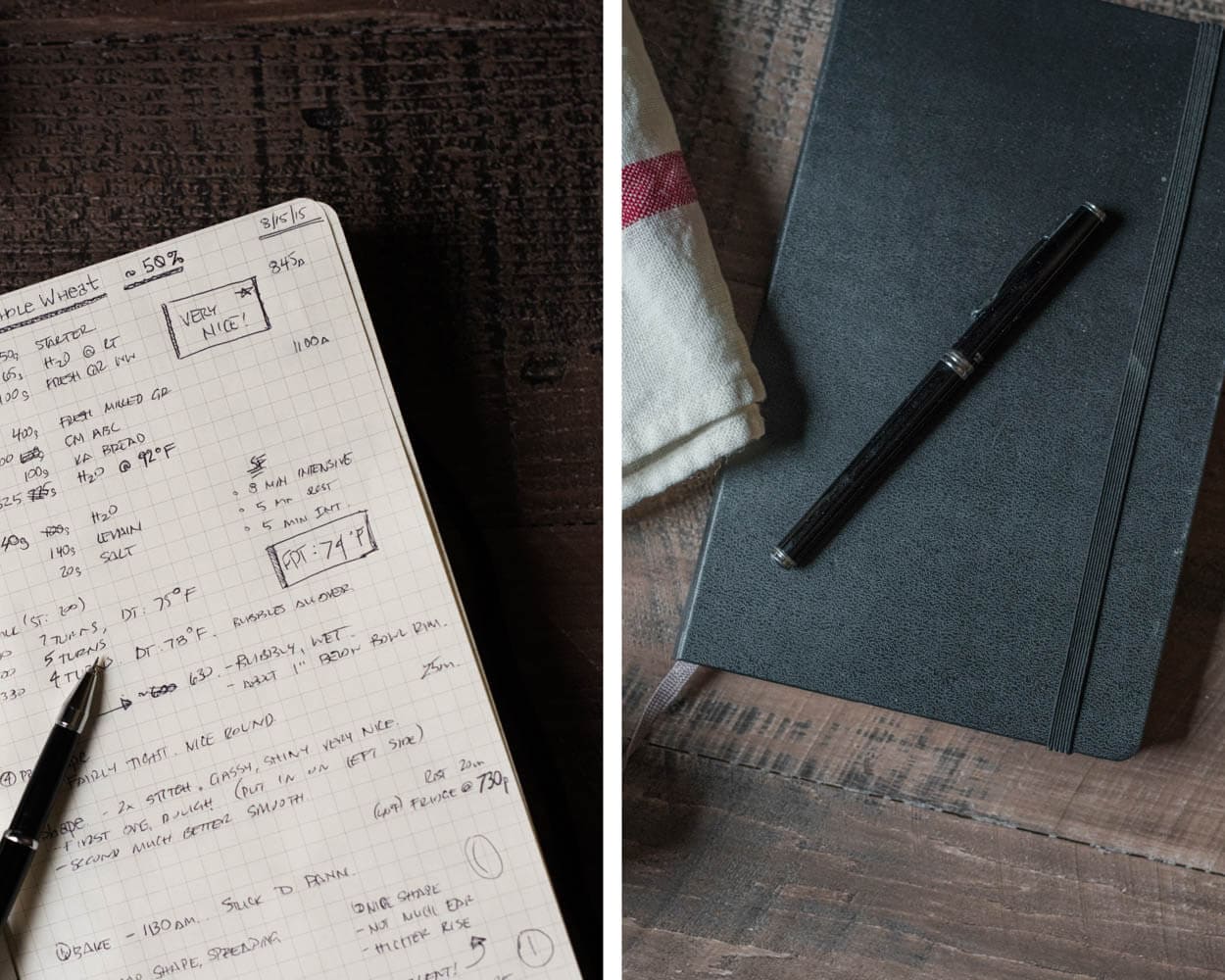
Before writing this post, I pulled out my trusty notebook (or use my free baker’s note sheet!) and paged through the handwritten (and flour-ridden) pages to find any scribbled “ah-ha” moments or little notes jotted down in the margin, along with a few curse words peppered throughout, and have bundled them up into this entry (sans curse words to keep it clean). A compendium of sorts containing my insights, breakthroughs, and ah-ha moments.
My best sourdough recipe doesn’t require an exotic blend of hard-to-find flour, a complicated multi-step levain build, or the use of a mechanical mixer. It’s built around making this bread in your home kitchen.
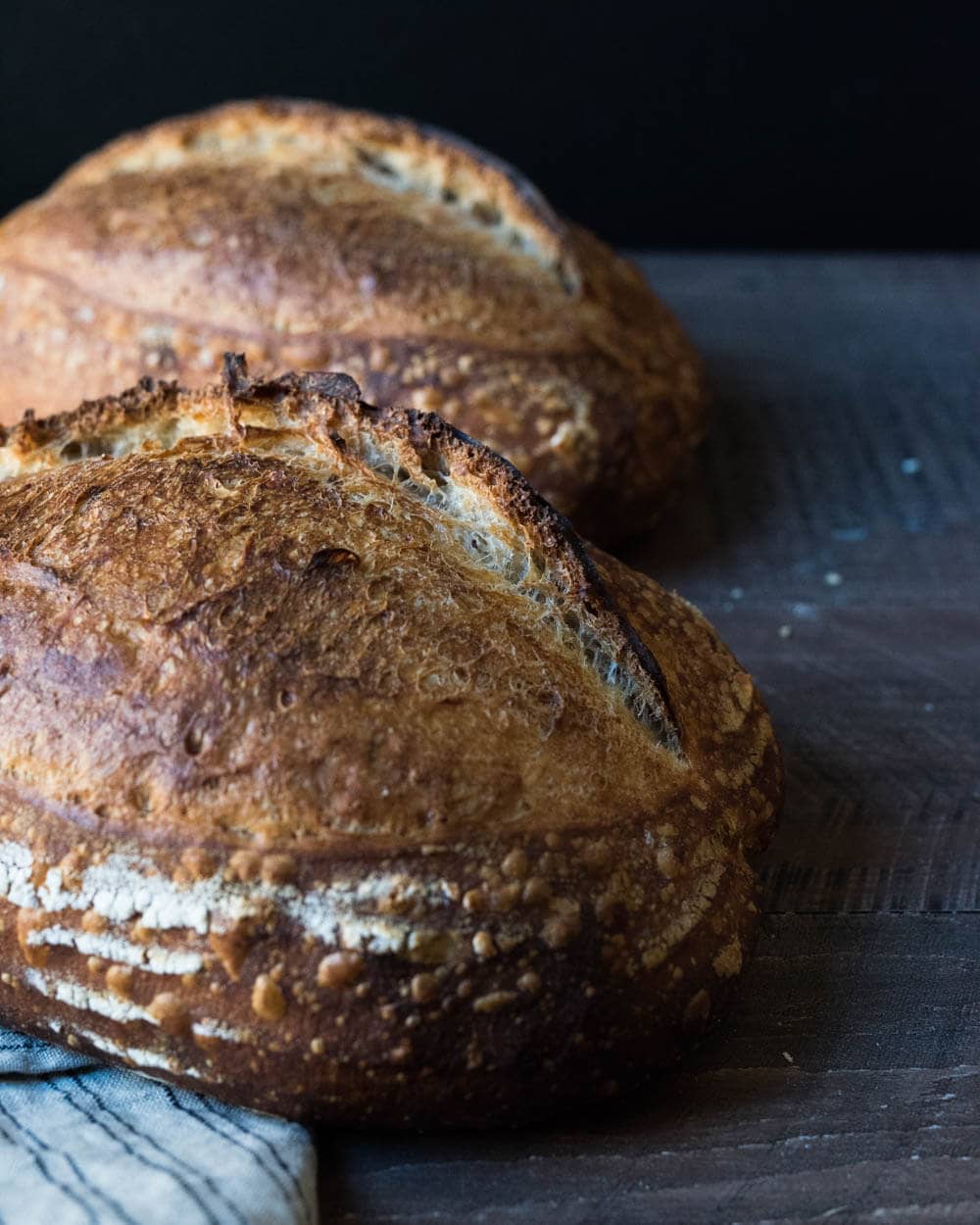
My best sourdough recipe is very highly hydrated and can be challenging. When mixing, be watchful for the signs and adjust the dough hydration to suit your environment and flour. If you’re not used to working with high-hydration dough, please start with hydration somewhere in the middle and slowly work up.
Flour Selection
I’ve tried a lot of flour out there (and am an avid user of freshly milled flour), indeed not everything there is, but I’ve ordered enough now that the UPS guy thinks I might have a bakery in my backyard. I have baked some great bread with Hayden Flour Mills, Central Milling, and Giusto’s. I’ve also had great success with King Arthur Baking high-protein white flour.
I have consistently made incredible loaves with Giusto’s flour; I only wish it were organic. Nevertheless, I find myself ordering a box of it here and there and enjoying the results every time. Of course, as I mentioned before, try whatever is local first (sadly, my source for local, organic flour is no longer available) and whatever you like.
When trying new flour, remember to hold back more water than you might otherwise, and then slowly add it in at the end of mixing or throughout bulk fermentation. Now, on to my best sourdough recipe.
Watch Me Make This From Start To Finish
I absolutely love this bread and make it often, but it can be challenging for first-time bakers. Be sure to watch my YouTube video below for a look at how I handle the dough and every step of the process.
If you’re brand new to baking sourdough, check out my Beginner’s Sourdough Bread recipe; it has in-depth information on every step in the baking process. Then come back and bake this!
My Best Sourdough Recipe
Vitals
| Total Dough Weight | 1,800 grams |
| Pre-fermented Flour | 6.4% |
| Levain percentage in final dough | 17.1% |
| Hydration | 85.0% |
| Yield | Two 900g loaves |
Total Formula
The target final dough temperature (FDT) is 78°F (25°C). This dough loves a warm ambient environment. Try to keep the dough at the listed temperatures if possible; use your oven with its light on inside, your microwave with a bowl of steaming water, or a proofer. I use my instant-read thermometer to check the dough temperature periodically throughout bulk.
For more information on how to calculate DDT, monitor temperature, and maintain temperature have a look at my post on The Importance of Dough Temperature in Baking.
| Weight | Ingredient | Baker’s Percentage |
|---|---|---|
| 852g | Medium-protein bread flour (~11.5% protein, Giusto’s Artisan Bread Flour) | 90.00% |
| 94g | Whole wheat flour (Giusto’s Organic Stoneground Whole Wheat) | 10.00% |
| 710g | Water 1 | 75.00% |
| 95g | Water 2 | 10.00% |
| 17g | Salt | 1.80% |
| 30g | Ripe sourdough starter (100% hydration) | 3.20% |
As I mentioned above, my best sourdough recipe is an extremely high hydration. If this is your first time working with this recipe, reduce the total water or hold water back during mixing to ensure your dough can handle the addition. The amount of water your dough will handle will vary based on your particular flour and environment—play it safe the first few bakes and work the water up gradually once you get a feel for the dough.
My Best Sourdough Recipe Method
1. Levain – 9:00 a.m.
Build the liquid levain in the morning and store somewhere warm around 77-80°F (25-26°C) ambient for 5 hours.
| Weight | Ingredient | Baker’s Percentage |
|---|---|---|
| 30g | Ripe sourdough starter (100% hydration) | 50% |
| 30g | Medium-protein bread flour (~11.5% protein, Giusto’s Artisan Bread Flour) | 50% |
| 30g | Whole wheat flour (Giusto’s Organic Stoneground Whole Wheat) | 50% |
| 60g | Water | 100% |
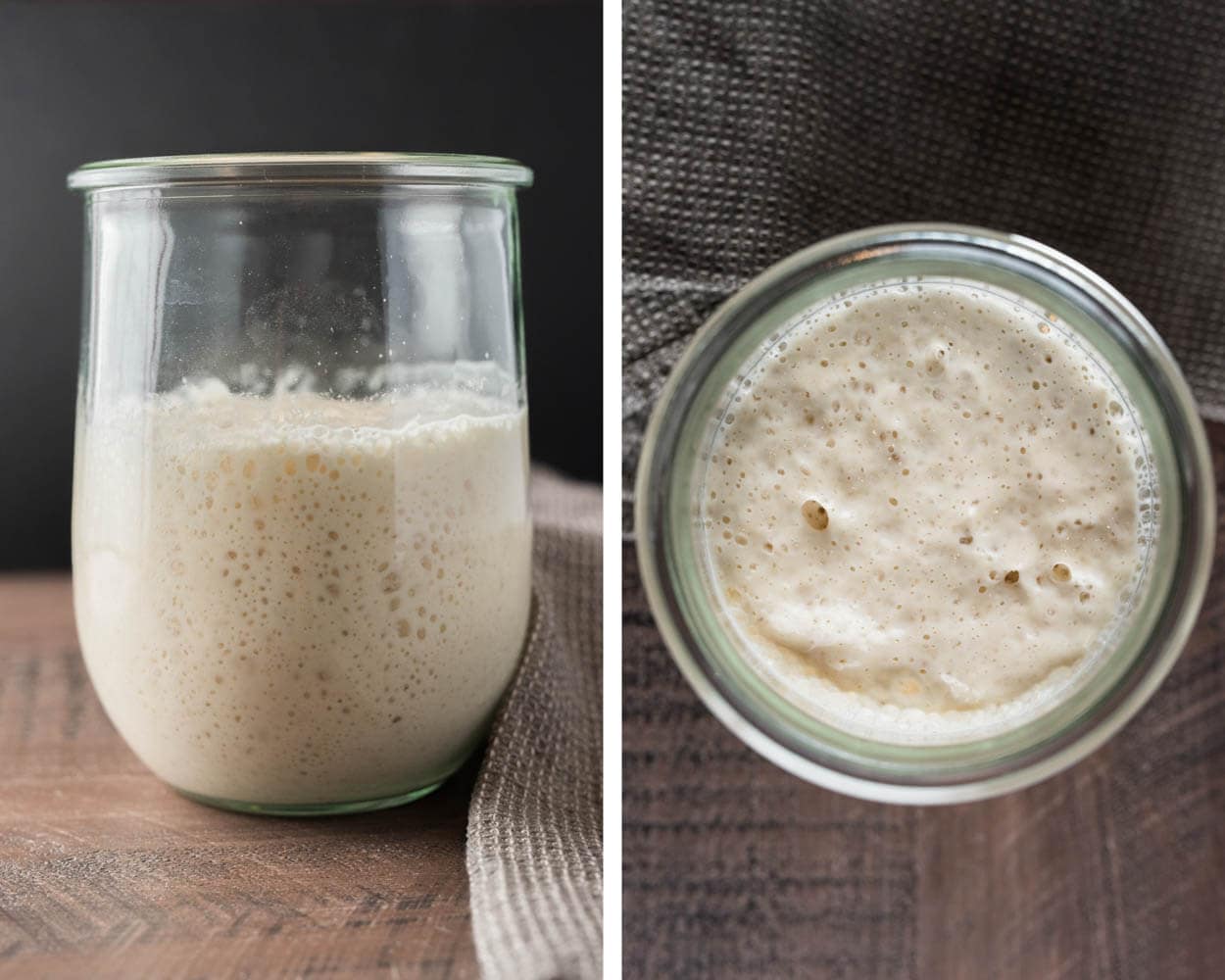
If you haven’t yet read through my post on my sourdough starter maintenance routine, check it out for some helpful hints on what to look for when your sourdough starter and levain are ripe and ready to use.
2. Autolyse – 12:00 p.m.
This highly hydrated dough can be mixed by hand or with a mechanical mixer (like a home spiral mixer). Either one will yield great results, but here, I’ll discuss mixing this dough by hand.
Mix the flour and water in a bowl until all the dry bits are incorporated, then cover. Ensure all the dry flour is hydrated—store near levain (we want the dough’s temperature to remain warm).
| Weight | Ingredient |
|---|---|
| 822g | Medium-protein bread flour |
| 64g | Whole wheat flour |
| 650g | Water 1 |
3. Mix – 2:00 p.m.
| Weight | Ingredient |
|---|---|
| 95g | Water 2 |
| 17g | Fine sea salt |
| 151g | Ripe liquid levain (see above) |
Add the ingredients to your dough in the mixing bowl that underwent an autolyse. Add the water slowly, in stages, while you’re mixing, and stop adding water if the dough feels excessively wet or soupy at any point.
Perform folds for about 2-3 minutes in the bowl. Grab under one side, pull up and over to the other side, then rotate the bowl a bit and repeat. I do this probably 30 times or so (it goes fast and easy). In the end, the dough should still be shaggy, but it will be more smooth and will start to hold itself together more in the bowl.
If you’re a fan of the slap & fold mixing technique I’ve described in the past, you can do this but be aware that it is difficult at this hydration. It’s best to first slap and fold the dough without adding all the reserved water to get the dough smooth and strong. Then, return the dough to the mixing bowl and slowly add the remaining water while folding the dough.
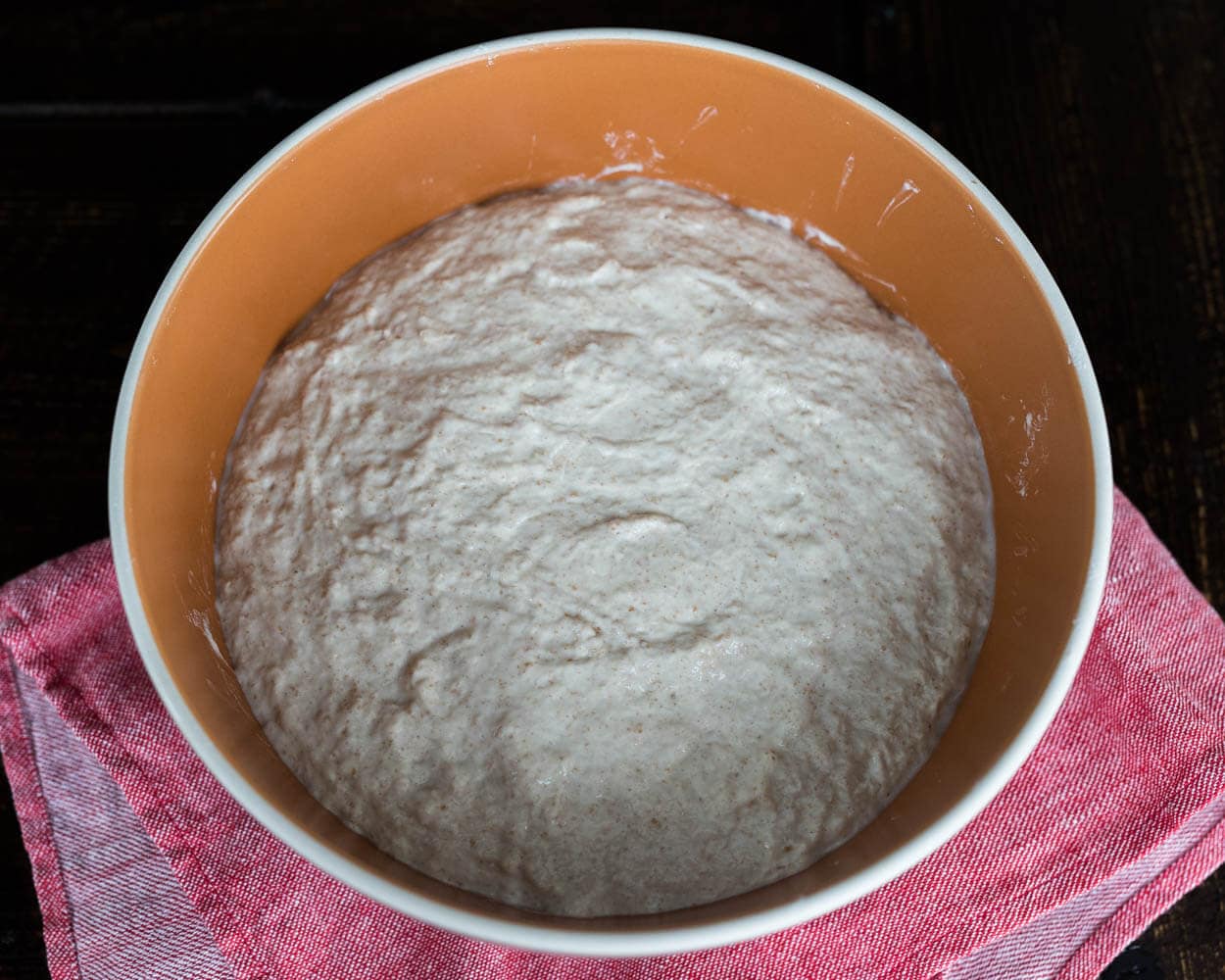
I find that the correct level of dough strength at this point is important. You want the dough to be smooth, elastic, and strong, but it doesn’t have to be fully developed, and it will still be shaggy. We will continue to strengthen the dough through stretch and folds in bulk fermentation.
Transfer dough to a tub or thick-walled bowl for bulk fermentation.
5. Bulk Fermentation – 2:15 p.m. to 6:15 p.m.
At 78°F (25°C) ambient temperature, bulk fermentation should go for about 4 hours. Perform six sets of stretch and folds during the bulk. The first three are at 15-minute intervals, and the last three are at 30-minute intervals. After these folds (2 hours and 15 minutes have gone by), let the dough rest for the remainder of bulk fermentation.
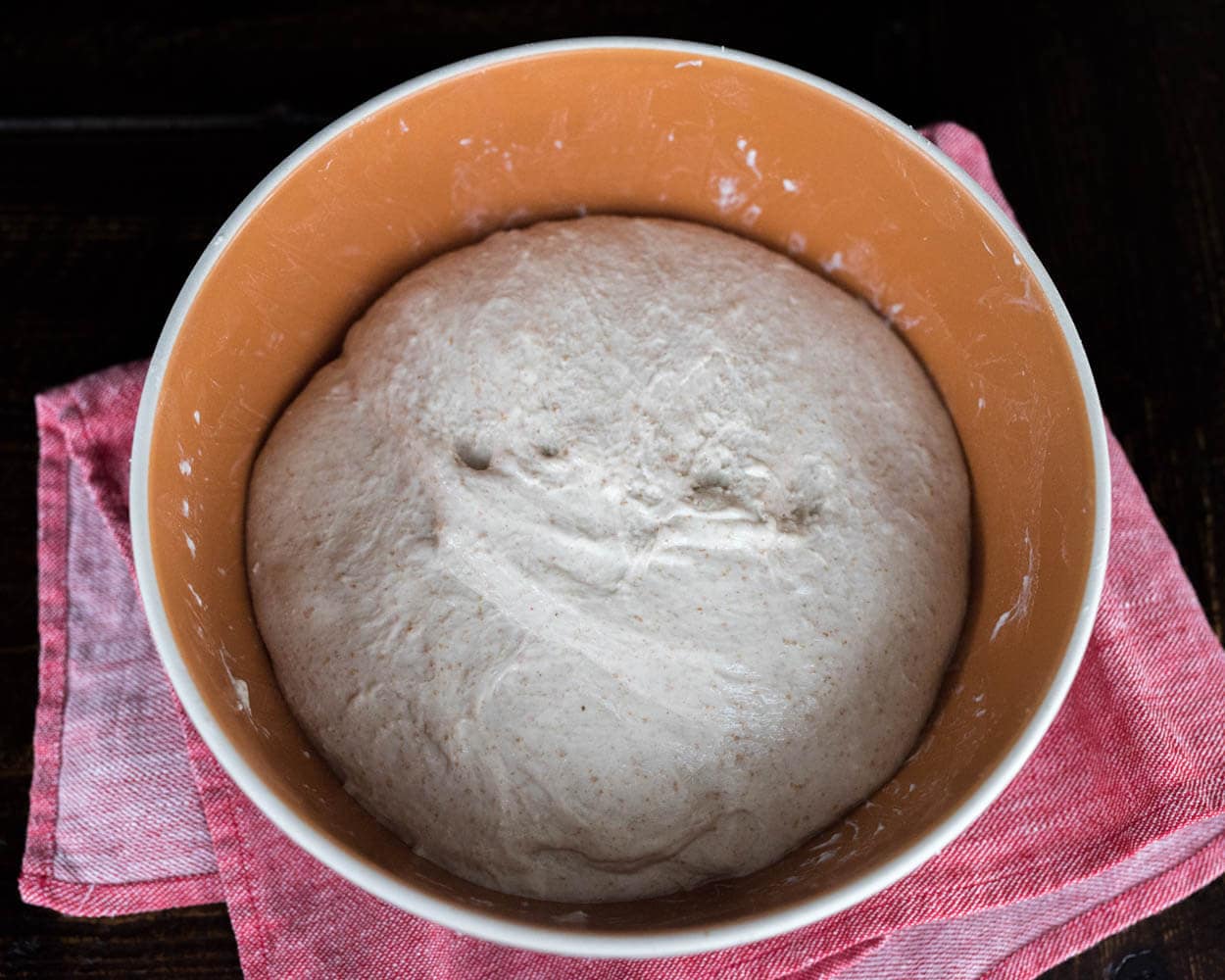
I stretch and fold more vigorously at the beginning of bulk than usual since it is extraordinarily slack and extensible (due to this recipe’s high hydration and autolyse). Pick up one side of the dough with both hands and pull it up, just before tearing, and fold it over to the other side. Rotate your container and repeat 4 or 5 times. That is one set.
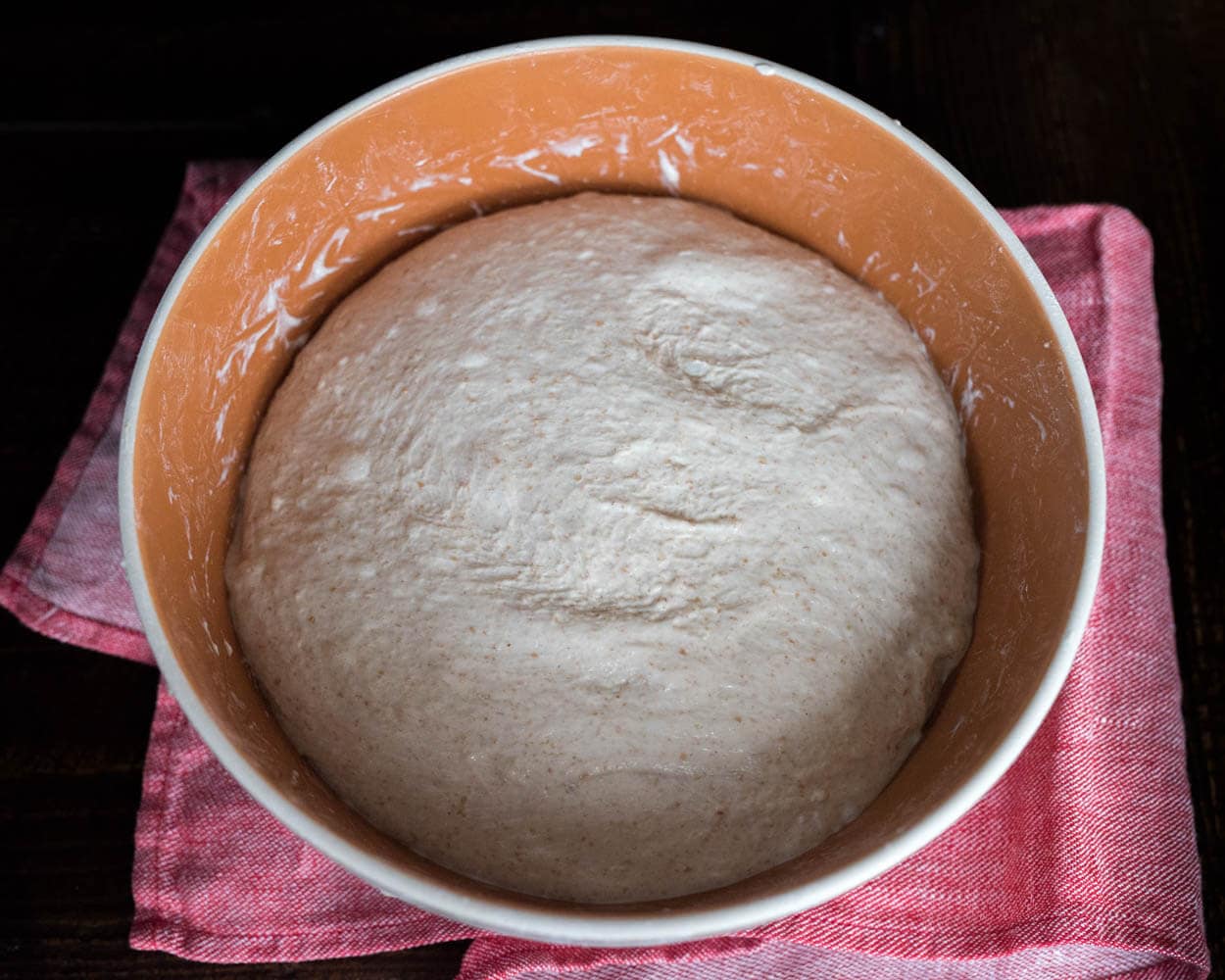
Above, you can see my best sourdough recipe dough halfway through bulk, after about 2 hours. There is no significant rise as of yet, but the edges are beginning to dome downward, and the dough’s texture is smoothing out slightly. We still have several more folds to do and more strength to build.
It is essential that the dough is kept near 78°F (25°C) as much as possible (minor fluctuations up and down are ok). If temperatures dip down too far, you might have to extend the bulk fermentation duration to compensate, and vice versa. Use your judgment, the signs described below, and be flexible.
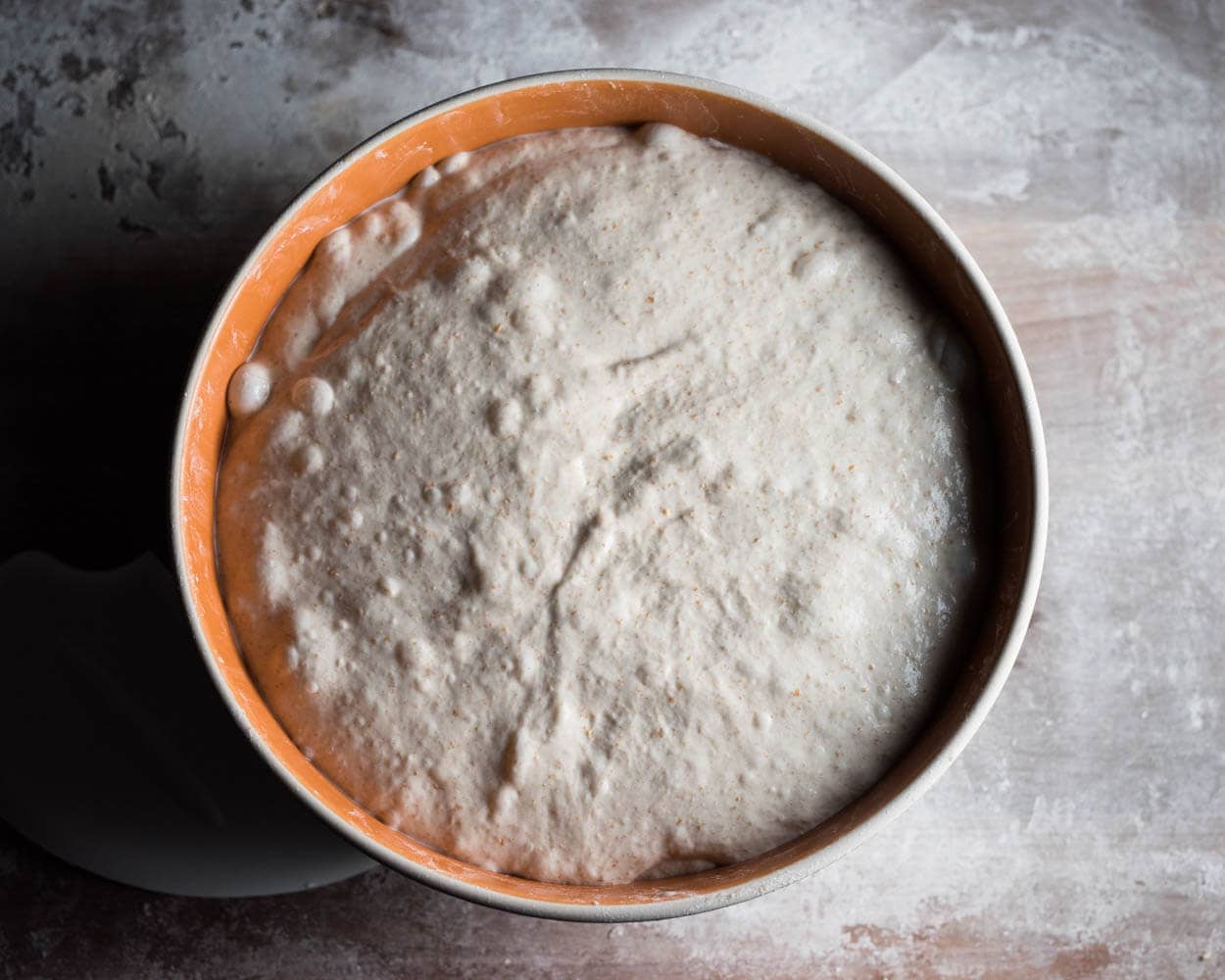
At the end of bulk, your dough should look very gassy, with some bubbles here and there, and the edges where the dough meets the bowl should be slightly domed. You can see all these signs in the image above.
When you gently shake the bowl, the entire mass jiggles from side to side—very alive. You’ll also notice that compared with the photo at the beginning of bulk, the dough is smoother and holds its edges, folds, and creases more readily (most of the bumps and ridges you see are due to trapped gasses from fermentation).
6. Divide & Preshape – 6:15 p.m.
Divide the dough into two halves and gently preshape each piece of dough into a round. Then, let the dough rest for 30 minutes, uncovered. Act quickly when handling this dough and rely heavily on your bench knife. I try to use my hands as little as possible when dealing with the dough at this point.
7. Shape – 6:45 p.m.
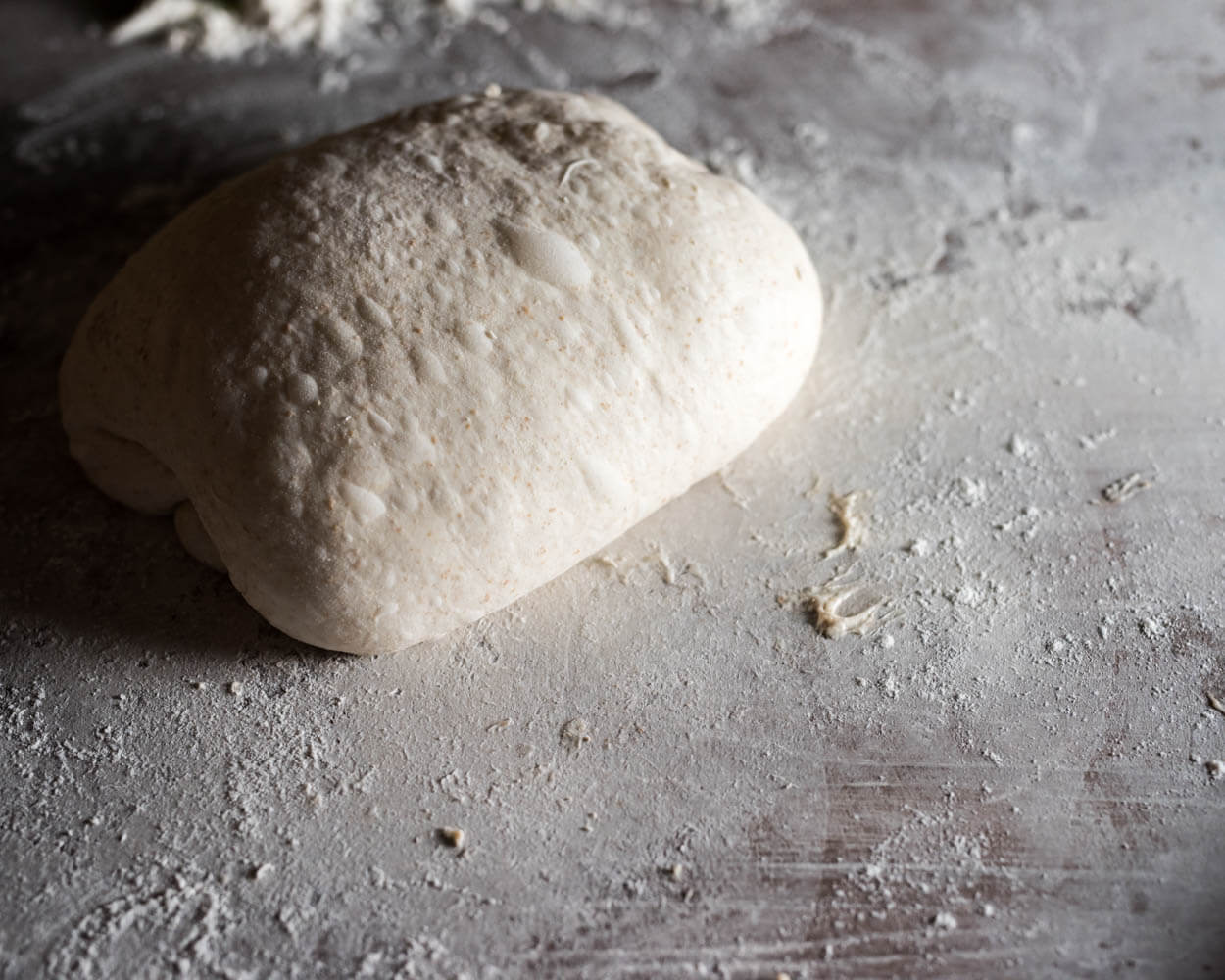
Lightly flour the top of your dough rounds and flour the work surface. With this recipe use a little more flour on the surface than normal, the dough will be extremely sticky and wet. Flip each round and shape into a batard (see notes below) or boule, whatever your preference.
Here’s a video of how I shape a bâtard. With this dough, be sure to use the “slack dough” shaping method since the dough is such high hydration.
I prefer to shape these as batards, and my shaping method is as follows:
- Flip pre-shaped round
- Fold the bottom up to about halfway
- Fold the left side over to about 3/4 to the right
- Fold the right side over to cover left
- Stretch top up & away from the center and fold down to about half (you’ll now have a “letter”)
- Grab a little of the dough at the sides near the top and stretch it over the center, so the dough crosses. Imagine lacing up a shoe where you first grab your laces and cross them over
- Repeat three times from top to bottom (the result will look like a laced up shoe)
- Take the bottom and gently roll the dough up to the top and try to seal it slightly when done rolling
Alternatively, if the dough feels pretty strong, you could shape it by “cinching” up the dough. For more instruction on how to shape this dough as an oblong loaf, see my post on how to shape a batard (with video!).
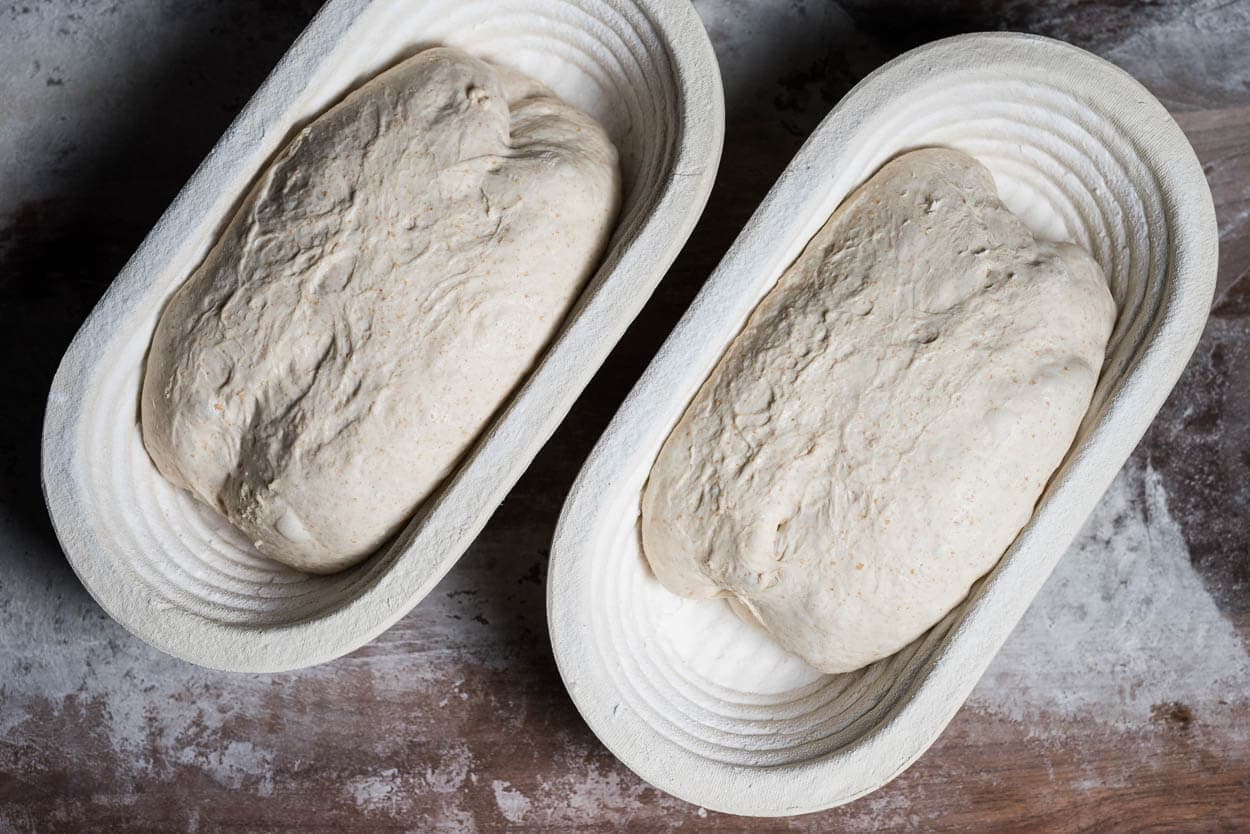
After shaping, let the dough rest on the bench for a few minutes and then place it into a banneton that is lightly dusted with white flour. You’ll see above my bannetons give the dough plenty of room to relax and expand in the fridge overnight. If your proofing container is on the smaller side, and you find your dough almost spilling over the edges, it might be time for a larger basket.
8. Proof – 7:25 p.m. to 9:00 a.m., the next day
Cover your banneton with plastic and place it in the refrigerator at 38°F (3°C) overnight.
9. Bake – Next Morning: Preheat oven at 8:00 a.m., Bake at 9:00 a.m.
Preheat your oven to 450°F (230°C). Remove the dough from the fridge (there’s no need to let the dough come to room temperature) and uncover. I scored the dough with a single, long slash to get that dramatic opening when baked. I keep the blade at a reasonably shallow angle so the taut skin created during shaping will “peel” back as the loaf rises.
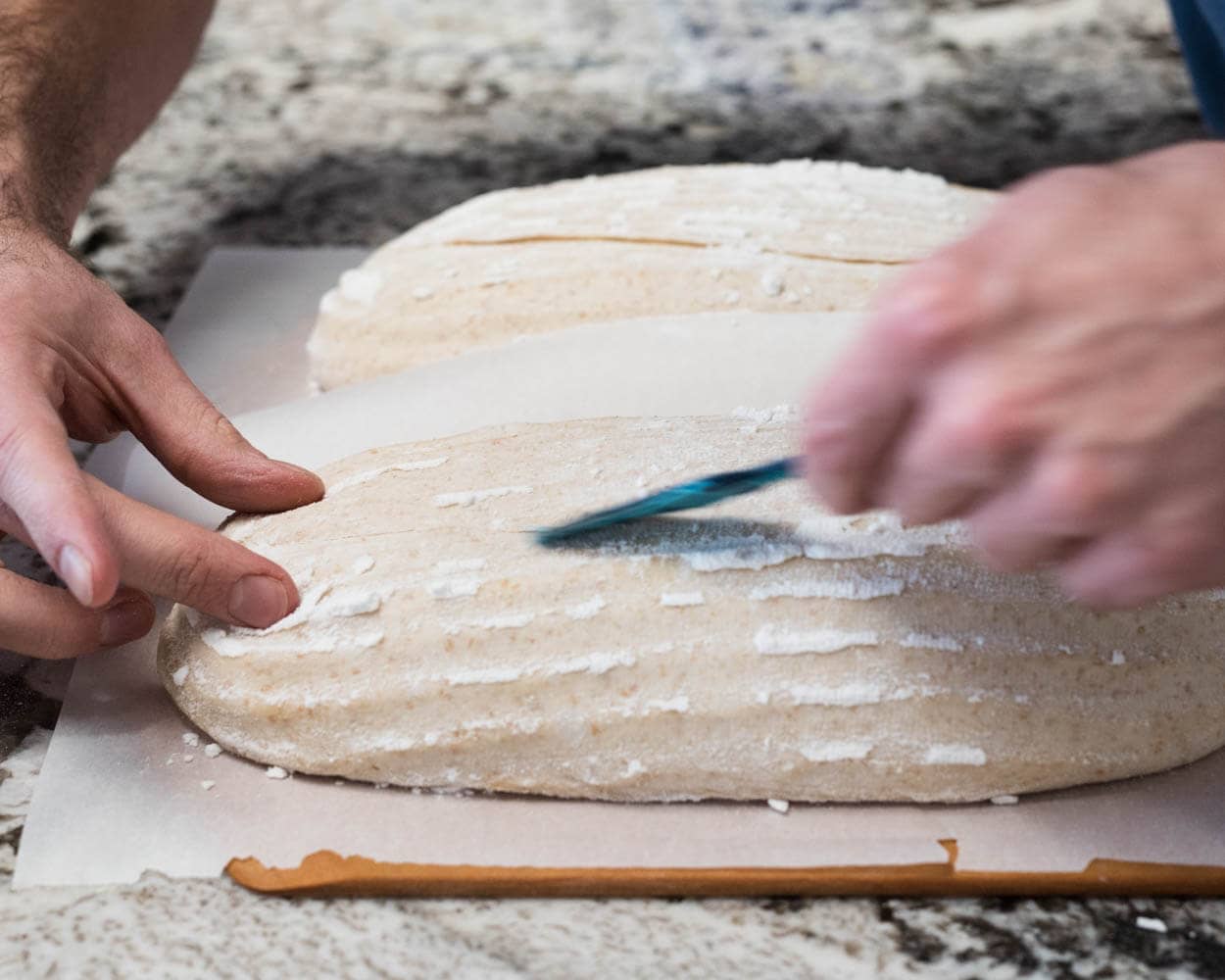
I steamed my oven in my usual way, described here in my post on how to steam your home oven for baking. But you can also bake in a pot or Dutch oven.
Bake for 20 minutes with steam, then remove your steaming pans if baking on a surface or Dutch oven/combo cooker lid. Then, bake for an additional 30 minutes until done to your liking. I like to bake rather dark, so I sometimes extend this second half of baking until I get the crust I’m looking for.
Once your loaf is done, remove and let cool on a wire rack for 1-2 hours. See my post on the best way to store the bread after it’s baked for a few tips on keeping it on the counter and freezing if you think you won’t get through both loaves in a week.
Conclusion
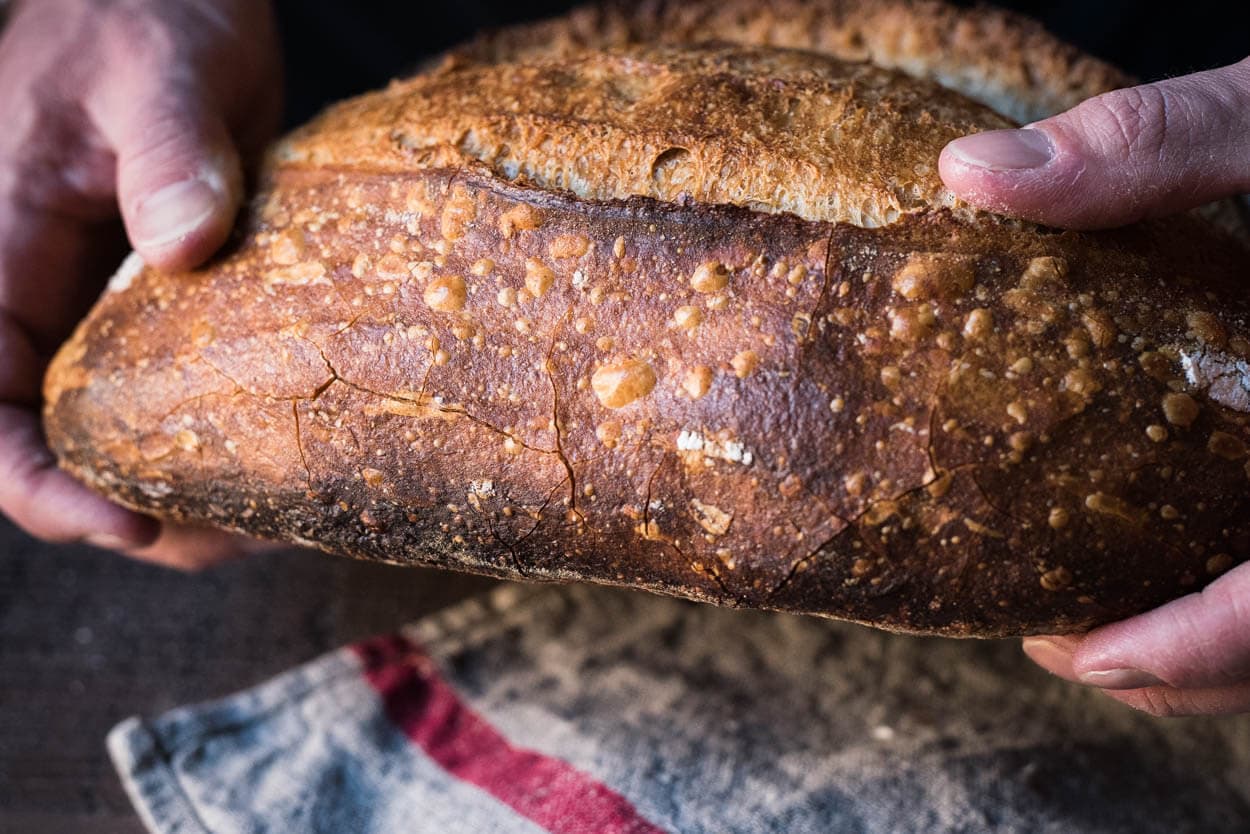
It’s hard to put into words just how much I enjoy this “my best sourdough recipe.” I bake it almost every week (sometimes multiple times if baking for friends and family), and yet every time I pull it from the oven, I smile. The crust color, the open and light interior, only the smallest perception of sour notes, and the way it crunches when toasted. I could go on and on.
The photos to follow are the results of scattered recent bakes that all followed this process exactly and have a slightly different outcome. You’ll notice some are a bit darker, some have more or less flour on them, some expand differently in the oven, and some are taller and some are shorter—that’s the nature of baking.
With baking, every single bake is different no matter how consistent you try to be. It’s the same with my Dad and his Italian restaurant, and the reason I’ll sometimes get a call in the middle of the afternoon: “hey, the pizza dough is incredible today, you should head over and grab some.”
Crust
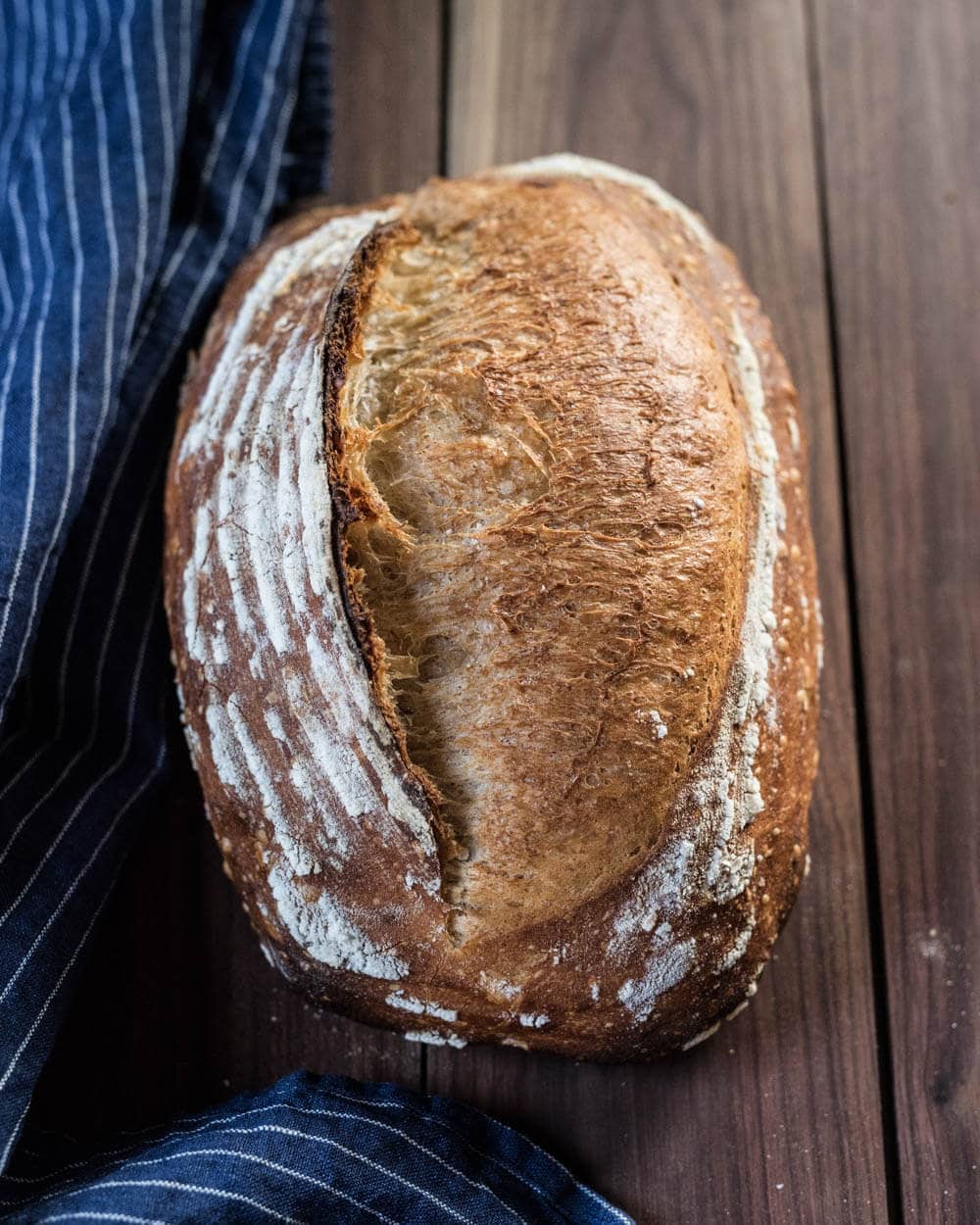
As a kid, I was known to take slices of bread, cut out the center, and eat the crust. It used to anger my family because they’d reach into the breadbasket only to find slices of only the soft parts. That’s how much I love the crust! Can you blame me, though?
I enjoy bread with a chunky, chewy crust, but this bread with its delicate and cracker-like crust takes the top spot for me. Even though I bake these rather dark, the crust remains thin and brittle, crackling under the slightest pressure. I love using the “heel” (the very end) of this bread to eat soup or combined with hefty slices of cheese. It’s delicious.
Crumb
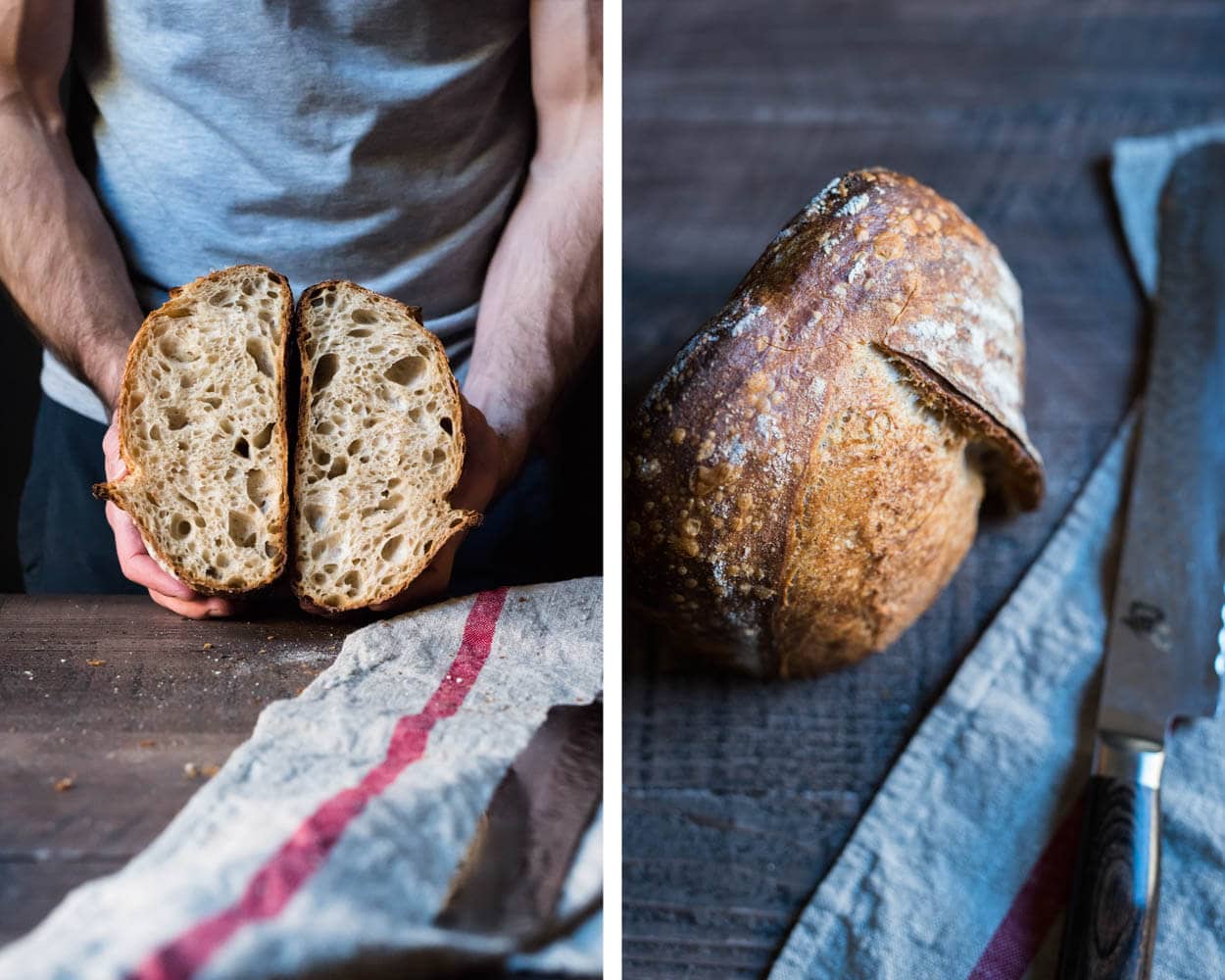
I think there’s a balance to be had with bread like this. It’s possible to let the crumb open up too much, but for me, this is just right. Scattered open areas with that translucent webbing spanning from wall-to-wall, a dynamic movement to these areas, almost show you how shaping was carried out.
Taste
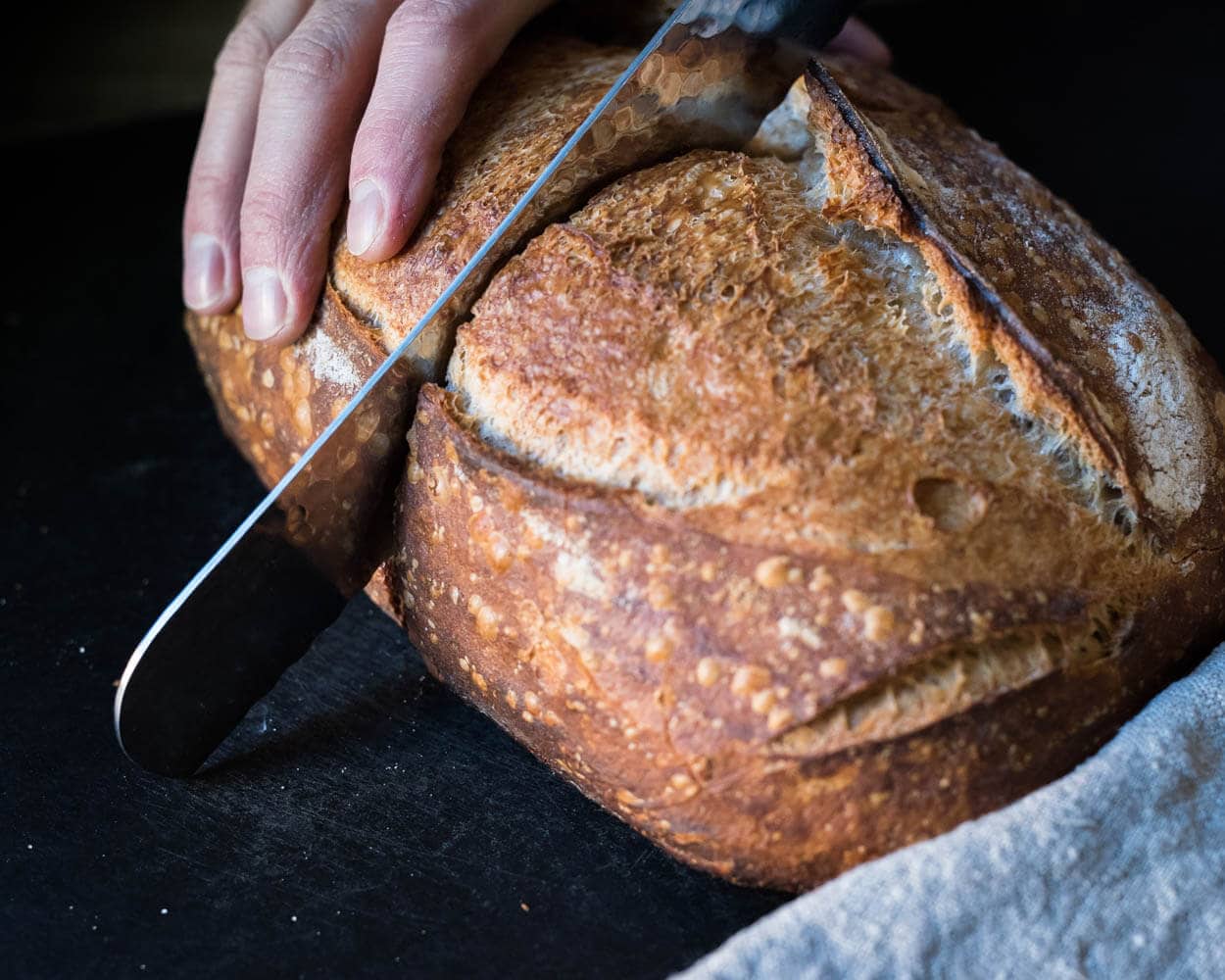
This bread has an almost imperceptible hint of sour, and because of this, the wheat flavors from the flour come forward. It has an incredibly tender, soft crumb that almost dissolves in your mouth. It’s one of those rare foods whereupon taking that first bite your mouth begins to water.
In the end, bread is just bread. But it’s also the staff of life and has been for thousands of years. It’s is also more than the sum of the ingredients you add to the mixing bowl. It’s how it makes you feel when you give some to a friend, and they grin ear-to-ear as they take a big bite. It’s the knowledge that you created this thing over a few days that once was a lump on your counter and is now an incredibly delicious food meant to be shared. To me, this is real bread and my best sourdough recipe to date.
Buon appetito!
Print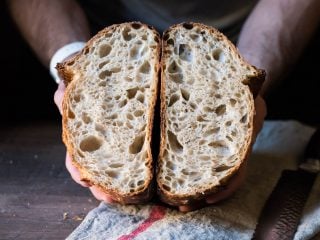
My Best Sourdough Recipe
- Prep Time: 24 hours
- Cook Time: 55 minutes
- Total Time: 24 hours 55 minutes
- Yield: 2 loaves
- Category: Sourdough, Bread
- Cuisine: American
Description
This sourdough bread is one of my favorite recipes. It’s a highly hydrated dough that results in a loaf with an open and lacey interior contrasted by a thin, crispy crust.
Ingredients
Levain
- 30g medium-protein bread flour
- 30g whole wheat flour
- 60g water
- 30g ripe sourdough starter
Main Dough
- 822g medium-protein bread flour
- 64g whole wheat flour
- 745g water
- 17g salt
- 151g ripe levain
Instructions
- Levain (9:00 a.m.)
In a small container, mix the levain ingredients and keep at 78°F (25°C) for 5 hours. - Autolyse (12:00 p.m)
In a medium mixing bowl, add 822g medium-protein bread flour, 64g whole wheat flour, 650g water, and mix until no dry bits remain. Cover the bowl and let rest for 2 hours. - Mix (2:00 p.m.)
To the mixing bowl holding your dough, add 95g water (holding back any as necessary if the dough is too wet), 17g sea salt, and the ripe levain (from step 1). Pinch and mix all the ingredients together and do folds in the bowl for 2 to 3 minutes until the dough smooths and is cohesive. Then, transfer your dough to a bulk fermentation container and cover. - Bulk Fermentation (2:15 p.m. to 6:15 p.m.)
Give the dough 6 sets of stretch and folds. The first three sets are at 15-minute intervals, and the last three sets are at 30-minute intervals. - Divide and Preshape (6:15 p.m.)
Lightly flour your work surface and scrape out your dough. Using your bench knife, divide the dough in half. Lightly shape each half into a round shape. Let the dough rest for 30 minutes, uncovered. - Shape (6:45 p.m.)
Shape the dough into a round (boule) or oval (batard) and place it in proofing baskets. Cover the baskets with a reusable plastic bag. - Proof (7:25 p.m. to 9:00 a.m. the next day)
Cover proofing baskets with reusable plastic and seal them shut. Then, place both baskets into the refrigerator and proof overnight. - Bake (Preheat oven at 8:00 a.m., bake at 9:00 a.m.)
I steamed my oven in my usual way, described here in my post on how to steam your home oven for baking. But you can also bake in a pot or Dutch oven. Preheat your oven with a combo cooker or Dutch oven inside to 450°F (230°C). Remove your dough from the fridge, score it, and transfer it to the preheated combo cooker. Place the cooker in the oven, cover with the lid, and bake for 20 minutes. After this time, remove the lid (you can keep it in the oven or remove it) and continue to bake for 30 minutes longer. When done, the internal temperature should be around 208°F (97°C). Let the loaves cool for 2 hours on a wire rack before slicing.
Notes
This is a very highly hydrated dough. Don’t add in all the reserved water during mixing if it feels like the dough is becoming overly weak, slack, or soupy.
What’s Next?
If you want more help getting an open crumb with this bread, I’ve created a 100+ page book with step-by-step instructions. Learn the best flour to use, the right fermentation schedule, and all my tips in my Bread Baker’s Handbook.
Are you a TPL Member? If so, the handbook is free for you!


2,142 Comments
Hello! I’ve baked this loaf a few times and I love it. My husband, however, complains that the crust on the bottom is too thick. It does take a lot of sawing to get it sliced!
What adjustments do you suggest for a thinner bottom crust? I’m baking at altitude (6,300 feet here in San Miguel de Allende) and always use all the water. I do use my baking steel beneath the Dutch oven, and set my racks in the lower third.
Thanks for the suggestions, AI suggested wrapping the baked bread in a damp towel… or increasing hydration and oven temp.
I put two stacked baking sheets under my Dutch oven and it keeps the bottom from getting overcooked (so it’s not too crusty). I make sure to put the baking sheets into the even until after the Dutch oven is preheated.
FYI, I’m at 5200 feet.
Oh my goodness! I had such low expectations based on how my loaf looked when I put it in the oven. I thought for sure it was going to be horrible. But it was amazing!! I pulled it out a little early because I don’t like it so dark and I think maybe next time I’ll even try to keep it in longer. Thank you for an amazing recipe and for sharing your expertise. I’m very new to making sourdough bread and fell in love with the whole process immediately. I think I watched your videos three dozen times before I actually summoned the courage to get started. I’m so glad I did. Thank you
I made this for the first time and they look almost exactly like yours! It was a super loose dough that I thought would stiffen and I suppose it did a bit. It was too loose to make an ear so the tops didn’t look exactly like yours but the inside was beautiful. I am at an elevation at a bit iver 2700 feet so I did use a bit less water, the fermentation happened very quickly. After the stretch and folds, which I barely timed), the dough sat for a very short period before I divided it and put in the fridge. I have an oval le creuset pan which is perfect for my loaves but I feel if I had a bigger pan or a true cloche, this might spread too much. If you have any tips for higher altitude baking for your recipe, I’d love to hear it.
Hey Maurizio! Love your recipes and really appreciate your knowledge. Even 2 hours past the bulk ferment, my dough still isn’t developed enough. I’m fairly confident I mixed it enough after two hours of autolyse. I tried to preshape the dough but it felt like it would fall apart. My total hydration was 77%. Any thoughts? I’ve put it back in bulk and gave it some folds to see if I can salvage it.
– Justin
This is the second time I’ve made this one. I figured my results the first time were impacted by my lack of experience. Other recent bakes from the book have been stellar. But this one has humbled me. The dough is more a liquid and even flouring everything repeatedly I’m struggling to pour it into the basket. It may turn out fine but I’m baffled how I can improve my dough.
Hi Leslie. I’ve made this recipe a few dozen times, and my “success” rate has pretty steadily improved over the past year. A few tips that seem to work for me; perhaps they’ll help you, too: (1) I do hold back on adding the full amount of Water 2. Yesterday, I only used about 75g (out of the 95). I’m thinking that even though I’m using a medium strength bread flour, maybe it needs to have more protein. But when I add all of Water 2, the dough just doesn’t absorb it well. (2) I use a mixer—twice! I use a mixer to prior to the autolyse, and let it run for a few minutes on low. And I use the mixer again, when I combine everything after the autolyse. This really seems to hep getting the Water 2 absorbed into my dough. I run it on low about 4 minutes, then put it into a different bowl so I can more easily do the stretch and folds during bulk fermentation. (3) I use my home office bathroom for temperature control! It’s a small room, so I put in a little space heater, set it for 77F, and that lets me make sure everything’s nice and warm throughout the process. Okay—those are my tips. Prior to doing this stuff, I’d get a nice rise only about 50% of the time. Now it works all the time (fingers crossed). FWIW, I’m also at 5,000 feet altitude in Colorado.
Hi Maurizo! I have made this three times now, and each time I have had the same issue. Taste is really good, but bread is rather dense/not as airy as yours seems to be. Dough temp was at 77.9, levain was well formed when incorporated. Even tried using a stand mixer this time vs. hand to see if I hadn't strengthened it enough in mixing. Dough was domed with air bubbles on top when extracted after bulk (I did notice it flatten a bit when I was extracting/preforming). Any suggestions where I might be going wrong? https://uploads.disquscdn.com/images/a5bb012bdda738cfcbe8c131b040191c3602065924d46b73d6b8114c64f9a0fa.jpg
Looks like a nice loaf, regardless. My thought looking at your images is that you might have degassed the loaf during shaping; the small, even alveoli in a loaf like this tend to result from overhandling. The flattening you mention may speak to this also. High hydration loaves do need a gentle hand (I rather roughed a batch up this evening through carelessness and impatience, and would be unsurprised to have a similar outcome when baking it tomorrow. It happens). Pan breads are often degassed through handling precisely to get an even crumb.
Hi Maurizo! Love your recipes but I'm really struggling with this one. Can you (or someone who has been successful with this recipe tell me the temp you bulk ferment at and the target rise (percent). Thanks!
I cannot address the target rise percent, but I do know that once I started using a Brod and Taylor Proofer set at 76 degrees my loaves are almost always pretty darn nice. I live in Minnesota, and our temps are very flexible-having the proofer takes that out of the equation. I also pay close attention to water temp and I mix by hand; for some reason, hand mixing yields much better results than I got when using my Kitchen Aid stand mixer. Hope this helps.
An excellent point. I too use a proofer (here in the chilly NE of the US) and I consider it an essential. If you consider dough temperature to be an ingredient (which it really is, in a sense), there’s really little alternative. Also, the proofer is very useful for all kinds of other applications, from making miso to curing sweet potatoes!
Hi again Maurizio! I love the open crumb on this recipe and I keep trying to perfect it! You call for a majority of medium protein flour which I understand does not absorb the water as well as high protein bread flour….thus giving me some slacky dough during pre-shape and shaping. I can use about 675 grams of water and that’s about it. Can you explain your thoughts on this? I now have some Central Milling ABC flour (Kirkland) which is a medium protein flour (11.7%) and I plan to use it along with KA Organic Whole Wheat on my next try. I am also going to work the dough more than just “normal” mixing before autolyse to get some gluten strength going. I look forward to reading your comments ! Thanks so much!
Hi Mauricio, thoughts on using the Rabaud method for the mixing process esp since this is a high hydration dough?
Hi Maurizio! I have tried this recipe a few times. I use KA Organig Artisan Bread flour which is medium protein. I also use KA organic whole wheat. I can not use more than 650 grams water for the entire recipe, not including the levain. The dough is very slack in shaping etc. What are your thoughts? I am just under 100 grams less water than you suggest (keeping in mind that some water may be too much as you say for this recipe). I would love to perfect this recipe!
Is there a baking tip to the reason many of your sourdough recipes are for double loaves of bread?
https://uploads.disquscdn.com/images/0ac7f8826cefe59bae3df71921349b65501ec557a28fda0d8ebf16a07e2616bf.jpg While i put it in the oven, i lost all hope for this bread, it wasn't holding its shape at all and was all sloppy. Didn't rise that much in the fridge overnight. But 15 mins inside the oven and magic happened. I regained some hope for it. There is still a lot of room for improvement. But atleast i know i can work on it more and get best results.
Hi, this always turns out great for me although for my taste it’s lacking salt. I noticed that recipes from Richard Harts book which I’ve recently gotten often uses almost double the amount of salt for a similar type of bread. Would it be ok to increase the salt in this recipe? or will it somehow mess with the fermentation?
I’ve tried this recipe twice and love it, the hydration is perfect and now it’s my go to! I’m still at the beginning of this journey but I absolutely adore it! I need to learn how to not be shy with the scoring… today I’ll try to make the levain the night before, wish me luck! https://uploads.disquscdn.com/images/25f8ada04031992d819d5006f3615531897a526d3bacc22503de1cbaca912847.jpg
Seeking advice…
Often the loaves are perfect.
Sometimes they seem to melt outward instead of rising up (pics attached).
I’ve tried:
1. Adjust water
2. Adjust flour protein content
3. Adjust bulk ferment time
4. Adjust number and vigor of stretch and folds
6. Adjust dough temp
7. Dozens of micro adjustments (I’ve made this loaf about 60 times)
Any advice much appreciated!
For my next lead I’m going to cut back on the 2 hour autolyse.
https://uploads.disquscdn.com/images/27f019e625f1a25882df65f6ae742f499cc12f6e8491b69e2ac4bbefa383bbb5.jpg
No idea why that photo is horizontal.
Pic of when they do work:
https://uploads.disquscdn.com/images/86db73d5bd81402e2d188a67102b51cb3a7cf04c6271c79c3b5db0240bc61e20.png https://uploads.disquscdn.com/images/7400580bd5ca3b376e9eb52a912abea948e9fb4074150e1b2d50fe9c137a2830.png
My current lead is that the dough is not being strengthened enough early in the process.
I suspect the inconsistent results are because it was just on the edge of being developed enough and some times it was and some times it wasn’t.
I switched from hand mixing to 4 minutes on lowest setting with dough hook in mixer yesterday and the results were excellent. Good oven spring, rounded rise, not slack.
I’ll try another batch tomorrow using the mixer to see if that reproduces the good results.
One other lead:
The shaping step feels off.
With higher protein bread flour (12.7%):
*25 minutes after pre-shape dough does not have much stretch and is hard to fold and stitch
With lower protein all-purpose flour (11.7%)
*25 minutes after pre-shape dough is slack and does not tighten. It’s like lava in that it won’t hold surface tension and just flows when it is shaped.
I'm having a similar issue with mine. the first time i made the recipe i thought it was forsure because i over hydrtaed it but this time i thought it seemed to have firmed up a bit more by the time i flipped the loaf out of the banneton but still i did not get as much rise out of it as i wanted. im wondering if a higher heat might help? i even waited until 12 the next day to let it firm up in the fridge even more.
I made this for the third time, it gets better each time…. I don’t know which I love more, this or the soft sandwich bread from the book.
I unexpectedly had to bulk ferment for 36 hours and it turned out great and had delicious flavor.
I’ll try inclusions as someone else did as well. Excited for grilled bread with salad this summer!!!
This recipe was terrible. My sourdough never properly bulk fermented. I checked it after 6 hours and there was no dome. Then I kept waiting for it until 9 hours and nothing changed. I even kept it at 78 degrees F.
Hey Maddie, super sorry to hear that. Was your starter used when it was ripe (well fermented, some numbers after feeding it)? The same goes for your levain. Both of these to be very strong to perform well in the dough. It sounds like fermentation never got off on the right foot here!
I’ve made this loaf several times and love it. My recent variation is to add shredded Asiago cheese (about 250g) during the stretch and folds (midway through). It’s absolutely delicious!
Whoa, that sounds delicious Anne! I'm going to try it 🙂
Is Water1 710g or 650g? In the total formula section it’s 710g in the autolyse section it’s 650g. Thanks.
It's 710g, then 650g of it is used in the autolyse (the rest was used in the levain).
I've made this loaf many times very successfully. It's fabulous. Though time intensive, I love it!! And come back to it with regularity. Yesterday, I found myself 10g short of whole wheat flour and thought, let's try 10g rye. Well, that is one thirsty flour! Took a bit to get all the dry bits incorporated. Then when combining with the starter and salt, it would not come together and became a hard, clumpy, mess. After a few touches and kneads, I gave up. There was no way this lump was going to "stretch and fold". I gave up and left it on the counter over night. This morning found that it rose. I may just bake it and see what happens. Can you tell me why the rye or the combination of flours does this?
My apologies for inadvertently posting twice. Wanted to come back and report the error of my ways! I believe it's a gluten error. I had successfully used the stand mixer with a bread hook for the initial mix and it worked beautifully. But this time I believe I over did it and the dough got tough! Made the recipe again without the rye and still the outcome was weird, not smooth, hard. Still bakes and tastes great but it's not airy like usual. Lesson learned. Hands only and don't over work the flour. #alwayslearning
Shana, thanks for coming back to share your discovery! While it's actually pretty difficult to truly overwork sourdough (it would take many minutes of continuous machine mixing), it can definitely happen if the mixer runs too long. The stand mixer applies much more consistent force than hand mixing, which can lead to that tougher texture you described.
For many of my recipes, I actually prefer hand mixing for better control and feel, though the stand mixer can be helpful for initial incorporation. If you do use the mixer again, try using it just for the initial mix phase (2-3 minutes max) and then switch to stretch and folds during bulk fermentation to build strength more gently.
Love seeing your #alwayslearning approach – that's exactly the mindset that leads to great bread!
https://uploads.disquscdn.com/images/ef8b1f92a996d6c62fb431435a907d78304c25a03fbfee69b6d00f175899e1fb.jpg I love this recipe, I've been trying to get a nice workable recipe for quite a while, and this is the best so far. I also want to say the tutorial is fantastic, great teaching, even for newbies! Taught me enough to see what needed adjusting, as every kitchen environment is just a little different.
You're 100% right about that, Kelly! Your loaf looks great 🙂
Hi Maurizio, The bread has turned out well and we have devoured it… But, I never get 151g ripe levain from the Levain recipe you provide. More like 131g. I've made the recipe three times and this is the result each time. What is happening?
Thank You!
Patti, it's completely normal for the levain to come in a bit under the stated weight! This happens because some of the dough sticks to your container or tools during transfer.
I mention this briefly in my book, but it's a common occurrence in sourdough baking. The 131g you're getting is perfectly fine to use in the recipe. If you're concerned about having enough, you could add 5g more of each (water, flour, starter) when building your levain next time to ensure you have a bit extra.
Happy baking!
Hi Maurizio! I’m so excited to try this recipe!!! Can I make the levain the night before at 9:00pm, instead of the day of?
You can, Nico! You'll have to reformulate it a bit, though. I would make it exactly like the overnight (12 hour) levain I talk about in my worksheet:
https://www.theperfectloaf.com/sourdough-starter-and-levain-quicksheet/
How much fiber is in each slice of loaf?
I've not calculated this, Eddie!
I tried this today and got a great result. I’m new to sourdough but have a lot of experience with very high hydration yeast breads so was not daunted by the slack dough which firmed up nicely with the s&fs… in fact I may have skipped the last one but the dough didn’t need it. The dough was much slacker than Maurizio’s for the preshape but I used my bench knife and dough scraper to assist (with a fair amount of flour on the bench) to get the dough to come together, and 30 mins later the shaping went fine. I cold proofed for 16 hrs and the dough rose nicely. I like a very thin crust so I used a combo of Maurizio’s hints to attain that: parchment plus silicone lifter and ice cube in Dutch oven, 20 mins lid on at 475°, 10 mins lid off at 450°, 10 mins out of Dutch oven on rack at 450° which yielded 210° internal temp. Loaf is tall, light, holey, very flavorful with incredibly great thin shattering crust! This is likely to end up being my perfect loaf. (BTW, I started with a ~1:4:4 overnight levain so I could start first thing in the morning, and I used King Arthur AP flour.)