

I’ve baked this loaf, or some variant of it, so many times I’ve lost count. This bread was born when I first got my hands dirty with flour and water. Its parent—if you could call it that—was originally Chad Robertson’s Tartine loaf with his liquid levain, brought to life, not with intensive kneading, but rather a series of folds during bulk fermentation.
My best sourdough recipe has grown since then. It has developed a personality of its own as I’ve expanded my baking repertoire and investigated the many facets of baking naturally leavened sourdough. It’s taken on and lost traits from many great bakers out there, borrowing from their inspiration and giving me a direction to raise this bread into something of my own. This bread is one that doesn’t entirely taste like anything else I’ve had, and yet, still employs many of the same processes and ingredients.
That’s one of the greatest things about bread: it can taste and look dramatically different just by changing the two hands that create it. Calling this post “my best sourdough recipe” is a lofty claim, but honestly, I do believe this is the best bread I’ve made thus far.
I sometimes revisit a discussion I had with a few readers of this site and their comments: “bread is just bread, it’s something to be eaten and is something life-giving, isn’t that enough?” I agree, but when something becomes a passion for you it’s important to set lofty goals and get excited when breakthroughs are made. Isn’t that the definition of a craft and the relentless honing required?
I’ve taken my best sourdough recipe from its most nascent form to its current stage and can trace through the years each change to its formula or process — and I’m sure I’ll be changing things well into the future as it continues to evolve — a work-in-progress.
Yes it’s excessive in some way, but there’s an excessiveness to ambition as well.
John Mayer
Maybe the actual recipe for this bread isn’t the most important part, but rather, the lessons and insights learned along the way as I continually hone my baking proficiency. I’m not claiming this recipe will yield the perfect loaf every single time, but I dare say it comes the closest for me—and that’s exciting.
This bread is the bread that I want to make the most often, the one my family asks for the most often, and the one I share most often. I have a special place for whole wheat bread, and taste-wise, it might make me want to call that my favorite one day, but the versatility of this bread is pretty hard to beat. In fact, I bake this so often that my freezer has an entire shelf lined with pre-sliced loaves wrapped and in bags labeled pane perfetto.
While the actual formula for my best sourdough recipe is simply a mix of flour, water, salt, and levain, there are many nuances here to pay close attention to; here are a few key things to successfully making this bread:
- An active starter
- An autolyse
- A high hydration
- Sufficient dough strength
- A warm and complete bulk fermentation
- A long, cold proof
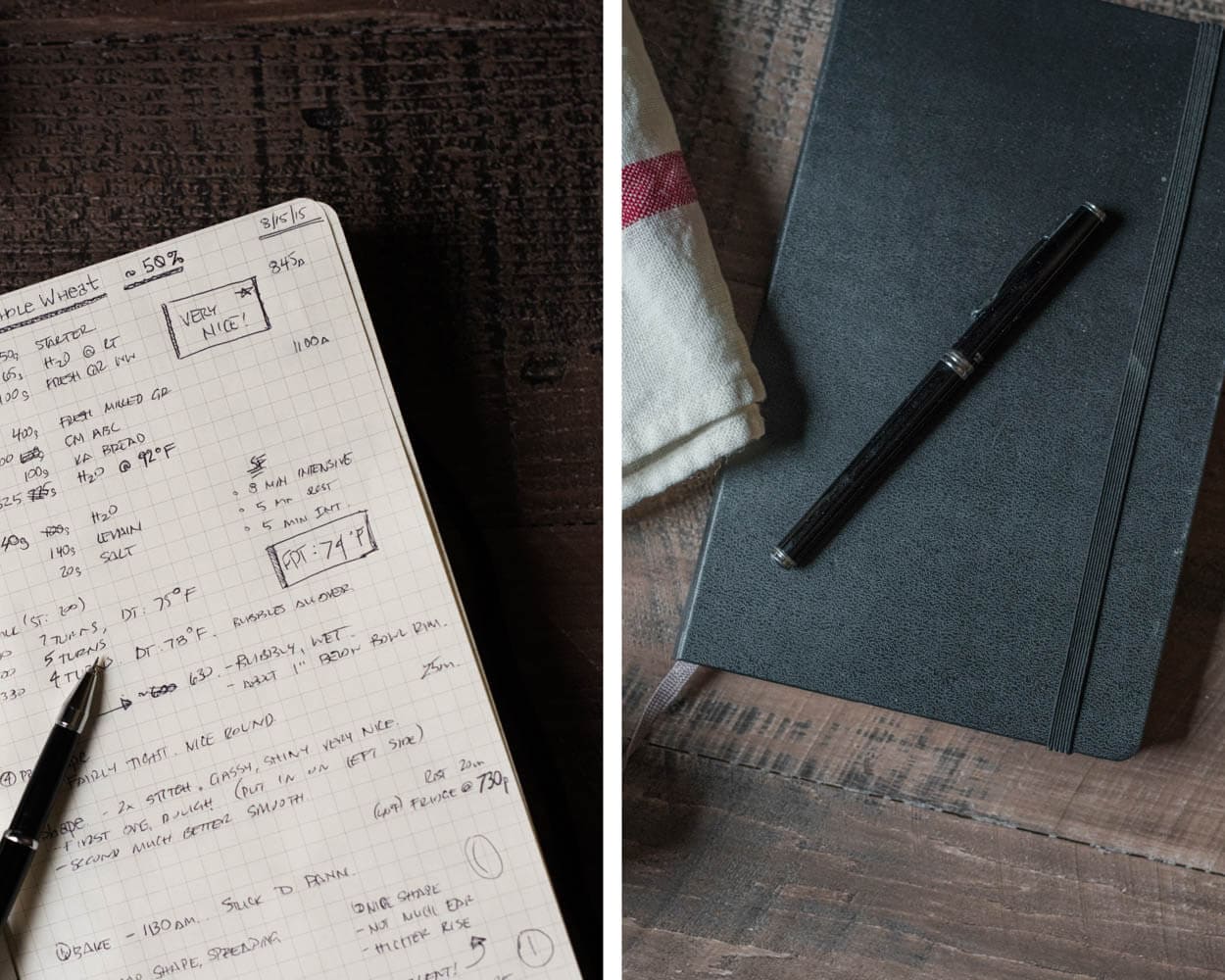
Before writing this post, I pulled out my trusty notebook (or use my free baker’s note sheet!) and paged through the handwritten (and flour-ridden) pages to find any scribbled “ah-ha” moments or little notes jotted down in the margin, along with a few curse words peppered throughout, and have bundled them up into this entry (sans curse words to keep it clean). A compendium of sorts containing my insights, breakthroughs, and ah-ha moments.
My best sourdough recipe doesn’t require an exotic blend of hard-to-find flour, a complicated multi-step levain build, or the use of a mechanical mixer. It’s built around making this bread in your home kitchen.
My best sourdough recipe is very highly hydrated and can be challenging. When mixing, be watchful for the signs and adjust the dough hydration to suit your environment and flour. If you’re not used to working with high-hydration dough, please start with hydration somewhere in the middle and slowly work up.
Flour Selection
I’ve tried a lot of flour out there (and am an avid user of freshly milled flour), indeed not everything there is, but I’ve ordered enough now that the UPS guy thinks I might have a bakery in my backyard. I have baked some great bread with Hayden Flour Mills, Central Milling, and Giusto’s. I’ve also had great success with King Arthur Baking high-protein white flour.
I have consistently made incredible loaves with Giusto’s flour; I only wish it were organic. Nevertheless, I find myself ordering a box of it here and there and enjoying the results every time. Of course, as I mentioned before, try whatever is local first (sadly, my source for local, organic flour is no longer available) and whatever you like.
When trying new flour, remember to hold back more water than you might otherwise, and then slowly add it in at the end of mixing or throughout bulk fermentation. Now, on to my best sourdough recipe.
Watch Me Make This From Start To Finish
I absolutely love this bread and make it often, but it can be challenging for first-time bakers. Be sure to watch my YouTube video below for a look at how I handle the dough and every step of the process.
If you’re brand new to baking sourdough, check out my Beginner’s Sourdough Bread recipe; it has in-depth information on every step in the baking process. Then come back and bake this!
My Best Sourdough Recipe
Vitals
| Total Dough Weight | 1,800 grams |
| Pre-fermented Flour | 6.4% |
| Levain percentage in final dough | 17.1% |
| Hydration | 85.0% |
| Yield | Two 900g loaves |
Total Formula
The target final dough temperature (FDT) is 78°F (25°C). This dough loves a warm ambient environment. Try to keep the dough at the listed temperatures if possible; use your oven with its light on inside, your microwave with a bowl of steaming water, or a proofer. I use my instant-read thermometer to check the dough temperature periodically throughout bulk.
For more information on how to calculate DDT, monitor temperature, and maintain temperature have a look at my post on The Importance of Dough Temperature in Baking.
| Weight | Ingredient | Baker’s Percentage |
|---|---|---|
| 852g | Medium-protein bread flour (~11.5% protein, Giusto’s Artisan Bread Flour) | 90.00% |
| 94g | Whole wheat flour (Giusto’s Organic Stoneground Whole Wheat) | 10.00% |
| 710g | Water 1 | 75.00% |
| 95g | Water 2 | 10.00% |
| 17g | Salt | 1.80% |
| 30g | Ripe sourdough starter (100% hydration) | 3.20% |
As I mentioned above, my best sourdough recipe is an extremely high hydration. If this is your first time working with this recipe, reduce the total water or hold water back during mixing to ensure your dough can handle the addition. The amount of water your dough will handle will vary based on your particular flour and environment—play it safe the first few bakes and work the water up gradually once you get a feel for the dough.
My Best Sourdough Recipe Method
1. Levain – 9:00 a.m.
Build the liquid levain in the morning and store somewhere warm around 77-80°F (25-26°C) ambient for 5 hours.
| Weight | Ingredient | Baker’s Percentage |
|---|---|---|
| 30g | Ripe sourdough starter (100% hydration) | 50% |
| 30g | Medium-protein bread flour (~11.5% protein, Giusto’s Artisan Bread Flour) | 50% |
| 30g | Whole wheat flour (Giusto’s Organic Stoneground Whole Wheat) | 50% |
| 60g | Water | 100% |
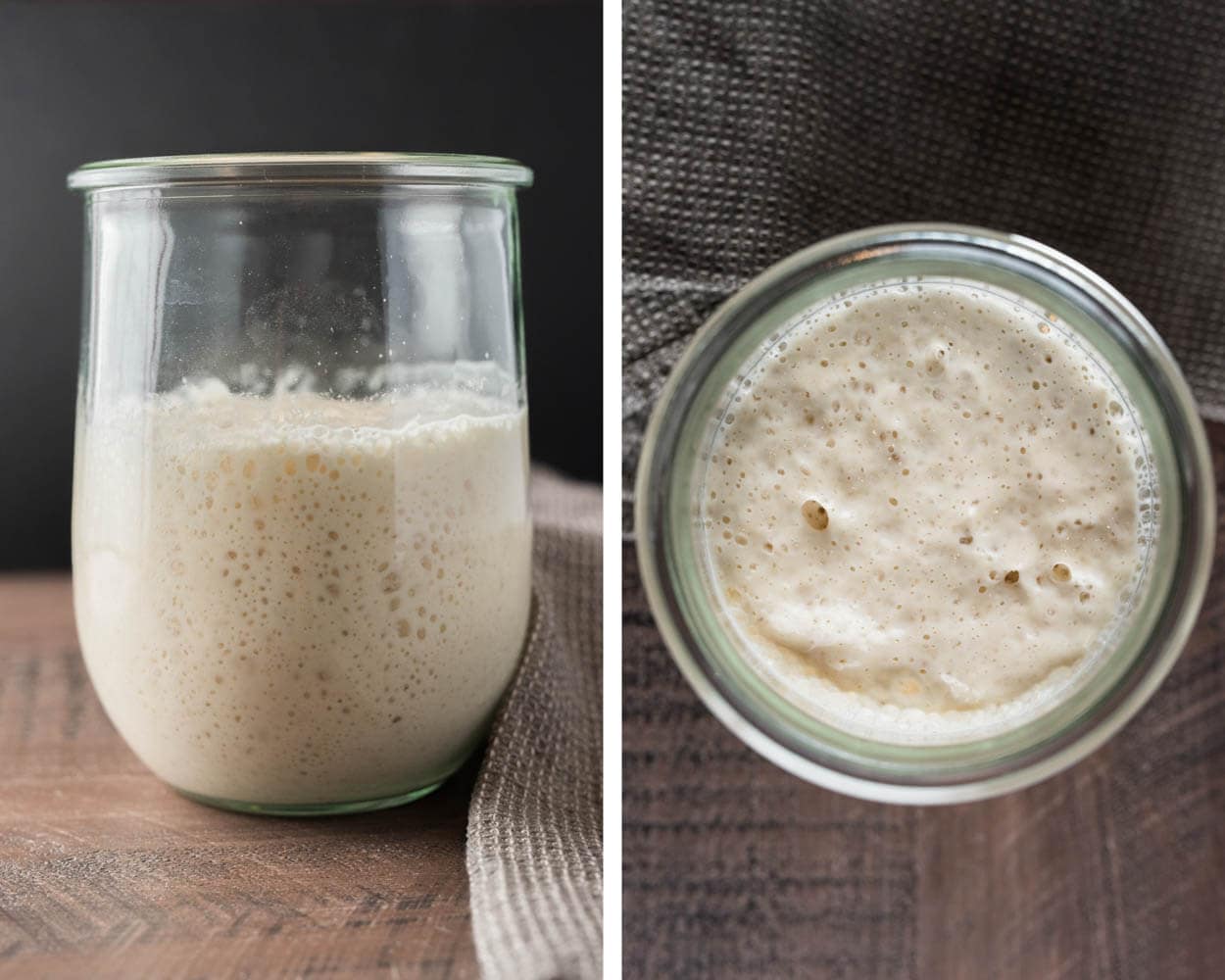
If you haven’t yet read through my post on my sourdough starter maintenance routine, check it out for some helpful hints on what to look for when your sourdough starter and levain are ripe and ready to use.
2. Autolyse – 12:00 p.m.
This highly hydrated dough can be mixed by hand or with a mechanical mixer (like a home spiral mixer). Either one will yield great results, but here, I’ll discuss mixing this dough by hand.
Mix the flour and water in a bowl until all the dry bits are incorporated, then cover. Ensure all the dry flour is hydrated—store near levain (we want the dough’s temperature to remain warm).
| Weight | Ingredient |
|---|---|
| 822g | Medium-protein bread flour |
| 64g | Whole wheat flour |
| 650g | Water 1 |
3. Mix – 2:00 p.m.
| Weight | Ingredient |
|---|---|
| 95g | Water 2 |
| 17g | Fine sea salt |
| 151g | Ripe liquid levain (see above) |
Add the ingredients to your dough in the mixing bowl that underwent an autolyse. Add the water slowly, in stages, while you’re mixing, and stop adding water if the dough feels excessively wet or soupy at any point.
Perform folds for about 2-3 minutes in the bowl. Grab under one side, pull up and over to the other side, then rotate the bowl a bit and repeat. I do this probably 30 times or so (it goes fast and easy). In the end, the dough should still be shaggy, but it will be more smooth and will start to hold itself together more in the bowl.
If you’re a fan of the slap & fold mixing technique I’ve described in the past, you can do this but be aware that it is difficult at this hydration. It’s best to first slap and fold the dough without adding all the reserved water to get the dough smooth and strong. Then, return the dough to the mixing bowl and slowly add the remaining water while folding the dough.
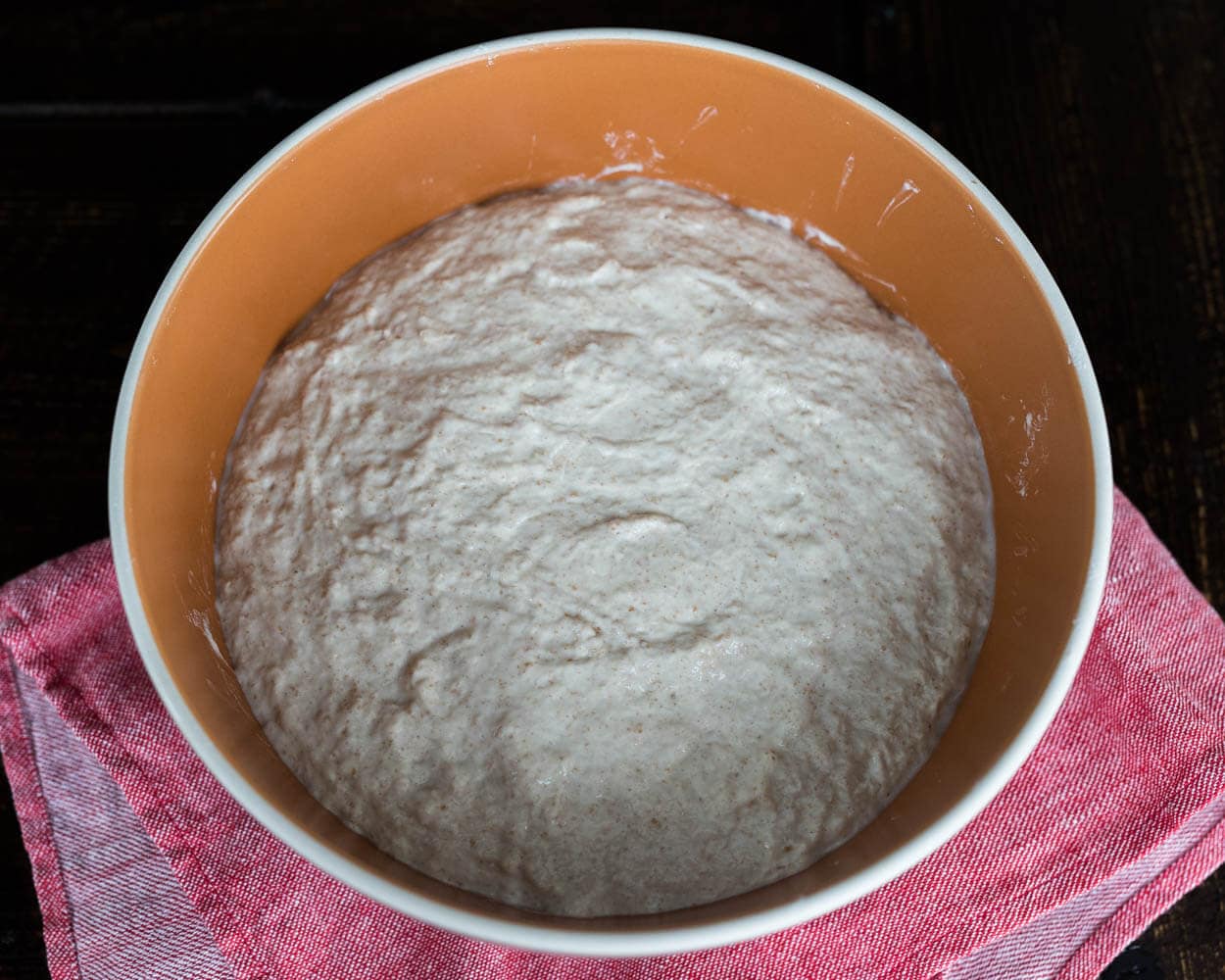
I find that the correct level of dough strength at this point is important. You want the dough to be smooth, elastic, and strong, but it doesn’t have to be fully developed, and it will still be shaggy. We will continue to strengthen the dough through stretch and folds in bulk fermentation.
Transfer dough to a tub or thick-walled bowl for bulk fermentation.
5. Bulk Fermentation – 2:15 p.m. to 6:15 p.m.
At 78°F (25°C) ambient temperature, bulk fermentation should go for about 4 hours. Perform six sets of stretch and folds during the bulk. The first three are at 15-minute intervals, and the last three are at 30-minute intervals. After these folds (2 hours and 15 minutes have gone by), let the dough rest for the remainder of bulk fermentation.
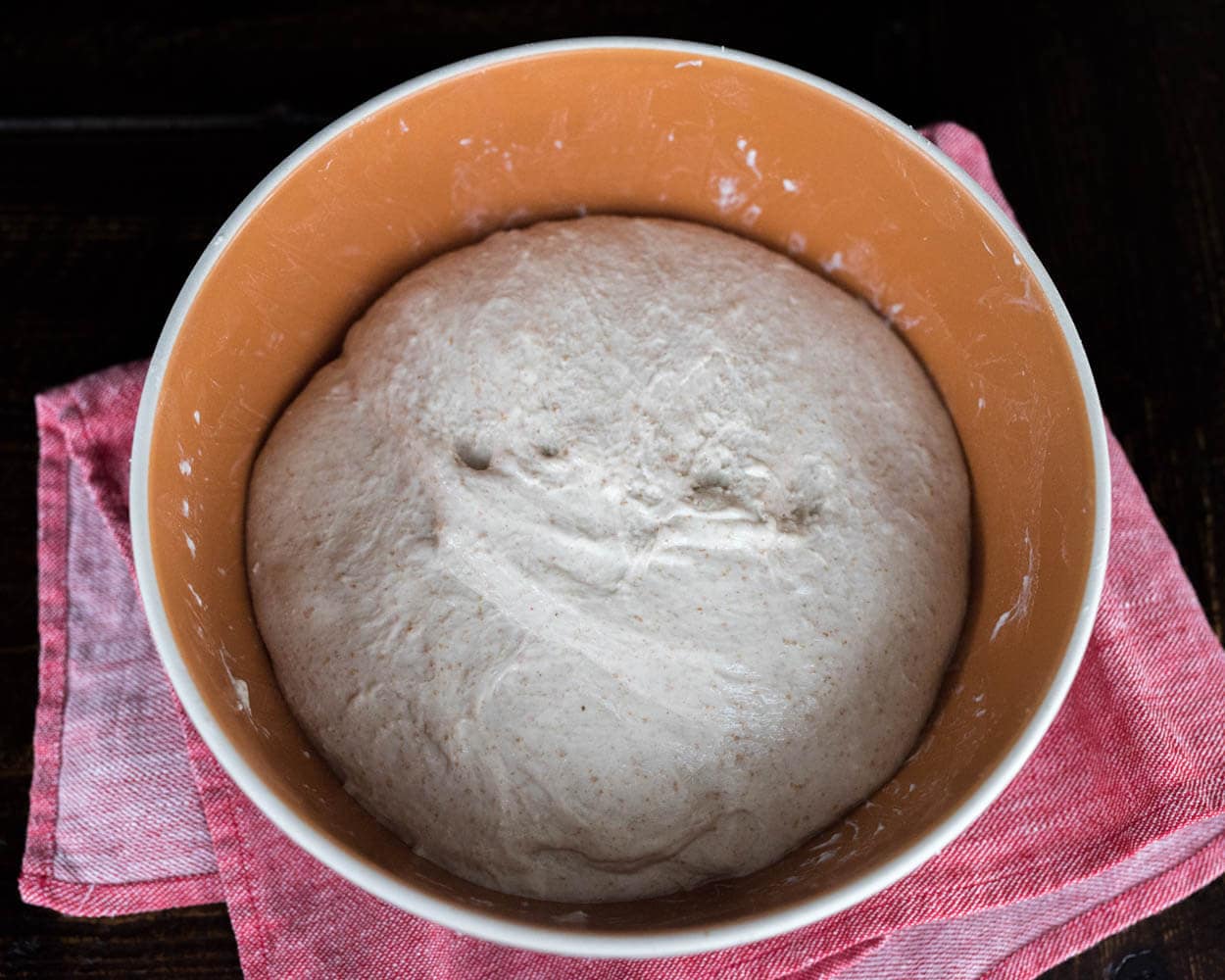
I stretch and fold more vigorously at the beginning of bulk than usual since it is extraordinarily slack and extensible (due to this recipe’s high hydration and autolyse). Pick up one side of the dough with both hands and pull it up, just before tearing, and fold it over to the other side. Rotate your container and repeat 4 or 5 times. That is one set.
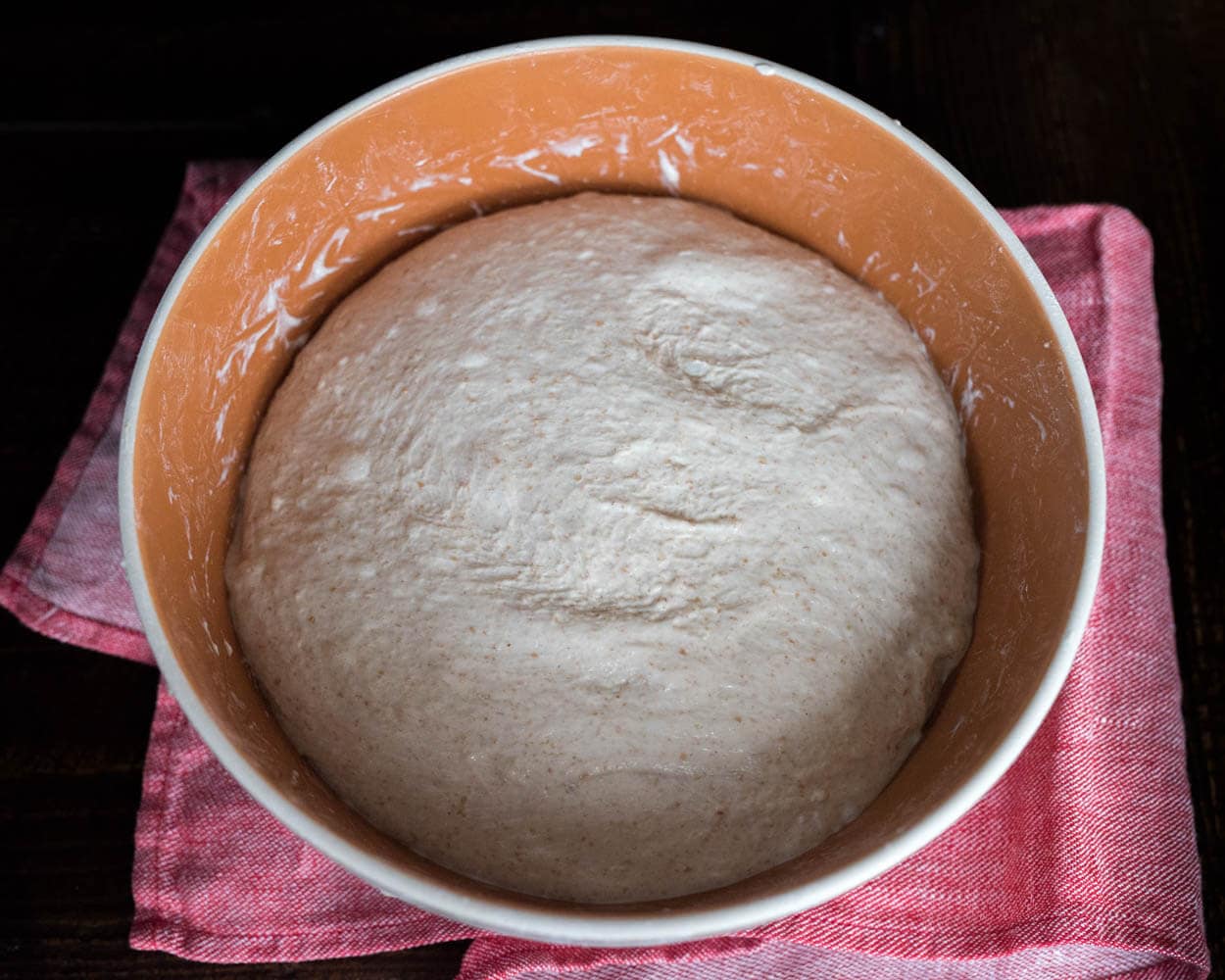
Above, you can see my best sourdough recipe dough halfway through bulk, after about 2 hours. There is no significant rise as of yet, but the edges are beginning to dome downward, and the dough’s texture is smoothing out slightly. We still have several more folds to do and more strength to build.
It is essential that the dough is kept near 78°F (25°C) as much as possible (minor fluctuations up and down are ok). If temperatures dip down too far, you might have to extend the bulk fermentation duration to compensate, and vice versa. Use your judgment, the signs described below, and be flexible.
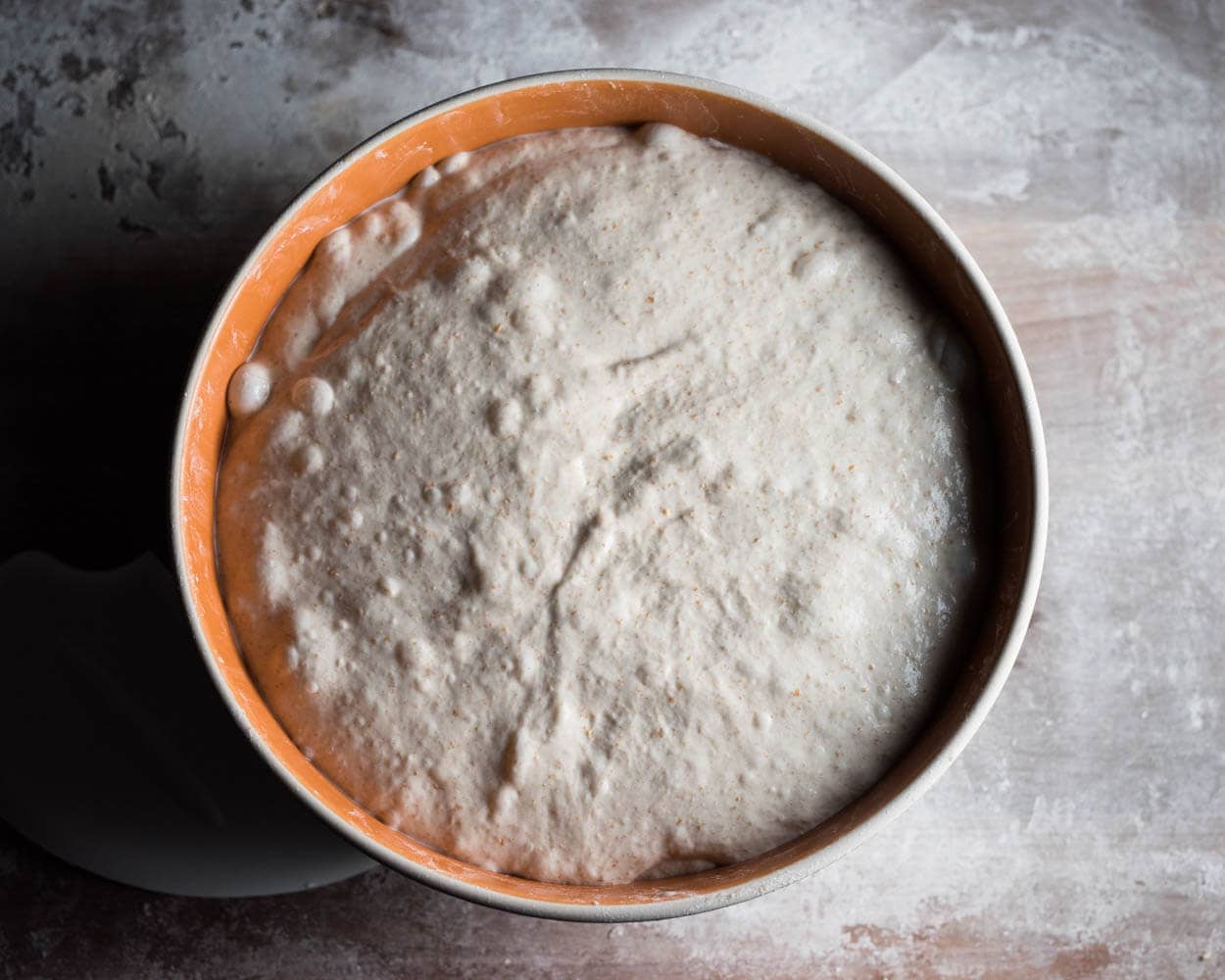
At the end of bulk, your dough should look very gassy, with some bubbles here and there, and the edges where the dough meets the bowl should be slightly domed. You can see all these signs in the image above.
When you gently shake the bowl, the entire mass jiggles from side to side—very alive. You’ll also notice that compared with the photo at the beginning of bulk, the dough is smoother and holds its edges, folds, and creases more readily (most of the bumps and ridges you see are due to trapped gasses from fermentation).
6. Divide & Preshape – 6:15 p.m.
Divide the dough into two halves and gently preshape each piece of dough into a round. Then, let the dough rest for 30 minutes, uncovered. Act quickly when handling this dough and rely heavily on your bench knife. I try to use my hands as little as possible when dealing with the dough at this point.
7. Shape – 6:45 p.m.
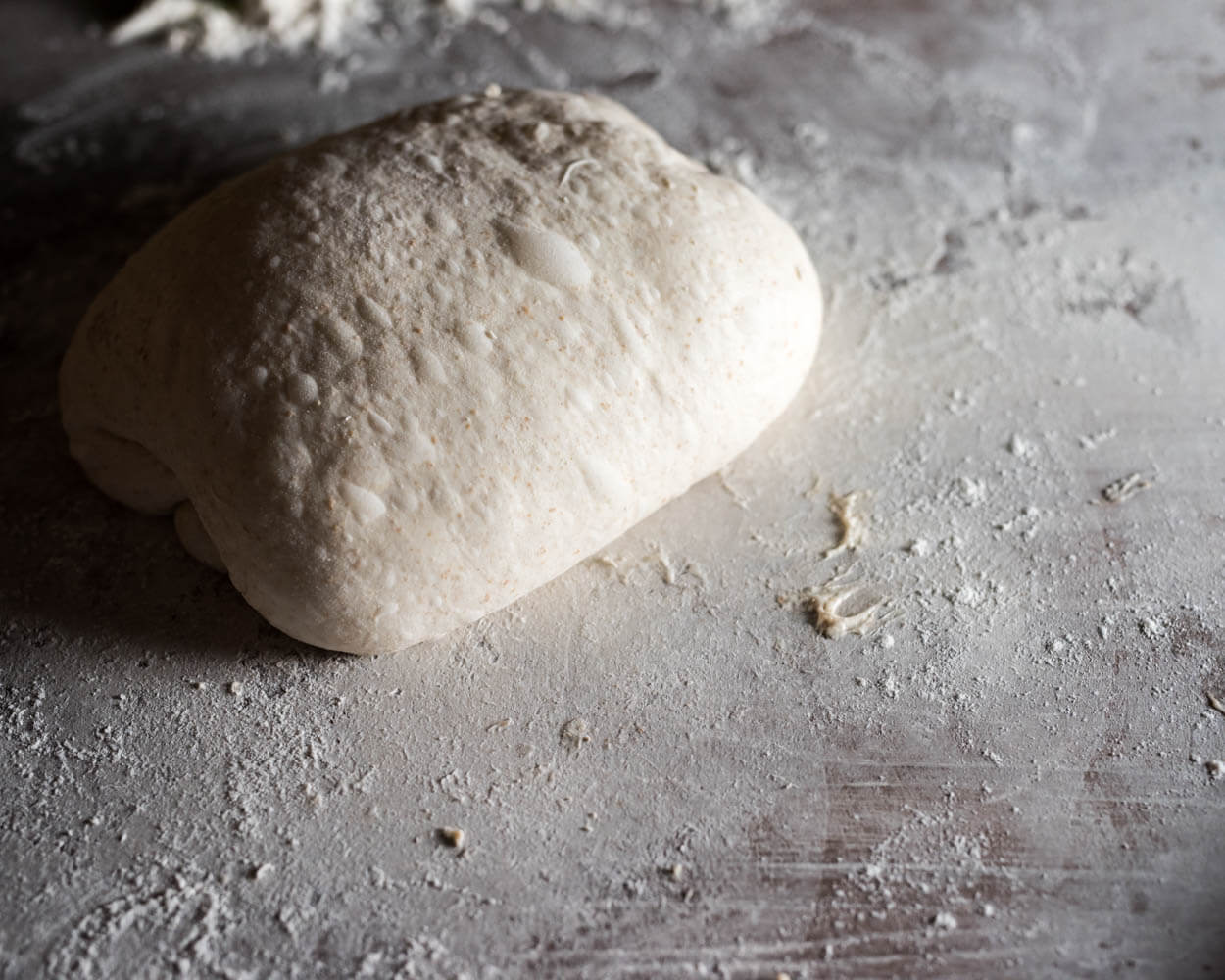
Lightly flour the top of your dough rounds and flour the work surface. With this recipe use a little more flour on the surface than normal, the dough will be extremely sticky and wet. Flip each round and shape into a batard (see notes below) or boule, whatever your preference.
Here’s a video of how I shape a bâtard. With this dough, be sure to use the “slack dough” shaping method since the dough is such high hydration.
I prefer to shape these as batards, and my shaping method is as follows:
- Flip pre-shaped round
- Fold the bottom up to about halfway
- Fold the left side over to about 3/4 to the right
- Fold the right side over to cover left
- Stretch top up & away from the center and fold down to about half (you’ll now have a “letter”)
- Grab a little of the dough at the sides near the top and stretch it over the center, so the dough crosses. Imagine lacing up a shoe where you first grab your laces and cross them over
- Repeat three times from top to bottom (the result will look like a laced up shoe)
- Take the bottom and gently roll the dough up to the top and try to seal it slightly when done rolling
Alternatively, if the dough feels pretty strong, you could shape it by “cinching” up the dough. For more instruction on how to shape this dough as an oblong loaf, see my post on how to shape a batard (with video!).
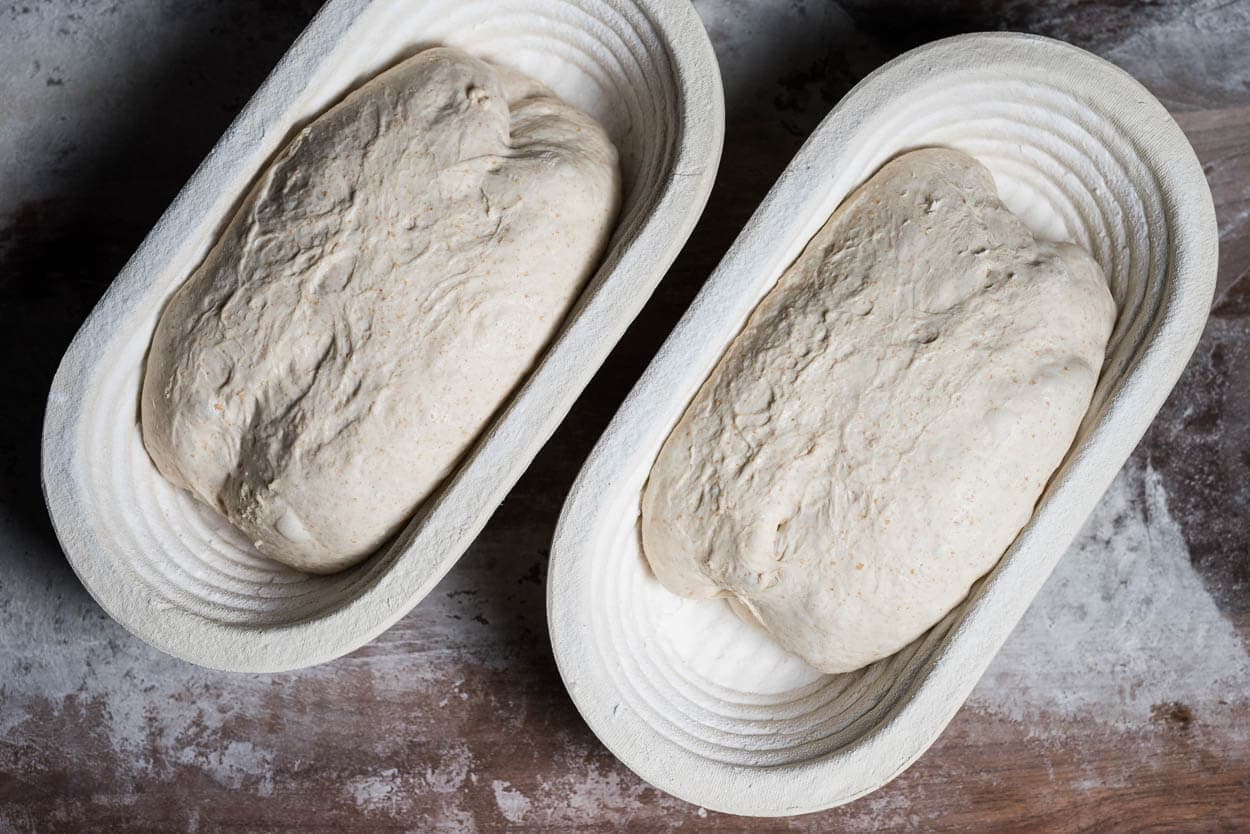
After shaping, let the dough rest on the bench for a few minutes and then place it into a banneton that is lightly dusted with white flour. You’ll see above my bannetons give the dough plenty of room to relax and expand in the fridge overnight. If your proofing container is on the smaller side, and you find your dough almost spilling over the edges, it might be time for a larger basket.
8. Proof – 7:25 p.m. to 9:00 a.m., the next day
Cover your banneton with plastic and place it in the refrigerator at 38°F (3°C) overnight.
9. Bake – Next Morning: Preheat oven at 8:00 a.m., Bake at 9:00 a.m.
Preheat your oven to 450°F (230°C). Remove the dough from the fridge (there’s no need to let the dough come to room temperature) and uncover. I scored the dough with a single, long slash to get that dramatic opening when baked. I keep the blade at a reasonably shallow angle so the taut skin created during shaping will “peel” back as the loaf rises.
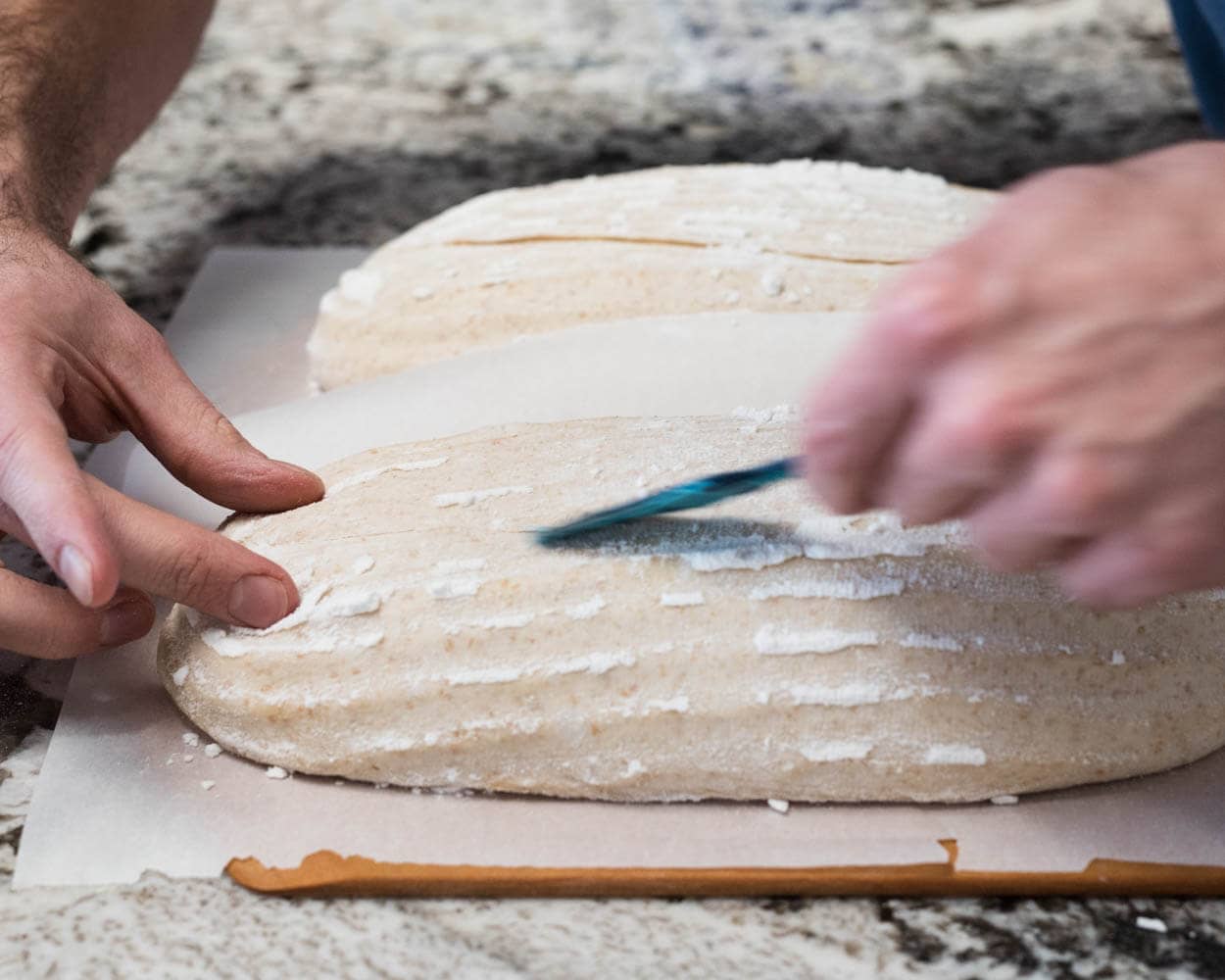
I steamed my oven in my usual way, described here in my post on how to steam your home oven for baking. But you can also bake in a pot or Dutch oven.
Bake for 20 minutes with steam, then remove your steaming pans if baking on a surface or Dutch oven/combo cooker lid. Then, bake for an additional 30 minutes until done to your liking. I like to bake rather dark, so I sometimes extend this second half of baking until I get the crust I’m looking for.
Once your loaf is done, remove and let cool on a wire rack for 1-2 hours. See my post on the best way to store the bread after it’s baked for a few tips on keeping it on the counter and freezing if you think you won’t get through both loaves in a week.
Conclusion
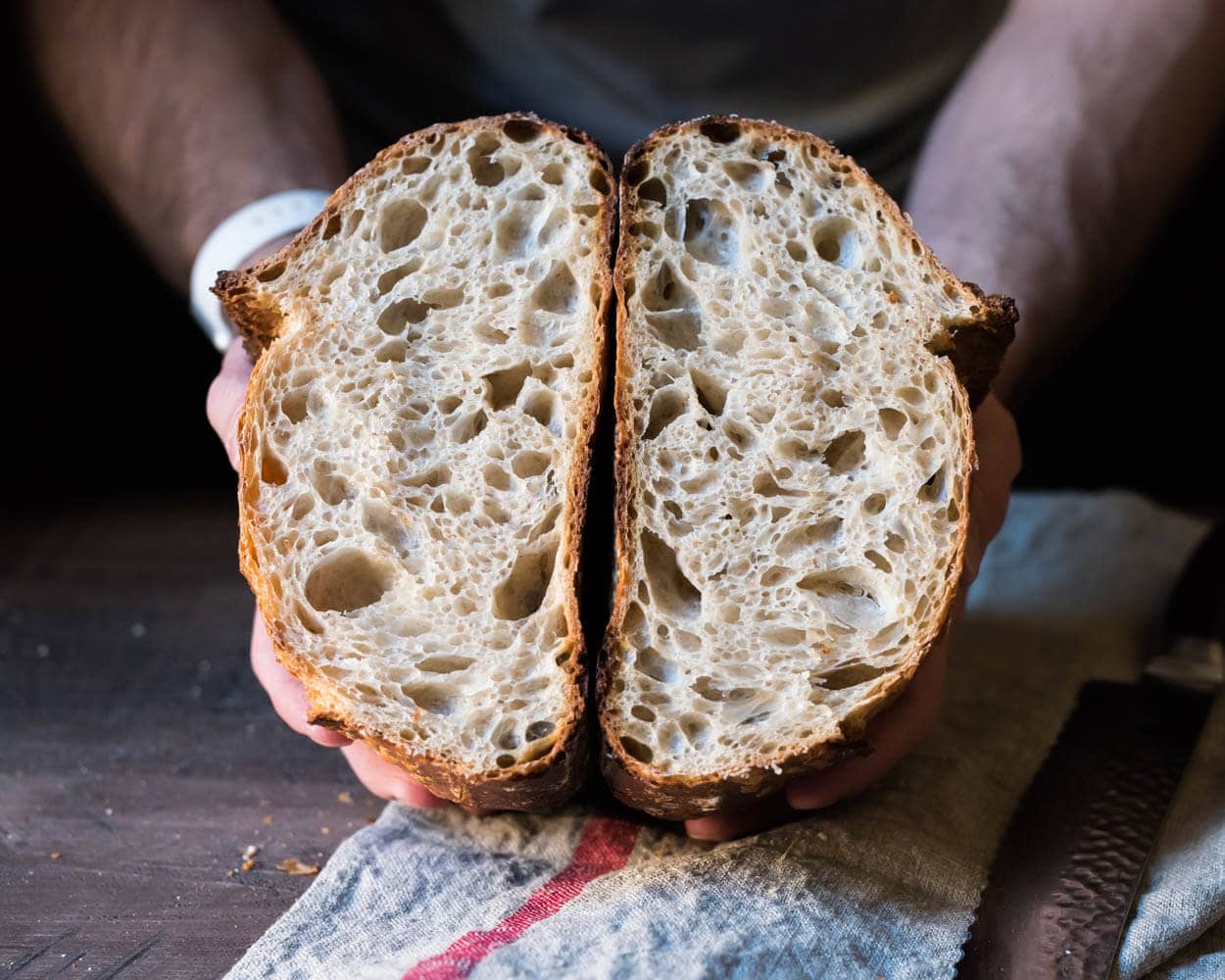
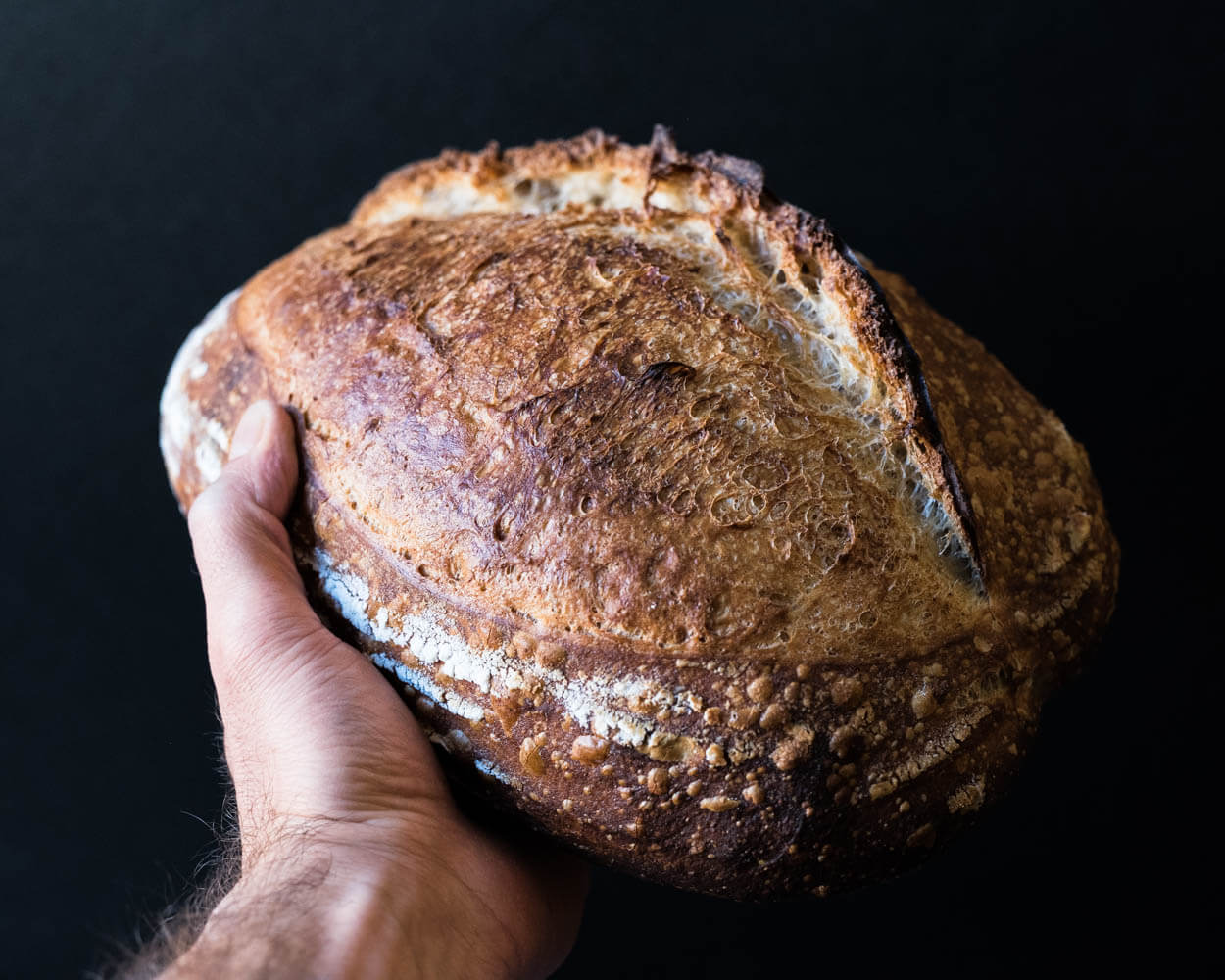
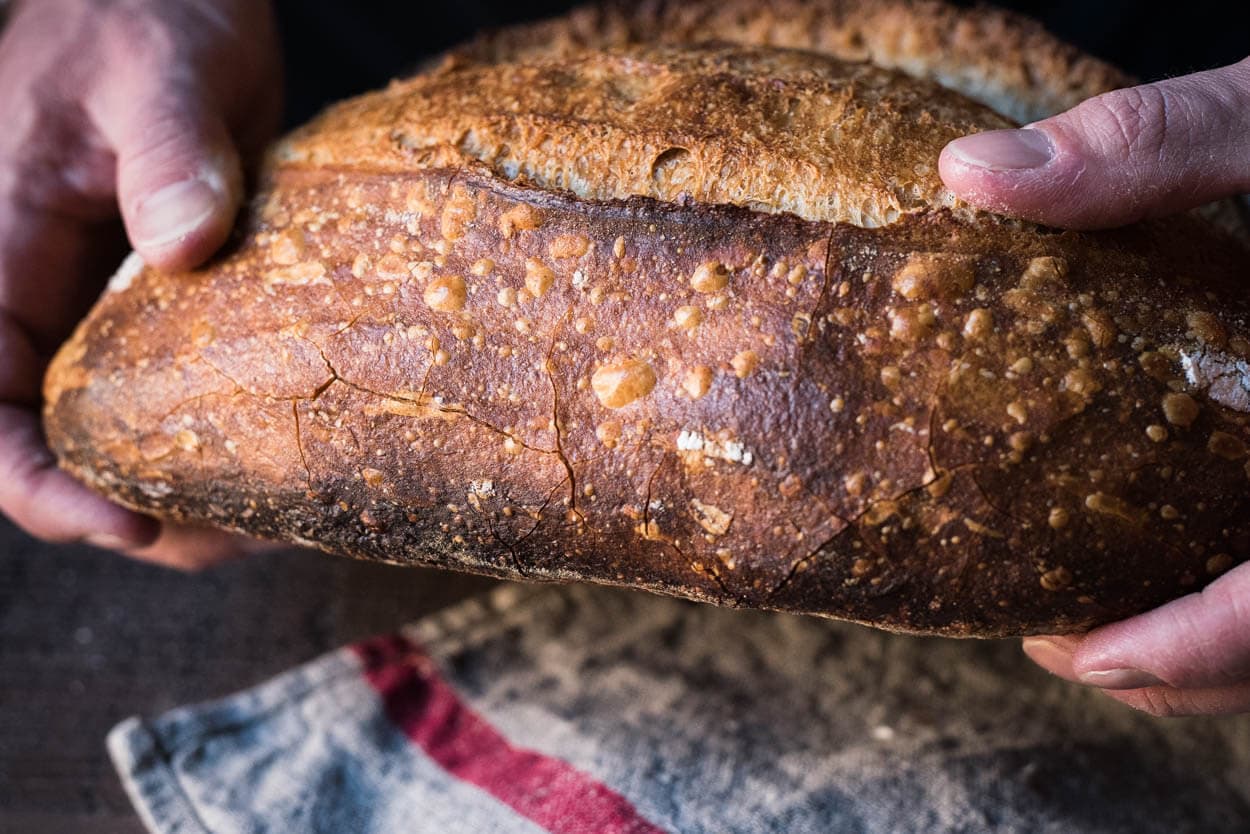
It’s hard to put into words just how much I enjoy this “my best sourdough recipe.” I bake it almost every week (sometimes multiple times if baking for friends and family), and yet every time I pull it from the oven, I smile. The crust color, the open and light interior, only the smallest perception of sour notes, and the way it crunches when toasted. I could go on and on.
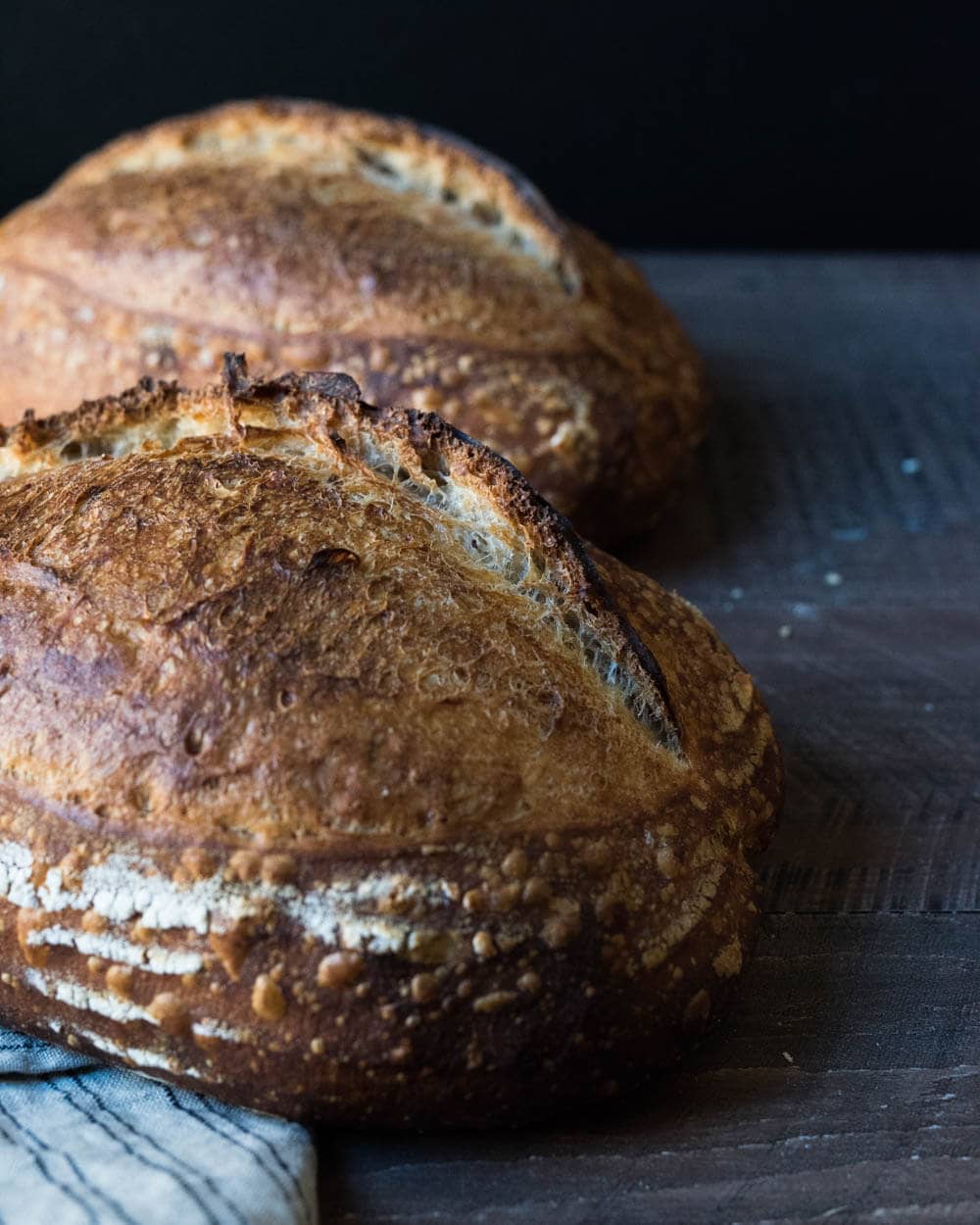
The photos to follow are the results of scattered recent bakes that all followed this process exactly and have a slightly different outcome. You’ll notice some are a bit darker, some have more or less flour on them, some expand differently in the oven, and some are taller and some are shorter—that’s the nature of baking.
With baking, every single bake is different no matter how consistent you try to be. It’s the same with my Dad and his Italian restaurant, and the reason I’ll sometimes get a call in the middle of the afternoon: “hey, the pizza dough is incredible today, you should head over and grab some.”
Crust
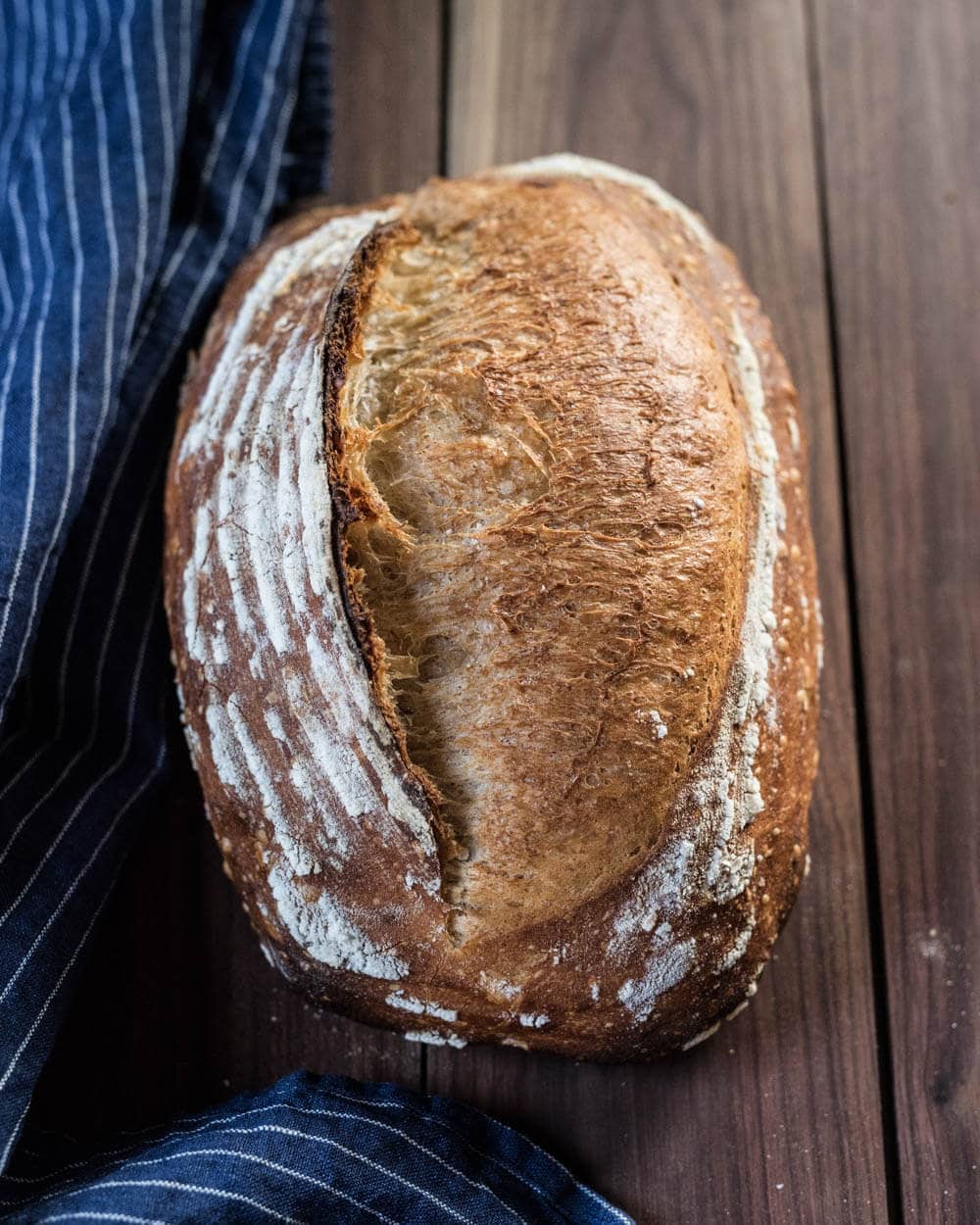
As a kid, I was known to take slices of bread, cut out the center, and eat the crust. It used to anger my family because they’d reach into the breadbasket only to find slices of only the soft parts. That’s how much I love the crust! Can you blame me, though?
I enjoy bread with a chunky, chewy crust, but this bread with its delicate and cracker-like crust takes the top spot for me. Even though I bake these rather dark, the crust remains thin and brittle, crackling under the slightest pressure. I love using the “heel” (the very end) of this bread to eat soup or combined with hefty slices of cheese. It’s delicious.
Crumb
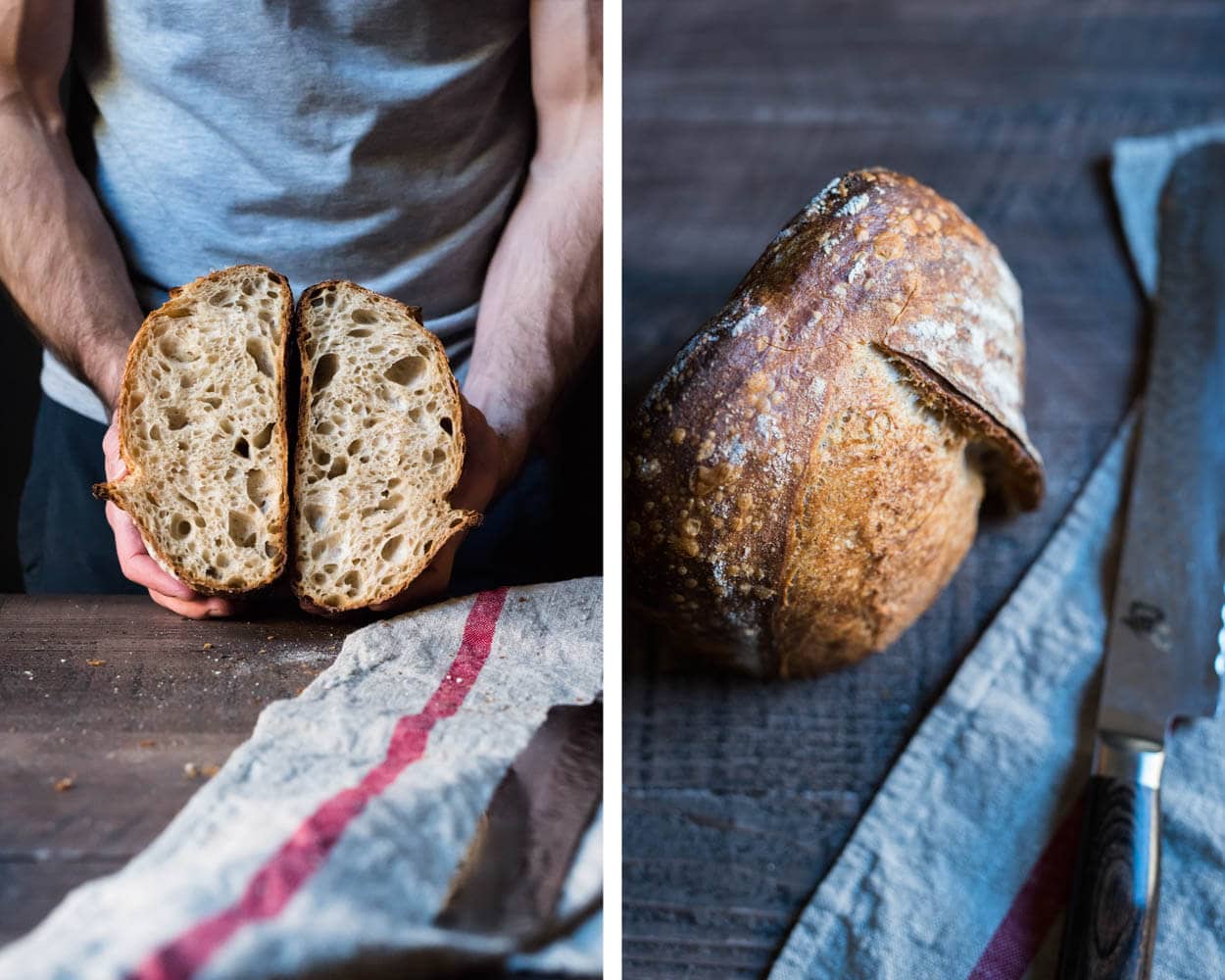
I think there’s a balance to be had with bread like this. It’s possible to let the crumb open up too much, but for me, this is just right. Scattered open areas with that translucent webbing spanning from wall-to-wall, a dynamic movement to these areas, almost show you how shaping was carried out.
Taste
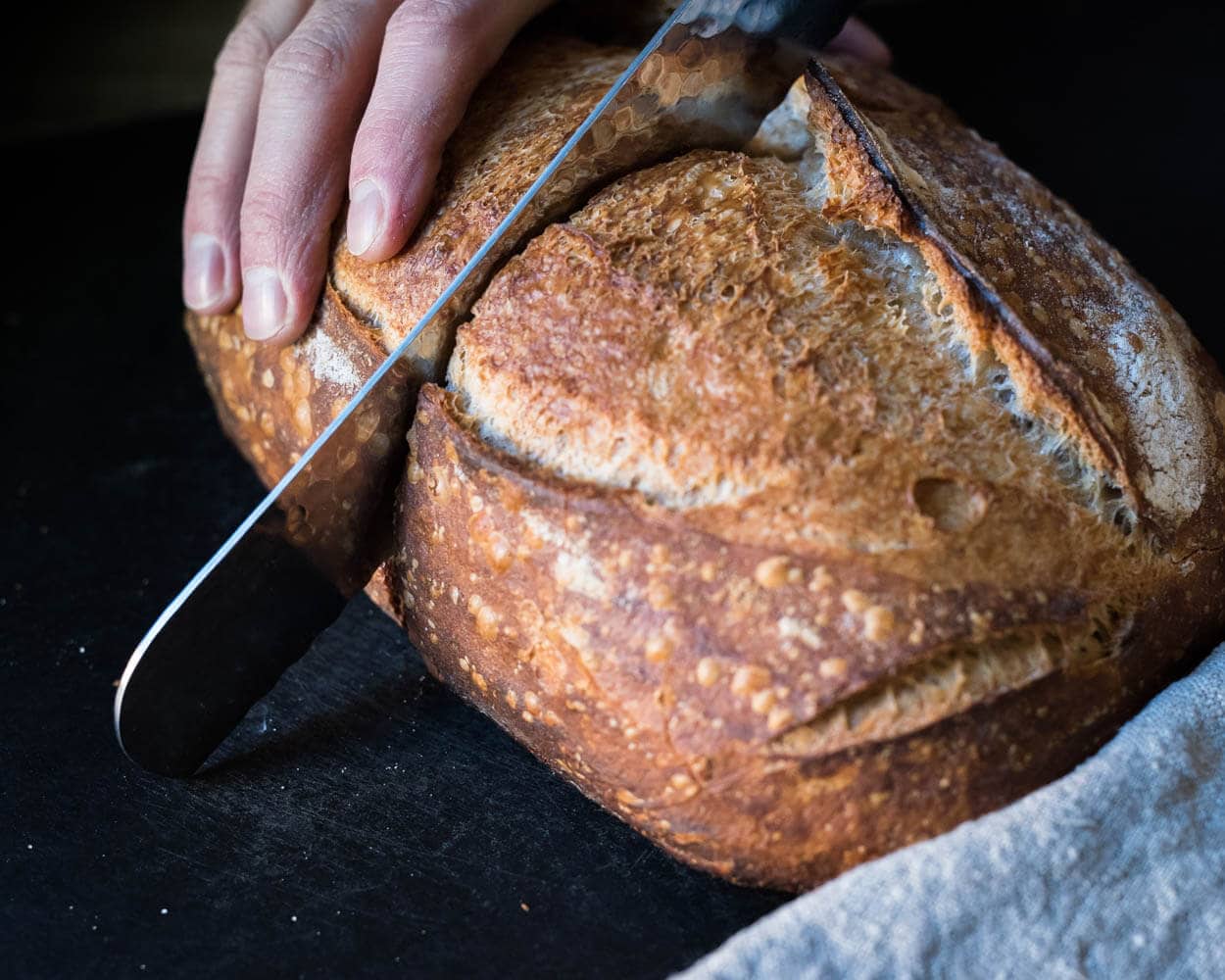
This bread has an almost imperceptible hint of sour, and because of this, the wheat flavors from the flour come forward. It has an incredibly tender, soft crumb that almost dissolves in your mouth. It’s one of those rare foods whereupon taking that first bite your mouth begins to water.
In the end, bread is just bread. But it’s also the staff of life and has been for thousands of years. It’s is also more than the sum of the ingredients you add to the mixing bowl. It’s how it makes you feel when you give some to a friend, and they grin ear-to-ear as they take a big bite. It’s the knowledge that you created this thing over a few days that once was a lump on your counter and is now an incredibly delicious food meant to be shared. To me, this is real bread and my best sourdough recipe to date.
Buon appetito!
Print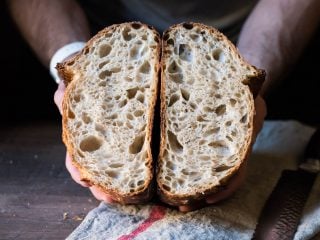
My Best Sourdough Recipe
- Prep Time: 24 hours
- Cook Time: 55 minutes
- Total Time: 24 hours 55 minutes
- Yield: 2 loaves
- Category: Sourdough, Bread
- Cuisine: American
Description
This sourdough bread is one of my favorite recipes. It’s a highly hydrated dough that results in a loaf with an open and lacey interior contrasted by a thin, crispy crust.
Ingredients
Levain
- 30g medium-protein bread flour
- 30g whole wheat flour
- 60g water
- 30g ripe sourdough starter
Main Dough
- 822g medium-protein bread flour
- 64g whole wheat flour
- 745g water
- 17g salt
- 151g ripe levain
Instructions
- Levain (9:00 a.m.)
In a small container, mix the levain ingredients and keep at 78°F (25°C) for 5 hours. - Autolyse (12:00 p.m)
In a medium mixing bowl, add 822g medium-protein bread flour, 64g whole wheat flour, 650g water, and mix until no dry bits remain. Cover the bowl and let rest for 2 hours. - Mix (2:00 p.m.)
To the mixing bowl holding your dough, add 95g water (holding back any as necessary if the dough is too wet), 17g sea salt, and the ripe levain (from step 1). Pinch and mix all the ingredients together and do folds in the bowl for 2 to 3 minutes until the dough smooths and is cohesive. Then, transfer your dough to a bulk fermentation container and cover. - Bulk Fermentation (2:15 p.m. to 6:15 p.m.)
Give the dough 6 sets of stretch and folds. The first three sets are at 15-minute intervals, and the last three sets are at 30-minute intervals. - Divide and Preshape (6:15 p.m.)
Lightly flour your work surface and scrape out your dough. Using your bench knife, divide the dough in half. Lightly shape each half into a round shape. Let the dough rest for 30 minutes, uncovered. - Shape (6:45 p.m.)
Shape the dough into a round (boule) or oval (batard) and place it in proofing baskets. Cover the baskets with a reusable plastic bag. - Proof (7:25 p.m. to 9:00 a.m. the next day)
Cover proofing baskets with reusable plastic and seal them shut. Then, place both baskets into the refrigerator and proof overnight. - Bake (Preheat oven at 8:00 a.m., bake at 9:00 a.m.)
I steamed my oven in my usual way, described here in my post on how to steam your home oven for baking. But you can also bake in a pot or Dutch oven. Preheat your oven with a combo cooker or Dutch oven inside to 450°F (230°C). Remove your dough from the fridge, score it, and transfer it to the preheated combo cooker. Place the cooker in the oven, cover with the lid, and bake for 20 minutes. After this time, remove the lid (you can keep it in the oven or remove it) and continue to bake for 30 minutes longer. When done, the internal temperature should be around 208°F (97°C). Let the loaves cool for 2 hours on a wire rack before slicing.
Notes
This is a very highly hydrated dough. Don’t add in all the reserved water during mixing if it feels like the dough is becoming overly weak, slack, or soupy.
What’s Next?
If you want more help getting an open crumb with this bread, I’ve created a 100+ page book with step-by-step instructions. Learn the best flour to use, the right fermentation schedule, and all my tips in my Bread Baker’s Handbook.
Are you a TPL Member? If so, the handbook is free for you!


2,173 Comments
Hi Maurizio,
Many thanks for this detailed and beautiful recipe! I tried it with a little less water (~78% hydration), and it all worked out great – the gluten development, the fermentation, the oven spring and the holes in the crumb. But unfortunately the crumb came out pretty sticky. Not dense, but sticky. What could cause such stickiness? I’d really appreciate your advice. Thanks!
Hello, Mauro! You’re very welcome, glad to hear it worked out well for you 🙂 An overly sticky crumb is usually due to underbaking. Try to bake your loaves longer to ensure they are fully cooked on the inside. If you have an instant read thermometer, insert it into the bread when you think it’s done to ensure the internal temperature is over 210ºF.
If you find the outside of the loaf burning too quickly you might want to try turning the temperature down a bit, perhaps 15-25ºF, so you can bake it longer without burning the exterior. Each environment and oven are different, so your bake times could be slightly different than what I list here!
Happy baking — keep me posted!
Hey Maurizio!
I tried this recipe using King Arthur bread flour and Josey Baker red wheat. When I released the bread from the banneton, it wouldn’t keep shape and ended up spreading like crazy. I wonder if this was a result of overhydration, but I did follow the recipe practically to a t. The dough didn’t feel overly sticky but it was certainly wet. Any ideas?
Hey Matthew! Yes, this is sometimes a sign of over hydration. The dough should be sticky but it should still feel strong by the end of bulk, it should want to stay together instead of spreading super fast. It’s also possible the dough was fine with the hydration but the proof might have been too long (or at too high of a temperature for too long), in which case the dough would spread quite a bit because the gluten in the dough has broken down under the long fermentation time.
If you feel like the proof time and temp were ok (I list my time and temp above) then I would try to reduce the hydration by 5-10% next time and see if that helps. I do know KA bread flour can take on a lot of water, but perhaps your particular batch and/or environment was too much for it.
Let me know how it goes (sorry for the late reply)!
I am having fun with your recipe on a rainy weekend, and all is going well. Your bannetons look ceramic rather than reed. Can you confirm and the best sorce?
Glad to hear that! The bannetons I used here are actually wood pulp (kind of like paper). I picked them up at Breadtopia.com — they’re nice!
Do you put the cold dough right into the oven out of the fridge or let it warm up a bit before baking?
Arthur — I almost always bake my dough straight from the fridge, no warmup time is needed.
Thanks. That’s what I did. I used the full amount of water and is was a bit too hydrated — didn’t hold its shape out of the brotform. But it still rose nicely and was absolutely delicious with a beautiful crust.
That’s fantastic to hear! Next time drop the water a bit and see if that helps the dough hold more shape. Happy baking!
This is so good…have made it a few times. Yum!
My 9 year old is asking for cheese in her sourdough. Any suggestion about how to add cheese to this recipe?
Thanks!
Awesome! As I’ve said, it’s one of my favorites 🙂
I’ve never added cheese to my bread before (!!) so it’s hard for me to say. I would probably recommend grating or shredding it and then adding it in during bulk, perhaps after the second or third set of stretch and folds — much like you’d add nuts or seeds.
Just an idea, I would have to experiment more to say for sure. Hope that helps!
Thanks, I did make cheese bread: Before putting the dough into the banneton and the fridge, I took the dough and rolled it open onto on a cutting board, poured in ~1/2-3/4 cup grated cheese, and rolled it up again (with the cheese inside) and put into the fridge to rise overnight. Baked as usual. Excellent!
Oooh that sounds fantastic! I will have to give this a try 🙂 Thanks for the update!
I’ve been baking sourdough loaves for around 6 months, with good results (especially since I got the Forkish book), but I have been struggling to get the open, airy crumb seen in this recipe. So I tried Maurizio’s method and the results were fantastic! I live in the south of Brazil, and I’m not sure whether it’s the flour here, or the altitude (900m), or what, but I had to adjust the balance of flour and water. The first time, the dough really was a soup, and at the folding stage I had to add 30-40g of flour even though I had used slightly less water than in the recipe. The dough turned from a soup to a wet mass and that worked fine. The second time, I decided to use 40g of whole wheat, 40g of rye and 40g of porridge oats (rather than the 73g of whole wheat in the recipe). The results were wonderful! I don’t have bannetons (impossible to get in Brazil) so my loaves aren’t shaped as beautifully as Maurizio’s, but the taste is great. Thank you so much for sharing your bread-making wisdom with us.
Your modifications sound great! We all have to adjust things to suit our flour and our environment — yours is very, very different than mine here (I live in the desert at 5200 ft. elevation!). I’ve read that a lot of the available flour down in South America is of lower protein so it can be a challenge to get a really open crumb, although there is definitely much more that goes into it than just protein percentage.
As far as the shaping goes, you’ll get there! It definitely takes quite a bit of practice, especially when there’s a super high hydration.
I’m really glad to hear your bakes have turned out well, thank so much for the update and happy baking Douglas!
You’re welcome; this weekend I made your whole wheat sandwich loaves recipe. Fantastic as well.
Awesome, thank you! I make that recipe every single week and just love it 🙂
Hi Maurizio, Thanks for doing all this great experimentation that we can learn from! I’m enjoying the challenge of working with high hydration dough; the folding technique in particular works great to ‘tame’ the wet dough! I had a question about the sequence of bulk fermentation and retarding the dough that maybe you can answer. I noticed in Flour, Water, Salt, Yeast that Ken Forkish follows the same sequence you describe of short bulk fermentation, shape into loaves, then retards the shaped loaves overnight in the fridge; but he uses this sequence only when he supplements his levain doughs with baker’s yeast. By contrast, in his recipes for ‘pure levain doughs’ he alters the sequence by doing bulk fermentation overnight in the fridge, then shaping/proofing the next day before baking. He doesn’t really explain why the change in technique is needed for pure levain doughs, so I’m wondering if you have any explanation. I’m sticking with your technique since it’s more straightforward, but was curious if you’d come across this in your experiments.
You’re very welcome! You can do the overall process either way, with a cold bulk like Ken or a warm bulk like I perform. There are pros and cons for each, and for some doughs a cold bulk is almost necessary (like for a 100% fresh milled whole wheat dough), but in the end they both need get to the same result of a fully fermented dough that is strong and active. A cold bulk can be a little easier on shaping the next day as the dough will be colder when it’s divided — this can help with extremely wet doughs that can be trouble to preshape/shape when they are warm. A warm bulk lets you preshape/shape the same day and retard the dough in shape so the next morning all that’s required is a slash and a bake (best for those early risers :)).
I’d say go with the one that best fits your schedule and know you can employ either technique depending on the time you have and what’s most comfortable for you. I rarely do a cold bulk mostly because I prefer my schedule and the way the dough develops.
I hope that helps!
Thanks very much for clarifying, Maurizio. While I enjoy the challenge, I’m really having a lot of trouble getting the high hydration dough to sit up straight during preshaping and shaping, so maybe I’ll try a cold bulk to see if shaping the cold dough makes it a little more manageable. If that doesn’t work, I may try reducing H2O by 5-10%, though I really liking the taste and texture you can achieve with high hydration. Thanks again!
You’re very welcome — either approach is a good one! Happy baking, Ian 🙂
Hey Maurizio! I love this recipe and have been trying to perfect it for a few months now. Today I baked off what I believe to be my best breads yet. Once I cut them I’ll know for sure. The crust is that perfect crisp thin. I baked off two loaves. One will be eaten today, but the other will either be for tomorrow or Monday and Tuesday lunches. How Can I preserve this bread for a day or two. Every time I make this bread the next day the crispiness is completely gone. As a chewy crust it is fine, but crispy is what makes this bread. Any storage solutions would be appreciated!
That’s great news, so glad to hear it! It can be hard to maintain the dry, crisp crust on bread several days after the bake. Depending on your environment your bread will either dry out or become more soggy as it’s exposed to the humidity in your air. Where I live the bread becomes incredibly dry a few days after and thus I keep my bread in a bread box or paper bag to help retain moisture. It sounds like you might live in a more humid environment and would recommend keeping your bread just out on the cutting board. If you slice it in half keep the sliced, interior face down so the only part exposed to air is the crust (a sort of natural protection to keep the crumb as it should be).
I hope that helps!
Hello again Maurizio, I have been baking by your recipes for some months now (about to delve into the spelt recipe with my freshly milled spelt) but can’t seem to get a loaf that isn’t a bit overdone at the bottom. Firstly, I can never do the full baking time that you recommend. It makes for burnt loaves for me. I know my oven runs a touch hot, and so I have tried turning down the temperature even lower than you recommend after the first 20 minutes, and I bake for less time in the second stage, but that doesn’t quite do it either. Any suggestions? Or am I missing something here? I should mention that I don’t have a Dutch oven. I use cast iron pans with a steam tray. I have also tried baking on a regular baking sheet, but that doesn’t help either. Would love your thoughts! Many thanks!
Glad you’ve been following along for a while now! I do find that when I bake with a Dutch oven the bottom of the dough can easily get overdone. I know you said you’re not using a DO, but it could be a similar issue if you are using cast iron pans — there are a few things we can try.
First, I usually lower the preheat temperature and/or time in my oven when I use a DO. Instead of preheating at 500ºF I’ll usually drop this down to 475ºF or 450ºF. As you mentioned, each oven is different and also sometimes ovens can misread temperatures (you can grab a cheap ambient oven thermometer to help ensure you’re setting the right temp), so a little trial and error can help deduce what temperatures work for you and your oven.
You can cover the bottom of your loaves with something to help prevent burning. Some bakers will use coarse bran or cornmeal for this purpose. Before you place your dough into the pan sprinkle a row of bran/cornmeal in the pan then place the dough on top of this.
If you’re baking on top of baking stones with a cast iron pan as well, remove the baking stones or place the pan on a rack above them. The cast iron pan will retain plenty of stored heat and the baking stones are nice to keep ambient heat high in the oven but can release too much heat when a pan is placed on top.
Finally, If your oven has its heating elements at the bottom try moving up your rack so it’s further away from the direct heat.
I hope one of these suggestions helps! Let me know if any of them work out for you 🙂
I have just tried it today, my first ever sourdough bread. It is simply the best bread I had in the last few years, thank you for the great recipe and detailed description, it helped a lot!
You’re very welcome, glad to hear that! Now you have a never ending supply of good bread, just need to stock up on butter 🙂 Happy baking!
I just made this recipe for the first time. I want to tell you how delicious it is, it is the best ever! Thank you Maurizio, you have no idea how much I look forward to eating this bread.
SO glad to hear that, Kris! Thanks for the message and I’m happy it’s worked out so well for you. Enjoy and happy baking!
Thanks so much for all of these wonderful recipes! I’ve made this recipe a few times and I have my first ninety-five percent whole grain sourdough in the oven now. Yum! My question is about temperature. We live in the SF Bay Area, and the temperature in our home is generally around 69-70 degrees. I don’t have a warm place in my kitchen or anything like that. How should I be adjusting these recipes? Generally I do build the levain the night before to give it extra time. I can make my water hotter than you suggest in the recipes but don’t want to make it too hot. interested to hear any thoughts you have. Thanks!
You’re very welcome! Happy to hear my recipes are working out so well for you.
When temps are low, near 70’s, it typically just means things will take more time. It means you’ll have to adjust each step of the process just a bit until the dough is ready. In other words, as they say: “watch the dough not the clock”. 🙂
Using warm water for your dough mix helps significantly and I always find myself doing this. Typically I’ll use water that’s around 90ºF and that works out just fine.
Another thing you could do is to keep your dough, in its bulking container, in the oven (turned off) with a light on inside. If you have an ambient temperature thermometer toss it in there as well so it doesn’t get too hot. I’ll just about always do this as well, the oven acts as a really nice, sealed and isolated environment for your dough.
I hope that helps!
Thanks for the response, very helpful! Again, really enjoying this site.
Hi Maurizio!
I tried yours “Best Sourdough Recipe ” and thought the process was fine until the end of fermentation. The dough´s surface did not seem to smoothe and seemed to me a little too wet. As the temperature here is around 65 F, the bulk fermentation took eight hours and still had not found conditions to shape the dough. The levain (your recipe) was very active and the dought also showed some bubbles during fermentation.
Should I adjust the recipe to use less hidratation?
Hello! Yes, it sounds like you should reduce hydration and see how the dough looks and feels at the end of bulk. During bulk fermentation the dough should smooth out and become stronger as you do stretch/folds and also the process of fermentation itself will strengthen the dough.
I’d reduce hydro next try and see if that helps!
Hi Maurizio! Thanks, its great to have this helpfull comment’s channel.
I’ve reduced hydro to 70% and still have not get the smooth surface on que dought at the end of the bulk fermentation, nor did it grows twice its size.
It should be some problem with my levain, shouldn’t be strong enough. It grows twice its size in 7 hours, with usually small bubles. I’ve been feeding it a month always twice a day, discarding half, but could not managing to see intense activity in it.
Hi Maurizio-
Over the past few weeks I’ve successfully made a starter and a few loaves of bread using the information from your site, and it’s all turned out wonderful on the first shot – so thanks for that!
I finally got up the courage to try your “Best Sourdough” recipe. The crumb and taste were absolutely as you described – simply incredible. However, the crust was a bit tougher – not bad by any means, but not brittle or thin.
Any idea on what I might do better? I’ll be the first to admit I’m not yet very skilled at shaping, particularly with high hydration dough. Could it have been a shaping error? Also, my starter is quite new – about 3 weeks – should I expect better results as it gets stronger over time? What else might help?
Thanks-
TJ
TJ — that’s awesome news! Really glad to hear that.
I don’t think your starter will have much to do with it, shaping is not likely either. I’ve found I get the best crust when I fully preheat my oven (and baking stones/steel or Dutch oven) for 1-1.5 hours, bake the loaf hot at the beginning and finally have ample steam in my oven. If you’re following my post on steaming your home oven then you should have plenty of steam in there. For heat I like to preheat for 1 hour or so at at least 500ºF and I load my dough quickly and shut that door as soon as possible so not too much steam & heat escapes.
If you’re baking in a Dutch oven I do notice even my crust is a little thicker when using that, I’m not sure what the cause for this is but that is usually the case. Perhaps the dough is at a constantly hot temperature for a long period instead of a major blast of heat at the beginning with a trickle down to lower temperatures.
I hope that helps. Sorry I don’t have a 100% sure fire want to improve on this!
Thanks Maurizio! I plan to bake it again this weekend – I have been using the dutch oven, so I will try one in the oven and one with another of your steam methods and compare. I’ll let you know how it goes. Thanks again!
You’re very welcome!
Maurizio-
The oven steam worked! Great crumb, and the crust is now nice and crackly. Thanks!
TJ
Awesome!! So glad to hear that, thanks for reporting back. Bake on!
Hello, Maurizio!
I wanted to tell you that I made this recipe with dark rye in place of the whole wheat, and high-gluten in place of the bread flour. Added 2tsp. rye flavor, and caraway seeds. It was very nice. However, because of the high-gluten flour, the crumb was a little more closed. I think I will try it without the high-gluten flour, to see if I can get away with it. I am thinking that with the lack of structure in rye flour, I may need to add back some high-gluten flour to pull it off, but I would like it very much if I could just use bread flour. I want to keep the hydration the same.
Anyway, I thought you might like to know that I looked for a good sourdough rye recipe, but I just love this recipe so much that I decided to use this recipe as a base, and experiment from there. I just couldn’t get myself to use another recipe.
Thank you!
-Casey
Hi, Casey!
Sounds delicious to me! I’ve been meaning to try adding in some rye flour to see how the flavor profile changes, I bet the addition adds some real flavor. I almost feel like the “bread” flour should be enough, without the addition of any more high-gluten flour. Bread flour typically has protein levels around 13%, which is pretty high compared to what I usually use… Would take some experimentation.
Thanks so much, I’m really happy to hear you’re enjoying my recipe! This still is my favorite one to bake 🙂
Happy baking!
Hello, Maurizio. I admire your bread and for several months trying to bake this bread, I clearly follow your instructions, but my bread always turns sticky crumb. I ask you to help and advise what mistakes can lead to such a defect? I would be very grateful!
Thanks! Usually a dense interior is due to insufficient fermentation. Pay attention to the Bulk step outlined above (the times and temperatures and how your dough should look & feel by the end) and also the final proof step. Your dough needs to ferment for the times listed above and also warmer temperatures help significantly. Remember to treat temperature as just an important ingredient as anything else!
Before this, though, make sure your starter is rising and falling predictably after you feed it. I like to feed my 2x a day the day or two before I bake with it to get it really strong and active. If you haven’t checked out my posts on starter maintenance have a look (click the recipes link at the top and then it’s under the Starter category).
I hope that helps!
Woooowee! I am amazed by this recipe. I am a newcomer to sourdough — really to any bread baking of an earnest effort — but I am a fanatic already. I have read many of the books referred to often as the ultimate sources (Tartine, BBA..), and was all geared up to make Robertson’s country loaf for the first time this past weekend. And then I found this last week. I had to try it. Having made only very few (I could count them on one hand) sourdoughs and never with a 100% wild starter (the satisfaction!!), I fully expected to be disappointed simply by virtue of the fact that my hands are inexperienced with such a wet dough and my intuition has not been fully awoken to be able to read when my bread dough needs to be treated differently than the recipe instructs. But..nothing ventured, nothing gained. So I jumped in the deep end! My bulk ferment had to go a good hour longer than I planned (thank you for your excellent descriptions and photos..really helped guide me), and the shaping was, well, not my most mannerly of moments. $#@! But I did it! How fun and gratifying. My husband, best friend and I devoured an entire loaf slathering goat’s cheese and raspberry preserves on this incredible bread. Thank you for your wonderful website! I’m a fan. Hey, if you got me to veer off course from Robertson’s loaf and I’m still smiling, you must be doing something right! I wish I could post a photo — ears! open crumb!! 🙂
Thanks for the comments! I love your recount of this first attempt and I’m really happy to hear it turns out so dang well 🙂 You hit on a good point though: sometimes “life” gets in the way of things and we have to adjust as necessary. A lot of baking has to do with that, and as our experience and intuition grows we’re able to adapt ever more.
Thanks again and I’m really happy to hear my site has helped you make such wonderful sourdough — stoked! Happy baking 🙂
Next weekend, I am going to try my hand at a spelt sourdough with a grain/seed soaker (using your spelt recipe as my northern star) and your gorgeous seeded rye recipe. I’ve got gorgeous, thriving spelt & rye starters thanks to you. Yes, it’s official. I’ve gone bread bananas. Thank you, Maurizio & happy 3rd anniversary of this fabulous site.
Thanks I appreciate that! Sounds like some good bread to me! I totally understand how it is to be completely taken with sourdough… it’s so satisfying 🙂
Happy baking!
Hi Maurizio, I’ve baked this recipe three weeks in a row now, paying ever closer attention to detail (especially since it’s actually now summer in London), taking lots of notes, and doing lots of research. I’m sure you can relate. The crumb is lovely and the taste is fantastic, but dammit I cannot get this bread to spring! Shaping is my weakest spot at the moment- could it mostly be down to a lack of strength and structure? Should I take a step back and maybe practice shaping again with a slightly lower hydration dough? By all rights I’m still a real beginner with little more than a year of sourdough baking under my belt, it’s seemed lately that I’m getting worse! Nevertheless, I’m still gonna throw my hands back into this dough again next week. Thanks for being such great inspiration.
Hi there! There’s a balance to be had here, and especially with a higher hydration bread like this one, where the increased hydration starts to compromise your oven spring and reduce the height of your bread. The higher the hydration the more strength required in your dough (during mixing, bulk and shape) to get it to spring up properly, but even this has a limit. Yes, I think the best approach would be to lower hydration by say 10% and work that until you get the height you’re looking for. Focus on building enough strength in the dough (you might need less now that the water has been reduced) and shape tight enough so the dough rises properly in the oven. Once you’ve got that under your belt work up the hydration until you get to the taste and look you’re after.
As I mentioned in this post it’s all relative to the flour you’re using as well. It might be that your flour isn’t able to take on the same level of water as mine (or due to environmental changes) — and that’s ok! In the end it’s 90% about taste and 10% about aesthetic, but I know how we all strive for that “perfect” loaf 🙂
I’m glad I could help and I hope these comments do as well! Please let me know if you have any more questions and keep me posted on how it’s going!
Hello Heather, as I read your post i would love to ask what pan you using as I can see you from England to.
I have iron cast tefal pan with lid, but it’s about 4.7l which results my bread to spread more. I am not seems to be lucky to find the right mesurment lodge anywhere in UK (3.6l)
So was you lucky to find one? Thank you
Hi Veronika- I have the Lodge Combi Cooker: https://www.amazon.co.uk/Lodge-litre-quart-Pre-Seasoned-Cooker/dp/B0009JKG9M, which is available here, but I brought over from the States. It tends to be an adequate size for a boule up to 1kg.
Hi Maurizio. Again, thank you so much for this website! I have a question — My first loaf of this bread, as well as the 100% whole wheat bread, turned out phenomenal. If I could show you a picture, you’d probably be proud 🙂 Anyway, ever since those two wonder loaves, I have had miserable hockey pucks come out of the oven. I threw away my starter, thinking I’d killed it (I forgot to feed it one day, and it looked terrible). I made new starter, just like the first one I made, and I’m still not having luck. My loaves (both white and wheat) taste delicious, but have very little oven spring. I’m following your recipes, just like I did with my awesome loaves, but no luck. I’m beginning to wonder if I bragged too much when those first ones came out of the oven (even dreamed of supplying local restaurants with gorgeous bread)…
Wendy — you’re welcome! Really glad my site has helped! Bragging is ok 🙂
Did you change flour (even if it’s the same brand, but different bag) between the good and bad loaves? Each flour, even different bags, can display slightly different characteristics — especially water absorption. Usually it’s pretty minor, but every once in a while you’ll snag a bag that is just wildly different. You want to try and internalize how the dough feels when you mix it with water, this comes with time and experience but after a while you’ll be able to spot when your mix is “too wet” or “too dry” and you can hold back or add water as necessary.
Aside from hydration changes make sure your starter is indeed healthy and strong. You want to see a consistent rise and fall (as I describe here in my sourdough starter maintenance post, if you haven’t had a chance to read it) and significant fermentation activity in there with lots of little bubbles. Try to feed your starter at a consistent time each day, for example, at 800am and then 800pm. Do this for a few days before a bake to help your starter get ramped up and ready to go. My maintenance post goes into detail with schedule and what to look for.
From there I’d say really try to focus on each step of the process and try to relate it back to my post here, things should look similar (in terms of dough development, fermentation activity, etc.). If the interior has a bunch of little holes throughout then that’s a good sign fermentation is on track but perhaps the dough has been over-hydrated, or there wasn’t enough tension built in the dough through stretch and folds at bulk, and finally make sure there is a nice and tight skin formed on your loaves at the end of shaping. If it feels like the dough is too sloppy and you can’t shape them rather tight then you should consider lowering hydration to help.
Finally, focus on changing one thing at a time at each bake! It’s hard to do, but try to keep everything else consistent so you know what pushes you in the right direction and what does not.
If you have photos of your next bake, and it turns out the same, feel free to shoot me an email through the Contact link at the top and I’ll see if I can diagnose further. Don’t worry, we’ll get you back to bragging status soon enough! Happy baking 🙂
Hello Maurizio- I feel like bit of a stalker commenting on so many of your posts, so frequently. But I wanted to let you know I’ve baked this today again. It was my second attempt. It is truly exceptional bread/recipe. It was probably a personal best for me. Thank you again for the site and guides; I am very grateful to have them.
I had one question, and hoped you could perhaps help. I seem to keep having this one issue…the issue being, as I divide and preshape, my two halves will behave/look differently. I notice one is always a little looser than the other. But I carry on, unsure of what to do or if perhaps my mind is playing tricks on me. I then go to shape- and the skin on the looser looking loaf will not become as taunt as my other loaf. I pull and spin some more. Get some gas bubbles on the surface, but still it’s always quicker to spread on bench rest. Nonetheless, I decide to press on. I proof, I, I score, I bake at the same time. One loaf comes out of the oven looking good enough to take a pic of. But before I can snap a photo for the husband to humble brag a bit, I pull out the second one and see it’s a sad little disc not even the best camera angle can deny. Any insight on what I might be doing would be so appreciated. Thank you!
Not a problem at all, I love the comments and questions! Really glad to hear this recipe worked out for you again.
It’s funny you should say that because I see that anomaly from time-to-time as well. I don’t see it quite to that extent but for me sometimes one shaped loaf is tighter than the other, or just shaped better in general. The always both rise properly in the oven but sometimes on is a little odd looking compared to the other. Honestly I almost always just chock it up to a mistake in shaping on my part.
The only other, really far-reaching theory I would have is to first think about your dough in bulk, you have what is essentially a column of dough from top to bottom. When you dump the dough out to preshape the half that’s been bulking on top might exhibit slightly different characteristics than the dough on the bottom half. There’s probably some some physics explanation going on in there I’m sure, and I can’t really say whether the top or bottom would always be better, but that is one reason we do turns in the bowl during bulk: it helps regulate temperature though the entire dough mass (in addition to build strength).
Just an idea. A really, really good question I’m afraid I don’t have an answer to! But I will say that I notice this effect less and less as I continue to bake through the years.
Thank you for the ideas on what to pay attention to moving forward. I do bulk ferment/stretch and fold in the bowl. So it is most likely my shaping then- im going to try and read up/watch some videos on technique tonight and try again the day after tomorrow. Thank you again!
You’re very welcome! In the near future I’ll have my own videos up of these methods, keep an eye out!
No sophomore slump for me. First Beginner’s Sourdough went very well. Now My Best Sourdough did well too, even though I accidentally put my shaped loaves in their banneton upside down! I just flipped them after they got firmed up by the cold and noticed very little ill effect.
But I do have a problem, Maurizio. These loaves have all been so wonderfully crusty that even my very sharp Wusthof bread knife has trouble getting through the top and bottom of the crust. It’s really quite a struggle and means that anything less than a thick slice gets kind of mangled. I’m wondering if an electric knife would offer any advantages. Or do you have any other techniques to suggest?
That’s great news!
To help with cutting I usually let the bread rest for several hours before cutting (the next day is even easier), if the crumb is still a little soft then the slices tend to be harder to cut. Other than that I just try to cut as straight and strong as I can without smashing the top of the bread too much.
Since I bake very frequently for me and my family, I invested in a really nice Shun bread knife that is out of this world awesome. It’s pricey, but I cut a lot of bread 🙂 The slightly curved blade and extremely sharp steel makes cutting a whole lot easier. An investment to be sure, but worth it for me!
Uh oh, now my Wusthofs aren’t looking so good. ;-( I went out and “test drove” some Shun Premieres last night at Crate and Barrel. I think I have some saving up to do.
Yes, they are expensive but I felt it was worth it for the amount of bread I bake!
I just pull the loaves out of the oven. My batch went crazy! Once it started to ferment it just went steady. There was no way I was going to be able to retard this one. It rose to double in the fridge within an hour! So it was so soft and slack that I decided to use a Dutch oven and a baker and this worked beautifully. I started the bread in the Dutch Oven from cold and times it when the signal reached 425ºF. Baked for ½ hour and then for another 25 mins. I haven’t cut it yet because it is still warm, but the loaf is so “luscious!” They are both huge and will make good sandwiches and toast! The Whole wheat i used was Red Fife.. for some reason Bulk Bard has to call it Stone Ground Hard Red Whole wheat. The dough smelled exactly as the Red Fife smelled.. but it disappeared and seems to have come back as another incarnation!
I just replied to your email but I’ll reiterate here: awesome! Sounds like a good bake and I hope you’re enjoying those with some good butter and jam 🙂
Hi Maurizio, I enjoy your site very much. I’m also on FB in bread Groups. I’ve been baking the no knead for about 8 yrs and recently got into sourdough, Tartine and FWSY. I bake loaves exclusively in cast iron or clay pots for steam and the heat. My question, in Chad’s video, he’s baking in a cold cast iron pot, not pre heating. I always preheat and never tried this. What are your thoughts and is the baking time extended past the 35-40 minutes?
Rob, thanks so much for the comments I appreciate that. I’ve also always preheated whatever baking enclosure I’m using, it’s my feeling that you really want that high heat to shock the dough into rising to its full potential. I’m wondering if in those videos of Chad online he had no choice but to use a cold pot, I’m sure he would have preheated it.
I think baking past the 35-40 minutes is fine, and sometimes I do this depending on the hydration of my dough or if my dough is in a pan, but for me I bake until the crust is deeply colored and at that point I know the interior is finished (a little knock on the bottom always verifies this, or if in doubt an instant read thermometer). Sometimes it’s 35 minutes and sometimes it’s 25 minutes — all depends on the dough.
I hope that conveys my thoughts! I’m glad to have you reading along, hope to hear from you again!
Hi Maurizio.
I just posted a question on another recipe too. As I mentioned, I tried this recipe with tremendous success ☺️
Thank You!
So I had a different wetness of dough by the time I got to bulk fermentation. I guess this is from using different flours than you. It was very wet! By the time I had to shape, the dough still had little strength and I had to pretty much slip it off the counter into the proofing bowl (I had come this far and so decided to keep going). The next day, when I went to put it onto the baking pan, it stuck to the floured cloth in the proofing bowl and I had to scrape much of the dough off the cloth and so there was no shape left at all, and no continuous skin in the top of the loaf. I know this all sounds terrible but here’s the thing… It baked beautifully. The rise was prefect, the crumb was open and beautifully moist. I wish I could post a picture but I don’t know how.
So my question is, why do we shape at all? If one can literally pour the dough into a pan and bake a scrumptious loaf, why go through all that trouble?
Many thanks in advance.
Muneera
Fantastic! If I ended up with dough like you describe I’d definitely lower hydration next time. You want it wet but not too wet, the dough still needs enough strength to rise properly in the oven. Chances are you’d be able to get a bit more rise than you did (sounds like it worked out well, though). Note that as the hydration increase you usually will see a reduction in rise, especially if the dough is not shaped tight enough.
I think the answer is we shape mostly for aesthetic reasons, but perhaps somewhat functional as well. We want to be able to shape the dough, and have it hold its shape, into various configurations to fit the bread’s purpose. For example, I like to primarily shape into a batard because I use my bread for sandwiches and it fits the sandwich ingredients I typically use. Boules are nice for this too but I make those when I want to use the bread for soups or for tearing the bread.
Pan loaves are nice also, and I do push hydration impossibly high when making these because the pan provides the structure needed for the dough to rise high. Without the pan these would probably just spread out on the hearth.
Some types of bread have almost no shaping at all, they are just cut, lightly preshaped and then that’s it.
I think in the end it’s how you want your bread to turn out: do you want a perfectly shaped batard with sharp angles and a nice defined ear on it? Or do you want a rustic boule that goes where it wants and that is part of the beauty? That’s one of the things I love about baking bread, there really is an unlimited number of choices with ingredients, shapes, bake times and so forth. It’s wonderful.
Hope that conveys my take on your question! Ciao 🙂
Hi Maurizio ,
congratulations for your site, it’s very nice! I’m Italian, can you recommend me some flour to buy in Italy? Thank You very much!!!!
Ciao, Andrea! Thanks I appreciate that 🙂 Unfortunately I don’t live in Italy so I’m not too familiar with the flour available out there. I’d recommend you try to find one that has lower protein, around 11-12% and mix that with some good quality whole wheat (“stoneground” is great) for this recipe, but also in general. I like to use lower protein flour as the majority of the flour in a recipe because I find it tastes less “gummy” or “chewy”.
Sorry I don’t have any Italian brands I can recommend, I’ll have to try them one day! Happy baking 🙂
In your opinion what is the best work table to handle very hydrated dough? Wood, marble or steel?
I haven’t had the opportunity to work on steel but I have worked on wood and granite (similar to marble). I prefer to work on wood, even with highly hydrated dough, because I like the feel of it and it can provide a little more friction between the surface and the dough which helps me when I shape. Granite was nice because it was easy to clean and I could use less flour.
I would imagine metal would be just fine but it would be a lot less work to clean up than wood. You could just scrape and wash it down.
I think in the end it’s up to your own personal preference!
Hi Maurizio. Thanks from Brazil for this great website. I’ve got a new oven with a baking stone and I want to try this recipe. I’m new at baking so I’ m afraid of ruine my baking stone. I have a doubt. After a cold retard do I need to wait sometime before I toss it into the oven? Cause I suppose the dough will be cold enough for a Temperature shock and it may brake my stone. Thank you again.
Hi, Pedro! I personally have never broken a baking stone baking this way, but I supposed it would be possible (I feel like it would be unlikely, though). What you could do is take the dough out 30 minutes before your oven is done preheating and let it come up to room temperature so it’s not so cold.
If you do this keep in mind your dough might be a little harder to score because it will have lost its firm shape from the cold fridge. I do this from time-to-time depending on how the dough looks when I need to bake it so it’s not a problem at all, just something to be aware of.
Happy baking!
Hi, any recommendations for someone who would like to try this recipe, but lives at sea level? I’m new to baking and not really sure what kind of conversions I should keep in mind.
Hi! Honestly I don’t think they would be much conversion necessary, except for a few things to keep an eye on.
Chances are your environment is a little more humid/moist than it is here at 5,000 ft in the desert so keep an eye on the hydration of your mix when you start adding water. I’d suggest reducing the water in this recipe by 10% to start and then work it up as you get comfortable and experiment with the flour you have.
At lower elevation your bake time and temperature might need some adjusting (also each person’s oven is different). Keep an eye on these loaves in the oven near the last 10 minutes of the bake and take them out if they start to color too fast (this might happen to you at lower elevation), or leave them in if then need longer cook time. Next time you can lower the temperature if it colors too fast, try 15ºF lower and see if that works.
Aside from that I don’t really think it’s necessary to adjust the amount of natural levain (rising agent) in this recipe to suit your elevation. I hope that helps, let me know how it goes and happy baking!
Can’t wait to try this method today. I’m curious – have you compared a long, cold bulk ferment and room temp proof as opposed to room temp bulk ferment and cold proof? I know some people swear by doing an extremely long cold bulk, up to 10 days, but I worry about over fermenting. Also, even with an overnight cold bulk ferment, it seems like the stretch and folds would be difficult, both in dealing with cold dough and a more drawn out schedule. Thoughts?
Another question just popped into my head… I’m also trying substitutes for water for the first time today. Doing a Porter Sourdough with Hazelnuts and Barley Flour. OK to autolyse with beer? Doing about half and half beer and water, beer has been left to go flat overnight.
Good move on letting the beer go flat, I’ve done this several times and it works much better than using it straight from the bottle 🙂
In my stout sourdough recipe here at my site I actually perform the autolyse with the stout included. It was a relatively short auto at only 40 minutes but the resulting bread turned out really nice.
I’d love to hear how it turns out for you! I really like using beer in bread in general but the winter time it’s a perfect addition.
I haven’t experimented with a cold bulk, yet. That’s something I plan to work on here very soon, especially with 100% whole wheat dough that ferments at rapid pace. 10 days seems like a really, really long time and I’d be worried about overproofing!
With a cold bulk you’d typically perform your mix and maybe do one set of stretch and folds and then toss into the fridge. I’ve read about other bakers performing stretch and folds even with the dough in the fridge but yes, I agree I think it would be hard to do so since the dough will chill and be harder to work with.
Thanks for the feedback! I tried a long autolyse yesterday and 5 stretch and folds during room temp bulk ferment before retarding overnight. Today I’ll divide and shape straight out of the fridge and proof at room temp before baking. Fingers crossed!
Good luck!
So it worked out great! But here’s something that surprised me.
I made two doughs. One with beer and barley flour, one with hard cider and millet. Otherwise, same formulas, same schedule.
I’m still really bad at shaping, need a lot of practice. I tried shaping the beer bread first and was not happy with it, so after letting it rest about thirty minutes I tried again. I was afraid that over handling might result in a denser crumb, but went for it anyway.
I did not do a second shape with the cider bread, just pre shape and shape.
When I cut into the baked loaves I was really surprised to find that the beer bread (the one handled more) had a much more open crumb than the cider bread, which was very good but had a pretty closed crumb. The beer bread is definitely the best loaf I have baked thus far.
Does that make any sense to you? The results are making me think differently about how to shape and handle the dough, but maybe it’s a fluke?
Great news! Sounds like some awesome variations to the recipe as well.
Things like this happen, a lot. Finding that dough strength sweet spot can be a hard thing, it sounds like the dough you shaped twice benefitted from a little more strength (doing a second shape like that could be seen as an extra set of stretch and folds during bulk). If you make that bread again try to do another set during bulk and then a single shape and see if you end up with the same open crumb.
I think in general it’s a good thing to handle the dough as little as possible when shaping so you preserve the open structure of the dough. However, sometimes a little more structure is needed and so extra handling during shaping is a good thing. For example, with this recipe I do a “stitch” style shaping that could be seen as quite a bit of handling but if the dough is stronger (or less hydrated) a more minimal shaping could be performed as the dough doesnt need that extra structure & support.
In the end experimentation and intuition helps you realize when the dough has “enough strength” and can use a lighter hand during shaping.
Either way that sounds like a really fantastic bake and you learned quite a bit, which is probably more important in the end! Sometimes these “accidents” are how I progressed the most in baking 🙂 Thanks for the update!
Would the baking schedule be the same with a dutch oven?
Yes the schedule should the same. I’d reduce all the baking temperatures by 15-25ºF though. I notice sometimes with a Dutch oven the bottom will cook a little bit faster than the top and end up a little more cooked.
Thanks for your site and this fabulous formula “My Best Sourdough”. Wow, just great. I had just started a loaf from Tartane Book 3, when my baking friend emailed me your URL. I read your process and realized it filled in all the blanks from the book and then some. Since then I’ve baked about 6-7 loafs all of them “perfect”. I generally use a stone, but once tried a Dutch oven since I was not getting a nice gringe. I’ve gotten a nice gringe twice and the loaf in the oven now looks very good. Do you have any suggestions for improving this percentage of success? The only thing I do differently from you is I use 75% hydration as I live on the N. CA coast and it is too damp here to go with 86% as the flour has a higher moisture content. That plus I already have a little trouble handling the dough at 86%, I may try creeping up, but I am getting excellent loaves at 75% except for the gringe. I might add that this is the loaf I have been trying to achieve for the last 3-4 years of active baking.
Bill — thanks for the kind words, glad things are working out so well for ya! A nice gringe comes with a few things, most notably giving your dough enough tension during shape time. Creating a nice taut skin on your dough helps keep it intact during proof but more importantly when you first start baking the loaf. The skin will keep your dough together as it heats up and begins to rise, and only the area where you slash will open up.
Speaking of scoring, make sure you have a very sharp blade and make your score deep enough so it’s right under that tight surface you’ve created during shape. I find I get a better ear if I slash at a fairly shallow angle to the dough, somewhere near 30º should work fine.
Lastly, it’s important your loaves are not over proofed. If you let your proof go too long you won’t have enough strength in your dough and things will spread too much when you transfer to the oven. It doesn’t sound like this is your problem but I wanted to point that out.
I hope that helps! Thanks again for the kind words, really appreciate that! Happy baking, Bill.
Thanks for great post! One quick doubt: from step 8 to 9, do you go straight from the fridge to the oven? It was not clear to me. Thanks!
Thanks! Yes, I’ll typically go straight from fridge to oven.
Great. Thanks for prompt reply. This is the first time I am baking your recipe and so far it is going very well. Have just placed the loaf in the fridge.,will let you know the results by tomorrow;)
can I add more flour at this point or is this a bust!
Sounds like you’re having good fermentation activity in there so that’s a good sign! It sounds like the hydration in this formula is too high for your flour, next time try everything the same but reduce water by 10% and see how it feels.
It’s definitely too late to add flour at this point. Just preshape it tight and then shape it really tight — you might still be surprised!
oh oh …I read someone else s post that sounded like they had a similar problem & they said they added flour during fermentation & it turned out.ok. I”ll watch it a couple hours and see what happens. Sounds like a weeks worth of work may be wasted…ugh!
You can definitely add flour, but the sooner you do the better. If bulk is already over then at that point I don’t like to add raw flour into the mix as it wont be properly hydrated and might not ferment fully. You’ll most likely end up with raw flour in your baked loaves.
This is not a week wasted! Now you have a strong, viable starter and you just take what you’ve learned this time and apply it to the next bake. Nothing lost and a lot learned!
my bulk fermentation has been going on for over 4 hours. There are bubbles on top, but it doesn’t appear to have risen much and the dough looks much more wet than the photos you show
Hi Maurizio! Could you bake this particular recipe with the combo cooker? Similar cooking times to your other recipes perhaps?
Yes, definitely! Should be similar bake times the only thing I’d suggest is to preheat for less time, perhaps 1 hr max, and bake at a slightly lower temp at the beginning (475F) for the first 20 mins. I notice sometimes with the combo cooker I’ll get a much darker crust on the bottom and the lower temp and times help offset that.
I have been trying the tartine country loaf for a while now and just started with your recipe and I am finally much closer to being successful with the type of loaves I want to make. I attribute this to using a mature starter and levain (that you suggested) instead of a young one; and a higher temp. I adjusted the hydration to 82.5%, which suits my flour better, but I think I am having trouble with overproofing as I am not getting any oven spring. Do you have a ballpark for the % rise I should have at the end of bulk fermentation? I’m currently getting about 50% rise at 4 hours at 80 degrees. And how about % rise with the final rise? Thank you for your blog and all of your comments/help!!!
You’re welcome! I don’t typically measure a percentage rise for my dough during bulk because I find it can be misleading (eg more while grains will rise less that usual). I look more for the signs described above: dome edges between the dough sides and the bowl, the dough should jiggle a bit when shaken, if you wet a hang and tug a little it should resist your tugging a bit and finally bubbles on top and at the sides. You should see some rise of course and you can kind of see the amount in my pictures above. That’s typical for me and my flour. For me and this formula it’s usually 3.5-4.5 hours at around 80F.
If you find its over proofing try to cut bulk a bit short (try 30m) and if you still get this you could try to reduce your proof time by a few hours as well. I don’t like to go less than 3 hours for bulk.
As far as the final proof I actually don’t notice much rise in my baskets at all. The dough will spread out and be a little puffy but there won’t be significant rise.
I hope that helps, let me know how it goes!