Since 2013, The Perfect Loaf has been dedicated to teaching others the art of sourdough bread, pizza, and more.
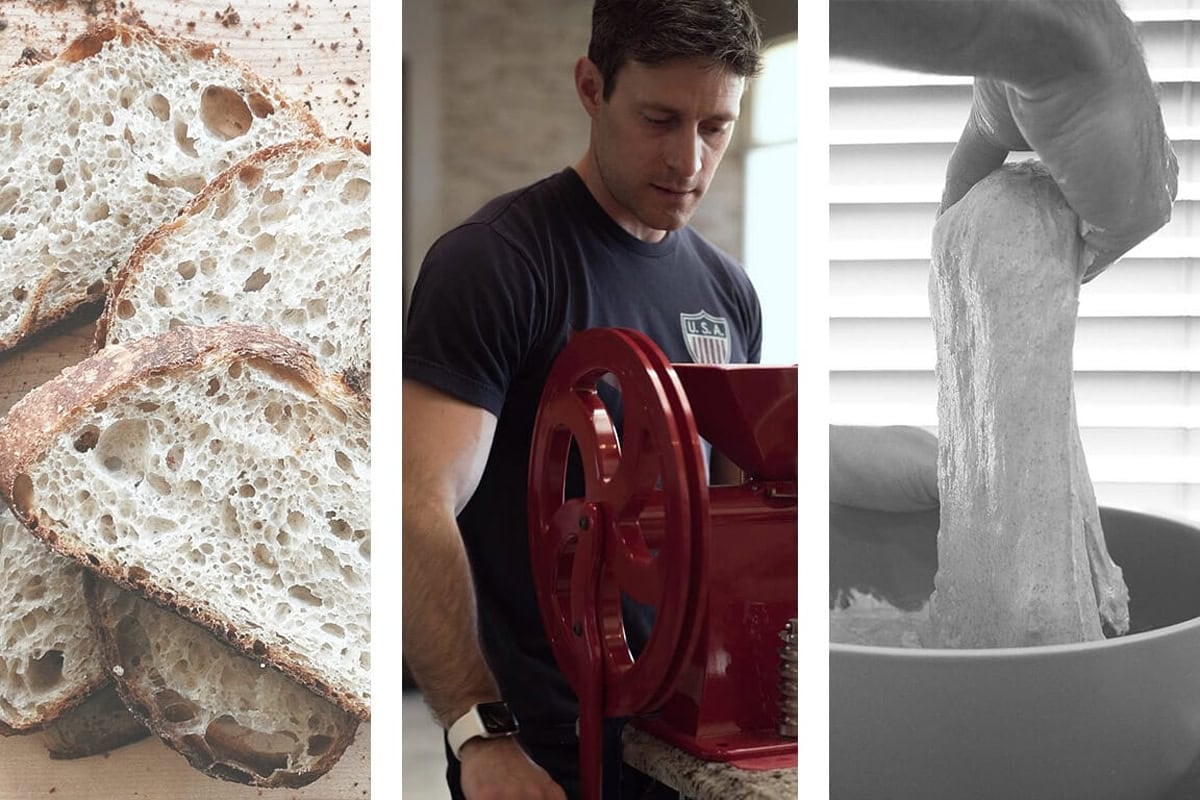
Hello there, I’m Maurizio, an author and software engineer turned baker, crafting sourdough bread and pizza in Albuquerque, New Mexico for over a decade. Growing up in an Italian family, our lives revolved around good food made by hand. From my dad’s restaurant pizzas to my mom’s homemade gnocchi, I learned to appreciate slow, homemade food. Summers in Italy, filled with family meals and fresh bread hunts, further shaped this value.
The Perfect Loaf, which I founded in 2013, combines my analytical mind with my passion for good food and shares my sourdough journey. Sourdough bread embodies my belief that exceptional taste comes from patience and natural processes. It’s not about complicated techniques, but about giving flavors time to develop.
Here, I aim to help you become a better baker, as I constantly evolve in the kitchen. I’m constantly learning, experimenting, and sharing insights – because if I’m not baking sourdough, I’m probably thinking about it, always in pursuit of that elusive perfect loaf.
He strives for perfection, for the perfect loaf, secretly hoping never to attain it — for where would he go from there?
Jeffrey Hamelman
Have a Baking Question?
If you have a burning baking question, I usually hang out with many like-minded—and very helpful!—bakers on The Perfect Loaf’s Discord, where you can post questions, comments, and photos. Come join the community and ask a question.
The Perfect Loaf is the leading independent sourdough baking website and was launched in 2013 by home baker Maurizio Leo.
The Perfect Loaf is a two-time Saveur Magazine Blog Award winner, winning both Editors’ and Readers’ Choice Awards in 2016, and a Readers’ Choice Award in 2018. In 2019, The Perfect Loaf was nominated for a Webby Award.
Absolutely. You can add them in at the end of mixing or during stretches and folds in bulk fermentation. I talk about it a bit here in my guide to bulk fermentation .
I have a question about a calculation in your book, page 129. In the section about Baker’s Percentages you discuss Pre-fermented Flour Percentage. The prefermented flour weight is 100g and the total flour weight is 1100g giving a percentage of 9.1%. I noticed that here is also 10g of prefermented flour in the ripe sourdough starter. If that extra 10g of flour is used in the calculation the PFF% would be 9.9%. Is there a reason the weight of flour in the starter is not used?
Essentially, I don't count it because it makes things difficult, it's another "layer" of ingredients added into the calculation. Plus, because the recipes are rather small (only 1-2 loaves), the amount of starter is small compared to the overall flour in the recipe. I do take the levain into account, though, this is much larger.
Hi Maurizio, Thank you for your free recipe/video with step-by-step instructions. I'm new to sourdough and used your recipe/video to bake my first two rounds. I'm on my third week with a levain currently out and getting ready! I also purchased your book and excited to try other recipes. :). Quick question- my sourdough ends up a bit sticky and I'm not sure why. The starter rises, it bakes enough (top/bottom is brown) and I let it cool for at least 2 hours before cutting it. I think bulk fermentation is the culprit because at the end the dough is super smooth and has some bubbles, but it doesn't "dome" as much as your video or pictures in the book. I live in the tropics where my kitchen is usually in the low 80's- could this be the culprit? Please advise of any changes you'd make. I appreciate your time & help. Keep doing what you're doing as I wouldn't be a sourdough fanatic without your videos!
Glad they've been a help, Carmen! I really appreciate the kid words and for you getting my cookbook (hope you're loving that, too). If you're at that hot of a temp and a very humid environment, you might want to reduce the hydration of the dough when youre mixing to better suit your environment. Later, you can work the hydration back up (if you want), but just so you get a feel for a stiffer dough, it might help. If you have a lot of water in the dough, it's very humid, and you're possibly not mixing as long as you need to, you won't see as much doming.
So, 1) drop the hydration a bit for a little while and see how the dough feels. 2) Increase the hydration slowly if you want, but mix a little longer.
I recently bought your book from Amazon and there’s not an errata sheet on page 1
Hello, I am brand new to sourdough, so I'm used to baking with commercial yeast and have been doing that for over a decade. Naturally, I have a lot of beloved yeast bread recipes now. Can I still use those recipes but with sourdough starter instead of yeast? Is there some general rule to know how much starter you need per cup of flour to achieve a successful rise? Thanks so much!
Hey, Emily! You can convert those yeasted recipes over to sourdough, if you'd like. I'm working on a post on how to do this soon. Generally, you want to take some of the flour and water in the recipe to make a preferment (levain). This will be mixed with a small bit of your sourdough starter.
I’m having some trouble with the sourdough starter recipe from your book. It’s been doing great from day 1 to day 6, but on day 7, when I switch to mostly white flour, the starter doesn’t rise much. I’ve tried both King Arthur and Central Milling flours, but no luck.
It does seem to start rising around the 24-hour mark, though.
Any ideas on what might be going wrong or how I can fix it?
I have been making your everyday sandwich loaf for sometime and have a problem with the loaves rising in the time you suggest. I have to use a 1 hp Kitchenaid mixer (old hands don't function as well anymore). At the end of mixing, the dough temp has risen to about 85 degrees. I am using stone ground flour from Barton Sprins Mills: red fife whole wheat and their all-purpose (13%). The final product tastes great, but why does it take so long to rise in the pan before baking? 2 hours+ at proper temp.
It's pretty normal not to see huge rise in the fridge overnight. Give it a poke, though, and if it feels very tight and dense, let it proof more on the counter for about an hour, then poke again. It should pass the poke test at that point: https://www.theperfectloaf.com/how-to-use-the-dough-poke-test/
Just made some Baguettes and I was happy with them for my first batch. The recipe describes each loaf as having a 14" length. My loaves ended up 15" – 16" in length and about 2" in diameter. The loaves seem a little spindly to me especially when compared to the photos. Is this width loaf to be expected??
Hey Chip. Sounds like you might have rolled them out a little too long—which is okay! They'll bake a little faster that way. Next time, don't roll them out quite as long and you'll have stubbier baguettes. All good!
Hi, I started my sourdough journey 2 years ago and have found your recipes and instructions extremely clear. So thank you! Got your book last year and have gotten stuck making Rustico again and again. Two days ago I decided to branch out and am trying the pane pugliese. Have never made a stiff levain before so am a little nervous. Overnight, at about 73-74F, it rose but did not double. I let it go for 13 hours and decided to just go for it. Description of the levain in the book – it's referring to the standard 100% hydration kind, right? Further down the recipe, there's a mention of removing the dough from the fridge, but this is a one-day bake, right? No cold retardation, I thought… Please help and clarify. Thanks!!
Hey Catherine, sorry for the late reply! So glad the site and my book have been a help. Like you, I make the Rustico over and over, I just love that recipe 🙂 Yes, the Pane Pugliese uses a stiff levain. It's totally okay if it does not double in size. There's a small typo in the recipe, the dough is never in the fridge! Sorry about the confusion there.
I am having trouble with getting a great ear/rise on my sourdough loaves. I use active starter at its peak, or shortly thereafter, in all the recipes, and am wondering if I should use starter that has risen and fallen and is ready to be fed (discard) for a better rise and more aerated crumb? I have seen one recipe for plain sourdough that calls for the discard rather than active starter, and am curious about the outcome.
In my experience (and opinion), you definitely want to use ripe starter to seed fermentation in new dough. Though, ripe starter and discard really are the same thing if they're used at the right time. It's hard to say why you're not getting good rise with out more details or photos. Feel free to write back here or send me an email on the About page!
It has a nice flavor and texture, and not a dense crumb. And it baked up well in a countertop oven. Simple, easy, and tasty. The hardest part is waiting 24 hrs to slice it.
I am really enjoying your website and all the sourdough information and tools. I do have a couple of questions……
In your recipe for Beginner Sourdough, you direct to make the levain at 8am with ripe sourdough starter. But when I feed my starter, it is at its peak activity/rise, 5 hours after feeding. So I would have to feed it at 3am, not realistic! How do I slow the peak activity down? Or is it OK to use the starter, even when it has started to “shrink” down again? At what point is the starter “ripe to bake with”? Or should I just use starter and not bother with the levain? And if so, how much starter?
I also am finding when baking (in a dutch oven), that I get good “oven spring” but my finished crust is really hard, very difficult to cut, even with a good bread knife. How can I fix that?
Hey there! What you can do is leave just a little less starter in your jar when you feed it the night before. Also, your starter is rather forgiving, it’s okay to use it a few hours later than when it’s perfectly ripe!
If your crust is too thick, try baking for less time on the second half of the bake. It’s a common problem to have a very thick crust with a Dutch oven!
Hi Mauricio, I am making the German Whole Rye recipe from your book, but I do not have a stand mixer to mix the dough on low speed for 10 to 12 minutes. What method shall I use to mix it by hand?
Yes, classes coming soon. Be sure to subscribe to the newsletter (scroll all the way to the bottom), I’ll announce more classes there. I just gave a baking demo in Tucson, AZ!
Hi Maurizio!
Thank you so much for your ‘ Sourdough Bible’ cookbook. Love it! It has really stepped up my sourdough game. I have a question about using Graham flour. I just bought a bag and am interested in a moist sourdough graham bread. Any suggestions?
Hey Maurizio,
Love your book. I have made almost all of your bread recipes from the book now. The Twenty Five Rye is my absolute favorite (although I sub out 44g spelt for some of the rye). Anyway, the Cinnamon Babka is amazing…I’ve made it twice. But it has a warm bulk, overnight cold retard in the bowl, and then cut and shape/pan and a long, warm counter proof next day. I want to bring it to a 10:00 am morning event, but if I make it the night before, I don’t think it will be quite the same as same day. What would you do if you were me? Would you skip the first cold retard and do the entire bulk at room temp, cut and shape, put in pan, and then overnight retard so that you could just pull it out and bake in the morning? The bulk (warm and cold) is so long, and THEN there’s the long, 5-hour counter proof. I don’t think I’d know at what point to put it in the fridge to get the fermentation right such that I can just take it out and bake in the morning. Or should I do it as written, get it in the pan, start counter proofing to get it going, but just do 2-2.5 hrs instead of 5 and then put in fridge overnight? Please let me know if you have any suggestions or if this really just needs to be baked the night before and bagged once cool. Thanks!
For the babka, you can get it all the way to shaping and in the pan, let it proof for half the proof time on the counter, then pop it into the fridge. The next day take it out to finish proofing until puffy. I would do this early-ish to ensure you have time to proof and bake (and cool a little, too).
OR!
Another option, which is what would do: bake it the day before. It does really well with a long rest before cutting. And if you want it warm, you can always warm it in the oven before you head out 🙂
I have followed your starter recipe exactly and it works beautifully with your sourdough recipes. Since your starter requires very little carryover culture each day at the two feeding times, my question is: Can I safely use your starter with other sourdough recipes which generally use levain recipes that call for starters that are fed with much larger amounts of carryover culture?
Hi Maurizio,
I love your cookbook! It’s beautiful and so well written. I made the Oat Porridge from your website a while ago and it was fantastic.
I decided to try it again but from your cookbook. Would you please confirm that the amount of water to add in step 2 is only 445g? I got to that step and the dough was super dry which I thought was odd because you said the dough needed to be strengthened. I added another 30g and started the bulk fermentation.
Right before the first stretch and fold, I decided to check the recipe online. I think it should be 645g of water in the cookbook version. I went ahead and added another 170g of water, along with the oats. Hopefully it’ll work out! I appreciate all your ideas and advice.
Purchased the Sourdough Home a few months ago and very happy with it. One question please. I have always been in the habit of building my levain when the storage starter is at peak. You say some “so that it is ready to use with just a single room-temperature refreshment before adding it to a dough”. So, for example, if I feed on a Thursday at 1:4:4 and store at 10c would I be able to build a levain on Saturday even though it the starter would not normally peak until Sunday? Thank you
Yes, you should be able to build a levain from that starter. You might have to test the 10C temp to make sure it’s where it needs to be so the starter in the SDH is ripe when you need it.







477 Comments
Just ordered your book and Amazon referred me to your blog! So glad I found it as I too am still trying to make “the perfect loaf”!
Amazing, thank you for getting my book and great to have you here, too. Here to help!
can I add pepitas into the dough and if so, at what point
Absolutely. You can add them in at the end of mixing or during stretches and folds in bulk fermentation. I talk about it a bit here in my guide to bulk fermentation .
I have a question about a calculation in your book, page 129. In the section about Baker’s Percentages you discuss Pre-fermented Flour Percentage. The prefermented flour weight is 100g and the total flour weight is 1100g giving a percentage of 9.1%. I noticed that here is also 10g of prefermented flour in the ripe sourdough starter. If that extra 10g of flour is used in the calculation the PFF% would be 9.9%. Is there a reason the weight of flour in the starter is not used?
Hey there! I talk about that a bit in the book, why I don't take the sourdough starter itself into the calculations. I also talk about it here:
https://www.theperfectloaf.com/reference/introduction-to-bakers-percentages/
Essentially, I don't count it because it makes things difficult, it's another "layer" of ingredients added into the calculation. Plus, because the recipes are rather small (only 1-2 loaves), the amount of starter is small compared to the overall flour in the recipe. I do take the levain into account, though, this is much larger.
Hope that makes sense!
Thanks
Hi Maurizio, Thank you for your free recipe/video with step-by-step instructions. I'm new to sourdough and used your recipe/video to bake my first two rounds. I'm on my third week with a levain currently out and getting ready! I also purchased your book and excited to try other recipes. :). Quick question- my sourdough ends up a bit sticky and I'm not sure why. The starter rises, it bakes enough (top/bottom is brown) and I let it cool for at least 2 hours before cutting it. I think bulk fermentation is the culprit because at the end the dough is super smooth and has some bubbles, but it doesn't "dome" as much as your video or pictures in the book. I live in the tropics where my kitchen is usually in the low 80's- could this be the culprit? Please advise of any changes you'd make. I appreciate your time & help. Keep doing what you're doing as I wouldn't be a sourdough fanatic without your videos!
Glad they've been a help, Carmen! I really appreciate the kid words and for you getting my cookbook (hope you're loving that, too). If you're at that hot of a temp and a very humid environment, you might want to reduce the hydration of the dough when youre mixing to better suit your environment. Later, you can work the hydration back up (if you want), but just so you get a feel for a stiffer dough, it might help. If you have a lot of water in the dough, it's very humid, and you're possibly not mixing as long as you need to, you won't see as much doming.
So, 1) drop the hydration a bit for a little while and see how the dough feels. 2) Increase the hydration slowly if you want, but mix a little longer.
Hope this helps!
Hi, I don't know how else to contact you, I can't seem to get a discord account going after paying for membership. Thanks.
I have a question about the typos on the book The Perfect Loaf…
Have they been corrected on the new prints?
Yes, all typos have been fixed if you've purchased a book in the last year!
do you have an errata sheet?
Yes, it's at the bottom of the cookbook page !
I recently bought your book from Amazon and there’s not an errata sheet on page 1
Hello, I am brand new to sourdough, so I'm used to baking with commercial yeast and have been doing that for over a decade. Naturally, I have a lot of beloved yeast bread recipes now. Can I still use those recipes but with sourdough starter instead of yeast? Is there some general rule to know how much starter you need per cup of flour to achieve a successful rise? Thanks so much!
Hey, Emily! You can convert those yeasted recipes over to sourdough, if you'd like. I'm working on a post on how to do this soon. Generally, you want to take some of the flour and water in the recipe to make a preferment (levain). This will be mixed with a small bit of your sourdough starter.
Here's a little more about what a levain (leaven) is:
https://www.theperfectloaf.com/what-is-a-levain-and-how-is-it-different-from-a-starter/
Thank you for your response, I'm looking forward to trying this!
Hey Maurizio,
I’m having some trouble with the sourdough starter recipe from your book. It’s been doing great from day 1 to day 6, but on day 7, when I switch to mostly white flour, the starter doesn’t rise much. I’ve tried both King Arthur and Central Milling flours, but no luck.
It does seem to start rising around the 24-hour mark, though.
Any ideas on what might be going wrong or how I can fix it?
Thanks!
Hey there, Pilar! I just emailed you back, check your email 🙂
I have been making your everyday sandwich loaf for sometime and have a problem with the loaves rising in the time you suggest. I have to use a 1 hp Kitchenaid mixer (old hands don't function as well anymore). At the end of mixing, the dough temp has risen to about 85 degrees. I am using stone ground flour from Barton Sprins Mills: red fife whole wheat and their all-purpose (13%). The final product tastes great, but why does it take so long to rise in the pan before baking? 2 hours+ at proper temp.
Try including a bit more starter or levain when you mix your dough. I would suggest doubling it.
I am not seeing my dough rise sufficiently after cold proofing in the fridge overnight!
It's pretty normal not to see huge rise in the fridge overnight. Give it a poke, though, and if it feels very tight and dense, let it proof more on the counter for about an hour, then poke again. It should pass the poke test at that point:
https://www.theperfectloaf.com/how-to-use-the-dough-poke-test/
Just made some Baguettes and I was happy with them for my first batch. The recipe describes each loaf as having a 14" length. My loaves ended up 15" – 16" in length and about 2" in diameter. The loaves seem a little spindly to me especially when compared to the photos. Is this width loaf to be expected??
Chip
Hey Chip. Sounds like you might have rolled them out a little too long—which is okay! They'll bake a little faster that way. Next time, don't roll them out quite as long and you'll have stubbier baguettes. All good!
Hi, I started my sourdough journey 2 years ago and have found your recipes and instructions extremely clear. So thank you! Got your book last year and have gotten stuck making Rustico again and again. Two days ago I decided to branch out and am trying the pane pugliese. Have never made a stiff levain before so am a little nervous. Overnight, at about 73-74F, it rose but did not double. I let it go for 13 hours and decided to just go for it. Description of the levain in the book – it's referring to the standard 100% hydration kind, right? Further down the recipe, there's a mention of removing the dough from the fridge, but this is a one-day bake, right? No cold retardation, I thought… Please help and clarify. Thanks!!
Hey Catherine, sorry for the late reply! So glad the site and my book have been a help. Like you, I make the Rustico over and over, I just love that recipe 🙂 Yes, the Pane Pugliese uses a stiff levain. It's totally okay if it does not double in size. There's a small typo in the recipe, the dough is never in the fridge! Sorry about the confusion there.
Let me know how that loaf turned out for ya!
I am having trouble with getting a great ear/rise on my sourdough loaves. I use active starter at its peak, or shortly thereafter, in all the recipes, and am wondering if I should use starter that has risen and fallen and is ready to be fed (discard) for a better rise and more aerated crumb? I have seen one recipe for plain sourdough that calls for the discard rather than active starter, and am curious about the outcome.
In my experience (and opinion), you definitely want to use ripe starter to seed fermentation in new dough. Though, ripe starter and discard really are the same thing if they're used at the right time. It's hard to say why you're not getting good rise with out more details or photos. Feel free to write back here or send me an email on the About page!
What is the pottery bowl that you have had on your site that you use to mix and bulk ferment? Has an orange like hue.
It's from Heath Ceramics!
Here are photos of the 90% rye at 90% hydration, but using pumpernickel instead of regular whole rye. https://photos.app.goo.gl/cDTLwbT7qUsyR3YY7
It has a nice flavor and texture, and not a dense crumb. And it baked up well in a countertop oven. Simple, easy, and tasty. The hardest part is waiting 24 hrs to slice it.
Looks wonderful, Louis! I love that you used the Breville to bake it, too. I’ve been thinking about getting one for here. Enjoy!
I started this recipe weighing all the ingredients. The autolyse is a liquid, is this correct?
I’m not sure what recipe you’re referring to, Von, but the autolyse will be a mix of just flour and water—that’s it.
I am really enjoying your website and all the sourdough information and tools. I do have a couple of questions……
In your recipe for Beginner Sourdough, you direct to make the levain at 8am with ripe sourdough starter. But when I feed my starter, it is at its peak activity/rise, 5 hours after feeding. So I would have to feed it at 3am, not realistic! How do I slow the peak activity down? Or is it OK to use the starter, even when it has started to “shrink” down again? At what point is the starter “ripe to bake with”? Or should I just use starter and not bother with the levain? And if so, how much starter?
I also am finding when baking (in a dutch oven), that I get good “oven spring” but my finished crust is really hard, very difficult to cut, even with a good bread knife. How can I fix that?
Hey there! What you can do is leave just a little less starter in your jar when you feed it the night before. Also, your starter is rather forgiving, it’s okay to use it a few hours later than when it’s perfectly ripe!
If your crust is too thick, try baking for less time on the second half of the bake. It’s a common problem to have a very thick crust with a Dutch oven!
Hi Mauricio, I am making the German Whole Rye recipe from your book, but I do not have a stand mixer to mix the dough on low speed for 10 to 12 minutes. What method shall I use to mix it by hand?
I would use a dough whisk! It will work just fine. See how I do it here in this 90% whole grain rye recipe (also delicious!):
https://www.theperfectloaf.com/sourdough-90-rye-bread-recipe/
Hi Maurizio! Do you ever give in person workshops? I love your site, AND I always feel I learn best in person…
Thank you!
Yes, classes coming soon. Be sure to subscribe to the newsletter (scroll all the way to the bottom), I’ll announce more classes there. I just gave a baking demo in Tucson, AZ!
Thank you Maurizio, the bread was delicious and very moist.
Hi Maurizio!
Thank you so much for your ‘ Sourdough Bible’ cookbook. Love it! It has really stepped up my sourdough game. I have a question about using Graham flour. I just bought a bag and am interested in a moist sourdough graham bread. Any suggestions?
So glad you’re enjoying my book, JoAnna! I have actually never used graham flour. I will get some and start testing for a recipe for here!
How do I convert the hand mixing method used on the recipes in your book to be used in a Famag spiral mixer?
Have you seen my guide to the Famag mixer? I have a good starting point for you there:
https://www.theperfectloaf.com/guides/how-to-use-a-famag-dough-mixer/
Hey Maurizio,
Love your book. I have made almost all of your bread recipes from the book now. The Twenty Five Rye is my absolute favorite (although I sub out 44g spelt for some of the rye). Anyway, the Cinnamon Babka is amazing…I’ve made it twice. But it has a warm bulk, overnight cold retard in the bowl, and then cut and shape/pan and a long, warm counter proof next day. I want to bring it to a 10:00 am morning event, but if I make it the night before, I don’t think it will be quite the same as same day. What would you do if you were me? Would you skip the first cold retard and do the entire bulk at room temp, cut and shape, put in pan, and then overnight retard so that you could just pull it out and bake in the morning? The bulk (warm and cold) is so long, and THEN there’s the long, 5-hour counter proof. I don’t think I’d know at what point to put it in the fridge to get the fermentation right such that I can just take it out and bake in the morning. Or should I do it as written, get it in the pan, start counter proofing to get it going, but just do 2-2.5 hrs instead of 5 and then put in fridge overnight? Please let me know if you have any suggestions or if this really just needs to be baked the night before and bagged once cool. Thanks!
Amazing to hear all this, thank you Carol!
For the babka, you can get it all the way to shaping and in the pan, let it proof for half the proof time on the counter, then pop it into the fridge. The next day take it out to finish proofing until puffy. I would do this early-ish to ensure you have time to proof and bake (and cool a little, too).
OR!
Another option, which is what would do: bake it the day before. It does really well with a long rest before cutting. And if you want it warm, you can always warm it in the oven before you head out 🙂
I have followed your starter recipe exactly and it works beautifully with your sourdough recipes. Since your starter requires very little carryover culture each day at the two feeding times, my question is: Can I safely use your starter with other sourdough recipes which generally use levain recipes that call for starters that are fed with much larger amounts of carryover culture?
Yes, absolutely!
Hi Maurizio,
I love your cookbook! It’s beautiful and so well written. I made the Oat Porridge from your website a while ago and it was fantastic.
I decided to try it again but from your cookbook. Would you please confirm that the amount of water to add in step 2 is only 445g? I got to that step and the dough was super dry which I thought was odd because you said the dough needed to be strengthened. I added another 30g and started the bulk fermentation.
Right before the first stretch and fold, I decided to check the recipe online. I think it should be 645g of water in the cookbook version. I went ahead and added another 170g of water, along with the oats. Hopefully it’ll work out! I appreciate all your ideas and advice.
Ha, this is the only loaf from the book I didn’t love. So stiff! And it said slap and folds to strengthen? That’s why. Not enough water. Thank you.
Yes, sorry about the hydration with that loaf. It does need more water and what you’ve done is the way to go!
Purchased the Sourdough Home a few months ago and very happy with it. One question please. I have always been in the habit of building my levain when the storage starter is at peak. You say some “so that it is ready to use with just a single room-temperature refreshment before adding it to a dough”. So, for example, if I feed on a Thursday at 1:4:4 and store at 10c would I be able to build a levain on Saturday even though it the starter would not normally peak until Sunday? Thank you
Yes, you should be able to build a levain from that starter. You might have to test the 10C temp to make sure it’s where it needs to be so the starter in the SDH is ripe when you need it.