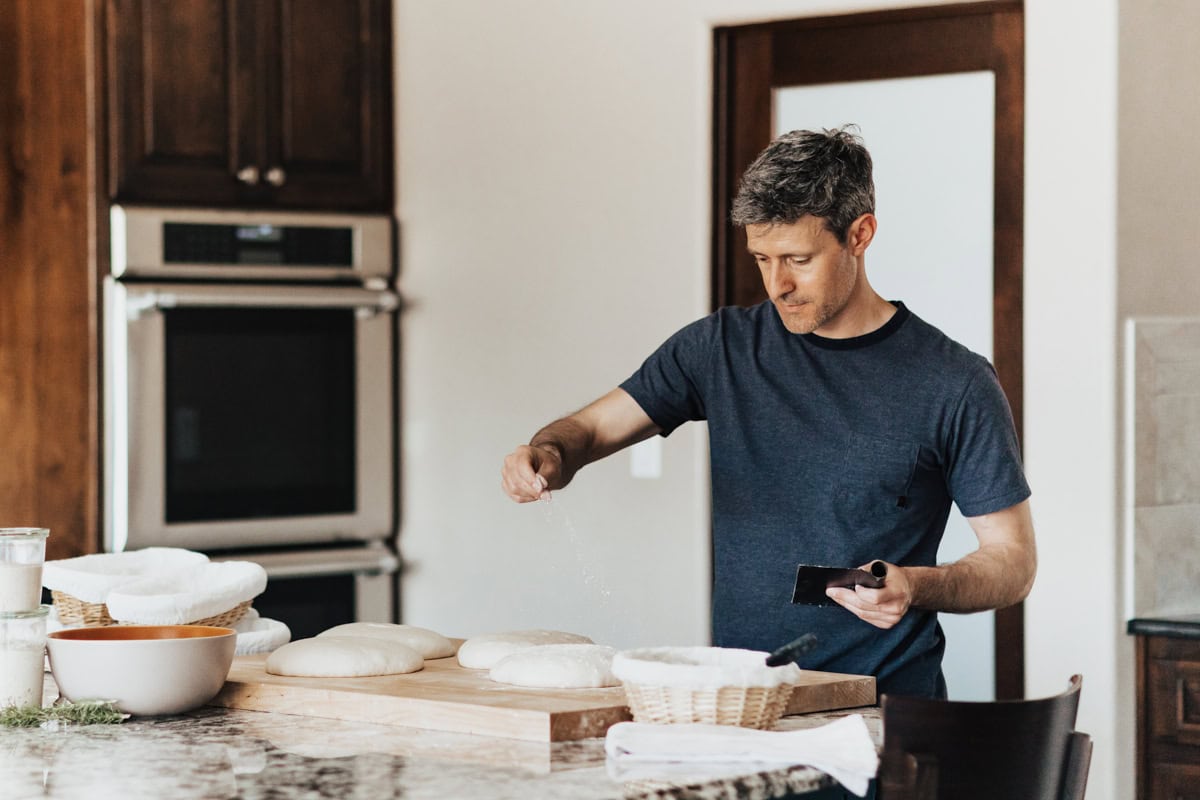
Hello there, I’m Maurizio, an author and software engineer turned baker, crafting sourdough bread and pizza in Albuquerque, New Mexico for over a decade. Growing up in an Italian family, our lives revolved around good food made by hand. From my dad’s restaurant pizzas to my mom’s homemade gnocchi, I learned to appreciate slow, homemade food. Summers in Italy, filled with family meals and fresh bread hunts, further shaped this value.
The Perfect Loaf, which I founded in 2013, combines my analytical mind with my passion for good food and shares my sourdough journey. Sourdough bread embodies my belief that exceptional taste comes from patience and natural processes. It’s not about complicated techniques, but about giving flavors time to develop.
Here, I aim to help you become a better baker, as I constantly evolve in the kitchen. I’m constantly learning, experimenting, and sharing insights – because if I’m not baking sourdough, I’m probably thinking about it, always in pursuit of that elusive perfect loaf.
He strives for perfection, for the perfect loaf, secretly hoping never to attain it — for where would he go from there?
Jeffrey Hamelman
If you have a burning baking question, I usually hang out with many like-minded—and very helpful!—bakers on The Perfect Loaf’s Discord, where you can post questions, comments, and photos. Come join the community and ask a question.
Or, email Maurizio directly.
The Perfect Loaf is the leading independent sourdough baking website and was launched in 2013 by home baker Maurizio Leo.
The Perfect Loaf is a two-time Saveur Magazine Blog Award winner, winning both Editors’ and Readers’ Choice Awards in 2016, and a Readers’ Choice Award in 2018. In 2019, The Perfect Loaf was nominated for a Webby Award.
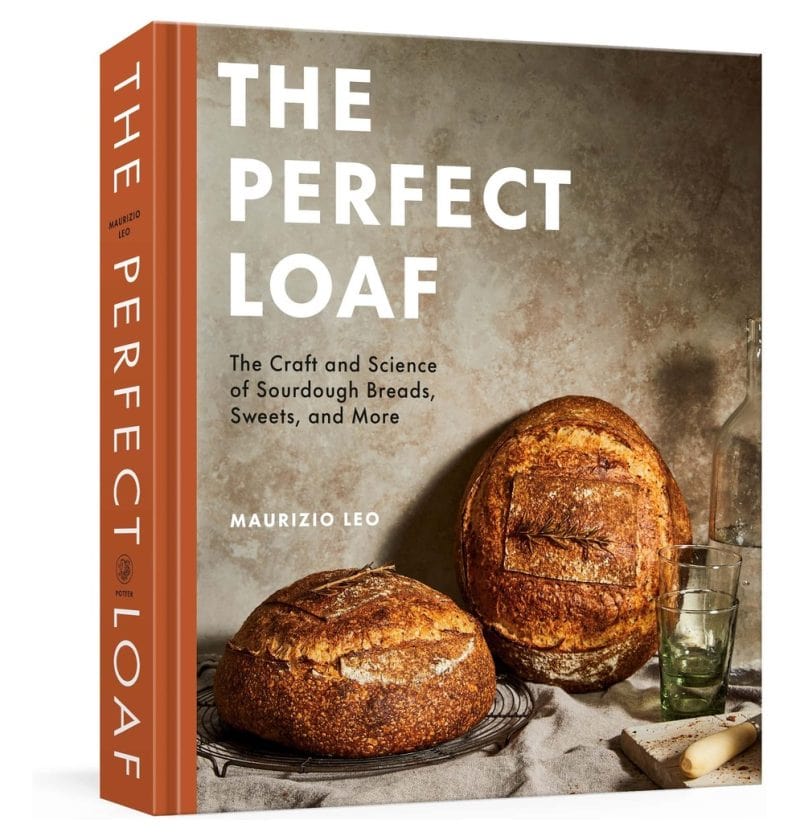
In 2022, Maurizio’s cookbook, The Perfect Loaf: The Craft and Science of Sourdough Breads, Sweets, and More, made the New York Times’ bestseller list.
The Perfect Loaf cookbook won a 2023 James Beard Foundation Book Award in the Bread category and a 2023 IACP Cookbook Award in the Baking category.
As an Amazon Influencer, The Perfect Loaf earns from qualifying purchases. Please see the policy for more.
477 Comments
It’s not always fun to be a contrarian but I joined here yesterday and just received your book. I’m not in love with the book so far.
For now I’m looking at the pizza dough on pages 294… I find it pretty confusing…for example you say something like … warm or cool the water to about 78 degrees…and then there are formulas on pages 138…
I’m pretty literal I this kinda blows my circuits.
Are you not just trying to say use water at a temperature that will result in a dough/levain temperature of 78 degrees?
There is no reference to mixing by hand… not using a powered mixer…
There is an old adage…tell what your going to tell…tell it then tell what you told.
Thank you…
(frustrated baker.)
Hey Rod! No worries, if you’re not loving the book so far (but hey, it may grow on you!), many different ways to bake and mine is just one of them. I mention warming the water to 78F because that’s an “ideal” temperature for fermentation, it’s the point where bacteria and yeast are both active. But yes, warm the water to that temp so the final mix is close to that temp.
So while it may seem like the temps and formula numbers are arbitrary, they’re in there for a reason! The formulas are all created with percentages to make it easy to scale up and down the recipes, that’s why you’ll see formulas with strange numbers that aren’t whole.
Anyways, I hope you give the book a chance! Trust me, nothing in there is arbitrary and just because 🙂 Let me know what you think after you’ve had some more time with it!!
Wow
Thank you for your prompt reply and followup. This is why I paid to be a member!
I’m making the pizza dough as we speak. The book seems great for information and content I just find that its a little “all over the place”… I’m a very methodical 1, 2, 3 type of guy.
BTW I keep my flour (Hayden Mills)in the freezer so it kinda complicates the temperature ideal. My final mix was 86 degrees…somehow. Probably the Kitchenaid mixer.
Also, it seems all the recipes are so different! I’m very new at this so I have a bunch of books (to make me more confused). Nancy Silverston for SD bread and Ken Forkish for pizza…
The book is definitely a consolidation of all the material here in one package, which is one reason why I wrote it 🙂
Hope the pizza turned out great, Rod!
Hello from San Diego, CA. I love love love your site Maurizio, so much good information and wonderful things to try. I have been baking sourdough based on using 1000g flour for 2 loaves. I’d like to try making some larger loaves, maybe 25% – 50% larger. Is there any reason that won’t work or are there any downsides to baking larger loaves? I have purchased some sourdough bread at a local bakery and the loaves are definitely bigger than what my current recipe yields. Thank you so much!
So happy to hear that, Terry! Glad my site has been helpful 🙂 Totally fine to scale up your dough to make larger loaves, no problem there at all!
Hi from NC! I have been following you pretty much exclusively on my new sourdough journey the past couple months. Thank you for all the wonderful videos and articles! I have since gotten my sister and cousin (and me!) your big wonderful hardback book! We are all loving it!
We also have gone through your storefront for several of your favorite baking tools. We all got the Brod & Taylor folding proofing box and are loving it. We followed your suggestion and don’t use the water tray and instead just keep our Weck jar and dough bowl covered. Manufacturer instructions shows the proofing box was calibrated using the water tray and if you don’t use it, it shows the temp will be a couple degrees lower. However I read with the lid on the jar it increases the temp by a couple degrees. So if we are aiming for 76 degrees for bulk ferment, what temp should we set the proofing box to?
Thanks so much!!
Hey, Tammie! Thanks so much, glad everything here and my book is helping 🙂
Glad you’re also liking the proofer. Correct, I don’t use the water tray. I would say shoot for 1-2° lower on the unit. For example, if you want your starter at 76F, I would do 74F. You can also test this just to verify, take the temp of your starter after it’s been in there for a few hrs (or right before you give it a feeding next). Then adjust as necessary.
Hope that helps and thanks for reading!
Btw, your Babka is 🔥! I am working my way through most of your recipes from the book. I have made brioche 2x, babka, simple sd lots of times, my best sd, pain de mie 2x, cranberry walnut, rosemary and olive oil, everyday sandwich bread. I’m mixing a babka again tomorrow for my soon-to-be home college student, and I want to try a Tangzhong loaf next! Thank you, thank you, thank you! I wish I had your book 3 yrs ago when I was starting out. Still learned a few things though. Mainly about manipulating dough temperature rather than just reacting to it. And I’ve learned a bit about gluten development (that sometimes, like with enriched doughs, you want it fully developed to a windowpane up front because of the butter), but would love to learn more (I watched some old Hamelman videos where he says he purposely didn’t fully develop some of his doughs during the mix). Anyway thanks. I’ve bought 3 copies of your book so far, and recommended it to several others. I love it, and the photos are beautiful.
Amazing, thank you so much, Carol! Really appreciate you leaving this note and so glad you’re enjoying my cookbook. You’ve been a busy baker! Thank you 🙂
I’ve since added the Oat Porridge Loaf (2x) and the Winter SD. People LOVED the Cranberry -Sage-Pecan combination. Thanks again!
Just curious – interested in your e-book but it seems that after paying $50 to be a member I would sill have to pay another $9.00 for the e-book?? Thanks. Looks like a useful site.
Hey, Mark! Nope, the eBook is included in the membership (if you join, it’s free on the Perks page!).
Just downloaded the Handbook but the links to Google docs DONT work and I cant get the spreadsheets. Can you help please
Hey there, so sorry for the late reply. Please send me an email (maurizio at theperfectloaf.com) and I’ll get you the links! I’ve now fixed them in the eBook for future downloads—sorry about that!
Hi Maurizio,
First of all, thank you so much for all the helpful content online. I recently purchased your cookbook, and I’ve been slowly combing through it as well. The past weeks I’ve been following your starter creation guide to a tee, and I had a very healthy starter ready last night before I messed it up.
I was on the evening feeding of day 7, getting ready to make discard waffles in the morning of day 8 when I woke up to see that I left the oven light on overnight!
The ambient temperature of the oven was around 130, and when I took the internal temp of the starter, it seemed to be around 115. From what I’ve read online, it seems I shouldn’t assume I killed my starter—rather, I should show it some extra love for a couple days and revive it. My question is, should I go back to day 2-3 or day 4-6? And how long do you think I should go back to this feeding schedule for before it returns to its healthy state?
I’m sorry to bother you on a weekend, but please let me know ASAP! I’m heartbroken and lost on what to do next 😭😭. I also sent this to you via email, but I wanted to post online just in case you wanted to respond to it in a way the community could see! Thanks so much in advance.
The past week*
Hi, Maurizio!
I love your book. I’ve been working my way through the recipes, and so far I have been very pleased. I had a question about your bomboloni recipe. The water added in the mix stage in your book says 32g, but when I mixed the ingredients (with half the sugar as you recommended), I got a dough that was almost stiff as pasta dough! Since all the signs in your book indicated this should be a “very soft” dough, this did not seem right. So I looked up your recipe here and the water was almost three times more. Nothing else seemed to fundamentally make up for the loss of water in your book recipe, so I added in about 60g more with the remaining sugar. It seemed to work great. I’m wondering if perhaps the book has an incorrect amount for the water there? Or did I miss something? One way or another, I’ll see how it turns out.
Thanks again! You are truly my favorite resource for all things bread. Been following you very closely since I found your website about seven years ago, and I’ve never been disappointed.
I had little success with the 100% whole wheat loaf recipe in your book. In particular the levain was extremely dry and never seemed to show the signs of ripening as you described. So I continued with the recipe and the loaves were very disappointing. Very flat little if no rise. Also, wondering why so many of your recipes specify using all purpose flour since it is not a very healthy flour.
Are you planning on selling the many beautiful panettone that you are showing on Instagram ?!?
I’m considering doing this, yes! I’ll definitely announce this at the site and through the newsletter 🙂
do you plan on offering a recipe for panettone?
Would love it,
Thanks!
Yes, absolutely. But I don’t think it will be ready for this Christmas, unfortunately. Hoping for next year 🙂
I think a perfect loaf is optimized for economics, nutrition, and aesthetics. I want all the nutrients in the wheat berry in the form that makes them most available. I want the entire baking process to be efficient. And I want a good product. Thus, I have been working with 100% organic hard red wheat for a few years.
These days, I work at 80% hydration in the starter, the leaven, and the dough, it makes scaling the recipe to more or fewer loaves easy. Mostly I want bread well suited for sandwiches – PeanutButter/jelly, grilled cheese . . . . and I want loaves that produce uniform slices. Most of my loaves get baked in Pullman pans sitting on sheet pans in a 375F convection oven.
Day before dough day, I make sure I have enough starter. First thing in the morning on bake day, I add 80 grams of water, mix, then add 100 grams of fresh whole wheat flour for each loaf and mix the leaven. It gets set on top of the refrigerator where the temperature is ~75F.
About noon, I mill 400 grams of flour for each 1 kilo loaf that I plan to bake into my dough bowl. I dissolve the needed salt into the required water, and place the water/salt into a well in the flour in the bowl. I weigh 180 grams of leaven for each loaf into the water. I stir the leaven into the water, with enough of the flour so the mixture in the center of the bowl is the consistency of pancake batter. I let flour with pool of liquid leaven in the center ferment in the covered bowl sitting on top of the refrigerator for a couple of hours. Then, I gently mix the flour into batter mixture, and let it ferment on top of the refrigerator for a couple of hours. A couple of hours later, I do a couple of stretch and folds, and let it rest on the kitchen counter (65F) until ~9pm when I round-up, let rest, shape the loaves, and place them in oiled Pulman pans. the loaves proof overnight (62F) and are baked first thing in the morning. The schedule changes in the summer when the kitchen is warmer overnight.
This procedure works because I work with freshly milled flour. It ferments fast and is very forgiving. And, this is about making good bread, not big loaves.
Love your ethos, approach, and method here, Aaron! I think what you’ve said there pretty much sums up what I try to teach here (and in my cookbook): there’s some foundational stuff to making great sourdough, and once you get all that, make the bread you want and how you want it. I’m just here to help guide you along the way with one method and one approach, there are many 🙂
Happy baking and thank you for the comments!
I made your Brioche from your book. It’s lovely. However, I did it in a bake along with a friend. She was a little bit ahead of me, due to a 3 hr time difference, so she baked before me. Her loaves completely burned, despite lowering the temperature on the second half of the bake. So I had a heads up, thanks to her. After 7′ my loaves were fully browned. So I lowered the first temp by 25′ (425 to 400) and put foil over them. Then I lowered to 375 and kept the foil over them the whole bake. I smelled burning, so I lowered the temp to 350 and cut the baking time short. It got to 204 degrees internal temp, but I was afraid it was going to be underbaked. It wasn’t. However, when I took it out of the pan after 10′, the weight of it caused the bottom to compress a little bit. It was pushing the limit of fermentation, so I’m sure this was not underproofed. I could actually see it frumping down when I stood it on the wire rack. I have a thermometer hanging in my oven, so I have calibrated my oven. Is
Whoa, that’s very strange, Carol! I’m surprised this has happened to you because those temps work perfectly for me. Great job adjusting as you went, next time I would start out at 400F then lower the temp as needed. I always check the internal temp on pan loaves like brioche just to be sure they’re fully baked. Use my temp guide in the book and lower the temp as needed.
Okay I made it again because ever since making the brioche, no other loaf has compared. ❤️ I didn’t bake both at the same time. It got late and I didn’t want to stay up until 2 am, so I bulked about 4 hours, counter proofed for 4 hours and then refrigerated both loaves in the tins. Problem is, I didn’t know how long to take it out for this morning because it had already proofed 4 hours, then 11 hrs cold retard. So I thought I’d bake one at a time. I took it out at 7:20 this morning and preheated the oven. But then I fell asleep on the couch waiting for it. I baked it at 9:15 am. Almost 2 hours out of the fridge. That’s 6 hrs of counter proofing plus the 11 hr overnight retard.
It was clearly overproofed with big bubbles under the top crust, even before baking. I wish I put it in the fridge last night after 2 hrs proofing instead of 4. Then at least I’d know for sure it had a ways to go. Next time! But I still have to decide what to do with the second loaf. If an overnight retard with the fridge on coldest setting is equal to 2-3 hours counter proofing, and I’ve already done 4 hrs, maybe I just bake from the fridge? But I don’t want an underproofed loaf…I’d rather be over than under. Maybe I’ll take it out while the oven preheats and check it every 15′? Sorry for rambling, but what would you do here for this second loaf? Counter proofing for me is already hard because I don’t do it often enough. I have learned about the “poking a balloon” feeling from the explanation in your book. But it’s harder to judge a cold dough. Any thoughts?
Question. In THE PERFECT LOAF BOOK , in the Baking Timeline on page 269 is states: 12 hours ( overnight) for the Levain. On page 270 it also states 12 hours ( overnight) for the Levain. However, directly under this in the MIX THE LEVAIN it says: Store in a warm place for 5 hours. Is this 5 hours an error? Love the book.
It’s a typo, sorry, Paul! The levain goes for 12 hours, not 5.
Thanks for the reply. After sending you that question I found the errata of some other corrections in your lovely book online. Good to see the book is doing well.
Hi Maurizio, thank you for the perfect loaf. I have been baking sourdough for about 5 years now but your book is phenomenal and has upped my game. Wish I had it all these years. 🙂
Just a question on equipment: I am wondering if you or anyone you know has ever used Anova Precision Oven? I am looking for a countertop oven and would only splurge on APO if it can produce as good (or maybe better) results than my dutch oven does (care less about sours vide etc options it provides). Any thoughts would be very helpful, thank you very much.
Appreciate that, Nitant, thank you.
Unfortunately, I haven’t had a chance to use the Anova, though I’ve had my eyes on it for quite a while. If I’m able to get it, I’ll definitely post about it here!
Thank you Maurizio for this response and everything you have helped with. I ordered mine yesterday after spending a lot of time reading reddit forums (such as CombiSteamOvenCooking). It was (still is) at 25% discount. I am ready for the learning curve and hope to get Dutch oven results as benchmark. It shall take some practice 🙂
On page 245 of TPL, Country Italian, the directions say to proof the dough in a warm place for 1.5-2 hours. Then when we get to the scoring instructions you say to take one of the proofing baskets out of the fridge. I’m confused. I’m making this bread for the second time. I found scoring room temp bread quite the challenge. Can you or someone on your team give some clarity as to the instructions for room temp proof then instructing to take the basket out of the fridge? Thanks so much.
I’m working my way through the recipes, repeating those I either loved or recipes that provide me the opportunity to do better the second time. This book is the best.
Pam
Hey, Pam! Unfortunately, it’s a typo in the book. The dough is never placed in the fridge, it’s kept at room temperature for the proof. If you’re having trouble scoring the dough, place it into the fridge, uncovered, for just 15 minutes to help firm up the skin on the dough. This will make cutting easier.
So glad you’re enjoying my book and sorry for the late reply!
Thank you! Today is Rosemary Potato. Just started bulk ferment. There is a stretch and fold right off the bat to get the inclusions incorporated. Not sure if that counts as one of the 3 called for but I will use my intuition to determine if another is needed. Perhaps a gentle coil fold. PS The Country Italian came out great. And yes I did put the proofing basket into the fridge for about 30 minutes and scoring was a cinch. Every new loaf is a blank canvas to improve my scoring.
Can you make pizza dough with 00 flour and starter? I haven’t seen this combo and wonder if the 00 flour isn’t substantial enough for the starter.
You certainly can. That flour will work just fine, 00 just indicates it’s very “white” (highly sifted) and finely milled.
Hello Maurizio. I am Jean Devine Owner of Garcia Street Books in Santa Fe. I am hosting an event with Bishops Lodge at 3 pm on 12/9 with 3 cookbook authors. The chef at the Lodge will make one recipe from each book for attendees to try and we will be selling books. Would you be interested in being one of the authors?
Hey, Jean. Please send me over an email (maurizio at theperfectloaf.com)
Looking forward to your next book.
🙂
I’ve been baking sourdough for a number of years. After weighing and measuring to feed my starter for a long time, I started going by consistency. It seems to work okay. But I’m wondering if there is an advantage to weighing that I’ve not considered.
I like to weigh because it helps me ensure I’m using the same ratios, especially with regard to how much starter I add to the mixture. Consistency can also be slightly misleading because weather changes as does the flour you’re using (meaning, you might have to adjust hydration).
However! I do find that feeding my starter twice a day, every day, has lead me to very closely spot the signs of how things are going without weighing. These days, I only weigh the amount of starter and water I add and I eyeball the amount of starter left in the jar. This saves significant time.
Hope this helps!
Hello Maurizio,
Thanks for all the help. I recently purchased a Famag IM8 with tilt….what a joy to work with that.
Ph is newer area for me. I have doing a lot of Ph testing and measuring but I am lacking bona fide anchors to better use my data. Ideally, I would like a know-it all-graph that would show ideal Ph for the starter and ideal Ph for the end of bulk fermentation. Finding compelling information to put my data into context or action has been elusive.
Any suggestions? Thanks, Don.
So glad you’re liking the Famag, it’s a wonderful mixer. The more I use it, the more I love it. I do hope to have material on pH in the near future. Stay tuned and happy baking 🙂
Thank you for your book. Every recipe I’ve tried turns out beautifully. Your instructions are clear and easy to follow. I have been substituting more whole grain flour for the white flour. I have a grain grinder and grind the flour shortly before the autolyze step. Anything I need to know about using even more whole grain flour in the recipes?
Thank you, so great to hear that, Monica. More whole grains: might need to increase hydration a bit to compensate, dough might also ferment quicker, so keep an eye on it during bulk fermentation and divide a little early if necessary. Happy baking!
Love you book. Be been consumed with it. So much to learn!
My starter is in progress. My question is when the starter is on day 4, after the 12 hours it falls down to about the half way mark in the jar. Is this correct? Can you give say what some of the signs to look for when starting a new starter. That would be very helpful.
Another question is do you always store your starter and Levain at room temperature? In Miami Florida?
So glad to hear that, Cecelia! Thank you for getting it. That’s totally okay for your starter to fall. I would say if it’s still doing this, try leaving less starter in the jar so it lasts longer before it’s overly ripe.
My starter/levain are almost always around 76F.
Thank you for your reply. That will be very helpful for me moving forward. I’m new to sourdough bread making and with the help in reading all your posts I’m improving with every bake .
If I may, I have another question…
I’ll be traveling in two weeks, for about 4 hours, and I’d like to take a starter with me on flight. I plan on checking my luggage. Do you have any tips that you can share?
Thank you in advance…
You’re very welcome. When traveling, I like to put some starter that’s been mixed up with about 50% water (so it’ll be a drier mixture), in a ziplock bag that’s in another ziplock bag (just in case the first bag leaks). Then on the outside, write “Sourdough: Flour and Water” for TSA.
Thank you for your speedy reply! You are amazing! It’s like when purchasing your book we get a direct line of communication with you. I’ve purchased several sourdough bread books in the past – but they never advanced my experience of fully understanding the process. What a great find!
Thanks…
Means a lot to hear that. Thank you!
my starter has never been better since I started to use the Starter House. I love it so much that I ordered another on to use for my levan.
I would like to see Brad & Taylor use the starter house format and develop a better proofing box.
Deanna
So glad the Sourdough Home is working so well for you, Deanna!
I live at an elevation of 2000 metres and it’s most always cool here around 22C. Every recipe I’ve read says in a warm place. Just how warm? I sure wish someone would just say what temp range is best.
I almost always list the temperature, Anne! I like to shoot for around 74-76F (23-24°C) for most of my doughs.
Comments pagination