

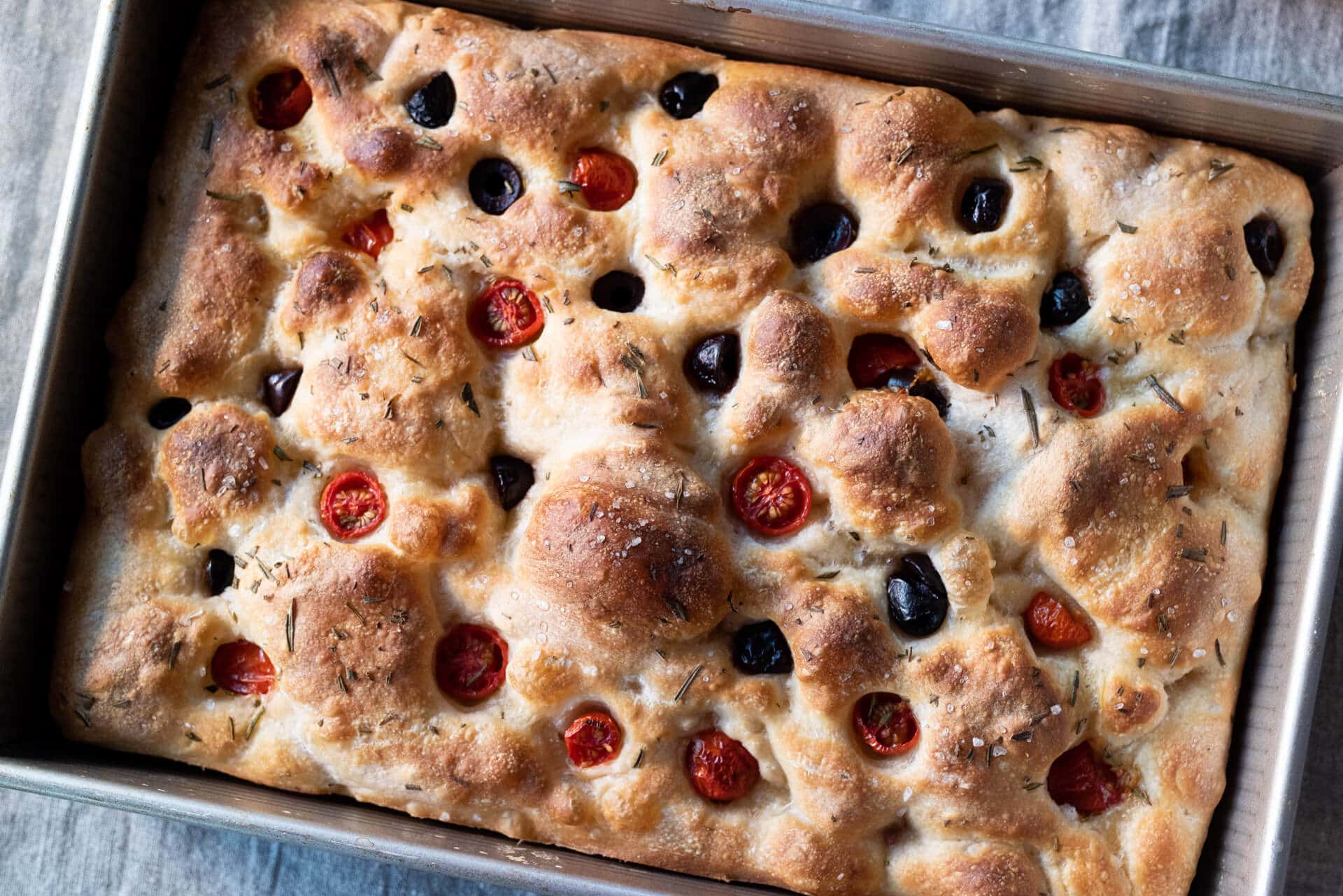
Wrinkled fingers and toes, sand in every nook and cranny, lunch sacks with empty oil-stained white baker’s paper, and serpentine hair that could pass as a sun-bleached mop head—all signs of a successful outing to the beach. Our daily trips to the Adriatic’s cool, blue waters were welcome escapes from the city heat during family visits to Southern Italy. Our little beach— perhaps with a bit of fantasy I like to think it was just ours—was a short drive away in a small stick-shift car packed to the brim with people. Family car after family car, we’d speedily caravan through the small towns toward our respite. The few, yet crucial, stops along the way had a single purpose: to fill our sacks with baked goods meant to sustain our time away. My favorite among these, by a long measure, was a simple sourdough focaccia.
With hardly a second thought, we’d buy several full sheet trays of the golden bread. The baker would cut the thick slabs into manageable pieces and wrap the entire thing in the white paper, sealed shut with a shiny sticker— conceivably an attempt to elevate the humble, yet utterly otherworldly, snack.
You see, focaccia is a rustic and simple affair: it’s a slab of naturally leavened dough topped with simple ingredients, any vegetable in season, olive oil, and salt. Some focaccia are soft, and some are crispy (my preference), sometimes thick and sometimes thin. There are as many variations across Italy as there are dialects. The beauty of this bread is that you can make it with little effort. First, mix the dough in the morning, then let it rise during the day, and finally bake it just before dinner. If you have a ripe sourdough starter, salt, and olive oil, you’re hours away from golden focaccia—and all the wonderful olfactory impressiveness therein—baking in your home oven.
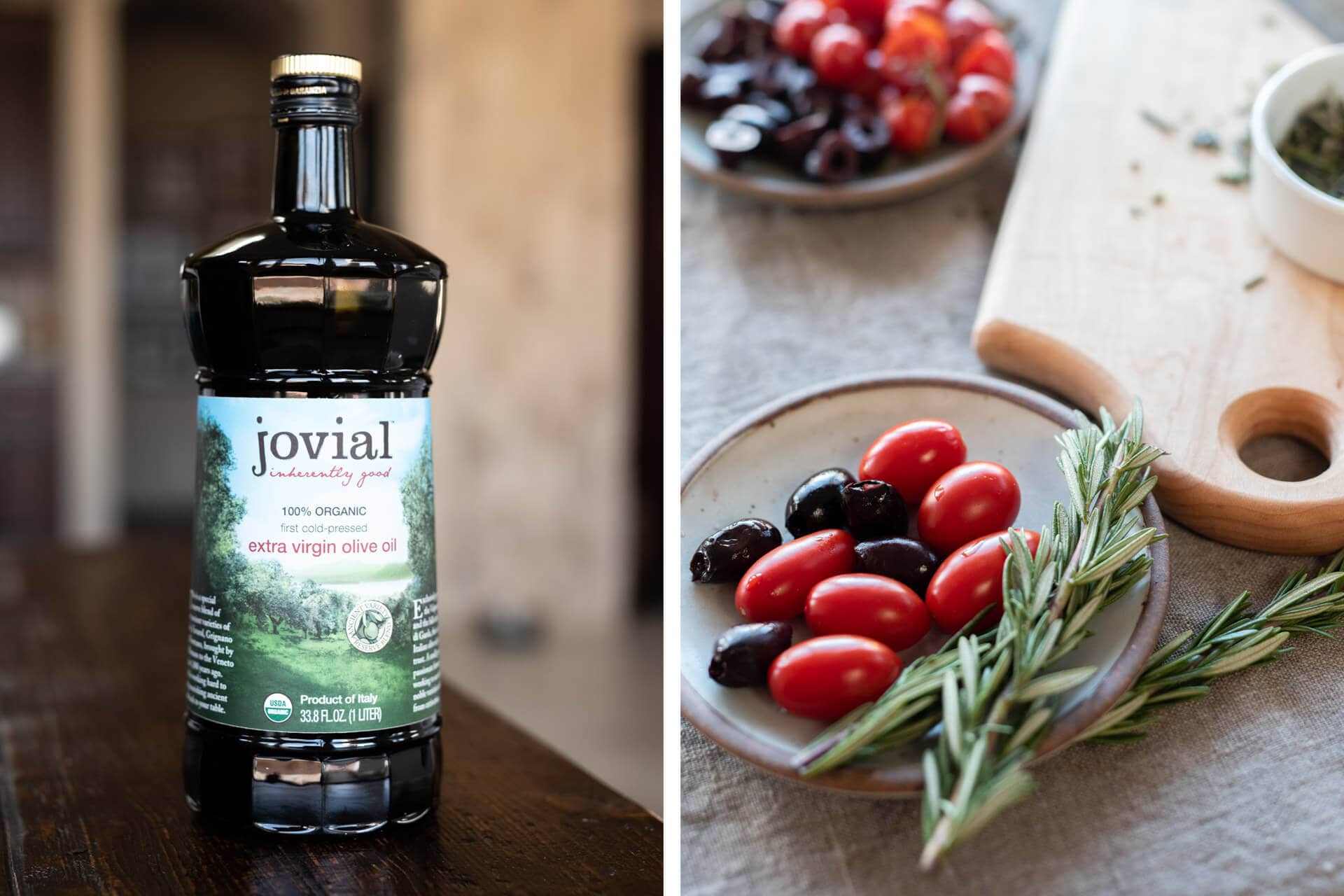
Because sourdough focaccia has so few ingredients, the ones you use should be of the utmost quality. Use vegetables in season and the highest quality olive oil you can find. In this post, I worked with Jovial’s Olio Nuovo, a fresh-pressed olive oil from the Valpantena area of Northern Italy. It isn’t easy to source exclusively fresh-pressed olive oil. Usually, this oil is blended with aged oil, balancing the flavor profile to make it consistent with other offerings throughout the year. This fresh oil has a delicate flavor but a balanced, upfront fruitiness as well. If you’ve never had the chance to try an oil like this, you’ll be pleasantly surprised.
Flour Selection
With this naturally leavened focaccia, I wanted little sourness in the result. While I typically include whole grains in most of my recipes, I wanted the flavor of this classic bread to be mild so the taste of the olive oil and fresh toppings pop. Removing all the whole grain flour from initial trials hit the spot.
For this formula, I blended 30% high protein flour (about 13% protein) with 70% all-purpose flour (11-12% protein). The high protein flour helps give this highly-hydrated dough strength and structure—and 30% is just enough.
Focaccia Toppings
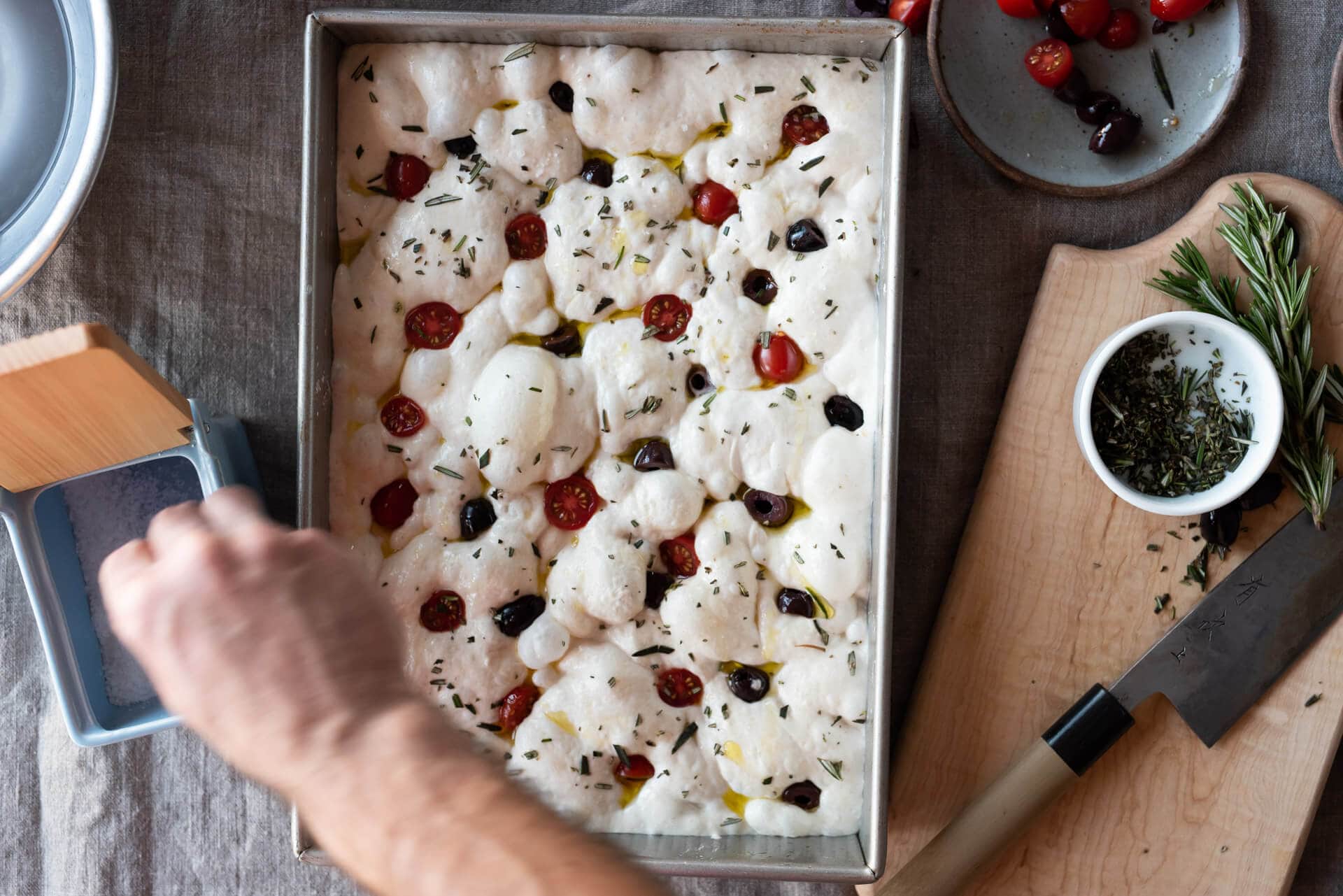
This simple sourdough focaccia can be topped with just about anything you can imagine. My favorite is rosemary, chopped cherry tomatoes, pitted kalamata olives, coarse sea salt, and good quality olive oil. Traditionally, Ligurian focaccia (and as shown in the recent Salt Fat Acid Heat episode on Netflix) is topped with a salty brine. Instead, I love dusting the top with coarse sea salt: the chunky crystals bring unexpected pops of flavor.
Here are a few more ideas:
- Tomatoes, capers, oregano, garlic, olive oil
- Thinly sliced Yukon gold potatoes tossed with coarse salt. Let the potatoes drain over a colander for 15 minutes to help remove some water. Then top in addition to coarse sea salt, fresh thyme, and olive oil
- Sliced and olive oil-marinated red onions, brined olives, and fresh chopped tomatoes
- Grated hard cheeses of all kinds (parmesan, pecorino, etc.), rosemary, olive oil
A Simple Sourdough Focaccia Recipe
Special Equipment
For this sourdough focaccia, you will need a round or rectangular pan for baking. I like to use a deep pan (as opposed to a baking sheet) so the focaccia doesn’t dry out too fast in the oven. My preferred pans:
- 9″ x 13″ USA Pan Rectangular Cake Pan
- Two 10 x 2.25″ LloydPans Round Pans (use the same dough weight as in this recipe, just divide in half and place each half into one pan)
Both pans have a nonstick interior, and they conduct heat exceptionally well, imparting a beautiful crust on the naturally leavened focaccia.
Vitals
| Total Dough Weight | 1,200 grams |
| Sourdough Starter | 19.00% |
| Hydration | 76.00% (78.00% with olive oil) |
| Yield | One 1200g focaccia |
Total Formula
This table shows the entire quantity and baker’s percentages for each ingredient. If you’d like to make two large focaccia (or four smaller ones), double everything in the table below.
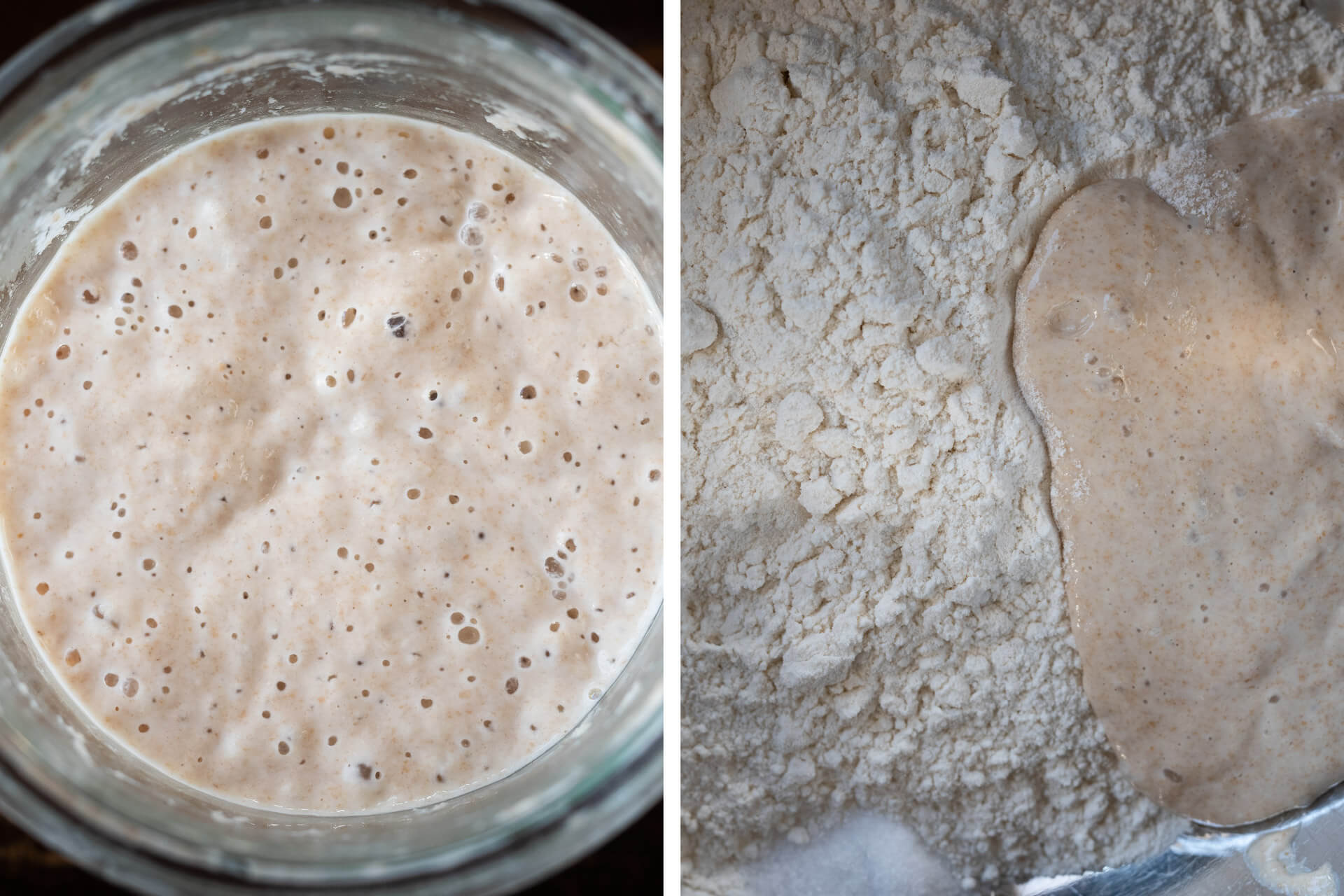
There’s no specific levain build for this focaccia, just use some of your sourdough starter when it’s ripe (when you’d normally give it a refreshment). See my post on the differences between a levain and sourdough starter for more information on the two preferments.
Target final dough temperature (FDT) is 76°F (24°C).
| Weight | Ingredient | Baker’s Percentage |
|---|---|---|
| 423g | All-purpose flour (King Arthur All-Purpose Flour) | 70.00% |
| 181g | High protein bread flour, malted (King Arthur Bread Flour) | 30.00% |
| 12g | Extra virgin olive oil (Jovial Olio Nuovo Organic Olive Oil) | 2.00% |
| 459g | Water | 76.00% |
| 11g | Salt | 1.80% |
| 115g | Sourdough starter (100% hydration) | 19.00% |
Method
Mix – 9:00 a.m.
This dough can be mixed by hand (I would use the slap and fold technique) or with a stand mixer like a KitchenAid or Famag spiral mixer.
To the bowl of a stand mixer fitted with the dough hook attachment, add both the flours, water, salt, and ripe sourdough starter (hold back the olive oil until later in mixing).
Mix on speed 1 for 1 to 2 minutes until incorporated. Then, mix on speed 2 for 5 minutes until dough strengthens and clumps around the dough hook. Let the dough rest in the mixing bowl for 10 minutes.
Next, turn the mixer on to speed 1 and slowly drizzle the olive oil into the bowl while mixing. Once all of the olive oil is absorbed, turn the mixer up to speed 2 for 1 to 2 minutes until the dough comes back together.
Transfer your dough to a bulk fermentation container and cover.
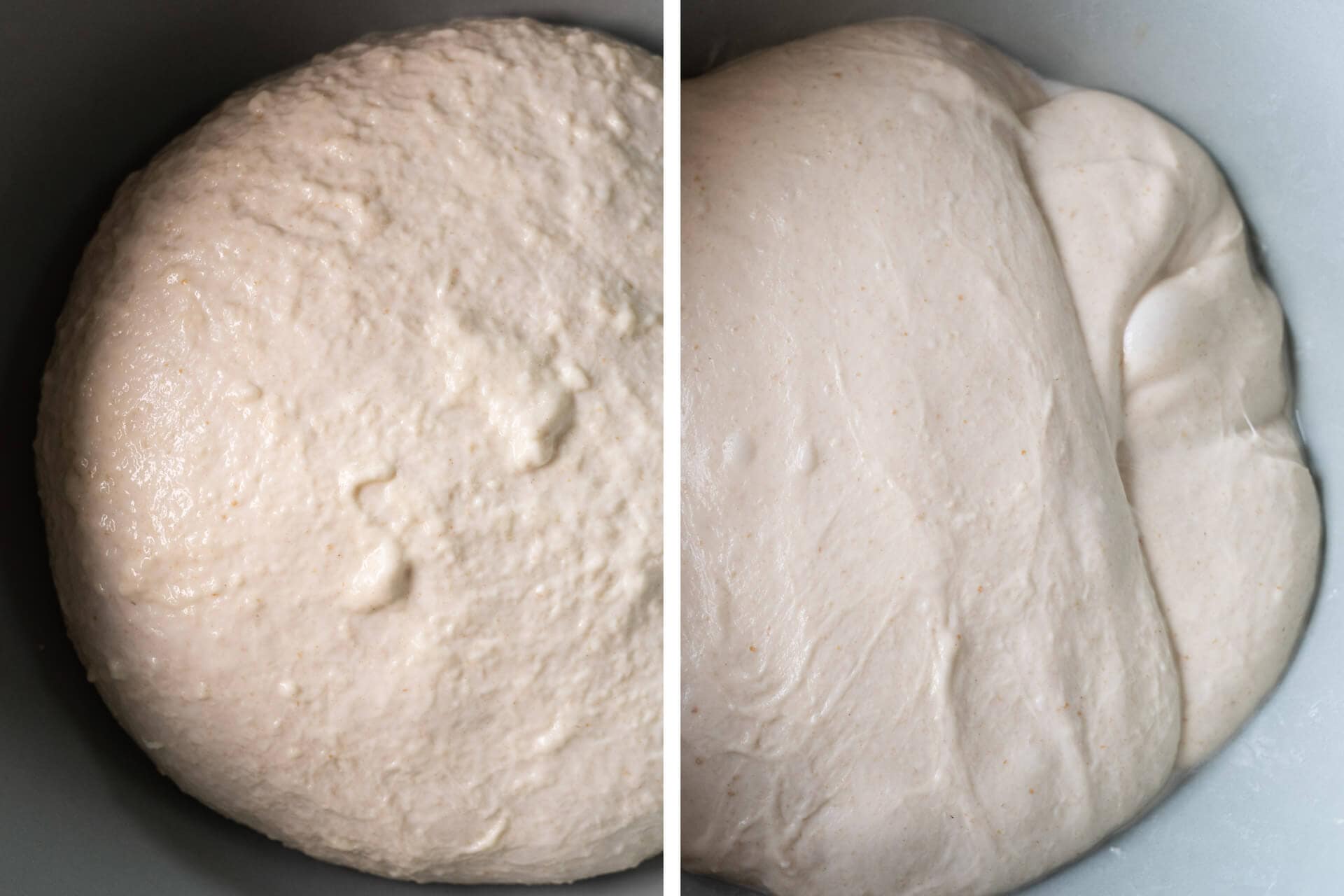
This highly hydrated and enriched dough is wet and loose, it won’t strengthen to the same degree as a typical bread dough.
As you can see below on the left, the dough is still very wet and chunky immediately after mixing. However, it’s not falling apart or soupy. Please resist the temptation to add more flour at this point. As you can see below in the image at the right, by the middle of bulk fermentation, it’ll strengthen after several sets of stretch and folds (see my guide on how to stretch and fold sourdough for more information).
Transfer the dough to a covered container for bulk fermentation.
Bulk Fermentation – 9:15 a.m. to 11:15 a.m.
Give the dough 4 sets of stretches and folds (fold a side of the dough up and over to the other side, and then rotate the container to perform 4 folds per set), starting 30 minutes after mixing, and a set every 30 minutes after that.
Proof – 11:15 a.m. to 3:15 p.m.
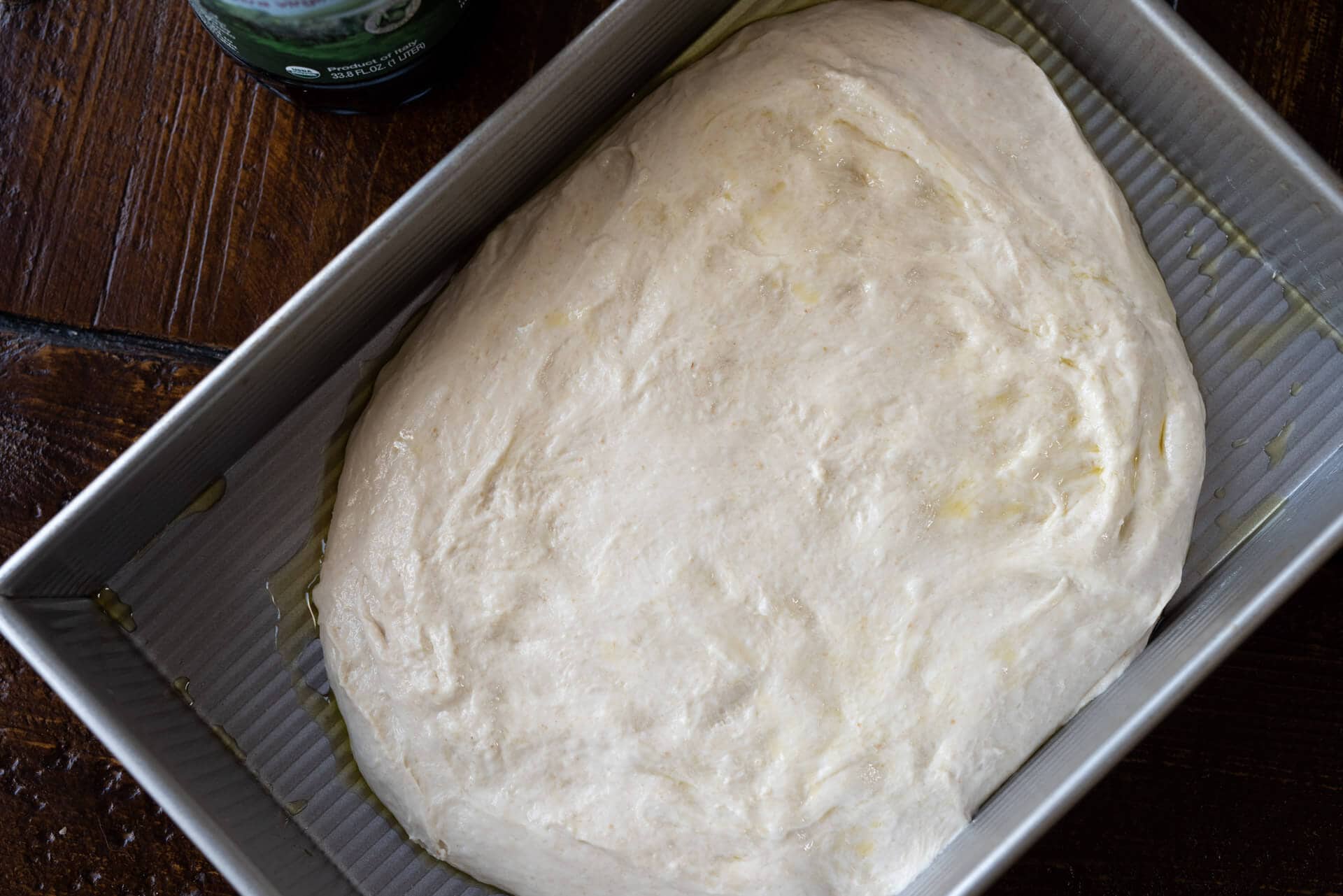
Transfer the dough to a deep rectangular pan that’s been greased with olive oil. If you don’t have a pan with a silicone liner, make sure to heavily oil the pan’s interior so the focaccia doesn’t stick during baking.
At 76-78°F (24-25°C), the dough will proof for 4 hours. This time period is flexible and dependent on the temperature: if it’s cooler, let it proof longer, and conversely, if it’s warm, you might be able to bake sooner.
Every 30 minutes for the first hour, uncover the pan and gently stretch the dough with wet hands to the pan’s edges to encourage it to fill the pan. The dough will naturally spread out during this proofing period, so it’s unnecessary to spread the dough aggressively. Once the dough is mostly spread to the edges, cover the pan and proof for 4 hours.
OVERNIGHT OPTION: After two hours in proof, cover the rectangular pan with an airtight cover and transfer to the fridge. The next day, take out the dough and let it come to room temperature, and continue with the Top & Bake step below.
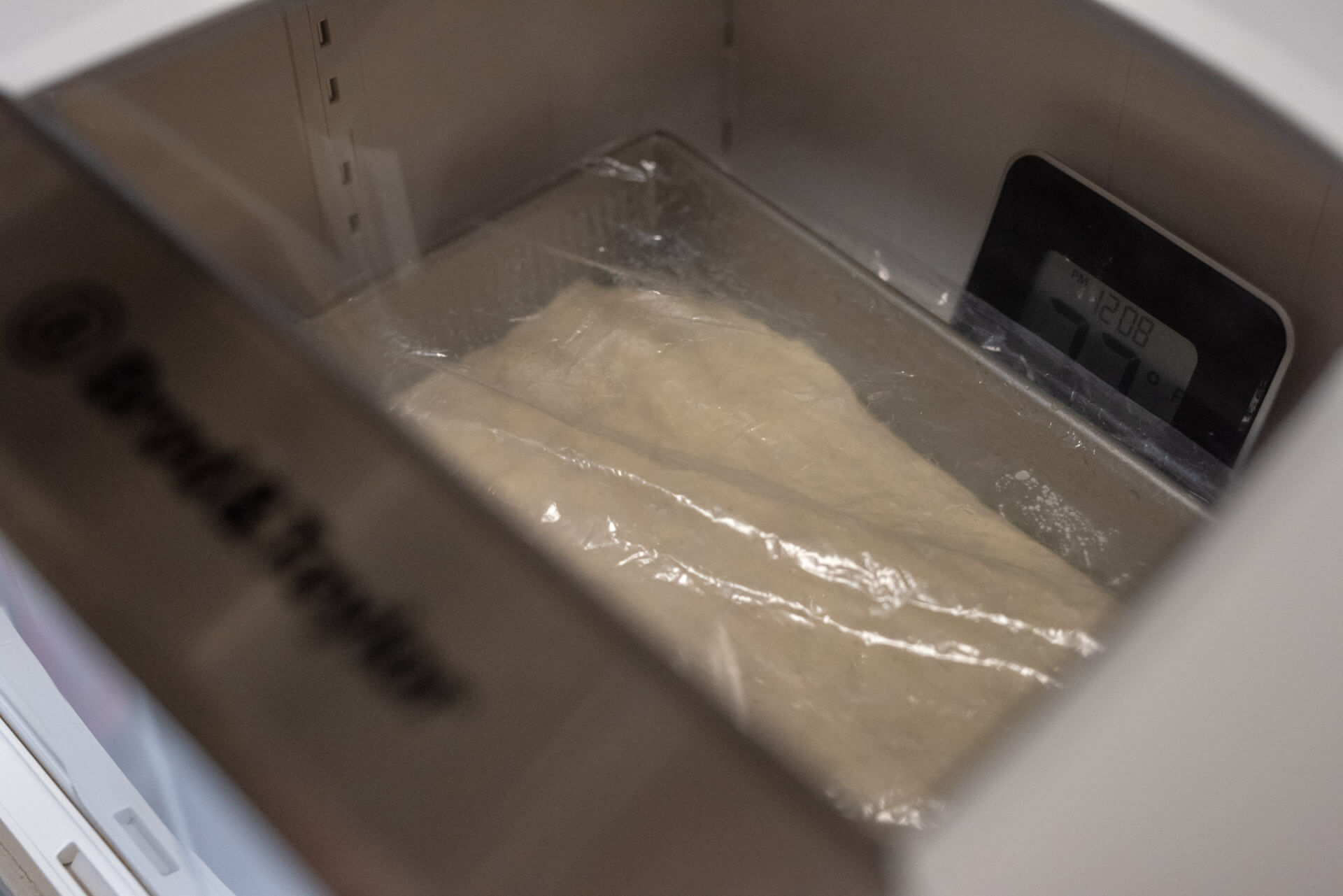
The rectangular pan I use fits perfectly inside my B&T Dough Proofer. I keep it inside the proofer, covered with reusable plastic, and set to 78°F (25°C) until ready to bake.
About 30 minutes before you anticipate the sourdough focaccia dough being ready, preheat the oven to 450°F (232°C) with a rack placed in the bottom third (a baking stone is not necessary).
Top & Bake – 3:15 p.m.
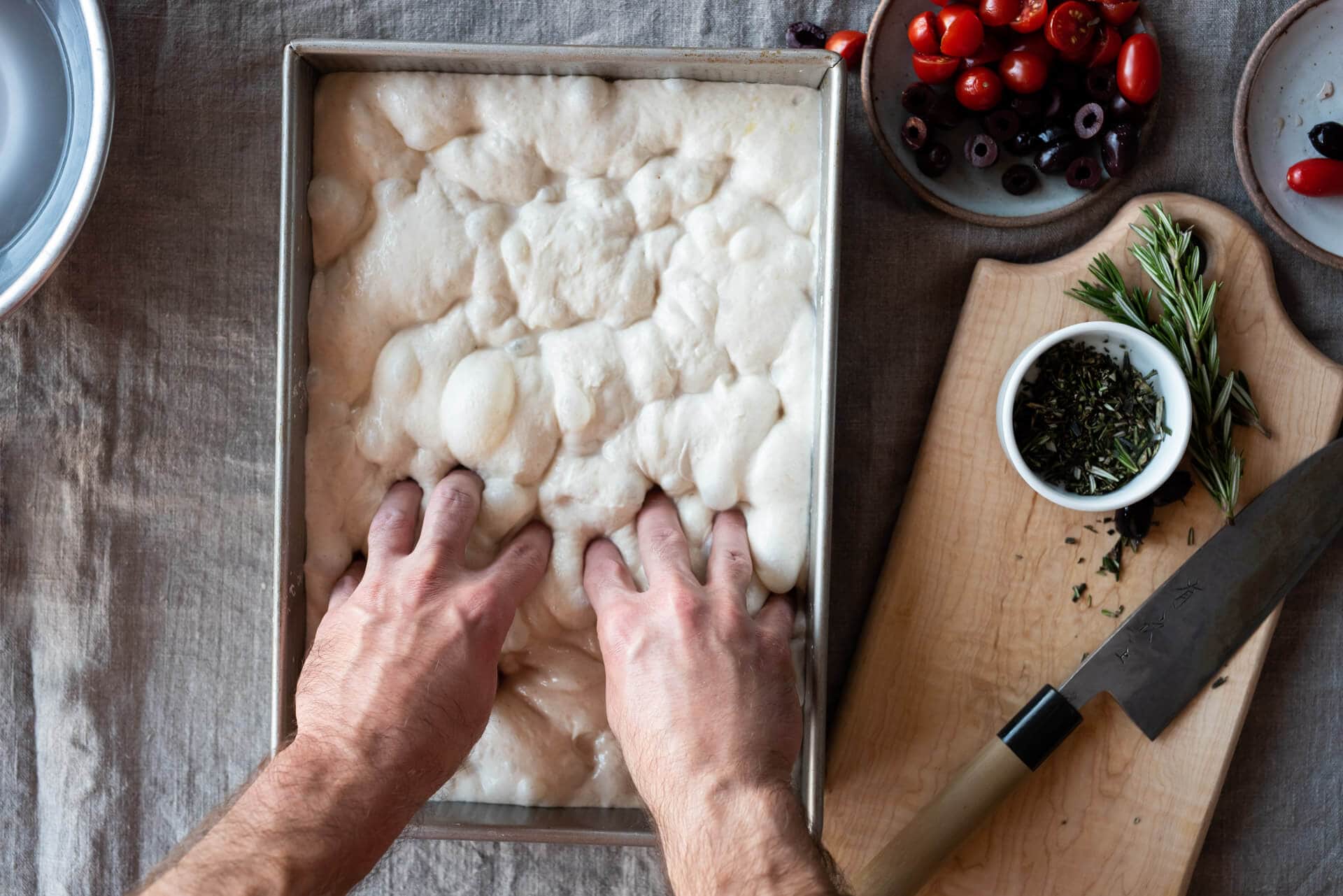
First, dimple the unadorned dough with wet fingers. Make sure the dimples are evenly spaced and go all the way down to the bottom of the pan. Then, drizzle on 1-2 tablespoons of your extra virgin olive oil and sprinkle with herbs and coarse sea salt. If using other toppings, add them now as well—I like to press them into the dough gently.
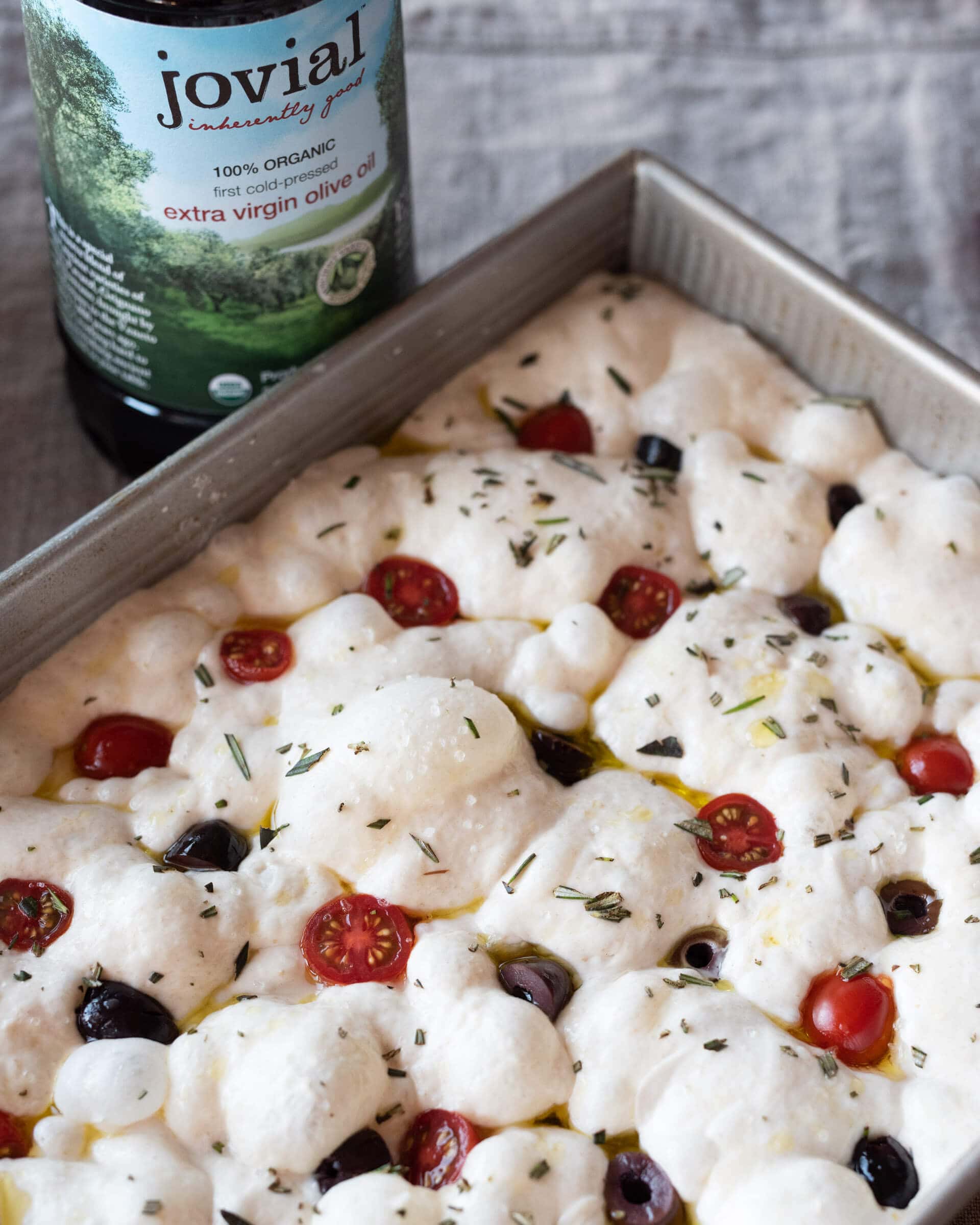
Bake the focaccia in the oven at 450°F (232°C) until deeply colored on top, about 30 minutes. Rotate the pan front-to-back halfway through this time. Keep an eye on it during the last 5 minutes and pull it out if it’s coloring too quickly, or leave it in longer if you’d like it a little darker.
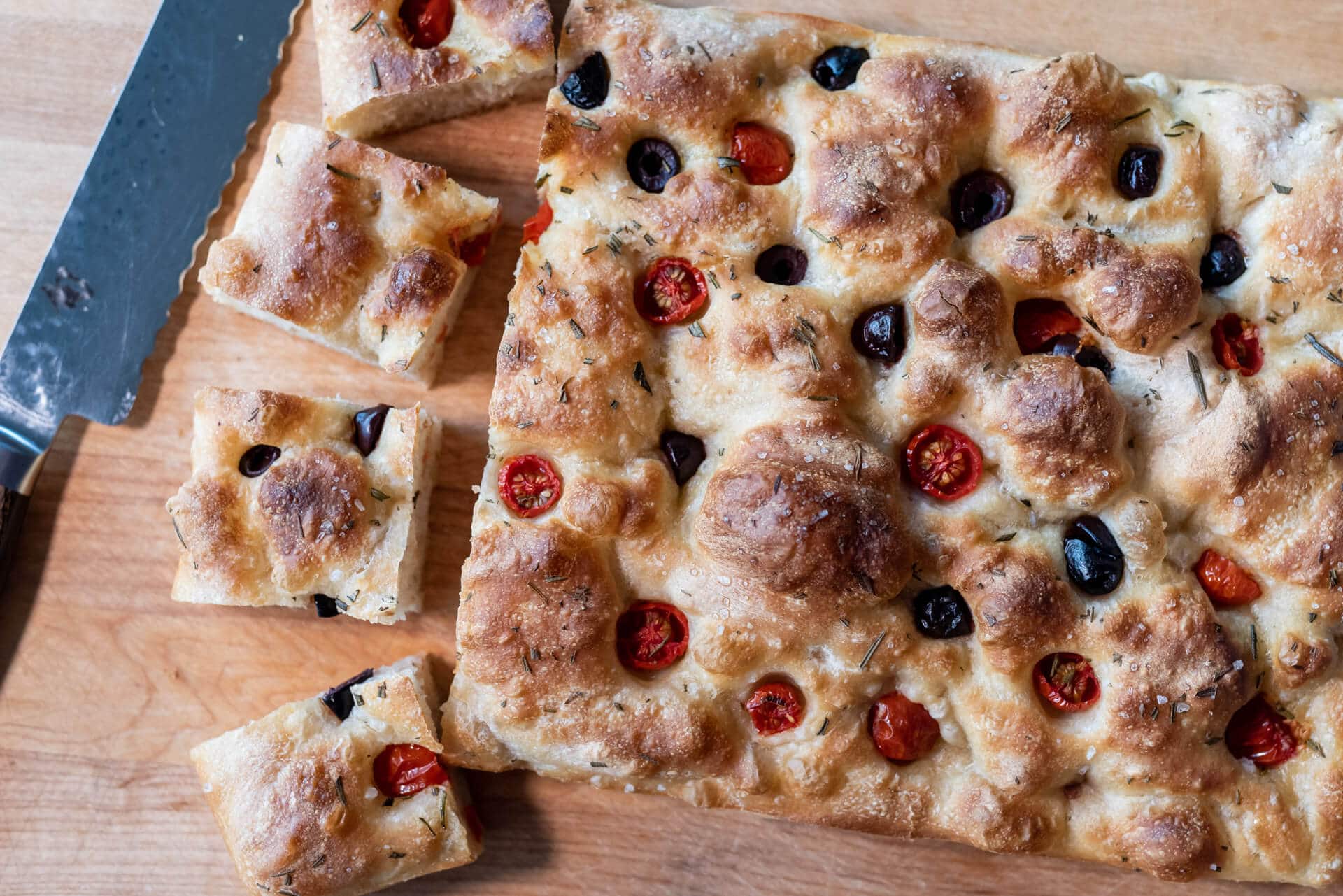
Let the focaccia cool a few minutes in the pan, then transfer to a cooling rack. It’s fantastic warm from the oven, and best on the day of baking, but it’ll keep well for a couple of days loosely wrapped in foil (reheat under the broiler before serving).
Conclusion
When I topped the pillowy focaccia dough, the aroma of fruity olive oil and chopped rosemary was captivating. Once the pan was slid into the oven, my house gradually filled with the most intoxicating perfume as the dough rose high and the edges began to crisp. The melange of baking dough, toasted herbs, olive oil, and briny olives had me checking the oven frequently—as if checking on it would expedite things. Sit tight, wait for it to finish, I told myself as I gently slapped my hand from opening the door yet again.
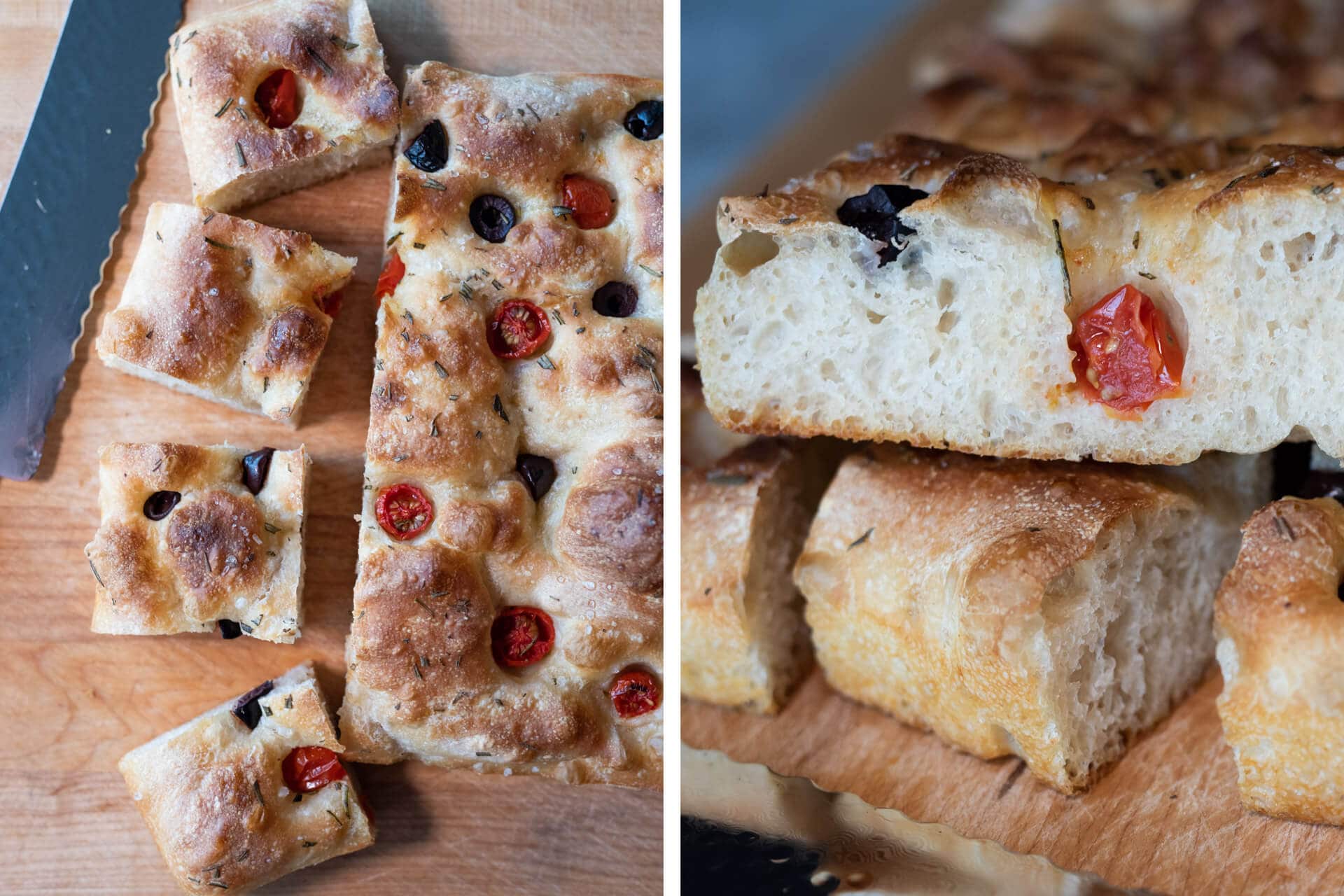
Thanks to the copious addition of high-quality olive oil, both in the mix and on top of the dough, causes the dough to turn crispy and take on a beautiful golden hue. Biting through a slice first provides a faint resistance, then gives way to a soft and ultra-tender interior. A perfect mix of flavors and textures—an experience best savored, as if you’re at the beach without an agenda.
This simple and rustic sourdough focaccia, made with a naturally leavened dough and topped with just the right balance of ingredients, brings me right back to the blue waters of the Adriatic; the sun in my eyes and thick, crunchy slices of bread eaten with haste. The only things absent are the beautiful white wrapping paper and all those little bits of sand that seem to work their way into just about everything—yea, I can do without that.
If you’re looking for more focaccia-goodness, check out my sourdough focaccia Pugliese which has potato added into the dough, for even more chew, softness, and deliciousness.
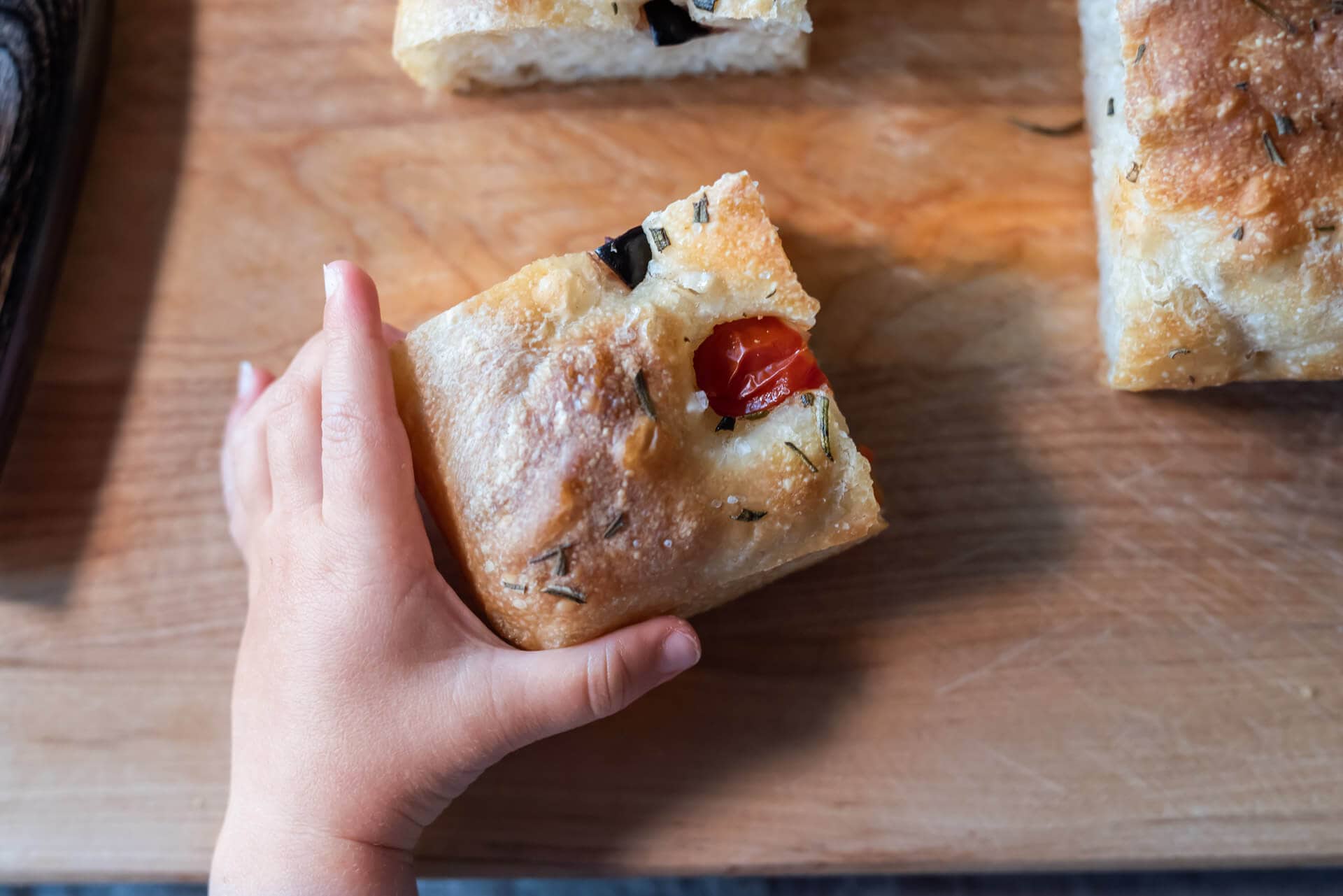
Thanks so much to Jovial for supplying me with their wonderful olive oil and sponsoring this simple sourdough focaccia recipe! As usual, the content and opinions here are my own.
Print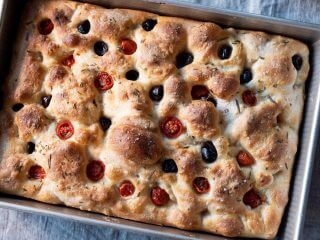
A Simple Sourdough Focaccia
- Prep Time: 6 hours
- Cook Time: 30 minutes
- Total Time: 6 hours 30 minutes
- Yield: 1 focaccia
- Cuisine: Italian
Description
This easy-to-make, delicious focaccia comes together in one day using your already ripe sourdough starter. Top with tomatoes, olives, rosemary, and coarse sea salt—or really, anything fresh in your kitchen that sounds delicious!
Ingredients
- 423g all-purpose flour
- 181g high-protein bread flour
- 12g extra virgin olive oil
- 459g water
- 12g salt
- 115g ripe sourdough starter
Instructions
- Mix (9:00 a.m.)
This dough can be mixed by hand or with a stand mixer (like a KitchenAid). To the bowl of a stand mixer fitted with the dough hook attachment, add both the flours, water, salt, and ripe sourdough starter (hold back the olive oil until later in mixing). Mix on speed 1 for 1 to 2 minutes until incorporated. Then, mix on speed 2 for 5 minutes until the dough strengthens and clumps around the dough hook. Let the dough rest in the mixing bowl for 10 minutes. Next, turn the mixer on to speed 1 and slowly drizzle the olive oil into the bowl while mixing. Once all of the olive oil is absorbed, turn the mixer up to speed 2 for 1 to 2 minutes until the dough comes back together. Transfer your dough to a bulk fermentation container and cover. - Bulk fermentation (9:15 a.m. to 11:15 a.m.)
Give the dough 4 sets of stretch and folds at 30-minute intervals, starting 30 minutes after bulk fermentation begins. - Proof (11:15 a.m. to 3:15 p.m.)
Liberally oil the inside of a 9×13″ rectangular pan or two 10″ diameter circular baking pans. Gently scrape the dough out of the bulk fermentation directly into the rectangular pan (or onto a work surface, divide in two, and place each in a circular pan). The dough will proof in the pan for 4 hours. Every 30 minutes for the first hour, uncover the pan and gently stretch the dough with wet hands to the pan’s edges to encourage it to fill the pan. The dough will naturally spread out during this proofing period, so it’s unnecessary to spread the dough aggressively. Once the dough is mostly spread to the edges, cover the pan and let it proof for the remainder of the 4 hours. About 30 minutes before the end of the 4-hour proof period, preheat your oven to 450°F (230°C) with an empty rack in the bottom third. - Top & Bake (3:15 p.m.)
When your oven is preheated, dimple the top of the dough all over with wet fingers. Then, liberally drizzle olive oil over the surface of the dough. Spread on chopped herbs and coarse sea salt. Bake until golden on the top and bottom, about 30 minutes. Let the focaccia cool in the pan, then transfer to a cooling rack. It’s wonderful straight from the oven, and best the day it’s baked.
Notes
Overnight proof option: Midway through the 4-hour proof, place the covered pan with dough in the refrigerator to proof overnight. The next day, take the dough out, bring it to room temperature, finish proofing until well risen and bubbly, and continue with the Top & Bake step.
If you use this recipe, tag @maurizio on Instagram so I can take a look!


744 Comments
Hi Maurizio! I’ve been doing your focaccia for several months now. There were only 2 or 3 times I had bubbles before the bake, otherwise the taste is great. Still trying to figure out why is it so hard to get the bubbles. What are the most common reasons for this?
And another thing. Not sure, but I think when I use KitchenAid the dough is much more loose, soupy, no chance of adding the reserved water. When I mix it by hand, it’s more firm. I have done like this yesterday, with KA, I will repeat it today, with the same flours, but by hand, to test this “problem”. I will get back to you
There is a slight difference when mixing by hand.
And again focaccia didn’t rise in the oven, no bubbles. :/ Is it because it’s sooo hot, 28°C room temp?
I’m not maurizio, but it could be many things.
-If the dough is not well developed there won’t be enough gluten to trap the gas, and then there won’t be any bubbles.
-It could also be your starter. if it’s hot you’re probably going to
need to feed your starter 2 or 3 times a day. If you let your starter
sit too long with out feeding it will become weak. A weak starter means
the yeast won’t be active and there won’t be any gas to catch.
-It helps to follow the guidelines listed here, and to take your own notes. How long do you let the dough bulk and poof, and at what temp. some bakers choose to take the temperature of the dough. If you haven’t been taking notes. I think you’re fine to follow the instructions here at 28c. If you have problems i would make sure you’re feeding your starter adequately and developing the dough well enough.
– You could also just not be following the directions at all. Make sure you’re allowing the dough enough time to ferment. The recipe here has a 3 hour bulk ferment and a 3 hour proof. That’s 6 hours on the counter before it goes into the oven.
I’ve made this focaccia 3 or 4 times now. I go between this recipe and another simpler recipe that uses cold, unfed starter discard straight from the fridge. I like them both for different reasons: this one has a well developed flavor but for some reason I can’t get quite as good a rise and bubbly interior structure. The other one rises insanely well and has a gorgeous structure but the development of the flavor doesn’t quite match this one. I’m going to keep tinkering to combine aspects of both to see if I can get the perfect focaccia from my kitchen. Thanks!
What recipe did you use with the unwed starter?
i’ve made this recipe with a week’s worth of discard a few times and it turned out perfectly. Discard is pretty lively as i refresh my starter twice a day.
Hi Maurizio,
Firstly thank you for all your wonderful hard work and tips with regards to everything Sourdough,
I’m looking forward to making my first Focaccia, but am a little confused regarding the Starter:
I’m currently feeding my starter every 12 hours (8am and 8pm) 50% Ap and 50%Wholewheat,
Its looking strong and bubbly, peaking at around 5 hours,
If I am to mix my formula at 9am, When would I give my starter its last feed ?
Does the starter need to be mixed with the other ingredients just before peaking ?
two hours later,
I’ve just read your notes on starter maintenance etc, I see if I increase the ratio it should peak around 12 hours
So feed night before around 9pm 1:5:5
Please let me know if this is correct
I’ve made focaccia from this recipe few times already and it always turns out amazing! I wonder tho, why when I transfer the dough to the pan it stretches by itself covering whole pan already by 30-60 minutes of proofing. What could be the reason for that?
Maybe you have warm room, so it rises quicker? I would assume that it’s not a bad thing.
I just made this as my first actual sourdough bread recipe (discard doesn’t count) and it was honestly soooo good. It had a really nice crust all around and it was really airy inside because of how much it rose in the oven. I topped it with rosemary, olives, and tomatoes and my family literally devoured it. Thanks so much for posting this!
Fantastic, Hafsa! Happy to hear you guys enjoyed it so much — happy baking!
Discard includes active sourdough yeast culture. How does it not count?
Hi Maurizio, I was waiting for my first cherry tomato harvest from my garden to make this and now it’s finally here! I only have KAF AP flour and I still can’t get my hands on bread flour. Do you suggest subbing white whole wheat, or using all AP instead? Thanks
Ahh, so jealous! I’m still waiting here, perhaps another week for me. You can use all KAF AP, but I would reduce the hydration some. I’d probably go down to 70% or so, see how it feels when mixing, and add more if you feel it can handle the water.
I love this recipe !! I just had a quick question when you say mix with the mixer what attachment head are you using ? I’ve been using the dough hook but I’m unsure if I should use the paddle then switch over ? Or does it not matter ? Thank you for sharing all of your recipes !!
Hey, Nicole! Yes, dough hook for this dough. The paddle can help when a dough just won’t come together, but this dough should be just fine with the hook. Happy baking.
Thank you for getting back to me !!! I was also wondering once we transfer it to oiled pan to stretch every 30 minutes is it uncovered or covered ?
I keep it covered!
Hi Maurizio. I made this with 100% einkorn flour and it turned out fabulous. I used 30% whole grain from Einkorn.com and 70% all-purpose from Jovial. I reduced the hydration to 68% in the formula, but did not add the last 50g of H2O. The dough was wet and did not come together in the stand mixer (less gluten development in einkorn flour), but I just persevered; I also reduced the starter to 15% (80% hydration); reduced the bulk ferment time by 30 minutes; proofed overnight in the fridge; warmed up for 2 hours @ about 85 degrees. I used that great USA pan. Thanks for your site! Although I am baking with only einkorn, I can adapt a lot of recipes here by lowering hydration and experimenting. Best of all: you’ve taught me how to do my own baker’s math!
Any advise on keeping bottom from sticking. I’ll try more oil but I’ve made this wonderful recipe twice and both times it’s been a challenge removing from the pan. Parchment paper, semolina flour, more oil. Using a Pyrex 9” X13” pan.
Fix this and I’ve got the perfect focaccia!
Thank you
I had this problem as well. Not having the non-stick pan that Maurizio recommends, I used a generous amount of olive oil in the pan for my first batch. The focaccia still stuck badly to the pan, and was excessively oily. For my second batch, I made a sling of parchment paper, cut to fit the bottom of the pan, and left wings draping over the long edges. (To get the parchment to sit flat in the pan, you can still rub the bottom of the pan with a small amount of oil before lining with parchment, though this is not necessary.) Then I applied a small amount of oil to the parchment, and sides of the pan. No more problems with sticking.
Thanks, Julian!
Thank you both. I will try the addition of parchment paper on the next go around.
Thanks for this delicious, and simple recipe, Maurizio. I’ve got another batch coming out of the oven today in about 20 minutes. The house already smells intoxicatingly of rosemary and garlic!
Awesome, Julian! Enjoy 🙂
Hey, Nick! As Julian said below, using parchment is the way to go. I’ve used a few pans without the nonstick silicone liner and parchment was the thing that’s helped the most. You can cut it to fit a rectangle or just keep it on the bottom and use an offset spatula to slide at the sides and help remove. Sorry for the sticking, I know that’s annoying!
Maurizio,
Your blog is fantastic. Thank you!
I love focaccia. My favorite is from Bari with potatoes in the dough. Do you have a good recipe for that? I’ve used Katie Parla’s lately, from Food of the Italian South.
I’d be interested in your variant if you have one.
Happy baking!
Hey, Greg! Ahh, Bari, really close to my family in Ceglie — they use potatoes quite a bit as well. I have a recipe here for potato bread that’s inspired by bread my dad had when growing up in the south of Italy, but I haven’t tried this with focaccia yet. I have Parla’s book (and love it), I’ll have to revisit that!
Hello maurizio
Did you change the measurements of the recipe, because I had written down ur focaccia recipe a couple of months ago, and now was looking on ur verry useful website, found out that the recipe has changed
Thanks
I did change it just a bit! I reduced the hydration a tiny bit to make the recipe a little more reliable for readers. If you want to go back to how it was, just add another dash of water or so when you’re mixing, it’ll get you close! It was a small change.
Hi there!
Thank you for great recipes! I am bit puzzled about this sentences though, where you explain where to put the rack in the oven: “with a rack placed in the bottom third” – do you mean in the bottom of the oven? or the third level from the Bottom? Which can be either almost at the top or in the middle of the oven 🙂
I live in Greenland so maybe the explanation is obvious to everyone else but me :))
Regards,
Heidi
Hey, Heidi! The bottom third is the bottom 33% of the oven, usually like one rung up from the very bottom in most ovens. Hope that helps!
Hi. Making this for the second time today. The first time I made it, it came out beautifully. I used 50% w/w bread flour and 50% white bread flour (both high protein), used all the water, and it behaved pretty much according to your instructions. Kitchen temp was probably around 70F.
I thought I’d like the bread a little softer, so this time, I used 50% w/w bread flour and 50% all purpose while flour (lower protein). I held back 50gm of water. The dough looked as I’d remembered after the first step, but I only added 25gm more of water this time. Dough was pretty wet, but not “soupy” and it mostly stayed together, but I stopped there and didn’t add the last 25gm of water out of caution. Again, it was pretty soft during bulk ferment. When I put it in the pan, this time I didn’t pull toward the center but stayed spread out and a little mushy/sticky. Kitchen temp is 78F this time. I’m proofing in the fridge overnight now.
My assumption was that I’d get even better results when I used a flour mix closer to your recipe and in a kitchen that wasn’t as cool, so I was surprised that, even with holding back water, the dough seemed more slack. Will see how it comes together tomorrow when I bake. Wondering if I should give it any time out of fridge before I prepare for baking.
Hey, Ira! It’s so hard to say, it could have been the other flour you’re using: perhaps it’s not able to take on as much water as the other one you used. With this focaccia, I’ve found that even if the dough is ultra hydrated, it still comes out really great! If it’s too far soupy, though, then you’ll start running into issues, there’s only so much flour can take and at some point you’ll lose volume and structure. I hope it turned out great!
I made the recipe today. My dough never rose like I expected. certainly no billows of dough in the end. Pretty new to this. Anyone with any ideas as to what went wrong. Of note, I used my Ankarsarum mixer to make the dough as opposed to slap and fold. didn’t add all of the 50gm of water held in reserve. Probably about half.
There are so many variables. Being new at it, I would start with the health and readiness of your starter and time/temp. Summer temperatures are making the bulk go faster for me.
Make sure your mature starter passes the float test.
Some great advice by @katystafford:disqus below. Be sure your starter is strong and use it when it’s very ripe (when you’d normally refresh). It’s important to start off with plenty of fermentation activity in your starter. From there, the dough should be kept in a warm spot to help keep activity going. Lastly, if it’s over hydrated and feeling very wet and soupy, hold back a little more water. Using your mixer will work just fine!
Hi! I just made your dough today and I am in the last half of the bulk ferment (my dough is resting nicely in its pan now). I’m debating on whether to bake it today or wait until tomorrow to bake it, implementing the long overnight rise. Have you found any differences taste-wise between the regular recipe vs. a dough that proofs in the fridge overnight? I know a lot of websites say that a long ferment in the fridge lets the flavors of the sourdough really shine the next day vs a regular rise at room temp, but I was wondering if you had tried it both ways with this focaccia recipe! Also, if I plan to bake this for dinner tomorrow, will my dough over-proof? How long is too long for an overnight rise?
Awesome! Yes, I’ve proofed this overnight. Depending on where your dough is at, expect a little less rise but more flavor (more sour notes, likely) and a softer texture. It’ll likely be just fine waiting until the next morning!
I do keep it covered, even when in the pan!
Hi Maurizio, in your Instagram account you used a round pan, what diameter was your pan or did you adjusted the final yield?
I used this 10×2.2″ round pan to bake that round focaccia — the pans are pretty incredible. I did the same batch size as in the recipe but divided it in half, one half per round pan.
Made this today – garlic, fresh oregano, capers, tomatoes. Great recipe! Though as others stated, the dough was very sticky and even with wet fingers the dough stuck when dimpling it. It didn’t seem to make a difference in the outcome.
However, the next time I make it I’ll put all the “toppings” except the tomatoes, olive oil and finishing salt into the dough instead of putting them on top. The toppings burnt and lost their vibrance. I think that it will be better if the delicate ingredients are incorporated into the dough. We’ll see 🙂
Glad to hear it worked out! Yes, it’s quite a high hydration dough — I’ve been testing this with a reduced hydration and have been getting great results, I might modify the recipe slightly.
As with pizza, some toppings do need to be added after the oven, or midway through. It’s always a fun experiment to see which those are 🙂 Happy baking!
Hi Maurizio,
Thank you for such an informative and bautiful site! The first time I tried this recipe it worked out beautifully, and I have had high expectations ever since. But each time I’ve tried making it since then, the dough hasn’t risen during the proofing stage and comes out of the oven relatively flat with a closed crumb. I have no idea if I am under-proofing or over-proofing. What signs do you look for to tell if your dough is done proofing when dealing with such a wet dough? I know how to tell with a classic boule, but I’m not sure of the signs to look for in such a wet dough like focaccia. I have also tried the overnight rest in the refrigerator, and the dough did not rise then either. When using the refrigerator, how long do you bring the dough to room temp before cooking, if at all?
Thanks!!
I’m having the same issue and would love to hear any tips you have.
Thanks
Strictly a guess, but perhaps your sourdough starter is not “active”. Was it as bubbly the illustration?
See my reply above, Radoslav.
It sounds like your dough is over hydrated, I’d drop the water in the dough by 5% and try again. I’ve been testing this recipe and have considered lowering the hydration a tad to make it more reliable for many readers (even though I peg it at this hydro here time and time again!).
Wow! This was so fantastic Maurizio! We just polished off half a pan and I’m going to mix another batch now. It was a mild day weather wise and I just let the dough develop most of the day yesterday. At night, I put it in the fridge, took it out mid morning today and baked for lunch. The top (especially bubbles) was coloring a little quickly – perhaps because I had it in top third of oven. I covered loosely with foil halfway through. So my crust isn’t as well done as I would like (perhaps also a bit over proofed). But the chew! And the flavor and open crumb! Yum!
So glad to hear it worked out well for you!
Hi Maurizio, I made this a couple of weeks ago and it was fantastic! Thank you for this wonderful recipe. 🙂
It was such a hit with my family that they asked for another one-so , I refreshed my starter the night before and it had risen 3X, and was all bubbly and fruity/yeasty smelling in the morning so I proceeded. The dough was a breeze (used my kitchen aid mixer as before) and I noticed that during the bulk fermentation in the pan it stretched readily after just 1 hour. Still I waited the full 2 hours and it looked great but was so sticky I couldn’t make the dimples. It’s baking now, and has definitely risen but I am wondering if my dough was overhydrated? I used most of the water, all except 20 g. I’m hoping it tastes as great as the first one. (I used KA AP and BF). Thanks for any thoughts.
Hey there! Yes, sounds like either too much water in the dough or it went a little too long in proof. It should have tasted just as delicious!
Ciao Maurizio, I would like to make this Focaccia but I haven’t made a starter as yet, can I use a dry sourdough instead? How much of it would you suggest for 500g flour?
Thank you in advance !
Elena
No, you would need to first make a starter out of the dry sourdough.
No you need to rehydrate the starter and wait until it’s rising and falling predictably for a few days before using it to bake with!
Hi, Maurizio.
I’ve made this a bunch of times, and it’s fantastic. As are all your recipes! I am going to do the overnight proof option for this– any recommendations on what to do after removing from the fridge? Thanks!
I’d say you could just bake straight from fridge!
Hi Maurizio,
I plan on making this for a family brithday gathering next week and was wondering if you’ve ever tried using flavored olive oils for either the dough or the topping.
Thanks for developing the recipe!
I have not, but I’d imagine they would be fantastic. Rosemary, basil or other herb infused OO sounds great to me — enjoy!
Made this today and it turned out great!
Glad to hear it, Cindy! Enjoy 🙂
Hi there, really enjoying your posts! Is there a fix during bulk fermentation if I’m finding the dough to be a bit too wet?
Would a few extra folds help? Adding in more flour at this point is probably not the answer…
Hard to adjust when at bulk stage. Just keep with it, it will still turn out fantastic. Next time, drop the water in the mix to compensate for your flour. I usually like to drop by 10% and adjust from there.
Just made this today but subbed all mozzarella brine for water. It didn’t rise and proof as puffy as I’m used to but I’m not sure if that was a function of the brine (extra salty) or the fact that it was a bit cold to start. Otherwise, super delicious! Topped with garlic and onion.
Interesting idea, Kellen! The salt would definitely slow things down. What you could try is use water for the dough, but then pour a tiny amount of that brine on top just before baking to infuse it with a little extra salt (and then don’t sprinkle salt on top). Still sounds delicious!
Made this today for the second time. Two thumbs up!! Super easy, fast and very delicious, again. Added cherry tomatoes, kalamata olives, fresh chopped rosemary, and shredded parmesan. Used only 100g bread flour because I’m running low and none to be found. Started about 9:30 am and out of the oven at 7pm. Used glass 9×13 pan with olive oiled parchment paper and it slipped right out. Yummy dinner! Thanks Maurizio!
Awesome, Sheila! Sounds delicious 🙂
So glad to read a successful review from someone who used a glass pan before trying this myself! Sounds delicious, Sheila! 🙂
Hi, I’m in the UK and we have different brands of flour here. However, I thought I would mention having read a few of these posts that I made the focaccia again yesterday. The first time I made it it was incredible. I used part extra strong Canadian flour and part regular strong plain flour. I think that is the combination that you use in your fab recipe. However due to the lack of supplies here I only had the normal strong plain flour which I think is the equivalent to your all purpose flour. I followed the recipe as normal and it was a bit of a disaster – very over hydrated and so therefore no dimples and much less rise. I think it is important to note that if you don’t have that extra high protein flour you should leave out that extra 50g water. I am assuming that was my error.
Yes, absolutely agree, Caroline. I had the same experience except I used pizza flour in place of the bread flour and same result. Even without the extra 50g water, it was too wet and didn’t rise enough. I am trying with proper bread flour (12-13% protein) today and without the 50g remaining water and will see how it goes!
Yes, definitely with lower protein flour you’ll want to hold back more water, Natalie!
Thank you Maurizio! It worked out very well with the adjustments, I was happy!
Yes, sounds like over hydration for the flour you were using — sorry about that. This is a pretty highly hydrated dough, hold back more water and mix it in only if it looks like it can handle!
I just made this today. I didn’t have a sheet cake pan, but had an enameled Le Creuset cast iron casserole dish. It stuck like crazy when I tried to remove it from the pan, even though I oiled it before putting the dough in. I just now saw the comment below to reduce the water if using all-purpose flour, that probably would have helped. The bottom was also on the edge of burnt. I am baking with an electric oven and haven’t really succeeded in not burning the bottom of my bread in the few loaves I’ve made so far. I’m going to try the next one in middle of the oven instead of the bottom third and see if that helps at all. Despite all that, the focaccia came out delicious!
You might also want to try lining your pan with parchment, that’ll help it remove cleanly!
Hi, made this today. My dough got quite bubbly, but it never rose as much as yours. And when i went to make dimples, they didn’t stay. I’m wondering if this is likely over-hydration or under-proofing? Thanks! Amazing website.
What temperature should the bulk fermentation be at? Thanks!
I typically do this at warm-ish room temp, around 74-76°F, but if your kitchen is cooler just give the dough a little extra time to ferment and it’ll work just as well!
I made this today. Great recipe! I wound up baking it in a 12” Lodge cast iron skillet. My math said that if it’s 1.5” in a 9×13”, it would be 1.8” in a 12” skillet (with sloped sides). Next time – and there will definitely be a next time – I will cut the recipe by about 20-25% to compensate, because it was a bit thick. Still delicious and surprisingly filling! Thanks.
Yes, if it’s a little too thick it becomes like a sandwich in itself 🙂 Sounds like a good modification for the next go!
Hello! Do I have to use bread flour for this recipe or is there a way that I can get by with just king Arthur’s all purpose flour? I’m having a difficult time finding bread flour since store are low on it right now. Is there anything I can substitute for bread flour?
King Arthur AP will work very well with this recipe, I’d probably reduce the water in the mix by 5-8% or so to compensate.
This recipe is great! My focaccia turned out soft and airy. Loved it!
Glad to hear that, Susie!