

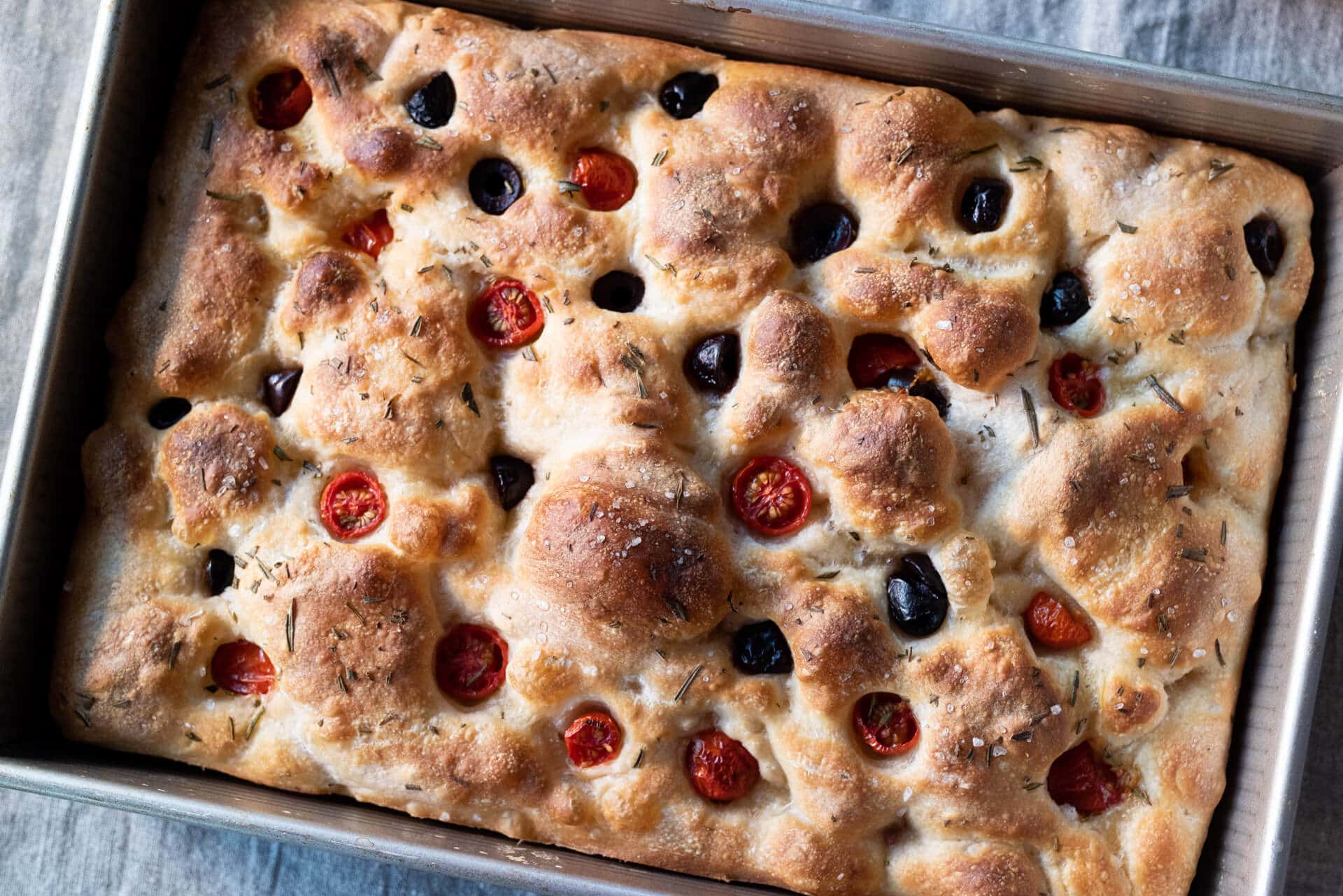
Wrinkled fingers and toes, sand in every nook and cranny, lunch sacks with empty oil-stained white baker’s paper, and serpentine hair that could pass as a sun-bleached mop head—all signs of a successful outing to the beach. Our daily trips to the Adriatic’s cool, blue waters were welcome escapes from the city heat during family visits to Southern Italy. Our little beach— perhaps with a bit of fantasy I like to think it was just ours—was a short drive away in a small stick-shift car packed to the brim with people. Family car after family car, we’d speedily caravan through the small towns toward our respite. The few, yet crucial, stops along the way had a single purpose: to fill our sacks with baked goods meant to sustain our time away. My favorite among these, by a long measure, was a simple sourdough focaccia.
With hardly a second thought, we’d buy several full sheet trays of the golden bread. The baker would cut the thick slabs into manageable pieces and wrap the entire thing in the white paper, sealed shut with a shiny sticker— conceivably an attempt to elevate the humble, yet utterly otherworldly, snack.
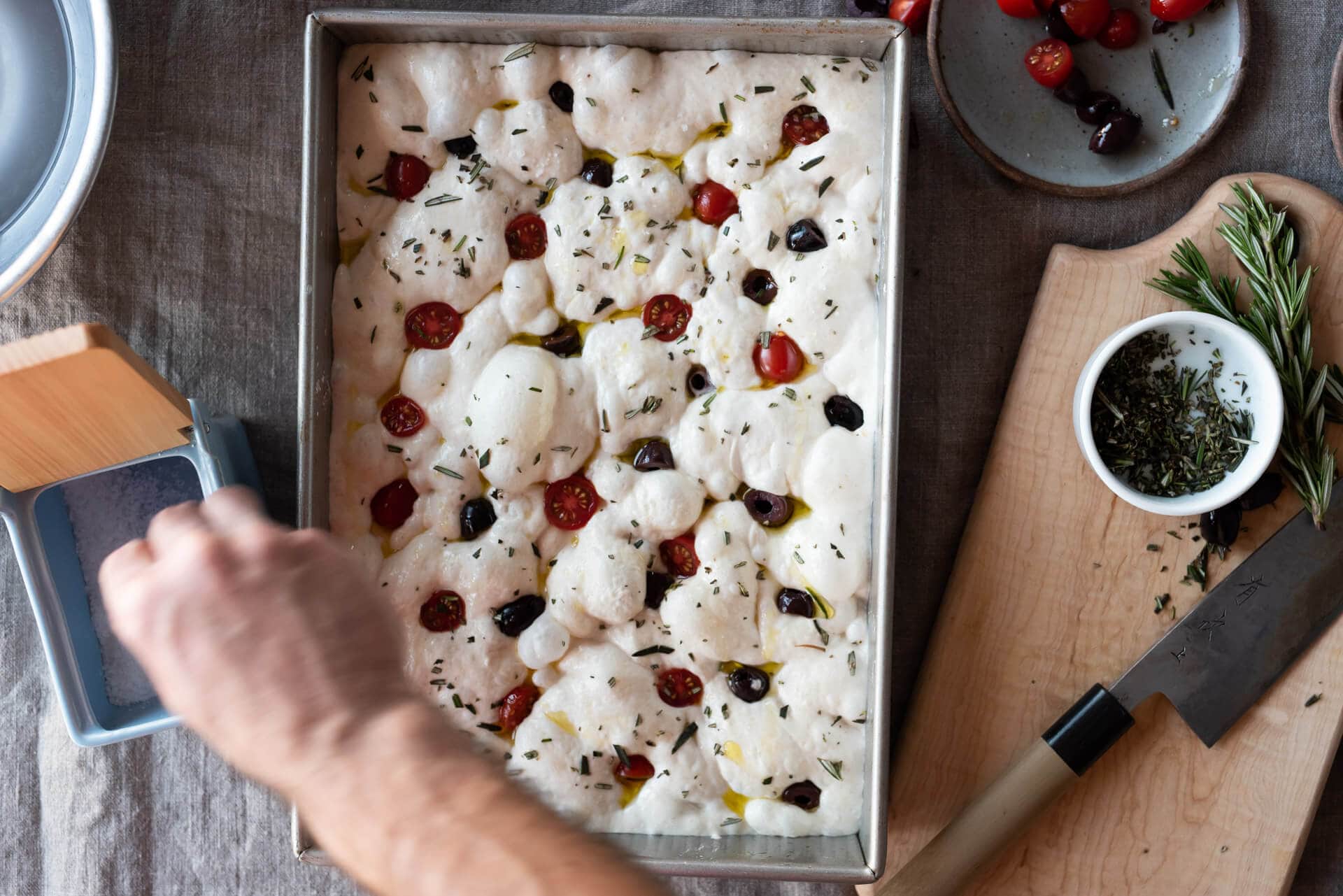
You see, focaccia is a rustic and simple affair: it’s a slab of naturally leavened dough topped with simple ingredients, any vegetable in season, olive oil, and salt. Some focaccia are soft, and some are crispy (my preference), sometimes thick and sometimes thin. There are as many variations across Italy as there are dialects. The beauty of this bread is that you can make it with little effort. First, mix the dough in the morning, then let it rise during the day, and finally bake it just before dinner. If you have a ripe sourdough starter, salt, and olive oil, you’re hours away from golden focaccia—and all the wonderful olfactory impressiveness therein—baking in your home oven.
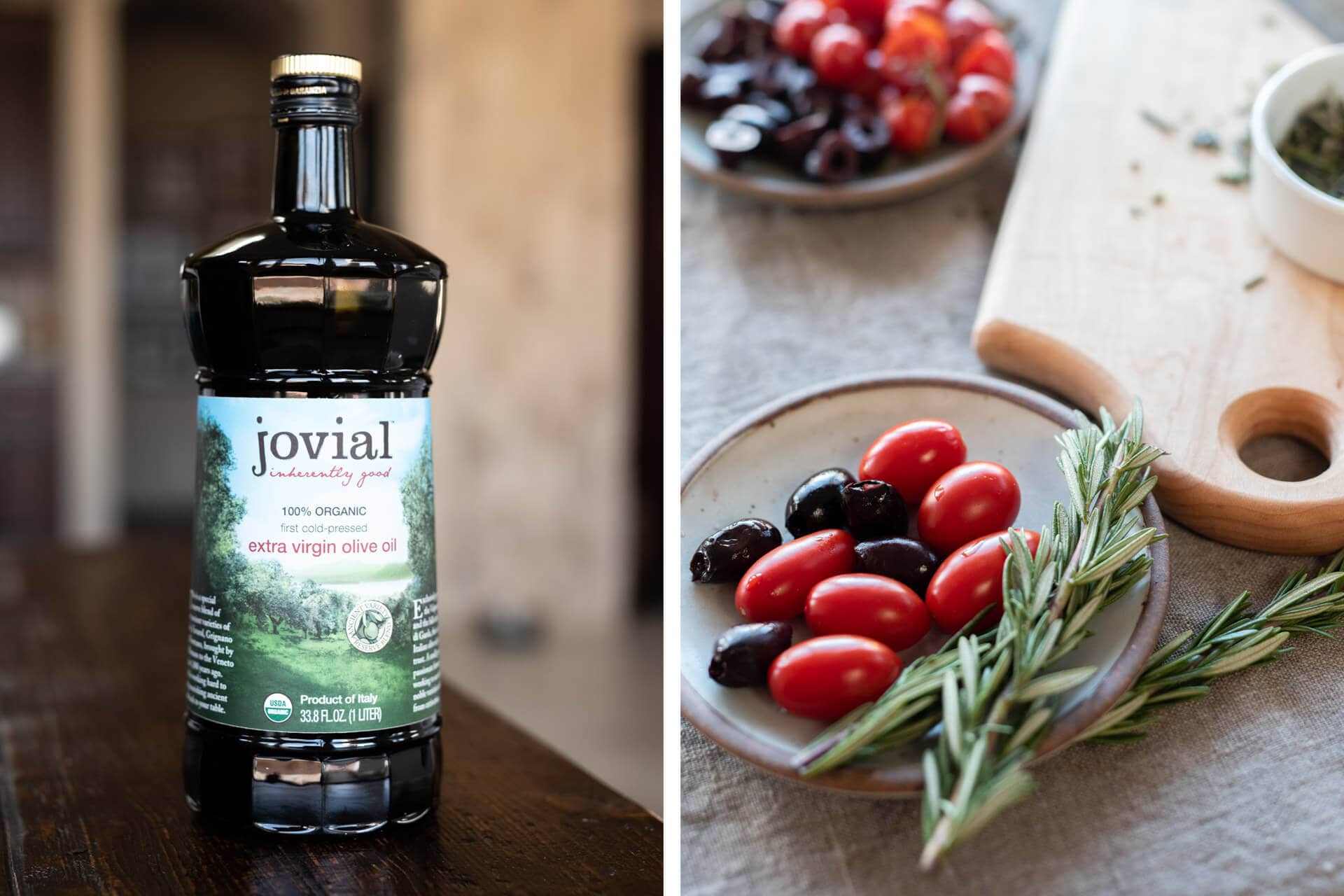
Because sourdough focaccia has so few ingredients, the ones you use should be of the utmost quality. Use vegetables in season and the highest quality olive oil you can find. In this post, I worked with Jovial’s Olio Nuovo, a fresh-pressed olive oil from the Valpantena area of Northern Italy. It isn’t easy to source exclusively fresh-pressed olive oil. Usually, this oil is blended with aged oil, balancing the flavor profile to make it consistent with other offerings throughout the year. This fresh oil has a delicate flavor but a balanced, upfront fruitiness as well. If you’ve never had the chance to try an oil like this, you’ll be pleasantly surprised.
Flour Selection
With this naturally leavened focaccia, I wanted little sourness in the result. While I typically include whole grains in most of my recipes, I wanted the flavor of this classic bread to be mild so the taste of the olive oil and fresh toppings pop. Removing all the whole grain flour from initial trials hit the spot.
For this formula, I blended 30% high protein flour (about 13% protein) with 70% all-purpose flour (11-12% protein). The high protein flour helps give this highly-hydrated dough strength and structure—and 30% is just enough.
Focaccia Toppings
This simple sourdough focaccia can be topped with just about anything you can imagine. My favorite is rosemary, chopped cherry tomatoes, pitted kalamata olives, coarse sea salt, and good quality olive oil. Traditionally, Ligurian focaccia (and as shown in the recent Salt Fat Acid Heat episode on Netflix) is topped with a salty brine. Instead, I love dusting the top with coarse sea salt: the chunky crystals bring unexpected pops of flavor.
Here are a few more ideas:
- Tomatoes, capers, oregano, garlic, olive oil
- Thinly sliced Yukon gold potatoes tossed with coarse salt. Let the potatoes drain over a colander for 15 minutes to help remove some water. Then top in addition to coarse sea salt, fresh thyme, and olive oil
- Sliced and olive oil-marinated red onions, brined olives, and fresh chopped tomatoes
- Grated hard cheeses of all kinds (parmesan, pecorino, etc.), rosemary, olive oil
A Simple Sourdough Focaccia Recipe
Special Equipment
For this sourdough focaccia, you will need a round or rectangular pan for baking. I like to use a deep pan (as opposed to a baking sheet) so the focaccia doesn’t dry out too fast in the oven. My preferred pans:
- 9″ x 13″ USA Pan Rectangular Cake Pan
- Two 10 x 2.25″ LloydPans Round Pans (use the same dough weight as in this recipe, just divide in half and place each half into one pan)
Both pans have a nonstick interior, and they conduct heat exceptionally well, imparting a beautiful crust on the naturally leavened focaccia.
Vitals
| Total Dough Weight | 1,200 grams |
| Sourdough Starter | 19.00% |
| Hydration | 76.00% (78.00% with olive oil) |
| Yield | One 1200g focaccia |
Total Formula
This table shows the entire quantity and baker’s percentages for each ingredient. If you’d like to make two large focaccia (or four smaller ones), double everything in the table below.
There’s no specific levain build for this focaccia, just use some of your sourdough starter when it’s ripe (when you’d normally give it a refreshment). See my post on the differences between a levain and sourdough starter for more information on the two preferments.
Target final dough temperature (FDT) is 76°F (24°C).
| Weight | Ingredient | Baker’s Percentage |
|---|---|---|
| 423g | All-purpose flour (King Arthur All-Purpose Flour) | 70.00% |
| 181g | High protein bread flour, malted (King Arthur Bread Flour) | 30.00% |
| 12g | Extra virgin olive oil (Jovial Olio Nuovo Organic Olive Oil) | 2.00% |
| 459g | Water | 76.00% |
| 11g | Salt | 1.80% |
| 115g | Sourdough starter (100% hydration) | 19.00% |
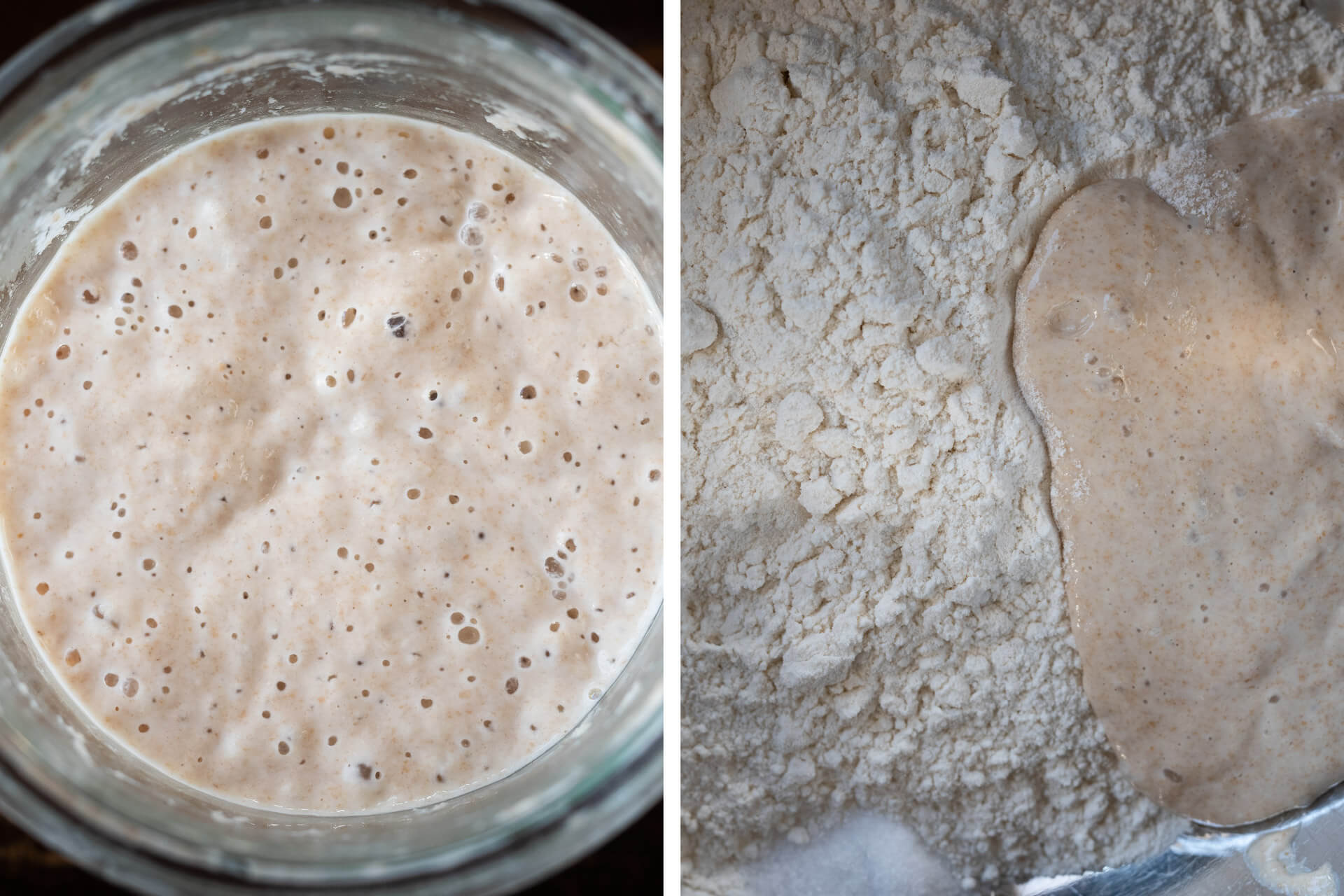
Method
Mix – 9:00 a.m.
This dough can be mixed by hand (I would use the slap and fold technique) or with a stand mixer like a KitchenAid or Famag spiral mixer.
To the bowl of a stand mixer fitted with the dough hook attachment, add both the flours, water, salt, and ripe sourdough starter (hold back the olive oil until later in mixing).
Mix on speed 1 for 1 to 2 minutes until incorporated. Then, mix on speed 2 for 5 minutes until dough strengthens and clumps around the dough hook. Let the dough rest in the mixing bowl for 10 minutes.
Next, turn the mixer on to speed 1 and slowly drizzle the olive oil into the bowl while mixing. Once all of the olive oil is absorbed, turn the mixer up to speed 2 for 1 to 2 minutes until the dough comes back together.
Transfer your dough to a bulk fermentation container and cover.
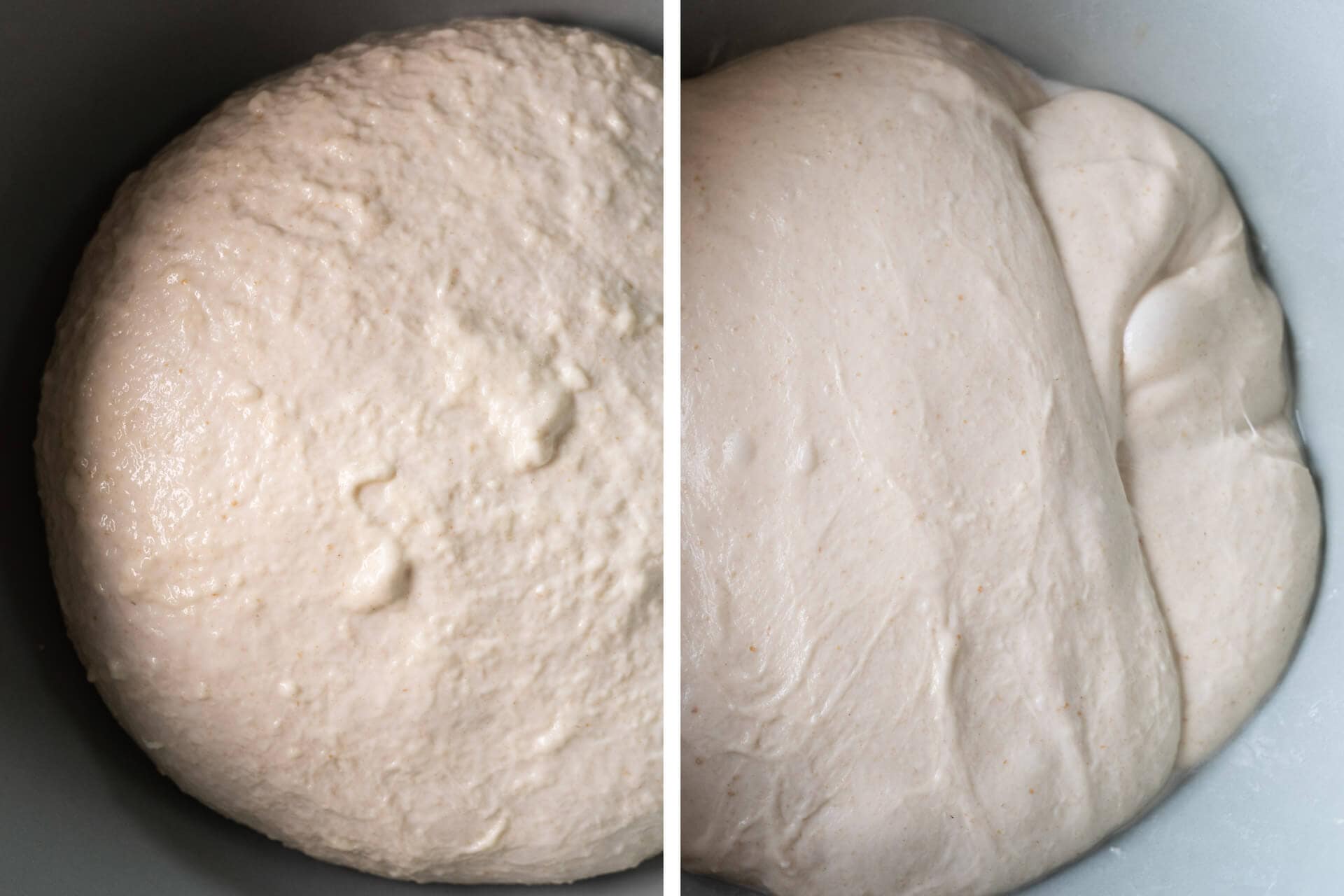
This highly hydrated and enriched dough is wet and loose, it won’t strengthen to the same degree as a typical bread dough.
As you can see below on the left, the dough is still very wet and chunky immediately after mixing. However, it’s not falling apart or soupy. Please resist the temptation to add more flour at this point. As you can see below in the image at the right, by the middle of bulk fermentation, it’ll strengthen after several sets of stretch and folds (see my guide on how to stretch and fold sourdough for more information).
Transfer the dough to a covered container for bulk fermentation.
Bulk Fermentation – 9:15 a.m. to 11:15 a.m.
Give the dough 4 sets of stretches and folds (fold a side of the dough up and over to the other side, and then rotate the container to perform 4 folds per set), starting 30 minutes after mixing, and a set every 30 minutes after that.
Proof – 11:15 a.m. to 3:15 p.m.
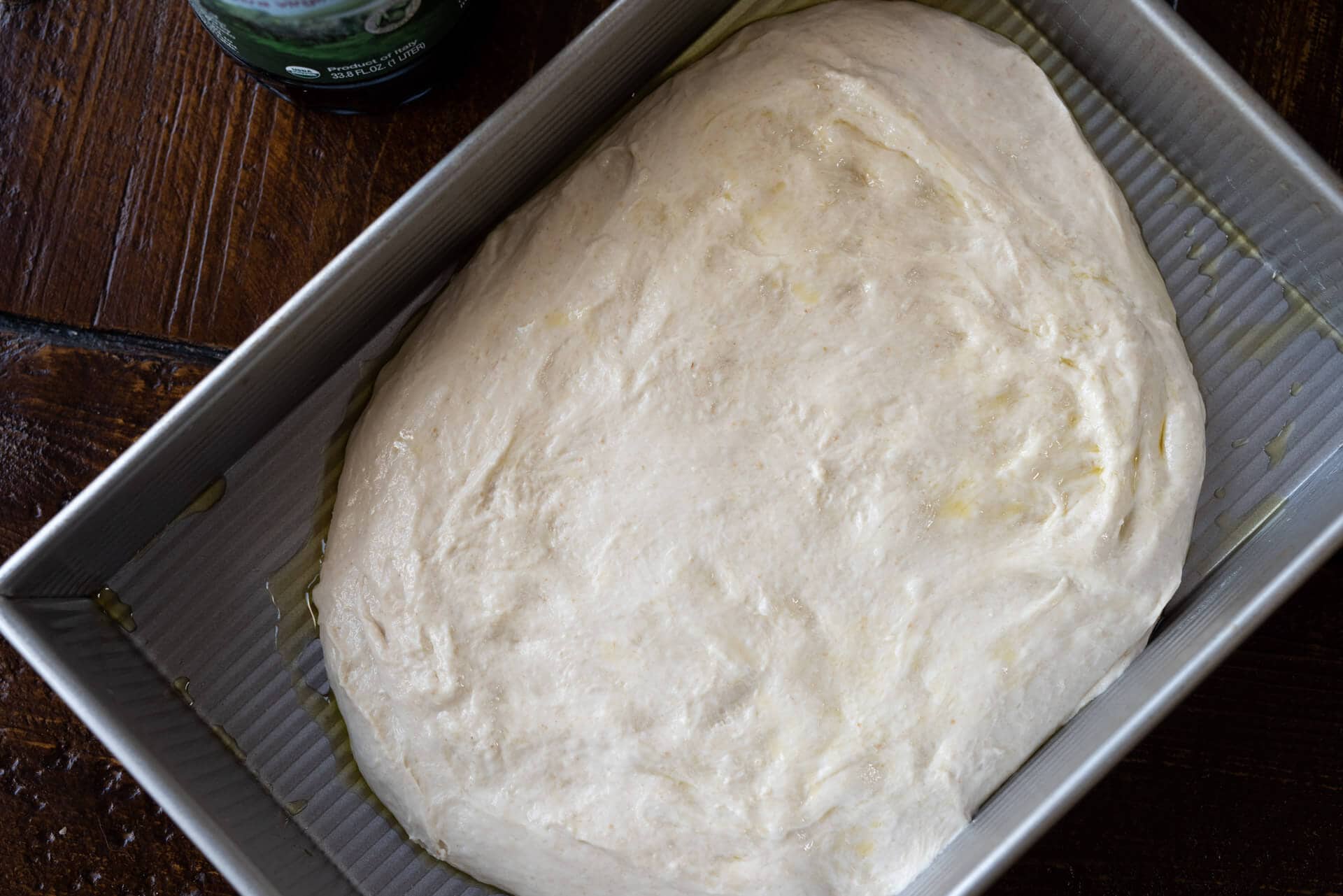
Transfer the dough to a deep rectangular pan that’s been greased with olive oil. If you don’t have a pan with a silicone liner, make sure to heavily oil the pan’s interior so the focaccia doesn’t stick during baking.
At 76-78°F (24-25°C), the dough will proof for 4 hours. This time period is flexible and dependent on the temperature: if it’s cooler, let it proof longer, and conversely, if it’s warm, you might be able to bake sooner.
Every 30 minutes for the first hour, uncover the pan and gently stretch the dough with wet hands to the pan’s edges to encourage it to fill the pan. The dough will naturally spread out during this proofing period, so it’s unnecessary to spread the dough aggressively. Once the dough is mostly spread to the edges, cover the pan and proof for 4 hours.
OVERNIGHT OPTION: After two hours in proof, cover the rectangular pan with an airtight cover and transfer to the fridge. The next day, take out the dough and let it come to room temperature, and continue with the Top & Bake step below.
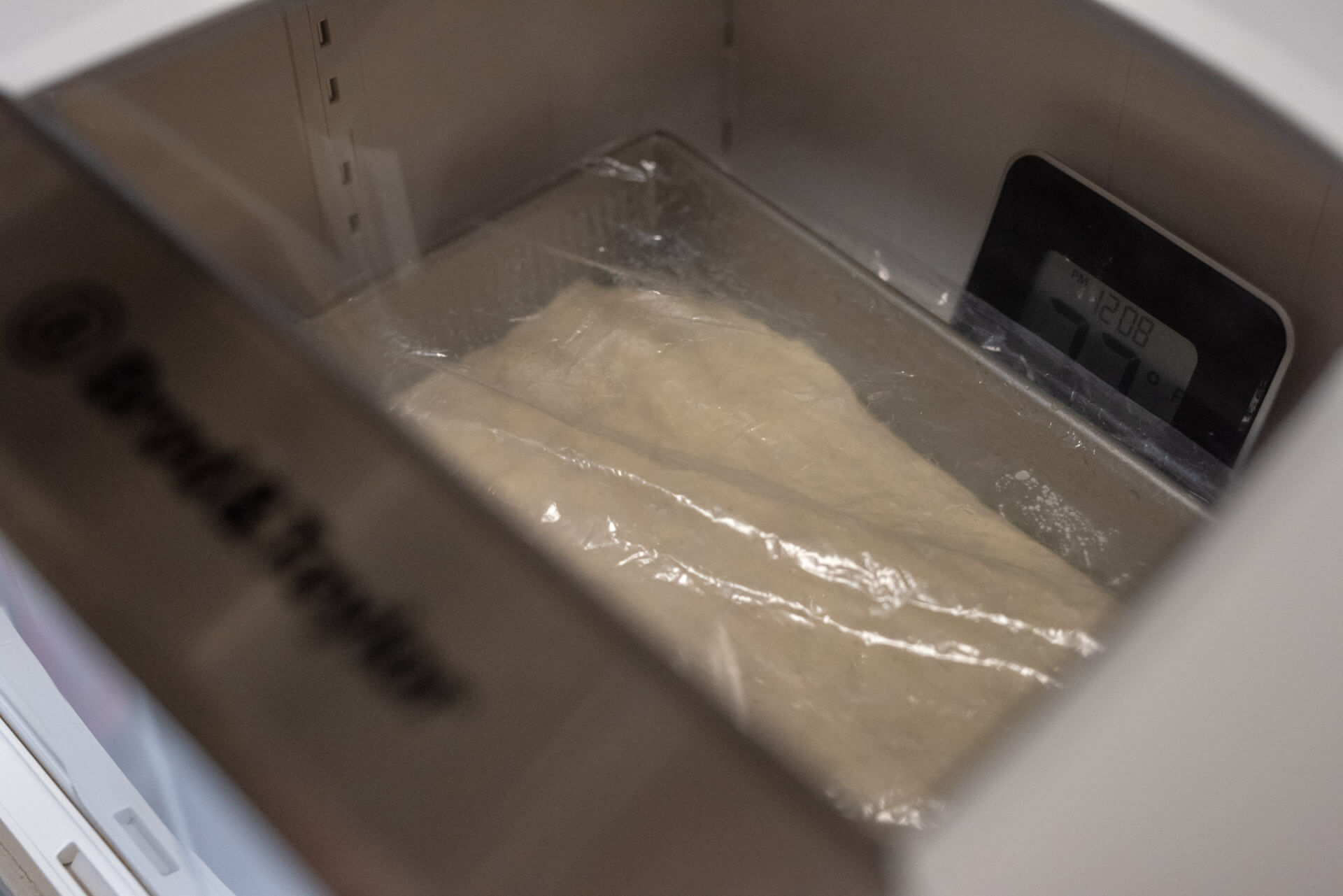
The rectangular pan I use fits perfectly inside my B&T Dough Proofer. I keep it inside the proofer, covered with reusable plastic, and set to 78°F (25°C) until ready to bake.
About 30 minutes before you anticipate the sourdough focaccia dough being ready, preheat the oven to 450°F (232°C) with a rack placed in the bottom third (a baking stone is not necessary).
Top & Bake – 3:15 p.m.
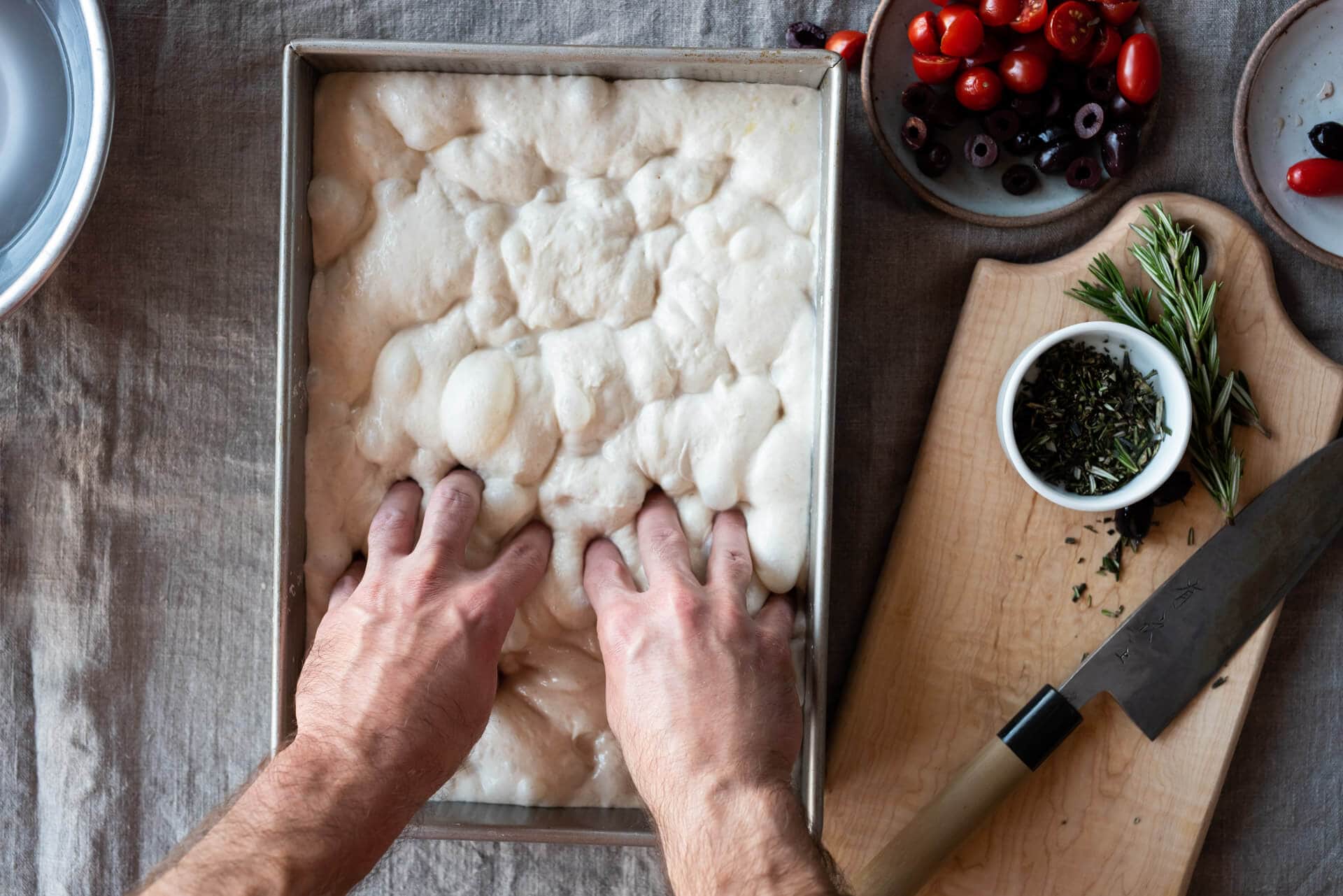
First, dimple the unadorned dough with wet fingers. Make sure the dimples are evenly spaced and go all the way down to the bottom of the pan. Then, drizzle on 1-2 tablespoons of your extra virgin olive oil and sprinkle with herbs and coarse sea salt. If using other toppings, add them now as well—I like to press them into the dough gently.
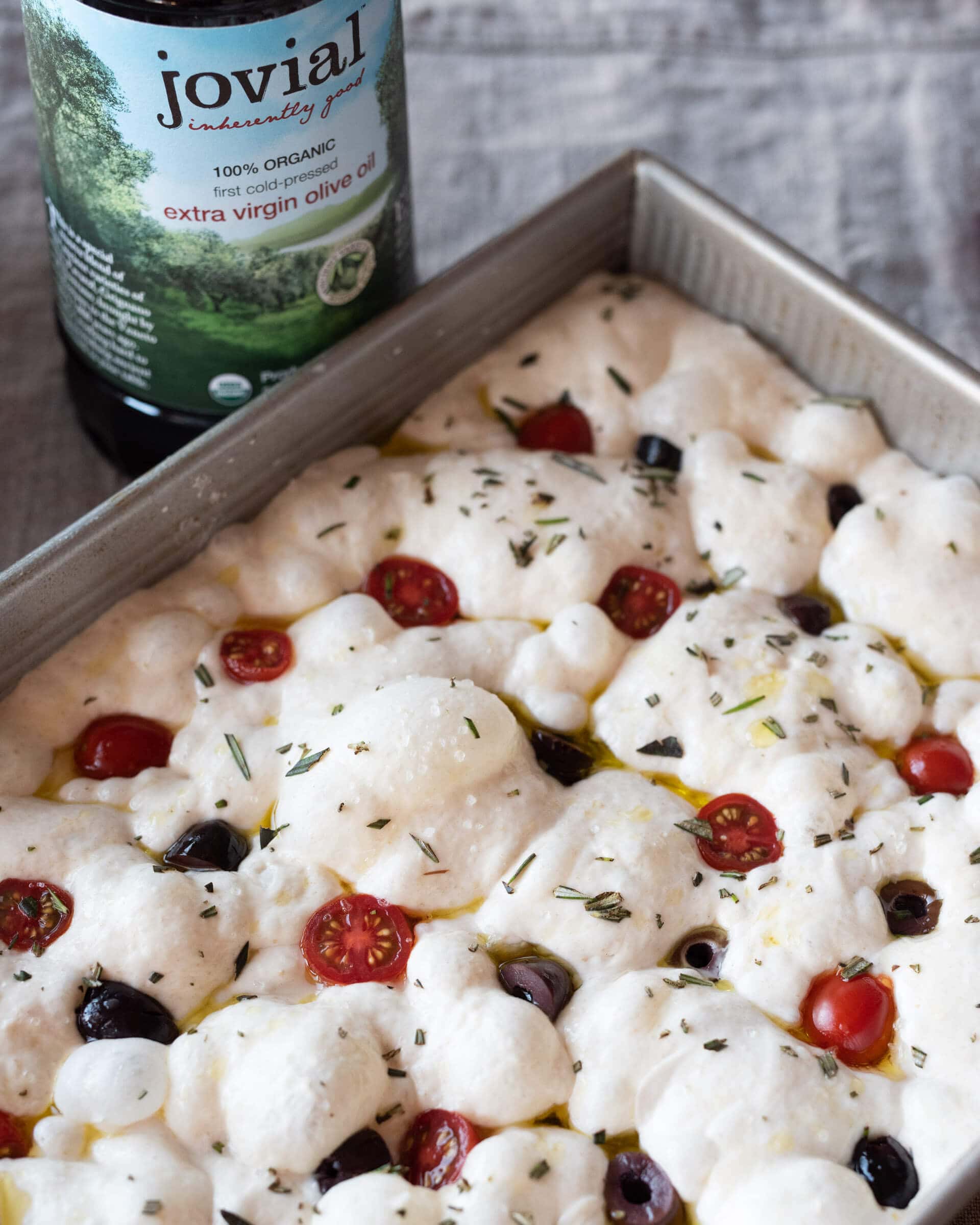
Bake the focaccia in the oven at 450°F (232°C) until deeply colored on top, about 30 minutes. Rotate the pan front-to-back halfway through this time. Keep an eye on it during the last 5 minutes and pull it out if it’s coloring too quickly, or leave it in longer if you’d like it a little darker.
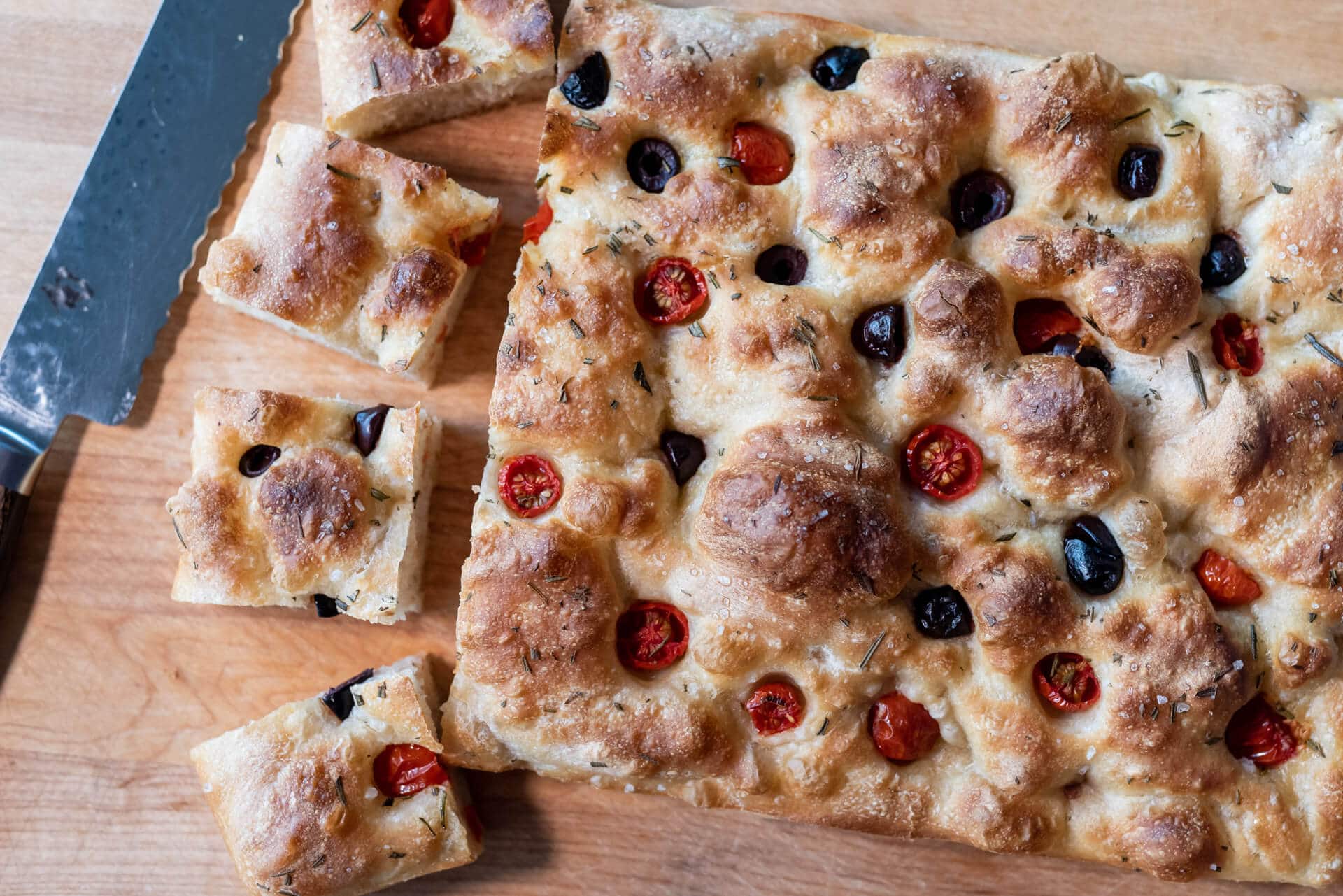
Let the focaccia cool a few minutes in the pan, then transfer to a cooling rack. It’s fantastic warm from the oven, and best on the day of baking, but it’ll keep well for a couple of days loosely wrapped in foil (reheat under the broiler before serving).
Conclusion
When I topped the pillowy focaccia dough, the aroma of fruity olive oil and chopped rosemary was captivating. Once the pan was slid into the oven, my house gradually filled with the most intoxicating perfume as the dough rose high and the edges began to crisp. The melange of baking dough, toasted herbs, olive oil, and briny olives had me checking the oven frequently—as if checking on it would expedite things. Sit tight, wait for it to finish, I told myself as I gently slapped my hand from opening the door yet again.
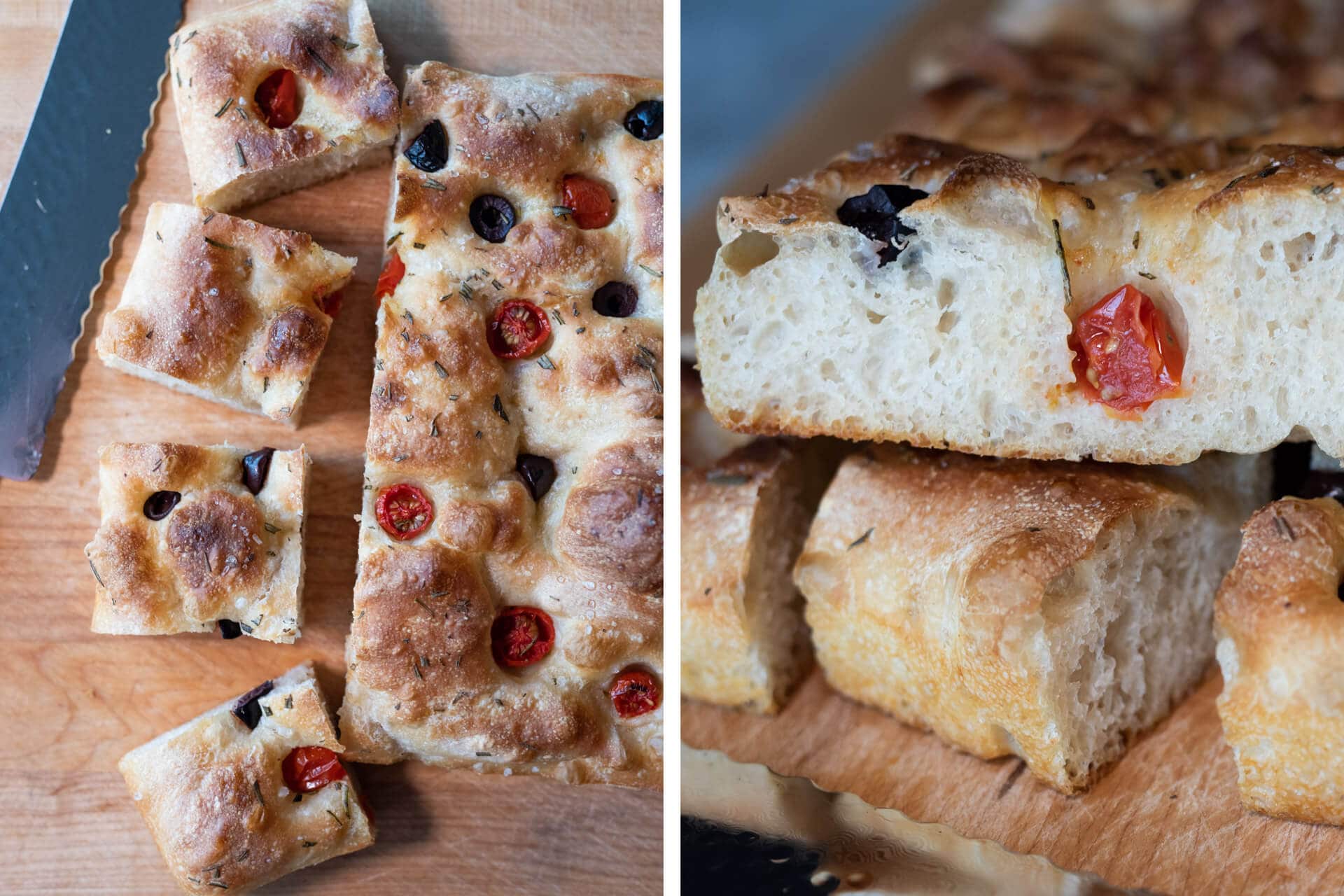
Thanks to the copious addition of high-quality olive oil, both in the mix and on top of the dough, causes the dough to turn crispy and take on a beautiful golden hue. Biting through a slice first provides a faint resistance, then gives way to a soft and ultra-tender interior. A perfect mix of flavors and textures—an experience best savored, as if you’re at the beach without an agenda.
This simple and rustic sourdough focaccia, made with a naturally leavened dough and topped with just the right balance of ingredients, brings me right back to the blue waters of the Adriatic; the sun in my eyes and thick, crunchy slices of bread eaten with haste. The only things absent are the beautiful white wrapping paper and all those little bits of sand that seem to work their way into just about everything—yea, I can do without that.
If you’re looking for more focaccia-goodness, check out my sourdough focaccia Pugliese which has potato added into the dough, for even more chew, softness, and deliciousness.
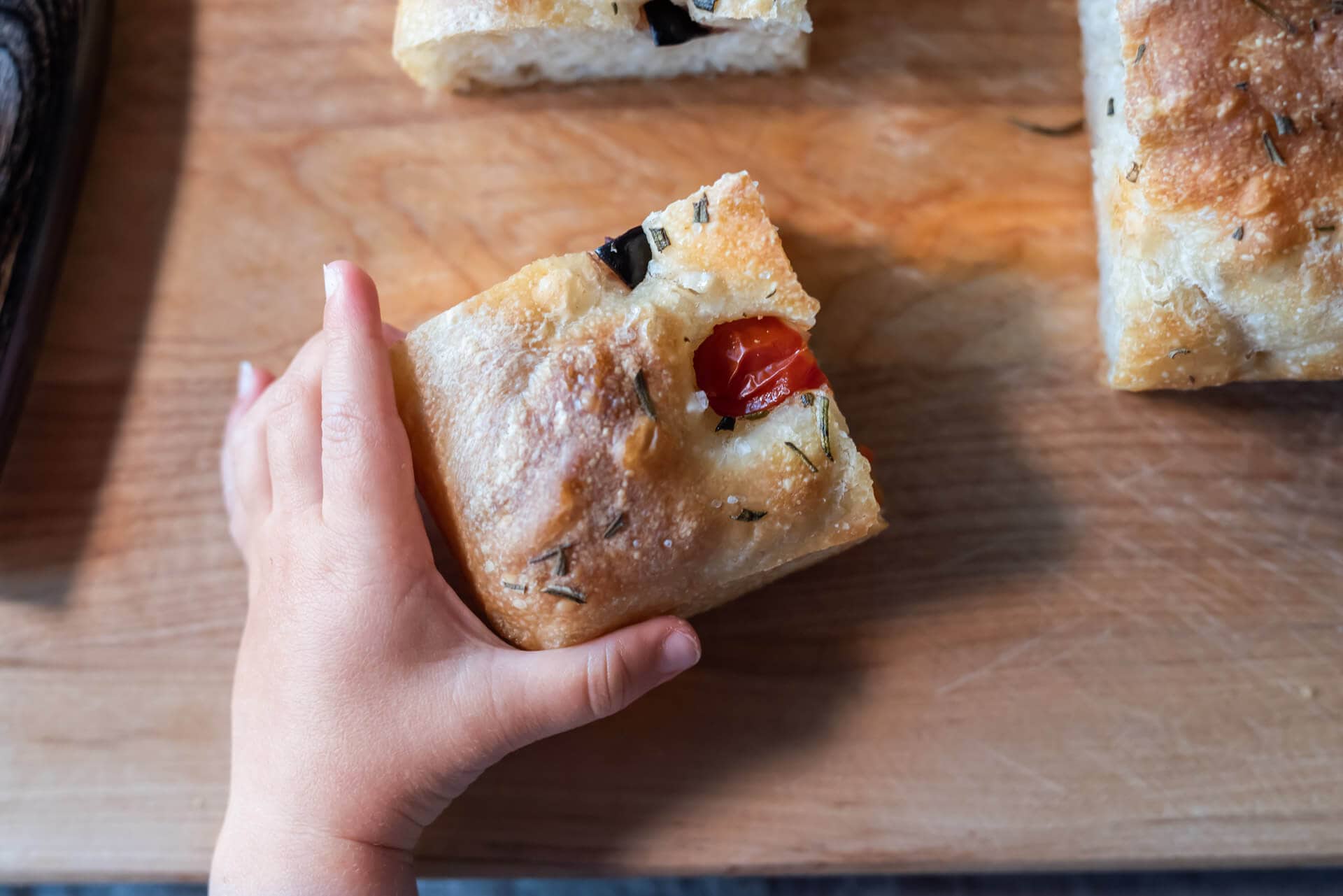
Thanks so much to Jovial for supplying me with their wonderful olive oil and sponsoring this simple sourdough focaccia recipe! As usual, the content and opinions here are my own.
Print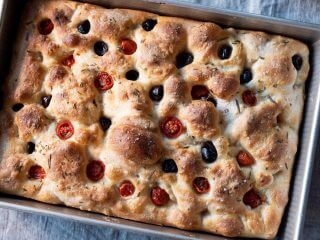
A Simple Sourdough Focaccia
- Prep Time: 6 hours
- Cook Time: 30 minutes
- Total Time: 6 hours 30 minutes
- Yield: 1 focaccia
- Cuisine: Italian
Description
This easy-to-make, delicious focaccia comes together in one day using your already ripe sourdough starter. Top with tomatoes, olives, rosemary, and coarse sea salt—or really, anything fresh in your kitchen that sounds delicious!
Ingredients
- 423g all-purpose flour
- 181g high-protein bread flour
- 12g extra virgin olive oil
- 459g water
- 12g salt
- 115g ripe sourdough starter
Instructions
- Mix (9:00 a.m.)
This dough can be mixed by hand or with a stand mixer (like a KitchenAid). To the bowl of a stand mixer fitted with the dough hook attachment, add both the flours, water, salt, and ripe sourdough starter (hold back the olive oil until later in mixing). Mix on speed 1 for 1 to 2 minutes until incorporated. Then, mix on speed 2 for 5 minutes until the dough strengthens and clumps around the dough hook. Let the dough rest in the mixing bowl for 10 minutes. Next, turn the mixer on to speed 1 and slowly drizzle the olive oil into the bowl while mixing. Once all of the olive oil is absorbed, turn the mixer up to speed 2 for 1 to 2 minutes until the dough comes back together. Transfer your dough to a bulk fermentation container and cover. - Bulk fermentation (9:15 a.m. to 11:15 a.m.)
Give the dough 4 sets of stretch and folds at 30-minute intervals, starting 30 minutes after bulk fermentation begins. - Proof (11:15 a.m. to 3:15 p.m.)
Liberally oil the inside of a 9×13″ rectangular pan or two 10″ diameter circular baking pans. Gently scrape the dough out of the bulk fermentation directly into the rectangular pan (or onto a work surface, divide in two, and place each in a circular pan). The dough will proof in the pan for 4 hours. Every 30 minutes for the first hour, uncover the pan and gently stretch the dough with wet hands to the pan’s edges to encourage it to fill the pan. The dough will naturally spread out during this proofing period, so it’s unnecessary to spread the dough aggressively. Once the dough is mostly spread to the edges, cover the pan and let it proof for the remainder of the 4 hours. About 30 minutes before the end of the 4-hour proof period, preheat your oven to 450°F (230°C) with an empty rack in the bottom third. - Top & Bake (3:15 p.m.)
When your oven is preheated, dimple the top of the dough all over with wet fingers. Then, liberally drizzle olive oil over the surface of the dough. Spread on chopped herbs and coarse sea salt. Bake until golden on the top and bottom, about 30 minutes. Let the focaccia cool in the pan, then transfer to a cooling rack. It’s wonderful straight from the oven, and best the day it’s baked.
Notes
Overnight proof option: Midway through the 4-hour proof, place the covered pan with dough in the refrigerator to proof overnight. The next day, take the dough out, bring it to room temperature, finish proofing until well risen and bubbly, and continue with the Top & Bake step.
If you use this recipe, tag @maurizio on Instagram so I can take a look!


749 Comments
Making this now – hopefully I can get some feedback, but I am ok winging it… Question: Essentially there is a four hour bulk rest after the initial set of stretch and folds?I say so because the timing states that we transfer to a pan, and let it rest for the remaining two hours, but then* it states to also let it rest for an additional two hours… so four hours of dormant time? (the only difference being that the first two hours we are helping it reach the corners?). -TheBeginnersBreadBox
p.s. Thank you so so much for your site. I love it so much! This is the “what else can we do with sourdough starter” mecca! Thank you, thank you, thank you!
Yes, that’s right. That final proof time, though, is variable based on how the dough is doing and the temperature in your kitchen. If the dough is super bubbly and weak looking/feeling, you can bake sooner. In other words, it’s not a strict 2 hour proof, shorten or lengthen this final time based on how the dough is doing!
Made this today and it turned out absolutely fantastic! My family devoured it. Only change I’ll make next time is to use parchment paper as I had a bit of trouble getting it out of the pan after. But seriously soooooo good. Thanks for the great recipe and step by step pictures/instructions, so helpful!
Glad to hear it, Rachael! I actually made this myself this weekend as well — it goes fast 🙂 I really like the USA Pan I have for this, it makes removal super easy. Otherwise, yes parchment works very well. Thanks for reporting back!
I’ll have to look into that pan! I saw you make it on IG and I had to have some haha!
This recipe has been on repeat in my house for the last 4 months or so. My fiance loves when I send him to work with sandwiches using this bread! We recently made a pizza with it and it turned out incredible. Love all your recipes!
Thanks for that feedback, Gianna, it’s great to hear it’s been a staple there in your kitchen. Coincidentally, I’m mixing a batch of this up for myself today! You’re right, it makes some killer sandwiches — in fact that just sorted out my lunch for today. 🙂 Happy baking!
Hi Maurizio, This is my 4th time making this recipe & although it turns out delicious everytime, mine does not have as many bubbles in it.
I am following the recipe exact & am doing the bulk fermentation in my B&T dough proofer so it has the consistent temperature. It looks similar to yours in every step of your photos except the photo under the ‘Top & Bake’ section where you have the massive bubbles before you put the toppings on.
Any suggestions?!
It’s hard to say, but it could be the level of fermentation in your dough. Those bubbles form in my dough when it’s well risen, super gassy, and when I push my fingers down into it to dimple, they push up and through in other areas. If you have good rise (with strong fermentation!) and your dough is strong enough (sufficient mixing/kneading/stretch and folds) it should pop up here and there!
Thank you! Is there a way to increase the level of fermentation in my dough to make it stronger? Does that have to do with my starter? Or should I try the bulk fermentation longer?
Both could be an answer. Definitely be sure your starter is fermenting very strongly and it’s mature when you use it — this is important. From there, if you keep your dough a little warmer this might help bulk fermentation.
Hi Maurizio, great recipe! I’ve made it twice and it’s come out incredible. My only issue is the focaccia getting stuck in the pan. Takes a lot of work to get it out. Almost is cemented in there. Aside from heavy oil in the pan, any suggestions? Thanks!
Awesome to hear that, Joe! Yes, that’s an issue if your pan doesn’t have silicone as a liner. Many people have found using parchment paper helps immensely!
Actually, sorry about the wrong description — the Manresa bread that I mentioned isn’t really focaccia…it’s more like a shallow wide bread (~ 2″ high in the middle) and based on how it’s shaped and cut, it’s obviously made in a wide shallow cake (or similar) pan…maybe I’ll take a photo and send it to you next time I’m there (unfortunately, it’s not pictured on their website). And for true focaccia, I now see that Jovial has a whole grain Einkorn recipe for it (and that’s what made me realize that the Manresa bread is really not focaccia). But I’d still love to know if you’ve tried making Einkorn focaccia and your results. Thanks again!
Hi Maurizio:
1) Have you tried making a 100% einkorn sourdough focaccia? Manresa Bread (operated by David Kinch of Michelin*** Manresa in Los Gatos, CA) makes one and it’s very good. I’d love to know how to make it. I believe that it’s made with whole grain (at least partly) and they told me that it only contains einkorn, water and olive oil.
2) I could have sworn that at one point you posted a picture of a cookie that you’d recently enjoyed in Italy — I believe that it was a nut-flour based type — and I’m trying to remember the name of it. If it was here that I saw it, would you mind pointing me to that blog post. I looked through several of the recent ones but couldn’t find it. Or maybe it was an Instagram post?
Thanks for spreading the bread-y love and joy!
Ginger:
1) I haven’t! But based on your other comment it sounds like it’s not a true focaccia. I’ll have to think about how to do this with einkorn, it would definitely be possible, but I’d expect it to be a little more flat and less airy, but super delicious I’m sure.
2) Yes, I did post a picture of cookies from southern Italy here. I made them here in my kitchen from the amazing cookbook Italian South by Katie Parla.
Hope that helps and I’ll give that einkorn focaccia shot sometime (I make my focaccia often)!
Thanks Maurizio! And to confuse matters more, at the bakery I believe that they’d said that it was all Einkorn, but I just now read a post with photo about it on Blue Bird (Oregon) where they buy their einkorn flour, and it clearly contains another wheat type too. It’s very good, but not 100% einkorn.
Yes, if I were to approach this recipe using einkorn, I’d likely do a mix of einkorn and traditional wheat, just to retain some of the familiar texture one expects with focaccia. Although, maybe it’s possible to go 100%, I just haven’t tried (yet)!
Hi Maurizio –
Thanks for the excellent recipe! A really easy, straightforward formula, right down to the timings – and I’m at sea level, not at 5000 feet like you are :). I was a little surprised by how wet the dough seemed, since I’ve made 80% hydration breads with similar ingredient lists that were much less extensible. It barely needed any stretching to fill the pan. My one deviation was to use my whole wheat starter instead of the white one, which added a skosh of extra flavor and made the dough just a little denser.
I made this yesterday, topped with rosemary, Maldon salt, and kalamata olives. We used it for awesome end-of-summer farmer’s market Caprese sandwiches – tomatoes, basil, mozzarella, and shallots (for the balsamic dressing) all straight from the farmers’ market, all on the just-out-of-the-oven focaccia. Delicious!
Thanks for the feedback, Jeff! I saw your post on IG as well — it came out fantastic. Yes, this is a very wet dough and the added olive oil adds to the delicate nature of it, but this means a more tender result in my experience. Now you’re making me hungry with all those toppings!
Thanks again and happy baking!
Hi Maurizio,
Thank you for this recipe. I tried it today, the focaccia turned out quite nice, even though I couldn’t follow the exact timings for the stretch and folds.
You’re very welcome, Deepa! Glad to hear that — yes it’s quite a forgiving process, even if you pushed bulk further it just seems to get better and better. Enjoy!
Hello Maurizio- when the dough is in the greased pan during bulk fermentation and before the proofing stage, should the greased pan be covered with saran wrap? Thanks!
Yes, I do keep it covered with a reusable cover (so it’s airtight)!
hi maurizio!! i just made this dough and for some reason it did not rise much, the dough was pretty dense in the middle. i followed the recipe exactly (i did cold overnight rise) but it had not doubled much. should i have left it out longer when i took it out of the fridge? i let it come to room temp and put it in a warm spot. any idea what went wrong? still tasted quite great!
Hey, Rosie! It’s hard to say exactly what the issue with your dough was. First, be sure to use your sourdough starter when it’s mature (typically this will be when it’s at its peak height in your jar, depending on your starter — have a look at my sourdough starter maintenance routine guide for more information on this). From there, be sure your dough gets plenty of time at room temperature during bulk fermentation, if you did half of the bulk at room temp and then into the fridge, you might have needed to give it more time before putting it in the fridge (I’m not sure if you mean you did your bulk fermentation in the fridge or your final proof). But yes, if you found the dough very sluggish and it didn’t look like it had enough fermentation, it needed more time to rise at room temp before baking. This dough should be very, very bubbly throughout, jiggly, and super soft.
I hope that helps, let me know if you have more questions!
Thanks for that feedback, Tom! Sounds like things turned out great, even with the slight modifications — and that goes to show how versatile this process really is, there are many ways to make great bread and adjustment “in the field” is usually necessary. I’ve noticed that as well, some of the olives I’ve used are so salty — and if you use enough — they’re really all you need on top. It’s all up to you! Thanks again, Tom, and happy baking!
Hello Maurizio- First off, thanks for this wonderful recipe. I’ve been baking breads for about 2 years now and this is my favorite! This summer, I’m hoping to serve this at pool parties and would like to make double or even triple the batches. Can you tell me if I could just 2x or 3x the recipe and at what point would I need to separate it out for the different focaccias? Not sure the science of this and curious if I could just separate into 2 or 3 pans once the bulk fermentation is complete? Thanks!!
That’s awesome to hear, Greg, thank you! Yes, just double or triple or scale the recipe up as needed. I list the Total Formula table in Baker’s Percentages so you could even scale things up in smaller or larger increments as well. If you doubled the recipe, for example, you could keep the dough all in one bulk mass and then divide it at the point where I talk about finishing the bulk/proof in the pan. Alternatively, you could even mix two completely different batches if you’d like — it’s really up to you (but I’d opt for the first option). Hope that helps and enjoy!
Hi Maurizio, I have had trouble with this recipe and I was hoping to get some tips. I’m a novice baker, but an avid cook. I’ve tried this the last two sundays and I just cant get enough rise. The focaccia comes out dense, thin, and both very tough and very gummy. It also doesnt get very good browning on top by the time it browns on the side and the bottom. I use your weekend bake sourdough starter. The first time I made this recipe I took my starter out on thursday and gave it regular feedings until sunday to get it lively again. I then follow the recipe exactly, although I don’t have a proofer and my house remains around 74 degrees F, so I try to proof it a bit longer. I just don’t seem to be getting the activity that youre getting after all of this. And i’m wondering if I’m doing a few things incorrectly. I have been able to add the extra 50g of h2o each time, but I’m wondering if I should forego this. The dough doesnt get soupy, it’s just has a low viscosity. I’ve noticed your dough by the end of proofing actually doesn’t have a sheen to it anymore, it just looks like an airy light dough. I live in a slightly less arid climate (SLC), but not by much, so i’m wondering if that affects it. Also, I’m wondering if I should modify the oven temp, because of my altitude? Maybe my starter is weak? Or im not working the dough enough? Or too much? Maybe I should use distilled water? Any help would be much appreciated, thanks so much!
Christopher — sorry for the delay. I’d say yes, try reducing the water just to test, don’t add that 50g water. Also, try keeping your starter out of the fridge for a week with consistent feedings and see if this helps spark more activity during fermentation. It could be that you’re not using a starter with enough strength, which will cause a lack of rise and even browning in the oven. At 74F the dough will definitely take longer to achieve full fermentation — give it the time it needs! Give that a try and please report back, happy baking!
Hi Maurizio, thank you for this recipe! One question, because I feel like I am mis-reading, or missing something. In the bulk fermentation step, you state: “The dough will rise for the first 2 hours in a large bulk container…and then the remaining time, untouched, in the final proofing pan,” but then go on to say “every 30 minutes for the remaining 2 hours of bulk fermentation gently stretch the dough” in the baking pan.
Does the stretching happen after letting it sit untouched, or during that period?
Thank you!
Hey, Jon! I updated the wording a bit to hopefully make it more clear. The first 2 hours of bulk is in any bulk container (I use a large ceramic bowl), this is so it’s easy to do vigorous stretch and folds. During this first 2 hours, do all your sets of stretch and folds. Then after that, transfer the dough to the final pan you’ll use for baking — the dough will then remain untouched here until you gently stretch it out to fill the pan and eventually bake.
I hope that’s more clear!
You’re the man. The part that was confusing me was it sounded like you were instructing to both keep it “untouched” and stretch it at the same time. But all is good – it’s going in the oven now! Thank you.
Hi Maurizio, this is a great focaccia recipe! Can you use this to make a “pizza alla romana” (roman pan pizza)?
Thanks, Angelo! Yes, definitely. I’ve been doing this lately with really great results. I’ve lowered the hydration by 3-5% so the dough isn’t so “weak” and sticky, and this has been working super well so far.
That’s great! I usually bake this kind of pizza at the bottom of the oven at max temp for around 10-15 minutes. Am I doing this right you think?
Really depends on the oven and the pan you’re using. If it turns out great, stick with it!
Hey Maurizio, I’m going to try this today. I have two questions:
1) why auto/fermentolyse isn’t necessary in this case?
2) why proof the dough and then dimple it and not the contrary?
Thanks
Awesome! Answers:
1) I wanted this to be a very straightforward recipe and didn’t feel an autolyse was necessary. You could do one, if you’d like, it might help reduce the amount of time needed to mix, but I wouldn’t go longer than 30 minutes (the dough might get too extensible.
2) If you dimpled the dough then proofed, the dimples would fill back in and disappear.
Hope you enjoy the focaccia — happy baking!
I just watched the ‘fat’ episode of Salt Fat Acid Heat and of course, jumped on your site for this recipe, drooling away! The babies have been bored and lethargic with all the frigid temps around here (but did make a chocolate bread last weekend with Myrtle). I think I’ll make this AND some bread this week! I might do a small percentage of whole wheat pastry flour in the focaccia…just cuz (as you know) that’s how I roll!
And Tom, that sounds like a great way to combat these COLD cold temps here. When I put my wild yeasts in the oven with the light on, they developed a skin, but a pan of hot water might be a better environment overall. Thanks!
Ahh, that’s such a great episode. That’s one of my favorite cookbooks as well, just a treasure trove of education locked away in there. I hope the focaccia turned out great and that you’re having some warmer temperatures — it’s finally starting to warm up here, thankfully. Can’t wait to get outside more with the kiddos.
Enjoy, Gina!
Thanks for that feedback Tom! I saw your photos on IG and your focaccia looked great. Your modifications sound good to me, using more whole wheat flour will change the flavor and texture profile, but I’m sure it was equally delicious. I’ve not tried this recipe with slap/fold, but I probably should as I use that method for almost all my other breads here. It’s a very wet dough so I bet that was fun 🙂
Thanks again for the feedback and for sharing, it’s awesome to hear how my recipes go in readers’ kitchens! Happy baking, Tom!
Excellent recipe, Maurizio! Used this exact dough recipe and just threw a bunch of toppings on it to make a pan pizza. Definitely too much bread :# but hydration-wise I actually thing the dough was strong enough to withhold pretty heavy toppings.
My thought is to use the same dough recipe and put it on a cookie sheet pan next and oil the dough a lot more aggressively. I tend to bake the crust first, as well, so that the strength of the dough isn’t compromised and then add toppings, but am considering adding more bread flour and just throwing the toppings on prior to bake.
If additional bread flour is added, would you recommend reducing mix time? At the moment, I mix for two 4 min intervals on my KitchenAid stand mixer at the lowest speed.
Also, I’ve been using my baking steel, and I’m not sure it actually helps the bake in a meaningful way, but haven’t experimented without it, as of yet.
Thanks for an awesome recipe, as always!
Right on, Matthew! I’ve done the same thing with a sheet pan as well but I scaled the dough weight down. I’ve been playing with this quite a bit lately and I’m really, really happy with the results. More testing needed here, though.
I recently tried this again with Yukon gold potatoes added (they were shaved thin on a mandoline) and next time I’ll add them halfway through the bake so the crust has a chance to harden off and color a bit — the potatoes baked super fast.
Yes, if you add additional KAF BF you can likely get away mixing the dough for less time since the overall protein percentage of the dough will be higher.
I use a baking stone as well, I place the pan right on top after it heats fully. I think it does help add a little more crunch and color to the bottom of the focaccia.
Keep me posted on any experiments you’re running with this, always awesome to hear!
This was my first focaccia and it turned out very well! One question, though: my dimples sprang back almost immediately. The bread had really dramatic oven spring, the crumb came out beautifully and the taste is fantastic, but I didn’t get those deep dramatic dimples that you had even though I poked my fingers all the way to the bottom. Any thoughts? Under-proofed, maybe?
I also had the pan-sticking problem others mentioned. I used a glass baking dish and copious amounts of olive oil. I might try a silicone mat next time.
Glad to hear that! Yes, my guess there is under proofed dough. The dough should be quite soft and extremely gassy when you go to bake. If you get significant rise it could be a sign it needed a bit more time to proof. Additionally, if the dough is under proofed it’ll really resist stretching and dimpling.
Silicone mat is a great idea!
Hi Maurizio – I’m using rye starter – do you think it might work with this recipe? Should I make the 94g of recipe starter with like 4 g of my rye , and then 45g whole wheat flour and 45g water?
All the best, Magda
It would work, you just might end up with a tad more acidity (sour flavor) in the focaccia. You could test it out, see if it’s to your liking, and if not make a levain just for this particular bake that would consist of some of your rye starer and mostly whole wheat or white flour.
Hey Maurizio – I make a “focaccia” at work and I’m just not sure if I’m doing it right. I know it’s impossible to diagnose stuff via the internet, but I have a few questions that I hope you might be able to address in a general sense, because I’m getting frustrated with my lack of results!
1. My focaccia is around 85% hydration – is this too wet?
2. What level of gluten development are we looking for? I use a Hobart to mix until I see some development, then 3-4 folds during bulk. Should I be looking for a very strong development from the mixer? Some videos from pro bakers I’ve seen on instagram have an almost latex-like windowpane straight out of the mixer. I’ve tried various levels of development from the mixing stage and I’m not sure which is best.
3. We use a (stiff) 100% whole wheat starter – the recipe I use calls for around 1000 g of this starter to 2000 g flour – we love the flavor this provides, but is this whole wheat compromising the texture/structure? (i also add commercial yeast for extra “kick,” as I don’t know if we’re always treating our starter correctly – but that’s a totally different conversation)
4. What level of proof are we looking for just before bake? I bulk and then transfer to sheet trays so that the dough can spread out and fill the trays during the final proof. We want super active, super proofy, correct? Is the poke test useful at all here? The dough is generally too wet to poke. I do dimple the dough – is right before baking the proper time for this? Or midway through proofing?
Oof – what a disaster of a post. I know these questions don’t mean much if you can’t see the formula, the dough, the end result, etc – but I do hope you can answer some thing like gluten and hydration and proof – thanks!!
Colin:
1. It’s really hard to say if a dough is “too wet” because it’s so specific to the flour and your environment. The best way to assess this is to do some experimentation: drop the water to 75% and work it up slowly from there. Go until you find your desired texture and rise.
2. I don’t mix this dough very much, definitely not to full windowpane. But I think it’s all relative to what you’re after. If you want a strong dough with very defined holes on the interior mix it longer. Again, the amount of mixing time is hard to say because it depends on the flour you’re using and the hydration, but I’d mix to moderate development, and then do some stretch and folds during bulk (as I discuss in the post). If I mix this for too long in a mixer I run the risk of over-oxidation and a dough that’d be too strong and won’t stretch easily. I hate to say “you’ll have to experiment,” but it seems that is going to be my answer again 🙂
3. Usually when you add whole wheat you will compromise the rise height and interior openness, especially at 50% prefermented flour.
4. Yes, you want super active and puffy dough by the end. It jiggles quite a bit in the pan and is so light to the touch. Poke test has not proven useful for me in the traditional sense, but you might be able to build up an intuitive sense for when the dough is ready by poking it, baking it, and deciding if that’s “enough” or not. But as you said, the dough is really too wet to poke to determine if it’s ready. Dimpling should be right before baking so they stay pressed in the oven.
I hope this helps… I know a lot of these topics are hard to convey through text!
THANK YOU SO MUCH! I took all of your info + a little more experimentation and finally ended up with the result I’ve been going for. It turns out that dough weight/volume per sheet tray was my biggest hurdle. I had WAY too much dough per tray, so that what I thought was proofed (puffy and spilling over the sides) it wasn’t even close. So, i reduced that significantly and ended up with this result:
https://i.imgur.com/k8vooVi.jpg
FINALLY. Even with all the other inputs the same (hydration, preferment, etc.), amount per tray was the key to the whole thing. (And a very long cold proof). Thanks again!!
Oooh that looks wonderful! Look at that beautiful fermentation. Really nice work, Colin, glad to hear these changes helped!
Hey, Tim! It really depends on how far the dough has fermented by the time you take it out of the fridge. You want it to have been well risen, nice and bubbly on top, and if you shake the pan a little you should see the dough jiggle in place. My guess would be 2 hours or so, at room temperature.
Let me know how it goes and happy baking!
A strong starter is definitely key to making this. Regarding the sides, I wonder if the heat in your oven isn’t tucking down into the sides of the pan? If you have a convection setting, maybe try kicking that on to see if it helps distribute heat evenly across the surface and the bottom of the pan.
For the bottom crust: try placing your pan directly on a preheated baking stone. I’ve been doing this recently with my sheet pan pizza and it transfers quite a bit of heat very quickly to the bottom — much nicer coloring! This might also help with the corners/sides.
Let me know how it goes, Tim!
Yes, rye starter will work just fine. For convection you might be ok with the temps listed as-is for this recipe, just keep an eye on it so it doesn’t color too deeply. Typically, though, I drop temps 25°F when using convection.
I’ve made this a couple times.
The recipe works really well for me. Thanks for the tip on using all white flour. I always use at least 20% whole grain, but I don’t when making this foccacia and it’s great.
I use the overnight proofing method in the refrigerator. I don’t have a proofer to warm the dough up the next day, so the dough sits out on the counter in my 67-68F kitchen. It takes 5-6 hours to come to room temp and proof enough to bake. I could probably go a little longer but both times I needed to bake the dough for dinner. I think it would be really hard to over proof this dough.
Also, I have made this with and without parchment under the dough and highly recommend using it. Just oil the pan, put down parchment paper and oil that, then place the dough in the pan.
Also, this is better IMO in a tall sided pan than in a lower sided baking tray.
Thanks for great instructions.
Awesome! Yes, I agree, I think this is one of those recipes that just wants to be made with all white flour. I love using whole grain as much as possible, but this classic bread just tastes great with white flour.
Yes, a tall-sided pan is key with this bread. I’ve used this same dough base in a shallow-sided baking sheet and it makes amazing sheet pan pizza (pizza al taglio)… I think I’ll have a recipe/process for this posted here at some point 🙂
Thanks for the feedback and happy baking!
I agree completely about it being very hard to over-proof this recipe. I accidentally ended up leaving it to proof on the counter for more than 4 hours – the dough looked very fragile and semi-collapsed. Dimpling was challenging — the dough just kept continuing to collapse, even as i put toppings on (mushrooms sautéed in sherry and garlic, thin sliced roasted potatoes, chopped cherry tomatoes, crushed kalamata olives), the dough had a hard time supporting the weight of the toppings.
I was expecting a flat, airless (delicious) mess. I got perfectly serviceable focaccia — decent bubbles, absolutely delicious crumb, oily, crunchy crust. Was it slightly less airy? yes. Were the bubbles more uniform and less spectacular? Yes. Did it matter even one bit to anyone other than me? No. entire tray vanished in minutes. And honestly, I loved it too. Great recipe.
Ah that’s awesome to hear, Seth! Yes, the dough is incredibly resilient, and with sufficient and proper fermentation, very flexible in terms of timing. It really is hard to over-ferment this because, like you said, even if it were super flat it’d still be pretty darn delicious. It’s seriously my go-to dough when I need to throw something together and have it work. Every time.
Thanks for the comments!
This really came out well. I was making this for a Christmas party on Saturday and luckily the Jovial olive oil arrived on Thursday. It has a wonderful fruity aroma and I brought it to the party for dipping. I topped with a mixture of Parmigiano-Reggiano and Locatelli cheeses, Kalamata olives, rosemary, a light sprinkle of coarse salt and of course, the excellent oil. Here are a couple of pics https://imgur.com/a/3v7HsFO I am making your Best Sourdough for Christmas dinner, always a crowd pleaser.
Ah, that looks wonderful, Larry! Really nice job, love the toppings also. I really like that Jovial oil, so good! I hope you had a wonderful holiday and Happy New Year!
Hi maurizio! I was wandering about the flour types, since I live in Argentina and flour here is classified from 0 to 0000. When you say “all purpose flour” do you know which one it is? I wan guessing it probably is 000, but I’m not sure.
Thanks!
All-purpose here is a moderately strong flour (11-12% protein) that’s low extraction (meaning, most of the wheat’s germ and bran have been sifted out, perhaps around 65% extraction). It’s milled quite fine as well. In Italy 00 refers to flour that is of very low extraction and super fine, if Argentina has a similar rating scale than I’d imagine 000 to be one step away from 00 — so yes, that would work!
Hello! Thinking about buying one book about sourdough bread. What would you recommend?
Hey, Laura! Check out my baking reading list — all of the books on there are incredible and highly recommended.
Hey Maurizio – I’m making this recipe at altitude (Denver). Are there any modifications you’d recommend? My first attempt was a bust (almost cracker like). Your recipes usually work beautifully up here, but no dice with this one (at least for round 1). I’ll try again tomorrow, but thought I’d reach out to see if you have any immediate thoughts. Thanks!
Hey, Kate! I live in Albuquerque so we’re at around the same altitude (and likely humidity). If you bake the focaccia too long it’ll dry out and get quite hard. Of course you want it fully baked through, but not so much that it becomes too hard. You could try increasing the temperature just a bit to see if that helps color the top and bake the bottom faster. Also, make sure you’re drizzling on enough oil on top of the focaccia before you bake it — you don’t want it totally drenched, but it should be enough oil to help keep it supple through baking. Finally, the pan you use can make a difference. If you’re using a shallow-sided pan that’s larger than the one I’m using here, it’ll dry out significantly faster. I find these high-sided pans work really well to keep the moisture locked in while the focaccia is baking.
I hope one of these suggestions helps — let me know how trial #2 goes!
Amazing, thank you! In the process of round two right now. Dough feels better already.
I also used my stand mixer yesterday (which I hardly ever do with your recipes) – perhaps that played into the failure? I much prefer using my hands (which I did this morning).
Will report back once I’ve taken a bite.
Thanks again!
Another great recipe with very clear instructions. My first attempt on Wednesday was disappointing. Very little rise. “If at first you don’t succeed…” The second attempt on Saturday proved the adage. I shared it with members of a food swap event and got rave reviews. Yesterday, another attempt for a family Christmas party got the same reaction. Your technique is very forgiving. I over-proofed today but no worries – recovery in the oven was amazing. I think my problem on Wednesday was a weak starter and insufficient time for proofing.
Right on, Druce! Ah yes, a weak starter (or one used too early without sufficient “makeup” time later in the process) would definitely cause issue. Glad you nailed it the second go — it’s a really forgiving recipe. Happy baking!
We tried this recipe today and it was absolutely delicious! The crust is crisp and very flavorful, and the interior is moist with a wonderful texture. I used starter given to me by a friend who has since passed away, but his starter lives on! Thank you for sharing your recipes and knowledge.
That’s great, Scott! Really happy to hear it worked out well. I love the idea of remembering a good friend through their sourdough starter — I’ve given away so many pieces of my starter perhaps the same will be done for me in time. Enjoy and happy to help!
How many jumps between this and a nice thick pan pizza, a la https://www.instagram.com/pizza_gutt/
Would a pan pizza crust require slightly lower hydration in order to stand up to the weight of toppings?
Been meaning to try out some square pies (and Sicilian style for sure) here soon. I would say yes, for sure a lower hydro. Depending on the flour, maybe 73-75%? I’d also use a shorter pan, probably a baking sheet. If you try this out let me know how it goes! I’ll likely give a stab sometime soon, too.
You’d also have to adjust the heat — probably would crank it up pretty high.
Made this focaccia today & it was wonderful! BUT – it got really badly stuck to the pan! I thought i had oiled the pan very well, wondering if a parchment sling would work?
Happy to hear it came out great! Yes, I think parchment paper would work quite well for this, just make sure it goes up on the sides to prevent sticking. You could also try a different pan, if you have one — perhaps glass would work well? Either way, happy baking, Mel!
I tried this for the second time today and used butter instead of olive oil (it was very sticky last week). It worked like a charm! I think the solid butter does a better job not getting absorbed by the dough or running down into less useful spaces.
That’s a really great idea, Fred! If I’m ever without my trusty pan I’ll give this a try. Thanks for reporting back on that!
I had the same problem the first time I made this. It stuck to the bottom and also burnt onto the pan. My oven runs 50 degrees too hot, but aside from adjusting the temperature down, I followed the instructions in the recipe. I made it again today and made a few changes. I used parchment paper and greased well under the paper and on the paper itself. I also moved the pan up to the center of the oven and put a large cast iron pan on the rack below to buffer/distribute the heat better than my crappy oven does. It worked like a charm — slid right out!
Thanks for those tips! Yes, seems like parchment has helped quite a few — that’s the route I’d go, @disqus_18WjxtL2dD:disqus!
What is preferment flour?
Pre-fermented flour is essentially the sourdough starter in this case — it’s just the percentage of overall flour in the recipe that was fermented prior to the fermentation that will take place in this dough. Hope that makes sense!
I am now itching to make the potato and thyme (my all time favorite spice) with big chunks of sea salt. I have Jovial’s organic olive oil and didn’t realize the Nuovo was different. I have just jumped on their site to get some of that as well.
Looks like soup and foccacia are in the works for next week’s dinner! And CONGRATS on the award!
Gina — the potatoes and thyme work so, so well together! I made this variant once but it’s next up again. Glad you picked up their Olio Nuovo, it’s seriously good stuff. Looking forward to hearing what you think of it!
Thanks for the congrats — really surprised and so happy! Happy baking.