

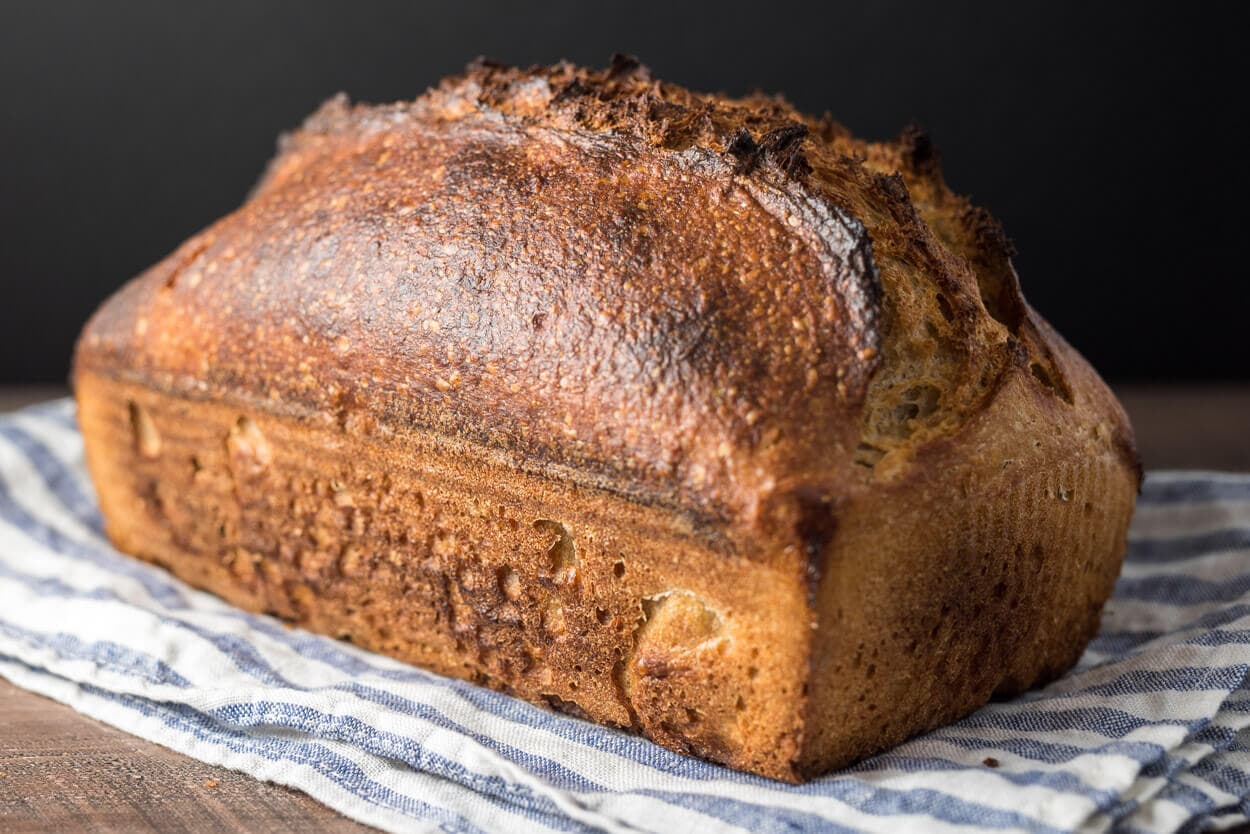
As a kid, I recall more often than not eating baguettes brought home from my Dad’s restaurant, usually procured through a late-night call asking for “some bread for tomorrow.” On the weekends my Mom and Grandmother would slice these baguettes at a super slanted angle and make French toast, probably one of the perfect bread for such a thing, but aside from these baguettes we also had a sack of pre-sliced whole wheat bread—which coincidentally also makes excellent French toast in a different sort of way. It was always whole wheat (even before that was the in thing to buy), and it was mostly just a vehicle for peanut butter & jelly, cinnamon & sugar, straight butter, or whatever other bright things kids can dream up. I always preferred the baguette with its wonderfully crunchy crust. But, there’s a special place for a PB & J sandwich—especially now with this whole wheat sourdough sandwich bread—that has so much peanut butter when dropped it would always land on the peanut butter side.
“Why don’t we ever have good ol’ sandwich bread?”, I heard my wife recently whisper to herself in the kitchen. This wasn’t the first time I’ve listened to such a statement, and scattered comments like these got me thinking back about that sliced bread (and baguettes too, and I just posted a recipe for baguettes!) I had as a kid. Nostalgia turned to motivation as I felt urged to develop a pan loaf with many of the same characteristics but 100% sourdough, and with somewhere around 98% fewer ingredients—you know, just flour, water, salt, and yeast.
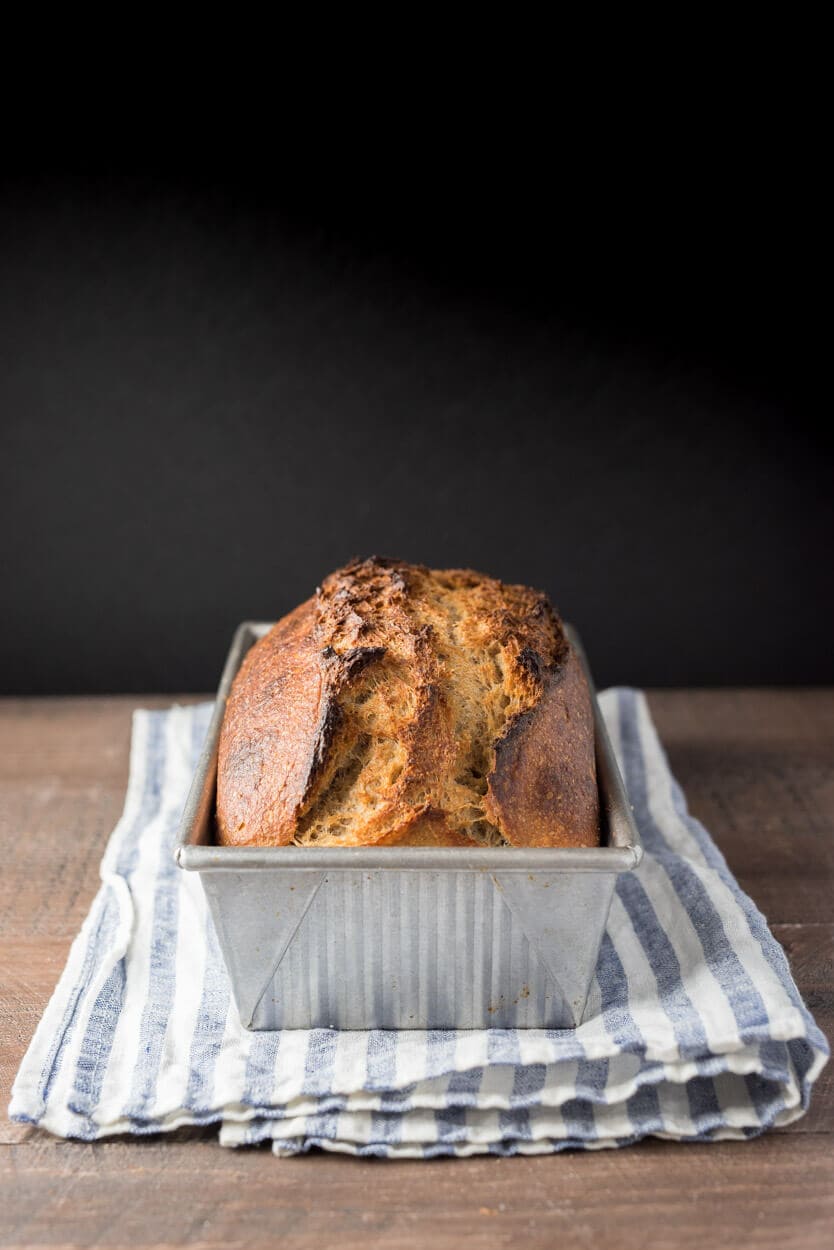
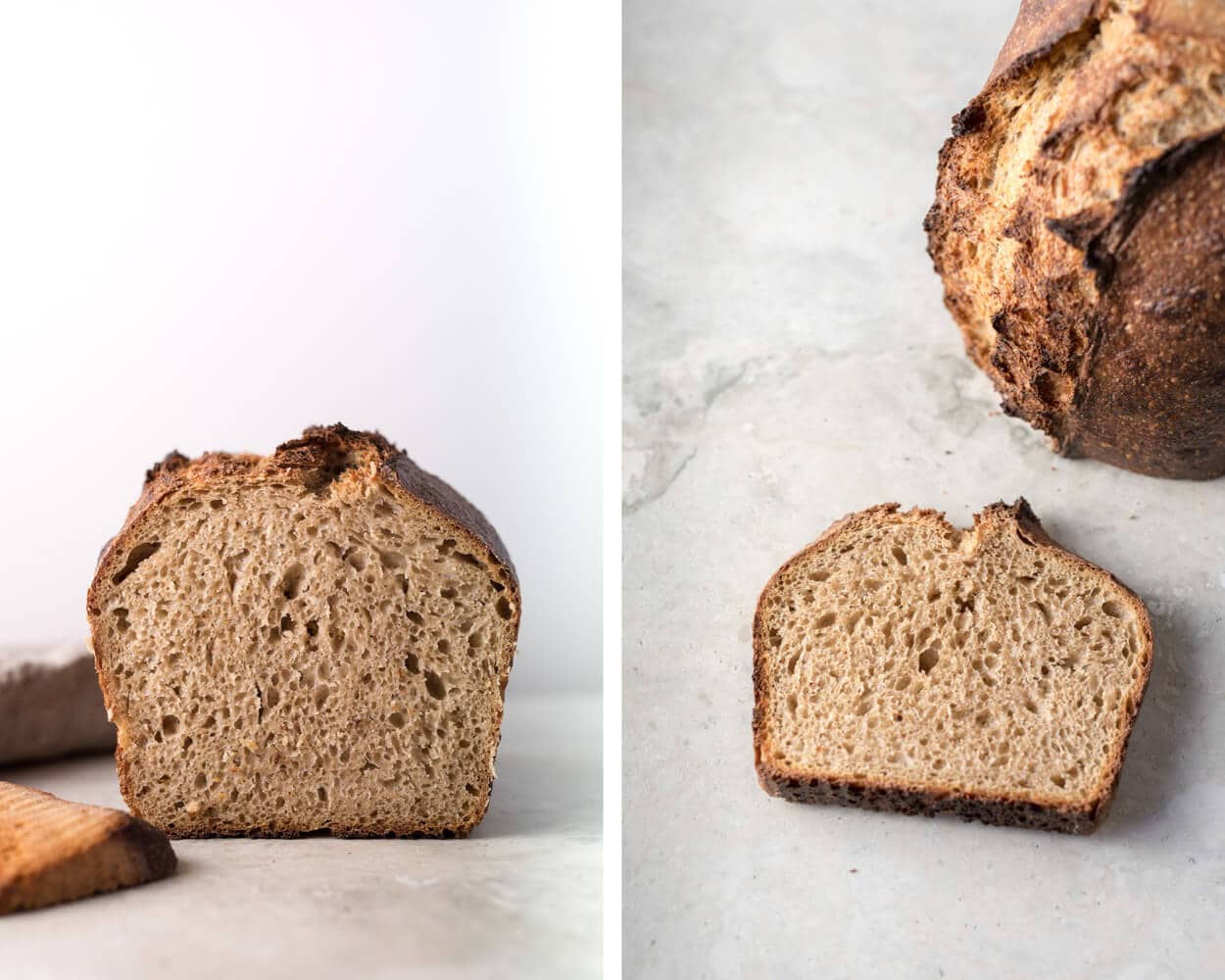
The perfect sandwich bread to me is related to that sacked bread from the supermarket, but only in the most remote way possible—perhaps only in the fact that it’s square-ish and sliced. I want a thin and shiny crust with a moist and light interior, a slightly sweet taste not from honey or sugar but from the whole grain itself. And that’s important: I want to taste the grain in this bread, not some strange flavor masked by something sweet. The interior should be tight but still light and well fermented, coaxing out maximal flavor from the grain. As far as aesthetics go, you can alter the way this bread rises and opens (or doesn’t open) at the top to suit your taste. I still prefer to impart my signature rustic feel and dark bake, but the final tweaks are up to you.
But first, let’s talk about flour.
Flour Selection
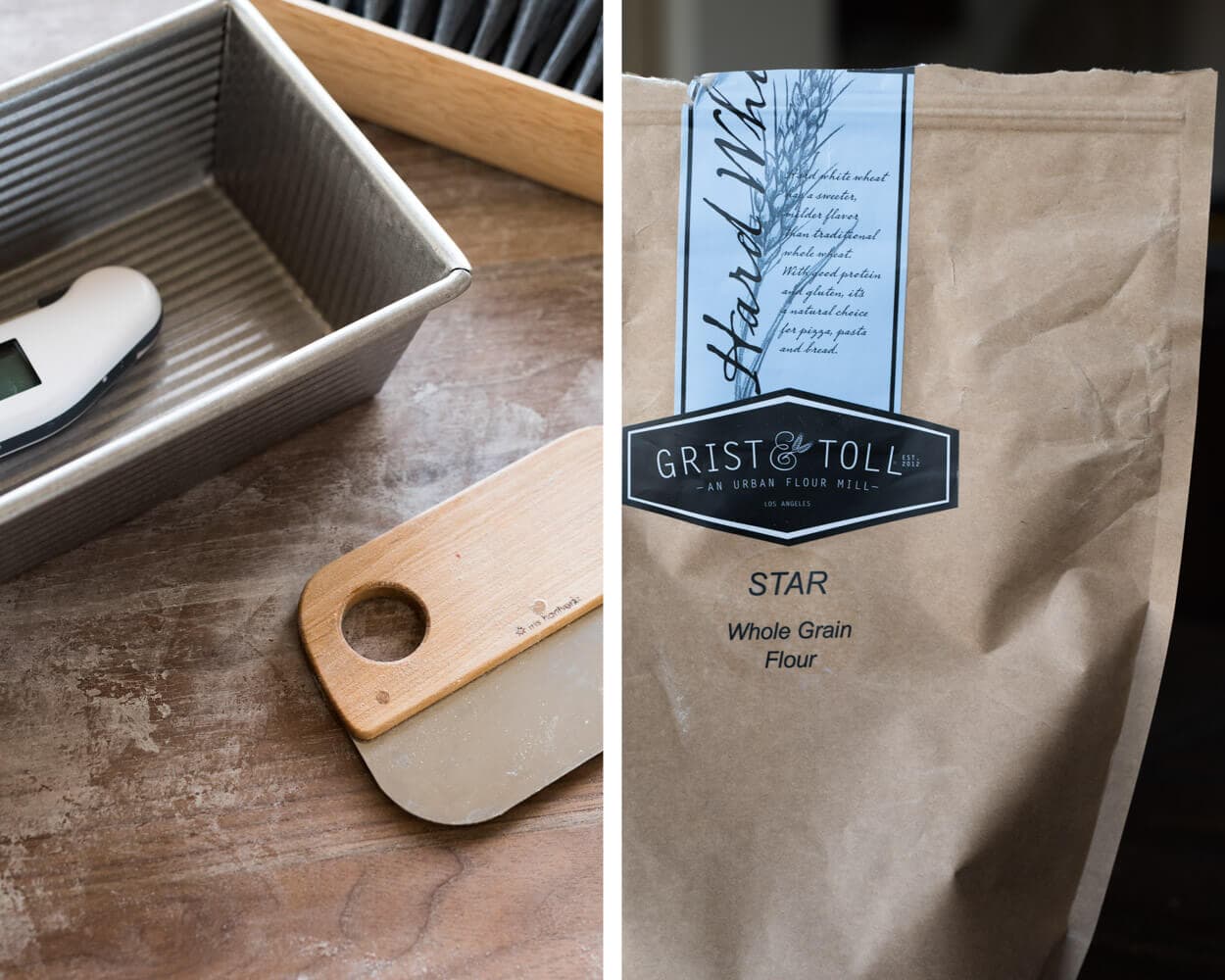
I chose white whole wheat for this recipe because I love the sweet flavor of it, especially compared to red whole wheat which can have a slight bitterness that sometimes pushes through. For the bakes leading up to this post, I used Grist & Toll Star White Whole Wheat. I’ve found the flour to be quite strong (regarding protein) with no gummy flavor to it, which is nice. I recommend using white wheat (King Arthur White Whole Wheat will work well, too) for this recipe but if you don’t have any on hand red wheat will work just fine — the flavor profile will be slightly different but still in the same vein. The small amount of red whole wheat was mostly used to build my levain (per usual) but also because it does add a slightly sharp flavor to the bread, just enough to balance out the sweetness. If you’re more a fan of the white wheat, sub the 10% red for white in the formula below.
If you remember, my recent Spelt Sourdough entry also used type 85 flour, and I explained there that this could be approximated by mixing 65% white bread flour with 35% whole wheat. In this formula, I’m only using a small percentage so again, feel free to mix whole wheat & bread flour to get the desired quantity or sub it out for another blend.
In the end, I like the flavor and characteristics imparted by these flour choices, but it is flexible. I know sometimes we want to bake bread with what we have in our pantry and not have to go out and buy special flour—by all means, experiment (and please let me know how your modifications turn out)!
Whole Wheat Sourdough Sandwich Bread Formula
A word of warning upfront: this formula has a very high hydration; the structure of the pan helps keep this dough together and permits me to push water as far as the flour will take it. This amount of water imparts a significantly moist and soft texture to the interior that is typical of sandwich bread, and the results are definitely worth the added hardship of dealing with such a wet dough.
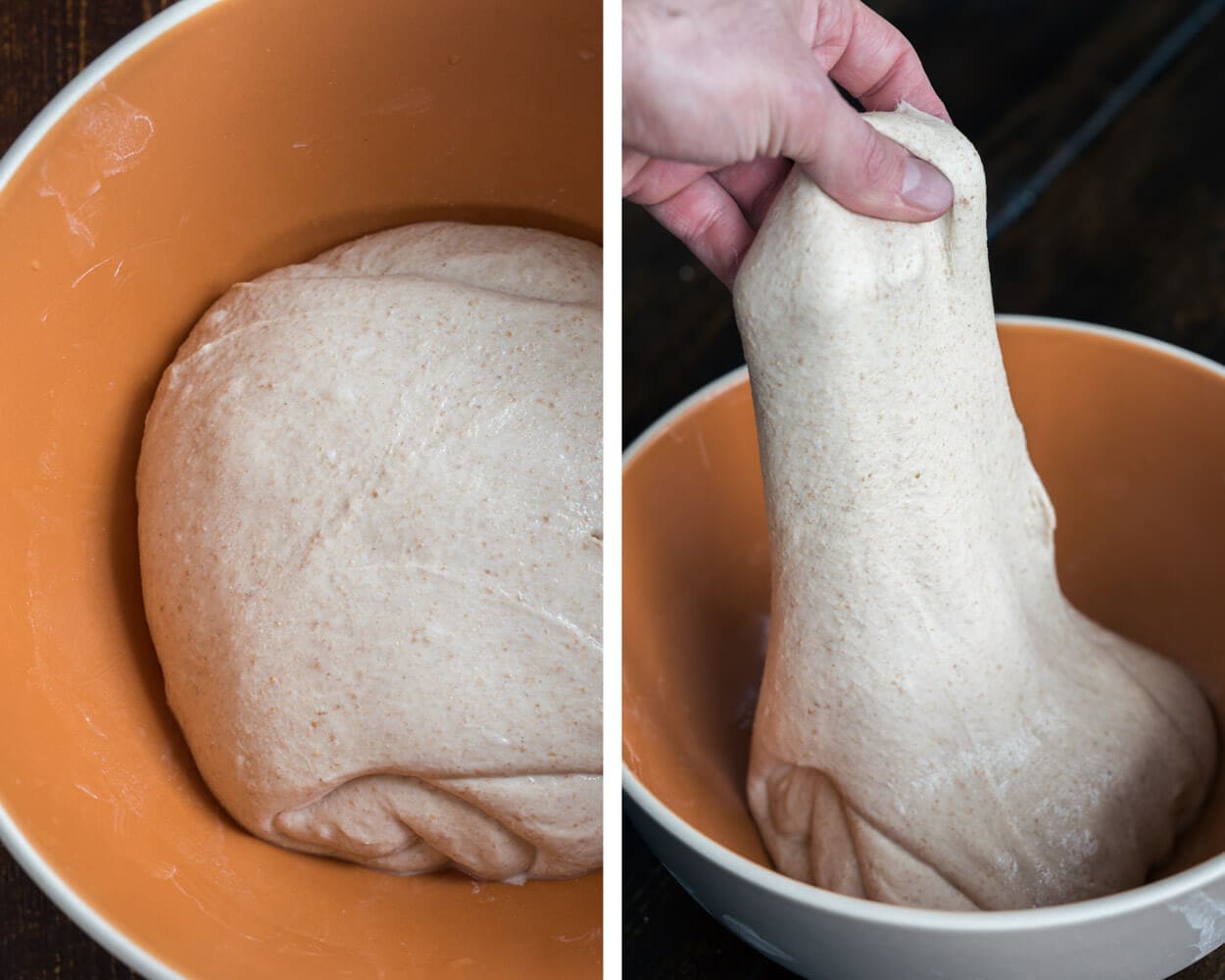
Keep in mind that your flour will act differently with all this water added so hydrate accordingly. Start with a lower percentage and work your way up until you find the perfect point for your flour mix. The dough should be wet looking, extensible, and very soft, but it should not be overly “soupy” or falling apart—if this happens hydration is too high for your flour. You can see below what my dough looked like right after mixing. After a bit of practice, this bread becomes easy to make, and you can double the formula to make two pans at a time. I see myself making this bread reasonably often, freezing one loaf and using the other, this way we always have sliced whole wheat sourdough sandwich bread at the ready.
Vitals
| Total Dough Weight | 1,200 grams |
| Pre-fermented Flour | 5.00% |
| Hydration | 90% |
| Yield | One loaf in a 9” x 5” x 2.75” pan |
The USA Pan used for this bake has a silicone coating, and while I lightly oil the pan with olive oil I don’t think it’s necessary—I have yet to have anything stick to this thing. It’s heavily used here in my kitchen mostly for my sourdough banana bread but now also traditional sandwich bread and even sourdough tea cakes.
Levain Build
| Weight | Ingredient | Baker’s Percentage |
|---|---|---|
| 15g | Ripe liquid starter (100% hydration) | 50% |
| 15g | Giusto’s Stoneground Whole Wheat | 50% |
| 15g | Central Milling Type 85 | 50% |
| 32g | Water | 100% |
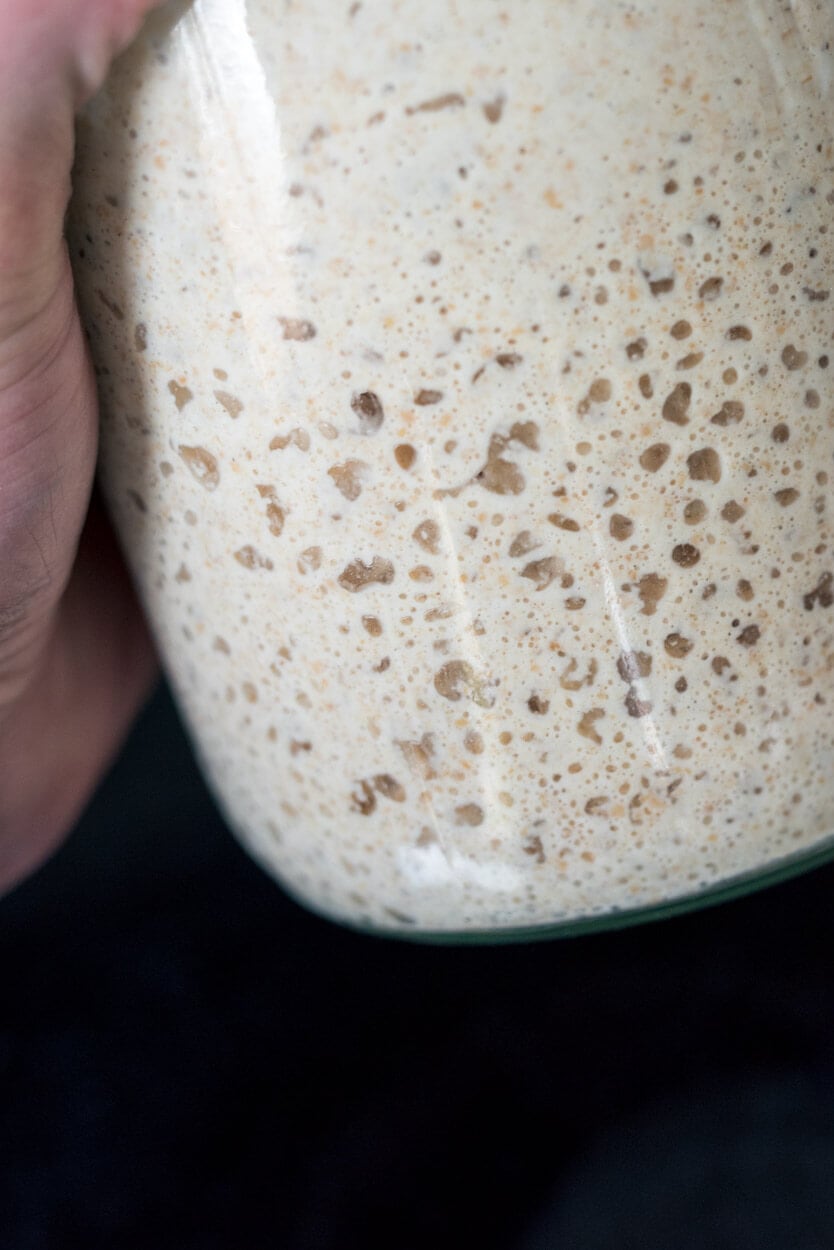
I used half Central Milling type 85, and half Giusto’s whole wheat for the levain build, but you can change this up if you’d like (e.g., use 100% whole wheat or 100% white whole wheat) just keep an eye on its fermentation rate as a higher percentage of pure whole wheat will peak much faster.
Dough Formula
After a few trials, I arrived on a final dough weight of 1200 grams for my bread pan. The resulting bread was nicely sized and perfect for what I’m looking for, but I think it could be pushed even further, perhaps somewhere around 1300-1400 grams if you want an even taller loaf, one that rises and slightly spills over the edges.
Note that the baker’s percentages listed below are with respect to the final dough ingredients and do not take into account the levain.
The target final dough temperature (FDT) is 75°F (24°C).
| Weight | Ingredient | Baker’s Percentage |
|---|---|---|
| 463g | Grist & Toll Star White Whole Wheat | 78.95% |
| 77g | Central Milling Type 85 | 13.16% |
| 46g | Giusto’s Stoneground Whole Wheat | 7.89% |
| 524g | Water | 89.47% |
| 12g | Fine sea salt | 2.11% |
| 77g | Ripe, liquid levain | 13.16% |
Method
1. Levain – 9:00 a.m.
Build the liquid levain in the morning and store somewhere around 78°F (25°C).
2. Autolyse – 1:00 p.m.
For the autolyse, mix flour and water (reserve 100g of the total water for later mixing) in a bowl until all dry bits are hydrated. Cover bowl and store somewhere warm (around 78°F/25°C) for 2 hours.
3. Mix – 3:00 p.m.
Due to the high hydration of this dough, it’s helpful to build some strength at the start of mixing before adding in the reserved 100g of water.
Add the mature levain and about 25g of the reserved water, mix thoroughly by hand to incorporate, and then slap and fold for about 6 minutes, just until the dough starts to show signs of a smooth surface and holds its shape on the counter. If you aren’t comfortable with this method or don’t like it, you can perform stretch and folds in the bowl until your dough tightens up and is slightly hard to stretch out and fold over—close to medium development.
When finished sprinkle the salt on top of the dough and use the remaining 75g of water (or less if the dough is starting to feel too wet and falling apart) to help dissolve. Pinch through a few times and fold the dough over itself to help incorporate. Keep folding the dough until all the water is absorbed and it comes together; it will end up slightly sticky.
Transfer dough to a tub or thick-walled bowl for bulk fermentation.
4. Bulk Fermentation – 3:20 p.m. to 7:00 p.m.
At 78°F (25°C) ambient temperature bulk fermentation should go for a little less than 4 hours. Watch the dough! With this much whole grain, it’s possible your dough could ferment faster than mine.
Perform five sets of stretch and folds during the bulk, spaced out by 30 minutes (the first set starts 30 minutes after you finish mixing). After the fifth set of stretch and folds, performed gently, let rest for the remainder of bulk. The dough will not rise an incredible amount, but it should be slightly jiggly and some bubbles on top and sides. You want to see a slightly convex edge between the dough and the bowl.
5. Pre-shape – 7:00 p.m.
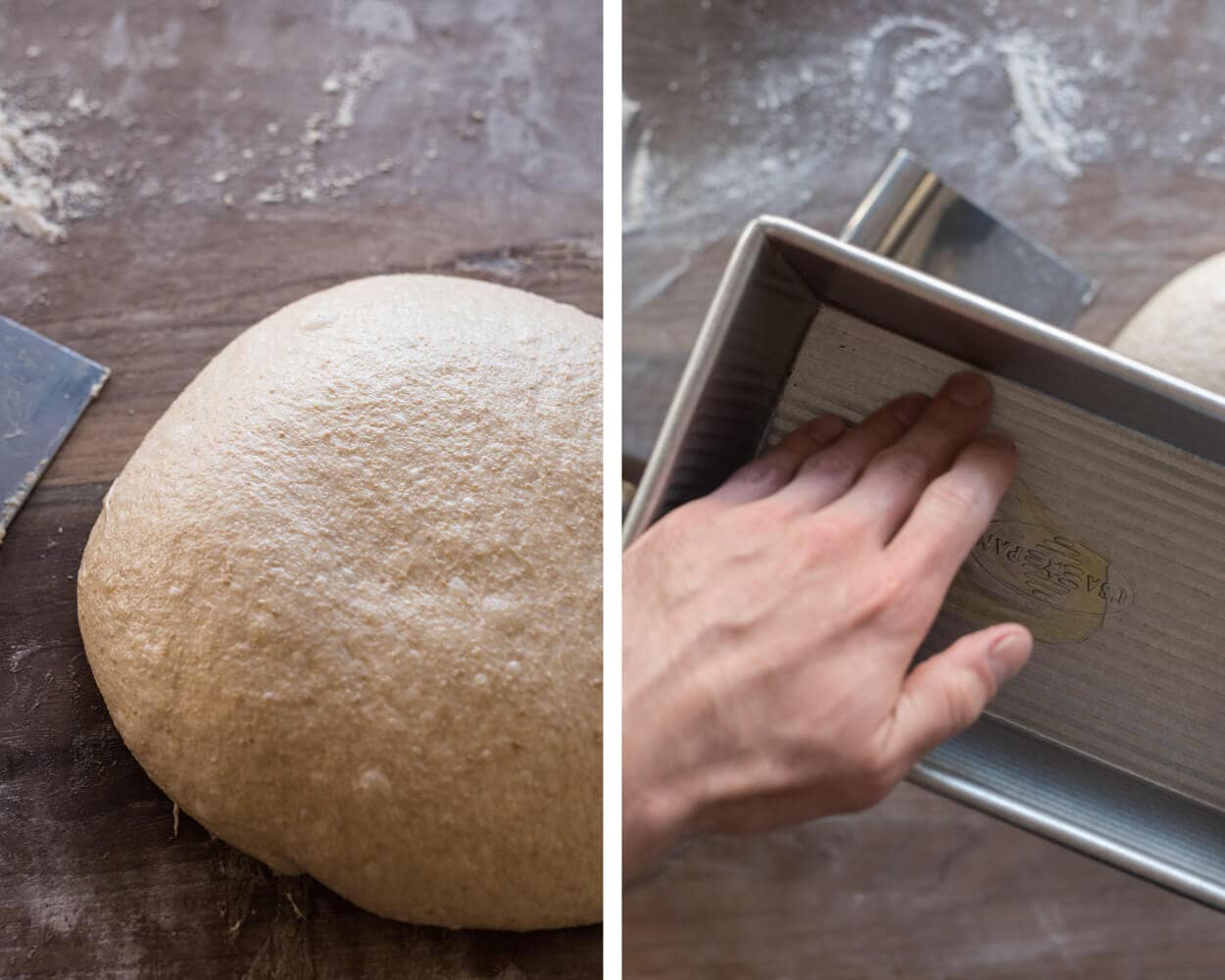
Sprinkle a light dusting of flour on your bench and dump out the dough. Shape into a single round mass and let rest 20 minutes uncovered. Because this dough is highly hydrated, rely mostly on your bench knife and try to touch the dough as little as possible. I use my knife to pick up and pull the mass around in a circle, forming a relatively tight skin on the dough. Using a little olive oil lightly oil the baking pan.
6. Shape – 7:25 p.m.
Shaping this dough can be challenging. The good news is it’s pretty hard to mess it up, just form it as best you can into a “tube” the width of the baking pan and get it in there with as much tension on the surface as possible. The structure of the pan will force your dough to rise upward whereas with a hearth loaf we’d have to ensure a proper shape so there’s no spreading in the oven.
Moderately flour the top of the dough and flour the work surface. Flip the resting round over onto the floured surface and fold the side edges at the top up and over to the middle (imagine a round bottom that tapers up to a point at the top, it will look like an inverted diamond of sorts). With floured hands take the point at the top and start to roll the entire mass of dough downwards, with each roll pushing the dough with your thumbs inward toward the bench—imagine rolling up a beach towel. At the end of this, you’ll have a tube that has essentially been rolled downward. Transfer to your oiled pan with the seam on the bottom.
An alternative shaping method that might be easier to perform is to just fold the sides slightly up and over towards the middle, then roll up the dough tightly. It won’t be as spread out to the sides, but the dough should relax in the pan overnight.
For more information and photos on shaping, proofing, and scoring pan loaves check out my guide to shaping pan loaves.
7. Rest & Proof – 7:30 p.m.
Cover your pan with plastic and then retard in the refrigerator at 38°F (3°C) for 10-14 hours. Even at such cool temperatures this dough can quickly overproof so keep an eye on it in the fridge in the morning.
8. Bake – Next Morning: Preheat oven at 6:00 a.m., Bake at 7:00 a.m.
Preheat oven for one hour at 450°F (230°C).
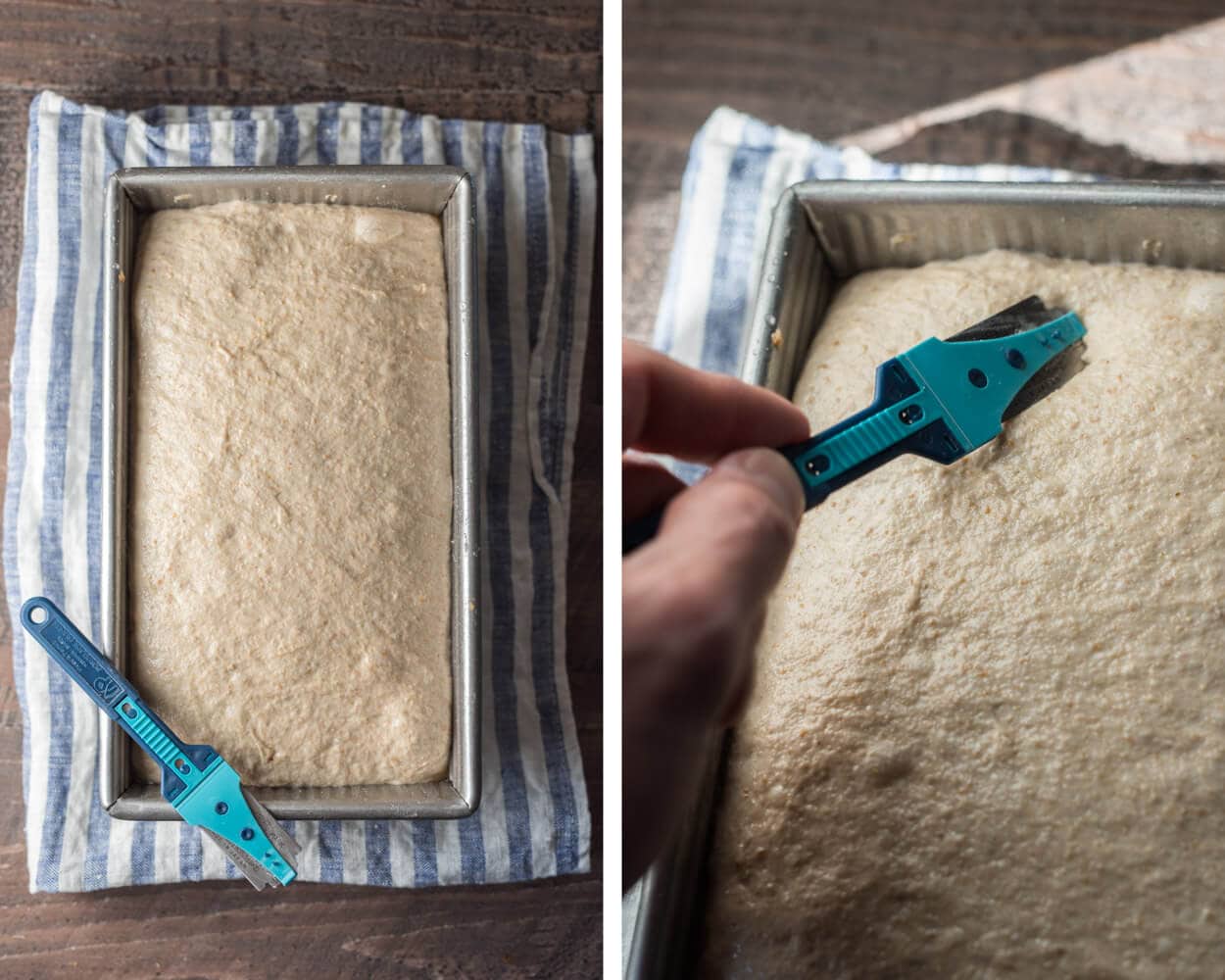
I did a very rough score on the top of the dough before placing into the oven. If you choose not to score at all, you’ll most likely get a taller loaf, and depending on how tight you shaped your dough, there may be more or less of a rupture on top. In the future, I’d like to play with an even longer proof in the fridge with no score at all. This should yield an even more tender crumb and hardly any dramatic fissure.
Spritz the top of the dough in the pan with a hand mister and place it into the oven. Bake for 20 minutes at 450°F (230°C) with steam, and an additional 30 minutes at 450°F (230°C) without steam. Then, turn the oven down to 425°F (220°C) and bake for an additional 15-20 minutes until done (the internal temperature on my loaf was 205°F/96°C).
I steamed the oven in my usual way, described here in my post on how to steam your home oven for baking. While this extra steam might not have been necessary, I wanted to ensure maximal rise and a thin & crisp crust. Remove from the oven and let cool in the pan on a wire rack until cool enough to remove the bread from the pan, then remove and let cool directly on the wire rack for a few hours.
If you cut this bread too soon, the interior may not be wholly set so give it a little time to relax (here’s why).
Conclusion
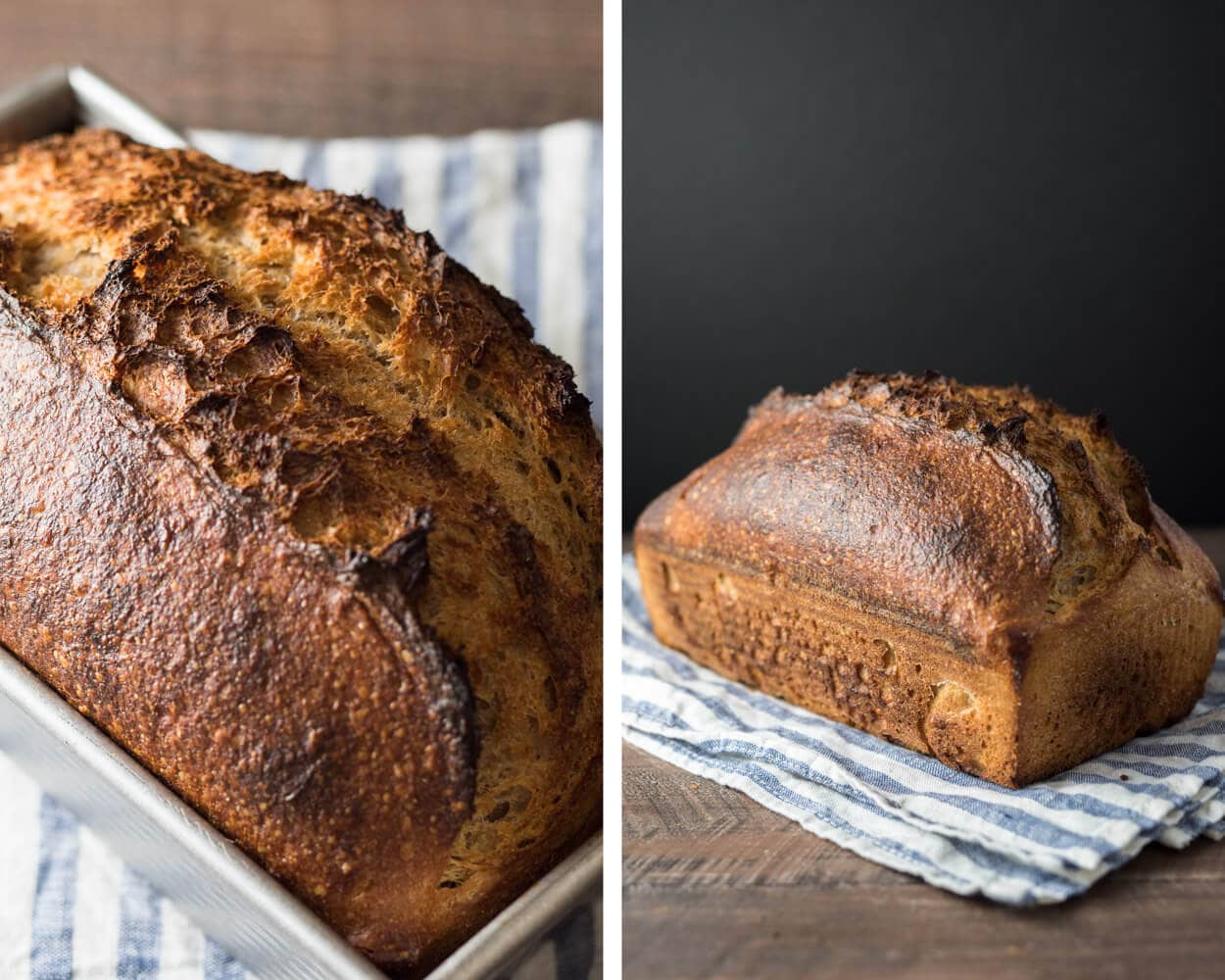
With only four ingredients this healthy bread is a daily bread that has a mellow, sweet taste. The crust is supple but not mushy, and the keeping qualities from sourdough mean we’ll be done eating this entire thing well before any threat of spoilage. This is unmistakably bread that can be made every week to satisfy those old fashion sandwich cravings (perfect for kids, too).
Crust
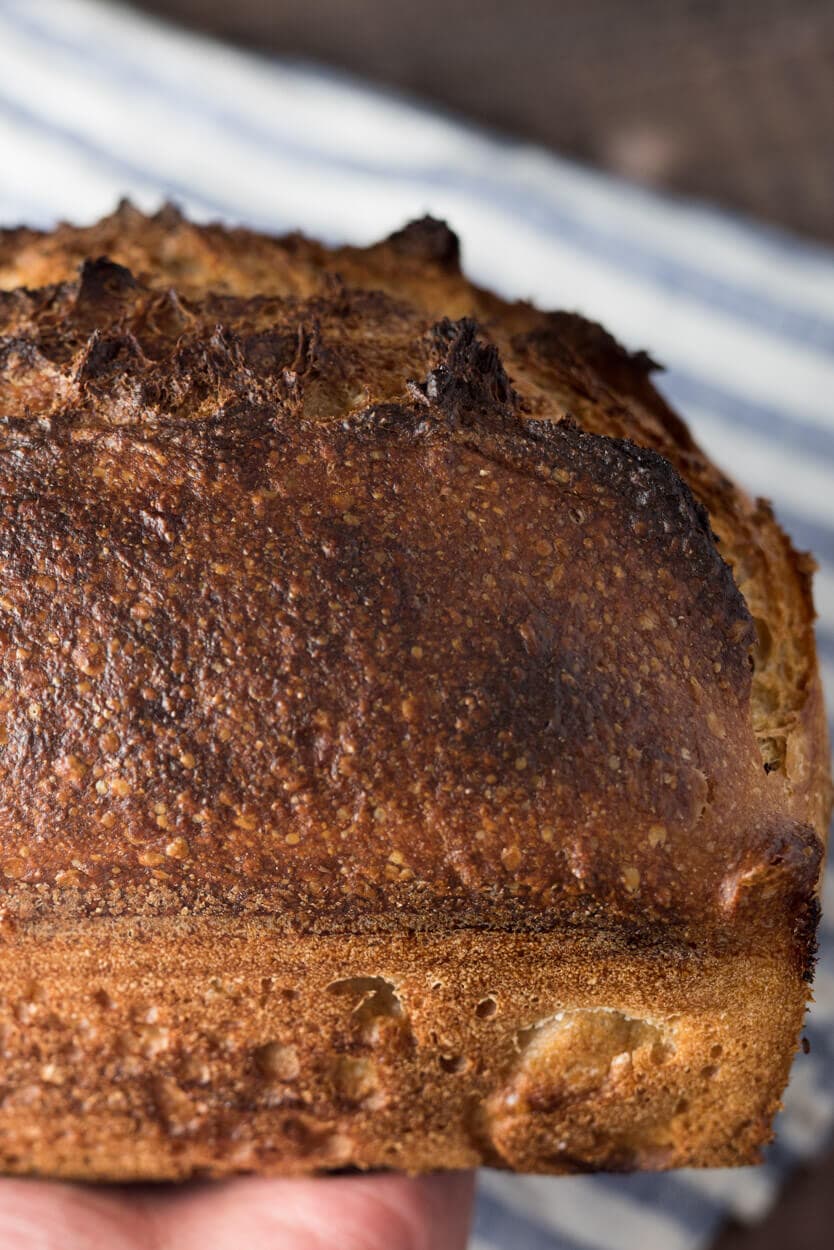
The crust is killer. The intense caramelization is so appetizing it makes your mouth water before you even have a bite. You can see lots of little blisters on the surface of this loaf (thanks in part by the extra steaming in the oven) that provide a little crunch when toasted, a perfect contrast to the incredibly tender crumb inside.
Crumb
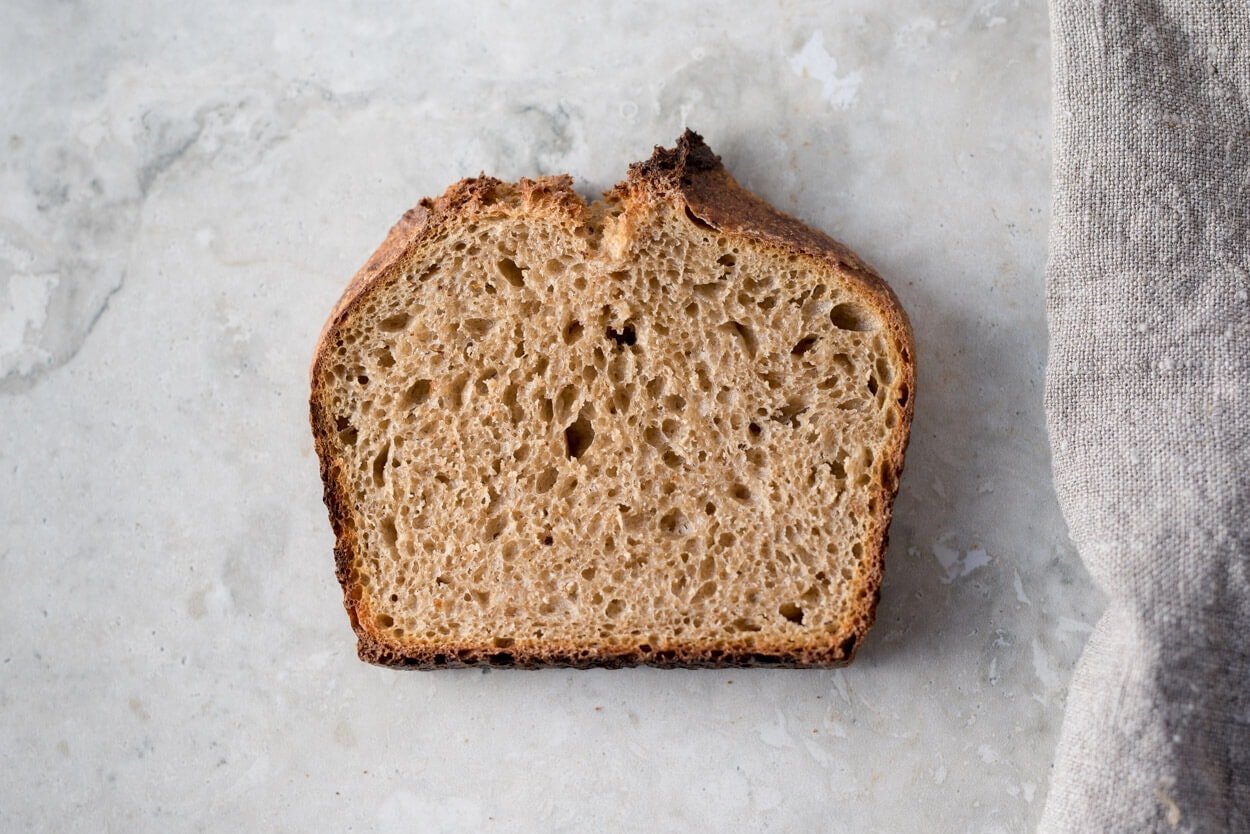
Bread like this asks for a certain level of tightness; it needs to hang on to all those fantastic ingredients you’ll be sandwiching in there. The high level of whole wheat helps ensure a fairly closed crumb but more important is the full scale of fermentation. You’ll notice no dense areas, no gummy sections; everything is well fermented and very tender. If you recall at the start that was one of the criteria I had for this bread and it’s readily satisfied.
Taste
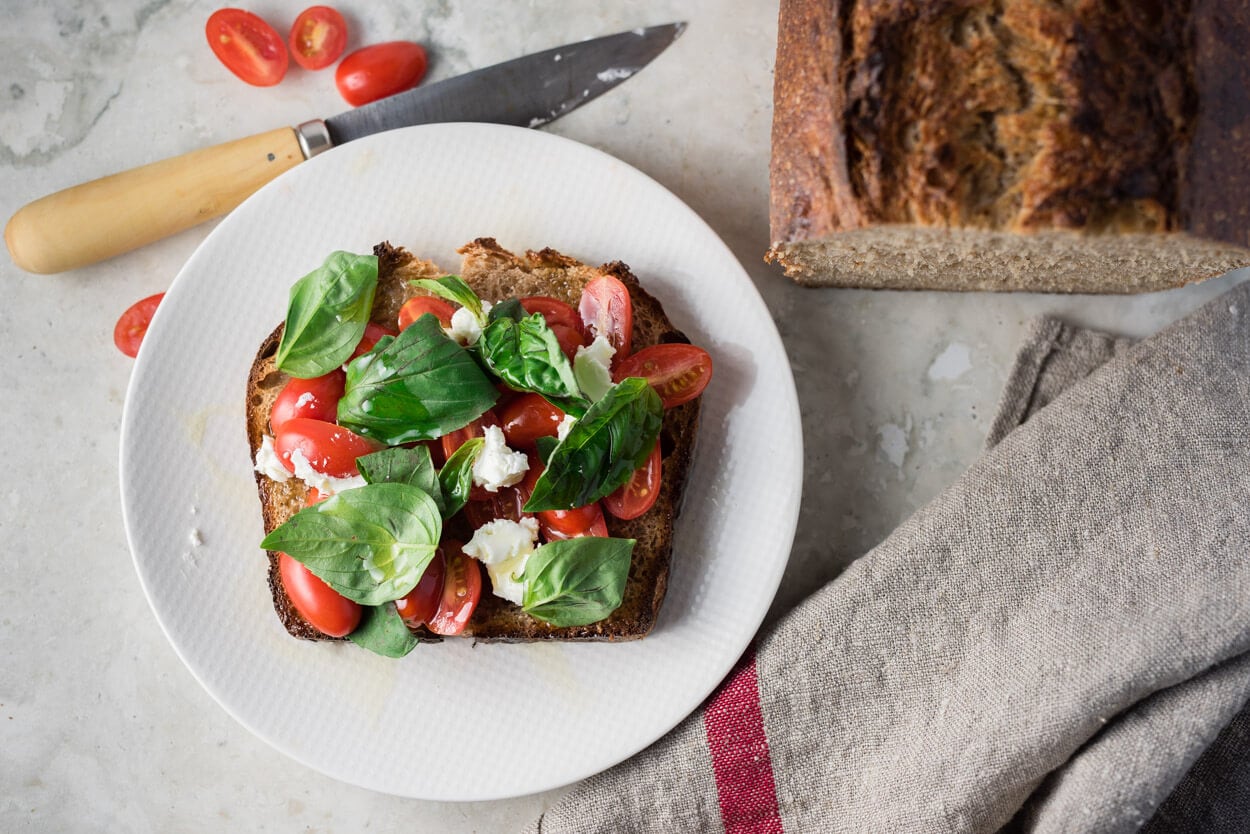
Channeling my smørrebrød history, I made an open-faced sandwich with ripe tomato, basil, goat cheese, and extra virgin olive oil—just perfect for this bread after heavy toasting. Sweet, soft, mellow and contrasting. All part of a bite and all contributing to the grin on my face. I’ve come to enjoy the flavor of Grist and Toll’s Star White Wheat, and I can’t wait to try this recipe with a few other varieties I have, including my own fresh milled white wheat berries. I don’t think you could go wrong with using red wheat instead of white, but as I mentioned previously white wheat has a slightly sweet and more subdued taste that works well with bread like this.
Well, there you have my take on a whole wheat sourdough sandwich bread. I feel like I’ll be tweaking this bread into the future as I already have a few things I’d like to try out: use a large percentage of freshly-milled flour, push fermentation even further (perhaps 2-4 more hours for the final proof), and finally increase the dough weight to 1400 grams to see just how high I can get this bread to climb. Some other welcome additions could be a seed or cornmeal topping and heck, even a little cornmeal mixed into the dough to add another level of sweetness.
Oh! I’d be remiss if I talked so highly about that thick slathering of peanut butter and leave without proof. Once this loaf cooled I was waiting knife-in-hand and it was the first thing I concocted, even the photo couldn’t wait.
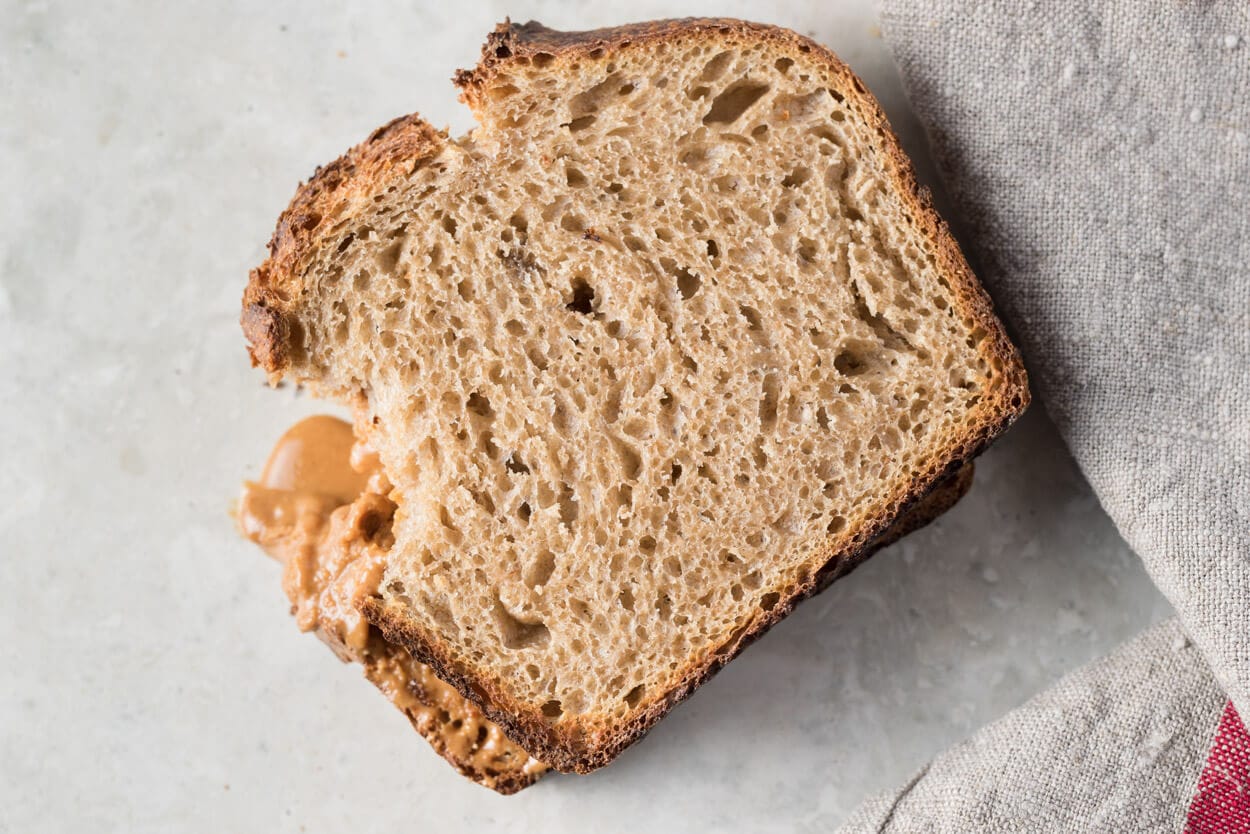
Buon appetito!
If you use this recipe, tag @maurizio on Instagram so I can take a look!


277 Comments
This is my first high hydration loaf. I ended up using all the water, (really dry flour in high altitude dry climate) and things seemed as expected until I took my loaf out of the refrigerator in the morning, (12 hours in the fridge) and the surface was wet looking still and flat, and the slash I made in the top closed again immediately. But when I baked it, it burst open on one side. Was it underproofed? Just wondering what I could have done – maybe should have let it proof in the fridge longer? Or perhaps left out the loaf pan an hour or two at room temp before putting it in the fridge for 12 hours? It rose while baking pretty well and the crumb appears like the pictures above although there are some bigger holes near the top – and it still tastes pretty good despite its misshapen appearance.
“I cut a rectangular piece of parchment paper and set it directly on my baking surface, just in case the heat was a little too high for the pan to handle.”
This made me wonder what kind of “baking surface” you are referring to. For pan loafs I always place the pan directly on the oven rack (obviously preheating the oven first). When making batards and boules I preheat a baking stone or my dutch oven. But maybe it’s better to place the pan on a preheated baking stone also? Is that what you are referring to? I always just used the rack, for some reason it never occurred to me that pan loaves could benefit from being placed on a hot baking surface (if the pan can handle the temperature shock).
I am making this bread today. Very anxious to see how the high hydration works out for me, and whether I have to hold back the 100g reserved water or not!
This being quarantine time I had to bake with what I had in hand so I subbed all whole wheat for the type 85 + whole wheat flours and then used bread flour for the white whole wheat, everything else stayed the same. I was a little worried during shaping that I had added too much water but I was able to wrestle the dough into the pan with minimal damage (to the dough or my self esteem).
It baked for the exact time as stated in the recipe and after an overnight cool I finally cracked into it this morning. Perfect dark brown crust and soft closed crumb on the inside! I’ll confess, I’m a new sourdough baker and this was my first perfectloaf recipe since they seemed kind of intimidating but Maurizio’s careful instructions and attention to detail paid off! Now I need to build up the courage to try that chocolate babka…
Hi Maurizio!
I’ve made this loaf twice now and it is insanely delicious. Still learning to shape, so one side is always a tiny bit taller haha!
I don’t ever get a huge dramatic rise, but it’s always light and airy inside. Any thoughts on why I don’t get a ton of oven spring? yours is so beautiful and I love the dramatic rupture.
I tried this recipe and the bread tastes good but it stuck so badly to my pan ( a cheap and old target pan). I make lots of sandwiches so I like that this has smaller holes! How can I make a bread that has similar small holes but use a hand shaping method? Do you have any recipes that match this? Is it possible to just reduce the hydration and shape this by hand?
Definitely grease that pan liberally next attempt. Yes, you can certainly drop the hydration and shape this as a hearth loaf (a boule would be great).
I had the same problem it was stuck to the top edges but not the bottom. So, just before I put it in the oven I ran my finger around the edge to make sure the oil had a nice barrier between the dough and the pan, especially in the corners.Made a huge difference and helped with the spring too!
I had some weird stuff happen trying this, but turned out tasty all the same! My levain got weird, and I missed the note about adding starter after the levain rested, like the comment below. It separated a bit, as I think the starter that I wasn’t supposed to add yet, was also a bit over ripe. Second was somehow I think I was way over hydration. After much slapping and pulling and the 5 stretches during bulk, I still had a blob in a bowl, but with a little rise. Also basically just had a blob in my pan after I did the beach towel roll pan shape. I lieu of this I pulled it out this morning when I turned on the over after the proof and let it rise for an hour, and it did. I also messed up the scoring, getting really nice rise in the middle of the loaf, and minimal rise in the corners. But even after all of that, I have delicious chewy sourdough that is extremely edible and even has a nice crust! Looking forward to round 2!
Ways to make quarantine better! My wife thinks I crazy, we now have a refrigerator full of strange jars of bubbly things, and three large loaves of sourdough, with only two people and a foster dog. Isolation seems like it has turned into the Great Global Baking Show.
You could try reducing the hydration 10% and see if that helps next go! I love a high hydration on these loaves but it’s all relative to the flour you’re using. Drop the water and see if you get a taller, more open loaf 🙂
Hi, I want to try this recipe but I am confused about step 2 (Autolyse). If I read this correctly, you are mixing flour and water without adding leavening and let it sit for 2 hours. Is this necessary, or can you mix in leavening with flour and water right the way? This is my first sourdough loaf, so I am not just trying to understand the mechanics of the process.
https://www.kingarthurflour.com/blog/2017/09/29/using-the-autolyse-method
That’s correct: the autolyse only has flour and water mixed together.
Greetings and thank you for sharing all that you do! I have a baking habit that includes making dough on Fridays and baking on Sundays. How could I make this work with a looong sleep in the refrigerator? I tried the 100% spelt pan bread and it worked well when I was finally patient enough to let it rise properly on Sunday! I looked through comments to see whether this had been asked but didn’t see. Thank you!
I have tried several different formulas for 100”% whole wheat bread over the years but never had much success. The usual result is a brick, sometimes edible sometimes not. So I thought I’d give this one a try. Sadly, it was an epic fail!
I have never worked with such a wet dough before but I was up for the challenge. Everything was going along perfectly just as you described it in your instructions. The slap and fold (another first for me) brought the dough together and the stretch and folds during bulk fermentation resulted in a light, pillowy dough with some gas bubbles visible on the surface. It jiggled seductively when I gently shook the bowl. I even managed to pre-shape and shape the dough (as much as ever you can with this dough I think). Into the pan and into the fridge.
I knew as soon as I took it out of the fridge this morning that it wasn’t right. There was no signs of any activity in the dough; it looked lifeless. I baked it anyway because having gone this far how could I not? Not even a hint of oven spring. This was clearly operator error and I went wrong somewhere.
So, a couple of things that may have contributed to the fail:
First, and least likely in my opinion was the liquid I used. I had made some ricotta cheese recently and I used the whey from that instead of plain water.
Second, my production timing was off such that the dough was 15+ hours in the fridge instead of the 11-12 you recommend.
Third, fearing over proofing at room temperature I baked it as was straight from the fridge. I’m thinking maybe I should have left it out a while.
I used fresh ground white WW flour.
I will definitely try this again but in the meantime, have you any thoughts on where I went wrong.
Thank you as always for your excellent posts.
Jock — yes I’d say reduce the hydration significantly if it was too wet. Be sure to use your starter when it’s mature to make the levain and then use the levain when it’s mature to mix into your dough. With reduced water the dough should be easier to handle and I think you’ll have a much better time overall. If you’re not seeing any activity in the dough at all, yes give it more time. However, my feeling is it probably was fermenting nicely but it might have been so hydrated you couldn’t see much.
Thank you for this advice and I apologize for the delay in acknowledging it.
I had a similar issue with your most recently posted recipe for Sourdough sandwich bread; the dough behaved exactly as described up to the proofing stage. It took almost 6 hours (the last 2 in my B&T proofer) to get any kind of rise. I make a pretty good SD rustic bread but seem to struggle with pan loaves! I will stick with it though. I am determined to find out where I am going wrong. One thing I didn’t mention, I mill my own flour with my Nutrigrain mill. Could that have an impact on the final product?
That’s very strange, Jock. If you use your starter and levain when they’re ripe, you should get plenty of rise during the process. If you see rise during bulk but not proof, are you dividing the dough too early? If you’re milling your own flour and using that for 100% of the flour in the recipe, you might not see as much rise and you might be at risk of over proofing your dough! Freshly milled flour is much more active.
Made this with KA white whole wheat flour. The only sub I did was using 3 grams of brown sugar instead of the malt and I cut down on the salt slightly (just my taste). My starter is also all rye so this makes a slight flavor difference, I imagine. Because I was unsure of how much water the KA flour could take up I decreased the water very slightly per your suggestion. It was still so wet I couldn’t really shape it into the pan, just rougly shaped it with a dough scraper. But no matter. The next day, when I took the dough out of the fridge I thought it might need a tad more rise so I left it out at room temp for a couple of hours. For steaming, I simply used a pan of water under the loaf. GREAT oven spring. I took it to 205 interior temp and it came out delicious
Right on, glad to hear it turned out so well. Yes, it’s a highly hydrated dough to be sure, but that’s the beauty of the loaf pan: structure! Thanks so much for reporting back, Pete — happy baking.
Hi, I think I’m about ready to tackle this loaf, I don’t own a loaf pan though, can I make this in a traditional banneton and bake in a cast iron pot?
Yes, that’ll work!n You might want to lower the hydration just a bit, though, I’d say 5%.
Hi! I started this today and it’s proofing in the fridge to bake in the morning. I was a bit nervous about how wet it was and at first thought I should have held back a bit of water. But the dough really came together after the stretch and folds, so I think I’ll be ok. I was going to figure out how to steam my oven without lava rocks, but then realized my loaf pan fits inside my Dutch oven. I’m going to preheat that in the morning and put the loaf in there. We’ll see how it goes. I’ll report back!
Ok, here’s how it went: I cooked it in the Dutch oven covered for 20 minutes. Took the lid off and baked another 30 minutes. Was about to drop the temperature to 425 but my crust already looked pretty dark. I took the temperature and it measured 208 F. I figured it was done so I took it out. As you can see from the pictures is was a very dense loaf, with a bit of a gummy texture. I would think it was just under-baked had I not taken the temperature. The taste was delicious and I already want to make it again to try and get it right. What are your thoughts?
https://imgur.com/gallery/8PCKf7Q
Hey sorry for the delay! Your loaf definitely could use with a shorter bake time, it might be that the added heat from the Dutch oven scorched the outside just a bit. That “dirty knife” is very indicative of the fact that it could have used more time in the oven to fully bake out the moisture inside. I’d say next time try a reduced oven temp, perhaps by 25-50F, and bake longer until the interior registers 208F. It should not get super dark on the top, if it’s starting to turn to a darker color quickly, reduce oven temp and finish baking. Let me know how it goes!
No need to apologize. I could tell from your Instagram feed that you were traveling. Looks like you had an awesome time. I will bake longer next time and let you know how it goes. Thank you so much for always getting back to me when I post questions. It’s greatly appreciated.
Yes, quite a lot of traveling! You’re very welcome, Katia. Keep me posted!
Katia, I had the same thing exactly happen to me. Dirty knife, dark crust, dense almost wet and gummy. I didn’t use a dutch oven or steam due to equipment limitations. My internal temp was 207 when I took it out. I personally am tempted to reduce the hydration and try again. Have you tried again and had any success?
Hi Al, I haven’t tried again, but I was going to try baking it longer at a lower temperature next time. Might try it this coming week. I’ll report back if I do.
Sorry I didn’t see your comment so long ago! This is a good approach, I think it’ll fix these issues you were seeing. But I might also suggest dropping the hydration just a bit, perhaps 5%, and see if that helps also.
I’d try exactly what @katialewinjablonsky:disqus mentioned below: usually a longer, cooler bake will help ensure the interior is fully baked out and reduce that gummy texture. Around 208-210F would be ideal for this bread!
Hi, I’ve been meaning to report, but just got around to it. I baked this again a couple of weeks ago. My dough was super active this time around with a bit of overflow at the sides after proofing in my loaf pan. I did not use my dutch oven, but put a sheet pan with boiling water at the bottom for the first part of baking. I lowered the temperature at each step by 25 degrees. The results were better, but not great still. When I went to turn the temperature down to 400 for my last 20 to 5 minutes of baking my crust was already VERY dark. But I resisted the urge to take it out because I didn’t want an undercooked loaf again. I left in it for another 20. Needless to say my crust was burnt. But the crumb was much better this time. We just cut the crust off and devoured it. I put a thermometer in my oven to double check it’s temperature and it’s not running hot. Not sure what the problem is…
Hi I’ve made this bread a dozen or so times and have always had the same problem. The crust gets so dark and crispy while the inside remains gummy. Any tips? I love the flavor but am always disappointed when I slice it open.
Hey, Anna! I’d say try reducing the baking temperature so you can bake it longer without coloring too fast. Drop each section of the bake by 25°F and see if that helps. That gummy interior is likely due to it not baking long enough. Let me know how it goes!
Hi Maurizio, I love your blog – I’ve learned so much from it. I’ve been enjoying making this bread, but would like to make a version that is 50% whole wheat and 50% unbleached bread flower. Do you have a sense of how much water I should use for this mixture? I know it will be less than I’d use for this original version, but I wasn’t sure how much less exactly. Thanks!
Right on, glad to hear that, Zach! Have a peek at my fifty-fifty whole wheat sourdough recipe, you could shoot for a hydration around there or even push it quite a bit higher since this bread will be baked in a pan (and the pan will provide plenty of structure to prevent it from spreading in the oven). Hope that helps!
Hi – wondering if you have any tips for getting the bread to release from the pan. The loaf came out beautifully on top with fantastic oven spring. However, the bottom stayed stuck in the pan so the loaf tore in half. Still delicious though. Thank you.
The pans I use here (USA Pan) have a natural nonstick coating, but you could try lightly greasing the pan with butter or oil to ensure smooth release next time you bake this!
Thank you for this recipe, I tried it with only a few mod’s. Added molasses, oil, honey, apple cider, dry milk powder and cooked wheat berries. My dough went over 100% hydration and it still came out with great crumb, I did add approx 50g bread flour at 1st folding in bulk, chewy and small to medium hole structure. A fairly wet dough that was very elastic. Hand fold in bulk container for 30 minutes continuously by hand on the initial introduction of levain to bulk dough. Bulk bin whole wheat for the major bulk, rye flour and unbleached bread flour filling in the rest for those small percentages you call for. No bench flour, wet hands and wet work surface. Two 5×9 loaf pans. No huge holes, save for a few towards the surface/skin, couple of those popped when baked. Great spring even with no overnight ferment in fridge, 2+ hour rise in oven with oven light, doubled, and then bake. Dough is soft and strong enough to be sliced very easily without a serrated knife, sharp damascus slices through surgically with great smooth even uncrushed slices.
Can you describe what it is in this process that is responsible for the lack of huge holes at such a high % hydration? Even at 70% hydration I usually get rustic holes.
To clarify, after the overnight ferment, pre-heat and also remove the dough from the fridge? Or is it go straight from the fridge to the oven?
Hey! As the percentage of whole grain flour in a recipe increases, you’ll usually see a more squat loaf. This is simply because there’s more germ/bran in the flour which has a cutting action on the gluten network built up in the dough. That’s not to say you won’t end up with a nice light loaf, it just won’t be the same as a dough with 100% white flour. The flavor though, incredible!
I typically bake straight from fridge to oven. If your dough looks sluggish and needs more warm fermentation time, take it out a bit early to let it sit on the counter before baking.
Awesome, glad to hear that! More recipes coming 🙂
This was great! I only had whole wheat bread and regular bread flour so I just did a mix of the two, but the end result was great. The top of my loaf wasn’t as craggy and eared as yours (presumably bc my steam setup isn’t as good?), but the crumb looked very similar and the taste was great. I am very new to sourdough baking and this turned out really well.
My loaf turned out OK– the flavor is off the charts, but the texture isn’t ideal. Definitely more on the gummy side, even though the internal temp was 209 when I took it out. The only real issue I think I had was I should have decreased the water– I live in a very humid area and the dough ended up possibly too wet, but I powered through it. I’ve read differing theories on gumminess in the texture, from overproofing to underbaking. What do you think?
Hi maurizio, have you ever wandered to use an oven bag to cook those breads? im going to try everything like you did but instead of your usual metod of steaming, im going to put my pan inside an ovenproof plastic bag and cook with the bread steam like in a dutch oven. have you ever tried this metod? thank you
Hey! No, I haven’t tried this but it sounds like it might be worth an experiment! I’m a little weary of using plastic items in the oven, but if it’s rated to go that high of a temp then it should work. Let me know how it goes if you get around to trying it!
Hello, thanks for the great post. I’m planning to make this recipe, and the details are very appreciated.
I wonder if I can use some oat flour (home-grounded traditional oat flakes) instead of the whole wheat..? I was thinking of replacing the red whole wheat flour. Do you think that would work..?
Thank you.
Howdy:
Instead of steaming the loaf, do you think it would achieve the same results if you put the loaf inside an oblong-shaped covered clay cooking vessel?
Debora
Hi Maurizio,
I’m planning on giving this one a shot, but I had some questions if you don’t mind me picking your brain.
I thought about incorporating some seeds (soaker method, as you have it for your rye recipe), but I’m worried about over hydration. I was thinking of dropping the overall hydration to about 85-90% to account for the extra moisture coming from the seeds. I currently only have access to run-of-the-mill (pun intended) KAF whole grain flour.
My second question is for the actual bake. Are you baking with steam, per your usual method? Or does the Pullman work well alone? The reason I ask is because my oven is not setup in that I can bake with steam easily. The heating element is on the bottom. What would you recommend?
Thanks for your work!
Hi Maurizio! I was wondering, you say preheat for an hour at 500 but then bake at 450. Is this intentional? Do you turn down the heat as soon as you put the loafs in the oven? Want to make sure thank you!
I’m not sure if you’ll see this in time, but I’ll give it a shot. I made the dough for this and I’m getting ready to bake in about an hour. Unfortunately, I’m a college student, so I don’t have a pizza stone, dutch oven, or an otherwise extra-hot surface to put the loaf pan on. It occurred to me that putting the loaf pan in a water bath might be able to provide an extra-hot surface for the pan AND achieve steam. Thoughts on whether this is feasible? Thanks!
Hi Maurizio! I absolutely love this bread. I have a bit of an opposite question to what Steph T just asked. I love the sourness of this loaf and have found myself wondering why it is so noticeably and repeatedly more sour than the others I bake. I would love to oomph up the sourness of my other loaves. I most commonly use your “My Best Sourdough” recipe as my base and tweak from there. Per loaf, that recipe would be about 8.5% levain opposed to the 13% levain here. Do you think that is the main difference? I’m retarding them roughly the same amount of time, the pan loaf usually slightly shorter. The flour type percentages are always similar. The only other significant difference between the recipes is the hydration. Wondering how much hydration may play a factor or if I should just experiment with a higher levain percentage. Thanks as always for your resources!!
Pleased to hear that, Keith! I’ve actually been experimenting more with pan loaves and should have some more recipes with pans coming soon — they’re so fun and delicious.
Yes, a higher pre-fermented flour (the levain) percentage could lead to a more sour loaf. Additionally, you could try using some rye flour in your levain and also the final dough mix. Rye helps increase acetic acid production for a more sour flavor. I wouldn’t go overboard on the rye, though, as the more you include the more dense your loaf will be. It’s up to you on the percentage, but even 5% plays a big role.
Finally, if you can try to push the cold proof in the fridge. There’s a limit of course, but if you could go even a few more hours you should notice more sourness.
Those are a few ideas to try the next go and see if you get a more sour result. Hope that helps and thanks for the kind words!
I’m excited for more pan loaf recipes. I’ve tried once to use your Best Sourdough recipe (but with only white flour) in a pan, but it looks like I need a larger loaf. I’m not sure I can go to that high of a hydration with my flour, since it already feels soupy at 87%, but I look forward to seeing your white flour pan recipe.
Thanks, Steph! Glad to hear the bake went well, despite the small additional sourness. Yes, generally (and assuming a few other things) longer time in the fridge at cold temps when proofing will mean a more sour loaf. Try the reduced proof time and see if that helps. Additionally, you could try making the levain out of all white flour instead of using whole wheat (or as I say here, Type 85). This should help reduce acidity further.
I do have plans to make an all-white sandwich loaf, stay tuned! A touch of honey is, well, a nice touch, as well 🙂
Happy baking!
Hi Maurizio!
This looks so good! I’ve been craving a homemade regular whole wheat sandwich loaf lately! I have a question about the levain. On Fridays (the only day I can bake sourdough) I have to leave for school at 7 am and will not be able to bake until like 4:45 pm. Do you recommend I just use a smaller amount of starter in my levain in order to have it ready by the time I am available? If so how much?
Also, if I do not have T85 flour, what would be a good substitute? Thanks so much for your recipes and help!
Yes, use a smaller amount of mature starter to build your levain — this will lengthen the time between when you mix and when it’s ripe and ready to use. The exact time will be variable based on the flour you’re using (more whole grain speeds things up) and the ambient temperature (warmer is faster). Generally I like about 10-12 hours for maturity when using 20% starter in my levain mix (assuming around 76-78°F ambient).
If you don’t have T85 you could do a mix of white flour and wheat flour: half and half. That should get you close!
Hope this helps and happy baking!
Hello Maurizio. I am confused. In this comment you say 20% starter in levian yet recipe says 50% bakers percentage. Is 50% a typo?
Hi Maurizio, Im continuing my journey with sourdough through your wonderful recipes and insight. Ive just made the Whole Wheat Sourdough Sandwich Bread on Sunday last and it has come out exactly in colour & texture as per your instructions ( the flavour is wonderful ) I changed some of the flour listed as its not available here ( Dublin `Ireland) I substituted the Giusto’s for Malted flour & didn’t have the diastatic available though given the colour & moistness not sure it would need it ? . I had as you predicted a lot of work on the very wet dough but I found the slap and fold at the beginning really helped ( though closer to 10 than 6 mins ) .
Could I ask you if you have ever used Miso in this recipe as I think it would be amazing as it has the texure to complement it. If so could you share how this could be done ? thanks again
Hey, Damian! Your modifications sound great. The diastatic malt is totally optional and probably not needed for this recipe since it’s mostly whole wheat anyways.
I’ve never used miso in this recipe, sounds delicious, though! I’ve actually never worked with miso at all, it sure would be a fun experiment. If you do try it out, please let me know how it goes.
Happy baking!
Thank you for your website! I’m very much a beginner. I’ve struggled with my starter but have finally arrived at a beautiful starter that smells like it should and rises and falls predictably every day as u describe. But I want to make bread now! I’ve tried the beginner sourdough and this recipe and the results have been tragic. Unfortunately where I live in Cincinnati, they don’t have a hockey team otherwise my bread slices could be used as hockey pucks!! My husband says he can use my loaves to weigh down our pool cover! In this recipe, when I mixed the leavin with autolyse, you talk about “slap and fold” or “stretch and turn” but my dough, at that point, was so wet and sticky that I can’t handle it at all. I tried to put it on a board with flour but in order to handle the dough at all, I ended up adding a tremendous amount of flour just to handle it. I’m so confused! Help! One thing that I did notice is that you say to cover the leavain and I used a towel. There was a “crust” covering my leavin after the allotted time. Is this a problem? What do u cover your leavain container with?
You bet, Karen, and welcome! When you make your levain feel free to cover it with a plastic lid if you have one. Sealing it like this will help the crust from preventing.
Sorry to hear about the horrible bake! It sounds like your flour and/or environment dictate the need for less water in your mix. I’d reduce the hydration of my recipe above by 10% and give it another go. Even after reducing it 10%, hold back some of the water (perhaps 100g) during mixing and add it in only if it feels like the dough can handle it.
With baking hydration adjustments are almost always needed and we have to be cognizant of that as we’re mixing. It doesn’t mean it has to make things more complicated, it’s just a small adjustment we have to do each time we bake (kind of like adjusting the liquid in a pancake batter!).
Hope this helps and good luck on the next go — let me know how it goes!
Update: I tried your steaming at home method but with salt blocks that I had on the bbq (still haven’t purchased pizza stones). It all worked like a charm- Thanks so Much Maurizio! I really can see the change in results following your guidance (for bread and steam).
Excellent! Salt blocks, interesting and what a great idea. Thanks again for the updates on all of this! Happy baking ????
I made this recipe and have received rave reviews which I thank you for Maurizio! One thing I am wondering about is steaming: I don’t have a pizza stone or the set up you suggest yet, so I tried the following: 1 baked them separately. 1st one, I put directly on the oven separation shelf (it’s well insulated to separate the top and bottom ovens) so I thought that may substitute okay. Secondly, I used my big roasting pan upside down over top of the bread, with no steam container for this one. Result: nice rise, open texture. 2nd bread, I also placed on same shelf but this time I added a steaming container of boiling water, then again placed the roasting pan upside over top to trap the steam inside with the bread. Result: less rise, still open texture but a wee bit denser. My next bake I plan to get the home steaming set up going that you have outlined and try again. It is a bit challenging doing this at home!
It is challenging, and requires a little more effort, but I find the results totally worth it! Thanks for posing an update and your results, that helps me (and others) when testing things in the future!
Just tried this loaf yesterday, and it is delicious toast for breakfast today with some homemade butter! But when I cooked it last night the crust was starting to burn and I couldn’t do the last 15-20 minutes at a lower temperature. It seems cooked through, any ideas what happened? Is it possible I had too much steam? Thanks so much for all the great advice and recipes, I will be trying this one again ????.
Excellent, really glad to hear that. It’s possible my listed temperatures are a bit to high for your oven/environment — you could try reducing the max heat by 15-25°F and see if that helps you bake longer without burning.
You’re welcome and I hope this helps — happy baking!
Love this recipe. Thanks, Maurizio! I used red whole wheat and got a pretty strong-tasting wheaty loaf, so I want to try this out with white whole wheat. I do a lot of heavily whole wheat baking, but like you say, there’s just something about mellow sandwich bread. My 9″x5″ loaf pan is shallow, so I lined it with a tall sheet of parchment to guide the loaf upwards. That probably wasn’t necessary since this bread had a lot(!!) of strength despite the hydration level, but the loaf looked great, so I’m not complaining. Also, I’m lazy, and dumping a loaf in a pan for an overnight proof takes fewer steps than getting out the pizza peel and wrestling a loaf into the Dutch oven…Different pros and cons on the final bread product in both of those cases. Thanks again!
Right on, thanks for the update! yes, a loaf of pan bread sure is satisfying, both in making it and eating it 🙂 Glad it worked out well for ya!
Really appreciate this! After spending a couple months trying to form a decent 100% whole grain loaf in the dutch oven, I followed your 100% hydration technique in the bread pans with whole stone-ground red fife. Surprisingly good oven spring — my crumb was more open, and the bread is good but maybe slightly too gummy. I had a dark crust at 190C, so I pulled it out of the oven. I also sliced into the first loaf (did two at the same time) after 2.5 hrs and perhaps could’ve let it rest longer. Next time will try the lower temperature and longer bake as you suggest. (Also, I didn’t do all the stretch and folds during bulk fermentation, as I had to leave the house). Overall, though, a really good result for the first time with a bit of room for improvement. Thank you, Paul
That’s great, Paul! I’ve found with the Red Fife I’ve baked with it usually needs a slightly lower hydration than other hard red. You might want to try reducing the hydro as well if you find the interior is still a bit gummy after baking.
Happy baking!
I reduced hydration to 95% and let cool right down to room temp before slicing. No gumminess, just a nice, glossy crumb!
Fantastic!!