

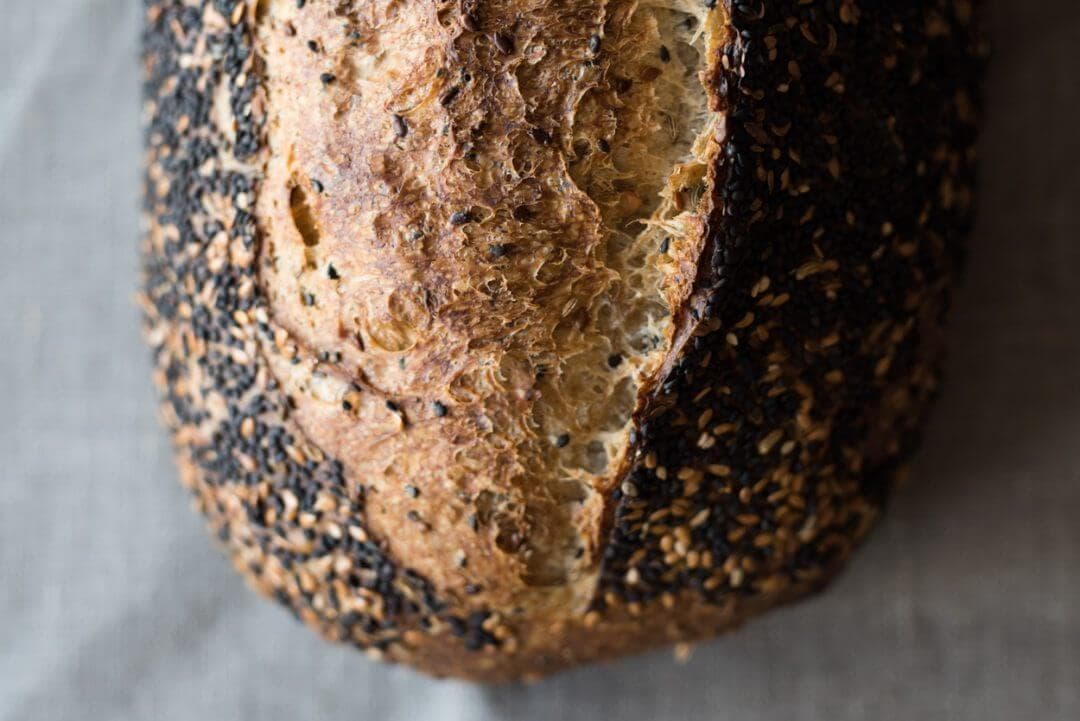
The third anniversary for The Perfect Loaf just passed, and I felt like it was only fitting for me to revisit an old idea, an old recipe of mine for a seeded sourdough I posted a long, long time ago. I make this whole wheat version intermittently, and I enjoy it, but I wanted to explore some new flavors, textures, and techniques. I mean, after baking hundreds of loaves since the beginning days of this site, my process has changed and evolved quite a bit; perhaps it was time to take a new look at this old favorite.
Of course, there are endless combinations of seeds and spices one can bake into a loaf of bread, but finding just the right balance of flavors and textures can prove to be a challenging task. Personally, I find a lot of the seeded sourdough I try to be a little heavy with seeds; conceivably, I’m just more sensitive to the deep umami flavors of sesame, the spicy nature of flax, or the anise-like flavor of fennel, but I like to keep it light. Of course, there is a time and place for hearty bread, but I like my seeded sourdough a little more like a gentle peck and less like a heavy, flapping punch.
There’s no denying the additional health benefits seeds bring to bread, and that was one of the prompting factors for me to revisit the idea, but I also wanted to play with seed flavors instead of using them as an afterthought. Some seeds really work well together to play off of each other’s flavors, working in concert to give rise to an overall sense of good taste.
The seeds chosen here are those that I personally feel go well together, but there are so many other combinations to be had—if desired, one can endlessly play the seed alchemist.
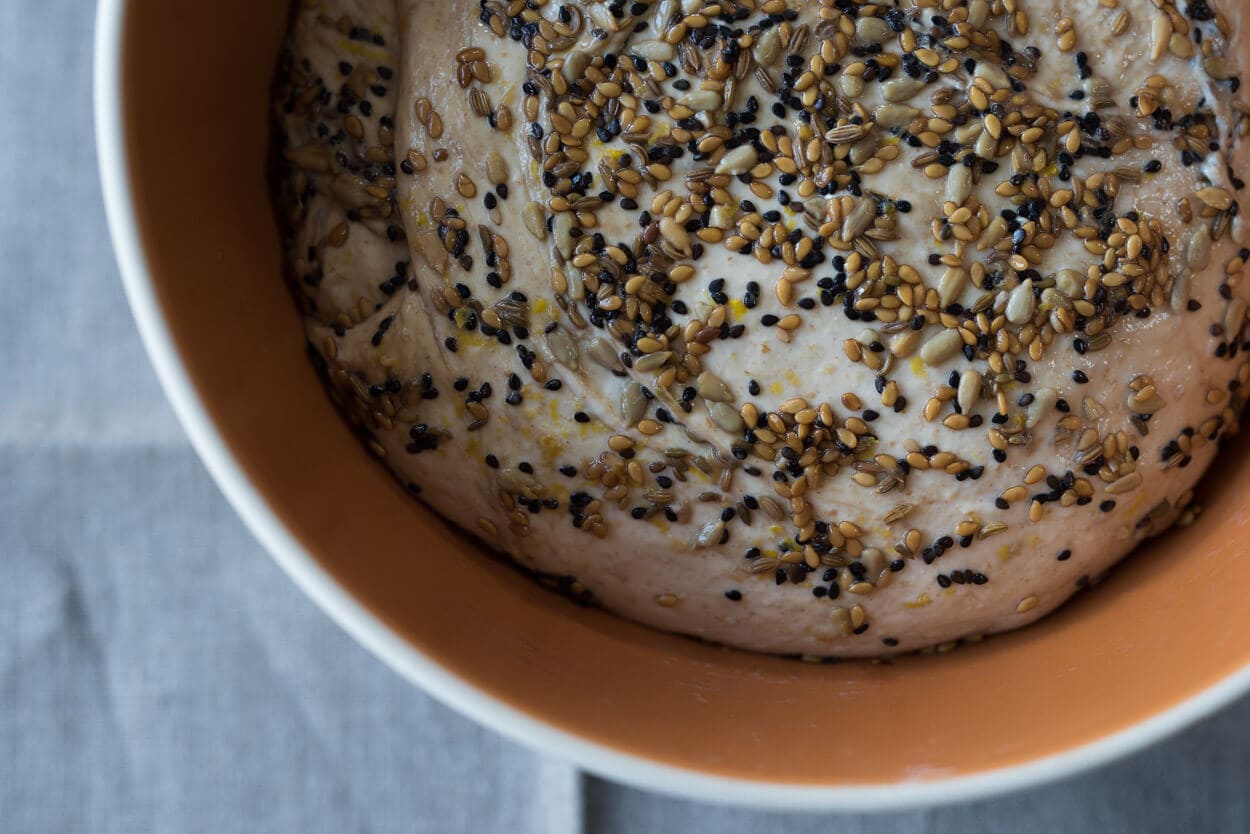
I’m not a big fan of caraway (it seems like this is a very polarizing flavor), and that’s why it’s not used here, but feel free to experiment with whatever seeds you might have in your pantry: caraway, poppy, white sesame, pumpkin, hemp and so on. Fennel is probably my favorite seed of them all; the bright, zesty flavor seems to go well with most things I make in the kitchen, and I had to include it here.
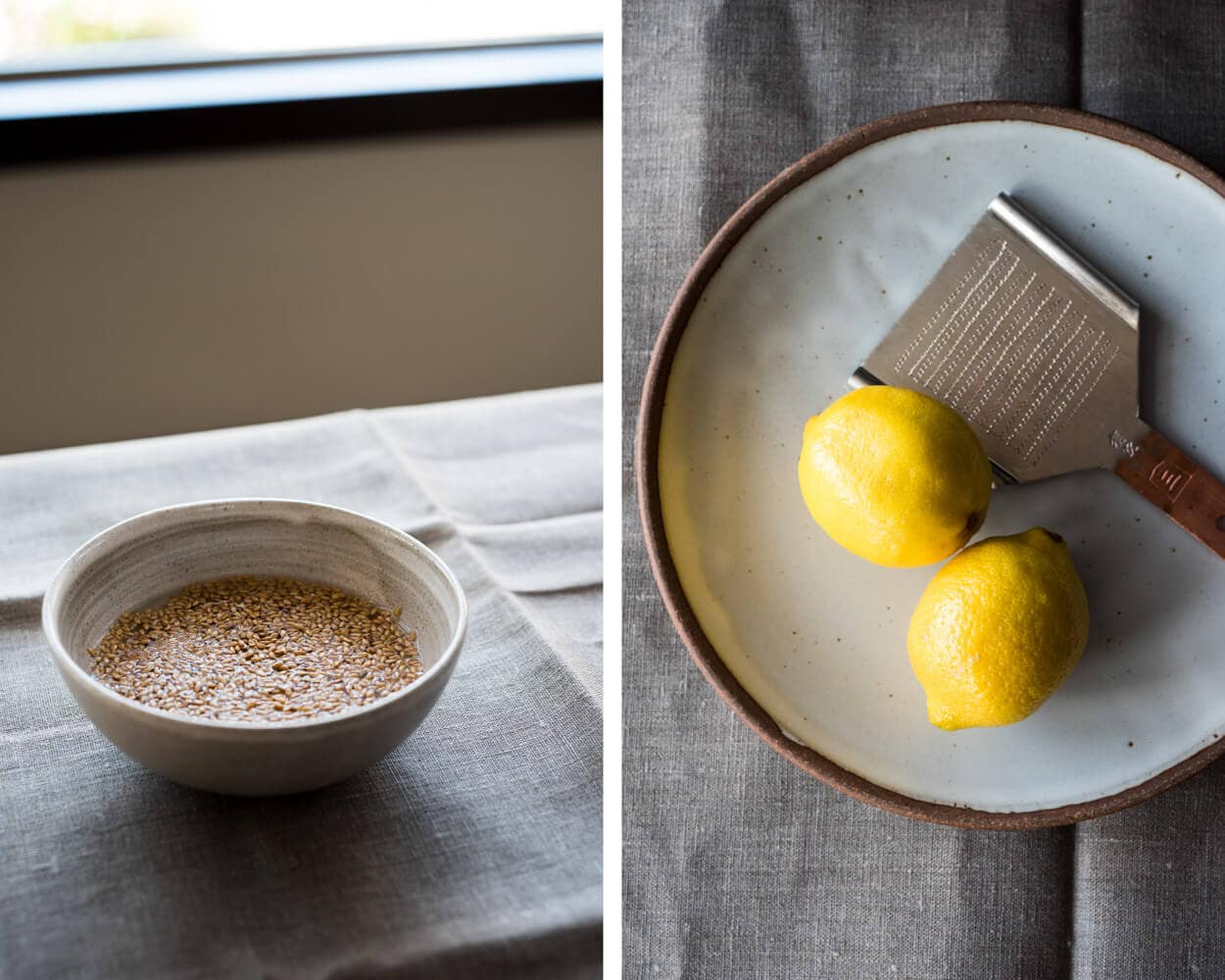
I know lemon zest is overused in baking and probably included in places where it really isn’t warranted, but it’s added here to help complement the multitude of seed flavors in this seeded sourdough bread. I found that sporadic bites would display a quick and mellow lemon flavor, which was a welcome surprise amidst the deep seed flavors’ backdrop. If you don’t have lemons on hand or feel the flavor isn’t necessary, then feel free to omit the zest; of course, it’s up to you.
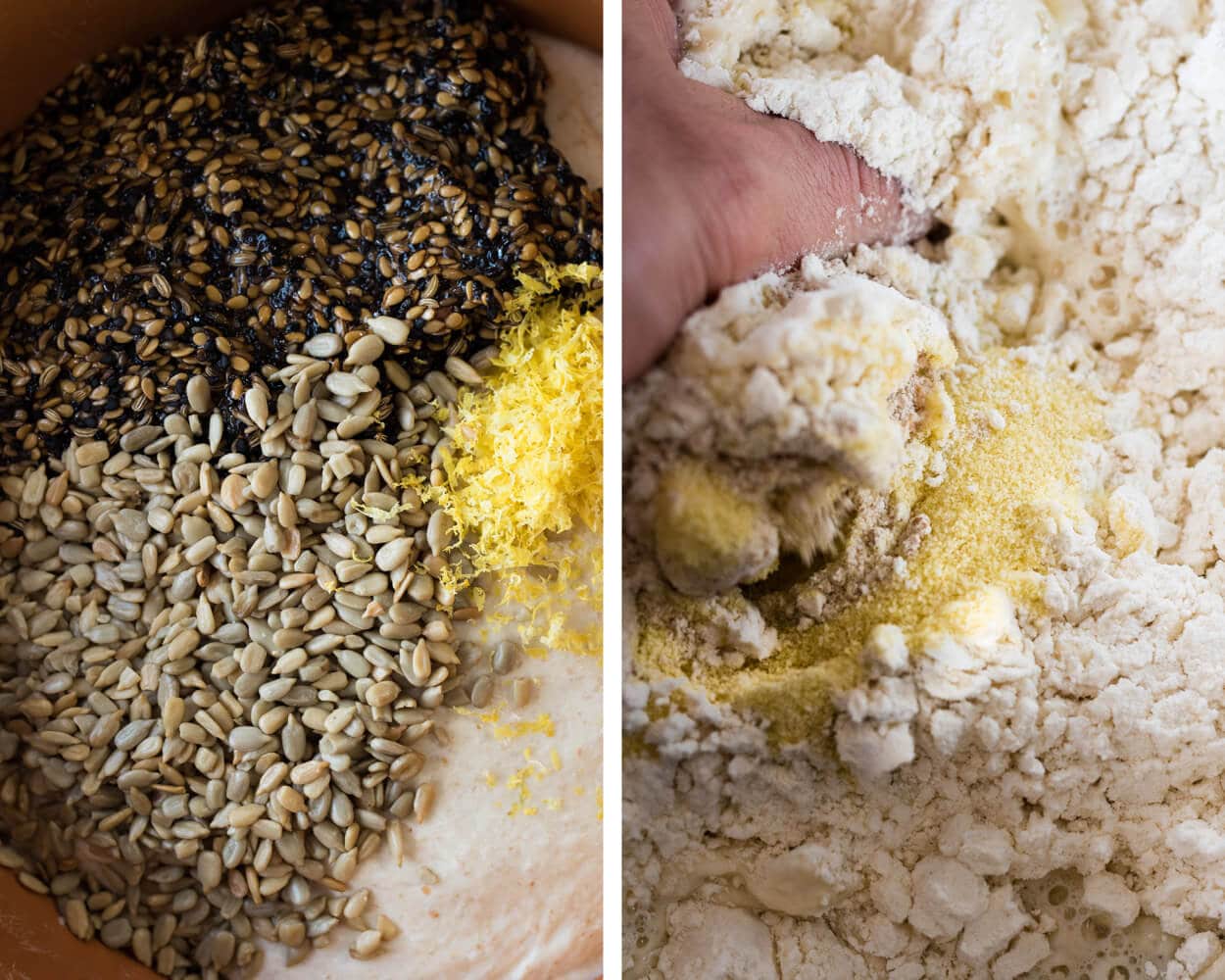
When mixing this dough with my hands, I often found myself pausing to look at the snaking sea of black sesame, the golden, gritty semolina, and the garish shine of lemon peel and thought to myself: this is going to taste really, really good.
Flour Selection
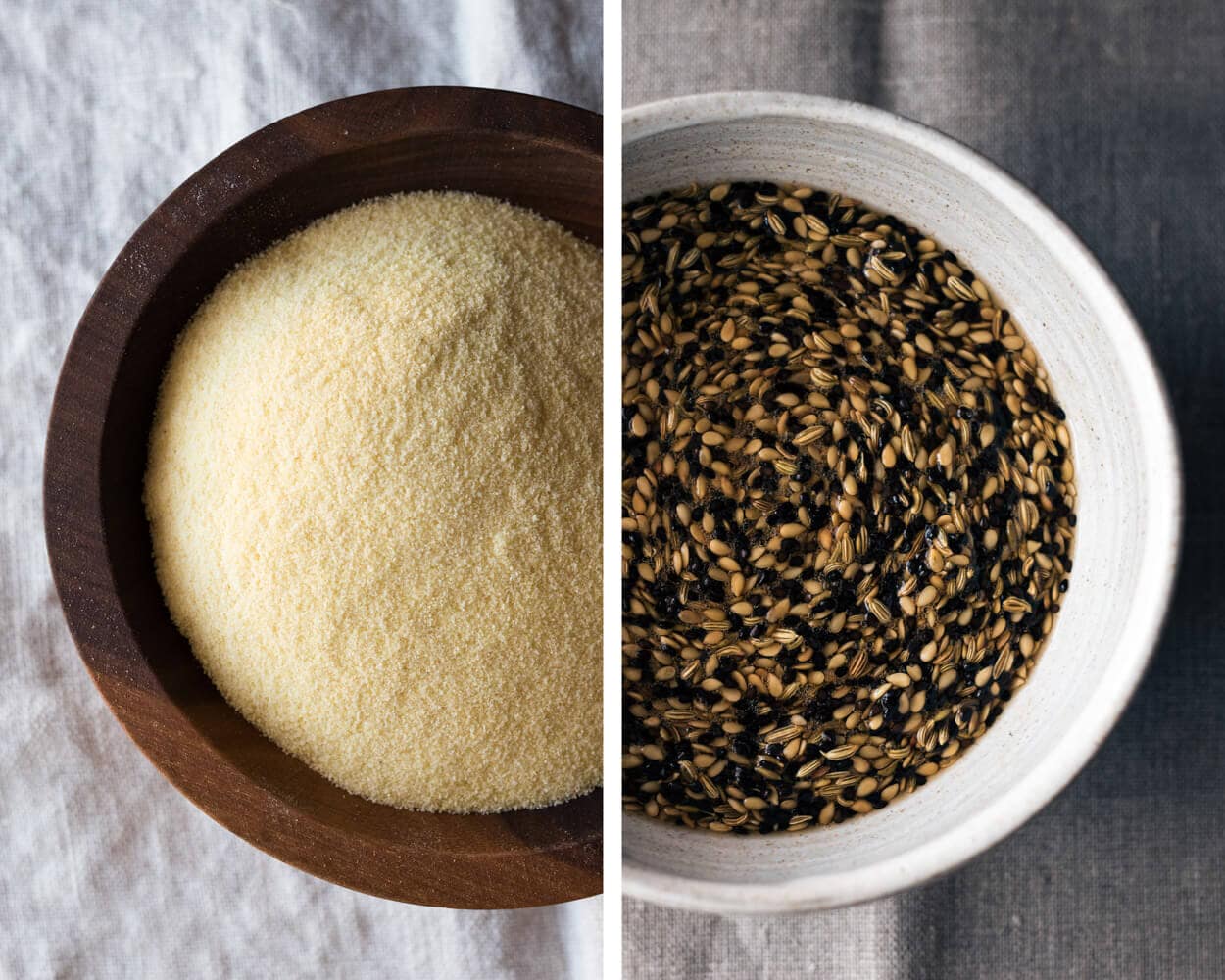
Lately, I’ve been making more and more fresh pasta at home, primarily comprised of coarse semolina flour milled from durum wheat, which has a higher-than-typical protein content. It’s a deep, luxurious yellow color and quite granular, similar to table salt. I like using this for pasta as it gives each bite a little more chew and a little density. For example, rolling thin is perfect for ravioli because you have two sheets of pasta pressed together with a filling. If the two sheets are too thick, you’ll end up tasting and chewing the pasta more than anything—you want the pasta to be thin but chewy/strong.
I added a fairly small percentage of semolina for this seeded sourdough bread, but the taste and texture are noticeable. It adds a little sweetness to help compliment all the robust seeds, and many say semolina helps attain a fragile and crunchy crust. I can say my outcome here doesn’t dispute that — the crust on my bakes have been fragile and cracker-like, how I like it; if you don’t have semolina at hand (durum works, of course), then substituting the semolina percentage in my formula for a stoneground or roller milled whole wheat. This replacement would add a level of flavor and strength to the dough and work quite well.
See my Pane Siciliano for another sourdough recipe using durum wheat →
Seeded Sourdough Formula
See my post on baker’s percentages for information on how to modify this formula.
| Total Dough Weight | 1800 grams |
| Pre-fermented Flour | 6.50% |
| Levain in Final Dough | 17.38% |
| Hydration | 83.00% |
| Yield | Two 900-gram loaves |
Total Formula
Target final dough temperature (FDT) is 78°F (25°C).
| Weight | Ingredient | Baker’s Percentage |
|---|---|---|
| 665g | Medium-protein bread flour (~11.5% protein, Giusto’s Artisan Bread Flour) | 75.00% |
| 133g | Semolina (coarsely milled Durum wheat) | 15.00% |
| 89g | Whole wheat flour (Giusto’s Stoneground Whole Wheat) | 10.00% |
| 40g | Flaxseed | 4.50% |
| 40g | Dark sesame seed | 4.50% |
| 40g | Sunflower seed, shelled (not roasted or salted) | 4.50% |
| 13g | Fennel seed | 1.50% |
| – | Zest of two lemons (optional) | – |
| 691g | Water 1 (soaker, levain, and autolyse) | 78.00% |
| 44g | Water 2 (mix) | 5.00% |
| 16g | Sea salt | 1.80% |
| 29g | Sourdough starter | 3.25% |
Seeded Sourdough Method
1. Levain – 9:00 a.m.
Mix the following ingredients in a container and leave covered to ripen at about 78°F (25°C) for 5 hours.
| Weight | Ingredient | Baker’s Percentage |
|---|---|---|
| 30g | Ripe sourdough starter (100% hydration) | 50% |
| 30g | Medium-protein bread flour (~11.5% protein, Giusto’s Artisan Bread Flour) | 50% |
| 30g | Whole wheat flour (Giusto’s Stoneground Whole Wheat) | 50% |
| 60g | Water 1 | 100% |
2. Prepare Seed Soaker – 9:10 a.m.
After you’ve mixed your levain, prepare the seed soaker. In a heatproof bowl (stainless steel is great), add the following seeds and boiled water (note the sunflower seeds are not added to the soaker).
Boil 175g of water in a kettle. Once boiling, turn off the heat and pour 133g of the hot water over the seeds in the heatproof bowl. Let this mixture soak until called for in the bulk fermentation step.
| Weight | Ingredient |
|---|---|
| 40g | Flaxseed |
| 40g | Dark sesame seed |
| 13g | Fennel seed |
| 133g | Water 1 |
3. Autolyse – 1:00 p.m.
Add the following to a mixing bowl and mix until all dry bits are hydrated. Cover bowl and store somewhere warm (around 78°F/25°C) for 1 hour.
| Weight | Ingredient |
|---|---|
| 636g | Medium-protein bread flour (~11.5% protein, Giusto’s Artisan Bread Flour) |
| 133g | Semolina (coarsely milled Durum wheat) |
| 60g | Whole wheat flour (Giusto’s Stoneground Whole Wheat) |
| 501g | Water 1 |
4. Mix – 2:00 p.m.
To the dough in autolyse, add the remaining water, salt, and levain.
| Weight | Ingredient |
|---|---|
| 44g | Water 2 |
| 16g | Sea salt |
| 144g | Levain (see Levain section, above) |
I chose to do slap and fold for about 5 minutes, just until the dough starts to show signs of a smooth surface and it’s catching some air. If you aren’t comfortable with the slap/fold method or don’t like it, you can perform stretch and folds in the bowl until your dough tightens up and slightly hard to stretch out and fold over—medium development.
Transfer dough to a tub or thick-walled bowl for bulk fermentation.
5. Bulk Fermentation – 2:10 p.m. to 5:40 p.m.
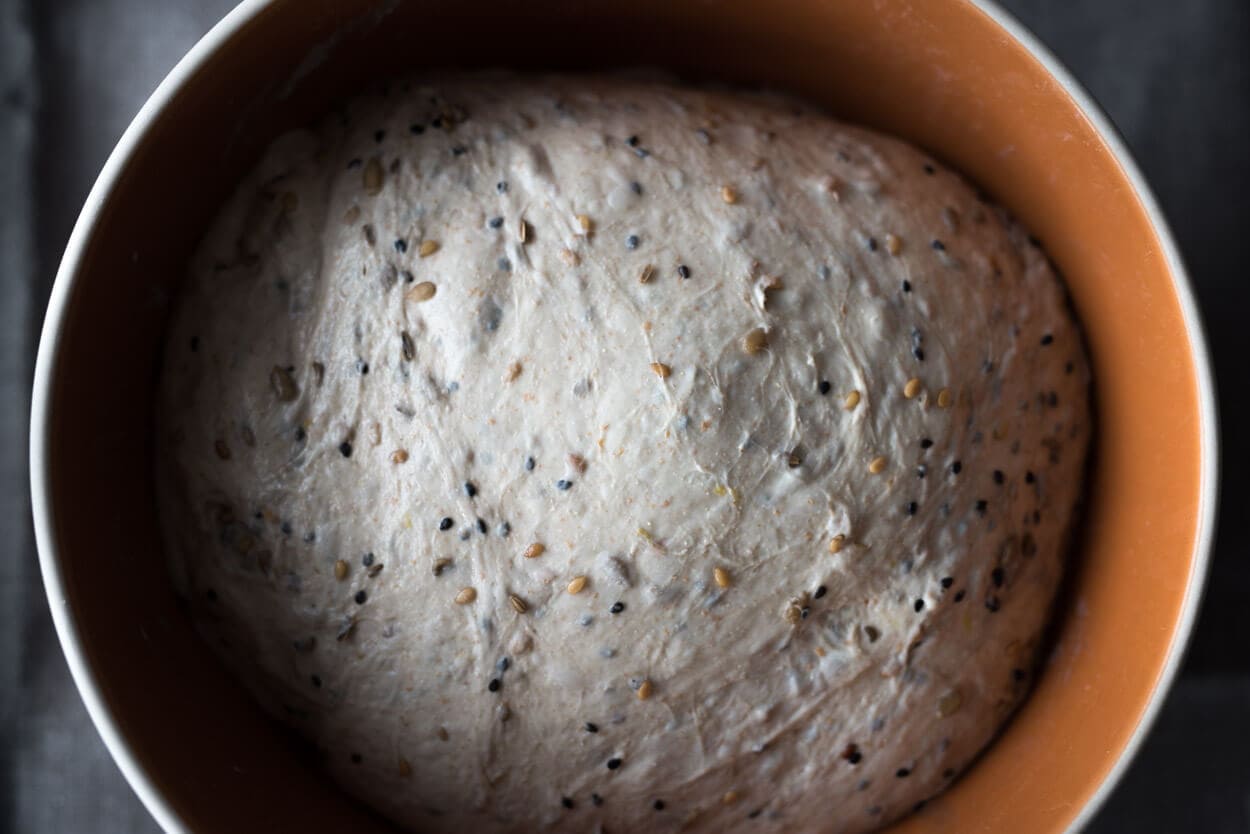
At 78°F (25°C) ambient temperature, bulk fermentation should go for around 3 1/2 hours. Keep an eye on the dough; for me, fermentation was moving rather rapidly, and the dough became extremely puffed up (see preshape photo below).
Perform a total of 4 sets of stretch and folds during the bulk, spaced out by 30 minutes.
Before the first set of stretch and folds, add the cooled seed soaker and optional lemon zest. I like to spread the mix-ins on top of the dough and then perform my stretch and folds to help the ingredients distribute. They will further distribute through the dough with each subsequent set of stretch and folds.
6. Divide and Preshape – 5:40 p.m.
Gently scrape your dough from the bulk container onto an un-floured work surface. Preshape the dough into two round boules and let rest 30 minutes uncovered.
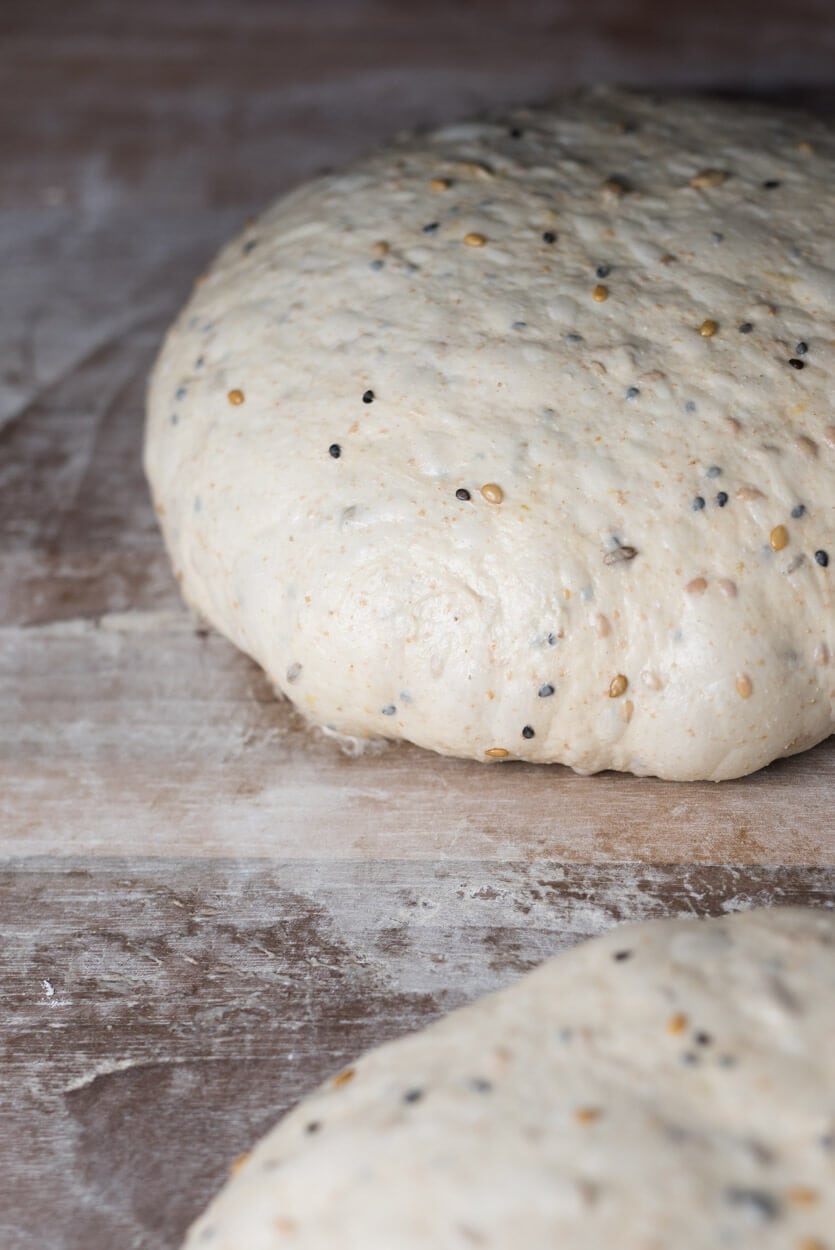
You can see the significant activity in my dough; it was seriously jiggly and quite puffed.
7. Shape – 6:10 p.m.
To coat the outside of your loaves with seeds (optional) as I’ve done, lay out a towel next to the shaping area that’s covered with a seed mixture. Take equal parts raw black sesame, flax, and fennel, and mix in a bowl. Spread this mixture out in the center of the towel evenly into a thin but cohesive layer. I didn’t include sunflower seeds in this mixture as I prefer the look of this bread with only small seeds on the exterior—personal preference. After the dough is shaped, we will quickly roll the top of each batard or boule in this mixture.
I shaped these loaves following my guide to shaping a batard.
Once you’ve shaped your dough, lightly spritz the top with a water mister, this helps the seeds stick to the exterior. Then, using your bench knife, scoop up your dough and invert it, so the seam side is facing up onto the towel with the seed mixture. Roll it around gently to coat and then transfer seam-side-up to your final proofing basket.
8. Rest & Proof – 6:20 p.m.
Cover your baskets with plastic and then retard in the refrigerator at 38°F (3°C) overnight. Even at such cool temperatures this dough can quickly overproof so keep an eye on it in the fridge in the morning. By the morning my dough was very gassy and had risen quite a bit in the fridge.
9. Bake – Next Morning: Preheat oven at 8:00 a.m., Bake at 9:00 a.m.
I steamed my oven in my usual way, described here in my post on how to steam your home oven for baking.
Preheat your oven to 450°F (230°C).
Scoring this bread can be difficult because the seeds form a hard crust on the outside. Get the blade into the dough and move quickly down to make a score. If the blade slips out of the cut, just continue where it left off and keep it going.
To make a double-score, make two straight, vertical slashes on the top of the dough, as you see below. The top one starts near the top-left of the dough and goes down halfway; the second one starts a little higher than where the first one left off and goes down straight almost to the loaf’s bottom. To visualize this, hold your two index fingers out in front of you, so the tops of your fingers are at the same height. Then shift your right hand down until your right fingernail lines up with your left finger’s middle joint—your two scores are the entire length of your index fingers.
Bake the dough for 20 minutes, then remove the steaming pans from inside the oven. Then, bake for an additional 30-35 minutes until done to your liking. Remove from the oven and cool on a wire rack for at least 1-2 hours. Be sure to store your bread properly to extend its life.
Conclusion
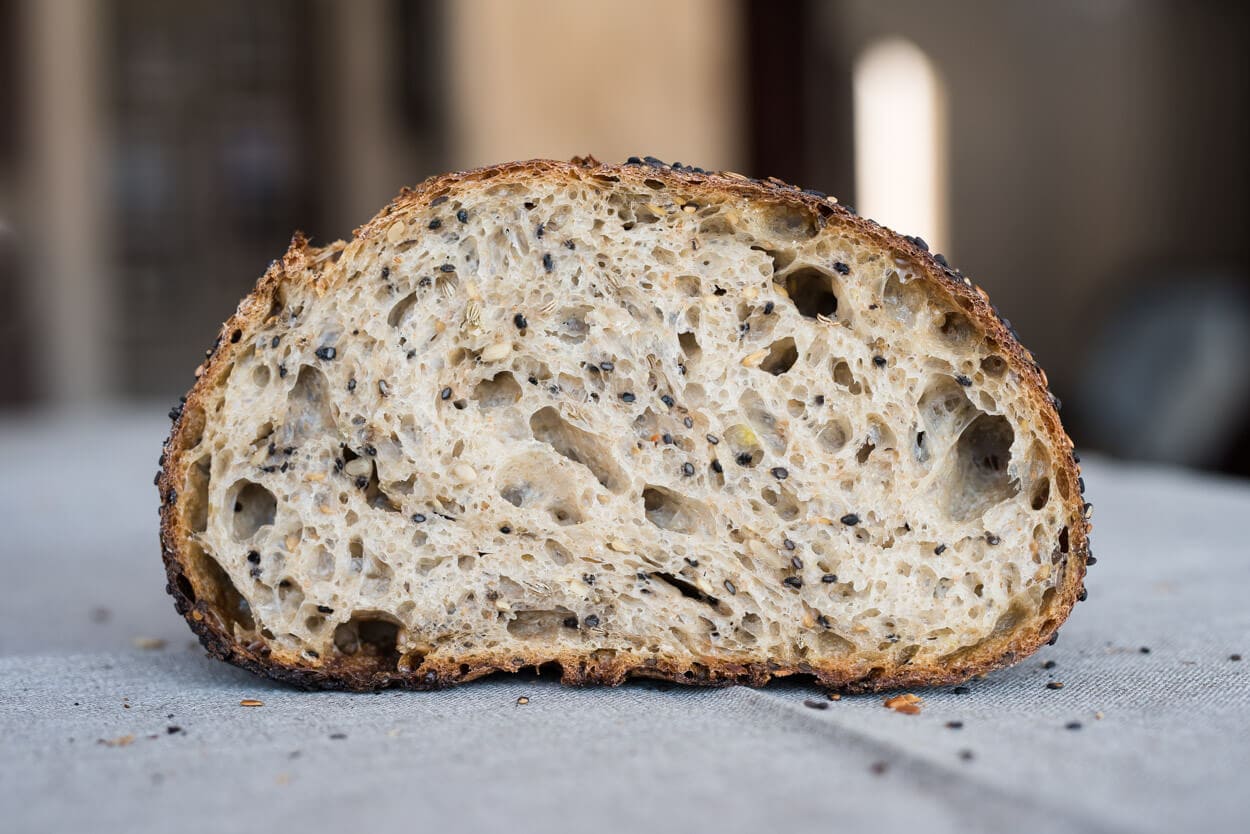
This seeded sourdough is such a great departure from weekly whole wheat or white sourdough; it brings deep flavors and interest to each slice. The interior bakes to a custard-like texture, while the crunch from the semolina-infused crust and densely woven seed mixture give a wonderful contrast. When toasted, I find the flavors actually amply further and the bread, specifically the crumb, takes on another level of brittleness that crackles constantly. It’s exemplary with good quality cultured butter and cheeses of all types (more below).
Crust
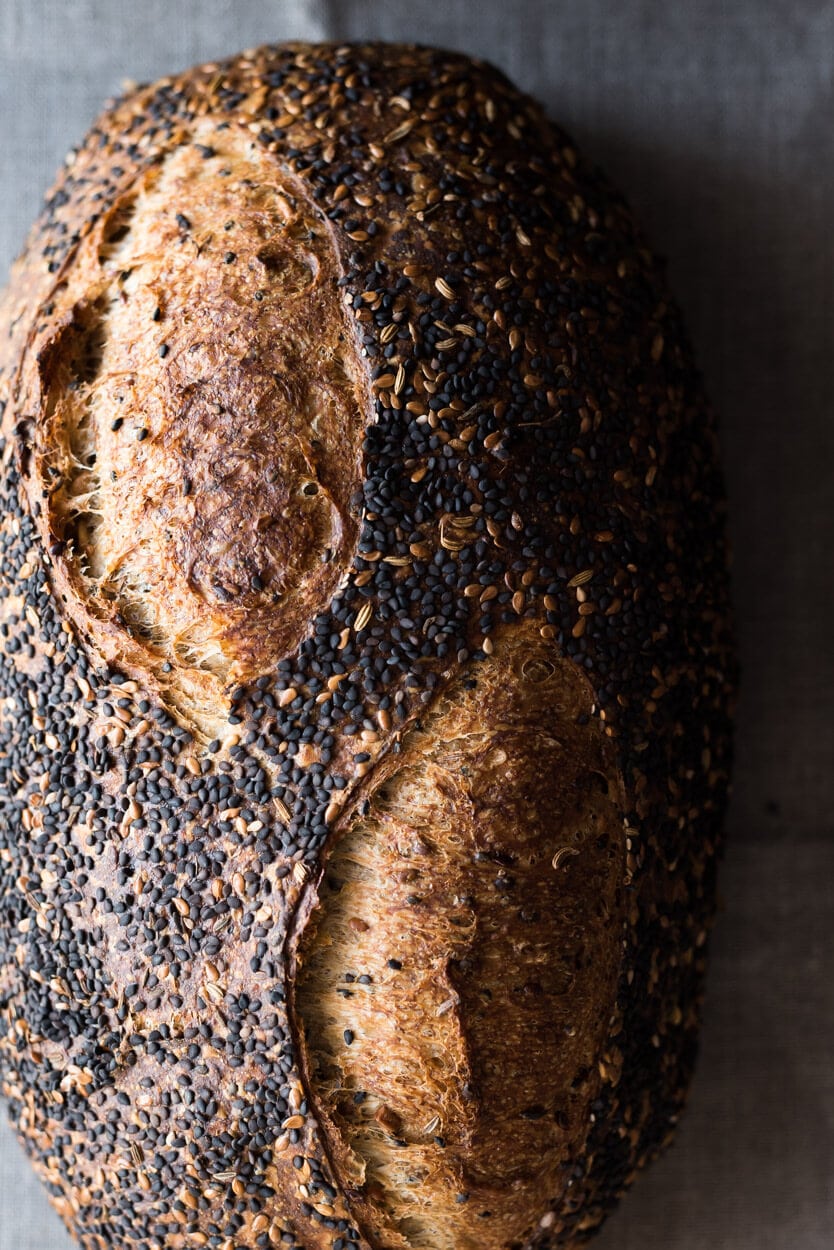
The dark, tawny crust is thin and crunchy; it feels like this seeded sourdough bread was wrapped tightly in a splintery cracker. The semolina has to play a role here, as does the high hydration and further impacted by the seed soaker. Speaking of seeds, the ominous look of the dark seeded exterior is a sight to behold. I showed these loaves to a few family members, and their initial reaction is always: “wow, that’s beautiful.” I have to say, though, the only downside to these seeds and cracker-like crust: a messy kitchen after slicing. Worth it!
The crust has to be one of my favorite parts of this seeded sourdough, but then there’s the crumb.
Crumb
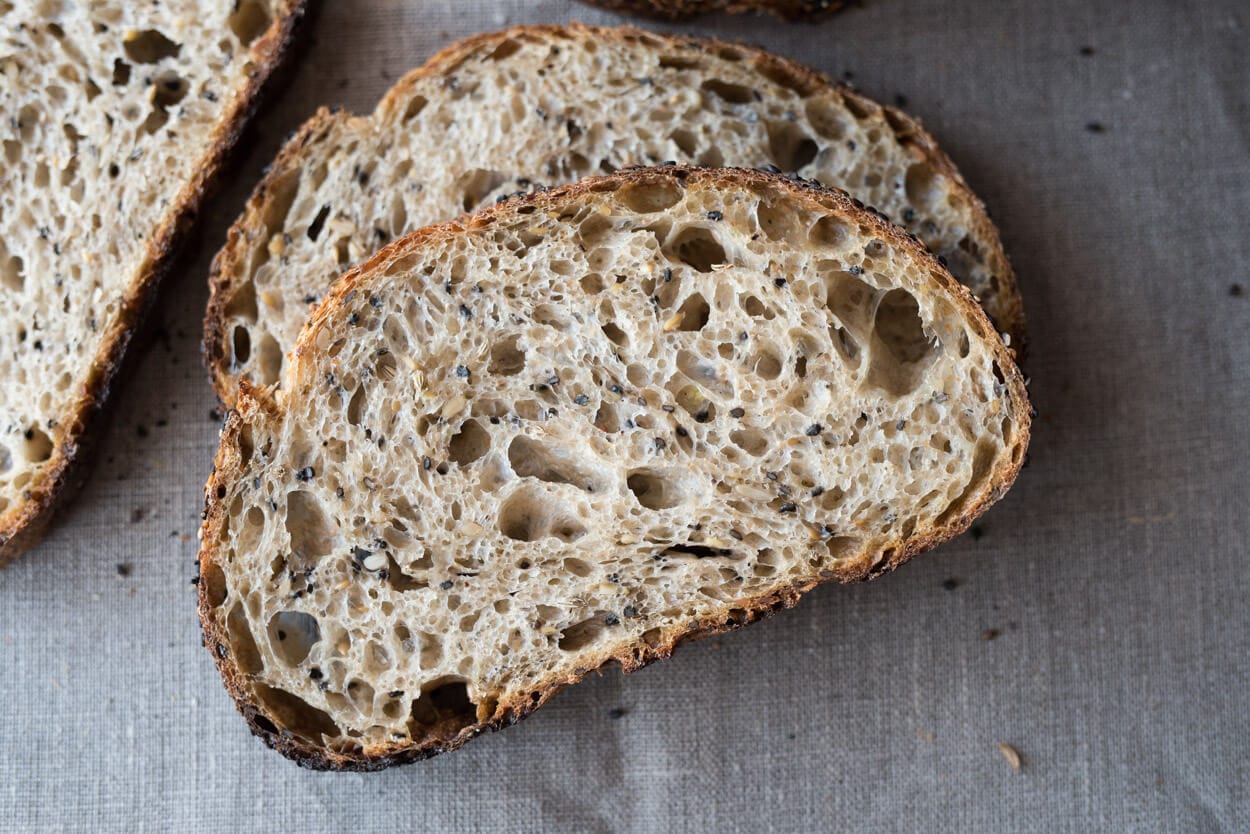
At the beginning of this post, I mentioned that finding the right texture for this type of bread can be challenging. I went heavy with the proof and pushed it as far as I felt possible. The dough was incredibly gassy and light, and this shows here in the interior. The entire loaf was very well fermented, extremely tender, and gelatinized through and through. I found that this bread’s soft, succulent interior works really well with the seeds and crust.
Taste
When you first see the outside of one of these loaves from the oven, you might think this bread is going to be way too flavor-forward, but as I said, in the beginning, I wasn’t looking for that with this formula. The loaf seems imposing, yes, even the interior, but when you taste it, you’ll see it’s more subtle than initial thoughts might indicate. Not including seeds like caraway, the loaf has just nudges of the seed flavors but nothing overpowering.
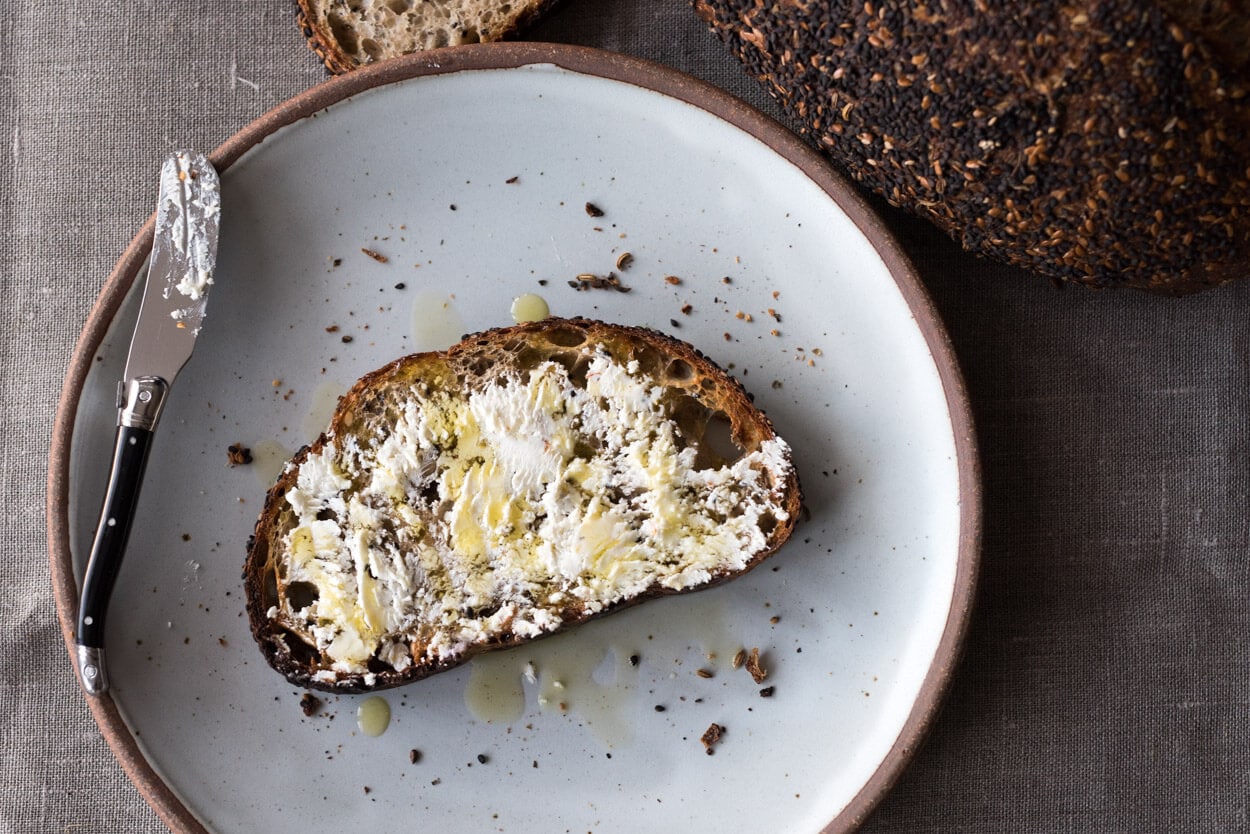
As mentioned earlier, I had a slice spread with a mixture of goat cheese, crushed pink peppercorn, lemon zest, and a drizzle of Amabile extra virgin olive oil (olive oil that’s cured in stone cisterns with a hint of mineral and fruit flavors) that was just out of this world. The seeds’ hearty flavors were balanced by the citrus flavors, mellow goat cheese, and fruity olive oil—I could live on this seeded sourdough bread.
Buon appetito!
Seeded Sourdough Recipe
- Prep Time: 24 hours
- Cook Time: 1 hour
- Total Time: 25 hours
- Yield: 2 loaves
Description
This seeded sourdough is such a great departure from weekly whole wheat or white sourdough; it brings deep flavors and interest to each slice. The interior bakes to a custard-like texture, while the crunch from the semolina-infused crust and densely woven seed mixture give a wonderful contrast. When toasted, I find the flavors actually amply further and the bread, specifically the crumb, takes on another level of brittleness that crackles constantly. It’s exemplary with good quality cultured butter and cheeses of all types.
Ingredients
Seed Soaker
- 40g flaxseed
- 40g dark sesame seed
- 13g fennel seed
- 133g water, boiled
Levain
- 30g medium-protein bread flour
- 30g whole wheat flour
- 30g ripe sourdough starter
- 60g water
Autolyse
- 636g medium-protein bread flour
- 133g semolina
- 60g whole wheat flour
- 501g water
Final Mix
- 40g sunflower seed, shelled, not roasted, unsalted
- 16g sea salt
- 144g ripe levain (from Step 1)
- 44g water
Instructions
- Levain (9:00 a.m.)
In a small container, mix the Levain ingredients and keep at 78°F (25°C) for 5 hours. - Prepare Seed Soaker (9:10 a.m.)
Add the Seed Soaker ingredients (except the sunflower seeds) to a heatproof bowl and let soak until called for in bulk fermentation. - Autolyse (1:00 p.m)
In a medium mixing bowl, add the Autolyse ingredients and mix until no dry bits remain. Cover the bowl and let rest for 1 hour. - Mix (2:00 p.m.)
To the mixing bowl holding your dough, add the Final Mix ingredients and mix to incorporate. Then, strengthen the dough for another 5 minutes until smooth and elastic. Transfer your dough to a bulk fermentation container and cover. - Bulk Fermentation (2:10 p.m. to 5:40 p.m.)
Give the dough 4 sets of stretch and folds at 30-minute intervals, where the first set starts 30 minutes after the start of bulk fermentation. Before the first set of stretch and folds, spread the seed soaker, sunflower seeds, and lemon zest (optional) over the dough. Each set of folds will help incorporate the mixture into the dough. - Divide and Preshape (5:40 p.m.)
Lightly flour your work surface and scrape out your dough. Using your bench knife, divide the dough in half. Lightly shape each half into a round shape. Let the dough rest for 30 minutes, uncovered. - Shape (6:10 p.m.)
Shape the dough into a round (boule) or oval (batard), top with a mixture of sesame, flax, and fennel, and place in proofing baskets. - Rest and Proof (6:20 p.m. to 9:00 a.m. the next day)
Cover proofing baskets with reusable plastic and seal them shut. Then, place both baskets into the refrigerator and proof overnight. - Bake (Preheat oven at 8:00 a.m., bake at 9:00 a.m.)
Preheat your oven with a combo cooker or Dutch oven inside to 450°F (230°C). When the oven is preheated, remove your dough from the fridge, score it, and transfer it to the preheated combo cooker. Place the cooker in the oven, cover with the lid, and bake for 20 minutes. After this time, remove the lid (you can keep it in the oven or remove it) and continue to bake for 30 minutes longer. When done, the internal temperature should be around 208°F (97°C). Let the loaves cool for 2 hours on a wire rack before slicing.
If you use this recipe, tag @maurizio on Instagram so I can take a look!
What’s Next?
If you loved this seeded sourdough, check out its distant cousin: a sunflower and sesame sourdough bread with an added touch of honey for a little sweetness. It’s a delicious loaf—I’d be hard-pressed to decide between baking either of these!
Or, if you’re looking to use more durum wheat, my Pane Siciliano recipe calls for 100% durum and is topped with white sesame seeds.


206 Comments
Love this recipe. I add pepitas and sunflower seeds as well.
your pics for this bread show light sesame seeds in the mix but the recipe does not call for light sesame seeds.
Hi there, I only have light sesame seeds for this recipe – I am going to put them inside the dough but do you think they would burn on the outside? Thank you for the all the recipes by the way – It's been a long road but finally good bread consistently now
This seeded bread is fantastic. I’ve never been a fan of seeded bread but I am now!
This bread is SO GOOD. All the stars. I didn’t get much of an ear but my crumb was nearly perfect…strange as I have never had a bread look so worrying on the outside and then to be surprised the bake was as perfect as I could do.
Amazing, glad to hear that Mollie. You won't see an ear with this bread, so you did everything right. Instead, I like to just score down into the dough with 3 slashes, much like a baguette .
Finally, I have baked excellent sourdough. The aroma and flavors of the Seeded Sourdough are intriguing & the bread made an excellent sandwich with a quality Italian Prosciutto Cotto & Mortadella with Pistachio, provolone & roasted cherry tomatoes in EVOO.
So happy!
Thanks!!!!
Yummm, that sounds delish Diane.
Hi Mario,
I did add a about 2 T. of molasses to your recipe, substituting it for the water. It turned out great–good crumb and crust– with just a bit of sweetness
I really like this idea, Mary!
HI Mario,
Thank you for the reply. However, you don’t need to replay to every comment I make. I just wanted to share. I’m grateful to you for improving my sour dough baking.
Hello Maurizio,
Always love your recipes. Wondered, is it possible to put a couple of tablespoons of molasses to sweeten it? And if so what kind of adjustments to water would I have to make?
I can't believe it !
After trying many times & ending up with frisbies !
I followed your basic sourdough recipe carefully & now delighted with what I have achieved .
What I did was halve every one of your ingredients for a smaller loaf , even for the Levain & held back the water.
Your repeated warnings about water were invaluable because for the first time ever I did not have a sticky BLOB to deal with & the loaf rose beautifully.
Fantastic. So happy to hear this, Katie! Have fun and happy baking 🙂
The timing for the bulk ferment seems off. Let sit 30 minutes followed by 4 sets of stretch and folds 30 min apart is 2.5 hours. You listed 3.5 hours. I. Wondering about that extra hour? Thank you.
The dough rests the remainder of the bulk fermentation.
Maurizio, lovely construction and exciting tasting bread. One clarification might help, however: in step 2 of the method section you say soaker does not include sunflower seeds. Yet, in the recipe ingredients list you include sunflower seeds under the soaker. Recipe steps have it right but this might confuse someone not placing careful attention.
Thanks for sharing such a great bread.
Bob
Fixing this, thank you Bob!
Hi, what’s the difference between soaking the seeds, like this recipe, and just toasting and adding them during bulk? (like your whole wheat recipe)
thank you
Usually with seeds, it's best to soak them to soften them so they dont end up as hard bits in the final bread!
Hi Maurizio,
I am posting this question here because this is the closest recipe you have to the Tartine semolina seeded version of this bread. I really love the flavors and have made it a few times. I just baked a loaf today and I am not happy with the shape. It held the round shape well when I did the final shaping, seed topping and set it in the boule for its final rise. However, when I baked it, it spread a little flat and didn’t spring very well. I haven’t cut it yet, but I imagine it will not have as many open holes in the crumb, and may be a little dense. I know the Tartine recipe is a little different from yours, but I was hoping you have a few pointers to help me troubleshoot.
Also, I wanted to compliment you on your book, and Aubrie’s photography in particular. My dad was a food photographer by trade and I worked for him in the studio as a teenager, so I appreciate the artistry and what it takes to produce images of that quality.
P.S. I am going to try your recipe next time…
Best,
Carmine
Hey Carmine! Sorry for the incredibly late reply. If your dough is spreading significantly in the oven, it might be under-strengthened and needed another set or two of stretches and folds in bulk fermentation and a tighter shape.
So glad you're enjoying my cookbook, thank you! Aubrie's photos are exactly as you say: just fantastic. It was a pleasure working with her creativity!
Do you not let the dough warm up and rise after it comes out of the fridge? Mine hasn’t grown much overnight.
Nope, you don't have to unless the dough is very tight and needs more room temp proof time!
Hello, I am in the middle of making this bread. I didn’t have flax seeds so I used all sesame. The seed soak was pretty wet and when I added it to the autolyse it was all quite wet. I normally don’t see your recipes this wet, I drained out a bit of the liquid and put the mix into a new bowl, then I will start the folds. I think I can pull it all together but the liquid from the soak wasn’t being absorbed into the mix. Is that normal? thank you
Hi there! I spent today making this recipe, as I’ve been baking a LOT of sourdough, but haven’t tried seeded sourdough yet! I’m at the end of the bulk rise and have to toss it – it’s dense and hasn’t risen. I had a feeling this would happen because it ripped easily during the stretch and folds- something was off. When I added the levain to the autolyse ingredients – the autolyse dough was like rubber. Very difficult to incorporate. The dough would turn into smooth rubber robes and didn’t want to allow the levain to incorporate. I worked in it for awhile and thought it finally mixed in- but maybe this was the problem. Any advice for me? Thank you so much for your time! I read a lot of the comments and so it must have been something I did wrong!
“Ropes” – not robes haha!
Hey, Hillary! It sounds like your dough needed more water. It’s a delicate balance with this recipe because there’s a lot of water in the seed soaker, so I took some from the main dough. Add a little more water to the autolyse!
Hi Maurizio, first let me say that The Perfect Loaf has been the gold standard in all of my sourdough endeavors over the past few years! I religiously bake your potato and rosemary sourdough multiple times per week and it always comes out amazing. Hoping you can help me troubleshoot this recipe for me…every time I have attempted this loaf, it comes out with a very dense crumb (wonderful flavor though.) I followed all ingredients to the letter of the law (except omitting the fennel and compensating proportionally with sesame and flax) and read every word of your instructions countless times. I have also ensured that my starter is extremely active and that the dough temp stayed squarely at 78F. The dough feels right after the slap and fold, but it is not active and bubbly during bulk (as it always is with potato rosemary and others)…I would truly appreciate your guidance!
Thanks, Adrienne! So great to hear my site has helped 🙂 First I should say this bread will typically have a more dense crumb due to the flour used and all off the seeds added, so expect that. What you could try, is use a bit of higher protein flour for the “medium-protein white flour” I call for—this should help get you more structure inside.
Also, if you have it, try using finely milled durum instead of the coarse semolina.
Both of these should help!
Hi there…. would it be ok to leave in the fridge slowly fermenting for say 24 or 48 hours before baking?
24 hours would be okay, but 48 is really pushing it!
Hello,
Is there a way to make this recipe into a bread sandwich . I just love the taste and the bread but my grandkids would love softer crust live a sandwich.
Thanks
You can put the dough into a bread tin and bake it there! You can see my guide to shaping them, here: https://www.theperfectloaf.com/guides/shaping-a-pan-loaf/
FINALLY got to make this and it turned out perfectly. The crumb matches your pics and not much ear though had a good oven spring. I baked on as a batard and one in a loaf pan and I like the loaf pan best. I did but the oven down 20 degrees for the loaf pan and used steam in the oven. Thanks for another great recipe.
So glad you liked this one, Joe!
I made this bread two days ago, and it was an instant hit. My new favorite loaf!
Since I have baked so many of your loaves, I owe you – for culinary enjoyment and hours of entertainment. I became a member now.
Thanks so much, I really appreciate the support! Happy baking 🙂
Hi Maurizio,
Im curious why don’t you soak the sunflower seeds along with the other seeds?
For sunflower, it’s not strictly necessary. I did it in this recipe just for convenience! You can leave them out of the soaker, no problem.
Hi Maurizio, I think I’ve mentioned this before, but this is my go-to favorite recipe of yours. I add some finely grated carrot (120 g) to the seeds to mimic a bread from my local grocery store, Wegmans (their bread is called Marathon bread, and I call mine Triathlon bread). It’s amazing!
Anyway, my question is this: often I will want to bake it on a specific day, but I don’t have the previous day available to make the bread. Is it possible to make the bread (auto-lyze, levain, mix through to bulk ferment and shape) and then freeze it in the baskets? If so, do I then do a shorter retard? Or can I thaw it in the evening, retard overnight and bake the next morning?
thanks for a great website!
Cheers, Paula
So glad you like this recipe, Paula! Carrot!? I’ve never tried that but I like that idea. I wouldn’t recommend freezing the dough. But you could change this to a same-day bake by skipping the cold proof (retard), and instead, let the dough proof at warm temperature for 1-3 hours until ready to bake. This way, you can do these loaves all in a single day.
Hello Maurizio,
I have been enjoying your site to teach me how to make sourdough bread. I have a question on this seeded sourdough overnight proof time. Your comments say proof 10 hours, but the timing from 6:20 pm into the refrigerator until baking at 9am the next day is much long than 10 hours. Which is correct?
Thank you,
Gretchen
Sorry about that, Gretchen! The key is to retard the dough overnight and just bake it sometime in the morning, when convenient. It’s ok if it’s 10, 12, or even 15 hours. Happy baking!