

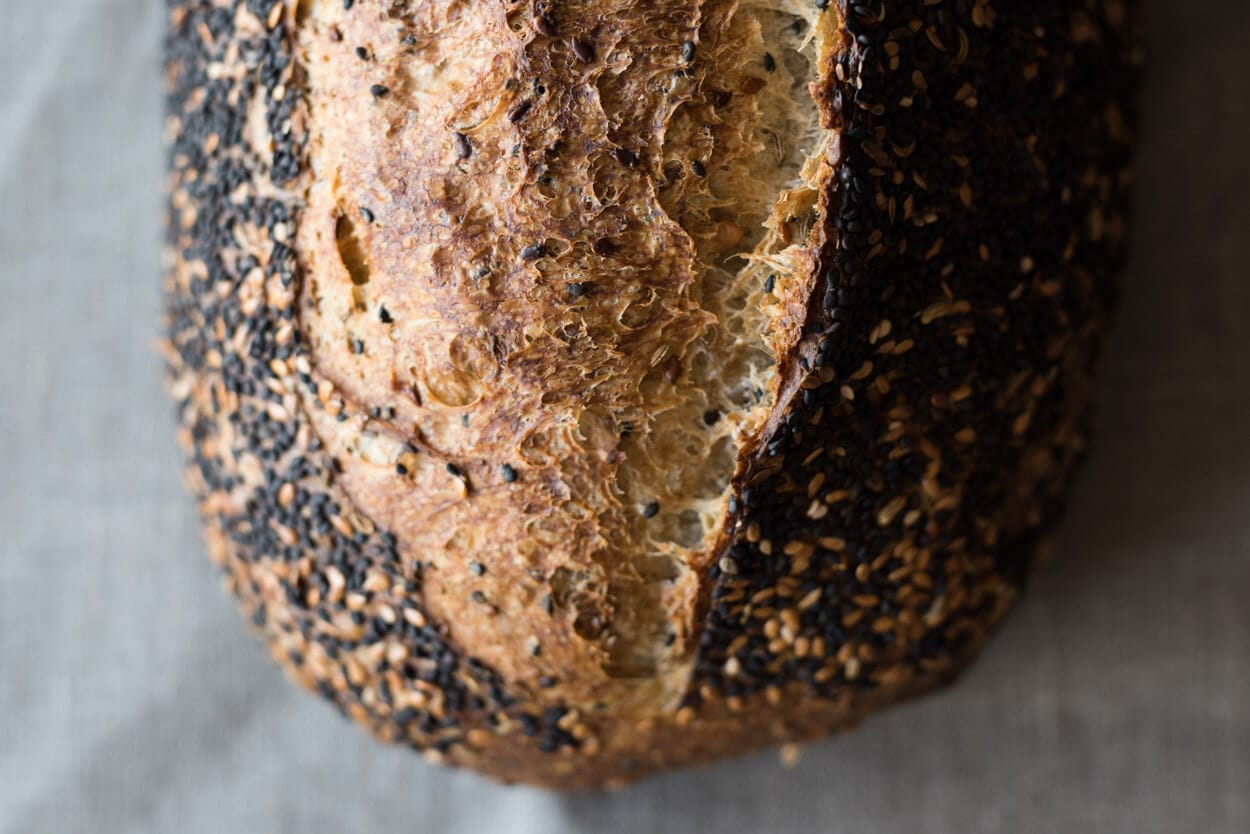
The third anniversary for The Perfect Loaf just passed, and I felt like it was only fitting for me to revisit an old idea, an old recipe of mine for a seeded sourdough I posted a long, long time ago. I make this whole wheat version intermittently, and I enjoy it, but I wanted to explore some new flavors, textures, and techniques. I mean, after baking hundreds of loaves since the beginning days of this site, my process has changed and evolved quite a bit; perhaps it was time to take a new look at this old favorite.
Of course, there are endless combinations of seeds and spices one can bake into a loaf of bread, but finding just the right balance of flavors and textures can prove to be a challenging task. Personally, I find a lot of the seeded sourdough I try to be a little heavy with seeds; conceivably, I’m just more sensitive to the deep umami flavors of sesame, the spicy nature of flax, or the anise-like flavor of fennel, but I like to keep it light. Of course, there is a time and place for hearty bread, but I like my seeded sourdough a little more like a gentle peck and less like a heavy, flapping punch.
There’s no denying the additional health benefits seeds bring to bread, and that was one of the prompting factors for me to revisit the idea, but I also wanted to play with seed flavors instead of using them as an afterthought. Some seeds really work well together to play off of each other’s flavors, working in concert to give rise to an overall sense of good taste.
The seeds chosen here are those that I personally feel go well together, but there are so many other combinations to be had—if desired, one can endlessly play the seed alchemist.
I’m not a big fan of caraway (it seems like this is a very polarizing flavor), and that’s why it’s not used here, but feel free to experiment with whatever seeds you might have in your pantry: caraway, poppy, white sesame, pumpkin, hemp and so on. Fennel is probably my favorite seed of them all; the bright, zesty flavor seems to go well with most things I make in the kitchen, and I had to include it here.
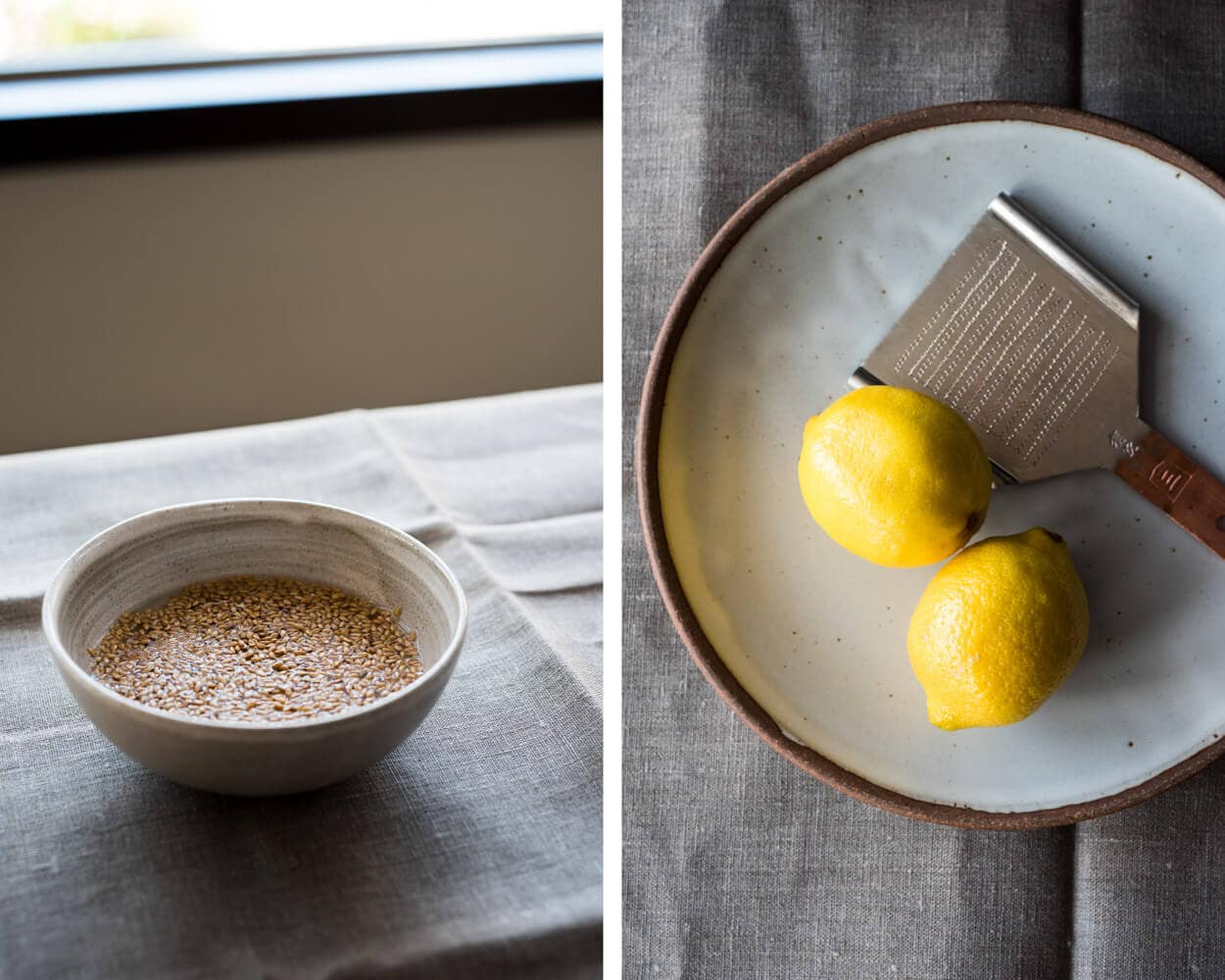
I know lemon zest is overused in baking and probably included in places where it really isn’t warranted, but it’s added here to help complement the multitude of seed flavors in this seeded sourdough bread. I found that sporadic bites would display a quick and mellow lemon flavor, which was a welcome surprise amidst the deep seed flavors’ backdrop. If you don’t have lemons on hand or feel the flavor isn’t necessary, then feel free to omit the zest; of course, it’s up to you.
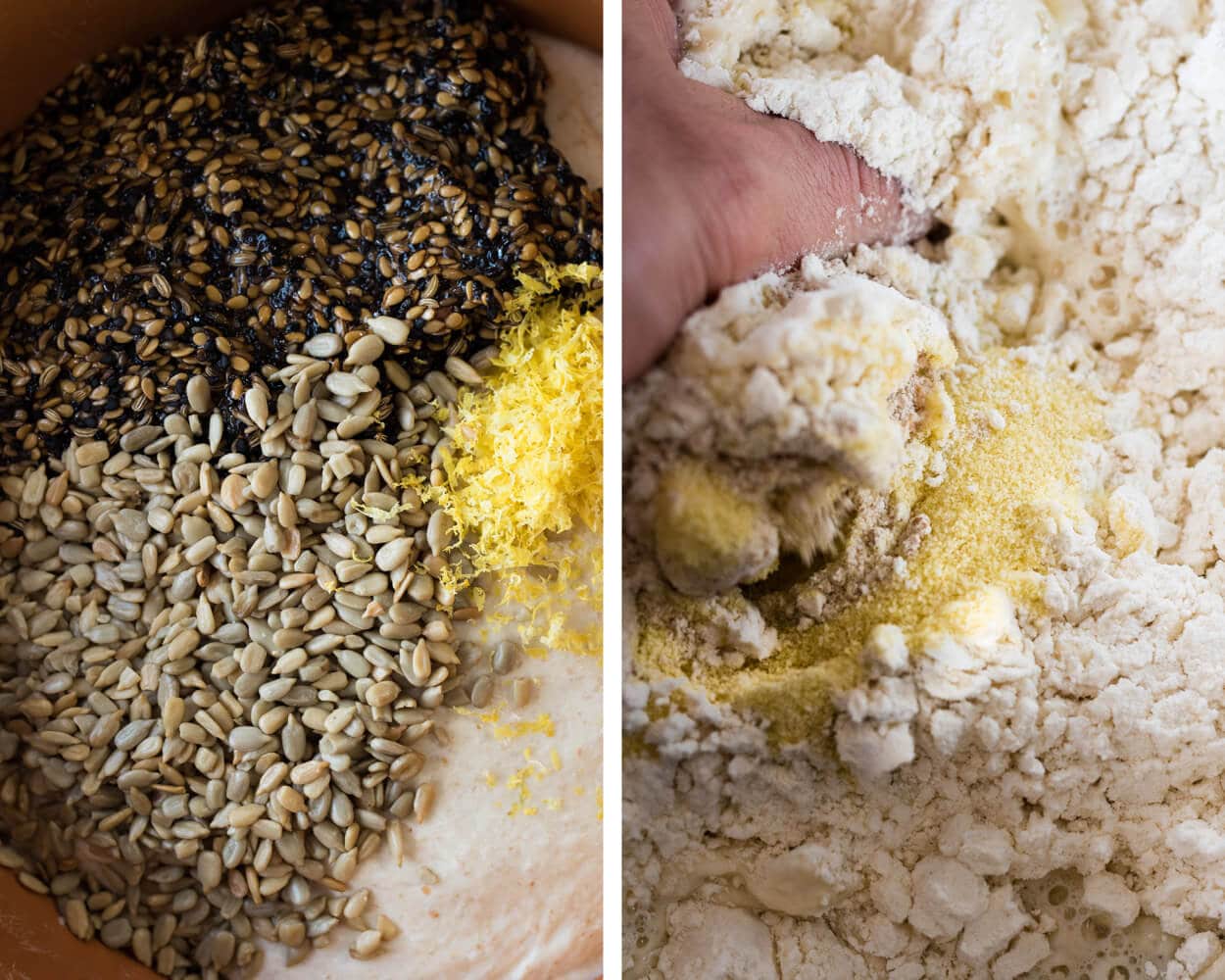
When mixing this dough with my hands, I often found myself pausing to look at the snaking sea of black sesame, the golden, gritty semolina, and the garish shine of lemon peel and thought to myself: this is going to taste really, really good.
Flour Selection
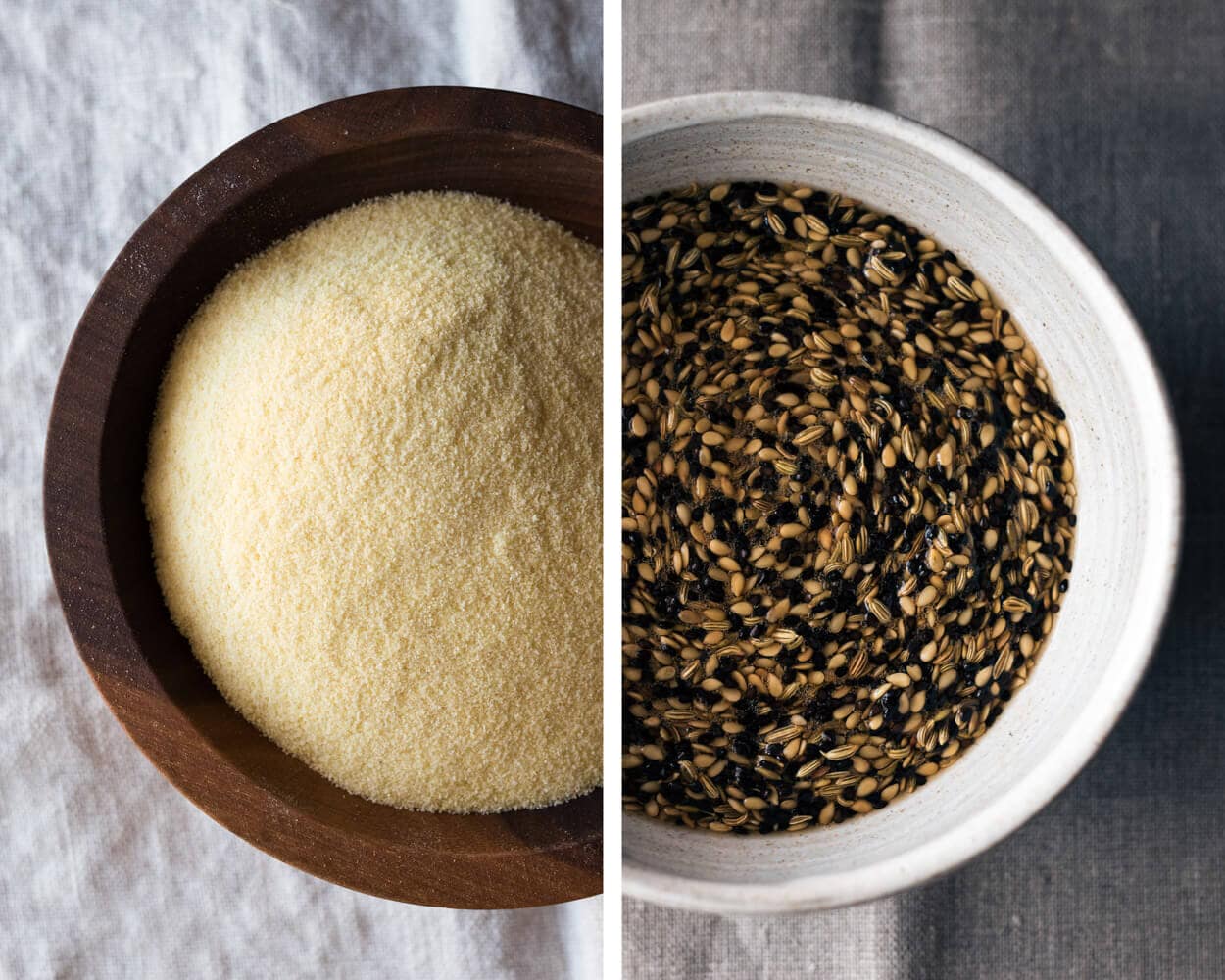
Lately, I’ve been making more and more fresh pasta at home, primarily comprised of coarse semolina flour milled from durum wheat, which has a higher-than-typical protein content. It’s a deep, luxurious yellow color and quite granular, similar to table salt. I like using this for pasta as it gives each bite a little more chew and a little density. For example, rolling thin is perfect for ravioli because you have two sheets of pasta pressed together with a filling. If the two sheets are too thick, you’ll end up tasting and chewing the pasta more than anything—you want the pasta to be thin but chewy/strong.
I added a fairly small percentage of semolina for this seeded sourdough bread, but the taste and texture are noticeable. It adds a little sweetness to help compliment all the robust seeds, and many say semolina helps attain a fragile and crunchy crust. I can say my outcome here doesn’t dispute that — the crust on my bakes have been fragile and cracker-like, how I like it; if you don’t have semolina at hand (durum works, of course), then substituting the semolina percentage in my formula for a stoneground or roller milled whole wheat. This replacement would add a level of flavor and strength to the dough and work quite well.
See my Pane Siciliano for another sourdough recipe using durum wheat →
Seeded Sourdough Formula
See my post on baker’s percentages for information on how to modify this formula.
| Total Dough Weight | 1800 grams |
| Pre-fermented Flour | 6.50% |
| Levain in Final Dough | 17.38% |
| Hydration | 83.00% |
| Yield | Two 900-gram loaves |
Total Formula
Target final dough temperature (FDT) is 78°F (25°C).
| Weight | Ingredient | Baker’s Percentage |
|---|---|---|
| 665g | Medium-protein bread flour (~11.5% protein, Giusto’s Artisan Bread Flour) | 75.00% |
| 133g | Semolina (coarsely milled Durum wheat) | 15.00% |
| 89g | Whole wheat flour (Giusto’s Stoneground Whole Wheat) | 10.00% |
| 40g | Flaxseed | 4.50% |
| 40g | Dark sesame seed | 4.50% |
| 40g | Sunflower seed, shelled (not roasted or salted) | 4.50% |
| 13g | Fennel seed | 1.50% |
| – | Zest of two lemons (optional) | – |
| 691g | Water 1 (soaker, levain, and autolyse) | 78.00% |
| 44g | Water 2 (mix) | 5.00% |
| 16g | Sea salt | 1.80% |
| 29g | Sourdough starter | 3.25% |
Seeded Sourdough Method
1. Levain – 9:00 a.m.
Mix the following ingredients in a container and leave covered to ripen at about 78°F (25°C) for 5 hours.
| Weight | Ingredient | Baker’s Percentage |
|---|---|---|
| 30g | Ripe sourdough starter (100% hydration) | 50% |
| 30g | Medium-protein bread flour (~11.5% protein, Giusto’s Artisan Bread Flour) | 50% |
| 30g | Whole wheat flour (Giusto’s Stoneground Whole Wheat) | 50% |
| 60g | Water 1 | 100% |
2. Prepare Seed Soaker – 9:10 a.m.
After you’ve mixed your levain, prepare the seed soaker. In a heatproof bowl (stainless steel is great), add the following seeds and boiled water (note the sunflower seeds are not added to the soaker).
Boil 175g of water in a kettle. Once boiling, turn off the heat and pour 133g of the hot water over the seeds in the heatproof bowl. Let this mixture soak until called for in the bulk fermentation step.
| Weight | Ingredient |
|---|---|
| 40g | Flaxseed |
| 40g | Dark sesame seed |
| 13g | Fennel seed |
| 133g | Water 1 |
3. Autolyse – 1:00 p.m.
Add the following to a mixing bowl and mix until all dry bits are hydrated. Cover bowl and store somewhere warm (around 78°F/25°C) for 1 hour.
| Weight | Ingredient |
|---|---|
| 636g | Medium-protein bread flour (~11.5% protein, Giusto’s Artisan Bread Flour) |
| 133g | Semolina (coarsely milled Durum wheat) |
| 60g | Whole wheat flour (Giusto’s Stoneground Whole Wheat) |
| 501g | Water 1 |
4. Mix – 2:00 p.m.
To the dough in autolyse, add the remaining water, salt, and levain.
| Weight | Ingredient |
|---|---|
| 44g | Water 2 |
| 16g | Sea salt |
| 144g | Levain (see Levain section, above) |
I chose to do slap and fold for about 5 minutes, just until the dough starts to show signs of a smooth surface and it’s catching some air. If you aren’t comfortable with the slap/fold method or don’t like it, you can perform stretch and folds in the bowl until your dough tightens up and slightly hard to stretch out and fold over—medium development.
Transfer dough to a tub or thick-walled bowl for bulk fermentation.
5. Bulk Fermentation – 2:10 p.m. to 5:40 p.m.
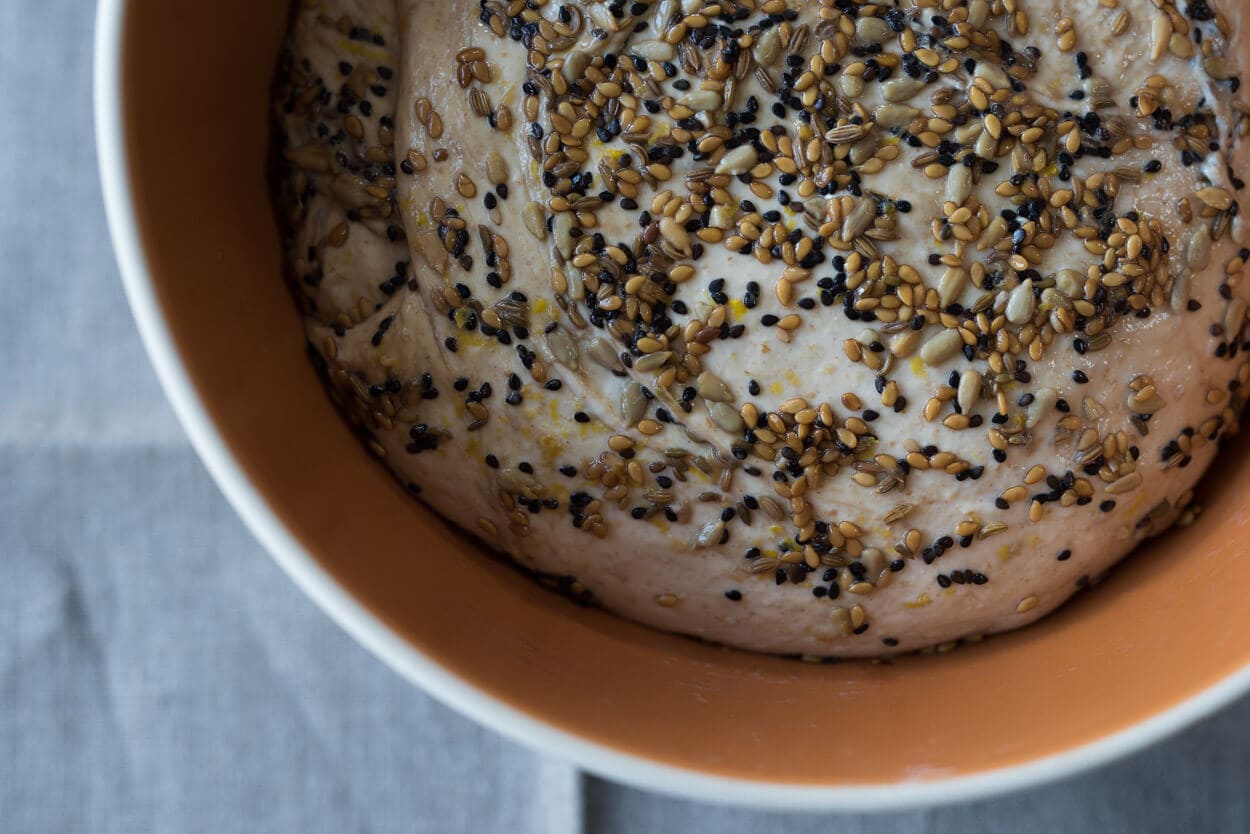
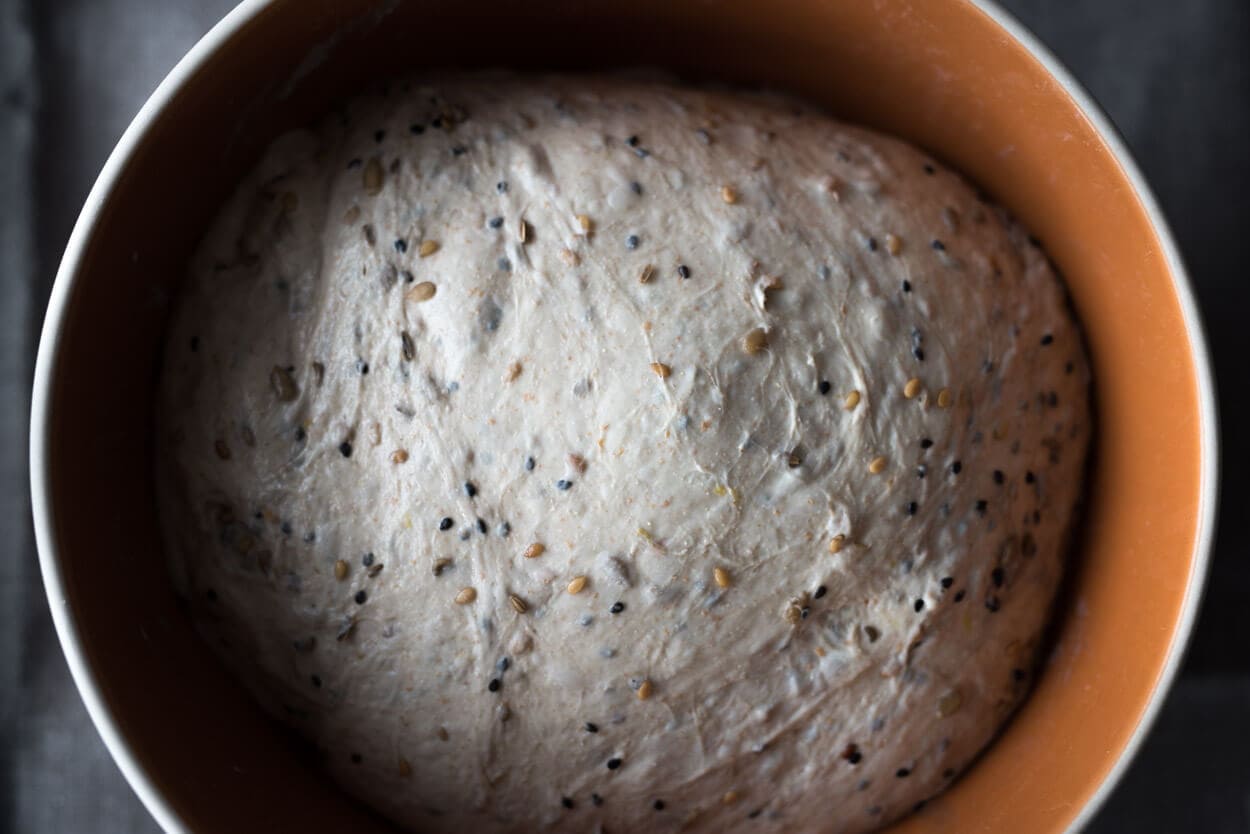
At 78°F (25°C) ambient temperature, bulk fermentation should go for around 3 1/2 hours. Keep an eye on the dough; for me, fermentation was moving rather rapidly, and the dough became extremely puffed up (see preshape photo below).
Perform a total of 4 sets of stretch and folds during the bulk, spaced out by 30 minutes.
Before the first set of stretch and folds, add the cooled seed soaker and optional lemon zest. I like to spread the mix-ins on top of the dough and then perform my stretch and folds to help the ingredients distribute. They will further distribute through the dough with each subsequent set of stretch and folds.
6. Divide and Preshape – 5:40 p.m.
Gently scrape your dough from the bulk container onto an un-floured work surface. Preshape the dough into two round boules and let rest 30 minutes uncovered.
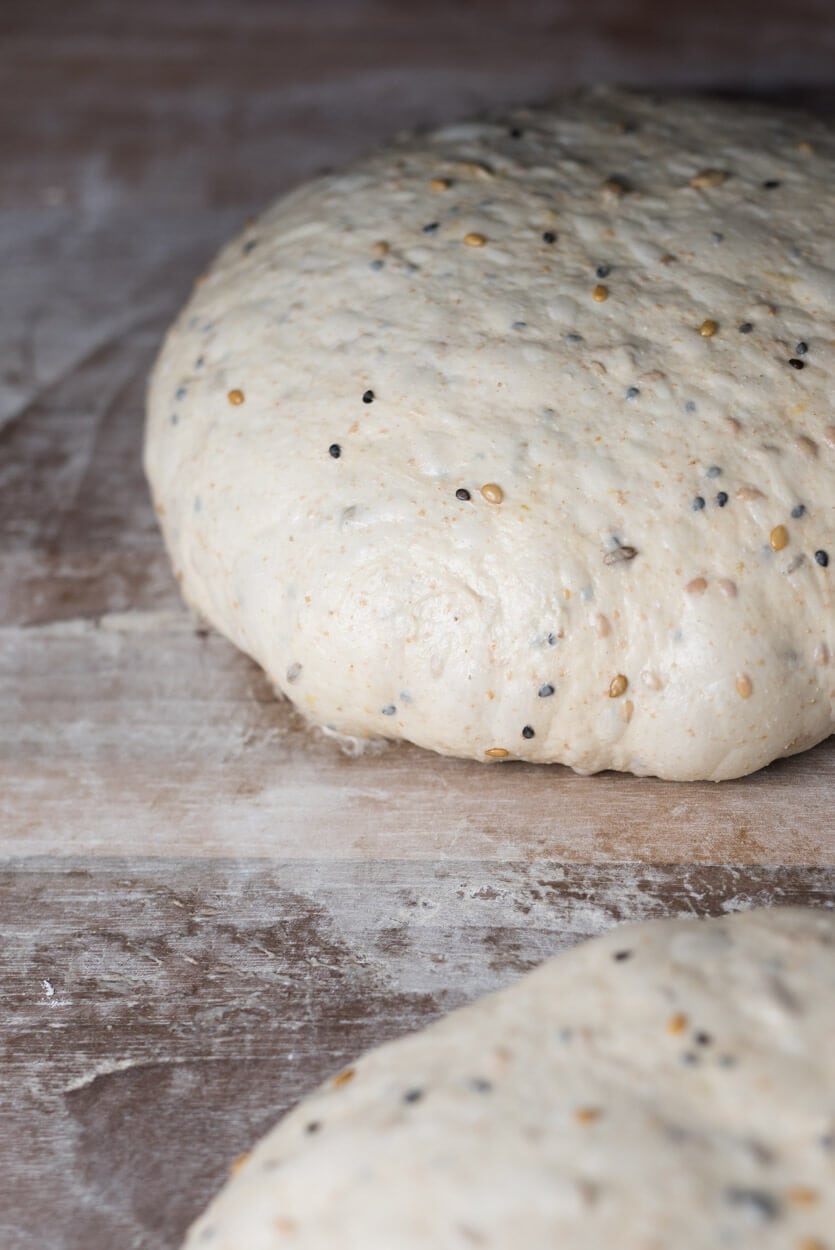
You can see the significant activity in my dough; it was seriously jiggly and quite puffed.
7. Shape – 6:10 p.m.
To coat the outside of your loaves with seeds (optional) as I’ve done, lay out a towel next to the shaping area that’s covered with a seed mixture. Take equal parts raw black sesame, flax, and fennel, and mix in a bowl. Spread this mixture out in the center of the towel evenly into a thin but cohesive layer. I didn’t include sunflower seeds in this mixture as I prefer the look of this bread with only small seeds on the exterior—personal preference. After the dough is shaped, we will quickly roll the top of each batard or boule in this mixture.
I shaped these loaves following my guide to shaping a batard.
Once you’ve shaped your dough, lightly spritz the top with a water mister, this helps the seeds stick to the exterior. Then, using your bench knife, scoop up your dough and invert it, so the seam side is facing up onto the towel with the seed mixture. Roll it around gently to coat and then transfer seam-side-up to your final proofing basket.
8. Rest & Proof – 6:20 p.m.
Cover your baskets with plastic and then retard in the refrigerator at 38°F (3°C) overnight. Even at such cool temperatures this dough can quickly overproof so keep an eye on it in the fridge in the morning. By the morning my dough was very gassy and had risen quite a bit in the fridge.
9. Bake – Next Morning: Preheat oven at 8:00 a.m., Bake at 9:00 a.m.
I steamed my oven in my usual way, described here in my post on how to steam your home oven for baking.
Preheat your oven to 450°F (230°C).
Scoring this bread can be difficult because the seeds form a hard crust on the outside. Get the blade into the dough and move quickly down to make a score. If the blade slips out of the cut, just continue where it left off and keep it going.
To make a double-score, make two straight, vertical slashes on the top of the dough, as you see below. The top one starts near the top-left of the dough and goes down halfway; the second one starts a little higher than where the first one left off and goes down straight almost to the loaf’s bottom. To visualize this, hold your two index fingers out in front of you, so the tops of your fingers are at the same height. Then shift your right hand down until your right fingernail lines up with your left finger’s middle joint—your two scores are the entire length of your index fingers.
Bake the dough for 20 minutes, then remove the steaming pans from inside the oven. Then, bake for an additional 30-35 minutes until done to your liking. Remove from the oven and cool on a wire rack for at least 1-2 hours. Be sure to store your bread properly to extend its life.
Conclusion
This seeded sourdough is such a great departure from weekly whole wheat or white sourdough; it brings deep flavors and interest to each slice. The interior bakes to a custard-like texture, while the crunch from the semolina-infused crust and densely woven seed mixture give a wonderful contrast. When toasted, I find the flavors actually amply further and the bread, specifically the crumb, takes on another level of brittleness that crackles constantly. It’s exemplary with good quality cultured butter and cheeses of all types (more below).
Crust
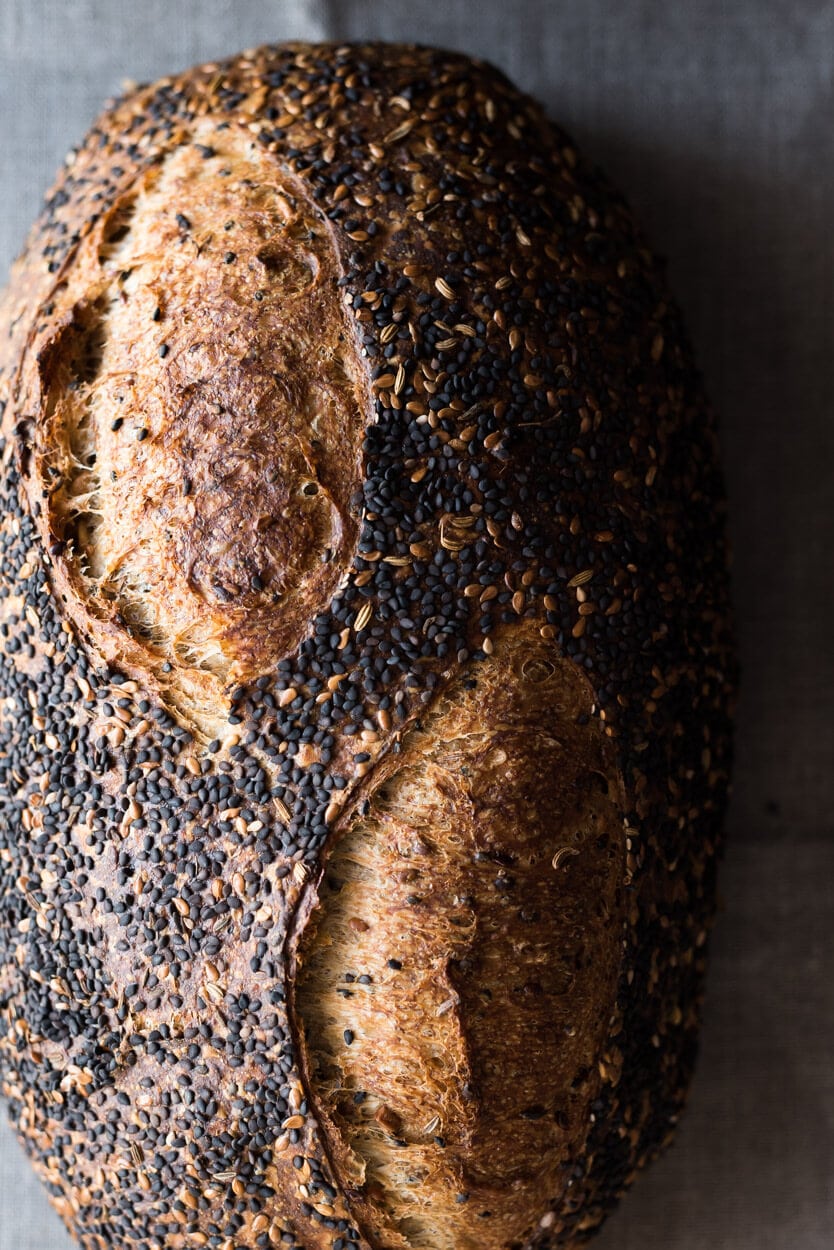
The dark, tawny crust is thin and crunchy; it feels like this seeded sourdough bread was wrapped tightly in a splintery cracker. The semolina has to play a role here, as does the high hydration and further impacted by the seed soaker. Speaking of seeds, the ominous look of the dark seeded exterior is a sight to behold. I showed these loaves to a few family members, and their initial reaction is always: “wow, that’s beautiful.” I have to say, though, the only downside to these seeds and cracker-like crust: a messy kitchen after slicing. Worth it!
The crust has to be one of my favorite parts of this seeded sourdough, but then there’s the crumb.
Crumb
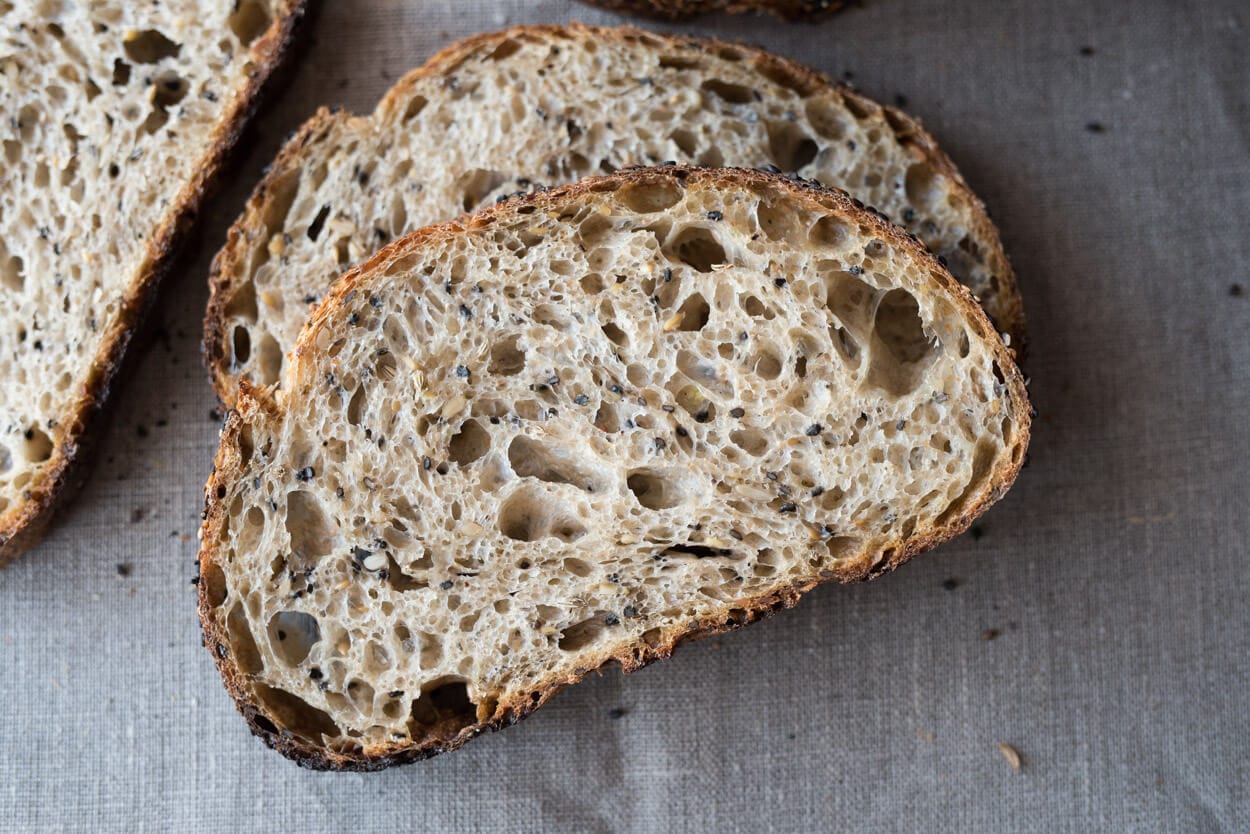
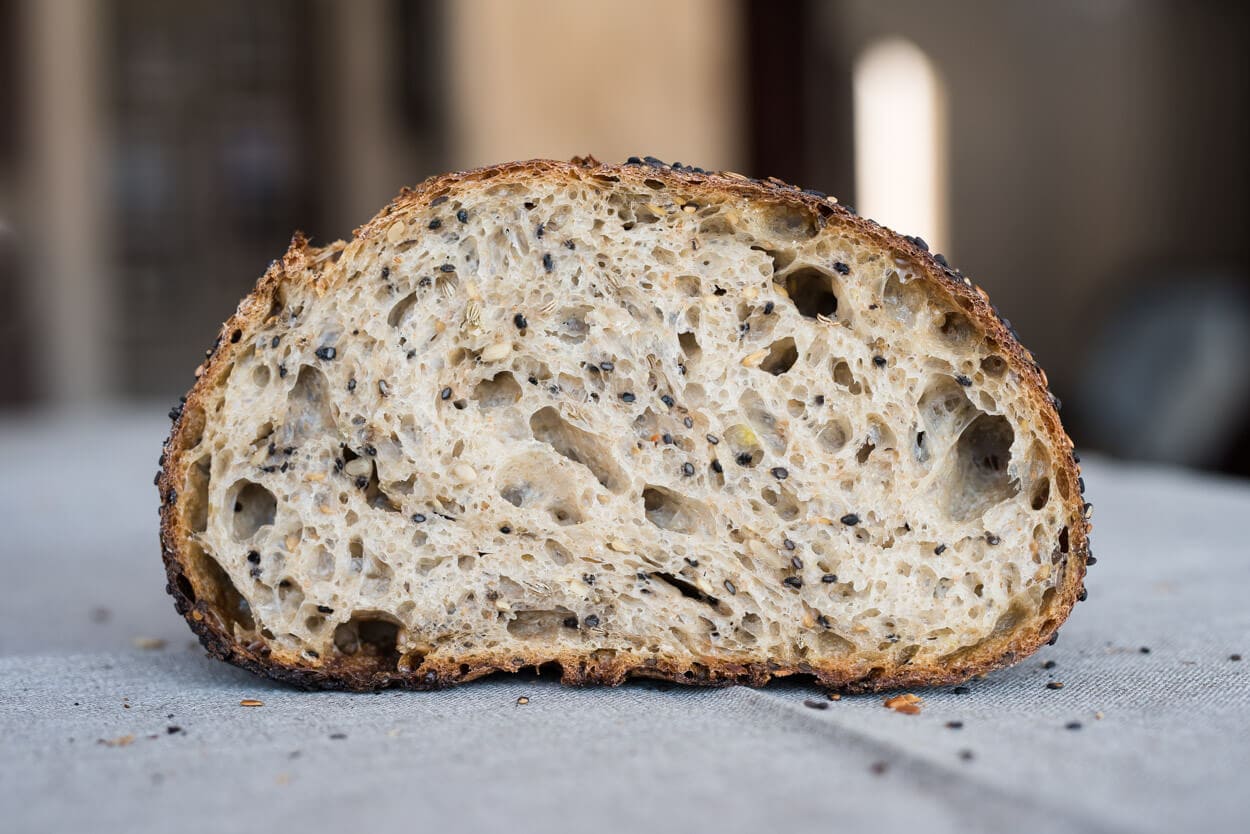
At the beginning of this post, I mentioned that finding the right texture for this type of bread can be challenging. I went heavy with the proof and pushed it as far as I felt possible. The dough was incredibly gassy and light, and this shows here in the interior. The entire loaf was very well fermented, extremely tender, and gelatinized through and through. I found that this bread’s soft, succulent interior works really well with the seeds and crust.
Taste
When you first see the outside of one of these loaves from the oven, you might think this bread is going to be way too flavor-forward, but as I said, in the beginning, I wasn’t looking for that with this formula. The loaf seems imposing, yes, even the interior, but when you taste it, you’ll see it’s more subtle than initial thoughts might indicate. Not including seeds like caraway, the loaf has just nudges of the seed flavors but nothing overpowering.
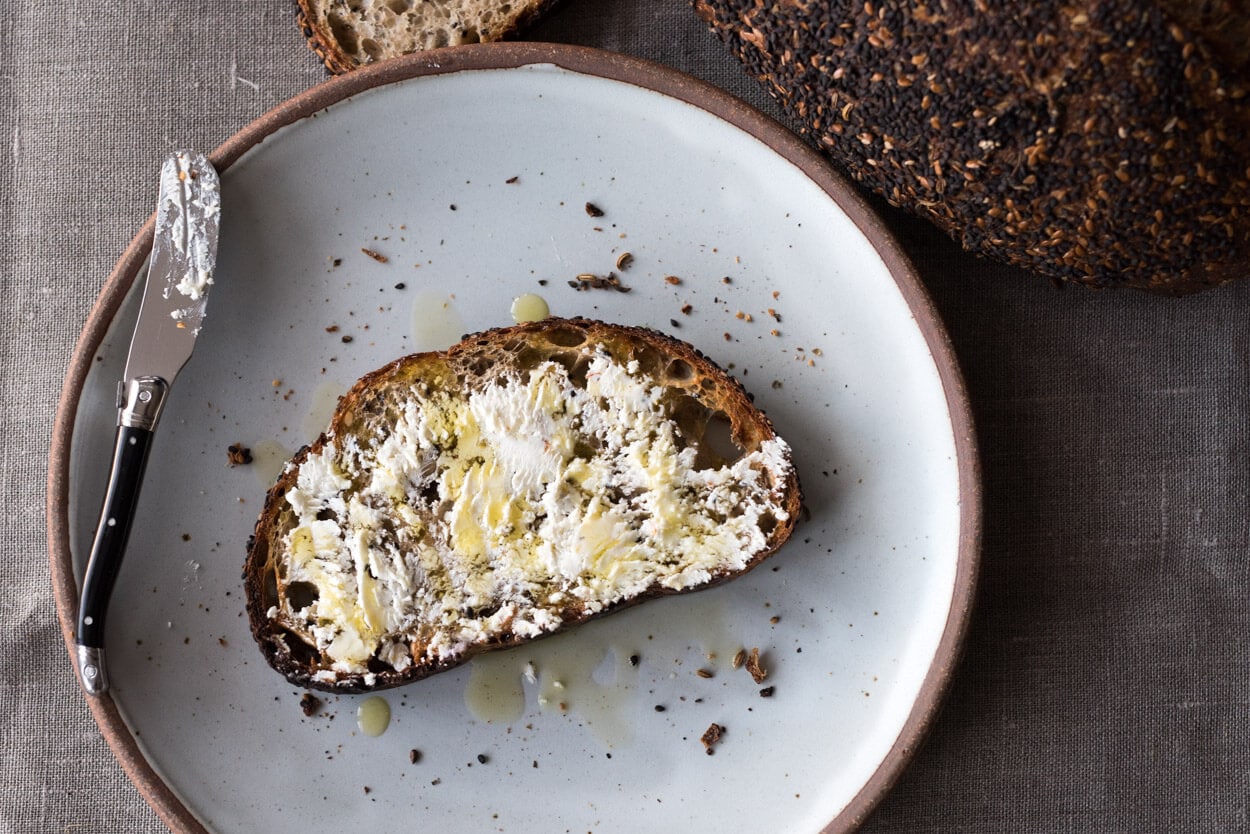
As mentioned earlier, I had a slice spread with a mixture of goat cheese, crushed pink peppercorn, lemon zest, and a drizzle of Amabile extra virgin olive oil (olive oil that’s cured in stone cisterns with a hint of mineral and fruit flavors) that was just out of this world. The seeds’ hearty flavors were balanced by the citrus flavors, mellow goat cheese, and fruity olive oil—I could live on this seeded sourdough bread.
Buon appetito!
Seeded Sourdough Recipe
- Prep Time: 24 hours
- Cook Time: 1 hour
- Total Time: 25 hours
- Yield: 2 loaves
Description
This seeded sourdough is such a great departure from weekly whole wheat or white sourdough; it brings deep flavors and interest to each slice. The interior bakes to a custard-like texture, while the crunch from the semolina-infused crust and densely woven seed mixture give a wonderful contrast. When toasted, I find the flavors actually amply further and the bread, specifically the crumb, takes on another level of brittleness that crackles constantly. It’s exemplary with good quality cultured butter and cheeses of all types.
Ingredients
Seed Soaker
- 40g flaxseed
- 40g dark sesame seed
- 13g fennel seed
- 133g water, boiled
Levain
- 30g medium-protein bread flour
- 30g whole wheat flour
- 30g ripe sourdough starter
- 60g water
Autolyse
- 636g medium-protein bread flour
- 133g semolina
- 60g whole wheat flour
- 501g water
Final Mix
- 40g sunflower seed, shelled, not roasted, unsalted
- 16g sea salt
- 144g ripe levain (from Step 1)
- 44g water
Instructions
- Levain (9:00 a.m.)
In a small container, mix the Levain ingredients and keep at 78°F (25°C) for 5 hours. - Prepare Seed Soaker (9:10 a.m.)
Add the Seed Soaker ingredients (except the sunflower seeds) to a heatproof bowl and let soak until called for in bulk fermentation. - Autolyse (1:00 p.m)
In a medium mixing bowl, add the Autolyse ingredients and mix until no dry bits remain. Cover the bowl and let rest for 1 hour. - Mix (2:00 p.m.)
To the mixing bowl holding your dough, add the Final Mix ingredients and mix to incorporate. Then, strengthen the dough for another 5 minutes until smooth and elastic. Transfer your dough to a bulk fermentation container and cover. - Bulk Fermentation (2:10 p.m. to 5:40 p.m.)
Give the dough 4 sets of stretch and folds at 30-minute intervals, where the first set starts 30 minutes after the start of bulk fermentation. Before the first set of stretch and folds, spread the seed soaker, sunflower seeds, and lemon zest (optional) over the dough. Each set of folds will help incorporate the mixture into the dough. - Divide and Preshape (5:40 p.m.)
Lightly flour your work surface and scrape out your dough. Using your bench knife, divide the dough in half. Lightly shape each half into a round shape. Let the dough rest for 30 minutes, uncovered. - Shape (6:10 p.m.)
Shape the dough into a round (boule) or oval (batard), top with a mixture of sesame, flax, and fennel, and place in proofing baskets. - Rest and Proof (6:20 p.m. to 9:00 a.m. the next day)
Cover proofing baskets with reusable plastic and seal them shut. Then, place both baskets into the refrigerator and proof overnight. - Bake (Preheat oven at 8:00 a.m., bake at 9:00 a.m.)
Preheat your oven with a combo cooker or Dutch oven inside to 450°F (230°C). When the oven is preheated, remove your dough from the fridge, score it, and transfer it to the preheated combo cooker. Place the cooker in the oven, cover with the lid, and bake for 20 minutes. After this time, remove the lid (you can keep it in the oven or remove it) and continue to bake for 30 minutes longer. When done, the internal temperature should be around 208°F (97°C). Let the loaves cool for 2 hours on a wire rack before slicing.
If you use this recipe, tag @maurizio on Instagram so I can take a look!
What’s Next?
If you loved this seeded sourdough, check out its distant cousin: a sunflower and sesame sourdough bread with an added touch of honey for a little sweetness. It’s a delicious loaf—I’d be hard-pressed to decide between baking either of these!
Or, if you’re looking to use more durum wheat, my Pane Siciliano recipe calls for 100% durum and is topped with white sesame seeds.


214 Comments
Hello maurizio!
First of all, you are an amazing bread maker! Loveeeeee theperfectloaf!
I wanted to ask about making the levain one night before and letting it 12hrs around 14°. Just like the Tartine method. I been making it that way and helps with my time schedule, starting earlier and finishing at 2pm. But I am afraid it leaves a more sour flavor to my breads in comparison when I make the levain the same morning for 4 hours around 25°.
Could that be the reason of the strong sour flavor? Or it might be some other factors?
Thanks for your help!
Hi! I was wondering if it’s possible to sub the semolina for cornmeal (polenta). Cheers!
I usually cook, or partially cook, polenta before working it into a dough (similar to my polenta sourdough recipe)—I’d be afraid you’ll end up with hard, dry bits of corn in the final loaf but I haven’t tried just mixing it in like flour!
I ended up winging it and the cornmeal actually worked! The dough was quite wet though and i’m thinking maybe the cornmeal doesn’t absorb water in the same way the semolina would?? But tastes awesome thanks for the recipe!
Excellent! That’s very possible, with the finer grind size of the semolina, it might be able to take on more water. I also find durum wheat pretty “thirsty” in general, so all factors to consider, there! Glad it tastes great, enjoy, Tamara!
Might pulsing the cornmeal in a grinder help break it down and absorb more water?
Thank you for sharing this amazing recipe. love seeds on the surface of the dough. The only problem is the seeds is a little burned. May I reduce the temperature or any solution ? Thank you so much. It’s very delicious:)
Reducing the temp and/or bake time should help! Sometimes, soaking the seeds/nuts in water can help avoid burning as well.
Beautiful recipe, again! That might be one of my best bake so far! Light, fluffy, and packed with flavor. The lemon zest really brings an amazing aroma!
Thank you, @maurizioleo:disqus !
Right on, Mathieu!
Loved this recipe. Breads came out amazing! Made some slight modifications and used:
– 420g organic bread flour
– 350g all purpose flour
– 60g organic wholemeal flour
– 545g water
– 200g levain (100% wholemeal flour; 100% hydration)
– 40g black sesame seeds
– 40g organic flax seeds
– 13g fennel seeds
– 40g sunflower seeds
– 130g warm water for seed hydration
– 18g fine salt
The bread is incredibly flavorful. Having this untoasted with some cheese is a real treat. Thinking of a parmesan bread next. Any recommendations for this? ☺️
Awesome, Bjorn! This is definitely one of my favorite breads to make (I’m a sucker for seeds). You could grate the parm onto the dough during bulk fermentation and fold it in.
Wonderful results! I actually started the recipe too soon, with my starter not reaching full rise yet. After a night in the fridge it wasn’t ready to bake. I held it for 10 more hours in the fridge and then set it out on the counter for 5 hours. It finally rose. I slipped it back in the fridge by 11pm. Then the next day at 8am I started was able to bake the first one. The results were incredible! It’s my first recipe by the perfect loaf and I’m already hooked. My mom tried it and gave me the best compliment ever. She said it tasted like it could be from Acme Bakery or SemiFreddis which any SF Bay Area person would know that is like super great comment, esp from my mom who is total sourdough snob. Thanks so much for these tips! Is it possible to hold other recipes in the fridge for an extra day to allow for more sour flavors to develop? Like at during the bulk fermentation stage and then again for the final proof? Thank you soooo much!
Right on, Jill! Your modifications look good for what your conditions likely were. So glad to hear it turned out well—and with HUGE praise!! Yes, you can usually hold doughs in the fridge longer, just know you’ll end up with a little less rise (but more flavor 🙂).
I’m working on a post right now with a cold bulk AND a cold proof. Will be out soon, keep an eye out!
hello Maurizio 🙂
I’m about to bake this bread but I have two questions.
I don’t have semolina can I use emmer wheat instead of it?
I need to bake it same day, can I proof it on the counter? I have no experience with it and I’m afraid that I will over-proof bread. Any tips?
Thanks 🙂
Emmer would be a great substitute! Yes, you can definitely proof it on the counter. 1-3 hours should do it, depending on dough and temperature. Let it proof until a gentle poke slowly springs back, not completely filling in.
Thanks for the reply. I did it yesterday and well, I failed but I learned something for sure.
After 1h first was under proof and flat. Second after 2h was better but still under proof.
I keep it in my proofing box at 25°C.
I liked the taste anyways so I will try it one again 🙂.
Is it possible that I’ve over mix it in my Famag (one speed 90rpm)? I was mixing it for 5 minutes 🤔
It’s possible to over mix a dough with a mechanical mixer, but 5m in speed 1 likely would not cause that to happen!
Love this recipe. I’ve married this with your multigrain sourdough sandwich bread recipe and it is now our weekly mainstay.
Fantastic flavor. Was a bit worried that sesame and fennel would clash with each other each being such strong flavors. But as usual, your recipe was a winner. I bake it in a pullman loaf pan and its now our favourite bread for lunch sandwiches.
Happy to hear that! There’s always that delicate balance to find with the ingredients… Finding that sweet spot is one of the things I love most about baking. Thanks for the comments and happy baking!
I tried this recipe yesterday, omitting the lemon zest and substituting millet for the fennel seed. I mistakenly added the sunflower seeds to the seed soaker mix but all turned out well. I increased the recipe by 12% and ended up making three smaller 8″ batards (about 680 g each). These loaves were a hit! Another keeper Maurizio! Thanks for all of the wonderful recipes.
Love those changes, Helga! No worries about soaking the sunflower, should have been just fine 🙂 Enjoy and thanks for reporting back!
Thank you for the way you’ve simplified the instructions in this recipe, this is still my favorite loaf after 2 years of bread baking!
You’re very welcome and I’m so glad to hear that!
OK Maurizio! Love, love, LOVE the black sesame and sunflower seed loaf. Like Laurinda , this is also the reason I want to try this seed SD. BUT, I love the honey in the BS+SF seed loaf and plan to add some to this recipe. What say you my baker friend?
Yes, honey will work well in here, too! It’s a relatively low % so it should be fine.
Have the sunflower and black sesame bulk rising right now! Love it!! Is this one as good? Already thinking about because of the semolina and fennel seeds.
They are both wonderful, although I might be biased 🙂 This one has additional flavors mixed in from the flax and lemon zest, it’s awesome, in a slightly different way!
Just got this one out of the oven and it looks perfect. This is my second sourdough from your recipes.
I am loving all the details and tips you specify and it sure is helping me improve my bread baking skills. Thank you so much 🙂
Awesome to hear that, Karuna! Thanks for the feedback and enjoy 🙂
I made this bread today and it is a winner. I reduced the hydration to about 75% and replaced the fennel seeds with chia seeds. I baked it on the same day as I do not like the sour taste that the bread acquires when leaving to ferment overnight. I really like the taste of this bread. I will be make it again. Thank you Maurizio!
So glad to hear that, Maribel! I’ve never used chia inside a loaf, sounds delicious 🙂
Glad you liked it, Helen! Great questions. The amount you score in really depends on how the dough: the strength of it overall (which is based on the formula), and how far it’s proofed. If the dough is strong feeling when you go to score, you can (and probably should) score in deeper. If the dough is very fragile feeling, weak, very proofed, a delicate and shallow score is necessary (going in too deep could deflate the dough).
I hope to have a post on this here soon. Hope that helps!
I will make this bread today. It sounds wonderful. One question about the autolyse that you suggest here. I usually start by mixing the levain with the flour and water and then autolyse but I see that you add the levain after the flour and the water have autolysed for 30 minutes or so. Is there a reason for this and is there a difference in the result? Thank you in advance
Awesome, Maribel! Once you add the levain to the flour and water, fermentation begins. This means you’d have a longer fermentation time overall than the recipe calls for. Check out my extensive guide to the autolyse technique for more explanation on this question! Let me know how the loaf turns out, it’s a tasty one. Happy baking 🙂
Wow. That was a quick response! thank you. I have been following a very well known Spanish baker for sometime and he always adds the levain to the autolyse. But I will try your suggestion with this bread. Thank you again.
Hi Maurizio, thank you so much for sharing recipes and knowledge here. I have a question in regards to the amount of water used in this recipe. i read below the comments and i can see that other people had the same question, so forgive me if you have already answered, i am still confused about it though, I understand the 60g water for the levain. then you say to boil 175g of water for the soaker but pour only 150g of that water to the seeds, where as in the ingredients list you have it as 133g. then you say to add 501 for the autolyse and then another 44g of water. so, which amounts should we follow? is the total water 735gr as stated in the overall ingredient list under total formula? or is it 60+150+501+44 = 755gr water? why boil 175gr if we are only using 133 or 150? also, if I would like to decrease the overall quantity of water to make it with a slightly lower hydration (75%) would that be okay? thank you 🙂
Hey! I’m not sure where you’re seeing 150g water for the soaker, it should just be 133g used to pour over the seeds. You can boil a little more than that to ensure you have enough, then scale out the 133g to pour over the seeds.
So the amounts listed in the Total Formula are for the entire bake, this includes the levain, autolyse, final mix, and the seed soaker. Follow the water amounts listed in the steps themselves, they show you what to add directly in that step (you can imagine you’d follow these steps in the kitchen as your progressing through a bake).
The Total Formula table up top is kind of a preview of everything you’ll need to make the recipe. Then the steps and smaller tables later show you want you need right at that point in the process.
Yes, you can absolutely decrease the hydration, and it might be necessary. I like to measure out the water called for in the recipe, then just hold back some during mixing if it feels like the dough doesn’t need the addition.
I hope that helps clear things up!
it really does! thank you 🙂
one more thing, under the table with the baker’s percentages, the total amount of flour is 1800gr where as if you add the flour under the ingredient list (665+133+89) then the total us 877gr. which one is correct?
Maria–the total, 1800g, is not the total flour, but the total yield in the recipe. This means it’s the total flour, water, seeds, etc., everything adds up to 1800g total dough at the end.
ahh of course!! 🙂 sorry about that!! thank you maurizio!!
Hi Maurizio – a very happy New Year to you and your family! I was looking at the water for soaking the seeds. You have 150g boiling water in the text, but 133g in the recipe box. Is 133g is amount to use? So the total water (not counting the levain/starter) is 678g. Is that correct? Thanks so much for this recipe!
Josephine–Happy New Year! The water for both should read 133g, fixing that now. Total water including levain is 691g. Let me know how it turns out and happy baking!
Hello, what do you mean in step 4 when you say strengthen the dough for 5 mins? I’ve been making basic sourdough since lockdown now but am unfamiliar with this term. Thanks!
You can strengthen the dough through stretch and folds in the bowl, or through a technique such as slap and fold. The goal with these techniques is to strengthen the dough part way, then finish it off through bulk fermentation when doing stretch and folds.
Does the recipe now have all necessary revisions? I’m still confused about the sunflower seeds. They are included in the seed soaker, but we are not supposed to soak them, right? Should they maybe just be omitted from the recipe? Could I use already roasted sunflower seeds? (since I have those on hand).
Yes, it’s good to go! You can soak them if you’d like, but it’s not necessary since they are hulled (they’re just the soft inside). You can use already roasted, that works! Let me know how it goes, this really is a great bread 🙂
I’m very confused by this recipe now. During autolyse, we add 454g of water to 849g of flour. Then we only add 45g more of water during mix, which gives us a total of 499g water to 849g of flour. Mine came out very dense with no way to do “slap and fold”, which is the expected next step. I realize we’re adding the soaked seeds back in, but this seems off to me and my results say the same. Is this correct?
Hey, Nate! In reviewing my notes for my last bake for this, it does look like I transcribed things incorrectly, esp. regarding the soaker water (there’s less, it should be in the main dough). I’m going to take a closer look and check my charts here. Sorry about all the issues with that dough! I’ll have this updated soon after I verify.
No worries and thank you for the response! I trusted my instinct and added some additional water, so we will see how it turns out. Either way it’s a learning experience!
Good move! Yes, the way it’s written, there’s not much water left for the actual mix, it’s all in the soaker and levain. Working on it! I bet you it’ll turn out great, there’s a lot of water in that soaker which should help the dough relax some before baking. Keep me posted and I’ll get this updated soon 🙂
So it ended up turning out really well! I ended up adding an additional 100g or so of water from the original recipe. I can tell it’s not quite as hydrated as many of the high hydration recipes, but it’s still delicious. I also managed to get a great rise out of this one (thanks again for your stretch and fold guide). Great recipe and seed combo!
Awesome, Nate! Glad to hear it turned out well–I’d say good job on the modifications to make it work! Coincidentally, I just finished updating this post. I had several things wrong from my notes (not sure how this happened), mostly that the soaker water was too high (which removed the water from the autolyse), and I forgot to include my “Water 2” which is the reserved water bit. So the hydration of this dough is 5% higher than what you were working with. If you added 100g of water that’s more than 5% though, and I wonder if this is due to the flour you’re using, the seeds, or both. I’m going to test this again soon to verify all is well.
Regardless, the post should now be correct and enjoy your loaf! Thanks for the comments and helping me track this down 🙂
Hello! I think the semolina is missing from the printable/PDF version of the instructions. It’s in the ingredient list, but missing in the instruction part.
Sorry about that! Should be fixed now 🙂
Thank you! I can’t thank you enough for the wonderful work you so on this site. Discovering how much pleasure baking bread brings me has saved me during this pandemic.
You’re very welcome—and happy to help! Stay well and happy baking!
I’m finally making your revised seeded sourdough today and just finished 5 minutes of slap and fold. I had to post right away to tell you how amazingly different the dough felt at this stage compared to the previous recipe. I think your revisions are spot on and I’m looking forward to seeing it to completion. I’m using all the ingredients as written, but omitting the optional lemon zest. I didn’t have to hold back any water and it felt so good to complete step 4 (Mix) and have everything come together so nicely. My dough appears firmer than yours at this stage, but I’m happy with the outcome. It’s a journey rather than a destination, right? Thanks again for all that you do!
Thank you so much for reporting back, Jeanne! Glad to hear the dough is more workable. I made the hydration a little more on point and I think it’s going to serve most better this way (I tend to put more water in my doughs because of my altitude and climate!). I hope it turned out well and enjoy!
Hi Maurizio! Thank you for taking the time to update the recipe. I so appreciate the effort. The changes are so interesting: more levain and more flour in the autolyse. The levain is at 9am, but I’m going to make mine at 8am to allow it to ripen for 5 hours in time for the next step at 1pm.
The Autolyse step is earlier, at 1pm and not 3pm, which changes the timing of the remaining steps. There are more seeds too, except for fennel. Did you purposely omit toasting the black sesame seeds this time? I think I’ll still toast mine because I love the scent. Don’t forget to add the sunflower seeds with the soaker and lemon zest (missing in the printed grey section). I can’t wait to try this version next week. I’ll let you know how it goes!
You’re welcome, Jeanne. I’ve been meaning to update the post with my latest findings in making this bread. Yes, the timing is a little different, but the duration for each step is just about the same. I don’t toast the black sesame seeds these days but you can absolutely do so! The aroma is quite amazing, you’re right about that. Yikes, thanks for pointing out those errors—no matter how many times I read something… Thank you! And please let me know how you like the new “iteration” 🙂 Happy baking!
I carefully reviewed the recipe again tonight and found the following: a) I would like to suggest a start time for the levain at 8am to allow 5 hours to ripen; b) for 100% hydration of the levain, I calculated 60g of water and not 74g as indicated, otherwise the total water in the recipe doesn’t add up to 709g; c) the flour weights are correct in the total formula, but in #3-Autolyse it lists the weights for the bread flour as 652g (should be 682g) and 61g of whole wheat flour (should be 91g), while the weight of the semolina is correct in both places. I didn’t see these initially so my apologies for another lengthy comment. Would you mind checking the numbers again to see if you agree? I’m so enjoying your bread recipes and look forward to making the new iteration!
Jeanne:
a) you can change the time you start your levain to any time that works for you, just shift the rest of the timetable to suit. I typically start mine around 9 am, and if a 5 hour levain is made, it’ll be ready to mix at 2 pm.
b) Yes, you’re right on there, water should be 60g in the levain
c) No, that’s the correct weight for the bread flour in the autolyse step because 30g was used to make the levain (682-30g=652g), same applies for the whole wheat flour.
Thanks for pointing out those issues, all looks well now!
Thank you so much for addressing these. I feel more confident in the numbers now!
Ciao, Maurizio!
yes, a) levain at 9am and mix at 2pm; I stand corrected there!
b) glad to see I was right on the water in the levain; I like when the math works…
c) I see the numbers so clearly now; thanks for clarifying that!
I’ll let you know how it turns out some time next week!
What brand of “very thirsty” semolina did you use in this recipe? I’ve made it twice and it’s still quite wet at Stage 4-Mix. The first time I followed the recipe exactly as written using Giusto’s Stoneground Whole Wheat, Giusto’s Artisan Bread Flour and Antico Caputo semolina. I did catch the typo about adding 128g of levain (should be 125g) and I baked at 450 degrees F in a Lodge double Dutch oven. The second time, I held back only 50 grams of water at the autolyse stage to try and add more water up front as someone suggested in the comments, but I did not add the remaining 50g during the mix stage. It was still quite wet despite more than 5 minutes of slap and fold (dough kept sticking to the counter) and 5 stretch and folds. Someone suggested including the water from the soaker in the baker percentages. Are you planning to update the recipe with this suggestion? The seed soaker adds so much moisture back in that it makes sense to include it up front. Anyway, on my third try, I’m going to hold back 100g of water up front as originally written, but this time not add any back in during the mix. This may do the trick, but I’m still curious how you get all that water incorporated in this recipe. I also use a Brod & Taylor proofer at 78 degrees because I’m in Maine and my kitchen is only about 73 at best when the heat is on. Despite the challenges, the bread baked beautifully and tasted amazing! I love what the addition of barley in the Giusto’s bread flour does to the crust. Any suggestions for improvement would be greatly appreciated!
Hey, Jeanne! Yes, I’m planning to update this recipe soon to correctly include that water (and I’ll likely reduce the hydration as well as needed). I used Giustos Semolina, which was very dry and could take on quite a bit of water. Durum is usually this way, in my experience, but it really does depend on the flour you have. I’d say yes, drop that water considerably until the dough is manageable. Once you have a more workable dough, things should go much smoother!
Ok, finished updating with all the fixes and with my latest tests. The bread should be much more manageable and just as delicious. Please let me know how it goes!
Oh nooooo I´m in the middle of making this bread, i´m about to mix everything looking back at the recipe about what comes first, and I just realised that the recipe has changed in the meantime, I was like what? How is this possible? Super confused, is it me? Did I not not read the recipe and instructions well enough? Now I realise you did some updates…. I´m mixing at 5:00pm while the new recipe mixes at 2:00pm also measurements have changed… Lets see how I can fix this, its my first time trying this recipe out…
Hey, Romy! Super sorry about that, I was hoping no one was in the middle of this. It’s ok, stick to the same timeline you were on (they are similar, just slightly different start/end times, but durations are the same). Just switch over to the new dough mix and it’ll all be fine. I’m assuming you have your soaker already going as well, just use that as the changes there are very, very small. Keep me posted!
Thank you for your quick reply 🙂 it’s actually kind of funny that I was right in the middle of this recipe… I’m about to mix in the soaker, i´ll keep you posted about the end result tomorrow.
This may be an odd question, but if you proof for a couple of days in the fridge is there a chance that the seeds in the dough may germinate?
That is something I’ve never thought about. My feeling is the environment might be too acidic and lack sufficient oxygen, but I’m not sure! Also, the cold temperature in the fridge would likely halt the germination process. What an interesting thing to think about, though.
Thanks for all the feedback, Tom! Yes, this is a challenging bread to make, from the high hydration stems many difficulties, but I’ve found it to be a challenge worth taking. Your mods sound right on, hold back that water next go, and perhaps even a bit more, and only add it in if it can handle.
I’ve been meaning to update this recipe just a bit, mostly to reduce the hydration for many (or at least drop a few more warnings in there), but also to adjust the bake times and temperatures. 450°F is much better suited for most ovens and environments, here at 5280ft that extra kick at 500F helps get things started, but many are not at my same altitude.
Thanks again and keep at it, adding a soaker like this is just a wonderful way to bring lots of flavor to a loaf! Happy baking.
I’ve made this twice now and about to make it a third time. I think I’m going to put all the water during the autolyse this time though. When I hold 100g of the water the dough becomes very stiff that I have to break it up when I add the rest of the water with the salt.
Sounds good, add it all in if the dough feels like it can handle it!
I liked the taste of the bread, but it was slightly dense. I formed the dough into balls, but after it rose overnight, it spread flat. Not sure what I did wrong? It might be better to put the dough in loaf pans. I don’t know why it didn’t rise, without losing its shape😕
I just have one suggestion for your recipe. Is it possible to create a recipe page, that one can print out in one or two pages? I wasn’t looking at how many pages the recipe had, and I printed out 9 pages. Kind of a waste of paper☺
It could be that your loaves are over proofed. There are a few indicators your dough could be going over: sluggish rise in the oven, the score on top of the dough might not open with a nice “ear” and instead just kind of fuse together, the interior will have lots of small holes and perhaps one or two large ones near the top (but no dense areas of unfermented flour), and finally the loaf could be a little on the sour side.
Working on a better print function!
I’ve had the same levain going since 2014. I feed it in the morning and bake at 3pm. When you say liquid mature levain do you mean the discard from the am feeding? Can I skip that and use my levain? I use 360grams for two loaves. Yours says 125grams.
That’s right, you want to use your starter when it’s ripe (when you’d normally give it a refreshment) to make the levain. You could also just use some of your starter if you’d like!
This looks incredible! What the difference between Giusto’s Stoneground Whole Wheat and whole wheat flour? Is the stoneground more whole? and can you interchange them?
Thanks
You could certainly use another whole wheat flour. Stoneground means it’s milled between two large stones instead of typical steel rollers. I find it’s a little more flavorful!
Thank you for an incredible, easy to follow recipe. I cut the recipe in half and it created a perfect little boule. I appreciate the inclusion of the ambient temperature. I also tend to keep my house pretty warm (78F) so I made sure to keep an eye on the dough. Last time I followed a seeded dough recipe, it called for 10-12 room temp bulk fermentation. Needless to say, my dough was over fermented and ended up in the trash. I only made minor substitutions with the seed soaker and used what I had on hand (flax, carraway, sunflower seeds) and used orange zest instead of lemon. Had a slice with goat cheese and fig/orange jam. Phenomenal!
Glad to hear it worked out well for you! And you’re right, this bread goes incredibly well with cheese. Enjoy!
Hello Maurizio, Thank you for another fantastic recipe! I made this recipe into pan loaves and added a bit of millet to the seed mixture. All the different flavors are so subtle, the lemon and fennel compliment the seeds so well. I baked the same day so the dough wouldn’t overproof here in Tennessee. The crunchy crust is worth fighting for! I’ll slice extra thin to make it last, it’s addictive. Thank you for all your hard work producing your site and sharing your knowledge with us, it’s very much appreciated!