

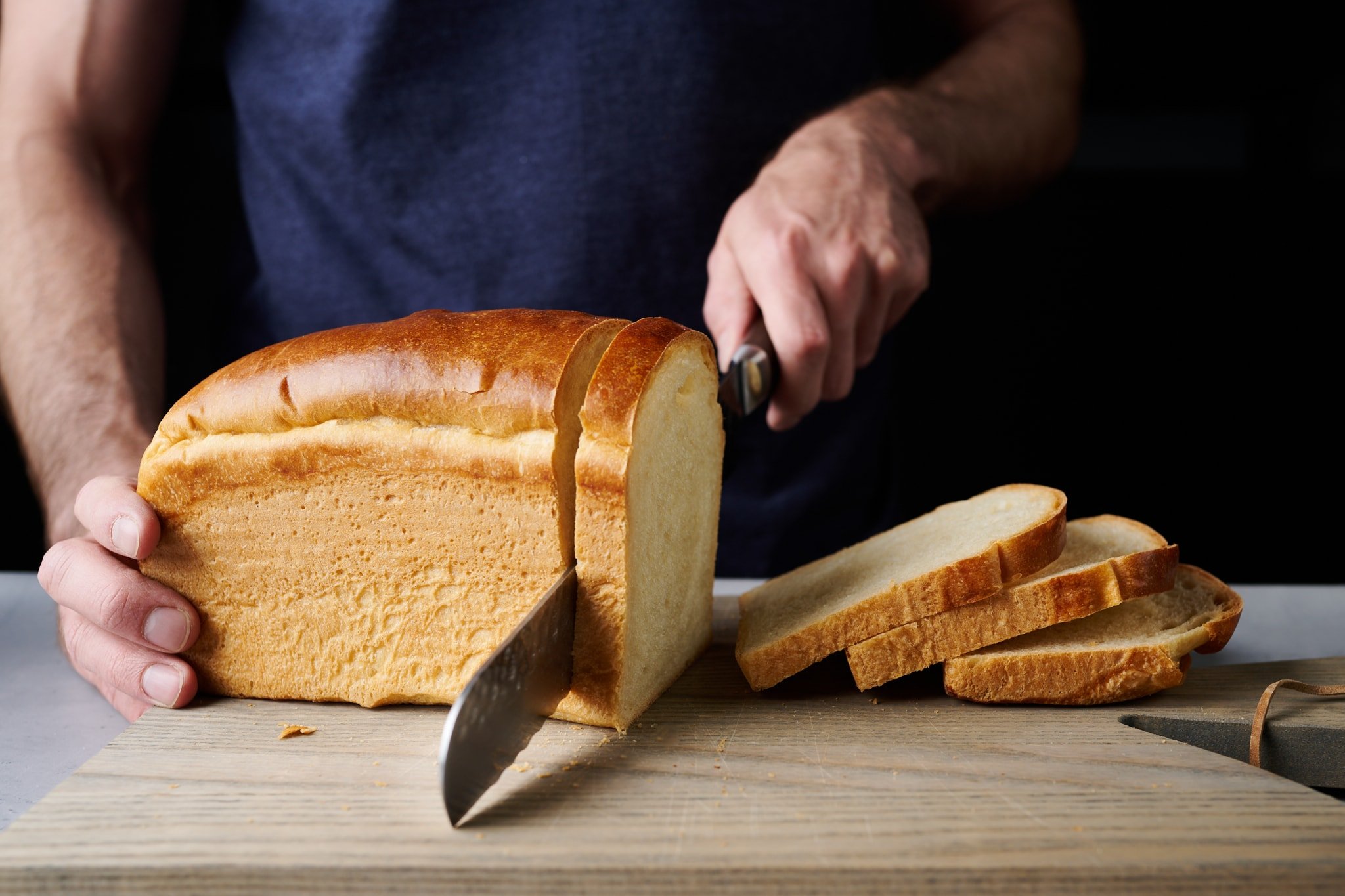
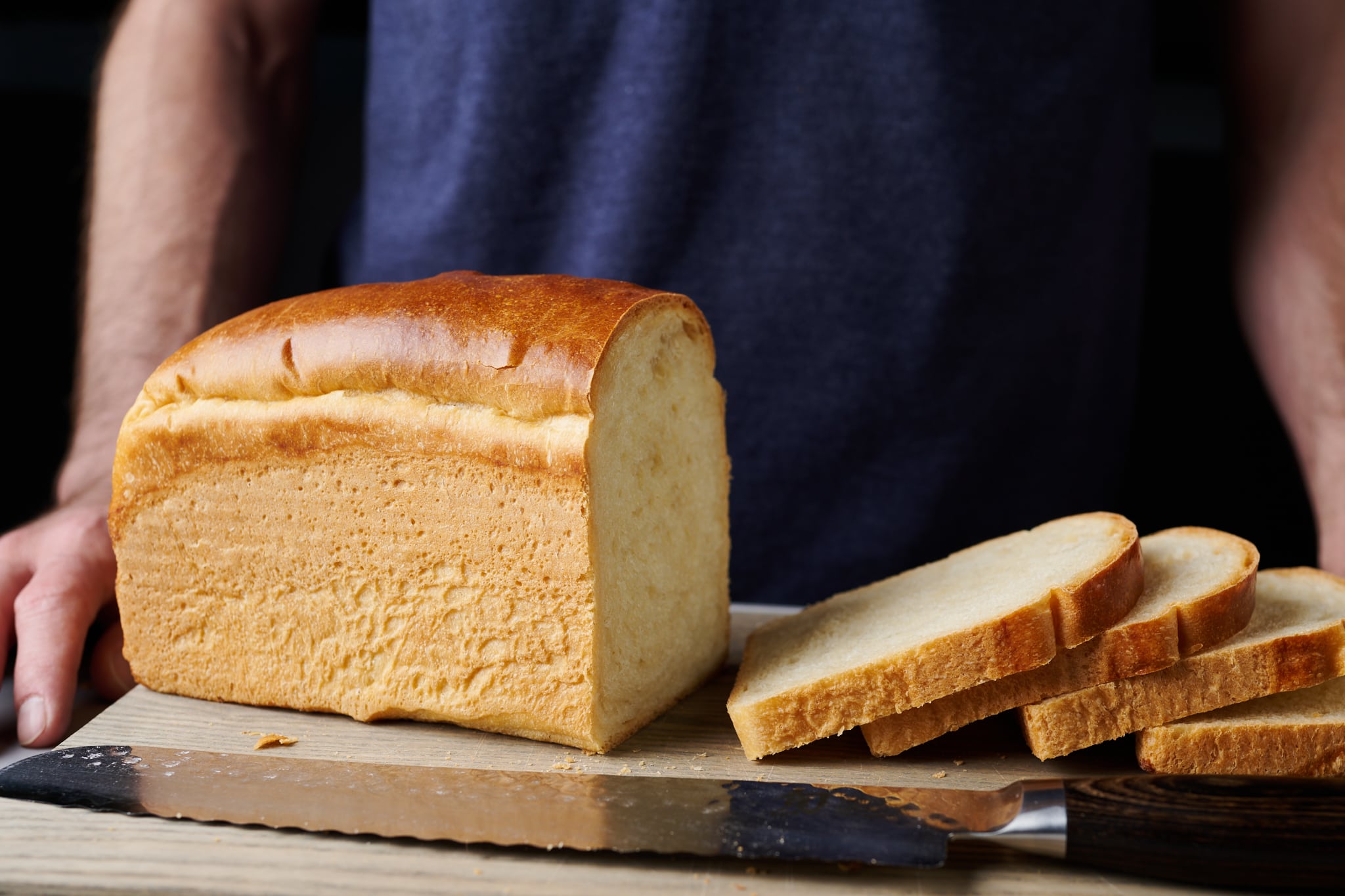
My sourdough pain de mie sandwich bread is pure white bread in all its glory–and it’s the toast lover’s best friend. Each slice is remarkably soft and light, with the thinnest possible crust, but when toasted, the slice crisps and frizzles in an absolutely ideal fashion. A few slices of this bread toasted within an inch of burning and served with a thick pat of butter on top might just be your new favorite breakfast. But there’s a depth of flavor to be found here, too, that sets it far apart from any supermarket white loaf: mild fermentation flavors and a touch of sweetness, all with the slightest hint of tang.
This style of bread is often called a Pullman Loaf, owing to the use of the Pullman pan, which purportedly was invented to be used in Pullman cars on a train to save space when baking. If you’re a frequent visitor here at The Perfect Loaf, you’ll know that the Pullman pan has pretty much supplanted all my other sandwich bread baking vessels. I love that bread baked in this pan has very straight sides, and that using the lid when baking results in a loaf that has an ultra-thin crust.
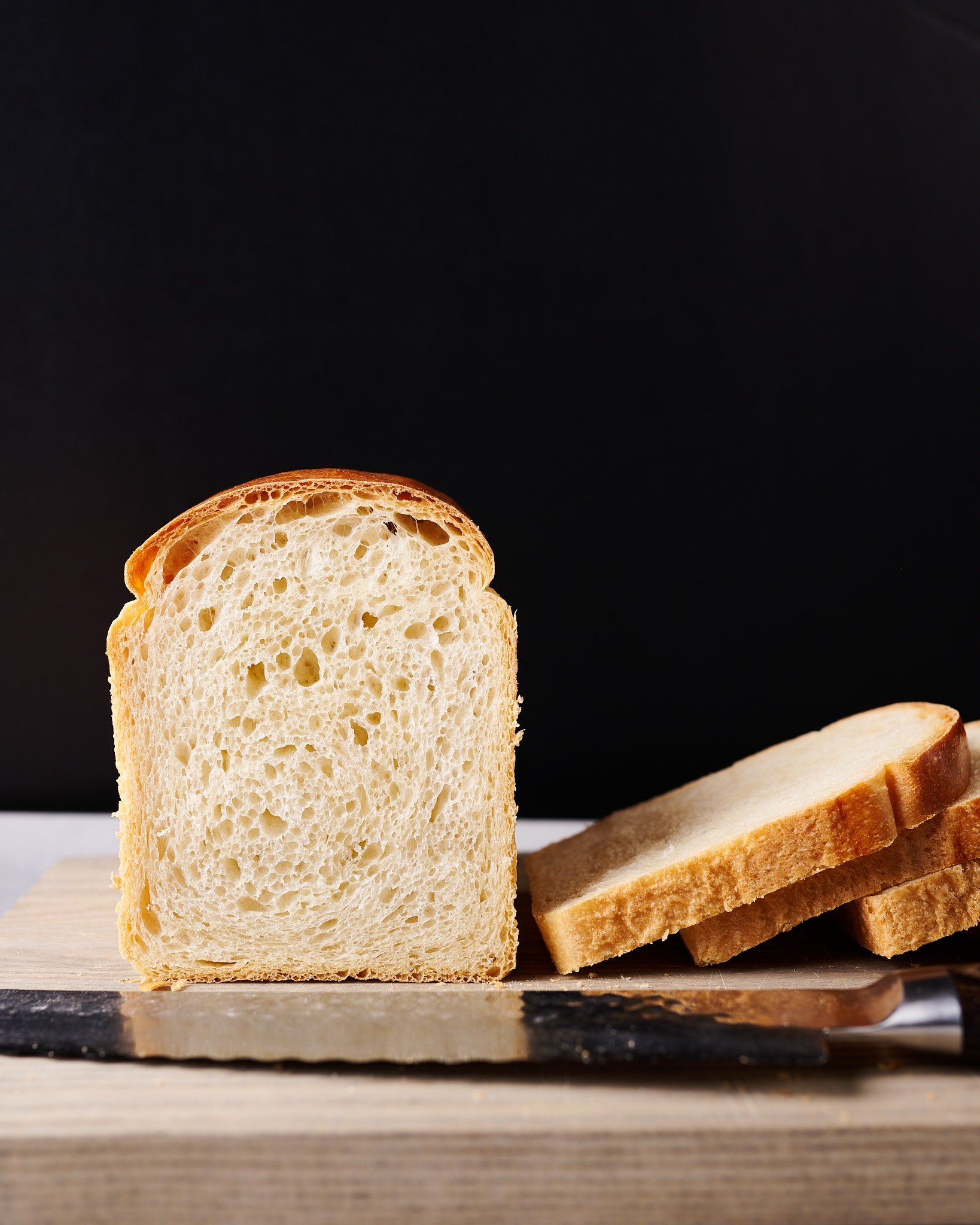
Sourdough Pain de Mie Video Walkthrough
Flour Selection
It’s rare for me to bake bread without any whole grain flour, but I make an exception with this recipe. In testing, I played with many flour blends, but in the end, I settled on using only all-purpose flour. By not using any whole grain flour in the dough (and the levain), you end up with bread that has reduced sourness and the lightest and most open interior possible.
Special Pans and Preparation
You can bake this bread in almost any pan that’s the right size, but I love the straight sides and nonstick liner of my USA Pan Pullman Loaf Pan (9″ x 4″ x 4″). If you slide on the cover before baking, you’ll end up with a loaf with four perfectly straight sides.
I’ve created a table of alternate pans with corresponding dough weights for each so that you can use what pan(s) you have and/or experiment with different sizes and shapes of loaves. Feel free to halve the recipe ingredients below to fit one pan, or even double the recipe and split it among 2 to 3 smaller pans.
| Pan (Dimensions in inches) | Total Dough Weight |
| 9 x 4 x 4 (Pullman pan shown in this post) | 800-900g |
| 8.5 x 4.5 x 2.5 (small loaf pan) | 600-700g |
| 9 x 5 x 2.75 (medium loaf pan) | 700-800g |
| 13 x 4 x 4 (large Pullman pan) | 1,100-1,200g |
Regardless of the pan you use, be sure to liberally grease the inside of the pan to ensure that the bread will come out cleanly after baking. Additionally, check out my post on shaping a pan loaf for tips on shaping, pans, and more.
Note: If using a large 13-inch Pullman pan, during shaping divide the dough into three equal-sized balls and shape them tightly. Then, place them into the pan side-by-side. Shaping the dough in this way (similar to how I shape a shokupan) will help prevent any sagging or collapsing while the loaf is baking.
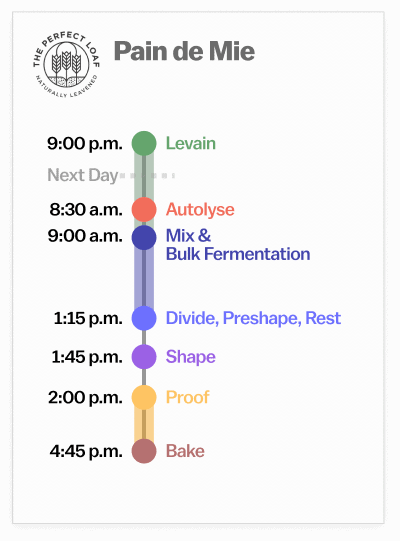
Sourdough Pain de Mie Baking Schedule
This Pullman bread is baked the same day (except for the overnight levain that you make the night before) with a room temperature proof for a mild-flavored result. However, if you’re ok with a slight increase in sourness, feel free to retard the dough overnight by proofing it, covered, in the refrigerator right after shaping.
Sourdough Pain de Mie Formula
Note that this formula has been slightly modified since I first published it in 2019. I wanted to increase the fermentation activity in the dough, so I upped the pre-fermented flour percentage from 7.25% to 8.5%. This change ensures that bulk fermentation will be completed in around 4 hours, as listed in the recipe.
Vitals
| Total Dough Weight | 1,600 grams |
| Pre-fermented Flour | 8.5% |
| Levain percentage in final dough | 19.5% |
| Hydration (water only) | 48.0% |
| Yield | Two 800g loaves |
Total Formula
Desired dough temperature: 78°F (25°C) (see my post on the importance of dough temperature).
| Weight | Ingredient | Baker’s Percentage |
|---|---|---|
| 835g | White flour (11.7% protein; King Arthur All-Purpose Flour) | 100.0% |
| 184g | Whole milk | 22.0% |
| 100g | Unsalted butter | 12.0% |
| 376g | Water 1 (levain and autolyse) | 45.0% |
| 25g | Water 2 (mix) | 3.0% |
| 58g | Honey | 7.0% |
| 15g | Fine sea salt | 1.8% |
| 7g | Ripe sourdough starter, 100% hydration | 0.9% |
Sourdough Pain de Mie Method
1. Levain – 9:00 p.m., night before baking
Mix the following ingredients in a container and leave them covered at a warm temperature, 74-76°F (23-24°C), to ripen overnight.
| Weight | Ingredient | Baker’s Percentage |
|---|---|---|
| 71g | White flour | 100.0% |
| 71g | Water 1 | 100.0% |
| 7g | Ripe sourdough starter, 100% hydration | 10.0% |
2. Autolyse (with levain) – 8:30 a.m.
| Weight | Ingredient |
|---|---|
| 764g | White flour |
| 184g | Whole milk |
| 305g | Water 1 (autolyse) |
| 149g | Ripe levain (from step 1) |
NOTE: I’ve recently updated this recipe to be like my cookbook version, which produces an even better result! One of the changes is to include this autolyse step with included levain.
I use the autolyse technique for this recipe to help reduce the total mixing time required, but I also find it helps aid in the dough’s extensibility.
Warm or cool the autolyse water so that the temperature of the mixed dough meets the final dough temperature (FDT) of 78°F (25°C) for this recipe. Place the flour, milk, water, and ripe levain in the bowl of a stand mixer fitted with the dough hook. Mix on low speed until just incorporated. Cover the bowl and let sit for 30 minutes.
Typically, I do not autolyse with levain added, but with this dough, it helps make mixing the dough easier since there’s a large portion of water in the levain.
3. Mix – 9:00 a.m.
| Weight | Ingredient |
|---|---|
| 100g | Unsalted butter |
| 25g | Water 2 (mix) |
| 58g | Honey |
| 15g | Fine sea salt |
Note: If it’s cold in your kitchen, warm the milk in the microwave or over the stove to help meet the final dough temperature of 78°F (25°C). See my post on how to bake sourdough bread in the winter for tips on encouraging strong fermentation in colder temperatures. Conversely, if it’s starting to warm in your area, use the milk cold from the fridge and see my tips for baking bread in the summer.
First, cut the butter into ½-inch pats. Set them on a plate to warm to room temperature.
Put the honey and salt on top of the dough in autolyse and pour the water over it to help dissolve. Mix the dough on low speed until the salt and water are incorporated, then increase to medium speed and mix, stopping to scrape the sides of the bowl as needed, until the dough comes together and, while still shaggy, starts to cling to the dough hook, about 6 minutes.
Turn the mixer on low speed (STIR on a KitchenAid) and mix for 2 to 4 minutes until the dough gains more strength and begins to cling once again to the dough hook. Next, with the mixer running, add the room temperature butter, one pat at a time, waiting to add each pat until the previous one is fully absorbed. Adding all the butter will take 5 to 8 minutes. In the end, the dough will still be very soft, and it won’t altogether remove from the sides of the bowl. Transfer the dough to a bulk fermentation container and cover.
4. Bulk Fermentation 9:15 a.m. to 1:15 p.m. (4 hours)
At a warm room temperature, 74-76°F (23-24°C), bulk fermentation should take about 4 hours. If your kitchen is cooler, place your bulk container in a small home dough proofer, or extend the bulk fermentation time to give the dough more time to ferment. The dough is ready when it is smooth, puffy, and well-risen.
Give this dough three strengthening sets at 30-minute intervals. The first set starts 30 minutes after the start of bulk fermentation. Give the dough a series of stretches and folds for the first set. Wet your hands, grab one side, and stretch it up and over the dough to the other side. Next, rotate the bowl 180° and perform another stretch and fold (this forms a long rectangle in the bowl). Then, rotate the bowl 90° and do another stretch and fold. Finally, turn the bowl 180° and do one last stretch and fold. The dough should be neatly folded up in the bowl.
Set a timer for 30 minutes, and perform the remaining two sets at 30-minute intervals. Then let the dough rest, covered, for the remainder of bulk fermentation.
5. Divide and Preshape – 1:15 p.m.
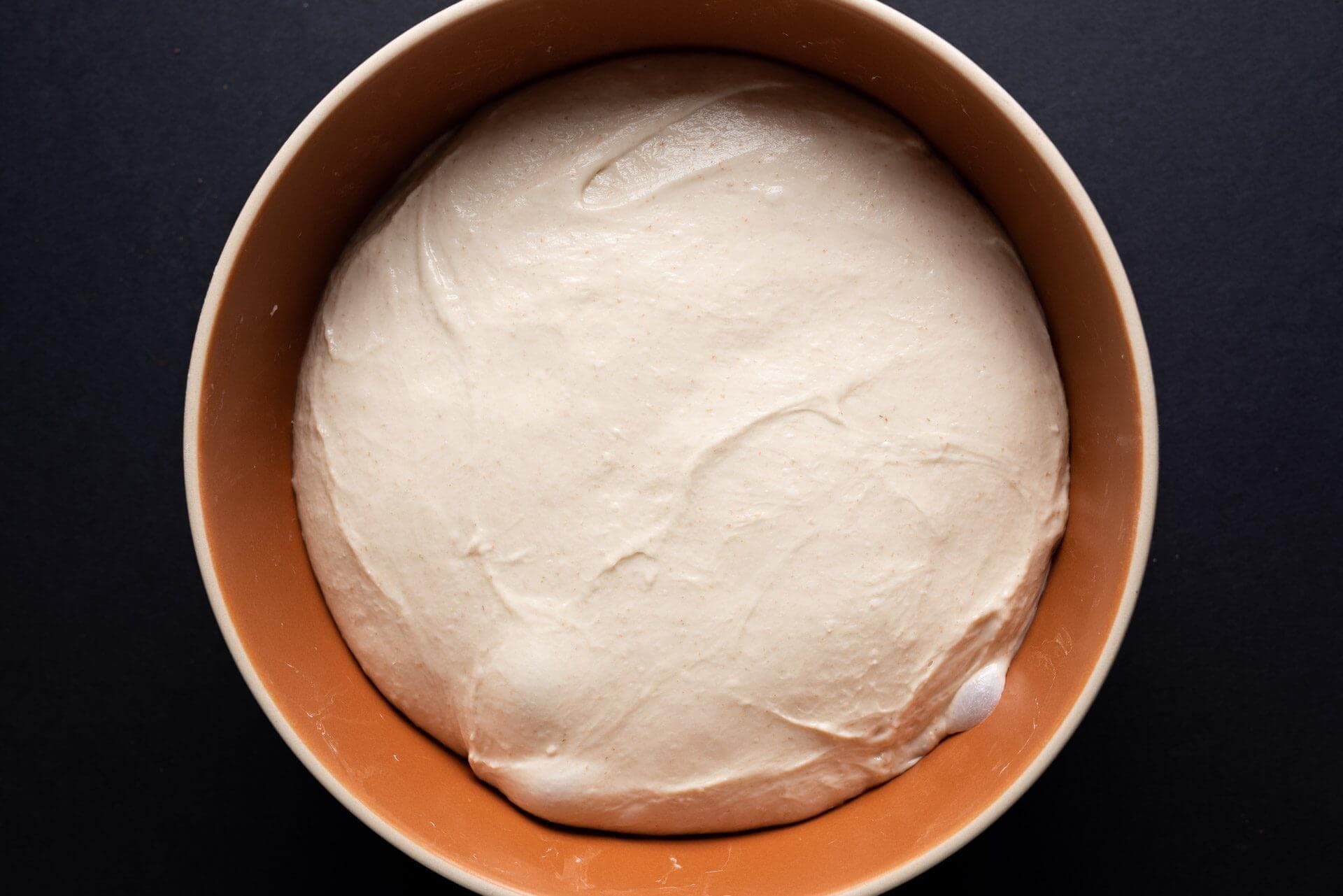
At the end of bulk fermentation, the dough will have risen in the bulk fermentation container (perhaps around 40% volume increase), be smooth and elastic, have bubbles on top, and a domed edge where the dough meets the bulk container. If the dough is not showing these signs, give it an additional 15 minutes and check again.
Fill a small bowl with water and place it next to your work surface. Scrape the dough onto a clean counter. Using a bench scraper in your dominant hand and the other hand wet, divide the dough in half. Then, preshape each piece of dough into a moderately tight round.
Let the dough rest, uncovered, for 30 minutes until it has relaxed and is ready to be shaped.
6. Shape – 1:45 p.m.
Grease two 9 x 4 x 4-inch Pullman pans with neutral oil.
I shaped these loaves as shown in my guide to shaping a pan loaf. Lightly flour the work surface and the top of a rested round. Using a bench knife, flip the round over onto the floured work surface. Fold the left and right sides of the dough toward the middle with a slight overlap. Then beginning at the side of the dough farthest from you, begin rolling the dough down to form a tight cylinder. Scoop the dough up with your bench knife and drop it into one of the prepared Pullman pans, seam side down. Repeat with the other piece of dough.
Cover the pans with a large, reusable plastic bag and seal.
7. Proof – 2:00 p.m. to 4:45 p.m.
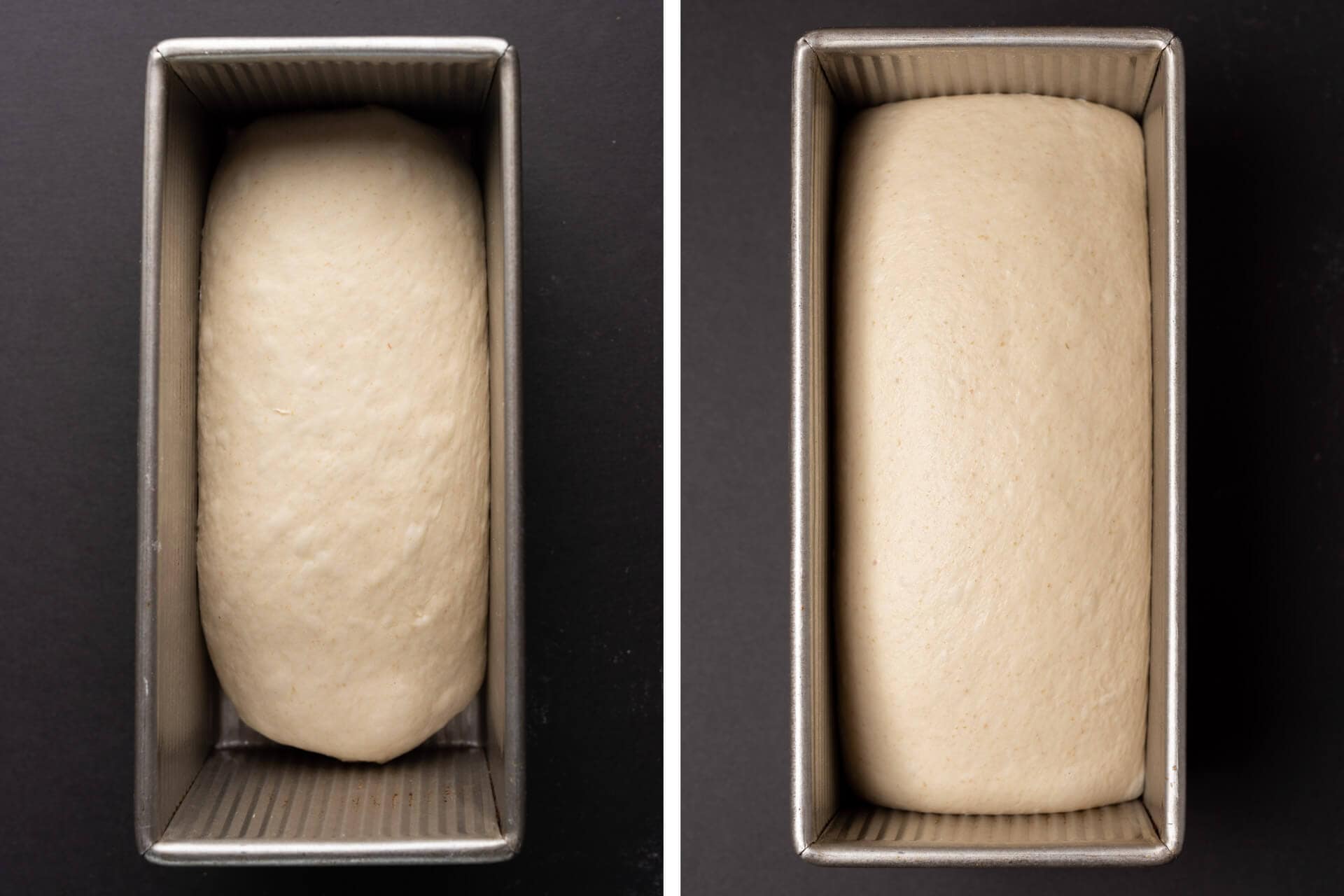
Be sure to give your dough the time it needs to fully proof; your dough might need more time if your kitchen is cold
At warm room temperature, 74-76°F (23-24°C), this dough should take 2 hours and 45 minutes to 3 hours to fully proof. If your kitchen is cooler, expect it to take longer.
When fully proofed, the dough should rise almost to the rim of the Pullman pan.
8. Bake – 4:45 p.m.
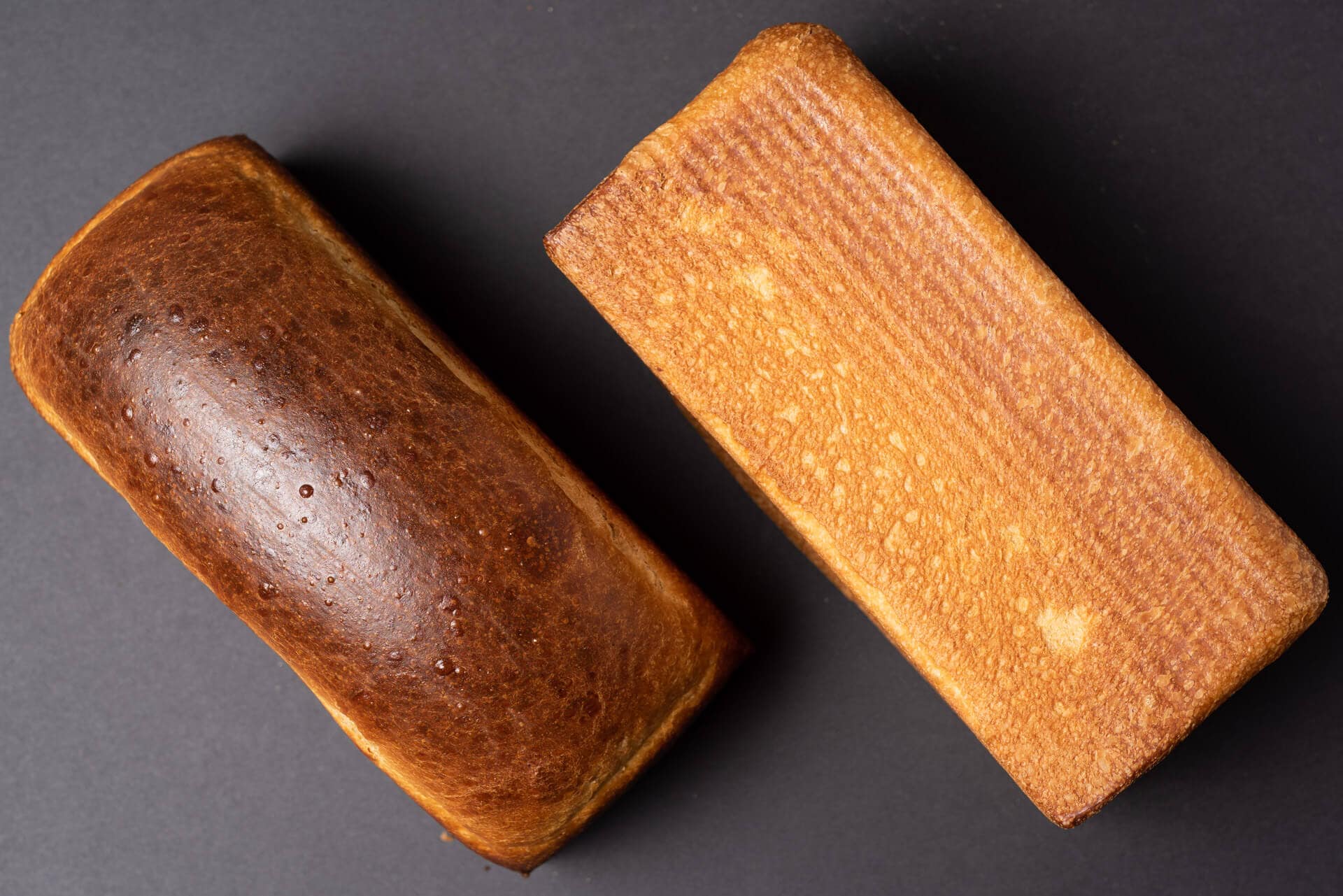
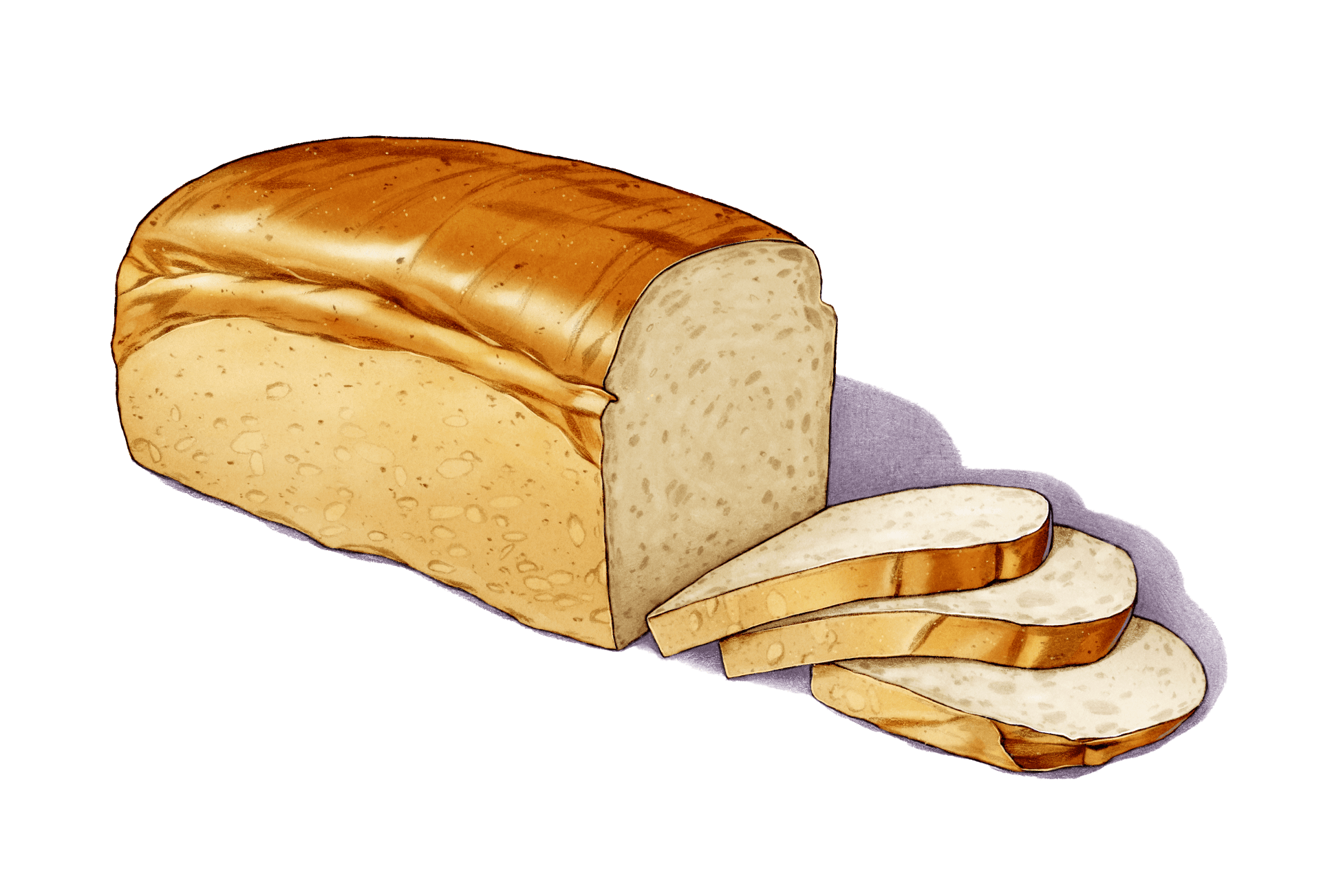
As you can see above, this loaf can take one of two different forms:
- On the left, I didn’t use the lid and the dough rose naturally in the oven. I brushed the top of the dough with a simple egg wash (about 1 teaspoon of whole milk whisked with one egg) before baking. See my guide to topping bread dough for more details.
- On the right, I slid on the snug lid of the pan before baking, and no egg wash was used.
Place an oven rack in the bottom-third of the oven, and preheat the oven to 425°F (220°C).
Place the pan into the oven and bake for 15 minutes. Reduce the oven temperature to 350°F (175°C) and bake for an additional 30 to 35 minutes. If using the lid, the crusts should be a light golden brown; if baking without the lid, the top crust will be a deep golden color. The loaves should have internal temperatures of around 200°F (93°C). If the temperature is lower, slide the covers back on (or not), return the pans to the oven, and bake 5 minutes longer. Then check the internal temperature again.
Remove the pans from the oven, uncover, and let the loaves rest in the pan for 10 minutes. Then, turn the loaves out onto a wire rack and let cool completely, 1 to 2 hours.
This sourdough pain de mie will stay soft and moist for up to a week if the bread is stored properly.
Print
Pain de Mie Sandwich Bread
- Prep Time: 20 hours
- Cook Time: 45 minutes
- Total Time: 20 hours 45 minutes
- Yield: 2 loaves
- Cuisine: American, French
Description
My sourdough pain de mie sandwich bread is pure white bread in all its glory–and it’s the toast lover’s best friend. Each slice is remarkably soft and light, with the thinnest possible crust, but when toasted, the slice crisps and frizzles in an absolutely ideal fashion.
Ingredients
Levain
- 71g white flour (medium-protein white flour or all-purpose flour)
- 71g water
- 7g ripe sourdough starter, 100% hydration
Autolyse
- 764g white flour (medium-protein white flour or all-purpose flour)
- 184g whole milk
- 305g water 1
- 149g ripe levain
Main Dough
- 100g unsalted butter
- 25g water 2
- 58g honey
- 15g fine sea salt
Instructions
- Levain – 9:00 p.m. (overnight)
Mix the levain ingredients in a jar and leave them covered at a warm temperature, 74-76°F (23-24°C), to ripen overnight. - Autolyse – 8:30 a.m.
Warm or cool the autolyse water (see page 138 on how to calculate) so the temperature of the mixed dough meets the DDT for this recipe. Place the flour, milk, water, and ripe levain in the bowl of a stand mixer fitted with the dough hook. Mix on low speed until just incorporated. Cover the bowl and let sit for 30 minutes. - Mix – 9:00 a.m.
Cut the butter into ½-inch pats. Set aside. To the bowl holding the autolyse dough, add the honey, salt, and water. Mix on low speed (STIR on a KitchenAid) for 2 to 3 minutes until the ingredients come together and no dry bits remain. Next, mix on medium speed (2 to 3 on a KitchenAid) for 4 to 5 minutes until the dough smooths and begins to cling slightly to the hook. Turn the mixer on low speed (STIR on a KitchenAid) and mix for 2 to 4 minutes until the dough gains more strength and begins to cling once again to the dough hook. Next, with the mixer running, add the room temperature butter, one pat at a time, waiting to add each pat until the previous one is fully absorbed. Adding all the butter will take 5 to 8 minutes. Transfer the dough to a bulk fermentation container and cover. - Bulk fermentation – 9:15 a.m. to 1:15 p.m. (4 hours)
At a warm room temperature, 74-76°F (23-24°C), bulk fermentation should take about 4 hours. Give the dough 3 sets of stretches and folds at 30-minute intervals where the first set is 30-minutes after bulk fermentation start. - Divide and preshape – 1:15 p.m.
Scrape the dough out of the bulk fermentation container, divide it directly in half, and preshape each half into a taut round. Let rest for 30 to 35 minutes. - Shape – 1:45 p.m.
Shape one round into a tight tube, and place in the pan seam side down. Repeat with the other piece of dough. Cover the pans with a large, reusable plastic bag and seal. - Proof – 2:00 p.m. to 4:45 p.m.
At warm room temperature, 74-76°F (23-24°C), this dough should take 2 hours and 45 minutes to fully proof. If your kitchen is cooler, expect it to take longer. - Bake – 4:45 p.m.
Place an oven rack in the bottom-third of the oven, and preheat the oven to 425°F (220°C).
Place the pan into the oven and bake for 15 minutes. Reduce the oven temperature to 350°F (175°C) and bake for an additional 30 to 35 minutes. The loaves should have internal temperatures of around 204°F (95°C). Remove the pans from the oven, uncover, and let the loaves rest in the pan for 10 minutes. Then, turn the loaves out onto a wire rack and let cool completely, 1 to 2 hours.
Notes
Use the Pullman pan lid for a thinner crust.
Pain de Mie FAQ
Why do Pullman loaf pans have lids?
The lids help ensure that the resulting loaf has the thinnest possible crust.
How do you unmold a loaf made in a Pullman pan?
If you’ve sufficiently greased your pan, the loaf should simply fall right out when you turn the loaf pan over and knock on the bottom. If the bread is stuck at any point on the sides, use a thin plastic spatula (to avoid scratching the pan) to help gently release the sides of the loaf from the pan.
Do I need to grease a Pullman tin?
If your tin does not have a nonstick liner, then yes, you should grease the interior with a neutral-flavored oil. Even if it has a nonstick liner, greasing the interior will ensure that the loaf will come out easily after baking.
Can I mix this dough by hand?
Yes, but adding in the butter can be challenging. I’d follow the same mixing procedure above but knead the dough using slap and fold or folds in the bowl.
Why is my loaf rising erratically and splitting at the top when it’s baked?
This can be a sign of under-proofed dough. Make sure you give the dough sufficient time in bulk fermentation and proof. If your kitchen is cool, your dough might need more fermentation time!
Can I use white sugar instead of honey?
Yes; in fact, that’s actually more traditional than my approach. I would say start with 5% sugar in the dough and adjust up/down to your liking. Note that high percentages of sugar can impede natural fermentation, so the dough might require more time in bulk fermentation and/or proof.
Can I proof this dough overnight in the fridge?
You certainly can, just know that the result might be a bit sourer than what I intended here. Fermentation will continue in the fridge overnight, even though dramatically reduced, and will likely lead to more of that signature tang that you get with natural leavening.
Can I halve this recipe and bake only one loaf?
Yes! Halve all the ingredients in the recipe above (as described in my guide to baker’s percentages) and proceed as indicated.
How much dough goes into a large Pullman loaf pan?
To bake this sourdough Pain de Mie in the large Pullman pan (13” long), I would scale the dough up to 1200g per loaf. When shaping, divide the dough into three equal-sized balls and shape them tightly. Then, place them into the pan side-by-side. Shaping the dough in this way will help prevent any sagging or collapsing while the loaf is baking.
Why are the sides of my Pain de Mie caving in?
Sinking or caving in at the sides can be from a few things. First, try decreasing the dough’s hydration to suit your flour better. I would leave out 20g of water or milk and see the result. Second, let the dough cool in the pan for 5 to 10 minutes before removing it to give it more time to set when it’s out of the oven. Finally, several bakers have reported that the loaf needed to be baked longer to ensure it’s fully baked through and set—try baking 5 to 10 minutes more.
What’s Next?
For a real treat, use this pain de mie, sliced thick with your favorite bread knife, as a base for French toast on the weekend—you won’t regret sacrificing some toast for this treat.
For another super-soft pan loaf, check out my sourdough shokupan (Japanese milk bread) which uses the tangzhong technique to bring even more tenderness to the crust and crumb.
Buon appetito!
Last updated March 13, 2025: The starter weight was incorrectly reported as 8g when it should have been 7g.


716 Comments
That’s a really great idea!
What’s the word on replacing the milk in here with dry milk powder? I can handle the conversion, but wondering if you think results would be the same. We don’t keep milk in the house because we just don’t use it, and I’m trying to avoid running out for some for this recipe.
That should work just fine — it’s a common ingredient in a bread like this. I rarely use milk powder because I don’t keep any on hand (we’re opposites!), but many recipes do use it in palce of milk in small percentages.
Thanks for the quick reply! Yea, I picked up a bag after a number of KA recipes used it to great success, and it’s made my life easier 🙂
I presume just make sure the overall hydration stays consistent by replacing the milk with equal weight water + powder? I’m scaling to appx 1800g to fit both a large pullman and a small regular loaf pan. Looks like appx 657g.
Correct, you’ll need to adjust the hydration “in the field” while you’re mixing. You’ll also have to figure out how much dry milk powder equals regular milk — that I don’t know!
Hi Maurizio,
So excited to make these loaves. I have one Pullman loaf pan just like yours but the other I’m putting in a not non-stick loaf pan. With what should I grease it? Butter? I’m worried that might burn. I have baking Pam, but that seems a little too commercial. lol. Help? THanks!!
I typically use butter, but any neutral oil will work as well!
Hi Not able to understand how to calculate percentage of starter or preferment in recipe can you please guide?
This calculator might be helpful for you! http://brdclc.com/?flour=1000&water=75&salt=2&leaven=20
Check out my post on baker’s percentages!
Hey Maurizio, just wanted to share that I did that recipe and it was great, it was my first time doing bread in a loaf pan. I really liked the result, perfect for a sandwich. I mixed by hand and used the slap and fold technique. The dough indeed was a bit sluggish, I had to give it a couple more hours. I also did the proof in the fridge.
I was reading the amazing book “On Food and Cooking” by Harold McGee and it has a little section called “Milk in Bread” in which it says that the Whey Protein in milk weakens the gluten, and it can be inactivated by bringing the milk to the boil before adding it to the dough (I am not sure if the UHT milk already does that step). Have you tried doing that already?
Glad to hear this worked well for you! I have not tried denaturing the milk before adding it, definitely work an experiment!
Hi – Im a beginning baker and have used your focaccia and pizza recipes with great success, ive also made various easier things like bagels, and flatbreads and pitas . . . but every bread I have tried to make hasnt been rising well . . . and when I tried the pain de mie i had my most epic fail yet! i hand mixed using slap and fold and my starter seems happy and floats and is generally predictable . . . and yet I never really saw much rise, finally i gave in and baked it, and the end result was dense, (rubbery even) but with some random medium holes throughout and a few bigger bubbles along the top. . . trying to troubleshoot and wondering where to even start since ive had almost no success with breads Thank you for any ideas . . .
LG
Make sure to use your starter when ripe to make the levain, and the levain is ripe to mix into the dough. From there, this is a slower moving dough so give it whatever time it needs to really rise up and get airy. If you keep it warm, around 78-80F, this will happen faster. You can’t rush an enriched dough like this when in bulk fermentation, it’ll never “catch up!”
Ciao Maurizio,
I have made this pain de mie 3 times so far with complete success ! Last batch was done with a tweak: I let it final proof in the fridge for 10 hours rather than on the counter top and the results were fascinating ! Better Taster and Texture !
Have you tried this ?
Awesome, Shad! I have done a cold proof on this dough and found a little more sourness to creep in, not bad, just different. Glad you enjoy it, I also take this route if I run out of time and need to push the dough to the next day 🙂
Hi Maurizio! Love all your recipes and thorough explanations! Thank you! Made this recipe for the first time last weekend and looooved it! I was just wondering if you’d made any progress on incorporating some whole wheat into a version of this bread? I saw you were experimenting with some when you initially released this recipe last year. Thanks in advanced!
Your recipes and thorough explanations have guided me from sourdough failure (dense flat bricks) to a world of airy, chewy crusty loaves that my friends and family salivate over- thank you!!! I mixed this recipe by hand and was worried it might not make it. I let it bulk ferment and proof for about 5 hrs each and the dough still seemed pretty dense. I didn’t have time to bake it last night so I popped the pans into the fridge over night and baked them this morning with an egg wash on top (I used olive oil to grease to the loaf pans. They rose beautifully in the oven and came out with a lovely crumbly deep golden crust and soft airy interior. Couldn’t be happier with them. You’ve inspired me to finally buy an electric stand mixer because I love this recipe and your cinnamon buns and am over mixing these buttery recipes by hand. Do you have any favourite mixers under $500? Thanks a million!
So glad to hear this, Maria! Means a lot to hear I’ve helped you on your baking journey like that. My favorite stand mixer is this KitchenAid one. It’s heavy duty and should last a lifetime.
Hi I have a new 13x4x4 covered pullman and don’t understand how to tailor the recipe for that pan – I see it listed as a choice but how do I change the ingredient weights? Sorry if this is a dumb question!! I’m new and reading daily!!
I made this recipe last weekend. It was the first time that I have added honey, milk or butter to my sourdough bread, and it turned out really good. I made half of the dough into bread and 1/2 into hamburger rolls. It made 10 good size rolls, and I did an egg yolk wash on both the bread and rolls and also sprinkled sesame seeds on the rolls. Both the loaf and the rolls were delicious. I did decrease the butter in this recipe by about 1/3 and mixed the dough by hand using my Danish whisk, (best thing ever for mixing bread dough). It was a very warm day but I still ended up proofing the dough and bread longer than suggested. That’s the beauty of baking sourdough bread, to me it’s just a good guide, but you still need to go by how it looks. Also, sourdough baking is very forgiving and if you leave it a little longer than suggested, it doesn’t really make much difference. Thanks for the great recipe. It made delicious sandwiches and toast, and the rolls were perfect for burgers.
What temperature should the water be at since the milk is cold? If it’s taking many people several hours longer to proof would it help to have the milk warmer then refrigerator cold?
Hi Maurizio and Co! I have been using your site + Chad’s Tartine Bread for over a year now. Your site is the best–priceless. Thank you! I am making great country-type loaves, but I have tried to make this Pain de Mie 3 times and keeping failing. The loaf is, to my eyes, underproofed: dense, “squidgy.” I feel like I am doing everything right, as I have a proofer, a thermometer, Kitchen aid, great flour, Kerrygold butter, even a covered Pullman plan. Maybe it is patience I am missing. I am dying to make this loaf in that perfect square! My starter seems wonderfully strong, and I know when it is mature. I even just made your Sourdough Babka and it was PERFECT! If I can make that enriched dough, why can’t I make this one? I did let the babka go for longer during bulk and proof–your directions for measuring how high it should rise from the top of the Pullman pan was kind of key for letting me know if it had proofed long enough. Can you give those same dimensions for this loaf. For example, if the dough goes into the pan leaving 2 inches to the top of the pan, what should it rise to? I also wonder what the proofer temp should be. The target temp says 76, but in these comments you suggested 80 for another person.
Update: I made 2 loaves, one in a regular loaf pan, one in the Pullman covered. They were better than my “fails” but because I had to let the Bulk go for close to 6 hours and the final proof for 3.5 hours, the bread was a bit more sour than I would want for a “white” loaf and the texture was quite different from the version I made with active yeast from Reinhart’s book, which was very delicate in both crumb and flavor. I want to use sourdough for everything, so I will keep trying but just wanted to provide an update.
Hello Maurizio
Just tried baking this bread everything seemed fine but I got very little rise in the oven and a dense crumb with bigger wholes than expected throughout. Thinking is was under proofed but it past the poke test. Almost 5 hr BF with about 3hr final proof. I was using a 9×5 pan not a pullman. Help would be appreciated.
Your site has been a huge help in learning how to make sourdough!
Just made this loaf, great recipe! Love it, thank you so much.
I was thinking, if I want to eliminate completely the sourness from the dough, should I add the baking soda to it?
Does anyone know what should I do? It tastes great: complex, sweet and salty, but I still can taste very very light sourness from the dough. I was reading that soda can compensate sourness, but don’t know when should I add it and should I add it at all? And how much to add…
Hi Maurizio first of all big thanks on every thing you do this website is awesome and very helpful . I had an issue a couple a days ago I thought I might share it . so I made your recipe and the bread was gummy , it took me 7 hours bulk and I like to work at night so it was very late I shaped cover it but in fridge 8 sleep at 2 c and 1 hour at room temp checked it poke test ( over proofed ☹ ) preheated oven 30 min put it in; oven spring 😊40 min later got it out it felt heavy put I ignored this let it cool and cut one open it was under cooked I think; bake it again 20 min still heavy and it never became soft and you know bread it was gummy and very sour. looking forward to learning more…
Hello! I would like to make this recipe as written, but only have one loaf pan at the moment and intend on baking these tomorrow. What should I do once I reach the proofing period?
I’d divide the recipe in half and only bake one loaf! Just divide everything by two in the recipe.
Thank you! I made this and it came out delicious. I had to bulk ferment for about 6 hours even though it was warm (78-80 degrees) in my kitchen. I used Bob’s Red Mills AP. I appreciate your detailed notes, photos, videos, and instructions in all of your recipes. I find have found them to be very accurate which is helpful and encouraging as a beginning bread baker.
Wondering if I could turn one of these loaves into a cinnamon bread? Any recommendations? Thanks so much, I’m loving all your recipes and recommendations!
As @branchfields:disqus said below, I have a few recipes that are enriched doughs with cinnamon (especially my sourdough babka. You could treat this recipe the same way those are done!
Hi Maurizio, I don’t have AP flour due to the flour shortage right now. I do have Central Milling Artisan Bakers Craft Plus. This is a lower protein malted bread flour – I believe you’ve used this. Would I still achieve the same soft crumb using this flour? I’m comfortable with higher hydration, if I should increase to a certain % to compensate for this flour or if you have any other tips please let me know! I will he baking in a 13” Pullman loaf pan w/out a lid. Thank you!
Sarah — yes, that flour will work very well for this recipe!
Any troubleshooting suggestions for a loaf that came out well short of the lid on my large (13x4x4”) USA Pan lidded Pullman?
1200g dough, 5hr bulk at 76-78F, 3hr final proof. Was hoping for a nice square, but ended up with a pale dome, the top a good inch below the lid. Look forward to another bake but unsure what to tinker with…
I would try increasing the dough weight to perhaps 1300g and see if that helps. I’ve tested this a single time in that size of pan and it worked, but perhaps we need to add a bit more dough to fill the pan. Report back how things going if you would! I’ll try to test this as well.
Hi Maurizio, I made this today and had a similar issue. I used 1200g of dough for my 13x4x4 pullman and I had rounded corners (flatish top) and only enough dough for the second loaf for one of my mini pans. However, I have to say, the bread was excellent! I think my proofs were fine but wondering if that would/could effect weight? I used Central Milling all purpose flour.
Can you make this bread using bread flour in lieu of AP?
Yes, bread flour will work with this.
Hey there! I have a proofing function on my oven that is supposed to keep the temp between 80 and 95 degrees. Could I use this for bulk fermentation and proofing? My kitchen temp is generally between 68 and 72 degrees, and the other two recipes I’ve tried required much more time in both bulk and proofing. And allow me to show my appreciation for your info and this site. So far I’ve done the weekday sourdough and focaccia recipes, both to great success. Thanks!
Yes, that will work well. I’d shoot for 80-82F for this recipe and timeline. Keep an eye on the dough during this time, it might move a little faster, adjust as necessary. Glad your bakes have gone well thus far!
Can we use a bit more starter in the levain? Not sure my levain was strong enough, even after 12 hours. The dough seemed promising throughout bulk fermentation and shaping. Looked very similar to the pictures, but didn’t end up rising during the final bulk. Once baked it was more like a sourdough pound cake and didn’t rise at all in the oven. I’m not sure if it was under or over proofed? I kept the dough warm in the microwave with the door cracked and light on. I should also mention that the only flour I could find was bleached all purpose. I’ve since come across a bag of unbleached all purpose flour and hope to try again.
Yes, you can certainly do that to compensate for lack of activity!
Why did you choose ap flour? What will happen if i were to use bread flour? What will be the end result? And if so do i have to change the hydration level of the water and milk?
I like the tender nature of lower protein AP flour, but bread flour will work just fine — it’ll be delicious. I would say same hydration, but you might find through testing it can take more, but it really is dependent on the flour itself.
Wow, that was a fast reply. Thank you very much.
And one more thing, will the bread rise higher if use bread flour? Asuming i did not put a lid. Coz im aming for a high rise loaf
Assuming all else equal, yes I do usually experience more rise with bread flour given the strength of the resulting dough.
Hi Maurizio,
I’ve made this twice so far with great results, thanks for the recipe! Just wondering though, I made it this last time in my new USA Pan large pullman with the lid on. It came out looking perfect but as it cooled, the sides buckled ever so slightly, making the slices not be perfectly square like yours. I made 1100g of dough as per your suggestion. Any idea as to why this happened and how I could prevent it in the future? It’s not a big problem but I’m just curious.
Glad to hear that, Drew! It might be the flour used and the level of hydration and/or enrichment is just a bit too much. If you have some higher protein flour (bread flour will work) you could try cutting in 50% of that with the AP flour to see if that gives the dough more structure after baking.
I was hoping to make multigrain seeded pan loaf. Can I just sub in some whole grain flour (I have some rye flour, and wheat berries that I’ve been milling myself since flour is so scarce) or should I up the hydration a bit? Any modifications I would need to make or can I just toss in some soaked seeds during the mix?
This bread is more of a delicate, slightly sweet bread. I’d recommend checking out my other more hearty pan loaves on my recipes page, almost any of those will readily take a seed addition!
Hello,
I am a novice baker who is trying to learn the art of sourdough and starters from your website and wonderful recipes. I just made your Pain de Mie recipe. I managed to get a wonderful final texture and appearance, however, there is still an after taste of the sourness. I have been been having this problem with most of my baking. Any tips on what I might be doing wrong?
In this particular case, I think I may have used the levian an hour after its peak. Could this have contributed to the sourness?
Hope to hear from you soon.
Many Thanks
Hira
Hey, Hira. Definitely try to use your levain when it’s a little before it’s at its peak, more mild. Also, if you placed this dough in the fridge at any time, try to skip that and do the dough all at ambient (counter) temperature. The fridge is convenient, but can impart additional sourness in the result. These two things will help quite a bit!
Thank you soo much for your quick response.
I didn’t stick the dough in the fridge at all. But will definitely try to be more careful of the levian / starter.
I have had this problem with sourness in all my attempts except the brioche buns. So far I have tried sourdough, doughnuts,chocolate babka, pizza.
I struggled most with the doughnuts regarding the sourness.
Is there anything I should be more careful with in my process.
Thank you for your help.
Maintenance of your starter and the levain build in some of those other applications will be critical in reducing sourness. Generally, naturally leavened enriched doughs are difficult, especially with regard to reducing sourness!
Thank you. I will keep trying.
I made this yesterday and we LOVED it!! I just made buttered toast with peanut butter. Fabulous texture and taste. When I mixed it in my stand mixer, I switched to the dough hook to incorporate the butter and to continue mixing it to develop strength. Should you keep going until it pulls away from the bowl? Mine never did and I’m having a hard time telling what you mean by moderate strength with this dough. It turned out very well, but I’m just trying to learn more about “reading” my dough, and you didn’t have a pic of how it looked in your mixer before bulk. It really had no real elasticity after mixing. The 3 stretch and folds gave it a lot of structure and strength….about exactly what I’d expect. Could l have done 5 minutes of slap and fold before my bulk, or is that unnecessary? I have a B&T proofer so that helped with bulk and final proof. Anyway….THANK YOU for another great recipe! This will be on repeat!! Making your focaccia again tomorrow…cherry tomatoes, thyme, Kalamata and green olives.
Glad to hear that, Suzanne! This is a favorite here for sure. The dough won’t completely pull from the mixing bowl, no. When I say moderate I mean it’s not fully developed (to where it’d pass the “windowpane test”), the reason is because we’ll be giving the dough sets of stretch and folds during bulk fermentation which will finish strengthening the dough. Like you said, those S&Fs really give it the strength it needs. I wouldn’t have done slap/fold since you’re already using your mixer, if you want to give it more strength just mix longer in the machine, perhaps another 3-5 minutes until it starts to really group around the dough hook.
Again, happy to hear this worked out for you! Give that focaccia a try, it’s so good!
Thank you for that description Maurizio! Glad to know what to look for and that I can skip any slap and fold. And I make your focaccia on a regular basis….it’s a favorite in my household with cherry tomatoes, green and black olives, thyme and flaky salt.
I baked a pullman loaf, closed, and an open loaf. The open loaf got really dark on the top as it baked. Wondering if my temp was off? The internal temperature hovered in the low 200’s. thoughts?
Yes, sounds like temp was too high in the oven. I’d drop it by 25°F and see if that helps. Keep an eye on it, if it starts to color too quickly drop the temp further.
thanks!
Your Pain De Mie bread recipe is the best loaf I have ever made. ( over 40 years of baking bread). There is no crumbs when you cut the loaf! I would like try olive oil instead of butter any suggestions on the amount?
Thanks for such a great recipe!
Candy — thanks so much for the comments and for the extremely high praise, I appreciate that. Olive oil would be fantastic, but I’d really have to test to form a recommendation… But I’d start at perhaps 8-10% and adjust based on the outcome. I’ve been meaning to do a classic olive oil sourdough, perhaps I should get on that! Thanks again and happy baking 🙂
I’m making this for the first time. I’m not a very accomplished sourdough baker but I do make Cindys SDSD every week for about a year now and it always turns out well…so, now for my problem with this. I’m at the point where I’ve done 4 s&fs and the dough is still very wet. Should I do more s&fs? I weighed all my ingredients according to the recipe and made no changes. The dough was so wet when I got it all mixed that I added 2-3 Tbsp of AP flour…it was still very wet . It is a bit firmer after the S&Fs but too wet to handle comfortably. Can I do anything or should I just assume I’m going to pour it into the pans when ready. I cannot imagine shaping this blob.
PS…I left it to bulk ferment an extra half hour, at that time it had doubled so I divided it and did the preshape…I was VERY liberal with the flour on the worktop and on the dough…I was so surprised that I could shape it…and it has baked and is cooling…it looks SO good…I’ll let you know about the taste after it cools.
Final note: It turned out really good…the interior is so soft…I had an egg and cheese sandwich, toasted, this morning, delicious. I’m still partial to part whole wheat though. Have you tried using some whole wheat in this recipe? I typically bake 10% rye, 30% whole wheat, 60% white.
If the dough is still super wet and slack, yes give it more folds. Generally: the number of sets of stretch and folds really depends on the dough at hand. Sometimes you’ll mix a little less and need more, sometimes the dough will be strong enough and you won’t need as many sets. It all depends 🙂
I’m so glad to hear it worked out well! Yes, I’ve tried using whole grains in this, and while it’s certainly tasty, it brings more sourness to the end result, which is what I was aiming to avoid. You can certainly experiment and see how it goes for you — it’s still an amazing loaf!
in reading some of the comments where people are having trouble, it reminds me of an episode in the 1st year of the modernist breadcrumbs podcast where they were talking about osmotolerant yeast and starters. perhaps some starters have developed some osmotolerance and can handle the higher sugar content while others cant. this week, in preparation to making this recipe, i took some of my starter and started a second starter, feeding it sugar in addition to the usual flour and water. starting at 2% sugar and working my way up to 10%, hopefully conditioning the starter better handle enriched doughs. has anyone else experimented with this? searching this brings up a few forums on the fresh loaf site.
Hey, Daniel! Yes, this is exactly the issue. I know of a few bakers who have had success in keeping a “sweet starter” and use this approach when making lots of enriched doughs. They say they have reduced rise times and stronger fermentation. I’ve been playing with this from time to time but haven’t nailed it just yet, but it’s something I’m looking into for the future. I plan to make a series of builds using sugar in increasing quantities instead of keeping a starter in this way, maintaining two starters is a lot of work! If you’ve been playing with this, I’d love to hear how it works out for you.
i made an enriched hokkaido dough a few weeks ago with a sweet starter terrific success. the 2 other times i tried sd brioche or challah, it wasn’t great. this time i did as outlined above ramped up sugar over 3 or 4 days on up to 15%. i made a batch of sweet flour for feedings at 15% sugar to flour so just had to scoop one ingredient for all subsequent feedings. i keep my starter in the fridge so just bring it out every 2 weeks for a few days of feeding whether i’m using it or not, so maintaining 2 isnt much of a burden. maybe next time i’ll do a side by side of same dough with the 2 diff starters. or maybe not 🤷♂️
Right on. I’ll definitely have to give this a try. Sounds like you have it setup for low maintenance which is the way to go! I know when I was working on panettone (the ultimate naturally leavened enriched dough) you really only use sugar for the dough mix — but there’s a lot more involved there… I’m still going to experiment!
say… i was interested in that science of sd class with debra wink last month but coronavirus was starting to make the world weird and had been planning to go to pizza expo and didn’t want another trip so didn’t. also had wanted to attend the class in new orleans at bellegarde and was sick so didn’t go. did science of sad class happen or get rescheduled? any other classes in coming months? guessing not much is being scheduled these days 🙁
Yea, unfortunately our class was cancelled — and a lot of other things, of course! I don’t have any other classes scheduled for this year, but we might offer that class again next year… I hope so!
Hi Maurizio! I make a batch of this every other week for my son’s sandwiches for lunch. It is his fav (well, next to your fococcia recipe). I make the 50/50 whole wheat on the off weeks for my morning toast. I’ve tried other people’s recipes but never get the results I do from your recipes. Thanks so much for helping me learn how to bake with sourdough!
So awesome to hear that! Thanks for the feedback, I really do appreciate it. Happy baking, Anne!
I made this today and so desperately wanted results but I managed to screw it up haha. I gave 4 hours of bulk ferment and 3 hours of proofing in a 65 degree house. I built a levain from my active starter last night. Any suggestions? I prefer to bake my breads in the first half of the day – thinking maybe I should bulk ferment overnight and then proof in my oven (turned off, with the light on becomes about 85 degrees for me). Any thoughts would be great! Thanks.
Hey, Nicholas! My guess is the dough was likely under proofed given those times and temperatures. If you’re going to keep the dough at 65F for bulk, you’ll definitely have to do it overnight. Try for 6-8 hours overnight and see how the dough looks and feels in the morning, then shape it and place it into the pans and proof in the turned-off oven at 80F or so until ready to bake. That should work well!
I’m so sad!! This is my second attempt at a AP loaf. I BF for 5 hours and then put it in the tin. It’s been 2 hours and it doesn’t look any different. 😭 I don’t think it likes my starter…
Did you use your starter when it was fully ripe/mature to mix the dough? It’s very important to get the dough started with a fully mature starter so it’s at full strength. This is a slow moving dough regardless. Make sure to keep the dough warm and to hit the final dough temperature I list in the recipe — important!
It has nothing to do with your particular starter, just be sure it’s mature when you use it and it’s fermenting well!
I tested the starter this morning and it did not float. I
believe a few things could have caused this fail.
1. I didn’t let the dough BF long enough 2. I didn’t use the Levain at the peak time
3. The starter I used didn’t like the AP flour.
My starter is a whole wheat 100% hydration and is about 2 months old. I’m new to sourdough.
I will try again tomorrow. Any tips with feeding the starter and making the Levain?
Best, Donna
The float test is not a definitive test, so even if it didn’t float it still might be ok to use. Use it when you’d normally give it a feeding, it should smell slightly sour, have bubbles throughout, and if it normally falls in the jar, right after it has fallen.
The important thing is to use the starter when it’s mature to make your levain, and then to use the levain when it’s mature to mix into your dough. If you use the levain a tad early, it just means bulk fermentation will take longer (but it’ll be fine, it just needs more time).