

After the past few weeks, I’m not sure I want to move ever again. Throughout the last year as our new house has been under construction, we’ve been steadily reducing anything superfluous around the house. My wife and I don’t have much “fluff” to start with (we try only to buy what we need), and yet, this move (just across town mind you) has been a sprint from start to finish. We had only a few weeks to fix all the small issues found by the inspector, prepare all the paperwork required, pack up our belongings, and finally do the last cleaning. Toss on a graduation trip one of the weekends plus visiting family, and that leaves only a smidgen of time to get all this done. But as is always true with me when it comes to baking, making this oat porridge sourdough bread was a priority.
We finally finished packing the track to the brim; furniture on top of furniture, kitchen stuff on top of bedroom stuff, clothes on top of everything else, but one sure thing was my starter acted as a co-pilot up front in the moving truck where I could keep a close eye on it.

Somehow we pulled it off and are now in a temporary abode until our home is finished hopefully only a few more weeks. Baking for the rest of the month is going to be tough, but it’s going to make moving into a home with a double oven that much better. I cannot wait to double my bread baking experiments.
Now that the moving gripes are out of the way let’s get started with this entry. I’ve been working on it for quite a while now through several attempts, failures, and successes. Let’s talk about oats.
My wife typically gives me dirty looks when she catches me finishing off the household’s supply of rolled oats before she can even get a few days of breakfasts in (since writing this I’ve started to stock these oats in bulk so we always have supply). I eat them just about every morning for breakfast with cut fresh fruit, pecans/walnuts/almonds, honey and either currants or raisins. It’s one of the only things I can eat in the morning that keeps me completely full until lunch. Given my high activity level (running, gym, dog walking, hiking, etc.) I almost always wake up ravenous, and oats do the trick.
A while back when I was flipping through Tartine No. 3, I stumbled on their oat porridge recipe and immediately read it with unwavering attention. So let me get this straight, oat porridge, my favorite breakfast concoction, cooked into a loaf of my already favorite sourdough recipe? I tell you I was ready to grab the package of oats from the cabinet and get baking straight away.
Despite my fervor for cooking this loaf, I’ve been hesitant to share my progress on until I finally tinkered and tested enough to discover some insight, with a bit of luck here and there, and a process that will deliver worthy results. Now that I’m happy with the outcome, and I’ve consistently made some exceptional tasting loaves, it’s time for me to share my findings with you.
Your first attempt at this bread might be more challenging than previous the recipes I’ve written in the past. I have never made a porridge bread before this, and I wasn’t sure what to expect, but really, what could be so hard about folding in some cooked oats? I’ve added all kinds of ingredients (walnuts, olives, sesame seeds, stout beer, etc.) and had smashing results so this shouldn’t be any different… Well, it turns out those cooked oats come with a lot of surprises. First and foremost, cooked oats do hold on to a lot of water, so you have to take that into account when hydrating your dough.
Additionally, the simple act of cooking oats pushes them into releasing much of their starches which in turn makes them very, very sticky (ever noticed if you leave your morning oatmeal in the bowl the oats stick to the bowl like glue?). Not only these two things but since they are sticky and hold together tightly after they are cooked, they can be quite difficult to properly mix through your fermenting dough without destroying the gluten network built up during bulk fermentation. Don’t worry though; we’ll work through each of these issues in turn.
Aside from all the doom and gloom, this is one incredibly moist, tender, light and tasty loaf. Once you get the hang of dealing with the porridge and the effect it has on your dough, you’ll be hooked on the results. This bread is one that’ll cause people to line up outside your door in the rain, hoping to get a loaf.
I’ve received a few comments and emails asking for me to show you a few of my “failed attempts” and the process from beginning to end, not just the final results. For this oat porridge bread, I chronicled each attempt, the results, and any notes and lessons learned. The method and ingredients directly below represent my best effort thus far, and the entries afterward show those that didn’t quite hit the mark. If you’re interested, read on as they might provide some added insight for those struggling with this tricky recipe.
Prepare the levain – 6:30 a.m.
The levain used for this bread is the same young levain I described in my last post. Start this in the morning when you wake, and it’ll be ready in around 5-6 hours.
| Weight | Ingredient |
|---|---|
| 18g | Ripe starter |
| 35g | Whole wheat flour (King Arthur whole wheat flour) |
| 35g | White bread flour, ~13% protein (Sangre de Cristo, a local high protein flour) |
| 70g | Water |
I try to keep the levain somewhere warm in the kitchen, at around 78°F (25°C). One handy little trick rick I’ll use if my house is still a tad on the cool side, especially in the early morning, is to put the levain in the oven and turn the interior light on until it warms up slightly (not the actual oven!). This setup provides a fairly sealed environment where the levain can do its thing for about 5 hours. If you’d like even more control, a home dough proofer is a way to go.
When your levain build is ready for use after its ~ 5-hour rest, first cook your oat porridge.
Oat porridge – 11:30 a.m.:
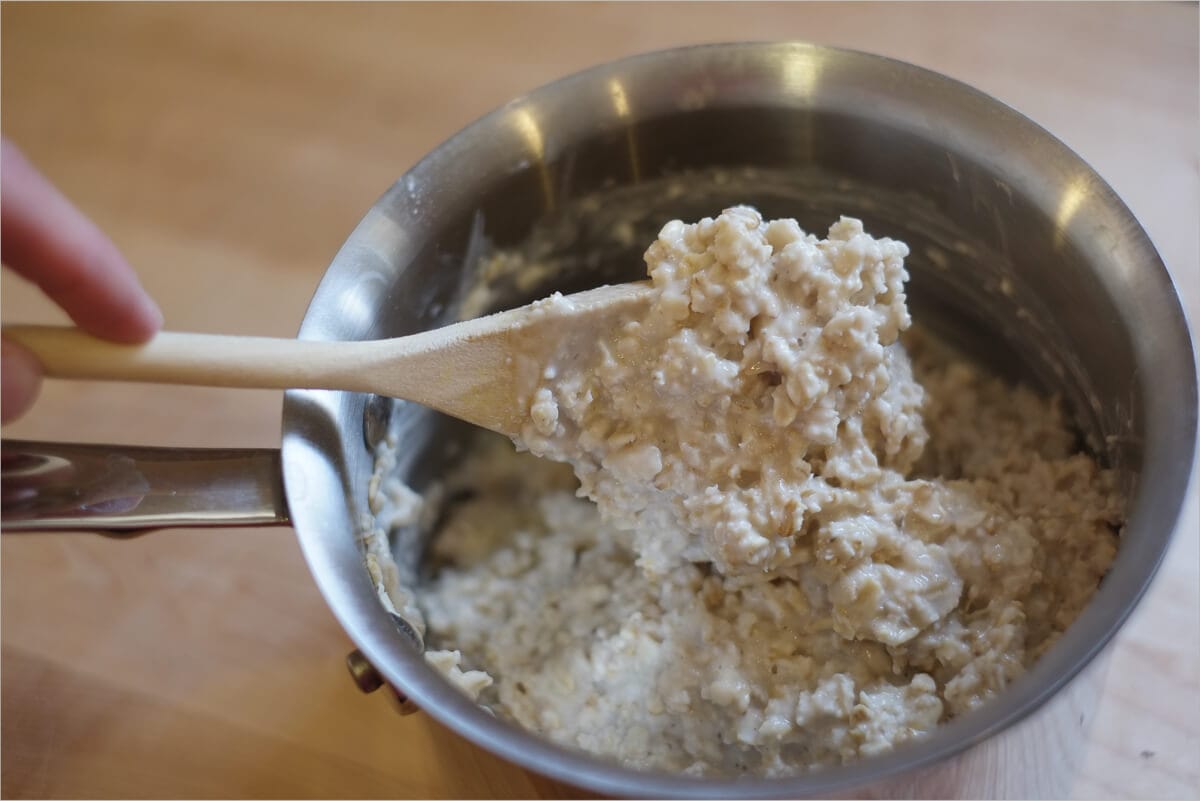
I cooked the following in a covered saucepan over the lower end of medium-low heat for about 16 minutes. You want the porridge to be creamy and ever so slightly on the liquid side. Don’t cook for too long or at too high a high a heat or the porridge will dry out and become very stiff. I’ve found that cooking this porridge requires a bit of trial and error; each person has a different idea of what “porridge” means and typically for me, it’s more on the dry side. When I made the porridge for this bread at a lower heat and only for 16 minutes, it was creamy with a whitish color that was easy to later fold and incorporate into the dough.
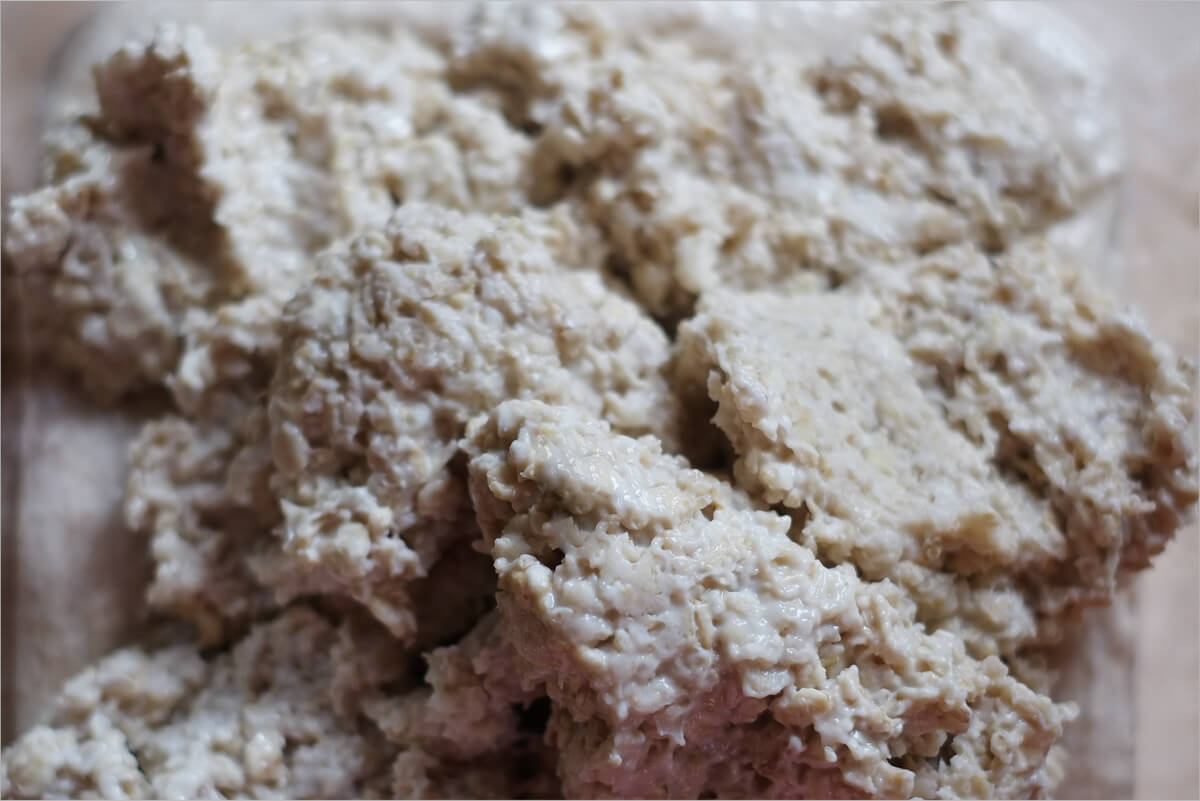
After this cooking time, I scooped out the porridge onto a baking sheet and covered with aluminum foil to cool but not dry out.
| Weight | Ingredient |
|---|---|
| 500g | Water |
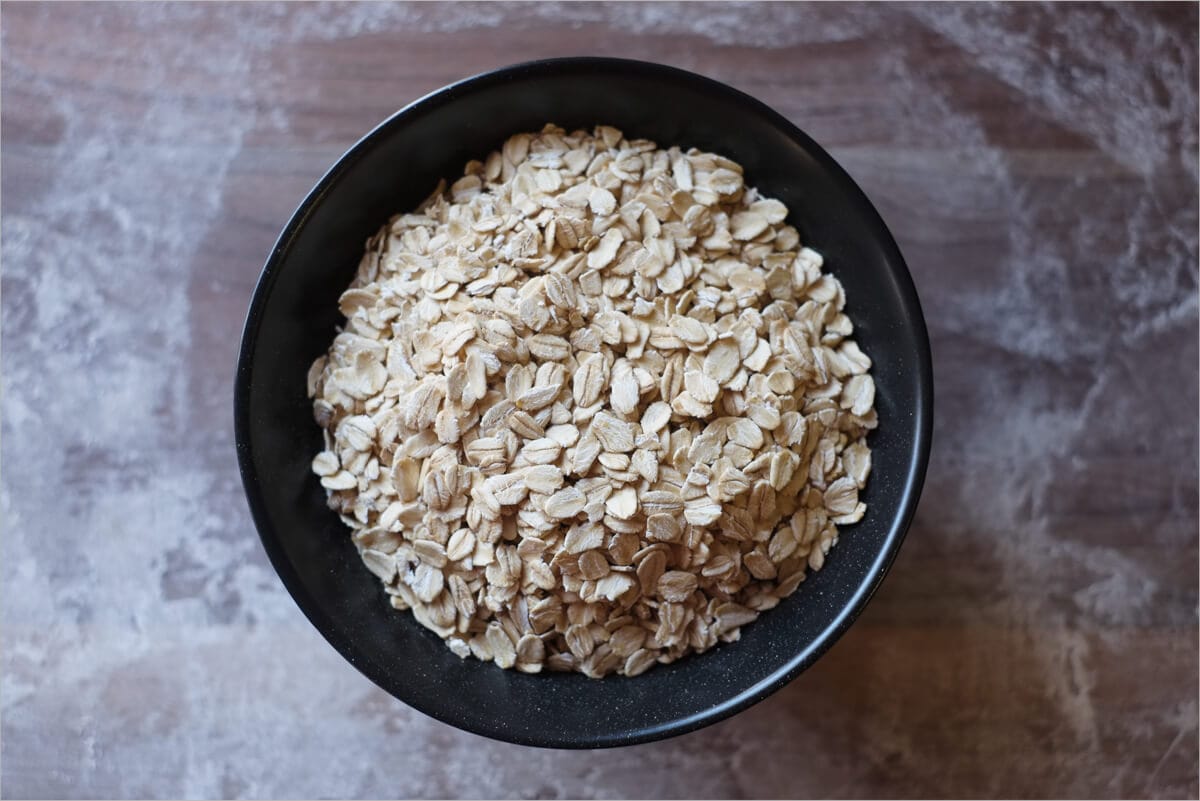
| 250g | Bob’s Red Mill old fashioned regular rolled oats |
| A Pinch | Fine sea salt |
You’ll want to cook this far enough in advance to ensure it cools sufficiently before mixing into your dough right before the first set of stretch and folds during bulk fermentation. You don’t want to mix warm/hot oats into your dough; fermentation will pick up at a rapid pace I have nightmares about dough like this. I cook the porridge right before I start the 1 hour autolyse to give it much needed cooling time.
Now that the porridge is cooked and cooling let’s start our 1 hour autolyse.
Pseudo-autolyse & Mix – 11:30 a.m.
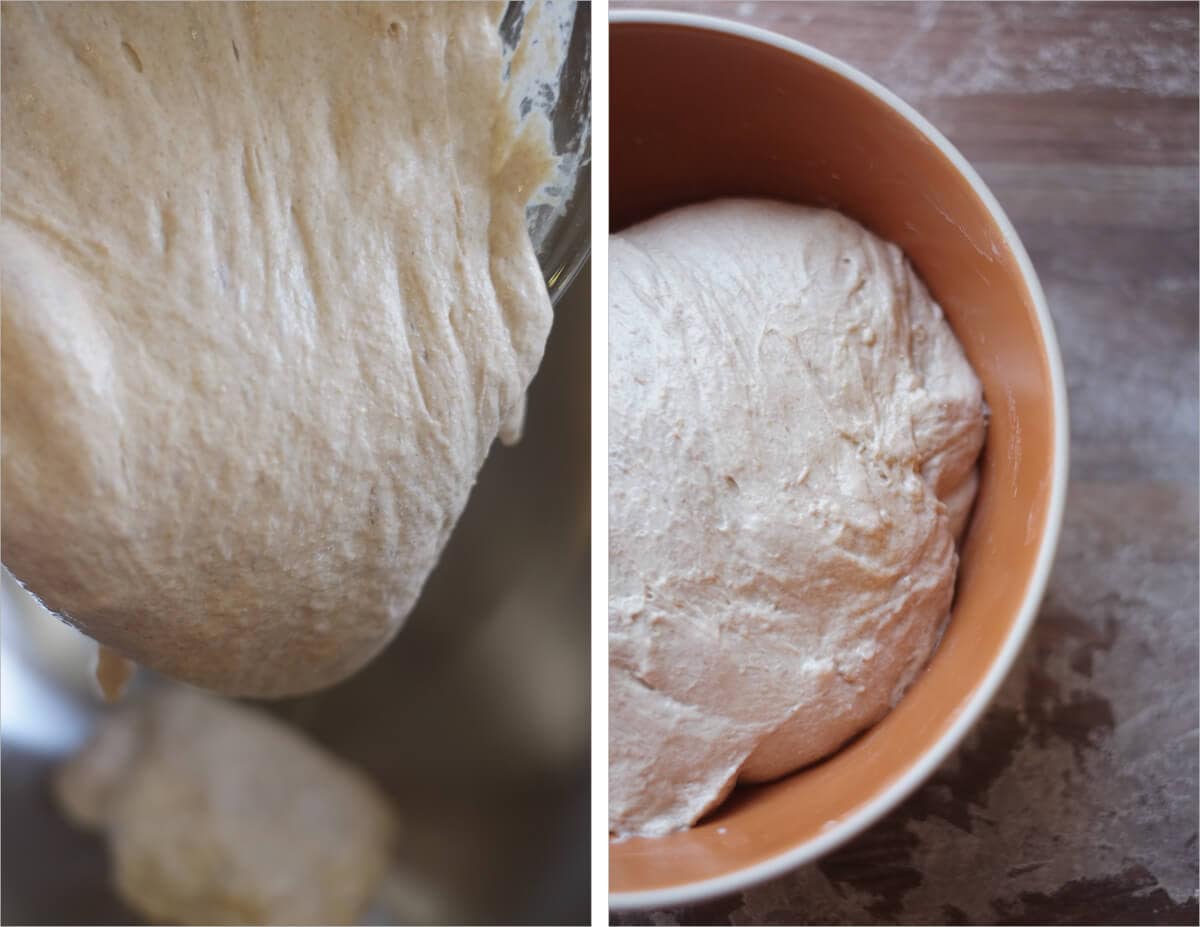
For this bread, I’ve found the best results with a 1 hour autolyse, which increases the extensibility of the dough. This leads to a more relaxed dough to help incorporate the oat porridge later in bulk fermentation.
I label this a “pseudo-autolyse” because it does include my preferment (levain), which isn’t typically added to an autolyse. For this mix, it makes sense for me to add my levain to the autolyse because the dough is rather stiff due to the lower hydration. Adding the levain, and all of its water, is necessary so I can effectively mix the dough.
Gather the following:
| Weight | Ingredient | Baker’s Percentage |
|---|---|---|
| 700g | White bread flour, ~13% protein (Sangre de Cristo, a local high protein flour) | 70% |
| 300g | Whole wheat flour (King Arthur Flour Whole Wheat flour) | 30% |
| 750g | Water | 75% |
| 150g | Ripe levain | 15% |
Then:
- In a thick bowl add in your 150g levain
- Add 700g of your total water to your mixing bowl and mix with your hand until the levain is wholly dissolved
- Add in your white and whole wheat flours
- Mix by hand until all the dry ingredients are incorporated
- Cover with wrap and keep covered in a warmish place in your kitchen at around 78°F (25°C) for 1 hour
After your one hour pseudo-autolyse, add to your mass:
- 25g sea salt
- 25g of the remaining water
Cut the salt through your dough with your hand and mix everything until it comes back together and becomes sticky.
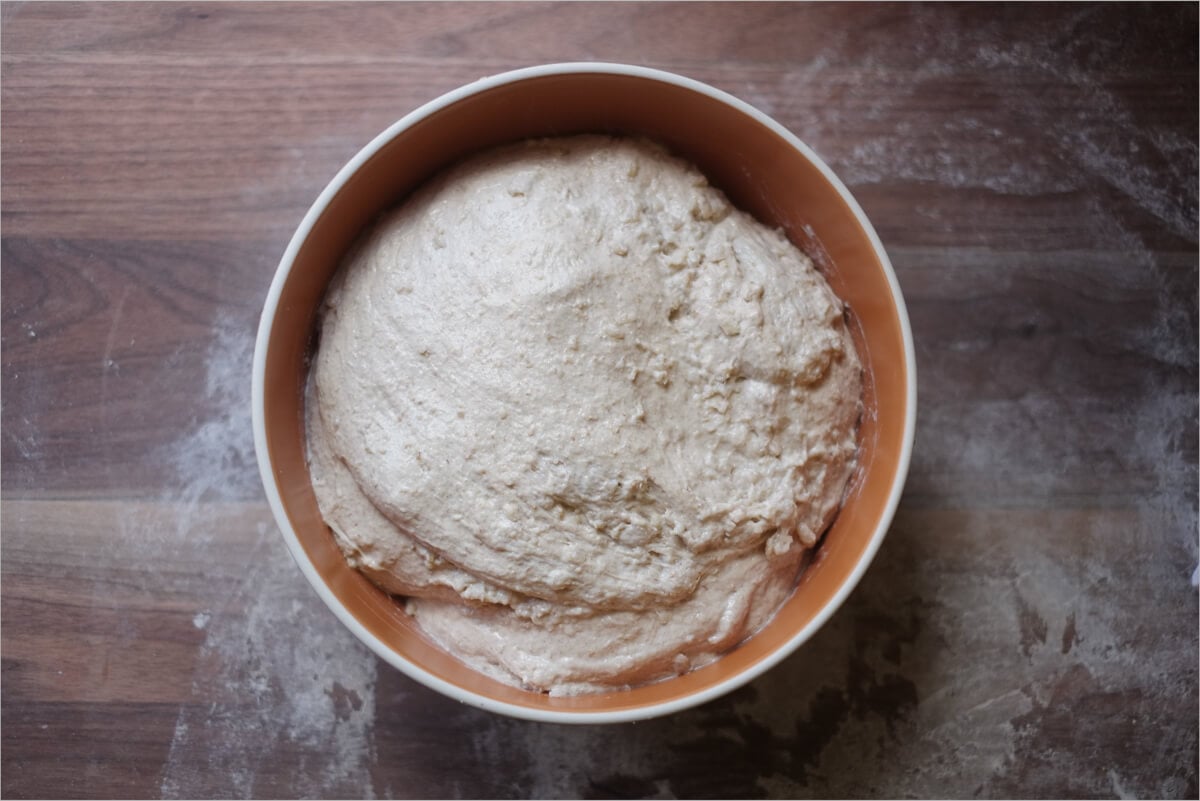
At this point, as I was mixing in the 25g salt and 25g water, I started to feel a little anxious… I wanted to add more water; things just felt strangely stiff. You must fight the urge to add more water here, trust me. Once you add in your cooked oat porridge later in the process, the oats will release quite a bit of water into your dough, dramatically increasing hydration. Early attempts at this bread had me sweating as I was trying to shape hydrations that were undoubtedly more than 100%.
| Final dough temperature: | 79°F (25°C) |
Bulk Fermentation – 12:30 p.m. to 6:00 p.m.
Transfer your dough to a clear container to be used during bulk fermentation and let rest for the first 30 minutes.
After the first 30 minutes and right before your first set of stretches and folds, add in the oat porridge a little bit at a time folding well after each addition (as I show in my guide to stretches and folds). Use splashes of your remaining 25g of water a little at a time as your folding the porridge into your dough. You’ll have to make the judgment call here whether you’ll need the entire 25g based on how your dough feels. I ended up using it all, but it has been quite dry lately here in New Mexico.
Now that the porridge is incorporated perform the first turn set, and each subsequent, in 30-minute intervals. When performing each set, pinch any large clumps of oats with your fingers to break them up; we want a fairly uniform distribution of porridge throughout the dough and very, very few pockets of porridge hiding in your final loaves.
- 1:00 p.m. – Turn Set 1
- 1:30 p.m. – Turn Set 2
- 2:00 p.m. – Turn Set 3
- 2:30 p.m. – Turn Set 4
- 3:00 p.m. – Turn Set 5
- 3:30 p.m. – Turn Set 6
- 4:00 p.m. – 6:00 p.m. – Rest on counter untouched
The dough was so wet I felt like I could have just kept strengthening it until the sun set. You’ll need to judge when the dough has reached sufficient strength to stop the stretch and folds. Six sets did the trick for me.
Pre-shape – 6:00 p.m.
Take the dough out of the container onto your work surface and sprinkle some flour on top before dividing. Divide into two halves and lightly scoot the dough in little circles across your work surface with your bench knife in one hand and your other empty hand. Let this pre-shape rest, covered with a damp towel or inverted bowls, for 20 minutes.
You want to do the pre-shape rather tight, a little tighter than you’d typically do for my standard country sourdough. The tight pre-shape will help strengthen the dough just a little bit more before your final shaping.
Lightly dust your proofing bowls/baskets with white or brown rice flour in preparation for the next step.
Shape + Proof – 6:30 p.m.
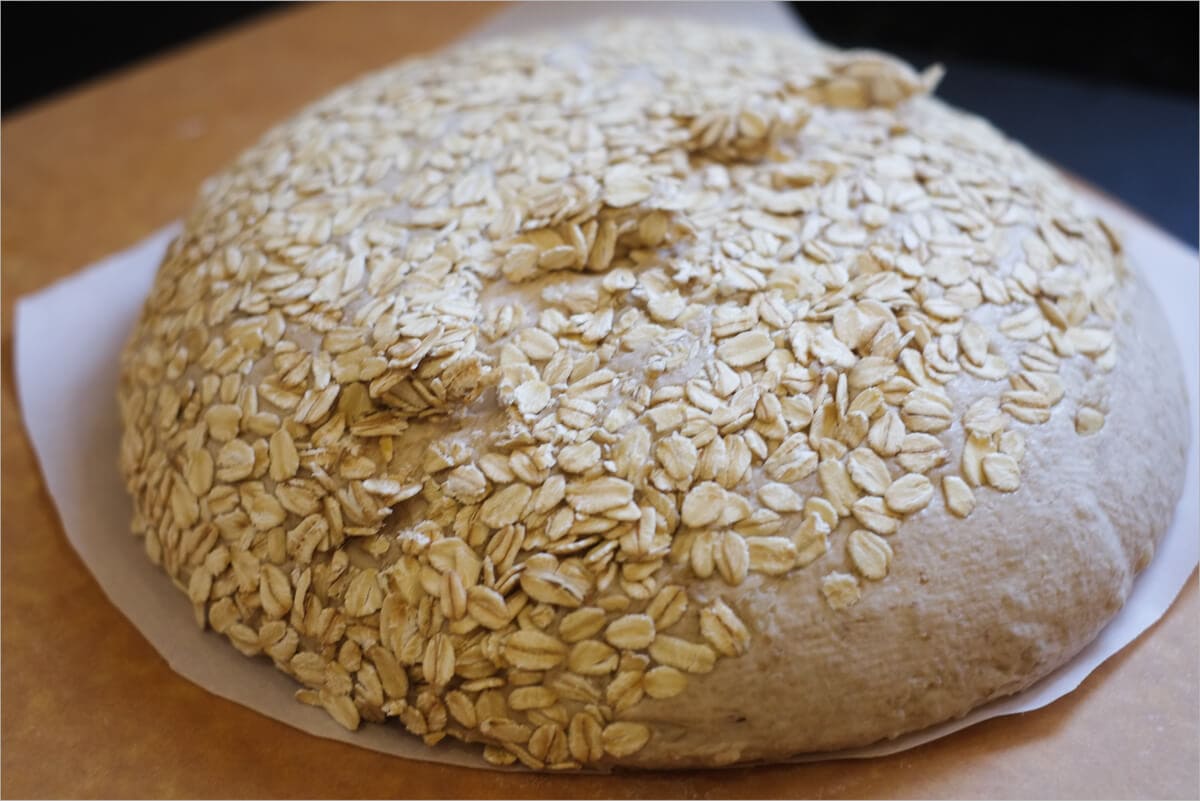
Take a clean kitchen towel and lay it on the counter. Spread flat some of the uncooked rolled oats onto the towel in a circle about the size of your desired finished boules. After shaping, you’ll quickly plop the shaped boule on top of these oats to coat the surface before placing into your proofing baskets, creating a nice dotted surface with a touch of crunch after baking.
Make sure you shape these boules tight to give them added structure during their overnight proof in the fridge.
For this wet porridge dough, I find shaping into tight boules produces a much better result than using Tartine’s “structural shaping” technique for a batard shape. Shaping here is your typical procedure, folding the dough up like a package and then twisting on the work surface to create tension. For a detailed explanation see this post’s section on shaping.
After each boule is shaped tight and resting on the counter, scrape up the first boule and gently invert and drop onto the resting rolled oats. Pick up the boule with both hands and gently lower into the proofing basket, seam side up. Spread out some more rolled oats for the next boule and repeat.
I found that this bread requires a little more proof time to get that fermentation active. After doing the final shape, I left these loaves out on the kitchen counter (ambient temp was around 74°F/23°C) for an hour.
Score + Bake – 9:00 a.m. (next day)
In the morning, preheat your oven with Dutch oven inside to 450°F (230°C). I usually leave the shallow side facing up on the left, and the deeper side on the right facing down. This way when it’s time to load the bread I can quickly grab the shallow side, slide in the dough, and then place back on the stone and place the deep side on top to cover.
See my guide to baking with a Dutch oven for more pictures and instruction.
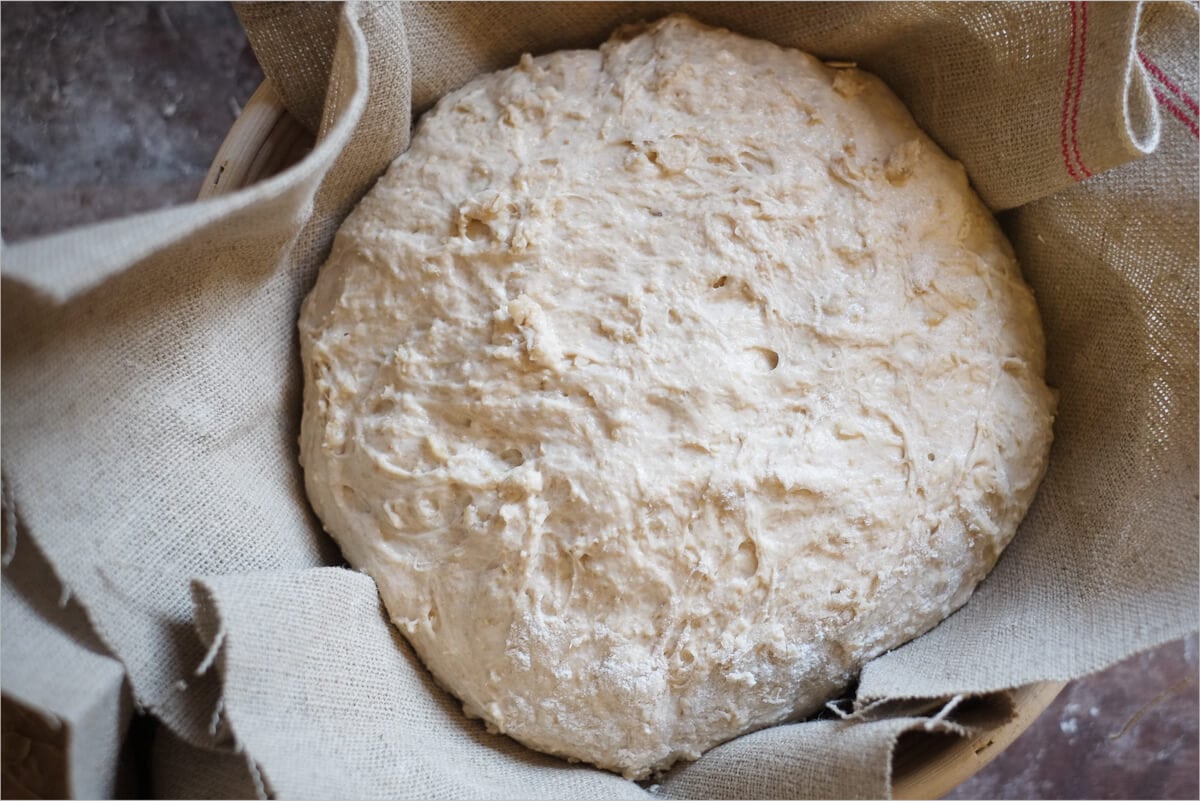
After one hour, take one of your baskets out of the fridge and cut a piece of parchment paper to place on top. Take your peel and then put it on top of those two and quickly invert it, so the dough is now resting on the parchment paper and the peel.
For these oat porridge loaves, I have taken quite a liking to Tartine’s “zipper” like scoring. Grab your kitchen shears and do 3-4 snips across the top of the dough so that the shears are almost entirely parallel to the surface. This score opens up so beautifully and creates a very rustic feel to these loaves, which contrasts elegantly with the dotted rolled oat surface.
Wait at least 1-2 hours before cutting into the finished loaves to let the interior fully set.
Take out the shallow side of your Dutch oven and drag in your boule. Quickly place the pan back in the oven, cover with the deep side, and bake for 20 minutes. After this time, open the oven and take off the deep lid of the Dutch oven (set it next to the other half inside the oven, which will help regulate oven temperature for the rest of the bake), then bake for an additional 35 minutes or so, until the bread is to your desired doneness.
This oat porridge sourdough requires a little longer bake time to get that nice dark outer crust. Additionally, the interior, extremely hydrated by the porridge, takes several additional minutes to bake thoroughly. For this dough you’ll want to experiment with bake times and temperatures, potentially decreasing the heat towards the end of the bake to extend the bake time without scorching the crust. I ended up baking for a total of 35 minutes for the last uncovered portion.
Once your bake is finished, be sure to wait to slice it, and store it properly to keep it fresh for up to a week.
Conclusion
This first venture into porridge bread was a challenge for me; adding in another type of grain that has been cooked with additional hydration threw a wrench into my process and had me experimenting until things came out how I was hoping. The results, though, are pretty darn great. This bread has a very, very moist crumb with a fragile crust that stays good for many days after baking. I made toast almost a week after and the bread still tasted fresh to me.
Crust
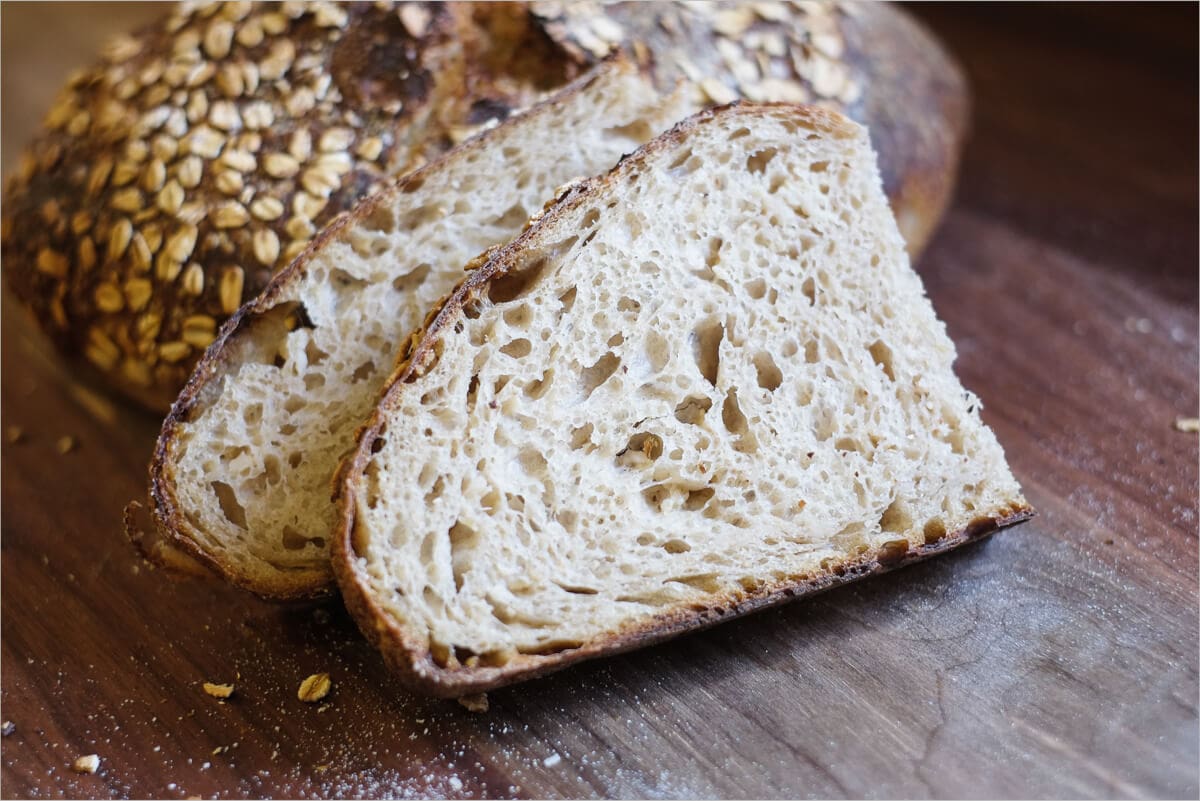
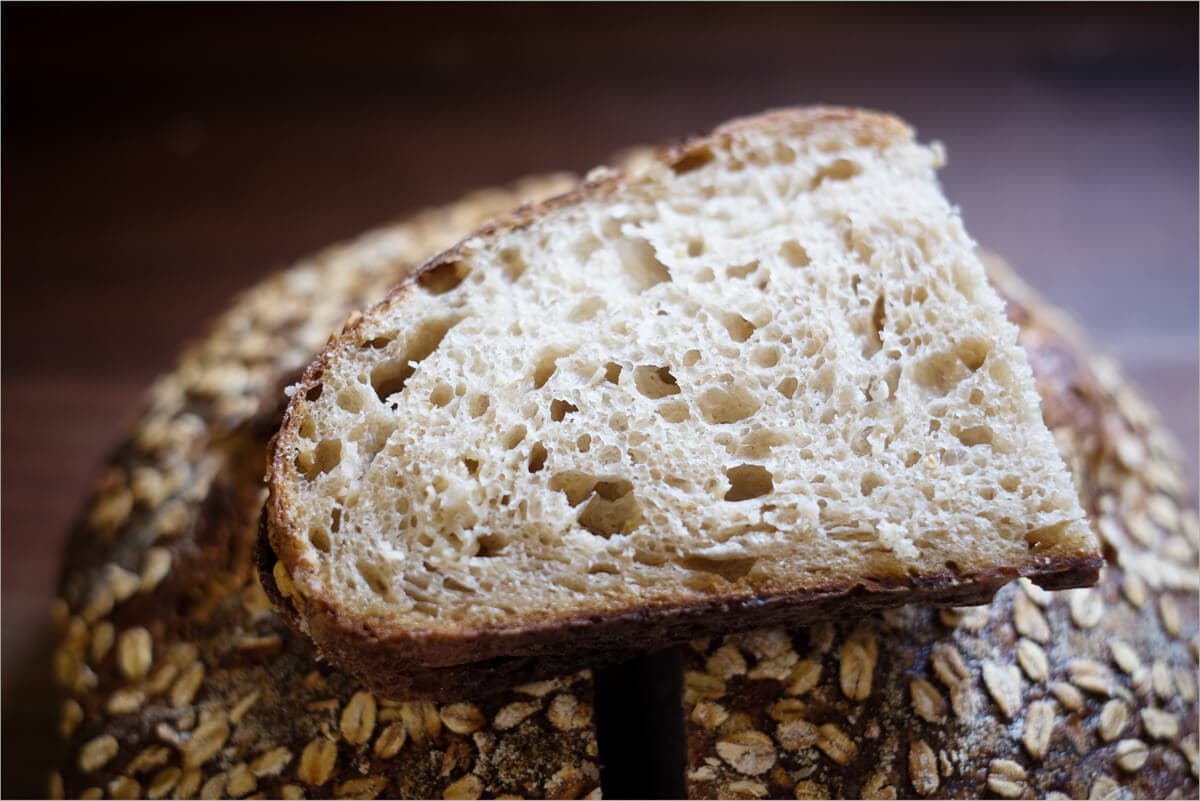
Marvelously thin and unexpectedly soft, this crust was colored so well and had such a unique taste. It’s something different than the other bread I’ve made, hard to put into words, but if I had to sum it up, I’d say soft like silk. The super high hydration must leave its mark and the mark is very welcomed.
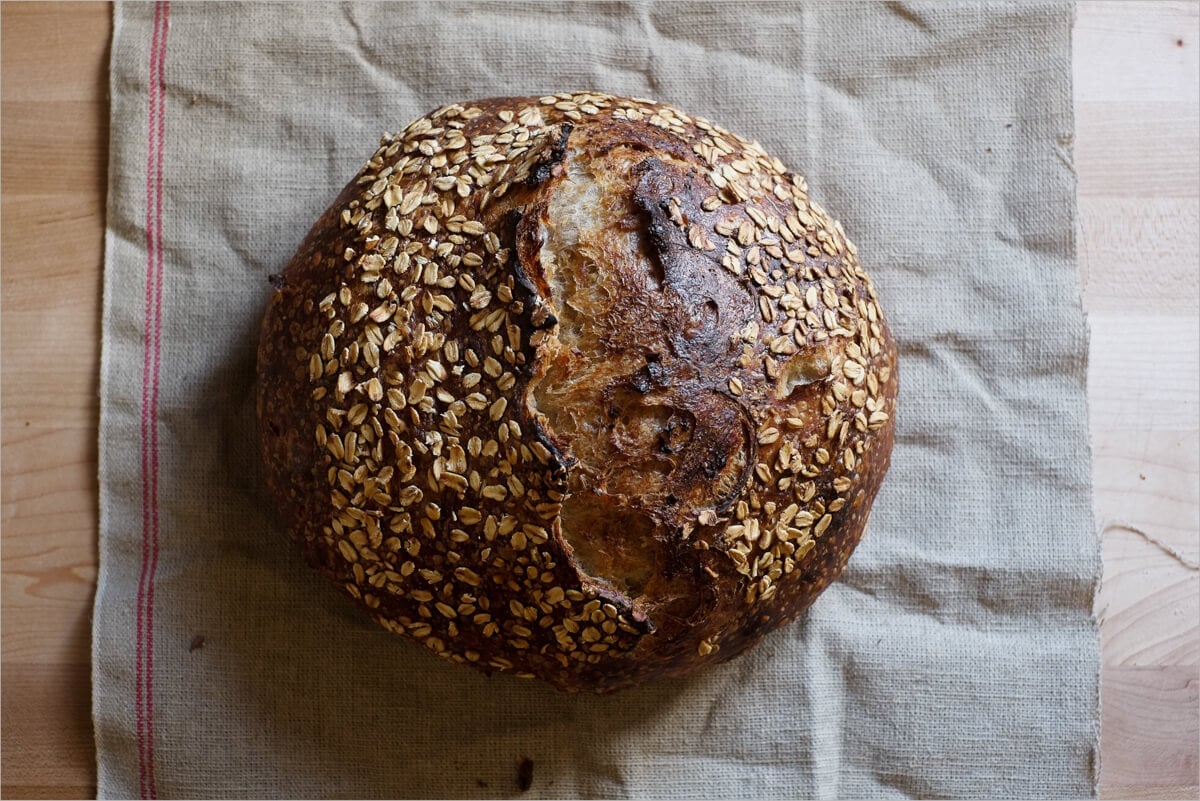
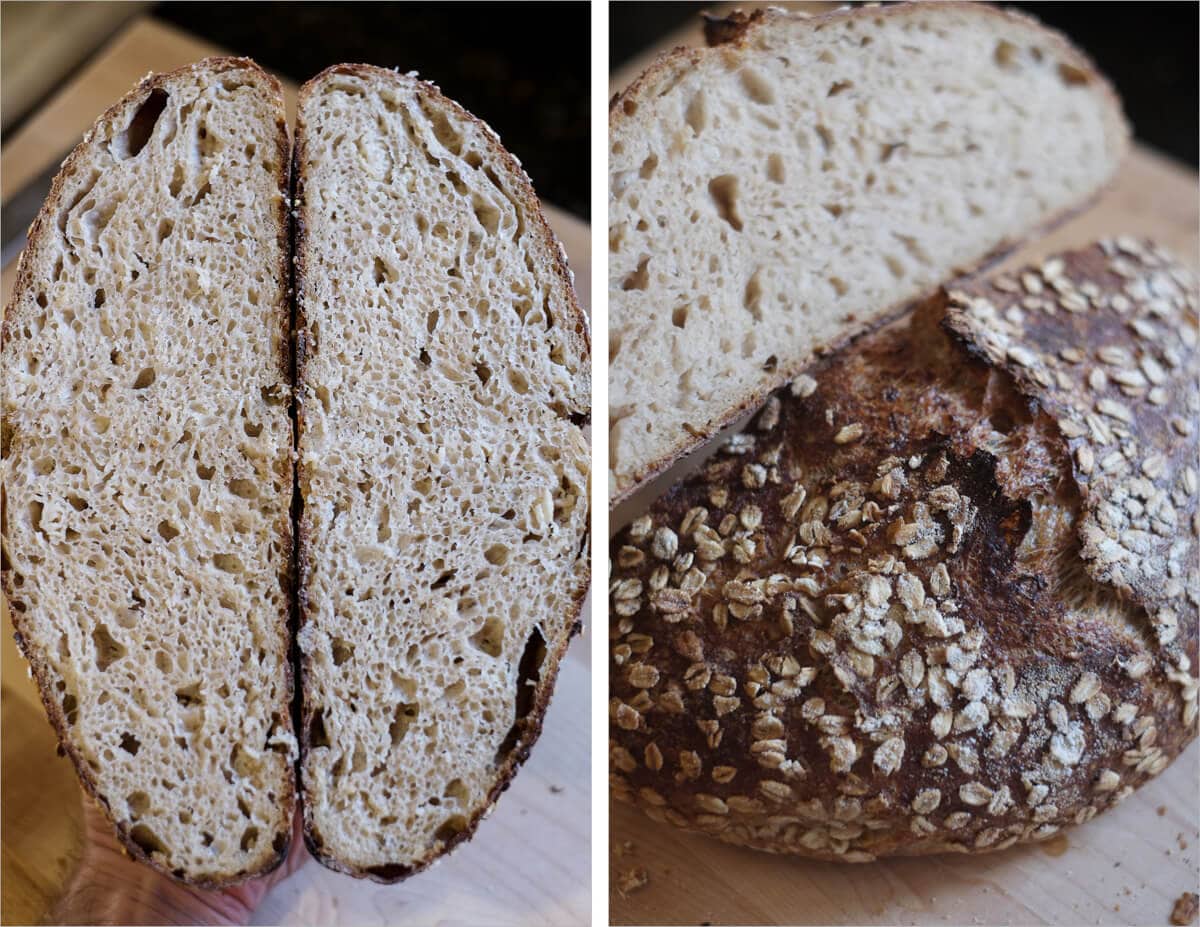
Just look at those colors. I heard myself saying “oooooh” in my head as I first saw that picture from my camera roll. I love the sheen and the shine, the striations of color, the dark spots and the light spots. The crunchy baked oats on top impart a nice crispness to the outside when you bite into the bread, I wouldn’t bake this bread without them.
Crumb
The crumb is just straight tender. Nothing I’ve had can compare to this light, stretchy and custard-like interior. My latest attempt produced an excellent and open result.
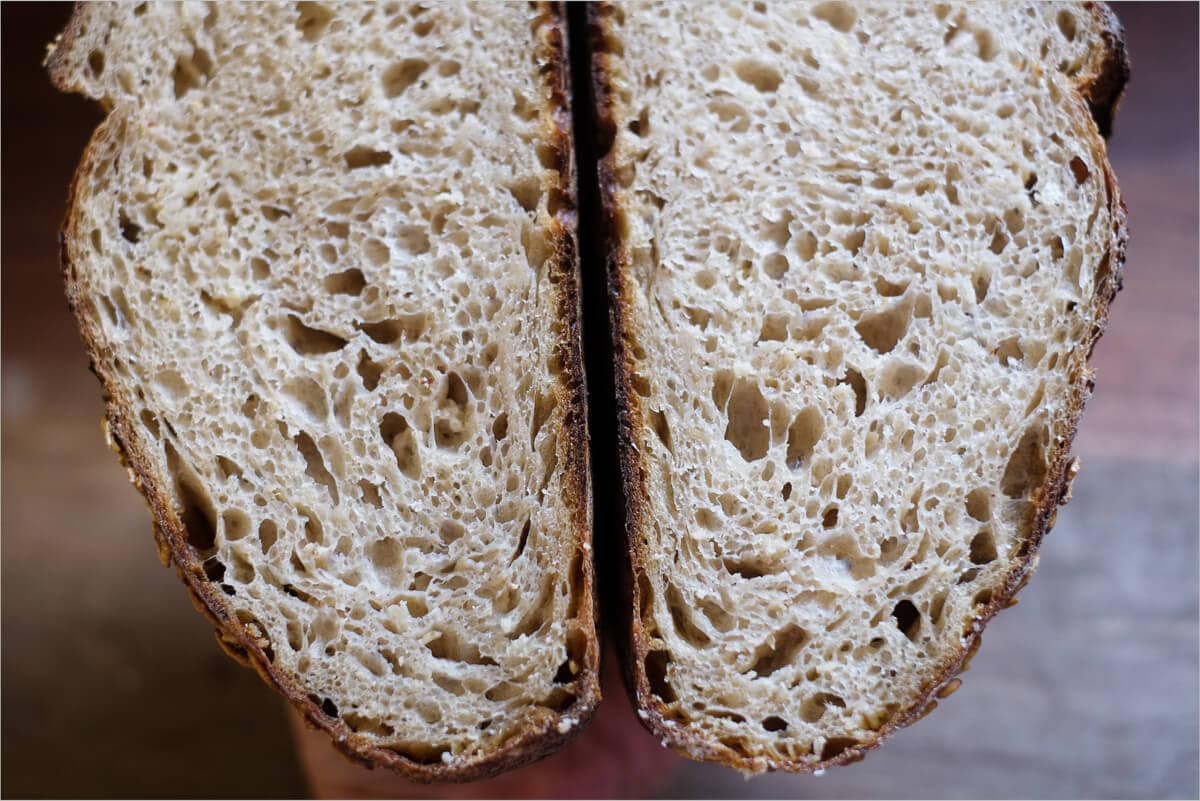
You can see in this shot the crumb was quite light and airy, I love this aspect of this bread. With my mixing and stretch and folding, I finally was able to sufficiently incorporate the oat porridge throughout the loaf.
Taste
Not much more to say here than already stated: it’s remarkable. This cooked oat porridge does not impart a particularly heavy “oat” taste to the bread, but rather, adds moistness and tenderness that hints at a light nutty flavor. For days after the bread remained moist inside, and when toasted, became crisp and continued to have that fresh-baked-bread taste.
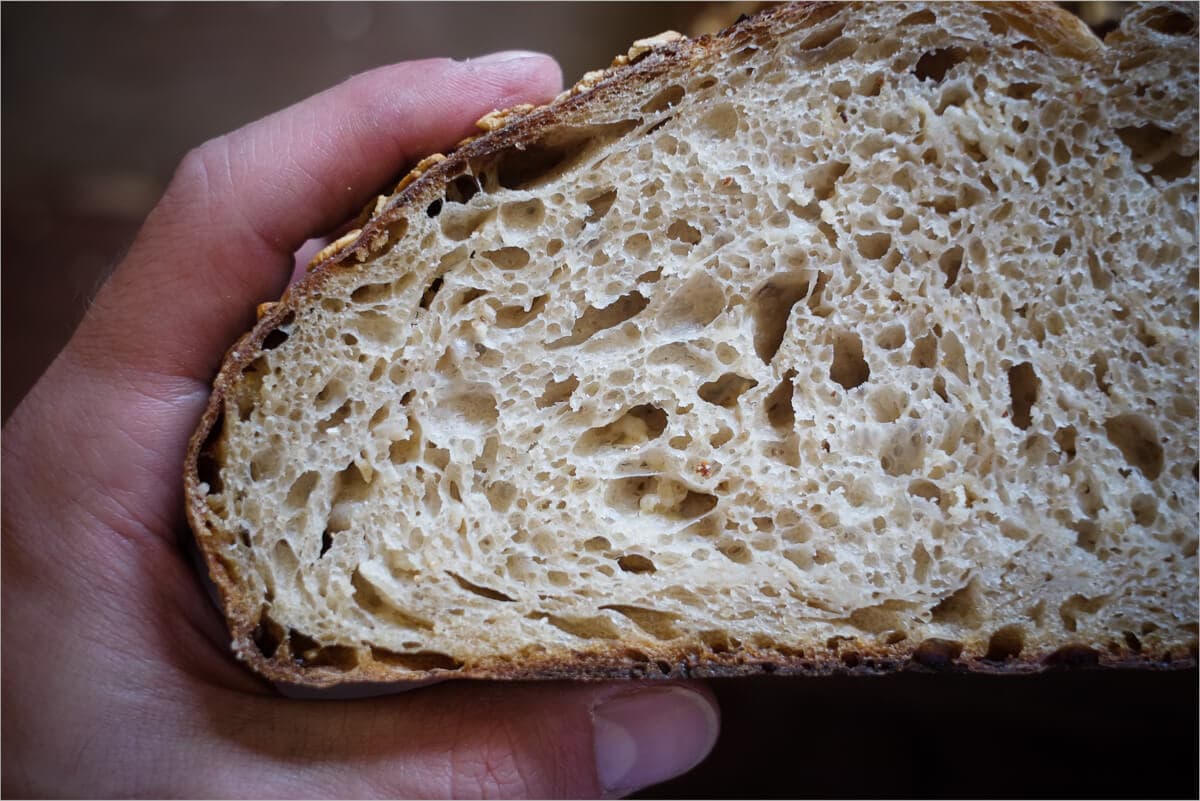
I highly recommend trying this bread! If you have any issues or questions, drop me a post below, and I shall do my best to get you on track. For the curious, read on for some of my “missed” attempts including some notes, pictures, and my hypotheses on why things didn’t quite pan out.
Previous Oat Porridge Attempts
Attempt #1 – The Strong Dough
The following bake was my very first attempt at this recipe and my first endeavor into the world of porridge bread. As you can see in the following pictures, the results were less than stellar. I did not sufficiently mix the porridge through the dough, the crust was on the pale side, and hardly any oven spring. Also, there was almost no openness to the crumb — a rather dense product.
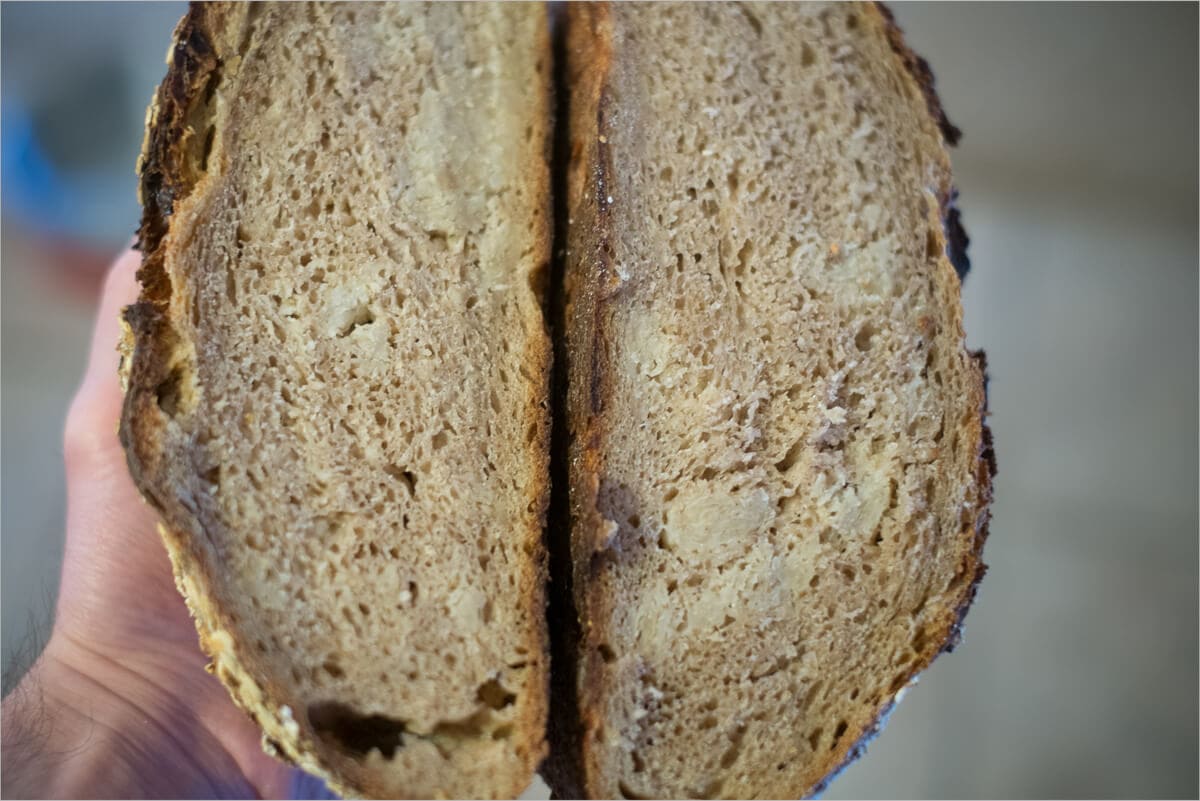
Yikes, that’s ugly! I followed the Tartine No. 3 Oat Porridge Bread recipe nearly precisely, except for two deviations: I only had Bob’s Red Mill Thick Rolled Oats on hand (this is what I typically eat for breakfast) instead of traditional rolled oats which are much thinner, and I upped the levain amount by 25g (to a total of 175g).
Using thick oats and cooking them uncovered at medium heat most definitely overcooked them and dried them out to the point where they became stiff & hard to integrate into the dough. These rigid pockets of oats were scattered throughout the final loaf and were both unsightly and not very pleasant.
For this attempt, I also only performed a 40 minute autolyse and the resulting dough was not extensible enough, adding to the difficult task of mixing in the dry and stiff porridge.
Key Lessons Learned from Attempt #1
- Don’t use thick rolled oats, instead opt for traditional rolled oats
- Dough needs at least a 1 hour autolyse to increase extensibility
- Mix in the porridge until it’s thoroughly incorporated
- Cook porridge covered to prevent it from drying out
Attempt #2 – The Hydrated Surprise
For my second go at this recipe, I vowed to rectify the stiff porridge by using regular rolled oats and upping the amount of water used during cooking. Instead of 500g for the porridge, I ended up using 800g, added in 100g increments after the 500g at the start. This was cooked again at medium heat in an uncovered saucepan.
In addition to adding more water to the porridge, I also increased the autolyse time to a full 1 hour. This length of time did help to increase extensibility in the dough to make oat incorporation easier.
When it came to adding in the porridge everything was looking good: the dough was rather tight, and strength was there, but there was some excellent extensibility thanks to the increased autolyse. A few turn sets into the bulk fermentation, and that’s when I noticed things were starting to go south on me… The dough became extraordinarily slack and was failing to hold any shape after stretching and folding. It was quickly turning into a nightmare scenario where hydration levels are pushed too far for the flour to handle. Cooked oats can absorb a significantly large amount of water, about 84% by weight, and that water is coaxed out of the grain later as bulk fermentation progresses. I ended up cobbling together some decently shaped boules, but at hydration that must have exceeded 100%, I was seriously having trouble.
The result was again abysmal. The crust was pale, displaying almost no caramelization during the bake and little dynamic oven spring.
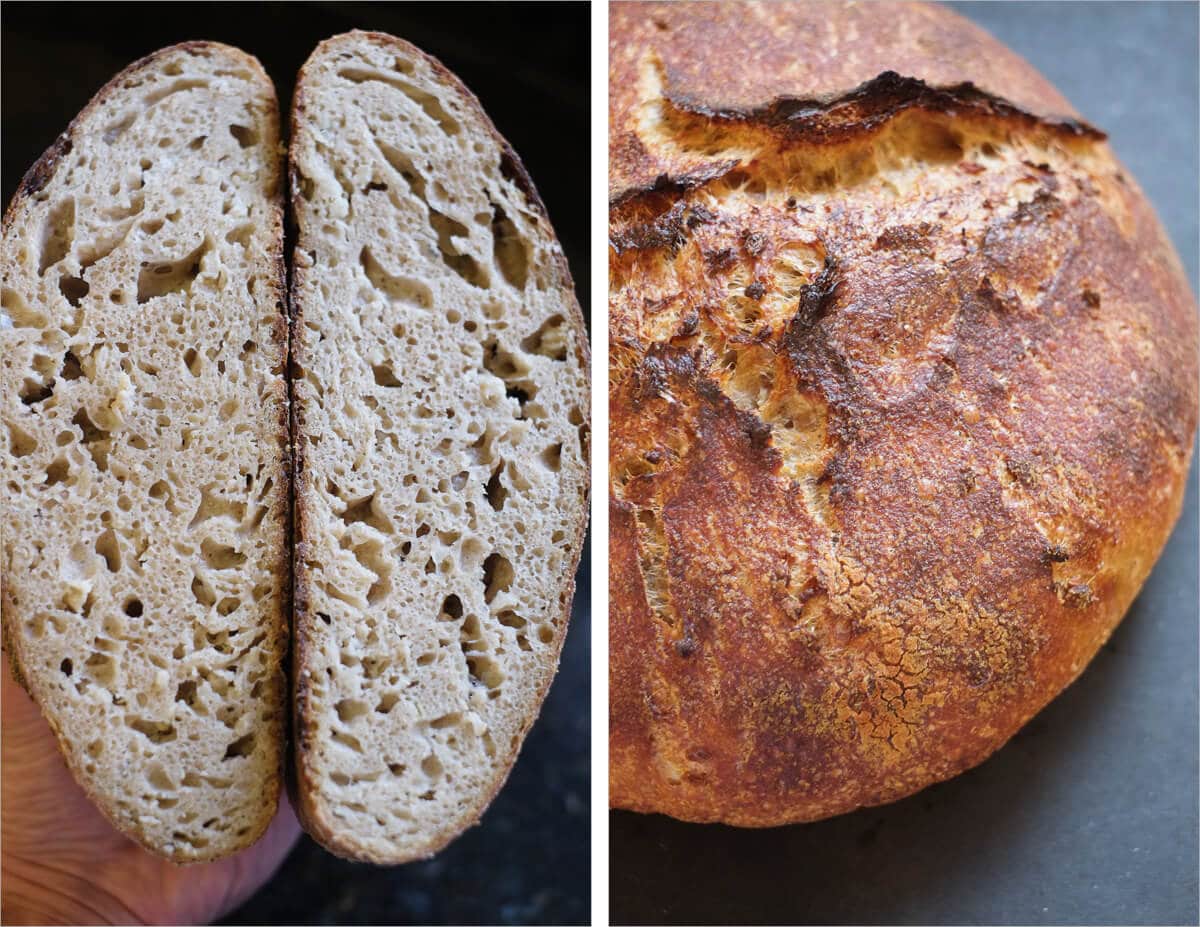
The crumb was marginally open, but it was far too wet. After cutting into the bread, it had a shine to it that almost looked damp to me. The actual taste of it was not that bad, but it needed a good solid run through the toaster to firm things up, perhaps the loaf required a little bit more baking time.
Key Lessons Learned from Attempt #2
- Do not add excess water to the porridge. Shoot for the 500g outlined in the successful recipe above
- Cook the oats on medium-low heat to prevent burning and rapid cooking
- The oat porridge was incorporated more thoroughly but not quite enough; we’ll need to do more pinching and folding
- Because of the extremely high hydration here, there was not enough strength in the dough, causing poor oven spring
- 1 hour autolyse time right on the money
Attempt #3 – Oh The Beautiful Crust
My hopes and energies were high at the start of my third attempt. I felt like I had successfully flanked the two sides of this bread: one side was under hydrated with a stiff porridge, and the other side was way over hydrated with an almost soupy mess of porridge and flours. At this point, I surely could find the middle point and create something magnificent.
I reduced the amount of water in the porridge down to 500g but cooked it on medium-low heat, covered, for 18 minutes. The result was a more creamy porridge which was much easier to fold into the dough and thoroughly incorporate. There was still some work to do here though; I needed to continue to pinch any oat pockets found during subsequent stretch and folds to break them up and do a more intensive job of incorporating.
As I lifted the top part of the Dutch oven off, I noticed the oven spring for this attempt was respectable, but it did not hit my self-imposed goal. Crumb, well, there was some excellent openness to it, but it was still far too tight more deep holes and pockets, please.
I was happily surprised at the beautiful color and caramelization of the crust when baking these loaves. Beautiful dark colors at the edges and light centers where the scissors had left their marks. Gorgeous.
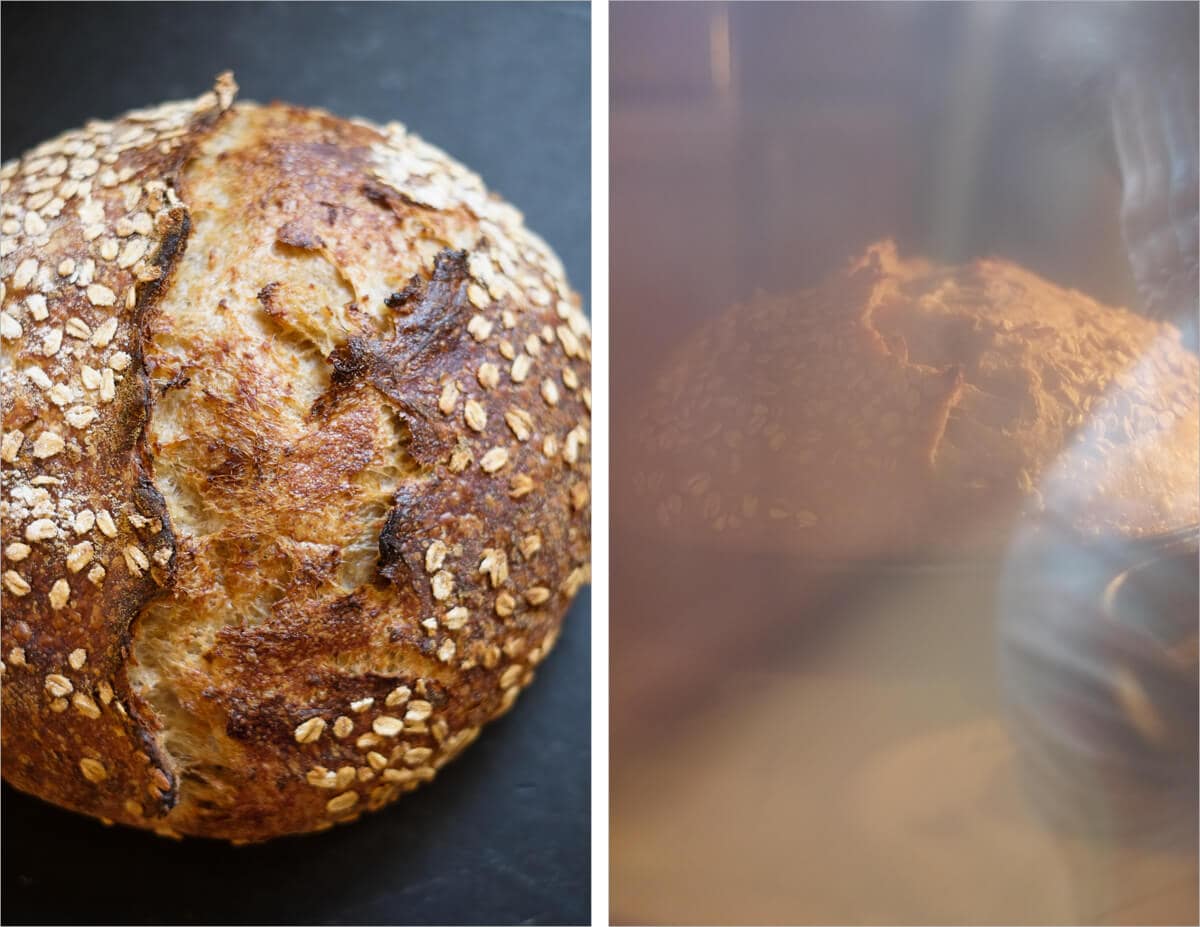
All-in-all it was a solid attempt with some excellent improvements on the outward appearance. With notes scribbled down in my notebook, I was determined to adjust a few parameters and give this another shot.
Key Lessons Learned from Attempt #3
- Cover the oat porridge while cooking to prevent burning and water evaporation
- Wait as long as possible before cutting into the baked loaves, at least 1 (seriously!) hour and preferably overnight
- Oats were incorporated much more uniformly, but still had some room for improvement here
Attempt #4 – Just Roll With It
I was eager, excited, and confident at the start. Keen to cook the oats to the correct creamy consistency, excited to get the hydration level spot on, and confident the result was going to be what I had been searching for the previous attempts. So. Close. Oh so close. My results had much promise, but there still were a few tweaks needed.
I found that the key is to cook the oats at the lower end of medium-low for a full 16 minutes, and covered. 500g is the correct amount of water for 250g of oats, and you want to add the pinch of salt at the beginning of the cook, right when you put the water and oats together.
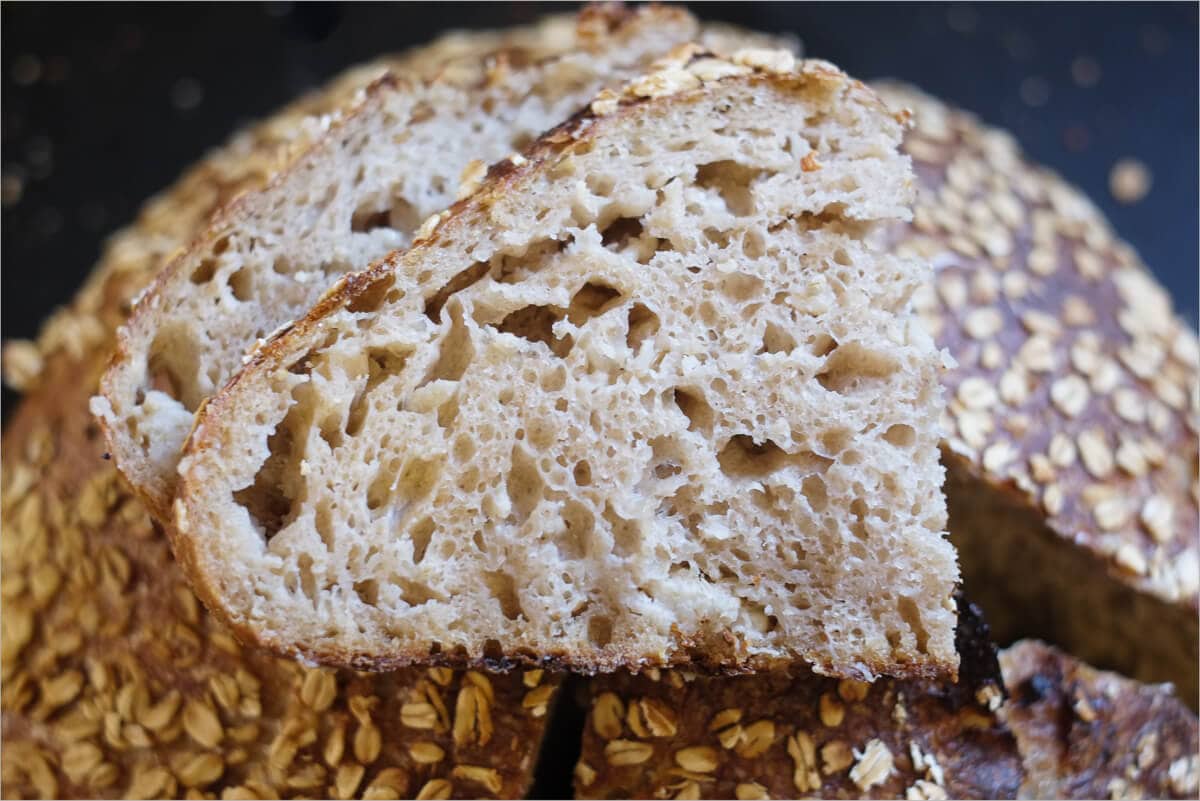
The crumb for this attempt was really splendid! I think things could have opened up a bit more with larger pockets given additional proof time. Since I reduce the levain to a meager 150g I should have realized the proof time should have been extended until I noticed things were moving along far enough.
The crust on this loaf came out gorgeous, yet again. Perfect caramelization, dynamic movement from the excellent oven spring and the scissor snips again showed a great zig-zag all the way down with dark colors on one side and light on the other.
Key Lessons Learned from Attempt #4
- Cook oats covered on the low end of medium-low for 16 minutes, you want a creamy consistency
- Add porridge before the first turn of bulk, incorporate well
- The dough will become pretty slack, do vigorous turns
- The 50g you hold back should be used cautiously. If your dough starts to feel slack, don’t add it all in.
- Pre-shape tight and shape tight
- Ensure fully proofed
Fin
And so that’s all we have, folks. Many attempts led up to what I believe was the best loaf yet. I know there will be more and more improvements as I continue to bake this bread, and don’t worry, those will be chronicled and entered into a future post if the loaf improves sufficiently.
Even though some of these bakes were not encouraging, especially at the outset, this craft is one that takes patience and persistence. Sometimes I almost forget this axiom but then I’m reminded I always have something exceptional to eat, and my troubled thoughts vanish as I take the first bite. I think it was best said by Hamelman:
Experiment, play, realize that failure isn’t really a failure, it’s an edible part of your evolution as a baker.
Jeffrey Hamelman
Buon appetito!
If you use this recipe, tag @maurizio on Instagram so I can take a look!


240 Comments
Hi from Geneva, Switzerland. Thank you so much for the recipe and the story. I was looking for an oat sourdough recipe for some time now and finally I went with yours. I thought that it would be tough to beat the rye sourdough with cumin and onion we became addicted to. But the result is spectacularly good bread ooh so fluffy inside. I got a really strong btead flour, cut all the ingredients to two thirds so it would fit into my old dutch crock pot, but the bread is still huge but very light. The surprise was that when I mixed the dough, keeping it to 65% hydration, it looked ok, very elastic but still strong. The only thing that gave it away was that it was really heavy. Then 8 hours later the oats did their thing and the dough became a little bit wet, it made me laugh when it ignored my attempts on shaping it. After the final raise in the basket (it was nicely raised) the little laps of time it took me to get the pot out of the oven, the proofed dough poured itself out of the baking paper all over the counter. I had to scoop it up and fold it like harmonica to make it fit in the pot. But suprise! It became a normal roud loaf of bread after 20 minutes and continued to raise even with the lid off. Thanks and I will definitely making this funny bread again!
Glad to hear it mostly turned out well, Alena! I’d say try strengthening the dough a bit more with another set or two of stretch and folds during bulk fermentation. Also, be sure to shape it tightly, even if challenging! That tight shape will help it keep its form all the way to bake time. Keep at it, this recipe does take a bit of practice! Happy baking 🙂
LOVED this recipe.
Tried this for the first time after a few months experimenting with high hydration sourdough, trying to push the limits to 100+% hydration, with olive oil and maple syrup incorporated in the liquid. Using a 600g flour to 450ml liquid (plus starter) for my initial autolyse, I decided on a 125g/250ml porridge (Scots spelling!) inclusion.
First headache. The porridge I used literally set solid in the pan, absorbing that amount of water before heating, so I added more water carefully, but only got the porridge barely heated through before it was again too thick to stir.
Eventually got a porridge cooling on some baking parchment, while my autolyse was happening.
I then veered off by rolling my porridge into a thin cooled sheet, and flattened/stretched my autolysed dough then laid the thin porridge on top and followed my usual multiple stretch and fold procedure to incorporate the inclusion as I would for any inclusion loaf.
Then followed your Turn Set protocol, using book folds for every set, so treating the inclusion a bit like butter in a fine puff pastry.
At each stage it became obvious my porridge was holding way too much water, as the dough got steadily softer and softer. I fell into that trap, and was glad I’d been gaining experience with handling high hydration plain loaves, as the pre-shape and final shape were particularly sketchy.
However, the proofed loaf held its shape, and went into the oven at 450°F for 20 minutes, then 420°F for another 25 minutes, and came out looking great. Not a huge spring, but great dark crust with super spongy and soft crumb, just as you describe. And very very delicious.
Next time, instead of trying to cook porridge for the recipe, I’ll simply soak the porridge in the right amount of water overnight, and blitz in the microwave the next morning, to avoid the over hydration cock-up.
My liquid ‘secret recipe’, which makes amazing plain sourdough loaves is:
600g flour (up to 50/50 blend of white/whole meal strong bread flour)
16g salt
120ml maple syrup
60ml olive oil
270 ml bottled spring water (tap water in London is useless for bread making)
160g active levain (starter)
30 minutes autolyse, 2 2-hourly stretch and folds, 1 hour pre-shape, 1 hour shape & straight into the banneton then overnight in the fridge. 15 mins @ 450°F then 20 mins @ 420°F for a perfect loaf.
Happy to hear you loved this recipe, Brian! Sorry for the delay. Good idea soaking the porridge. Another thing I’ve been testing lately is to simply pour boiled water over the oats, stirring, and letting that cool before mixing (everything) into the dough. Rolled oats are plenty thin and will be softened sufficiently with that method.
Thanks for sharing that plain sourdough recipe—I’ve been playing with adding maple syrup to a loaves recently as well… It adds a wonderful flavor and subtle sweetness that’s addictive!
Thanks for reporting back and happy baking, Brian!
Thanks Maurizio!
Your attention to detail, and in particular the learnings shared from your own experiments really shortcuts the process for everyone.
Any tips on maximising the use of Spelt?
You’re very welcome. Check out my spelt recipes on my recipes page! Usually spelt is pretty sensitive to water, so I tend to keep the hydration lower when working with it at high percentage.
Hi Brian, I am pretty new to sourdough baking. Am trying to make this porridge recipe. Am also intrigued by this SD recipe that you are so fond of because of the maple syrup and olive oil. Is this for one loaf or 2? Is your approach to mix everything before the autolyse, or doing a more traditional autolyse with the flour and water first, then waiting, then adding the starter, then waiting and then starting your S&F?
Hi Victoria,
If you’re new to sourdough, then I would be very cautious about this recipe. It’s full of potholes, which are identified in the actual post, as well as my comments.
As far as my recipe is concerned, it’s a single loaf, with all of the wets (water, maple syrup, oil and peak activity starter/leavain) mixed then added straight to the dry mix (flours & salt).
Beyond that initial thorough mix, it’s the lift & fold bulk ferment sequence (21° C temperature) and then a large circular Banetton in the fridge overnight.
If you want to do the porridge loaf, I really recommend trying increased levels of hydration with a standard flour/salt/levain mix, as you’ll get a good understanding of how to handle much water doughs will. It’s tricky stuff requiring a very gentle touch.
Best of luck, and happy baking!
TY for your response. back to your perfect loaf…two quick questions. Want to try to make it. Are you mixing everything by hand or with a stand mixer before your S&F? If yes to the stand mixer, how long are you running it before the letting it rest for the
30 minute autolyse?
I just mix the wets into the drys in a bowl and go at it with the wrong end of a wooden spoon until there’s no dry flour visible in the bowl, so it’s quite a crude, grainy mass. Cover with a tea towel or shower cap and leave for a 30 minute autolyse. Then come back for the first set of stretch and folds, using a water spray gun to wet your surface and hands to prevent sticking. For the first set, get your dough out of the bowl using the curved plastic scraper tool, and spread/tug out as gently as you can until it’s about an inch thick. Then lift with two hands on the edge nearest you until the dough is airborne, and fold in half away from you (so the wet side meets itself) now fold this piece in half in the same way. Repeat this so you’ve done 4 folds, one in each direction. This will have given you 16 layers in your dough. For the first stretch and fold, you can now do some circular stretches pulling the bottom up and over to the middle, and you’ll start to feel decent tension in the dough. Back into the bowl, a light spray and cover. After 2 hours, repeat the 4 stretch and folds, using your water spray, and a delicate touch. Now you’ve got at least 256 layers built into your dough. Back into the bowl. After 2 more hours, do your reshape this time using a dusting of flour on your worktop, which is essentially more lifting and folding, and leave your dough seam side down on a dry surface. After an hour, do your final shape, which you want to build tension into the final dough. Then into banetton seam side up, and overnight in the fridge. You should get quite a good rise in the fridge overnight. Then turn out onto oven parchment or your slider, apply your lamé cuts, and bake in a steamed preheated Dutch Oven or on a hot iron slab at 250°C for 20 minutes, then 220°C for another 20 minutes. I’ve been getting fabulous oven springs with this recipe.
Hopefully that makes sense.
It’s a hugely highly recommended loaf for flavour, great crust, and a light, soft crumb.
Have a great Easter!
Brian
Have you considered:
(1) Autolysing your flour with the cooled porage? Your difficulty of incorporating the porage into the dough is because the autolyse is so tough from having little water. Whenever I have had tried to make a dry autolyse, because I have a lot of the water in something else to mix in later, eg a tangzhong, it has often been a disaster. So I try to avoid it, for example by including the tangzhong in my autolyse. It seems to me that porage is rather similar to tangzhong. If you did this, perhaps you could also include a more “normal” amount of water in your porage (see 4).
(2) Holding some flour back so the autolyse is wetter. You would add the balance of the flour when you added the porage to the autolyse. Some precedent, perhaps, exists in Reinhart’s “epoxy method” recipes, where some flour is held back and added at a final “epoxy” mix.
(3) Including the porage in the levain. I recently found a potato bread recipe that included the mashed potato in the levain. I tried it and it came out very well. There was a similar issue that it was a large levain, and not much water left over to autolyse the flour. So that recipe pseudo-autolysed by tipping the flour into the levain, and just holding back the salt and a little water for the final mix.
(4) Making your porage “properly”. In Scotland, porage is stirred continuously while it is cooked. They have a special tool called a spurtle to do it. The World Porridge Making Championship awards a golden spurtle to the winner. The handle of a thick-shafted wooden spoon is a good substitute. When it comes to porage for eating, this method is quite superior, though laborious. The recommended liquid:oats ratio for this method, which I endorse, is 5:2 by volume. But maybe these things are counterproductive if you don’t intend to eat the porage.
Fantastic comments, Ivan. Several things I haven’t thought of! Since writing this post, I’ve changed a few things with this recipe and will revisit to revamp it a little bit. First off, I rarely cook the porridge now, I simply pour boiling water over the rolled (thin) oats and let them steep and cool before using. This way, I don’t have varying levels of breakdown in the oats—leads to more consistency. Regarding the autolyse, I think it’s much more simple to just omit the auto altogether, or, go for a short auto that includes the levain. This way, there’s no worry about that water issue, because you’re right, that’s part of the problem: there’s not enough water to incorporate the porridge sufficiently.
I’ve never heard of the epoxy method, I’m going to have to look that up!
I think adding the potato to the levain could work, but I’ve never tried this. I do wonder how it might effect the fermentation in the levain with those added starches… Something I’d definitely like to experiment with.
Thanks for all these comments, Ivan! I have some new things to try 🙂
I didn’t know this was called the “epoxy” method, but after playing around with sourdough in my home kitchen for the past decade, this is the way I do it. I am the sort of cook/baker who goes by feel. I can just tell when it’s right- which probably makes me a terrible recipe writer!
But essential for consistent bakes!
Hi Maurizio, thanks for the fabulous recipe. I was hoping to have evaded the curse of this bread and was really excited when I managed to see this beauty in my oven – https://i.imgur.com/kTotU1U.jpg – but unfortunately the bread is still fairly gummy and had a gummy band near the base – https://i.imgur.com/dihu9XU.jpg . Either my baking time and temp or it might be that I cooked the porridge for less than your 16 minutes. I used whole rolled oats (“product of the USA”, so hopefully similar enough to yours, even though I live in South Africa) but I whizzed the oats first in my food processor. The cooking time was only ten minutes and it was a fairly dry porridge at that point, so I judged it okay to use, but perhaps it needed to be really dry and you weren’t joking about 16 minutes! The other thing might be the bake time and my oven. The oven was about 230 (hard to be accurate with my oven) which is cooler than I normally use for sourdough (normally use 260 for the first 20 minutes). I baked it covered, on the ‘lid’ of the dutch oven for the first 20 minutes and then another 40 minutes. Thereafter I left it in with the oven door ajar for another 20 minutes. My thinking is that next time I bake this I’m going to cover the top of the loaf with foil and try and bake for an additional 15-20 minutes, but perhaps a higher temperature as is normally used for sourdough? Any thoughts? Bread is still very nice, but I have to toast it to enjoy it!
Wow! You weren’t lying about the oats absorbing a ton of water! I used quick steel cut oats, but even after reading about your experience, and learning from your various attempts, I ended up with very wet dough. My porridge dough was more porridge than dough early on in my bulk. I tried every trick I know to build enough strength into the dough, but I ended up abandoning any hope of a decently shaped loaf. Instead I pivoted to a baking dish and pulling off something more akin to a porridge focaccia. Even though all signs were pointing to this loaf not being what I expected, it was fun to continue to work through the issues and push myself towards a new solution. I was able to learn a few things along the way. Back to the drawing board! Thank you, Maurizio, for this great blog and sharing your experiences!
Happy to help, Stephen. Sorry to hear about your baking woes with this loaf, it is indeed a challenging one. In the end, it’s absolutely worth the effort, and once you get that perfect hydration balance, it all works out well. Keep at it, and there’s always the baking pan pivot like you did!
Wow – THANK YOU for such wonderfully detailed instructions! I even have the book, but this comprehensive description was so helpful for someone who has only been dabbling in sourdough for 3 months, especially the insight into your first few attempts. I followed this pretty much to a T (took quite a bit of dexterity to really get the porridge evenly blended into the dough). My only inexact element was the cook time for the oats, I forgot to set the timer at the start so guesstimated on the 16 minutes (I also began with the heat a bit too high, had lots of sticking but plenty in the batch to get to 500g of quality porridge). I used the extra 50g of water being in AZ where it’s super dry – in my experience, bread flour in particular often needs a little extra hydration here. I did one extra stretch & fold, because of course I was nervous about how wet the dough seemed after so long. Was also very intention about the tight shaping. My first loaf, which sat in the fridge from 9pm to 10:30am, turned out beautifully, crumb just a hair tighter than perfect. The second loaf, which didn’t go in until about 12:30pm, had AMAZING oven spring and gorgeous crumb. I think the slightly longer cold fermentation gave it just the edge it needed to be the perfect loaf. The taste…. I can’t even describe how delicious this is, definitely a “je ne sais quoi” quality to it. Thank you again for making this so approachable!
Glad to hear my site has helped, Kelly! This is a challenging bread for sure, there’s a lot of porridge going in that dough! But one that’s absolutely worth it. Enjoy 🙂
Hi,
Love your recipes. Quick question on the timing described here. You state 12:30 for the salt/water mix then a 30 minute rest to the FIRST set of turns. In the table slightly lower though it states first turn at 12:30, second at 1:00. Should that read MIX at 12:30 and first turn at 1:00 with the addition of the porridge?
Hi! I’m having the same issue as Nitish Lulkarni. Followed the recipe to the gram. I didn’t even add the remaining 50gr. of water, because my wet hands added enough to it. I did quite a lot of slap’n’folds to incorporate the oats and I did 5 turns because there was enough strength.
Then I decided to experiment – I left one of the 3 loaves on room temp for proofing, because I wanted to bake the same day, for testing.
It was a complete flop – it became a droopy mass that couldn’t be controlled. 0 spring and flat as a disk 😀 It’s cooling now, but I doubt there’ll be anything interesting inside.
The other 2 loaves are in the fridge on 5C degrees, because they’ll stay a bit longer than just overnight, so I lowered the temp to slow down fermentation.
HOwever I left 1 uncovered and 1 covered to see if that can cause a bit of evaporation. So far they both feel very strong. Hopefully that’ll be the case tomorrow. I’ll report accordingly.
But thank you for this recipe and the VERY detailed method. It’s only my 2nd attempt, but I’m hopeful 🙂
So here’s the verdict on the 2 loaves that spent the night in the fridge (approx. 17hrs).
The one I left uncovered produced an amazing oven spring, perfect caramelisation and crunch, also very good taste, BUT – too wet inside. Baked through and through (almost an hour due to a bit lower temp ~220C after opening the Dutch oven). There’s a good amount of air pockets, but they’re small and dense.
The one I left covered had a decent spring, but could’ve been better. Same baking time and insides as the other one.
I’m guessing I went wrong on a few steps:
– cooked the oats less than 16 mins and uncovered, but at the time I was happy with the consistency as it looked as you described it.
– did only 5 turns and it was a bit slack-ish after the overnight proof
– I have to really get better at shaping 😀
Still, VERY delicious loaves. Will try them again tomorrow 🙂 Thank you for the recipe!
It sounds like your dough is most likely over hydrated. Try reducing the hydration by 10% and give it another go — the reduced water should bring a lot of strength to the dough and you’ll feel it immediately. Once you find a suitable hydration, you can try to push it back up, but as you do, take note of how the consistency of the dough changes: the dough will start to slacken out as you add more and more water, this means you’ll likely have to mix more upfront or add another set or two of stretch and folds during bulk fermentation.
Try to keep everything else as consistent as possible and let me know how the next attempt It sounds like your dough is most likely over hydrated. Try reducing the hydration by 10% and give it another go — the reduced water should bring a lot of strength to the dough and you’ll feel it immediately. Once you find a suitable hydration, you can try to push it back up, but as you do, take note of how the consistency of the dough changes: the dough will start to slacken out as you add more and more water, this means you’ll likely have to mix more upfront or add another set or two of stretch and folds during bulk fermentation.
Try to keep everything else as consistent as possible and let me know how the next attempt goes!
Hi! I followed this recipe to the T. But the dough fell flat as soon as i tried scoring it before baking. The bread did not really rise as much as expected. Any pointers that could help me with my second attempt? Thanks!
I’m having the same issue, I kept the hydration at 70% but the shaping is difficult and when I take out of the basket it doesn’t hold it’s shape, I’ve had 4 or 5 goes at this recipe and the same results. Would it be worth reducing the hydration lower to 65% or even 60%?
Yes, I’d drop the hydration and see if that helps — I’m confident it will!
I also have the same issue and I’d love some pointers.
Maybe I’ll try to add less water and the oats in the autolyse so they can release water and the autolyse is better?
Not sure.
Thought about adding a touch of honey or maple syrup to the recipe. Any thoughts on this? Have had great success following your recipes. Thanks.
Wow, Wow & WOW! I decided to just go with the recipe as it was written with only a minor change, I cooked the oatmeal in 12&12. I was worried though because it was clumpy and I was afraid that would translate in to the dough. Boy was I wrong! Hands down, one of my favorite recipes. I am almost a complete Percect Loaf acolyte after this bake. In fact, I am giving your babka recipe a shot this week. Any thoughts on using ginger sugar on one 12 and cinnamon sugar on the other before rolling them up?
Did you add honey?
I would love the info on adding honey to this…sounds divine!
Hi Maurizio, first of all thanks for sharing your accomplishments and experience baking, its inspiring, just a question, what would be the ” bakers %” of the porridge used in this recipe? Thanks and greetings from Colombia, South America.
Hi Maurizio, wanted to ask if steel cut/irish oats would work as well?
Yes, that’ll work. Just be sure they’re tender when you fold them into the dough. With thin, rolled oats you almost don’t even have to cook them because they’re so thin, steel cut might take a bit longer to cook to ensure they don’t end up too toothsome in the end loaf.
Hi there! I’ve been experimenting with an Oat Sourdough recipe – starting with the tried and true high hydration sourdough recipe from Emilie Raffe’s “Artisan Sourdough Made Simple” and trying to find the best approach for added oats. My journey has been similar to yours described here. My next attempt will follow your ratios – however I have found soaking the oatmeal with a scant ~10g of starter creates a beautiful extra sourness in the finished product. As I write this – I think I’ll prepare two oat mixtures for comparison, one per your cooked method and another soaked so I can evaluate overall hydration of each before adding to the dough. Thank you for sharing your experiments and testing with this recipe – it’s given me confidence to jump in and a experiment on my own.
Yes, I’ve done what you describe, essentially a double-fermented oat porridge — super tasty bread! It also tenderizes them a bit more, too. You’re very welcome and thanks for the comment! I hope your loaves turn out great. Happy baking!
Hi Maurizio,
Thank you for a great recipe! Tried this yesterday and to my great surprise it turned out quite well!
Do you have any ideas on how one could tweak this recipe to fit into a weekday schedule like your Simple weekday sourdough recipe?
All the best from Norway
Glad it turned out well for you, Kristian! You could essentially use the same levain build process as my simple weekday sourdough bread, build one to ripen during the day while you’re at work, then continue with mixing when you get home. You could prepare the porridge the night before and just keep it wrapped up, or do it in the morning when you prepare the levain. That’ll work quite well!
Thank you so much for all your efforts in this website and not at least taking time to answer comments.
Here is a picture of the result:
https://photos.app.goo.gl/m3n8VEiLLHGAfL6o8
Happy baking to you and everyone else in here!
You’re very welcome, Kristian! Happy to help. Happy baking 🙂
I will attempt your formula this week. Do you think I could cook the oats in milk instead of water? How would I adjust the ratios? Thank you!
Absolutely, that would taste great. Just sub out all the water used for the porridge with milk.
Sarah Owens has a fabulous spelt and oat porridge loaf recipe in her book Sourdough. It is my go-to sourdough recipe. To cook the oats, she simply pours boiling water over the oats with sufficient time to rest… sort of a soaker-type idea. Maybe worth checking out. 🙂
Since writing this post I’ve also been using this same method and it works very well!
For the pour and soak method, is it the same ratio (2:1 water to oats)?
I made these loaves on Friday and they turned out perfect! What a soft and, like you said, silky crumb this made. I really feel like I’m settling into my own rhythm with making sourdough. Experimenting with added ingredients is far less daunting.
I’m so grateful for all that you do. This website is beautifully laid out, the instructions are clear and concise, the pictures complement the recipe, and the short and slow-motion YouTube videos you’ve posted have helped so much with shaping and S&F.
Much appreciated!
Glad to hear that, Rob! This is certainly one of my favorite breads to bake. And I’m also happy to hear my website has helped so much — it means a lot to hear praise like this given how much work I put into sharing the knowledge. Thank you!
Happy baking 🙂
Hi
Just curious if quick oats would cause issues with the porridge loaf?
Got so many to use up! But for the benefit of the bread should I be using rolled oats?
I love using quick oats as a topper to bread but I actually think they’d work just fine in this recipe as the porridge as well. They’ll cook down much more so they will likely completely disappear in the loaf but their impact will still be there. I’ll have to try this as well!
Hello,
Thanks for the insights. Have you ever tried adding the toasted almonds and almond oil as is suggested in Tartine3?
I haven’t but I can only imagine that would be delicious…
Here is a video of Chad making Oat Porridge Bread and 2 others. Watch for interesting techniques:
https://www.bonappetit.com/video/watch/handcrafted-how-to-make-3-kinds-of-bread-from-1-sourdough-starter
Thanks for linking that, I’ve seen it but it’s great to revisit!
Maurizio, why not incorporate the oats well before the first fold so as to not unnecessarily interfere with gluten formation? If using soaked rather than cooked oats they could be incorporated at the same time as the flour before autolysis. If using cooked oats, that might be trickier in which case they could go in with the salt water. Adriana
Yes, you can certainly do that. Sometimes I’ll add mix-ins/porridge right at the end of mixing instead of waiting into bulk. It really depends, though, because some ingredients can interfere with mixing and attaining a good gluten structure. Generally, though, at the end of mixing time is another place where I like to add.
You’re welcome, Candice! Sorry for the delayed reply. Yes, the hydration can quickly go overboard with this bread, it’s best to hold back water and be conservative. Even with caution, however, sometimes the dough gets the best of us. I hope your more-recent bakes have gone well — happy baking!
Maurizio, this looks like a challenge for this novice sourdough baker. To add an amazing new dimension to your rolled oats, sauté the dry oats in a couple of tablespoons of butter until lightly golden brown, then cook them as you normally would. The flavor is AMAZING and bewitching and you’ll never go back. I suspect they will be delicious in this bread.
It’s a challenge, but not really too bad once you get a hang of managing the hydration. I really like your idea of cooking the oats in some butter — I’m certainly going to try this! Sounds like it’d bring another dimension to this bread. Thanks for the suggestion!
Try the pilaf style oats in your porridge or bread. Be generous with the butter, 3 tbsp butter to 1 cup oats. You will never go back. I made some this morning and my house smells amazing! Adriana
Hi Maurizio, I am six months into my fantastic sourdough adventure and am loving the magic of experimenting and learning! Thank you for all the inspiriation – your site is a great resource. My interest is in creating a *delicious* bread that is as high in fibre as possible, but still has a great texture. I was inspired by your oat bread, but not being a porridge fan, I added my dry oats as if it were another grain and it worked beautifully. My ratios: 30% white flour, 30% whole meal flour, 20% oat, 20% rye.
Hey, Adri! Really glad to hear you’re enjoying my site and baking sourdough. Rolled oats are usually pretty thin so adding them straight away like that should work just fine. They might have a little more chew in the crumb than the porridge, but that’s ok, too! You could also try using “instant oats” instead of regular rolled: they’re even thinner and more like bits and ends. I’ve been using instant oats for a while now to top my loaves and they’re excellent. Thanks for that suggestion and happy baking!
This looks so lovely and I am excited to give it a try. If I took the whole wheat down to 200g and then added 100g rye do you think that would be okay? Or would that cause any issues?
Thanks! That’ll be just fine — you might see a slightly tighter crumb and a more active dough (in terms of fermentation), but the end result will still be delicious!
Everywhere I go, people want me to make this bread. I did not quite have my recipe memorized from Tartine, so I was so happy to find it here. I am in Vermont now, and made it with regular white flour, not bread flour. It seems fine too. I am visiting from Canada, and our flour is higher in gluten content than here. I happened to have bought a proofing basket on this trip, which is great. But for the second loaf, I find that as I need to use a regular bowl, the bottom can get overly moist. I add a second towel folded up in the bottom of the bowl to absorb the excess moisture.
Yes, totally ok to use whatever white flour you have, it sounds like its plenty strong to hold up to the porridge mix-in. Great idea with the added towel to absorb moisture! Thanks for the feedback, Valerie — happy baking!
I have been baking this bread from the Tartine book for a year now, following the original recipe. It works really well for me. I just have to break up the oats manually first (after cooling) before incorporating them. I squish them in with my hands, I don’t even attempt to fold them in. My question is that I have been doing this a sea level, but am visiting my sister in Colorado, who lives at the 7000 foot level. Are there any suggestions on how to bake this kind of bread at higher elevations? Thanks! You have great hints and suggestions.
That’s great — porridge breads are so wonderful. I live at 5280 ft and the two biggest things I’d say, are: 1) you’ll likely have to bake your bread longer in the oven to achieve the same level of doneness, but do keep an eye on it in the oven as each oven is different; and 2) your dough might be more active in CO than at sea level. You might want to end bulk earlier if you notice the dough is rising too much but make the call as you’re baking, it really depends on the conditions that day as I’m sure you know, things are always changing 🙂
Hope that helps and safe travels!
Thanks for your quick reply! I love this bread. I give loaves away to neighbours, and they tell me it is the best bread they have ever had. I like to also mix the flakes- rye, spelt, kamut, oat, and barley is also great. And add a bit of flax seeds at the end of the cooking time for the oats. It is one of the other recipes in the book. It stays moist for ages- doesn’t seem to ever go stale.
Hi Maurizio,
what is the purpose of cooking a porridge from the oats instead of just using oat flour in the dough? I can find recipes online that use either flour or porridge, but the difference is never discussed.
Daniel — what’s nice about rolled oats is they have a large capacity for absorbing water and bringing that into the dough without over hydrating it (if you’re careful). Additionally, the “porridge” brings a wonderful texture to the crumb, almost like a custard in the end.
I’ve never used oat flour, actually, and never even thought of it — sounds like a good experiment to me!
I tried it today.
360g mature levain (wheat, 100% hydration)
200g whole rye
180g flour made from toasted oats
420g wheat flour (type 630)
620g water
23g salt
1.8g baker’s yeast
https://imgur.com/a/hKZzGNS
It came out pretty nice, the crust is great, and the crumb is moist and a bit dense (as I hoped it would be). I think I let if ferment a bit too long, it’s more sour than I would like. Obviously I cannot compare it with a porridge bread, as I never made one, but I might try that next time.
Looks delicious, Daniel! Yes, likely a little too long in the proof — it might have also had increased activity due to the starches in the oats. If you get around to trying a porridge, I’d love to hear how they compare. Next time I see oat flour at the store I might try my hand at this as well. I also think it might work super well in a pan loaf…
Enjoy and thanks for reporting back!
Hi!
Many thanks for the incredible work you do here! Just wondering—in some of your more recent recipes, the levain is not part of the autolyse. I’m just wondering if you feel that would make a difference here, and which way would be preferable. Thanks!
Hey, Lauren! That’s right, I typically do not add the levain in with the autolyse (a “true” autolyse does not have any starter or levain) unless the autolyse is very short (< 20 minutes) and I'm working with a high hydration levain and low hydration dough (sometimes if the dough you're working with is so stiff, you have to add the levain otherwise it’s very difficult to mix the dough).
In this recipe I don’t feel it necessary to add the levain to the autolyse. The main thing to keep in mind there is that once your levain is mixed in with your dough, fermentation begins. If you’re planning on a long auto, this might mean your dough will over proof if left to ferment (especially without salt) for too long, Generally, less than 30 minutes this isn’t a problem, though.
Hope that answers your question!
Hi Maurizio, many thanks for the recipe. I baked my loaf this morning and it turned out quite well despite my initial worries that it won’t rise. I thought the dough was super slack and sticky and I thought I let the bulk fermentation go for too long. Because of these worries I didn’t leave it on the counter as you recommend but put it in the fridge straight after shaping. I wanted to ask you, how big is your proofing basket? After shaping a batard I made a quick decision to cut the loaf down a bit and folded that side under because I was worried it won’t fit in my proofing basket! The remaining dough I made into a little round roll (but I didn’t bake it long enough and it was a bit too wet when I cut into it).
Do you find the crumb is much wetter then in a standard white/wholemeal loaf? Also, is a very slight shine normal or a sign the loaf should stay in the oven a bit longer?
Thank you again!
Magda
Hi Maurizio! What an intriguing recipe. I love oats and can’t wait to try this. Can you please clarify one thing for me: do you use young levain (“Prepare the young levain” or ripe (as you mention in “Dough Mix”)? TIA 🙂
Finally got around to making this recipe and we love it! https://imgur.com/CTpam5D & https://imgur.com/IEjCDZv When I cooked the oats I steamed them like rice for 15 minutes and the oat flakes absorbed all of the liquid and were soft and sticky. This made it easier to separate the flakes and mix it into the dough. I also used fresh milled white wheat and kept the hydration the same as the recipe. The crust is thin but not too thin that it would be difficult to cut. The crumb is soft without being gummy even four hours after bake…it was difficult to wait! This will make a nice addition to breakfast in the morning.
I love that you added your previous attempts and what happened with those. It’s really helpful to see where I probably went wrong this time..
I decided to try and step up my game and do a porridge loaf yesterday and am getting results comparable to your 2nd attempt. After the bulk ferment I’ve ended up with a gooey over-hydrated mess. I’m guessing its as you said the oats are releasing their water and I’m going to have try and salvage this dough somehow…. It didn’t help that I watered my hands a bunch trying to incorporate the semi-dried out oats into the dough when folding the dough, which added even more water.
Will try again! Thanks!
Hi Maurizio, as many have said before I am so grateful that your site exists, it is incredibly helpfull. I do have one question for you, i too have the tartine ancient grains book and the oat porridge was one that really peaked my interest, when i saw your step by step instructions for it i was overjoyed. I just have one question, is there are a reason you choose to not use wheat germ? and would it be simple to include it within your version if this recipe? Also, since you are familiar with the tartine book i just wanted to ask about different steps of the rise processes and what over extending them at each phase could potentially do to your loaf. Multiple steps in the tartine method mention an overnight ferment which could potentially extend the process to 3 days or so. Thank you so much!
Hey, Alyx! You can definitely add the wheat germ if you’d like, totally up to you. It does add nice flavor and increased nutrition, just know that it may increase the fermentation rate in the dough and speed up the timeline of the whole process (just watch the dough and adapt to suit!). I do have some wheat germ here and I’ve been meaning to experiment more with it…
Your second question could require a very, very long answer. Each step is slightly different and each has a threshold for how long it can go before going too far. For example, with your bulk fermentation step: you want the dough to be sufficiently fermented (see my posts all over my site for indicators of this) but if you go too far it’ll be overly sloppy, difficult to preshape, and could over proof. The entire process is a continuum and each step is related to the others, if you go far on one you could recuperate by shortening the other, but there are limits to this. The best advice I can give here is to just watch the dough and see how it’s progressing, if it looks like it’s getting too aerated/bubbly/weak at any of the steps move on to the next.
I hope this helps and happy baking!
Thanks so much for your response, it definitely was helpful!
HI Maurizio, I have made this bread several times and it turns out very good, however there is a huge excess of levain. Will you check the measurements are correct in the recipe. Thank you!
Excellent, glad to hear that, Kim! Ok, just fixed the levain to build just enough needed for this recipe. Thanks for the suggestion, I’ve been meaning to do that for a while now. Happy baking!