

Our sleep was always broken by a small, three-wheeled cart scurrying down the stone streets with a large megaphone strapped to the roof. Political ramblings poured unrestricted out of that speaker, echoing off buildings and stone-paved streets as it ran down the length of each avenue—faster and louder than I’m sure anyone in our family’s hometown in Southern Italy cared for. Without the desire for air conditioning, every house had its window open overnight to let in the cool breeze. And the opportunistic man in the speedy cart was keenly aware of this situation. As a kid traveling to visit family, waking early wasn’t nearly as bad as going to bed early; after all, it just meant you’d get to play sooner.
But probably my favorite thing of all, and the reason I secretly hoped that man would drive by even earlier, was it meant heading out early with my dad and brother to the local baker for fresh naturally leavened bomboloni (doughnuts).
Back then, I didn’t quite appreciate the lives these bakers led. For them to sell fresh baked goods first thing in the morning, they likely worked through the night: mixing, folding, shaping dough, and finally baking in the old ovens just as the sun streamed through the city streets. We’d walk in oblivious to all of this, instead focused acutely on which pastry to buy and devour on the walk back. I like to think our enthusiasm for their baked goods somehow validated their long night of hard work. I do know they were there every morning, ready to discuss a recent soccer game, wrap the pastry in a paper, and send us back on our way.
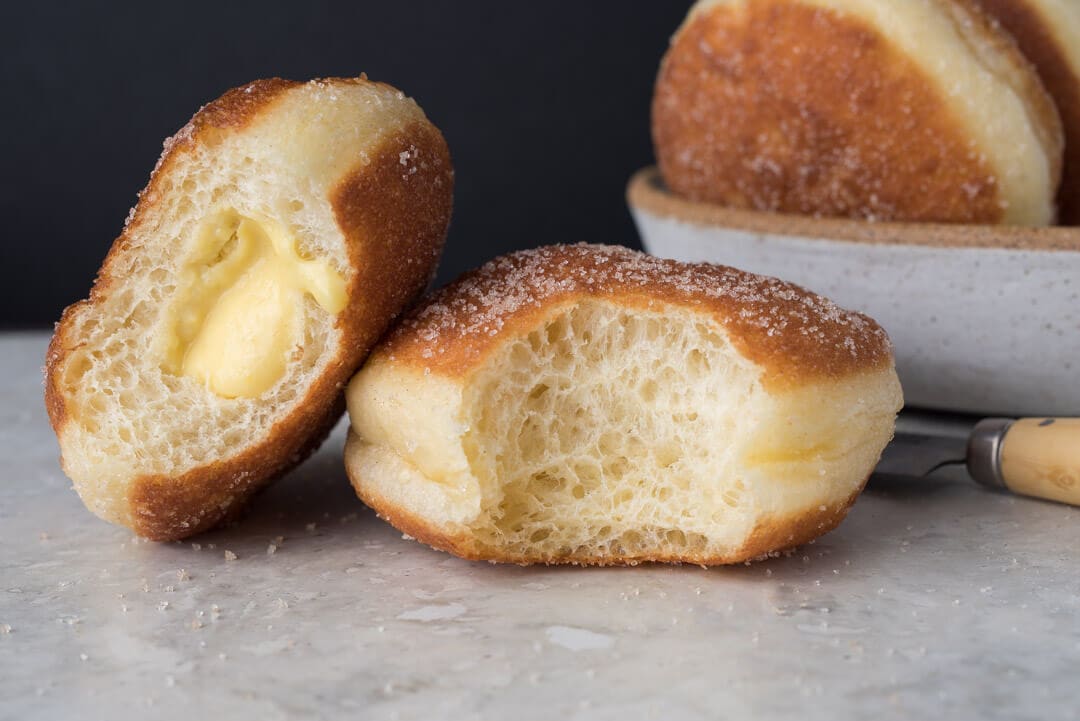
Naturally leavened bomboloni are essentially sourdough doughnuts (with no sourness). They’re also known as berliner, krapfen, ballen, pączki, donut, and many more names all over the world. It seems everyone at some point figured out that frying enriched dough was incredibly delicious. I’m sure glad they did.
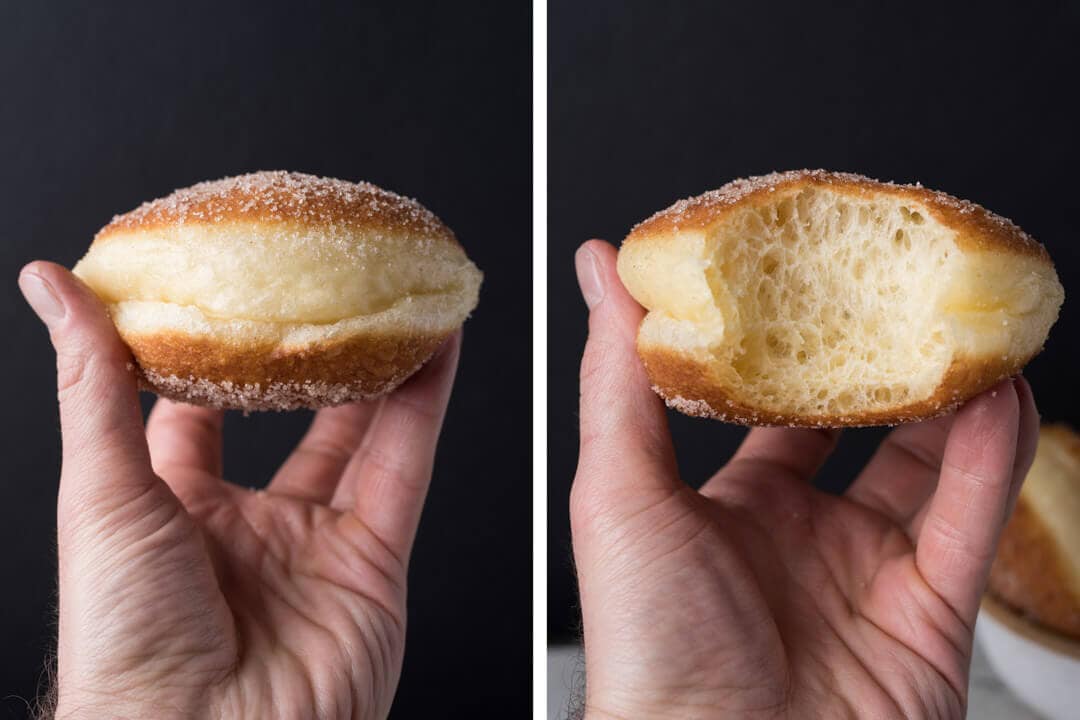
These bomboloni fry up so light and airy you can see why almost every culture has had their own incarnation. When I filled the first one with pastry cream (read on for the recipe) and took that first bite I was instantly transported back to my childhood in Italy. I almost always opted for the cream-filled variety but in the off chance they didn’t have one, the jelly ones came in at second choice. Let’s get frying.
Be sure to read to the end for a new troubleshooting section, a recipe for crema pasticerra, and a recipe for the sugar/cinnamon coating.
Naturally Leavened Bomboloni (Doughnuts) Recipe
These can be challenging to execute properly and do take some practice. Use the photos in this post and the following four extremely important details to ensure success. To make these as light as air, you will need:
- A strong levain
- Sufficient dough strength (lots of mixing, almost to full “windowpane”)
- Lengthy, warm bulk fermentation and final proof (see my post on the Importance of Dough Temperature for more)
- Delicate handling when transferring from proof tray to frying oil
I’ll delve more into each of the above during their step in the process below, but I want to highlight these important elements at the start. First and foremost, strong fermentation is absolutely critical. This begins with your sourdough starter and, subsequently, your levain. Make sure your starter is fed regularly, and you use a ripe starter to create your levain.
Due to the sugar and other enrichments in this dough, overall fermentation activity will be reduced. To counter this, the bulk fermentation and proof steps will need to be lengthened. In addition, it’s also very important to keep the dough warm during each of these steps!
Vitals
If you’d like to double this recipe to make more doughnuts just multiply everything in the Build and Formula section by two. I would not recommend halving the recipe, a total dough weight of 1200g is already quite small for a stand mixer and to ensure sufficient dough mass for fermentation.
| Total Dough Weight | 1200 grams |
| Yield | 18 x 65 gram bomboloni |
Levain Build
A 100% hydration levain made with all white flour will be very mild and not overly acidic. Be sure to use this levain when it’s strong and ripe but not overly so: it should be used right about when it reaches its peak height and looks very active.
| Weight | Ingredient | Baker’s Percentage |
|---|---|---|
| 45g | Mature 100% hydration starter | 50% |
| 90g | All-Purpose White Flour (King Arthur Unbleached All Purpose) | 100% |
| 90g | Water | 100% |
Dough Formula
Target final dough temperature (FDT) is 76-78°F (24-25°C). If your FDT is slightly lower than this, that’s fine, just be sure to keep the dough around 78°F (25°C) during bulk, and it should get back up to temperature rather quickly.
| Weight | Ingredient | Baker’s Percentage |
|---|---|---|
| 253g | All-Purpose White Flour (King Arthur Unbleached All Purpose) | 50.00% |
| 253g | High Protein Bread Flour (King Arthur Bread Flour) | 50.00% |
| 187g | Eggs (about 3 large + 1 yolk, cold from the fridge) | 37.00% |
| 101g | Unsalted Butter (European Style, Kerrygold) | 20.00% |
| 101g | Fine White Sugar | 20.00% |
| 91g | Water | 18.00% |
| 10g | Salt | 2.00% |
| 203g | Mature 100% hydration levain | 40.00% |
Method
1. Levain – 9:30 a.m.
Using a ripe sourdough starter, build the levain (everything listed in the Levain Build section, above) in the morning and store somewhere around 78°F (25°C) ambient until ripe, about 5 hours.
2. Mix – 2:00 p.m.
First, measure out the required butter and cut into 1/2” chunks. Leave this out at room temperature to soften while mixing the other ingredients.
Measure out the called for eggs: crack three full eggs into a small bowl on a scale. If the weight is close to the requirement, add only the yolk of the remaining fourth egg to get to the required amount, if not add the entire egg. Lightly whisk to break the yolks and incorporate.
The paddle attachment is far more efficient at strengthening this type enriched dough. As it’s mixing you’ll notice the dough will tend to cling to the middle of the paddle and press to the sides of the bowl. Stop periodically during mixing to scrape the paddle and sides to reincorporate. At the end of the second phase of mixing the dough should almost pass the “windowpane” test (full development). We will do a few sets of stretch and folds during bulk to finish strengthening the dough.
To the bowl of a stand mixer fitted with the paddle attachment, add the flour, sugar, eggs, levain, salt, and water. If the dough is overly dry add in a little bit more water (be cautious doing so, we don’t want to have a dough that’s too wet).
Set the mixer to STIR and mix for about a minute until everything comes together. Set mixer to SPEED TWO and mix for 5 minutes. At the end of this time, the dough will still stick to the bottom and sides of the bowl but it will start to clump up around the paddle.
Let the dough rest for 10 minutes.
Check your butter. It should be pliable and show a finger indent when lightly pressed. If it’s still cold, place in the microwave for 10 seconds or so. It shouldn’t be melted, just pliable.
Set your mixer to SPEED THREE and mix for 9-10 minutes. During this time add the butter to the bowl, one small chunk at a time. Wait until each chunk is absorbed into the dough before adding the next.
The slow-motion video to the right shows my dough midway through the second phase of mixing after the butter has been incorporated. You can see the dough has balled up around the paddle but overall it still needs further development. At this point stop the mixer, scrape down the sides and paddle and continue mixing. You will have to do this several times throughout mixing.
Near the end of this mixing, the dough will almost pass the windowpane test. Using wet hands grab a chunk of dough and gently spread it out with your fingers. If mixed sufficiently, you’ll see a thin membrane that will barely start to rip when stretched out.
When finished, transfer the dough to a container for warm bulk fermentation.
3. Warm Bulk Fermentation – 2:30 p.m. to 8:30 p.m.
This dough requires a long and warm bulk fermentation. At 78°F (25°C), the dough will ferment 6 hours before it’s placed in the fridge overnight. I place my entire bulk container in my dough proofer set to this temperature (see my guide to using a dough proofer if you’re unfamiliar with their use)
Perform a total of 4 sets of stretch and folds during bulk, spaced out by 30 minutes (starting 30 minutes after mixing finishes).
After the last set (2 hours into bulk), let the dough rest for the remaining 4 hours. By the end of the 6 hours, the dough should have risen by at least 30%. Ensure the bulk container is covered and place it in the refrigerator overnight for cold bulk fermentation.
4. Cold Bulk Fermentation – 8:30 p.m. to 8:00 a.m. (next day)
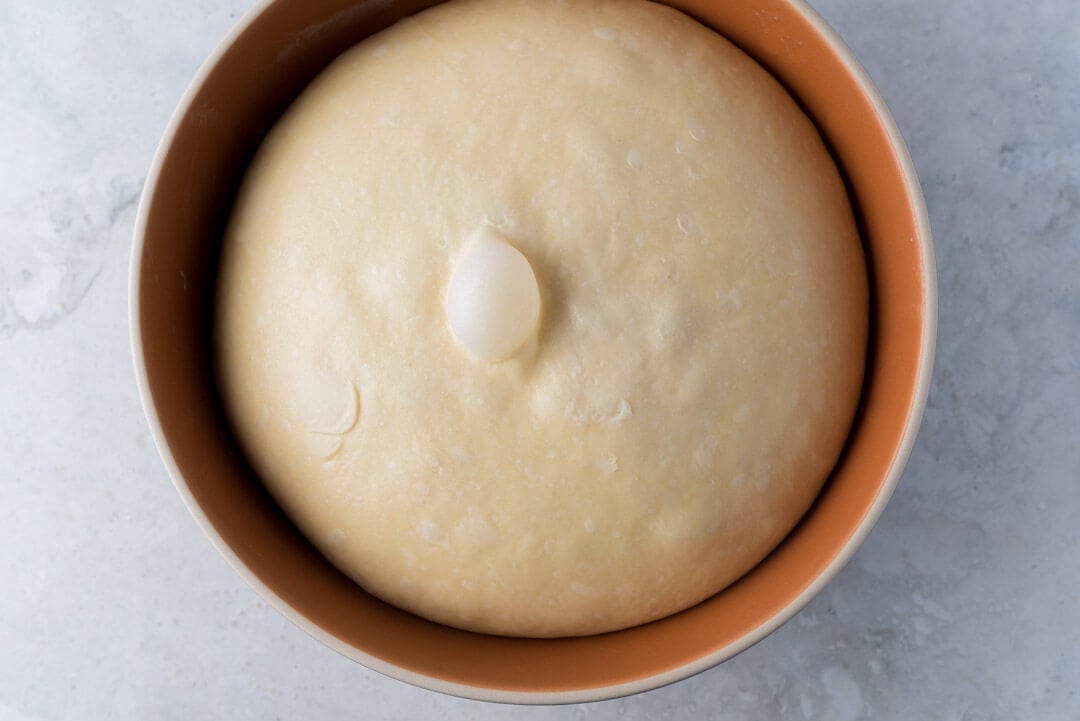
The duration of this cold bulk fermentation step is very flexible. The dough can continue to rest in the fridge several more hours (or perhaps even more) after I have listed here if desired. Take it out and proceed with the rest of the process when convenient.
Above, you can see the activity in my dough after the warm and cold bulk steps—it’s active and alive, even though at this point it’s cold and firm from the fridge.
5. Divide & Shape – 8:00 a.m.
Take the cold bulk fermentation container out of the fridge, uncover, and dump the dough to an un-floured work surface. The dough will feel very cold and stiff, which is exactly what we want. You might need a little flour on your hands to prevent sticking but keep this to a minimum: we’re looking for maximum friction between the dough and the work surface to create very tight rounds.
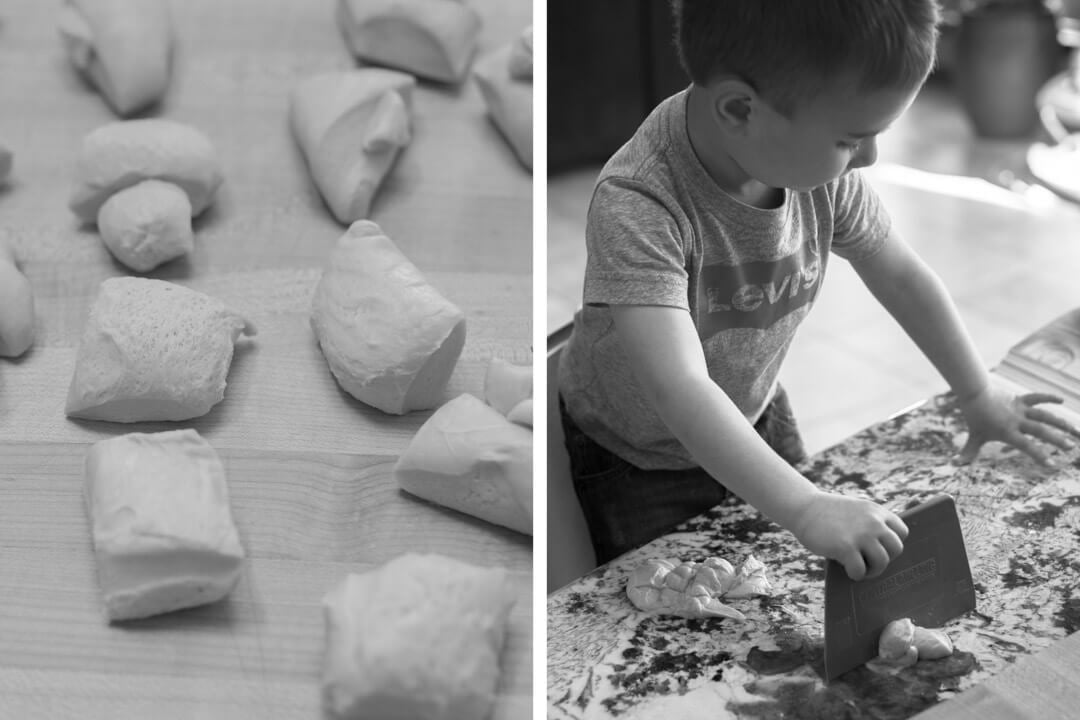
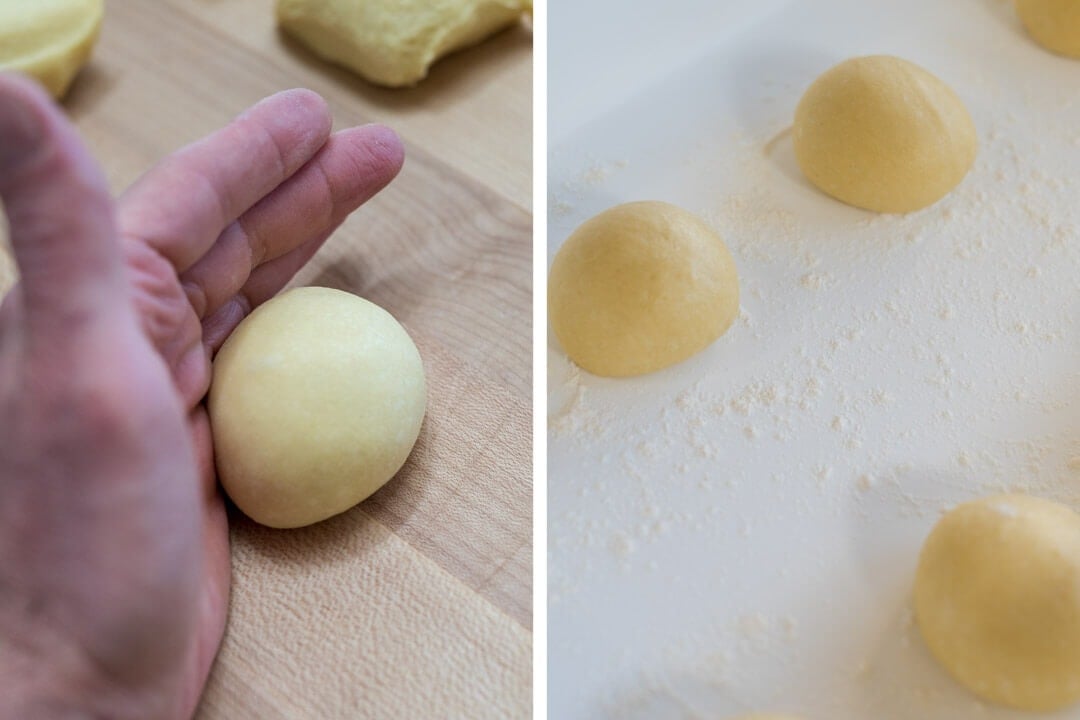
Using your scale, divide the mass of dough into eighteen 65g pieces. You might have a little leftover dough, perfect for engaging a little helper in the kitchen, as you can see below.
Using your hands preshape the dough pieces into rounds. Each round needs to have a very taut surface and no seam on the bottom. Use the side of your hand to push the round against the surface to tighten the surface.
Shaping these naturally leavened bomboloni is very similar to how I shape buns and rolls.
6. Proof – 8:15 a.m. to 7:30 p.m. (appx. 12 hours)
To proof these rounds I use two rectangular pizza trays (a covered baking sheet will also work well) dusted liberally with flour. I can fit 8 rounds in each tray with room for them to expand during the proof. The remaining two rounds I place in two floured Pyrex storage containers (these are good to test with when you start frying).
Place the covered trays with the rounds in a warm spot, around 78°F (25°C), for 12 hours. Since the trays are too large for my dough proofer, I keep them in my oven with the light on and periodically check to ensure they’re kept warm.
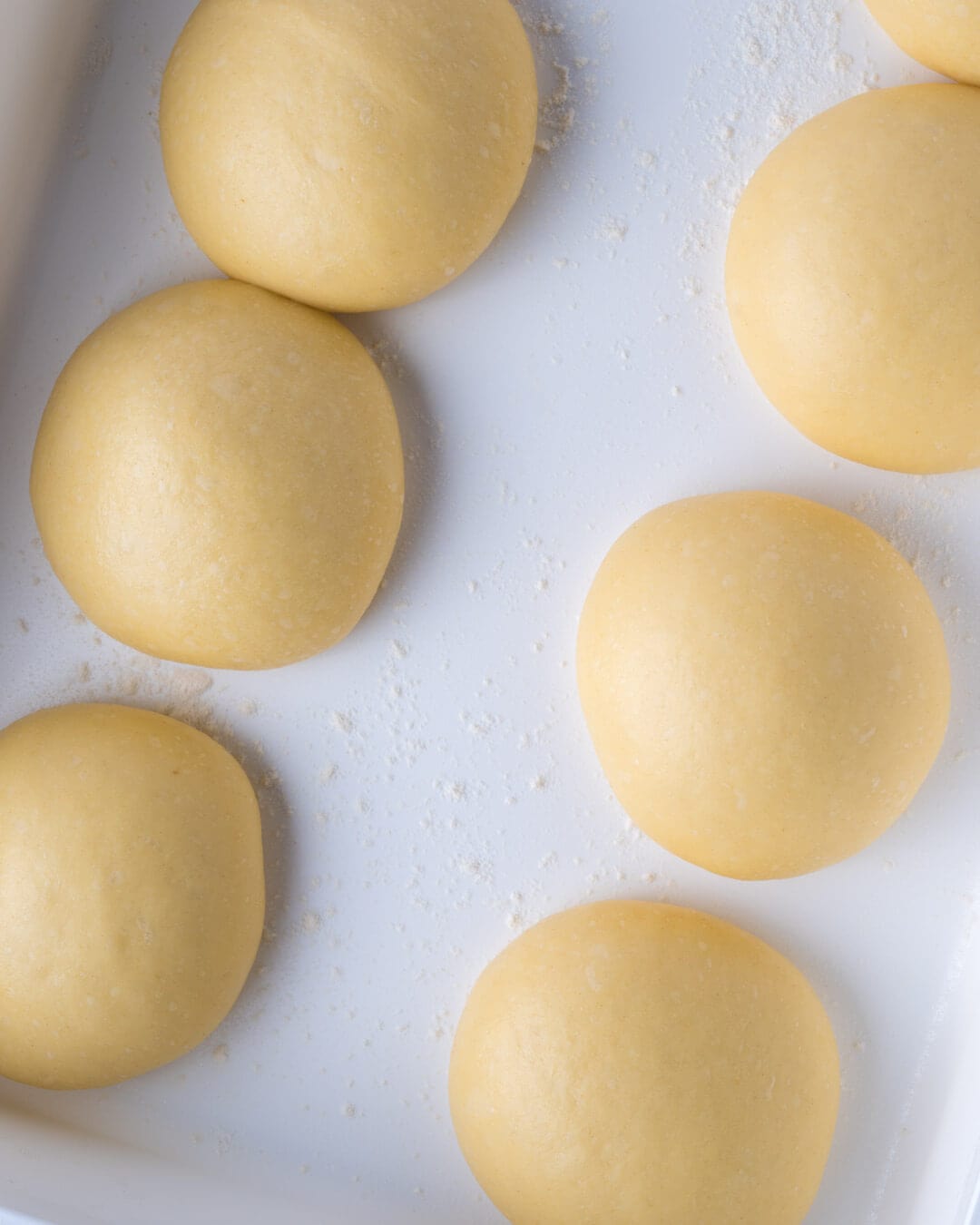
Let the dough proof for about 12 hours. It’s very important the dough is fully proofed before you begin to fry these. They should almost double in size and be very puffy and delicate. If you gently poke them they will feel like they are completely filled with air. Below, you can see the difference between the just-shaped rounds in the image in the previous step.
If you’d rather fry these in the morning you could stop the proof a few hours before completion and finish proofing them in the morning. If you refrigerate them when they are fully proofed, the bomboloni might not fry with quite the same height the next day as they would if frying at night (the longer the proof, the less rise you’ll see).
You can also refrigerate the proofed dough at this point and fry them first thing in the morning for breakfast.
I’ve done both ways, including splitting the batch into two sessions, making one batch the night they’re mixed and one the next day, and they both turn out beautifully.
7. Fry – 7:30 p.m. (or put in the fridge until next day)
Frying Tools
- Vegetable oil, refined coconut oil (my preference), or any frying oil
- Lodge 3.2 qt combo cooker (the same one I use to bake bread!) to hold the frying oil
- Thermoworks ChefAlarm frying thermometer (or a standard Frying thermometer)
- Timer (I love my Thermoworks Big & Loud timer)
- Frying spoon
- Baking sheet lined with paper towels and a cooling rack inside
Frying Oil, Type & Temperature
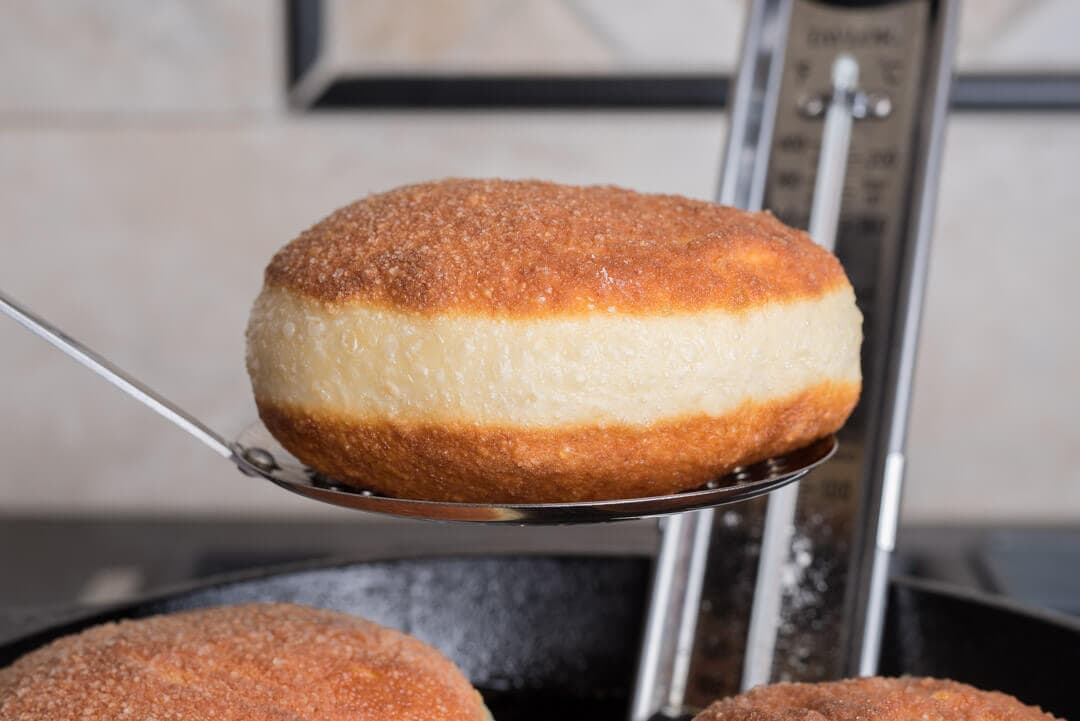
I’ve experimented with both canola and vegetable oil for frying these naturally leavened bomboloni (doughnuts), and much prefer vegetable between the two (but I will be using coconut oil from here on out, see Update below). Canola imparted a slightly odd flavor to my initial test batch and it has an off-putting smell to me. You will have to experiment with the frying temperature. At an oil temperature of 360-370°F (182-187°C) mine cook to a nice golden brown in 2.5 minutes per side.
Update:
I recently tried frying with refined coconut oil (I purchased this tub of refined coconut oil, which should last quite a while (be sure to get refined oil as the smoke point is high enough for frying) and the results were very, very good. Because this oil is solid at room temperature, once the bomboloni cool, they become even crispier and have a little oily feeling to them. Additionally, when frying, the oil doesn’t give off unwanted smells in the kitchen. The resulting bomboloni tasted very similar to vegetable oil and did not have any coconut flavor to them.
You can see a shot of my coconut-oil-fried-bomboloni on Instagram.
Fry
Before beginning, place the trays with fully proofed dough in the refrigerator while you get the frying station setup. It’s much easier to transfer the delicate rounds from tray to oil when they’re a little more firm.
Meanwhile, fill the deep side of the combo cooker to about 2/3 full with frying oil and set over medium heat. The heavy cast iron combo cooker will help keep the oil at a more consistent temperature, even after adding the cool rounds of dough. Place the frying thermometer on the side of the pot and heat until the oil registers 360-370°F (182-187°C).
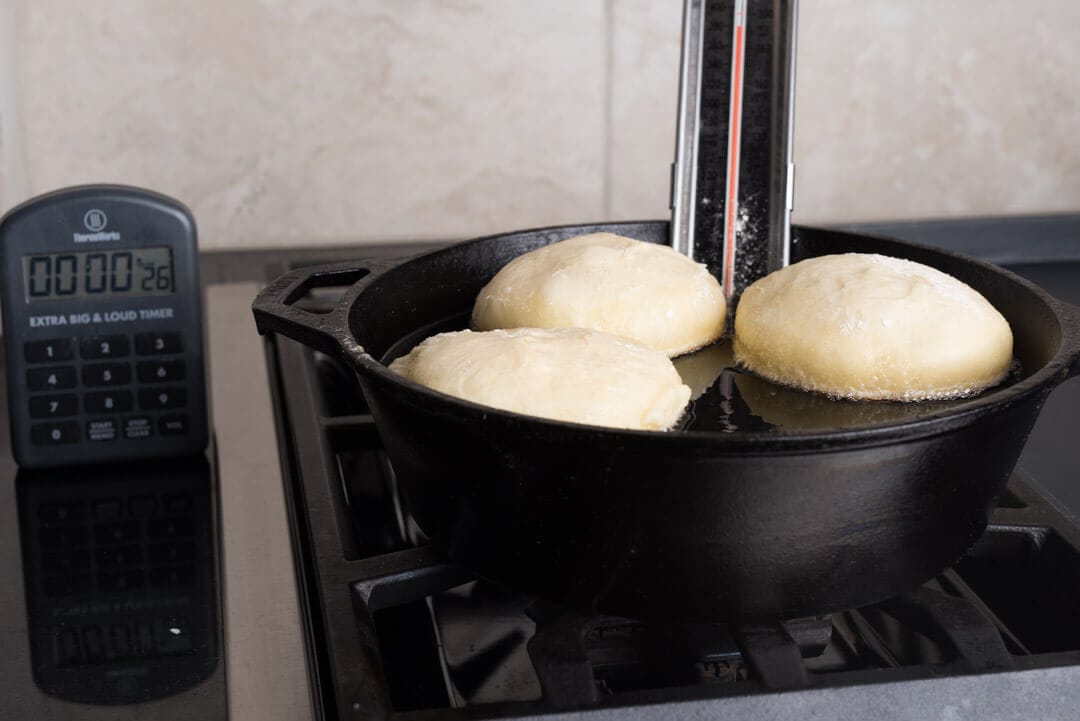
Set your timer for 2.5 minutes. Gently transfer one round from the proofing tray to oil using the frying spoon so the smooth top of the dough is down in the oil first. Flipping the dough over helps to get a nice uniform roundness on the bottom and encourages initial upward expansion.
Keep a close eye on the frying thermometer, the oil temperature will drop each time you add new dough to fry. Constantly monitor and adjust the heat on your range to keep the oil at just the right temperature. I can comfortably fry 3 rounds of dough at a time in the Lodge Combo Cooker. If you have a larger Dutch oven you could accommodate more.
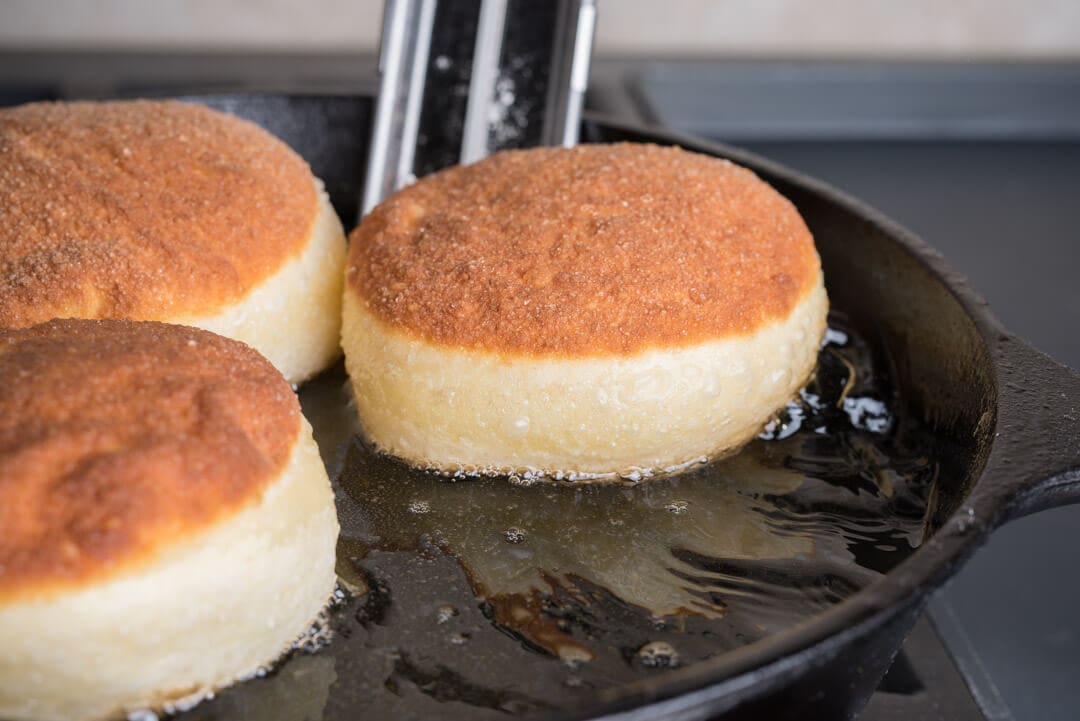
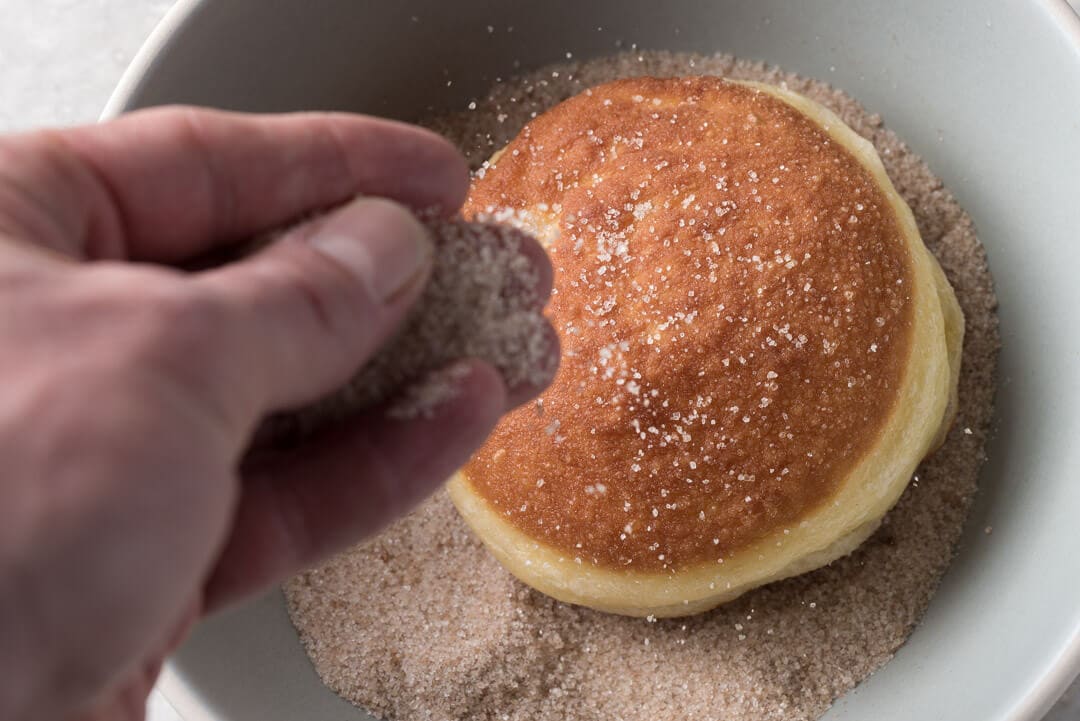
I prefer the look and texture after frying these for 2.5 minutes per side, but if you’d like them lighter reduce the fry time. When fully cooked, use your frying spoon to transfer each bomboloni to the baking sheet lined with a paper towel and cooling rack inside. Let cool several few minutes then toss in a mixture of sugar & cinnamon. Later, pipe with crema pasticcera (recipe below), if desired.
Cinnamon & Sugar Coating
This couldn’t be more simple. Mix the following in a bowl and when the bomboloni are still slightly warm, toss to coat several times. I prefer large, granulated sugar for the coating but you could also use fine sugar.
| Weight | Ingredient |
|---|---|
| 2g (1 teaspoon) | Cinnamon, ground |
| 200g (1 cup) | Sugar, coarse or fine granulation |
Crema Pasticcera (Pastry Cream) Recipe
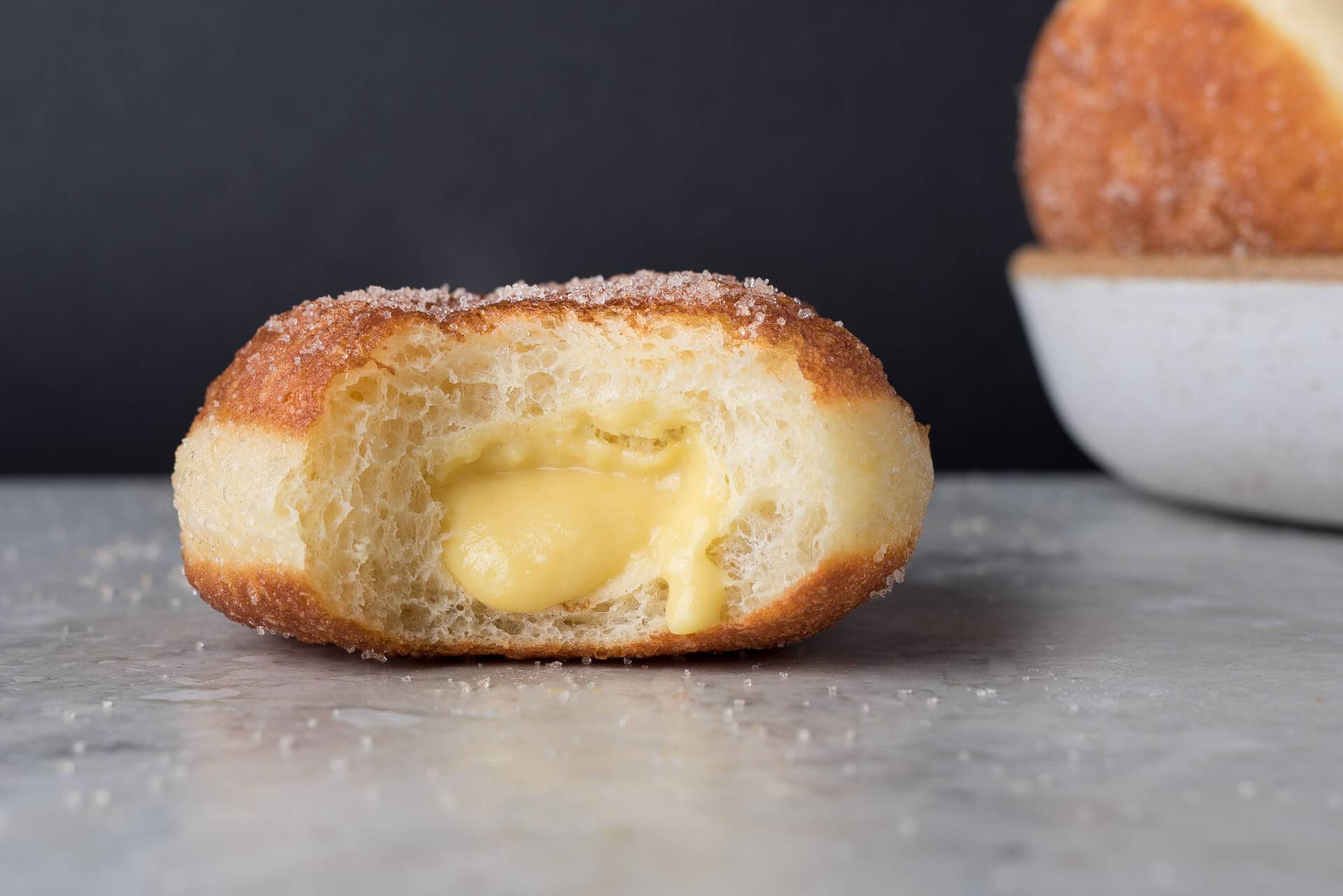
I adore adding lemon zest to this pastry cream. It’s subtle but noticeable, and somehow reminds me of the summer days spent back in Italy. Additionally, this recipe is a great base for many other types of creams (coffee, chocolate, fruit-flavored, etc.).
This recipe makes enough crema to fill half the bomboloni, depending on how much you pipe in and it can easily be doubled.
Ingredients
| Weight | Ingredient |
|---|---|
| 365g | Whole milk |
| 30g | All-purpose white flour (King Arthur Unbleached All Purpose) |
| 100g | Fine white sugar |
| 4 | Large egg yolks |
| 1g | Salt |
| 4g | Vanilla extract |
| 1 lemon | Lemon zest (optional but encouraged) |
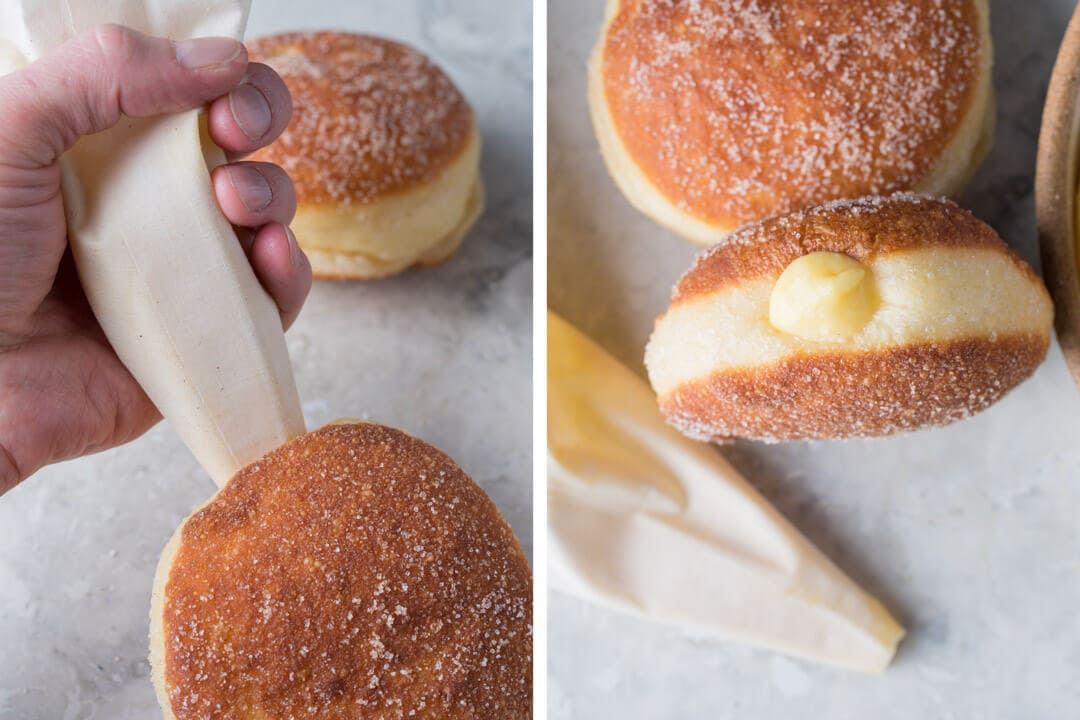
Method
Gather a whisk, strainer, saucepan, and two medium mixing bowls.
- Place the milk in a saucepan over medium heat. Warm until bubbles start to form on the sides (just before boiling but do not boil)
- In a medium mixing bowl mix together flour, salt, and sugar. Add the egg yolks and whisk everything until incorporated. It’ll form a thick paste — just make sure everything is mixed together
- Pour the warm milk into the egg mixture a little bit at a time, whisking to incorporate after each addition
- Pour everything in the mixing bowl back into the saucepan over medium heat. Whisk constantly as the mixture heats. Continue heating and whisking until the contents just begin to boil (you’ll see large bubbles popping when you pause to whisk)
- Strain the mixture into another bowl. You’ll have to press and stir the thickened cream through the strainer
- Add the vanilla extract and lemon zest and stir to incorporate
- Cover the bowl with plastic wrap pressed to the surface of the cream (to prevent a skin from forming in the fridge) and refrigerate until firm
The crema will keep well for 3-4 days in the fridge. Use a piping bag and paring knife to fill the bomboloni just before serving. Make a small cut on the side with the knife, insert the piping bag, and squeeze in the desired amount.
Conclusion
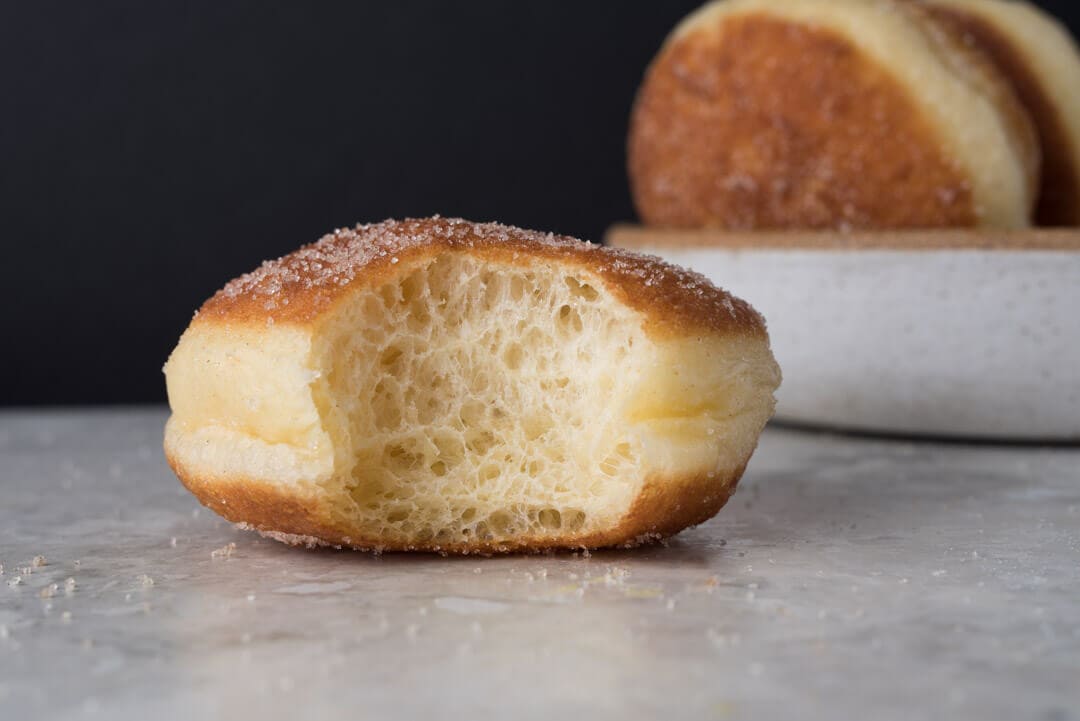
These are such a treat; I love making them for special events (birthdays!), holiday weekends, or group gatherings. With my recipes for sourdough waffles and pancakes, I have lots of options for weekend breakfasts. It’s easy enough to prepare the dough a day or two in advance, proof overnight, and have fresh bomboloni first thing in the morning. Because the dough is rather flexible, once you dial in the bulk and proof times, and develop a sense for when they are ready, you can adjust the schedule to make these in advance until ready to fry. And because frying is such a straightforward process, they’re a quick and easy thing to whip up once the dough is ready.
Crust, Crumb, and Texture
Impossibly light is the perfect adjective to describe these naturally leavened bomboloni. They are soft, pliant, and have just the slightest hint of crisp at the top and bottom. I like to fry them just a touch toward the darker side to emphasize the contrast between crispy crust and tender interior — it works well to further emphasize the overall lightness of each doughnut.
The coarse sugar coating adds a little extra crunch with each bite, even if the sugar tends to scatter readily, and the ones filled with crema pasticerra are in a league of their own. Each person seems to have a preference for just how much crema they want inside, but there’s really no wrong answer. Go big, no one is going to complain!
Taste

With no sourness at all, these bomboloni are, to me, the perfect breakfast indulgence. My target was for a result that wasn’t overly sweet or rich but rather one that was just on the edge of each of these. The end result is one that certainly tastes fantastic on its own with a light dusting of sugar, but transforms to something truly magical when filled with crema.
These bomboloni embody my childhood trips to Italy and our visits to the local town baker. Each morning as I take a bite into one fresh from frying, I’m whisked away back to traveling Southern Italy to visit family. The only thing missing, for better or worse, is the morning visit from the three-wheeled cart with megaphone rigged to the top. Although, now at home, I simply use my alarm clock — at least it has a snooze button.
Buon appetito!
If you use this recipe, tag @maurizio on Instagram so I can take a look!
Troubleshooting & How I Got Here
I spent a significant amount of time testing and developing this method and process. This recipe started with my brioche-like hamburger buns formula. That enriched dough was a good jumping off point but I knew the percentages would have to be changed. I tested various amounts for sugar, butter, and eggs and settled on the formula above. The result is a doughnut that fries up well and isn’t overly sweet on its own: it’s light and airy with requisite richness and sweetness. And they’re so, so perfect for filling with cream.
Below are a few common problems you might run into when attempting this recipe (and are the same things I struggled with in the beginning). Click on the symptom to reveal possible causes with suggested fixes.
Why is there no rise while the dough is proofing?
The time and temperature required to bulk ferment and final proof this dough is very critical. If the dough is not warm enough and left to bulk ferment long enough there will not be sufficient activity in the dough before it’s placed in the fridge overnight (retarded). Ensure the dough rises at least 30% during bulk fermentation, push out bulk as long as necessary until the dough achieves this. Typically, this takes between 5 and 6 hours at 78-80°F (25-26°C).
When frying, why do I get large bubbles on the top or sides?
I’ve noticed there are a few things that could lead to massive bubbles forming when frying a bomboloni. The first is a dough that is not strong enough and required more mixing. The dough should almost pass the windowpane test when done mixing, and the four sets of stretch and folds during bulk will finish imparting the required strength. From there, the dough needs to be lightly degassed during shaping and shaped tight. There should be no seams on each shaped round. Finally, the under-proofed dough can cause erratic, uncontrolled bubbles to form. The rounds need to be fully proofed and, when poked, feel like very gassy and light pillows. They will seem almost over proofed.
Why does butter leak out of the dough?
The butter should be incorporated into the already-strengthened dough when it’s at room temperature, not melted. When pressed with a finger, you’ll see an indentation but it shouldn’t be a puddle of liquid butter. If the butter has melted, place it back into the fridge and let it firm up before adding to the dough.
Why does the butter never mix into the dough?
If the butter is too cold and not pliable, it won’t incorporate easily into the dough when mixing. See the question above for how the butter should look and feel.
I can’t keep my dough at 78°F (25°C) during bulk and proof, what can I do?
As I mentioned in the post above, bulk and proof temperatures are very important with this recipe. If you’re not able to keep the dough warm enough during these steps, it could take several hours longer at each step before it’s ready to proceed to the next. Watch the dough and give it the time it needs!
Can I freeze this dough?
I have not tried to freeze this dough but others have reported successfully freezing my brioche hamburger buns. I would be wary to do this, though, and would first like to test before saying yes/no!


320 Comments
Another fantastic recipe, Maurizio! Some things that I learned –
1. My formed doughnuts did not seem to grow much vertically during final proof, just spread, but clearly became airier.
2. Letting them proof on squares of parchment (lightly oiled was my preference, so excess flour doesn’t fall into and accelerate breakdown of my fry oil)
3. 65 g balls of dough made enormous doughnuts! 32 g sized ones were preferable and they fried up to just under tennis ball size.
4. We keep a cold house in the winter ~62 deg F. Since I wasn’t seeing vertical growth in these, I let the first half of the dough balls proof for 18+ hours in the oven (light was on occasionally just for the initial few hours). Dough balls from the second half of the dough batch (which got an extra 24 hours cold retard) sat proofing for 24 hours and just seemed to be approaching the over proofed territory, but were delicious! Such depth of flavor and so airy!
5. I used a frying technique/trick that we Indians use when frying pooris (an unleavened fried whole wheat bread) – in order for pooris to puff up reliably into balloons, one gently splashes hot fry oil on the top surface continuously. It came to me instinctively and I’m sorry to say that I did it for every one of them. So I can’t say whether this contributed towards producing almost spherical doughnuts. 🙂
6. I might have pulled the custard from heat a tad too early as it oozed out of the piping bag as soon as I started filling it. But it was delicious! I went in an eggnog direction with vanilla bean paste and fresh grated nutmeg. Should’ve added a dash of cinnamon too.
I want to make these again soon, but my weighing scale disagrees.
Thanks for all the tips and feedback, Nivedita! Curious that they spread so much, I’d say maybe the dough wasn’t strengthened enough? Perhaps it could use a bit more time in the mixer to build up strength, this might also help them from rising too much—although it’s just as important they’re shaped very tightly, too.
Making the crema does take a little practice, too. Reading the signs can be a challenge at first, but once you get it successfully a single time, it’s easier from there on.
Let us know how the next one goes!
I made these with a sweet levain and they were incredible! I did have a few of them deflate a little or turn on their sides while frying. I see you say that could mean they were underproofed—they were so full of air though—I don’t know if they could have gotten any bigger without completely deflating during the frying process. I’m about to mix up another recipe and will make this batch a little smaller in size, as well as making sure the dough has really developed after mixing. So, so good!
Yes, that full development is so critical on these, they need a strong mix (full windowpane). Glad they turned out well for you, Meg! Sweet starter is also a great way to drop the sourness.
I’ve just made these and had a ton of fun throughout the process. However, when it came to removing the proofed rounds from their individual parchment squares, I had a bear of a time. Even after a 24-hour second proof (10 hours in the oven with the light on, the rest in the fridge) and with flour on the paper, they stuck. Would it be a bad idea to spray the paper with oil or grease it with butter?
Glad it went well, Sean! Yes, it takes a very delicate hand to transfer these, I use a plastic spatula and slide it under as I tip the dough. Another thing you can do is use small 4×4″ parchment squares, then just drop the square into the frying oil and remove it after a few seconds with tongs, it’ll slide right out. Alternatively, greasing with butter or oil will also work!
Hello! This recipe looks absolutely stunning- and all the positive and encouraging comments make me even more hopeful for my very own batch too! Thanks so much for it; looks good enough for a sourdough newbie like me to try!
Thing is that I just ran out of bread flour and only have all-purpose white flour… would it be a big issue if I subbed all the bread flour for the all-purpose? Would I be losing out on any structural integrity for the dough? (Just trying to keep myself at home as much as I can, but if it’s absolutely necessary for the perfect bomboloni I’ll put myself out there! Serious business.)
Thank you! I find the bread flour does help get a little more rise and structure, but it should work well with just AP flour. Be sure to mix the dough to full development when it’s in the mixer! Happy baking 🙂
Thanks so much- had to incorporate in a lot of extra elbow grease with some slap and pull. Yielded a kinda sticky dough that pulled away from the bowl but has a shiny exterior (not sure if that’s right oh no)
I’m also currently on my 5th hour for the first warm rise and my dough doesn’t seem to be rising…? Just a couple of bubble/air pocket-lookin things on the top. Is that a sign that it’s proofing and I can put it in the fridge soon, or should I push the proof a couple more hours? (Temp in the proofing location is around 27-28C right now!)
Frying tip- proof them on individual pieces of baking parchment and then fry on the parchment. The paper will come off clean and you don’t need to worry about messing up / deflating them during transfer. (Credit to an Ottolenghi recipe)
This is such a great idea, Allie!
Hi, these were really sticky. I raised them in the oven over night (12) hrs on silicone paper and covered them with cling film which totally stuck. Should they be this sticky? Thinking maybe I need a bit more flour. Managed to fry the first 9 which turned out to be more finger shape, then opted to bake the remaining so that I didn’t need to handle them.
Sorry to hear that, Nadia! Sounds like the dough needed less liquid or a longer mix—or a combination of both!
I love this recipe and have made it many times at home. I’m wondering if you have tried baking them? I don’t have fryers in my bakery or the right hood system to allow fried foods but my kids keep requesting these so I would love to be able to make a version at work.
So glad to hear that, Jessica! I haven’t tried baking them, but I am going to very soon (looking for a fall variety!).
I live in hot country, average temp of 30 to 32°C. Do i still need to proof for 12 hours?
At those temps, not likely. Keep an eye on the dough and adjust as necessary! You’ll probably need to proof for 8-10 hours, depending on the dough.
Hi i used a hungry starter instead of a one at its peak. Will that be okay or do i have to redo it?
For these, I really like to use my starter when it’s perfectly timed. If your starter is very overly acidic, it might lead to a more sour result. That said, you do want a starter that’s nice and ripe, just not so much that it is very thin consistency and perhaps smelling like paint thinner.
Made these for the 2nd time. Baked instead of fried and they were awesome! Love the light and airy crumbs. Hubby and kids are still not quite used to the slight tanginess (though it’s perfect for me). Wonder if using a sweet levain or increasing the amount would help reduce it? Looking forward to your updated recipe!
JT—glad to hear that! Yes, I’m going to be updating this with a sweet levain soon!
Hi there again. Is it possible to overproof these and how would I know. I inadvertently allowed (got distracted by babies) them to proof at about 90 for around 2-3hrs. Oops. How will I know if they are overproofed giving the enriched dough?
Jaq
Ah! Chances are the dough will be fine, this is a very slow moving dough. Unfortunately, it’ll be challenging to tell if they’ve gone over, but I would still fry them even if you’re worried they are. I’d expect an over proofed bomboloni to be really puffy, the surface might look like it’s tearing or breaking apart, and it’ll probably have big bubbles extruding from the surface with a thin membrane. Like I said, I’d still fry them no matter what!
We went ahead and fried them a couple hours early and they were amazing…and not overproofed!! Another perfect recipe! Thanks!
I made the unfortunate decision to leave these overnight in a hot kitchen (>30 deg cel). In the morning they were overproofed – really puffy, lots of big bubbles. Tried to fry one, but it just acted like a sponge to the oil. Baking them saved the day. They’re really light, with lots of open crumbs inside. Outside they’re flaky, almost puff pastry-like. Sourness a little more pronounced, but not overwhelming. I’ll try again with shorter proofs next time around.
Can I change the butter with margarine, or plant based butter?
I know some have reported success using vegan butters for other baked goods here, I’d say it’s worth an experiment!
Can I bake them instead of frying ?
I’ve not tried this, but others have said it works really well!
Made these today and turned out beautifully! Will definitely make these again!. A little challenging transferring from baking tray to frying. 😍
So glad to hear they turned out well, Teresa!
Excited to try these! Would an enameled Dutch Oven work in place of your recommended cast iron pot? Thanks!
Also; HUGE shout out to your cinnamon roll recipe! They are a massive hit with the family, and get better with every try! 🙂
Yes, that will work just fine, Erin! Glad to hear that about the cinnamon rolls 🙂 They’re a fav here too!
Hi there! What could be the reason for a distinct sour flavour?:/
I’m working on updates to this post to reduce the sourness even further!
That’s great! Could the sour taste be due to long proofing though? I think i ended my bulk fermentation sooner than i should have and let them proof for about 15 hours…
Yes, definitely. If the starter/levain is too ripe, and the dough is pushed too far, it can take on more sourness. A balance is needed there! But my changes to this recipe will help, once I get it updated!
Thank you so much Maurizio!
Hi, Iam so happy with the look and the texture. Beautiful bomboloni. But I could taste the sourness.. Iam so waiting for the updated recipe. Thank you
Hello! Was this recipe updated? I tried making them and they did have quite a tang
first of all thank you for the description It was delicious . I had a little difficulty while cooking because the bottom part swelled while cooking, then turned and distorted. What should I do to keep it out of shape?
That’s happened to me from time to time. Usually it’s either from under proofed dough, or shaping that isn’t quite even across the balls when shaped.
Thank you Maurizio , I think it was not under proofed dough most probably shaping was not successful as you made . Thx again .
Wow, just wow. Thank you so much for this recipe, those are the best doughnuts I’ve ever accomplished and I’ve made a lot of them throughout my life as I love doughnuts.
Even though it was a lengthy process, and I don’t have a KitchenAid so had to make the dough by hand, it was worth all the effort.
It’s like eating a cloud of delicious flavor! And the slight tang from the sourdough is such a nice treat as I know I’m eating what I harvested haha.
Furthermore, my wife commends you on the creme patisserie – she loved it (so did I!).
Thank you again for this recipe and I’ll definitely make them again and again and again. ☺️
Glad to hear you like them, Patryk! Yes, it’s a bit of an investment, but they’re so, so good—totally worth it. Glad you like the crema as well! Happy baking 🙂
It is an process, but split into two days it is manageable. I made these yesterday, final proofed today and fried them this evening. They are light and airy. They fried beautifully, but there were a lot of small bubbles (similar to bubble crust in sourdough loafs) on the side that was first fried, the bottoms fried up nicely and smooth. The other problem is that when they frying the ring was really wide and after frying they collapsed quite a bit. I would prefer less. Do you think they were over proofed? They rose quite a bit when frying maybe I could proof them less next time. I wasn’t home, so I just felt them on the counter for 11h 30 min. they were really nice, did not collapse when handled with hands for frying and not sticky at all. They tasted a bit sour to my palate, do you think a bit more sugar in the dough would help? retarding less? maybe just to cool the dough to become more manageable like for brioches?
All in all I call it a success. Great recipe and tips.
I was wondering if they could be done in a single day. Overnight levain, bulk proofing for 3,5 hours at 30oC (86F), quick chill in freezer and 8h of final proof at 30oC (86F) before frying. What do you think?
It sounds to me like they were possibly the opposite, under proofed. I’d try proofing even longer, maybe one more hour or so. I notice i get those bubbles occasionally as well… I have yet to figure out the cause (besides obvious fermentation!).
It would be hard to do this recipe in a single day unless the dough was proofed for a very long time, perhaps all day! I’m working on making this recipe less sour. Updates soon 🙂
it is an process, but split into two days it is manageable. I made these yesterday, final proofed today and fried them this evening. They are light and airy, almost too airy. They fried beautifully, but there were a lot of small bubbles (similar to bubble crust in sourdough loafs) on the side that was first fried, the bottoms fried up nicely and smooth.
Unfortunately they turned out quite dense and awful.. worst part was just trying to fry them – they were so sticky I couldn’t lift them.. started promising but turned out a mess.
Sorry to hear that, Kiki! Sounds like they were most likely under proofed. Did you give the dough plenty of time in bulk and proof? They really do take a while!
Made these 2 weeks ago and put 4 in the freezer at the point that it was time to fry. Today I took them out of the freezer, let them on the counter covered for about an hour, I cooked them in the air fryer at 400 degrees for about 8 minutes. They puffed up beautifully and tasted great! The tops were bread-like, but a light glaze worked perfect with the vanilla creme filling.
Love this, Carol! Great idea with the air fryer, too. I need one of those…
Hi, I’ve made these a few times and they’re so lovely! However, mine don’t seem quite as soft as yours and I’d love to get them just a little softer. Do you think it’s a mixing issue? I mixed to almost full windowpane, about 10 minutes. Otherwise I was thinking to add some milk in place of water as a tenderizer. Curious about your thoughts. Thank you!
I don’t think it’s a mixing issue, these do need to be mixed sufficiently (which is sounds like you did). You could try adding more milk, that will soften them. Be sure to really push that proof!
I made these again in a warmer spot for the bulk fermentation and wow did it make a difference! I had been struggling to find a warm enough spot and I’m so happy that I did. So much more activity, the dough increased more than 30% by the next day and made me think I could have cut that fermentation short a bit more than I did (I did 5 hrs. 15 min). I let the second proof go overnight between 73-75 degrees for about 14 hours and they really felt like little pillows filled with air. I did use a small amount of milk in the dough and I think everything combined really made these very soft and beautiful. Thanks so much for your reply!
Awesome, Samantha! Glad to hear about the improvements and thanks for coming back with your changes and feedback. Enjoy!!
I made these and they came out amazing. Woud this recipe work as brioche bombs baked in the oven? If so, on what temperature do you recommend?
Some people have reported success making these by baking in the oven!
I just finished making these and they are to die for. Thank you very much for this detailed recipe. You explained it very well and they are very informative. I adjusted the temp to speed up the second fermentation to 30c and they are all puffed up within 3-4 hours. My baking tray was also too big to put in the fridge so when you suggested to firm them up a bit before frying them, I put them on my balcony as it was -2c outside. 😀 Worked well indeed. I also fried them with coconut oil and they were just amazing. Do you usually throw away those oil after one use? Also how should we store these lovelies, room temp or better in the fridge? Thanks again, Maurizio.
These were so amazing! Great flavor, light and fluffy, not tangy or sour at all! This was my first baking project using starter. I started late in the day, so I refrigerated for a little over 24 hours for the cold bulk fermentation to get back onto the time schedule. It didn’t seem to be a problem. I proofed in my oven with the light on for 10 hours and they were way more than doubled in size, maybe a little over proofed, with some tiny bubbles on the top surface. The plastic wrap stuck to the top of the puffs, and some of them deflated a little when pulling it off. Those fried up a little mis-shapen and smaller, but were still unbelievably fabulous. The directions were great and it was so worth the wait! Making a cup of tea and going to have a cream-filled one for breakfast!
Thanks again for the feedback, Carol!!
Wow! We are really on a roll with your recipes. The dinner rolls continue to amaze all of my eaters, the cinnamon rolls were out of this world, and now the Bombolini! Mine weren’t as perfectly round as yours, and they got stuck together during the long proof (I will leave more room next time) but they were generously forgiving and all tasted delicious. Thanks for another well written and clear recipe. I’m hoping you are working on a cookbook… Thank you!
So glad to hear that, Gretchen!
I found the dough to be quite stiff — I added significantly more water than I anticipated I would need to. My (new to me) KitchenAid K5SS was overheating and the dough was almost immediately clumping into a ball on the flat beater rather than clinging to the sides and bottom of the mixing bowl. The dough did, however, pass the windowpane test. Now onto bulk fermentation…
Anyone else find this to be a relatively stiff dough?
It really depends on the flour you’re using! It’s a balancing act with the dough as well, the more enrichments I add the harder it is to handle… So it’s a fine line between just enough and not enough.
These were a perfect quarantine Christmas luxury. We have a colder house (~68-70 F) so we were able to extend the cold bulk to about 15 hrs and then room temp proof for another 18 hrs to have them ready to fry the morning of day 3 without having to cold proof.
Nice adjustments, Colin! Yes, with a cooler house it’s easy to just let these go overnight and pick things up the next day 🙂 Enjoy and thanks for the comments!
Hi Maurizio! I want to make these into bite sized donuts for Christmas. What size would you make the dough balls?
I’m feeling something like 30-40g?
Thank you!
Would this dough work as a loaf? Want to make a brioche loaf!
Yes, it would!
Hi Maurizio,
How many days can the dough stay in the fridge during cold bulk fermentation before they need to be shaped and proofed?
I wouldn’t do more than overnight/next day. The longer they’re in there the more sour they’ll become and the less rise you’ll see in the end.
Hey! I was wondering when making the levain if I should use all purpose flour even if my starter is fed with bread flour? Thank you!
Either will work just fine!
Hi Maurizio! I followed your recipe and my bombolinis are soooo delicious! Very fluffy and airy and amazing flavor. I don’t like frying food, so I decided to experiment a bit and baked half of the rounds in the oven and I used an air fryer for the other half, both methods worked well, I am pretty happy with the results. Thank you so much for the recipe and taking the time to explain every detail in each step, it helped a lot.
Awesome to hear that, Erika! I haven’t tried using an air fryer but that’s a great idea.
Hi Maurizio! My bombolonis came out light and fluffy, but they were too sour, any solution for this? I did warm bulk at 25 degrees c for 6 hours, cold bulk in the fridge for 20 hours (I lengthened the cold bulk fermentation so that I can do the final proof the bombolonis overnight and fry them in the morning) and proof at 25 degrees at 12 hours!
It might have been too much time in fermentation. I’m working on an update to this post to help reduce sourness significantly. I hope to have it updated soon!
Same problem. I usually never proof that long because I know that it will develop sourness. I proofed them for like 8 hours (which is already super long for me) and they were quite sour. Thanks