

Our sleep was always broken by a small, three-wheeled cart scurrying down the stone streets with a large megaphone strapped to the roof. Political ramblings poured unrestricted out of that speaker, echoing off buildings and stone-paved streets as it ran down the length of each avenue—faster and louder than I’m sure anyone in our family’s hometown in Southern Italy cared for. Without the desire for air conditioning, every house had its window open overnight to let in the cool breeze. And the opportunistic man in the speedy cart was keenly aware of this situation. As a kid traveling to visit family, waking early wasn’t nearly as bad as going to bed early; after all, it just meant you’d get to play sooner.
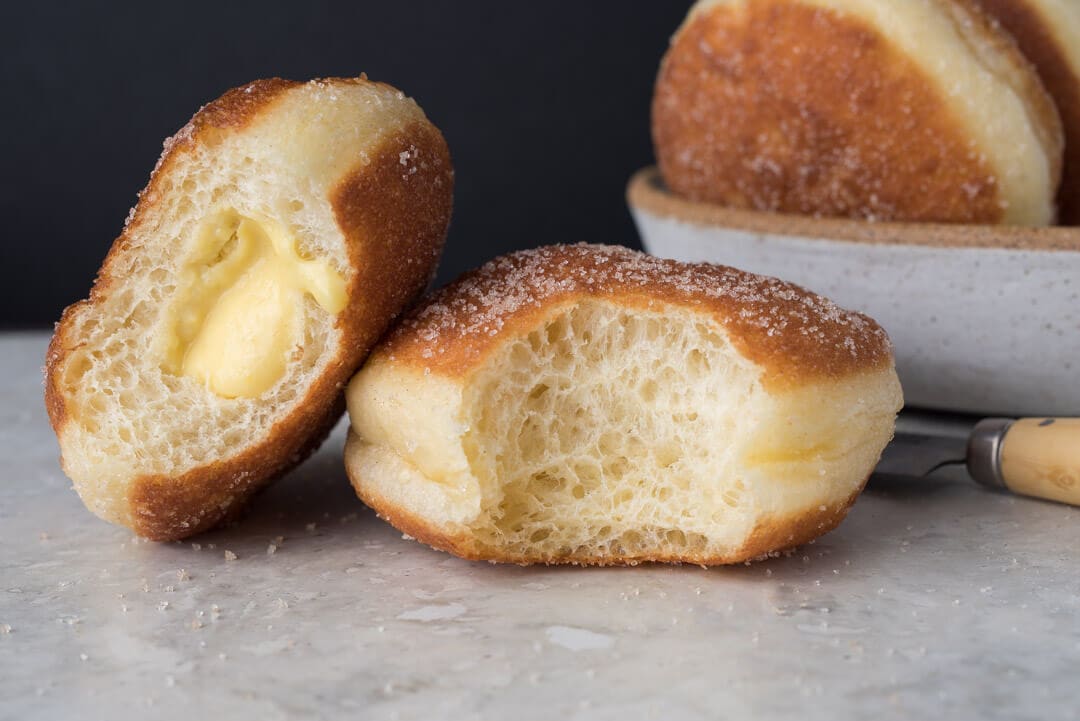
But probably my favorite thing of all, and the reason I secretly hoped that man would drive by even earlier, was it meant heading out early with my dad and brother to the local baker for fresh naturally leavened bomboloni (doughnuts).
Back then, I didn’t quite appreciate the lives these bakers led. For them to sell fresh baked goods first thing in the morning, they likely worked through the night: mixing, folding, shaping dough, and finally baking in the old ovens just as the sun streamed through the city streets. We’d walk in oblivious to all of this, instead focused acutely on which pastry to buy and devour on the walk back. I like to think our enthusiasm for their baked goods somehow validated their long night of hard work. I do know they were there every morning, ready to discuss a recent soccer game, wrap the pastry in a paper, and send us back on our way.
Naturally leavened bomboloni are essentially sourdough doughnuts (with no sourness). They’re also known as berliner, krapfen, ballen, pączki, donut, and many more names all over the world. It seems everyone at some point figured out that frying enriched dough was incredibly delicious. I’m sure glad they did.
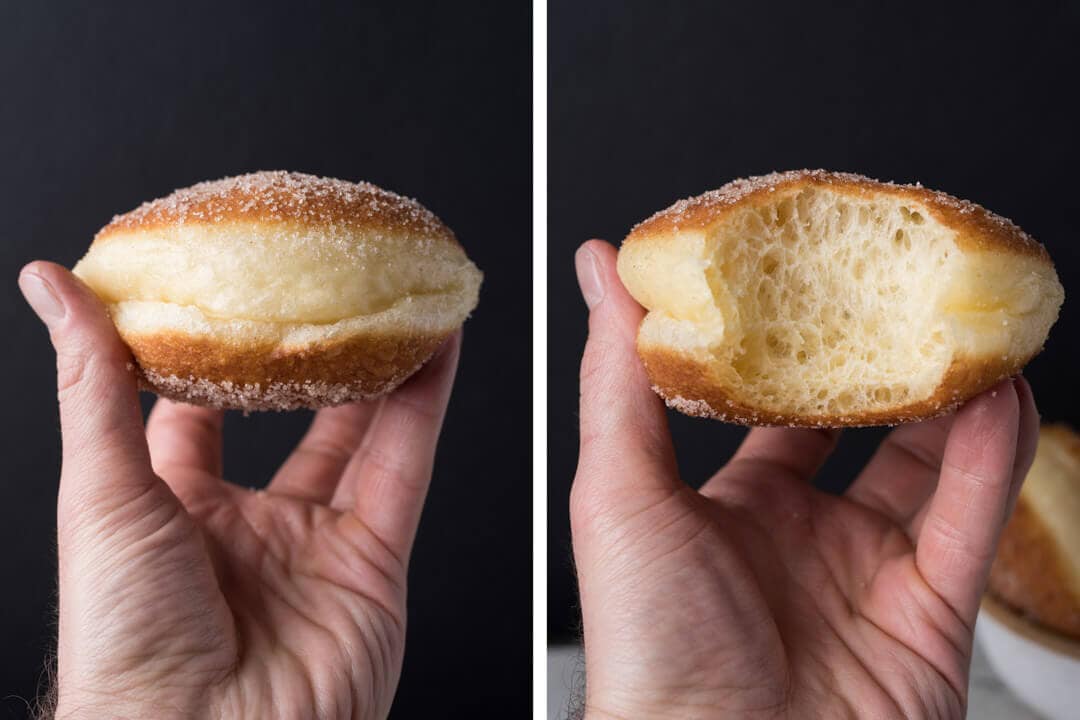
These bomboloni fry up so light and airy you can see why almost every culture has had their own incarnation. When I filled the first one with pastry cream (read on for the recipe) and took that first bite I was instantly transported back to my childhood in Italy. I almost always opted for the cream-filled variety but in the off chance they didn’t have one, the jelly ones came in at second choice. Let’s get frying.
Be sure to read to the end for a new troubleshooting section, a recipe for crema pasticerra, and a recipe for the sugar/cinnamon coating.
Naturally Leavened Bomboloni (Doughnuts) Recipe
These can be challenging to execute properly and do take some practice. Use the photos in this post and the following four extremely important details to ensure success. To make these as light as air, you will need:
- A strong levain
- Sufficient dough strength (lots of mixing, almost to full “windowpane”)
- Lengthy, warm bulk fermentation and final proof (see my post on the Importance of Dough Temperature for more)
- Delicate handling when transferring from proof tray to frying oil
I’ll delve more into each of the above during their step in the process below, but I want to highlight these important elements at the start. First and foremost, strong fermentation is absolutely critical. This begins with your sourdough starter and, subsequently, your levain. Make sure your starter is fed regularly, and you use a ripe starter to create your levain.
Due to the sugar and other enrichments in this dough, overall fermentation activity will be reduced. To counter this, the bulk fermentation and proof steps will need to be lengthened. In addition, it’s also very important to keep the dough warm during each of these steps!
Vitals
If you’d like to double this recipe to make more doughnuts just multiply everything in the Build and Formula section by two. I would not recommend halving the recipe, a total dough weight of 1200g is already quite small for a stand mixer and to ensure sufficient dough mass for fermentation.
| Total Dough Weight | 1200 grams |
| Yield | 18 x 65 gram bomboloni |
Levain Build
A 100% hydration levain made with all white flour will be very mild and not overly acidic. Be sure to use this levain when it’s strong and ripe but not overly so: it should be used right about when it reaches its peak height and looks very active.
| Weight | Ingredient | Baker’s Percentage |
|---|---|---|
| 45g | Mature 100% hydration starter | 50% |
| 90g | All-Purpose White Flour (King Arthur Unbleached All Purpose) | 100% |
| 90g | Water | 100% |
Dough Formula
Target final dough temperature (FDT) is 76-78°F (24-25°C). If your FDT is slightly lower than this, that’s fine, just be sure to keep the dough around 78°F (25°C) during bulk, and it should get back up to temperature rather quickly.
| Weight | Ingredient | Baker’s Percentage |
|---|---|---|
| 253g | All-Purpose White Flour (King Arthur Unbleached All Purpose) | 50.00% |
| 253g | High Protein Bread Flour (King Arthur Bread Flour) | 50.00% |
| 187g | Eggs (about 3 large + 1 yolk, cold from the fridge) | 37.00% |
| 101g | Unsalted Butter (European Style, Kerrygold) | 20.00% |
| 101g | Fine White Sugar | 20.00% |
| 91g | Water | 18.00% |
| 10g | Salt | 2.00% |
| 203g | Mature 100% hydration levain | 40.00% |
Method
1. Levain – 9:30 a.m.
Using a ripe sourdough starter, build the levain (everything listed in the Levain Build section, above) in the morning and store somewhere around 78°F (25°C) ambient until ripe, about 5 hours.
2. Mix – 2:00 p.m.
First, measure out the required butter and cut into 1/2” chunks. Leave this out at room temperature to soften while mixing the other ingredients.
Measure out the called for eggs: crack three full eggs into a small bowl on a scale. If the weight is close to the requirement, add only the yolk of the remaining fourth egg to get to the required amount, if not add the entire egg. Lightly whisk to break the yolks and incorporate.
The paddle attachment is far more efficient at strengthening this type enriched dough. As it’s mixing you’ll notice the dough will tend to cling to the middle of the paddle and press to the sides of the bowl. Stop periodically during mixing to scrape the paddle and sides to reincorporate. At the end of the second phase of mixing the dough should almost pass the “windowpane” test (full development). We will do a few sets of stretch and folds during bulk to finish strengthening the dough.
To the bowl of a stand mixer fitted with the paddle attachment, add the flour, sugar, eggs, levain, salt, and water. If the dough is overly dry add in a little bit more water (be cautious doing so, we don’t want to have a dough that’s too wet).
Set the mixer to STIR and mix for about a minute until everything comes together. Set mixer to SPEED TWO and mix for 5 minutes. At the end of this time, the dough will still stick to the bottom and sides of the bowl but it will start to clump up around the paddle.
Let the dough rest for 10 minutes.
Check your butter. It should be pliable and show a finger indent when lightly pressed. If it’s still cold, place in the microwave for 10 seconds or so. It shouldn’t be melted, just pliable.
Set your mixer to SPEED THREE and mix for 9-10 minutes. During this time add the butter to the bowl, one small chunk at a time. Wait until each chunk is absorbed into the dough before adding the next.
The slow-motion video to the right shows my dough midway through the second phase of mixing after the butter has been incorporated. You can see the dough has balled up around the paddle but overall it still needs further development. At this point stop the mixer, scrape down the sides and paddle and continue mixing. You will have to do this several times throughout mixing.
Near the end of this mixing, the dough will almost pass the windowpane test. Using wet hands grab a chunk of dough and gently spread it out with your fingers. If mixed sufficiently, you’ll see a thin membrane that will barely start to rip when stretched out.
When finished, transfer the dough to a container for warm bulk fermentation.
3. Warm Bulk Fermentation – 2:30 p.m. to 8:30 p.m.
This dough requires a long and warm bulk fermentation. At 78°F (25°C), the dough will ferment 6 hours before it’s placed in the fridge overnight. I place my entire bulk container in my dough proofer set to this temperature (see my guide to using a dough proofer if you’re unfamiliar with their use)
Perform a total of 4 sets of stretch and folds during bulk, spaced out by 30 minutes (starting 30 minutes after mixing finishes).
After the last set (2 hours into bulk), let the dough rest for the remaining 4 hours. By the end of the 6 hours, the dough should have risen by at least 30%. Ensure the bulk container is covered and place it in the refrigerator overnight for cold bulk fermentation.
4. Cold Bulk Fermentation – 8:30 p.m. to 8:00 a.m. (next day)
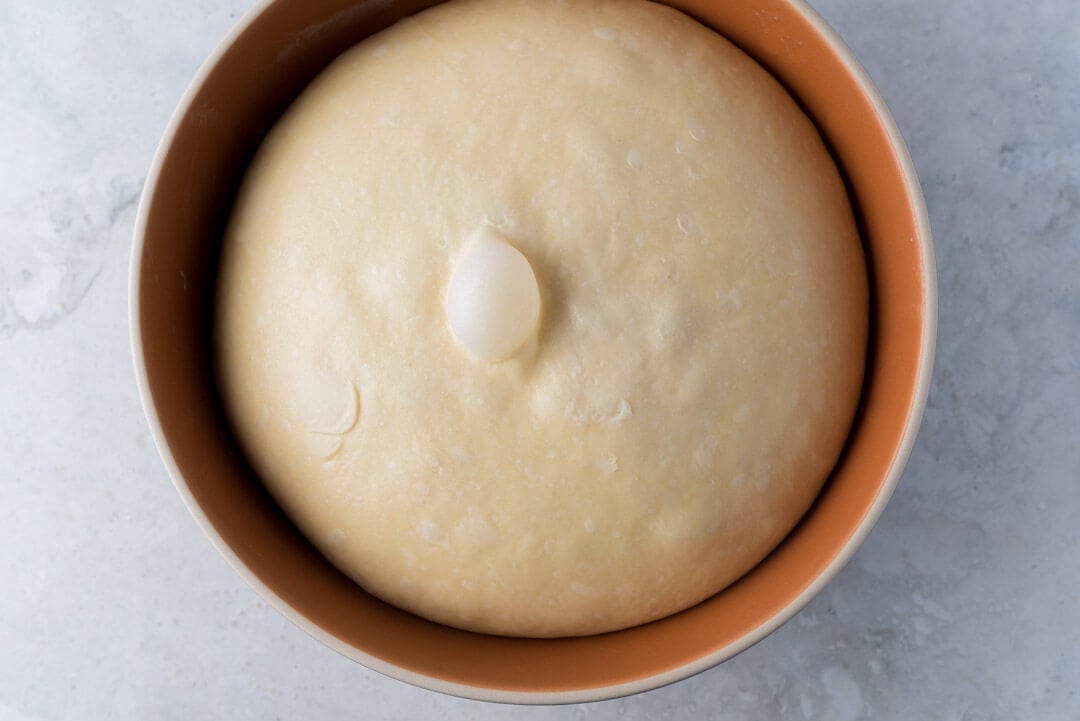
The duration of this cold bulk fermentation step is very flexible. The dough can continue to rest in the fridge several more hours (or perhaps even more) after I have listed here if desired. Take it out and proceed with the rest of the process when convenient.
Above, you can see the activity in my dough after the warm and cold bulk steps—it’s active and alive, even though at this point it’s cold and firm from the fridge.
5. Divide & Shape – 8:00 a.m.
Take the cold bulk fermentation container out of the fridge, uncover, and dump the dough to an un-floured work surface. The dough will feel very cold and stiff, which is exactly what we want. You might need a little flour on your hands to prevent sticking but keep this to a minimum: we’re looking for maximum friction between the dough and the work surface to create very tight rounds.
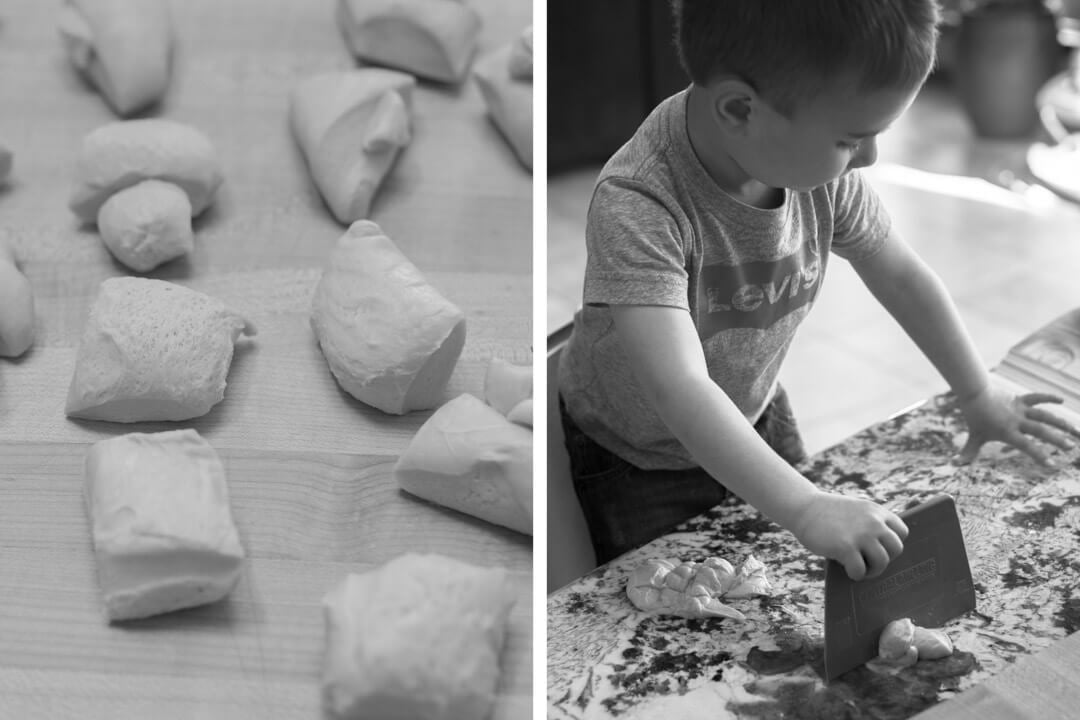
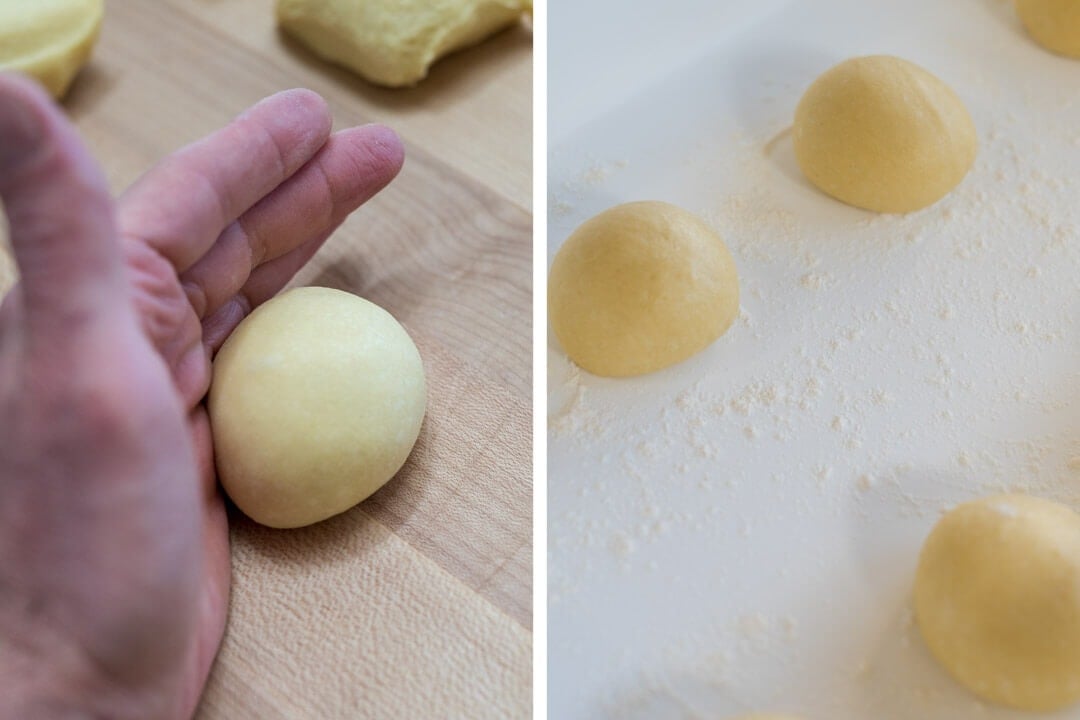
Using your scale, divide the mass of dough into eighteen 65g pieces. You might have a little leftover dough, perfect for engaging a little helper in the kitchen, as you can see below.
Using your hands preshape the dough pieces into rounds. Each round needs to have a very taut surface and no seam on the bottom. Use the side of your hand to push the round against the surface to tighten the surface.
Shaping these naturally leavened bomboloni is very similar to how I shape buns and rolls.
6. Proof – 8:15 a.m. to 7:30 p.m. (appx. 12 hours)
To proof these rounds I use two rectangular pizza trays (a covered baking sheet will also work well) dusted liberally with flour. I can fit 8 rounds in each tray with room for them to expand during the proof. The remaining two rounds I place in two floured Pyrex storage containers (these are good to test with when you start frying).
Place the covered trays with the rounds in a warm spot, around 78°F (25°C), for 12 hours. Since the trays are too large for my dough proofer, I keep them in my oven with the light on and periodically check to ensure they’re kept warm.
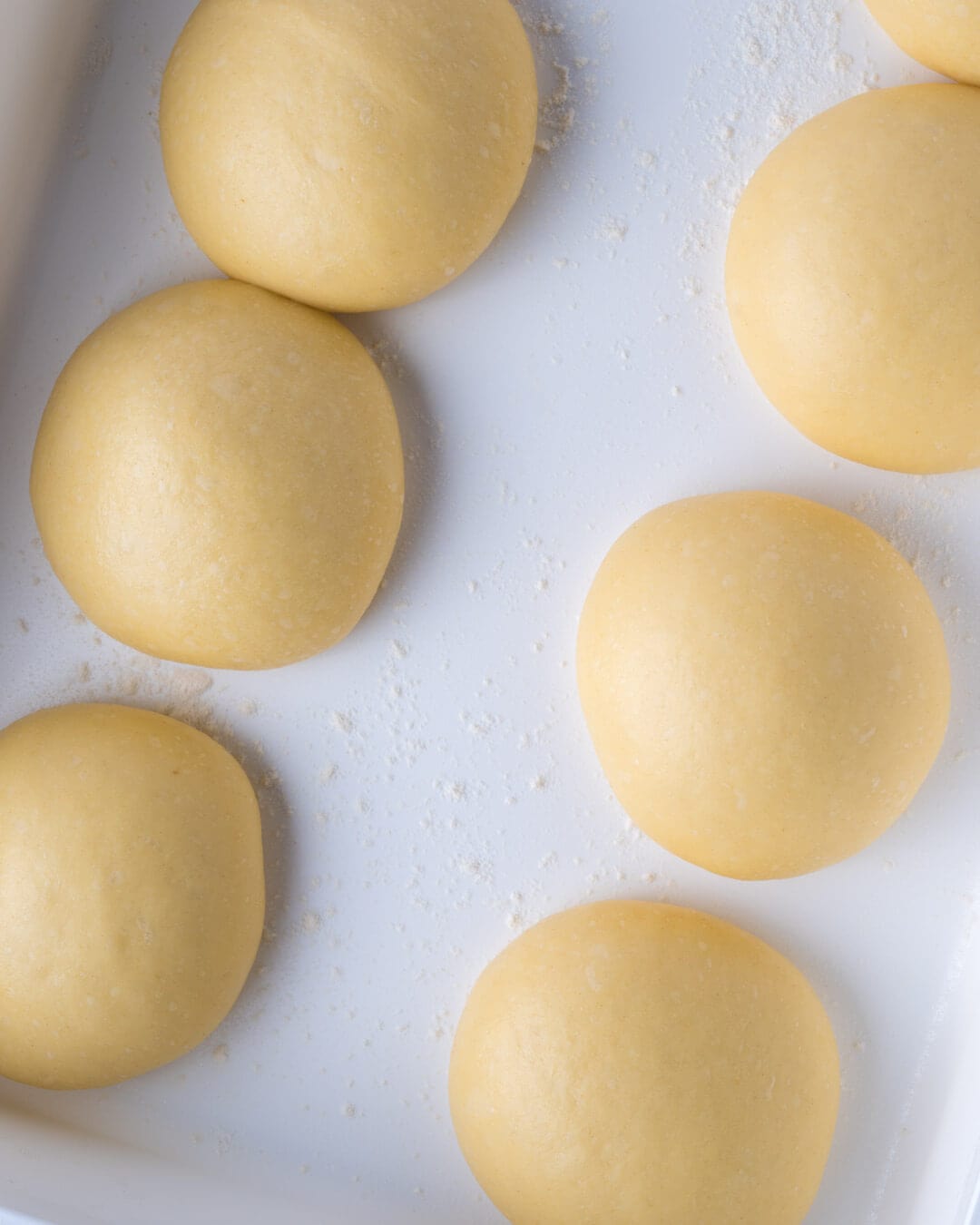
Let the dough proof for about 12 hours. It’s very important the dough is fully proofed before you begin to fry these. They should almost double in size and be very puffy and delicate. If you gently poke them they will feel like they are completely filled with air. Below, you can see the difference between the just-shaped rounds in the image in the previous step.
If you’d rather fry these in the morning you could stop the proof a few hours before completion and finish proofing them in the morning. If you refrigerate them when they are fully proofed, the bomboloni might not fry with quite the same height the next day as they would if frying at night (the longer the proof, the less rise you’ll see).
You can also refrigerate the proofed dough at this point and fry them first thing in the morning for breakfast.
I’ve done both ways, including splitting the batch into two sessions, making one batch the night they’re mixed and one the next day, and they both turn out beautifully.
7. Fry – 7:30 p.m. (or put in the fridge until next day)
Frying Tools
- Vegetable oil, refined coconut oil (my preference), or any frying oil
- Lodge 3.2 qt combo cooker (the same one I use to bake bread!) to hold the frying oil
- Thermoworks ChefAlarm frying thermometer (or a standard Frying thermometer)
- Timer (I love my Thermoworks Big & Loud timer)
- Frying spoon
- Baking sheet lined with paper towels and a cooling rack inside
Frying Oil, Type & Temperature
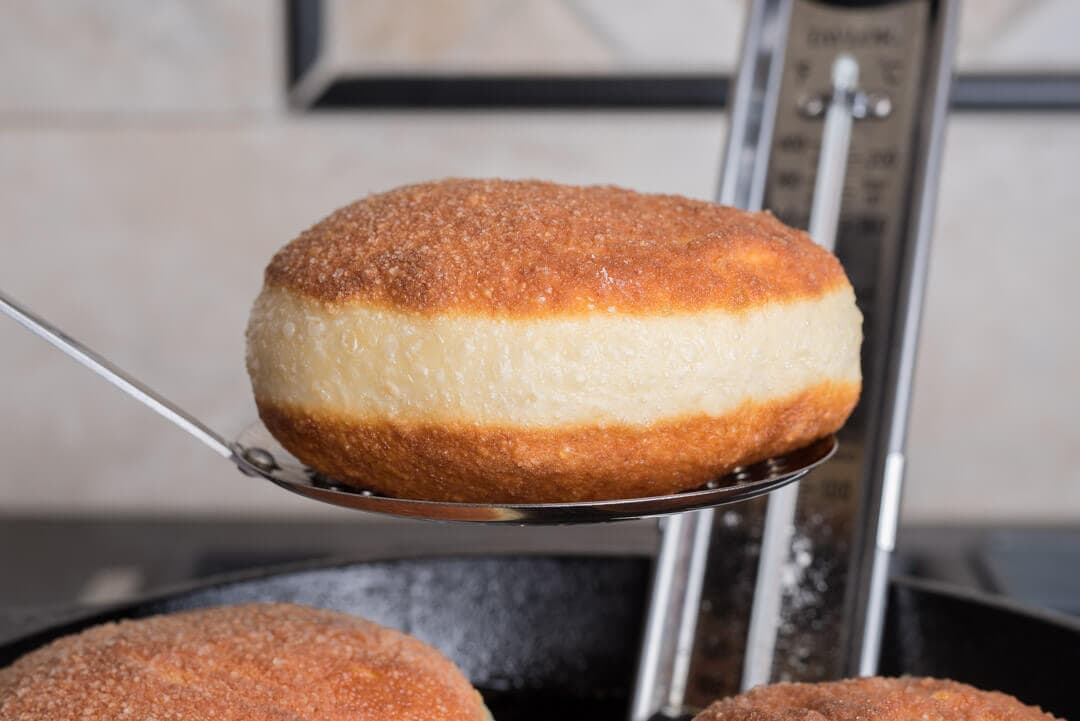
I’ve experimented with both canola and vegetable oil for frying these naturally leavened bomboloni (doughnuts), and much prefer vegetable between the two (but I will be using coconut oil from here on out, see Update below). Canola imparted a slightly odd flavor to my initial test batch and it has an off-putting smell to me. You will have to experiment with the frying temperature. At an oil temperature of 360-370°F (182-187°C) mine cook to a nice golden brown in 2.5 minutes per side.
Update:
I recently tried frying with refined coconut oil (I purchased this tub of refined coconut oil, which should last quite a while (be sure to get refined oil as the smoke point is high enough for frying) and the results were very, very good. Because this oil is solid at room temperature, once the bomboloni cool, they become even crispier and have a little oily feeling to them. Additionally, when frying, the oil doesn’t give off unwanted smells in the kitchen. The resulting bomboloni tasted very similar to vegetable oil and did not have any coconut flavor to them.
You can see a shot of my coconut-oil-fried-bomboloni on Instagram.
Fry
Before beginning, place the trays with fully proofed dough in the refrigerator while you get the frying station setup. It’s much easier to transfer the delicate rounds from tray to oil when they’re a little more firm.
Meanwhile, fill the deep side of the combo cooker to about 2/3 full with frying oil and set over medium heat. The heavy cast iron combo cooker will help keep the oil at a more consistent temperature, even after adding the cool rounds of dough. Place the frying thermometer on the side of the pot and heat until the oil registers 360-370°F (182-187°C).
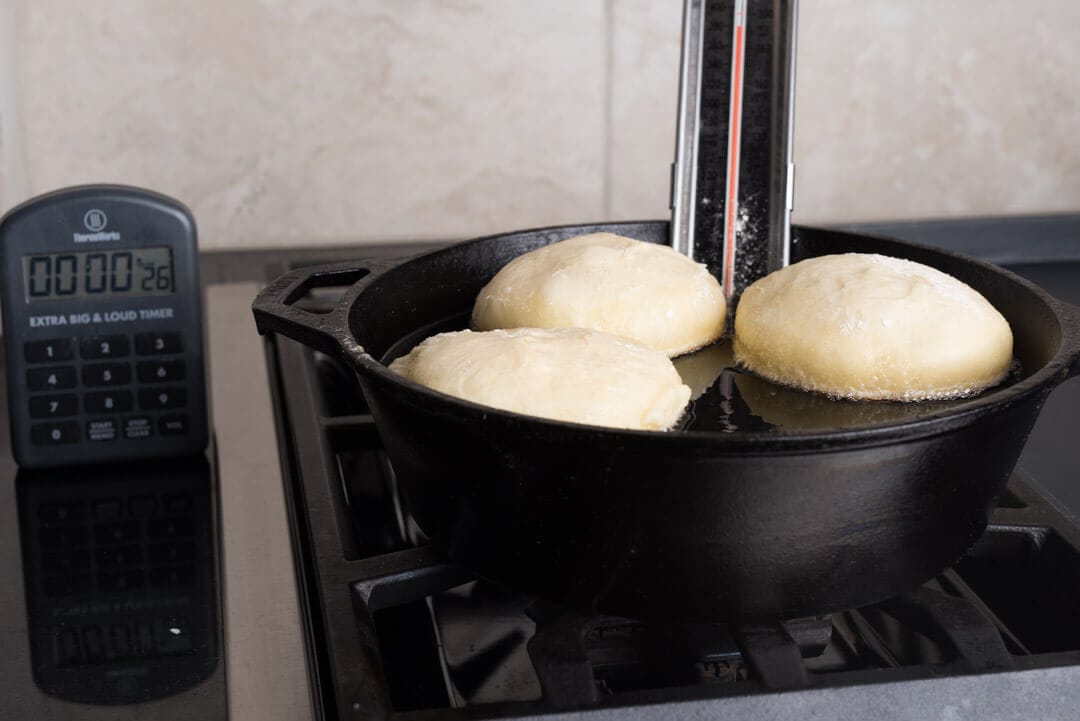
Set your timer for 2.5 minutes. Gently transfer one round from the proofing tray to oil using the frying spoon so the smooth top of the dough is down in the oil first. Flipping the dough over helps to get a nice uniform roundness on the bottom and encourages initial upward expansion.
Keep a close eye on the frying thermometer, the oil temperature will drop each time you add new dough to fry. Constantly monitor and adjust the heat on your range to keep the oil at just the right temperature. I can comfortably fry 3 rounds of dough at a time in the Lodge Combo Cooker. If you have a larger Dutch oven you could accommodate more.
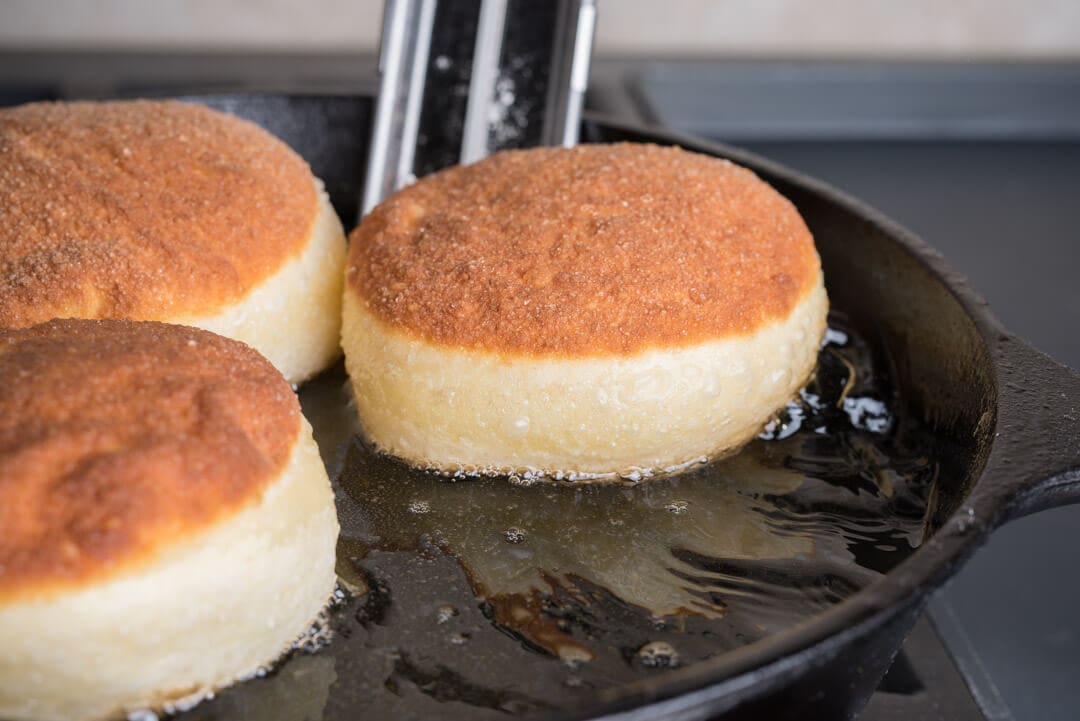
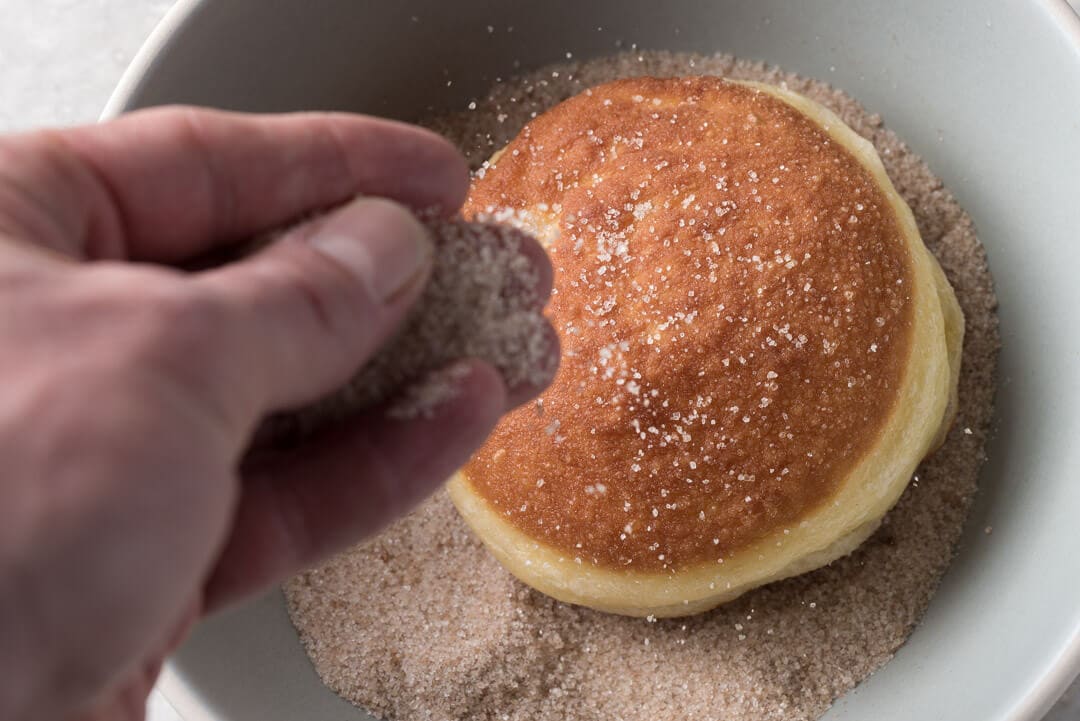
I prefer the look and texture after frying these for 2.5 minutes per side, but if you’d like them lighter reduce the fry time. When fully cooked, use your frying spoon to transfer each bomboloni to the baking sheet lined with a paper towel and cooling rack inside. Let cool several few minutes then toss in a mixture of sugar & cinnamon. Later, pipe with crema pasticcera (recipe below), if desired.
Cinnamon & Sugar Coating
This couldn’t be more simple. Mix the following in a bowl and when the bomboloni are still slightly warm, toss to coat several times. I prefer large, granulated sugar for the coating but you could also use fine sugar.
| Weight | Ingredient |
|---|---|
| 2g (1 teaspoon) | Cinnamon, ground |
| 200g (1 cup) | Sugar, coarse or fine granulation |
Crema Pasticcera (Pastry Cream) Recipe
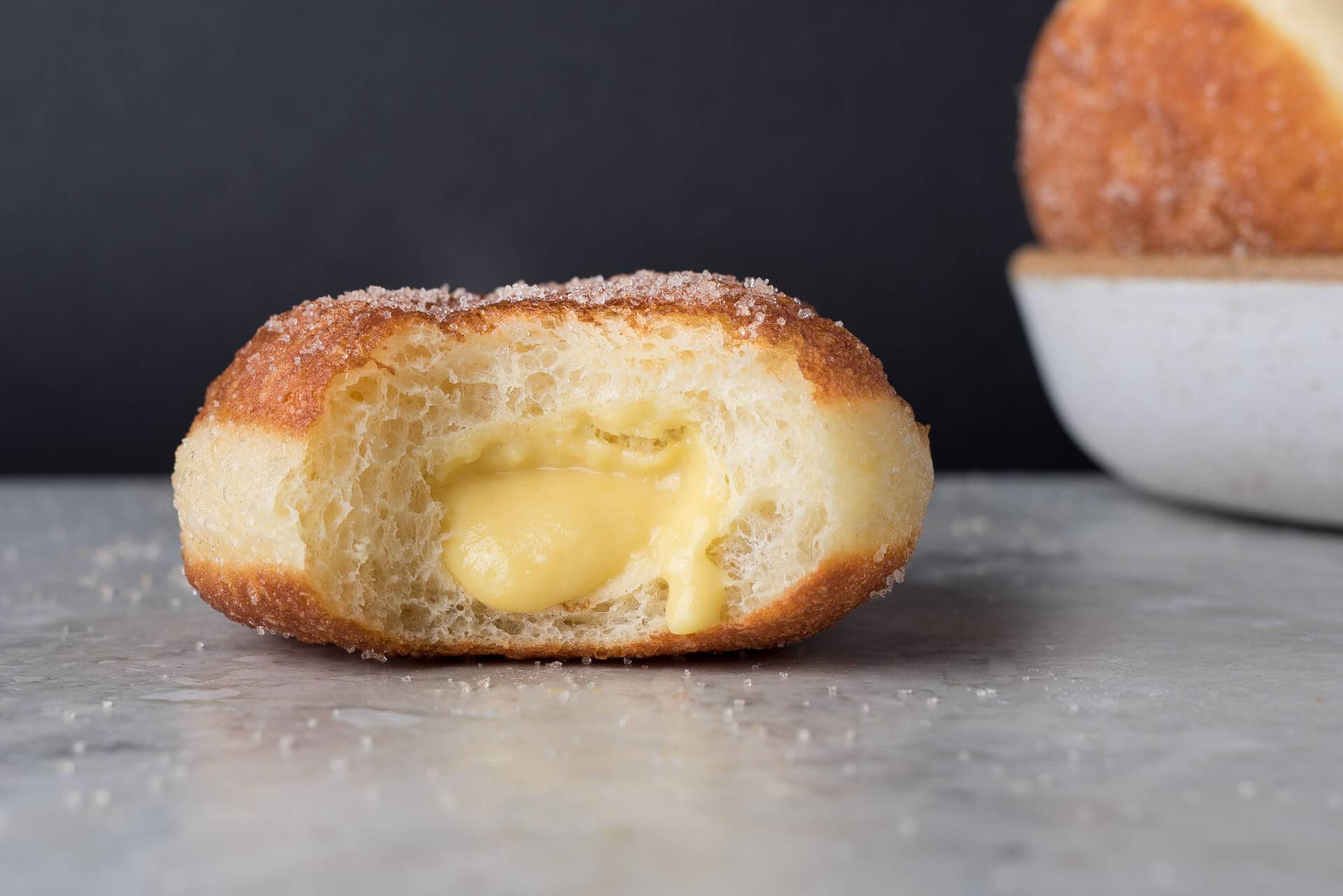
I adore adding lemon zest to this pastry cream. It’s subtle but noticeable, and somehow reminds me of the summer days spent back in Italy. Additionally, this recipe is a great base for many other types of creams (coffee, chocolate, fruit-flavored, etc.).
This recipe makes enough crema to fill half the bomboloni, depending on how much you pipe in and it can easily be doubled.
Ingredients
| Weight | Ingredient |
|---|---|
| 365g | Whole milk |
| 30g | All-purpose white flour (King Arthur Unbleached All Purpose) |
| 100g | Fine white sugar |
| 4 | Large egg yolks |
| 1g | Salt |
| 4g | Vanilla extract |
| 1 lemon | Lemon zest (optional but encouraged) |
Method
Gather a whisk, strainer, saucepan, and two medium mixing bowls.
- Place the milk in a saucepan over medium heat. Warm until bubbles start to form on the sides (just before boiling but do not boil)
- In a medium mixing bowl mix together flour, salt, and sugar. Add the egg yolks and whisk everything until incorporated. It’ll form a thick paste — just make sure everything is mixed together
- Pour the warm milk into the egg mixture a little bit at a time, whisking to incorporate after each addition
- Pour everything in the mixing bowl back into the saucepan over medium heat. Whisk constantly as the mixture heats. Continue heating and whisking until the contents just begin to boil (you’ll see large bubbles popping when you pause to whisk)
- Strain the mixture into another bowl. You’ll have to press and stir the thickened cream through the strainer
- Add the vanilla extract and lemon zest and stir to incorporate
- Cover the bowl with plastic wrap pressed to the surface of the cream (to prevent a skin from forming in the fridge) and refrigerate until firm
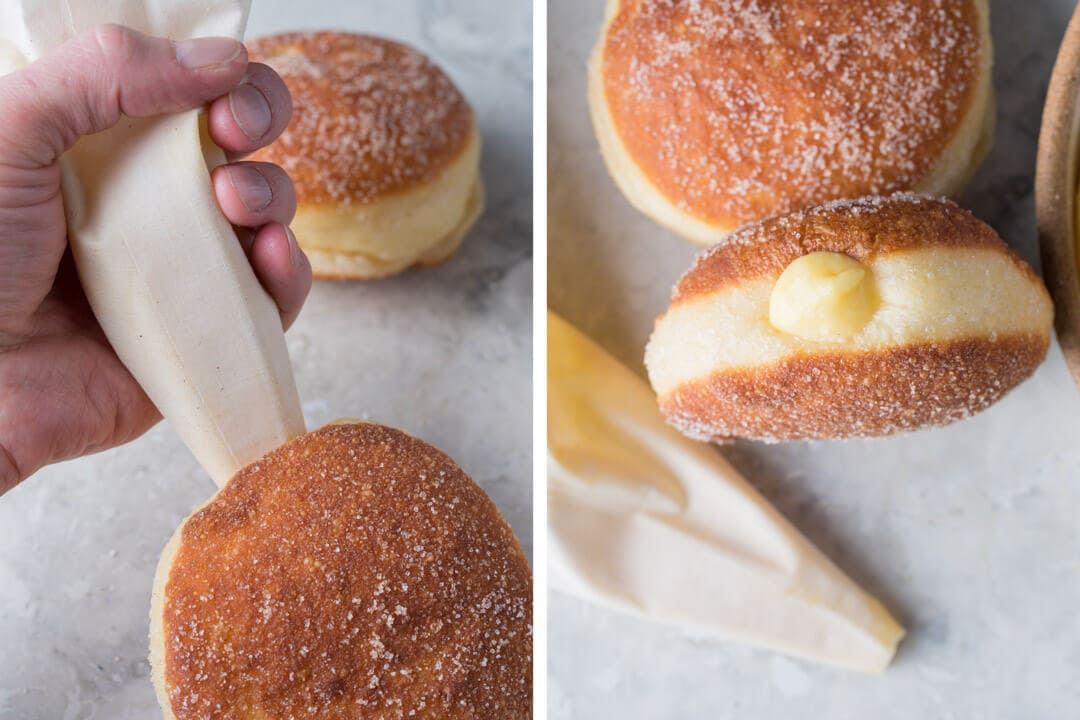
The crema will keep well for 3-4 days in the fridge. Use a piping bag and paring knife to fill the bomboloni just before serving. Make a small cut on the side with the knife, insert the piping bag, and squeeze in the desired amount.
Conclusion
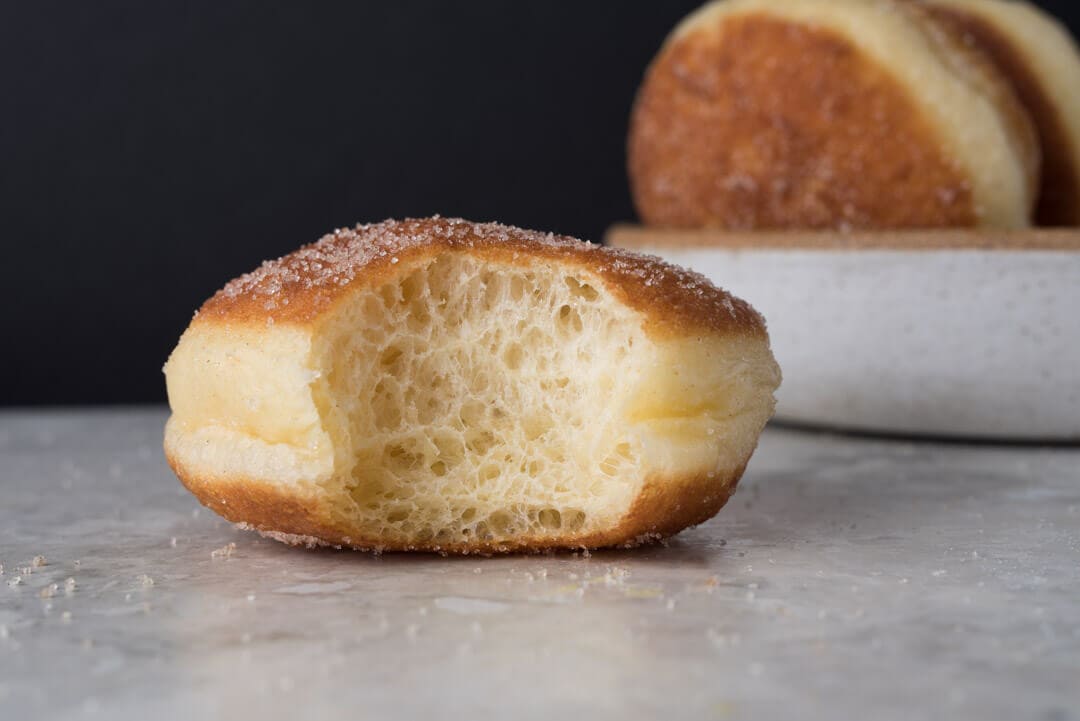
These are such a treat; I love making them for special events (birthdays!), holiday weekends, or group gatherings. With my recipes for sourdough waffles and pancakes, I have lots of options for weekend breakfasts. It’s easy enough to prepare the dough a day or two in advance, proof overnight, and have fresh bomboloni first thing in the morning. Because the dough is rather flexible, once you dial in the bulk and proof times, and develop a sense for when they are ready, you can adjust the schedule to make these in advance until ready to fry. And because frying is such a straightforward process, they’re a quick and easy thing to whip up once the dough is ready.
Crust, Crumb, and Texture
Impossibly light is the perfect adjective to describe these naturally leavened bomboloni. They are soft, pliant, and have just the slightest hint of crisp at the top and bottom. I like to fry them just a touch toward the darker side to emphasize the contrast between crispy crust and tender interior — it works well to further emphasize the overall lightness of each doughnut.
The coarse sugar coating adds a little extra crunch with each bite, even if the sugar tends to scatter readily, and the ones filled with crema pasticerra are in a league of their own. Each person seems to have a preference for just how much crema they want inside, but there’s really no wrong answer. Go big, no one is going to complain!
Taste
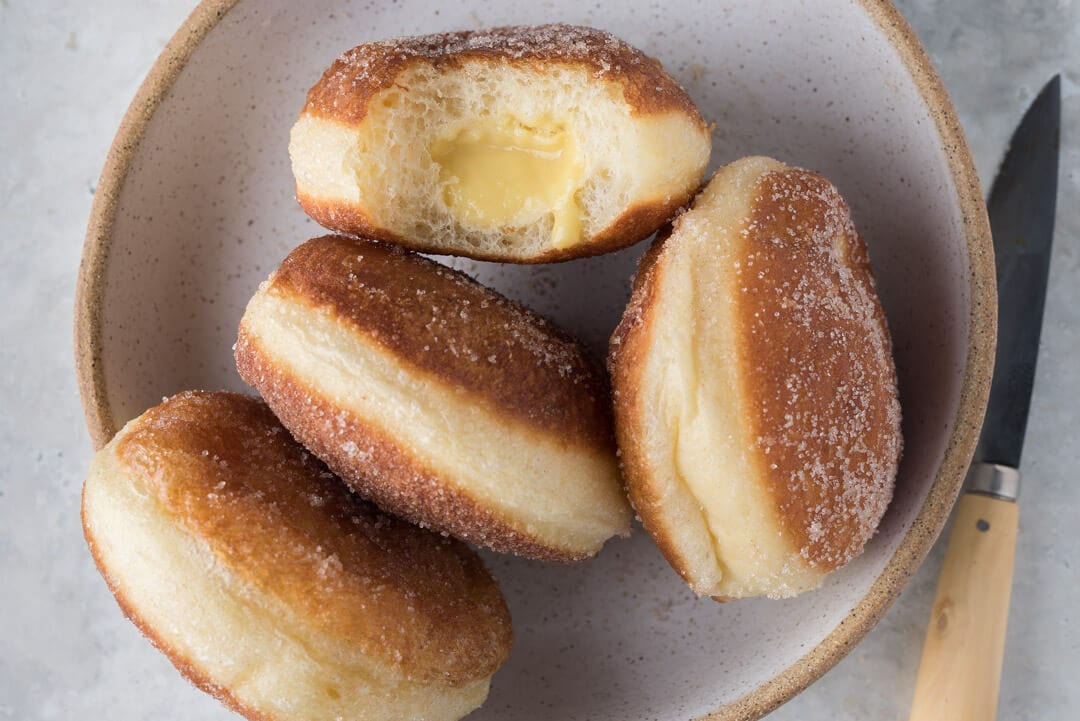
With no sourness at all, these bomboloni are, to me, the perfect breakfast indulgence. My target was for a result that wasn’t overly sweet or rich but rather one that was just on the edge of each of these. The end result is one that certainly tastes fantastic on its own with a light dusting of sugar, but transforms to something truly magical when filled with crema.
These bomboloni embody my childhood trips to Italy and our visits to the local town baker. Each morning as I take a bite into one fresh from frying, I’m whisked away back to traveling Southern Italy to visit family. The only thing missing, for better or worse, is the morning visit from the three-wheeled cart with megaphone rigged to the top. Although, now at home, I simply use my alarm clock — at least it has a snooze button.
Buon appetito!
If you use this recipe, tag @maurizio on Instagram so I can take a look!
Troubleshooting & How I Got Here
I spent a significant amount of time testing and developing this method and process. This recipe started with my brioche-like hamburger buns formula. That enriched dough was a good jumping off point but I knew the percentages would have to be changed. I tested various amounts for sugar, butter, and eggs and settled on the formula above. The result is a doughnut that fries up well and isn’t overly sweet on its own: it’s light and airy with requisite richness and sweetness. And they’re so, so perfect for filling with cream.
Below are a few common problems you might run into when attempting this recipe (and are the same things I struggled with in the beginning). Click on the symptom to reveal possible causes with suggested fixes.
Why is there no rise while the dough is proofing?
The time and temperature required to bulk ferment and final proof this dough is very critical. If the dough is not warm enough and left to bulk ferment long enough there will not be sufficient activity in the dough before it’s placed in the fridge overnight (retarded). Ensure the dough rises at least 30% during bulk fermentation, push out bulk as long as necessary until the dough achieves this. Typically, this takes between 5 and 6 hours at 78-80°F (25-26°C).
When frying, why do I get large bubbles on the top or sides?
I’ve noticed there are a few things that could lead to massive bubbles forming when frying a bomboloni. The first is a dough that is not strong enough and required more mixing. The dough should almost pass the windowpane test when done mixing, and the four sets of stretch and folds during bulk will finish imparting the required strength. From there, the dough needs to be lightly degassed during shaping and shaped tight. There should be no seams on each shaped round. Finally, the under-proofed dough can cause erratic, uncontrolled bubbles to form. The rounds need to be fully proofed and, when poked, feel like very gassy and light pillows. They will seem almost over proofed.
Why does butter leak out of the dough?
The butter should be incorporated into the already-strengthened dough when it’s at room temperature, not melted. When pressed with a finger, you’ll see an indentation but it shouldn’t be a puddle of liquid butter. If the butter has melted, place it back into the fridge and let it firm up before adding to the dough.
Why does the butter never mix into the dough?
If the butter is too cold and not pliable, it won’t incorporate easily into the dough when mixing. See the question above for how the butter should look and feel.
I can’t keep my dough at 78°F (25°C) during bulk and proof, what can I do?
As I mentioned in the post above, bulk and proof temperatures are very important with this recipe. If you’re not able to keep the dough warm enough during these steps, it could take several hours longer at each step before it’s ready to proceed to the next. Watch the dough and give it the time it needs!
Can I freeze this dough?
I have not tried to freeze this dough but others have reported successfully freezing my brioche hamburger buns. I would be wary to do this, though, and would first like to test before saying yes/no!


319 Comments
When proofing how do you cover your pans? Or do you leave them uncovered to proof?
I pretty much always cover any dough left to ferment, the only exception is for a particular period with my sourdough pretzel recipe. Enjoy, Vanessa!
Maurizio, thank you for your advice…Im having trouble finding something to cover the rectangluar pans with.. Is plasticwrap ok?Does it matter if the platic is touching the donut balls?
Yes, that’ll work well. Be sure to keep the plastic up off the balls, though, unless you grease one side of the plastic (which only works with thick plastic film or thick bags). You could also use an inverted baking sheet placed on top! Anything that you have in the kitchen, really.
Ciao Maurizio , Buon Natale.
Complimenti per la ricetta.
Usually in Italy we make them with yeast but I am curious to try your recipe.Many people prepare them in a short period of time using a lot of yeast and short bulk fermentation.For me in the contrary the important factor is using less yeast and a long and cold overnight bulk fermentation which adds taste and flavors to the dough.
In my recipe I use both milk and eggs ,but a famous italian baker named Montersino(Krapfen recipe) uses only whole eggs with no milk or water.I wonder if you know and can explain me which difference will there be using only eggs or using milk or water .
I also fry them an a lower temperature than yours around 160 degrees C.
Ciao
Grazie, Massimo! Sorry for the late reply. There’s likely a bunch of different ways to make these each with their own resulting texture and flavor. I haven’t tried using milk, but I could see that working — it’d add a little more fat to the dough, perhaps making it more tender/creamy, but too much might run the risk of compromising the structure. Honestly, I’d have to test with milk to see how they turned out! I like to use water but it is only a small amount since there’s plenty of liquid in the levain/starter/madre and the eggs. For me, the dough is already rich enough with all the eggs and butter so using just water works very well.
Regarding your first statement: using yeast will certainly work, or even a combination of a naturally leavened preferment and instant yeast, but these have so much flavor I’m set on this process. It works well enough, even if the schedule is lengthy.
Hope that helps and grazie!
I did this – works very well! Used a little 2 tablespoon scoop to size them. They’re still a generous size and I filled them with raspberry Jelly.
Hi Maurizio,
I would like to know if I can bake them instead of frying? If yes, what would you recommend for the setting of the oven and time length?
Thank you!
I have not tried this, but I do recall someone else posting about it in the comments below! I have on my radar baked donuts, I’m hoping to get to them sometime soon 🙂
I am cooking my second batch of these tomorrow in 5 days. The last batch were such a hit, my mother requested them for morning tea tomorrow to take to the grandparents and I have had a request from my sister already to make smaller ones for my nieces birthday in 5 weeks. A couple of friends have also made requests looks like I will be making these regularly. Made a nutella pastry cream to go in it. It was delicious.
I only have one question as I want to have more uniform shape. I found it a little tricky moving from the proofing tray and putting it in the oil to cook and therefore the shapes changed slightly. What does everyone use to move them so that the shapes stay the same.
That’s awesome to hear, Matthew! I use a small scraper, the same plastic scraper I use for my pizza dough. It kind of looks like a firm spatula. This way I can dig under the dough gently, lift it with my fingers (on the other hand), and gently drop it into the oil. The ball will slightly compress when you scoop it up, but when you drop it down into the dough it’ll elongate just a touch and mostly return to a circular shape.
Thanks Maurizio, I used a scraper last time. Maybe I proofed them for too long and they stuck a bit more than I could manage. Maybe I wasn`t very patient either. I will have to keep working on it to perfect.
I proof them on parchment and slide them into the oil with the paper. It comes off after a moment in the oil.
This is a great idea.
Hi Maurizio,
I just wanted to chime in to say that I’ve now made this recipe twice for my husband’s birthday, once last year and once this year. I follow the recipe as closely as I can and they have come out absolutely perfect both times. The first year we did not have a working mixer, so I did everything by hand. While the butter addition was tiring, it worked fine! We like to fry them in the morning, so we’ve fridged them overnight after the final proof both times. This most recent go-round, my husband really didn’t want to wait until the next morning, so we tried frying the odd scraps dough ball the afternoon before, knowing full well it was not going to be fully proofed. It puffed up a ton, like some of the other commenters have mentioned, so there’s some data to back that up :-). It tasted great though, but not as good as the real batch the next day!
These never last more than two days in our house. This most recent time I halved the recipe as a way of controlling our consumption, and it also worked out just fine!
Thank you so much for all of your testing and sharing! I love your site and regularly rely on many, many of your recipes!
Alison — that’s so great to hear! I too make these for special occasions (and my own birthday, why not!?), they’re a real treat. I’ve heard from a few people hand-mixing went really well for them, it’s great to have another confirmation point. Thanks so much for the kind words and update on this! Happy baking 🙂
When you say did everything by hand, do you mean a hand mixer or literally by hand? Just wondering since I don’t have a stand mixer and was wondering if this will work using a hand mixer without a paddle attachment.
When I mentioned that I’d done it by hand, I mean that I only used my hands: no stand mixer, no hand mixer. It’s a lot of work and took a lot more time, but it still turned out fantastic!
Wow! That is a lot of work, and I’m glad to hear it still turned out great for you. Thank you for responding back. I’m making this for the first time today. Will see how they turn out.
Hey Maurizio,
I recently made this recipe and everything worked out perfectly except at the frying stage. When I put the dough into the hot oil they puffed up so much that I couldn’t flip them on the other side – I would flip them over and no matter what I did, they would just flip right back over. I wondered if this was a result of over-proofing? I ended up just cutting out holes in the remaining dough balls to make ring-shaped donuts, but that unfortunately meant I couldn’t fill them with anything.
Any idea of how to fix this?
To me it sounds like the dough was likely underproofed, not over. Usually excessive rise like this means they could have spent more time proofing in shape. This dough is notoriously slow to ferment so give them ample time, at warm temperature, for the final proof — extending it by several hours if necessary to achieve the texture and look as you see above in my post. They should be very, very puffy and delicate, light, well-risen. Give them more time next time you try this recipe and you’ll see less explosive rise in the oil. Let me know how it goes!
Hey Maurizio,
I recently made this recipe and everything worked out perfectly except at the frying stage. When I put the dough into the hot oil they puffed up so much that I couldn’t flip them on the other side – I would flip them over and no matter what I did, they would just flip right back over. I wondered if this was a result of over-proofing? I ended up just cutting out holes in the remaining dough balls to make ring-shaped donuts, but that unfortunately meant I couldn’t fill them with anything.
Any idea of how to fix this?
I have not but they should work very well! I’ve seen a few bakers post my recipe as little holes and they look great.
Hello Maurizio,
how flexible is the cold bulk fermentation and how important? Can it last say from 4 hours to 24 hours?
What is the importance of it?
I will be finishing my first attempt at this recipe tomorrow night.. I made them vegan so I am prepared to see differences.
Thank you!
Generally, the longer the dough rests in cold fermentation the more sour the end result will be as fermentation does continue to some degree, even at a cold temperature. There’s definitely a minimum with this dough, if the dough isn’t cold enough when you go to divide and preshpape/shape, you’ll have a tough time with potentially greasy dough as it heats up. In terms of a maximum time, there definitely is one, but I can’t say for sure how long. I find overnight is the sweet spot for me, but you could try pushing another 12 hours if necessary — the dough will likely still be just fine, just be on the lookout for any flavor changes.
I hope that helps!
I have a question regarding Kugelhopf recipe you posted on King Arthur Flour blog. I’ve posted my question under your blog entry there twice, but I don’t know why it didn’t appear. I figured, I will ask under your another enriched dough recipe.
My question is: Can I put Kugelhopf dough in the fridge overnight at the end of the bulk fermentation? Then, the next day, take it out and put in the pan to proof at room temp (adjusting time accordingly)?
Hey, Konrad! King Arthur reached out to me for an answer and they should have replied back to you by now (they’re super responsive). I told them it would work just fine, just expect that the result will be slightly more sour due to lengthy, cold fermentation. I typically like to do same-day bakes with sweet naturally leavened doughs and the reduction in acidity/sourness is precisely the reason. However, feel free to give it a try sometime, you might be just fine with the flavor profile! And yes, if you go that route definitely give it the time it needs the next day to fully proof on the counter. Happy baking, Konrad!
Thank you Maurizio for quick response! I must consider how my family would handle sour sweet dough. I am planning to bake your Kugelhopf as a twist on traditional polish babka for Easter (Bundt pan kind, not chocolate twisted kind).
As for the sourness of enriched sweet doughs, I have another question. My previous enriched sourdoughs (Pain de Mie by txfarmer from thefreshloaf.com, sourdough challah from Maggie Glazer and french breakfast rolls enriched only with full fat milk) got more sour few days after baking (not in a bad way). The taste reminded me of some fruits and it was quite pleasant. What could be reason for this change in taste? Is it typical and flavours simply develop more over time or is it something specific to my starter? (I keep it 50% wholegrain rye 50% all-purpose, as first stages of your guide for developing a starter suggest – I’ve just never changed it to all-wheat.)
Sorry for the delay, Konrad! Coincidentally, I just posted my own version of a pain de mie 🙂
I’ve noticed that with some breads flavors will actually continue to develop as the loaf rests and ages. It’s almost a welcome, wonderful thing. For example, I actually find eating a hearty loaf like a miche (or whole wheat sourdough) is best 2-3 days after baking. The flavors just meld and work so well together after a few days.
I’m not sure the cause of this to be honest, anything I present would really just be conjecture. I’ve found that, depending on the recipe I’m baking, I have a set amount of time I wait until I slice it for optimal flavor — I usually just discover this time through testing. And eating. Hope that helps!
hello Maurizio, first of all thanks a lot for such a great recipe, all those details and pictures made really comfortable to try it, first time I was able to fry them and not have those bubbles and uneven frying. The end result was amazing, the best “donut” recipe I did and I believe the best there is, the pastry cream is such a delight as well!
Just one thing I was wondering, unfortunately I had to fry them on liquid oil and I felt that they absorbed a little too much oil after they were done, I’ve adjusted the temperature as you mentioned and even tried to fry a few with a hotter oil and a little colder to compare the results but they all end up absorbing a little more oil than I expected, maybe it’s just my expectations but do you happen to know if there might be something I may be missing? Thanks again
You’re very welcome, Leandro! Glad to hear things worked out so well for you. I’m not an expert in frying, but after making these many times, I’ve found they do get too “greasy” if the oil is old (it’s been reused too many times) or they sit in the oil too long before fully cooking (the temperature is too low). It might also be possible that it’s the type of oil you’re using as well. If you have access to good quality vegetable oil give that a try, it’s very reliable and will give you a good benchmark from which you can try other oils — veg oil seems to always work very well for me!
thank you so much! I will definitely check all that out, I’m waiting for my bucket of coconut oil to arrive as well, I believe the quality of the oil is sub par indeed, again, thank you!
SOS…Hello there..altho the donughts tast super yet problems when frying…they bulged and cracked..what could be the reason? kept on looking at the temperature and was in the range from 360 to 380 at times but tried to keep it under control…they are soft on the inside well cooked yet could be softer on the outside as well
Hey! It could be that they were no sufficiently proofed: give them another half hour at room temp before frying them. Also, be sure to shape them very, very tight. You want a uniform skin on the outside of each ball. They should look very smooth with no tears or breaks at all. Hope that helps!
they were proofed yet I think it was the shaping cause I flattened them by hand after shaping them as balls…I attempted to fix the bulging problem I had with them last time from the ball shape…trial and error, lets try next week again
thanks Maurizio
hello! just a proofing question.
would there be any way the dough would work without the first warm bulk ferment? im trying to figure out a way to make this recipe even more hands off for myself and just thought, maybe a longer refrigeration without the warm rise/turning? thanks in advance for answering!!!!
-briana
Hey! With this dough I’d say no, that step is absolutely necessary. With some traditional bread doughs you can do a “cold bulk” instead of a warm one, but because of the sugar in this dough, lengthy fermentation times are required.
thanks so much!!!! i’m trying to nail the timing so that i can have the donuts ready to fry by 6 am without too much hassle. haha. it’s like a funny math problem.
Hello. I would love to make these for my children, however my daughter is severely allergic to eggs, and I wonder if the recipe would still somewhat work if done without the eggs. I normally add more liquid and more fat to compensate, but not sure how that would play out with the donuts. Any thoughts? Thank you
The eggs bring a certain richness to this dough, you could omit them but the flavor of the end product would definitely be different. You might be able to modify the ingredients to include more butter, or even an egg replacement (?), but you’ll be working with a different end product — which might not be a bad thing, just different!
Curious if you got this to work?
I’m going to be ‘frying’ these off tonight, I can’t wait!
I did have a little issue with my dough after the cold fermentation; the top was a little dried out (perhaps I left it in the refrigerator too long). And I only loosely covered the container with a tea towel, so maybe I should have dampened the towel slightly or used cling wrap? In any case, I tried to remove as much of the dried out dough before pre-shaping. I’m proofing them in my oven as we speak and after three hours they’ve already started rising nicely!:)
I’m going to try my hand at air frying them instead of the traditional oil frying! I’m going to brush the little bomboloni rounds with melted butter before placing them into the air fryer.
I love custard filled donuts, so I just had to make the Crema Pasticcera (with lemon zest) and IT IS the BOMB! 😀
Thanks for this recipe!
Yes, definitely cover the container with something to the interior is air-tight — we don’t want any air to access the dough or you’ll develop a film on the top like you mentioned.
I haven’t heard of anyone else who tried an air fryer, please let me know how this goes! What a great idea.
Glad to hear you’re liking things so far and the pasticcera, it’s so, so good! Enjoy 🙂
Just wanted to report that I air fried my first test-run bomboloni and it came out PERFECTLY! I’m so excited, you have no idea! 🙂
I had brushed melted butter on it before frying, but it ended up cooking right in, so for the rest of the batch I’m going to brush the butter on after frying, then toss in the cinnamon/sugar mixture. Other than that, it tastes great and they look almost as good as the ones in your photos! 😀
Fantastic! I need to get my hands on one of those friers 🙂 Thanks for the update!
Could I proof these at room temp? I actually was planning on getting up super early on day 2 (tomorrow) after refrigerator bulk ferment, shape them, and proof them for a couple hours. Would that work okay?
Yes, it definitely would! I do find transferring the dough from proofing box to frying oil easier when it’s chilled, though. You could room temp proof them until read, then pop into the fridge for 30m or so to firm up and ease transfer (or not, up to you!).
Can I substitute the butter with shortening? If I can, how different will it be? And different from what aspects?
I am actually not sure, I haven’t tried this myself. I rarely use shortening here and always opt for butter in it’s place. Sorry about that!
I make donuts for a living so I was glad to see your update on frying medium. Donuts should always be fried in a solid fat as you discovered and never in liquid oil. Palm, fully hydrogenated soy or other vegetable, lard (yum!), etc. We only ever used fats that are plastic, I.e. not hard as a rock like cocoa butter. Sounds like a great experiment though. Expensive, but interesting! Liquid oil stays, you guessed it, liquid after cooling and produces donuts that are soggy, limp, greasy and with short shelf life. The small amount of fat absorbed by the surface during frying in a solid fat returns to its solid state after cooling (or at least firmer than liquid oil) and sets up into donuts with a dry ( not greasy) surface, good texture and height, with longer shelf life– provided dough development, degree of proofing and frying temperature are what they should be.
Fantastic Nicholas, thanks for all that information and confirming what I’ve found as well. One question for you, perhaps it’s something you’ve found as well: occasionally when frying my dough will create small little bubbles all over the surface of my doughnuts. While it’s not a bad thing in any way, I always wonder what causes these to form. Have you seen this happen with yours?
Thanks again and enjoy!
Hi, i don’t have a proofer and im in a dry climate. My oven will proof at 100 degrees F. Should i proof at room temperature or in the oven? Any adjustment for time?
Hi Maurizio!
I would like to make some bomboloni for my parents, and because my father is diabetic, I want to make a third of the batch separately with a powdered sugar substitute. I’m a bit of a rookie with sourdough (thank you so much for giving me the inspiration!), and I was wondering if there are any adjustments I should make to the levain or the fermentation lengths, since I’ll have two smaller, different sized batches.
Another question I have: if I don’t have a proofer and it’s pretty cold outside, can I proof these in a turned off oven with a little tray of boiling water inside, to rise the temperature?
Thanks!
Just be sure to keep each half of the dough as insulated from temperature swings as possible. You might need to let the dough go a little longer at bulk and/or proof, but you’ll have to adjust as the dough is developing. Because the dough will be in two smaller pieces, you might experience slightly sluggish fermentation — again, you’ll have to adjust as the dough develops, just be aware of that.
Yes, definitely proof those in the oven (turned off) with warm water or the interior light turned on to keep it warm. If you have an ambient temp thermometer, stick it in there with the dough to keep track of the temperature and turn the light off (or vent the oven) as necessary.
Hope this helps!
having trouble viewing the recipe. It’s not letting me get to the actual steps. Was hoping to make these for our family on Christmas.
Sorry about that, was having issues with my install. All is fixed now!
no worries at all. Just looking forward to making them.
Oh what FUN!!!! I made these for New Year’s desert last night. I was a bit nervous about them being rather flat after proofing for 8 hours in my very warm kitchen, but they puffed up SO big and beautiful! I made Mary Berry’s crème pat recipe but it came out less creamy…probably cuz I used corn meal instead of corn flour. Will definitely be making these again! So easy and so good! Happy New Year M!
Right on, Gina! They’re a bit intimidating at first, but the dough is actually pretty flexible as long as you get enough fermentation in there. Glad to hear they turned out great and Happy New Year to you and family!
I’ve made these twice over the past week–so delicious!! I love that they’re not overwhelmingly sweet–just enough to be considered a treat. The pastry creme filling is yummy and nicely complements the bomboloni. Thank you for developing this recipe! I’ll definitely be making these again. 🙂
That’s great to hear, Heather! I agree, these have just the right balance all around. Thanks for the feedback and happy baking!
I am wondering why my Bomboloni turned out a bit sour, especially when warm? I proofed at 78* for about 9 hours and then cold proofed at 38* overnight (approx 12 hours). Followed the rest of the recipe as written. They puffed up nicely when fried and were light and airy, the flavor was a bit of a surprise. Any suggestions on what to try next time? My starter was mild but active and my levain smelled sweet when I used it.
I made these last week. Mine were not as light and airy as yours but rose beautifully into round fried bread balls. When they were sprinkled with the cinnamon and sugar they were enriched zeppoles like you would find at the county fair. If I could repeat my mistakes, I could open my own stand…I think people might go for it! I think the warm bulk went too long because it was a few degrees hotter in the house and the second rise was weak. At the end time it just wasn’t there, I let it go for another hour with no improvement so it was time to fry. When we ate them, we cut them in half, scooped out the middles and loaded it with the pastry cream…Yum! I will try this again when the weather is cooler and I have better control of the temperature.
Hey Maurizio, great recipe and post. I was wondering if you can extend the enriched brioche bun dough recipe to a 12 hour (76F) proof too ? The reason I ask is because I feel that the bomboloni and brioche bun dough are closely similar. I want to experiment with the brioche buns because I noticed my first few tries at them they were kind of heavy, thus i think the fermentation takes longer on lower hydration + enriched doughs. Any thoughts on this ?
Hi Maurizio, I saw the question about freezing the dough below, I did freeze the shaped bomolonis toward the end of step 6 above. Then two days later at about 7am, i took the shaped frozen pieces out and let defrost until noon on a baking sheet. Then fried them in the same method of step 7 for a lunch desert (together with the pastry cream). They came amazing and retained fresh flavor until late in the evening. it is a great receipt!
I tried this a couple of times, but every time I did, it didn’t expand as beautifully as yours does; it ends up shaping up into an oddly shaped sphere rather than the usual donut shape. How do i stop that from happening? Is it from the shaping, or not enough proofing time, or something else entirely?
Thanks for the help, as well as this recipe. Even though mine weren’t as pretty, they damn sure taste great.
I can’t wait to make these. I knew them as krapfen in the Dolomite region of northern Italy in 1986. Apricot jam was my favourite filling. They were so delicious and I had tried to find a recipe online with no luck, so thank you!! I am about to get some sourdough starter someone made with wild yeast. I know I will not perfect them the first time, but I’m prepared to keep trying. What a fantastic website – recommended by a fellow New Zealand sourdough lover. Thanks!!
These are so delicious! I am very happy with my first effort. How would you suggest storing these for a day or so? Sealed container made for soggy bombolini this morning, though still absolutely delicious. There is a touch of sour in mine and I wonder if i fermented too long.
Excellent recipe! I rushed the first batch and they were surprisingly not as bad as I expected; then tried something similar by pinching off a 65g ball of dough from a slightly less enriched recipe. Anyway, you say to put the proofed dough in the fridge, which would definitely help my biggest problem of feeling like I deflate each ball as I pull it up off the tray, so I think the third time will definitely be the charm. How long would you say the dough is in the fridge? Also, any more tips for getting the bomboloni up off a silpat besides the fridge?
Hi – these look fantastic and I am going to have a go at making them this weekend. 18 is quite a lot though. Is there any way to keep them fresh for 2 or 3 days (I’m thinking to fry them on Sunday and then take them to work on Monday for my colleagues to try), or do they really have to be eaten the day they are made?
Hello,
I made this recipe last weekend and it is really delicious.
I got really big bubbles forming while frying most probably because I let them proof at room temperature which was between 18-21ºC and I didn’t extend the proofing time even noticing that it was recommended – I was in a hurry to fry and taste :). Anyway, I didn’t mind at all with the bubbles, I actually liked them 🙂
I tried two creams: the pastry cream you show and an egg cream. Both were superb.
I’ll definitely repeat this recipe, probably when temperatures got a little bit more warmer 🙂
Thank you a lot for sharing the recipes, experience and tips.
Hello,
Quite a recipe you give us here, we can only be thankful for that 🙂 I haven’t tried it yet, but i will, that’s for sure.
Thank you for everything, the website is a goldmine !